SYSTEMS 2
made 12/19 to disambig from main solutions/sys
MERRI OK
SEE SYMPTOM SYSTEM DEGRADATION
see death spiral matthew efx
SEE CRISIS SYS FAIL
merri ok
---
:{===
5 26
Potsdam Institute for Climate Impact Research PIK
2,725 views May 4, 2026
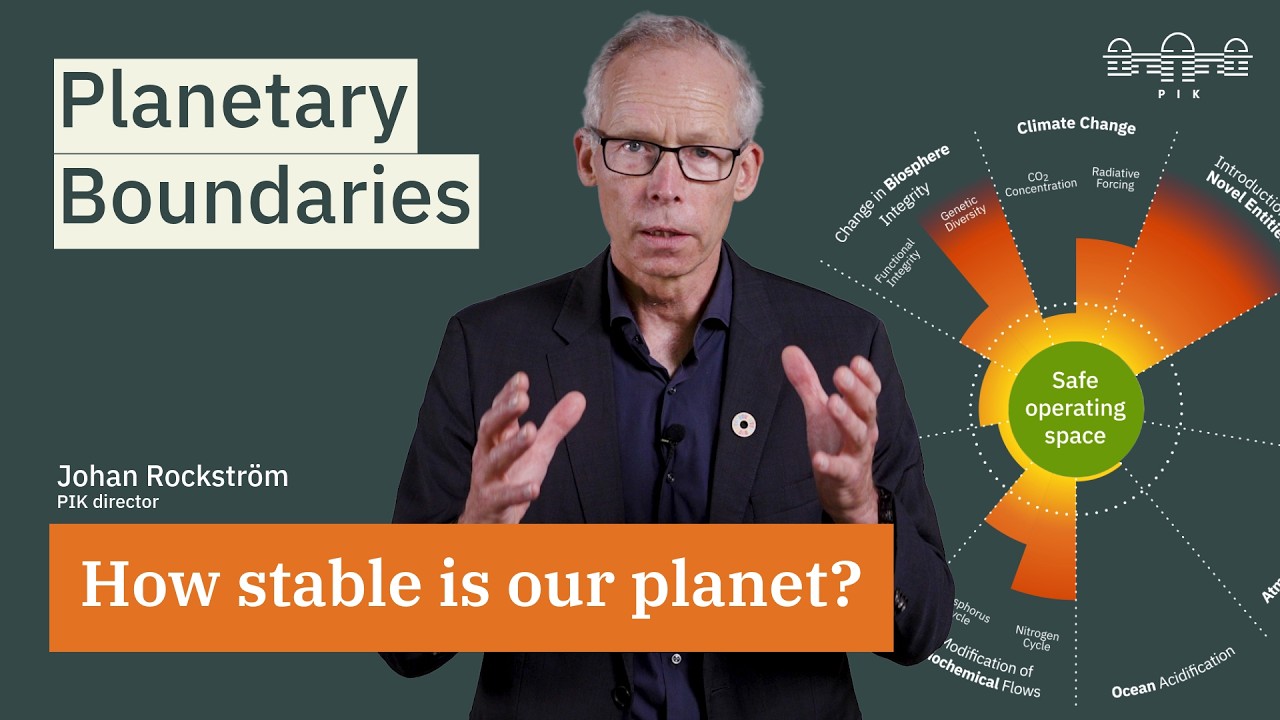
How stable is our planet? PIK Director Johan Rockström explains the “Planetary Boundaries” framework. These boundaries refer to the stability of the Earth, and ultimately its capacity to support human life as we know it. Rockström concludes: “Staying within planetary boundaries isn’t a constraint. It’s an opportunity to redefine progress – towards a world that is stable and just, where we’ll live healthily within the means of our only home.”
---
root cause CU an 1 26
All of the dysfunction in Congress is coming from decisions that the U.S. Supreme Court ushered in, and it is completely changing the face of American government, a legal scholar explained.
Writing for The Atlantic on Tuesday, Stanford Law School fellow Duncan Hosie said that there are two key rulings that have resulted in the downfall of Congress.
"These dynamics share a root cause: the partisan polarization that has reshaped American politics over the past four decades," wrote Hosie. "But the connection is deeper and more complex than that. Whereas polarization weakened Congress, it emboldened the Court to dismantle laws and, in the process, undermine Congress’s ability to make laws at all, reinforcing Congress’s sclerosis."
The first began during the "Newt Gingrich revolution," he argued, with "rising partisanship and institutional upheaval."
Sorting members into "distant ideological camps and normalizing scorched-earth tactics" led to absolutist politics and made bipartisan politics for the greater good rare. Instead, ideological battles were launched with Supreme Court nominees with a litmus tests for partisan purity over reasonable interpretations of the law. Even justices below the High Court have become partisan as "Republican appointees began consolidating its authority at Congress’s expense."
Under Chief Justice John Roberts, Hosie said, the Court has canceled "congressional constitutionalism." Laws passed such as the Voting Rights Act, the Affordable Care Act, the Family and Medical Leave Act and campaign finance regulations have all be undermined by the Roberts cCurt.
The latter took a hit with a collection of decisions, such as Citizens United (2010), that "dismantled Congress’s two most significant efforts to regulate private money in public elections, eroding the safeguards that protect elections as conduits of public opinion," Hosie wrote.
There's a chance one case this year could make such issues even worse. The Roberts Court "dismantling" key laws "has left Congress more detached from its electorate, diminishing its claim and role as a representative authority."
Deregulating campaign finance laws has turned politics into such a huge undertaking that lawmakers and candidate spend more time trying to raise money than they do making direct contact with voters, conducting legislative oversight or fostering bipartisanship, the legal scholar said.
"Empiricalstudies confirm that reliance on large donors depresses participation in time-intensive legislative activities — things such as bill sponsorship, floor debate and committee work," Hosie wrote. "It simultaneously redirects lawmakers’ attention toward courting high-net-worth donors and away from talking to people in their districts."
The second issue is gerrymandering. Partisan legislatures draw maps that make congressional districts more one-sided. It then ensures that members of Congress appeal to the most extreme factions of their electorate.
Hosie called the court's ruling in "Rucho v. Common Cause (2019) [the most] entrenched electoral distortion in American politics. The Court has since doubled down. Last month, Justice Samuel Alito defended Texas’s gerrymandered maps on the grounds that they reflected 'partisan advantage pure and simple' — an unabashed apologia for a practice destructive to democracy."
Drawing congressional maps to craft "safe seats" means the ideologues win. That can "marginalize moderate voices," he explained. It reduces any incentive for compromise and accountability.
These rulings have ultimately reduced the power of Congress and expanded that of the judiciary branch that was meant to be equal under the Constitution. "Substantively, it has redefined what the Constitution forbids, preemptively removing entire policy domains from democratic deliberation before voters and lawmakers can even weigh in," Hosie closed.
---
NO LNX
Change is coming as Trump awakens a sleeping giant
Robert ReichApril 13, 2026
The past terrifying week has caused me to wonder: How did America ever get to a point where one man, backed by the military might of the United States, could credibly threaten death to an entire civilization?
I’m also wondering how 19 super-rich American households could have added $1.8 trillion to their wealth in just the last 24 months — roughly the size of the economy of Australia — while the rate of child poverty in the U.S. has more than doubled, from a low of 5.2 percent in 2021 to over 13 percent now?
How have we come so perilously close to climate catastrophe, with spring temperatures in the Western United States already shattering records — and yet governments are spending over a trillion dollars a year subsidizing the fossil fuel industry and banks have channeled over $3 trillion to fossil fuel companies since the Paris Agreement, while there are almost no funds to protect living ecosystems?
How have we allowed artificial intelligence, the most powerful technology the world has ever seen, to threaten millions of jobs; make vulnerable the software that runs our financial, energy, and defense systems; and potentially destroy the human race — while allowing it to amass so much political power that it eludes all guardrails and regulations?
I have served at the highest levels of the U.S. government. I’ve watched our political and economic systems grow and change over the last 50 years, and I’ve spent much of that time writing about their evolution. I’ve never been reluctant to accuse those in power of abusing their authority.
While I have some ideas about how and why our system has sacrificed democracy and critical thought to the false gods of greed and growth (anyone interested in my tentative thoughts is more than welcome to read my recent Coming Up Short), I cannot state with certainty how we arrived at this point.
Yet notwithstanding how we got here, how do we change course? I refuse to accept that we cannot, or that it’s too late.
On Friday, I taught students who are seeking degrees in public policy. They wanted to know why — given all this — I remain optimistic.
I told them that I have faith in the goodness and reasonableness of the American people when they become aware of huge problems that threaten our and the world’s existence. And that the problems I’ve mentioned have now reached such size and dangerousness that the public can no longer ignore them.
We are, I think, coming to a tipping point in how we understand the challenges to our continued existence.
As author Jeremy Lent has written:
“A civilization built on a different foundation would start from an acknowledgment that the deep interconnectedness of all life is not romantic aspiration but scientific fact — confirmed by complexity science, systems biology, and Earth science, and affirmed by wisdom traditions of cultures that never lost that understanding.
From this recognition, different goals follow: not perpetual growth but setting the conditions for all people to flourish on a regenerated Earth. Not maximization of returns on capital but the kind of reciprocal, mutualistic relationship with living systems that makes long-term human wellbeing possible.
There is no blueprint that will save us. No one person or group can design in advance what such a civilization will look like in its particulars. But a framework of core principles can orient us — the way a distant horizon orients a traveler moving through unmarked terrain.
You may not yet see the exact path, but knowing the general direction changes everything about which opportunities you embrace and which you recognize as alluring detours.
The trance that keeps us from seeing this is powerful. But it has been broken before. Every paradigm that once seemed like reality itself — the divine right of kings, the natural inferiority of women, the Earth at the center of the universe — turned out to be a myth that was shattered.”
I agree with Lent. It’s time to eschew the myths that contributed to the reelection of the most dangerous person ever to occupy the White House, myths that continue to limit our beliefs and imaginations: that widening inequality and an ever-larger military are necessary and inevitable, that we need a billionaire oligarchy to guide our economy and a “strongman” to lead our government, that a political revolution founded on returning American democracy to the ideal of self-government would be too destabilizing, that continued growth of the Gross Domestic Product is an unmitigated good, and that more “productivity” and “efficiency” are always beneficial.
The most dangerous myth of all is that there is no alternative to the path we’re on, that we have no control over our destiny, and that, just as it was inevitable that we came to where are, our unraveling is similarly inevitable.
I refuse to accept this deterministic myth. The first act of genuine systemic change is to stop believing it.
It’s been a terrifying week, but one that is awakening millions of people.
Thank you for being an ally in seeking a better world.
Robert Reich is a professor of public policy at Berkeley and former secretary of labor. His writings can be found at https://robertreich.substack.com/.
context:
Report typos and corrections to: feedback@alternet.org.
Is Trump’s erratic and violent rhetoric pushing the world toward catastrophe?
Read Comments - Join the Discussion
You know you're in trouble when Tucker Carlson has the moral high ground
Congress's cowardice exposed again as Trump ignores judge's ruling
Trump's threat nothing more than a calculated smokescreen for his real crimes
Inside the secret meeting that almost stopped Trump
Their silence is deafening — and dangerous
Trump 'looks panicky' behind the scenes: WH correspondent
Trump knows exactly what he's doing
Trump torn apart for 'all-time dumb' move
Trump 'crashing out' over Orban loss: 'He can't handle the truth'
Change is coming as Trump awakens a sleeping giant
How to impeach Trump — for real this time
Republicans laugh over bill naming physical fitness test after overweight 79-year-old
Trump supporters have a secret weapon against bad news about him: report
MOST POPULAR
Behind the failing MAGA governor who wants to be Trump's heir
Trump's threat against Pope Leo is exactly why Francis shaped him for the job
Inside Trump's 'designed-to-backfire' closure of Hormuz Strait
'Worst-case scenario': Financial experts predict major Trump economic downturn
Trump torn apart for 'all-time dumb' move
Trump's compulsive habit is straight out of the dictator's playbook
Republicans laugh over bill naming physical fitness test after overweight 79-year-old
Trump supporters have a secret weapon against bad news about him: report
Nikki Haley tears Trump apart for 'chaos and distraction'
'A few trinkets': Trump's favorite Democrat not getting much in return
Trending Topics
george conwaynoam chomskycivil warKayleigh mcenanyMelania trumpdrudge reportpaul krugmanLindsey grahamLincoln projectal franken bill maherPeople of praiseIvanka trumperic trump
MOST POPULAR
Republicans laugh over bill naming physical fitness test after overweight 79-year-old
Trump torn apart for 'all-time dumb' move
Republican mercilessly booed while trying to defend Trump
Far-right Knights Templar Int'l ‘deeply offended’ by Trump’s ‘blasphemous image’
Trump has already disclosed 'harrowing' blueprint for seizing election control: watchdog
Loser Trump also rejected in Orban's big election loss: expert
How to impeach Trump — for real this time
Democrats can position to steal one of Trump's most powerful weapons: analysis
Even conservative Republicans warned against MAGA's new 'holy war'
Alarm sounded as Trump could further turn safe seats into battlegrounds
---
AN 2 26
In the wee hours of Monday, January 19, US President Donald Trump sent a now-infamous text message to the prime minister of Denmark:
Considering your Country decided not to give me the Nobel Peace Prize for having stopped 8 Wars PLUS, I no longer feel an obligation to think purely of Peace, although it will always be predominant, but can now think about what is good and proper for the United States of America... The World is not secure unless we have Complete and Total Control of Greenland. Thank you!
Trump’s brief, belligerent message (full text and analysis _{here}_) underscores a stark reality: One man is causing an acceleration of civilizational collapse.
Only hours later, at the annual gathering of world political and financial leaders at the World Economic Forum in Davos, Switzerland, a general sense of fear and dread enveloped the proceedings. Even Trump’s half-hearted announcement that he wouldn’t use force to acquire Greenland couldn’t lift the gloom. The most memorable speech was that of Canadian Prime Minister Mark Carney, who began by saying:
Today, I’ll talk about the rupture in the world order, the end of a nice story, and the beginning of a brutal reality where geopolitics among the great powers is not subject to any constraints... But let’s be clear-eyed about where this leads. A world of fortresses will be poorer, more fragile, and less sustainable...
Systems scientists have been warning for decades that the current growth-based world economic order is unsustainable, and that it will inevitably become smaller and more simplified during the remainder of the 21st century. This downsizing is likely to be messy and sometimes violent. Meanwhile, observers who focus on geopolitics have argued that the US, which built a global empire during the 20th century, is already showing signs of decline in several respects, and that China is poised to become the next global superpower, if only briefly (that is, until the viability of global superpowers is itself outworn).
What is surprising is that this unraveling of the old order is accelerating so suddenly—and doing so largely thanks to just one man. During the last couple of decades, experts on societal collapse discussed whether the “Great Unraveling” would be a slow erosion over decades or a fast disintegration over mere years. The latest evidence (including Trump’s Greenland text) tips the scales toward a faster collapse scenario.
Since this shift is being driven largely by Donald Trump, it’s natural to wonder whether international calm could be restored simply by shunting him aside. There is, after all, growing concern over Trump’s health. (His sleepiness during daytime, his slurred speech, and his frequent frustrated fumbling for the correct word—in his Davos speech he called Greenland “Iceland” four times—have raised questions about his fitness for the job). The US Constitution provides two methods for removing an unfit president: impeachment, and the invocation of the 25th Amendment. Few informed observers of the American political scene expect either of these remedies to be implemented soon. Even if they were, Trump’s actions in the past year have irrevocably undermined stability in the US and globally. If his second presidency were to end tomorrow, Trump likely will have had as decisive an influence on history as pivotal world leaders like Winston Churchill, FDR, Vladimir Lenin, Adolf Hitler, or Joseph Stalin.
In this article we’ll explore how and why the march toward collapse is hastening, and what this trend has to do with Trump’s failure to understand social power. We’ll also explore what individuals can do in response to increasing signs of societal instability.
Three Elements—and Three Tools—of Social Power
The conclusions about Trump and accelerating societal unraveling stated above are rooted in my studies of the nature of power (see my book Power: Limits and Prospects for Human Survival and its related limited-run _{podcast}_). Every large society, from ancient kingdoms to modern industrial empires, has had to master three elements of social power—i.e., the ability to get other people to do things. The essential problem for would-be leaders of large societies is to enlist the populace to fight wars, build pyramids (or other significant structures and institutions), and increase economic activity. But what motivates people? Typically, they respond to coercion, enticements, and persuasion. If these are the three elements of social power, then it follows that the three main tools of social power are weapons, money, and communication technologies. In the book I trace the development of these tools, and the social consequences of their progressive development and use.
In PowerI also point out that there are two basic types of social power—vertical and horizontal. Vertical power is top-down, exercised through threats and punishments: “You must do this, or else,” or “If you do this, I’ll give you that.” Horizontal power is mutual and cooperative: “We can do this together”; it arises through inspiration and negotiation. Democracies tend to rely more on horizontal social power, and autocracies more on vertical power; but durable large societies seem to demand both.
When we see the military of Canada (CANADA??!!) modeling war plans for inflicting maximum casualties on US troops in the event of an invasion, it’s fair to conclude that old alliances are coming unglued fast.
Trump seems reflexively to rely solely on vertical social power—the use of threats and bribes. With such means, he has taken control of the Republican Party, won the presidency twice, and dominated Congress to the point that it has become virtually inert. He has been successful largely because horizontal power relationships in the US have been under increasing strain during the last few decades for several reasons, notably fast-rising economic inequality. From one perspective, his achievements are remarkable. Trump seems to understand power better than any other leader on the national stage. But his understanding of power is one-dimensional.
Trump seems profoundly ignorant of, or indifferent to, horizontal power. He has squandered the goodwill of allies and needlessly created international enemies. Again, Carney at Davos:
The multilateral institutions on which the middle powers have relied—the WTO, the UN, the COP—the architecture, the very architecture of collective problem solving are under threat. And as a result, many countries are drawing the same conclusions: that they must develop greater strategic autonomy, in energy, food, critical minerals, in finance and supply chains... Call it what it is—a system of intensifying great power rivalry, where the most powerful pursue their interests, using economic integration as coercion.
Even authoritarian nations, if they’re to outlive their leader, need buy-in from citizens and allies. Chinese citizens, for example, expect stability and predictability while rapid economic growth improves their economic prospects. They also know that they will face severe penalties if they speak out against the regime, and they (mostly) willingly comply. Americans, however, thanks to Trump’s poor understanding of power, can now expect much less stability and predictability amid economic stagnation or even reversal. And many will be increasingly unwilling to comply.
Vertical Power Alone Is Fragile
Trump’s Deputy Chief of Staff Stephen Miller recently told *CNN*’s Jake Tapper,
...[Y]ou can talk all you want about international niceties and everything else, but we live in a world, in the real world... that is governed by strength, that is governed by force, that is governed by power. These are the iron laws of the world.
Trump is not the first world leader to rely almost exclusively on vertical social power. History is replete with authoritarian regimes and tyrants. Here’s an excerpt from a 3,000-year-old cuneiform text from the Assyrian Empire:
I am Tiglath Pileser the powerful king, the supreme King of Lashanan; King of the four regions, King of all Kings, Lord of Lords, the supreme Monarch of all Monarchs, the illustrious chief who under the auspices of the Sun god, being armed with the scepter and girt with the girdle of power over mankind, rules over all the people of Bel; the mighty Prince whose praise is blazoned forth among the Kings...
Pileser sounds positively Trumpian.
:{:{But vertical social power, on its own, often tends to lead to revolution, coup d-état, assassination, or war. Some historical authoritarian dynasties lasted centuries (China offers several examples}:
https://en.wikipedia.org/wiki/Dynasties_of_China
:{:{ However, the lifetime of many modern authoritarian regimes has been brief (for example, }Pol Pot{ ruled Cambodia for only four years). Concentrating the power of the state in one man often makes the glue that holds the nation together more brittle. What does the future hold for Russia after Putin? Why is the post-Gaddafi regime in Libya so frail?}:
Strongmen tend to leave power vacuums in their wake, along with weakened social institutions. The fall of a strongman doesn’t always make way for a vibrant democracy; more often, it leads to chaos and a string of other short-term strongmen. In the case of Trump, the strongman is already old and (in }many observers’{ opinions) infirm. He’s }_{not overwhelmingly popular, and his likely successors are even less so. The inevitable end of Trump’s rule, whether it occurs in days or years, will leave the US far more polarized and unruly than it was in 2016 when he was first elected.}:}:
Internationally, the US system of alliances that was patiently built over seven decades has not adapted well to Trump’s style of threats and bullying. When we see the military of Canada (CANADA??!!) modeling war plans for inflicting maximum casualties on US troops in the event of an invasion, it’s fair to conclude that old alliances are coming unglued fast. And that means global peril for both peace and trade. Trump is not a solely American problem.
Power Tools as Engines of Destruction
In Donald Trump’s hands, the perennial tools of power are becoming engines of destruction.
- Weapons and coercion:From the earliest kingdoms to today’s modern states, it is men with weapons who have conquered or defended territory and countered domestic unrest. Trump’s use of the military, and threats of its use, are not just turning away allies, but also presenting his officers with intractable moral and strategic problems. Meanwhile, he is deploying troops to US cities against the wishes of governors and mayors. The possible results are explored in an article by Claire Finkelstein ominously titled “We Ran High-Level US Civil War Simulations. Minnesota Is Exactly How They Start.” Finkelstein writes, “The core danger we identified is now emerging: a violent confrontation between state and federal military forces in a major American city.”
- Money and enticements: All organized societies gather and exert social power through their control of currencies and trade. Early in his second term, Trump announced hefty tariffs on imports from nearly all nations. While he has waffled on the percentage amount of those tariffs, they are still in effect and having a chilling effect on global commerce. In April, in response to tariffs, Canadian prime minister Carney announced that the 80-year period of American economic leadership was over. The US dollar, which has been the world’s reserve currency since 1946, is now increasingly perceived as toxic. A stampede to ditch the dollar would impoverish all who are invested in it; instead, countries seem to be quietly exiting dollar-denominated holdings. The inevitable result will be a decline in the value of the dollar and in US living standards.
- :{:{Communication technologies and persuasion: From the invention of writing in ancient kingdoms to the spread of social media and AI deepfakes in the present, communications tools have been used to induce large numbers of people to think and behave in ways leaders (or “influencers”) want them to. Inspiration, threats, promises, and warnings motivate voting, fighting, and buying. Democracies typically value science and unfettered fact-based journalism. Autocracies usually spew propaganda. The Trump administration has been labeled a tabloid presidency by Timothy L. O’Brien, who worked with Trump for the 2006 biography, TrumpNation, and who compares the president’s leadership style to tabloid magazines like the Weekly World News, with its focus on “dubious,” “trashy,” and “lunatic” stories designed to “knock readers back on their heels.”}:
The administration has attacked mainstream news outlets that have been critical of it, sometimes employing the government’s regulatory powers as a cudgel. Trump’s false claims are so frequent that professional fact-checkers are employed by mainstream print and broadcast news organizations solely to spot, count, and refute them. Meanwhile, through a combination of verbal threats and funding cuts, the Trump administration is assaulting science, medicine, culture, and education. For example, the administration no longer gathers or publishes information about climate change, including both raw data and scientific research.}:
What to Do?
As I explained at some length in a recent article (which includes lots of resources and advice), local action to build community resilience is the antidote to national and global unraveling. Notice the persistent bonds of horizontal power holding your community together and engage in activities that build social ties. Strengthen local institutions, from credit unions to food co-ops. Identify and participate in international networks of trust and mutual aid, such as the Global Democracy Coalition. And learn from people in other parts of the world who have lived through authoritarian takeovers or successfully opposed them.
Build community resilience wherever you are. My organization, Post Carbon Institute, has produced books, articles, reports, and podcasts—as well as webinars and an online course—to help, and there are other organizations working along complementary lines. Our friends at Shareable have developed a fantastic set of guides (_{Mutual Aid 101}_) for anyone interested in starting a mutual aid initiative in their own community.
Collapse is accelerating. So must our efforts to build personal and community resilience. Don’t cower in front of your screen. Get out and join with others in projects to make your town stronger and more socially and environmentally sustainable.
---
A GRIST 11 25
Consider your morning cup of coffee. Your kettle’s heating element — or flame on a stove — warms up water that you infuse with beans and pour into a mug. Maybe you get busy and the cup of joe sits there for a while, releasing its heat into the atmosphere of the room, until it reaches equilibrium with the indoor temperature. In other words: It got cold.
*This story was originally published by Grist. Sign up for Grist's weekly newsletter here
Now consider that the expansive Southern Ocean, which wraps around Antarctica, could one day do much the same thing. Since the Industrial Revolution kicked off, humans have dialed up the kettle to its max, adding extraordinary amounts of heat into the atmosphere, more than 90 percent of which has been absorbed by the sea. (It’s also taken up a quarter of our CO2 emissions.) Under climate change, the Southern Ocean has been storing warmth which, like your morning jolt, can’t stay there forever, and will someday return to the atmosphere.
New modeling suggests that this “burp” of heat — the scientists called it that, by the way — could be abrupt. In a scenario where humanity eventually reduces its greenhouse gas emissions and then goes “net negative,” finding ways to remove those planet-warming pollutants from the atmosphere, global temperatures fall. But suddenly the Southern Ocean belches its accumulated heat, leading to a rate of planetary warming similar to what humanity is causing right now. And the thermal burping would continue for at least a century.
Put another way: According to this modeling, at least, humans figure out a way to reverse climate change, only to see the Southern Ocean essentially restart it. While there would be nothing our descendants could do to stop this — since the warming would be driven by already stored heat — the calculations are yet another urgent call to reduce that pollution as quickly and dramatically as possible.
This sudden eructation is not a sure thing, however — it’s the prediction of a model. But it’s a step toward understanding how the planet could respond as humans continue to manipulate the climate, both warming and cooling it. “The question is: How will the climate system, and specifically the ocean, react to scenarios where we remove CO2 from the atmosphere, and when we have a net global cooling effect?” said Svenja Frey, an oceanography PhD student at Germany’s GEOMAR Helmholtz Centre for Ocean Research Kiel and coauthor of the paper.
The Southern Ocean may encircle the frozen continent of Antarctica, but it’s very effective at storing heat: It alone holds around 80 percent of the warmth that’s taken up by all the oceans. Some of this comes from currents that transport relatively toasty waters south, but also lots of upwelling in the Southern Ocean brings cold water to the surface to be warmed up.
The skies above the Southern Ocean are also somewhat less reflective than elsewhere around the globe. Cargo ships and industries in the Northern Hemisphere spew air pollution in the form of aerosols, which themselves bounce solar energy back into the cosmos and help brighten clouds, which reflect still more. That cooling phenomenon has vied, in a sense, with the warming that’s come from the burning of fossil fuels. “That competition hasn’t been as prevalent over the Southern Hemisphere, because it’s this slightly more pristine atmosphere,” said Ric Williams, an ocean and climate scientist at the University of Liverpool, who studies the Southern Ocean but wasn’t involved in the paper.
In the scenario the researchers modeled, the atmospheric concentration of CO2 increases by 1 percent every year until the total amount is double what the planet had before the Industrial Revolution. Then negative emissions technologies reduce the carbon concentration by 0.1 percent annually. (The study didn’t look a specific techniques, but one option is direct air capture of CO2, though this remains expensive and limited in scale.) In response, the atmosphere, land, and oceans cool.
But something starts brewing in the Southern Ocean. Its surface becomes colder, but also saltier due to the formation of new sea ice: When sea water freezes, it rejects its salt, which is then absorbed into the surrounding waters and makes the surface layer heavier. “At the same time, we have these warm, deeper waters,” Frey said. “At some point, the water column becomes unstable, and that’s when we have the deep convection event.”
In other words, a burp. It’s just one way that our planet’s extraordinarily complex and intertwining systems might respond to rising and falling emissions in the centuries ahead. “There’s very large uncertainty in the Earth system response to net-negative emissions — we don’t understand that very well,” said Simon Fraser University climate scientist Kirsten Zickfeld, who studies these dynamics but wasn’t involved in the new paper. “We may well encounter surprises along the way, as this paper shows.”
To be clear, in this scenario, removing atmospheric carbon significantly reduces global temperatures, even factoring in the burp. And the faster we move away from fossil fuels, the less CO2 we’ll have to remove down the line. “Doing negative emissions and reducing our carbon load in the atmosphere is a good thing,” Williams said. “I would just add that, rather than do negative emissions, it’s better not to do the positive emissions in the first place.”
This article originally appeared in Grist at https://grist.org/oceans/hey-so-one-day-the-ocean-might-burp-up-a-bunch-of-heat/.
Grist is a nonprofit, independent media organization dedicated to telling stories of climate solutions and a just future. Learn more at Grist.org
---
---
MTA GUY
- Next Systems Studies Convergence - April 3rd
- MTA co-directors present at George Mason University as part of Ben Manski’s Next Systems course.
Ben Manski is Assistant Professor of Public Sociology at George Mason University where he serves as director of Next System Studies and of the Democratizing NOVA project at Mason's Center for Social Science Research. He studies the participation of ordinary people in the deliberate constitution of their societies. His work takes in social movements, law, politics, climate and ecology, political economy and the corporation, focusing on democracy, democratization, and constitutionalism, and he has published widely on these themes. In the past, Manski practiced public interest law for eight years and managed national non-profit organizations, direct action campaigns, and political campaigns and parties for 25 years. He is an Institute for Policy Studies Associate Fellow, Next System Project Research Fellow, Liberty Tree Foundation Fellow, and a Critical Realism Network Associated Fellow. Manski is a University of Wisconsin JD (2005) and University of California Santa Barbara PhD (2000).
april and nov events
What if we had Real Solutions to the Systemic Crisis?
The second edition of The Democracy Collaborative's Index of Systemic Trends is here! index.democracycollaborative
...All in all, the dashboard warning lights are still blinking insistently across much of this second edition of the Index of Systemic Trends, emphasizing the ongoing systemic nature of the crisis we are facing in America – one that has been building over many decades, and has largely continued to do so over the past five years, in spite of welcome but ultimately unsuccessful efforts to change course.
One key lesson from this Index, both in terms of changes over the past five years and the longer-run trends of the past several decades, is the relative fragility and insufficiency of after-the-fact policy “fixes” – whether in terms of tax-and-spend redistribution, or regulatory interventions, or both – as any kind of substitute for deep structural interventions in the core institutions and relationships of the political economy. Absent “pre-distributive” transformations in the basic operations of the U.S. economy, there will always have to be redistribution, and it will likely always remain inadequate (at least over the medium run)....
---
POLY- META CRISIS
How to respond to societal collapse | Sarah Wilson | TEDxSydney
254,433 views Sep 22, 2025
Science and modelling shows our civilisation is in existential collapse, but what if this terrifying reality is the prod that humanity needs to live fully and in attainment again? In this provocative talk, international best-selling author and journalist Sarah Wilson explores the upside of losing what we’ve been taking for granted. Sarah Wilson is a multi-New York Times and Amazon best-selling author, podcaster, social philosopher and renegade. She is the host of the podcast Wild with Sarah Wilson and writes the popular Substack newsletter This is Precious, which has an engaged community of 57,000 subscribers.
...
Sarah is an advisor to corporations and universities on media, mental health and existential risk. She’s guest lectured for the University of Cambridge’s Sustainability and Leadership masters course and partnered with organisations such as the Climate Council, Harvard University and Intelligence Squared on campaigns...
4:52
So the International Institute of
4:54
Applied Systems recently forecast that
International_Institute_for_Applied_Systems_Analysis
International Institute for Applied Systems Analysis (IIASA) is an independent International research institute located in Laxenburg, near Vienna in Austria, founded as an East-West scientific cooperation initiative during the Cold War. Through its research programs and initiatives, the institute conducts policy-oriented interdisciplinary research into issues too large or complex to be solved by a single country or academic discipline. These include climate change, energy security, population aging, and sustainable development. The results of IIASA research and the expertise of its researchers are made available to policymakers worldwide to help them make informed and evidence-based policies.
4:58
if we experience 3 years in a row of
5:01
temperatures of 1.5° or more over the
5:05
pre-industrial temperatures, then the
5:08
bulk of the European food bowls will
5:10
collapse. Now, I should just point out
5:13
that as of May 2025, we are well into
5:16
our second year above that 1.5 degree
5:20
threshold. The other thing is that when...
8:42
feel it and most certainly our children
8:45
can feel it. Now in cognitive psychology
8:48
they have a term for when we are living
8:51
a life that does not match up to truth
8:53
and it's called cognitive dissonance and
8:56
it creates a very deep sense of despair
8:58
and loneliness and anxiety. However,
9:01
when we do choose to face truth front
9:04
on, no matter how brutal it might be, we
9:07
experience something called congruence,
9:10
and that is felt in the human body as a
9:13
sense of belonging, a sense of arrival,
9:15
and a sense of eerie
9:17
relief. Now, without a doubt, our..,
:21
civilization is already in collapse.
9:24
There are a number of systems that are
9:26
already in decline. climate,
9:29
biodiversity, democracy is certainly in
9:31
decline. I just learned recently that
9:33
72% of the world is now living in an
9:36
autocracy and not a democracy. A couple
9:39
of years ago, we hit peak oil and in a...
---
LINKED IN 625
---
longnow
Thursday, March 27, 02025
Ezra Klein, New York Times columnist, podcast host, and author of Why We're Polarized and Derek Thompson, NPR news analyst, podcast host, and author of Hit Makers, present their new book Abundance, a paradigm-shifting call to rethink big, entrenched problems that seem mired in systemic scarcity: from climate change to housing, education to healthcare.
Tuesday, Apr 1, 02025
Sara Imari Walker
Sara Imari Walker, theoretical physicist, astrobiologist, and cofounder of the Beyond Center, presents An Informational Theory of Life, drawing on her research into the origins of life and the nature of information in biological systems.
---
AN 2 25
According to the Washington Post, as many as 200,000 federal workers may be fired because of efforts by the Trump Administration and the Elon Musk-led Department of Government Efficiency (DOGE) to greatly downsize the United States' federal government. And the criticism of their efforts is coming not only from Democrats, but also, from voices on the right.
Former Rep. Charlie Dent (R-Pennsylvania), during a February 17 appearance on MSNBC, slammed Trump and DOGE for carrying out mass government layoffs in a "haphazard" way. And the next morning, MSNBC's Joe Scarborough (a Never Trump conservative and ex-GOP congressman) argued that while government "waste" needs to be reduced and the U.S. needs to balance its federal budget, the Trump Administration and DOGE are recklessly jeopardizing "food safety" and "air safety."
The Guardian's George Monbiot also fears that Trump's second term could trigger some type of major crisis.
READ MORE:George Conway: Trump’s 'pathological narcissism' is fueling 'full-scale' DOJ 'revolt'
In a February 18 opinion column, Monbiot lays out a variety of frightening scenarios and offers some tips for surviving a worst-case scenario.
"Though we might find it hard to imagine," Monbiot warns, "we cannot now rule it out: the possibility of systemic collapse in the United States. The degradation of federal government by Donald Trump and Elon Musk could trigger a series of converging and compounding crises, leading to social, financial and industrial failure…. A financial crisis in the U.S. would immediately become a global crisis."
Monbiot continues, "But the hazards extend much further. Musk, calling for a 'wholesale removal of regulations,' sends his child soldiers to attack government departments stabilizing the entire U.S. system. Regulations, though endlessly maligned by corporate and oligarchic propaganda, are all that protect us from multiple disasters. In its initial impacts, deregulation is class war, hitting the poorest and the middle classes at the behest of the rich. As the effects proliferate, it becomes an assault on everyone's wellbeing."
The columnist warns that undermining regulatory government agencies could make everything from a pandemic to "future climate disasters" worse.
READ MORE:'Brutal': Ex-federal prosecutor reveals why Trump DOJ’s 'illegal order' was 'so corrupt'
"As Trump rips down environmental protections and trashes federal responsiveness," Monbiot explains, "the impacts will spiral. They could include non-linear shocks to either the insurance sector or homeowners, escalating into U.S.-wide economic and social crisis. If, or when, another pandemic strikes, which could involve a pathogen more transmissible and even more deadly than COVID-19 — which has so far killed 1.2 million people in the U.S. — it will hit a nation whose defenses have been stood down."
Monbiot urges Americans — as well as residents of the U.K., where The Guardian is published — by doing a lot of networking.
"So, though there is no substitute for effective government, we must seek to create our own backup systems," the Guardian columnist advises. "Start with this principle: don't face your fears alone. Make friends, meet your neighbors, set up support networks, help those who are struggling. Since the dawn of humankind, those with robust social networks have been more resilient than those without. Yes, we also — and urgently — need national and global action, brokered by governments. But it's beginning to look as if no one has our backs. Prepare for the worst."
READ MORE:John Roberts is to blame for Trump challenge of federal courts: analysis
*George Monbiot's full Guardian column is available at this link.
---
---
an common dr
as the Midwestern and Eastern U.S. braced for what could be the longest heatwave in decades for some locations, a wildfire near Los Angeles forced more than 1,000 people to evacuate over Father's Day weekend.
The climate crisis caused primarily by the burning of fossil fuels is making both heatwaves and wildfires more frequent and extreme, and politicians and environmental advocates pointed out the role that state and national policy can play in fueling extreme weather.
"Each of the last 12 months have been the hottest on record," Sen. Bernie Sanders (I-Vt.) wrote on social media on Sunday. "This week, cities across the country will see record-high temperatures. A vote for Donald Trump is a vote to surrender the fight against the devastation of climate change. We cannot let that happen."
"Politicians making bad policy decisions (like killing congestion pricing) is the number one cause of climate change, which makes heatwaves like this one worse."
Former U.S. President Donald Trump reportedly told oil and gas executives this spring that donating $1 billion to his campaign would be a "deal" for them because he would dismantle the Biden administration's climate regulations.
Sanders' remarks came as the National Weather Service (NWS) Weather Prediction Center forecast that "record-breaking heat" would "expand from the Midwest and Great Lakes to the Northeast this week, potentially lingering through early next week."
NWS said the heatwave would be the "first significant" heatwave of the season and could break daily temperature records and some monthly June temperature records for the portion of the country stretching from the Ohio Valley to the Northeast between Monday and next Saturday.
"The longevity of dangerous heat forecasted for some locations has not been experienced in decades," NWS said.
The heat index could come close to 105°F in many places, and nighttime temperatures of around 75°F mean that those without cooling infrastructure will see "little to no relief."
The high temperatures could impact millions of people from Michigan to Maine. As of Saturday, 22.6 million people were under extreme heat warnings, watches, or advisories, according toThe New York Times.
University of California, Los Angeles, climate scientist Daniel Swain told the Timesthat the heat would "affect a bunch of highly populated areas where there hasn't been quite as many stories about extreme heat recently," adding, "Now, it's New England's turn."
The NWS warned, "With the intense heat and high humidity it is important to take precautions to protect one's health, particularly those without effective cooling and/or adequate hydration."
New York Gov. Kathy Hochul issued a warning on social media on Saturday, pointing out that extreme heat is the leading weather-related cause of death in the U.S.
However, climate advocates criticized Hochul for exacerbating the root cause of more extreme heatwaves with her last-minute cancellation of a New York City congestion pricing plan earlier this month.
"Politicians making bad policy decisions (like killing congestion pricing) is the number one cause of climate change, which makes heatwaves like this one worse," the Sunrise Movement wrote in response to Hochul's post.
Long-time climate advocate and author Bill McKibben said: "This governor just blocked congestion pricing, one of the most important climate policy advances possible. She's redefining trolling."
Climate Central noted that, "while heatwaves are common in summer, this early season excessive, likely record-breaking heat is made as much as two times to five times MORE likely to occur in mid-June due to human-caused climate change (particularly overnight warmth)."
Meanwhile, on the West Coast, the Post Fire ignited at around 1:45 pm on Saturday local time in Los Angeles County, California, about 65 miles from downtown Los Angeles, The Washington Postreported.
As of Sunday afternoon, it had spread 12,265 acres and was 2% contained, according to California Department of Forestry and Fire Protection (Cal Fire). Fire officials said the blaze was fanned by heat, low humidity, and wind and had damaged two structures.
"Currently crews are working to construct perimeter fire lines around the flakes of the fire. Aircraft are working to stop forward progress but have limited visibility," Cal Fire wrote on Sunday, adding that "the fire is pushing up into Hungry Valley Park. California State Park Services have evacuated 1,200 people from Hungry Valley Park. Pyramid Lake is closed because of the threat of the Post Fire."
One of those evacuated was 33-year-old Oscar Flores, who was visiting Hungry Valley Park with his 12-year-old son on Saturday.
"It looked like it was the last day of the world," Flores told the Los Angeles Times. "People were loading quickly and merging out, driving fast. The ranger said you have 10 minutes [to get] whatever you can pack."
===
---
4 24
we talked to economist Joseph E. Stiglitz about his new book,*The Road to Freedom,* and his ideas about what it will take to build a more fair economy and good society after the collapse of neoliberalism.
The current so-called “polycrisis” — political, economic, and environmental — means the question of what comes next has been very much on the minds of today’s thinkers. Today we present an exclusive excerpt from economist and philosopher Daniel Chandler’s forthcoming book, Free and Equal: A Manifesto for a Just Society. Chandler, who directs the Programme on Cohesive Capitalism at the London School of Economics, offers a take on the future based on his reading of the philosopher John Rawls, the influential theorist of justice....
---
---
[[ note sys:
mma 6 23
ALICIA MENENDEZ (MSNBC HOST): I leave you to the work of keeping your ear to the ground on what the far-right is saying all about this so that I don't have to, and then I can just learn about it from you. I mean I thought it was interesting, given that he called on his supporters to come rally for him. There wasn't necessarily the optics of what he potentially wanted, but I have often been cautioned by those who study and follow the far-right on this program, that sometimes it is happening underground, in ways that might not be as visible to the naked eye.
ANGELO CARUSONE (MEDIA MATTERS): Yeah, and I think that's an important thing, to that observation, because a large part of the reason why people weren't there is a reflection of the type of people now that are really his supporters, the people he's speaking to. And a big reason why the people didn't show up is that they were told by the organizers, the sort of now tip people, you know the people that are actually leading the narrative for Trump, don't show up, because it would be a false flag. Don't show up, because there's no way not to commit violence. It's too early to be doing that. That was the narrative that we were hearing in the right-wing fever swamps. Not that we should be committing violence, but that it's too early. It's not the right time. And if you go, they're going to try to set you up, and they're going to try to have some informant that sort of, false flags the situation and gets you worked up to sort of take action. But it's too early, so keep your powder dry. That's the part that's really alarming, is that people didn't show up, not because they didn't support him, but because the principal organizers backing Trump right now in the fever swamps, which is where he's organizing power, on the fringes. And that's what makes this whole thing so scary is that it's very real. They said don't go. Even Alex Jones's people are saying don't go. It's too early, we're not ready yet. And this will inevitably lead to violence, and we just don't have our ducks in a row for it. And that is the scary part. It's that they didn't come because they're planning and preparing for something bigger.
...
ALICIA MENENDEZ: Right. And Angelo, part of the reason why I wanted to have you and Ruth on together is that you're both always able to articulate that this is not about a single person. This is about an apparatus that is built around them. And I was struck by the fact that you have a Fox News pundit reportedly helping convince Trump not to return the classified documents. How would you describe Trump's relationship with right-wing news? If you can even call it that at this point?
ANGELO CARUSONE: At this point, it is an instrument for organizing power. They have this massive media apparatus, but the way in which Trump organizes power on the fringes is through this vehicle.That is the mechanism for organizing, but it's also the delivery system for disinformation. So you began your segment with Ted Cruz, part of the way you get to that cycle and feedback loop is that you inject this poison into the ecosystem, and it gets reverberated through this right-wing media for ten months that it's politically motivated. Just this week, Fox News then spends several hours talking about the fact that nearly 50% of Americans think that this indictment is politically motivated, which is actually a reflection of the poison that they've been putting in the system. And then you have people like Ted Cruz coming on and validating that.
ALICIA MENENDEZ:And you think the specific verbage, that banner, the wannabe dictator banner, reportedly got this producer fired. But then you have a U.S. Senator using the same language.
ANGELO CARUSONE: Exactly. And that is what is so concerning about this, is that we've always had fringes, the society has fringes. But what would answer your question, this is bigger than just one person. Because it has activated a muchlarger piece of infrastructure, that actually has the power and it's currently doing, dismantling our democratic institutions, our civic norms,all of the things that we're seeing with misogyny, with anti-lgbt activity, all these groomer narratives, the increase in violence, the bloodthirst, the attack on our institutions. It is all a reflection and an indication, andan alarm bell of these systems in action. And Trump has really been the catalyst for that system. So you take him out of it, it's still going to continue to cascade and they've been eroding the very buttresses that would prevent it from getting out of control.
---
mma 4 23
aLICIA MENENDEZ (HOST): Angelo, I am so glad that Andy reminded us that 1/6 is a part of this continuum here. Philip Bump at The Washington Post reports, quote, "Fox News's coverage since mid-2020 has disproportionately involved clips of isolated criminal activity to generate a sense of unconstrained violence in urban areas -- despite evidence that the increase in crime since the pandemic also occurred in rural areas." You touched upon that, but what I want to come back to is the fact that this week, you had the GOP-led House leading a field hearing about crime in New York City, which then Fox News covers, and it just becomes part of this endless feedback loop where the circus becomes reality.
ANGELO CARUSONE (MEDIA MATTERS PRESIDENT AND CEO): Yeah, and I think the part that concerns me the most is -- I think, that it's one thing when it's just a misinformation, feedback loop,that itself is a problem, but in a way, it's actually less scary than the current scenario because a couple of years ago -- and now, it's really just fully formed -- there was a switch. And basically the Republican party, via the right-wing media, decided that they were going to organize power on what used to be considered the fringes. And so once they sort of moved those fringe and set them right and directly front and center in the Republican core, it actually basically pulls in people that are most likely to act on these types of ideas, on this misinformation feedback loop. So what they're basically doing is taking an already simmering cauldron of anxiety, of fear, of hate, of rage, and they are ratcheting up that temperature, bit by bit. And so every time they sort of misrepresent, missample the threat of crime, who's actually responsible, that it's coming for you, they are basically raising the temperature on that cauldron. So it shouldn't be a surprise that it's increasingly starting to spill over and boil over. It's kind of what they're doing. They are organizing power on the fringes. This is what you get when you move the fringes front and center.
===]]
---
an 6 23
no lnx
writing in Sunday's New York Times, global economics correspondent Patricia Cohen broke down how financial globalization proves that "almost everything we thought we knew about the world economy was wrong."
Cohen notes the stark contrast between "the world's business and political leaders'" optimistic outlook on the global economy during the 2018 "annual economic forum in Davos," to "now, as the second year of war in Ukraine grinds on and countries struggle with limp growth and persistent inflation, questions about the emerging economic playing field have taken center stage."
The columist points to the "heady triumphalism that followed the collapse of the Soviet Union in December 1991," adding, "Associated economic theories about the ineluctable rise of worldwide free market capitalism took on" a sense "of invincibility and inevitability," as "open markets, hands-off government and the relentless pursuit of efficiency would offer the best route to prosperity."
READ MORE: The world economy is changing. People know, but their leaders don't
During that time, Cohen continues, "There was reason for optimism," noting, "During the 1990s, inflation was low while employment, wages and productivity were up. Global trade nearly doubled. Investments in developing countries surged. The stock market rose."
:{:{}:
}:
She then emphasizes, "It was believed that a new world where goods, money and information crisscrossed the globe would essentially sweep away the old order of Cold War conflicts and undemocratic regimes," but "there were stunning failures as well," as "globalization hastened climate change and deepened inequalities."
Cohen acknowledges even though "the financial meltdown in 2008 came close to tanking the global financial system," it wasn't until the Covid-19 pandemic, that "the rat-a-tat series of crises exposed with startling clarity vulnerabilities that demanded attention."
READ MORE: A Pride Month reminder: Corporations are not allies
Furthermore, she notes "the consulting firm EY concluded in its 2023 Geostrategic Outlook, the trends behind the shift away from ever-increasing globalization 'were accelerated by the Covid-19 pandemic — and then they have been supercharged by the war in Ukraine.'"
Cohen adds:
She emphasizes, "as the dust has settled, it has suddenly seemed as if almost everything we thought we knew about the world economy was wrong, referencing a recent World Bank analysis, saying, "Nearly all the economic forces that powered progress and prosperity over the last three decades are fading," adding, "The result could be a lost decade in the making — not just for some countries or regions as has occurred in the past — but for the whole world."
READ MORE: Washington's $849 million capital gains windfall shows 'taxing the rich is a really good idea'
Cohen's article continues at this link (subscription required).
FROM YOUR SITE ARTICLES
American capitalism has passed its peak — and the signs of decline are piling up ›
Robert Reich: There are only 5 ways to become a billionaire — and none of them involve being successful in free market capitalism ›
The emerging new world economy ›
RELATED ARTICLES AROUND THE WEB
Capitalism Has Failed—What Next? - Monthly Review ›
Why the next stage of capitalism is coming - BBC Future ›
The mechanism of disaster capitalism and the failure to build ... ›
---
---
an 5 23
https://www.alternet.org/managing-complexities-not-solving-problems/
no lnx
Our times call for managing complexities, not solving problems
April M. Short and Independent Media Institute May 24, 2023
How Paicines Ranch in California works to bring business and investment up to date with our times and closer to nature—prioritizing ecosystem health, habitat, and the sequestration of carbon through soil practices.
At first the ground squirrels felt like the enemy—a problem to be solved. They were causing major issues for the 25 acres of vineyard at Paicines Ranch in San Benito County, California, with their burrows and mounds, and their taste for fine grapes.
This article was produced by Local Peace Economy, a project of the Independent Media Institute.
“We were like, these squirrels are terrible, we must get rid of them—or at least keep them out of the vineyard,” recalls Esther Park, CEO of Cienega Capital. While Park doesn’t work directly on the vineyard, she collaborates with the team that does via the No Regrets Initiative, which is the financial and investment arm of Paicines Ranch that Cienega Capital funds.
The vineyard crew came up with a number of schemes to solve the problem of those pesky ground squirrels. That is, until they met with ecologists and learned about the many essential roles the squirrels, and the underground burrows they create, play in the ecosystem.
“While they might be annoying to us as humans, they’re actually pretty key to providing habitat to many different species,” said Avery Sponholtz, who is on the No Regrets Initiative team and director of philanthropy for the Globetrotter Foundation. (Both are interconnected with the ranch as both were created by Sallie Calhoun and work in tandem with one another.)
It’s not every vineyard that would deem the ecological role of ground squirrels as equal in value to high crop yields. But instead of looking at challenges like that of the ground squirrels as problems to be solved—which is the predominant mode of operating just about everywhere you look in today’s largely extractivist, capitalist world—Paicines Ranch is intentionally working to operate under a different mentality: They’ve taken on an intentional mindset of managing complexities rather than solving problems.
In the example of the ground squirrels, the complexity lies in the fact that support for regenerative ecosystems is a core value of Paicines Ranch’s mission. The project was founded with the aim of working with the dynamic natural world to explore ways of building healthy ecosystems while growing crops and supporting community through food. Its 7,600 acres double as wildlife habitat for “animals, birds, insects, trees, plants, grasses, springs, rivers, and much more,” notes its website.
“We realized if we’re going to hold diversity of species up as an outcome that we want to achieve, those ground squirrels are actually pretty important,” says Park.
Now, instead of trying to solve the problem of the ground squirrels, the team has shifted toward “managing the complexity of [the] ecosystem,” adds Park.
“The squirrels are not necessarily helping us achieve some of the outcomes that we want, and yet they are helping us to achieve some of the other outcomes we want. And we’re getting comfortable with not having the answers, and just doing what we can to manage the complexity of that.”
Park shared another example of how to shift into managing complexities rather than solving problems, from the investment world.
“We deal a lot with grass-fed and pastured livestock operations, and one of the things that most producers point to as being a problem for them is access to [meat] processing [facilities],” she says.
Park says the problem the livestock operations often bring up is that they need more meat processing facilities, and while there have been many efforts to try to address the problem, “most of them have failed.” Parks says this boils down to the fact that the challenge is significantly more complex than just a need for more processing.
“It’s not just that you need a processor… There are all these other factors in the ecosystem that are affecting your whole supply chain,” she says. “It’s better to think about ways to manage all of the moving parts in a way that will serve each individual business, but also to get to know the processor and their business, and also the consumers and all of the other folks who are involved.”
She shares that she helped organize an online workshop for the purpose of connecting all of the different stakeholders along the meat production and processing supply chain. Among the speakers was an experienced and successful meat processor who spoke about the real constraints they face as a business, and the conversation began “helping people get their heads around the complexity of the nature of what they’re facing, versus thinking, ‘This is the answer to solve my problem,’ because oftentimes it’s actually not.”
Holistic Management
Managing complexities—rather than solving problems—has become a theme of the work Calhoun, who owns and manages Paicines Ranch and works with Park and Sponholtz, puts into the world. In addition to her work with the ranch, Calhoun is an activist, impact investor, and philanthropic funder in regenerative agriculture who founded the No Regrets Initiative, which seeks to use a wide variety of forms of capital—human, natural, investment, and philanthropic—to effect change in the agricultural system. She says all that she does aims to improve the health of ecosystems and the communities living in them. Calhoun’s efforts are often aimed in particular at agricultural soil health and sequestering carbon in soil to mitigate climate change.
Calhoun says she was introduced to the idea of running a business centered on managing complexities via Allan Savory, a livestock farmer and president and co-founder of the Savory Institute, who came up with something called holistic management. Managing complexities is one of the key premises of holistic management.
“It was created to help land stewards—because if you are a land steward, you are inherently managing complexity, right?” says Calhoun. “[Allan Savory] makes the distinction that the systems that we create, like computers and the internet, are complicated, but we understand them. Whereas there’s a whole set of natural living systems, which are complex—and complexity means that we can’t actually understand them. If we poke them, we don’t know what’s going to happen, and so we need to respond accordingly.”
Another main point of holistic management Calhoun points to is that so many systems we operate under are focused on preventing unwanted problems, rather than managing for the wanted outcomes.
“We literally declare war on drugs, and war on terror, and war on poverty—thereby guaranteeing the continuation of all of those things, because it’s this mentality of fighting against a problem rather than thinking about what you want to create,” she says. “My ideas really started over 20 years ago from the work of [Savory], and now we’ve been able to carry that and figure out what it means in other parts of our work.”
Managing the Complexities of Our Changing World
The realities of our changing planet call for different ways of doing business, relating to success, and, generally, being in the world. We were warned that climate disasters and their strange weather would come, and now they’re upon us, causing immense collateral damage to humans and other feeling beings on this special planet of water and life. The compound horrors we’ve collectively contributed to as a species are spiraling to a scale that can feel almost as hard to wrap our minds around as the vastness of the stars, time, and the universe. Tensions and talk of war are on the rise globally, and people in the wealthiest nations on the planet are contending with cost-of-living crises, worsened in the wake of the economic fallout of an ongoing global pandemic. And things do not promise to improve anytime soon—especially not by way of business as usual. Creative, collaborative, care-based ways of relating will be necessary to weather the coming storms—literally and figuratively.
There is an opportunity in the midst of the polycrisis (as the World Economic Forum has dubbed it) to reframe the challenges ahead as “complexities to manage” rather than “problems to solve.” This reframing can save us from becoming overwhelmed and has the potential to guide people toward more realistic ways of being and expectations. Because that’s what life is, ultimately: a series of complexities, as notes Jodie Evans, co-founder of CODEPINK.
Evans hosted a conversation with Calhoun, Park, and Sponholtz in March 2023 as part of an upcoming webinar series, and their conversation focused on just that: managing complexities in business and life.
During the conversation, Calhoun shared that the work their team does operates under two sets of guiding principles: one for soil, another for relationships.
Soil health principles, Calhoun says, include keeping the soil covered; keeping green, growing roots in the ground as much of the year as you can; having a diversity of plants; minimizing disturbance—which includes both tillage and also synthetic chemicals, fertilizers, pesticides, and herbicides; and, where possible, integrating animals.
Calhoun says the first five soil health principles, listed above, are derived from the U.S. Department of Agriculture and are noncontroversial. She and her team also added a sixth, which is to integrate creative humans who are passionate about the regeneration of the landscape.
The relationship principles, she says, tend to be a little murkier.
“We spend a lot of time talking about the soil health principles and the ways that we keep soil healthy, and we’re thinking now amongst our team about relationship health principles and how to bring those into our work in a more explicit way and be able to share for those funders and investors… [to provide more] articulation of the way that we try to operate in relationship,” says Calhoun.
Sponholtz shared thefirst draft of relational principles from her notebook:
We believe that we must have bidirectional trustin our relationships.
We believe that we are interdependent and that our fates are tied to each other.
We believe that there is magic, and not everything is knowable with the senses that we have available to us in this moment.
We believe that love is necessary, and the response to beauty is love.
We believe belonging is necessary.
We believe that complexity is critical.
On Magic and Remembering We Are Nature
Park elaborated on the third principle about magic, which draws from a rich and long historical foundation of human intuition and spirituality that crosses cultures.
“We’ve been fixated on this kind of one-dimensional way of knowing something is true, which is data, and yet, historically, we had wisdom that comes from places other than data, or even our brains,” she says. “We relied on our senses, and our senses expand to the relationships that we have and the vibrations that we feel from… nature, and from each other. Those are real ways of knowing things, but we’ve put them to the side as being woo-woo or being something irrational or unreliable. And yet these are things that are super important to informing how we work.”
Park notes that Indigenous cultures around the world have always valued ways of knowing beyond data, and that it’s vital to center those Indigenous, more natural technologies, systems, and ways of being as paths to the future.
“As a team, we really embrace these, what we call, ‘original ways of knowing,’” she says. “We’ll have discussions like: ‘There’s something in my gut that doesn’t feel right about this.’ And we’ll all be like, ‘Okay, we’re not doing it.’ That weighs equally, and in fact sometimes more, to us than what we might see or read on paper. That’s an important part of the way that we work that is different.”
Park says one of the root causes of the situation we find ourselves in today as humans is disconnection from ourselves, from each other, and from the natural world.
“It’s those disconnects that allow us to do the really harmful things that we do to each other and to the land,” she says. “If we’re so disconnected, then we have to reconnect… And particularly when it comes to the natural world, part of that reconnection is acknowledging that we are part of it.”
She says often some of the efforts to solve the problems we are facing neglect to see humans as a part of nature and Earth. For example, land conservation often frames the ideal as being for humans to remove themselves from nature.
“The idea is to just get the people off the land and let nature do its thing,” she says. “But we’re part of nature too. Here in North America, the Indigenous folks actively managed the land. It didn’t just sort of become that way on its own. They actively managed it. We’re a part of this story too.”
And, she notes that humans have a lot to learn from the rest of the planet.
“We need to approach things with humility, knowing that as a species we are the babies; trees and plants were here way before we were. They’re our ancestors and they’re our elders, and we have to respect our position in the ecological sphere.”
Part of doing that is to return to taking an approach closer to that of nature, rather than top-down approaches that seek to control and compartmentalize—in other words, making the shift into managing complexities.
Author Bio: April M. Short is an editor, journalist, and documentary editor and producer. She is a co-founder of the Observatory, where she is the Local Peace Economy editor, and she is a writing fellow at the Independent Media Institute. Previously, she was a managing editor at AlterNet as well as an award-winning senior staff writer for Good Times, a weekly newspaper in Santa Cruz, California. Her work has been published with the San Francisco Chronicle, In These Times, LA Yoga, Pressenza, the Conversation, Salon, and many other publications.
FROM YOUR SITE ARTICLES
A cognitive neuroscientist details 10 findings from psychology that reveal the dark side of human nature ›
How a tribal rights lawyer is winning back the rights of nature ›
How scammers like Anna Delvey exploit a core feature of human nature: social psychologist ›
RELATED ARTICLES AROUND THE WEB
City living and urban upbringing affect neural social stress ... ›
The mutational constraint spectrum quantified from variation in ... ›
The gut microbiota is associated with immune cell dynamics in ... ›
---
---
raw story
https://www.alternet.org/2022/10/the-war-with-donald-trump
Most of us are sick and tired of hearing about Donald Trump. We want him to go away, forever. But the unfortunate truth is that just isn’t happening—not any time soon, at least. Trump’s influence over the Republican party is as great as ever, and if we ignore that, it is like ignoring an infection. It will fester and spread and eat away at the flesh of America unless it is dealt with. But what is the antibiotic that stops the cultural disease that is Donald Trump?
First, we must realize that we are engaged in something like a game of chess. To defeat our opponent, we must be thinking many steps ahead, and we must try to anticipate what they are going to do. We must rely on our rational mind and our reactions must be mindful and strategic, rather than reflexive and impulsive. That may sound like obvious advice, but so far, the Left has been responding predictably, without foresight or strategy, and playing right into Trump’s hand as a result. The more CNN and MSNBC attack Trump and say he is the anti-Christ, the more he is loved by the Right. They think, “If he’s pissed them off that much, he must be doing something right!”
It’s time to acknowledge a failed strategy and try something new. If we don’t, nothing will change, and Trump will keep his influence over almost half the country. He may even get re-elected, as absurd as that sounds in light of the events that transpired on January 6th of last year. But if he does not—whether it’s because he loses or is not allowed to run—there will still be half of the nation following Trump and that influence will be felt in Congress and on the streets. So how can we start playing the game differently?
The intention of this warning is not to prepare us for war, but to avoid it. To prevent the outbreak of a physical war, we may have to engage in a psychological war. It’s the kind of war where no one dies, and our weapon is simply convincing content. But before we entertain some potential solutions and strategies, we should have a sense of how Trump is going to play the game, based on what we know about his psychology. In theory, if we can predict him, we can disarm him.
There’s Nothing More Dangerous Than a Man with Nothing to Lose_{}_
My first article about Donald Trump, published in January of 2016, described his narcissistic personality disorder and why it made him a dangerous world leader. According to Raw Story, it was their most popular article ever, receiving an estimated 30 million views over the years. I was not alone in this assessment—more than a few clinical psychologists have identified Trump as a “textbook narcissist.” Two years into his presidency, I wrote a similar piece that explored how Trump might respond to “narcissistic injury,” which occurs when a narcissist loses power and gets disgraced.
When Trump lost the presidency to Joe Biden, he became filled with rage and obsessed with revenge. The first thing he tried to do was overturn the election using an angry mob. Ever since his “fall from grace” (though technically there was no ‘grace’ to begin with), he has nothing to lose, and this makes him more dangerous than ever. His narcissistic injury has created narcissistic rage, and this rage means he will try to destroy all those he has a vendetta against. To achieve his goal, he will play dirty, gaslight, and intimidate at a level that would seem extreme even for him. Right now, he is doing everything in his power to systematically fill the Republican party with loyalists and sycophants who will do his bidding with no regard for laws or fairness. The question is, is there anything that can be done about it?
As long as Trump is the most popular figure with right-wing America, Republican politicians will be forced to fall in line. It would seem that what must be done is changing how Trump is perceived by his followers. To do that, we must understand the worldview of his supporters, and why they see Trump as their savior. If we can socially engineer a “fall from grace” with the majority of his supporters, then Republican politicians and Fox News pundits will all begin jumping ship. It briefly looked like that was going to happen when the Capitol Building was being stormed, but Trump cleverly strong-armed them all back into submission.
We are in a War of Worldviews
As a cognitive neuroscientist who has been analyzing Donald Trump and his supporters over the last six years—in dozens of articles for websites like Raw Story, The Daily Beast, and Psychology Today, and in interviews with progressive voices like and
 —I have come to realize that the war with Trump is a war of worldviews. But it is not as simple as the Right versus the Left, and if we make the mistake of thinking it is, then we are missing a massive factor in his continued popularity and will remain clueless about how to combat it.
Yes, it’s true that Trump has become the messiah for conservative America, and that Christian fundamentalists make up a big chunk of his support. These people feel like the conservative worldview is dying and that their Christian values and customs will fade into oblivion if something drastic isn’t done to reverse the trend towards secularism. Fox News fuels these fears daily, and Trump saw an opportunity to exploit the existential terror. But make no mistake—Trump is not a religious man and at his core he is no conservative. It is commonly known but ignored that he used to be a Democrat and a good buddy of both Bill and Hillary Clinton, not to mention Jeffrey Epstein, whose sleazy values were anything but conservative.
Steve Bannon’s social engineering helped Trump win over conservative America, and similar information warfare could reverse that. A deep and thorough character study of Donald’s anti-conservative past, that forces his followers to see him as an opportunist and not one of them, could go a long way if it were presented by a source that the Right perceives to be a neutral party. His followers will not watch CNN or MSNBC, so the challenge would be to figure out how to deliver the story to them from a source they trust, or at least don’t despise. Truth be told, not all his conservative supporters are racist or bad people. Many just believe everything that Right-wing media feeds them and are convinced that the Left is the real danger to America. If these conservatives can be persuaded that the reality show star is not a true tribe member, it could hurt Trump’s dominance over the Republican party, and reveal to everyone that he’s not invincible. We should not expect this content to make them switch political sides, but if it can weaken Trump’s grip on America, the effort could be worth it.
Perhaps the most important thing to understand about what is happening in America is that people want change. Donald Trump and Bernie Sanders were the most popular presidential candidatesbecause they were the ones promising to take on corruption in Washington and money in politics—even if one of them wanted to do none of those things in reality. People are angry at an economic situation that has led to the highest level of income inequality the nation’s ever seen. Billionaires and corporations on both sides have control over the stories media outlets run and influence the laws to work in their favor. What if we can offer something new to the rational people on the Left and the Right who want systemic change? What if it could be radically progressive—in the sense that the ideas are profoundly different—but in ways that appeal to people across the political spectrum? Is that even possible?
A New Political Party is the Way Forward
Former Democratic presidential candidate Andrew Yang and former New Jersey governor Christine Todd Whitman have founded a new party known as the Forward Party, and it has already announced candidates who will be running for office in the midterm elections.
The party is focused on depolarizing America and healing the division, but without proposing policies that are directly in the center, since they also do not move America “forward.” Because it is open to candidates who lean right and left, it is bipartisan, but it also the definition of progressive, because its platform consists of many radical new ideas—like Yang’s plan for universal basic income (UBI). It may sound like an oxymoron, but the Forward Party might just be America’s first “bipartisan progressive party.”
Could a third party be the thing that unites all rational Americans in a war against corruption, political extremism, and Trumpism? It is hard to say, since neither side seems to be too interested in compromise, and divisive issues like abortion and gun control make any kind of reconciliation difficult to imagine. And what new big ideas is the Forward Party offering that make it something radically different from the Democratic party?
I, for one, believe it is a step in the right direction, though I understand if some think the Forward Party is too young to stand a real chance in the next presidential election. However, if there was ever a time that a third party actually stood a chance, it is right now. If the Forward Party’s presidential candidate seems like the best choice for America, a reasonable strategy would be to support that candidate right up until the moment it seems like defeating Trump is no longer possible. At that point, the Forward Party candidate would urge their supporters to vote for the candidate who can ensure Trump never gets back into the oval office. But if the Forward Party’s pick is polling well and has a chance to win, then it would seem like the perfect opportunity to break America’s infamous two-party system. According to the Washington Post, a growing number of experts believe that the way to fix democracy is to move beyond the two-party system.
As a scientist, I believe that a scientific approach to improving society is what America needs. To be clear, that doesn’t mean looking to existing science for answers—most of our problems will not have obvious answers that can be found in any text book. I simply mean that we should always be experimenting with new ways of doing things and collecting data to see what is or is not working. That way we can collectively adapt and evolve and become an optimally-functional system. Evolutionary theory has shown us that organisms that can’t adapt to a changing world die out. Complex systems science says that social systems are similar to organisms in terms of their dynamics and structure. That means societies must also be able to adapt to a changing world. In other words, they have to be self-correcting. In his best-selling book The Beginning of Infinity, the theoretical physicist David Deutsch—father of quantum computing—explained how societies can be structured to be optimally self-correcting. This requires implementing mechanisms for error detection and correction. If the Forward Party wants to truly be forward-thinking, it must look at the strategies for optimizing systems discovered by nature and cataloged by science. This approach is known as “systems thinking,” and it is transforming how both scientists and citizens solve complex problems of all kinds.
In recent years, a growing number of scientists have recognized the societal significance of a statistical reasoning method known as Bayesian reasoning, which is a procedure for updating your theory, model, or belief-system in the face of new evidence. It involves a relatively complex mathematical formula but you don’t need to know any math to use informal Bayesian reasoning in everyday life—as . All you have to do is 1) consider all possible explanations for something, rather than relying purely on “gut instinct,” 2) rank and rate each theory according to how likely it is to be true based on all the known facts, 3) test each theory by using it to make future predictions, and 4) update how you ranked and rated the likelihood of each being true to reflect what you learned from the testing phase.
Some of our most respected scientists, like cognitive psychologist Steven Pinker and theoretical physicist Sean Carroll, have identified Bayesian reasoning as a powerful tool in the war against irrationality, as it can combat misinformation and bogus conspiracy theories. At the same time, it can reveal real conspiracies should they exist, by demonstrating that a particular theory about a conspiracy explains the facts better than the alternatives, such as the mainstream narrative. What Bayesian reasoning provides in a nutshell is a universal approach to determining truth.Beliefs should not be believed blindly; they should be tested continually. This is another method for self-correction.
With these principles in mind, I created the Road to Omega Substack to sketch out how the sciences of complexity—like systems science, evolutionary theory, and statistical science—can reveal new ways to design optimally functional and resilient social, political, and economic systems. Not only that, collectively these sciences illuminate what could be called a “new cosmic narrative”—a picture of the universe as a creative system that inevitably generates complexity in the form of life, consciousness, and civilization.
That means that we are not accidents of nature, we are actually the primary drivers of this complexity growth process. An awareness of this fact can instill within us a purpose, that purpose being to see that our civilization progresses into a more complex, integrated, and intelligent state of existence; one that acquires the ability to get off of the planet before our sun diesand takes all sentient life with it. I have described this new scientific paradigm, which creates a foundation for a unifying worldview, in my new book The Romance of Reality: How the Universe Organizes Itself to Create Life, Consciousness, and Cosmic Complexity.
If a progressive ideology is one that aims to bring about human progress, then it must view society as a whole as an adaptive system, and it must look to the new sciences of complexity to understand the evolutionary mechanisms that drive organisms toward higher organization and computational capacity. The Forward Party is a chance to build a political party that is self-correcting and constantly evolving, rather than dogmatic and rigid. It is young and therefore can be shaped and sculpted into a truly progressive party, one that is not under the influence of billionaires and corporations that don’t have the best interests of the people in mind. It is also a chance to weaken the grip that Donald Trump has on the nation, by offering a new political option that is uncorrupted by money and untainted by extremist elements. The country desperately needs radical change, but change that is rooted in logic and rationality. Those are the requirements for change that moves us forward and not backward; that is, for change to be progress.
Bobby Azarian is a cognitive neuroscientist, an author, and a Psychology Today blogger. Follow him on Twitter and Instagram @BobbyAzarian.
===
{{
}}:
aha-let best defense from fascism, note henry is systemic, connects dots ~ reduction
{{
}}:
an ah 12 22
The MAGA movement suffered a long list of disappointments in the 2022 midterms, which found Donald Trump-backed candidates losing statewide gubernatorial or U.S. Senate races in Pennsylvania, Michigan, Wisconsin, Arizona, Georgia and other swing states. But one MAGA candidate who performed extremely well in the midterms was Florida Gov. Ron DeSantis, and he did it without Trump campaigning for him.
DeSantis ran a far-right reelection campaign, defeating Democratic nominee Charlie Crist (a former Republican and ex-Florida governor) by 19 percent. Florida, in fact, is the one place where Republicans really did enjoy a major red wave in the 2022 midterms. And some right-wing pundits, including author Ann Coulter, are urging the GOP to nominate DeSantis, not Trump, in the 2024 presidential election — assuming that DeSantis decides to run.
DeSantis doesn’t pretend to be moderate; being a far-right culture warrior is his brand. Journalist/author and scholar Henry A. Giroux analyzes DeSantis’ appeal in a scathing article published by Truthout on December 16, and he doesn’t sugarcoat anything. DeSantis, Giroux warns, is “fueling the emergence of fascist politics in the United States.”
READ MORE: 'He is so done': Ann Coulter doubles down on Republicans to abandon Donald Trump
“While some pundits have connected DeSantis’ politics to an emerging authoritarianism,” Giroux explains, “they still fail both to name the ongoing development of fascism in the U.S. and to recognize that it takes different forms in different societies and historical formations. They dismiss any talk of fascism by suggesting that its unique historical attributes, such as the genocidal use of concentration camps, have to be repeated precisely in order to assign the term fascism to present events. Fascism is never entirely interred in the past; it is a dangerous ideology that may go into remission but never disappears.”
Giroux continues, “Fascism is a recurrent and infinitely translatable phenomenon and often takes on the cultural and political attributes of the societies in which it appears. The refusal to acknowledge that fascism can appear in many forms, often lying dormant in a society until the emergence of certain forces unleash it, reinforces the willingness of many to retreat into silence or ignore the seriousness of the emerging fascist threat. Expressing ourselves in words, learning from history and making connections among disparate events all matter in the age of fascism.”
Giroux stresses that when one is analyzing fascism, it’s important to recognize patterns and understand how individual events fit into the big picture — events like DeSantis sending migrants to Martha’s Vineyard, Massachusetts or Trump having dinner with white nationalist and Holocaust denier Nick Fuentes at Mar-a-Lago.
“Fascist politics saturate U.S. society,” Giroux warns. “Ultranationalism, the calls for racial purity, voter suppression, hyper-militarism, required loyalty oaths from higher education faculty, rampant censorship, a ubiquitous anti-intellectualism, and a full-fledged attack on social provisions and public goods make clear that democracy is in crisis. Yet, in too many cases, the larger significance of these incendiary calamities is missed because they are treated as separate from each other…. DeSantis’ publicity stunt of using migrants as political pawns was also disconnected in the mainstream and liberal media from his attempt to erase the history of the Jim Crow era as part of his larger project of a politics of disposability.”
Giroux continues, “For instance, little was said connecting this racist policy to DeSantis’ passing laws banning books about Black history and racial narratives from schools and libraries, along with limiting what teachers can teach about racism — a policy that clearly indicates how DeSantis is following in the footsteps of the Nazification of education in Hitler’s Germany.”
Hungarian Prime Minister Viktor Orbán, a far-right authoritarian, has drawn a great deal of admiration among MAGA Republicans — including Fox News’ Tucker Carlson.And Giroux outlines some parallels between DeSantis and Orbán.
“Following in the footsteps of Viktor Orbán, the authoritarian leader who has turned Hungary into a fascist country, DeSantis has waged a war on immigrants, targeted gay and transgender youth, purged voters, banned books in Florida schools, limited what teachers can say about racism and other critical elements of American history, and used state power to punish businesses, evident in his ruthless and vindictive attack on Disney,” Giroux observes. “He has also used policing to punish Black voters who disagree with his policies, courted Christian nationalists, supported a white nationalist agenda and waged a war on higher education. There is little doubt that DeSantis has turned Florida into a laboratory of fascist politics.”
READ MORE: 'A strange no-eye-contact oddball': Who is the real Ron DeSantis?
===
===
an 12 22
In September 2022, an international group of climate scientists published a study showing that the world was close to, or in some cases had even surpassed, key tipping points in the climate crisis that would trigger irreversible changes in the world’s ecosystems. These include the collapse of the Greenland and West Antarctic Ice Sheets, tropical coral reef die-off, the abrupt thawing of Northern permafrost, the loss of Barents Sea ice, the melting of mountain glaciers, the dieback of the Amazon rainforest, and changes to the West African monsoon that will impact the Sahel region of Africa.
This article was produced by Earth | Food | Life, a project of the Independent Media Institute.
These points launch the world into the unknown and unknowable, as they engage feedback loops the consequences of which we cannot accurately predict. And yet those predictions concern the mass suffering and death of tens of millions, and maybe more. We are at a tipping point. And President Biden has yet to declare the climate emergency he publicly pondered in July 2022. He likely (and legitimately) fears a political backlash; populism is seen now as a barrier to climate reforms.
What’s wrong? Threats to our species as a whole, and to our survival, are amorphous things. They are too large, and too slow, for us—for the slowly evolving human brain—to see properly. But threats framed as originating from other persons, from the people around us are not. Our species is quite accustomed to dealing with such threats—this is the history of war. And in the case of things like pandemics, where amorphous threats like contagions were framed as threats by the government to deprive us of liberty, they have triggered terrifying populist responses.
The climate crisis certainly is a form of oppression, exacted upon a vast majority of middle and low-income folks by a wealthy few in a fossil fuel industry that knew and hid the facts of what it was doing, and the relatively few politicians and world leaders that authorized and enabled their acts. And while we are accustomed to scientists and those same politicians framing news regarding the crisis, or very young persons like Greta Thunberg with their angry but relatively muted responses centered on the rights of future generations, we can imagine other framings.
What if the news that climate crisis-driven heat waves are killing people were not framed as a study or science at all, but the still true vision of a handful of wealthy elites and the few thousand political cronies that protect their profits by committing the indiscriminate killing of children, of grandmothers, and of pregnant women. Why not see it this way, in the terms our brains might react to?Why not frame it in terms of class, which triggers action on the right and left, often beyond the margins? Yes, climate change is an ethereal thing we cannot touch, like the bullets of Putin’s army, but that’s merely a choice of how we perceive it. Who pays the price of the crisis and who benefits from it, and the science that shows such a flow of responsibility, is a fact.
It could be that we do not frame it in this way because that framing does not present any particular solution, any better solution, than more amorphous frames. We still need to go to courts and other bodies to determine liability. We still need governments, and their processes to regulate emissions or build systems of sequestration. We still need massive regulatory networks to implement climate mitigation plans.
All of this is true, but it is also true that—like the trials at Nuremberg—the world has faced unprecedented threats and the situations that followed them with unprecedented systems of justice. Perhaps climate change is such an unprecedented threat, justifying solutions—like the demanding particularly culpable corporations follow the lead of companies like Patagonia—andbegin to transform their structure** accordingly to start to repair the damage they have caused.
That sort of demand, regardless of governments,would be particularly appropriate were the repairs treated as reparations and the beneficiaries future generations—the most likely class of persons to be harmed. Future generations could be best compensated through effective family planning incentives, entitlements, and reparations awarded to their parents throughnovel devices like private baby bonds that encourage sustainably sized families likely to maximize the resilience of their children. If we believe that government derives from the people, these solutions—ones that involve the creation of those people—precede and exceed the ability of governments, and the companies they protect, to refuse.
Moreover, how we frame the crisis can trigger the governmental processes described above by motivating officials to act, much the way the framing of the pandemic created massive political backlashes. There are many other examples of amorphous threats transformed into tangible ones. Certainly, the harms caused by the crisis, and the irreversible harms the tipping points promise, are cause for a populist backlash, if we just find a way to see it as the oppression of many by a few that it is.
Author Bio: Carter Dillard is the policy adviser for the Fair Start Movement. He served as an Honors Program attorney at the U.S. Department of Justice and also served with a national security law agency before developing a comprehensive account of reforming family planning for the Yale Human Rights and Development Law Journal.
===
===
an 8 22
{{
}}:
cAHOKIA MOUNDS, Illinois: I am standing atop a 100-foot-high temple mound, the largest known earthwork in the Americas built by prehistoric peoples. The temperatures, in the high 80s, along with the oppressive humidity, have emptied the park of all but a handful of visitors. My shirt is matted with sweat.
I look out from the structure—known as Monks Mound — at the flatlands below, with smaller mounds dotting the distance. These earthen mounds, built at a confluence of the Illinois, Mississippi and Missouri rivers, are all that remain of one of the largest pre-Columbian settlements north of Mexico, occupied from around 800 to 1,400 AD by perhaps as many as 20,000 people.
This , perhaps the greatest in North America, rose, flourished, fell into decline and was ultimately abandoned. Civilizations die in familiar patterns. They exhaust natural resources. They spawn parasitic elites who plunder and loot the institutions and systems that make a complex society possible. They engage in futile and self-defeating wars. And then the rot sets in. The great urban centers die first, falling into irreversible decay. Central authority unravels. Artistic expression and intellectual inquiry are replaced by a new dark age, the triumph of tawdry spectacle and the celebration of crowd-pleasing imbecility.
“Collapse occurs, and can only occur, in a power vacuum,” anthropologist writes in The Collapse of Complex Societies. “Collapse is possible only where there is no competitor strong enough to fill the political vacuum of disintegration.”
Several centuries ago, the rulers of this vast city complex, which covered some 4,000 acres, including a 40-acre central plaza, stood where I stood. They no doubt saw below in the teeming settlements an unassailable power, with at least 120 temple mounds used as residences, sacred ceremonial sites, tombs, meeting centers and ball courts. Cahokia warriors dominated a vast territory from which they exacted tribute to enrich the ruling class of this highly stratified society. Reading the heavens, these mound builders constructed several circular astronomical observatories — wooden versions of Stonehenge.
The city’s hereditary rulers were venerated in life and death. A half mile from Monks Mound is the seven-foot-high Mound 72, in which archeologists found the remains of a man on a platform covered with 20,000 conch-shell disc beads from the Gulf of Mexico. The beads were arranged in the shape of a falcon, with the falcon’s head beneath and beside the man’s head. Its wings and tail were placed underneath the man’s arms and legs. Below this layer of shells was the body of another man, buried face downward. Around these two men were six more human remains, possibly retainers, who may have been put to death to accompany the entombed man in the afterlife. Nearby were buried the remains of 53 girls and women ranging in age from 15 to 30, laid out in rows in two layers separated by matting. They appeared to have been strangled to death.
The poet Paul Valéry noted, “a civilization has the same fragility as a life.”
Across the Mississippi River from Monks Mound, the city skyline of St. Louis is visible. It is hard not to see our own collapse in that of Cahokia. In 1950, St. Louis was the eighth-largest city in the United States, with a population of 856,796. Today, that number has fallen to below 300,000, a drop of some 65 percent. Major employers — Anheuser-Busch, McDonnell-Douglas, TWA, Southwestern Bell and Ralston Purina —have dramatically reduced their presence or left altogether. St. Louis is consistently ranked one of the most dangerous cities in the country. One in five people live in poverty. The St. Louis Metropolitan Police Department has the highest rate of police killings per capita, of the 100 largest police departments in the nation, according to a 2021 report. Prisoners in the city’s squalid jails, where 47 people died in custody between 2009 and 2019, complain of water being shut off from their cells for hours and guards routinely pepper spraying inmates, including those on suicide watch. The city’s crumbling infrastructure, hundreds of gutted and abandoned buildings, empty factories, vacant warehouses and impoverished neighborhoods replicate the ruins of other post-industrial American cities, the classic signposts of a civilization interminal decline.
“Just as in the past, countries that are environmentally stressed, overpopulated, or both, become at risk of getting politically stressed, and of their governments collapsing,” argues in Collapse: How Societies Choose to Fail or Succeed. “When people are desperate, undernourished and without hope, they blame their governments, which they see as responsible for or unable to solve their problems. They try to emigrate at any cost. They fight each other over land. They kill each other. They start civil wars. They figure that they have nothing to lose, so they become terrorists, or they support or tolerate terrorism.”
Pre-industrial civilizations were dependent on the limits of solar energy and constrained by roads and waterways, impediments that were obliterated when fossil fuel became an energy source. As industrial empires became global, their increase in size meant an increase in complexity. Ironically, this complexity makes us morevulnerable to catastrophic collapse, not less. Soaring temperatures (Iraq is enduring 120 degree heat that has fried the country’s electrical grid), the depletion of natural resources, flooding, droughts, (the worst drought in 500 years is devastating Western, Central and Southern Europe and is expected to see a declinein crop yields of 8 or 9 percent), power outages, wars, pandemics, a rise in zoonotic diseases and breakdowns in supply chains combine to shake the foundations of industrial society. The Arctic has been heating up four times faster than the global average, resulting in an accelerated melting of the Greenland ice sheet and freakish weather patterns. The Barents Sea north of Norway and Russia are warming up to seven times faster. Climate scientists did not expect this extreme weather until 2050.
“Each time history repeats itself, the price goes up,” the anthropologist Ronald Wrightwarns, calling industrial society “a suicide machine.”
In A Short History of Progress, :
{{Civilization is an experiment, a very recent way of life in the human career, and it has a habit of walking into what I am calling progress traps. A small village on good land beside a river is a good idea; but when the village grows into a city and paves over the good land, it becomes a bad idea. While prevention might have been easy, a cure may be impossible: a city isn’t easily moved. This human inability to foresee — or to watch out for — long-range consequences may be inherent to our kind, shaped by the millions of years when we lived from hand to mouth by hunting and gathering. It may also be little more than a mix of inertia, greed, and foolishness encouraged by the shape of the social pyramid. The concentration of power at the top of large-scale societies gives the elite a vested interest in the status quo; they continue to prosper in darkening times long after the environment and general populace begin to suffer.
}}:
Wright also reflects upon what will be left behind:
{{The archaeologists who dig us up will need to wear hazmat suits. Humankind will leave a telltale layer in the fossil record composed of everything we produce, from mounds of chicken bones, wet-wipes, tires, mattresses and other household waste to metals, concrete, plastics, industrial chemicals, and the nuclear residue of power plants and weaponry. We are cheating our children, handing them tawdry luxuries and addictive gadgets while we take away what’s left of the wealth, wonder and possibility of the pristine Earth.
:{:{Calculations of humanity’s footprint suggest we have been in ‘ecological deficit,’ taking more than Earth’s biological systems can withstand, for at least 30 years. Topsoil is being lost far faster than nature can replenish it; 30 percent of arable land has been exhausted since the mid-20th century.}:
We have financed this monstrous debt by colonizing both past and future, drawing energy, chemical fertilizer and pesticides from the planet’s fossil carbon, and throwing the consequences onto coming generations of our species and all others. Some of those species have already been bankrupted: they are extinct. Others will follow.}:
}}:
As Cahokia declined, violence dramatically increased. Surrounding towns were burned to the ground. Groups, numbering in the hundreds, were slaughtered and buried in mass graves. At the end, “the enemy killed all people indiscriminately. The intent was not merely prestige, but an early form of ethnic cleansing” writes anthropologist Timothy R. Pauketat, in *Ancient Cahokia and the Mississippians*. He notes that, in one fifteenth-century cemetery in central Illinois, one-third of all adults had been killed by blows to the head, arrow wounds or scalping. Many showed evidence of fractures on their arms from vain attempts to fight off their attackers.
Such internecine violence is compounded by a weakened and discredited central authority. In the later stages of Cahokia, the ruling class surrounded themselves with fortified wooden stockades, including a two-mile-long wall that enclosed Monks Mound. Similar fortifications dotted the vast territory the Cahokia controlled, segregating gated communities where the wealthy and powerful, protected by armed guards, sought safety from the increasing lawlessness and hoarded dwindling food supplies and resources.
Overcrowding inside these stockades saw the spread of tuberculosis and blastomycosis, caused by a soil-borne fungus, along with iron deficiency anemia. Infant mortality rates rose, and life spans declined, a result of social disintegration, poor diet and disease.
By the 1400s Cahokia had beenabandoned. In 1541, when Hernando de Soto’s invading army descended on what is today Missouri, looking for gold, nothing but the great mounds remained, relics of a forgotten past.
This time the will be global. It will not be possible, as in ancient societies, to migrate to new ecosystems rich in natural resources. The steady rise in heat will devastate crop yields and make much of the planet uninhabitable. Climate scientists warn that once temperatures rise by 4℃, the earth, at best, will be able to sustain a billion people.
The more insurmountable the crisis becomes, the more we, like our prehistoric ancestors, will retreat into violence, magical thinking and
 .
The historian Arnold Toynbee, who singled out unchecked militarism as the fatal blow to past empires, argued that civilizations are not murdered, but commit suicide. They fail to adapt to a crisis, ensuring their own obliteration. Our civilization’s collapse will be unique in size, magnified by the destructive force of our fossil fuel-driven industrial society. But it will replicate the familiar patterns of collapse that toppled civilizations of the past. The difference will be in scale, and this time there will be no exit.
===
===
CDV ; note sys: jrnl fail ~ moderation; drain swamp =? poetic/rhet?
{{
}}:
https://www.alternet.org/2022/06/donald-trump-an-american-monster/
quite long]
{{
}}:
...But who created this American monster? Donald Trump was not built by a deranged scientist in a secret lab. He is not an orphan, and did not emerge out of nowhere. He was the almost inevitable result of a decades-long assault by the "conservative" movement aimed at ending American democracy (especially multiracial democracy) and replacing it with a pseudo-democratic authoritarian state, perhaps organized under the system political theorist Sheldon Wolin described as "inverted totalitarianism."
As part of that long-term assault, most or all the historic victories of the civil rights movement, the women's rights movement, the gay rights movement, the labor and environmental movements and other struggles for human dignity and a more just society are being rolled back. If this project succeeds, America's already threadbare social safety net will be virtually eliminated. White Christian fascists and corporate plutocrats will forge a ruling coalition with near-total dominion over American life and society. The separation of church and state, along with the guarantee of free speech and most of the Bill of Rights, will disappear.
There is no longer a "normal" or "traditional" version of the Republican Party for so-called conservatives to return to. Even those conservatives who have disavowed or denounced the Trump movement are implicated in his rise. They are like political Dr. Frankensteins, horrified by what they have created but unable to kill it. Over the course of decades, they painstakingly built the monster and created the blueprint for American fascism.
As Wajahat Ali wrote this week in the Daily Beast, some of Trump's "most prominent enablers" are now trying to distance themselves from the "ongoing, concentrated, right-wing effort to overturn the 2020 election":
{{Even though most of these ex-Trumpers will fail up in their careers—as is often the case in Washington, D.C. — it's important for the rest of us to recognize them as utterly complicit actors who deserve to wear that MAGA hat on their heads until the end of time….
If you believe that there is a 'team normal' in the modern GOP, then you'll also probably believe that fewer doors and arming teachers will reduce mass gun shootings, banning books will save your child from being transgender, and climate change is a hoax created by China.
Either way, you're not acknowledging that the GOP is now a weaponized cult that no longer produces 'rational' Republicans, but instead caters to the festering, fevered paranoid swamp of dangerous conspiracy theories and white supremacist ideologies. This persistent right-wing disinformation has now radicalized its base, in which many membersbelieve violence is necessary to 'take back' their country. The reality is that Team Normal and Team Crazy both play for the GOP, wear the same uniforms, and, for now, worship the golden calf known as Trump.
}}:
Ultimately, Donald Trump is not some type of monstrous Other or outsider. He was not conjured up in some other dimension ruled by Lovecraftian demons, only to descend on America out of the ether to sow destruction, chaos, misery and death.
In reality, Donald Trump — as a man, a symbol and a political leader — and everything he embodies is the product of our society, driven by extreme social inequality, consumerism and greed, unfulfilled dreams, widespread alienation and loneliness, anti-intellectualism, racism and white supremacy, the cult of the spectacle, our fetish for violence and a range of related antisocial and anti-human values and tendencies.
In a recent essay for ScheerPost republished at Salon, Chris Hedges offers a powerful diagnosis of our corrupt and failing American political system, arguing that the House Jan. 6 committee will do nothing to correct it:
{{The two established wings of the oligarchy, the old Republican Party represented by politicians such as Liz Cheney, one of two Republicans on the committee, and the Bush family, are now united with the Democratic Party elite into one ruling political entity. The ruling parties were already in lockstep for decades on the major issues, including: war, trade deals, austerity, the militarization of police, prisons, government surveillance and assaults on civil liberties. They worked in tandem to pervert and destroy democratic institutions on behalf of the rich and corporations. They desperately work together now to stave off the revolt by enraged and betrayed white working men and women who support Donald Trump and the far right.
}}:
There are other systemic failures as well. America's mainstream news media, through both habit and laziness, have approached Donald Trump, and American politics more generally, as a running narrative of "great men" (and, more recently, "great women"), singular figures who are the main characters in an unfolding drama largely independent of history, culture or economic reality.
This partly explains the media's obsession with polling and public opinion, the addiction to horserace coverage and the drive to identify "winners" and "losers" on a daily basis. Of course the mainstream media is also driven by profit, and compelled to shape the news so as not to offend advertisers or alienate the political establishment and other social and cultural elites.
Media practitioners are also trained to avoid moral language when describing domestic politics, although they routinely use such language when discussing foreign affairs, and especially Americans' official enemies. The result is that most mainstream American political journalism remains an exercise in stenography and superficial commentary, almost always bending the knee to such totems as "moderation," "normal politics," "fairness" and "balance," concepts that were likely never helpful or transparent and are now totally inadequate to the task of confronting America's democracy crisis.
Many in the media still refuse to see the Trump movement and the modern Republican Party as destructive revolutionary forces, rather than as traditional political movements with an investment in the existing system. At this point, the media's willful or compulsive refusal to comprehend the nature of the threat has become a pathology. Journalists at mainstream outlets would benefit greatly from reading "The Authoritarian Playbook: A Media Guide," a new report from the nonpartisan nonprofit group Protect Democracy. It offers the following advice:
{{To the extent that the authoritarian playbook has a central theme, it is that democratic erosion is a process of power concentration and consolidation. While all political actors seek to accumulate power, authoritarians, uniquely, seek to entrench that power and protect it from external checks. Experts generally agree that democracies don't tend to die at the hands of individuals alone. Rather, contemporary attacks on democracy only succeed when they are coordinated, systemic, and undertaken by broad parties or movements.
}}:
If Donald Trump the American monster is somehow banished from American political life — through criminal prosecution, advancing age or some other force — another such monster will rapidly appear. In fact, Ron DeSantis and other leading Republican-fascists are eagerly waiting for Trump to leave the stage, and could well turn out to be more competent and more effective than him. Trumpism is a hydra-headed movement, no longer dependent on Trump as an individual: Chop off one of its heads and another will grow.The only long-term solution is to drain the swamp that birthed the monster.
===
===
{{AHA IS COLLECTION OF SYSTEM FAILS: INTERCONNECTED
{{
}}:
===
aha yikes 2nd a = 2nd civil war
{{
}}:
monetization of hate/violence algo amplify
{{
}}:
an 222
{{
}}:
U.S. Congressman is calling on Americans to own “sufficient” weaponry to overthrow the government, suggesting they should do so “if 30 to 40 percent agree” the nation is living under “tyranny.”
“If 30 to 40 percent could agree that this was legitimate tyranny and it needed to be thrown off they need to have sufficient power without asking for extra permission – it should be right there and completely available to them in their living room in order to effect the change,”U.S. Rep. Thomas Massie (R-KY) said in a video (below) posted by Right Wing Watch.
Congressman Massie, who recently came under fire for tweeting a quote by a pedophile-pornography possessing neo-Nazi and falsely attributing it to French Enlightenment philosopher Voltaire, appeared on far-right Youtuber Tim Pool’s show.
Pool’s videos get “millions” of views each day, according to The Daily Beast, which adds he “has racked up more than a billion views and millions in earnings while dangerously whitewashing the far right.”
Massie, known for his assault-weapons brandishing Christmas family photo this week was widely mocked for arguing against Medicare for All, because “Over 70% of Americans who died with COVID, died on Medicare.”
During Pool’s show, according to Right Wing Watch, theYouTuber added that he believes the Second Amendment entitles Americans to own nuclear and biological weapons.
===
aha3: the pandemic was a social problem we absolutely could have dealt with, we have before, but me vs we gop knee jerk shut down Obama office/capability: trump alt fact Earth2 sociopath denied/ignored; healthcare Obamacare under relentless attack by GOP socialized medicine; covid crisis eg lack of ventilators at least temporarily utterly discredited libtard BS
gop governors resisted/outlawed mask vax requirements b/c mandate = tyranny and way to beat up Biden = gov't who was succeeding (ramped up vax even beyond goals in utter contrast to trump utter fail; canadian trucker BS not 1st convoy try/fal and bunch of anti-gubmint conspir BS on signs
irony/paradox:
freedumb lovers fear left biden green tyranny which does not exist, but boost RW authoritarian tyranny which absolutely does and i rising/winning eg orban/trump/bolsonaro putin:
in so doing they amplify division/ polarizatin, alienation chaos which degrades trust our resilience to deal with chaos/crisis which further fuels distrust /desperation chaos --> fascism death spiral
{{
}}:
see civil virtue/ responsibility
{{
}}:
aha2 bowling alone (globalization/ outsourcing, corporatization walmarting of rural rust belt] led to kids leaving, all sorts of other problems, rw talk radio proposed enemy/scapegoat solution ol time religion --> echo/escalator polarization that just made problems worse which called for trump i lone can fix it --> nazis on florida overpass /cda truckers....
{{
}}:
aha: echo is isolation from Earth1, legit press info (ie ideas/info you do not want b/c does not fit your POV) and escalator= AMPLIFY/ BOOST/ PROPAGATE TO MORE PPL AND MORE INFLUENTIAL/INFECTIOUS PPL/ SOURCES; boost is boosted by algorithm and hype hate anger fear is monetized which is both an incentive and an extra further boost --> runaway mode
{{
}}:
an 2 22 edit bd
On February 15, Bloomberg ran a story about the “freedom convoy” that seemed to illustrate Dietrich Bonhoeffer’s theory of stupidity.
Bonhoeffer was a Lutheran minister who was part of the German resistance to the Nazi Party and to Adolf Hitler’s rise. His book, The Cost of Discipleship, is a meditation on “The Sermon on the Mount” in which Bonhoeffer splits the Christian concept of grace in two.
On the one hand is “cheap grace,” which is “without discipleship, grace without the cross, grace without Jesus Christ, living and incarnate.”
On the other hand, Bonhoeffer said, is “costly grace.” It “confronts us as a gracious call to follow Jesus, it comes as a word of forgiveness to the broken spirit and the contrite heart. It is costly because it compels a man to submit to the yoke of Christ and follow him.”
Indeed, resisting fascism by submitting “to the yoke of Christ” and following him cost him dearly. At age 39, the Nazis hanged him.
His theory of stupidity is featured in a letter written to friends a few years earlier. The letter, which is now known as “After Ten Years,” argues that evil like the Nazis isn’t the worst thing. Stupidity is.
“One may protest against evil; it can be exposed and, if need be, prevented by use of force,” he wrote. “Evil always carries within itself the germ of its own subversion in that it leaves behind in human beings at least a sense of unease. Against stupidity we are defenseless.”
Neither protests nor the use of force accomplish anything here; reasons fall on deaf ears; facts that contradict one’s prejudgment simply need not be believed – in such moments the stupid person even becomes critical – and when facts are irrefutable they are just pushed aside as inconsequential, as incidental. In all this the stupid person, in contrast to the malicious one, is utterly self satisfied and, being easily irritated, becomes dangerous by going on the attack.
Bloomberg reporters Jen Skerritt and Robert Tuttle were covering protests of the Canadian government’s requirement that truck drivers delivering freight across the US-Canadian border must be vaccinated.
Protests in Alberta and Manitoba, dubbed the “freedom convoy,” took the form of blockades of bridges and trucking routes, at odds with Prime Minister Justin Trudeau’s declaration of emergency powers.
Skerritt and Tuttle interviewed one trucker. His name is Jake Klassen. His two campers and semi were in the blockade. He said Trudeau’s emergency powers were an attempt to “take everything from us.”
Then there is this part:
Klassen said he hasn’t been able to visit his nine-year-old daughter in months. She is receiving palliative care at St. Amant, a care residence in Winnipeg, but due to restrictions that require visitors to be fully vaccinated, Klassen and his wife can’t see her.
“Yes, that's absolutely stunning and sad,” said Victoria Barnett.
Barnett was director of programs on ethics, religion and the Holocaust at the National Holocaust Museum. She’s the author of many books on interfaith history. She edited a 2017 translation of “After Ten Years.” I asked if Jake Klassen exemplifies Bonhoeffer’s theory of stupidity.
Maybe, but as part of a bigger phenomenon. “After Ten Years” was his attempt to understand the first 10 years of National Socialism and what had happened to his compatriots, his church, his country.
He's trying to figure out why most Germans caved to Nazi ideology and why they became integral to what happened. The historian Klemens von Klemperer (himself a refugee) called the Third Reich a "consensual dictatorship" -- which is a pretty good description.
Go into that a bit more please. How was it consensual?
His main point is that stupidity is a moral failure, not an intellectual one. He's reflecting on the process by which people willfully become part of a larger movement or political group, etc. As they become increasingly involved, two things tend to happen:
- They become isolated(or they isolate themselves) from those who disagree with them or challenge them (and I would say also from news sources that would challenge their worldview) and
- They get a lot of reinforcement. One of the things that happened in 1933 after Hitler came to power was that Nazi Party organizations were founded for every demographic group – teachers, housewives, kids, etc. Everyone suddenly had a badge, a uniform, meetings to go to, new friends to meet etc. — and that was a big factor in creating a new sense of a larger German community serving a "grander" purpose (in the Nazi mindset).
A big part of that, of course, was identifying enemies and those who needed to be excluded -- Jewish citizens, political opponents, critical journalists, etc. But that early formation of consensus made life much harder, even by the end of 1933, for people who didn't agree with it.
What you're describing is collectivism, no?
The self-understanding of the German Volk was a collective concept personified by the "Fuhrer.” That's a big part of authoritarian or fascist regimes. Authoritarian leaders can do things without parliamentary approval, because they represent the "true" will of "the people."
But that also created a dynamic in Nazi Germany in which there was this mass adoration – almost a mass hysteria – for the person of Adolf Hitler. There are paintings portraying him as a messianic figure.
Bonhoeffer said there is no defense against stupidity. But if it's a moral failing, wouldn't a defense be private and public morality?
Ideally, yes.
Bonhoeffer's essay is an exploration of why that didn't happen. (Elsewhere, he explores the lack of civil courage) But Nazi Germany is a disturbing case study in the failure of leaders, institutions (such as the church), etc., to stand up in an effective way to National Socialism.
The best and bravest people were either arrested early on or got out. But he's pondering (and I think this is autobiographical) the failure of good decent people critical of the regime to be more effective.
That didn't happen. (Along the way, one must acknowledge that many of them became complicit). But by staying in and working from inside the regime, they also failed to offer a clearer example of resistance.
That's why by 1942 Bonhoeffer believes (as he writes here) that "only an act of liberation, not instruction, can overcome stupidity."
The trucker above says he's seeking liberation, too. Liberation from responsibility. How would Bonhoeffer persuade a man that he has agency and can visit his dying daughter by making the right choice?
One thing DB ignores is the psychology of all this. (He describes stupidity as a sociological problem). In Nazi Germany, we're also looking at the pressures and dynamics within a fascist police state.
In other circumstances, however (eg, the truckers' protests), this gets back to the peer pressures within a group that’s getting its information only from certain sources, in which there is a lot of pressure to conform to the will of the group (and a reward for doing so).
I've studied this in terms of the psychology of group behavior in Nazi Germany, but the literature on personality cults, mob behavior, etc., shows that the longer and more deeply a person gets involved in something like this, the less individual agency they perceive they have.
For Bonhoeffer personally -- he wrote as a theologian and person of deep faith -- that faith has the capacity to make someone see more clearly. But “After Ten Years” is a rather bleak assessment.
I'm reminded of something Michael Josephson said in 1989:
Success can be defined so many different ways but right now it is defined in a kind of how high is your position, how many people work for you, how high is your salary. When you get into that kind of yuppie version of success,you’re going to sacrifice things along the way.There’s not enough commitment to the ground rules of civil virtue.
A society focused on "success" (greed, selfishness) is a society in which a man won't do the right thing to see his dying daughter and as a consequence, will make sacrifices he can’t reverse along the way.
He's making an important point about what we value publicly and how that affects the individual's ethics and sense of responsibility.
I've been very disturbed by some of the very callous reactions during the pandemic – eg, the minimization of the deaths in nursing homes, the rush to get back to normal when thousands of people are still getting sick and dying (and when large sectors of the population -- children under the age of 6 -- can't yet be vaccinated).
But as I saw somewhere, the scale of the callousness has been on display for some time now in how we've dealt with school shootings, the high level of violence in our society and the much higher levels of violence experienced by people of color and the poor.
A society is measured in part by what we are willing to live with and by whether we are willing to change to make life better. Bonhoeffer, in his text, addresses this when he writes about the responsibility we are willing to take upon ourselves for the sake of a different future.
Prime Minister Justin Trudeau seems to be doing what Bonhoeffer wished more Germans had done. He called out conservatives in the Parliament for standing with the Swastika and the Confederate flag.
I interviewed a number of Germans back in the 1980s when I was working on my first book (a collection of oral histories from people who had been in the Confessing Church) and I recall Kurt Scharf (a very brave pastor, who would later became a bishop) saying thatif Germans had held mass demonstrations and marched in 1933 in solidarity with German Jews, they might have changed things.
Impossible to know in retrospect, that’s what’s important here (and for understanding Bonhoeffer as well) -- taking a public position not only draws a line for what can be tolerated, but it also serves as a model to others that it is possible to speak out. That's what he was writing about in the section on the lack of civil courage among Germans.
{{
}}:
===
yikes financialization combined with weather chaos?! amplifying feedback?
{{
}}:
CFTC act
Food prices[
Institutions such as hedge funds, pension funds and investment banks[93] have been instrumental in pushing up world food prices in the last five years, with investment in food solely as a commodity rising from $65bn to $126bn (£41bn to £79bn) between 2007 and 2012, contributing to 30-year highs. Financial institutions now make up 61% of all investment in wheat futures.
According to Olivier De Schutter, the UN special rapporteur on food, there was a rush by institutions to enter the food market following the Commodity Futures Modernization Act.[93] De Schutter told the Independent in March 2012: "What we are seeing now is that these financial markets have developed massively with the arrival of these new financial investors, who are purely interested in the short-term monetary gain and are not really interested in the physical thing – they never actually buy the ton of wheat or maize; they only buy a promise to buy or to sell.
The result of this financialisation of the commodities market is that the prices of the products respond increasingly to a purely speculative logic. This explains why in very short periods of time we see prices spiking or bubbles exploding, because prices are less and less determined by the real match between supply and demand."[93]In 2011, 450 economists from around the world called on the G20 to regulate the commodities market more.[93] Rising food prices over recent years have been linked with social unrest around the world, including rioting in Bangladesh and Mexico,[93] and theArab Spring. PROLLY MORE IF I LOOKED}}:
===
https://theconversation.com/winners-of-2021-nobel-prize-in-physics-built-mathematics-of-climate-modeling-making-predictions-of-global-warming-and-modern-weather-forecasting-possible-169329
{{
}}:
no lnx grfx
The Earth’s weather and climate interactions form one of the most complex systems imaginable. NASA/Joshua Stevens/Earth Observatory via Flickr, CC BY-NC]
Winners of 2021 Nobel Prize in Physics built mathematics of climate modeling, making predictions of global warming and modern weather forecasting possible
October 5, 2021 9.46pm EDT
David Randall
University Distinguished Professor of Atmospheric Science, Colorado State University
Disclosure statement
David Randall receives funding from the National Science Foundation and the National Oceanographic and Atmospheric Administration.
Partners
Colorado State University
Colorado State University provides funding as a member of The Conversation US.
As a climate scientist myself, I was excited to learn that Syukuro Manabe, Klaus Hasselmann and Giorgio Parisi have been awarded the 2021 Nobel Prize for Physics. I first met Manabe when I was a graduate student in the early 1970s, so I was particularly pleased that the prize recognizes the profound importance of Manabe’s decadeslong work on the creation of climate models, as well as the application of those models to understand how increasing levels of greenhouse gases have led to global warming.
A diagram showing an image of clouds, trees, land, ice and oceans all interconnected.]
Climate and weather are influenced by many interconnected systems that all influence one another. Femkemilene via WikimediaCommons, CC BY-SA]
How complicated is the weather and climate system?
Weather is what you see hour to hour and day to day. Weather involves just the atmosphere. Climate is the average weather over decades and is influenced by the oceans and the land surfaces.
Weather and climate are complicated because they involve many different physical processes – from the motion of air to the flow of electromagnetic radiation, such as sunlight, to the condensation of water vapor – across a wide range of spatial and temporal scales.
The system is incredibly complex and interconnected. For example, a cluster of small thunderstorms can influence a weather system that spans a continent.
Before about 1955, weather forecasters extrapolated future weather from changes over the previous days. They used simple but labor-intensive methods that were partly quantitative and partly based on experience.
An drawing of Earth divided into grids and also showing energy interactions.]
Climate models take data from today, break it into smaller three–dimensional chunks and run that data through complicated calculations to predict the future. NOAA via Wikimedia Commons]
The birth of climate models
By the late 1950s, it became possible to make forecasts by running weather models on just-emerging but rapidly improving digital computers.A weather model is a system of equations that expresses the physical laws that govern weather. “Running” a weather model means solving the equations on a computer, using data from today’s weather to predict tomorrow’s weather.
Partly because of computer limitations, the first weather models could only cover portions of the Earth – like North America, for example. But by the early 1960s, faster computers made it possible to create models representing the whole global atmosphere.
Manabe led the development of one such model, building an interconnected web of thousands of equations that could simulate climate and climate change.
With this model, Manabe and his colleagues were able to produce fairly realistic simulations of such things as jet streams and monsoons. While modern global weather prediction and climate models are much more powerful, they can be viewed as descendants of Manabe’s early model.
When Manabe began his work in the early 1960s, some scientists had already pointed out the possibility that increasing atmospheric carbon dioxide could lead to global warming. In 1967, Manabe and colleague Richard Wetherald used a simplified version of their climate model to perform the first quantitative study of the effects of increased carbon dioxide in the atmosphere. In addition to confirming that carbon dioxide increases global temperatures, they also found that increased water vapor content in warmer air amplifies overall warming because water vapor itself is a greenhouse gas.
Making predictions
Syukuro Manabe was one of the earliest researchers to use climate models to study global warming. Bengt Nyman/WIkimedia Commons, CC BY]
Climate involves both the oceans and the atmosphere, but early models had not united the two. In 1969, Manabe and his oceanographer colleague Kirk Bryan built the first climate model to include both the oceans and the atmosphere.
Building on that progress, in 1975 Manabe and Wetherald published results from a simulation of global warming using a global climate model. In this simulation, they doubled the molar fraction of carbon dioxide in the atmosphere from 300 parts per million volume to 600 parts per million volume and let the model crunch the numbers.
:{:{}:
}:
Nearly 50 years ago, they predicted the overall warming of the Earth’s surface, much stronger warming in the Arctic, a decrease in ice and snow cover, an increase in the average global rate of precipitation and a cooling of the stratosphere. During the 1980s, Manabe’s team also used their models to identify the possibility of increased dryness over some continental regions.
All of those predictions have now come true.
Modern weather and climate models are far more powerful than the models of old and can be used to make both long–term and short–term predictions.
Linking climate, weather and chaos
The work of the other winners of the 2021 Nobel Prize in Physics, Hasselman and Parisi, followed on the heels of Manabe’s early research and shows how large–scale interactions across the globe give rise to the chaotic and hard-to-predict behavior of the climate system on day-to-day time scales.
Parisi studied the role of chaos in a wide variety of physical systems and showed that even chaotic systemsbehave in an orderly fashion. His mathematical theories are central to producing more accurate representations of chaotic climate systems.
Hasselman filled in another gap by helping to further connect climate and weather. He showed that the highly variable and seemingly random weather of the atmosphere gets converted into much more slowly changing signals in the ocean. These large–scale, slow changes to the oceans in turn then modulate the climate.
In combination, the work of Manabe, Hasselman and Parisi has enabled scientists to predict how the chaotic, coupled behavior of the atmosphere, oceans and land surfaces will change over time. While detailed long-range weather forecasts are not possible, humanity’s ability to understand this complicated system is an incredible achievement. As I see it, Manabe, Hasselman and Parisi are richly deserving of the Nobel Prize in Physics.
{{
}}:
===
===
ez to demagogue b/c ppl don't get it's a world commodity? supply and demand fundamentalism/reductionism? a lot of current increase is speculation prices will be higher later, self fulfill prophecy feedback loop?
https://www.alternet.org/2022/03/ted-cruz-fact-checked-gas/
{{
}}:
also CNN ~ portman
===
https://www.alternet.org/2021/09/texas-freeze/
{{
}}:
com dr
{{
}}:
New research published Friday suggests that melting Arctic sea ice caused by global heating may be responsible for the deadly deep freeze that devastated much of North America and plunged millions of Texans into darkness in February.
While climate researchers have previously connected the phenomena of polar heating and mid-latitute freezes, a new study published in the peer-reviewed journal Scienceis the first to link Arctic warming and February's cold snap. Authorities said the four-day extreme weather event—which left millions of residents trapped in sub-freezing darkness as Texas' largely independent power grid failed. State officials said the freezing temperatures killed more than 150 people in Texas, though others estimate the true death toll was likely much higher.
Polar vortices—large areas of low pressure and cold air swirling around the North and South poles—usually keep icy air contained there. However, research suggests that polar heating and ice melt fueled by the worsening climate emergency is allowing the normally trapped Arctic air to flow far southward.
Reporting on the new study, New Scientist explains:
{{That link still isn't fully established. However, a group led by Judah Cohen at the Massachusetts Institute of Technology found that vanishing sea ice and greater snowfall in the Arctic over the past 40 years, effects caused by climate change, may be driving cold winter weather in North America and Eurasia via the stratospheric polar vortex, the cold winds high above the pole. The rapid warming in the Arctic appears to be disrupting—that is, stretching—this vortex in a way that has a knock-on effect on atmospheric circulations above North America, generating unusually cold spells in winter.
}}:
"If you expected global warming to help you out with preparing for severe winter weather, our paper says the cautionary tale is: don't necessarily expect climate change to solve that problem for you," Cohen told New Scientist. "This is an unexpected impact from climate change that we didn't appreciate 20 years ago."
Continuing a decadeslong pattern of Texas Republicans denying the climate emergency, Gov. Greg Abbott blamed solar and wind power for February's blackouts, while calling the proposed Green New Deal "deadly" as people in his state were actually dying in darkness.
Jennifer Francis, a climate scientist at Woodwell Climate Research Center in Falmouth, Massachusetts, told the Associated Press that "the Texas cold blast of February 2021 is a poster child" for the Arctic link theory. Francis, who was not involved in the new study, said the research "takes this controversial hypothesized linkage and moves it solidly toward accepted science."
"By analyzing both observations and model simulations," Francis told New Scientist, "the conclusions are well supported and help explain how extreme cold spells like the debilitating one in Texas this past February are still likely—and perhaps more so—as the climate crisis unfolds."
Writing in The Conversation, Cohen and Mathew Barlow, two of study's five authors, conclude that "our research reinforces two crucial lessons of climate change: First, the change doesn't have to occur in your backyard to have a big effect on you. Second, the unexpected consequences can be quite severe."
"In this case, large changes in the Arctic are not just a local concern—they also have wide-ranging impacts across North America and parts of Asia," they note. "And those impacts are not always what people are expecting. The results highlight another reason to rapidly reduce the greenhouse gas emissions that are driving global warming and at the same time theneed to develop better strategies for managing extreme weather events, both hot and cold."
===
===
circ affects sharks CA
---
https://science.howstuffworks.com/environmental/earth/oceanography/amoc-news.htm
{{
}}:
Imagine a world where North America is locked in snow. Winter storms ravage Europe, while Australia bakes in permanent drought. This isn't just the plot of Roland Emmerich's 2004 disaster flick "The Day After Tomorrow." It's also what could happen if a crucial network of currents in the Atlantic Ocean were to shut down.
Unfortunately, research published Aug. 5, 2021 in Nature Climate Change suggests that these currents are weakening due to manmade climate change. And if nothing is done to prevent it, they may collapse completely.
The Pulse of the Ocean
The Atlantic Meridional Overturning Circulation, or AMOC, plays an essential role in regulating ocean temperatures. It is composed of a network of currents branching throughout the Atlantic Ocean like veins and arteries — some scientists compare it to the ocean's pulse.
The AMOC works like a perpetually turning conveyor belt. As water warms in the tropics, it "upwells," or rises to the surface, becoming more buoyant and less salty. This warm upwell rushes northward towards the polar regions, where it cools, becoming denser and saltier, before sinking once more. The cold, dense water is then whisked back to the tropics to start the cycle anew.
"The crucial ingredient is a positive feedback loop," says Niklas Boers, a researcher at the Potsdam Institute for Climate Impact Research in Germany. Salt water's density keeps the AMOC churning. However, "this also means that when large amounts of freshwater are added to the North Atlantic," Boers says, "the positive feedback might collapse."
Such an event is known as a "tipping point," a kind of ecological threshold that, once crossed, can take centuries or even millennia to stabilize. And evidence suggests that the tipping point is edging closer. In a 2019 report, the Intergovernmental Panel on Climate Change (IPCC) deemed the AMOC "very likely" to continue weakening under climate change.
The AMOC Run Amok
So, what would a world with a collapsed AMOC look like?
Since the AMOC has been "on" for all of recorded human history, it's difficult to say for sure. But Earth's ancient past offers some clues.
The last time the AMOC shut down was during a period known as the Younger Dryas, some 14,500 years ago. The most recent ice age was coming to an end; as temperatures rose, massive glacial melt off the North American landmass flooded into the Atlantic, disrupting the flow of oceanic currents. Then something strange happened: without a current to carry tropical waters to higher latitudes, the north polar warming trend reversed. The Northern Hemisphere was plunged into near-glacial conditions for the next 3,000 years.
If this were to happen again, Boers says, "we'll see much cooler temperatures in northern Europe." Certain regions could cool by as much as 14 degrees Fahrenheit (8 degrees Celsius). Unlike the Younger Dryas period, some of this freezing may be offset by global warming trends; however,AMOC collapse plus a warmer planet would permanently flood some cities along the United States' eastern seaboard.
In contrast, the Southern Hemisphere would experience even more warming, particularly around Antarctica. Many parts of Europe would also experience severe flooding and winter storms. "For Western Africa," Boers says, "it has been suggested that an AMOC collapse could lead to permanent drought conditions."
So, with that in mind, how close are we to "The Day After Tomorrow"?
A Real-life Disaster Movie?
Theoretically, the AMOC could be shut down by another massive influx of freshwater from a melted glacier the size of, say, Greenland. And the accelerated rate of glacial melt in that region does make this possibility alarming, to say the least.
That said, the effects wouldn't be as or
 as disaster movies portray. Many comprehensive climate models don't predict a total AMOC shut down for another 250-300 years under current emissions, though they predict a bevy of negative consequences as the currents slowly slide toward collapse.
Climate catastrophe is a slow-burn issue — but it's one that has a clear solution. "Avoid emitting greenhouse gases," says Boers. We live at a tipping point in Earth's history, one where our species faces a choice: We can either be the hero of the movie, or the disaster.
===
===
{{
}}:
cf al gore Inc truth
{{
}}:
https://www.alternet.org/2021/08/gulf-stream-collapse/
{{
}}:
no lnx pix twt
{{
}}:
'Unimaginably catastrophic': Researchers fear Gulf Stream system could collapse
{{
}}:
Jessica Corbett and Common Dreams August 05, 2021
While heatwaves, fires, and floods produce warnings that "we are living in a climate emergency, here and now," a scientific study suggested Thursday that a crucial Atlantic Ocean current system could collapse, which "would have severe impacts on the global climate system."
{{
}}:
The study, published in the journal Nature Climate Change, focuses on the Atlantic Meridional Overturning Circulation (AMOC), which includes the Gulf Stream. As the United Kingdom's Met Office explains, it is "a large system of ocean currents that carry warm water from the tropics northwards into the North Atlantic," like a conveyor belt.
{{
}}:
Previous research has shown AMOC weakening in recent centuries. The author of the new study, Niklas Boers of the Potsdam Institute of Climate Impact Research (PIK), found that this is likely related to a loss of stability.
{{
}}:
"The Atlantic Meridional Overturning is one of our planet's key circulation systems," Boers, who is also affiliated with universities in the U.K. and Germany, said in a statement.
{{
}}:
"We already know from some computer simulations and from data from Earth's past, so-called paleoclimate proxy records, that the AMOC can exhibit—in addition to the currently attained strong mode—an alternative, substantially weaker mode of operation," he continued."This bi-stability implies that abrupt transitions between the two circulation modes are in principle possible."
{{
}}:
In the absence of long-term data on the current system's strength, Boers looked at its "fingerprints," sea-surface temperature and salinity patterns. He said that "a detailed analysis of these fingerprints in eight independent indices now suggests that the AMOC weakening during the last century is indeed likely to be associated with a loss of stability."
{{
}}:
"The findings support the assessment that the AMOC decline is not just a fluctuation or a linear response to increasing temperatures," he continued, "but likely means the approaching of a critical threshold beyond which the circulation system could collapse."
{{
}}:
As The Guardian's Damian Carrington reports, the collapse of "one of the planet's main potential tipping points"would be devastating on a global scale:
{{
}}:
Such an event would have catastrophic consequences around the world, severely disrupting the rains that billions of people depend on for food in India, South America, and West Africa; increasing storms and lowering temperatures in Europe; and pushing up the sea level in the eastern U.S. It would also further endanger the Amazon rainforest and Antarctic ice sheets.
{{
}}:
The complexity of the AMOC system and uncertainty over levels of future global heating make it impossible to forecast the date of any collapse for now. It could be within a decade or two, or several centuries away. But the colossal impact it would have means it must never be allowed to happen, the scientists said.
{{
}}:
"The signs of destabilization being visible already is something that I wouldn't have expected and that I find scary," Boers told the newspaper. "It's something you just can't [allow to] happen."
{{
}}:
It is unclear what level of global heating would cause a collapse, "so the only thing to do is keep emissions as low as possible," he added. "The likelihood of this extremely high-impact event happening increases with every gram of CO2 that we put into the atmosphere."
{{
}}:
Some climate action advocates responded to the study by highlighting a science fiction movie that, as famed film critic Roger Ebert wrote nearly two decades ago, "is ridiculous, yes, but sublimely ridiculous—and the special effects are stupendous."
{{
}}:
"We all laughed at The Day After Tomorrow, back in 2004," said Guy Shrubsole, policy and campaigns coordinator at Rewilding Britain. "Turned out it was a documentary."
{{
}}:
The environmental advocacy group 350 Tacoma responded to the findings with a call to action.
{{
}}:
"There are warning signs that the Gulf Stream could collapse, an unimaginably catastrophic (and irreversible) impact of fossil fuel-caused climate breakdown," the group tweeted. "Scientists say we cannot allow this to happen. People in power stand in our way."
{{
}}:
The study comes ahead of a United Nations climate summit in Glasgow set to begin October 31. Last month, U.N. Secretary-General António Guterres noted the upcoming event and reminded leaders of wealthy countries that "the world urgently needs a clear and unambiguous commitment to the 1.5-degree goal of the Paris agreement," and "we are way off track."
{{
}}:
{{
}}:
The Day After Tomorrow - Official® Trailer [HD]
www.youtube.com
RELATED ARTICLES AROUND THE WEB
The Gulf Stream is slowing to a 'tipping point' and could disappear ... ›
Slowing Gulf Stream current to boost warming for 20 years - BBC ... ›
Climate crisis: Scientists spot warning signs of Gulf Stream collapse ... ›
{{
}}:
===
===
https://onezero.medium.com/how-to-design-better-systems-in-a-world-overwhelmed-by-complexity-1841f7c33615
{{
}}:
Keller Easterling is an architect, designer, and author whose works traverse a wide range of spaces. I came to her work as someone interested in complex systems — a topic that Easterling, a professor of architecture at Yale, has been writing about for decades. She has written about everything from the Appalachian Trail (in Organization Space) to North Korea’s demilitarized zone (Enduring Innocence) to special economic zones and broadband infrastructure (Extrastatecraft).
Medium Design, Easterling’s new book, can be read as a corollary to her prior work. Extrastatecraft, for instance, provides detailed descriptions of various sprawling, techno-solutionist systems that prop up capitalism and their negative impacts — but readers didn’t find explicit guidance concerning what to do about them. To be fair, a lot of books about capitalism do this; there’s plenty of cultural currency in being the most right about how bad things are. And factoring in the interconnected crises of climate change, political demagoguery, algorithm-enabled far-right radicalization, ever-widening income inequality, ever-growing refugee populations, and, of course, living through a pandemic, things are pretty bad, and solutions are badly needed.
Easterling doesn’t provide simple solutions. Medium Design actively works against popular culture’s hunger for simple solutions. While embracing a diversity of tactics for a diversity of crises, Easterling puts forward an expansive definition of “design” that includes examples of systemic hacks like community land trusts and tactical refusals of market norms like social capital credits. The “medium” in question is more a reference to being in the midst of things and making unusual connections rather than something between XS and XL design.
Technology tends to be the handmaiden of grand narrative thinking, with a lauded new idea (blockchain, self-driving cars, living in space) deployed to steamroll and erase current problems. Easterling’s observation that integrating new technologies with existing ones rather than full replacement — such as introducing multimodal transit switch points for a transit system using autonomous vehicles, high-speed rail, and buses rather than a world of infinite hyperloops — isn’t a galvanizing take. But her goal is less to galvanize readers behind her solutions and more to encourage a way of working and thinking that’s guided by creative reconfigurations and collaborations rather than delivering an imaginary TED Talk.
It’s difficult to pragmatically negotiate workarounds to or paths out of oppressive systems while still existing within those systems. Design, especially in the service of “doing good,” often ends up putting a Band-Aid over systemic crisis, and speaking abstractly about hacks and workarounds lends itself to accusations of complicity. Easterling doesn’t offer easy answers: One chapter of the book just outlines the near-inevitability of even the most well-intentioned systems going wrong and being corrupted. And yet, that’s not reason enough for her to give up or refuse engagement with the messiness of the world.
There’s a part in the middle of Medium Design where you say something about how ideas don’t burst upon the scene or sell books unless they’re presented as individual, leading ideas. When I read that, I thought to myself that this is the problem in trying to talk about the book—I’m sort of expected to say, “Keller Easterling says this is the way forward,” or something, and it’s really written in opposition to that whole idea of the singular great idea or perfect certainty.
:{{{:{}:
Keller Easterling: The book is trying to expose a kind of ideational monotheism for which we’re still hardwired. The assumption is that the author will unleash a radical new idea that kills the father and replaces everything else. Even when you don’t do that, they will say you did, and they will always use the word “radical.” But I am trying to find a trapdoor out of that habit of mind — the search for the one and only argument, the one and only evil, the one and only enemy, or the Manichean struggle. I want to multiply the terms and spectrums of assessment about politics to increase the chances for change. Consider not only a left-right spectrum, but also a spectrum of political temperament. Not in place of a left-right assessment, but in addition to it. Falling neatly into the trap, a well-meaning yet conforming response might be, “But isn’t that centrist?” Perfect joke structure.}}}:
:{{{:{I definitely had some moments where I caught myself reactively questioning the book, because I think I’m just so used to hearing phrases like “neither left nor right” and assuming that can only mean center-right compromise, because that’s the dominant mainstream American politics interpretation of rejecting the political spectrum.}:
I am not centrist. I come from the left, and I’m an anti-capitalist. But it seems pretty dangerous to me to make capital the singular evil, since there are so many other sources of harm — racist depravity, sectarian hatred, religious division, empires, violently sociopathic leadership, and countless other motives for hoarding authoritarian power while oppressing others and abusing the planet. Capital is often an accessory, but not always. You can’t really measure Trump only on the left-right spectrum. There are other things related to temperament, and they are strengthened by opposition. How can the left be better equipped to deal with these superbugs?}}}:
To talk about reverse engineering some of the multipliers in the market is not colluding with the market, but manipulating it. Trying to unwind it, undo it, find antidotes for reversing it. Using some of the market’s own multipliers as a counter-contagion is not “working from within.” It is not third-way neoliberalism. It is not seeing only the market as the only solution to things. But it is also too urgent to wait for perfection or purity. Most of the examples that I’m giving in the book are examples of mutualism. Most are trying to convert financial terms into spatial and environmental terms — to transfer from the abstract ledger of a dominant, often abusive market to a sustainable mode of exchange.
Sometimes it is even taking what would be problems or deficits and converting them to spatial assets through their interplay with other problems. It is the interplay itself that is valuable.
:{{{:{It’s auspicious timing that we’re talking this week, while the markets are having this paroxysm at retail investors finding an exploit in their system and inflating retail stocks. I think it’s interesting how badly everyone seems to want a tidy narrative—“The little guy is taking on the hedge funds!” But getting caught up in which side to root for means not really paying attention to the interesting thing, which is how power works and how much of this larger market system is kind of made up. Have you been following that very much?}:
I have been following it a little bit, but only newspaper headlines. I don’t do social media, so I don’t see a lot of other undercurrents. The exposure of market manipulation is brilliant, but it is still in the terms of that abstract market. There can be so much self-perpetuating buckshot. Maybe protocols that mix information of different types — heavy as well as virtual information — come with less automatic harm.}}}:
:{{{:{Another thing the book navigates is rejecting techno-solutionism without rejecting technology entirely. In one chapter, you describe this proposition for transit design based around switching stations for multimodal transit—combining rail and autonomous vehicles and buses, rather than insisting on one or the other. It’s honestly the first argument for autonomous vehicles that actually made sense to me—not as a singular replacement for all transit, but part of an ecosystem.}:
Yeah, the [modern] mind loves obsolescence and replacement. The new right answer must kill the old right answer, and there can only be successive thinking, not coexistent ideas. It’s insane that we think this way. And if there is a giant traffic jam of congestion because of using [autonomous vehicles] in lieu of transit, our modern answer is flying cars — the next new redemptive technology. There is a kind of theological structure. Each one is redemptive, transcendent, comprehensive.}}}:
I find it difficult in [academia], too, where there is a lot of emphasis on quantitative proofs or solutions. And this book is about another form of innovation that is not a quantifiable proof, a new technology, or a more precise measurement of doom. Instead, an innovation can be a relationship, a protocol, a way that things combine.
I wish the book could have benefited from the practical experience we have following the Covid-19 protocol. It goes from a scale of microns to the scale of territories, with all kinds of things in between — like tiny vapor droplets coming out of our mouths; big, lumpy six-foot distances; masks; and all kinds of behaviors. The innovation is not just the vaccine or new technology but the way we’re acting, the way we put things together.
:{{{:{Were there any examples of unconventional approaches to innovation that didn’t end up in the book that you would add if you could?}:
I just wrote a little blog piece for Verso about all the things you think about after you finish the book — when you clap your hand to your forehead and realize what you could have said. But for me it’s what we were talking about a minute ago, the burgeoning forms of mutualism and mutual aid — legal structures for reorganizing property against gentrification or cooperative forms of land tenure that have a tradition within abolitionist thinking.}}}:
Even small changes to law might help these forms enormously, but they’re also popular tools that citizens promote. I have a few examples of them in the book, but I think I could have developed it a lot more — dwelling more on case studies of community land trusts or agrarian trusts. There’s a growing bibliography that I could have referred to. And to reinforce the connection to abolition: Katherine Franke’s book Repair: Redeeming the Promise of Abolition is a good reference. Ruth Wilson Gilmore’s forthcoming book, Change Everything: Racial Capitalism and the Case for Abolition, will surely be nourishing in this way. And I wish I had found a way to refer to Anna Tsing’s work earlier in the book — her discussions of capital, assemblages, and entanglement.
:{{{:{There are references in the text to these practical examples of land ownership and mutualism, as well as cultural analogies. One that really stuck out to me was using the scene of the seduction of Lady Anne in Shakespeare’s Richard IIIas an example of the workings of “political superbugs” — a term you use in the book to describe figures like Donald Trump who are able to manipulate people and conditions to their will despite being so transparently corrupt and irredeemable.}:
Because I used to do theater, I once had to play Lady Anne. It was just scene work that you sometimes do when you’re studying theater. But it’s always been a puzzle to me. I was trying to figure out what superbugs like Richard III and Trump do and why they succeed. That scene is a particularly good demonstration of how they do it and just how easy it is for them. They have a faculty that this book is trying to rehearse.}}}:
They’re very good at unfocusing eyes to see what people are doing — not just what people are saying. And they’re very good at manipulating these potentials. In the book, I talk about how dogs would never rely only on lexical expressions like “good girl” as a cue that it’s time for dinner or time for a walk. They also see potentials in the room, like where you are in relation to the door, the dog bowl, and the leash. Superbugs are really good at that. It’s child’s play to them. The easiest, almost effortless first step is getting you into a fight. Once they have you in a fight, you are in the palm of their hand. They can do whatever they want with you.
:{{{:{It’s interesting to learn that you have a background in theater, because one of the ways I’ve found myself explaining the book is that it’s kind of a philosophy of “yes, and” — the improv theater idea where an actor has to work with and build off the context being created with their scene partner. You don’t have to love your scene partner’s ideas, but you might be able to find something in them to work with. In the book, you write a bit about learning from the superbugs. How does one borrow some of those tactics without becoming a superbug oneself?}:
The forms of mutualism that we’re talking about — this knack, know-how, savoir faire, or way of putting things together — is a potentially constructive, nonviolent way of using all of those potentials. These are often undeclared potentials that even also lend a bit of stealth. There’s an example in the book of communities that use problems as a currency. Communities may have absolutely nothing. Not only do they have nothing, but they also have problems. But they choose to use those problems as a currency. They trade needs.}}}:
Characters who know how to do that are the people who have the knack, the people who have the savoir faire, the people who know how to do something — the cooks, urbanists, plumbers, and chemists of cultural interplay. The superbug tries to keep everybody in the old monotheistic thinking — tries to keep everyone fighting or oscillating between the one-and-only and the binary. But maybe resourceful designers can manipulate potentials in a way that outwits the superbug.
:{{{:{When I was telling someone about the book, they asked me, “So, do you think this is an optimistic book or a pessimistic book?” I said that I thought it was optimistic, but kind of like a ruthless optimism—kind of an absence of naivete and more of a tactical optimism, understanding that something has to work, and it’s probably more worthwhile to believe that than to be the most correct about how it won’t work. Is that a fair assessment? Is “ruthless optimist” a legible description?}:
Yeah, optimistic or scrappy, maybe. Or it’s trying to reveal some unexpected, underexploited potentials for design. So many designers are brilliant, correlative thinkers. They “know how.” It’s a pity when this incredible talent is sometimes restrained by the limits of a professional cul-de-sac, because the spatial practices that we’re talking about are much broader and consequential. There’s so much more to do and so many more ways that designers can engage. Sometimes it even makes me a little crazy that there’s not more cultural currency in spatial practices. I think I should know something about digital culture, economics, and so on. But it’s often not the case that a broader culture thinks they ought to know something about space. The book is a rough experiment in that direction that first has to get some relief from stubborn habits of mind.}}}:
===
doh/belated: enough fails of right kind and magnitude (or inter-lock/ cascade) can lead to systemic failure/crisis? texas is failure to think sys b/c we know weather chaos coming, cold as well as warm;free mkt dereg bs is reductive sys theory; naomi k says texas // to covid fail, mkt see "excess" capacity as inefficiency so no resileince to bigger shocks sys tell us are coming; me vs we, short vs long term
who said small price to pay to keep gubmint out of our business?
https://www.alternet.org/2021/02/green-new-deal/
Author and environmentalist Naomi Klein argued in a New York Times column Sunday that Republicans rushed to attack the Green New Deal as disaster struck in Texas because the popular push for a sweeping transformation of the U.S. energy system poses a genuine threat to the deregulated, fossil-fuel dependent status quo that left the Lone Star State vulnerable to extreme weather driven by the climate crisis.
"Texans are living through the collapse of a 40-year experiment in free-market fundamentalism, one that has also stood in the way of effective climate action," Klein wrote. "Fortunately, there's a way out—and that's precisely what Republican politicians in the state most fear."
Klein characterized the ongoing power, water, and food crises in Texas as the consequence of "an energy-market free-for-all" stemming from "a fateful series of decisions [that] were made in the late-'90s, when the now-defunct, scandal-plagued energy company Enron led a successful push to radically deregulate Texas' electricity sector."
"As a result, decisions about the generation and distribution of power were stripped from regulators and, in effect, handed over to private energy companies," Klein wrote. "Unsurprisingly, these companies prioritized short-term profit over costly investments to maintain the grid and build in redundancies for extreme weather. Today, Texans are at the mercy of regulation-allergic politicians who failed to require that energy companies plan for shocks or weatherize their infrastructure (renewables and fossil fuel alike)."
In the aftermath of Winter Storm Uri, ordinary Texans are beginning to see the direct impact of the deregulatory push on their material wellbeing as electric companies hit them with bills topping $17,000—"a consequence," Klein argued, "of leaving pricing to the whims of the market."
Alluding to her previous work on "the shock doctrine"—a term she coined to describe how the right has exploited past disasters to force through unpopular privatization and austerity agendas—Klein noted that "large-scale shocks... become ideal moments to smuggle in unpopular free-market policies that tend to enrich elites at everyone else's expense."
"I often quote a guru of the free market revolution, the late economist Milton Friedman," Klein wrote. "In 1982, he wrote about what he saw as the mission of right-wing economists like him: 'Only a crisis—actual or perceived—produces real change. When that crisis occurs, the actions that are taken depend on the ideas that are lying around. That, I believe, is our basic function: to develop alternatives to existing policies, to keep them alive and available until the politically impossible becomes politically inevitable."[gop sez BO cos chic guy]
The difference between past shocks such as the 9/11 attacks, Hurricane Katrina, and the 2008 financial crisis and the current emergency in Texas, Klein argued, is that "Republican ideas are no longer lying around—they are lying in ruin."
Texas' Republican Gov. Greg Abbott attacked the Green New Deal—a proposal that has not even been implemented—in an appearance on Fox News last week because he knows its promise to "create millions of union jobs building out shock-resilient green energy infrastructure, transit, and affordable housing" is "extremely appealing" to Texans as they "suffer under the overlapping crises of unemployment, houselessness, racial injustice, crumbling public services, and extreme weather," Klein wrote.
"All that Texas' Republicans have to offer, in contrast," Klein added, "is continued oil and gas dependence—driving more climate disruption—alongside more privatizations and cuts to public services to pay for their state's mess, which we can expect them to push in the weeks and months ahead." [death spiral]
As The Houston Chroniclereported last week, Republican members of the Texas state legislature are already signaling that "one of the most immediate reforms they will push for is recalibrating the state's electricity grid to ensure more fossil fuels are in that mix and fewer renewables."
But Klein contended that "unlike when the Republican Party began deploying the shock doctrine, its free-market playbook is no longer novel."
"The horrors currently unfolding in Texas expose both the reality of the climate crisis and the extreme vulnerability of fossil fuel infrastructure in the face of that crisis," Klein wrote. "So of course the Green New Deal finds itself under fierce attack. Because for the first time in a long time, Republicans face the very thing that they claim to revere but never actually wanted: competition—in the battle of ideas." twt
in recent days, as Common Dreams has reported, progressive advocacy groups such as the youth-led Sunrise Movement and Greenpeace USA have made the case that—contrary to the GOP's bad-faith attacks—a Green New Deal is precisely what's needed to help Texas equitably recover from the present emergency and build the resilience necessary to withstand future climate-driven disasters.
"Many people across the country are realizing for the first time that fossil fuels are not only polluting, they are unstable. Millions of Texans are being let down by coal, oil, and gas right now," Greenpeace climate campaigner Ashley Thomson said last Thursday.
On Monday, activists with the Sunrise Movement of Texas are expected to rally at the state capitol in Austin to demand immediate relief for struggling Texans, the resignations of Abbott and Sen. Ted Cruz (R-Texas.), and passage of a Green New Deal that would "make our state and country more resilient to future disasters, and create millions of good union jobs in the process of transforming these necessary structures."
"Texas is the perfect example of what happens when our politicians cater to fossil fuel executives instead of the young people who have been shouting from the rooftops for years, warning of an impending climate emergency like this," said Chante Davis, a 17-year-old Sunrise Movement leader and Houston resident.
"I've survived three once in a lifetime storms in my 17 years of life," added Davis, whose family moved to Texas in the wake of Hurricane Katrina. "We need change, and the Green New Deal is the obvious, urgent solution. As our communities come together to fill the void of our government, our leaders must invest in us to provide jobs that directly address the crises we face."
FROM YOUR SITE ARTICLES
- The Green New Deal can work — here's how - Alternet.org ›
- Green New Deal champion Chloe Maxmin unseats powerful state ... ›
- The Sunrise Movement warns Pelosi: Your actions on climate fall ... ›
RELATED ARTICLES AROUND THE WEB
- What Is the Green New Deal? A Climate Proposal, Explained - The ... ›
- Text - H.Res.109 - 116th Congress (2019-2020): Recognizing the ... ›
===
===
{{
}}:
lords of davos admit capitalist sys fail, but just greenwash BS? naomi
{{
}}:
{{
}}:
reboot of agenda 21, plademic, the memes are mating /remix smoothie
{{
}}:
https://theintercept.com/2020/12/08/great-reset-conspiracy/
...
The Great Reset is an attempt to create a plausible impression that the huge winners in this system are on the verge of voluntarily setting greed aside to get serious about solving the raging crises that are radically destabilizing our world.
So no, the Great Reset is not just another name for the Green New Deal, as many a right-winger with a digital chalkboard and an unhealthy AOC obsession is absurdly claiming. It is, first and foremost, about blocking a real Green New Deal, which most assuredly would not have the support of BP, Mastercard, the Prince of Wales, and all of the other Great Reset partners.
And yet, in recent weeks, a slew of right-wing commentators on Fox News, as well as Brazil’s minister of foreign affairs and prominent opposition politicians in Australia and Canada, have claimed to be confused about this and are suddenly giving oxygen to what was, until recently, amarginal conspiracy. Laura Ingraham, Tucker Carlson, and Ben Shapiro have all been terrifying their huge audiences with claims that green socialism is about to be forced down their throats via Schwab’s Great Reset, which, they explain, is the very same thing as President-elect Joe Biden’s “Build Back Better” plan, which is itself a thin cover for Rep. Alexandria Ocasio-Cortez’s Green New Deal. (Like an early fan of an indie punk band, Glenn Beck has been using his perch at The Blaze to point out that he was ranting about the Great Reset when it was just a gleam in Schwab’s eye.)
Do these people honestly think that Schwab is in cahoots with AOC and using the pandemic to put BP out of business — with the full cooperation of BP? Of course not. But President Donald Trump is on his way out, and the Green New Deal is popular — precisely because it is as far away from Davos as it could be, grounded in a polluter-pays ethos and in programs like a jobs guarantee and universal health care that enjoy broad working-class support. For right-wing politicians and the oil companies that back them, the more climate action can be conflated with an organization known for its traffic jams of private jets and its Bond villain founder, the easier it will be to resist any climate plan at all. That’s why the earliest alarmism about the Great Reset came from the Heartland Institute, ground zero of the climate change denial machine.
[Jason Kenney, leader of the United Conservative Party,speaks during a news conference in Calgary, Alberta, Canada, on Friday, April 5, 2019. Kenney said he would create a C$1 billion ($750 million) crown corporation to support Indigenous resource projects including pipelines if he's elected to lead Alberta's government this month, according to an emailed statement. Photographer: Todd Korol/Bloomberg via Getty ImagesJason Kenney, leader of the United Conservative Party, speaks during a news conference in Calgary, Canada, on April 5, 2019. Photo: Todd Korol/Bloomberg/Getty Images
This messaging is gaining traction not because people are suckers but because they are mad — and they have every right to be. Lockdown policies have demanded months of individual sacrifice for the collective good without providing the most basic collective protections to keep families from slipping into starvation and homelessness, or to keep small businesses afloat. Meanwhile, trillions have been spent to backstop markets and bail out multinationals, and pandemic profiteering is rampant. Is it any wonder that so many find it entirely plausible that the same elites who expect them to swallow all the coronavirus-related sacrifices while they party in the Hamptons and on private islands would also be willing to exaggerate the risks of the disease to get them to the accept more bitter “green” medicine, for the common good? As that first Davos theme made clear, trust between the people and the mountaintop has been broken — and it most certainly has not been rebuilt.
For a glimpse of how all of this fits together, take a look at what is going on in Alberta, Canada, under its truly reprehensible premier, one Jason Kenney. Kenney came to power pledging to serve as a shameless valet for the Alberta oil patch, specifically its extra-fast-planet-cooking tar sands. He promised to ram through all pipelines, no matter the opposition, and create a “war room” to surveil all opponents....
===
https://www.alternet.org/2020/11/billionaire-tax/
{{
}}:
{{
}}:
$427 billion lost each year to tax dodging by corporations and the rich: landmark study
Julia Conley and Common Dreams November 23, 2020
A first-of-its-kind international report released Friday shows how wealthy countries are the primary driversof tax revenue loss each year—contributing to $427 billion in losses to public funding annually and affecting the ability of countries all over the world, including developing nations, to provide services to the public.
The Tax Justice Network's inaugural State of Tax Justice report is the first study to thoroughly measure how much money each country loses each year to corporate tax abuse and private tax evasion, using data that was self-reported by corporations to tax authorities.
The report notes that in light of the global coronavirus pandemic, the loss of revenue to tax abuse and evasion has major implications for public health efforts. One nurse's annual salary is lost every second to tax havens—the equivalent of 34 million nurses' salaries each year.
"A global tax system that loses over $427 billion a year is not a broken system, it's a system programmed to fail," said Alex Cobham, chief executive of the Tax Justice Network.
"Under pressure from corporate giants and tax haven powers like the Netherlands and the U.K.'s network, our governments have programmed the global tax system to prioritize the desires of the wealthiest corporations and individuals over the needs of everybody else," he continued. "The pandemic has exposed the grave cost of turning tax policy into a tool for indulging tax abusers instead of for protecting people's wellbeing."
Lower-income countries are particularly affected by tax evasion during public health crises like the current pandemic, with losses are equivalent to 52% of their public health budgets. While rich countries lose hundreds of billions more dollars each year to tax evasion and abuse, their losses only make up about 8% of their public health budgets.
Latin America and Africa's tax losses are equivalent to about 20.4% and 52.5% of their public health budgets, respectively.
Contrary to data compiled in the European Union's "highly politicized blacklist" of tax havens, the Tax Justice Network said, high income countries are behind a vast majority of global tax abuse. The British territory Cayman Islands is responsible for other countries losing $70 billion in public funding each year, while the U.K.'s tax laws take away more than $42 billion. The U.S. is in fifth place globally, robbing other countries of $23.6 billion each year.
While countries including Palau and Trinidad and Tobago are on the EU's blacklist and are not cooperative with international tax regulations, the Tax Justice Network reported, they "did not create any observable tax losses for other countries."
Meanwhile, high-income countries are behind 98% of public funding losses around the world, contributing to a loss of $419 in annual tax revenues.
:{:{}:
}:
Corporate abuse by multinational corporations is directly responsible for the loss of $245 billion each year, with companies shifting $1.38 trillion in profits out of the countries where those profits were earned into tax havens, the report said. Private tax evaders also stored a total of $10 trillion in offshore accounts, leading to a loss of $182 billion in public funding.
Joe Boughner, public affairs director for Canada-based labor union ACFO-ACAF, tweeted that corporations which penalize workers for "crippling our economy" by taking time off should focus far more on the $5.7 billion lost each year to tax evasion and corporate abuse.
Rosa Pavanelli, general secretary of the global labor union Public Services International, who took part in Tax Justice Network's webinar launching the report, pointed to the notion of "building back better" after crises like the pandemic, which has been adopted by the United Nations and U.S. President-elect Joe Biden.
"If you really believe in building back better then pay your taxes!" Pavanelli tweeted. "If governments don't act now our democracies are really in trouble."
To ensure countries around the world don't continue to lose hundreds of billions of dollars each year which could go to strengthening their public health, infrastructure, and education systems, the Tax Justice Network said, governments must promptly take three far-reaching actions:
Introduce an excess profit tax on multinational corporations making excess profits during the pandemic, such as global digital companies, in order to cut through profit shifting abuses.
:{:{}:
}:
Introduce a wealth tax to fund the Covid-19 response and address the long term inequalities the pandemic has exacerbated, with punitive rates for opaquely owned offshore assets and a commitment between governments to eliminate this opacity.
Establish a UN tax convention to ensure a global and genuinely representative forum to set consistent, multilateral standards for corporate taxation, for the necessary tax cooperation between governments, and to deliver comprehensive, multilateral tax transparency.
The report also called on G20 member countries, which are collectively responsible for 26.7% of global tax losses and cost countries $114 billion each year through their tax laws and loopholes for the wealthy, to address the issue at their summit this weekendand require the publication of individual multinational companies' tax reporting, "so that corporate tax abusers and the jurisdictions that facilitate them can be identified and held to account."
"Now more than ever we must reprogram our global tax system to prioritize people's health and livelihoods over the desires of those bent on not paying tax," Cobham said.
FROM YOUR SITE ARTICLES
'The billionaire election': How 2020 is a referendum on wealth ... ›
Billionaire wealth has surged by nearly $1 trillion during 7 months of ... ›
Billionaire wealth rises to more than $10 trillion for first time ever ... ›
RELATED ARTICLES AROUND THE WEB
How does US tax law allow billionaires not to pay? Read this and try ... ›
Tech billionaire charged in 'largest ever' tax fraud for hiding $2 ... ›
What could the US afford if it raised billionaires' taxes? We do the math ›
==
===
https://www.alternet.org/2020/10/aoc-bank/
{{
}}:
no twt lnx
"It's long past time to open doors for people who have been systematically shut out and provide a better option for those grappling with the costs of simply trying to participate in an economy they have every right to—but has been rigged against them."
That's according to Rep. Rashida Tlaib (D-Mich.), who along with Rep. Alexandria Ocasio-Cortez (D-N.Y.) and a handful of other progressives in Congress introduced legislation on Friday they say "would provide a much-needed financial lifeline to states and municipalities, as well as unbanked and underbanked residents, that have been left in dire straits by the Covid-19 pandemic."
:{:{}:
}:
Specifically, as a joint statement from the congresswomen explains, the Public Banking Act (pdf) would enable "the creation of state and locally administered public banks by establishing the Public Bank Grant program administered by the secretary of the Treasury and the Federal Reserve Board which would provide grants for the formation, chartering, and capitalization of public banks."
"We spent $30 trillion in the global crisis from 2007-2009 propping up financial institutions that held the country hostage for their reckless behavior. Only $8 trillion dollars has been committed thus far in the Covid-19 pandemic," Tlaib noted. "These banks have been, are, and will continue to depend on the public dollar. It is time for this relationship to be reciprocated and have the banks work for the people and not solely privatized profits wreaking havoc on communities of color."
In addition to allowing the Treasury secretary and the Fed's board to give grants to public banks for "bank formation, capitalization, developing financial market infrastructure, supporter operations, covering unexpected losses, and more without the requirement to provide matching funds," the bill:
Allows the Federal Reserve to charter and grant membership to public banks, and in conjunction with the appropriate federal agencies, establish a separate regulatory scheme with respect to these.
Establishes public banking incubator program to provide technical assistance to public member banks to develop technologies, practices, and data that promote public welfare.
Establishes new liquidity and credit facilities at the Federal Reserve to provide direct federal support to state and local public banks and their communities;
Prohibits investment in fossil fuel projects.
Tlaib and Ocasio-Cortez argue that public banks not only would benefit city and state governments and aspiring entrepreneurs due to lower interest rates and fees, but also could result in broader community benefits by, for example, funding public infrastructure projects. Ocasio-Cortez called their legislation "monumental."
"Public banks are uniquely able to address the economic inequality and structural racism exacerbated by the banking industry's discriminatory policies and predatory practices," she said. "The creation of public banks will also facilitate the use of public resources to construct a myriad of public goods including affordable housing and local renewable energy projects. Public banks empower states and municipalities to establish new channels of public investment to help solve systemic crises."
mark r: Yes! Get the money grabbers out of your pockets! Banking for the People. We should call these women, “#ThePeoplesSquad” because every single thing they do is on behalf of us. Not big corporations. Thank you @AOC and @RashidaTlaib.
:{:{}:
}:
The other half of the Squad—Congresswomen Ayanna Pressley (D-Mass.) and Ilhan Omar (D-Minn.)—and Reps. Jesús G. "Chuy" García (D-Ill.), Pramila Jayapal (D-Wash.), Al Green (D-Texas), Bennie G. Thompson (D-Miss.), Earl Blumenauer (D-Ore.), Barbara Lee (D-Calif.), and Jan Schakowsky (D-Ill.) are backing the bill, as are 29 outside groups.
Organizations supporting the measure include the California Public Banking Alliance (CBPA), Take on Wall Street, Americans for Financial Reform, Beneficial State Foundation, Communications Workers of America,Friends of the Earth, Food & Water Action, Americans for Financial Reform, California Reinvestment Coalition, Center for Popular Democracy, Community Change, Farm Aid, Institute for Policy Studies, Jobs With Justice, NJ Citizen Action, Oil Change International, Oil Change International, People's Action, Strong Economy for All, UNITE HERE, Working Families Party, Democracy Collaborative, ACRE, and Public Citizen.
Climate Justice Alliance policy coordinator Anthony Rogers-Wright expressed excitement that "our values regarding the need for a rapid Fossil Fuel phaseout" are represented in the bill, highlighting evidence that economically, "Big Oil is in big trouble and the people don't want the money they keep in their banks utilized to bailout or finance an industry that's killing people and planet."
Take on Wall Street campaign director Porter McConnell explained that her group supports the Public Banking Act "because public banks can create jobs and boost the local economy, save cities and states money, and lend counter-cyclically to blunt the impact of Wall Street booms and busts."
"As we learned recently from the Paycheck Protection Program, when you pay big Wall Street banks to provide public goods, they inevitably reward themselves and their friends at the expense of white, Black, and brown working families," McConnell said, referencing the business loan program established in March by Congress' last Covid-19 relief measure. "We deserve a financial system for working families, not the big banks."
FROM YOUR SITE ARTICLES
AOC and Ayanna Pressley grill Trump officials over the cruel ... ›
AOC's 70 percent billionaire tax is not high enough — 90 percent is ... ›
Trillions in coronavirus spending is putting AOC's favorite economic ... ›
AOC dismisses billionaire Jamie Dimon's Green New Deal critique ... ›
Reality TV star tries mocking AOC's calls for corporate accountability ... ›
RELATED ARTICLES AROUND THE WEB
Alexandria Ocasio-Cortez questions big bank CEOs in ... ›
AOC and Rashida Tlaib's Public Banking Act, explained - Vox ›
AOC Questions Big Bank CEOs - YouTube ›
===
===
aha/doh: civil war is sys fail
{{
}}:
https://www.alternet.org/2020/10/second-american-civil-war/
{{
}}:
alexh
{{
}}:
In 2020, the United States has been rocked by everything from a deadly pandemic and a brutal recession to civil unrest in a long list of cities to fears that violent conflicts will occur either on Election Day or after the election. Journalist Matthew Gault, in an article published by Vice this week, wonders if the political divisions in the United States run so deep that the country is headed for another civil war.
Describing the unrest that has occurred this year, Gault writes, "People are marching in the streets, aligned with two ideologically distinct factions. Many of them, overwhelmingly from one side, are armed, and violence and death has resulted when these two sides have clashed. The signs of a coming conflict are everywhere."
Certainly, the U.S. has had plenty of unrest in the past, from riots and assassinations during the 1960s to the Los Angeles riots in 1992. But Gault views 2020 as especially disturbing.
"Political polarization is up, gun and ammunition sales have spiked, killers such as Kyle Rittenhouse are being lauded by their political allies, and protests are widespread in American cities," Gault explains. "Police kill unarmed people in the street, the government is polarized and corrupt, and our institutions are failing. Armed militias patrol U.S. streets."
Gault goes on to note that as if everything else that has occurred in 2020 weren't enough, Philadelphia erupted in violence the week before the presidential election following the fatal shooting of Walter Wallace, Jr. — a 27-year-old African-American man — by police.
"In the aftermath of the shooting, protestors have smashed windows and spray painted the police substation," Gault notes. "Police say 30 officers have been hurt, and one who was hit by a pickup truck has been hospitalized for a broken leg."
Gault adds, "We have a sect of the president's supporters who have vowed to show up at polling places armed. If you have a terrible and ominous feeling about all this, you're not alone. Some on the far right are talking about another civil war."
What would another civil war in the United States look like? The last one occurred during the 1860s, when Americans were still using horses to commute to work — and a great deal has changed technologically since then.
Gault explains, "According to several experts I spoke with, a new civil conflict will look nothing like the first American Civil War. It's not likely that clear sides will be drawn up with massive armies of Americans marching towards each other as drones strike from above. An insurgency is more likely — a period of sustained and distributed conflict where non-state actors carry out violence to achieve a political goal."
One of the people Gault interviewed was David Kilcullen of Foundation for Defense of Democracies. Kilcullen is worried about the United States' future, telling Gault,"The worst atrocities come from fear, not hate. Because people think they're good, and they can justify incredible atrocious violence to themselves on the basis that it is defensive….. You need a belief that some other group is encroaching on your territory."
Gault also interviewed journalist Robert Evans, known for his reporting on conflicts in Syria, Iraq and Ukraine.Evans told Gault, "We are in a state of civil war whenever, in more than one geographical location in the United States, it becomes commonplace for multiple non-state armed groups to fight each other with deadly force. When that is an occurrence that is common in more than one location in the country, that's a civil war."
According to Evans, "To most people, the idea of a second American Civil War feels more like science fiction than a possible future…. I have seen systems collapse.Everything I've seen and everything I've read over the past two years has convinced me that the United States is closer to that kind of terror than anyone is willing to admit."
Adam Isacson of WOLA — a group that promotes human rights in Latin America — told Gault that a civil war in the U.S. might resemble the one that occurred in Colombia, where the conflict didn't occur throughout the entire country. Isacson recalled that when he was in Bogotá in the early 2000s, Colombia didn't seem like a country that was in a state of civil war.
Isacson told Gault, "You realize that even in this horrible period for Colombia, for most of the country, this conflict was just something you saw on television. It doesn't really impact their everyday lives…. Collapse is not evenly distributed…. I'd say there's a real danger that (the U.S.) is going to see sustained political violence."
===
===
aha: who broke America: RR, gramms, gingrich--->REPAIR THE COMMONS look for greatest damage, then stop bleeding?
{{
}}:
find leverage?
{{
}}:
RR: 1) fairness doctrine kill --> Rush, Fox 2) anti-trust --> FANG 1 plus 2 --> Qanon. russian disinfo, Cambridge Anal
{{
}}:
gubmint useless/wasteful if not evil --> aGENDA 21, 2 santas , militias boogaloo, Covid fail
{{
}}:
student debt (extraction by indiv states --> pvt debt collector?!
{{
}}:
unions air traffic controllers
{{
}}:
libtard financialization, militarization, criminalization War on Drugs
{{
}}:
death squads MS13
{{
}}:
CU, cheney
{{
}}:
graham OIRA tozzi DQA, DEREG PVT
xian
gang of 5 manafort, atwater
wise use
risk assess
vigurie direct mail negative ads (superpacs) --> dark post/FB ad
yaf/leadership inst?--> TP kirk? JOK
==
===
{{
}}:
aha: reduction = retaliation = transaction
{{
}}:
terministic screen/tunnel vision limits to small number of visible things right here and now vs larger complex system/ long term; also zero sum
{{
}}:
https://www.alternet.org/2020/09/americas-enemies-perceive-weakness-in-donald-trump-foreign-policy-expert-explains-how-the-president-squandered-us-exceptionalism/
{{
}}:
no lnx audio
c de v
bot line chaotic makes him weak/played
president of the United States takes the following oath at his or her inauguration: “I do solemnly swear (or affirm) that I will faithfully execute the Office of President of the United States, and will to the best of my Ability, preserve, protect and defend the Constitution of the United States.”
Donald Trump has repeatedly betrayed this promise, and should long since have been removed from office for doing so.
The Constitution deems that the president is commander in chief of the military. As revealed in famed journalist Bob Woodward’s new book “Rage”, Donald Trump believes that members of the U.S. military who have been wounded or killed in battle are “suckers” and “losers” for not being as selfish and cowardly as he is. Trump also believes that disabled veterans should not be seen in public because they somehow shame or embarrass the country.
Trump also has no respect for the United States military’s role as defender of the country’s democracy from threats both foreign and domestic. To that end, he attempted to order military commanders to attack Americans who were (and are) exercising their constitutionally-guaranteed civil rights by protesting against his regime in response to the police killing of George Floyd, as well as in support of social justice more generally.
Fortunately, military commanders put the institutional legitimacy of the armed forces ahead of the president’s whims by deflecting his orders. Gen. Mark Milley, chairman of the Joint Chiefs of Staff, has also apologized for appearing alongside Trump on the streets of Washington.
Trump has repeatedly suggested that he is likely ignore the results of the 2020 election, and may seek to use the military to quell protests or other acts of resistance, perhaps by invoking the Insurrection Act.
Trump has also pardoned accused or convicted war criminals because he idolizes cruelty and lawlessness. Trump and his regime, in fact, views war criminals as useful tools in his authoritarian campaign against American democracy.
Many of the United States’ most senior retired military personnel, members of the intelligence community and diplomats, as well as other elites in the national defense community, have publicly condemned Donald Trump as an extreme threat to the country’s safety, security and democracy.
Overall, Donald Trump has made the United States less safe, less respected, less powerful, less influential, and less respected as a world power. In the Age of Trump and the coronavirus pandemic, the U.S. has become a pariah nation, shamed before the world.
Is there any strategic logic to Trump’s decision-making about the United States and its role in the world? How do Trump’s ignorance, selfishness and authoritarian beliefs, combined with his conviction that his own personal interests are identical to the nation’s, imperil our safety and security? Does the Trump regime’s contempt for the truth and empirical reality endanger the long-term future of our nation?
In an effort to answer these questions, I recently spoke with Jim Sciutto, CNN’s chief national security correspondent and co-anchor of “CNN Newsroom.” Sciutto previously served as ABC News’ senior foreign correspondent and during his extensive career has reported from more than 50 countries, including Iraq, Iran and Afghanistan. His new book is “The Madman Theory: Trump Takes on the World.”
At the end of this conversation Sciutto warns that the consensus among many of the country’s senior defense and intelligence professionals is that Donald Trump idolizes Vladimir Putin, and is somehow personally bound to him. If this is true, Trump’s fealty to a foreign leader has fatally compromised his ability to make decisions in the best interests of the United States and the American people.
You can also listen to my conversation with Jim Sciutto on my podcast “The Truth Report” or through the player embedded below.
How are you feeling, given all that is happening and has happened with Donald Trump and his administration?
I’m feeling stress for my country. That is not a political sentiment. I love my country. I’ve spent a lot of time outside of it for professional reasons. As a foreign correspondent, you end up loving America more because you live in places where they do not have our freedoms or institutions, many of which we take for granted. When I see those institutions being undermined here in the United States and people losing confidence in their own country, I am very concerned. I am still an optimist, but there is much to be concerned about here in the United States because of Donald Trump and all that has happened.
How does America look from abroad?
:{:{}:
}:
There is not a lot of respect right now for the United States. I do not want to overstate that because, frankly, there are many countries in the world with much bigger problems than this country right now.
For example, the COVID outbreak. The U.S. has certainly been one of the worst in terms of responding to it. That is not a political statement. It is based on the data. Europe is doing much better for example than the United States with the pandemic and its deadly consequences and other problems.
The state of the country’s political discourse is also not good. Is the United States able to solve problems in the way it did not too long ago? Pew polling shows that the world’s opinion of the United States has greatly diminished. The world is viewed much worse than it was during another low point, which was during George W. Bush’s invasion of Iraq.
How are career diplomats and other public servants reacting to the Trump regime and its assaults on norms and values? These are government professionals who have served in multiple administrations. How are they making sense of this tumult?
Here is what is different. There have always been disagreements about policy and how best to accomplish those goals. What is different now is that there is an assault on the truth. There is not an agreed-upon set of facts. At first, I thought that maybe having to confront a pandemic would do that. Another example would be Russia’s interference in the 2016 presidential election. There was a bipartisan judgment that Russia interfered, and that the Russians did so to help Trump win.
It came out of committees, as well as the intelligence agencies. Trump attacked those findings and took them personally. That was a consensus not just of a bipartisan committee but the country’s intelligence community as well. Intelligence findings can be attacked more easily because it is still a matter of interpretation.
But in the middle of a pandemic, there are hard facts. People are dying. You can count the number of people dying. You can count and document the positive infection rates.
You can count the number of infections. One can easily disprove Donald Trump’s claims that cases are only rising because there is more testing, because the percentage of people testing positive is also going up. But not in this environment where even the facts are disputed. Conspiracy theories existed well before Donald Trump, but he has super-turbocharged them to the point where they are leaking more and more into mainstream conversation. Democracy cannot operate without an agreed-upon set of facts and the country is miles down that rabbit hole right now.
:{:{}:
}:
Does Donald Trump have an ideology? Is his administration guided by some overriding principle that orients its approach to the world?
:{:{}:
}:
He has an approach and a view of the world. It is an open question as to whether he has a strategy — and that is a question raised by people who worked for him. For my new book, I spoke only to people who worked for Trump and were appointed by him at the highest levels.
:{:{}:
}:
When I asked those officials to describe Trump’s view of the world it was described as transactional: “What can you do for me? I scratch your back. You scratch mine.” Trump has done that equally with adversaries and allies. Trump has no worldview beyond that. There is no understanding of the ancillary benefit of friendships and alliances.
[Former national security adviser] H.R. McMaster told me how much trouble he had convincing Trump that there was more to alliances than just some sort of quid pro quo bottom line. These include shared history, shared values, a shared interest in the rule of law, sharing of intelligence to fight terrorism and other understandings. Trump does not see the world and alliances in that way. As such, Donald Trump will just as easily upend a friendship as he will antagonize a competitor. The United States is on a path of confrontation with China. But the United States also has highly antagonistic relationships now with our closest allies in Europe. With South Korea, the president is demanding they quintuple their contribution to the deployment of U.S. forces there and is threatening to take those forces away in the midst of the worsening standoff with North Korea.
Or even consider Canada, arguably one of our closest allies. Trump has used national security powers to impose economic sanctions on them including tariffs. In essence, Donald Trump has labeled Canada a national security threat.
Donald Trump does not read. He is proudly ignorant. He is a malignant narcissist. How is it even possible to have a coherent foreign policy with such a president?
Trump’s national security advisers knew and realized that he was not reading any of the briefing notes. So early on, McMaster’s team came up with the idea of boiling the briefings down to note cards with just three bullet points, thinking that would get through to Trump....
===
{{
}}:
===
aha-ish: Bannon promoted djt as disruptor, the system is sick/rigged so he will blow it up and give us something better; he will fight your enemies (the chinese, the godless commies/boomers, drain the swamp, restore American prode/dominance [coal mfg]; relatd to throw the bums out they are all crooks? What do trumpistas think the swamp is? they atre fine with crony capitalism b/c bizmen are tough minded, numbers-based tough realists who will bwe efficient and stop wasting our tax money on losers/POC lazy welfare queens. so we should not be surprised when system crashes, because trump ppl know nothing, and are grifter rent-seekers. all they know about gov't is how to leech off it and dump their messes on it. short term / self-ish thinking: how do I/the books look good for next qtr (or for trump the next news cycle, which is 12 hours?!)
as someone else recently observed (burn dwn hs gingrich?) gop has built in political/rhet advantage b/c willing to crash the system to maintain power. (gives them leverage in negot? BUT lost votes in gov't shutdowns?]
{{
}}:
{{
}}:
https://www.alternet.org/2020/08/trump-derangement-syndrome-those-of-us-who-warned-america-that-fascism-was-coming-were-called-hysterical-alarmists-we-were-right-all-along/
{{
}}:
Do you remember “Trump Derangement Syndrome?”
It was a cute phrase that likely first appeared in 2015, deployed by prominent voices across the political spectrum to demean, mock, reject, dismiss and deflect the warnings that Donald Trump was a fascist, an authoritarian and a white supremacist, not to mention a vile and dangerous human being with apparent mental pathologies who posed a massive threat to American democracy....
no lnx
Do you remember “Trump Derangement Syndrome?”
It was a cute phrase that likely first appeared in 2015, deployed by prominent voices across the political spectrum to demean, mock, reject, dismiss and deflect the warnings that Donald Trump was a fascist, an authoritarian and a white supremacist, not to mention a vile and dangerous human being with apparent mental pathologies who posed a massive threat to American democracy.
Such truth-telling patriots were called “hysterical” and “alarmist,” or told they were “out of touch” and overly “bitter” about Hillary Clinton’s defeat thanks to the antiquated mechanism of the Electoral College and Russian interference. Those who first raised the alarm about Trumpism as a new version of fascism were also assured that ” the institutions were strong” and fascism could never take hold in America — and most certainly not in the form of a proudly ignorant wrestling-heel wannabe and reality-TV huckster.
When Trump won the presidential election in 2016, there were some on the left eager to dance on Hillary Clinton’s grave. A few even gave Trump the totally unearned benefit of the doubt: He claimed to oppose globalization, neoliberalism and “endless war,” and to speak for the “white working class”.
Centrist Democrats and the so-called mainstream American news media also rejected the existential threat to democracy that Trump represented. They convinced themselves, over and over, that the supposed power and gravity of the office would normalize and mature him. He was a “businessman” and a “pragmatist” eager to make deals, not an ideologue — so why worry? Trump was “brash” and “unconventional,” but America’s political institutions were strong.
The stenographers of current events and the other hope-peddlers, with their horse-race journalism, false equivalence “both-sides-ism” and obsession with meaningless controversies would not let themselves see the truth of Trump’s danger or that of his neo-fascist movement. To admit the truth about Trump would mean that the old habits of writing and thinking about American politics are obsolete. Moreover, such an admission would demand speaking truth to power in a way that many members of the mainstream news media, specifically, are too afraid to, for both professional and personal reasons.
Republicans and other members of the Trump movement used “Trump Derangement Syndrome” to bully their critics into silence. The American right celebrated drinking “liberal tears” and loved the way Trump’s victory had made Democrats and so-called progressives go “crazy.”[// to the fed art'l that mollie h etc do not defend djt cos can't but own the libs/ hit bogey[wo]men]
Trump Derangement Syndrome is weaponized language in the same vein as the myth of the “liberal media.” Both lies put Democrats and the mainstream news media on the defense. While the American right and the Republican Party (and now Trump’s neo-fascist movement) drag the issue-space further and further to the right — and have done so for decades — the “liberal media” tries to find an imaginary balance by presenting right-wing extremism as somehow a “reasonable” alternative point of view.
Trump Derangement Syndrome was also a smokescreen for Donald Trump’s wild success in advancing the agenda of the plutocrats, gangster capitalists, Christian nationalists and “Dominionists” — as well as overt white supremacists — in destroying the very idea of government itself as well as American multiracial democracy.
Of course, it was not Donald Trump’s most vocal critics who were “deranged” but his followers, enablers and allies. As I explained in January 2017, shortly before his inauguration:
It is not those who oppose Trump who are deranged, but rather those voters who convinced themselves that a plutocrat authoritarian reality TV star con man and professional wrestler wannabe with no experience in government at any level was qualified to be president of the United States.
This is America’s great national derangement. Those who stand against and oppose Donald Trump are patriots who are trying to return the country to sanity.
Now, some three months away from another Election Day, Donald Trump has finally arrived at the moment which those of us who were slurred as “hysterical” and “alarmist” have warned about for more than five years.
Last Thursday, Trump issued this now-infamous tweet:
With Universal Mail-In Voting (not Absentee Voting, which is good), 2020 will be the most INACCURATE & FRAUDULENT Election in history. It will be a great embarrassment to the USA. Delay the Election until people can properly, securely and safely vote??? [// muslim ban "whAT'S GOIng on" = agenda/ deep state]
That same afternoon, when questioned about Trump’s threats to interfere with the 2020 election, Secretary of State Mike Pompeo told the U.S. Senate: “In the end, the Department of Justice and others will make that legal determination.” This is not true. The Department of Justice and the president possess no legitimate authority to delay or cancel a federal election.
Later in the day, Trump continued to work from the authoritarian’s playbook, attempting to pivot away from his earlier statements. During a White House press event, Trump said:
Do I want to see a date change? No. But I don’t want to see a crooked election. What will happen in November – it’s a mess. I want a result much more than you… I don’t want to be waiting around for weeks and months.
This is a familiar strategy in which the authoritarian challenges norms and boundaries by floating trial balloons and then pretends to change his mind as a way to make the heretofore-unthinkable into something acceptable.
Trump’s most recent threats are but another crescendo in he and his servants’ efforts to subvert and eventually overturn secular multiracial democracy and the rule of law in America.
Only weeks ago Trump began deploying his own personal secret police force, hoping to enforce his will by suppressing dissent and free speech in Democratic-led cities all over the United States. The events in Portland, Oregon, are but a prelude to Trump’s national terrordome.
Trump’s own personal secret police force along with his civilian “watchdogs,” may well be used to intimidate Democratic voters on Election Day and beyond. Trump has repeatedly asked hostile foreign countries to interfere in the 2020 presidential election on his behalf. He was impeached for doing just that with his attempt to blackmail the government of Ukraine to launch a phony investigation of Joe Biden.
Trump continues to threaten senior Democratic leaders, including Biden, Barack Obama, House Speaker Nancy Pelosi and Senate Minority Leader Chuck Schumer and others withtreasoncharges, potential imprisonment and perhaps even execution. Former national security adviser John Bolton’s recent book includes details of Trump’s lurid fantasies about having journalists killed. According to Bolton, Trump supports imprisoning his “enemies” in concentration camps — something he is already doing with brown and Black migrants and refugees from Latin America, the Caribbean and other parts of the nonwhite world.
Donald Trump, has repeated his threats, ever since the 2016 campaign, that he will not respect the will of the American people if he loses a presidential election.
In sum, Donald Trump is not pretending. None of this is a game. He is a neo-fascist. Such observations and warnings are not hysterical. They are plain observations based on a consensus of the available facts. [also he can be prosecuted, just today info DA new charges?]
As historian Ruth Ben-Ghiat explained in a 2017 essay at The Washington Post:
The strongman knows that it starts with words. He uses them early on to test out his plans to expand and personalize executive power on political elites, the press and the public, watching their reactions as they arrange into the timeless categories of allies, enemies and those who help him by remaining silent. Some say the strongman is all bluster, but he takes words seriously, including the issue of which ones should be banned.
Now what to do?
In a perfect and just world, the hope peddlers, professional centrists, stenographers of current events and others who maintain the boundaries of approved public discourse in America would go to the public square, prostrate themselves before the world and then beg forgiveness for how they, for years and by various means, empowered Donald Trump.
That will not happen. Instead, such voices will proclaim that they were sounding the alarm about Donald Trump years ago and are the real vanguard defenders of American democracy. In reality, such voices were enablers, far behind the truth if not actively running away it. They are now trying to position themselves on the correct side of history because their shame and failure to protect America from Donald Trump and his neo-fascist movement are so great.
In the weeks remaining before Election Day — which will certainly not be “free and fair” and when Trump’s machinations will be at their most extreme — the mainstream news media and theAmerican people must internalize the fact that the rule of law and the U.S. Constitution mean little for Trump and his regime.
Hopeful claims — or delusions — that the Constitution and state laws dictate the rules of Election Day must be viewed with extreme cynicism. Trump and his enforcers are not restrained by such arcane conventions.
If there is indeed an election on Nov. 3, Americans mUst vote against Trump in overwhelming numbers in order to force him to step down. Unless Donald Trump is convincingly vanquished at the polls, he will find some way to stay in office.
If Donald Trump and Attorney General William Barr try to cancel the presidential election or interfere with it in any other way, Americans must take to the streets and engage in corporeal politics — including a national strike and other plans to disrupt day-to-day life and “business as usual” — on a scale so large that they make the George Floyd people’s uprising look like a PTA meeting.
Ultimately, those of us who warned the American people for years, sometimes on a daily basis, about this Mad King and would-be tyrant take no joy from saying, We told you so. There is no satisfaction in being correct about such a horrible thing.
On this point,Jared Yates Sexton, author of “American Rule: How a Nation Conquered the World But Failed Its People,” wrote last Thursday on Twitter:
Those of us warning that Trump is an authoritarian capable of destroying democracy haven’t been doing it for profit or attention or out of unwarranted alarmism. None of this is hard to predict. They don’t hide it at all. Stop expecting everything to be fine because “America.”
To watch American democracy, fall so ill so fast, and now to be on the verge of collapse — when such a thing could have been so easily prevented — is a world historical tragedy. SYSTEM CRASH economy, health care sys?!
===
===
aha-ish:
hard to see interdisc links between climate and other issues; even of left led to lukewarm support of GND; cf below of heartland aha reverse engr: to deal w/ covid and climate crisis, we need strong goc't [and supra-nat'l. ?]
{{
}}:
naomi drilled interview 6/20: kids see intersectionality vs older/boomer do you have to make this hard? about capitalism? care work is low carbon; started in climate at katrina NO dis cap'l ism research, got that floods were out future; red bait mccarthy stick used to beat up system thinking (commies want to overthrow our way of life/cap'l SYSTEM vs update the operating system; puncuated transition anishinabe woman cda?0 BP rebrand docs on drilled]
GND attacked on fox but not really defended on cnn and msnbc: rt story = loss; // Keystone XL beg for 2 min, then followed by FF greenwash ad that was LONGER?! Brazil 10 yrs ago Anjelica Navarro we need a Marshall Plan for climate;
===
==
https://www.alternet.org/2020/06/the-coronavirus-next-victim-could-be-capitalism/
{{
}}:
salon
{{
}}:
The pandemic has deftly illustrated two lessons that we, as a civilization, must learn in order to survive:
1. Science does not care about your political ideology.
2. The economic status quo — namely, free market capitalism — is fatally flawed, in ways that the coronavirus pandemic has brought to light.
The first lesson was evident in President Donald Trump’s initial response to the coronavirus. Despite being warned as early as January that it was an existential threat, he dismissed his advisers’ concerns as “alarmist” and did everything he could to ignore and downplay the problem so that the stock market wouldn’t be negatively impacted. It took him more than ten weeks to declare a state of national emergency and, even then, America’s ability to respond to the pandemic was weakened by the various budget-cutting policies he implemented prior to the pandemic that ignored expert advice and made it more difficult for the Centers for Disease Control to do its job.
a similar point could be made about man-made climate change. Even though the scientific consensus is clear — global climate change is real, caused by humans and poses an existential threat to our planet — Trump continues to deny it solely because fossil fuel companies and other special interest groups don’t want to lose money.
There in an additional factor in both the coronavirus and climate change denialism, of course: A distrust of intellectuals who use pesky, inconvenient facts in disciplines like epidemiology and climatology to make arguments that go against conservative, free market doctrine. After all, a strong centralized government is needed to regulate the economy in ways that will protect the planet from climate change and to save lives as the pandemic worsens. Because right-wingers don’t want to believe that the federal government should have this power, they cannot acknowledge that it is necessary on these occasions — and certainly not when doing so would seemingly concede a point to the left.
Yet scientific realities don’t change simply because right-wing egos would be wounded if the left is proved correct about pandemics and ecological apocalypses. That is why the pandemic reveals that science must always take precedence over ideological whinging when it comes to shaping key policy decisions.
“Ultimately, of course, the science is a key part of any decision, but the science alone does not determine what that decision should be,” Dr. Kevin Trenberth, a distinguished senior scientist in the Climate Analysis Section at the National Center for Atmospheric Research, told Salon. “And the politicians are supposed to be the ones who assimilate all of the information and time it and including the science, but also all of the possible consequences in all ways, shapes and forms including health, economics and society. And so on.”
He added, “The problem is I don’t think most politicians actually recognize their role, and it’s much worse in the United States than it is in many other countries. And the reason it’s much worse is because of advocacy, because of money in particular, because of Citizens United and the nasty politics that gets involved with using so-called dark money, television and all sorts of things like that.”
This brings us to the other fundamental truth that has been illustrated by the pandemic — namely, that our free market capitalist system is inherently unsustainable.
Part of that unsustainability is rooted in ecology.
“I think that there are larger lessons and messages here about the sustainability of a global population of nearly 8 billion and growing people on a planet with finite resources,” Dr. Michael E. Mann, a distinguished professor of atmospheric science at Penn State University, told Salon. “And what COVID-19 has laid bare is the fragility of this massive infrastructure which we’ve created to artificially maintain consumption far beyond the natural carrying capacity of the planet. And continued exploitation of fossil fuels, obviously, is inconsistent with a sustainable human society.” [calling dr ehrlich]
One of the chief problems with free market capitalism — or, for that matter, the global economic system in general — is that it depends on constant consumption in order to sustain itself. If that consumption is disrupted even for a brief period, the entire system grinds to a halt, with people losing their employment and poverty skyrocketing. As the coronavirus pandemic has revealed, this is not always because people needto be poor. It isn’t as if we experienced a famine or the sudden depletion of a vital natural resource. The fundamentals of our economy remain as strong as they ever were; the problem is that, because people are not able to continue consuming, the edifice built on top of that foundation has begun to crumble.
“Going with the structural metaphor concept, there always huge cracks underneath the facades of capitalism, and the huge weight of this pandemic has widened those cracks,” Norman Solomon, co-founder and national coordinator of RootsAction.org and a Sanders delegate to the 2016 Democratic National Convention, told Salon. “For the most part, the people who are the most vulnerable anyway to corporate capitalism, they’re suffering the most, they’re dying the most.”
He added, “The entire political economy is geared to overproduction and over-consumption to maximize corporate profits. And at the same time, the access to consumable goods and services is so unequal. And I think these are coexisting problems. But if you look at it from 30,000 feet — I guess you can’t look at it from 30,000 feet now because nobody is flying — but if you look at it from a macro- view, the extended consumption is insane.”
The pandemic has also highlighted race and class differences in our society. Members of the African American and Latinx communities have been disproportionately impacted by the coronavirus, with African Americans making up almost half of the coronavirus cases in Philadelphia and the African American and Latinx communities making up more than three out of every five coronavirus deaths in New York City. In terms of economic inequality, as the Brookings Institution writes, “people living paycheck to paycheck in service sector jobs are in a very different position to those working in salaried jobs they can do from home. Stark gaps in wealth, health and work have gone from being chronic problems to acute ones.” The authors noted that even amenities that don’t always seem essential, such as a fast internet connection, have become vital for psychological health during the pandemic — and this, too, underscores the income gap.
The one glimmer of hope here is that the pandemic may push Americans toward a more just economic and social system. J. Miles Coleman, the associate editor of Sabato’s Crystal Ball, told Salon on Thursday that “we’re already intensely polarized as a country — people’s partisan preferences can influence everything from their shopping habits to dating life — but if the economic situation worsens, it certainly opens the door for radicalization.”
He added, “When the economy suffers, voters tend to be more open to anti-establishment or populist candidates: during the Great Depression, Huey Long with his ‘Every Man a King’ slogan tapped into that sentiment, and was seen as a threat to Franklin Roosevelt.”
Certainly those changes would not come a moment too soon. We may pull through from this crisis, but global warming is just one of many future existential threats that lurk around the corner. Humanity is not going to survive — at least, not in any sense worth looking forward to — if it doesn’t start paying attention to scientific fact and using that knowledge for the betterment of all of us, not just the privileged.
==
===
aha: someone said alt right is search for uncastrated father; jordan p gives rules; muslim kids in french ghettos get radicalized, so do cuck in parent's basements who can't be pick up artists and wohl of wall street. [matrix 4 guy does sys analysis:darwin/ invis hand meritocrisy leaves losers to blame themselves, not structural forces.
{{
}}:
{{
---
cdv
https://www.alternet.org/2020/06/matrix-4-writer-breaks-down-the-clash-between-trumps-right-wing-revolution-and-the-democrats-wishful-thinking/
Matrix 4’ writer breaks down the clash between Trump’s right-wing revolution and the Democrats’ ‘wishful thinking’
Written by Chauncey DeVega / Salon June 3, 2020
The American people are in pain. There have been days of protest and civil unrest in many American cities following the killing of George Floyd, an unarmed black man, by the Minneapolis Police Department on Memorial Day.
This article was originally published at Salon
These convulsions in the American body politic are not just the result of one more murder of an unarmed, surrendered black man by a white cop, televised before the world like a New Age lynching. America’s problems are vast.
The coronavirus pandemic has killed more than 108,000 people in the United States, with the total number of cases now approaching 2 million. Donald Trump and his administration have responded with malevolent indifference. These deaths are but another entry in a social Darwinist ledger where the “useless eaters” are being left to die for “capitalism” — and in service to Trump’s 2020 re-election campaign.
Now the American people are struggling through a second Great Depression, in which tens of millions cannot pay their rents or mortgages, or feed their families. Republicans have only offered a pittance for ordinary people amid this global economic disaster — a onetime payment of $1,200 — while giving big corporations and the richest citizens trillions of dollars of the American people’s money.
Overall, there is a sense that something is deeply wrong in this country and this society, which elevated a racial authoritarian demagogue and avatar of corruption to the presidency. Many Americans feel ashamed by how their country now appears before the world. There is great potential for positive change in America, but to this point no great hero or leader has emerged. That vacuum is what makes Trump’s power so great. Even though he lacks a great mass movement after the model of Adolf Hitler and the Nazis, he commands cult-like followers who will carry out his every wish.
Trump is an authoritarian and neofascist, who only knows how to destroy and not create. He is not a unifier but a divider. Like other leaders of that ilk, Trump uses violence, chaos and pain as a primary means of expanding and securing power.
For Trump and the Republican Party, America’s pain is a target of opportunity for their gangster capitalist agenda.
Trump has used “stochastic terrorism” to encourage violent threats by his followers and enforcers against prominent Democrats like Joe Biden, Hillary Clinton and Barack Obama. Trump has also targeted nonwhite people, Muslims, immigrants and “liberals” in general with violent threats.
Trump has made reference to “Second Amendment solutions” as a way of inspiring right-wing militias and other paramilitaries to attack his perceived enemies. As seen with his recent declaration of “MAGA Night,” Trump would like to mobilizes white supremacists and other right-wing terrorists as his street hooligan enforcers.
Trump has urged his armed followers to threaten or perhaps overturn the governments of Democratic-led states and cities if they do not bow to his will by ending public health measures designed to slow the spread of the coronavirus pandemic. To some extent, they have been successful: The Michigan state legislature was recently forced into recess by such threats of violence.
This week, Trump has threatened to invoke a 200-year-old law called the Insurrection Act to crush the protests and civil unrest which has burst forth in response to the killing of George Floyd. This is one more step in Trump’s effort to create an autocratic pseudo-democracy where he rules indefinitely. Martial law would be the most efficient way for Donald Trump to use a “state of emergency” — his personal Reichstag-fire moment — as a way to end America’s constitutional democracy and the rule of law.
Donald Trump has his knee on the throat of American democracy, just as surely as Minneapolis police officer Derek Chauvin had his on the throat of George Floyd.
In a recent article for the Intercept, Bosnian-born novelist Aleksandar Hemon — also the co-writer of the forthcoming “Matrix” sequel — warns that the United States is careening towards ethnic violence, civil war and self-destruction under Donald Trump. The “most important and troubling symptom,” he writes, is the rising atmosphere of conflict “meant to culminate in transformative, cathartic violence; this marks the beginning of collective self-actualization.” Hemon continues:
As we bear witness to armed white American militias storming or protesting outside government institutions, it is clear that the chaos and tragedy of Covid-19 are being used by Trump and the GOP to enhance the conflict and accelerate the birth of a new, greater America. At the heart of every nationalist mythology is some kind of a rebirth, usually bloody and requiring sacrifices, preferably of the weak and the doubtful. …
For many of my fellow ex-Yugoslavs, it was instantly clear that once the GOP and Trump committed to conflict and destruction, they could never afford to quit, for that would constitute a tactical error leading to an irreversible defeat. They now have no choice but to follow their trajectory to its logical extreme, which must be victory and rebirth at all cost. They will kill if they have to, or at least let Covid-19 do it.
When armed Trumpists pretend to be a happening of good people who demand the end of the lockdown, anti-fascist ex-Yugoslavs don’t necessarily see an American version of murderous Serbian paramilitaries. What we see with heart-clenching clarity is that the familiar nationalist strategy of perpetually inciting conflict is advancing along a predictable trajectory.
In our recent conversation, Hemon warned that Donald Trump and the far right are engaged in revolutionary politics where compromise is not possible because they are preparing for armed conflict, while Joe Biden and the Democrats are only worried about the normative strategy and tactics of electoral democracy. Hemon also described Trump as leading a death cult organized around white supremacy and the related existential insecurities of the white men who are attracted to such politics. Like other death cults, Trump’s supporters are willing to kill and die in his name, believing it will lead to personal rebirth and glory.
Hemon also shared details on a proposed project he developed with Lana Wachowski and David Mitchell in 2017, about a United States ruined by Trump-like demagogues, civil war, environmental disasters and — believe it or not — a pandemic. As usual, our conversation has been edited for length and clarity.
So many people are in a state of terror and fear right now. From my perspective they should have been afraid at least four years ago in response to Trump. Why were so many people in denial about the dire dangers of Donald Trump and what he represents? Why are they so late in realizing the reality of the situation? It was all so obvious.
The fight is not over. This moment with Trump, the other members of the global right-wing and the virus is going to have consequences across many areas of our lives. We are struggling just to stay alive right now. There are going to be severe consequences from all the forces coming together that no one can quite predict.
The virus allows Trump, Boris Johnson, Jair Bolsonaro, Vladimir Putin, Viktor Orbán and other authoritarians toacceleratea total reconfiguration of their respective societies. Such leaders are not fighting the virus so much as they are fighting to radically change society to serve their far-right agenda. That goal and agenda is not always visible to many people.
Donald Trump keeps saying that he is a “war president.” That claim is being misinterpreted by most observers in the mainstream news media. What Trump really means is that he is an authoritarian and the rule of law does not apply to him. Trump is able to hide his true intent because hefloods the zone with chaos, distractions and lies. In most important ways, Donald Trump is open about his plans.
This is part of a strategy. The global right and its leaders want to make everything meaningless. They want people to “fish in murky waters,” as the saying goes back in my home of Yugoslavia. One headline by itself would stand out and the public would understand the danger. People either understand the entirety and wholeness of this dangerous situation or they choose not to. If the public cannot see the big picture, they will also not be able to see how the smaller parts fit together as a whole. It all seems like one isolated series of events after another. For those who cannot see the big picture, it is a maelstrom and they lack perspective to make sense of it all.
Another element of Trump’s authoritarianism — and this is why the mainstream media is still unable to effectively grapple with this crisis — are the threats against reporters and journalists, where he calls them “fake news” and “human scum”. Journalists have also been attacked and killed in America under Trump.
There is an inability to grasp the magnitude of the catastrophe. Before the war in Bosnia, in the former Yugoslavia, the catastrophe of war was so huge that people were too fearful to imagine what was happening because that would have meant — as turned out to be the case — that their entire way of life, the very structure of life, would be destroyed. If the people in Bosnia or the former Yugoslavia were then to have acknowledged or understood the magnitude of the catastrophe it would have meant making choices about changing their lives. This would have helped them to keep their agency. But too many of them waited, therefore losing their agency, and the catastrophe of the civil war and ethnic cleansing made the decision for them.//AGW
This is a frightening proposition to a lot of people. That meant, in case of their war, they would have to get up and leave their lives and not take much for themselves. And so one finds oneself in a situation where you see that there is a catastrophe unfolding and say, “But what am I going to do now?”
Difficult decisions must be made. And it’s terrible. It is a horrible proposition. People start negotiating with reality to avoid the catastrophe and the real possibility of death. In this country at present that looks like, “Maybe it’s not that bad? Maybe Biden is going to fix it? Maybe somehow Trump is going to turn presidential all of a sudden? Maybe the Republicans actually do love this country? Maybe I should wait to see what happens, and decide in a month?”
With Trumpism the news media has to change the entire way in which they interpret and engage with reality. The American news media, for the most part, cannot do it. They cannot make that pivot. The rules are different with an authoritarian such as Donald Trump.
At the same time, the advantage of Trump and his movement is that they do not care about reality or the truth. They are a death cult. They are not afraid to die. The Trumpists and Republicans are excited and motivated by the possibility of remaking reality itself, because they are in revolutionary mode. The Democrats and everyone else are, by comparison, trying to find a magical way to retain the status quo. Which, even if the status quo was somehow good enough, is now impossible to salvage. The American right’s, and the global right’s, revolutionary process is far too advanced at this point.
What guidance would you give the average person about maintaining perspective and reorienting themselves to this new reality?
People are struggling with the logistics of life, just staying on the surface and not drowning. Given the circumstances with the economy and the state of the world I would not blame anyone for that. But there has been this longstanding notion that America is a stable society. It is a country with its own deep tradition of checks and balances. In America, however deep the social injustice and inequality, the future was something that could be reasonably anticipated. Even if things were bad, there was a sense of continuity and predictability.
But what is happening now with COVID is that people in the United States simply do not know what is going to happen in a month. The future has become unpredictable. In America, people are now negotiating reality. Having to figure out reality and what is true or not on a basic level is a shocking change for many people in America and some other parts of the world. People are now thinking of the “future” in terms of months and not three or 10 or 30 years in the future. With this disruption in even being able to plan for the future, it takes agency away and gives it to other people and individuals. Someone else is now deciding your fate. Meanwhile, the people on the right have guns and think that they are some type of liberation force. They think they are the ones with the agency and freedom. Being on the left puts you in a position of not having agency in the United States at present.
One person’s dystopia is another person’s utopia. The global right wing has purpose. They have got the guns. They are highly ideological and committed. There is a core group of the global right-wing extremists who are committed to “accelerationism,” destroying society in order to create their own new world.
The right wing is in revolutionary mode because part of every nationalist movement or discourse is a myth of some kind of sacrifice or rebirth in blood and sacrifice. That logic justifies all of their wars and mass killing. Donald Trump has no ideology or understanding of political theory and philosophy. But Trump does have an instinctive understanding of nationalism.
He just said the other day, “Our doctors are at war.” It’s a war that is part of the rebirth of the nation.
Donald Trump and the right wing are in revolutionary mode, but there are so many observers who believe that they are just stupid and insane. These outsiders do not really understand what is happening. They dismiss what the right wing is doing as some type of farce or joke when it is deadly serious.
Revolutionary political parties do not need many supporters or members to succeed. Obsessing over how many people do or do not support Donald Trump is an error. Numbers are not the absolute measure of his strength. The true measure of Trump’s strength is how many people are willing to die for him. How many people in America and Europe are willing to die for a leftist cause? Donald Trump has stormtroopers. We don’t have stormtroopers. It is that simple. The Democrats are so afraid of anyone who even appears that they might just be a tiny bit radical. Even something like national health care is treated as too radical. The Democrats are not preparing for a fight; they’re preparing for a vote. Those are not the same things. It is not enough. And it is probably useless in the long run, when the Democrats are up against a revolutionary right-wing movement.
The other part of the equation is the people who are willing to kill for Donald Trump and his movement. Moreover, Trump’s supporters have been killing their “enemies” here in the United States through mass shootings and other violence. Those murders, assaults and other violence have been a feature of Trump’s regime. Unfortunately, the mainstream news media has not been consistently reporting on it because such outcomes are now normalized....
It is empowering. It flatters their masculine power. Nationalism and fascism are always masculine political projects.This is why misogyny is always an aspect of any kind of nationalism. Fascism and nationalism also empowers old men. And in the context of white male supremacy, the advances of people of color and women were imagined as somehow disempowering white men. These white men became disgruntled. They lost jobs. But the problem with that white male anger is that it ignores that black and brown people lost their jobs too from deindustrialization, neoliberalism, globalization and related forces.The anger and sense of loss and feeling that they do not have agency was compensated for by uniting behind Donald Trump.
I always took Trump seriously. He was always capable of reaching this point. It’s not that he’s exceptional. It is rather that the conditions were right for Trump to win the presidency because he embodies this vulgar, blatant misogyny, sexism and arrogance. His psychopathic characteristics exactly match the fantasies of fascism.
There is another aspect of Donald Trump’s popularity among his followers. There is something terribly reassuring to a certain type of person that one can be stupid and lazy and so openly unpleasant and still become president of the United States. By comparison Barack Obama had to be a saint. He had to be perfect, Harvard-educated and wise. But Trump’s white supporters hated him intensely. Trump restores a certain type of faith in white supremacy for his supporters because someone as stupid and bad and lazy and evil as Trump can become president of the United States. Trump’s supporters now know that the worst of them can still be president. That must be terribly reassuring.
Donald Trump’s narcissism and other mental pathologies exactly match the collective pathology of white nationalists. Trump is a natural-born white supremacist because in any other context he is an idiot and a psychopath....
}}:
===
what systems are failing? covid is a system stress test; alt fact post trruth is fail of mainstream press? FANG?
aha omg two ~ crisis: covid and BLM is this wicked problem?
we always worried a crisis would happen which trump is tempermentally, mentally [transactional, low Info voter] and ideologically unsuited to deal w/ [unclear if he buys his own gov't is bad BS, but base loves it , as do corp funders
blm --> anti trump protest, loot--> shoot, "ominous force"
cohen plus macho BS, see retaliation
{{
}}:
{{
}}:
https://www.alternet.org/2020/06/trump-tells-mayors-and-governors-most-of-you-are-weak-during-teleconference-rant-about-unrest-you-have-to-dominate/
{{
}}:
https://www.alternet.org/2020/06/listen-heres-the-leaked-audio-of-trumps-unhinged-call-with-governors-and-says-they-need-to-crack-down-on-protesters/
global protests erupt in solidarity with Black Lives Matter protesters in US
People in a number of international cities violated bans on large gatherings over the weekend to show solidarity with protests against police brutality.
an 620
trump can’t bail himself out by stoking white people’s fear of rioting ‘thugs’
===
===
4/27/20
{{
}}:
aha sys fail insanity: no brainer to stop subsidizing ?! banks keep loaning $ to frack tho NEVER MADE A PROFIT?! NOW GOV'T BAILOUT HAMM ETP KELCY; EXXON AND CHEVRON LOOKING TO BANKRUPT SMALL INDEP [THAT DJT CLAIMS TO CARE ABOUT] BUY UP ASSETS CHEAP WHICH ARE FRYING THE PLANET; MEANWHILE COVIS DEMOS FAIL OF LIBTARD, WE HAVE WINDOW GND, WAY CHEAPER THEN CLEAN UP COVID MESS WHICH HIT US B/C WE TAKE OUT HABITAT AND EAT WILD ANIMALS
{{
}}:
{{
}}:
icn 420
{{super-Polluting Methane Emissions Twice Federal Estimates in Permian Basin, Study Finds
BY: PHIL MCKENNA
The methane is a byproduct of fracking for oil, often burned off at well heads or emitted into the atmosphere instead of being captured for use as fuel.}}:
{{
}}:
covid bail bill
cf antonia juhaz bakken bailout? oil -40$ bakken, 200b$ debt; in 2008 oil 150$, many poor cty could not afford, helped trigger Gt Recession?
==
{{
}}:
==
{{
}}:
420 COVID FAIL
{{
}}:
==
==
https://www.alternet.org/2020/04/the-champions-of-capitalism-are-rushing-into-disaster-and-refusing-to-admit-their-ideology-has-failed/
{{
}}:
no lnx
{{
}}:
The champions of capitalism are rushing into disaster and refusing to admit their ideology has failed
{{
}}:
President Donald J. Trump drops-by a meeting with Vice President Mike Pence and airline CEOs discussing the Coronavirus’s possible impact on the travel industry Wednesday, March 4, 2020, in the Roosevelt Room of the White House. (Official White House Photo by D. Myles Cullen)
{{
}}:
Written by Richard D. Wolff / Independent Media Institute April 3, 2020
{{
}}:
The desperate policies of panic-driven governments involve throwing huge amounts of money at the economies collapsed in response to the coronavirus threat. Monetary authorities create money and lend it at extremely low interest rates to the major corporations and especially big banks “to get them through the crisis.” Government treasuries borrow vast sums to get the collapsed economy back into what they imagine is “the normal, pre-virus economy.” Capitalism’s leaders are rushing into policy failures because of their ideological blinders.
{{
}}:
The problem of policies aimed to return the economy to what it was before the virus hit is this: Global capitalism, by 2019, was itself a major cause of the collapse in 2020. Capitalism’s scars from the crashes of 2000 and 2008-2009 had not healed. Years of low interest rates had enabled corporations and governments to “solve” all their problems by borrowing limitlessly at almost zero interest rate cost. All the new money pumped into economies by central banks had indeed caused the feared inflation, but chiefly in stock markets whose prices consequently spiraled dangerously far away from underlying economic values and realities. Inequalities of income and wealth reached historic highs.
{{
}}:
In short, capitalism had built up vulnerabilities to another crash that any number of possible triggers could unleash. The trigger this time was not the dot.com meltdown of 2000 or the sub-prime meltdown of 2008/9; it was a virus. And of course, mainstream ideology requires focusing on the trigger, not the vulnerability.Thus mainstream policies aim to reestablish pre-virus capitalism. Even if they succeed, that will return us to a capitalist system whose accumulated vulnerabilities will soon again collapse from yet another trigger.
{{
}}:
In the light of the coronavirus pandemic, I focus criticism on capitalism and the vulnerabilities it has accumulated for several reasons. Viruses are part of nature. They have attacked human beings—sometimes dangerously—in both distant and recent history. In 1918, the Spanish Flu killed nearly 700,000 in the United States and millions elsewhere. Recent viruses include SARS, MERS andEbola. What matters to public health is each society’s preparedness: stockpiled tests, masks, ventilators, hospital beds, trained personnel, etc., to manage dangerous viruses. In the U.S., such objects are produced by private capitalist enterprises whose goal is profit. It was not profitable to produce and stockpile such products, that was not and still is not being done.
{{
}}:
Nor did the U.S. government produce or stockpile those medical products. Top U.S. government personnel privilege private capitalism; it is their primary objective to protect and strengthen. The result is that neither private capitalism nor the U.S. government performed the most basic duty of any economic system: to protect and maintain public health and safety. U.S. capitalism’s response to the coronavirus pandemic continues to be what it has been since December 2019: too little, too late. It failed. It is the problem.
{{
}}:
The second reason I focus on capitalism is that the responses to today’s economic collapse by Trump, the GOP and most Democrats carefully avoid any criticism of capitalism. They all debate the virus, China, foreigners, other politicians, but never the system they all serve. When Trump and others press people to return to churches and jobs—despite risking their and others’ lives—they place reviving a collapsed capitalism ahead of public health.
{{
}}:
The third reason capitalism gets blame here is that alternative systems—those not driven by a profit-first logic—could manage viruses better. While not profitable to produce and stockpile everything needed for a viral pandemic, it is efficient. The wealth already lost in this pandemic far exceeds the cost to have produced and stockpiled the tests and ventilators, the lack of which is contributing so much to today’s disaster. Capitalism often pursues profit at the expense of more urgent social needs and values. In this, capitalism is grossly inefficient. This pandemic is now bringing that truth home to people.
{{
}}:
A worker-coop based economy—where workers democratically run enterprises, deciding what, how and where to produce, and what to do with any profits—could, and likely would, put social needs and goals (like proper preparation for pandemics) ahead of profits. Workers are the majority in all capitalist societies; their interests are those of the majority. Employers are always a small minority; theirs are the “special interests” of that minority. Capitalism gives that minority the position, profits and power to determine how the society as a whole lives or dies. That’s why all employees now wonder and worry about how long our jobs, incomes, homes and bank accounts will last—if we still have them. A minority (employers) decides all those questions and excludes the majority (employees) from making those decisions, even though that majority must live with their results.
{{
}}:
Of course, the top priority now is to put public health and safety first. To that end, employees across the country are now thinking about refusing to obey orders to work in unsafe job conditions. U.S. capitalism has thus placed a general strike on today’s social agenda. A close second priority is to learn from capitalism’s failure in the face of the pandemic. We must not suffer such a dangerous and unnecessary social breakdown again. Thus system change is now also moving onto today’s social agenda.
{{
}}:
Richard D. Wolff is professor of economics emeritus at the University of Massachusetts, Amherst, and a visiting professor in the Graduate Program in International Affairs of the New School University, in New York. Wolff’s weekly show, “Economic Update,” is syndicated by more than 100 radio stations and goes to 55 million TV receivers via Free Speech TV. His two recent books with Democracy at Work are Understanding Marxism and Understanding Socialism, both available at democracyatwork.info.
{{
}}:
This article was produced by Economy for All, a project of the Independent Media Institute.
{{
}}:
==
==
https://www.alternet.org/2020/04/how-the-pandemic-pulled-back-the-curtain-on-the-flawed-global-economic-system/
no lnx
{{
}}:
How the pandemic pulled back the curtain on the flawed global economic system
{{
}}:
Written by Marshall Auerback, Jan Ritch-Frel April 2, 2020
When the wealthiest country in the world is unable to produce basic medical gear to cope with a rampaging pandemic, it is dealing with a strategic vulnerability by depending on multinational supply chains to produce manufactured goods. Absent sufficient redundancies and physical reserves of resources, “just-in-time” lean supply systems can’t cope with sudden disruptions. The global pandemic of 2020 is a case in point.
{{
}}:
This pandemic continues to unfold, but it will serve as the D-Day equivalent of a new predominating economic model for the world, and which in many ways was beginning to take shape before COVID-19. At its core, developed and mixed market economies will factor in the health risk and growing military cost of sustaining international supply chains against investing in high-tech production closer to their markets, and increasingly export their goods to the rest of the world.
{{
}}:
Dozens of economies that developed in the past 50 years by enmeshing themselves in the international supply chain on the basis of their labor price advantage will find themselves increasingly cut out of the new process. The contest for global power will increasingly pivot to the extraction and refinement of minerals and component materials that are critical to sustaining the high-tech economy model, away from carbon energy resources. We will be hearing much more about “national stockpiling” and “strategic reserves” beyond oil in the months and years ahead.
{{
}}:
Not only has COVID-19 exposed potential health risks and costs involved (as globalized trade routes become vectors of contagion), but the champions of the offshoring phenomenon increasingly resort to myths and misconceptions that are irrelevant to a 21st-century economy. They are as obsolete as spending trillions annually on managing the supply and price of Middle East oil, which American foreign policy figures, including Martin Indyk, are beginning to openly say “isn’t worth it.”
{{
}}:
Before we get into the details on thefuture economy, let’s quickly review how the U.S. saw a massive decline in its industrial capacity. Bad ideas and pernicious orthodoxies grew like barnacles over the decades on what was once the world’s leading manufacturer. First was the idea that offshoring is essential to preserving profitability. Often this assertion has been more apparent than real. As far as profitability goes, many companies have made choices to move manufacturing offshore despite continuing domestic profits on home shores. For example,the five North American plants that General Motors (GM) shut down in 2019 were still profitable, but the company, which had received a government bailout in 2009, chose to refocus on the higher-margin operations in China.
{{
}}:
Of course, capitalism controlled by bankers and speculators gives free rein to companies to make profits on how they see fit.The consequences are that for decades, Detroit’s “Big Three” automakers have consistently underperformed their German and Japanese counterparts because of their decision to embrace a Wall Street-driven culture that has prioritized short-term quarterly earnings, massive dividend payouts and unprecedented spending on stock repurchases over productive investment in innovation. And as GM’s 2019 experience illustrates, the resultant profits did not go to spur domestic reinvestment, which in turn creates domestic employment, but abroad to expand China’s manufacturing base. GM is but one example of the hundreds of major corporate actors that have denuded the country’s industrial ecosystem, creating gaps in the U.S. workforce and shortages of vital skilled labor.
{{
}}:
There are also multiple examples of companies acquiring smaller innovative companies “solely to discontinue the target’s innovation projects and preempt future competition,” according to researchers Colleen Cunningham, from London Business School, and Florian Ederer and Song Ma, both from Yale. A particularly poignant example of these “killer acquisitions,” given today’s ongoing ventilator shortage, is Covidien’s attempted 2012 purchase of California-based Newport Medical Instruments, a smaller competing medical device company that had secured a contract from the federal government in 2010 to produce up to40,000 mobile ventilators.But as David Dayen of The American Prospect observed, the purported rationale for the acquisition was bogus: It had nothing to do with expanding Covidien’s product base and everything to do with destroying a competitor whose product “could cut into its existing profits.”
{{
}}:
For years, the political economist Seymour Melman argued that companies that embraced the soft option of downsizing/offshoring labor would ultimately create grave production weaknesses in the U.S. economy and stifle innovation. Higher domestic wages, by contrast, would induce competent managers to compensate by using and investing in more and better machinery, which in turn would lead to a virtuous cycle of production: higher profits, which can lead to higher wages, leading to better machinery and organization of work.
{{
}}:
While American companies may think they are improving their individual competitiveness in the short term by shifting operations to low-cost labor economies, the current pandemic illustrates that they collectively undermined America’s (and their own) competitiveness over the long haul.
{{
}}:
Intuitively, Melman’s forecasts make sense. A modern manufacturing “ecosystem” makes it much easier to redeploy and pivot to new priorities when there are shortages in vital areas. China, for example, has a sufficiently deep and robust industrial infrastructure to adjust production lines quickly, even as the U.S. continues to struggle with ventilator shortages. And in Germany, a flagship company likeSiemens, for example, announced that it is “making its Additive Manufacturing (AM) Network along with its 3D printers, available to the global medical community to speed design and production of medical components … to enable faster and less complicated production of spare parts for machines like ventilators.”
{{
}}:
The Next Economy
{{
}}:
A combination of existing technologies and capacities that are already in business application and on the rise will enable the new era of production and global economic overhaul and develop in motion with Melman’s thinking. These include artificial intelligence computing, automated manufacturing and increasingly universal and portable manufacturing equipment, innovations in energy production and storage, high-speed data transfer, and nanotechnology. Some of these technologies are mature, profitable and business-ready. Others are still in an early phase but will be seen as more economically viable or worthy of state investment and subsidy in light of a growing awareness among policy planners that the consequences of running global supply chains are potentially more expensive.
{{
}}:
All of these technologies are revolutionary. Their concomitant rise will create a new economic era dominated by the countries that fully integrate them into their economies:
{{
}}:
AI computing has the capacity to introduce game-changing efficiencies in the production process, quality control in terms of production and blueprints for new models of production and consumption. It can handle huge volumes of administration and management of automated systems. This industry is estimated to be growing at an annual rate of over 45 percent.
Automated manufacturing can be expensive and requires skilled labor to maintain, but it can produce goods at precision levels beyond what people can make, as well as at increasing volumes. 3D manufacturing is a universalizing process: one machine capable of producing a dizzying number of products that already competes with some products from global supply chains. Many companies are locating back in deindustrialized New York and other U.S. cities on the back of 3D manufacturing.
{{
}}:
Recent major advances in energy production—from solar and wind to geothermal and energy storage—are the holy grail of non-carbon energy sources, permitting solar and wind industries to compete on a 24-hour basis with carbon-based fuels, giving more weight for policy planners to minimize fuel imports and revisit dormant energy alternatives.
{{
}}:
High-speed data transfer—enabled through satellites and huge server farms—is necessary for the multi-location management and logistical coordination of the segments of the new supply chain: the means of information transfer and the capacity of one hand to know what the other is doing.
The rise of nanotechnology—the capacity to engage in precision design and manufacture at a molecular scale—presents humanity with a new frontier of materials and products that have capabilities beyond what we currently know in terms of materials, products, medicines and much more. Products ranging from glass to suntan lotion are already vastly enhanced by nanotechnology production. Qualities of human-made materials such as those designed for fireproofing, bulletproofing, insulation and space travel are in the midst of being revolutionized. Medicines can be deployed through nanotechnology at the molecular level, vastly improving their effectiveness.
{{
}}:
The collective strength of these technologies will diminish the appeal of finding cheaper labor outside a country’s borders or common market—and the costs they entail. Countries that are advanced along these lines and have access to the minerals required to engage in this form of production will prosper, plugging into their existing consumer market and building up a head of steam that will eventually lead to a new chain of international exports and imports. These trend lines will accelerate the decline of brick-and-mortar retail and service industries.
{{
}}:
Export-led economies that grew on the back of a labor price advantage will find themselves in a role reversal of having the option of importing better goods from the markets they once exported to or paying intellectual property (IP) licensing fees to produce them domestically. The geopolitical advantages that went with offering a developing country a labor role in a global supply chain will be replaced with discounts on IP licenses or imports.
{{
}}:
The past phases of industrialization saw an ongoing contest among wealthy countries for control of petroleum, minerals and shipping lanes, using all their available powers to obtain them. The historical pattern is that residents of the resource-rich and undeveloped countries suffer far more than prosper in the mineral extraction and export process to wealthy markets. Barring a major shift in attitudes to wealth distribution or successful political resistance to exploitation, the pattern will likely continue, with the wealthy countries’ preoccupations pivoting increasingly from carbon energy resources to the components of the new economy: cobalt, lithium and rare metals. Resources that sustain the present and future economies, like iron, copper and gold, will continue to retain their strategic value.
{{
}}:
Much of Europe and Asian countries like China, South Korea and Japan are poised for the transition. Based on their traditions of rigid state-driven capitalism, these nations instinctively grasp how state capacity and direction can help drive further industrial development. It remains to be seen if the U.S. is fully capable of it. That is unlikely, if the prevailing neoliberal ideology persists, limiting the role of the U.S. government to be, at best, a neutral umpire that sustains efficient, rent-free markets able to supervise the delivery of an increasingly narrow set of public goods (as opposed to an active participant in industrial policy).
{{
}}:
The U.S., with thousands of advanced research institutions, is certainly capable of the next stage of economic development. It has a developed market and a partial manufacturing base. But it also has a long history of wage-avoidance for its workforces and an utterly dysfunctional political process. You need nation-state competence and highly skilled labor in this new world, as well as a willingness to expand ownership and dividend models to workers and the governments that funded the research for this advanced economy.
{{
}}:
The coronavirus pandemic will force the U.S. and other countries to stop making distinctions between low-tech business (supposedly fine to offshore) versus high value-added industry. Not only can production lines be altered to cope with shortages (as China is doing), but there is often a continuum in the industrial ecosystem.
{{
}}:
Consider the case of surgical masks. Even though their production is ostensibly a low-tech commodified business, the critical inner filtration layer of a mask, which allows the wearer to breathe while reducing the inflow of possible infectious particles, is a high-end business: Costing “upward of [$4.23 million] apiece, the machine that creates this fabric melts down plastic material and blows it out in strands, like cotton candy, into flat sheets of melt-blown fabric for face masks and other filtration products. A similar line of machines can create a related kind of fabric, called spun-bond fabric, also used in face masks and in medical protection suits worn by health-care workers,” according to a report carried by National Public Radio.
{{
}}:
The point is that there is a continuum. One creates the demand for the other. Eliminate one industry and another potentially dies, much like a biological ecosystem. We now know that when forests are cut down, at some point if the surviving forest is too small, the whole ecosystem collapses. The ecosystem has to be large enough to encompass all of the niches that make it work.
{{
}}:
If the machine tool industry is allocated in one country, the textile industry in another, the steel industry in another, the whole thing becomes much more delicate and inefficient, depending on a greater range of variables to succeed. Crucially, the speed with which innovations can ricochet around the system decreases significantly. When Japanese auto manufacturers have access to Japanese machine tool makers, they can get at the machine tool advances before GM and Ford. Proximity becomes a competitive advantage.
{{
}}:
All of which helps to explain why the distinction between offshoring hardware while retaining software is not only fatuous but damaging to long-term economic welfare.
{{
}}:
Offshoring left the U.S. unprepared for COVID-19. It has also occasioned a widespread reassessment of globalization: What was once seen as the heretical refuge of economic nationalists has now become respectable again. Even without this pandemic, the foundations of America’s economic model were failing and becoming rapidly obsolete.
{{
}}:
The question is: As the world moves to a post-carbon future, can the U.S. economy take away the primacy of rent-extracting sectors like finance, insurance and real estate; Hollywood films, smartphone apps, or increasingly irrelevant sectors like oil and natural gas exports, and join the leaders of the pack? Or is coronavirus merely the pandemic that presages a more terminal disease?
{{
}}:
Marshall Auerback is a market analyst and commentator. Jan Ritch-Frel is the executive director of the Independent Media Institute.
{{
}}:
This article was produced by Economy for All, a project of the Independent Media Institute.
{{
}}:
==
===
https://medium.com/insurge-intelligence/escaping-extinction-through-paradigm-shift-83e33d4cb548
INSURGE INTELLIGENCE, a crowdfunded investigative journalism project for people and planet.
For the last month, as a journalist and academic, I’ve experienced a strange sensation of paralysis.
I don’t usually experience this. Usually I find myself driven by the pressures of wanting to cover with due justice a full spectrum of intersecting crises and potential solutions.
But this month watching the spectacle of political madness unfolding across Washington, London and Brussels, while chaos and suffering continues to kick off across Venezuela, Yemen, Israel-Palestine, Syria, Nigeria and beyond, I experienced something I haven’t felt in a long-time. A sense of total burn-out. Of futility. Of tiredness.
Watching the news has become like entering a psychological boxing ring where you get the shit punched out of you repeatedly until you drop to the floor, broken, bloodied, and inert: helpless.
I can’t imagine this is a particularly unique sensation. But I wanted to share it with you because this is common ground. Common ground across the deepening divides tearing our societies apart. No matter which side of the divide we stand on, that sensation of paralysis and helplessness is playing out in tangible form in the political processes we see out there.
The sensation of paralysis is therefore not just a psychological artifact. It’s the internal experience of the systemic dysfunction playing out in the world. It’s a reflection of the state of collapse that our prevailing democratic institutions are experiencing as they prove completely incapable of responding to and solving for the intricate complexity of inherently interconnected converging global crises.
How to deal with the ‘Other’ has now become the defining sticking point of contemporary Western politics. It is particularly exemplified in the paralysis of the UK government and parliament in the face of the Brexit process; the paralysis of the US government over the Trump administration’s ‘Wall’; the inexorable mainstreaming of anti-‘Other’ sentiment across Europe; in the extent to which the failure of the incumbent order to resolve internal crises has driven the resurgence of new forms of extreme politics, inspired by nativism and nationalist rejections of groups of people considered both ‘foreign’ and parasitical.
Within this paradigm, expulsion of the ‘Other’ is the final solution. This is the zero-sum game model of existence. There’s not enough to go round, so we need to accumulate as much for our(narrowly-defined)selves as possible. More growth, but just for ‘us’ — because ‘They’ are the ones taking our jobs.
But rumbling beneath the surface of this obsession with the ‘Other’ is a deeper problem that we find much difficulty facing up to: the fact that the system of life we have built for ourselves and which many of us think is being undermined by too many of ‘Them’, is already collapsing in its own right.
There has been welcome media coverage of a startling new UN report by the Intergovernmental Science-Policy Platform on Biodiversity and Ecosystem Services (IPBES). The report concludes that human civilization is systematically destroying its own life-support systems, resulting in the potential mass extinction of at least one million animal and plant species.
The driving motor of this destruction is the ‘endless growth’ paradigm of our current global economy, a paradigm that has seen human populations and cities grow exponentially across the world, in turn driving the exponential growth in consumption of resources, raw materials, food and energy.
That accelerating expansion of industrial civilization-as-we-know-it has ravaged natural ecosystems, leading to the decline of numerous species who are critical for the continued healthy functioning of natural services providing food, pollination and clean water that are essential to sustain our own civilization.
If we continue on this path, our ongoing destruction of nature, forests, and wetlands will fatally damaging the earth’s capacity to renew breathable air, productive soil and drinkable water.
The report is by far the most comprehensive to hit home how the collapse of biodiversity ultimately entails the collapse of human civilization. But it is hardly the only study confirming our current trajectory.
In February, the UN Food & Agricultural Organisation (FAO) issued its own comprehensive global assessment across 91 countries, warning that prevailing agricultural techniques were destroying the biodiversity needed to sustain global food production.
According to the report, of 7,745 local (occurring in one country) breeds of livestock reported globally, 26 percent are at risk of extinction; nearly a third of fish stocks are overfished, with more than half having reached their sustainable limit; and 24 percent of nearly 4,000 wild food species — mainly plants, fish and mammals — are decreasing in abundance (a number likely to be much higher due to lack of data).
Another report out this month by the World Wildlife Fund and Global Footprint Network outlines how this massive, systematic environmental destruction is rooted in a way of life based on overconsumption of natural resources: we are growing beyond our means. We are taking without giving back.
The new report shows how if everyone in the world consumed at the same level as EU residents, from the period of 1st January 1 to 10th May alone, humanity would have used as much as the planet’s ecosystems can renew over the entire year: which means that 2.8 planet earths would be needed to provide for this level of consumption.
So there is something fundamentally wrong. Yet for the most part, our political leaders are preoccupied with the surface symptoms of this fundamental crisis of civilization, rather than the crisis itself.
The UN IPBES global assessment, for instance, confirms that the planet is currently experiencing 2,500 conflicts over fossil fuels, water, food and land — conflicts which are therefore directly related to the ongoing collapse of the earth’s biodiversity.
These conflicts are driving the mass displacement and migrations of people across the world, in turn radicalizing political bureaucracies and triggering extreme nationalist responses.
This month, a new study by the Internal Displacement Monitoring Centre (IDMC) of the Norwegian Refugee Council (NRC) — launched at the UN headquarters in Geneva — found that a record 41.3 million people worldwide are displaced inside their own countries due to conflict and violence. This is the highest it has ever been, an increase of more than a million since the end of 2017 and two-thirds more than the global number of refugees.
The report flags up particular crises: the ongoing conflicts in the Democratic Republic of the Congo and Syria, a rise in intercommunal tensions in Ethiopia, Cameroon and Nigeria’s Middle Belt region — which together contribute most of the 10.8 million new displacements.
Many of these disruptions are directly linked to climate change impacts. In 2018, extreme weather events were responsible for the majority of the 17.2 million new displacements. Tropical cyclones and monsoon floods led to mass displacement in the Philippines, China and India, mostly in the form of evacuations. California suffered the most destructive wildfires in its history, which displaced hundreds of thousands of people. Drought in Afghanistan triggered more displacement than the country’s armed conflict, and Nigeria’s crisis in the northeast was aggravated by flooding that affected 80 per cent of the country.
The climate connection was further underscored in a major scientific study published earlier this year in Global Environmental Change, which concluded that climate change played a significant role in migration and asylum seeking from 2011 to 2015, by creating severe droughts which drove and exacerbated conflicts.
Conflicts across the Middle East, Western Asia and Sub-Saharan Africa were exacerbated by “climatic conditions” — eventually resulting in as much as one million desperate refugees turning up on European shores. That mass migration, of course, played a pivotal role in the UK campaign to leave the European Union, and the revival of nationalist sentiment across Europe, the US and elsewhere.
By end of century, it won’t just be migration we have to worry about — it will be, if we continue business-as-usual, an uninhabitable planet: a situation where we, too, will end up becoming the Other.
And this is where the sheer futility of conventional political responses — and prevailing political discourse — rears its ugly head. Because of course, whether or not we leave the EU will have literally no meaningful impact in itself on the fundamental systemic drivers of mass migration. Neither will whether or not we do indeed build a Wall along the US-Mexico border.
Yet while the planet burns beneath our feet, we are preoccupied with essentially irrelevant questions whose answers offer nothing of substance to address the real crisis — to which, for all intents and purposes, we are blind.
It is no wonder that following the inspirational lead of Greta Thunberg, some have seen little option except to take to the streets through protest movements like Extinction Rebellion. The hope is that sustained nonviolent resistance can compel governments to take the urgent action necessary to transition rapidly to fossil fuel free societies.
But there is a serious faultline in this approach. XR suffered from a serious lack of joined-up thinking. It was not grounded in a comprehension of the climate crisis as a systems crisis, and therefore failed to explicitly link up climate action to other key systems such as austerity, food, water, politics, culture, and ideology. XR therefore failed to appeal to the working class and largely occluded people of colour and diverse faith groups.
The other faultline is that the target of action — national government — may well have missed the point. Governments are merely nodes in a wider system of power which they do not really control, but tend to pander to — a system of power which we are all to varying degrees and in different ways complict in.
It is precisely through governments that the prevailing system has, over the last several decades, carefully built-up a special resistance to the power of street protests. This is why the largest demonstrations failed to derail the Iraq War. Counterinsurgency doctrines fine-tuned in theatres of war have been increasingly applied in domestic settings to counter, disrupt and neutralise all forms of protest action. The fear of what Samuel Huntington once called the ‘crisis of democracy’ has meant that governments have dedicated themselves to ensuring that direct protest action has as little tangible impact as possible. Hitting the streets and hoping the powers-that-be do what you want is, therefore, not a viable strategy.
That doesn’t mean that XR shouldn’t be part of a wider strategy.
But right now there is no wider strategy, there is no cross-coordination between groups and sectors to create a more systems-level understanding of the crisis, and therefore enable a more systems-level vision of the solutions. And there is a very key reason for that. The response which sees ‘open rebellion’ as the only feasible form of reaction is a direct result of the degrading impact of a system whose entire design is to invoke a sense of helplessness and apathy in citizens.
We have been trained to believe that voting every once in a while in parliamentary systems suffices for effective democratic action that serves our legitimate interests. We now know that this is not enough. Our democracies are not just broken, beholden to special interests belonging to an interlocking network of energy, defense, agribusiness, biotechnological, communications and other industrial conglomerates dominated by a tiny minority.
Our democracies are in a state of collapse: incapable of addressing the systemic complexity of the crisis of civilization. As they fail, they are veering toward rejecting their own democratic ethos toward increasing authoritarianism — shoring up centralized state powers to ward off dangerous ‘Others’ and unruly citizens. And so it is only natural that we feel the most immediate response must be to react against this state of abject failure. Yet this response itself is a function of the same sensation of helplessness and paralysis induced by the system itself.
The problem is that liberal democracies in their current form are in a state of collapse for a reason: they are, indeed, incapable of addressing the systemic complexity of the crisis of civilization. No amount of nonviolent resistance will provide our existing political institutions with the capacity to address the crisis. Because the problem runs much, much deeper.
Until we address the question of transforming the very sinews and structures of contemporary neoliberal capitalism-as-we-know-it, the defining economic paradigm of our global civilization, we are speaking the wrong language.
But even here, this transformation is not simply a question of economics. It is a question of our entire paradigm of existence. And it is here — in recognising that the current crisis is calling us not merely to a fundamental transformation in our external relations, but one that is simultaneously co-extensive with our internal being — that the pathway for action emerges.
Over the last 500 years or so, humanity has erected an ‘endless growth’ civilization premised on a particular patchwork of ideological worldviews, ethical values, political and economic structures, and personal behaviours. This is a paradigm that elevates the vision of human beings as disconnected, atomistic, competing material units, which seek to maximise their own material consumption as the principal mechanism for self-gratification. This is the paradigm that defines how we live in our everyday lives, and constantly bleeds into how we end up conducting our relationships with our family and friends, in our workplaces, and beyond. It is the paradigm that has cemented our current trajectory toward mass extinction.
This is not just about external systems. It’s also about the internal systems of thought with which the external is co-extensive, and through which we have imprisoned ourselves. Our entire reductionist, mechanical model of what we think it means to be human needs to be re-written.
[How collective intelligence can change your world, right now
An open source toolkit for self and social transformation
medium.com]
To break this paradigm requires far more than making demands of broken institutions. Because, let’s just lay out our cards and be totally honest here, for most of the largely middle class white people that participated in the XR protests, it’s really not that difficult to do so.The biggest gap here is that it doesn’t necessarily require an act of transformative change on the part of the protestors themselves.
This is what is missing from our response to the crisis of civilization. Our responses are based on demanding change from the ‘Other’. Whether it’s governments, or philanthropy or business — it’s about calling to account everyone other than ourselves. The problem is out there, and we have to shout and glue ourselves to the ground to get Them to listen.
When are we are going to realise that They are Us?
It’s not that we shouldn’t protest or call for institutions to change. But far more than that, if we are really serious about this, the far bigger challenge is for each of us to work within our own networks of influence, to explore how we ourselves can begin changing the organisations and institutions in which we are embedded.
And it means grounding this effort in completely new frame of orientation, one in which human beings are inherently interconnected, and inter-embedded within the earth; where we are not atomistically separated from the reality in which we find ourselves as technocratic overlords, but are co-creators of that reality as individuated parts of a continuum of being.
Whatever happens out there in the world, the crisis out there is calling unto each of us to become who we need to be, truly are, and always were. And on the basis of that internal renewal, to take radical action in our own place-based contexts to build the seeds of the new paradigm, right here, right now.
How can we change some of the systems within our schools, our places of work, our places of play? How can we harness learnings from our personal practice and transformation as people and family units, and translate that into working with our local communities to galvanise place-based change in our own local contexts? How can we plant the seeds for new organisations, institutions, businesses, political approaches, through our own actions, even while we call on pre-existing ones to take urgent action, refusing however to simply wait idly for them to do so, by starting up ourselves? How can we, throughout these efforts, work toward seeding the recognition that the great task is to build a new post-growth, post-carbon, post-materialist paradigm?
Let us not simply go to a protest. Let us build our own capacity as individuals and members of various institutions to think and do differently within our own consciousness and behaviour, as well as across energy, food, water, culture, economics, business, finance. By doing so, we plant the seeds of an emerging paradigm of life and reality that redefines the very essence of what it means to be alive.
This is the conversation we need to begin having, from our boardrooms, to our governing councils — for those of us who have woken up to what is at stake, the real question is, how can I actually mobilise to build the new paradigm?
---
Dr. Nafeez Ahmed is the founding editor of the 100% reader-funded investigative journalism project INSURGE intelligence. His latest book is Failing States, Collapsing Systems: BioPhysical Triggers of Political Violence (Springer, 2017). He is an 18-year investigative journalist, formerly of The Guardian where he reported on the geopolitics of social, economic and environmental crises. He now reports on ‘global system change’ for VICE’s Motherboard. He has bylines in The Times, Sunday Times, The Independent on Sunday, The Independent, The Scotsman, Sydney Morning Herald, The Age, Foreign Policy, The Atlantic, Quartz, New York Observer, The New Statesman, Prospect, Le Monde diplomatique, among other places. He has twice won the Project Censored Award for his investigative reporting; twice been featured in the Evening Standard’s top 1,000 list of most influential Londoners; and won the Naples Prize, Italy’s most prestigious literary award created by the President of the Republic. Nafeez is also a widely-published and cited interdisciplinary academic applying complex systems analysis to ecological and political violence. He is a Research Fellow at the Schumacher Institute.
INSURGE intelligence
We are crowdfunding adversarial investigations into power, to empower people and save the planet. Join us via www.patreon.com/nafeez
####
==
===
220 cascade interactions between economic and climate collapse?
aha: recessions are periodic, fed no suffic buffer? trump keeps money free to goose stock mkt so can boast 401k; blew up fed deficit, household debt and student debt high; authoritarian growing everywhere, what effect of worldwide recession again? Greece?
what if we get hit by huge agw costs at the same time as worldwide recession? how wd such costs affect economies?
==
aha 2: related: debt is the opposite of a buffer? many/most american do not have 400$ for emergency? but debt is an asset on someone's books? tho in recession/depression or even a stock downturn, wealth evaporates?! fed chair may be fired for no negative interest rates?
we know that inequality is destabilizing, more likely to generate fails that system must cope with?!
==
==
meh libtrd?
https://medium.com/metacurrency-project/the-future-of-governance-is-not-governments-9c894e17b1cd
arthur brock 1/20 https://medium.com/metacurrency-project deep wealth
Culture hacker, software architect, & targeted currencies geek… Building bridges to the next economy & network society. http://ArtBrock.com
The Future of Governance is not Governments
Living systems on every scale have governance — methods of self-regulation to manage the coherence and continuity of the system. Also, for steering toward goals or away from dangers.
This governance is not the same as a government. Government as we know it is a blunt instrument designed to enforce the will of the many over the few (although at this point it enforces the will of few on the many) It is a monolithic bureaucracy. And frankly, it isn’t very good at governance, at least not as defined in the first paragraph.
The Nature of Change
Notice that governance includes both conserving continuity and making progress. All living systems have this tension between being conservative and progressive.
Progressive: Adapt or die — change is required. A system which cannot adapt to changing circumstances, will get steam-rolled by them. Furthermore, we want more than just adapting to survive, but evolving to improve and thrive. We want to move toward goals, and higher quality of life. And we want to be able to perceive and avoid dangers, and respond deftly when confronted by them.
Conservative: Maintain integrity or fly apart. What makes a system work is the pattern of self-regulation it has established: feedback loops, dynamic balances, flows which nourish all the parts of whole, so the whole can function. Disruption of the integrity of these patterns brings death even more quickly than a failure to evolve.
False Enemies
Globally, politics polarizes around that tension: conservative vs. progressive. This is a false choice. Both are mandatory. It doesn’t matter whether we like it or not. When the world around you is changing, and that change is accelerating, the question is never whether to change or stay the same.
The questions we must confront are:
- What changes are vital? (to survival and goals)
- How do we implement those changes in a way that doesn’t destroy the integrity of what works?
Selecting a conservative vs. a progressive candidate is a false choice that we are forced to make because of broken architectures of governments.
The Failure of Representative Democracy
Representative Democracy may have been a breakthrough 2000 years ago. It even made sense 200 years ago when the U.S. Constitution was written. The only way to discuss and deliberate was to go meet someplace, and everyone can’t ride hundreds of miles by horseback or carriage to participate, so you choose representatives to bring your local news and concerns to the table. There are many alternatives in an Internet age.
Fine — except for a few major problems.
- One person can’t actually represent many. Maybe if we sit down and you tell me your concerns and commitments about an issue, then I could represent you (and myself) on that issue. But as you add a few more people, that gets increasingly difficult. Now make it millions of people that I don’t talk to directly and make it apply across all issues. What are the chances I’m really representing you? Is it even possible that I could come close to representing that kind of population across the complex range of issues that officials are supposed to make decisions about?
- Party Affiliation: A two-party system reduces politics down to voting for a conservative or progressive. Multi-party politics isn’t much better as it still reduces the range of discourse down to the ideological platform of the party. Voter choices go from 2 to 3 or 5, which is nowhere near the level of complexity of choice that we need for navigating the world we’re in.
- Non-Local Issues: Particularly, at the level of the Federal government, most of the decisions made have little to do with locale. Local decisions are certainly made on neighborhood, municipal, and loosely state levels. (Many states are too big be “local” ) So we are constrained to voting by party and locale. These factors map very poorly to the real world challenges we need to collectively navigate.
A World too Big, Fast, and Complex
The Constitution was written for an Agrarian Republic. The level of complexity that officials were expected to confront absolutely did not include things like Nuclear Power and Weaponry, Electronic Surveillance, Climate Change, Net Neutrality, Air Traffic Control, etc. If you’ve gotten a glimpse of CSPAN, you probably have exposure to how poor a grasp politicians have on even basic workings of some of these issues.
They can’t be experts on everything, especially when their job security is mostly tied to schmoozing influential funders. We have politicians without the right expertise, with inherent conflicts of interest by who they have to please to keep getting campaign funds, who can’t possibly represent the complexity of their constituency, and are elected by association with ideological simplifications … and we pretend there’s a chance of good governance from this setup.
The Constitutional Government fared fairly well for nearly a hundred agrarian years. Yet as the country moved into a more industrial era, the government had no good way to integrate a major shift in economic power. I would assert that the Civil War was a symptom of that failure to integrate the northern industrial and southern agrarian economic needs and patterns except by military force.
After this point, the U.S. Government appeared to continue on smoothly but increasingly became controlled by the banks and corporations of the industrial economy. As the U.S. economy has been transitioning into information age dynamics, it gets harder to even maintain the appearance of relevance.
The bureaucracy simply doesn’t have the throughput to keep up with the increased complexity of issues and the pace that the world is changing.
The End of Old World Order
The government was already dying. The gap between what it had become and what we need it to be was becoming intolerable for too many people. That is part of what enabled Trump to get his foot into the door of the presidency, and if his first week in office is any indication, his team will dismantle much, and quickly.
This is not business as usual. They are not playing by the old rules. There is a good chance that they won’t acknowledge any established means of reclaiming the power they’ve seized. Not by impeachment. Not by the next election. Not by constitutional convention. Spending your energy on those things will likely be energy lost.
We’ll see if I’m right about this, but if I am, that means our only real alternative is to build the next generation of self-governance that reclaims the powers we’ve surrendered to the government.
It will need to be a P2P, fully-distributed, digital democracy that will be so different from how we think of government, that it may better be thought of as a kind of social network. You jump on, scan your feed, participate in conversations you’re interested in, weigh in with “likes” or other similar feedback, etc.
Feasibility
For many, the reality of this will sound far-fetched. Remember, the cells in our body figured out how to do extremely sophisticated self-governance on scales of trillions. Fully P2P governance. No cell is President or Dictator of the system.
If cells can do it, we can too. Unfortunately, we don’t have millions of years to figure it out, we’ve escalated the situation to create the crises we needed to force our own hands.
I’m not saying this kind of transition will be easy for people to accept. No change on this magnitude is easy. However, I don’t see any better alternatives.
Invitation
People are agitated. Energy is emerging to connect for change. People need to be connecting and having new conversations about what to do. I’d like to channel some of that energy into building real alternatives instead of chasing expired political strategies.
This is an invitation to all who have the capacities to contribute to building the world we need.
- Community organizers
- Social process wonks
- Programmers and Crypto geeks
- Storytellers who can weave this vision of a future to aid in people’s transition
- UX, UI, and Graphic Designers
- All people willing to leave old pictures of government behind and experiment with new self-governance
For the technology side of things, please check out "); background-size: 1px 1px; background-position: 0px calc(1em + 1px);">
Ceptr and how you might be able to participate there. For the reinvention of governance, check out the "); background-size: 1px 1px; background-position: 0px calc(1em + 1px);">Art of Governance site I’m building this week.
Art of Governance, and the collaborative tools for sharing ideas and up-voting and such, will initially be on a normal (centralized) web site, but we’ll move it to fully-distributed tools as quickly as we are able.
Come play!
---
To respond to the questions I’ve received here and elsewhere about this post, it is now first in a series of four articles about governance.>The Future of Governance is not Governments (this post)
- Challenging Broken Assumptions of Governance
- Powerful Design Principles for Next-Gen Governance
- Healthy Feedback Loops: The 90% of Governance Beyond Decision Making
==
==
https://culturalevolutioncenter.org/
https://culturalevolutioncenter.org/workshop-on-managing-planetary-collapse/
regenerative design
books: https://cerl.libib.com/
https://medium.com/@joe_brewer/society-as-platform-a-new-frontier-in-complexity-science-5fbe2be87263
Humanity is now confronted with new challenges unlike anything we have experienced before. Our evolved history as a species has not prepared us for what is happening now. It is time to start seeing culture as a complex system that evolves according to Darwinian principles.
What do international terrorism, human-caused climate change, and the rise of speculative bubbles in finance have in common? At their heart, each is fundamentally a cultural phenomenon that is often confused with its more superficial elements associated with religion, politics, technology, or economics. There are hidden “governing dynamics” that arise as ideologies and worldviews, diverse modes of social organization with associated norms and practices, and the foundational ontologies and epistemologies that define what is real and knowable for a given society.
Humanity has gone from subsistence living where our daily survival was a struggle to weave healthy relationships with the natural ecosystems around us to one of living within social niches of our own creation. Long ago, it was rocks carved into spear tips that determined our ability to acquire food. Now it is the use of fossil fuels extracted by large machines, which are then sent to refineries for modification and redistribution, eventually finding their way into chemical fertilizers used to extract nutrients from the soil.
All of this arose through the processes of cultural evolution.
Every major challenge in the world today is deeply and profoundly cultural —and cultural systems are always complex. They are comprised of many interacting parts with critical interdependencies that are not reducible to usefully meaningful modular parts. There are threshold effects, phase transitions, chaotic attractors, various kinds of self-organization, and all are deeply dynamic and emergent as evolutionary processes at the intersection of culture and the environment.
If we are to have any hope of tackling chronic problems like ecological destruction, political corruption, misinformation campaigns, or ethnic conflicts that escalate to violence, we will need to bridge the foundational knowledge areas of complexity science and the convergent approach to social change known as cultural evolutionary studies together in a coherent framework for research, education, and design practice. One way to do this is to think of Society as a Platform in the same way that software development requires “platform solutions” in its current capacities of sophisticated developments.
We need to think about social transformation in rigorous and concrete language — with a strong candidate being the characterization of what comprises the core operating systems for a given society along with the logical outcomes of running themin the world as it is today. For example, what does it mean that pursuit of growth (measured in Gross Domestic Product) is the modus operandi for national and international economic policies? How this this logic play out in a world where the human population has crescendoed beyond seven billion living souls with all the requisite consumption required to fill their stomachs, provide shelter from the elements, and aspire toward the high materialistic excess of glamour in the media spectacles of worship for the super rich?
An operating system like this is built on core assumptions — humans treated as separate from nature; material acquisition equated with happiness and well-being; natural limits don’t exist; and so forth. Sadly, such assumptions are often deeply flawed. Playing them out in the operating system of a 21st Century society will inevitably lead to overshoot and collapse.
How is the study of Society as Platform (with cultural complexity at its core) being practiced now? What are its strengths and weaknesses, capacities and inadequacies? Is the state of knowledge sufficient to bring coherence, then deployment, as the Earth’s climate continues to warm from fossil fuel combustion and inequality becomes so extreme around the world that civil wars and violence hang ominous like storm clouds on the horizon? These are questions we feel an urgent need to ask.
When my own inquiries into this topic began more than a decade ago, I found myself bridging between the fields of complexity science, earth system science, and the cognitive sciences. I was on a mission to find thepatterns of consilience where insights converge into holistic understandings. What I learned along the way is that the most powerful tools for studying culture — construction of network graphs using the tools of data analytics; ethnographic studies to cultivate richly “thick” interpretive frameworks; discourse analysis to reveal frame semantic structures that help societies make sense of the world; and much more — is that cultures evolve as emergent systems of interacting complexity.
There is no piecemeal way to study this. The disciplinary silos of academia have failed to deliver systemic insights. Practitioners tend to carve up the world into issue silos that do more to reveal how they construct their personal identities than they reveal what the leverage points are for strategic interventions that might actually work.
It is time to take this observation seriously. I created the "); background-size: 1px 1px; background-position: 0px calc(1em + 1px);">Center for Applied Cultural Evolution to do this very thing. My collaborators and I are now working out the design intentions for entire ecosystems of social learning to promote ecological and societal regeneration. We are taking the bioregion as our physical geography. It will function as the body of our platform for cultural change that becomes increasingly intentional and holistic through the applications of integrative social science.
Humanity is in the process of becoming evolution capable of knowing itself. Never before in the history of life on Earth has there been a part of the evolutionary process that could abstract and conceptualize, experiment with and discern how evolution works. Now that we have this knowledge, we can apply it to ourselves in a collaborative dance of cosmic emergence.
This is the only way we avoid self-termination as a species. Humanity has already changed the chemical and biological processes of the Earth at planetary scales. We may well have already put the nail in the coffin of runaway climate change that takes us down with millions of other species. We cannot know how likely (or rather unlikely) it is that we find the path of regeneration that restores planetary health. But still we must try.
Time is of the essence. Let us begin in earnest.
Onward, fellow humans.
---
Joe Brewer is the executive director of the "); background-size: 1px 1px; background-position: 0px calc(1em + 1px);">Center for Applied Cultural Evolution.
tools: https://culturalevolutioncenter.org/tools-for-social-change/
==
===
https://www.alternet.org/2020/01/heres-how-trump-weaponizes-crackpot-ideas-to-maintain-a-firm-grip-on-his-maga-base
{{_{
}}}_
no lnx
{{_{
}}}_
Here’s how Trump weaponizes crackpot ideas to maintain a firm grip on his MAGA base
{{_{
}}}_
Written by Alex Henderson January 10, 2020
{{_{
}}}_
If President Donald Trump is reelected in November, it won’t be because the majority of Americans share his views, but because of his ability to fire up his MAGA base, whip them into a frenzy, address their grievances and get them to the polls in large numbers. Trump, journalist Michael Kruse explains in a Politico article headlined “Trump’s Art of the Seal,” knows and understands his audience — and one of the things that has kept that audience excited is his ability to take fringe ideas, get them discussed in mainstream venues and weaponize them.
{{_{
}}}_
Trump has inspired widespread discussion of crackpot conspiracy theories ranging from birtherism (the racist claim that President Barack Obama was really born in Kenya instead of the U.S.) to the CrowdStrike theory — a belief that it was Ukraine, not Russia, that interfered in the 2016 presidential election. It was Trump’s pursuit of the CrowdStrike theory, Kruse explains, that led to him being impeached by the U.S. House of Representatives.
{{_{
}}}_
During President Barack Obama’s first term, Kruse explains, Trump’s “proto-political operation was essentially a two-man team” consisting of veteran GOP operative Roger Stone and his protégé Sam Nunberg.
{{_{
}}}_
“One of Nunberg’s self-appointed tasks was to help Trump understand what the masses on the right really wanted, and one way he did that was by listening to MarkLevin’s increasingly popular radio show,” Kruse recalls. “The people who were tuning in most intently to Levin, Nunberg thought, were the people most likely to vote for Trump if he launched an actual bid.”
{{_{
}}}_
Nunberg, according to Kruse, helped Trump realize that the far-right Tea Party movement was as angry at the GOP establishment as it was at Democrats.
{{_{
}}}_
“The Tea Party, in the estimation of Levin and his listeners, didn’t start as a reaction to the liberal outrages of President Barack Obama — it started as a reaction to what they viewed as the inconsistently hardline conservative policies of President George W. Bush,” Kruse observes. “Amnesty for immigrants, for instance? An absolute no-go.”
{{_{
}}}_
As Trump’s movement grew, Kruse notes, it didn’t do so by appealing to conservative intellectuals.
{{_{
}}}_
“For the better part of the past half-century, Trump, 73, has extracted from an array of similar sources — from the New York Post’s dishy Page Six to the toxicity of Twitter to far-right websites and lowbrow TV — a knack for knowing what people want. Not all people, but many people.”
{{_{
}}}_
Poll after poll has demonstrated that Trump is unpopular with the majority of Americans. But among his hardcore MAGA base, he is still quite popular. And Kruse wraps up his Politico article by describing the stranglehold Trump maintains on the Republican Party in 2020.
{{_{
}}}_
“If Trump began his political ascent as a follower — cannily co-opting ideas that resonated with a certain segment of the electorate — in doing so, he clearly has proceeded to forge a following of his own,” Kruse explains. “He has become a leader of those who are willing to be led in this way, solidifying lockstep support from the agenda-setting base of his party as well as its kingpins and figureheads, who parrot him the way he once did Levin.”
{{_{
}}}_
==
ref
{{_{
}}}_
https://www.politico.com/news/magazine/2020/01/10/donald-trump-art-of-the-steal-096841
{{_{
}}}_
{{_{
}}}_
POLITICO
{{_{
}}}_
no lnx many
{{_{
}}}_
Trump’s Art of the Steal
How Donald Trump rode to power by parroting other people’s fringe ideas, got himself impeached for it—and might prevail anyway.
{{_{
}}}_
{{_{
}}}_
By MICHAEL KRUSE
{{_{
}}}_
01/10/2020 05:09 AM EST
{{_{
}}}_
Michael Kruse is a senior staff writer for POLITICO.
{{_{
}}}_
Sometime soon, Donald Trump, the third president in the history of the United States to be impeached, is expected to face a trial in the Senate, charged with abuse of power and obstruction of Congress. Traced back to its roots, this is a crisis entirely of his own creation: He came across a sketchy scrap of information, a debunked piece of Russian propaganda relating to Ukraine, and he saw it as something he could use, to help himself and to hurt an opponent. He latched onto it, pumped it up, and passed it along.
{{_{
}}}_
Anyone wondering how the president could make this kind of mistake has missed something important about Trump’s rise. For as long as he has been in politics—in fact, for longer—he has been a ruthlessly effective practitioner of the art of parroting others’ most provocative, salacious ideas. “There are a lot of people that think …” “That’s what I heard …” “Some people even say …” His gossipy M.O. was a staple of his campaign, propelling his historic victory, but it also has driven the scandal that has consumed his presidency—“I would like you to find out what happened with this whole situation with Ukraine, they say CrowdStrike,” he said on the now well-known call last July with President Volodymyr Zelensky.
{{_{
}}}_
If what he was referencing sounded kind of like a dodgy talk radio rant, that’s not an accident. It’s a deliberate tactic, one that Trump was developing, and exploiting, from the moment he first seriously started to consider a run for the White House.
{{_{
}}}_
In the early to middle part of the previous decade, Trump’s proto-political operation was essentially a two-man team—there was Roger Stone, now a felon, and there was Stone’s protégé, Sam Nunberg. One of Nunberg’s self-appointed tasks was to help Trump understand what the masses on the right really wanted. And one way he did that was by listening to Mark Levin’s increasingly popular radio show. The people who were tuning in most intently to Levin, Nunberg thought, were the people most likely to vote for Trump if he launched an actual bid. “Donald Trump,” Nunberg told me, meaning his candidacy, meaning his victory, “would never have happened without Mark Levin.”
{{_{
}}}_
[Billionaire real estate developer Donald Trump, left, walks to the Federal Courthouse in Newark, N.J., with Roger Stone, the director of Trump's presidential exploratory committee Monday, Oct. 25, 1999, for the swearing-in of Trump's sister as a federal appeals court judge. In a prelude to his possible presidential bid, Trump quit the Republican Party Monday and joined New York's wing of the Reform Party setting the stage for a possible presidential nomination battle with Pat Buchanan.
Donald Trump, photographed in Oct. 1999, with Roger Stone, the director of his presidential exploratory committee, walking behind him. | AP Photo]
{{_{
}}}_
Nunberg’s frequent emails to Trump, sent via an assistant in Trump’s office and which have not been reported on before, were accounts of the many grievances that animated Levin and his listeners. Union members resented union leaders. Republican rank and file loathed Republican elites. The Tea Party, in the estimation of Levin and his listeners, didn’t start as a reaction to the liberal outrages of President Barack Obama—it started as a reaction to what they viewed as the inconsistently hard-line conservative policies of President George W. Bush. Amnesty for immigrants, for instance? An absolute no-go. Trump, Nunberg stressed when we talked, didn’t want to be told what to say, but Nunberg nonetheless made his pitch for him as an insurgent outsider: “This is all marketing and you’re a great product … in a new type of market,” he said he told Trump. “Help me help you sell gold to these people that normally buy gold.”
{{_{
}}}_
Trump started listening to the show.
{{_{
}}}_
“He would call me up sometimes,” Nunberg recalled. “‘Oh, did you just hear what Levin said?’”
{{_{
}}}_
For the better part of the past half-century, Trump, 73, has extracted from an array of similar sources—from the New York Post’s dishy Page Six to the toxicity of Twitter to far-right websites and lowbrow TV—a knack for knowing what people want. Not all people but many people. And not what they say they want, but what they really want. Ostentatious and aspirational glitz. Plain talk to the point of crude talk. Conflict.
{{_{
}}}_
Employees, executives, aides and others who’ve known Trump well say he’s not a book-reader so much as a room-reader, “sucking in information that he finds valuable,” grabbing “nuggets” that he thinks can help him get what he covets, which is some slurry of wealth, attention, respect and power. “A creature of feel,”the late strategist Pat Caddell described him to me in the summer of 2018, “a visceral stimulus creature”—who could repackage what he took in and sell it back to the hoi polloi.
{{_{
}}}_
In 2010, for example, he recognized a lightning-rod issue torquing emotions and jumped right in, gleaning buzz for himself with his offer to purchase the site of the so-called “Ground Zero Mosque”—which alerted him to the potential potency of anti-Obama birtherism, which paved the way for his anger-girded, fear-mongering presidential candidacy. Trump is in this way less a thinker and more a megaphone, an amplifier of the ideas of others, the value of those ideas in his mind based not on veracity so much as utility. Which is another way of saying he’s not so much a leader as he is a follower. Perhaps the ultimate follower. Trump is the Follower of the Free World.
{{_{
}}}_
[Top: People protest a mosque construction near Ground Zero during a New York City Landmarks Commission vote in 2010. Bottom: A copy of President Barack Obama's long form birth certificate sits on a reporter's lap in the White House Briefing Room on April 27, 2011, after the administration released the document following extended criticism by those who did not believe he was born in the United States.
Top: People protest a mosque construction near Ground Zero during a New York City Landmarks Commission vote in 2010. Bottom: A copy of President Barack Obama's long form birth certificate sits on a reporter's lap in the White House Briefing Room on April 27, 2011, after the administration released the document following extended criticism by those who did not believe he was born in the United States. | Getty Images]
{{_{
}}}_
“Donald was never a CEO. He was a brand manager—you know, how do I appeal to the masses?” former Trump publicist Alan Marcus told me recently. “It’s like Elmer Gantry. It’s the carnival barker. It’s what every pitchman has always done. Tell the people what they want to hear.”
{{_{
}}}_
“Taking the information he wants or needs,” former Trump casino exec Jack O’Donnell said.
{{_{
}}}_
“Whether it’s true or not,” former Trump Organization exec Barbara Res said.
{{_{
}}}_
Taking it in. Sending it out. Over and over. Again and again.
{{_{
}}}_
This, regardless of whatever else it is or means, is a remarkable and undeniable talent: hoovering others’ ideas, making them his, and in doing so growing a following uniquely his own that far exceeds the size of the even considerable original audience. AMP It’s what got him elected. In some ways, too, it’s what got him impeached.
{{_{
}}}_
“There’s no question,” presidential historian Doug Brinkley told me last week. “He just trolls around and looks for weird stories that grab his attention, and he figures, ‘I know the American psyche, and this’ll grab their attention,’ and he throws it out there.”
{{_{
}}}_
But effective as cherrypicking and amplifying the most emotionally and politically useful tidbits has been for Trump throughout his life, it has proved an uneasy fit when practiced from the inside of an office that is supposed to represent the accumulated knowledge and official position of the entire U.S. government. In some sense, the entire impeachment process is a collision between Trump’s magnification of random, unverified rumors and an official regime of fact and process. The outcome will determine more than whether Trump is removed from office. It may well establish a new standard for what our government defines as true.
{{_{
}}}_
Speedy with job-site arithmetic but dismissive of academics, whom he considered weak and effete, Fred Trump Sr. of Queens, N.Y., bestowed upon his middle son and eventual heir not just extravagant riches but an anti-elitist, expertise-averse worldview. At New York Military Academy, at Fordham University in the Bronx and then the University of Pennsylvania in Philadelphia, classmates have said, a young Donald Trump was a “disinterested,” skyscraper-doodling student, “loath to really study much,” game to “bluff his way through.”
{{_{
}}}_
But the fact that he wasn’t a scholar didn’t mean that he was stupid, according to people who worked with or watched him closely over the decades of his professional existence.
{{_{
}}}_
[Donald Trump (L), owner of the New Jersey Generals of the U.S. Football League, said his league’s $1.32 billion antitrust suit against the National Football League will crack “one of the great monopolies in the is country.” At right is his attorney Roy Cohn.
Donald Trump and his attorney Roy Cohn in October, 1984. | Getty Images]
{{_{
}}}_
“If he’s willing to listen, he’s a quick learner,” Res said.
{{_{
}}}_
“A quick study,” biographer Gwenda Blair concurred.
{{_{
}}}_
“Donald just absorbs, absorbs, absorbs,” former Trump Organization executive Louise Sunshine said. “He can extract so much information from his awareness of his surroundings and of the world around him.”
{{_{
}}}_
Starting in the 1970s, he learned, of course, how to fight dirty and win from his antagonistic attorney and mentor, Roy Cohn.
{{_{
}}}_
In the ’80s, he learned from Stone, and from watching George Steinbrenner, Ed Koch and Ronald Reagan, too. Steinbrenner, the bombastic owner of the New York Yankees, led as a loner. His secretary frequently could be heard saying, “Mr. Steinbrenner, Trump on line 2”. Koch won three terms as the mayor of New York in part “by playing the kibitzer,” wrote Martin Shefter, “the brash fellow who has an opinion on everything.” The formula for success, Koch thought, was relatively uncomplicated: Get attention to get votes. “And you can only do that,” he once said, “by being bigger than life. It’s theatrics.” Staging news conference after news conference, Koch packed the way he talked with superlatives, “best this” and “best that.” Reporters joked about having to join gyms just to keep up with him. But he seldom left them wanting for material. He called foes “wackos” and “kooks.” He called the city council “a gaggle of clowns.”
{{_{
}}}_
Reagan, meanwhile, won the Oval Office in one way not dissimilar to Koch’s path to Gracie Mansion—by winning over blue-collar, disaffected Democrats, who sought “safety” in the face of the changing, increasingly diverse society surrounding them. Reagan spent the decade blurring the lines between politics and entertainment, wondering at times how anybody could be an effective president without having been an actor first.
{{_{
}}}_
For Trump, the “visceral stimulus creature,” Steinbrenner, Koch and Reagan provided daily tutorials of sorts. And while his political affiliations were elastic and his overall ideology embryonic, Trump demonstrated early his acumen for tearing pages from proven playbooks and giving them his own signature twists—with blaring full-page newspaper ads in the late ’80s, criticizing American foreign policy and calling for the death penalty for (the innocent) Central Park Five. AA
{{_{
}}}_
[Top: At the June 1978 launching ceremony of the new New York Hyatt Hotel/Convention facility that will be built on the site of the former Commodore Hotel are, from left: Donald Trump, Mayor Ed Koch, Gov. Hugh Carey and Robert T. Dormer, executive vice president of the Urban Development Corp. Bottom right: President Reagan shakes hands with Donald Trump at a White House reception for members of the Friends of Art and Preservation in Embassies Foundation. Bottom left: New York Yankees manager Billy Martin, standing, meets developer Donald Trump at Municipal Stadium in West Palm Beach in March 1988. Seated with Trump are his son Donald, 10, with a ball given to him by Martin, and Yankees owner George Steinbrenner.
Top: At the June 1978 launching ceremony of the new New York Hyatt Hotel/Convention facility that will be built on the site of the former Commodore Hotel are, from left: Donald Trump, Mayor Ed Koch, Gov. Hugh Carey and Robert T. Dormer, executive vice president of the Urban Development Corp. Bottom right: President Reagan shakes hands with Donald Trump at a White House reception for members of the Friends of Art and Preservation in Embassies Foundation. Bottom left: New York Yankees manager Billy Martin, standing, meets developer Donald Trump at Municipal Stadium in West Palm Beach in March 1988. Seated with Trump are his son Donald, 10, with a ball given to him by Martin, and Yankees owner George Steinbrenner. | AP/Ronald Reagan Presidential Library/Getty]
{{_{
}}}_
And in the ’90s, Trump learned from watching Ross Perot run for president (and lose) and Jesse Ventura run for governor of Minnesota (and win). “The nutty billionaire and the wrestler,” he called them, according to Stone. He watched Newt Gingrich weaponize words in the political arena in a new and virulent manner, labeling Democrats “traitors” and “sick,” urging his fellow Republicans to do the same. He watched the rise ofpartisanship on cable TV, MSNBC on the left, Fox News on the right, and the spiking clamor for conservative talk radio—from 240 all-talk stations in the country in 1987 to 900 in ’92 to 1,130 in ’95. Rush Limbaugh, the trailblazer, the precursor to somebody like Mark Levin, railed away about “feminazis” and “commie-libs”—and his listeners loved it. “He’s saying what I think,” they thought.
{{_{
}}}_
And Trump in 2011 seized on what people, some people—misguided, bigoted or both—thought about the country’s first black president. The birtherism campaign he began to wage was the distillation of his scattershot but resolute education as the kibitzer, the gossip hound, the insurgent outsider, the nascent politician, the feeder off the fever swamps. The follower.
{{_{
}}}_
“I’m starting to wonder myself whether or not he was born in this country,” he said on Fox News in March of that year.
{{_{
}}}_
“He doesn’t have a birth certificate,” he told talkerLaura Ingraham two days later.“Somebody told me …”
{{_{
}}}_
“A lot of people do not thinkit was an authentic certificate,” he said on CNN in 2012, long after the White House released Obama’s “long form” birth certificate.
{{_{
}}}_
[Mark Levin speaks, with President Donald Trump behind him, during a ceremony to present the Presidential Medal of Freedom to former Attorney General Edwin Meese, in the Oval Office of the White House, Tuesday, Oct. 8, 2019, in Washington.
Mark Levin speaks during a ceremony at the White House in 2019. | Alex Brandon/AP Photo]
{{_{
}}}_
“Was it a birth certificate?You tell me,” he told ABC News in 2013. “Some people saythat was not his birth certificate.”
{{_{
}}}_
That same year, Nunberg arranged for Trump to make his Levin show debut, preparing a memo “to familiarize Mr. Trump with Mark Levin,” he wrote—deploying tried-and-true ways to pique Trump’s interest. Nunberg emphasized Levin’s ratings history (“In the first 18 months on the air, the program jumped to #1 in the time slot”), the company he kept (considersSean Hannity “his best friend”),his reach (books Liberty and Tyranny and Ameritopia: The Unmaking of America sold more than a million copies, Nunberg noted), and his compensation (“a reported annual salary of $12.5 million a year”). Nunberg mentioned, too, that what he said on the air often was disseminated on a variety of websites like TheRightScoop.com. People, in other words, “some people,” “many people,” “a lot of people,” were listening to what Levin was saying.
{{_{
}}}_
Armed with this advance work, the memo as well as the emails, Trump fit in well with Levin. In addition toshilling for the upcoming season of “The Celebrity Apprentice”—“Trace Adkins, La Toya Jackson, Dennis Rodman”—Trump delivered to Levin’s listeners what they wanted—which essentially was … Levin’s ideas, studiously collected by Nunberg, consumed by Trump and regurgitated back to the host.
{{_{
}}}_
“If the Republicans are going to win,” Trump said, “they’re going to have tobreak away from the Karl Roves of the world and, frankly, get more involved—you know, the Tea Party, these people are great. I’ve done some speeches in front of theTea Party.They are great Americans, they love this country, they work so hard, and they have been so mistreated by … the liberal media. … They truly are not treated with proper respect.”
{{_{
}}}_
And he landed especially hard on immigration and any notions of amnesty for undocumented immigrants.
{{_{
}}}_
“I watched last night,” he continued, referring to Obama’s State of the Union that year, “as Senator McCain and everybody were jumping up and down, you know, applauding—I never saw him move so fast, you know, nice guy, but he jumped up—and was applauding as soon as the immigration became a part of the discussion, a part of the speech.”
{{_{
}}}_
“Immigration,” Trump said, “will be the next thing, based on what I’m watching.”
{{_{
}}}_
Trump and Levin wrapped up by exchanging compliments.
{{_{
}}}_
“I’m extremely impressed with what you’re doing,” Levin said.
{{_{
}}}_
“You just have a great show,” Trump said. “I’m always listening.”
{{_{
}}}_
“Donald Trump,” Levin told his listeners after Trump signed off.“See that, folks? Very solid. Very conservative. To the right of the Republican establishment. Strong supporter of the Tea Party.I’m telling you. I’ve been watching this. I’ve been listening. People have been sending me his tweets.”
{{_{
}}}_
There was a reason for that. “He’s putting stuff out there,” Nunberg told me of Trump’s tweets at the time, some of which Nunberg was suggesting, “that sounds like Mark Levin.” FEEDBACK LITERALLY
{{_{
}}}_
In the few months before his interview with Levin:
{{_{
}}}_
{{_{
}}}_
Donald J. Trump
@realDonaldTrump
Obama weak on immigration. All words, no action. He's been Prez 4 years.
{{_{
}}}_
197
6:12 PM - Oct 16, 2012
Twitter Ads info and privacy
987 people are talking about this
{{_{
}}}_
Donald J. Trump
@realDonaldTrump
Obama is laughing at Karl Rove & all the losers who spent hundreds of millions of dollars and didn’t win one race, including the big one!
{{_{
}}}_
63
1:05 PM - Dec 3, 2012
Twitter Ads info and privacy
349 people are talking about this
And in the few months after:
{{_{
}}}_
{{_{
}}}_
Donald J. Trump
?
@realDonaldTrump
Whether you like it or not, Bush also gave us Obama!
{{_{
}}}_
54
8:12 AM - Jun 27, 2013
Twitter Ads info and privacy
190 people are talking about this
{{_{
}}}_
This ear-to-the-proverbial-ground political ramp-up wasn’t limited to Levin and talk radio. It was around this time as well that Trump began to give more and more talks on the pre-presidential hustings, GOP chicken dinners in places like Iowa and New Hampshire.
{{_{
}}}_
He talked to Pat Caddell about what he was picking up on the trail.“He would put forth his position or his feelings, and he would judge the level of the response to it, and that helped him organize, I suppose to whatever degree it was organized, his views about issues,” Caddell told me in 2018. “Things he said that didn’t go over disappeared. Things that did stayed.”
{{_{
}}}_
Twitter, too, increasingly served a similar purpose.
{{_{
}}}_
“He glommed onto it like it was an oxygen source,” Caddell explained. “And he would tweet what he believed, and people would retweet or answer or whatever, and it was kind of his ongoing focus group.”
{{_{
}}}_
“He loved it,” Nunberg said. “He doesn’t trust the political people who do the focus groups.” Instead: “What are we getting the most retweets on?”
{{_{
}}}_
In 2014 and ’15—well before Trump came down the escalator and announced his intention to run—Nunberg sent Trump nearly daily updates of snippets of news and possible topics and wordings for tweets. At the tops of the documents he showed the number of Trump’s Twitter followers ticking up (a snapshot from December of 2014: 2,751,488 … 2,753,548 … 2,757,190 …) and the number of days left until the GOP primary debate at the Reagan library and the Iowa caucuses and the New Hampshire primaries ticking down.
{{_{
}}}_
A month into the presidential campaign, after the Vietnam-avoiding Trump insulted McCain by saying he was “not a war hero” and that he liked people “who weren’t captured,” he refused to apologize. That, Nunberg said, partly was because of what he had internalized by listening to Levin. Nunberg told Trump it was going to help him. (It certainly didn’t hurt him.) “He said, ‘Why?’” Nunberg said. “And I said, ‘Because our people despise John McCain. They despise the fact that McCain hides behind his military record to shit on Republicans and you can’t criticize him on anything because of his military record. I said, ‘John McCain—he is hated almost as much as Barack Obama on talk radio.’ … I said, ‘He might as well be Barack Obama on talk radio.’”
{{_{
}}}_
Talk radio led the way. Trump followed.
{{_{
}}}_
Theoretically, Trump could have changed. As successful as this pattern of behavior had been in the years preceding his run and during the campaign itself—he was, after all, elected president—Trump could have adjusted once he took office, having at his disposal, suddenly and quite unexpectedly, the world’s preeminent intelligence-gathering apparatus. But no—sticking to “that gossip kind of mentality,” said O’Donnell, the casino exec, Trump has continued to mine Twitter, plucking what he wants, “very comfortable with half thoughts,” “always looking for tidbits of information that he can use to his advantage.”
{{_{
}}}_
“He sees the ones that are the most popular,” former Fox News anchor Eric Bolling, identified by Time as someone who speaks regularly to Trump, told the magazine in June of 2018, “and getting the most [of the] zeitgeist, most attention on social media.”
{{_{
}}}_
And then? The last and most important piece of this by now almost rote process?
{{_{
}}}_
“He repeats it,” Bolling said.
{{_{
}}}_
[BEDMINSTER TOWNSHIP, NJ - NOVEMBER 20: (L to R) President-elect Donald Trump and former New York City mayor Rudy Giuliani shake hands following their meeting at Trump International Golf Club, November 20, 2016 in Bedminster Township, New Jersey. Trump and his transition team are in the process of filling cabinet and other high level positions for the new administration.
President-elect Donald Trump and former New York City mayor Rudy Giuliani shake hands at Trump International Golf Club in New Jersey, days after the election in Nov. 2016. Giuliani would go on to become President Trump's personal attorney. | Drew Angerer/Getty Images]
{{_{
}}}_
And for as long as he’s occupied the Oval Office, Trump’s been thinking about Ukraine.“Ukraine,” Sen. Lindsey Graham of South Carolina said a couple months back, “has always been problematic, from Day One. He’s heard a lotabout Ukraine from a lot of people.” He’s heard about it, according to reports, from RudyGiuliani, from his favored right-wing media outlets, from Vladimir Putin.
{{
}}:
He started spreading it almost immediately.AMP
{{
}}:
“I heard it’s owned by a very rich Ukrainian,” he said of CrowdStrike, incorrectly, in an interview with The Associated Press in April of 2017. “That’s what I heard.”
{{
}}:
Officials have insisted to the president the CrowdStrike conspiracy is just that. He has not heeded their counsel.
{{
}}:
It’s what led to the call with Ukraine’s Zelensky that led to the series of events that led to his impeachment. “The server,” Trump said, “they say Ukraine has it.”
{{
}}:
“It’s combustible because Trump’s only looking for news stories and information that suits his persona, that build his persona up,”Brinkley, the presidential historian, told me last week. “And by doing that he is following the trolls down an ugly path.”
{{
}}:
There are those who predict Trump’s tendencies will ultimately undo him. Thomas Bossert, who was Trump’s first homeland security adviser, logged a warning on a Sunday morning last fall. “If he continues to focus on that white whale,” Bossert said of Trump’s questionable Ukraine theory, “it’s going to bring him down.”
{{
}}:
But it is hard to see that happening now. It’s virtually assured that Trump’s impeachment will end not with his ouster but with an acquittal by the Republican-controlled Senate. This purported ordeal could even be a boost. In fundraising, and in some polling, it already has been. And come November, he absolutely could win again. And if that happens,Trump in some sense would possess more power than any president ever—subjected to the gravest constitutional check, then given by voters another four years.
{{
}}:
If Trump began his political ascent as a follower, cannily co-opting ideas that resonated with a certain segment of the electorate, in doing so he clearly has proceeded to forge a following of his own. He has become a leader of those who are willing to be led in this way—solidifying lockstep support from the agenda-setting base of his party as well as its kingpins and figureheads, who parrot him the way he once did Levin. The result: a crescendoing feedback loop, in which followers are leaders and leaders are followers, perpetuating ideas based on what works rather than what’s real.
{{
}}:
“One of the sacred principles in U.S. history has been that presidents are supposed to tell the public the truth,” Brinkley said. “So this is a new kind of Republican that refuses to ever admit culpability or a mistake and is willing to destroy not just institutions but fact-based thinking, empirical thinking.” Trump? “He doesn’t care whether it’s true or not true, whether it destroys somebody or not—there’s no morality into it. It’s just a strange, weird bit of information—‘and it helps me, and I’m going to propagate it.’”
{{
}}:
{{
}}:
===
===
not my aha but maybe related to inequality = --> // polarization:
redmap did systemic long term damage TP--> freedom cocks, suicide squad, unaccountable old white guys --> voter suppression, anti-abortion ...
amplified and accelerated polarization
:{{{:{}:
}}:}:
So yes, it worked. But it also contained the seeds of the party’s unraveling, placed a frustrated and impossible-to-please base in charge, and set the stage for an outsider to sweep up the pieces four years later...
As the nation changed, redistricting not only held back demographic change, but it turned back the clock and solidified conservative white power. As Lizza concluded, “these 80 members represent an America where the population is getting whiter, where there are few major cities, where Obama lost the last election in a landslide, and where the Republican Party is becoming more dominant and more popular. Meanwhile, in national politics, each of these trends is actually reversed.”
Boehner, given little choice, followed the “suicide caucus” over the cliff. Predictably, disaster ensued and he had to change course. And predictably, the “suicide caucus” saw no reason to compromise or change its own. This was just one of more than four dozen battles to repeal Obamacare in the House, none of which stood any greater likelihood of victory.Immigration reform, one of the only policy options the autopsy’s authors saw as crucial for the party’s future, stood no chance in this climate.
Neither did the GOP leadership. A year later,Meadowswould turn on Boehner, filing a parliamentary motion to “vacate the chair” that would ultimately lead to the speaker’s resignation.
The House had been set on a dangerous new course. REDMAP, like some Frankenstein’s monster, would not only devour Boehner, but the new members empowered by these toxic, technology-driven gerrymanders would accelerate all of the worst polarizing trends in our politics. The Freedom Caucus, legislators created and empowered by REDMAP, would run the House. Ryan, Boehner’s successor, would later step aside in frustration as well, proven ineffective despite GOP control of Congress and the White House. The autopsy wouldn’t be worth the paper it was printed on. The GOP establishment hoped that controlling redistricting would buy themselves time to set a new course. Instead, the party’s course, and our nation’s history, would beset by the new leaders that their gerrymandering rendered unbeatable and uncontrollable.
...
:{{{:{}:
}}:}:
https://www.alternet.org/2019/12/the-decade-republicans-hijacked-our-democracy-via-the-gerrymander/
==
==
aha: fail b/c simplistic linear short term transaction model applied to a complex system
{{
}}:
{{
}}:
https://www.alternet.org/2019/12/how-trumps-trade-war-hurt-the-very-individuals-it-was-supposed-to-help/
{{
}}:
no lnx
{{
}}:
How Trump’s trade war hurt the very individuals it was supposed to help
{{
}}:
Written by Sarah Toce / Salon December 30, 2019
{{
}}:
President Donald Trump’s trade war raised prices for consumers and hurt the manufacturing industry, according to a report from economists on the Federal Reserve Board.
{{
}}:
“The first comprehensive estimates” of the trade war’s effect on American manufacturers show that the tariffs have hurt the industry more than they helped, wrote Aaron Flaaen and Justin Pierce, two senior economists at the Federal Reserve’s Industrial Output Section.
{{
}}:
“We find that U.S. manufacturing industries more exposed to tariff increases experience relative reductions in employment as a positive effect from import protection is offset by larger negative effects from rising input costs and retaliatory tariffs,” the report said.
{{
}}:
In short, the economists concluded that the tariffs gave a “small boost” to manufacturers, which was “offset by larger drags from the effects” of rising costs and retaliatory tariffs.
{{
}}:
Mother Jones summarized the main findings in a handy chart:
{{
}}:
The report looked at a wide range of effects on the impacted sectors. In some cases, the tariffs were simply contradictory. While import tariffs may have helped protect some manufacturers from foreign competitors, tariffs on imported materials have increased costs for those same companies. Retaliatory tariffs imposed by China and other countries in response to the U.S. tariffs further “put U.S. firms at a disadvantage in those markets,” Flaaen and Pierce wrote.
{{
}}:
As a result, manufacturing employment fell, and consumer prices increased. The economists acknowledged that their analysis only examined short-term trends, while long-term trends could show different effects. Trump has argued that the tariffs provide leverage for ongoing trade negotiations, but extensive data thus far shows that his trade war has devastated manufacturers, farmers and other industries.
{{
}}:
The economists cited extensive existing research showing that “the majority of U.S. tariff increases are absorbed by U.S. retailers” and are almost entirely passed on to consumers in price increases. Some studies have found that American companies which engaged in trade with China saw “lower stock returns and higher default risk.” The report also acknowledged the political implications of the trade war, citing a study which concluded that it could “explain a shift in voting away from Republican House candidates in the 2018 election.”
{{
}}:
The report follows months of extensive reporting on the ongoing manufacturing recession. It confirms what thousands of manufacturing firms have been saying for months: Tariffs are having the opposite effect of what the president claimed.
{{
}}:
“There’s been a lot of anecdotal evidence about how tariffs are behind the manufacturing slump. Now the Federal Reserve proves it, finding that the trade war is hurting the sector it was ostensibly supposed to help,” ProPublica reporter Lydia DePillis tweeted. “The [White House] would say that it takes a while for supply chains to adjust, and manufacturers will recover as they find alternative input sources. Also theoretically, mounting pressure will eventually force the Chinese to knuckle under in a way that will rebalance global trade. Given that we haven’t yet seen the text of the Phase One trade deal with China that’s supposed to be signed imminently, that promise remains … theoretical.”
{{
}}:
But the economists did not only find that the trade war is failing to help manufacturers. Their research suggests that tariffs simply do not work in any economy that relies on global supply chains.
{{
}}:
“Our results suggest that the traditional use of trade policy as a tool for the protection and promotion of domestic manufacturing is complicated by the presence of globally interconnnected supply chains,” Flaaen and Pierce wrote. “While the potential for both tit-for-tat retaliation on import protection and input-output effects on the domestic economy have long been recognized by trade economists, empirical evidence documenting these channels in the context of an advanced economy has been limited.”
{{
}}:
Igor Derysh is a New York-based political writer whose work has appeared in the Los Angeles Times, Chicago Tribune, Boston Herald and Baltimore Sun.
==
===
https://www.alternet.org/2019/12/its-darkest-before-the-dawn-social-scientists-say-our-time-of-crisis-holds-hope-for-change-renewal-and-rebirth/
{{
}}:
no lnx
It’s darkest before the dawn: Social scientists say our time of crisis holds hope for change, renewal and rebirth
.
Written by Paul Rosenberg / Salon December 29, 2019
“Resistance to Trump/ism is an effort to reclaim and reaffirm our higher values from those who are unable and/or unwilling to recognize and respect them.”
— Elizabeth Mika
“In a dark time, the eye begins to see”
— Theodore Roethke
We live in a dark time. In “September 1, 1939,” his poem on the outbreak of World War II, W.H. Auden called the 1930s a “low dishonest decade,” and the same could well be said of the 2010s. As that decade reaches its end, the good news is that so many people around the country and around the world are not just cursing the darkness, but lighting candles.
We can see this clearly with Greta Thunberg and the worldwide climate strike movement she has ignited. We can see it with the Parkland students who turned devastating tragedy into a watershed change in the gun safety debate, and helped inspire Thunberg as well. We can see it in the #MeToo movement — “It’s hopeful that the world is changing,” says founder Tarana Burke. We can see it in the massive democracy demonstrations around the world, from Hong Kong to Chile to Sudan and beyond. We can see it in the tens of thousands of Americans, disproportionately women, who have become political activists or political candidates since Donald Trump’s election in 2016. Candles alone aren’t enough, of course, as all those I just cited would insist. But they’re a start.
If there’s a reason for optimism in the New Year, and the decade that now begins, it’s in part because recognizing and understanding a problem are the first steps toward solving it. I’m no Pollyanna. We face enormous, even catastrophic problems. I don’t want to minimize them in any way. But I repeatedly interview people whose knowledge can help us make significant progress, can help us “make a way out of no way,” as John Lewis would say. Inspired by the quotation above from therapist Elizabeth Mika — from a tweet, believe it or not — I set out to get commentary on what this could mean.
I began by reaching out to Mika herself and to Ian Hughes, author of “Disordered Minds: How Dangerous Personalities Are Destroying Democracy,” both of whom share a view of tyrannies as “three-legged beasts” — the tyrant, his supporters and the society as a whole — a dynamic that Polish psychiatrist Andrzej Lobaczewski described as “pathocracy,” in which a pathological minority comes to dominate a nation. I knew that Hughes and Mike have both thought a great deal about how to fight the rise of such a regime. Since social dysfunction is necessary for pathocracy to take root, I wanted to bring in a wider range of people to address the broader social landscape as well, with a particular focus on the psychological dimension, because that seems so central to the challenges facing us.
“There is much to be hopeful about in these dark days, even though it may not seem so,” Mika told me. “That is because our difficult times also carry within them a promise of renewal, of a genuine change for the better.” Broadly speaking, the idea of renewal through adversity is anything but new — it’s one of the oldest human stories, encoded in winter holidays, in rites of passage, in countless myths, stories and songs. But as that long history suggests, it’s an idea that evolves and develops over time, incorporating new understanding and at times even undergoing renewal through adversity itself.
Mika employs a framework called “positive disintegration,” a theory of human personality development, created by another Polish psychiatrist, Kazimierz Dabrowski. Here is how she described it:
:{:{}:
}:
Positive disintegration is the dismantling of our old ways of being and our old character structure — more specifically our false self with its fear-based erroneous beliefs and low level values, and the harmful ways of living they produce — and creating a new personality through now conscious choices we make according to higher values once we see the truth about ourselves.
:{:{}:
}:
In our pre-disintegration — that is, pre-awakening — life, we believe that we were random, isolated beings whose existence is meaningless and without purpose beyond the satisfaction of our egocentric, lower level needs for power, money, status, hedonistic pleasure and admiration. Our lives revolve around these lower-level priorities, and our relationships with each other, along with our institutions, reflect that. It’s no wonder that our rates of anxiety, depression, addictions, relational breakdowns, violence and suicide skyrocket. Those are the stark results of our mistaken beliefs about who we are and the harmful lifestyle we have built on them.
Enter Trump/ism, as timely as ever a manifestation of our collective shadow, meant to confront us with the repressed truth about ourselves.
Rather than viewing it only as a calamity — which in so many respects it is — we could see it as an evolving act of grace. By unveiling the truth about ourselves, individually and collectively, as a nation, Trumpism has led us to the awakening to the existence and importance of higher values in our lives.
It would be premature to claim such a sweeping awakening has already happened. But there are signs, at least, of some stirring democratic renewal — as noted byJennifer Mercieca, a historian of political rhetoric at Texas A&M and author of the forthcoming book, “Demagogue for President: The Rhetorical Genius of Donald Trump.”
She cited two encouraging trends: increased political engagement and increased interest in how political communication works. “These twin facts signal to me that Americans are both concerned about the health of their democracy and, in response, are performing their watchdog function,” Mercieca said. “These are good things.”
For his part, Hughes spoke more broadly, citing three causes for hope: First, “the courage and humanity of ordinary people in the face of the crassness and cruelty of the powerful,” second, the foresight of the architects of democracy, and third, the enormous Trump-era growth in understanding of how much the mental health of political leaders matters for society. These represent three crucial components of a healthy democracy: the people themselves, the protecting institutions and the growth of knowledge.
First, regarding the role of courage, Hughes discussed the recent Showtime documentary “The Kingmaker,” about the notorious regime headed by Imelda Marcos and her family in the Philippines. “It is a story of malignant narcissism empowered by obscene wealth,” he said, a story repeated all across the globe. “Narcissism empowered by wealth is the dominant narrative of our age.” But the film portrays a counter-narrative as well:
In the movie, one of the pro-democracy activists recounts how, after she had been tortured by Marcos’ security agents during the martial law years, she felt a sense of power and pride surge through her abused body. She felt she had been tested, more severely than most of us will ever be, and had passed the test. She had had the courage of spirit to stand up to the bullies, to face down their inhumanity, and to assert her own profound humanity in its place. Her testimony gives me hope that it will be upon her solidness of character, rather than on the sham vulgarity of today’s character-disordered leaders, that our future can be built.
Second, Hughes takes hope in the foresight of democracy’s architects, “who had the incredible sagacity to create institutions that would ensure that their hard-fought victories over the myopic violence of bullies-in-power would endure.” He cited a number of examples, currently being tested:
This applies to the founding fathers in the U.S., of course, but it also applies to the extraordinary architects of India’s secular democracy, whose legacy is currently being threatened, but will hold. It applies to the drafters of the Universal Declaration of Human Rights, whose defenders are legion and span the planet. And it applies to the founders of the European Union, whose freedoms I enjoy and whose legacy will endure after Brexit, because their idea of a shared European identity has become embedded, particularly in the minds of young people, across the European continent.
Of course we cannot be sure that all these will hold, at least not by themselves. As Hughes notes, they may well hold because the institutions they created have legions of defenders, who in turn bring their courage and humanity to bear in standing up to the threats of would-be tyrants.
Third, Hughes said, “I take hope from the fact that our understanding of how profoundly the mental health of political leaders matters for society has been growing enormously under Trump.” For those of us who caught on early, this progress may seem maddeningly slow. But Hughes, who was just a young boy when the Irish “troubles” began in the 1960s, deserves to be heard as he spells out what he means:
Trump’s malignant narcissism is openly acknowledged, terms like “pathocracy” are entering the public arena, and an understanding is emerging of how social conditions enable toxic leaders to rise to power. We are becoming acutely aware, once again, that democracy is our primary defense against the pathology of toxic leaders. I think this emerging body of knowledge has enormous historical and global significance, precisely because the scourge of toxic leadership is itself global and reaches far back into history.
As a scientist my worldview is based on the hope that knowledge can change the world. As a teenager I had the hope that the recognition of our tiny place in the cosmos could move us from our profound delusion of being masters of the universe to a more profound and productive humility. Disordered leaders are incapable of such humility, of course, and they have built an international order based on their inhumanity. They are powerful and they are wealthy, but they are a minority. A more powerful international movement, based on the humanity of the majority, is already emerging that will defeat them.
Mercieca sees similarly hopeful signs. There’s a real threat of democratic erosion, she said, adding, “Within this crisis of democracy people are attempting to uphold democratic norms”:
They are acting as watchdogs over the government by engaging in the political process, actively consuming political news, protesting actions of the government, and planning to vote in the next election. Relatedly, people are very interested in or concerned about the way that our public sphere functions. This is crucial in this moment because one of the causes of our current age of catastrophe is our broken public sphere.
Indeed, as the media have faltered as watchdogs, Mercieca continued, people have taken up that role themselves:
I’m encouraged by the fact that people want to know more about how platforms and algorithms shape our experience of the world; about how rhetoric, propaganda and public relations can be abused to control reality; and about how traditional and non-traditional media profit motives and news values affect the possibility of democratic stability.
I’m also encouraged that people still have enough faith in thesystem to enact their watchdog function. The people still believe in American democracy; they still believe that their vote matters. They believe that they have the power to resist authoritarianism and defend democracy. That belief, shared by so many, is crucial. Without it democracy is already lost.
The issue of expertise and knowledge caught the attention of another communications expert, Dr. Dannagal Young, author of “Irony and Outrage: The Polarized Landscape of Rage, Fear, and Laughter in the United States” (Salon interview: Part 1/Part 2). “Truth still exists, and there are those working to study it, report on it, and illuminate it,” Young said. “We are still here. And we will be here, regardless of the economics of digital and social media that prioritize and reward spin and partisan mis- and disinformation over tedious truth”:
From historians on Twitter (Princeton’s Kevin Kruseis a must-follow, who issues a steady and tireless drumbeat of “Yes, the Republican Party was the party of Lincoln, but let’s talk about the party realignment of the 1960s rooted in race, shall we?”) to climate scientists desperate to translate evidence into legislative action — as industry-fueled elite discourse is beset on undermining their credibility and their science — researchers, scientists, sociologists, historians, and political scientists will be fighting all the way through 2020.
Chrissy Stroop, co-editor of the new anthology, “Empty the Pews: Stories of Leaving the Church,” was perhaps the most pessimistic respondent. She was deeply disturbed by the rise of a budding theocracy under Trump, and how few in the media take it seriously as a threat to democracy.
“It feels like all of America is turning into the kinds of authoritarian Christian schools I attended as a child and graduated from,” Stroop said. She is “deeply disappointed in America’s pundit class, which, as a whole, has failed to understand why the support of white evangelicals and other mostly white, right-wing Christians for an authoritarian strongman like Donald Trump was entirely predictable. In my view, only if we can get the gatekeepers of our major news outlets to take seriously the theocratic threat to democracy and human rights do we have a shot at saving American democracy.”
Yet she bristles with ideas about how to be effective. “Individually, some evangelicals and Trump supporters are reachable,” Stroop said, “so of course we should all be talking to those we have pre-existing relationships with, if it’s possible and safe to do so.” But mass outreach to white evangelicals, she believes, is misguided.
“Democratic efforts at ‘faith outreach’ and other projects directed at peeling off some of these voters are for the most part a waste of resources that would be better spent on get-out-the-vote initiatives,” Stroop continued. “My public work is engaged not toward reaching authoritarian evangelicals, but rather toward exposing them.” Hence the rationale behind “Empty the Pews,” which Stoop called “an intervention aimed … at elevating the voices of those of us who know toxic Christianity from the inside and are now trying to sound the alarm.”
...
He [KRAUSE?] went on to cite three main bodies of evidence, the first of them relating to misperceived motivations:
People assume that the “other side” is driven by misanthropy, but all people are motivated more by “in-group love” than by “out-group hate.” Studies find that when people are faced with decisions in conflicts — how to vote or what to fund — we act primarily to protect those we trust, rather than to harm those we distrust.
Second, about shared values:
A survey by the organization More in Common finds that we share more values with the “other side” than we assume. Conservatives wrongly assume that liberals aren’t patriotic; in reality, four out of five liberals are proud to be American. Liberals wrongly assume that conservatives are willfully “colorblind”; in reality, four out of five conservatives acknowledge the existence of racism.
And third, perhaps most fundamentally, about shared moral foundations:
A dozen studies find that, despite divisive moral rhetoric (conservatives calling for “freedom” vs. liberals calling for “fairness”), everyone’s morality is grounded in a common concern: protecting people from harm.
Specifically, Gray said that his own team’s work establishes “that we all understand morality through the same lens”:
Morality is about safeguarding our children from harm. [BUT NOT THEIR KIDS] By recognizing that apparently different moral values are all grounded in the same universal motivation — loving our children — we can look beyond the partisan bickering and start the New Year with a bit more hope.
This helps explain, for example, the remarkably positive evaluations I reported on from “America in One Room.” That real-life microcosm of the American electorate didn’t produce civil war. Instead, “‘By the end of their time there, they referred to each other as friends,’ one facilitator, Amy Carl, said of her group of 14 people.”
As Gray concluded, “People clearly disagree about abortion, guns and parenting styles, but they all earnestly believe that their stance best helps to safeguard the vulnerable from suffering.”
The challenge, then, is how to overcome the misperceptions.It is no small task, to be sure, but it’s much easier than reconciling the irreconcilable. One plausible takeaway is that rival elites are much more divided than ordinary people are. This view is roughly congruent with the biggest-picture overview I’ve encountered in decades, the perspective of structural demographic theory (SDT), which explains the cyclic rise and fall of political instability in multiple civilizations around the globe. I reached out to University of Connecticut professor Peter Turchin, the biologist and social scientist who refined and generalized the original SDT model, to get his commentw on our present state.
“It is clear to most observers that our society is in deep crisis,” Turchin said. “The technical term in structural-demographic theory is a ‘revolutionary situation’: when the established elites are still holding the levers of power, but the social pressures for crisis have built up to the point where something has to give.”
This situation is not surprising, he said:
What I find remarkable is how precisely we today are following the trajectory into crisis that my colleagues and I saw in the historical societies we have studied (see my prediction of the impending crisis published in Nature in 2010). The explanation, probably, is that the three major mechanisms driving up social pressure for crisis — popular immiseration, intra-elite conflict and weakening of the state — work in mutually reinforcing ways. We see all those mechanisms operating in our current crisis.
Turchin felt greater optimism in the past, he told me, but now perceives a mixed and troubling picture:
:{:{}:
}:
Initially I thought that we collectively have a decent chance of avoiding this crisis, but now this hope is receding. A major reason for my pessimism is the resolute refusal by our ruling class, including both its liberal and conservative wings, to see the real causes of the crisis. Instead, they are consumed by internecine battles.
Thus, my position can be called half-optimistic, because we are acquiring the tools that could enable us to avoid the worst, and half-pessimistic, because I don’t see the willingness of our elites to use these tools.
Turchin’s half-optimism is a big deal, but his half-pessimism is deeply troubling, largely because of the urgent need for climate action. We really don’t have time for a civil war right now, not even a little one. The historical evidence he marshals is frightening. Is it possible that his forecast is too dark?
I believe it is, because of a potentially unique set of circumstances, starting with the historical trajectory of popular activism combined with the mobilization potential of social media and the potential to mobilize tens of millions of young people to action. Mass movements, as opposed to episodic uprisings, are historically recent phenomena, epitomized by the abolitionist movement, starting in the 18th century, and by the rise of Chartism and feminism in the 19th.
The speed with which the Climate Strike movement has spread, for instance, is unprecedented, as are the leadership roles now being seized by young people. If all of us — “progressive” or “conservative” — view morality through the lens of safeguarding our children from harm, how can we ignore them now? America’s elites have failed, that much is true. The world’s adults have failed. The existing structures have failed. If ever there was a time for “positive disintegration” on a mass scale, that time is now.
==
==
new
https://www.alternet.org/2019/12/the-decade-republicans-hijacked-our-democracy-via-the-gerrymander/
no lnx
{{
}}:
The decade Republicans hijacked our democracy — via the gerrymander
{{
}}:
Written by David Daley / Salon December 30, 2019
{{
}}:
As this decade comes to a close, 59 million Americans live in a state where one or both chambers of the state legislature is controlled by the party that got fewer votes in the 2018 election.
In Wisconsin in 2018, voters elected a Democratic U.S. senator, defeated an incumbent Republican governor, picked Democrats for every statewide office, and favored Democratic candidates for the state assembly by more than 200,000 ballots. Republicans nevertheless controlled more than 63 percent of the seats.
We end the 2020s with voter purges in Ohio, Wisconsin and Georgia, with precinct closures weaponized to lower voter participation across the South, with Texas, Tennessee and Florida making it harder to register new voters. The ball drops on the 2010s with state legislatures in Florida, Michigan and Missouri willing to undo voting reforms approved by upwards of 60 percent of the people via initiative.
One of our final images of the U.S. House will be the floor debate over impeachment, with its dueling images of older, white men defending the president’s actions over Ukraine and younger members, largely women and people of color, insisting that no one, even a president, stand above the law.
White men make up a smaller slice of the American electorate with each election. Yet they maintain outsized power in Congress and state legislatures. A new decade dawns with a crisis of representation that threatens the integrity of representative democracy itself.
We’re in this mess, in many ways, because of gerrymandering. This was the decade that the gerrymander — perhaps the oldest political trick in the book — pushed American politics into a dangerous state of anti-majoritarianism, grounded in racial fear and identity politics, that may take at least another decade to overcome, assuming we ever do so.
It’s worth remembering how we got here. After all, the decade began with the likelihood that changing American demographics might push the nation in a very different direction.
As thousands celebrated America’s first black president in Chicago’s Grant Park on election night 2008, the smartest analysts on every network, left and right, watched Barack Obama defeat John McCain and wondered whether an increasingly diverse nation might render Republicans a minority party for decades.
Top Republican strategists had a different idea. The 2008 election might have been historic, they understood, but 2010 had the potential to be transformative. Every state legislative and congressional district in the nation would be redrawn after the 2010 census. State legislatures would draw most of the lines. If Obama and the Democrats suffered a difficult midterm election, as new presidents often do, Republicans could quickly change their fortunes, dominate redistricting, and draw themselves an enduring advantage, even in competitive states they’d lost in 2008, such as Wisconsin, North Carolina, Ohio, Pennsylvania and Michigan.
{{
}}:
The GOP plan — known as REDMAP, or the Redistricting Majority Project — was headquartered at the Republican State Leadership Committee, led by former party chairman Ed Gillespie. It was announced on the op-ed page of the Wall Street Journal by no less than GOP mastermind Karl Rove. The RSLC’s key benefactors included Koch Industries, Walmart, Reynolds American and the U.S. Chamber of Commerce. The RSLC identified just over 100 state legislative races in crucial states, and drowned Democratic incumbents in waves of sophisticated negative advertisements in the final weeks of the 2010 race. (It helped that cocky Democrats snoozed on the importance of redistricting and barely put up any fight.) And when it came time to remap these states in 2011, using the most exacting voter data and sophisticated mapping technology ever deployedon redistricting, the political operations of new House Speaker John Boehner, Paul Ryan and many other establishment figures would play key roles.
{{
}}:
It worked. In 2012, the first election held under these lines, Democratic U.S. House candidates won 1.4 million more votes than Republicans nationwide. Republicans held the chambers nevertheless, decisively, 234-201. In targeted swing states like Pennsylvania and Michigan, Democratic candidates would earn tens of thousands more votes, but the Republican-drawn districts packed and cracked those votes so precisely that the GOP would win 13 of the 18 seats from Pennsylvania and nine of 14 from Michigan. Democratic state legislative candidates would routinely win more votes in these states as well; Republicans would hold both chambers in Michigan, Ohio, North Carolina, Pennsylvania and Wisconsin regardless.
So yes, it worked. But it also contained the seeds of the party’s unraveling, placed a frustrated and impossible-to-please base in charge, and set the stage for an outsider to sweep up the pieces four years later.
But first, something else would happen in 2012: Barack Obama defeated Mitt Romney, and shaken Republicans realized they’d lost the popular vote in five out of six presidential elections, GOP leaders commissioned a warts-and-all diagnosis of the party’s brand. It wasn’t pretty. One-time Republican voters now described the party as “scary,” “out of touch,” “narrow-minded,” even “stuffy old men.”
Its authors named the report the Growth and Opportunity Project but it soon became known by everyone as something catchier and more urgent: the Republican autopsy. Among the causes of death? Republicans had “lost their way with younger voters.” Many minorities “think that Republicans do not like them or want them in the country.”
It recommended that the party modernize itself, learn how to persuade and appeal to a wider variety of people, champion policies that make life better for working Americans rather than the rich, then head to communities Republicans had tended to avoid and make their case. “We need to campaign among Hispanic, black, Asian and gay Americans and demonstrate that we care about them, too,” the autopsy concluded.
{{
}}:
When Donald Trump captured the GOP nomination in 2016, many Republicans bemoaned not following this advice from the autopsy and more, such as championing immigration reform and becoming genuinely welcoming and inclusive on social issues. But it was already too late. The autopsy itself had been dead on arrival, and long before Trump descended his gilded Manhattan escalator and joined the Republican race. It had already been smothered, unaware, by the very Republican establishment who commissioned the report.
REDMAP made it impossible.
The new districts drawn by Republicans made their districts older, whiter, and more conservative. These new districts — where the Republican primary was the only race that mattered — produced a different kind of congressman (and most of them were men), incentivized against compromise, insulated from the ballot box, interested in listening only to their base.[polarization?]
These members also didn’t much care for the Republican establishment in Washington. They would bring a much different tone and tenor to Congress. Boehner, now the House speaker, learned this right quick. In summer 2013, a first-term congressman from North Carolina’s 11th district wrote Boehner a letter, suggesting that the GOP look to defund Obamacare by threatening a government shutdown. Boehner knew it was folly. Democrats controlled the White House and the Senate. It was a strategy doomed to fail. Rove blasted it in the Wall Street Journal.
ButMark Meadows enlisted 79 other Republicans in this quest. His own district, previously a swing district that most recently produced a conservative Democrat, had been redrawn so that he captured it by more than 15 percentage points. It was 87 percent white.
In the New Yorker, Ryan Lizza and David Wasserman looked at the districts of the 80 signatories. They were, on average, 75 percent white and just 9 percent Latino, compared to an average district that’s 63 percent white and 17 percent Latino. In 2012, Obama won the national popular vote by 4 percentage points. In those districts, Romney won by an average of 23. The Republican members exceeded even that landslide margin: They won their seats by an average of 34 percentage points. As the nation changed, redistricting not only held back demographic change, but it turned back the clock and solidified conservative white power. As Lizza concluded, “these 80 members represent an America where the population is getting whiter, where there are few major cities, where Obama lost the last election in a landslide, and where the Republican Party is becoming more dominant and more popular. Meanwhile, in national politics, each of these trends is actually reversed.”
Boehner, given little choice, followed the “suicide caucus” over the cliff. Predictably, disaster ensued and he had to change course. And predictably, the “suicide caucus” saw no reason to compromise or change its own. This was just one of more than four dozen battles to repeal Obamacare in the House, none of which stood any greater likelihood of victory.Immigration reform, one of the only policy options the autopsy’s authors saw as crucial for the party’s future, stood no chance in this climate.
Neither did the GOP leadership. A year later,Meadowswould turn on Boehner, filing a parliamentary motion to “vacate the chair” that would ultimately lead to the speaker’s resignation.
The House had been set on a dangerous new course. REDMAP, like some Frankenstein’s monster, would not only devour Boehner, but the new members empowered by these toxic, technology-driven gerrymanders would accelerate all of the worst polarizing trends in our politics. The Freedom Caucus, legislators created and empowered by REDMAP, would run the House. Ryan, Boehner’s successor, would later step aside in frustration as well, proven ineffective despite GOP control of Congress and the White House. The autopsy wouldn’t be worth the paper it was printed on. The GOP establishment hoped that controlling redistricting would buy themselves time to set a new course. Instead, the party’s course, and our nation’s history, would beset by the new leaders that their gerrymandering rendered unbeatable and uncontrollable.
Did Boehner learn any lesson from his unholy creation? Well, earlier this month he and Ryan signed on as chairs of a Speakers Advisory Council generated to fundraise for the REDMAP creators’ 2020 redistricting strategy.
Here’s the thing: When you’re trying to ensure that the side with less support continues to hold power, when you’re trying to maintain control without talking to a changing nation, your tactics aren’t likely to end with redistricting. [MAX X DRIVES SYS OUT OF BALANCE --> UNINTENDED CONSEQ AND SYS FAIL?]
Indeed, efforts to make it harder for citizens to vote were among the very first actions by gerrymandered state legislatures, especially in Wisconsin and North Carolina, where a federal court found that those barriers were “surgically” crafted to target blacks. Gerrymandered legislatures can take such anti-democratic actions because the people’s representatives need not fear the judgement of the people. [no FEEDBACK] And after the U.S. Supreme Court [MOD] undid essential protections within the Voting Rights Act, in the 2013 case Shelby County v. Holder, states and other entities didn’t have to fear the courts, [DISABLE CHECKS AND BALANCE] either, when they wanted to change the rules around voting. Across much of the nation, but especially in the South, as well as in states with one-party control and newly gerrymandered legislatures, came aflood of voter ID bills, cutbacks in absentee and early voting, voter roll purges, precinct closures and more.
Gerrymandered legislatures felt free to ignore the will of the people. Other legislatures followed along. In Florida, for example, where 64 percent of voters approved a 2018 state constitutional amendment ending felony disenfranchisement, lawmakers added an additional burden instead — complete repayment of any fines and fees connected to the sentence or prison term — that many critics compared to a poll tax. Legislators also undermined a legal victory allowing campus sites to be used for early voting with a sneaky provision that requires something always at a premium on colleges: Easy parking.
Texas would make it a felony for anyone to cast an ineligible ballot, even by accident. Arizona looked to dial back early voting and expand voter ID requirements. Tennessee passed legislation that would make it put those who run voter registration drives in jeopardy of massive fines if they submitted too many incomplete applications. Indiana made it harder to sue in state court to extend voting hours, often necessary when machines malfunction or when lines are long.Legislatures in Missouri, Utah, Michigan and Idaho worked to unwind popular 2018 initiatives won by citizens demanding reforms politicians had refused to make.
And so we end this decade with the water in Flint still undrinkable, thanks to gerrymandering.
In 2011, Michigan’s GOP-controlled legislature dramatically expanded the state’s power to take over financially struggling municipalities and place them under the control of a state-appointed emergency manager. Angry voters toppled the law in a November 2012 ballot initiative, concluding that it gave the state too much power to usurp local control and run roughshod over elected officials. One month later, lawmakers ignored the public and reinstated the program.
Then, in 2014, the emergency manager appointed to run Flint changed the city’s water supply to the Flint River and decided against installing corrosion inhibitors to properly treat the water, saving an estimated $140 a day. It sparked a lead contamination crisis and an outbreak of Legionnaire’s disease that killed 12 people and sickened hundreds of children.
And so we end this decade with fetal heartbeat laws on the march in aggressively gerrymandered states like Ohio, Georgia and Alabama, that would enact abortion restrictions dramatically out of sync with the wishes of voters even in these red states.
And so we end this decade with a national consensus on gun controland putting an end to the horrifically numbing routine of mass shootings, but an anti-majoritarian and broken political system where large majorities are ever-stymied and unable, again and again, to translate the will of the people into action. The decade closes with consensus on climate change, but progress and agreements being rolled back.
We stand on the verge of the next redistricting cycle, which will begin in 2021, without the prospect of intervention from the federal courts, with the gerrymander wars headed south and the prospect of states using citizen population, rather than total population, to draw state legislative districts, all, again, with the goal of standing athwart demographic change and shouting “stop.”
These wars will be fought with Democrats, at last, fully awakened and focused on state legislatures. They’ll take place with dramatically more public awareness and media attention paid to the importance of structural voting issues that once made eyes glaze over. And they’ll be undertaken with solid majorities of Americans of all ideologies backing rules and reforms enshrine the best promises of our democracy.
But the damage that has done is severe and will be long-lasting. Forty years ago, when Raymond Donovan, the labor secretary under Ronald Reagan, was acquitted on fraud and larceny charges, he famously asked “Which office do I go to to get my reputation back.” We should all pose the same question about the way urgent issues went unaddressed during this bitter and polarized decade, stolen from us, in part, by the gerrymander.
It may require a generation to repair the damage to our civic fabric from this decade’s cynical and corrosive festival of partisan gerrymandering. It helped heightened and accelerated polarization, extremism and our dysfunctional politics. It’s incumbent on all of us to ensure it doesn’t get worse before it gets better. There may not be any battle in the next decade that’s more urgent.
David Daley, a former editor of Salon, is the author of the national bestseller “Ratf**ked: Why Your Vote Doesn’t Count” and the forthcoming “Unrigged: How Americans Fought Back, Slayed the Gerrymander and Reinvented Democracy.”
==
===
https://www.alternet.org/2019/12/the-citizens-united-ruling-broke-american-democracy-at-the-start-of-the-decade-it-may-never-recover/
{{
}}:
many lnx
{{
}}:
The Citizens United ruling broke American democracy at the start of the decade. It may never recover
{{
}}:
Written by Igor Derysh / Salon December 29, 2019
{{
}}:
The election of President Donald Trump will likely define this decade, but the breakdown in our political system which sowed deeper partisan divisions and ultimately paved the way for his White House victory can be traced back to a single January day almost exactly ten years ago.
{{
}}:
On Jan. 21, 2010, then-Supreme Court Justice Anthony Kennedy cast the deciding vote in the Citizens United case, which was brought by a group chaired by David Bossie, who would later serve as Trump’s deputy campaign manager.
{{
}}:
Kennedy wrote in the majority decision that limits on independent expenditures violated the First Amendment rights of corporations and other groups, effectively overturning spending restrictions dating back more than a century.
{{
}}:
The decision allowed corporations to spend unlimited money on campaign ads as long as they did not formally coordinate with candidates or political parties. According to Kennedy, there could not be corruption, because “an independent expenditure is political speech presented to the electorate that is not coordinated with a candidate.”
{{
}}:
Some have argued that the ruling was the “logical next step” after the court’s 1976 Buckley v. Valeo decision, which said election spending limits may violate the First Amendment. But the Supreme Court ruled in favor of corporate limits in 1990 and then upheld limits on corporate and union spending in 2003.
{{
}}:
{{
}}:
The Citizens United ruling was later compounded by Republican efforts to block transparency rules, Federal Election Commission rulings and further court decisions like McCutcheon v. FEC, paving the way for the creation of super PACs, or committees which can spend unlimited sums of money to promote or oppose candidates while hiding the identities of their donors.
{{
}}:
The impact of the Citizens United ruling and subsequent campaign finance changes are undeniable. In 2010, the biggest Republican donor of the election cycle spent $7.6 million to support conservative candidates, according to the Center for Responsive Politics (CPR).Just eight years later, casino mogul Sheldon Adelson and his wife, Miriam, donated $122 million to support GOP candidates, or more than 15 times as much.
{{
}}:
Democrats pumped big money into elections, too. Presidential contender Mike Bloomberg spent $95 million during the last election cycle, while fellow billionaire candidate Tom Steyer spent more than $73 million, according to CPR data. [FOR GUNS AND CliMATE]
{{
}}:
There was certainly loads of money pumped into elections prior to Citizens United. The 2008 presidential election, which was the last national contest before the Supreme Court decision, saw about $338 million in outside spending. But the amount of outside cash injected into the presidential race skyrocketed to more than $1 billion in 2012 and $1.4 billion in 2016.
{{
}}:
Such massive expenditures are not limited to presidential races. The 2018 midterm election cycle was the first in history to see more than $1 billion in outside spending — up from $69 million just four cycles earlier and $567 million in 2014, according to the CPR.
{{
}}:
Super PACs quickly became the biggest outside spenders. In 2018, the House Republican-linked Congressional Leadership Fund spent $136 million, the Senate Democratic-aligned Senate Majority PAC spent $112 million and the Mitch McConnell-connected Senate Leadership Fund spent $94 million, according to the CPR.
{{
}}:
Though both parties have raised and spent hundreds of millions in outside money — and the Citizens United ruling has been criticized by both former President Barack Obama and Trump — researchers at the University of Chicago, Columbia University and the London School of Economics and Political Science found that the rise of dark money has resulted in a huge advantage for Republicans in state legislature races, particularly in “states with weak unions.”
{{
}}:
“We find that Citizens United increased the GOP’s average seat share in the state legislature by five percentage points. That is a large effect— large enough that, were it applied to the past twelve Congresses, partisan control of the House would have switched eight times,” the researchers wrote in a Washington Post op-ed. “In line with a previous study, we also find that the vote share of Republican candidates increased three to four points on average.” PLUS GERRY VOTE SUPPRESS?!]
{{
}}:
The result has been a shift much further to the right in numerous state legislatures and an increase in “ideological extremism,” which was more prevalent among Democrats, according to the study.
{{
}}:
In the 2010 election, the first to see a massive upswing in outside money, Republicans captured two dozen state legislative chambers ahead of a game-changing nationwide gerrymandering effort, which made it harder than ever for Democrats to win back the seats they lost.
{{
}}:
“Without Citizens United every frontline Congressional race of the last two cycles are TOTALLY different,” Fordham Law Professor Zephyr Teachout tweeted. “A billion in outside spending in 2018. And that is just a tiny fraction of the impact.”
{{
}}:
Despite Kennedy’s insistence that there could be no corruption because candidates cannot coordinate with super PACs, the ruling has also led to corruption as candidates flout rules preventing them from coordinating with the PACs. [EITAN]
{{
}}:
“The supposed barrier between candidates and unrestricted super PACs is flimsier than ever,” Roll Call reported just four years after the ruling. “As midterm elections approach, complaints are rolling into the FEC from both parties about super PACs that share vendors, fund-raisers and video footage with the politicians they support.”
{{
}}:
GOP leaders like Paul Ryan devised ways to solicit money directly from billionaires like Adelson by using go-betweens. The New York Times reported in 2015 that Republican presidential candidate Carly Fiorina had “aggressively” exploited loopholes to allow a super PAC to effectively run her campaign.
{{
}}:
And the corruption is not merely limited to exploiting loopholes in the law. Obama warned in a State of the Union speech that the Citizens United ruling could lead toforeign interference in U.S. elections. Supreme Court Justice Samuel Alito could be seen mouthing the words, “Not true.”
{{
}}:
But Obama’s foreshadowing turned out to be remarkably true. Lev Parnas and Igor Fruman, the two associates of Trump’s personal attorney, Rudy Giuliani, were recently indicted on charges that they illegally funneled foreign money to Republican politicians, including a $325,000 contribution to a pro-Trump super PAC.
{{
}}:
George Nader, an adviser to Saudi Arabia and the United Arab Emirates who was linked to efforts to aid Trump’s campaign during the election, was also indicted for allegedly funneling $3.5 million into elections, including a $1 million contribution to a Democratic super PAC.
{{
}}:
In 2012, a foreign-owned company made a $1 million contribution to a pro-Mitt Romney super PAC.
{{
}}:
Democratic presidential candidates, including Sen. Bernie Sanders, I-Vt., have premised their campaigns on driving big money out of politics. Sanders has long called for a constitutional amendment to repeal Citizens United, which was echoed by Sen. Elizabeth Warren, D-Mass., and others at the party’s December primary debate.
{{
}}:
But it may be nearly impossible to meet the high threshold to ratify a constitutional amendment. There has only been one amendment ratified since 1971. While House Democrats voted to approve H.R. 1, which called for the ruling to be repealed, there appears to be little to no support for the legislation from Republicans in the upper chamber.
{{
}}:
Groups like the American Civil Liberties Union have decried these efforts as attempts to “ban political speech.”
{{
}}:
“In our view, the answer to that problem is to expand — not limit — the resources available for political advocacy. Thus, the ACLU supports a comprehensive and meaningful system of public financing that would help create a level playing field for every qualified candidate,” the organization said. “We support carefully drawn disclosure rules, we support reasonable limits on campaign contributions and we support stricter enforcement of existing bans on coordination between candidates and super PACs.”
{{
}}:
Some local governments have tried to counter the rise of dark money with public financing.Seattle’s “democracy vouchers” give voters $100, which they can donate to any campaign in a local election. Democratic presidential candidate Andrew Yang has proposed a similar “Democracy Dollars” program, which would expand this initiative across the country.
{{
}}:
But while cities, states and federal lawmakers grapple with the rise of dark money in politics, one thing that is clear is that Citizens United irrevocably changed politics over the course of the last decade — and beyond.
{{
}}:
Kennedy himself admitted in 2015 that the disclosure requirement he believed would fix any potential issues of corruption was “not working the way it should.”FEC Commissioner Ann Ravel quit in 2017 over the state of campaign finance, writing in her resignation letter that “our political campaigns have been awash in unlimited, dark money” since the Citizens United decision.
{{
}}:
“Most of the funding comes from a tiny, highly unrepresentative segment of the population,” she wrote. “Disclosure laws need to be strengthened, the broken jurisprudence of Citizens United re-examined, public financing of candidates ought to be expanded to reduce reliance on the wealthy and commissioners who will carry out the mandates of the law should be appointed.”
{{
}}:
A Brennan Center report pointed out that a small wealthy group of Americans now wields “more power than at any time since Watergate, while many of the rest seem to be disengaging from politics.”
{{
}}:
“This is perhaps the most troubling result of Citizens United: in a time of historic wealth inequality,” report author Daniel Weiner wrote, “the decision has helped reinforce the growing sense that our democracy primarily serves the interests of the wealthy few and that democratic participation for the vast majority of citizens is of relatively little value.”
{{
}}:
{{
}}:
===
===