ANWR ARCTIC 3
---
see glacier ice, sea level rise
no merri
includes Anarctic
see arboreal forest wildfires
trump admin loosen regs,
i neglect scary reports eg arctic warming 3x > planet --> methane
5 yr anniv conf of Paris, Biden will put us back in; EU has boosted targets?
UN
https://www.alternet.org/2020/12/11-000-scientists-climate-emergency/
-=-=
-=-=
-=-=
8 AUG 2026
GUK
An American oil company connected to Donald Trump is preparing to sink wells in remote Greenland despite not having received permission from the local authorities.
As the US president renews his threats to claim the vast Arctic territory, materials to prepare for drilling were brought ashore in recent days on Greenland’s eastern coast.
That has prompted Greenland’s government to issue a “strong warning” that no approval had been granted to land the kit. “All future logistical matters must be advised and approved by the mineral resources authority – before they are carried out,” the government said in a statement.
Two days later, Trump made his latest menacing post on Truth Social, showing himself looming over a Greenlandic village.
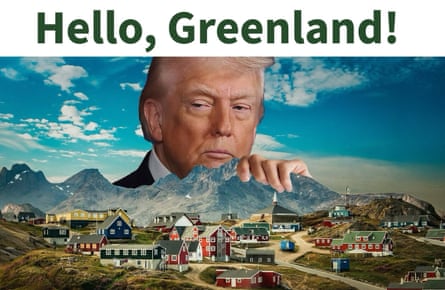
Trump’s Truth Social post. Illustration: truthsocial.com/realDonaldTrump
Executives of Greenland Energy, a Texas company set up last year, have claimed that $1tn of crude may lie beneath the Jameson Land region. They announced plans to spend $60m drilling two wells to find out.
Although Greenland stopped issuing new oil licences in 2021 on environmental grounds, a UK company called 80 Mile had secured exploration rights in Jameson Land. Greenland Energy’s corporate filings say it will take a majority stake in the project in exchange for funding the exploration, though it still needs government permission to proceed.
Licensed to drill? How a Trump-linked Texas oil company is elbowing its way into Greenland
Greenland Energy has retained Phil McGraw, better known as Dr Phil, a prominent rightwing former chatshow host who served on Trump’s religious freedom commission, to make a documentary series that will “capture the mission of these modern-day wildcatters”.
It has also appointed as a director a US navy veteran who is working on Golden Dome, the missile defence plan for which Trump says controlling Greenland is “vital”.
Larry Swets, Greenland Energy’s chair and a big shareholder, appears to enjoy access to Trump’s circle. He has said the oil project is “not related to American annexation”.
After a company representative falsely claimed at a Jameson Land community meeting in June that it had permission to land drilling equipment, Swets said: “Our enthusiasm for the project led us to communicate in a way that created confusion.”
But the next month, local people in the sparsely populated region noticed a tug pulling a barge shorewards and unloading a dozen containers. “The goal was to get the equipment onshore at Nunap Qeqqa [Jameson Land] in connection with planned oil exploration drilling,” the Greenland government’s statement said.
The Danish investigative outlet Danwatch quoted the head of the shipping company as confirming the delivery was for Greenland Energy.
Young arctic foxes in the tundra in Jameson Land. Photograph: Biosphoto/Alamy
Greenland Energy has declined to respond to questions from the Guardian. A letter it sent to shareholders on Thursday said: “Recent high-level meetings between project leadership and Greenlandic regulatory and oversight authorities have been constructive, and we continue to be encouraged by the progress being made toward the remaining approvals required for drilling.” It said that after those discussions, just one well would be drilled to begin with.
As a semi-autonomous territory of Denmark, decisions about Greenland’s natural resources rest with its local elected leaders, who now face a delicate decision. They could grant permission for oil drilling, even though the planned wells appear to fall within a conservation area protected by the Ramsar convention on wetlands. Or they could refuse and, some worry, give Trump a pretext to advance his imperialist agenda.
The Greenland government’s statement said it “would not be proportionate” to demand the equipment be removed. An application for permission remained under processing, it added.
A Greenland Energy representative has said a vessel carrying its 300 shipping containers of drilling equipment is to set sail from Canada on 12 September. Sinking the wells would begin in October.
Jeff Landry, the hard-right Louisiana governor serving as Trump’s Greenland envoy, has said Greenland could be pumping oil next year.
--=-=-
-=-=
GUK
Licensed to drill? How a Trump-linked Texas oil company is elbowing its way into Greenland
Greenland Energy says billions of barrels of crude could lie beneath territory and claims it has permission to bring drilling kit ashore – a claim denied by Nuuk
Thu 9 Jul 2026
On 10 June, a snowy-haired American in his 60s addressed the residents of a remote Greenland hamlet. He was there to tell them about a business venture supported by figures linked to Donald Trump. “So,” Robert Price said via an interpreter, “we have a project to drill for oil here.”
The Texas oil company that Price represents, Greenland Energy, hopes to prove that billions of barrels of crude lie underground by bringing in 300 shipping containers of drilling kit.
“We have the permit to put the equipment on the land,” footage of the gathering in Ittoqqortoormiit shows Price saying. “And then we’ve filed our permits – pending approval – to drill.”
But Greenland’s resources ministry said that contrary to Price’s claim, there were “no actually active permissions for any exploration activity or permissions for preparations for these activities”.
The dispute threatens a showdown between the Trump-linked backers of Greenland Energy and the authorities in the vast, sparsely populated territory. Trump’s lieutenants are using the prospect of an American oil find in Greenland to bolster their case for an American takeover.

Jeff Landry, right, on a visit to Nuuk in May as Trump’s special envoy to Greenland. Landry said the territory ‘could be exporting 2m barrels of oil a day’. Photograph: Christian Klindt Soelbeck/Ritzau Scanpix/AFP/Getty
The US president’s special envoy to Greenland, the hard-right Louisiana governor, Jeff Landry, returned from a visit in May to declare on Fox News: “We need a deal. Greenland needs a deal. We could be – Greenland could be – exporting 2m barrels of oil a day right now.”
Landry, who says his task is to “make Greenland a part of the US”, added: “We could have those barrels on production within 10 months or so.”
Greenland Energy appears to be the only company making plans to drill in the territory. Despite seemingly not yet having permission, it has chartered an Arctic-going vessel to ferry its equipment 4,000km through icy waters to Greenland’s eastern coast.
Price, an energy industry veteran who has become the public face of the company, said the vessel would depart in two months, on 12 September, with drilling to begin in October. Halliburton, the giant Houston-based contractor once led by the former Republican vice-president Dick Cheney, will run the logistics.
Ever since Trump made his imperial desires for Greenland explicit, US business interests have been gaining footholds in its vast expanses. The ventures range from rare-earth minerals and hydroelectric power to bottling “luxury” spring water.
Greenlanders have watched nervously as Trump has exercised US military power and toyed with doing so in the Danish territory. The day after he sent special forces to snatch the leader of Venezuela, Trump said: “We do need Greenland, absolutely.” Trump cited oil as the reason the US needed to stamp its authority on Venezuela. The US has since extracted oil revenues of about $8bn with scant oversight.
Arriving at this week’s Nato summit in Turkey, Trump renewed his call for the US to wrest control of Greenland from Denmark.
Among those alarmed is Avaaraq Olsen, the mayor of the region that covers the capital, Nuuk, and extends east across Jameson Land, where the oil drilling is planned. She said she was “so afraid” that Americans striking oil could align with Trump’s plans.
“We are like the most peaceful place on Earth,” she said. “And we have always lived in peace and harmony. And suddenly there is all these Americans trying to take over.”
The coast of Jameson Land in north-east Greenland. Greenland Energy has chartered an Arctic-going vessel to ferry its equipment 4,000km through icy waters to Greenland’s eastern coast. Photograph: Biosphoto/Alamy
Licence to drill
Greenland stopped issuing licences to explore for oil in 2021 after 50 years of fruitless drilling. “The environmental consequences of oil exploration and extraction are too great,” a minister said at the time.
But a handful of licences remained valid. They included some covering a chunk of Jameson Land, a region closer to London than to Washington. These licences belong to a company registered in the UK called 80 Mile.
It is those licences that Greenland Energy, formed last year and listed on the Nasdaq stock exchange in New York, is hoping to exploit by putting up $60m to drill two wells in exchange for a majority stake in the project.
Price has claimed that crude worth $1tn (£750bn) could lie beneath Jameson Land. “I believe it’s there,” he said during the meeting in Ittoqqortoormiit, a settlement of 300 people in Jameson Land. “The scientists believe that it’s there. But until we drill these wells, we don’t know.”
The wells are expected to be drilled in an area protected by the global Ramsar Convention to preserve wetlands, which hosts important populations of wildlife including muskoxen. Photograph: Biosphoto/Alamy
The wells are expected to be drilled in an area protected by the global Ramsar Convention to preserve wetlands. David Boertmann, an expert on Greenland’s birds, said the conservation zone hosts important numbers of barnacle geese and pink-footed geese as well as whimbrel, golden plover, Sabine’s gull and snowy owl, plus muskoxen. Oil exploration activities could threaten the birds’ habitat, Boertmann said.
Greenland Energy’s stock market filings make clear that its plans can go ahead only if Greenland’s government grants permission for drilling and for it to take a stake in any oil extraction that follows.
Múte B Egede, Greenland’s minister for mineral resources, said Greenland Energy’s ‘statements to the public do not always reflect the actual situation’. Photograph: Mads Claus Rasmussen/EPA
There are signs that the government may be reluctant to do so. Days after Price’s comments, Greenland’s minister for mineral resources, Múte B Egede, said he could “understand if citizens are concerned” about the project’s connections to Trump.
He added: “Activities cannot be carried out until the necessary permits have been granted. I must say again that the company’s statements to the public do not always reflect the actual situation.”
Greenland Energy declined to respond to questions from the Guardian. But Larry Swets, a financier who is one of Greenland Energy’s biggest shareholders and serves as executive chair, has acknowledged: “Our enthusiasm for the project led us to communicate in a way that created confusion about who is responsible for what in Greenland – and that benefited no one, least of all the local communities closest to the project.”
The tundra of Jameson Land, which includes a conservation zone that is home to a number of bird populations. Photograph: Biosphoto/Alamy
Trump connections
At the Ittoqqortoormiit meeting, one person asked whether Swets had “close relations with Trump”. Price replied: “Not that I know of.”
Social media posts by Swets’s wife appear to show that this year she visited Trump’s Mar-a-Lago club. Swets did not respond to questions about whether he had accompanied his wife to Trump’s Florida residence, which serves as a presidential court away from the White House.
Although Swets has said the oil project is “not related to American annexation”, Greenland Energy’s connections to the US president are growing, as the company amasses an eclectic array of Trump-linked backers.
In April, the Wall Street billionaire Kenneth Griffin bought 9% of Greenland Energy’s shares. Griffin is a Republican mega-donor and, despite criticising the Trumps’ self-enrichment, gave $1m towards the president’s second inauguration.
Then in June, a US Navy veteran, Carol Craig, joined Greenland Energy’s board. Sidus Space, the defence tech company she founded, is working on Trump’s Golden Dome missile defence system. Trump has said that controlling Greenland, home to the US armed forces’ space base at Pituffik, is a “vital” part of the Golden Dome plan.
The same month, Greenland Energy announced a deal with Phil McGraw’s Envoy Media. Better known as Dr Phil, the TV personality’s 20 years hosting a talkshow that spun out of Oprah Winfrey’s show made him a household name in the US.

Phil McGraw, right, better known as Dr Phil, is making a documetary series about Greenland Energy. Photograph: Abaca/Shutterstock
McGraw spoke at a Trump rally in 2024. After Trump’s victory, McGraw “embedded” himself with ICE agents enforcing Trump’s immigration crackdown. His latest venture, a documentary series about Greenland Energy, will be broadcast on cable and social media and, according to the company, will “capture the mission of these modern-day wildcatters”.
Discussing the prospect of oil with Swets and Price in a YouTube curtain-raiser, McGraw says: “We’ve heard Trump talk about buying Greenland and everybody laughed, but actually there is some real value to Greenland.”
Days later, McGraw was in the Oval Office with Trump, saying how honoured he was to serve on the president’s Religious Liberty Commission. “Thank you very much, Phil,” Trump said. “I appreciate your support.”
Some Greenland Energy shareholders are hoping the president will show similar appreciation for its Arctic oil exploration. On a dedicated Telegram group, they discuss what might send the company’s stock price higher. Referring to a presidential plug for the company that could make them richer before a drop of oil has been drilled, they are hoping to secure what they are calling a “Trump pump”.
---
OMFG
Trump just declared an 'energy emergency.' Here's what it ...

The Washington Post
https://www.washingtonpost.com › 2025/01/20 › trump...](https://www.washingtonpost.com/climate-environment/2025/01/20/trump-day-one-executive-orders-energy/)
2 days ago — In a Day 1 executive order, President Donald Trump withdrew from the landmark climate accord. Additional orders on energy are expected.
NO LNX WAPO
Trump just declared an ‘energy emergency.’ Here’s what it means.
In Day 1 executive orders, President Donald Trump withdrew from the landmark climate accord and pushed to dismantle his predecessor’s environmental agenda.
January 20, 2025
By Maxine Joselow, Chico Harlan and Evan Halper
During his first moments as the nation’s 47th president Monday, Donald Trump moved to withdraw the United States from the Paris agreement, boost domestic fossil fuel production and reverse many of former president Joe Biden’s signature efforts to combat climate change and other pressing environmental problems.
The flurry of executive orders drew cheers from the fossil fuel industry but raised fears among U.S. allies about the future of global climate initiatives. The United States ranks as the largest historical emitter of planet-warming greenhouse gases, and its exit from the Paris accord threatens to derail emissions-cutting efforts during a critical four-year period.
Nations pledged in 2015 to limit global temperature rise to 1.5 degrees Celsius (2.7 degrees Fahrenheit) above preindustrial levels — a crucial threshold for averting the most catastrophic climate impacts. But scientists recently confirmed that 2024 was the first year to surpass this threshold — and the hottest year on record.
Trump signed an executive order pulling out of the Paris climate accord during an event with supporters at Capital One Arena in D.C. He slammed the accord as “unfair” and “one-sided,” prompting loud applause from the crowd.
Later on Monday in the Oval Office, Trump signed additional executive orders declaring a “national energy emergency,” boosting oil and gas drilling in Alaska, “unleashing American energy” and stopping new offshore wind projects in federal waters. It was not immediately clear what government actions the energy emergency would entail, although Trump allies have suggested it could allow federal agencies to quickly approve pipelines and other fossil fuel infrastructure deemed important to national security.
In the orders, Trump directed agencies to review dozens of Biden’s environmental policies and, if possible, quickly reverse them. He instructed the Energy Department to end the Biden administration’s pause on approving new facilities that export liquefied natural gas, and he instructed the Interior Department to lift restrictions on oil and gas drilling across millions of acres of federal lands in Alaska, including in the Arctic National Wildlife Refuge.
“We will drill, baby, drill,” Trump declared in his second inaugural address Monday, adding that the United States has “the largest amount of oil and gas of any country on Earth, and we are going to use it.” (In fact, Venezuela and Saudi Arabia have the biggest oil reserves, according to the U.S. Energy Information Administration.)
It is common for presidents to sign executive orders on their first day that reverse some of their predecessors’ decisions. But the contrast between Biden’s climate legacy and Trump’s energy agenda is particularly pronounced, heralding a seismic shift in policy across the federal government.
Some of the steps outlined in Trump’s executive orders, such as ending the pause on new LNG exports, will take effect immediately. Other efforts, such as rewriting complicated regulations, could take months or even years.
For instance, it could take years for the Environmental Protection Agency and the Transportation Department to weaken fuel-efficiency standards for cars and light trucks, which Biden strengthened. Though Trump has described these rules as an “electric vehicle mandate,” they do not ban the sale of new vehicles powered by gasoline or diesel.
In some cases, market forces could have a greater impact on the nation’s energy landscape than the new administration’s policies. The price of oil, for instance, tends to dictate companies’ decisions about major new investments in drilling and refining.
Trump had made no secret of his energy agenda for his first day in office, frequently boasting about his plans after his November victory over Biden.
“I will sign Day One orders to end all Biden restrictions on energy production, terminate his insane electric vehicle mandate, cancel his natural gas export ban, reopen [Arctic National Wildlife Refuge] in Alaska — the biggest site, potentially anywhere in the world — and declare a national energy emergency,” Trump said in December.
Former North Dakota governor Doug Burgum, Trump’s pick for interior secretary and “energy czar,” also suggested during his confirmation hearing Thursday that the incoming administration could consider declaring an energy emergency because of soaring electricity demand.
“This is part of a larger crisis our nation is facing around electricity,” Burgum told the Senate Energy and Natural Resources Committee.
The energy emergency declaration relies heavily on concerns about the nation’s power grid not being able to keep up with surging demand, particularly from tech companies developing artificial intelligence. It stresses that the nation’s “ability to remain at the forefront of technological innovation” requires more energy.
In a call with reporters Monday morning, officials with the incoming administration stressed that the order is focused, in part, on keeping the United States ahead of China in the AI arms race.
The tech companies building these data centers had initially planned to power them solely with clean energy. But new wind and solar generation is not keeping up with the needs of the immense AI infrastructure, and tech companies are routinely being told their projects will have to wait years to come online.
Pulling out of Paris again
Among Trump’s initial climate moves, the decision to exit the Paris agreement stands as the most internationally consequential, reinforcing a sense that the United States is an unreliable partner in the global effort to reduce emissions. That sense had been growing even before Trump’s election, as the United States expanded its oil and gas production after joining other nations in pledging to phase out fossil fuels.
“We are back to countries performing actions in their narrow, short-term interests,” said Li Shuo, director of the China climate program at the Asia Society Policy Institute. “That will inform the judgment of all the other political capitals in the world that the zeitgeist of global climate action is not where it should be.”
In Beijing, China’s Foreign Ministry expressed concern over Trump’s decision to withdraw from the Paris agreement.
“Climate change is a common challenge faced by all of humanity. No country can stand apart from it or stay unaffected,” said Guo Jiakun, the ministry’s spokesman. “Upholding the concept of a shared future for mankind, China will work with all parties to actively tackle the challenges of climate change and jointly advance the global transition toward a green and low-carbon [future],” Guo said at a press briefing Tuesday.
Though Trump announced a similar action in 2017, at the start of his first term, the circumstances then were different: A rule stated that parties could withdraw from the accord, which came into force in 2016, only once it was three years old. Because the withdrawal process takes a year, the United States technically remained a member of the agreement until Nov. 4, 2020 — one day after voters awarded the presidency to Biden.
This time, the United States will be able to exit the accord more quickly. And the move will come at a perilous time for global climate efforts.
Right-wing parties, particularly in Europe, are gaining traction by pushing back against green policies. Wealthy countries are falling well short in financing climate-related projects in poorer nations, swelling a sense of injustice between the Global North and Global South — and leaving some countries worried about the viability of future global negotiations.
“A lot of countries could use [the U.S. exit] as an excuse to do little,” said Linda Kalcher, a former U.N. climate adviser and the founder of Strategic Perspectives, a Brussels-based climate policy group.
At the same time, many countries see an economic case for the clean-energy transition — and a political opportunity to fill a power vacuum.
China might have the most to gain, policymakers and experts predict. Already, China’s share of global solar panel manufacturing exceeds 80 percent. And Chinese-made EVs are surging in competition against those of American and European automakers. The United States’ withdrawal from the Paris accord could further cement a perception of Beijing as the superpower that can help the world cope with climate perils.
When Trump pulled out of the Paris agreement the first time, a group called America is All In announced that dozens of states, cities and corporations were still committed to the pact. Gina McCarthy, the former White House climate czar under Biden and the managing co-chair of America is All In, promised in a statement to continue that fight.
“Our states, cities, businesses, and local institutions stand ready to pick up the baton of U.S. climate leadership and do all they can — despite federal complacency — to continue the shift to a clean energy economy,” she said.
---
an 224 spate
Antarctic tipping point that occurred 8,000 years ago 'could happen again' - Alternet.org
thom 3 wisc winter hurric
Category 6? Scientists highlight 'growing inadequacy' of current hurricane scale - Alternet.org
---
Trump rolls back Biden-era fuel efficiency standards for vehicles
December 5, 2025
Climate Groups Falter, Bill Gates Recalibrates, & Al Gore Soldiers grows ‘increasingly marginalized’
December 5, 2025
Trump Set to Sign Off on New Arctic Drilling Surge
December 5, 2025
‘Climate doom is not science’ – Retracted study in journal Nature ‘fails even as a piece of speculative modeling’
December 5, 2025
---
---
more heat dome, greece US midwest
jeff goodell bk kpfa 7/26/23 upfront hotter water quickly loses O2 see salmon
---
https://www.alternet.org/ocean-temps/
100 degree fla, coral bleach
https://www.alternet.org/weve-fallen-off-a-cliff/
no lnx twt an 7 23
'We’ve fallen off a cliff': Scientists warn Atlantic currents could collapse as early as 2025
Brett Wilkinsand Common DreamsJuly 26, 2023
"It is very plausible that we've fallen off a cliff already and don't know it," said one researcher.
The system of Atlantic Ocean currents that drive warm water from the tropics toward Europe is at risk of collapsing in the coming decades, an analysis of 150 years of temperature data published Tuesday concluded.
"The Atlantic Meridional Overturning Circulation (AMOC), which includes the Gulf Stream, is a major tipping element in the climate system and a future collapse would have severe impacts on the climate in the North Atlantic region," states the study, which was published in the scientific journal Nature Communications.
Although the analysis notes that "assessments by the Intergovernmental Panel on Climate Change (IPCC), based on the Climate Model Intercomparison Project (CMIP) model simulations suggest that a full collapse is unlikely within the 21st century," the study's authors "estimate a collapse of the AMOC to occur around mid-century under the current scenario of future emissions."
"We show that a transition of the AMOC is most likely to occur around 2025-2095," the paper states with "95% confidence."
University of Copenhagen professor Peter Ditlevsen, who led the study, told The Guardian: "I think we should be very worried. This would be a very, very large change. The AMOC has not been shut off for 12,000 years."
Bill McKibben, co-founder of the climate action group 350.org, tweeted that "Gulf Stream collapse used to be viewed as a far-off and remote possibility... Less so now."
Meteorologist and climate journalist Eric Holthaus called the study's findings "incredibly worrying."
The Washington Post reports:
The new study adds to a growing body of evidence that this crucial ocean system is in peril. Since 2004, observations from a network of ocean buoys [have shown] the AMOC getting weaker—though the limited time frame of that data set makes it hard to establish a trend. Scientists have also analyzed multiple "proxy" indicators of the current's strength, including microscopic organisms and tiny sediments from the seafloor, to show the system is in its weakest state in more than 1,000 years.
For thousands of years, the Gulf Stream has carried warm waters from the Gulf of Mexico northward along the eastern North American seaboard and across the Atlantic to Europe. As human-caused global heating melts the Greenland ice sheet, massive quantities of fresh water are released into the North Atlantic, cooling the AMOC—which delivers the bulk of the Gulf Stream's heat—toward a "tipping point" that could stop the current in its tracks.
According to The Guardian:
A collapse of AMOC would have disastrous consequences around the world, severely disrupting the rains that billions of people depend on for food in India, South America, and West Africa. It would increase storms and drop temperatures in Europe, and lead to a rising sea level on the eastern coast of North America. It would also further endanger the Amazon rainforest and Antarctic ice sheets.
"It is very plausible that we've fallen off a cliff already and don't know it," Hali Kilbourne, an associate research professor at the University of Maryland Center for Environmental Science, toldThe New York Times. "I fear, honestly, that by the time any of this is settled science, it's way too late to act."
Other studies—including one published in March and another in 2021—have also concluded that the AMOC is at risk of collapsing this century.
Meanwhile in the Southern Hemisphere, Antarctic currents that enrich 40% of Earth's deep oceans with oxygen and nutrients essential for marine life have slowed dangerously in recent decades and could also collapse by mid-century, an Australian study released in May showed.
FROM YOUR SITE ARTICLES
New evidence that an extraterrestrial collision 12,800 years ago triggered an abrupt climate change for Earth ›
What was the 'catastrophic implosion' of the Titan submersible? An expert explains ›
Atlantic Salmon Is Basically Extinct: You’re Eating a Genetically Eroded Version ›
RELATED ARTICLES AROUND THE WEB
A major Atlantic current is at a critical transition point | NOVA | PBS ›
Is Atlantic Ocean current near collapse? Could be sooner than ... ›
A Stagnant Jet Stream Is Fueling Intense Heat Worldwide. Could ... ›
---
---
6 23 2030 summer?
https://www.alternet.org/arctic-sea-ice-disappearance-inevitable/
---
record low sea ice
https://www.alternet.org/no-time-to-waste-antarctica/
---
https://ecowatch.us7.list-manage.com/track/click?u=214ab5fbb3f6015d74ffab4ec&id=28484cd158&e=c2e8fdabfa
12 22 ecowatch https://www.ecowatch.com/bomb-cyclone-winter-storm-us.html
arctic Air Brings Dangerous Cold to U.S., Could Test Texas Grid
A bomb cyclone of Arctic air is descending on the lower 48 states, bringing with it life-threatening extreme cold, heavy snow and rain, and blizzard conditions.
The National Weather Service office in Buffalo, NY — no stranger to extreme winter weather — described it as a “once in a generation winter storm.” The coldest temperatures in decades will send wind chills as low as -70°F in eastern Wyoming and the Eastern Seaboard will likely see its coldest Christmas since Taylor Swift was born.
The extreme cold will also likely, and tragically, illustrate the heavy toll of extreme weather on people experiencing homelessness.
In addition to driving methane gas prices even higher for families across the central U.S., the cold will also likely test the Texas electrical grid, which crashed catastrophically in 2021, mostly due to failure of the methane gas system. More than 7,300 megawatts of new wind, solar, and energy storage capacity has been added to the Texas grid in the past year, and could help keep the grid stable.
Research suggests the rapidly warming Arctic appears to be playing a role in creating more opportunities for cold air to dive south.
---
---
As NYC is inundated with wildfire smoke, Rupert Murdoch’s WSJ calmly shows link to climate crisis, while Murdoch's Fox News mocks it
WRITTEN BY JOHN WHITEHOUSE
RESEARCH CONTRIBUTIONS FROM SAGE HODIL
PUBLISHED 06/07/23
New York City is currently inundated with a hazardous level of wildfire smoke, making the skies appear yellowish-orange.
The smoke is from wildfires in Canada, which scientists say are “becoming bigger and more frequent” due to climate change, as reliably explained by Rupert Murdoch’s Wall Street Journal:
Wildfires like those ravaging Canada are becoming bigger and more frequent as forests around the world increasingly dry out amid the warming climate, many scientists say.
Some of the biggest fires are breaking out in the boreal forests of the Northern Hemisphere such as most of the ones in Canada. That is because the Arctic region has warmed nearly four times faster than the rest of the world, said Carly Phillips, a Boston-based research scientist at the Union of Concerned Scientists.
In the boreal areas—mostly conifer forests with long winters and short summers—of Canada and Alaska, she said the annual area burned has nearly doubled in the past 60 years, along with an increase in the frequency of large fires. Russia’s vast Siberian forests have been consumed by giant fires too. Phillips said this year’s outbreak, while unprecedented in size, is just following the trend.
“I don’t know if it’s a tipping point, but what this underscores is that the climate crisis is here and now,” Phillips said.
The link is so obvious and uncontroversial that Journal staff members have no problems tweeting it.
And yet, over at Murdoch’s Fox News Channel, this is just another reason for hosts to punch left, this time at frequent target Rep. Alexandria Ocasio-Cortez (D-NY), who dared to point out that the country has work to do to adapt to the climate crisis.
Video file
Video CitationFrom the June 7, 2023, edition of of Fox News' Outnumbered
None of this is novel. Fox News (and the Journal’s right-wing editorial board) have for years pushed climate denial on the body politic. Now that the effects of the climate crisis are impossible to miss, the network is still refusing to recalibrate.
Like the Dominion case shows, it’s not clear if Fox’s audience — or whatever is left of it — will allow the network to speak the truth.
Either way, I’d recommend that people working at Fox News headquarters in Manhattan buy some high-quality masks. They might even still have some sitting around.
THE LATEST
Linda Yaccarino just started as Twitter’s new CEO, but Elon Musk already destroyed the platform for advertisers
06/08/23 9:27 AM EDT
200+ things that Fox News has labeled “woke”
06/08/23 8:58 AM EDT
Newsmax's Greg Kelly praises the smoke from Canadian wildfires: “It's a beautiful, interesting aura”
06/08/23 8:45 AM EDT
Sean Hannity mocks New Yorkers for wearing masks to protect themselves from wildfire smoke
06/07/23 9:58 PM EDT
Fox News' Jesse Watters attacks government officials for suggesting masking to protect against wildfire smoke
06/07/23 The Wall Street Journal
Wall Street Journal
Climate deniers
climate deniersMORE
Related
Sean Hannity mocks New Yorkers for wearing masks to protect themselves from wildfire smoke
06/07/23 9:58 PM EDT
Fox News' Jesse Watters attacks government officials for suggesting masking to protect against wildfire smoke
06/07/23 7:59 PM EDT
again sci shocked 4x rate
https://www.alternet.org/2022/09/we-were-shocked-arctic-ocean/
an 8 22 almost a foot by 2100
The fossil fuel-driven climate emergency has already locked in so much ice melt in Greenland that sea levels will surge by nearly a foot in the coming decades, peer-reviewed research published Monday warns, underscoring the need to rapidly transform virtually all aspects of the global political economy.
Even if the world stopped emitting greenhouse gases today, the Greenland ice sheet is set to lose at least3.3% of its mass, or 110 trillion tons of ice, and that will cause almost a foot in global sea-level rise (SLR), says the study, published in Nature Climate Change. The authors don't specify a time frame for the melting and SLR, though they expect much of it to happen between now and 2100.
But rather than lead to despair, this projection of inevitable damage—made by scientists based at institutions in Belgium, Denmark, Finland, Norway, the Netherlands, Switzerland, and the United States—should catalyze immediate and robust climate action, experts stress. Without it, the life-threatening situation confronting humanity is destined to grow far deadlier.
Earlier this year, the National Oceanic and Atmospheric Administration predicted that sea levels along the U.S. coastline would rise by an average of 10 to 12 inches by 2050, drastically increasing the threat of flooding in dozens of highly populated cities.
By mid-century, 150 million people worldwide could be displaced from their homes just by rising sea levels, according to some estimates. The consequences of a one-foot SLR would be especially catastrophic for developing island nations, where low elevation and high poverty combine to increase vulnerability.
These countries, which have done little to cause the climate crisis now roasting the Greenland ice sheet, lack the financial resources for adaptation and face the prospect of being wiped off the map.
"Every study has bigger numbers than the last," William Colgan, a scientist at the Geological Survey of Denmark and Greenland and co-author of the new paper, told The Washington Post. "It's always faster than forecast."
As lead author Jason Box, also from the Geological Survey of Denmark and Greenland, told the newspaper, the finding that 3.3% of Greenland's ice sheet will be gone in a matter of decades regardless of what is done to halt planet-heating pollution represents "a minimum, a lower bound."
Things are all but guaranteed to get worse if humanity continues to burn fossil fuels. Should the record-breaking ice loss that occurred in 2012 become the norm, for example, the world is likely to see around two-and-a-half feet of SLR from Greenland alone, the study says.
By the same token, each fraction of a degree of warming that is avoided makes a difference.
If Greenland's ice sheet were to disintegrate completely, sea levels would rise more than 22 feet—"enough to double the frequency of storm-surge flooding in many of the world's largest coastal cities" by the end of the century, scientists have warned, so the stakes for adequate climate action are still immense even if a certain amount of melting and SLR has been deemed irreversible.
Greenland is located in the Arctic, which has been heating up for over a century and is one of the fastest-warming regions in the world. Dangerous feedback loops are of particular concern. The replacement of reflective sea ice with dark ocean water leads to greater absorption of solar energy, and the thawing of permafrost portends the release of additional carbon dioxide and methane—both leading to accelerated temperature rise that triggers further melting, defrosting, and destabilization.
In December, researchers estimated that the Arctic has been heating up four times faster than the rest of the globe over the past three decades. Another recent study found that 2021 was the 25th consecutive year in which Greenland's ice sheet lost more mass during the melting season than it gained during the winter. Rainfall is now projected to become more common in the Arctic than snowfall decades sooner than previously expected.
This context has a direct bearing on the new paper, which contains more dire predictions than other reports relying on different assumptions.
The United Nations' Intergovernmental Panel on Climate Change (IPCC), for instance, has projected that Greenland will lose roughly 1.8% of its mass and contribute up to half a foot of SLR by 2100 if humans continue spewing large amounts of greenhouse gases into the atmosphere.
"One reason that new research appears worse than other findings may just be that it is simpler," the Postexplains. "It tries to calculate how much ice Greenland must lose as it recalibrates to a warmer climate."
"In the past, scientists have tried to determine what Greenland's ongoing melting means for the global sea level through complex computer simulations," the newspaper continues. "They model the ice itself, the ocean around it, and the future climate based on different trajectories of emissions." The result, in general, has been "less alarming predictions."
As the Post reports:
The new research 'obtains numbers that are high compared to other studies,' said Sophie Nowicki, an expert on Greenland at the University at Buffalo who contributed to the IPCC report. Nowicki observed, however, that one reason the number is so high is that the study considers only the last 20 years—which have seen strong warming—as the current climate to which the ice sheet is now adjusting. Taking a 40-year period would yield a lower result, Nowicki said.
[...]
Box, for his part, argues that the models upon which the IPCC report is based are 'like a facsimile of reality,' without enough detail to reflect how Greenland is really changing. Those computer models have sparked considerable controversy recently, with one research group charging they do not adequately track Greenland's current, high levels of ice loss.
For example, the processes causing ice loss from large glaciers in Greenland "often occur hundreds of meters below the sea surface in narrow fjords, where warm water can flick at the submerged ice in complex motions," the newspaper notes. "In some cases, these processes may simply be playing out at too small a scale for the models to capture."
Pennsylvania State University professor Richard Alley, an ice sheet expert who was not involved in the study, told the Post that "the problems are deeply challenging, will not be solved by wishful thinking, and have not yet been solved by business-as-usual."
One thing that's certain, Alley added, is that higher temperatures will lead to greater amounts of SLR.
"[The] rise can be a little less than usual projections, or a little more, or a lot more, but not a lot less," he said.
https://www.alternet.org/2022/08/global-warming-antarctica-sleeping-giant/
arctic heating #X fast?!
https://www.alternet.org/2022/07/greenland-lost-ice-three-days/
sea level ocean warm mcguire dire, feedback loop? ocean warm ice bering sea feedback loop?
kpfa talkies read art'l that quotes?
https://www.amazon.com/Waking-Giant-changing-earthquakes-volcanoes-ebook/dp/B007KZY518
6 22
https://www.alternet.org/2022/06/antarctica-melting-faster-5500-years/
the human-caused climate crisis is pushing crucial glaciers in Antarctica to lose ice at a rate not seen in more than 5,000 years, according to a new studypublished Thursday.
Researchers at the University of Maine, the British Antarctic Survey, and Imperial College Londonfound that the Pine Island and Thwaites glaciers on the West Antarctic Ice Sheet could cause global sea level rise of up to 3.4 meters, or over 11 feet, in the next several centuries due to their accelerated rate of ice loss.
The glaciers—one of which, the Thwaites, has been called the "doomsday glacier" by climate scientists because of its potential to raise sea levels—are positioned in a way that allows increasingly warm ocean water to flow beneath them and erode the ice sheet from the base, causing "runaway ice loss," the University of Maine team said in a statement.
The researchers examined penguin bones and seashells on ancient Antarctic beaches in order to analyze changes in local sea levels since the mid-Holocene period, 5,500 years ago.
Sea levels were higher and glaciers were smaller during the mid-Holocene, as the climate of the planet was warmer than it is today.
Since then, according to the study published in Nature Geoscience, relative sea levels have fallen steadily and the Thwaites and Pine Island glaciers have stayed relatively stable—until recent decades.
Ice loss was likely accelerated just prior to the mid-Holocene, and since then, the rate of relative decrease in sea levels over the past 5,500 years was almost five times smaller than it is in present day, due to "recent rapid ice mass loss," according to the scientists.
"That the present-day rate of glacier retreat that has doubled over the past 30 years is, indeed, unprecedented,"wrote Caroline Brogan, a science reporter at Imperial College.
With the Thwaites spanning an area of more than 74,000 square miles and the Pine Island glacier spanning more than 62,600 square miles, the rapid ice loss of the two glaciers could cause major rises in sea levels around the globe.
Dylan Rood of Imperial College's Department of Earth Science and Engineering, a co-author of the study, likened the two glaciers to arteries that have burst.
"These currently elevated rates of ice melting may signal that those vital arteries from the heart of the West Antarctic Ice Sheet have been ruptured, leading to accelerating flow into the ocean that is potentially disastrous for future global sea level in a warming world," said Rood. "Is it too late to stop the bleeding?"
The study follows increasingly urgent calls from theIntergovernmental Panel on Climate Change, theInternational Energy Agency, and climate scientists around the world for an end to fossil fuel extraction, which is needed to achieve net-zero carbon emissions by 2050 and limit the average global temperature from rising more than 1.5°C above preindustrial levels.
Scientists have warned that the accelerated melting of the Thwaites glacier is likely irreversible.
"We're going into unknown territory," Scott Braddock, a researcher at University of Maine,told Science News. "We don't have an analog to compare what's going on today with what happened in the past."
yikes high temps
https://www.alternet.org/2022/03/polar/
https://www.alternet.org/2021/10/arctic-sea-ice/
https://www.alternet.org/2021/09/texas-freeze/
com dr
New research published Friday suggests that melting Arctic sea ice caused by global heating may be responsible for the deadly deep freeze that devastated much of North America and plunged millions of Texans into darkness in February.
While climate researchers have previously connected the phenomena of polar heating and mid-latitute freezes, a new study published in the peer-reviewed journal Scienceis the first to link Arctic warming and February's cold snap. Authorities said the four-day extreme weather event—which left millions of residents trapped in sub-freezing darkness as Texas' largely independent power grid failed. State officials said the freezing temperatures killed more than 150 people in Texas, though others estimate the true death toll was likely much higher.
Polar vortices—large areas of low pressure and cold air swirling around the North and South poles—usually keep icy air contained there. However, research suggests that polar heating and ice melt fueled by the worsening climate emergency is allowing the normally trapped Arctic air to flow far southward.
Reporting on the new study, New Scientist explains:
That link still isn't fully established. However, a group led by Judah Cohen at the Massachusetts Institute of Technology found that vanishing sea ice and greater snowfall in the Arctic over the past 40 years, effects caused by climate change, may be driving cold winter weather in North America and Eurasia via the stratospheric polar vortex, the cold winds high above the pole. The rapid warming in the Arctic appears to be disrupting—that is, stretching—this vortex in a way that has a knock-on effect on atmospheric circulations above North America, generating unusually cold spells in winter.
"If you expected global warming to help you out with preparing for severe winter weather, our paper says the cautionary tale is: don't necessarily expect climate change to solve that problem for you," Cohen told New Scientist. "This is an unexpected impact from climate change that we didn't appreciate 20 years ago."
Continuing a decadeslong pattern of Texas Republicans denying the climate emergency, Gov. Greg Abbott blamed solar and wind power for February's blackouts, while calling the proposed Green New Deal "deadly" as people in his state were actually dying in darkness.
Jennifer Francis, a climate scientist at Woodwell Climate Research Center in Falmouth, Massachusetts, told the Associated Press that "the Texas cold blast of February 2021 is a poster child" for the Arctic link theory. Francis, who was not involved in the new study, said the research "takes this controversial hypothesized linkage and moves it solidly toward accepted science."
"By analyzing both observations and model simulations," Francis told New Scientist, "the conclusions are well supported and help explain how extreme cold spells like the debilitating one in Texas this past February are still likely—and perhaps more so—as the climate crisis unfolds."
Writing in The Conversation, Cohen and Mathew Barlow, two of study's five authors, conclude that "our research reinforces two crucial lessons of climate change: First, the change doesn't have to occur in your backyard to have a big effect on you. Second, the unexpected consequences can be quite severe."
"In this case, large changes in the Arctic are not just a local concern—they also have wide-ranging impacts across North America and parts of Asia," they note. "And those impacts are not always what people are expecting. The results highlight another reason to rapidly reduce the greenhouse gas emissions that are driving global warming and at the same time theneed to develop better strategies for managing extreme weather events, both hot and cold."
https://www.alternet.org/2021/05/sea-level-rise/
jake comm dr
A new study published Wednesday in the journal Nature warns that if the world's governments fail to meet warming targets set by the Paris climate accord, sea level rise from the melting of the Antarctic ice sheet will accelerate at a "rapid and unstoppable" rate in the coming decades.
Authored by researchers at the University of Massachusetts Amherst, the new paper finds that if planetary warming continues at its current rate—which is headed toward 3° Celsius above pre-industrial levels—Antarctic melting will reach a tipping point by 2060, beyond which the consequences would be "irreversible on multi-century timescales."
"If the world warms up at a rate dictated by current policies we will see the Antarctic system start to get away from us around 2060," Robert DeConto, the lead author of the study, told The Guardian. "Once you put enough heat into the climate system, you are going to lose those ice shelves, and once that is set in motion you can't reverse it."
"It's really the next few decades that will determine the sea level rise from Antarctica," DeConto added. "These ice shelves won't be able to just grow back."
The researchers find that if the most optimistic Paris goal of no more than 1.5° Celsius of warming by the end of the century is met, the Antarctic ice sheet would contribute around six centimeters of sea level rise by 2100.
"But if the current course toward 3 degrees is maintained, the model points to a major jump in melting," the study warns."Unless ambitious action to rein in warming begins by 2060, no human intervention, including geoengineering, would be able to stop 17 to 21 centimeters of sea-level rise from Antarctic ice melt alone by 2100."
Under a scenario in which no further action is taken to limit planet-warming greenhouse gas emissions, the research paper finds, Antarctic melting would contribute a "globally catastrophic" 10 meters or more to sea level rise by 2300.
"If we did nothing at all to reduce emissions we could get five meters of sea level rise just from Antarctica by 2200, at which point you'd have to remap the world from space," said DeConto. "It would be unimaginable."
The study comes days after U.S. President Joe Biden hosted a climate summit with 40 world leaders to discuss ways to bring the world into line with Paris warming targets. Biden, for his part, pledged to cut U.S. emissions at least 50% below 2005 levels by the end of the decade—a goal climate activists slammed as nowhere near sufficient.
"Science and justice demand that we reduce emissions by 70% from 2005 levels by 2030 on the road to zero emissions by mid-century," Janet Redman of Greenpeace USA said last month. "The White House can get this done by removing government subsidies to fossil fuel companies, investing in an equitable and sustainable economic recovery, and stopping fishy carbon offset deals."
FROM YOUR SITE ARTICLES
- Antarctica's ice shelves are trembling as global temperatures rise ... ›
- A glacier the size of Florida is on track to change the course of ... ›
- There's a supermoon just around the corner — and it comes with a ... ›
RELATED ARTICLES AROUND THE WEB
- Climate Change: Global Sea Level | NOAA Climate.gov ›
- Sea level rise, facts and information ›
- Is sea level rising? ›
lee raymond really wanted to drill anwr?
https://www.alternet.org/2021/04/antarctic-ice-sheet/ trembling?
peat carbon bomb, tip pt?
https://insideclimatenews.org/news/05042021/projected-surge-of-lightning-spells-more-wildfire-trouble-for-the-arctic/
with the Arctic warming at up to three times the pace of the global average, more lightning storms will invade the High North, igniting wildfires that release carbon dioxide and speeding the transition of flat mossy tundra to brush and forest landscapes that absorb more solar heat energy.
Yang Chen, an Earth scientist with theUniversity of California, Irvine and lead author of a study released today in the journal Nature Climate Change that projected the increases in lightning strikes, said the findings were somewhat unexpected, and intensify wildfire concerns in the High North because lightning is the main ignition source in the Arctic.
“The size of the lightning response surprised us because expected changes at mid-latitudes are much smaller,” he said. More lightning-caused fires would speed a vicious circle of climate-warming changes already under way in vast areas of tundra and permafrost across Siberia and Alaska, he added.
A surge in the frequency of large Arctic fires in the last five years spurred the research, which is based on 20 years of NASA satellite data showing the relationship between lightning and the climate, he said.
Linking that data with climate projections through 2100, the scientists estimated the number of lightning strikes will grow by about 40 percent for every 1.8 degrees Fahrenheit of warming. By late in the century, the IPCC projects the Arctic could warm by 4.5 degrees to 8 degrees Fahrenheit, depending on emissions.
The study also shows that the region that experiences lightning will shift, with future flash rates in the far northern tundra areas equal to the current rate in boreal forests, 300 miles to the south.
The increase may cause “a fire-vegetation feedback whereby more burning in Arctic tundra expedites the northward migration of boreal trees,” that will absorb more heat from the sun, accelerating the Arctic cycle of warming,” the authors wrote in the study.
More Lightning, More Fires, More Carbon in the Sky
The other part of the story is the vegetation is getting drier, and consequently, more flammable. That increases the odds that any individual lightning strike will ignite a fire. “If you have more lightning and drier fuels you will have more ignitions,” said co-author Sander Veraverbeke, a climate researcher with Vrije Universiteit Amsterdam. “What I found quite intriguing is the relative increase becomes higher the farther north you go, lightning increasing 85 percent in boreal forests but 150 percent or more in tundra.”
In recent years, some of the largest, longest-burning wildfires ignited by lightning in Arctic tundra and forests burned deep into soils of carbon-rich peat, which have been documented to release large quantities of carbon dioxide when they combust. As much as 90 percent of the carbon emissions from an Arctic wildfire come from the smoldering soils, he said, with only a little bit coming from the burning trees.
“Burning peat can release 2.5 to 3.5 kilograms (5.5 to 7.7 pounds) of carbon per square meter of ground,” he said. “That’s a lot, two or three times as much as from a fire in the savanna or the Mediterranean.” Arctic fires can scar the land so deeply that emissions from the disturbed permafrost and peat continue for decades or even centuries.
“It takes a really long time to recover, if it even does recover,” he said, “and if not, it becomes a long-term net flux of carbon to the atmosphere, contributing to more global warming.”
In some parts of the tundra, shrubs and trees start to grow after a fire. While those plants do store carbon, the new growth can also warm the climate because the patchwork of shrubs and trees, which is darker than an unbroken blanket of white snow, absorbs more of the sun’s heat.
Michelle C. Mack, an Arctic ecologist at Northern Arizona University who was not involved in the study, said the new research highlights important consequences of some more profound changes a rapidly warming climate is bringing to the Arctic, like treeline migration and permafrost thaw.
“I think that the lightning is a moderate worry, while the consequences for permafrost thaw are profound and should stimulate lots of worrying,” she said. Broadly, across northern Alaska and Canada, the dryness of vegetation is crucial to predicting fire severity and carbon emissions, she added. “If tundra is wet, cold, and soggy, it doesn’t matter how many lightning strikes hit it,” she said. “It is unlikely to burn.”
Study co-author Jim Randerson, an Earth scientist at the University of California, Irvine, said tundra fires burn layers of moss and organic debris that insulate the frozen ground below them. So even deep soils that don’t burn can thaw and release carbon dioxide and methane, “which will drive even more warming,” he said.
The new findings bolster other recent research on Arctic lightning, said Rick Thoman, an Alaska climate specialist with the University of Alaska Fairbanks who was not involved in the study. The potential for fire-sparking lightning strikes will increase most in tundra zones where fire is still mostly a stranger, he said. Another study published last month in Geophysical Research Letters showed a tripling of Arctic lightning strikes globally between 2010 and 2020, increasing “linearly with the temperature anomaly.”
Challenges and Opportunities for Firefighters
The series of large fires in Alaska and Siberia the last five years were all preceded by weeks and months of record heat that turned normally soggy bogs into tinder for the lightning storms. While the new study highlights the double whammy that global warming is for Arctic wildfire ignitions—supercharging the atmosphere with moisture and warmth needed for lightning storms while at the same time drying out the surface of the tundra in some areas—it also hints at some opportunities to better confront the fires. ...
https://theintercept.com/2020/12/13/indigenous-pipeline-oil-gas-insurers/
as OIL AND gas projects expand across the United States and Canada, often imperiling Indigenous land without ever obtaining consent, land defenders are increasingly pressuring the financiers of fossil fuel infrastructure — banks, insurance companies, and asset managers — to respect their sovereign land right. Amplifying the calls of this grassroots movement, the largest organization representing American Indians and Alaskan Natives passed a historic resolution last month calling on “private insurance companies to end their underwriting of the expansion of tar sands oil, Arctic oil and gas, and LNG export terminals.”
The resolution, put forward by the National Congress of American Indians, or NCAI, also asks insurance companies to adopt policies on “free, prior, and informed consent.” This principle, enshrined in the United Nations Declaration on the Rights of Indigenous Peoples,is “really just a fancy way of saying that any corporation, any bank, any agency that wants to engage in a project that impacts Indigenous lands and treaty lands must get consent from that particular tribal nation or Indigenous community,” said Matt Remle, who is Lakota and the primary author of the resolution. “And if the community says no, that project doesn’t happen.”
Remle is also the co-founder of Mazaska Talks, an Indigenous-led organization focused on campaigns to divest from projects that violate human rights and treaty rights abuses, which came out of an effort that began about five years ago to defund the Dakota Access pipeline.This movement pushed the city of Seattle to divest $3 billion from Wells Fargo in 2017, one of the main backers of the pipeline, and sparked similar campaigns throughout the country. More recently, every major bank has agreed to not fund drilling in the Arctic after facing pressure from Stop the Money Pipeline, a coalition of over 130 organizations which includes Mazaska Talks.
most Wall Street banks at least publicly acknowledge free, prior, and informed consent while still financing projects, like the tar sands pipelines, that face Indigenous-led opposition. Yet no major U.S. insurance companies, the biggest insurers of oil and gas projects across the globe, have released publicly facing statements about Indigenous rights, let alone the principle of free, prior, and informed consent, according to Elana Sulakshana, energy finance campaigner at Rainforest Action Network. This is, in part, why there has recently been more intense scrutiny of insurance companies’ enablement of fossil fuel projects on Indigenous land.
Activists demand the city of Seattle to divest its money and banking business from Wells Fargo, over the company’s investment in the Dakota Access pipeline, in 2016.
Photo: Alex Garland]
The resolution’s passage builds on the grassroots Indigenous movements underway that have been pressuring insurance companies, as one tool among many, to defend their land.
For instance, last month, the Gwich’in Steering Committee wrote aletter asking insurers to not back the destruction of the sacred calving grounds in Alaska’s Arctic National Wildlife refuge. Drilling in the calving grounds threatens the migratory Porcupine caribou, which in turn “threatens the Gwich’in existence and way of life.” The letter calls upon oil and gas companies, banks, and insurance companies to “stand with the Gwich’in Nation by not initiating any oil and gas development in the Arctic Refuge.”
This letter was prompted by the Trump administration rushing to auction off drilling rights in the Arctic National Wildlife Refuge before President-elect Joe Biden’s inauguration. Under federal law, all agencies are required to respect Indigenous nations’ right to self-governance, which means consulting with communities about drilling projects. The Bureau of Land Management, the agency that administers federal land, did not engage in any form of meaningful consent, said Bernadette Demientieff, the executive director of the Gwich’in Steering Committee. She noted that the agency held public meetings in only three of the nine Gwich’in communities in Alaska and did not hold meetings in communities accessible only by boat or plane.
“They only had hearings in certain communities. They did not have the government-to-government consultation that they’re supposed to,” said Demientieff. “They basically came to our community and told us what they were going to do. That was it.”
The Bureau of Land Management pushed back against the claim that it did not engage in government-to-government consultation, stating that it held more than 25 meetings “with tribal governments with the potential to be directly affected by an oil and gas leasing program.”
The Gwich’in Steering Committee also reached out individually to the 22 insurance companies addressed in the public letter to request a meeting. So far they’ve had one meeting, with Swiss Re, in which Demientieff spoke about the environmental devastation they have been witnessing, she said, such as the erosion of the land beneath coastal villages and “thousands and thousands ofdead fish in our lakes and rivers.” On December 14, the committee announced that Swiss Re had committed not to “provide coverage or investment support for projects related to exploration, drilling or production of oil or gas in the Arctic, including in the Arctic National Wildlife Refuge.”
OTHER INDIGENOUS NATIONS have also been seeking to meet with insurance companies. On September 2, the Great Plains Tribal Chairmen’s Association, which represents 16 tribal nations, sent a letter to David Long, the CEO of Liberty Mutual, urging the insurance company to “immediately end its relationship” with the Keystone XL pipeline. This pipeline is expected to carry bitumen oil from Alberta’s tar sands into the United States in a proposed route that would violate Indigenous treaty rights and sacred sites. Long and Liberty Mutual did not respond to requests for comment.
Liberty Mutual is providing financial backing to the Keystone XL pipeline with a publicly filedsurety bond worth $15.6 million. An additional $15.6 million bond is required after construction begins....
2/20 yikes matthew efx, circulation
siberia burns?!
omfg carbon AND methane bomb?!
https://www.alternet.org/2020/10/understanding-the-norths-climate-change-trifecta/
Arctic Circle became unbelievably hot on June 20. In the Russian community of Verkhoyansk, temperatures topped 38C, marking what may be the highest air temperature ever recorded within the Arctic.
The temperatures at Verkhoyansk are part of a larger trend across western Russia this summer, with small communities throughout the region reporting temperatures that are smashing local records that have stood for decades. During the latter half of June, surface temperatures throughout western Siberia were as much as 10C above historical norms, marking one of the hottest Junes on record despite relatively cool temperatures at the start of the month.
For scientists the world-over these record-breaking temperatures are alarm bells, demonstrating the kind of extreme weather events we can expect to see more often if climate change continues unchecked. However, it is the long-term fallout from modern heat waves that has many northern scientists deeply concerned, as they will affect our planet for decades to come.
The fires that follow
During heat waves surface temperatures soar, often triggering a chain of fire-promoting weather conditions including extreme thunderstorms. These thunderstorms have hundreds of lightning strikes that can ignite the dry soils and vegetation that serve as fuel for fire.
In northern regions like the boreal biome, these fire-promoting conditions can cause large-scale wildfires that burn millions of hectares of forest in a single summer.
Historically, humanity has considered wildfire a true disaster and spent considerable resources to suppress them. We now understand that despite the initial loss of established trees and soils, wildfires are a natural and integral part of the boreal biome.
Modern wildfires, however, are occurring with increasing frequency and intensity, covering a larger area due weather events like severe heat waves. In extreme fire years, these modern wildfires can burn deep into the organic soils that characterize boreal forests. These carbon-rich soils have been built up over thousands of years and hold approximately 30 per cent of the world's terrestrial carbon stocks.
When fires burn deep into soils or return too quickly to a forest, they lose their “ancient carbon" stocks. Instead of being held in the ground these ancient carbon reserves are combusted and released back into the atmosphere, increasing the carbon levels. The higher carbon dioxide levels generated by wildfires intensify climate change impacts like heat waves, which can lead to further wildfires, forming a powerful “positive feedback" loop with climate change.
While these trends alone are alarming, northern researchers warn that the fallout from heat waves won't stop when the fires burn out. In northern regions where the soils historically stay frozen year-round, a whole new set of changes are beginning to take form.
When permafrost perishes
Permafrost forms on the landscape when soil materials remain below freezing for two or more consecutive years. In some areas permafrost forms in direct response to a cold climate.
As one moves further south, however, permafrost becomes increasingly dependent on the presence of thick organic soils, surface vegetation and a shady overstorey to survive the warm summer months. In those cases, the ecosystem acts like a giant protective blanket, limiting the sun's heat that is able to reach the frozen permafrost materials below.
Carbon-rich peat burns readily, making it good fuel for lightning-caused fires.
(U.S. National Parks Service, Western Arctic National Parklands)]
When permafrost ecosystems burn, the wildfire consumes these protective layers, often triggering permafrost thaw.This can occur gradually, with the thawed layer expanding slowly over decades, or abruptly, with the thawed layer expanding dramatically over years. The land may cave in or sink, plant communities may change completely and local water flows may be rerouted.
In both cases, the loss of permafrost makes the massive Arctic carbon reserves more vulnerable to loss. With gradual thaw microbes are able to break down and release the previously frozen carbon back to the atmosphere as carbon dioxide. In contrast, abrupt thaw commonly occurs in ice-rich permafrost resulting in warmer but also wetter soils. Under these conditions decomposition still occurs but carbon is commonly returned to the atmosphere as methane, a greenhouse gas approximately 30 times more powerful at trapping heat than carbon dioxide.
All this lost carbon may make the positive feedback with climate change even stronger. While scientists are working to understand if the vegetation that grows after permafrost thaw is able to offset all the carbon released during decomposition, most current models indicate that permafrost thaw will ultimately be a source of atmospheric carbon.
Read more: More frequent fires could dramatically alter boreal forests and emit more carbon]
Researchers are coming to understand just how tightly linked these disturbances caused by climate change really are. What appears as an individual event — heat wave, forest fire or permafrost thaw — has cascading ramifications through time and space in the Arctic, potentially serving as the seed crystal for the next disturbance in the coming months, years or even decades that follow.
Heat waves, wildfires and permafrost thaw represent an environmental trifecta that are inherently linked and drive change in the occurrence and intensity of one another.
Catherine Dieleman, Research associate, Department of Integrative Biology, University of Guelph
This article is republished from The Conversation
https://www.alternet.org/2020/12/arctic/
6 big banks divest
Another alarm bell in the climate emergency’ as Arctic Sea ice shrinks to second lowest level on record
Andrea Germanos / Common Dreams September 22, 2020
Arctic sea ice shrank to the second-lowest extent since records began over four decades ago, federal scientists said Monday, prompting renewed warnings about the climate crisis. The minimum ice cover…
==
ew 920
Antarctica’s ‘Doomsday Glacier’ Is Starting to Crack
https://www.alternet.org/2020/09/irreparable-damage-looming-15-state-ags-file-suit-to-block-trump-from-fossil-fuel-on-arctic-refuge/
no lnx
"irreparable damage’ looming: 15 state AGs file suit to block Trump from fossil fuel assault on Arctic Refuge
Written by Andrea Germanos / Common Dreams September 10, 2020
A coalition of 15 attorneys general filed a lawsuit Wednesday to block the Trump administration’s plan to allow fossil fuel drilling in the Coastal Plain of the Arctic National Wildlife Refuge.
“Hard to say what’s worse—destroying the nation’s largest wildlife refuge, or further inflaming the climate crisis with new oil and gas drilling so a few fossil fuel companies can profit at the people’s expense,” Washington Gov. Jay Inslee said in a statement. “This is a moral, environmental, and economic disaster,” he added.
The lawsuit, co-led by Washington Attorney General Bob Ferguson and Massachusetts Attorney General Maura Healey, was filed in the U.S. District Court for the District of Alaska and accuses the administration of violating the National Environmental Policy Act, the National Wildlife Refuge System Administration Act, the Alaska National Interest Lands Conservation Act, the Administrative Procedure Act, and the Tax Cuts and Jobs Act of 2017 in its oil and gas proposal for the area.
:{
}:
According to Ferguson, Trump’s plan for ANWR is merely “the latest egregious example of his administration’s four-year assault on our environment.”
:{
}:
“President Trump and [Interior] Secretary Bernhardt—a former lobbyist for Big Oil—unlawfully cut corners in their haste to allow drilling in this pristine, untamed wildlife refuge to oil and gas development,” Ferguson said in a statement announcing his plan to “hold the Trump administration accountable to the rule of law and block this unlawful drilling plan.”
The Coastal Plain, the lawsuit states, “is a 1.56 million-acre national treasure, unparalleled in its biological significance for hundreds of species, including caribou, threatened polar bears, and millions of birds that migrate to and from six continents and through all 50 states.”
It also represents “an area sacred to the Gwich’in people” and “is particularly vulnerable to environmental stressors, including climate change, which has caused thinning sea ice and thawing of permafrost in the region,” the filing states.
The administration’s actions, the lawsuit adds, “severely underestimate the avoidable and irreparable damage to vital habitat and pristine waters, imperil wildlife already struggling to thrive in a rapidly changing ecosystem, and increase greenhouse gas emissions at a time when our nation and the world drastically need to reduce emissions to mitigate the most extreme harms of climate change.”
Joining Ferguson and Healey in the legal action are Xavier Becerra of California, William Tong of Connecticut, Kathleen Jennings of Delaware, Kwame Raoul of Illinois, Janet Mills of Maine, Brian Frosh of Maryland, Dana Nessel of Michigan, Keith Ellison of Minnesota, Gurbir Grewal of New Jersey, Letitia James of New York, Ellen Rosenblum of Oregon, Peter Neronha of Rhode Island, and TJ Donovan of Vermont.
The administration’s decision to allow drilling in the refuge was already hit with a lawsuit last month from environmental advocacy groups and the Gwich’in Nation—who deem the Coastal Plain “the sacred place where life begins.”
The drilling plan has also come in for scrutiny from the United Nations.
The Committee for the Elimination of Racial Discrimination (CERD) last month called for a probe into the Trump administration’s drilling plan, citing allegations that it threatens the human rights of the Gwich’in and “would exacerbate the already disproportionate impact of climate change on indigenous peoples, in particular in Alaska.”
==
ew 920
Antarctica and Greenland's ice sheets are currently melting at a pace consistent with worst-case-scenario predictions for sea level rise, with serious consequences for coastal communities and the reliability of climate models.
ew 920
recent Science Magazine feature blamed an underwater heat blob for exacerbating sea ice loss as it proclaimed what many Arctic scientists already know: Arctic sea ice is racing toward its demise.
820
https://www.ecowatch.com/earth-sea-ice-melt-study-2647072206.html
no lnx gik ref
Earth has lost 28 trillion tonnes (approximately 31 trillion U.S. tons) of ice in just 23 years, and the climate crisis is largely to blame.
The finding comes in a review paper published in The Cryosphere this month that used satellite data and numerical modelling to calculate all the ice that melted worldwide between 1994 and 2017.
"In the past researchers have studied individual areas – such as the Antarctic or Greenland – where ice is melting. But this is the first time anyone has looked at all the ice that is disappearing from the entire planet," study coauthor and director of Leeds University's Centre for Polar Observation and Modelling Andy Shepherd told The Guardian. "What we have found has stunned us."
Arctic sea ice, Antarctic ice shelves, mountain glaciers, the Greenland and Antarctic ice sheets, and Southern Ocean sea ice all lost mass during the study period, the researchers wrote. About 68 percent of those losses were caused by warmer air temperatures, while the remaining 32 percent were caused by warmer ocean water.
"There can be little doubt that the vast majority of Earth's ice loss is a direct consequence of climate warming," the researchers wrote, as The Guardian reported.
In fact, the total ice loss recorded matches the worst-case scenario predicted by the Intergovernmental Panel on Climate Change (IPCC). And it's likely to get worse. The researchers prognosticate a meter (approximately three feet) of sea level rise by 2100.
"To put that in context, every centimetre of sea level rise means about a million people will be displaced from their low-lying homelands," Shepherd told The Guardian.
But sea level rise isn't the only consequence of ice melt. For one thing, the melting ice exposes darker ocean waters or soil, which absorb the sun's heat rather than reflect it, increasing global heating. The fresh water melting from ice sheets also disrupts Arctic and Antarctic ocean ecosystems, while the loss of mountain glaciers threatens the drinking water of several communities.
"What more can be said? What further evidence are we waiting for?" UK Green Party co-leader Caroline Lucas tweeted in response to the news. "Feel so overwhelmingly sad - and so angry too. We can't say we didn't know. Are we really saying we just didn't care?"
This has been a bad summer for ice news. Another study published this month found that Greenland's ice sheet had reached the "point of no return" and would continue to melt even if the climate crisis were halted. A third study found that Greenland lost a record amount of ice in 2019.
Arctic Sea Ice Melting by 2035 Is Possible, Study Finds - EcoWatch ›
Greenland Lost 600 Billion Tons of Ice Last Summer, Raising Sea ... ›
Retreating Antarctic Glacier Could Raise Sea Levels 5 Feet ... ›
Greenland Lost an Unprecedented Amount of Ice in 2019, Study Finds ›
How does sea ice affect global climate? ›
Arctic Ice Melt Is Changing Ocean Currents – Climate Change: Vital ... ›
https://climate.nasa.gov/news/2950/arctic-ice-melt-is-changing-ocean-currents/
tags: climate crisis sea ice sea level rise arctic greenland antarctica glaciers oceans
==
==
https://theconversation.com/trump-greenlights-drilling-in-the-arctic-national-wildlife-refuge-but-will-oil-companies-show-up-144715
==
Arctic Sea Ice Melting by 2035 Is Possible, Study Finds
Alex Kirby
The temperature of the Arctic matters to the entire world: it helps to keep the global climate fairly cool. Scientists now say that by 2035 there could be an end to Arctic sea ice.
The northern polar ocean's sea ice is a crucial element in the Earth system: because it is highly reflective, it sends solar radiation back out into space. Once it's melted, there's no longer any protection for the darker water and rock beneath, and nothing to prevent them absorbing the incoming heat.
High temperatures in the Arctic during the last interglacial – the warm period around 127,000 years ago – have puzzled scientists for decades.
Now the UK Met Office's Hadley Centre climate model has enabled an international research team to compare Arctic sea ice conditions during the last interglacial with the present day. Their findings are important for improving predictions of future sea ice change.
What is striking about the latest research is the date it suggests for a possible total melt − 2035.Many studies have thought a mid-century crisis likely, with another even carefully specifying 2044 as the year to watch. So a breathing space of only 15 years may surprise some experts.
During spring and early summer shallow pools of water form on the surface of the Arctic sea ice. These "melt ponds" help to determine how much sunlight is absorbed by the ice and how much is reflected back into space. The new Hadley Centre model is the UK's most advanced physical representation of the Earth's climate and a critical tool for climate research, and it incorporates sea ice and melt ponds.
The researchers report their findings in the journal Nature Climate Change. Using the model to look at Arctic sea ice during the last interglacial, they concluded that the impact of intense springtime sunshine created many melt ponds, which played a crucial role in sea ice melt. A simulation of the future using the same model indicates that the Arctic may become sea ice-free by 2035.
The joint lead author of the team is Dr Maria Vittoria Guarino, an earth system modeller at the British Antarctic Survey (BAS) in Cambridge. She says: "High temperatures in the Arctic have puzzled scientists for decades. Unravelling this mystery was technically and scientifically challenging. For the first time, we can begin to see how the Arctic became sea ice-free during the last interglacial.
"The advances made in climate modeling mean that we can create a more accurate simulation of the Earth's past climate which, in turn, gives us greater confidence in model predictions for the future."
Dr. Louise Sime, the group head of the palaeoclimate group and joint lead author at BAS, says, "We know the Arctic is undergoing significant changes as our planet warms. By understanding what happened during Earth's last warm period we are in a better position to understand what will happen in the future.
Melt Ponds Crucial
"The prospect of loss of sea ice by 2035 should really be focusing all our minds on achieving a low-carbon world as soon as humanly feasible."
Dr. David Schroeder from the University of Reading, UK, who co-led the implementation of the melt pond scheme in the climate model, says, "This shows just how important sea ice processes like melt ponds are in the Arctic, and why it is crucial that they are incorporated into climate models."
The extent of the areas sea ice covers varies between summer and winter. If more solar energy is absorbed at the surface, and temperatures rise further, a cycle of warming and melting occurs during summer months.
When the ice forms, the ocean water beneath becomes saltier and denser than the surrounding ocean. Saltier water sinks and moves along the ocean bottom towards the equator, while warm water from mid-depths to the surface travels from the equator towards the poles.
Scientists refer to this process as the ocean's global "conveyor-belt." Changes to the volume of sea ice can disrupt normal ocean circulation, with consequences for global climate.
==
https://www.ecowatch.com/heatwave-doomsday-vault-2646863764.html
Johnny Wood
What better place to build a Doomsday Vault than the remote, snow-covered islands of Norway's Arctic Svalbard? Sitting around 1,000 kilometers from the North Pole, the facility is buried in permafrost to protect the precious seed samples housed there. But a freak heatwave is causing the region's ice to melt.
Following several days of near record-breaking hot weather in July, Svalbard temperatures topped out at 21.7℃, the country's meteorological institute reported. This is the hottest ever recorded here, exceeding the previous record of 21.3℃ setover 40 years earlier and a stark contrast to the region's average of between 5-7℃ for this time of year.
Deep Trouble?
The Svalbard Global Seed Vault – also known as the Doomsday Vault – is a gigantic bunker, sitting deep inside a mountain surrounded by snowy wastelands. The facility stores close to 900,000 seed samples from around the world and acts as a sort of back-up plan for agriculture, should disaster render parts of the planet unlivable or the world suffer a catastrophe, such as nuclear war or extreme climate change.
It's been described as an "insurance policy for food security."
Inside the vault, temperatures are kept below minus 18℃, cold enough to keep the seed samples safe for at least 200 years, even without backup power. But climate change is causing problems for the vault.
In 2016, which was the warmest year on record according to NASA, soaring temperatures caused meltwater to breach the vault's entrance tunnel. While no seeds were damaged, the floodwater left an expensive repair bill and tarnished the vault's reputation as impregnable to natural or manmade disasters.
The Heat Is On
Warming in the islands has been underway for some time. Figures for 2017 show average temperatures are between 3-5℃ hotter than in 1971, according to the Climate in Svalbard 2100 report, with the largest increases affecting the inner fjords.
Between 2071 and 2100, average temperatures throughout the archipelago will increase by between 7-10℃, the report predicts, shortening the snow season and causing loss of near-surface permafrost.
What's happening in Svalbard is symptomatic of wider changes impacting the Arctic expanse, which is warming twice as fast as the rest of the planet. Parts of the Canadian Arctic are**thawing 70 years earlier than predicted**, scientists from the University of Alaska Fairbanks found, a sign that climate change could be happening faster than first thought.
As warmer-than-average summers destabilize permafrost, much of which has lain frozen for millennia, methane and other gases trapped in the ice could be released at scale, accelerating climate change. In turn, warmer temperatures would lead to further permafrost loss.
Melting ice, on land and at sea, destroys animal habitats for species like polar bears and Arctic foxes, which use their snowy white coats as camouflage either to hunt for food or avoid predators.
Climate scientist Dr Boris K Biskaborn of the Alfred Wegener Institute polar and marine research centre found Arctic continuous permafrost ground temperatures increased by 0.39℃ between 2008 and 2016. A similar trend was found in Antarctica, with increases of 0.29℃ over the same period.
Warming ground temperatures are an indication of the extent of climate change. Biskaborn predicts melting permafrost could lead to increased Arctic air temperatures of up to 0.27℃ by 2100.
Svalbard's seed bank exists to protect the world's most valuable natural resources from catastrophe. If we want to avoid making multiple withdrawals, tackling the underlying causes of climate change is a priority.WEF
==
no grafs lnx maps
https://www.climate.gov/news-features/features/despite-antarctic-gains-global-sea-ice-shrinking
Despite Antarctic Gains, Global Sea Ice Is Shrinking
Author: Maria-Jose ViñasMike Carlowicz
March 5, 2019
Editor's note: Climate.gov reached out to NASA's Claire Parkinson in March 2019 for an update on this analysis. Here's what she had to say:
Global sea ice coverage has continued its overall downward trend since the results described earlier through 2015. The global results combine (1) continued decreases in Arctic sea ice coverage and (2) new decreases in Antarctic sea ice coverage. The new decreases in the Antarctic reverse what had been an overall upward trend in Antarctic sea ice, from 1979 through 2014, to such an extent that, on an annual average basis, the Antarctic sea ice coverage descended to its lowest value in the satellite record in 2017, before rebounding slightly in 2018. This, along with low values in Arctic sea ice coverage, led to the yearly average global sea ice coverage also reaching its lowest value in 2017, with a slight 2018 rebound.
Claire Parkinson has been studying polar sea ice for about four decades. She has been speaking to public audiences for nearly as long. And it was those public audiences who provoked one of the NASA climatologist’s latest research projects.
“When I give public lectures or talk with people interested in the topic of polar ice, somebody will often say something like: ‘Well, the ice is decreasing in the Arctic but it’s increasing in the Antarctic, so don’t they cancel out?’” said Parkinson. “The answer is no, they don’t cancel out.”
In the past decade, sea ice around the Arctic Ocean has reached record lows several times, while the extent of ice around Antarctica has reached new highs. This has led to public misconceptions about climate change and the ice around Earth’s poles. Parkinson’s instincts and scientific experience told her that growth in one place does not necessarily offset losses in the other. But instincts are not enough. She dug into the data....
==
Study predicts polar bears will die off within 80 years: ‘The poster child for climate change’
Igor Derysh / SalonJuly 27, 2020
Polar bears could face extinction by the end of the century as a result of shrinking sea ice in the Arctic caused by climate change, according to a new study published in…
https://www.sciencemag.org/news/2020/07/antarctic-ice-sheet-collapse-could-add-3-metres-sea-level-rise
Antarctic ice sheet collapse could add 3 meters to sea-level rise
By Charlotte HartleyJul. 23, 2020
The East Antarctic Ice Sheet could be in more danger of collapsing than previously thought, National Geographic reports. The ice sheet is the world’s largest, holding 80% of the planet’s ice. But some 400,000 years ago, a large chunk about the size of Arizona collapsed into the ocean, causing sea levels to rise by more than 3 meters. The worrying thing is that this happened during a period of relatively mild warmth, according to a study published yesterday in Nature. And it could happen again.
At the time of the previous collapse, the amount of carbon dioxide in the atmosphere had reached about 300 parts per million (ppm). It now stands at 400 ppm. The researchers say this has caused them to re-evaluate the perceived “invincibility” of the East Antarctic Ice Sheet and seriously consider the possibility of it shrinking. These findings are consistent with estimates of sea-level rise caused by glacial melting elsewhere on the continent and around the world.
==
720 ew
the record-breaking heat in the Arctic saw temperatures soar above 100 degrees for the first time in recorded history. Now, a new analysis has put to rest any notion that the heat was caused by natural temperature fluctuations.
Read More
==
https://insideclimatenews.org/news/28052020/antarctic-ocean-ice-melt-climate-change
520
==
icn 520
Largest Arctic Science Expedition in History Finds Itself on Increasingly Thin Ice
BY MICHAEL KODAS
==
Banks’ Vows to Restrict Loans for Arctic Oil and Gas Development May Be Largely Symbolic BY: NICHOLAS KUSNETZ Financial institutions rarely provide such loans and with oil prices at rock bottom, the Arctic is not a priority for the energy industry. |
| Read More |
==
420 srch
About 106 results (0.20 seconds)
Search Results
Politico
Oil sector skeptical of Trump plans
TRUMP WANTS TO LOOK INTO ANWR 'DISCRIMINATION': Alaska Sen. ... Citigroup both ruled out financing oil and gas projects in the Arctic last week, ... including no longer underwriting any coal projects and divesting any ...
4 hours ago
Alaska Public Media News
Wells Fargo becomes third major US bank to nix Arctic oil ...
Wells Fargo says it won't finance oil development in the Arctic ... have been campaigning for banks to divest from Arctic fossil fuels. In the 2017 tax bill, Congress ordered the government to auction off drilling rights in ANWR.
Mar 2, 2020
EcoWatch
Goldman Sachs Is First U.S. Big Bank to Divest From Arctic Oil and Gas
Goldman Sachs, one of the world's largest investment banks, gave a minor victory to the divestment movement by declaring that it will not fund ...
Dec 16, 2019
MultiBriefs Exclusive (blog)
As 2020 begins, news from the Arctic offers scant ...
There's perhaps no better litmus test for climate health than Arctic ice, which is ... to save the Arctic National Wildlife Refuge (ANWR) from drilling. ... and Liberty Mutual to divest from some dirty energy projects like Arctic oil and ...
Jan 1, 2020
Common Dreams
Even 'Worst Fossil Fuel Banker' JPMorgan Chase Will No Longer Fund This Way of Destroying the Planet
"For the world's biggest banker of Arctic oil and gas to stop funding new fossil ... of the Arctic National Wildlife Refuge (ANWR) to fossil fuel extraction. ... management, the bank should be divesting "from any companies that are ...
Feb 25, 2020
NPR
As Climate Warnings Grow Dire, Energy Companies Face A ...
Litigation and global divestment campaigns ... But drilling in the Arctic National Wildlife Refuge is a "reputational minefield," he said.
Dec 2, 2019
EnviroNews (blog)
Trump Admin Opens Arctic National Wildlife Refuge to Oil ...
Democrats had been able to successfully protect the ANWR from Republican attacks — until Trump's tax bill. “Arctic Refuge drilling passed, not ...
Sep 14, 2019
ew 12/19 arctic, others follow?
https://www.ecowatch.com/goldman-sachs-big-bank-divests-2641609193.html
==
ew 420 record?!
https://www.ecowatch.com/greenland-ice-melt-2645742998.html
===
===
https://insideclimatenews.org/news/07042020/global-warming-ecosystem-biodiversity-rising-heat-species
Global warming is about to tear big holes into Earth's delicate web of life, pushing temperatures beyond the tolerance of thousands of animals at the same time. As some key species go extinct, entire ecosystems like coral reefs and forests will crumble, and some will collapse abruptly, starting as soon as this decade, a new study in the journal Nature warns.
Many scientists see recent climate-related mass die-offs, including the coral bleaching of the Great Barrier Reef and widespread seabird and marine mammal mortality in the Northeastern Pacific linked to a marine heat wave, as warning signs of impending biodiversity collapse, said lead author Alex Pigot, a biodiversity researcher at University College, London. The new study shows that nowhere on Earth will escape the impacts.
"In the U.S., the southern states from Texas to Florida, the Appalachians and the West Coast are projected to be at particularly high risk, with between 20 and 40 percent of species facing conditions beyond anything they have previously experienced," Pigot said.
In those regions many species live in small geographic areas under a narrow range of climatic conditions. As global warming heats their habitat to the point that it is intolerable, many species have no place to go. Some will go extinct, with a domino effect that affects scores of other species. If it gets too hot for bumblebees, for example, it affects the reproduction of plants. If it gets too warm for insects and reptiles, it affects food supplies for birds and mammals.
"I hope our predictions are wrong. But increasingly, what we're observing around us are the signs of this happening," Pigot said, referring to research showing how global warming affects individual species. "I think these studies are showing that many species are already living very near their thermal limits. Our results suggest that these losses are likely to involve multiple species near simultaneously rather than happening gradually, one species at a time," he said.
At the current rate of warming, abrupt exposure events in tropical oceans will begin before 2030 and spread to tropical forests and higher latitudes by 2050. The risks decrease and arrive more slowly if global warming is capped at less than 3.6 degrees Fahrenheit, as per the goals of the 2015 Paris climate agreement, the study concluded.
"If we can avert the worst of the warming we can buy extra time," Pigot said. "Even if we can get a few extra decades, it gives us time to work on expanding protected areas, or deciding on whether to try things like assisted migration and assisted evolution."
Even an immediate curb on greenhouse gas emissions doesn't preclude warming of up to 7 degrees Fahrenheit by the end of the century because the current amount of warming could be magnified by big increases of heat-trapping methane in the Arctic or by changes to cloud processes, he said.
Jennifer Sunday, a research biologist at McGill University, said the new study for the first time shows when species will be faced with warmer temperatures than they've ever experienced for five years in a row. And it turns out that a surprising number of animals within various ecosystems will hit those climate thresholds at the same time, which can lead to widespread ecosystem disruptions or collapse, said Sunday, who was not involved in the research.
"We did not know about the time-course of events. We have lots of models that compare species ranges today to those at a future date, but we did not know when most of the changes were going to happen," she said. The research also makes it clear that global warming's impacts on ecosystems could arrive very suddenly.
"I think we often and maybe subconsciously expect climate change to be a gradual process, but this helps to illustrate that the impacts may be in fits and spurts," she said. "As we know today, our human adaptive systems are not great at dealing with synchronous events," she said, referring to the global response to the coronavirus pandemic. The findings show that some climate impacts could be as sudden and widespread as the pandemic, challenging our adaptive management systems.
Species in Tropics, Polar Regions, Will be Hardest Hit
In the study, Pigot's team assessed temperatures ranges for more than 30,000 land and sea species—birds, mammals, reptiles, amphibians, fish and other marine animals and plants—to estimate when they will start experiencing unprecedented temperature conditions. Capping global warming at 2.7 degrees Fahrenheit would decrease the risk of ecosystem failures significantly, but allowing global warming to continue unchecked would lead to widespread biodiversity decline quickly, they found.
Ecological communities in tropical regions near the equators will be hard hit because many species there are already living near the upper end of their heat tolerance spectrum. In high latitudes, toward the poles, communities of species will struggle because those areas are warming about twice as fast as the global average, giving them even less time to adapt, he said....
Ecological communities in tropical regions near the equators will be hard hit because many species there are already living near the upper end of their heat tolerance spectrum. In high latitudes, toward the poles, communities of species will struggle because those areas are warming about twice as fast as the global average, giving them even less time to adapt, he said.
Pigot said the study shows how the risks from climate change will change from year to year. "The key finding of our study, that exposure to potentially dangerous climate conditions is likely to occur abruptly, hasn't been previously detected." he said.
Pigot said he sees parallels between the new study and current discussions about the response to the coronavirus pandemic, which seems to be raising general awareness of how nonlinear systems work, changing slowly at first, then dramatically spiking all at once. The study shows how risks to biodiversity are highly magnified in a non-linear way with warming of 3.6 degrees Fahrenheit or more, he said.
"By the time things get really bad it's going to be too late," he said. "But our results show very clearly that it is not too late to act to delay the risk or even avert it entirely for many thousands of species. By holding warming below 2 degrees Celsius (3.6 degrees Fahrenheit), we can effectively flatten the curve of how climate risks to biodiversity accumulate over time."
==
https://www.alternet.org/2020/02/scientists-sound-the-alarms-as-temperature-in-antarctica-reaches-record-high/
Scientists sound the alarms as temperature in Antarctica reaches record high
Climate scientists on Friday revealed the latest troubling new observation in Antarctica, illustrating the consequences of the rapid warming of the area brought on by the manmade climate crisis. As The…
no lnx
Scientists sound the alarms as temperature in Antarctica reaches record high
By Jason Auch - originally posted to Flickr as IMG_0369, CC BY 2.0, https://commons.wikimedia.org/w/index.php?curid=9708400
Written by Julia Conley / Common Dreams February 7, 2020
Climate scientists on Friday revealed the latest troubling new observation in Antarctica, illustrating the consequences of the rapid warming of the area brought on by the manmade climate crisis.
As The Guardian reported Friday, researchers stationed at the Esperanza research station at the northern tip of the Antarctic peninsula found that temperatures reached 64.9º Fahrenheit (18.3º Celsius)—the highest temperature logged since scientists began recording the continent’s temperature in 1961.
SMN Argentina
?
@SMN_Argentina
#Antártida | Nuevo récord de temperaturas ???
Este mediodía la Base #Esperanza registró un nuevo récord histórico (desde 1961) de temperatura, con 18,3°C. Con este valor se supera el récord anterior de 17,5°C del 24 en marzo de 2015. Y no fue el único récord...
View image on Twitter
1,753
8:25 AM - Feb 6, 2020
Twitter Ads info and privacy
1,297 people are talking about this
The record-breaking temperature was logged a week after scientists at New York University and the British Antarctic Survey reported that the grounding line of the Thwaites glacier in Antarctica—where the ice meets ocean water—was 32º Fahrenheit.
The record-warm temperature was recorded in one of the fastest-warming regions of the world.
Lewis Pugh, an endurance swimmer and advocate for the world’s oceans, posted an image on social media of a swim he took in East Antarctica “to demonstrate how it is changing.”
“We need urgent and ambitious action to tackle this climate crisis!” Pugh tweeted.
Lewis Pugh
?
@LewisPugh
I swam in East Antarctica to demonstrate how it is changing.
Argentinian scientists have just logged a record air temperature of 18.3°C on the Antarctic Peninsula.
We need urgent and ambitious action to tackle this climate crisis! #Antarctica2020
View image on TwitterView image on Twitter
937
4:56 AM - Feb 7, 2020
Twitter Ads info and privacy
436 people are talking about this
Podcast host and climate advocate Assaad Razzouk added that when the researchers at the Esperanza station recorded the record-warm temperature, the Antarctic peninsula was warmer than the United Kingdom.
?
@AssaadRazzouk
Antarctica hits hottest temperature on historical record at 18.3C (65F): It’s warmer there right now than in the UK
...
View image on Twitter
880
3:44 AM - Feb 7, 2020
Twitter Ads info and privacy
862 people are talking about this
The peninsula has warmed by about 5.4º Fahrenheit over the past 50 years. The latest reading broke the previous record of 63.5º Fahrenheit (17.5º Celsius), which was recorded in March 2015.
“The reading is impressive as it’s only five years since the previous record was set and this is almost one degree centigrade higher,” James Fenwick, a climate scientist at Victoria University of Wellington in New Zealand, told The Guardian. “It’s a sign of the warming that has been happening there that’s much faster than the global average.”
Even minor increases in temperatures in Antarctica alarm climate scientists, especially as researchers have observed the retreat of glaciers and even a massive cavity beneath the Thwaites glacier a year ago.
The consequences of such warm temperatures “are the collapse of the ice shelves along the peninsula,” Nerilie Abram, a climate scientist at the Australian National University, told The Guardian.
The void found beneath the Thwaites glacier last year intensified concerns among climate scientists that Antarctica is melting faster than experts have previously believed.
The collapse of the glacier is “completely plausible,” Ted Scambos, a scientist at the National Snow and Ice Data Center in Boulder, Colorado, who was not involved with the recent studies, told NBC News at the time.
“Thwaites has a really perfect storm going for it,” he added, referencing the findings of Pietro Milillo, a scientist at NASA’s Jet Propulsion Laboratory, who last year in a study pointed to “different mechanisms of retreat” leading to the glacier’s melting.
While temperatures on the Antarctic peninsula have warmed and the cavity beneath Thwaites has formed, the glacier is retreating at a rate of about 650 feet per year. The melting of the glacier can be attributed to about 4% of global sea level rise, Scambos told NBC News.
Thwaits is often called the “Doomsday Glacier” by scientists, as the collapse of the ice mass could lead to a global sea level rise of two feet, flooding coastal cities all over the world.
==
dwindling Arctic Sea Ice May Affect Tropical Weather Patterns
:{BY: BOB BERWYN
A new study finds a possible link between Arctic warming and more frequent El Niños in the Central Pacific. Read More}:
https://www.ecowatch.com/antarctica-doomsday-glacier-water-2644974237.html
scientists have discovered record warm water beneath Antarctica's "doomsday glacier" for the first time, leading to concerns for the glacier whose collapse could contribute nearly a meter (approximately 3 feet) to global sea level rise.
The findings are part of the International Thwaites Glacier Collaboration — a UK and U.S.-led research expedition to better understand how quickly the Thwaites Glacier in West Antarctica might collapse. On Jan. 8 and 9, researchers drilled a bore hole through the ice, then measured the waters beneath for the first time on Jan. 10 and 11, according to New York University (NYU). They recorded temperatures more than two degrees Celsius above freezing.
"Warm waters in this part of the world, as remote as they may seem, should serve as a warning to all of us about the potential dire changes to the planet brought about by climate change," researcher David Holland, who directs NYU's Environmental Fluid Dynamics Laboratory and NYU Abu Dhabi's Center for Global Sea Level Change, said in the university press release. "If these waters are causing glacier melt in Antarctica, resulting changes in sea level would be felt in more inhabited parts of the world."
The Thwaites Glacier has been called the "doomsday" glacier and the "most important" glacier in the world, BBC News explained. The glacier, roughly the size of Britain or Florida, already contributes four percent a year to global sea level rise. Not only that, it acts as a stop on the rest of the West Antarctic Ice Sheet, which could raise sea levels by more than three meters (approximately 10 feet).
"It certainly has a big impact on our U.S. coast and in many areas," Twila Moon of the National Snow and Ice Data Center at the University of Colorado Boulder, who is not involved with the Thwaites project, told The New York Times of the glacier.
While satellite data shows that the glacier is rapidly retreating, there has not been an on-the-ground investigation of the glacier until now, BBC News reported. Partly, this is because of how difficult it is to reach. West Antarctica is the stormiest place on Earth, and the glacier is more than 1,000 miles from the closest research station.
Researchers specifically took measurements from the glacier's grounding zone. That's the place where the glacier's ice moves off of bedrock and into the sea, NYU explained. Thwaites is especially precarious because the bed it rests on slopes downward, according to BBC News. As warm water melts the ice between the glacier's surface and the bedrock, the glacier retreats and the ice on top is more likely to break off.
"The fear is these processes will just accelerate," University of Oregon glaciologist Dr. Kiya Riverman told BBC News. "It is a feedback loop, a vicious cycle."
To better understand the grounding zone, the scientists drilled a 600 meter (approximately 1,968.5 feet) hole through the ice and used a device to measure the ocean's temperature and turbulence — a sign of the glacier's fresh water mixing with the salt water of the ocean. This is the first time scientists have measured the ocean beneath Thwaites through a bore hole, and their results so far show they were right to be worried.
"The fact that such warm water was just now recorded by our team along a section of Thwaites grounding zone where we have known the glacier is melting suggests that it may be undergoing an unstoppable retreat that has huge implications for global sea level rise," Holland told NYU.
==
==
icn 120
3 Arctic Wilderness Areas to Watch as Trump Tries to Expand Oil and Gas Drilling
BY: SABRINA SHANKMAN
Once land is leased, it's a complicated process to undo. Environmental groups are fighting to stop efforts to open these ecologically sensitive areas before it's too late.
https://insideclimatenews.org/news/31102018/jet-stream-climate-change-study-extreme-weather-arctic-amplification-temperature
Global Warming Is Messing with the Jet Stream. That Means More Extreme Weather.
BY BOB BERWYN
Greenhouse gases are increasingly disrupting the jet stream, a powerful river of winds that steers weather systems in the Northern Hemisphere. That's causing more frequent summer droughts, floods and wildfires, a new study says.
The findings suggest that summers like 2018, when the jet stream drove extreme weather on an unprecedented scale across the Northern Hemisphere, will be 50 percent more frequent by the end of the century if emissions of carbon dioxide and other climate pollutants from industry, agriculture and the burning of fossil fuels continue at a high rate.
In a worst-case scenario, there could be a near-tripling of such extreme jet stream events, but other factors, like aerosol emissions, are a wild card, according to the research, published today in the journal Science Advances.
The study identifies how the faster warming of the Arctic twists the jet stream into an extreme pattern that leads to persistent heat and drought extremes in some regions, with flooding in other areas.
The researchers said they were surprised by how big a role other pollutants play in the jet stream's behavior, especially aerosols—microscopic solid or liquid particles from industry, agriculture, volcanoes and plants. Aerosols have a cooling effect that partially counteracts the jet stream changes caused by greenhouse gases, said co-author Dim Comou, a climate and extreme weather researcher at the Potsdam Institute for Climate Impacts Research and the Vrije Universiteit Amsterdam.
"The aerosols forcing was a bit of a surprise to us," Comou said. "Those emissions are expected to decrease rapidly in the mid-latitude regions in the next 10 to 30 years" because of phasing out of pollution to protect people from breathing unhealthy air.
In recent decades, aerosol pollution has actually been slowing down the global warming process across the Northern Hemisphere's mid-latitude industrial regions. If aerosol emissions drop rapidly, as projected, these regions would warm faster.
That would change the temperature contrast between the Arctic and mid-latitudes, which would dampen the warming effect of greenhouse gases on the jet stream. By how much depends on the rate, location and timing of the reductions, and the offset would end by mid-century, when man-made aerosols are expected to be mostly gone and no longer reflecting incoming solar radiation, said Pennsylvania State University climate scientist and study lead author Michael Mann.
Repeats of the Summer of 2018?
The jet stream is a powerful high-altitude wind that shapes and moves weather systems from west to east. Different branches of the jet stream undulate from the subtropics to the edge of the Arctic. In the past 15 years at least, the jet stream has been coiling up more, slithering farther north and south. When it gets stuck in the extreme pattern identified by the scientists, it leads to more deadly and costly weather extremes.
That extremely wavy pattern, called "quasi-resonant amplification," was evident during the extreme summer of 2018, Mann said....