shadow docket
---
PRIMARY 4 26 EZ
MERRRI OK
// EMERGENCY? CPP ALITO ROBERTS
9 25 shadow docket
racial profile ok
humphreys executor fire ftc etc
---
---
---
---
---
CPP SHADOW DOCKET
The Scheme Time to Wake Up | Senator Whitehouse's Speeches Converge
Apr 23, 2026
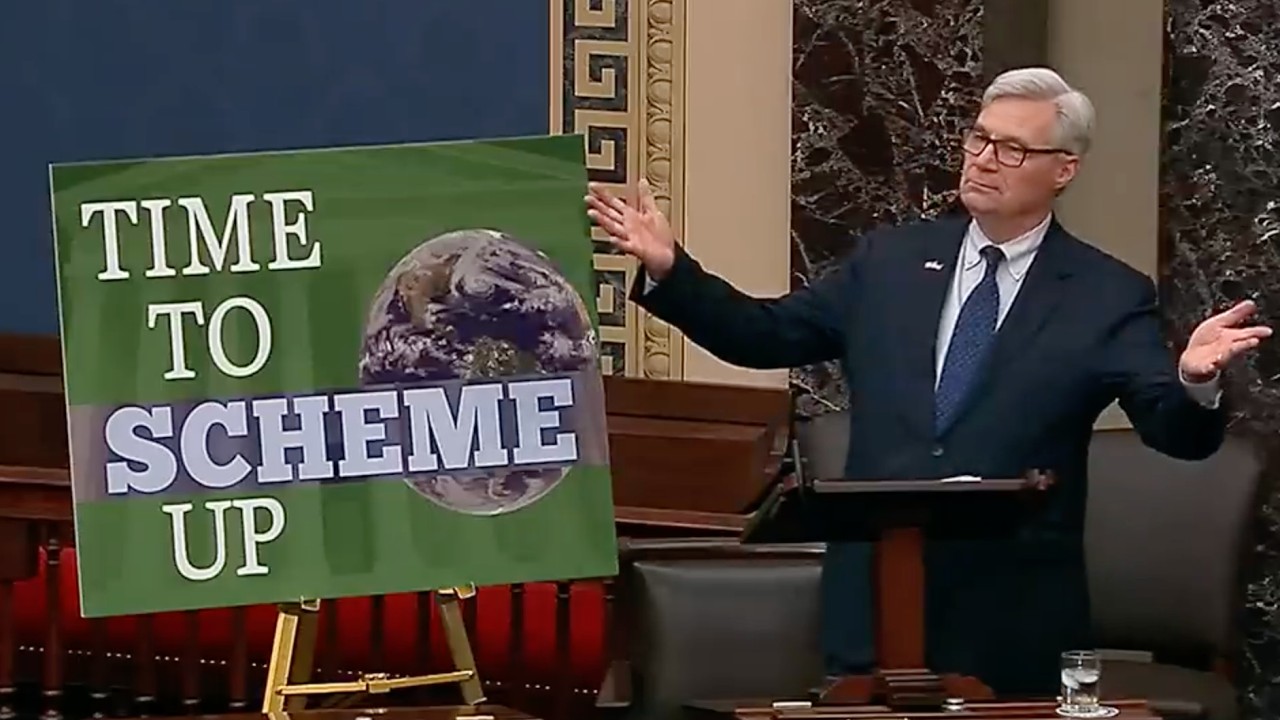
April 22 | Senator Sheldon Whitehouse (D-RI) delivers his 306th speech in his Time to Wake Up series, converging with his 36th Scheme speech. The billionaire-backed scheme to capture and control the Supreme Court was developed largely to protect the fossil fuel industry’s free-to-pollute business model. Here’s the proof.
---
AN 4 26
The U.S. Supreme Court, “nine angry men and women in black robes,” according to Philadelphia Inquirer columnist Will Bunch, has gone “off the rails,” and is now “at war with itself.”
“Almost every day, there are new signs — from shocking news leaks to surprisingly indecorous public jabs, and legal opinions that read like cries for help — that the U.S. Supreme Court is at war … with itself,” Bunch argues. “Looming large over this soft civil war inside one of America’s three branches of government is our most fundamental liberty, the right to vote.”
Pointing to President Donald Trump’s war in Iran, amid its “shaky” ceasefire and “the daily unraveling” of the White House, “the biggest bombshell wasn’t dropped in the Persian Gulf but in the pages of the New York Times.”
Bunch is referring to the widely-cited scoop from the Times‘ Jodi Kantor and Adam Liptak, that reveals the extreme steps Chief Justice John Roberts took to block President Barack Obama’s Clean Power Plan — and expand the powers of the Court via the “shadow docket.”
“For more than a decade now, these emergency rulings have largely constrained Democratic presidents and boosted the power of Donald Trump on major issues,” Bunch writes.
He notes that the Times published a batch of five justices’ secret memos, including those from Roberts, that “exposed the hypocrisy” of the Chief Justice, “who has argued during his two decades overseeing the court that its justices are not political actors but impartial umpires ‘calling balls and strikes,’ based on sound interpretation of the law.”
Bunch states these memos “reveal Roberts as less an umpire and more the manager of a team desperate to win the World Series for corporate America.”
The leaking of the memos, which, to many, cast Roberts in a negative light, “is just the latest in a series of news leaks and public statements coming from the Supreme Court that lack any precedent, legal or otherwise.”
Bunch says the court had already been facing a “crisis of credibility,” given the “revelations of alleged corruption” swirling about Justice Clarence Thomas, and the “billion-dollar efforts by wealthy conservatives to shape and then lobby the court.”
The Times’ report was far from the first leak.
In 2022 came the “Mother of All Leaks” — the draft opinion that would ultimately overturn 1970s’ landmark ruling, Roe v. Wade.
The leaker was never discovered, but “there’s been much speculation that it came from the conservative wing hoping the news coverage would prevent last-minute defections.”
Meanwhile, since the Court’s 2024 decision granting President Donald Trump and all presidents sweeping immunity from criminal prosecution for “official acts,” Bunch writes, “there has been even less decorum and more overt verbal warfare.”
Sometimes, justices publish their snipings inside their opinions, “as when Justice Sonia Sotomayor wrote in response to that ruling on presidential power that POTUS is now ‘a king above the law,’ signing off ‘with fear for our democracy.'”
Bunch says an even more “shocking” event occurred when Sotomayor “lashed out” at Justice Brett Kavanaugh, when she commented that one of his opinions had come from “a man whose parents were professionals. And probably doesn’t really know any person who works by the hour.”
She quickly apologized.
Like the 2022 leak, no one has publicly stated who leaked the secret memos to The New York Times.
But, Bunch surmises, someone “very high in the judicial pyramid is trying to send a ‘bat signal’ to the American public — that things at the nation’s highest court have gone off the rails.”
---
---}:
CONTEXT SHADOW DOCKET EMERGENCY CPP
AN 4 26
Last week, internal memos from an obscure 2016 Supreme Court decision were leaked by The New York Times, showing shocking revelations about Chief Justice John Roberts, who frequently plays a public role as a non-partisan justice, but behind the scenes, he's being exposed for his right-leaning slant.
In an analysis about it on Tuesday, Slate's Dahlia Lithwick and Mark Joseph Stern explained that this ruling is what began the "shadow docket."
AlterNet highlighted a piece by Georgetown University Law School Professor Steve Vladeck last week, calling out the legal flubs. Vladeck, who wrote the book on the "shadow docket," discussed the 2016 ruling, which had zero oversight and made significant changes to the U.S. legal system, all over a power grab in opposition to President Barack Obama's administration.
For years, conservatives have complained about the "shadow docket," calling it judicial secrecy and implying it was "bad motives to a benign emergency procedure that operates according to neutral legal principles," the Slate report said. The newly released memos "reveal exactly why the Republican-appointed justices don’t want to shine public or academic light on this practice: If this leak is any indication, the public would be aghast to see the brazenly political, spin-soaked flimflam that goes into deciding these critical cases."
When the high court stepped in to block the "Clean Power Plan" in 2016 with nothing more than a paragraph, while Justice Elena Kagan blasted it as "unprecedented." But it's the Supreme Court, so this set the new precedent, and what has followed is a decade of anti-green technology. Red states jumped in with a "Hail Mary" to stop the new EPA rules from going into effect and the conservatives on the court agreed.
"At the time, SCOTUS had never before frozen an executive branch policy while an appeals court was still reviewing it (and had already refused to grant a stay)," the legal analysts explained. That was what happened in this case. The D.C. Circuit Court hasn't even heard arguments over the case yet. Meanwhile, because the requirements didn't take effect until 2018, states had years to address them in court. Fossil fuel companies were given six years to prepare.
But the conservative justices still claimed there was a huge sense of urgency, and they needed to step in to stop everything from moving forward.
The leaked memos from Roberts and Justice Stephen Breyer, exchanged with their colleagues, show how they came to the conclusion that it was an "emergency" and that the shadow docket needed to step in.
"Perhaps most shockingly, this correspondence reveals that it was the chief justice who pressed hardest for a swift and sweeping decision, and that his reasoning had far more to do with presidential politics and personal grievance than any majestic legal logic," wrote Stern and Lithwick.
"More than anything, the new reporting puts the lie to the hollow claims of the chief justice sitting astride a mythical 3–3–3 court where his measured centrism guides the nation through partisan times. It is now manifestly clear that Roberts is himself a top partisan operator, especially under the cover of secrecy and internal norms of collegiality and confidentiality," they added.
While Vladeck detailed the legal mistakes in the ruling, Lithwick and Stern bashed Roberts for his catty snit, claiming that Obama shouldn't be able to "transform a substantial swath of the nation’s economy" without it being "tested by this Court before it is presented as a fait accompli. But it seems that the EPA is sufficiently confident of this rule’s immediate implications that not even the combined efforts of Congress and the President could reverse its effects.”
The Slate writers called Roberts' "glib" reaction particularly rich, given he has spent the past decade voting "to let the Trump administration implement a policy with immense, irreversible national consequences before his court has approved it on the merits."
The only way that they can read the comments from Roberts (and supported by Justice Samuel Alito) is that they were somehow offended, Lithwick and Stern said. "That the Obama administration, by way of comments, was somehow disrespecting the high court."
In Alito's memo, he claimed that the regulations would make a “nullity” of the court’s power and “institutional legitimacy," the piece said. Roberts went so far as to attack the EPA administrator, saying that if they didn't stop the rule immediately, then everything would be "functionally irreversible."
It wasn't a personal attack; it was an attack on the court as an institution. "Obama’s EPA was allegedly short-circuiting the court’s much-prized supremacy, and needed to be put in its place," the legal analysts explained.
The result has been the Supreme Court's "profoundly flawed analysis" of how to define an "emergency" so that they can "rubber-stamp policies and practices that seem dubiously meritorious, with adverse effects on millions of people waved away," the analysis closed.
---
---
WE KNOW SCORE ONLY FROM DISSENTS? 6-3
AN 1 26
In its 6-3 ruling in *Vasquez Perdomo v. Noem* handed down on Monday, September 8, the U.S. Supreme Court upheld the way in which the Trump Administration is conducting U.S. Immigration and Customs Enforcement (ICE) raids. A federal court judge in Los Angeles and the 9th Circuit Court of Appeals had ruled that the raids amounted to illegal racial profiling, but the High Court's six GOP-appointed justices disagreed. The three dissenters, meanwhile, were Democratic appointees: Justices Sonia Sotomayor, Ketanji Brown Jackson and Elena Kagan.
:{:{Critics of the Vasquez Perdomo v. Noem ruling range from the American Immigration Council to the America Civil Liberties Union (ACLU) to MSNBC host Ali Velshi, who described the decision as anti-4th Amendment during a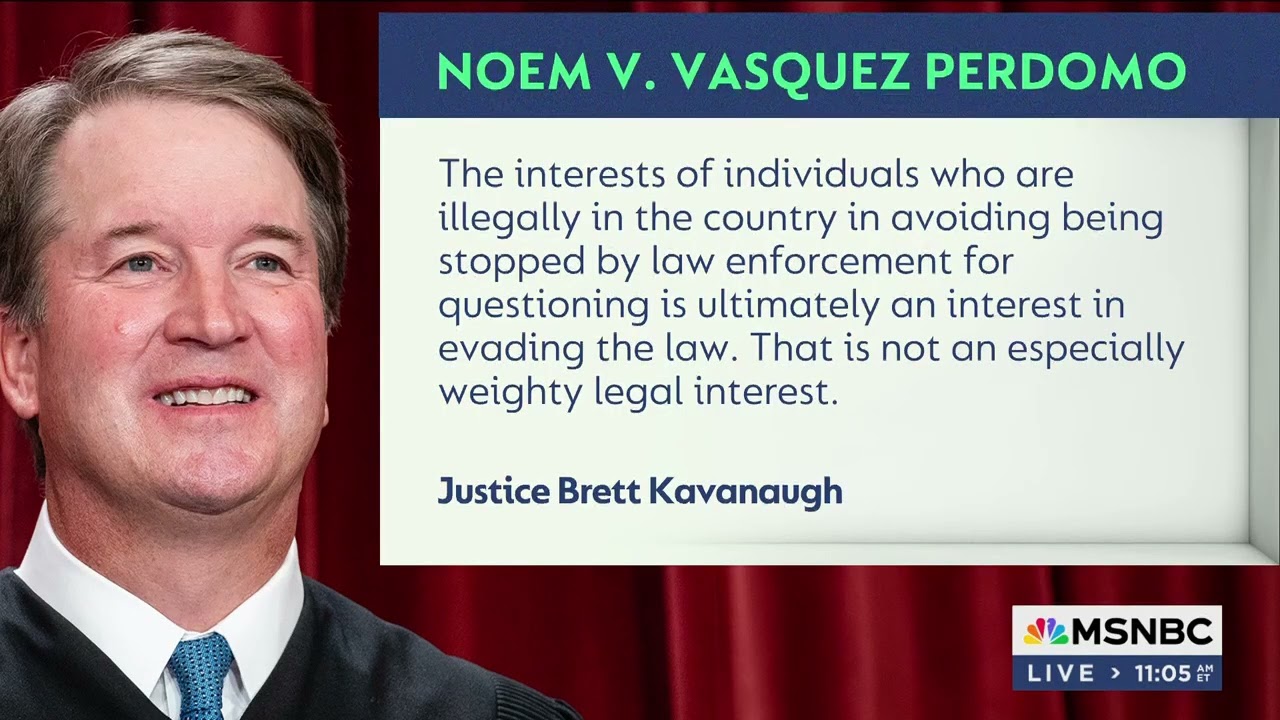 }:
The decision's implications, Velshi warned, go way beyond immigration policy and ICE raids and treat the U.S. Constitution's 4th Amendment as expendable. Ratified in 1791 as part of the Bill of Rights, the 4th Amendment protects against unreasonable search and seizure.
READ MORE:'Doing a pretty terrible job': Trump official mocked over response to dismal economic data
"ICE agents now have the High Court's blessing to racially profile people during immigration sweeps in Los Angeles," Velshi warned. "They're allowed to stop people based solely on their apparent race or ethnicity, language or accent, the type of work they do, where they do it. The 4th Amendment requires reasonable suspicion before anyone, any person, citizen or not, documented or not, can be stopped by law enforcement. The law is not allowed to just guess at that — that because of how you look or speak, or where you live and work, that you might have committed a crime."
Velshi continues, "Equal protection forbids race as a factor. The lower courts enforced that principle; the Supreme Court just erased it. And perhaps the most outrageous part: the conservative majority in the Supreme Court issued their decision using the so-called shadow docket, where the Court rules on Trump Administration emergency motions without oral arguments or explanation — no hearing, no accountability, just judicial fiat handed down in the dark."
However, the MSNBC host, who is originally from Canada, stressed that "this ruling isn't about immigration" and has "broader implications."
"It tells millions of Americans that your protection from unreasonable search and seizure depends on whether the government decides you look like you belong, which is not what the Constitution's Framers envisioned, I hope — certainly not democracy as we have come to know it in this country," Velshi told viewers. "Consider Brian Gavidia, a U.S. citizen from East Los Angeles — who voted for (Donald) Trump, by the way…. He says federal agents shoved him against a fence, twisted his arm, and demanded to know which hospital he was born in. All because he looked Latino. This is the new normal that the Court has sanctioned."
READ MORE:'Republican for Trump': Alleged Kirk shooter's grandmother confirms entire family is MAGA
Velshi attacked Justice Brett Kavanaugh's reasoning in Vasquez Perdomo v. Noem as "hollow," stressing, "Rights are not conditional favors granted after innocence is proven — they are the shield against arbitrary suspicion in the first place. Kavanaugh's distorted logic seems to suggest that if you're brown, you're guilty of an immigration violation until you're proven innocent…. That's not just sloppy logic, it's dangerous….. It's not that the conservative justices don't understand the Constitution; it's that they don't care…. Once the 4th Amendment is treated as negotiable for one group — Latino communities, brown people, in this case — it becomes weaker for all of us."
---
===
SHADOW DOCKET PROTECT DOGE FROM FOIA? MAK REPT MARK JOS STERN, GOT OUR DATA
---
---
AN 7 25
During the first six months of President Donald Trump's second term, the Supreme Court has frequently issued emergency docket (also known as the "shadow docket") rulings that have usually gone Trump's way. And at least one justice is admitting that the shadow docket is not popular even among his own colleagues.
According to a Thursday evening report in the Daily Beast, Justice Brett Kavanaugh — who Trump appointed to the Court in 2018 – spoke about the Roberts Court's shadow docket rulings during a recent conference in Missouri. Kavanaugh acknowledged that the shadow docket's brief decisions that rarely offer details on why the justices ruled the way they did is a divisive topic among the nine members of the High Court.
"I think there are different views among members of the court about when to do it and when not," he said. "We’re nine independent people."
READ MORE:'This is a good one right?' Epstein victim recalled being introduced to Trump at age 14
"There can be a risk in writing the opinion of lock-in effect – of making a snap judgment and putting it in writing, in the written opinion, that is not going to reflect the final view," he added.
The Brennan Center for Justice explained that while the Supreme Court's "merits docket" happens during its regularly scheduled term, and has decisions that are thoroughly explained in detail, the shadow docket decisions usually happen between terms, and come with little to no explanation. And while merits docket cases are accompanied by briefings publicly submitted by both plaintiffs and respondents and have oral arguments, shadow docket decisions have neither briefings nor hearings, and can sometimes be handed down in the middle of the night.
One recent controversial shadow docket ruling — in which the Court's six conservatives voted as a united bloc — allowed the Trump administration to hollow out the Department of Education. That ruling overturned a previous decision by a lower court judge, and gave no reasoning for its decision. And after another 6-3 shadow docket ruling allowing Trump to fire three Democratic appointees on the National Labor Relations Board and the Merit System Protection Board, Justice Elena Kagan (appointed by former President Barack Obama) slammed both that decision and the Roberts Court's reliance on the shadow docket.
"Once again, this Court uses its emergency docket to destroy the independence of an independent agency, as established by Congress," Kagan said.
---
an 7 25
Anyone wanting to understand the brouhaha over Pam Bondi’s refusal to turnover (or even acknowledge) the Epstein files need look no further than what the Supreme Court just did.
In McMahon v. New York the Supremes gave Trump a simple way to revoke federal spending authorized by Congress: just fire everyone responsible for implementing that spending.
The high court is allowing Trump and Education Secretary Linda McMahon to fire over half the people who work for the Department of Education until there’s a full hearing on the constitutionality of their action. But by then it will be too late to save much of the department.
Note that the Supreme Court made this astounding decision on its so-called “shadow docket” where it doesn’t even have to explain itself (the only record we have is Justice Sotomayor’s dissent).
No matter that Congress created the Department of Education; apparently, Trump can effectively end it. No matter that Congress in the 1974 Impoundment Control Act prohibits a president from unilaterally refusing to spend money that has been authorized by Congress; apparently, Trump can disregard the Act.
Trump now has unbridled power to repeal federal laws by the simple expedient of firing federal employees who implement them.
Why? How? On what basis? Who’s behind this? We don’t know. We may never know.
Which gets us to the brouhaha over Jeffrey Epstein.
For years, Trump has talked darkly of a “deep state” — a secret cabal intent on destroying America by harming the nation’s children.
Such as, perhaps, six justices who let him shut down the Education Department without even setting out their reasons?
Recall “Pizzagate,” the QAnon conspiracy theory that in 2016 allegedly linked Democrats to a ring of child sex-traffickers. It’s still around but has morphed into a less partisan conspiracy theory involving an alleged worldwide elite of child sex-traffickers.
Jeffrey Epstein and his death fit perfectly. Many right-wing media personalities have posited that the billionaire convict was murdered in prison as part of a cover-up of a sprawling sex-trafficking conspiracy.
Senior Trump administration officials built up great fanfare around the release of the supposed Epstein “client list.”
Even JD Vance accused the government of hiding the list. “If you’re a journalist and you’re not asking questions about this case,” Vance said, “you should be ashamed of yourself.”
But that was back in 2021, before Vance became part of the, um, conspiracy.
In February of this year, Attorney General Pam Bondi acknowledged the existence of Epstein’s client list. She said the client list is “sitting on my desk right now.”
Now the Trump-Vance administration says Epstein’s client list doesn’t exist.
The Epstein case illustrates Trump’s “deep state” no less than does an unsigned “shadow docket” Supreme Court decision allowing Trump to wipe out the Department of Education.
The phrase “Epstein didn’t kill himself” — a rebuttal to the official explanation of Epstein’s death — has taken on a cultural meaning way beyond the facts of the case. It means an unaccountable elite doing evil things in secret.
Trump built his political base on that premise. Once in office, he said time and again, he would expose that unaccountable, secret, evil elite.
No wonder 70 percent of voters believe “law enforcement is withholding information about powerful people connected to Epstein,” including 61 percent of Trump voters. And 58 percent of voters said Trump “maybe was or definitely was” involved in a cover-up.
Conspiracy theories thrive when elites act in secret. I have no idea whether Epstein killed himself or was murdered. But Wired Magazine’s metadata — showing that the FBI’s “raw” surveillance video from the night Epstein killed himself is seemingly missing 2 minutes and 53 seconds — got my attention.
As did the Supreme’s bonkers secret decision in McMahon.
And I’m no conspiracy theorist.
After hyping the promised release, a joint FBI and Department of Justice report last week said they had found no evidence of a list — or that Epstein, who died by suicide in his prison cell in 2019, had been murdered — prompting outcry from within MAGA circles.
As Bondi faces heightened scrutiny for her repeated attempts to dodge questions about the Epstein files, Loomer also teased that “there are people in the White House who agree with me that Pam [Bondi] spent too much time on Fox News and her statements were inconsistent and undermined what messaging is today about the Epstein files.”
Other prominent MAGA-aligned supporters of the president have also warned that Trump could see significant damage to his standing among his base if he does not change course.
Sixty-three percent of voters in a Quinnipiac University national poll released Wednesday said that they disapproved of Trump’s handling of the files. Republicans were also nearly split. Just 40 percent said they support how he’s handled the files, with 36 percent disapproving and another 20 percent not offering an opinion.
Mike Flynn — who briefly served as Trump’s national security adviser in his first term — wrote in a lengthy X post on Wednesday that Trump needed to “gather your team and figure out a way to move past this.”
“The roll out of this was terrible, no way around that,” Flynn wrote. “Americans want America to be successful, therefore, WE NEED YOU TO BE SUCCESSFUL.”
Elon Musk — with whom Trump had a blowup fight last month in which Musk accused Trump of being named in the Epstein files — criticized his former boss for trying to paint the whole situation as a hoax.
“He should just release the files and point out which part is the hoax,” Musk wrote on X Wednesday.
The MAGA meltdown over Epstein “could be his Afghanistan going into the fall,” Mark Mitchell, head of polling and operations at Rasmussen Reports, told Steve Bannon Tuesday on his “War Room” podcast.
“People are trying to say this isn’t a big deal,” Mitchell said. “People are trying to say nobody wants this Epstein information out. It’s an absolute misdirection. This is horrifying. And if it isn’t corrected, it threatens derailing Trump’s agenda, getting rid of his political capital.”
“This is not about a guy who died in 2019, this is about a representation of two-tier justice and about unaccountable government,” Mitchell told Bannon.
On Wednesday, conservative political commentator John Solomon told Bannon that he had interviewed the president, and that Trump supported the appointment of a special prosecutor to investigate elements of the Epstein case as part of a broader look into a supposed deep state conspiracy to punish the Republican Party.
“I think he’s frustrated by all the social media chatter by people who don’t really know what’s in the Epstein files,” Solomon said. “He was very pointed about that, let’s stay focused on the things that matter to the American people. ‘I want the answers to Epstein like everyone’, he said, so let the prosecutor do that.”
The Epstein fiasco also prompted Speaker Mike Johnson to split with Trump on Tuesday, calling for the Department of Justice to release all the information it has on the sex offender in the name of “transparency.”
“It’s a very delicate subject, but you should put everything out there, let the people decide it,” Johnson told conservative commentator Benny Johnson, adding that Bondi should explain her previous claims of having the elusive Epstein “client list.”
Just a day prior, the Louisiana Republican had defended Bondi, choosing to defer to the Trump administration instead of criticizing the attorney general.
But Trump appears to remain unmoved despite growing rebellion within his MAGA cohort.
In the Oval Office on Wednesday, Trump repeated his claims that the whole ordeal was a “hoax” peddled by Democrats and once again defended Bondi’s handling of the case.
“She’s done very good. She says ‘I gave you all the credible information,’ and if she finds any more credible information, she’ll give that too. What more can she do than that?” Trump said, adding that he had “lost a lot of faith in certain people” over their outcry on the administration’s approach to the issue.
---
---
an truthdig 6 25
In an unsigned two-page decision (*Trump v. Wilcox*) released on May 22, the Supreme Court upheld the Trump administration’s move to fire members of the National Labor Relations Board and the Merit Systems Protection Board without cause and in the middle of their designated terms. The decision reversed two separate judgments issued by two different D.C. District Court judges that had blocked the firings as unconstitutional.
The Supreme Court’s ruling was issued on an expedited basis as part of a rapidly expanding and highly controversial set of truncated decisions known as the “shadow docket,” a term coined by University of Chicago professor William Baude in a 2015 law review article to describe emergency appeals that come before the court outside of its standard “merits” docket and that are typically resolved without complete briefing, oral arguments or detailed opinions. Although shadow-docket rulings are frequently used to lift, or “stay,” lower-court injunctions while further litigation continues, they often have the same practical effect as final decisions.
The two officials involved in the Wilcox case, Gwynne Wilcox of the NLRB and Cathy Harris of the MSPB, were nominated to their positions by President Joe Biden and were confirmed by the Senate. Before their dismissals, they were set to serve fixed terms, with Wilcox’s tenure expiring in 2028 and Harris’ in 2029.
The NLRB’s five-member governing board is charged with enforcing U.S. labor law and collective bargaining, and adjudicating alleged unfair labor practices. The MSPB has a three-member board and adjudicates federal employee challenges to adverse employment actions. Both agencies were established by Congress to operate as independent, nonpartisan overseers free from presidential interference.
Donald Trump has long railed against agency independence. In a 2019 speech at Turning Point USA’s Teen Action Summit, he declared, “I have an Article 2, where I have the right to do whatever I want as president,” referring to the second article of the Constitution and the “unitary executive” theory, which contends that all executive power is concentrated in the president. Trump is also a proponent of the goal of “deconstructing the administrative state,” a phrase popularized by Steve Bannon and more recently promoted by Project 2025.
Donald Trump has long railed against agency independence.
Sensing an opportunity to strike, Trump fired Wilcox, a career labor attorney, on Jan. 27, a week after his second inauguration. Harris was sent packing a month later. The lower-court orders mandating their reinstatements were issued in March. But on April 9, Trump’s solicitor general and former criminal defense attorney D. John Sauer requested the Supreme Court to intervene and put the district-court judgments on hold, allowing the dismissals to take effect while returning the cases to the district courts and the Court of Appeals for additional hearings, a process that could easily take more than a year.
In his petition to the Supreme Court, Sauer implored the justices to disregard the court’s 1935 precedent decision in Humphrey’s Executor v. United States, which held that Congress has the constitutional power to enact laws limiting the president’s authority to fire executive officers of independent agencies that exercise quasi-legislative or quasi-judicial functions. Sauer asked the justices to put the lower-court reinstatement orders on hold or, alternatively, issue a final decision on the merits, endorsing the administration’s actions.
Although the firings of Wilcox and Harris clearly ran afoul of Humphrey’s, the Supreme Court granted a stay, and both women were sacked. Just as shocking, the court did so without hearing oral arguments, and without citing Humphrey’s a single time in its decision.
The three Democratic-appointees on the court dissented. Writing for herself and justices Sonia Sotomayor and Ketanji Brown Jackson, Justice Elena Kagan blasted her Republican colleagues for their bad faith and bias in favor of the president. “For 90 years,” she charged, “Humphrey’s Executor v. United States … has stood as a precedent of this Court. And not just any precedent. Humphrey’s undergirds a significant feature of American governance: bipartisan administrative bodies carrying out expertise-based functions with a measure of independence from presidential control.”
Quoting Alexander Hamilton, she continued, “To avoid an arbitrary discretion in the courts, it is indispensable that they should be bound down by strict rules and precedents.” Without mentioning the shadow docket by name, she castigated the majority for rushing to judgment, “unrestrained by the rules of briefing and argument — and the passage of time — needed to discipline our decision-making.”
Although the Supreme Court has a long history of entertaining emergency appeals — such as last-minute requests for stays of execution in death penalty cases — emergency requests in high-profile cases proliferated during Trump’s first term, earning the shadow-docket sobriquet. According to Georgetown University law professor and shadow-docket scholar Steve Vladeck, the first Trump administration sought emergency relief 41 times, with the Supreme Court granting relief in 28 of those cases. By comparison, the George W. Bush and Barack Obama administrations filed a combined total of eight emergency relief requests over a 16-year period.
In December 2017, the Supreme Court issued a shadow-docket ruling allowing the third and final version of Trump’s racist Muslim travel ban to move forward pending further appeals. The court ultimately approved the ban in a 2018 merits decision. Later in Trump’s first go-round, the court used the shadow docket to uphold Trump’s executive actions calling for the diversion of federal funds to construct the southern border wall, prohibiting transgender people from openly serving in the military and restricting the ability of Central American refugees to seek political asylum.
During Biden’s presidency, the shadow docket shifted to emergency requests filed by red state governments and private parties, but the court maintained its rightward bias. Among other shadow-docket decisions, the court ended Biden’s COVID-19 eviction moratorium; permitted the new six-week Texas abortion ban to take effect (it would later approve the ban in a final decision that overturned *Roe v. Wade*); and reinstated a first-Trump-term policy that made it easier for companies to pursue projects that pollute U.S. waters.
“What we are seeing are the consequences of a deeply conservative court.”
Kagan is not alone in her critique that the shadow docket undermines precedent and lacks transparency. At times the criticism has become heated. In September 2021, Atlantic staff writer Adam Serwer triggered an open feud with Justice Samuel Alito, penning a column that accused the court’s right-wing majority of publishing its ruling on Texas’ abortion law in the middle of the night to minimize public outcry. In response, Alito excoriated the media during an hour-long live-streamed speech delivered at Notre Dame University for portraying the court’s majority as “a dangerous cabal that resorts to sneaky and improper methods to get its ways,” and for feeding “unprecedented efforts to intimidate the court or damage it as an independent institution.”
Fortunately, not every shadow-docket order has leaned in the direction of Trump and the MAGA movement. One notable exception was the court’s May 16 ruling that extended an earlier ban on the deportation of undocumented Venezuelan men in immigration custody in Texas under the Alien Enemies Act of 1798. But even that decision ended with a note of encouragement for Trump, advising that “The Government may remove the [men] … under other lawful authorities.” There was also an impassioned 14-page dissent written by Alito and joined by Justice Clarence Thomas.
On May 30, the court issued another pro-Trump shadow-docket order, allowing the Trump administration to revoke the temporary legal status of more than 500,000 immigrants from Cuba, Haiti, Nicaragua and Venezuela that had been granted by the Biden administration. And in the coming weeks and months, the court can be expected to return to the shadow docket again in cases involving the deportation of undocumented migrants to South Sudan, the operations of the Department of Government Efficiency (DOGE) and possibly the legality of Trump’s tariffs.
Given the court’s overall jurisprudence, there is scant reason to be optimistic that it will openly repudiate or substantially limit the president’s authority in these or other cases critical to the nation’s future. As Elizabeth Wydra, president of the liberal Constitutional Accountability Center, told Reuters in a 2021 interview, “What we are seeing are the consequences of a deeply conservative court, with the added travesties of the shadow docket.”
---
https://www.alternet.org/supreme-court-2659941059/
no lnx tom b raw 5 23
according to a leading expert on federal law, the current conservative-majority Supreme Court has gone to extraordinary lengths to issue emergency orders at a historically high rate on hot-button issues, and that is raising concerns about their so-called "shadow docket."
In an interview with the Atlantic's Adam Serwer, University of Texas School of Law professor Steve Vladek expressed dismay at how the court has been handling its workload and said the uptick in emergency orders -- many unsigned and lacking legal reasoning -- is creating chaos for the lower courts because they are devoid of guidance for future cases.
As Vladek notes, emergency orders used to be much rarer and mainly deployed in death penalty cases prior to imminent executions.
Under the current court, they have been used to interfere with Covid-19 mandates and a host of other hot-button issues including abortion rights.
As he explained to Serwer, the highest court is leaving the lower courts wondering how to administer justice and on what basis.
"I think the lower courts are in a bit of a sticky wicket, because in some of these cases, especially in the COVID religious-liberty cases, the Supreme Court has been instructing lower courts that its unsigned, unexplained orders are precedential—and that lower courts are erring, as the Court says in one case of the Ninth Circuit, by not following rulings where there was no majority rationale," he explained.
He added, "I think we’re seeing a bit of a smorgasbord where some lower courts are just following what the Supreme Court has said, and some are just throwing up their hands and saying, Without more guidance from the Supreme Court, I’m just sort of stuck here," before offering, "That’s perhaps the biggest point on which there ought to be consensus: Leaving aside who wins and who loses, the less the Supreme Court explains itself in this context, the harder it is for the relevant actors, for the lower courts, for the relevant government officials, to understand what their responsibilities are."
"I think it’s really hard to look at the overall data set and compare, for example, the October 2020 term to the last two terms and not see pretty significant shifts in at least how some of the justices are behaving," he concluded.
You can read more here.
FROM YOUR SITE ARTICLES
How South Carolina ended up with an all-male Supreme Court ›
'That or the highway': Elie Mystal says Congress should threaten Supreme Court funding to enforce ethics code ›
Scathing parody mocks Supreme Court justices’ excuses for dodging ethics code ›
---