Rice, Condi
NO MERRI
PENSION? SINECURE HOOVER DUBYA INST
Hoover Institution: She is the current Director of the  Hoover Institution at Stanford University.
chevron board, SHULTZ SEAT , MANY OTHERS
INTERN RAND
named a tanker for her
green VC ?
Condoleza Rice, National Security Adviser
Rice sat on the boards of broker Charles Schwab, insurance giant Transamerica Corp., and Chevron, where her name now graces a 130,000-ton oil tanker.
===
endorse trump fail IRAN WAR 6 26?!
Former Secretary of State Condoleezza Rice was spotted at the White House attending a roundtable discussion on college sports in the East Room on March 06, 2026 after Trump launched a war with Iran.
...
Former Secretary of State Condoleezza Rice was spotted at the White House on Friday as President Donald Trump demanded “unconditional surrender” by Iran.
The timing of Rice’s visit to 1600 Pennsylvania Avenue turned heads as she served as national security adviser to President George W.
BEAST
The Daily Beast
Key Iraq War Architect at White House as Iran War Rages
Sarah Ewall-Wice
:{:{Fri, 6 March 2026}:
Former Secretary of State Condoleezza Rice was spotted at the White House attending a roundtable discussion on college sports in the East Room on March 06, 2026 after Trump launched a war with Iran.
Former Secretary of State Condoleezza Rice was spotted at the White House on Friday as President Donald Trump demanded “unconditional surrender” by Iran.
The timing of Rice’s visit to 1600 Pennsylvania Avenue turned heads as she served as national security adviser to President George W. Bush and was a major proponent for the Iraq invasion in 2003, while claiming Iraq was lying about disarmament.
Rice went on to serve as Bush’s secretary of state from 2005 to 2009 throughout the ongoing Iraq War.
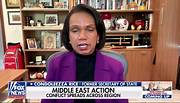
The former top Republican administration official has not served in the government for some time, but just Thursday, Rice appeared on Fox News, where she urged President Donald Trump to take care of Iran once and for all.
She also made some of the same arguments as the White House for “Operation Epic Fury” despite the death toll rising and the war escalating as Iran strikes countries throughout the region in retaliation for the U.S. attack.
“The most important thing is to recognize that Iran has been at war with us for at least 47 years, all the way from 1979,” Rice told Special Report with Bret Baier.
She insisted that to say the Iran regime is not a threat is “ahistorical” and said “they have been a threat for a long time.”
The former secretary of state noted that there is “uncertainty with any military operation and what the aftermath might be.”
While Rice acknowledged there are concerns about what comes next, she argued: “If you can render Iran essentially incapable of military action against us and against our allies, that’s worthy, and I think what they’re trying to do is to neuter Iran as a military power in the region.”
The former top Bush official did say she believes the question of making sure the administration does not unintentionally expand on the operation’s goals, or get “mission creep,” was important, but insisted taking care of Iran’s military capabilities is very important.
More in Politics
National Security Expert Ben Rhodes Explains How Trump’s ‘Stupid’ Iran Move Backfired on Him
The Daily Beast
86
Scott Pelley Accuses Bari Weiss Of 'Putting A Thumb On The Scale' For Trump
HuffPost
Bill Maher Invites Mike Pence to Get High as F*ck With Him on Podcast
Mediaite
The very next day, Rice showed up at the White House. The former secretary of state was a participant on Friday at a roundtable on college sports with Trump.
After she left the Bush administration, Rice, a known sports enthusiast, went on to become one of the inaugural members of the College Football Playoff selection committee and is even a partial owner of the Denver Broncos.
During the event, the president praised her as a “champion of college athletics” and “really respected.” She could be seen seated at the table listening, but did not speak.
The Daily Beast asked the White House if Rice had any other meetings with Trump officials during her visit.
At the end of the roundtable, cameras captured her shaking hands with Trump and then exiting the room with him and White House Chief of Staff Susie Wiles.
---}:
---
NZMX
Former Secretary of State Condoleezza Rice says the war with Iran has fundamentally reshaped the Middle East in America's favor, leaving Tehran weaker, Israel stronger, and President Donald Trump with a historic opportunity to secure long-term regional stability.
Writing in The Wall Street Journal, Rice argued that while the conflict has yet to produce a decisive military victory, it has achieved critical strategic goals.
"The three-month military campaign degraded Iran's ability to project power," Rice wrote, pointing to damage inflicted on Iran's conventional forces, missile stockpiles, and proxy networks.
The biggest winner, she said, is Israel.
"In this regard, Israel has never been more secure," Rice wrote, noting that Jerusalem's military response following Hamas' Oct. 7, 2023, terrorist attack severely weakened Iranian-backed terrorist groups, including Hamas and Hezbollah.
Rice also said the war accelerated cooperation among the United States, Israel, and key Arab nations through intelligence sharing and joint defense efforts.
Many Arab governments that once opposed Israel now view cooperation with the Jewish state as beneficial for economic growth, technology, and modernization.
The former secretary of state argued that the conflict also exposed major weaknesses inside Iran. The regime's leadership was shown to be vulnerable to American military power and allied intelligence capabilities, while Tehran's leverage over global energy markets proved more limited than many believed.
Most important, Rice contended, U.S. and Israeli military operations significantly delayed Iran's nuclear ambitions.
"It will be a long time before Iran can build a viable nuclear weapon," she wrote.
While Iran may still possess stockpiles of highly enriched uranium, Rice argued that key nuclear infrastructure, conversion facilities, centrifuge networks, and leading scientists were devastated during the campaign.
Rice urged the Trump administration to resist calls for sanctions relief or concessions in future negotiations.
"Not a single penny of frozen assets or sanctions relief should go to Tehran," she wrote, warning that Iran previously used such funds to rebuild its military capabilities and support terrorist proxies.
She also called for continued military readiness and deeper intelligence cooperation with regional allies to ensure Iran cannot rebuild its nuclear or missile programs.
While acknowledging that the conflict has not toppled the Iranian regime, Rice said Tehran is weaker and more isolated than at any point in recent years.
"Strategic patience is hard, and it isn't always satisfying. But time is on the side of the U.S. and its allies," Rice wrote. "Reaching no deal is fine. Reaching a bad deal isn't."
Related Stories:
- Trump Won't Break Iran Ceasefire Unless US Troops Are Killed: WSJ
- Iran Leader Claims US, Israel Suffered 'Decisive Blow'
---
db?
Mar. 6 2026
Former Secretary of State Condoleezza Rice was spotted at the White House on Friday as President Donald Trump demanded “unconditional surrender” by Iran.
The timing of Rice’s visit to 1600 Pennsylvania Avenue turned heads as she served as national security adviser to President George W. Bush and was a major proponent for the Iraq invasion in 2003, while claiming Iraq was lying about disarmament. Rice went on to serve as Bush’s secretary of state from 2005 to 2009 throughout the ongoing Iraq War.
The former top Republican administration official has not served in the government for some time, but just Thursday, Rice appeared on Fox News, where she urged President Donald Trump to take care of Iran once and for all.
She also made some of the same arguments as the White House for “Operation Epic Fury” despite the death toll rising and the war escalating as Iran strikes countries throughout the region in retaliation for the U.S. attack.
Read more: https://www.msn.com/en-us/news/politics/key-iraq-war-architect-at-white-house-as-iran-war-rages/ar-AA1XGDyH
---
6 26 duck
New York Post
Ex-Secretary of State Condoleezza Rice says Trump needs to 'take care ...
Mar 5, 2026Former Secretary of State Condoleezza Rice urged President Trump to "take care of Iran for good," praising the bold military action — Operation Epic Fury — that resulted in the death of ...

Fox News
Condoleezza Rice says Iran strikes aim to 'neuter' its military ...
8:55
Mar 5, 2026Former Secretary of State Condoleezza Rice praised the Trump administration's Operation Epic Fury that aims to neuter Iran's military power.

The Hill
https://thehill.com › policy › international › 5910745-rice-us-iran-conflict
Condoleezza Rice praises US efforts against Iran in op-ed
1:00
3 days agoFormer Secretary of State Condoleezza Rice on Wednesday said the U.S.-Israeli conflict in Iran has left behind a "weaker, more confused" regime in charge of the Middle Eastern country. …
The Independent
Iraq War architect Condi Rice heaps praise on Trump admin for Iran ...
Jun 27, 2025Iraq War architect Condi Rice heaps praise on Trump admin for Iran strikes Bush era official says bombing raid delivered 'shot in the arm for American credibility' but president unlikely to ...
MSN
Condoleezza Rice: With Iran war, Israel has never been more secure
Former Secretary of State Condoleezza Rice says the war with Iran has fundamentally reshaped the Middle East in America's favor, leaving Tehran weaker, Israel stronger, and President Donald Trump ...

inkl
Iraq War architect Condi Rice heaps praise on Trump... - inkl
Jun 27, 2025Former secretary of state Condoleezza Rice, who was a key player in the George W Bush administration during the War on Terror, has praised President Donald Trump 's decision to launch airstrikes against Iranian nuclear targets in support of Israel 's Operation Rising Lion offensive.

internewscast.com
Condoleezza Rice Urges Trump to Address Iran with a Lasting Solution
Mar 5, 2026Condoleezza Rice, the former U.S. Secretary of State, characterized the Trump administration's Operation Epic Fury as a strategic effort to diminish Iran's military influence both within its own borders and internationally, including its connections with Hezbollah. During an appearance on "Special Report" on Wednesday, Rice commended the collaborative U.S.-Israeli military actions ...
Daily Beast
https://www.thedailybeast.com › key-iraq-war-architect-at-white-house-as-iran-war-rages
Key Iraq War Architect at White House as Iran War Rages
Mar 7, 2026Former Secretary of State Condoleezza Rice was spotted at the White House attending a roundtable discussion on college sports in the East Room on March 06, 2026 after Trump launched a war with Iran.

The National Desk
Former state secretary says Trump is trying to 'neuter' Iran's military ...
Mar 5, 2026Condoleezza Rice, who served as a state secretary under former President George W. Bush, said the Trump administration is trying to "neuter" Iran's military.
Newsmax
https://www.newsmax.com › newsfront › condoleezza-rice-iran-weak › 2026 › 06 › 04 › id › 1258540
Condoleezza Rice: With Iran War, Israel Has Never Been More Secure
3 days agoFormer Secretary of State Condoleezza Rice says the war with Iran has fundamentally reshaped the Middle East in America's favor, leaving Tehran weaker, Israel stronger, and President Donald Trump with a historic opportunity to secure long-term regional stability.
More results
- Generate answer for CONDALEEZ RICE CONDI IRn war trump
---
an 2 23
https://www.alternet.org/these-conflicts-always-come-home/
---
STANFORD ADMIN
In the fall of 1964, Casper emigrated to the United States and spent two years as an assistant professor of political science at the University of California, Berkeley. In 1966, he joined the faculty of the University of Chicago Law School. Between 1979 and 1987, he served as dean of the law school. In 1989, Casper was appointed provost of the University of Chicago and served in that capacity until 1992. He served as president of Stanford University from 1992 to 2000.
Casper also has the honor of having been the subject of the first Google search by someone not a part of the Google team. In 1998, the future founders of Google were demonstrating their search software for John Hennessy. He chose to search for "Gerhard Casper".[23]
ALI
. Some legal scholars and jurists, including the late Supreme Court Justice Antonin Scalia, as well as some conservative commentators, have raised concerns that ALI's work constitutes judicial lawmaking rather than a neutral restatement of existing law.[4][5] ENDIT
During George W. Bush's 2000 presidential election campaign, Rice took a one-year leave of absence from Stanford University to serve as his foreign policy advisor. The group of advisors she led called itself the Vulcans in honor of the monumental Vulcan statue, which sits on a hill overlooking her hometown of Birmingham, Alabama. Rice would later go on to give a noteworthy speech at the 2000 Republican National Convention. The speech asserted that "... America's armed forces are not a global police force. They are not the world's 911."[33][60][61]
...
Private sector
Rice headed Chevron's committee on public policy until she resigned on January 15, 2001, to become National Security Advisor to President George W. Bush. Chevron honored Rice by naming an oil tanker Condoleezza Rice after her, but controversy led to its being renamed Altair Voyager.[49][50]
Rice has served as an instructor at MIT Seminar XXI.[51] She also served on the board of directors for the Carnegie Corporation, Charles Schwab Corporation, Chevron Corporation, Hewlett-Packard, Rand Corporation, Transamerica Corporation, and other organizations.
In 1992, Rice founded the Center for New Generation, an after-school program created to raise the high school graduation numbers of East Palo Alto and eastern Menlo Park, California.[52] After her tenure as secretary of state, Rice was approached in February 2009 to fill an open position as a Pac-10 Commissioner,[53] but chose instead to return to Stanford University as a political science professor and the Thomas and Barbara Stephenson Senior Fellow on Public Policy at the Hoover Institution.
In 2014, Rice joined the Ban Bossy campaign as a spokesperson advocating leadership roles for girls.[54][55]
On July 11, 2022, the Denver Broncos announced that Rice had joined the Walton-Penner ownership group (consisting of S. Robson Walton, Greg Penner, Carrie Walton Penner, Mellody Hobson, and Sir Lewis Hamilton), which recently agreed to buy the NFL team for $4.65 billion.[56] On August 9, 2022, the NFL owners approved the purchase of the Denver Broncos by the Walton-Penner group.[57]
...
National Security Advisor (2001–2005)
[ ](https://en.wikipedia.org/wiki/File:Condoleezza_Rice_Colin_Powell_George_W._Bush_Donald_Rumsfeld.jpg)Rice, Secretary of State Colin Powell, and Secretary of Defense Donald Rumsfeld listen to President George W. Bush speak about the Middle East on June 24, 2002.
On December 16, 2000, Rice was named as National Security Advisor,[62] upon which she stepped down from her position at Stanford.[63] She was the first woman to occupy the post. Rice earned the nickname of "Warrior Princess", reflecting strong nerve and delicate manners.[64]
On January 18, 2003, The Washington Post reported that Rice was involved in crafting Bush's position on race-based preferences. Rice has stated that "while race-neutral means are preferable", race can be taken into account as "one factor among others" in university admissions policies.[65]
Terrorism
During the summer of 2001, Rice met with CIA director George Tenet to discuss the possibilities and prevention of terrorist attacks on American targets. On July 10, 2001, Rice met with Tenet in what he referred to as an "emergency meeting"[66] held at the White House at Tenet's request to brief Rice and the NSC staff about the potential threat of an impending al Qaeda attack. Rice responded by asking Tenet to give a presentation on the matter to Secretary Donald Rumsfeld and Attorney General John Ashcroft.[67]
Rice characterized the August 6, 2001, President's Daily Brief Bin Ladin Determined To Strike in US as historical information. Rice indicated "It was information based on old reporting."[68] Sean Wilentz of *Salon* magazine suggested that the PDB contained current information based on continuing investigations, including that Bin Laden wanted to "bring the fighting to America."[69] On September 11, 2001, Rice was scheduled to outline a new national security policy that included missile defense as a cornerstone and played down the threat of stateless terrorism.[70]
[ ](https://en.wikipedia.org/wiki/File:President_George_W._Bush_addresses_the_media_at_the_Pentagon_on_Sept._17,_2001.jpg)President Bush addresses the media at the Pentagon on September 17, 2001.
When asked in 2006 about the July 2001 meeting, Rice asserted she did not recall the specific meeting, commenting that she had met repeatedly with Tenet that summer about terrorist threats. Moreover, she stated that it was "incomprehensible" to her that she had ignored terrorist threats two months before the September 11 attacks.[66]
In 2003, Rice received the U.S. Senator John Heinz Award for Greatest Public Service by an Elected or Appointed Official, an award given out annually by Jefferson Awards.[71]
In August 2010, Rice received the U.S. Air Force Academy's 2009 Thomas D. White National Defense Award for contributions to the defense and security of the United States.[72]
Subpoenas
In March 2004, Rice declined to testify before the National Commission on Terrorist Attacks Upon the United States (the 9/11 Commission). The White House claimed executive privilege under constitutional separation of powers and cited past tradition. Under pressure, Bush agreed to allow her to testify so long as it did not create a precedent of presidential staff being required to appear before Congress when so requested.[73] In April 2007, Rice rejected, on grounds of executive privilege, a House subpoena regarding the prewar claim that Iraq sought yellowcake uranium from Niger.[74]
Iraq
[ ](https://en.wikipedia.org/wiki/File:Cheney,_Rumsfeld,_and_Rice_in_Camp_David.jpg)Cheney, Rice and Rumsfeld participate in a video conference with President Bush and Iraqi PM Maliki in 2006.
Rice was a proponent of the 2003 invasion of Iraq. After Iraq delivered its declaration of weapons of mass destruction to the United Nations on December 8, 2002, Rice wrote an editorial for The New York Times entitled "Why We Know Iraq Is Lying".[75] In a January 10, 2003, interview with CNN's Wolf Blitzer, Rice made headlines by stating regarding Iraqi president Saddam Hussein's nuclear capabilities: "The problem here is that there will always be some uncertainty about how quickly he can acquire nuclear weapons. But we don't want the smoking gun to be a mushroom cloud."[76]
In October 2003, Rice was named to run the Iraq Stabilization Group, to "quell violence in Iraq and Afghanistan and to speed the reconstruction of both countries."[77] By May 2004, The Washington Post reported that the council had become virtually nonexistent.[78]
Leading up to the 2004 presidential election, Rice became the first National Security Advisor to campaign for an incumbent president. She stated that while: "Saddam Hussein had nothing to do with the actual attacks on America, Saddam Hussein's Iraq was a part of the Middle East that was festering and unstable, [and] was part of the circumstances that created the problem on September 11."[79]
After the invasion, when it became clear that Iraq did not have nuclear WMD capability, critics called Rice's claims a "hoax", "deception" and "demagogic scare tactic".[80] Dana Milbank and Mike Allen wrote in The Washington Post: "Either she missed or overlooked numerous warnings from intelligence agencies seeking to put caveats on claims about Iraq's nuclear weapons program, or she made public claims that she knew to be false".[81]
Role in authorizing use of torture
:{A Senate Intelligence Committee reported that on July 17, 2002, Rice met with CIA director George Tenet to personally convey the Bush administration's approval of the proposed waterboarding of alleged Al Qaeda leader Abu Zubaydah. "Days after Dr Rice gave Mr Tenet her approval, the Justice Department approved the use of waterboarding in a top secret August 1 memo."[82]
Waterboarding is considered to be torture by a wide range of authorities, including legal experts,[83][84][85][86] war veterans,[87][88] intelligence officials,[89] military judges,[90] human rights organizations,[91] former U.S. attorney general Eric Holder,[92] and many senior politicians, including former U.S. president Barack Obama.[93]}:
In 2003 Rice, Vice President Dick Cheney and Attorney General John Ashcroft met with the CIA again and were briefed on the use of waterboarding and other methods including week-long sleep deprivation, forced nudity and the use of stress positions. The Senate report says that the Bush administration officials "reaffirmed that the CIA program was lawful and reflected administration policy".[82]
The Senate report also "suggests Miss Rice played a more significant role than she acknowledged in written testimony to the Senate Armed Services Committee submitted in the autumn."[82] At that time, she had acknowledged attending meetings to discuss the CIA's use of torture, but she claimed that she could not recall the details, and she "omitted her direct role in approving the program in her written statement to the committee."[94]
In a conversation with a student at Stanford University in April 2009, Rice stated that she did not authorize the CIA to use the torture. Rice said, "I didn't authorize anything. I conveyed the authorization of the administration to the agency that they had policy authorization, subject to the Justice Department's clearance. That's what I did."[95] She added, "We were told, nothing that violates our obligations under the Convention Against Torture. And so, by definition, if it was authorized by the president, it did not violate our obligations under the Conventions Against Torture."[95]
In 2015, citing her role in authorizing the use of so-called "enhanced interrogation techniques", Human Rights Watch called for the investigation of Rice "for conspiracy to torture as well as other crimes."[96]
Secretary of State (2005–2009)
Main article: Condoleezza Rice as Secretary of State
See also: Foreign policy of the George W. Bush administration and List of international trips made by Condoleezza Rice as United States Secretary of State
...
As Secretary of State, Rice traveled heavily and initiated many diplomatic efforts on behalf of the Bush administration;[105] she holds the record for most miles logged in the position.[106] Her diplomacy relied on strong presidential support and is considered to be the continuation of style defined by former Republican secretaries of state Henry Kissinger and James Baker.[105]
 Condoleezza Rice speaks with Vladimir Putin during her April 2005 trip to Russia.
Post-Bush administration
After the end of the Bush Administration, Rice returned to academia and joined the Council on Foreign Relations.[107]
Public appearances and commentary
In October 2010, Rice met with President Obama for a discussion on national security issues.[108][109] In November, Rice participated in the groundbreaking of the George W. Bush Presidential Center.[110][111] Two years later, Rice introduced world leaders such as Tony Blair and Jose Maria Aznar at the center's dedication ceremony.[112]
...
On January 26, 2017, Rice participated in a talk with the University of San Francisco, where she opined that the United States had entered "uncharted territory" with President Donald Trump due to his lack of government experience and that the new president should be given time to realize the limitations of his powers.[129] On March 31, Rice met with Vice President Mike Pence and President Trump at the White House.[130][131] In May, Rice said that alleged Russian hacking of DNC emails should "absolutely not" delegitimize Trump's presidency.[132]
Rice supported the Trump administration "painting a very bleak picture for the Chinese", opining that the cabinet saw the region as the only country with leverage over North Korea.[133] In 2018, Rice called decisions by North Korean leader Kim Jong Un to make overtures to the South Koreans "clever" and expressed that he was more isolated and reckless than his father.[134] Ahead of the Singapore Summit, Rice stated her support for negotiations with North Korea, but warned the US should "go step by step, make sure there's good verification of everything the North Koreans are doing, and keep your eye on the prize of denuclearization. Because what we want to do is stop them short of threatening the American homeland."[135]
By September 2019, Rice had publicly stated her dislike for Trump's rhetoric, especially on immigration, and warned that Trump needed "to be a lot more careful in the way that he speaks about these things because race is a very delicate and raw nerve in America."[136] In November, as House Democrats moved forward with their impeachment inquiry into President Trump for his correspondence with Ukraine, Rice commented that she did not "like for the President of the United States to mention an American citizen for investigation to a foreign leader" and that she was troubled by "a state of conflict between the foreign policy professionals and someone in Rudy Giuliani who says he was acting on behalf of the President."[137]
In August 2021, Rice wrote an op-ed arguing that the United States withdrew from Afghanistan too quickly and called claims that Afghans were to blame for the Taliban takeover a "corrosive and deeply unfair narrative".[138] In October, Rice appeared as a guest cohost on The View, where she asserted that Americans were more interested in household issues than continuing to investigate the January 6 United States Capitol attack.[139][140][141] In December, Rice joined Governor of Alabama Kay Ivey in Birmingham to announce the recommendations of the Alabama Innovation Commission, which had worked with the Hoover Institution, on means of advancing statewide technology and entrepreneurship.[142][143]
In April 2022, Rice attended Madeleine Albright's funeral, where she delivered a reading from the Bible.[144] In July, Rice participated in an Aspen Security Forum with fellow former National Security Advisors Thomas E. Donilon and Stephen Hadley.[145] In October, Rice met with Secretary of State Antony Blinken at the Hoover Institution Hauck Auditorium and asked the incumbent about issues such as protests in Iran and the Russian invasion of Ukraine.[146][147]
In 2023, after former President Trump and Governor of Florida Ron DeSantis criticized US support for Ukraine, Rice stressed the need for any potential presidential candidates to understand the essence of the conflict, which she defined as "defending a rules-based system that says might doesn't make right, you can't just extinguish your neighbor."[148]
Author
...
ODDLY NO TALK
---
GGL 6 26
AI Overview
Condoleezza Rice is not a member of the Palantir Technologies Board of Directors. [1]
While Palantir insiders previously considered her for a board seat, her official corporate board affiliations in the technology and artificial intelligence sectors are with other firms. [1, 2, 3]
Formal Affiliations with Palantir
- Advisory Role: Dr. Rice has worked with Palantir in an advisory capacity. Her consulting firm, RiceHadleyGates LLC, has provided strategic consulting to various Silicon Valley companies. [1, 2, 3]
- Public Endorsement: She has historically praised Palantir's data-sifting tools for their high utility in supporting national intelligence and counter-terrorism efforts. []
Active Tech & AI Board Memberships
Instead of Palantir, Dr. Rice's active governance and leadership roles are concentrated at the following institutions:
- C3.ai: She serves as an Independent Director on the board of
 C3.ai, an enterprise artificial intelligence software company.
- Hoover Institution: She is the current Director of the
 Hoover Institution at Stanford University.
- Makena Capital Management: She serves as a board member for this private endowment firm.
- Dropbox: She previously served as a corporate board member for Dropbox from 2014 to 2021. [1, 2, 3, 4, 5]
Current Palantir Board Composition
The official  Palantir Board of Directors includes co-founders Peter Thiel, Alex Karp, and Stephen Cohen, alongside other independent directors such as Alexander Moore and Alexandra Schiff. [1, 2]
Israel and Palestine
Abrams was also at the center of another attempt to thwart the outcome of a democratic election, in 2006. Bush had pushed for legislative elections in the West Bank and Gaza in order to give Fatah, the highly corrupt Palestinian organization headed by Yasser Arafat’s successor, Mahmoud Abbas, some badly needed legitimacy. To everyone’s surprise, Fatah’s rival Hamas won, giving it the right to form a government.
This unpleasant outburst of democracy was not acceptable to the Bush administration, in particular Rice and Abrams. They hatched a plan to form a Fatah militia to take over the Gaza Strip, and crush Hamas in its home territory.As reported by Vanity Fair, this involved a great deal oftorture and executions. But Hamas stole a march on Fatah with their own ultra-violence. David Wurmser, a neoconservative who worked for Dick Cheney at the time, told Vanity Fair, “It looks to me that what happened wasn’t so much a coup by Hamas but an attempted coup by Fatah that was pre-empted before it could happen.” Yet ever since, these events have been turned upside down in the U.S. media, with Hamas being presented as the aggressors.
While the U.S. plan was not a total success, it also was not a total failure from the perspective of America and Israel. The Palestinian civil war split the West Bank and Gaza into two entities, with rival governments in both. For the past 13 years, there’s been little sign of the political unity necessary for Palestinians to get a decent life for themselves.
Abrams then left office with Bush’s exit.
==
Birthplace: Birmingham, AL
Gender: Female
Religion: Presbyterian
Race or Ethnicity: Black
Sexual orientation: Matter of Dispute [1]
Occupation: Government
Party Affiliation: Republican [2]
Nationality: United States
Executive summary: US Secretary of State, 2005-09
Condoleezza Rice describes herself as a moderate Republican, and has never been identified with so-called "black issues", which has led some African-Americans to view her with suspicion. She says she became a Republican when she watched the 1984 Democratic Convention on TV, and decided that the Democrats' appeals to "women, minorities, and the poor" really meant "helpless people and the poor". Rice said, "I decided I'd rather be ignored than patronized."
Her parents were both college professors. Her unusual first name is derived from the Italian for an opera stage instruction, con dolcezza, meaning "with sweetness". Rice was raised in segregated Birmingham during the civil rights movement. A childhood friend, 11-year-old Denise McNair, was one of the four young girls killed in the bombing of Birmingham's 16th Street Baptist Church in 1963. Rice never became involved in the civil rights movement, but she says, "My parents had me absolutely convinced that, well, you may not be able to have a hamburger at Woolworth's but you can be President of the United States."
She mastered the piano at three, and was told that she could have had a career as a concert pianist. She skipped first and seventh grades, entered college at 15, holds three degrees including a doctorate in political science, and earned her Master's in just one year's study. She was a professor of Political Science at Stanford from 1981-99, and from 1993-99 she was also Stanford's provost, responsible for overseeing the school's budget and academic programs.
She served as a mid- to upper-level member of the National Security staff during the first Bush presidency, and as National Security Advisor during the second Bush presidency, before succeeding Colin Powell as Secretary of State in 2005. She was the second woman to be US Secretary of State, after Madeleine Albright during the Clinton administration. She was the first black woman to be Secretary of State, and she held the highest position in a presidential cabinet that any black woman has held.
Little is known of Rice's personal life, except that she has never been married. She is reportedly a good ice skater and a knowledgeable football fan, and she dated the Denver Broncos' Rick Upchurch while she was attending the University of Denver. She once owned a house and shared a line of credit with another woman, Stanford co-worker and documentary filmmaker Randy Bean, although the nature of their partnership remains unknown. More recently, she occasionally had football executive Gene Washington on her arm when she attended State Department events, but their relationship was described only as "cordial". At a dinner party while Rice was National Security Advisor, she referred to President George W. Bush as "my husband" before abruptly correcting herself.
She was on the Board of Directors at the Chevron Corporation, where an oil tanker was named in her honor. When this became a point of embarrassment for Rice, spotlighting her links to the oil industry, the Condoleezza Rice was rechristened the Altair Voyager.
---
[1] "Gay Rumours Eclipse Condi's Glory Moment", The Sunday Times (London), 2 December 2007. Quoting Anne Roifes, "It is widely believed in gay circles that Condi is a lesbian... that could be one reason she will not run [for Presidential nomination]." Also, "First Clinton, Now Condi... Murdoch Papers Go Lesbian Mad", The First Post, 3 December 2007, mentioning reports that Rice as Provost at Stanford "was completely out as a lesbian and it was not a scandal, just a reality" and her purchase, with Randy Bean (an unmarried woman), of a house together. Ms. Bean stated that the property was an investment, not a cohabitation.
[2] Switched from Democratic to Republican in 1982.
Father: John W. Rice (Presbyterian minister)
Mother: Angelina Ray Rice (d.)
Mother: Clara Rice (stepmother, school principal)
Boyfriend:Rick Upchurch (Denver Broncos receiver, dated in 1970s)
Boyfriend: Gene Washington (pro football executive, dated 1980s, and intermittently 2003-)
High School: St. Mary's Academy, Englewood, CO (1970)
University: BA Political Science, University of Denver (1974)
University: MA Political Science, University of Notre Dame (1975)
University: PhD Political Science, Graduate School of International Studies, University of Denver (1981)
Teacher: Political Science, Stanford University (1981-93)
Professor: Political Science, Stanford University (1993-)
Administrator: Provost, Stanford University (1993-99)
US Secretary of State (2005-09)
White House National Security Advisor (2001-05)
US National Security Council Senior Director, Soviet & East European Affairs (1989-91)
Member of the Board of Chevron
Member of the Board of Charles Schwab
Member of the Board of Grassroots.com
Member of the Board of Transamerica
Member of the Board of Hewlett-Packard
Alfalfa Club 2001
American Academy of Arts and Sciences
Foundation for Art and Preservation in Embassies Honorary Patron
Kennedy Center ex-officio member
Lincoln Club of Northern California
Millennium Challenge Corporation Board of Directors
Pacific Council on International Policy
RAND Corporation Trustee (1991-97)
Institute for International Studies (Stanford)
US Institute of Peace Officer Ex Officio
Woodrow Wilson International Center for Scholars Board of Directors
Dubya Nickname Guru
Dubya Ranch Hand Jan-2003
FILMOGRAPHY AS ACTOR
Bhutto (21-Jan-2010) · Herself
When the Levees Broke: A Requiem in Four Acts (16-Aug-2006) · Herself
Rotten Library Page:
Author of books:
The Soviet Union and the Czechoslovak Army, 1948-1983: Uncertain Allegiance (1984)
The Gorbachev Era (1986, with Alexander Dallin)
Germany Unified and Europe Transformed: A Study in Statecraft (1995, with Philip Zelikow)
Extraordinary, Ordinary People: A Memoir of Family (2010, memoir)
6 26
Condoleezza "Condi" Rice (/ˌkɒndəˈliːzə/ KON-də-LEE-zə; born November 14, 1954) is an American diplomat and political scientist who served as the 66th United States secretary of state from 2005 to 2009 and as the 19th U.S. national security advisor from 2001 to 2005. Since 2020, she has served as the 8th director of Stanford University's Hoover Institution. A member of the Republican Party, Rice was the first female African-American secretary of state and the first woman to serve as national security advisor. Until the election of Barack Obama as president in 2008, Rice and her predecessor, Colin Powell, were the highest-ranking African Americans in the history of the federal executive branch (by virtue of the secretary of state standing fourth in the presidential line of succession). At the time of her appointment as Secretary of State, Rice was the highest-ranking woman in the history of the United States to be in the presidential line of succession.
Rice was born in Birmingham, Alabama, and grew up while the South was racially segregated. She obtained her bachelor's degree from the University of Denver and her master's degree from the University of Notre Dame, both in political science. In 1981, she received a PhD from the School of International Studies at the University of Denver.[1][2] She worked at the State Department under the Carter administration and served on the National Security Council as the Soviet and Eastern Europe affairs advisor to President George H. W. Bush during the dissolution of the Soviet Union and German reunification from 1989 to 1991. Rice later pursued an academic fellowship at Stanford University, where she served as provost from 1993 to 1999. On December 17, 2000, she joined the George W. Bush administration as national security advisor. In Bush's second term, she succeeded Colin Powell as Secretary of State, thereby becoming the first African-American woman, second African-American after Powell, and second woman after Madeleine Albright to hold this office.
Following her confirmation as secretary of state, Rice pioneered the policy of Transformational Diplomacy directed toward expanding the number of responsible democratic governments in the world and especially in the Greater Middle East. That policy faced challenges as Hamas captured a popular majority in Palestinian elections, and influential countries including Saudi Arabia and Egypt maintained authoritarian systems (with U.S. backing).[citation ^needed] While in the position, she chaired the Millennium Challenge Corporation's board of directors.[3] In March 2009, Rice returned to Stanford University as a political science professor and the Thomas and Barbara Stephenson Senior Fellow on Public Policy at the Hoover Institution.[4][5] In September 2010, she became a faculty member of the Stanford Graduate School of Business and a director of its Global Center for Business and the Economy.[6] In January 2020, it was announced that Rice would succeed Thomas W. Gilligan as the next director of the Hoover Institution on September 1, 2020.[7] She is currently serving as a director for C3 AI and Makena Capital Management; she had also served on the board of Dropbox from 2014 to 2021.[8][9][10][11]
Early life
 Condoleezza Rice in 2008
Rice was born in Birmingham, Alabama, the only child of Angelena (née Ray) Rice, a high school science, music, and oratory teacher, and John Wesley Rice Jr., a high school guidance counselor, Presbyterian minister,[12] and dean of students at Stillman College, a historically black college in Tuscaloosa, Alabama.[13] Her name, Condoleezza, derives from the music term con dolcezza (Italian for 'sweetly, softly', lit.'with sweetness'). Rice has roots in the American South going back to the pre–Civil War era, and some of her ancestors worked as sharecroppers for a time after emancipation. Rice discovered on the PBS series Finding Your Roots[14] that she is of 51% African, 40% European, and 9% Asian or Native American genetic descent, while her mtDNA is traced back to the Tikar people of Cameroon.[15][16]
...
Early political views
Rice was a Democrat until 1982, when she changed her political affiliation to Republican, in part because she disagreed with the foreign policy of Democratic President Jimmy Carter,[31][32] and because of the influence of her father, who was Republican. At the 2000 Republican National Convention, she said "My father joined our party because the Democrats in Jim Crow Alabama of 1952 would not register him to vote. The Republicans did."[33]
Academic career
 Condoleezza Rice during a 2005 interview on ITV in London
Rice was hired by Stanford University as an assistant professor of political science (1981–1987). She was promoted to associate professor in 1987, a post she held until 1993. She was a specialist on the Soviet Union and gave lectures on the subject for the Berkeley-Stanford joint program led by UC Berkeley professor George W. Breslauer in the mid-1980s.
At a 1985 meeting of arms control experts at Stanford, Rice's performance drew the attention of Brent Scowcroft, who had served as National Security Advisor under Gerald Ford.[34] With the election of George H. W. Bush, Scowcroft returned to the White House as National Security Adviser in 1989, and he asked Rice to become his Soviet expert on the United States National Security Council. According to R. Nicholas Burns, President Bush was "captivated" by Rice, and relied heavily on her advice in his dealings with Mikhail Gorbachev and Boris Yeltsin.[34]
Because she would have been ineligible for tenure at Stanford if she had been absent for more than two years, she returned there in 1991. She was taken under the wing of George Shultz (Ronald Reagan's secretary of state from 1982 to 1989), who was a fellow at the Hoover Institution. Shultz included Rice in a "luncheon club" of intellectuals who met every few weeks to discuss foreign affairs.[34] In 1992, Shultz, who was a board member of Chevron Corporation, recommended Rice for a spot on the Chevron board. Chevron was pursuing a $10 billion development project in Kazakhstan and, as a Soviet specialist, Rice knew the president of Kazakhstan, Nursultan Nazarbayev. She traveled to Kazakhstan on Chevron's behalf and, in honor of her work, in 1993, Chevron named a 129,000-ton supertanker SS Condoleezza Rice.[34] During this period, Rice was also appointed to the boards of Transamerica Corporation (1991) and Hewlett-Packard (1992).
Provost promotion
At Stanford, in 1992, Rice volunteered to serve on the search committee to replace outgoing president Donald Kennedy. The committee ultimately recommended Gerhard Casper, the provost of the University of Chicago. Casper met Rice during this search, and was so impressed that in 1993, he appointed her as Stanford's provost, the chief budget and academic officer of the university in 1993[34] and she also was granted tenure and became full professor.[35] Rice was the first female, first African-American, and youngest provost in Stanford's history.[36][37][38] She was also named a senior fellow of the Institute for International Studies, and a senior fellow (by courtesy) of the Hoover Institution.
Former Stanford president Gerhard Casper said the university was "most fortunate in persuading someone of Professor Rice's exceptional talents and proven ability in critical situations to take on this task. Everything she has done, she has done well; I have every confidence that she will continue that record as provost."[39] Acknowledging Rice's unique character, Casper told The New Yorker in 2002 that it "would be disingenuous for me to say that the fact that she was a woman, the fact that she was black and the fact that she was young weren't in my mind."[40][41]
As Stanford's provost, Rice was responsible for managing the university's multibillion-dollar budget. The school at that time was running a deficit of $20 million. When Rice took office, she promised that the budget would be balanced within "two years." Coit Blacker, Stanford's deputy director of the Institute for International Studies, said there "was a sort of conventional wisdom that said it couldn't be done ... that [the deficit] was structural, that we just had to live with it." Two years later, Rice announced that the deficit had been eliminated and the university was holding a record surplus of over $14.5 million.[42]
Rice drew protests when, as the provost, she departed from the practice of applying affirmative action to tenure decisions and unsuccessfully sought to consolidate the university's ethnic community centers.[41]
Return to Stanford
During a farewell interview in early December 2008, Rice indicated she would return to Stanford and the Hoover Institution, "back west of the Mississippi where I belong," but beyond writing and teaching did not specify what her role would be.[43] Rice's plans for a return to campus were elaborated in an interview with the Stanford Report in January 2009.[44] She returned to Stanford as a political science professor and senior fellow at the Hoover Institution on March 1, 2009.[45] Condoleezza Rice is currently the Denning Professor in Global Business and the Economy at the Stanford Graduate School of Business; the Thomas and Barbara Stephenson Senior Fellow on Public Policy at the Hoover Institution; and a professor of political science at Stanford University.[1]
Role in nuclear strategy
In 1986, Rice was appointed special assistant to the director of the Joint Chiefs of Staff to work on nuclear strategic planning as part of a Council on Foreign Relations fellowship. In 2005, Rice assumed office as Secretary of State. Rice played an important role in trying to stop the nuclear threat from North Korea and Iran.[46]
---
SW
Dr. Condoleezza Rice was the U.S. Secretary of State in the second term of President George W. Bush. Previously, Rice became Assistant to the President for National Security Affairs, commonly referred to as the National Security Advisor, on January 22, 2001, under President Bush. She is the second African-American to serve as National Security Advisor and the first woman to hold that office.
In March 2009, Rice returned to Stanford University in California, and its Hoover Institution. "Her new role on campus will start less formally, with guest lectures, seminars and personal writing projects," including two books for which she reportedly has "a $2.5 million contract with Crown Publishers." Rice plans to teach courses on "international politics, with a focus on decision-making. Specifically, she seeks to teach 'decision simulation,' where students are pressed to think about real-life questions and choices and not just abstract policy. She told the campus newsletter Stanford Report that she would enjoy teaching a simulation of the Russian invasion of Georgia." ^[1]
- Advisory Board (Chair), George W. Bush Institute ^[2]
Contents [hide] |
Foreign Policy 101
WhiteHouse.org, the "Officious Website of President George W. Bush," has posted "Foreign Policy 101 with Secretary-Doctor-Professor Condoleezza Rice", complete with documentation links.
Packaging a Presidential Candidate
"Despite the time-worn diplomatic formula of quiet airport greetings by often-dour foreign ministers," U.S. Secretary of State Condoleezza Rice has been welcomed by a falconer (with bird) in Kyrgyzstan, a sumo wrestling champion in Japan, and athlete Nadia Comaneci in Romania. Rice's "rock star status ... has been one result of a deliberate strategy," writes Joel Brinkley in the New York Times. [1]
Jim Wilkinson, one of Rice's senior aides, organizes her "image-making events," "serves as a gatekeeper" for people "who want to see her," and "is constantly looking out for image-making opportunities." The resulting buzz has fueled speculation that Rice will run for president in 2008, though she denies any "interest in running." One result of this focus on image is that Rice's appearances have been "skewed towards broadcast media. In October and November [2005] she gave 22 interviews to television and radio stations and only 3 to newspapers and magazines." [2]
At least one 527 political organization, Americans for Dr. Rice, has been formed with the goal of drafting Dr. Rice for U.S. presidential election, 2008. Several television and radio spots have been aired in Iowa, New Hampshire, Washington, DC, and Miami. [3]
Profiles
:{Born November 14, 1954, in Birmingham, Alabama, during segregation, Rice claims her childhood taught her determination against adversity, and the need to be "twice as good" as non-minorities. She earned her bachelor's degree in political science, cum laude and Phi Beta Kappa, from the University of Denver in 1974 (where she enrolled at the age of 15); her master's degree from the University of Notre Dame in 1975; and her Ph.D. from the Graduate School of International Studies at the University of Denver in 1981.
While in Denver, Dr. Rice attended a course on international politics taught by Josef Korbel. The course sparked her interest in the Soviet Union and international relations, leading her to call Korbel "one of the most central figures in my life." Rice joined the faculty of Stanford University in 1981 and became a tenured professor of political science. At Stanford, she was a member of the Center for International Security and Arms Control, Senior Fellow of the Institute for International Studies and between 1985 and 1986 a national fellow at the Hoover Institution. In 1986, while an international affairs fellow of the Council on Foreign Relations, Rice served as Special Assistant to the Director of the Joint Chiefs of Staff where she worked on nuclear strategic planning. [4]}:
From 1989 through March 1991 (the period of the fall of Berlin wall and the final days of the Soviet Union), she served in the George Herbert Walker Bush Administration as Director, and then Senior Director, of Soviet and East European Affairs in the National Security Council, and as a Special Assistant to the President for National Security Affairs. In this position, she helped formulate the strategy of President Bush and Secretary James A. Baker III in favor of German reunification and "helped bring democratic reforms to Poland, and played a vital role in crafting many of the Bush administration's policies with the former Soviet Union." She so impressed President Bush that he introduced her to Mikhail Gorbachev as the one who "tells me everything I know about the Soviet Union."
After working for Bush senior she returned to Stanford in 1991. In 1993 she was appointed Stanford Provost, becoming the youngest person in the position as well as first woman and first non-white. She held the position until 1999.
The White House's official biographical note on Rice states that she was a member of the board of directors for the Chevron Corporation, the boards of the Charles Schwab Corporation, the William and Flora Hewlett Foundation, the University of Notre Dame, the International Advisory Council of J.P. Morgan and the San Francisco Symphony Board of Governors.
Chevron named an oil tanker Condoleezza Rice after her but later quietly renamed it Altair Voyager. Rice explained on Fox News Sunday that Chevron had a policy of naming tankers after its Directors. Rice was a Director of Chevron from 1991 to 2001. "We made the change to eliminate the unnecessary attention caused by the vessel's original name," Chevron's spokesman, Fred Gorell, told the San Francisco Chronicle. (Rice joins Carla Hills with this dubious homage by Chevron).
In 2001, at a meeting with European Union Ambassadors in Washington, D.C. it was Rice who delivered the news that as far as the U.S. was concerned "Kyoto is dead."
:{In 1997, she served on the Federal Advisory Committee on Gender -- Integrated Training in the Military. She was also a "Founding Board member of the Center for a New Generation, an educational support fund for schools in East Palo Alto and East Menlo Park and was Vice President of the Boys and Girls Club of the Peninsula.
In addition, her past board service has encompassed such organizations as Transamerica Corporation, Hewlett Packard, the Carnegie Corporation, Carnegie Endowment for International Peace, the Rand Corporation, the National Council for Soviet and East European Studies, the Mid-Peninsula Urban Coalition and KQED, public broadcasting for San Francisco," her biographical note states.}:
Christian media report that her strong religious beliefs are an important influence on her thinking on major policy issues. According to the New York Times, Rice said that she did not intend to continue in her position even if Bush were to win a second term.
Dr. Rice is a Fellow of the American Academy of Arts and Sciences and has been awarded honorary doctorates from Morehouse College in 1991, the University of Alabama in 1994, the University of Notre Dame in 1995 and the Mississippi College School of Law in 2003.
National Security Advisor 2000-2004
Highlights of Dr. Rice's record during this period have been recalled by Sen. Robert C. Byrd in his 60-minute address on January 25, 2005, during U.S. Senate hearings on the Rice nomination to Secretary of State; notably her "failure to protect our country before the tragic attacks of September 11, her public efforts to politicize intelligence, and her often stated allegiance to the doctrine of preemption." [5]
Sen. Barbara Boxer also provided a recounting of Dr. Rice's record during the Senate Foreign Relations Committee hearing on January 18, 2005.
Statements About Al Qaeda and the War on Terrorism
In the week after the September 11 attacks, then Secretary of State Colin Powell told Newsweek that Rice's view was to go after not just Al Qaeda but also the 'rogue' states suspected of harbouring weapons of mass destruction. [6]
On the CBS program, Face the Nation in March 2003, Rice claimed the links between al-Qaida and the Iraqi regime were indisputable. "Now the al-Qaida is an organization that's quite disbursed and--and quite widespread in its effects, but it clearly has had links to the Iraqis, not to mention Iraqi links to all kinds of other terrorists. And what we do not want is the day when Saddam Hussein decides that he's had enough of dealing with sanctions, enough of dealing with, quote, unquote, 'containment,' enough of dealing with America, and it's time to end it on his terms, by transferring one of these weapons, just a little vial of something, to a terrorist for blackmail or for worse."
Later that year, in September, Rice was still insisting that the links had existed despite the lack of evidence being found. "No one has said that there is evidence that Saddam Hussein directed or controlled 9/11, but let's be very clear, he had ties to al-Qaeda, he had al-Qaeda operatives who had operated out of Baghdad," she claimed on NBC's Meet the Press program. [7]
A critical observer noted that under her watch as National Security Advisor:
- The prophetic August 6, 2001, President's Daily Briefing Memo ("PDB") got shuffled to the bottom of Bush's "Things to Do" list. That's the historic briefing which, in press conferences and interviews after 9/11, she called "too vague" to foresee any imminent terrorist danger. Actually, that PDB had directly predicted the high probability that the al Qaeda would soon highjack airliners and attack the U.S.
- Ms. Rice has yet to uncover who, within her own White House, was reckless enough to have leaked a valued CIA undercover agent's name and personal data. (See Valerie Plame and Treasongate: Beyond Karl Rove.)
- We shouldn't expect her Iraq Stabilization Group to project an exit-strategy timeline anytime soon for BushCo's defense contractors.
Statements About Iraq
In January 2000, as candidate George W. Bush's foreign policy adviser, Rice penned a paper for Foreign Affairs magazine titled "Campaign 2000 -- Promoting the National Interest," which reveals some notable observations and reasonings that contrast with her later statements:
- :{"As history marches toward markets and democracy, some states have been left by the side of the road. Iraq is the prototype. Saddam Hussein's regime is isolated, his conventional military power has been severely weakened, his people live in poverty and terror, and he has no useful place in international politics. He is therefore determined to develop WMD. Nothing will change until Saddam is gone, so the United States must mobilize whatever resources it can, including support from his opposition, to remove him."
- Referring to both North Korea and Iraq, Rice wrote: "These regimes are living on borrowed time, so there need be no sense of panic about them. Rather, the first line of defense should be a clear and classical statement of deterrence --if they do acquire WMD, their weapons will be unusable because any attempt to use them will bring national obliteration. Second, we should accelerate efforts to defend against these weapons. This is the most important reason to deploy national and theater missile defenses as soon as possible, to focus attention on U.S. homeland defenses against chemical and biological agents, and to expand intelligence capabilities against terrorism of all kinds."
- "Foreign policy in a Republican administration will most certainly be internationalist; the leading contenders in the party's presidential race have strong credentials in that regard. But it will also proceed from the firm ground of the national interest, not from the interests of an illusory international community. America can exercise power without arrogance and pursue its interests without hectoring and bluster. When it does so in concert with those who share its core values, the world becomes more prosperous, democratic, and peaceful. That has been America's special role in the past, and it should be again as we enter the next century," she wrote.[8]
In a forum organized by the Council on Foreign Relations at the Republican National Convention in August 2000, Rice was quizzed by an unidentified person on how a Bush Administration would deal with Iraq. "By that I mean will they continue to 'contain' Saddam Hussein or will there be a thought towards the idea of a Saddam free Iraq? Will the plight of the Kurds be considered?," the questioner wanted to know.
Rice was adamant that Hussein's days were numbered especially if a reason to topple him militarily arose. "The containment of Iraq should be aimed ultimately at regime change because as long as Saddam is there no one in the region is safe -- most especially his own people. There are three elements to this policy: one is to try to strengthen the coalition of states that support the sanctions regime; the second is to give better support to opposition forces in accordance with the Iraqi Liberation Act; the third is that is if Saddam gives you a reason to use force against him, then use decisive force, not just a pinprick. And in the long run, you should succeed in creating a Saddam-free Iraq," she said. [9]
Three questions later, Rice was asked a soft question on what a Bush administration would do to counter what was described as an anti-American sentiment abroad that had grown under a Clinton administration. "The first thing is that we need also to change the tone and rhetoric in America's foreign policy. It was a mistake to refer to ourselves as the indispensable nation. That caused considerable resentment. We have to consult and strengthen our relations with our allies, as a first priority," she said.
"...So if you are in tune with your allies, you say what you mean and mean what you say, if you avoid foreign policy that appears to the whole world like photo opportunities. Then you'll have plenty of credibility," she said. [10]
Richard N. Haass, the former director of policy planning at the State Department told the New York Times of meeting Rice in July 2002 to discuss Iraq policy. "Basically she cut me off and said, 'Save your breath -- the president has already decided what he's going to do on this'," he said. [11]
Beginning in 2002, Rice became one of the Bush administration's most outspoken supporters of the 2003 war in Iraq, arguing that Saddam Hussein posed a nuclear danger to the world. As administration hard-liners worked to build support for war beginning in 2002, Rice often mentioned the fear that Hussein would develop a nuclear weapon.
In September 2002, Rice also insisted that Hussein was pursuing nuclear weapons. "We do know that he is actively pursuing a nuclear weapon," she said on CNN's Late Edition with Wolf Blitzer on September 8, 2002. "The problem here is that there will always be some uncertainty about how quickly he can acquire nuclear weapons. But we don't want the smoking gun to be a mushroom cloud." [12] [13].
After Iraq delivered its declaration of weapons of mass destruction to the United Nations on December 8, 2002, it was Rice who wrote and submitted a column to the New York Times claiming that it "fails to account for or explain Iraq's efforts to get uranium from abroad, its manufacture of specific fuel for ballistic missiles it claims not to have, and the gaps previously identified by the United Nations in Iraq's accounting for more than two tons of the raw materials needed to produce thousands of gallons of anthrax and other biological weapons." [14]
The following year Rice was still touting the long-discerdited claims - albeit somewhat qualified - about Iraq seeking uranium from Africa as justification for the war. "At the time that the State of the Union address was prepared, there were also other sources that said that they were, the Iraqis were seeking yellow cake, uranium oxide from Africa," Rice said on This Week with George Stephanopolous on the U.S. ABC network. [15]
In a February 2003 interview with Larry King Live, Rice claimed there was no doubt about the al Qaeda connection. "…What emerges is a picture of a Saddam Hussein who became impressed with what al Qaeda did after it bombed our embassies in 1998 in Kenya and Tanzania, began to give them assistance in chemical and biological weapons, something that they were having trouble achieving on their own, that harbored a terrorist network under this man Zarqawi, despite the fact that Saddam Hussein was told that Zarqawi was there," she said. [16]
However, the Washington Post revealed that that two memos challenging the uranium claims had been sent to National Security Council staff as well as one phone call from the Director of the Central Intelligence Agency. Democrat Representative Henry A. Waxman told the Washington Post that "if the national security adviser didn't understand the repeated State Department and CIA warnings about the uranium allegation, that's a frightening level of incompetence ... It's even more serious if she knew and ignored the intelligence warnings and has deliberately misled our nation." [17]
Rice on Iraq: "This War Came To Us, Not The Other Way Around" Demonstrating capacity for total delusion, "Secretary of State Condoleeza Rice made a surprise visit to Baghdad Sunday [May 15, 2005]. During her top-secret trip, Rice claimed the U.S. invasion of Iraq was not a preemptive attack. She said "this war came to us, not the other way around." Rice vowed the U.S. would remain in Iraq until Iraq can "defend itself." She also warned Syria that it is "standing in the way of the Iraqi people's desire for peace." --Democracy Now!
"defend itself"?? It doesn't take much consideration, for those who have not discarded truth from their lives, to see just who, or what, is being "defended" in Iraq, and by whom.
Testimony Before 9/11 Commission
In March 2004, Rice was involved in a high-profile controversy over her refusal to publicly testify under oath before the National Commission on Terrorist Attacks Upon the United States. Additional, or redundant, information about this testimony can be found in the article National Commission on Terrorist Attacks Upon the United States: Testimony (Condoleezza Rice).
Debate on her role in counter-terrorism policy increased after testimony and a contemporary book by Richard A. Clarke, Against All Enemies. When former White House counter-terrorism adviser, Richard Clarke, gave evidence on March 25, 2004 he bluntly said that Bush's national security advisers, and Rice in particular, had failed to take warnings of al-Qaida attacks on America seriously.
Several hours later Rice counter-attacked. "This story has so many twists and turns, he needs to get his story straight," she said. At a media briefing Rice read from a previously classified email Clarke had sent to Rice after the September 11, 2001 attacks. [18]
Rice also appeared on the high-rating CBS 60 Minutes program in an attempt to counter the impact of Clarke's criticisms of Rice and the White House. Amongst other claims, Rice said "Iraq was put aside" after the September attacks. It was a claim contradicted by a number of news reports.
On March 30, Counsel to the President Alberto R. Gonzales wrote to the Chairman and Vice-Chairman of the National Commission on Terrorist Attacks upon the United States notifying them that, subject to conditions, George W. Bush agreed to allow her to publicly testify under oath before the commission.
The conditions though, were not minor procedural matters. "First, the commission must agree in writing that Dr. Rice's testimony before the commission does not set any precedent for future commission requests, or requests in any other context, for testimony by a national security adviser or any other White House official," Gonzalez wrote.
More significantly, however, the White House requested that "the commission must agree in writing that it will not request additional public testimony from any White House official, including Dr. Rice." [19]
In her testimony, Rice opted to avoid responding directly to Clarke's specific comments, preferring to argue that while there were competing priorities the national security advisers had completed work on the first major national security policy directive just one week before the attacks. [20] [21]
Rice thus became the first sitting National Security Advisor to testify on matters of policy. [22]
See also
- Top 27 Pieces of Evidence that Show Rice Perjured Herself in Front of the 9/11 Commission.
- the memo from Richard Clarke dated 25 January 2001, to Condoleezza Rice, stating "We urgently need ... a Principals level review on the al Qida network."
Condi's "Defense"
"But no one told us we needed to DO anything." (to the 911 commission)
Moe Blues at Bad Attitudes wrote on April 9, 2004, that Condi provided no defense:
:{"Here's the real problem with Condi's defense: that PDB (August 6, 2001, President's Daily Briefing Memo) was not issued in a vacuum. Warnings of some 'spectacular' terrorist attack had been building since May of 2001. Those warnings reached a crescendo in late July. It was against that background that the PDB was issued."Rice would have everyone believe that the PDB was an isolated document; that, taken alone, it indicated nothing. But reasonably intelligent people can see that the sum total of what was going on that summer pointed to the need for more vigorous action. Yet, the administration did nothing.
"If Condi Rice and the rest of the administration are incapable of seeing such obvious patterns as those preceding 9/11, they are incapable of defending this country. If they did see those patterns yet chose to ignore them in favor of taking month-long vacations, they are guilty of criminal negligence."Either way, Condi undercut her own defense."}:
Statements about Israel
I first visited Israel in 2000. I already then felt that I am returning home despite the fact that this was a place I never visited. I have a deep affinity with Israel. I have always admired the history of the State of Israel and the hardness and determination of the people that founded it. ... I am also the daughter of a Presbyterian minister and was brought up on the very moving stories of the Holy Land. They mean a lot to me. When I first visited Mt. Olives, Lake Kinneret, Jerusalem, I felt a very deep emotional experience.— Condi Rice, quoted in: Avraham Shmuel Lewin, Rice: Israel’s Security Is Key To Security Of Rest Of World, Jewish Press, May 13, 2003.
Published Works
- Condoleezza Rice with Philip D. Zelikow, Germany Unified and Europe Transformed: A Study in Statecraft, Harvard University Press, 1995, hardcover, 520 pages, ISBN 0674353242; trade paperback, 1997, 520 pages, ISBN 0674353250.
- Edited by Condoleezza Rice and Alexander Dallin, The Gorbachev Era, Stanford Alumni Assn, 1986, trade paperback, ISBN 0916318184; Garland Publishing, Incorporated, 1992, hardcover, 376 pages, ISBN 0815305710.
- Condoleezza Rice, Uncertain Allegiance: The Soviet Union and the Czechoslovak Army, Princeton University Press 1984, ISBN 0691069212.
Resources and articles
Related SourceWatch articles
- Bush administration leaks
- Bush's White House Staff
- CondiGate
- Iraq Stabilization Group
- Operation Iraqi Freedom: Year Three: Quagmire
- National Commission on Terrorist Attacks Upon the United States: Testimony
- National Commission on Terrorist Attacks Upon the United States: Testimony (External Links)
- National Commission on Terrorist Attacks Upon the United States: Testimony (Condoleezza Rice) for information regarding Condi's "Testimony" and White House Spin.
- Richard A. Clarke: August 2002 background briefing
- Richard A. Clarke: Post-9/11 email
- Vulcans
- White House Iraq Group
- Shirin Tahir-Kheli
References
- ↑ Lisa M. Krieger, "Former Secretary of State Condoleezza Rice returns to Stanford University," Mercury News (San Jose, California), March 1, 2009.
- ↑ Advisory Board, George W. Bush Institute, accessed April 20, 2010.
External articles
- Includes October 25, 2007, testimony before House Committee on Oversight and Government Reform.