Ledeen
iran contra fail--> cya bk? neo-con
chickenhawk, paid to promote foreign disinfo (sometimes punked?)
no merri
see yellowcake CHALABI PAID? reboot of bulgaria BS?
gen flynn pal, feith dtr got CPA gig
wife barbara ginni pal, ~ women [ 3 barbs with olson/comstock ?]
Jan 30
https://sethabramson.substack.com/p/new-the-coming-collapse-of-donald-50c
no lnx
The McMaster Plot and Barbara Ledeen
Ginni Thomas’s story takes a turn toward possible sedition in 2018, just as Trump and his team were gearing up for the 2020 election by seeking to ally themselves with pro-Kremlin Ukrainians promising manufactured dirt on the man Trump believed would be his November opponent: Joe Biden.
{Note: All of this is covered in exhaustive detail in the nearly 600-page nonfiction book Proof of Corruption, published by Macmillan in 2020, so I won’t unpack it further here.}
It was in 2018 that, according to the New York Times, Ginni Thomas conspired with one of the most prominent members of Groundswell, Barbara Ledeen, to formulate a conclusive “enemies list” for Trump to use in targeting opponents outside (but even more so, inside) the federal government. Ledeen is married to Michael Ledeen, the co-author of Michael Flynn’s first book, The Field of Fight: How We Can Win the Global War Against Radical Islam and Its Allies(St. Martin’s / Griffin, 2017).
ABOVE: Barbara Ledeen (second from left) in the U.S. Capitol in 2003.]
Flynn—the former highly controversial intel official (at the DIA) and Trump National Security Advisor, a federal indictee, and now an open insurrectionist—is very close to the Ledeens, and has been for years. Indeed, in May of 2021 Proof published the “lost chapter” of Proof of Corruption, entitled “Flynn and the Ledeens”, which detailed how Flynn turned to the Ledeens in 2016 after Trump ordered him to get Hillary Clinton’s “missing” emails, even if doing so meant conspiring with or paying Russian criminals. Barbara Ledeen’s work with Flynn on this clandestine project—which continued after it was universally known that the Kremlin was waging cyberwar on the United States and using “cut-outs” to dump data it had stolen from federal officials—underscored her willingness to skirt the line of legality in trying to help Trump win a presidential election (and Flynn’s equal willingness in this regard). Indeed, Ledeen ultimately made contact with individuals she believed to be Russian hackers on the “dark web”, and—despite America being in a cyberwar with Russia—sent materials transmitted to her by these “Russians” to Erik Prince. Ledeen has since posted on Facebook, “We owe a lot to Erik Prince.”
That the wife of a Supreme Court Justice would have any professional contact with someone like Barbara Ledeen, let alone secretly conspire with her to draft a “list” of the sort held by the the corrupt, nearly-impeached U.S. president Richard Nixon—who avoided impeachment only by resigning from office—is stunning. But in fact Ginni Thomas’s work with Ledeen appears to have gone much deeper than even this.
At a time when she was a “close friend” of Ginni Thomas, per the Times—and had worked with Thomas on at least one secretive plot (the “enemies list”) intended to aid Trump—Barbara Ledeen acted as a “messenger” in a national security–implicating plot to blackmail the nation’s sitting National Security Advisor, H.R. McMaster. The plot mirrored Kremlin intelligence operations, inasmuch as it intended to use a “honey trap” (an attractive woman tasked with seducing the plot’s intended victim) to gain info from McMaster that could be used to extort him into resigning from one of the top national security positions in the U.S. government. Though the criminal plot, as reported by the Times, was run by “a network of conservative activists…[who had] mounted a campaign during the Trump administration to discredit perceived enemies of President Trump inside the government”—precisely the project Ginni Thomas was then working on with the implicated Barbara Ledeen—Ginni Thomas’s name was never brought into reporting on the scheme. This may be for the simple reason that the scheme was never executed; McMaster resigned his job before the unnamed “network of conservative activists” could run their counterintelligence op on him, so that illegal scheme was never the subject of the sprawling federal criminal investigation that would undoubtedly have turned up everyone who was involved in it.
Anyone inclined to think Ginni Thomas was unaware of what “close friend” Barbara Ledeen was doing—as part of a broader gambit (regarding Trump’s enemies) Thomas is now confirmed to have been involved in with Ledeen—would be hard-pressed to maintain that view in light of a second “undercover operation” the Times uncovered, this one also of dubious legality and spearheaded by a Ginni Thomas associate: James O’Keefe. Per the New Yorker, this plot “targeted government employees, including F.B.I. agents, suspected of trying to thwart Trump’s agenda.” The magazine notes that Thomas had given O’Keefe an “Impact Award,” just as she had Mark Meadows.
The Times report notes that the O’Keefe operation was styled as an intelligence plot—a “sting operation” involving “secret surveillance” and “undercover operatives”—which means it mirrors the “warlike” intelligence ops run by the Groundswell group (to which O’Keefe was tied via his association with Ginni Thomas, its chairwoman). Indeed, in a seeming echo of Thomas’s own political obsessions, this second scheme targeted, the Times reports, individuals who likely were on the Thomas-Ledeen-built “enemies list,” as it betrayed the “obsession some of Mr. Trump’s allies had about a shadowy ‘deep state’ trying to blunt his agenda.” There could be no more precise recitation of O’Keefe associate Ginni Thomas’s own post-2016 political obsession.
Anyone who doubts whether it is appropriate to call these operations run by people so close to Ginni Thomas “intelligence” operations must read the New York Times article in full, as it explains (emphasis supplied) that
[c]entral to the effort, according to interviews, was Richard Seddon, a former undercover British spy who was recruited in 2016 by the security contractor Erik Prince to train Project Veritas operatives to infiltrate trade unions, Democratic congressional campaigns and other targets. He ran field operations for Project Veritas until mid-2018.
:{
}:
Last year, The New York Times reported that Mr. Seddon ran an expansive effort to gain access to the unions and campaigns and led a hiring effort that nearly tripled the number of the group’s operatives, according to interviews and deposition testimony. He trained operatives at the Prince family ranch in Wyoming.
So how high up did these Ledeen- and O’Keefe-involved intelligence operations go? The Times reports that “Ledeen…said she was brought on by someone ‘with access to McMaster’s calendar’”—a telling detail, given the grave national security implications of the minute-by-minute whereabouts of one of the nation’s foremost intelligence officials. The fact that Ledeen has been unwilling to name any of the others who were involved in the plot she participated in raises the real possibility that a top adviser to Trump who ran one of the foremost civilian intelligence-gathering ops in D.C., Ginni Thomas, would have been revealed as at least one of the individuals with knowledge of the operation.
Lest this seem mere inflammatory speculation, consider what the New York Times has to say on who recruited Ledeen to the McMaster operation, as well as Ledeen’s clear unwillingness to reveal that person’s name: “Who initially ordered the operation is unclear. In an interview, Ledeen said ‘someone she trusted’ contacted her to help with the plan. She said she could not remember who.” Ledeen added that her role in the events reported on by the Times was to “pass[ ] [a] message to a man she believed to be a Project Veritas operative during a meeting at the University Club in Washington” (a place it appears Ginni Thomas has frequented).
What sort of meeting in D.C. was it that Ledeen both (a) refused to identify, and (b) saw then–congressional staffers meeting with far-right activists to share intelligence? It’s certainly possible that other groups besides Groundswell answered to this description in 2018, but Ledeen’s involvement in that group, her “close” friendship with its chairwoman, her unwillingness to speak about the provenance of the meeting, and the known activities of Groundswell all suggest that Ginni Thomas’s operation may well have been the original epicenter of the McMaster sting. Much more investigation would be required to confirm this, of course, but it is noteworthy that—consistent with the caution that Ledeen’s Groundswell group displayed in revealing the names of anyone who attended its meetings—Ledeen claimed to the Times (rather improbably) that not only could she not remember who had passed her intelligence about McMaster’s schedule, but that the person she gave that intelligence to had used a “fake name”, so there was no point in repeating it. Would a Project Veritas employee really have used a fake name at a private gathering with friendly congressional staffers like Ledeen? One would be hard-pressed to see why—or, for that matter, why Project Veritas’s founder would’ve been working closely with Groundswell’s longtime chairwoman in 2018 and 2019 but for some reason eschewed her intelligence-gathering operations in 2018—but these too remains unsolved mysteries that no one appears to be looking into at the moment.
We do, however, have some indications about the role Ginni Thomas may have played in the McMaster operation.
In early 2020, the perpetually arch Wonkette attributed McMaster’s ouster to Ginni Thomas and Groundswell, writing that “After Groundswell’s early success [in] getting rid of National Security Advisor H.R. McMaster….[Ginni] Thomas scored a meeting with the president in January 2019, where he ‘listen[ed] quietly as members of the group denounced transgender people and women serving in the military.’” Salon issued a similar verdict, reporting that Groundswell “led a successful effort to oust former national security adviser H.R. McMaster, who [had] replaced [Michael] Flynn.” The unstated implication to be taken from these and other similar reports, in view of reporting on the Project Veritas sting operation against McMaster, is that the operation allegedly intended by Ginni Thomas associate James O’Keefe was “Plan B” to a more conventional lobbying/disinformation action by Thomas and Groundswell.
Additional evidence in this regard comes from reporting by Axios, which dates the beginning of the formalized Ginni Thomas-Barbara Ledeen “hit list” to approximately the middle of 2018, only a matter of weeks after McMaster’s April 9, 2018 resignation (and a matter of days after the last known email regarding the McMaster plot, which the Times reports was inexplicably still a going concern in May, well after its target had left the Trump administration). Times reporting indicates that at that time Ginni Thomas associate James O’Keefe was just beginning what he publicly claimed would be a “series” of undercover operations against “deep state” figures; the list Thomas and Ledeen were then compiling certainly included prime candidates for a project of that sort, and therefore represents a temporal nexus between the two efforts. Just so, Ginni Thomas’s “Crowdsourcers” partnership with O’Keefe reportedly unfolded at some point between mid-2018 and the end of 2019, meaning that it likewise coincided with the “series” of undercover operations against Trump enemies O’Keefe promised.
So was Groundswell’s success in pushing out McMaster one of the inspirations for Ginni Thomas and Barbara Ledeen formalizing their partnership—or even expanding it into new partnerships with associated parties like Project Veritas? Describing the enemies list Groundswell’s leader began producing in 2018, Axios reports (emphasis supplied) that
[b]y the time President Trump instructed [John McEntee], his 29-year-old former body man and new head of presidential personnel to rid his government of anti-Trump officials [in February of 2020], he’d [already] gathered reams of material to support his suspicions.
While Trump’s distrust has only intensified since his [early 2020] impeachment and acquittal, he has long been on the hunt for “bad people” inside the White House and U.S. government, and fresh “pro-Trump” options. Outside advisers have been happy to oblige.
In reporting this story, I have been briefed on, or reviewed, memos and lists the president received since 2018 suggesting whom he should hire and fire. Most of these details have never been published.
A well-connected network of conservative activists with close ties to Trump and top administration officials is quietly helping develop these “Never Trump”/pro-Trump lists, and some sent memos to Trump to shape his views, per sources with direct knowledge. Members of this network include Ginni Thomas, the wife of Supreme Court Justice Clarence Thomas, and Republican Senate staffer Barbara Ledeen.
The big picture: since Trump’s [February 2020] Senate acquittal, aides say the president has crossed a psychological line regarding what he calls the “Deep State.” He feels his government—from Justice to [the] State [Department] to [the] Defense [Department] to [the Department of] Homeland Security—is filled with “snakes.” He wants them fired and replaced ASAP.
This reporting strongly contradicts any notion—pushed exclusively, to this point, by anonymous White House insiders seeking to (for unknown reasons) distance Trump from Ginni Thomas—that Trump saw Thomas as a “wacko” he listened to only out of concern for her husband’s opinion of him. Rather, it suggests that, as the 2020 Trump presidential campaign churned into high gear in February 2020, both Ledeen and Ginni Thomas were deemed critical Trump advisers who could regularly liaison with the White House—in the person of McEntee or with Trump directly—to advance the then-president’s ongoing “war” on the “Deep State.”
It was this war that Trump would frame as being continued in the “protest” he helped orchestrate on January 6, 2021. As he said in his White House Ellipse speech that day, speaking of government employees around the country, “In every single swing state, local officials, state officials…made illegal and unconstitutional changes to election procedures without the mandated approvals by the state legislatures. These changes paved a way for fraud on a scale never seen before. I think we [have to] go a long way outside of our country [to find fraud on this scale].” He called what “they” were doing a matter of “national security”, adding that he’d committed himself—in an imagined second term in office—to “drain[ing] the Washington swamp…[and] clean[ing] up the corruption in our nation’s capital. We’ve done a big job on it, but you think it’s easy? It’s a dirty business. It’s a dirty business. You have a lot of bad people out there [in Washington].” Not long after Ginni Thomas posted on Facebook her support for the armed mob gathered before Trump at the Ellipse, Trump told that mob that it was an unnamed “group of people” who were then trying to “illegally take over our country.”
All of this may explain why, when major media outlets write about Groundswell even in passing, it is referred to as a “network of conservative activists…[with] close ties to Trump and his senior officials.”
The Fallout From Ginni Thomas’s “Groundswell Purge”
Ginni Thomas and Barbara Ledeen’s influence over Trump’s administration, via John McEntee and direct contact with Trump, had more far-reaching an impact than many realize. By pushing Trump to launch a comprehensive sweep of his administration—which effort the president initiated by first rehiring McEntee (who had previously been let go because he couldn’t pass a national security background check)—Thomas and Ledeen helped usher in a new era of the Trump administration, one that would have profound implications for the post-election period that began in November 2020.
As the New York Times reports, the Groundswell-backed purge led to a “freeze on all political appointments across the government” and a new Trump policy under which “cabinet secretaries [were to be told] that the White House would be choosing their deputies from now on.” This latter policy was be in evidence just nine months later, when Trump installed two young and ill-prepared—but unwaveringly loyal—political operatives, Kash Pateland Ezra Cohen-Watnick, as top deputies inside the Pentagon.
Patel thus became the chief of staff for new Secretary of Defense Chris Miller—who wasn’t permitted to choose his own top aide—with Cohen-Watnick becoming Miller’s acting undersecretary for intelligence and security. Both men were in their roles by January 6, when the Pentagon inexplicably failed to relieve the Capitol for nearly four hours, doing so only after the building had already been cleared of the insurrectionists who had intended to occupy it. It is reasonable to ask, now, whether Patel and Cohen-Watnick would have been in a position to influence the conduct of the United States military on January 6 if Ginni Thomas had not led a clandestine effort to ensure that only unflinchingly loyal Trump acolytes were serving under Trump cabinet members.
As CNN reported at the outset of McEntee’s purge, which extended through Election Day and encompassed the installation of Patel and Cohen-Watnick at the Pentagon,
Trump has told aides he wants fewer people working for him in the White House and only loyalists installed in key administration positions, several people familiar with the matter say. Trump’s allies have provided him lists—not always solicited—of people they’ve identified as disloyal and of names they say would work better toward advancing his agenda. The lists have been generated over the past three years, but some are being dusted off in the post-impeachment purge.
….
[A]fter hearing for three years from acquaintances and confidants about various people deemed disloyal, [Trump’s] efforts seem to have newfound urgency. Trump told people recently he wants to take action on removing some people who he’s been “warned about,” according to one person who’s spoken to him. Some of the conservative activists who have been working on the effort to compose the lists include Ginni Thomas, the wife of Supreme Court Justice Clarence Thomas, and Senate staffer Barbara Ledeen.
(Emphasis supplied.)
Most tellingly, however—with respect to the connection between the Groundswell-pushed purge and the Patel and Cohen-Watnick appointments—is this reporting from CNN: “McEntee indicated he plans to first focus his efforts on personnel at the State Department and Defense Department.” As Proof has reported, at the very moment Patel and Cohen-Watnick were dithering at the Pentagon on January 6, a militant associated with Donald Trump’s legal team, Joe Oltmann, was in the State Department lobbying loyalist Trump political appointees to seize voting machines.
It may not be too much to say, therefore, that the insurrectionist government Trump headed on January 6—“insurrectionist” as to its leadership cadre—was one that had been orchestrated by Ginni Thomas over a years-long lobbying effort that involved multiple meetings with President Trump himself. Indeed, in a February 2020 NPR interview, Axios reporter Jonathan Swan indicated that Trump had been an active partner of Thomas’s, rather than merely a passive recipient of her work product. According to Swan, who had by then reviewed never-before-seen administration documents to compile his report, “Over the last 18 months [a period of time ranging from the first Thomas-Ledeen ‘enemies list’ to the hiring of McEntee], the president has been asking for names of people within his government who are disloyal, who are, quote-unquote, ‘Never Trump’ or anti-Trump, or, quote-unquote, ‘the bad people.’ He’s told aides that he feels that there are ‘snakes everywhere,’ quote-unquote” (emphasis supplied). Swan added that Trump was specifically targeting DOJ, the Pentagon, and the Department of Homeland Security, but “also…the White House. He has a network outside the White House, which is comprised of very well-connected conservative activists. One of them in particular is Ginni Thomas, who is the wife of Supreme Court Justice Clarence Thomas.” Axios even explained that it was a Groundswell memorandum that had first aimed its sights at the then-head of the Presidential Personnel Office, Sean Doocey, whose eventual ouster led to his replacement with none other than John McEntee.
In other words, it now appears that Ginni Thomas didn’t just want to direct Trump’s government-wide purge from outside the government, she wanted to influence who would execute the purge from inside the government. And she was successful in these clandestine efforts.
Swan summarizes his early 2020 findings—issued well under a year before the attack on the Capitol—by observing that “Ginni Thomas has put an extraordinary amount of energy and time into a project of shaping the president’s thinking on the staffing of his government.” Dahlia Lithwick of Slate, one of the most highly respected Court-watchers in U.S. media, would go even farther the following day, writing that Ginni Thomas “is paid to staff up the Trump administration with [her] friends and cronies, even as her husband [Justice Clarence Thomas] sits on cases that involve [Trump] and the agencies she seeks to reshape.”
{Note: As Proof has reported, in addition to the now-infamous Trump plot to install Jeffrey Clark as Attorney General, Oltmann’s lobbying of Trump loyalists in the State Department, and Trump’s installation of Patel and Cohen-Watnick at the Pentagon, the Department of Homeland Security was critical to the insurrectionbecause Trump’s legal team had tasked Christina Bobb—a former DHS employee—with lobbying her former boss to overturn the 2020 presidential election. And so it was that every Trump administration unit targeted by Ginni Thomas for purging, from DOJ to DHS, became part of the administration’s coup plot.}:
Barbara Ledeen and January 6
At the time Barbara Ledeen was involved in the plot against the nation’s National Security Adviser, she was—incredibly—also a federal employee herself. Specifically, she was a staff member of the Senate Judiciary Committee, which was then led by Senator Chuck Grassley (R-IA). Reports indicate that though Ledeem served the Committee generally, she was deemed to be a staffer for Senator Grassley in particular.
Given that Ginni Thomas’s lobbying of President Trump focused on appointments, and that Ledeen was a regular collaborator with Thomas on secretive Groundswell projects, it is deeply concerning to learn that Ledeen was in the “judicial nominations unit” of Grassley’s office up until 2019, whereafter she continued this work (for the same Senate committee) under Trump golfing partner Sen. Lindsey Graham (R-SC).
{Note: Just prior to January 6, Ledeen returned to service with Grassley. More on this below.}
One reason Proof calls this coincidence concerning is because when Donald Trump rushed Amy Coney Barrett’s Supreme Court nomination to a vote virtually on the eve of the November 2020 presidential election, he did so, and openly, with an eye toward cases that might come before that Court in the near term—including post-election cases addressing an issue Trump had had with the conduct of the election since before Election Day: mail-in ballots.
None of these interrelationships and power dynamics would matter much to a probe of the January 6 insurrection were it not the case that the recent article on Chuck Grassley at Proof was continually forced to refer to anonymous persons in the Senate office of Chuck Grassleymaking critical decisions about how to respond to reports Grassley may have been involved in the January 6 coup plot in some way. Proof was forced into this position because only the official spokesman to Grassley, Taylor Foy, would speak to the press for attribution on this issue. Other Grassley staffers refused to speak for attribution, even as they repeatedly made claims to the media that turned out to be untrue.
So who was one of the leading staffers in Chuck Grassley’s office in September 2021, when he faced his toughest questioning yet over his actions on Insurrection Eve?
Barbara Ledeen.
Chuck Grassley and Barbara Ledeen: Two Experienced Republican Operatives with a Very Long History
The questions Grassley faced last September focused on one issue in particular: what did his staffers or others tell him about Trump’s coup scheme prior to January 6? What did he know about the plot, and from whom did he hear it, and when? But a second question—one raised by Grassley staffers’ unproven, self-aggrandizing claims that in September 2021 they had sifted through Grassley’s January 2021 correspondence and found no evidence of wrongdoing—was this one: why would reporters take Grassley’s staffers’ word on this point, when some of the people doing the searching may well have been the same operatives who initially briefed Grassley on Trump’s coup plans?
There is, of course, a necessary (and a far more specific) third question, as well: what role did Barbara Ledeen play in either briefing of Grassley prior to Insurrection Day—during which time she was a staffer for Lindsey Graham but still working for the Senate Judiciary Committee (on which Grassley was the senior Republican)—or in aiding Grassley’s ultimately self-exculpating September 2021 search of his files for potentially incriminating documents?
In answering these three questions, it’s important to first understand that the “purge” project Ginni Thomas and Barbara Ledeen were leading from outside the White House was being led inside the White House, per reporting from CNN, by top Trump adviser Peter Navarro. Navarro was also one of the authors, with Trump attorney John Eastman, of the “Green Bay Sweep” coup plot that in September 2021 Grassley’s staff—including Ledeen—assured the press Grassley knew nothing about.
With this denial, the suggestion must be, therefore, that either Peter Navarro kept from Ledeen his ambitions for January 6 despite them being the central players (with Ginni Thomas) in a massive, government-wide pro-Trump project to eliminate non-loyalists from Trump’s inner circle, or that Ledeen was briefed by Navarro or Eastman about the “Green Bay Sweep” but decided to hide that information from her boss in the United States Senate. Worth noting here, too, is that only two people (out of more than two dozen) who appear to have attended theTrump International Hotel war room on Insurrection Eve felt the need to lie about that attendance and maintain that lie over time: (1) Peter Navarro, and (2) Barbara Ledeen’s close friend, Michael Flynn. While this could be mere coincidence, it could also indicate that two insurrectionists in Ledeen’s orbit fear with great particularity any inquiry into what they were doing on the day Chuck Grassley attempted to remove Vice President Mike Pence from the January 6 equation.
{Note: In identifying these connections, Ginni Thomas’s orbit cannot be forgotten, either. Thomas appears to have been essential in pushing Mark Meadows into Trump’s inner circle, and it is Mark Meadows who, the New York Times reports, led a “band of loyalists…[who] fought to keep Trump in power….[by] taking on an outsize role in pressuring the Justice Department [over the election results], amplifying conspiracy theories and flooding the courts in an attempt to overturn the 2020 election.” Trump’s man at DOJ, Jeffrey Clark, has already asserted the Fifth Amendment to protect himself from self-incrimination, as has Eastman, who sent his coup outline to Meadows. So in considering how ignorant Ledeen would have to have been of a plot advanced by those in her orbit, we must also consider how ignorant Thomas would have to have been of a plot likewise advanced by those in her orbit.}
For his part, Grassley has vacillated on his own degree of knowledge of the coup plot.
As Proof has reported, when Grassley was pressured, in September 2021, on whether Trumpist partisans “approached” him with the Eastman-Navarro coup plot prior to his declaration that he would be in charge of the January 6 joint session—a claim made in the 2021 book Peril by Bob Woodward and Robert Costa—Grassley’s hedging could only be described as epic. “I [was not] ‘approached’ in the situation as you described it”, he replied cagily (emphasis supplied). By leaving the door open, indeed wide open, to the implication that he had been approached about the coup plot in some way other than the precise one Woodward and Costa had detailed, Grassley allowed the implication that he might have been briefed on the plot by either his own staffers (many of whom were connected to Barbara Ledeen via the Senate Judiciary Committee), Judiciary Committee staffers like Ledeen herself, or outside agitators like Thomas. Grassley’s denial of the reporting in Peril appeared to cover only an approach from Trump’s legal team (e.g., Eastman) or administration advisers (e.g., Navarro). All of which only heightens the scrutiny on those Eastman or Navarro might’ve thought to use as interlocutors with Grassley—a list of people that undoubtedly has Thomas and Ledeen at its top.
Recall, now, that in the days leading up to Grassley’s astonishing declaration that Pence would not be at the Capitol on January 6, Ginni Thomas was in contact with John Eastman—her husband’s former law clerk—via the Thomas Clerk World listserv.
In short, if, as Grassley implies, he caught wind of Trump’s coup plot before he took a public action that clearly aimed to advance it, there are no more obvious suspects in the matter of who briefed him on that plot than Barbara Ledeen and Ginni Thomas—which makes it astonishing that thus far it seems neither have been interviewed by the House January 6 Committee. That public records appear to indicate that Grassley rehired Ledeen on January 3, 2021—the day the post-election Congress was sworn in—underscores that he would have been in contact with her in the days leading up to his Insurrection Eve gambit, and also that it was during this period of time that Ledeen would have been in the position of wanting and needing to underscore to Grassley her utility to his staff. Her ready access to Trump’s inner circle, and intelligence regarding its January 6 designs, would surely have been one of her primary chits in this regard.
As indicated above, Ledeen has a very long history of being interested—much like Ginni Thomas is—in clandestine intelligence-gathering, and in the dissemination of such intelligence. That she would have wanted to pass on Eastman and Navarro’s plans to her new (or, rather, both former and “new”) boss Grassley cannot be doubted, if in fact she had access to those plans. Consider the sort of schemes we have seen from Barbara Ledeen in the past:
ABOVE: Just one example of Barbara Ledeen seeking to position herself as an intelligence intermediary between individuals in positions of power and influence.]
On the other end of Ledeen’s second stint as a Grassley staffer, it must be noted that, as the New York Times has reported, Ledeen “retired” from her position with Grassley almost immediately after Grassley’s staff was forced to answer questions about which of them, if any, had briefed the senator about Trump’s coup plot. Given that Ledeen’s first employment with Grassley lasted for seven years, the fact that her second was cut short after only a matter of months is certainly worthy of some additional investigation.
Telling, as well, is Michael Flynn’s confession to federal investigators that Ledeen acted as a “conduit” between Trump and the late Peter W. Smith in the plot to buy stolen documents from Russian hackers during the 2016 presidential campaign. This mirrors Ledeen’s claim of being a “messenger” in the scheme to blackmail Flynn’s successor, H.R. McMaster. So it is that when, two days after hiring Ledeen, Grassley seemed to quote from the Eastman Memo (see below) only to later be cagey about who had acted as a conduit or messenger to him from Eastman’s ring of coup plotters, it would be understandable if the suspicion of federal criminal investigators were to fall on a repeat interlocutor in several criminal schemes: Barbara Ledeen. This is especially so given that Ledeen’s closest political associate, Ginni Thomas, was in contact with Eastman during the period he was drafting his now-infamous memo.
ABOVE: Step 1 in the Eastman coup plot noted the advantage of having Grassley replace Pence as overseer of the January 6 joint session. Grassley thereafter unilaterally announced that he would indeed take on this role.]
There is, too, the broader context of Ledeen’s career—and her husband’s—to consider.
Much as this publication has often said of Trump lawyer Joe diGenova and his wife Victoria Toensing,Esquire reports that “there scarcely has been a Republican presidential scandal in the past 40 years that Michael Ledeen hasn’t had a hand in.” The same might be said, in the Trump era, of the Ledeens’ good friend Michael Flynn, or the originator of the Stop the Steal “movement,” longtime Trump friend and adviser Roger Stone. It is Stone who, of all the political operators in Washington, is most associated with the word ratfucking (popularly defined as “political sabotage or dirty tricks, particularly pertaining to elections”). In writing of the Ledeens, Esquire notes that “Michael Ledeen’s family has made ratf[u]cking a generational enterprise.”
Statements from Grassley spokesman Taylor Foy have only further confused the issue.
As reported by a popular Iowa politics website, which was itself working off research done by celebrated independent investigative journalist Marcy Wheeler, the origin of Grassley’s knowledge of the coup plot (below referred to as “the PowerPoint”) seems to have remained deliberately murky even through December of 2021:
Foy’s hair-splitting is telling in too many ways to count. But here are a few indications that this topic is one Chuck Grassley’s office feels a need to dissemble in addressing:
While Grassley may not have chaired the Senate Judiciary Committee from early January 2019 to early January 2021, he was on it, and Ledeen was working for its chairman (Senator Graham) as a means of serving the entire committee—so yes, Ledeen was doing work for Grassley “in the [two] years leading up to January 6.”
Prior to working for Grassley indirectly from 2019 to 2021, Ledeen worked for Grassley directly from 2012 to 2019, making Foy’s attempt to suggest that Sen. Grassley was at a distance from Ledeen disingenuous at best.
Grassley did, in fact, rehire Ledeen 72 hours before the insurrection, so Foy clarifying that Ledeen wasn’t rehired to be part of Grassley’s Judiciary Committee staff—but rather was serving him in some other capacity—goes beyond mere disingenuity, as Foy seeks here to leave the impression that Ledeen wasn’t working for Grassley at all during Insurrection Week. In fact, she was.
That Ledeen’s retirement from the Senate came under circumstances worthy of additional investigation is underscored by Foy’s use of that retirement as a sort of rhetorical “get-out-of-jail-free” card in dealing with reporters. Despite the fact that Ledeen leaving the Senate in precipitous fashion makes the incident more rather than less worthy of investigation, Foy attempts to fashion it as a means for Grassley and his team to avoid significant questions about her.
Given that Foy worked alongside Ledeen for a very long time, his efforts to put distance between himself and her border on the comical: “you’d have to ask her”; “I don’t have her contact information”; “I can’t speak to her [knowledge].” In fact, not only would Foy almost certainly have her contact information (given that she only just recently left Grassley’s office), but he should be able to tell media whether Ledeen exhibited any awareness of “the PowerPoint” during the three quarters of a year—at a minimum—that he worked alongside her in Senator Grassley’s employ.
But Foy’s most telling evasion, bordering on pure deceit, is his last one: “She didn’t work for Senator Grassley at the time.” Foy here takes advantage of the fact that Woodward and Costa’s reporting about the Eastman plot covered a several-week period of time, from mid-December 2020 through Insurrection Day. Ledeen did work for Grassley during part of that time, but not for all of it, which Foy here exploits to imply that she didn’t work for Grassley for any of it.
Conclusion
As a former federal criminal investigator, I was trained to consider the relationships between all parties to a given event, the histories of all parties to an event, and the motives that these histories and relationships may disclose. I’m trained to deem past conduct a possible precedent for future conduct; lies as illuminating as truths; and the opportunity for a malfeasor to misbehave as the obvious and necessary precursor to a finding that they did. With all this in mind, and on all of these grounds, there is simply no doubt that Ginni Thomas and Barbara Ledeen are presently the foremost (if not the only) suspects in the matter of who transmitted to key members of Congress the coup plot John Eastman and Peter Navarro had devised with Donald Trump’s knowledge.
Incredibly, the other chief suspects in this are all connected to Ginni Thomas and Barbara Ledeen by various means: Ali Alexander, a participant in Ginni Thomas’s Groundswell group; Erik Prince, the man who helped train Project Veritas (run by Thomas’s partner James O’Keefe) in intelligence-gathering; Michael Ledeen, Barbara Ledeen’s politically well-connected husband, who has been involved in scandals in every Republican administration since Nixon’s; Michael Flynn, a close friend of the Ledeens, and Michael Ledeen’s co-author;
Mark Meadows, whose Trumpist career was advanced in aggressive terms by Ginni Thomas, in part (but only part) by the awarding of an laurel Thomas devised to celebrate and advertise her favored political instruments; Cleta Mitchell, another participant in Groundswell, and one who also participated directly in Donald Trump’s efforts to overturn the 2020 election; John Eastman and Peter Navarro themselves, the former of whom was in contact with Ginni Thomas in the weeks and months before the attack on the Capitol and the latter of whom spearheaded a “purge” effort inside the White House that was masterminded by Ginni Thomas and Barbara Ledeen outside of it; Presidential Personnel Office director and former Trump “body man” John McEntee, who assumed a position for which he was entirely unqualified because of a clandestine disinformation campaign against his predecessor Sean Doocey by—you guessed it—Ginni Thomas and Barbara Ledeen;
Steve Bannon, whose media operation was hopelessly entwined with Thomas and Groundswell and who was himself a privileged guest of Thomas’s secretive group on at least one occasion; and Donald Trump, who met with Thomas on a number of occasions to discuss the very topic at issue here: locating and positioning loyalists in government who would do anything Trump demanded of them. A small number of other tangential figures, like Jeffrey Clark at DOJ, would not have been key liaisons themselves, but were nevertheless somehow located and selected via a murky process run by Trump partisans; Thomas and Ledeen had spent years plucking men like Clark from obscurity for the sake of getting them to do Trump’s bidding, and in the search for those who recruited Clark to participate in a coup plot in December 2020, Thomas and Ledeen would likewise be the prime suspects for any federal criminal investigator.
In short, as the House January 6 Committee seeks to connect three spheres of coup plotting—grassroots activists and political insiders, Congress, and the White House—there is no map of the key players within these spheres in January 2021 that does not have both Ginni Thomas and Barbara Ledeen at or near the center of it. The House January 6 Committee would be wise to subpoena these two women immediately in order to find out what they know as soon as possible. Proof is confident that if such a subpoena is issued, one or both women will take the same tack that their associates already have, either by asserting the Fifth Amendment (like Eastman and Clark), defying their subpoenas (like Meadows and Bannon), fighting document production vociferously (like Flynn and Trump), issuing statements filled with half-truths (like Foy and Navarro), or testifying under circumstances that suggest perjury (Alexander).
It is deeply regrettable that Ginni Thomas’s association with Turning Point USA as an advisory board member led to a false rumor that she directly aided that organization’s leader, Charlie Kirk, in organizing buses to transport Trump voters to Washington on January 6. While Thomas’s indirect involvement at both ends of Kirk’s operation—on the front end she advised it, and on the back end the Turning Point buses were aimed at aiding the efforts of Alexander, a previous participant in her Groundswell group—the fact that Ginni Thomas was not working the phones ordering up buses (a task well below her pay-grade) obscured the fact that she appears to have been involved in January 6 in more complex and troubling ways. It is little wonder that after cheering on the events of January 6 on the morning of Insurrection Day, she thereafter did the bare minimum to justify her conduct, adding a non-apologetic note to her Facebook page before making it invisible to the public, and then sending a private apology to a private listserv regarding private missives none of us have ever seen. There remains no sense that Thomas regrets her role in January 6 or is even willing to speak about it.
All of the foregoing puts in an entirely new light Ginni Thomas’s husband—who, we are assured from those who know them both, she directly lobbies on matters before the Supreme Court—being the only member of the Supreme Court to rule that Donald Trump should be able to keep secret documents related to his contacts with advisers in the run-up to January 6. That Ginni Thomas appears to have been one of Trump’s key advisers in 2019 and 2020, and that during this period she was working hand-in-glove with one of the most notorious election-year “ratfuckers” in the Republican Party, raises the question of whether Clarence Thomas had reason to apprehend (either under his own steam or at his wife’s urging) that Ginni Thomas or her closest associates might well be implicated in January 6 plotting if all of Trump’s presidential records are disclosed to Congress. Unless we assume that Ginni Thomas hid from her husband the nature of her contacts with Trump and her work on Trump’s behalf—which would be impossible, given that Clarence Thomas was present at intimate gatherings with his wife and the former president; it is also not, according to friends of the Thomases, how their marriage has been structured for many decades now—Justice Thomas was aware of his wife’s proximity to coup plotters like John Eastman when the issue of Trump’s records being released to Congress came before the Court.
While the Supreme Court ruling releasing Trump’s records to Congress was an 8-1 decision—meaning that Thomas’s dissent was ultimately immaterial as a practical matter—in the months and years to come other issues touching upon Donald Trump’s ongoing insurrection will come before the Court. One or indeed many more than one may end up as 5-4 decisions favoring the protection of Trump’s borderline seditious conduct. These majority rulings will depend upon the vote of a man who is surely well aware of what his wife did or did not know about the January 6 coup plot in advance.
If House members do not determine what Ginni Thomas knew between now and the presumed Republican takeover of Congress in January 2023, it will be impossible for the case to be made that Clarence Thomas cannot sit on any Supreme Court case that involves Trump or the January 6 insurrection now or in the future. That is how urgent the immediate issuance of federal subpoenas to Barbara Ledeen and Ginni Thomas is.
:{
}:
wiki
In an interview published 7 April 2005, Cannistraro was asked by Ian Masters what he would say if it were asserted that the source of the forgery was former National Security Council and State Department consultant Michael Ledeen. (Ledeen had also allegedly been a liaison between the United States Intelligence Community and SISMI two decades earlier.) Cannistraro answered by saying: "you'd be very close".[43] Ledeen has denied this in an article which mentions, though, that he has worked for the aforementioned Panorama magazine.[44]
In an interview on 26 July 2005, Cannistraro's business partner and columnist for the "American Conservative" magazine, former CIA counter terrorism officer Philip Giraldi, confirmed to Scott Horton that theforgeries were produced by "a couple of former CIA officers who are familiar with that part of the world who are associated with a certain well-known neoconservative who has close connections with Italy." When Horton said that must be Ledeen, he confirmed it, and added that the ex-CIA officers,"also had some equity interests, shall we say, with the operation. A lot of these people are in consulting positions, and they get various, shall we say, emoluments in overseas accounts, and that kind of thing".[45]
In a second interview with Horton, Giraldi elaborated to say thatLedeen and his former CIA friends worked with Ahmad Chalabiand the Iraqi National Congress. "These people did it probably for a couple of reasons, but one of the reasons was that these people were involved, through the neoconservatives, with the Iraqi National Congress and Chalabi and had a financial interest in cranking up the pressure against Saddam Hussein and potentially going to war with him."[46]
https://prospect.org/article/spy-games/
Spy Games
TAP talks to the author of a new book on an Italian agency's crucial role in advancing faulty pre-war intelligence on yellowcake in Niger.
BY ONNESHA ROYCHOUDHURI MAY 7, 2007
Collusion: International Espionage and the War on Terror by Carlo Bonini and Giuseppe D'Avanzo (Melville House, 245 pages)
After intelligence officials ignored CIA Paris Station Chief Bill Murray's numerous reports that Iraq had not attempted to purchase uranium from Niger, Murray reportedly wrote an exasperated cable back to Langley: "Do you want me to send a weekly report that the Eiffel Tower is still standing as well?"
In their new book, Collusion, Carlo Bonini and Giuseppe D'Avanzo put Murray's frustration in context. The Italian journalists outline how bogus intelligence based on forged documents was repeatedly discredited, and then re-circulated throughout British, French, and U.S. agencies.
:{
}:
Hans Blix recalls to the authors, "The Italian documents concerning Nigerian yellowcake were the most spectacular evidence used to justify the war in Iraq... It was only the Italian documents that backed up Bush's celebrated sixteen words" [in the January 2003 State of the Union address]: The British government has learned that Saddam Hussein recently significant quantities of uranium from Africa.
While many people heard Bush speak those words, most probably aren't aware that the Italian intelligence service, known by its acronym SISMI, was the engine that drove the shoddy information on Niger. Collusion finally gets beneath the headlines, revealing how Rocco Martino, a failed Italian spy, tried to make a buck by selling fake intelligence.Bonini recounts how Martino was manipulated by higher-ups in SISMI seeking to get in the good graces of White House leadership.
I asked Bonini about Martino, and about the rest of his new book, during his recent trip to New York.
Who is Rocco Martino?
He's like the stereotypical swindler in a movie. He was born in 1938 in a small town in the south of Italy, and he started his career in the carabinieri -- they are one of the two police law enforcement agencies in Italy. He then joined the intelligence service, but was basically thrown out soon after because he was considered so bad and so unreliable. Just to give an idea of his character, when he served as an intelligence officer, he tried to rob a bank. He was arrested but, because he was an intelligence officer, he didn't have too many problems. After he was thrown out, he kept doing the same kind of work. He became a freelance agent.
What were the fake yellowcake documents based on?
The documents were completely forged except for one piece of truth. That was the document the former Iraqi ambassador to the Vatican sent to the Niger government in May announcing his trip to the country. The Rome Niger embassy had a copy of this telegram. It was 1999. The trip of the ambassador itself didn't mean anything. When they decided to cook up the documents, they took this telegram and then completely faked this deal between the Niger government and the Iraqi government for a supply of 500 tons of uranium ore.
How believable were the documents and how was Italy behind the propagation of these false documents?
The stamps were clearly fake. The name of one of the foreign ministers was incorrect. It was absolutely clear that it was junk material. Rocco's main partner in crime was Laura Montini, known more widely as Signora Laura. Rocco was introduced to Signora Laura by a SISMI officer. She was a SISMI mole in the embassy and had been for some time. As soon as Rocco and Signora Laura start to cook up this Italian job, this unbearable piece of intelligence with the hopes of selling it to intelligence organizations, SISMI took over. Signora Laura's handler was a SISMI officer. From the very beginning, you see the shadow of SISMI in the background. Once the documents are made, SISMI comes into play. In October 2001, SISMI decides to exchange the information with US intelligence. They knew the documents were badly forged, so they didn't exchange the actual documents, they simply passed along the content of the documents.
How was it that such obviously flawed intelligence gained footing in U.S. and British intelligence?
:{
}:
Because for a long time, the U.S. intelligence as well as British intelligence didn't see the documents. They only knew the content. They were relying on SISMI's word. SISMI kept feeding U.S. intelligence with this information. On three separate occasions -- September 2001, October 2001, and February 2002 -- they passed along this same information based entirely on the forged documents. The same happened with the British. SISMI exchanged the information regarding uranium with the British between March and April of 2002. When the U.S. intelligence decided to double-check the information with the British intelligence in the spring of 2002, the U.S. intelligence thought that they had their first confirmation.
There is a general non-disclosure rule between intelligence agencies that you never reveal your source of information. When SISMI was caught in this story and it started to turn sour, SISMI tried to backpedal by claiming that they never provided the U.S. intelligence with the fake documents, and that they didn't even know about the existence of the documents until they were published in the newspapers. When that didn't work, they claimed that it was not them, but the French intelligence agency that provided the U.S. intelligence with the documents. That's because Rocco Martino, a freelance agent, was working for the French at the time.
That was the disinformation campaign under which SISMI tried to step out from this mess. Unfortunately for SISMI, the French were steadfast throughout the process in confirming that this was nothing more than a lie. Alain Chouet, the number two at the French intelligence agency, was able to give a precise timeline of what the French intelligence had been doing throughout the saga with the fake documents. This timeline was later confirmed by CIA officers.
Collusion reveals how falsified information becomes widely disseminated through competitive intelligence. Can you explain what that is and how its uses have evolved?
Simply put, competitive intelligence turns false information into something true, or at least credible, by the end of the process. Competitive intelligence consists of putting a piece of normally credible but fake intelligence in the circuit. Basically, this piece of intelligence needs to get a white paper. Once the white paper reaches the top political level, then the information goes back to where it came from in order to be double-checked. It's a mirror game -- especially if you disseminate the same piece of intelligence to a place where you know that sooner or later the information will be double-checked. The same information starts circulating and re-circulating.
Competitive intelligence is a disinformation and manipulation technique with two uses. The first aim of competitive intelligence is to shape and determine the position of policy makers or to rationalize positions that policy makers have already made. The other aim of competitive intelligence is to win the hearts and minds of the public of your enemy. There was a dramatic change in its use after September 11th. The disinformation conventionally used to crack enemy intelligence was used to manipulate and reshape the general wisdom within the country.
What is the role of the press in competitive intelligence?
The press is a fundamental component. In order to shape the general wisdom within your country, you need an echo chamber.You need somebody that will go public with this information. If you have a major media outlet quoting anonymous sources assessing the same kind of information that you want to plant in public opinion and the circuit of your intelligence, you have another mirror. Imagine that you're a policy maker. You have this piece of intelligence that has just circulated throughout the intelligence agencies finding confirmation. Then you leak the same intelligence to a big newspaper. The big newspaper makes headlines of it, quoting anonymous sources. Then you can go on TV, and when you're asked if it's true, you can say, 'Yes. We all have the same intelligence.'
You write that Ahmad Chalabi's Iraqi National Congress "produced intelligence required by the current policy makers," and that "this intelligence, whose source remained a secret, would be delivered to the press in order to nudge public opinion in the right direction."
This was going on even in the '90s. An example of how intelligence was siphoned through Chalabi: Scott Ritter, former UN weapons inspector, had an early experience with Chalabi in 1998. Chalabi was already connected to key players in the campaign for regime change in Iraq. At a dinner in Washington, Ritter mentioned investigations were being done to determine if a chemical agent was found in fragments of destroyed missiles, Chalabi picked up this piece of intelligence and leaked it to the Washington Post, which assumed that the information came from the Iraqi National Congress. So Scott Ritter had to read this on the front page of the Washington Post. He knew that he had passed on this information. That intelligence turned out to be false, but the damage was done.
It's clear that SISMI was manipulating Martino, but was the U.S. intelligence manipulating SISMI?
It's difficult to say. U.S. intelligence is probably too generic a term. The CIA was very skeptical of what SISMI was telling them, but the DIA was not. So there were two competitors. In February 2002 what started was a competition between the CIA and the DIA, because theDIA was eager to please Dick Cheney. Cheney was absolutely crazy about this Niger story and wanted it checked again and again until he got the answer he was looking for.
You write that the "OSP [Office of Special Plans] approached the War on Terror in the same way that a Madison Avenue ad agency would approach the launch of a new product." Did the OSP play a direct role in the false documents?
We didn't find any evidence of a direct OSP role in the documents. Probably some time just before the invasion, the Pentagon had some knowledge of the documents because in October of 2002, the documents finally made their way to Washington. Francis Brooke, the former right-hand of Chalabi who had a close relationship with the OSP office says that he definitely heard something about those documents from his friends at the Pentagon.
Many members from the OSP including Larry Franklin and Harold Rhode, were in Rome in December 2001 with the full knowledge of former Secretary of Defense Donald Rumsfeld, but without the knowledge of Colin Powell, George Tenet, or Condoleezza Rice. There were secret meetings with Iranian intelligence officers, SISMI officers, Michael Ledeen of the American Enterprise Institute, and Manucher Ghorbanifar [who helped Michael Ledeen launch the Iran-Contra affair]. During these meetings, the main issue that was discussed was invading Iraq. So in December 2001, just two months after September 11th, the road was already paved.
You yourself became the victim of a disinformation campaign both during and after publishing the book.
This disinformation campaign was coming from different channels, all from the center-right press, the noise machine under direct control of then Prime Minister Silvio Berlusconi. The first claim was that we were blaming SISMI for something that the French had done. The second claim was that the book was fueled by a personal vendetta -- that we weren't looking for facts, just to victimize the director of SISMI because of personal problems with him. It was an interesting pretext because as we learned later on last summer, when the Italian public prosecutor discovered the illegal surveillance program in Milan, we found out that we were under surveillance. The formal justification was that we were internal enemies of the service. Apparently, that initial argument that we were not actually investigating, but had personal reasons to attack and expose the Italian secret service was reason to put you under secret surveillance.
In addition to the yellowcake documents, you also spend some time in the book investigating two botched terrorism cases in Italy -- widely publicized arrests that ended in no convictions. Why did you choose to include these?
Both stories involved alleged plots targeting U.S. sites in Italy -- a cemetery and an embassy. It's not a coincidence that the two stories have the U.S. in the background. The two investigations were to put Italy in a position to be thanked by Washington, which is actually what happened. Through the cases, you see how manipulation can affect the war on terror.
Editor's Note: For more on the Niger forgeries, see Laura Rozen's "The Italian Job," from our March 2006 issue.
by Onnesha Roychoudhuri
vanity fair
no lnx
PROPAGANDAJULY 2006 ISSUE
THE WAR THEY WANTED, THE LIES THEY NEEDED
The Bush administration invaded Iraq claiming Saddam Hussein had tried to buy yellowcake uranium in Niger. As much of Washington knew, and the world soon learned, the charge was false. Worse, it appears to have been the cornerstone of a highly successful “black propaganda” campaign with links to the White House.
BY CRAIG UNGER
OCTOBER 17, 2006
It’s a crisp, clear winter morning in Rome. In the neighborhood between the Vatican and the Olympic Stadium, a phalanx of motor scooters is parked outside a graffiti-scarred 10-story apartment building. [#image: /photos/54cc088e0a5930502f5f9caa]No. 10 Via Antonio Baiamonte is home to scores of middle-class families, and to the embassy for the Republic of Niger, the impoverished West African nation that was once a French colony.
Though it may be unprepossessing, the Niger Embassy is the site of one of the great mysteries of our times. On January 2, 2001, an embassy official returned there after New Year’s Day and discovered that the offices had been robbed. Little of value was missing—a wristwatch, perfume, worthless documents, embassy stationery, and some official stamps bearing the seal of the Republic of Niger. Nevertheless, the consequences of the robbery were so great that the Watergate break-in pales by comparison.
A few months after the robbery, Western intelligence analysts began hearing that Saddam Hussein had sought yellowcake—a concentrated form of uranium which, if enriched, can be used in nuclear weapons—from Niger. Next came a dossier purporting to document the attempted purchase of hundreds of tons of uranium by Iraq. Information from the dossier and, later, the papers themselves made their way from Italian intelligence to, at various times, the C.I.A., other Western intelligence agencies, the U.S. Embassy in Rome, the State Department, and the White House, as well as several media outlets. Finally, in his January 2003 State of the Union address, George W. Bush told the world, “The British government has learned that Saddam Hussein recently sought significant quantities of uranium from Africa.”
Two months later, the United States invaded Iraq, starting a conflict that has killed tens of thousands of people, cost hundreds of billions of dollars, and has irrevocably de-stabilized the strategically vital Middle East. Since then, the world has learned not just that Bush’s 16-word casus belli was apparently based on the Niger documents but also that the documents were forged.
In Italy, a source with intimate knowledge of the Niger affair has warned me that powerful people are watching. Phones may be tapped. Jobs are in jeopardy, and people are scared.
On the sixth floor at Via Baiamonte, a receptionist finally comes to the door of the nondescript embassy office. She is of medium height, has dark-brown hair, wears a handsome blue suit, and appears to be in her 50s. She declines to give her full name. A look of concern and fear crosses her face. “Don’t believe what you read in the papers,” she cautions in French. “Ce n’est pas la vérité.” It is not the truth.
But who was behind the forgeries? Italian intelligence? American operatives? The woman tilts her head toward one of the closed doors to indicate that there are people there who can hear. She can’t talk. “C’est interdit,” she says. It is forbidden.
“A Classic Psy-Ops Campaign”
For more than two years it has been widely reported that the U.S. invaded Iraq because of intelligence failures. But in fact it is far more likely that the Iraq war started because of an extraordinary intelligence success—specifically, an astoundingly effective campaign of disinformation, or black propaganda, which led the White House, the Pentagon, Britain’s M.I.6 intelligence service, and thousands of outlets in the American media to promote the falsehood that Saddam Hussein’s nuclear-weapons program posed a grave risk to the United States.
The Bush administration made other false charges about Iraq’s weapons of mass destruction (W.M.D.)—that Iraq had acquired aluminum tubes suitable for centrifuges, that Saddam was in league with al-Qaeda, that he had mobile weapons labs, and so forth. But the Niger claim, unlike other allegations, can’t be dismissed as an innocent error or blamed on ambiguous data. “This wasn’t an accident,” says Milt Bearden, a 30-year C.I.A. veteran who was a station chief in Pakistan, Sudan, Nigeria, and Germany, and the head of the Soviet–East European division. “This wasn’t 15 monkeys in a room with typewriters.”
In recent months, it has emerged that the forged Niger documents went through the hands of the Italian military intelligence service, SISMI (Servizio per le Informazioni e la Sicurezza Militare), or operatives close to it, and that neoconservative policymakers helped bring them to the attention of the White House. Even after information in the Niger documents was repeatedly rejected by the C.I.A. and the State Department, hawkish neocons managed to circumvent seasoned intelligence analysts and insert the Niger claims into Bush’s State of the Union address.
By the time the U.S. invaded Iraq, in March 2003, this apparent black-propaganda operation had helped convince more than 90 percent of the American people that a brutal dictator was developing W.M.D.—and had led us into war.
To trace the path of the documents from their fabrication to their inclusion in Bush’s infamous speech, Vanity Fair has interviewed a number of former intelligence and military analysts who have served in the C.I.A., the State Department, the Defense Intelligence Agency (D.I.A.), and the Pentagon. Some of them refer to the Niger documents as “a disinformation operation,” others as “black propaganda,” “black ops,” or “a classic psy-ops [psychological-operations] campaign.” But whatever term they use, at least nine of these officials believe that the Niger documents were part of a covert operation to deliberately mislead the American public.
The officials are Bearden; Colonel W. Patrick Lang, who served as the D.I.A.’s defense intelligence officer for the Middle East, South Asia, and terrorism; Colonel Larry Wilkerson, former chief of staff to Secretary of State Colin Powell; Melvin Goodman, a former division chief and senior analyst at the C.I.A. and the State Department; Ray McGovern, a C.I.A. analyst for 27 years; Lieutenant Colonel Karen Kwiatkowski, who served in the Pentagon’s Near East and South Asia division in 2002 and 2003; Larry C. Johnson, a former C.I.A. officer who was deputy director of the State Department Office of Counterterrorism from 1989 to 1993; former C.I.A. official Philip Giraldi; and Vincent Cannistraro, the former chief of operations of the C.I.A.’s Counterterrorism Center.
In addition, Vanity Fair has found at least 14 instances prior to the 2003 State of the Union in which analysts at the C.I.A., the State Department, or other government agencies who had examined the Niger documents or reports about them raised serious doubts about their legitimacy—only to be rebuffed by Bush-administration officials who wanted to use the material. “They were just relentless,” says Wilkerson, who later prepared Colin Powell’s presentation before the United Nations General Assembly. “You would take it out and they would stick it back in. That was their favorite bureaucratic technique—ruthless relentlessness.”
All of which flies in the face of a campaign by senior Republicans including Senator Pat Roberts, chairman of the Senate Select Committee on Intelligence, to blame the C.I.A. for the faulty pre-war intelligence on W.M.D. Indeed, the accounts put forth by Wilkerson and his colleagues strongly suggest that the C.I.A. is under siege not because it was wrong but because it was right. Agency analysts were not serving the White House’s agenda.
What followed was not just the catastrophic foreign-policy blunder in Iraq but also an ongoing battle for the future of U.S. intelligence. Top officials have been leaving the C.I.A. in droves—including Porter Goss, who mysteriously resigned in May, just 18 months after he had been handpicked by Bush to be the director of Central Intelligence. Whatever the reason for his sudden departure, anyone at the top of the C.I.A., Goss’s replacement included, ultimately must worry about serving two masters: a White House that desperately wants intelligence it can use to remake the Middle East and a spy agency that is acutely sensitive to having its intelligence politicized.
Cui Bono?
Unraveling a disinformation campaign is no easy task. It means entering a kingdom of shadows peopled by would-be Machiavellis who are practiced in the art of deception. “In the world of fabrication, you don’t just drop something and let someone pick it up,” says Bearden. “Your first goal is to make sure it doesn’t find its way back to you, so you do several things. You may start out with a document that is a forgery, that is a photocopy of a photocopy of a photocopy, which makes it hard to track down. You go through cutouts so that the person who puts it out doesn’t know where it came from. And you build in subtle, nuanced errors so you can say, ‘We would never misspell that.’ If it’s very cleverly done, it’s a chess game, not checkers.”
Reporters who have entered this labyrinth often emerge so perplexed that they choose not to write about it. “The chances of being manipulated are very high,” says Claudio Gatti, a New York–based investigative reporter at Il Sole, the Italian business daily. “That’s why I decided to stay out of it.”
Despite such obstacles, a handful of independent journalists and bloggers on both sides of the Atlantic have been pursuing the story. “Most of the people you are dealing with are professional liars, which really leaves you with your work cut out for you as a reporter,” says Joshua Micah Marshall, who has written about the documents on his blog, Talking Points Memo.
So far, no one has figured out all the answers. There is even disagreement about why the documents were fabricated. In a story by Seymour Hersh in The New Yorker, a source suggested that retired and embittered C.I.A. operatives had intentionally put together a lousy forgery in hopes of embarrassing Cheney’s hawkish followers. But no evidence has emerged to support this theory, and many intelligence officers embrace a simpler explanation. “They needed this for the case to go to war,” says Melvin Goodman, who is now a senior fellow at the Center for International Policy. “It serves no other purpose.”
By and large, knowledgeable government officials in the U.S., Italy, France, and Great Britain are mum. Official government investigations in Italy, the U.K., and the U.S.—including a two-year probe into pre-war intelligence failures by the Senate Select Committee on Intelligence—have been so highly politicized as to be completely unsatisfying.
Only the ongoing investigation by Special Prosecutor Patrick Fitzgerald into the Plamegate scandal bears promise. However, it is focused not on the forgeries but on the leaks that were apparently designed to discredit former ambassador Joseph C. Wilson and that outed his wife, former C.I.A. agent Valerie Plame, after Wilson revealed that the Niger story was false. I. Lewis “Scooter” Libby, the former chief of staff for Vice President Dick Cheney, has already been charged in the case, and President Bush’s senior adviser, Karl Rove, has been Fitzgerald’s other principal target. But, with the dubious exception of an ongoing F.B.I. inquiry, there is no official probe into who forged the Niger documents, who disseminated them, and why, after they had been repeatedly discredited, they kept resurfacing.
Meanwhile, from Rome to Washington, and countless points in between, journalists, bloggers, politicians, and intelligence agents are pondering the same question: Cui bono? Who benefits? Who wanted to start the war?
The Stuff of Conspiracy Fantasies
If Italy seems like an unlikely setting for a black-propaganda plot to start the Iraq war, it is worth remembering that Et tu, Brute is part of the local idiom, and Machiavelli was a native son. Accordingly, one can’t probe Nigergate without examining the rich tapestry of intrigue that is Italian intelligence.
Because Italy emerged from World War II with a strong Communist Party, domestic politics had elements of a civil war, explains Guido Moltedo, editor of Europa, a center-left daily in Italy. That meant ultra-conservative Cold Warriors battled the Communists not just electorally but through undercover operations in the intelligence world. “In addition to the secret service, SISMI, there was another, informal, parallel secret service,” Moltedo says. “It was known as Propaganda Due.”
Led by a neo-Fascist named Licio Gelli, Propaganda Due, with its penchant for exotic covert operations, was the stuff of conspiracy fantasies—except that it was real. According to The Sunday Times of London, until 1986 members agreed to have their throats slit and tongues cut out if they broke their oaths. Subversive, authoritarian, and right-wing, the group was sometimes referred to as the P-2 Masonic Lodge because of its ties to the secret society of Masons, and it served as the covert intelligence agency for militant anti-Communists. It was also linked to Operation Gladio, a secret paramilitary wing in NATO that supported far-right military coups in Greece and Turkey during the Cold War.
In 1981 the Italian Parliament banned Propaganda Due, and all secret organizations in Italy, after an investigation concluded that it had infiltrated the highest levels of Italy’s judiciary, parliament, military, and press, and was tied to assassinations, kidnappings, and arms deals around the world. But before it was banned, P-2 members and their allies participated in two ideologically driven international black-propaganda schemes that foreshadowed the Niger Embassy job 20 years later. The first took place in 1980, when Francesco Pazienza, a charming and sophisticated Propaganda Due operative at the highest levels of SISMI, allegedly teamed up with an American namedMichael Ledeen, a Rome correspondent for The New Republic.According to The Wall Street Journal, Pazienza said he first met Ledeen that summer, through a SISMI agent in New York who was working under the cover of a U.N. job.
The end result of their collaboration was a widely publicized story that helped Ronald Reagan unseat President Jimmy Carter, whom they considered too timid in his approach to winning the Cold War. The target was Carter’s younger brother, Billy, a hard-drinking “good ol’ boy” from Georgia who repeatedly embarrassed his sibling in the White House.
It began after Billy mortified the president in 1979 by going to Tripoli at a time when Libya’s leader, Muammar Qaddafi, was reviled as a radical Arab dictator who supported terrorism. Coupled with Billy’s later admission that he had received a $220,000 loan from Qaddafi’s regime, the ensuing “Billygate” scandal made headlines across America and led to a Senate investigation.[barb? ] But it had died down as the November 1980 elections approached.
Then, in the last week of October 1980, just two weeks before the election, The New Republic in Washington and Now magazine in Great Britain published a story co-authored by Michael Ledeen and Arnaud de Borchgrave, now an editor-at-large at The Washington Times and United Press International. According to the story, headlined “Qaddafi, Arafat and Billy Carter,” the president’s brother had been given an additional $50,000 by Qaddafi, on top of the loan, and had met secretly with Palestine Liberation Organization leader Yasser Arafat. The story had come dramatically back to life. The new charges were disputed by Billy Carter and many others, and were never corroborated. [UM... FAKE NEWS?]
A 1985 investigation by Jonathan Kwitny in The Wall Street Journal reported that the New Republic article was part of a larger disinformation scam run by Ledeen and SISMI to tilt the election, and that “Billy Carter wasn’t the only one allegedly getting money from a foreign government.” According to Pazienza, Kwitny reported, Michael Ledeen had received at least $120,000 from SISMI in 1980 or 1981 for his work on Billygate and other projects. Ledeen even had a coded identity, Z-3, and had money sent to him in a Bermuda bank account, Pazienza said.
Ledeen told the Journal that a consulting firm he owned, I.S.I., worked for SISMI and may have received the money. He said he did not recall whether he had a coded identity.
Pazienza was subsequently convicted in absentia on multiple charges, including having used extortion and fraud to obtain embarrassing facts about Billy Carter. Ledeen was never charged with any crime, but he was cited in Pazienza’s indictment, which read, “With the illicit support of the SISMI and in collaboration with the well-known American ‘Italianist’ Michael Ledeen, Pazienza succeeded in extorting, also using fraudulent means, information … on the Libyan business of Billy Carter, the brother of the then President of the United States.”
In an interview with Vanity Fair, Ledeen denied having worked with Pazienza or Propaganda Due as part of a disinformation scheme. “I knew Pazienza,” he explained. “I didn’t think P-2 existed. I thought it was all nonsense—typical Italian fantasy.”
He added, “I’m not aware that anything in [the Billygate] story turned out to be false.”
Asked if he had worked with SISMI, Ledeen told Vanity Fair, “No,” then added, “I had a project with SISMI—one project.” He described it as a simple “desktop” exercise in 1979 or 1980, in which he taught Italian intelligence how to deal with U.S. officials on extradition matters. His fee, he said, was about $10,000.
The Bulgarian Connection
In 1981, Ledeen played a role in what has been widely characterized as another disinformation operation. Once again his alleged ties to SISMI were front and center. The episode began after Mehmet Ali Agca, the right-wing terrorist who shot Pope John Paul II that May, told authorities that he had been taking orders from the Soviet Union’s K.G.B. and Bulgaria’s secret service. With Ronald Reagan newly installed in the White House, the so-called Bulgarian Connection made perfect Cold War propaganda. Michael Ledeen was one of its most vocal proponents, promoting it on TV and in newspapers all over the world. In light of the ascendancy of the Solidarity Movement in Poland, the Pope’s homeland, the Bulgarian Connection played a role in the demise of Communism in 1989.
There was just one problem—it probably wasn’t true. “It just doesn’t pass the giggle test,” says Frank Brodhead, co-author of The Rise and Fall of the Bulgarian Connection. “Agca, the shooter, had been deeply embedded in a Turkish youth group of the Fascist National Action Party known as the Gray Wolves. It seemed illogical that a Turkish Fascist would work with Bulgarian Communists.”
The only real source for the Bulgarian Connection theory was Agca himself, a pathological liar given to delusional proclamations such as his insistence that he was Jesus Christ. When eight men were later tried in Italian courts as part of the Bulgarian Connection case, all were acquitted for lack of evidence. One reason was that Agca had changed his story repeatedly. On the witness stand, he said he had put forth the Bulgarian Connection theory after Francesco Pazienza offered him freedom in exchange for the testimony. He subsequently changed that story as well.
Years later, Washington Post reporter Michael Dobbs, who had initially believed the theory, wrote that “I became convinced … that the Bulgarian connection was invented by Agca with the hope of winning his release from prison. … He was aided and abetted in this scheme by right-wing conspiracy theorists in the United States and William Casey’s Central Intelligence Agency, which became a victim of its own disinformation campaign.”
Exactly which Americans might have been behind such a campaign? According to a 1987 article in The Nation, Francesco Pazienza said Ledeen “was the person responsible for dreaming up the ‘Bulgarian connection’ behind the plot to kill the Pope.” Similarly, according to The Rise and Fall of the Bulgarian Connection, Pazienza claimed that Ledeen had worked closely with the SISMI team that coached Agca on his testimony.
But Ledeen angrily denies the charges. “It’s all a lie,” he says. He adds that he protested to The Wall Street Journal when it first reported on his alleged relationship with Pazienza: “If one-tenth of it were true, I would not have security clearances, but I do.”
Not long before his death, in 2005, Pope John Paul II announced that he did not believe the Bulgarian Connection theory. But that wasn’t the end of it. In March 2006 an Italian commission run by Paolo Guzzanti, a senator in the right-wing Forza Italia Party, reopened the case and concluded that the Bulgarian Connection was real. According to Frank Brodhead, however, the new conclusions are based on the same old information, which is “bogus at best and at worst deliberately misleading.”
In the wake of Billygate and the Bulgarian Connection, Ledeen allegedly began to play a role as a behind-the-scenes operative with the ascendant Reagan-Bush team. According to Mission Italy, by former ambassador to Italy Richard Gardner, after Reagan’s victory, but while Jimmy Carter was still president, “Ledeen and Pazienza set themselves up as the preferred channel between Italian political leaders and members of the new administration.” Ledeen responds, “Gardner was wrong. And, by the way, he had every opportunity to raise it with me and never did.”
When Reagan took office, Ledeen was made special assistant to Alexander Haig, Reagan’s secretary of state. Ledeen later took a staff position on Reagan’s National Security Council and played a key role in initiating the illegal arms-for-hostages deal with Iran that became known as the Iran-contra scandal.
The Italian Job
In 1981, P-2 was outlawed and police raided the home of its leader, Licio Gelli. Authorities found a list of nearly a thousand prominent public figures in Italy who were believed to be members. Among them was a billionaire media mogul who had not yet entered politics—Silvio Berlusconi.
In 1994, Berlusconi was elected prime minister. Rather than distancing himself from the criminal organization, he told a reporter that “P-2 had brought together the best men in the country,” and he began to execute policies very much aligned with it.
Among those Berlusconi appointed to powerful national-security positions were two men known to Ledeen. A founding member of Forza Italia, Minister of Defense Antonio Martino was a well-known figure in Washington neocon circles and had been close friends with Michael Ledeen since the 1970s. Ledeen also occasionally played bridge with the head of SISMI under Berlusconi, Nicolò Pollari. “Michael Ledeen is connected to all the players,” says Philip Giraldi, who was stationed in Italy with the C.I.A. in the 1980s and has been a keen observer of Ledeen over the years.
Enter Rocco Martino. An elegantly attired man in his 60s with white hair and a neatly trimmed mustache, Martino (no relation to Antonio Martino) had served in SISMI until 1999 and had a long history of peddling information to other intelligence services in Europe, including France’s Direction Générale de la Sécurité Extérieure (D.G.S.E.).
By 2000, however, Martino had fallen on hard times financially. It was then that a longtime colleague named Antonio Nucera offered him a lucrative proposition. A SISMI colonel specializing in counter-proliferation and W.M.D., Nucera told Martino that Italian intelligence had long had an “asset” in the Niger Embassy in Rome: a woman who was about 60 years old, had a low-level job, and occasionally sold off embassy documents to SISMI. But now SISMI had no more use for the woman—who is known in the Italian press as “La Signora” and has recently been identified as the ambassador’s assistant, Laura Montini. Perhaps, Nucera suggested, Martino could use La Signora as Italian intelligence had, paying her to pass on documents she copied or stole from the embassy.
Shortly after New Year’s 2001, the break-in took place at the Niger Embassy. Martino denies any participation. There are many conflicting accounts of the episode. According to La Repubblica, a left-of-center daily which has published an investigative series on Nigergate,documents stolen from the embassy ultimately were combined with other papers that were already in SISMI archives. In addition, the embassy stationery was apparently used to forge records about a phony uranium deal between Niger and Iraq. The Sunday Times of London recently reported that the papers had been forged for profit by two embassy employees: Adam Maiga Zakariaou, the consul, and Montini. But many believe that they, wittingly or not, were merely pawns in a larger game.
According to Martino, the documents were not given to him all at once. First, he explained, SISMI had La Signora give him documents that had come from the robbery: “I was told that a woman in the Niger Embassy in Rome had a gift for me. I met her and she gave me documents.” Later, he said, SISMI dug into its archives and added new papers. There was a codebook, then a dossier with a mixture of fake and genuine documents. Among them was an authentic telex dated February 1, 1999, in which Adamou Chékou, the ambassador from Niger, wrote another official about a forthcoming visit from Wissam al-Zahawie, Iraq’s ambassador to the Vatican.
The last one Martino says he received, and the most important one, was not genuine, however. Dated July 27, 2000, it was a two-page memo purportedly sent to the president of Niger concerning the sale of 500 tons of pure uranium per year by Niger to Iraq.
The forged documents were full of errors. A letter dated October 10, 2000, was signed by Minister of Foreign Affairs Allele Elhadj Habibou—even though he had been out of office for more than a decade. Its September 28 postmark indicated that somehow the letter had been received nearly two weeks before it was sent. In another letter, President Tandja Mamadou’s signature appeared to be phony. The accord signed by him referred to the Niger constitution of May 12, 1965, when a new constitution had been enacted in 1999. One of the letters was dated July 30, 1999, but referred to agreements that were not made until a year later. Finally, the agreement called for the 500 tons of uranium to be transferred from one ship to another in international waters—a spectacularly difficult feat.
Martino, however, says he was unaware that they were forgeries. He was merely interested in a payday. “He was not looking for great amounts of money—$10,000, $20,000, maybe $40,000,” says Carlo Bonini, who co-authored the Nigergate stories for La Repubblica.
SISMI director Nicolò Pollari acknowledges that Martino has worked for Italian intelligence. But, beyond that, he claims that Italian intelligence played no role in the Niger operation. “[Nucera] offered [Martino] the use of an intelligence asset [La Signora]—no big deal, you understand—one who was still on the books but inactive—to give a hand to Martino,” Pollari told a reporter.
Rocco Martino, however, said SISMI had another agenda: “SISMI wanted me to pass on the documents, but they didn’t want anyone to know they had been involved.”
The Cutout
Whom should we believe? Characterized by La Repubblica as “a failed carabiniere and dishonest spy,” a “double-dealer” who “plays every side of the fence,” Martino has reportedly been arrested for extortion and for possession of stolen checks, and was fired by SISMI in 1999 for “conduct unbecoming.” Elsewhere he has been described as “a trickster” and “a rogue.” He is a man who traffics in deception.
On the other hand, operatives like Martino are highly valued precisely because they can be discredited so easily. “If there were a deep-cover unit of SISMI, it would make sense to use someone like Rocco,” says Patrick Lang. “His flakiness gives SISMI plausible deniability. It’s their cover story. That’s standard tradecraft with the agencies.”
In other words, Rocco Martino may well have been the cutout for SISMI, a postman who, if he dared to go public, could be disavowed.
Martino, who is the subject of a recently reopened investigation by the public prosecutor in Rome, has declined to talk to the press in recent months. But before going silent, he gave interviews to Italian, British, and American journalists characterizing himself as a pawn who distributed the documents on behalf of SISMI and believed that they were authentic. “I sell information, I admit,” Martino told The Sunday Times of London, using his pseudonym, Giacomo. “But I sell only good information.”
Over the next two years, the Niger documents and reports based on them made at least three journeys to the C.I.A. They also found their way to the U.S. Embassy in Rome, to the White House, to British intelligence, to French intelligence, and to Elisabetta Burba, a journalist at Panorama, the Milan-based newsmagazine. Each of these recipients in turn shared the documents or their contents with others, in effect creating an echo chamber that gave the illusion that several independent sources had corroborated an Iraq-Niger uranium deal.
“It was the Italians and Americans together who were behind it. It was all a disinformation operation,” Martino told a reporter at England’s Guardian newspaper. He called himself “a tool used by someone for games much bigger than me.”
What exactly might those games have been? Berlusconi defined his role on the world stage largely in terms of his relationship with the U.S., and he jumped at the chance to forge closer ties with the White House when Bush took office, in 2001. In its three-part series on Nigergate, La Repubblica charges that Berlusconi was so eager to win Bush’s favor that he “instructed Italian Military Intelligence to plant the evidence implicating Saddam in a bogus uranium deal with Niger.” (The Berlusconi government, which lost power in April, denied the charge.)
Because the Niger break-in happened before Bush took office, La Repubblica and many others assume that the robbery was initiated as a small-time job. “When the story began, they were not thinking about Iraq,” says *La Repubblica’*s Bonini. “They were just trying to gather something that could be sold on the black market to the intelligence community.”
But it is also possible that from its very inception the Niger operation was aimed at starting an invasion of Iraq. As early as 1992, neoconservative hawks in the administration of George H. W. Bush, under the aegis of Secretary of Defense Dick Cheney, unsuccessfully lobbied for regime change in Iraq as part of a grandiose vision for American supremacy in the next century.
During the Clinton era, the neocons persisted with their policy goals, and in early 1998 they twice lobbied President Clinton to bring down Saddam.The second attempt came in the form of “An Open Letter to the President” by leading neoconservatives, many of whom later played key roles in the Bush administration, where they became known as the Vulcans. Among those who signed were Michael Ledeen, John Bolton, Douglas Feith, Richard Perle, Donald Rumsfeld, Paul Wolfowitz, and David Wurmser.
According to Patrick Lang, the initial Niger Embassy robbery could have been aimed at starting the war even though Bush had yet to be inaugurated. The scenario, he cautions, is merely speculation on his part. But he says that the neocons wouldn’t have hesitated to reach out to SISMI even before Bush took office. “There’s no doubt in my mind that the neocons had their eye on Iraq,” he says. “This is something they intended to do, and they would have communicated that to SISMI or anybody else to get the help they wanted.”
In Lang’s view, SISMI would also have wanted to ingratiate itself with the incoming administration. “These foreign intelligence agencies are so dependent on us that the urge to acquire I.O.U.’s is a powerful incentive by itself,” he says. “It would have been very easy to have someone go to Rome and talk to them, or have one of the SISMI guys here [in Washington], perhaps the SISMI officer in the Italian Embassy, talk to them.”
Lang’s scenario rings true to Frank Brodhead. “When I read that the Niger break-in took place before Bush took office, I immediately thought back to the Bulgarian Connection,” he says. “That job was done during the transition as well. [Michael] Ledeen … saw himself as making a serious contribution to the Cold War through the Bulgarian Connection. Now, it was possible, 20 years later, that he was doing the same to start the war in Iraq.”
Brodhead is not alone. Several press outlets, including the San Francisco Chronicle, United Press International, and The American Conservative, as well as a chorus of bloggers—Daily Kos, the Left Coaster, and Raw Story among them—have raised the question of whether Ledeen was involved with the Niger documents. But none have found any hard evidence.
An Absurd Idea
Early in the summer of 2001, about six months after the break-in, information from the forged documents was given to U.S. intelligence for the first time. Details about the transfer are extremely sketchy, but it is highly probable that the reports were summaries of the documents. It is standard practice for intelligence services, in the interests of protecting sources, to share reports, rather than original documents, with allies.
To many W.M.D. analysts in the C.I.A. and the military, the initial reports sounded ridiculous. “The idea that you could get that much yellowcake out of Niger without the French knowing, that you could have a train big enough to carry it, much less a ship, is absurd,” says Larry Wilkerson, Colin Powell’s former chief of staff.
“The reports made no sense on the face of it,” says Ray McGovern, the former C.I.A. analyst, who challenged Rumsfeld about the war at a public event this spring. “Most of us knew the Iraqis already had yellowcake. It is a sophisticated process to change it into a very refined state and they didn’t have the technology.”
“Yellowcake is unprocessed bulk ore,” explains Karen Kwiatkowski, who has written extensively about the intelligence fiasco that led to the war. “If Saddam wanted to make nuclear bombs, why would he want unprocessed ore when the best thing to do would be to get processed stuff in the Congo?”
“When it comes to raw reports, all manner of crap comes out of the field,” McGovern adds. “The C.I.A. traditionally has had experienced officers…. They are qualified to see if these reports make sense. For some reason, perhaps out of cowardice, these reports were judged to be of such potential significance that no one wanted to sit on it.”
Since Niger was a former French colony, French intelligence was the logical choice to vet the allegations. “The French were managing partners of the international consortium in Niger,” explains Joseph Wilson, who eventually traveled to Niger to investigate the uranium claim. “The French did the actual mining and shipping of it.”
So Alain Chouet, then head of security intelligence for France’s D.G.S.E., was tasked with checking out the first Niger report for the C.I.A. He recalls that much of the information he received from Langley was vague, with the exception of one striking detail. The agency had heard that in 1999 the Iraqi ambassador to the Vatican, Wissam al-Zahawie, had made an unusual visit to four African countries, including Niger. Analysts feared that the trip may have been a prelude to a uranium deal.
Chouet soon found that the al-Zahawie visit was no secret. It had been covered by the local press in Niger at the time, and reports had surfaced in French, British, and American intelligence. Chouet had a 700-man unit at his command, and he ordered an extensive on-the-ground investigation in Niger.
“In France, we’ve always been very careful about both problems of uranium production in Niger and Iraqi attempts to get uranium,” Chouet told the Los Angeles Times last December. Having concluded that nothing had come of al-Zahawie’s visit and that there was no evidence of a uranium deal, French intelligence forwarded its assessment to the C.I.A. But the Niger affair had just begun.
Into Overdrive
A few weeks later, on September 11, 2001, terrorists struck the World Trade Center and the Pentagon. The neocons had long said that they needed another Pearl Harbor in order to realize their dreams of regime change in Iraq. Now it had taken place. According to Bob Woodward’s Bush at War, C.I.A. director George Tenet reported to the White House within hours that Osama bin Laden was behind the attack. But by midday Secretary of Defense Donald Rumsfeld had already raised the question of attacking Saddam. Likewise, four days later, Deputy Secretary of Defense Paul Wolfowitz advised President Bush not to bother going after Osama bin Laden in Afghanistan but to train American guns on Iraq instead.
In the immediate aftermath of 9/11, Bush’s approval ratings soared to 90 percent, the all-time high for any U.S. president. This was the perfect opportunity to go after Saddam, except for one thing: the available intelligence did not support the action. Ten days after the attacks, Bush was told in a classified briefing that there was no credible evidence linking Saddam Hussein to the attacks.
Now the Niger operation went into overdrive. The details of how this happened are murky. Accounts from usually reputable newspapers, the United States Senate Intelligence Committee, and other sources are wildly at variance with one another. In October 2001, SISMI, which had already sent reports about the alleged Niger deal to French intelligence, finally had them forwarded to British and U.S. intelligence. The exact dates of the distribution are unclear, but, according to the British daily The Independent, SISMI sent the dossier to the Vauxhall Cross headquarters of M.I.6, in South London. The delivery might have been made, Italian reports say, by Rocco Martino. At roughly the same time, in early October, according to La Repubblica, SISMI also gave a report about the Niger deal to Jeff Castelli, the C.I.A. station chief in Rome. According to a recent broadcast by CBS’s 60 Minutes, C.I.A. analysts who saw the material were skeptical.
In addition, on October 15, 2001, Nicolò Pollari, the newly appointed chief of SISMI, made his first visit to his counterparts at the C.I.A. Under pressure from Berlusconi to turn over information that would be useful for America’s Iraq-war policy, Pollari met “with top C.I.A. officials to provide a SISMI dossier indicating that Iraq had sought to buy uranium in Niger,” according to an article by Philip Giraldi in The American Conservative.
According to the Senate Intelligence Committee, the analysts saw Pollari’s report as “very limited and lacking needed detail.” Nevertheless, the State Department had the U.S. Embassy in Niger check out the alleged uranium deal. On November 20, 2001, the U.S. Embassy in Niamey, the capital of Niger, sent a cable reporting that the director general of Niger’s French-led consortium had told the American ambassador that “there was no possibility” that the African nation had diverted any yellowcake to Iraq.
In December 2001, Greg Thielmann, director for strategic proliferation and military affairs at the State Department’s Bureau of Intelligence and Research (INR), reviewed Iraq’s W.M.D. program for Colin Powell. As for the Niger report, Thielmann said, “A whole lot of things told us that the report was bogus. This wasn’t highly contested. There weren’t strong advocates on the other side. It was done, shot down.”
“Faster, Please”
Michael Ledeen waves an unlit cigar as he welcomes me into his 11th-floor office at the American Enterprise Institute, in Washington. Home to Irving Kristol, Lynne Cheney, Richard Perle, and countless other stars in the neocon firmament, the A.E.I. is one of the most powerful think tanks in the country. It has sent more than two dozen of its alumni to the Bush administration.
After 17 years at the A.E.I., Ledeen is the institute’s Freedom Scholar and rates a corner office decorated with prints of the Colosseum in Rome, the Duomo in Florence, and other mementos of his days in Italy. Having served as a consultant at the Pentagon and the State Department and on the National Security Council, Ledeen relishes playing the role of the intriguer. In the Iran-contra scandal, Ledeen won notoriety for introducing Oliver North to his friend the Iranian arms dealer and con man Manucher Ghorbanifar, who was labeled “an intelligence fabricator” by the C.I.A. Ledeen has made his share of enemies along the way, especially at the C.I.A. According to Larry Johnson, “The C.I.A. viewed Ledeen as a meddlesome troublemaker who usually got it wrong and was allied with people who were dangerous to the U.S., such as Ghorbanifar.”
Apprised of such views, Ledeen, no fan of the C.I.A., responds, “Oh, that’s a shock. Ghorbanifar over the years has been one of the most accurate sources of understanding what is going on in Iran. … I have always thought the C.I.A. made a big mistake.”
Bearded and balding, the 65-year-old Ledeen makes for an unlikely 007. On the one hand, he can be self-deprecating, describing himself as “powerless … and, well, schlumpy.” On the other, one of his bios grandiosely proclaims that he has executed “the most sensitive and dangerous missions in recent American history.”
Ledeen props his feet up on his desk next to an icon of villainy—a mask of Darth Vader. “I’m tired of being described as someone who likes Fascism and is a warmonger,” he says. “I’ve said it over and over again. I’m not the person you think you are looking for. … I think it’s obvious I have no clout in the administration. I haven’t had a role. I don’t have a role.” He barely knows Karl Rove, he says. He has “very occasionally” had discussions with Cheney’s office. And he denies reports that he was a consultant for Douglas Feith’s Office of Special Plans, the division of the Pentagon that was famous for cherry-picking and “stovepiping” intelligence that suited its policy of invading Iraq. “I have had no professional relationship with any agency of the federal government during the Bush Administration,” Ledeen later clarifies via e-mail. “That includes the Pentagon.”
However, there is considerable evidence that Ledeen has had far more access than he lets on to the highest levels of the Bush administration. Even before Bush took office, Rove asked Ledeen to funnel ideas to the White House. According to The Washington Post, some of Ledeen’s ideas became “official policy or rhetoric.” As for Ledeen’s role in the Office of Special Plans, Karen Kwiatkowski, who worked in the Pentagon during the run-up to the Iraq war, has described Ledeen as Feith’s collaborator and said in an e-mail that he “was in and out of there (OSP) all the time.”
Through his ties to Rove and Deputy National-Security Adviser Stephen Hadley, Michael Ledeen was also wired into the White House Iraq Group, which was charged with marketing an invasion of Iraq.
Ledeen claims, as he told the Web site Raw Story, that he had strongly advised against the plan, saying that the invasion of Iraq was the “wrong war, wrong time, wrong way, wrong place.” But the truth is somewhat more complicated. Ledeen had urged regime change in Iraq since 1998, and just four hours after the 9/11 attacks he posted an article on the National Review Web site urging Bush to take “the fight directly to Saddam on his own territory.”
But to Ledeen, Iraq was just one part of a larger war. As he later told a seminar, “All this talk about first we are going to do Afghanistan, then we will do Iraq … that is entirely the wrong way to go about it.” He urged Americans not to try to “piece together clever diplomatic solutions to this thing, but just wage a total war against these tyrants.”
In January 2003, two months before the war started, he wrote, “If we were serious about waging this war, we would, at an absolute minimum, support the Iranian people’s brave campaign against their tyrants … and recognize an Iraqi government in exile in the ‘no fly’ zones we control. … If we don’t, we may well find ourselves facing a far bigger problem than Saddam alone.”
Ledeen repeatedly urged war or destabilization not just in Iraq but also in Iran, Syria, Lebanon, even Saudi Arabia. “One can only hope that we turn the region into a cauldron, and faster, please,” he wrote. “Faster, please” became his mantra, repeated incessantly in his National Review columns.
Rhapsodizing about war week after week, Ledeen became chief rhetorician for neoconservative visionaries who wanted to remake the Middle East. “Creative destruction is our middle name, both within our own society and abroad,” he wrote after the attacks. “We must destroy [our enemies] to advance our historic mission.”
The U.S. must be “imperious, ruthless, and relentless,” he argued, until there has been “total surrender” by the Muslim world.“We must keep our fangs bared,” he wrote, “we must remind them daily that we Americans are in a rage, and we will not rest until we have avenged our dead, we will not be sated until we have had the blood of every miserable little tyrant in the Middle East, until every leader of every cell of the terror network is dead or locked securely away, and every last drooling anti-Semitic and anti-American mullah, imam, sheikh, and ayatollah is either singing the praises of the United States of America, or pumping gasoline, for a dime a gallon, on an American military base near the Arctic Circle.”
“An Old Friend of Italy”
As 2001 drew to a close, such positions seemed decidedly outside the mainstream. Career military and intelligence professionals saw the relatively moderate Colin Powell and George Tenet, a Clinton appointee, reassuringly ensconced as secretary of state and director of central intelligence, respectively. “George Tenet had been there for a number of years,” says Larry Wilkerson. “He knew what he was doing. He was a professional. What did he have to do with Douglas Feith? It didn’t seem possible that someone like Douglas Feith could exercise such influence.” But a schism was growing between the cautious realism of analysts in the C.I.A. and the State Department, on one side, and the hawkish ambitions of Dick Cheney and the Pentagon, on the other.
As for Ledeen, how much clout he carried with the administration is a matter of debate. But one measure of his influence may be a series of secret meetings he set up—with Hadley’s approval, he claims—in Rome in the second week of December 2001. During these meetings, Ghorbanifar introduced American officials to other Iranians who passed on information about their government’s plans to target U.S. soldiers in Afghanistan. Among those in attendance were Harold Rhode and Larry Franklin of theOffice of Special Plans. (In a separate matter, Franklin has since pleaded guilty to passing secrets to Israel and been sentenced to 12 years in prison.) “That information saved American lives in Afghanistan,” Ledeen asserts.
But other accounts suggest that Ledeen may have used his time in Italy to reactivate old friendships that played a role in the Niger affair.
According to La Repubblica, Nicolò Pollari had become frustrated by the C.I.A.’s refusal to let SISMI deliver a smoking gun that would justify an invasion of Iraq. At an unspecified date, he discussed the issue with Ledeen’s longtime friend Minister of Defense Antonio Martino. Martino, the paper reported, told Pollari to expect a visit from “an old friend of Italy,” namely Ledeen. Soon afterward, according to La Repubblica, Pollari allegedly took up the Niger matter with Ledeen when he was in Rome. Ledeen denies having had any such conversations. Pollari declined to be interviewed by Vanity Fair, and has denied playing any role in the Niger affair. Martino has declined to comment.
By early 2002, career military and intelligence professionals had seen the Niger reports repeatedly discredited, and assumed that the issue was dead. But that was not the case.
“These guys in the Office of Special Plans delighted in telling people, ‘You don’t understand your own data,’” says Patrick Lang. “‘We know that Saddam is evil and deceptive, and if you see this piece of data, to say just because it is not well supported it’s not true is to be politically naïve.’”
Not everybody in the C.I.A. was of one mind with regard to the alleged Niger deal. As the Senate Intelligence Committee report points out, some analysts at the C.I.A. and other agencies considered the Niger deal to be “possible.” In the fall of 2002, the C.I.A. approved language referring to the Niger deal in one speech by the president but vetoed it in another. And in December 2002, analysts at WINPAC, the C.I.A.’s center for Weapons Intelligence, Nonproliferation, and Arms Control, produced a paper that chided Iraq for not acknowledging its “efforts to procure uranium from Niger.”
Nevertheless, the C.I.A. had enough doubts about the Niger claims to initially leave them out of the President’s Daily Brief (P.D.B.),the intelligence updates given each morning to President Bush. On February 5, 2002, however, for reasons that remain unclear, the C.I.A. issued a new report on the alleged Niger deal, one that provided significantly more detail, including what was said to be “verbatim text” of the accord between Niger and Iraq. In the State Department, analysts were still suspicious of the reports. But in the Pentagon, the Vulcans pounced on the new material. On February 12, the D.I.A. issued “a finished intelligence product,” titled “Niamey Signed an Agreement to Sell 500 Tons of Uranium a Year to Baghdad,” and passed it to the office of Vice President Dick Cheney.
Cheney gave the Niger claims new life. “The [C.I.A.] briefer came in. Cheney said, ‘What about this?,’ and the briefer hadn’t heard one word, because no one in the agency thought it was of any significance,” says Ray McGovern, whose job at the C.I.A. included preparing and delivering the P.D.B. in the Reagan era. “But when a briefer gets a request from the vice president of the United States, he goes back and leaves no stone unturned.”
The C.I.A.’s Directorate of Operations, the branch responsible for the clandestine collection of foreign intelligence, immediately tasked its Counterproliferation Division (CPD) with getting more information. According to the Senate Select Committee on Intelligence report, just hours after Dick Cheney had gotten the Niger report, Valerie Plame, who worked in the CPD, wrote a memo to the division’s deputy chief that read, “My husband has good relations with both the PM [prime minister] and the former Minister of Mines (not to mention lots of French contacts), both of whom could possibly shed light on this sort of activity.”
Her husband, as the world now knows, was Joseph Wilson, who had served as deputy chief of mission at the U.S. Embassy in Baghdad and as ambassador to Gabon under George H. W. Bush. Wilson approached the task with a healthy skepticism. “The office of the vice president had asked me to check this out,” Wilson told Vanity Fair. “My skepticism was the same as it would have been with any unverified intelligence report, because there is a lot of stuff that comes over the transom every day.”
He arrived in Niger on February 26, 2002. “Niger has a simplistic government structure,” he says. “Both the minister of mines and the prime minister had gone through the mines. The French were managing partners of the international consortium. The French mining company actually had its hands on the product. Nobody else in the consortium had operators on the ground.”
In addition, Wilson personally knew Wissam al-Zahawie, the Iraqi ambassador to the Vatican, whose visit to Niger had raised suspicions. “Wissam al-Zahawie was a world-class opera singer, and he went to the Vatican as his last post so he could be near the great European opera houses in Rome,” says Wilson. “He was not in the Ba’thist inner circle. He was not in Saddam’s tribe. The idea that he would be entrusted with this super-secret mission to buy 500 tons of uranium from Niger is out of the question.”
On March 1, the State Department weighed in with another cable, headed “Sale of Niger Uranium to Iraq Unlikely.” Citing “unequivocal” control of the mines, the cable asserted that President Tandja of Niger would not want to risk good relations with the U.S. by trading with Iraq, and cited the prohibitive logistical problems in such a transaction.
A few days later, Wilson returned from Niger and told C.I.A. officials that he had found no evidence to support the uranium charges. By now the Niger reports had been discredited more than half a dozen times—by the French in 2001, by the C.I.A. in Rome and in Langley, by the State Department’s INR, by some analysts in the Pentagon, by the ambassador to Niger, by Wilson, and yet again by State.
But the top brass at the C.I.A. knew what Cheney wanted. They went back to French intelligence again—twice. According to the Los Angeles Times, the second request that year, in mid-2002, “was more urgent and more specific.” The C.I.A. sought confirmation of the alleged agreement by Niger to sell 500 tons of yellowcake to Iraq. Alain Chouet reportedly sent five or six men to Niger and again found the charges to be false. Then his staff noticed that the allegations matched those brought to him by Rocco Martino. “We told the Americans, ‘Bullshit. It doesn’t make any sense.’”
The Marketing Campaign
Until this point, the American people had been largely oblivious to the Bush administration’s emerging policy toward Iraq. But in August 2002, just as Douglas Feith’s Office of Special Plans formally set up shop in the Pentagon, White House chief of staff Andrew Card launched the White House Iraq Group to sell the war through the media. The plan was to open a full-fledged marketing campaign after Labor Day, featuring images of nuclear devastation and threats of biological and chemical weapons. A key piece of the evidence was the Niger dossier.
Test-marketing began in August, with Cheney and his surrogates asserting repeatedly that “many of us are convinced that Saddam will acquire nuclear weapons fairly soon.” Making Cheney seem moderate by comparison, a piece by Ledeen appeared in The Wall Street Journal on September 4, suggesting that, in addition to Iraq, the governments of Iran, Syria, and Saudi Arabia should be overthrown.
But the real push was delayed until the second week of September. As Card famously put it, “From a marketing point of view, you don’t introduce new products in August.” The first anniversary of the 9/11 attacks was perfect.
The opening salvo was fired on Sunday, September 8, 2002, when National-Security Adviser Condoleezza Rice told CNN, “There will always be some uncertainty about how quickly [Saddam] can acquire nuclear weapons. But we don’t want the smoking gun to be a mushroom cloud.”
The smoking-gun-mushroom-cloud catchphrase was such a hit that Bush, Cheney, and Rumsfeld all picked it up in one form or another, sending it out repeatedly to the entire country.
Meanwhile, the C.I.A. had finally penetrated Saddam’s inner sanctum by “turning” Foreign Minister Naji Sabri. Tenet delivered the news personally to Bush, Cheney, and other top officials in September 2002. Initially, the White House was ecstatic about this coup.
But, according to Tyler Drumheller, the C.I.A.’s chief of operations in Europe until he retired last year, that reaction changed dramatically when they heard what Sabri had to say. “He told us that they had no active weapons-of-mass-destruction program,” Drumheller told 60 Minutes. “The [White House] group that was dealing with the preparation for the Iraq war came back and said they were no longer interested. And we said, ‘Well, what about the intel?’ And they said, ‘Well, this isn’t about intel anymore. This is about regime change.’”
At roughly the same time, highly placed White House sources such as Scooter Libby leaked exclusive “scoops” to credulous reporters as part of the campaign to make Saddam’s nuclear threat seem real. On the same day the “mushroom cloud” slogan made its debut, The New York Times printed a front-page story by Michael Gordon and Judith Millerciting administration officials who said that Saddam had “embarked on a worldwide hunt for materials to make an atomic bomb.” Specifically, the article contended that Iraq “has sought to buy thousands of specially designed aluminum tubes, which American officials believe were intended as components of centrifuges to enrich uranium.”
The next day, September 9, the White House received a visitor who should have known exactly what the tubes were for—Nicolò Pollari. As it happens, the Italians used the same tubes Iraq was seeking in their Medusa air-to-ground missile systems, so Pollari presumably knew that Iraq was not trying to enrich uranium but merely attempting to reproduce weaponry dating back to an era of military trade between Rome and Baghdad. As La Repubblica pointed out, however, he did not set the record straight.
Pollari met with Stephen Hadley, an understated but resolute hawk who has since replaced Condoleezza Rice as national-security adviser. Hadley has confirmed that he met Pollari, but declined to say what was discussed. “It was a courtesy call,” Hadley told reporters. “Nobody participating in that meeting or asked about that meeting has any recollection of a discussion of natural uranium, or any recollection of any documents being passed.”
But there was no need to pass documents. It was significant enough for Pollari to have met with Hadley, a White House official allied with Cheney’s hard-liners, rather than with Pollari’s American counterpart, George Tenet. “It is completely out of protocol for the head of a foreign intelligence service to circumvent the C.I.A.,” says former C.I.A. officer Philip Giraldi. “It is uniquely unusual. In spite of lots of people having seen these documents, and having said they were not right, they went around them.”
“To me there is no benign interpretation of this,” says Melvin Goodman, the former C.I.A. and State Department analyst. “At the highest level it was known the documents were forgeries. Stephen Hadley knew it. Condi Rice knew it. Everyone at the highest level knew.” Both Rice and Hadley have declined to comment.
Michael Ledeen, who had access to both Pollari and Hadley, categorically denies setting up the meeting: “I had nothing to do with it.” A former senior intelligence official close to Tenet says that the former C.I.A. chief had no information suggesting that Pollari or elements of SISMI may have been trying to circumvent the C.I.A. and go directly to the White House.
But the Niger documents had been resurrected once again.Two days later, on September 11, 2002, the first anniversary of the terrorist attacks, Hadley’s office asked the C.I.A. to clear language so that President Bush could issue a statement saying, “Within the past few years, Iraq has resumed efforts to purchase large quantities of a type of uranium oxide known as yellowcake. … The regime was caught trying to purchase 500 metric tons of this material. It takes about 10 tons to produce enough enriched uranium for a single nuclear weapon.”
In addition, in a new paper that month, the D.I.A. issued an assessment claiming that “Iraq has been vigorously trying to procure uranium ore and yellowcake.”
Later that month, the British published a 50-page, 14-point report on Iraq’s pursuit of weapons that said, “There is intelligence that Iraq has sought the supply of significant quantities of uranium from Africa.”
“When you are playing a disinformation operation,” says Milt Bearden, “you’re like a conductor who can single out one note in the symphony and say, ‘Let the Brits have that.’”
On September 24, Prime Minister Tony Blair cited that “dossier of death” and asserted again that Iraq had tried to acquire uranium from Africa. “The reports in [the Niger file] were going around the world, and Bush and Blair were talking about the documents without actually mentioning them,” Rocco Martino told Milan’s Il Giornale. “I turned the television on and I did not believe my ears.”
Now it was time for the international media to chime in with independent corroboration. In early October 2002, Martino approached Elisabetta Burba, a journalist at Panorama, the Milan-based newsmagazine. Burba and Martino had worked together in the past, but there may have been other reasons he went to her again. Owned by Silvio Berlusconi, Panorama was edited by Carlo Rossella, a close ally of the prime minister’s. It also counted among its contributors Michael Ledeen.
Martino told Burba he had something truly explosive—documents that proved Saddam was buying yellowcake from Niger. Burba was intrigued, but skeptical. She agreed to pay just over 10,000 euros—about $12,500—on one condition: Martino would get paid only after his dossier had been corroborated by independent authorities. Martino gave her the documents.
When Burba told Rossella of her concerns about the authenticity of the Niger documents, he sent her to Africa to investigate. But he also insisted that she give copies to the U.S. Embassy. “I think the Americans are very interested in this problem of unconventional weapons,” Rossella told her.
On October 17, Burba flew to Niger. Once there, she discovered for herself how difficult it would be to ship 500 tons of uranium out of Africa. By the time she returned, she believed the real story was not about Saddam’s secret nuclear-weapons program at all, but about whether someone had forged the documents to fabricate a rationale for invading Iraq. But when she reported her findings to Rossella, he called her off. “I told her to forget the documents,” he told Vanity Fair. “From my point of view, the story was over.”
Now, however, thanks to Panorama, the U.S. had received copies of the Niger documents.They were quickly disseminated to the C.I.A. station chief in Rome, who recognized them as the same old story the Italians had been pushing months before, and to nuclear experts at the D.I.A., the Energy Department, and the N.S.A.
The State Department had already twice cast doubt on the reports of the sale of uranium to Iraq. In the fall, Wayne White, who served as the deputy director of the State Department’s intelligence unit and was the principal Iraq analyst, reviewed the papers themselves. According to The Boston Globe, he said that after a 15-minute review he doubted their authenticity.
“Stick That Baby in There”
In early October, Bush was scheduled to give a major address on Iraq in Cincinnati. A few days earlier, according to the Senate Intelligence Committee report, the N.S.C. sent the C.I.A. a draft which asserted that Saddam “has been caught attempting to purchase up to 500 metric tons of uranium oxide from Africa—an essential ingredient in the enrichment process.”
The C.I.A. faxed a memo to Hadley and the speechwriters telling them to delete the sentence on uranium,“because the amount is in dispute and it is debatable whether it can be acquired from the source. We told Congress that the Brits have exaggerated this issue. Finally, the Iraqis already have 550 metric tons of uranium oxide in their inventory.” Iraq’s supply of yellowcake dated back to the 1980s, when it had imported hundreds of tons of uranium ore from Niger and mined the rest itself. The C.I.A. felt that if Saddam was trying to revive his nuclear program he would be more likely to use his own stockpile than risk exposure in an illegal international deal.
But the White House refused to let go. Later that day, Hadley’s staff sent over another draft of the Cincinnati speech, which stated, “The regime has been caught attempting to purchase substantial amounts of uranium oxide from sources in Africa.”
This time, George Tenet himself interceded to keep the president from making false statements. According to his Senate testimony, he told Hadley that the “president should not be a fact witness on this issue,” because the “reporting was weak.” The C.I.A. even put it in writing and faxed it to the N.S.C.
The neocons were not done yet, however. “That was their favorite technique,” says Larry Wilkerson, “stick that baby in there 47 times and on the 47th time it will stay. At every level of the decision-making process you had to have your ax out, ready to chop their fingers off. Sooner or later you would miss one and it would get in there.”
For the next two months, December 2002 and January 2003, references to the uranium deal resurfaced again and again in “fact sheets,” talking-point memos, and speeches. Bush, Cheney, Rumsfeld, Powell, and Rice all declared publicly that Iraq had been caught trying to buy uranium from Niger. On December 19, the claim reappeared on a fact sheet published by the State Department. The bureaucratic battle was unending. In light of the many differing viewpoints, the Pentagon asked the National Intelligence Council, the body that oversees the 15 agencies in the U.S. intelligence community, to resolve the matter. According to The Washington Post, in a January 2003 memo the council replied unequivocally that “the Niger story was baseless and should be laid to rest.” The memo went immediately to Bush and his advisers.
Nevertheless, on January 20, with war imminent, President Bush submitted a report to Congress citing Iraq’s attempts “to acquire uranium and the means to enrich it.”
At an N.S.C. meeting on January 27, 2003, George Tenet was given a hard-copy draft of the State of the Union address. Bush was to deliver it the next day. Acutely aware of the ongoing intelligence wars, Tenet was caught between the hard-liners in the White House, to whom he reported, and the C.I.A., whose integrity he was duty-bound to uphold. That day, he returned to C.I.A. headquarters and, without even reading the speech, gave a copy to an assistant who was told to deliver it to the deputy director for intelligence. But, according to the Senate Intelligence Committee report, no one in the D.D.I.’s office recalls receiving the speech.
A State of the Union address that was a call for war, that desperately needed to be vetted, had been misplaced and gone unread. “It is inconceivable to me that George Tenet didn’t read that speech,” says Milt Bearden. “At that point, he was effectively no longer D.C.I. [director of central intelligence]. He was part of that cabal, and no longer able to carry an honest message.”
In an e-mail, a former intelligence official close to Tenet said the charge that Tenet was “part of a ‘cabal’ is absurd.” The official added, “Mr. Tenet was unaware of attempts to put the Niger information in the State of the Union speech. Had he been aware, he would have vigorously tried to have it removed.”
The next day, despite countless objections from the C.I.A. and other agencies, Bush cited the charges from the fraudulent Niger documents in his speech. Later that year, Stephen Hadley accepted responsibility for allowing the sentence to remain in the speech. He said he had failed to remember the warnings he’d received about the allegations.
Blaming the C.I.A.
In last-minute negotiations between the White House and the C.I.A., a decision was made to attribute the alleged Niger uranium deal to British intelligence.The official reason was that it was preferable to cite British intelligence, which Blair had championed in his 50-page report, rather than classified American intelligence. But the C.I.A. had told the White House again and again that it didn’t trust the British reports.
The British, meanwhile, have repeatedly claimed to have other sources, but they have refused to identify them. According to Joseph Wilson, that refusal is a violation of the U.N. resolution stipulating that member states must share with the International Atomic Energy Agency all information they have on prohibited nuclear programs in Iraq. “The British say they cannot share the information, because it comes from a third-country intelligence source,” says Wilson. “But that third country is presumably a member of the United Nations, and it too should comply with Article 10 of United Nations Resolution 1441.” So far, Wilson says, no evidence of a third country has come to light.
A week after Bush’s speech, on February 4, the Bush administration finally forwarded electronic copies of the Niger documents to the I.A.E.A. Astonishingly, a note was attached to the documents which said, “We cannot confirm these reports and have questions regarding some specific claims.”
On March 7, the I.A.E.A. publicly exposed the Niger documents as forgeries. Not long afterward, Cheney was asked about it on Meet the Press. He said that the I.A.E.A. was wrong, that it had “consistently underestimated or missed what it was Saddam Hussein was doing.” He added, “We know [Saddam] has been absolutely devoted to trying to acquire nuclear weapons. And we believe he has, in fact, reconstituted nuclear weapons.”
On March 14, Senator Jay Rockefeller IV, the ranking Democrat on the Senate Intelligence Committee, wrote a letter to F.B.I. chief Robert Mueller asking for an investigation because “the fabrication of these documents may be part of a larger deception campaign aimed at manipulating public opinion and foreign policy regarding Iraq.” But Senator Pat Roberts, of Kansas, the Republican chair of the committee, declined to co-sign the letter.
Then, on March 19, 2003, the war in Iraq began.
On July 11, 2003, faced with public pressure to investigate the forgeries, Roberts issued a statement blaming the C.I.A. and defending the White House. “So far, I am very disturbed by what appears to be extremely sloppy handling of the issue from the outset by the C.I.A.,” he said.
Under Roberts’s aegis, the Senate Intelligence Committee investigated the Niger affair and came to some extraordinary conclusions. “At the time the President delivered the State of the Union address, no one in the IC [intelligence community] had asked anyone in the White House to remove the sentence from the speech,” read the report. It added that “CIA Iraq nuclear analysts … told Committee staff that at the time of the State of the Union, they still believed that Iraq was probably seeking uranium from Africa.”
In November 2005, Rockefeller and Democratic senator Harry Reid staged a dramatic shutdown of the Senate and challenged Roberts to get to the bottom of the forgeries. “The fact is that at any time the Senate Intelligence Committee pursued a line of questioning that brought us close to the White House, our efforts were thwarted,” Rockefeller said.
So far, the Republican-controlled Senate committee has failed to produce a more extensive report.
An Even Bigger Mistake
For his part, Michael Ledeen thinks all the interest in the Niger documents and Bush’s famous 16 words is overblown. “I don’t want my government’s decisions based on falsehoods,” he says. “But the president referred to British intelligence. So far as I’ve read about it, that statement is true.”
Ledeen categorically asserts that he couldn’t have orchestrated the Niger operation, because he disagreed so strongly with the administration’s policy. “I thought it was wrong to do Iraq militarily,” he says. “Before we went into Iraq, I said that anyone who thinks we can march into Iraq, overthrow Saddam, and then have peace is crazy. I thought it was a mistake at the time, and the way they did it.” He adds, “Let’s get real. This is politics. People in office do not like people who criticize them.”
It is unclear how these assertions square with the widespread reports that Ledeen was tightly wired into the neocons in the administration; with his long history of ties to SISMI, as reported by The Wall Street Journal and the court records from the trial of Francesco Pazienza; and with Ledeen’s own pro-war writings.
Despite all the speculation, there are no fingerprints connecting Ledeen to the Niger documents. Even his fiercest adversaries will concede this. “In talking to hundreds of people, no one has given us a hint linking Ledeen to the Niger documents,” says Carlo Bonini of La Repubblica, which is facing a defamation suit by Ledeen in Italy.
It is also unclear what, if anything, the Italians may have received for their alleged participation in Nigergate. In 2005, a consortium led by Finmeccanica, the Italian arms company, and Lockheed Martin unexpectedly beat out U.S.-owned Sikorsky to win a contract to build presidential helicopters. Some saw the contract, worth as much as $6.1 billion, as a reward to Berlusconi for helping Bush on Iraq.
Regardless of who fabricated the Niger documents, it is difficult to overstate the impact of the war they helped ignite. By May 18, 2006, the number of American fatalities was 2,448, while various methods of tracking American casualties put the number of wounded at between 18,000 and 48,000. At least 35,000 Iraqis have been killed. A new study by Columbia University economist Joseph E. Stiglitz, who won the Nobel Prize in Economics in 2001, and Harvard lecturer Linda Bilmes concludes that the total costs of the Iraq war could top $2 trillion. That figure includes the long-term health-care costs for injured soldiers, the cost of higher oil prices, and a bigger U.S. budget deficit.
But the most important consequence of the Iraq war is its destabilization of the Middle East.If neoconservatives such as Ledeen and their critics agree on anything, it is that so far there has been only one real winner in the Iraq conflict: the fundamentalist mullahs in Iran. For decades, the two big threats in the Middle East—Iran and Iraq—had counterbalanced each other in a standoff that neutralized both. Yet the Bush administration, despite having declared Iran a member of the Axis of Evil, proceeded to attack its two biggest enemies, Afghanistan and Iraq. “Iran is unquestionably the biggest beneficiary of the war in Iraq,” says Milt Bearden.
Perhaps it is not surprising that the Bush administration is now rattling its sabers against Iran, which has been flexing its muscles with a new nuclear program. As a result, according to a Zogby poll in May, 66 percent of Americans now see Iran as a threat to the U.S. Zbigniew Brzezinski, national-security adviser to President Carter, has argued that starting the Iraq war was a catastrophic strategic blunder, and that taking military action against Iran may be an even bigger mistake. “I think of war with Iran as the ending of America’s present role in the world,” he told Washington Post columnist David Ignatius. “Iraq may have been a preview of that, but it’s still redeemable if we get out fast. In a war with Iran, we’ll get dragged down for 20 or 30 years. The world will condemn us. We will lose our position in the world.”
To Michael Ledeen, however, Iran’s ascendancy is just one more reason to expand the Iraq war to the “terror masters” of the Middle East. “I keep saying it over and over again to the point where I myself am bored,” he says. “I have been screaming ‘Iran, Iran, Iran, Iran’ for five years. [Those in the Bush administration] don’t have an Iran policy. Still don’t have one. They haven’t done fuck-all.”
Craig Unger is a Vanity Fair contributing editor.
kos contrib 2005?
no lnx
Who forged the papers upon which Bush based his infamous 16-word claim that Saddam was seeking uranium from Africa, and that Joseph Wilson debunked? Justin Raimondo reports a new (though not entirely unexpected) revelation in the case, in the context of Patrick Fitzgerald's investigation of the retaliatory leaking of Wilson's wife's identity as a CIA operative.
Wikipedia's background on the origin of the forged documents:
By late 2003, the trail of the documents had been partially uncovered. They were obtained by a "security consultant" (and former agent of the precursor agency to SISMI, the SID), Rocco Martino, from Italian military intelligence (SISMI). An article in The Times (London) quoted Martino as having received the documents from a woman on the staff of the Niger embassy, after a meeting was arranged by a serving SISMI agent. ("Tracked down," by Nicholas Rufford and Nick Fielding, Sunday Times (London), Aug. 1, 2004.) Martino later recanted and said he had been misquoted, and that SISMI had not facilitated the meeting where he obtained the documents.
Martino, in turn, offered them to Italian journalist Elizabetta Burba. On instructions from her editor at Panorama, Burba offered them to the U.S. Embassy in Rome in October, 2002. [6]
It is as yet unknown how Italian intelligence came by the documents and why they were not given directly to the U.S. In 2005, Vincent Cannistraro, the former head of counterterrorism operations at the CIA and the intelligence director at the National Security Council under Ronald Reagan, expressed the opinion that the documents had been produced in the United States and funneled through the Italians: "The documents were fabricated by supporters of the policy in the United States. The policy being that you had to invade Iraq in order to get rid of Saddam Hussein ...." [7]
In an interview published April 7, 2005, Cannistraro was asked by Ian Masters what he would say if it was asserted that the source of the forgery was former National Security Council and State Department consultant Michael Ledeen. (Ledeen had also allegedly been a liaison between the American Intelligence Community and SISMI two decades earlier.) Cannistraro answered by saying: "you'd be very close." [8]
In an interview on July 26, 2005, Cannistraro's business partner and columnist for the "American Conservative" magazine, former CIA counter terrorism officer Philip Giraldi, confirmed to Scott Horton that the forgeries were produced by "a couple of former CIA officers who are familiar with that part of the world who are associated with a certain well-known neoconservative who has close connections with Italy." When Horton said that must be Ledeen, he confirmed it, and added that the ex-CIA officers, "also had some equity interests, shall we say, with the operation. A lot of these people are in consulting positions, and they get various, shall we say, emoluments in overseas accounts, and that kind of thing." [9]
In a second interview with Horton, Giraldi elaborated to say that Ledeen and his former CIA friends worked with Ahmad Chalabi and the Iraqi National Congress. "These people did it probably for a couple of reasons, but one of the reasons was that these people were involved, through the neoconservatives, with the Iraqi National Congress and Chalabi and had a financial interest in cranking up the pressure against Saddam Hussein and potentially going to war with him."[10]
Now Justin Raimondo writes:
Even as the FBI was following the trail of the forgers, the Italians were looking into the matter from their end. A parliamentary committee was charged with investigating, and they issued a heavily redacted report: now, I am told by a former CIA operations officer, the report has aroused some interest on this side of the Atlantic. According to a source in the Italian embassy, Patrick J. "Bulldog" Fitzgerald asked for and "has finally been given a full copy of the Italian parliamentary oversight report on the forged Niger uranium document," the former CIA officer tells me:
"Previous versions of the report were redacted and had all the names removed, though it was possible to guess who was involved. This version names Michael Ledeen as the conduit for the report and indicates that former CIA officers Duane Clarridge and Alan Wolf were the principal forgers. All three had business interests with Chalabi."
Alan Wolf died about a year and a half ago of cancer. He served as chief of the CIA's Near East Division as well as the European Division, and was also CIA chief of station in Rome after Clarridge. According to my source, "he and Clarridge and Ledeen were all very close and also close to Chalabi." The former CIA officer says Wolf "was Clarridge's Agency godfather. Significantly, both Clarridge and Wolf also spent considerable time in the Africa division, so they both had the Africa and Rome connection and both were close to Ledeen, closing the loop."
(Ledeen and Clarridge links added)
This supports recent reports that Fitzgerald's investigation has widened considerably. UPDATE 10/24/05: UPI confirmation of story.
This content was created by a Daily Kos Community member.
ledeen sorta admits he had entities that had relations to other entities?
no lnx
who forged the papers upon which Bush based his infamous 16-word claim that Saddam was seeking uranium from Africa, and that Joseph Wilson debunked? Justin Raimondo reports a new (though not entirely unexpected) revelation in the case, in the context of Patrick Fitzgerald's investigation of the retaliatory leaking of Wilson's wife's identity as a CIA operative.
Wikipedia's background on the origin of the forged documents:
By late 2003, the trail of the documents had been partially uncovered. They were obtained by a "security consultant" (and former agent of the precursor agency to SISMI, the SID), Rocco Martino, from Italian military intelligence (SISMI). An article in The Times (London) quoted Martino as having received the documents from a woman on the staff of the Niger embassy, after a meeting was arranged by a serving SISMI agent. ("Tracked down," by Nicholas Rufford and Nick Fielding, Sunday Times (London), Aug. 1, 2004.) Martino later recanted and said he had been misquoted, and that SISMI had not facilitated the meeting where he obtained the documents.
Martino, in turn, offered them to Italian journalist Elizabetta Burba. On instructions from her editor at Panorama, Burba offered them to the U.S. Embassy in Rome in October, 2002. [6]
It is as yet unknown how Italian intelligence came by the documents and why they were not given directly to the U.S. In 2005, Vincent Cannistraro, the former head of counterterrorism operations at the CIA and the intelligence director at the National Security Council under Ronald Reagan, expressed the opinion that the documents had been produced in the United States and funneled through the Italians: "The documents were fabricated by supporters of the policy in the United States. The policy being that you had to invade Iraq in order to get rid of Saddam Hussein ...." [7]
In an interview published April 7, 2005, Cannistraro was asked by Ian Masters what he would say if it was asserted that the source of the forgery was former National Security Council and State Department consultant Michael Ledeen. (Ledeen had also allegedly been a liaison between the American Intelligence Community and SISMI two decades earlier.) Cannistraro answered by saying: "you'd be very close." [8]
In an interview on July 26, 2005, Cannistraro's business partner and columnist for the "American Conservative" magazine, former CIA counter terrorism officer Philip Giraldi, confirmed to Scott Horton that the forgeries were produced by "a couple of former CIA officers who are familiar with that part of the world who are associated with a certain well-known neoconservative who has close connections with Italy." When Horton said that must be Ledeen, he confirmed it, and added that the ex-CIA officers, "also had some equity interests, shall we say, with the operation. A lot of these people are in consulting positions, and they get various, shall we say, emoluments in overseas accounts, and that kind of thing." [9]
In a second interview with Horton, Giraldi elaborated to say that Ledeen and his former CIA friends worked with Ahmad Chalabi and the Iraqi National Congress. "These people did it probably for a couple of reasons, but one of the reasons was that these people were involved, through the neoconservatives, with the Iraqi National Congress and Chalabi and had a financial interest in cranking up the pressure against Saddam Hussein and potentially going to war with him."[10]
Now Justin Raimondo writes:
Even as the FBI was following the trail of the forgers, the Italians were looking into the matter from their end. A parliamentary committee was charged with investigating, and they issued a heavily redacted report: now, I am told by a former CIA operations officer, the report has aroused some interest on this side of the Atlantic. According to a source in the Italian embassy, Patrick J. "Bulldog" Fitzgerald asked for and "has finally been given a full copy of the Italian parliamentary oversight report on the forged Niger uranium document," the former CIA officer tells me:
"Previous versions of the report were redacted and had all the names removed, though it was possible to guess who was involved. This version names Michael Ledeen as the conduit for the report and indicates that former CIA officers Duane Clarridge and Alan Wolf were the principal forgers. All three had business interests with Chalabi."
Alan Wolf died about a year and a half ago of cancer. He served as chief of the CIA's Near East Division as well as the European Division, and was also CIA chief of station in Rome after Clarridge. According to my source, "he and Clarridge and Ledeen were all very close and also close to Chalabi." The former CIA officer says Wolf "was Clarridge's Agency godfather. Significantly, both Clarridge and Wolf also spent considerable time in the Africa division, so they both had the Africa and Rome connection and both were close to Ledeen, closing the loop."
(Ledeen and Clarridge links added)
This supports recent reports that Fitzgerald's investigation has widened considerably. UPDATE 10/24/05: UPI confirmation of story.
This content was created by a Daily Kos Community member.
ref
https://www.upi.com/Defense-News/2005/10/24/Walkers-World-Bush-at-bay/96791130158620/?u3L=1
no lnx
DEFENSE NEWS OCT. 24, 2005 /
Walker's World: Bush at bay
By MARTIN WALKER, UPI Editor
WASHINGTON, Oct. 23 (UPI) -- The CIA leak inquiry that threatens senior White House aides has now widened to include the forgery of documents on African uranium that started the investigation, according to NAT0 intelligence sources.
This suggests the inquiry by special prosecutor Patrick Fitzgerald into the leaking of the identity of undercover CIA officer Valerie Plame has now widened to embrace part of the broader question about the way the Iraq war was justified by the Bush administration.
Fitzgerald's inquiry is expected to conclude this week and despite feverish speculation in Washington, there have been no leaks about his decision whether to issue indictments and against whom and on what charges.
Two facts are, however, now known and between them they do not bode well for the deputy chief of staff at the White House, Karl Rove, President George W Bush's senior political aide, not for Vice President Dick Cheney's chief of staff, Lewis "Scooter" Libby.
The first is that Fitzgerald last year sought and obtained from the Justice Department permission to widen his investigation from the leak itself to the possibility of cover-ups, perjury and obstruction of justice by witnesses. This has renewed the old saying from the days of the Watergate scandal, that the cover-up can be more legally and politically dangerous than the crime.
The second is that NATO sources have confirmed to United Press International that Fitzgerald's team of investigators has sought and obtained documentation on the forgeries from the Italian government.
Fitzgerald's team has been given the full, and as yet unpublished report of the Italian parliamentary inquiry into the affair, which started when an Italian journalist obtained documents that appeared to show officials of the government of Niger helping to supply the Iraqi regime of Saddam Hussein with Yellowcake uranium. This claim, which made its way into President Bush's State of the Union address in January, 2003, was based on falsified documents from Niger and was later withdrawn by the White House.
This opens the door to what has always been the most serious implication of the CIA leak case, that the Bush administration could face a brutally damaging and public inquiry into the case for war against Iraq being false or artificially exaggerated. This was the same charge that imperiled the government of Bush's closest ally, British Prime Minister Tony Blair, after a BBC Radio program claimed Blair's aides has "sexed up" the evidence on Iraq's weapons of mass destruction.
There can be few more serious charges against a government than going to war on false pretences, or having deliberately inflated or suppressed the evidence that justified the war.
And since no WMD were found in Iraq after the 2003 war, despite the evidence from the U.N. inspections of the 1990s that demonstrated that Saddam Hussein had initiated both a nuclear and a biological weapons program, the strongest plank in the Bush administration's case for war has crumbled beneath its feet.
The reply of both the Bush and Blair administrations was that they made their assertions about Iraq's WMD in good faith, and that other intelligence agencies like the French and German were equally mistaken in their belief that Iraq retained chemical weapons, along with the ambition and some of technological basis to restart the nuclear and biological programs.
It is this central issue of good faith that the CIA leak affair brings into question. The initial claims Iraq was seeking raw uranium in the west African state of Niger aroused the interest of vice-president Cheney, who asked for more investigation. At a meeting of CIA and other officials, a CIA officer working under cover in the office that dealt with nuclear proliferation, Valerie Plame, suggested her husband, James Wilson, a former ambassador to several African states, enjoyed good contacts in Niger and could make a preliminary inquiry. He did so, and returned concluding that the claims were untrue. In July 2003, he wrote an article for The New York Times making his mission -- and his disbelief -- public.
But by then Elisabetta Burba, a journalist for the Italian magazine Panorama (owned by Prime Minister Silvio Berlusconi) had been contacted by a "security consultant" named Rocco Martoni, offering to sell documents that "proved" Iraq was obtaining uranium in Niger for $10,000. Rather than pay the money, Burba's editor passed photocopies of the documents to the U.S. Embassy, which forwarded them to Washington, where the forgery was later detected. Signatures were false, and the government ministers and officials who had signed them were no longer in office on the dates on which the documents were supposedly written.
Nonetheless, the forged documents appeared, on the face of it, to shore up the case for war, and to discredit Wilson. The origin of the forgeries is therefore of real importance, and any link between the forgeries and Bush administration aides would be highly damaging and almost certainly criminal.
The letterheads and official seals that appeared to authenticate the documents apparently came from a burglary at the Niger Embassy in Rome in 2001. At this point, the facts start dribbling away into conspiracy theories that involve membership of shadowy Masonic lodges, Iranian go-betweens, right-wing cabals inside Italian Intelligence and so on. It is not yet known how far Fitzgerald, in his two years of inquiries, has fished in these murky waters.
There is one line of inquiry with an American connection that Fitzgerald would have found it difficult to ignore. This is the claim that a mid-ranking Pentagon official, Larry Franklin, held talks with some Italian intelligence and defense officials in Rome in late 2001. Franklin has since been arrested on charges of passing classified information to staff of the pro-Israel lobby group, the American-Israel Public Affairs Committee. Franklin has reportedly reached a plea bargain with his prosecutor, Paul McNulty, and it would be odd if McNulty and Fitzgerald had not conferred to see if their inquiries connected.
Where all this leads will not be clear until Fitzgerald breaks his silence, widely expected to occur this week when the term of his grand jury expires.
If Fitzgerald issues indictments, then the hounds that are currently baying across the blogosphere will leap into the mainstream media and whole affair, Iranian go-betweens and Rome burglaries included, will come into the mainstream of the mass media and network news where Mr. and Mrs. America can see it.
If Fitzgerald issues no indictments, the matter will not simply die away, in part because the press is now hotly engaged, after the new embarrassment of the Times over the imprisonment of the paper's Judith Miller. There is also an uncomfortable sense that the press had given the Bush administration too easy a ride after 9/11. And the Bush team is now on the ropes and its internal discipline breaking down, making it an easier target.
Then there is a separate Senate Select Intelligence Committee inquiry under way, and while the Republican chairman Pat Roberts of Kansas seems to be dragging his feet, the ranking Democrat, Jay Rockefeller of West Virginia, is now under growing Democratic Party pressure to pursue this question of falsifying the case for war.
And last week, Congressman Dennis Kucinich, D-Ohio, introduced a resolution to require the president and secretary of state to furnish to Congress documents relating to the so-called White House Iraq Group. Chief of staff Andrew Card formed the WHIG task force in August 2002 -- seven months before the invasion of Iraq, and Kucinich claims they were charged "with the mission of marketing a war in Iraq."
The group included: Rove, Libby, Condoleezza Rice, Karen Hughes, Mary Matalin and Stephen Hadley (now Bush's national security adviser) and produced white papers that put into dramatic form the intelligence on Iraq's supposed nuclear threat. WHIG launched its media blitz in September 2002, six months before the war. Rice memorably spoke of the prospect of "a mushroom cloud," and Card revealingly explained why he chose September, saying "From a marketing point of view, you don't introduce new products in August."
The marketing is over but the war goes on. The press is baying and the law closes in. The team of Bush loyalists in the White House is demoralized and braced for disaster.
ref 2
http://web.archive.org/web/20060615211748/http://**rightweb.irc-online**.org/profile/1261
michael A. Ledeen, who holds the Freedom Chair at the American Enterprise Institute, objects to being called a conservative. Instead Ledeen, a regular contributor to National Review Online, prefers the term “democratic revolutionary.” What's more, Ledeen says that “most self-described leftists today are reactionaries, and have lost the right to describe themselves as people of the left.” 2
Ledeen prides himself on being a public intellectual who has over the past few decades been directly involved in shaping and implementing U.S. foreign policy. He is a prolific author who has written 15 books, including recent ones on terrorism, Tocqueville, and Machiavelli, who Ledeen often cites in explaining his views along with Leo Strauss, another leading influence on neoconservatives like himself. Rather than advocating a conservative foreign policy, Ledeen and other neoconservatives say they are committed to “democratic revolution.”
“Michael Ledeen is a Renaissance man in the tradition of Machiavelli,” said Ted Koppel.
Along with many other neoconservatives, Ledeen's main institutional affiliation is with the American Enterprise Institute, the think tank that has provided the Bush administration with at least 20 officials and continues to help shape the administration's foreign policy.
Karl Rove, when he served as Bush's policy analyst, regularly consulted with Ledeen on foreign policy issues. When the Washington Post published a list of the people whom Karl Rove, President George W. Bush's closest adviser, regularly consulted for advice outside the administration, foreign policy veterans were shocked when Michael Ledeen popped up as the only full-time international affairs analyst, wrote Jim Lobe of Inter Press Service. 3
“The two met after Bush's election,” the Post reported, quoting Ledeen about Rove's request that “any time you have a good idea, tell me.” “More than once, Ledeen has seen his ideas, faxed to Rove, become official policy or rhetoric,” noted the newspaper. “When I saw that, I couldn't believe it,” said one retired senior diplomat. “But then again, with this administration, it seemed frighteningly plausible.” 4
Other AEI associates that are busy advancing a neoconservative foreign policy agenda include: Thomas Donnelly, Nicholas Eberstadt, David Frum, Reuel Gerecht, Frederick Kagan, Jeane Kirkpatrick, Irving Kristol, Joshua Muravchik, Michael Novak, Richard Perle, Danielle Pletka, Michael Rubin, Gary Schmitt, and Ben Wattenberg.
AEI lists Ledeen's areas of expertise as the following: American national character, leadership and the use of power, U.S. foreign policy, U.S.-China relations, Europe (Italy), Africa (Mozambique, South Africa, Zimbabwe) and intelligence. In addition, Ledeen testifies in Congress on Iran policy and terrorism, and is frequently quoted by the media on terrorism and the Middle East. Ledeen also advises “multinational corporations in Europe, Africa, and the United States, and is a corporate director in America and Africa.” 5
Although by academic training he is not a Middle East expert, Ledeen is known largely for his statements about U.S. policy toward the region and for his own activism and involvement in regional affairs. He has been a major figure in such groups as the Jewish Institute for National Security Affairs (which focuses almost exclusively on U.S. military ties with Israel), U.S. Committee for a Free Lebanon, and the now-defunct Coalition for Democracy in Iran, which he founded with Morris Amitay, former director of the American Israeli Public Affairs Committee (AIPAC). Ledeen's most recent book, The War against the Terror Masters, pinpointed Iraq, Iran, and Syria as the leading “terror masters.”
In March 2006 Ledeen testified before the House Committee on International Relations and recommended a policy of regime change and revolution in Iran. Ledeen argued that the U.S. government has “yet to fight back” against the terror masters in Iran. The mullahs “have waged unholy war against us” since 1979, he said. “They created Hizbollah and Islamic Jihad, and they support most all the others, from Hamas and al-Qaidato the Popular Front for the Liberation of Palestine General Command. Iran's proxies range from Shiites to Sunnis to Marxists, all cannon fodder for the overriding objective to dominate or destroy us.” 6
“That leaves us with three courses of action,” said Ledeen, “none of which is automatically exclusive of the others: sanctions, military strikes, and support for democratic revolution. I am opposed to sanctions, I am generally opposed to military strikes, and I fully endorse support for revolution.”
He recommended that Congress move to back the Iran Freedom Support Act “by more openly embracing a policy of regime change in Iran, and allocating an adequate budget to demonstrate our seriousness in this endeavor. I know some members would prefer to dance around the explicit declaration of regime change as the policy of this country, but anyone looking closely at the language and content of the Iran Freedom Support Act, and its close relative in the Senate, can clearly see that that is in fact the essence of the matter. You can't have freedom in Iran without bringing down the mullahs.”
“The first step in crafting a suitable policy toward Iran,” said Ledeen, “is to abandon the pretense that we can arrive at a negotiated settlement.” Instead, the U.S. government should support “revolution” against the Iranian regime. While arguing that Iran is rife with dissent, Ledeen has failed to make a convincing case that dissidents living in Iran would welcome U.S. aid.
Oftentimes, those who disagree with Ledeen's foreign policy assessments are labeled “appeasers.” Writing in 2003, Ledeen said that the “appeasers” in Congress and the State Department “don't want to know about Iran, because if they did, they would be driven to take actions that they do not want to take. They would have to support democratic revolution in Iran, and they prefer to schmooze with the mullahs.” Concluding his 2003 commentary in National Review Online, Ledeen wrote: “I guess some top official will have to die at the hands of (obviously) Iranian-supported terrorists before the Pentagon is permitted to work on the subject.” 7
Ledeen frequently urges Congress and the White House to move “faster, please” in pursuing the terror masters. In December 2005, Ledeen wrote: “Look in the mirror and say ‘they are at war with us, but we are not taking the war to them anywhere but Iraq. That's a sucker's game.' Then call the White House and say ‘faster, please.'” 8
Although Ledeen is frequently quoted by the media and has testified in Congress on Iran policy, he has dubious credentials as an Iran expert. “Michael Ledeen has never been to Iran; he speaks no Persian,” said Brown University Professor William Beeman, the author of a new book on U.S.-Iran relations. “He has minimal credibility in assessing the Iranian elections, or evaluating the political situation there.” 9
In a National Review Online commentary in January 2006, Ledeen wrote that the Republican leadership in Congress, namely Henry Hyde and Richard Lugar, was marching “in lockstep with Foggy Bottom and Langley.” 10 Over the past three decades, the neoconservatives together with the hawks have blamed the State Department and the CIA for underestimating the threats to U.S. national security and blocking a more interventionist U.S. foreign policy.
Not one for the niceties of diplomacy, Ledeen wrote: “Whenever I hear policymakers talk about the wonders of ‘stability,' I get the heebie-jeebies. That is for tired old Europeans and nervous Asians, not for us.” 11
Going “faster, please” is what Ledeen advocated at the onset of the Iraq invasion. “I think we're going to be obliged to fight a regional war, whether we want to or not,” said Ledeen. “As soon as we land in Iraq, we're going to face the whole terrorist network,” he said. “It may turn out to be a war to remake the world.” 12
Ledeen was the first executive director of the Jewish Institute for National Security Affairs, a group established in the mid-1970s with the objective of promoting close strategic relations between the United States and Israel, especially through military ties. While doing consulting work for the Reagan administration, Ledeen bypassed the U.S. embassy in Tel Aviv for a private meeting with Prime Minister Peres. According to congressional testimony by then-National Security Adviser Robert McFarlane, Ledeen introduced the original Israeli proposal to trade arms for hostages that led to the Irangate scandal. Ledeen was also part of a secret National Security Council initiative directed by Elliott Abrams and Oliver North to aid the Nicaraguan contras by channeling U.S. arms through Israel to Iran and then rerouting the sales income to the contras. This was at a time when Congress expressly prohibited U.S. military aid to the contras.
Such notoriety may have inspired the Wall Street Journal in a front-page profile of Ledeen to describe him as “a man with an intense knowledge of 20 th century history, a deep commitment to democracy, and a willingness to be adventurous. This is a man who has helped shape American foreign policy at its highest levels.” JINSA proudly notes that in his few years with the Reagan administration “he carried out some of the most sensitive and dangerous missions in recent American history.” 13 Ledeen remains an advocate for dangerous missions.
In 1992 the Wall Street Journal article titled “Roles of Ex-Pentagon Officials at Jewish Group Show Clout of Cold-Warrior, Pro-Israel Network,” examined the role of JINSA and such key figures as Stephen Bryen, Richard Perle, Ledeen, and Richard Cheney—all of whom remain active in shaping the U.S.-Israeli military-industrial complex. This “tight little circle illustrates the enduring network of Cold War conservatives and pro-Israel interests in Washington, DC.” 14
Ledeen has a colorful track record, which has produced substantial grist for the conspiracy mill: He was allegedly tied to the Italian P2 Masonic Lodge, a violent right-wing group that was involved in a number of terrorists attacks in Italy in the 1970s the 1980s; in the late 1970s, while P2 was doing its dirty work, Ledeen was working as a consultant to Italian intelligence on terrorism issues; as a consultant to the National Security Council in the 1980s, Ledeen acted as a go-between for Oliver North in the early stages of the Iran-Contra affair, working with the Israeli spy David Kimche to gain the release of U.S. hostages in Beirut through an Iranian arms dealer, Manucher Ghorbanifar;
he helped promote the “Bulgarian Connection” theory that the KGB was behind the assassination attempt on the pope in 1981; and, more recently, the Sydney Morning Herald reported (August 8, 2003) that Ledeen worked with Pentagon staffers to redevelop the channel to arms dealer Ghorbanifar in support of resistance efforts in Iran.
Reported the Herald: “[Harold] Rhode recently acted as a liaison between [Douglas] Feith's office, which drafted much of the administration's post-Iraq planning, and Ahmed Chalabi, a former Iraqi exile groomed for leadership by the Pentagon. Mr. Rhode is a protégé of Michael Ledeen, who was a National Security Council consultant in the mid-1980s when he introduced Mr. Ghorbanifar to Oliver North, a NSC aide, and others in the opening stages of the Iran-Contra affair. It is understood Mr. Ledeen reopened the Ghorbanifar channel with Mr. Feith's staff.” 15
Not one to mince words, Ledeen urged the then-newly installed Bush administration (National Review Online, March 8, 2001) topurge the “environmental whackos, radical feminazos,”and “foreign-policy types on the National Security Council Staff and throughout State, CIA, and Defense, who are still trying to create Bill Clinton's legacy in the Middle East.”
Ledeen's books include: Perilous Statecraft: An Insider's Account of the Iran-Contra Affair (1988), Freedom Betrayed: How America Led a Global Democratic Revolution, Won the Cold War, and Walked Away (1996), Machiavelli on Modern Leadership (1999), Tocqueville on American Character (2000), and The War Against the Terror Masters (2002). From his book The War against the Terror Masters: “The awesome power of a free society committed to a single mission is something [our enemies] cannot imagine. … Our unexpectedly quick and impressive victory in Afghanistan is a prelude to a much broader war, which will in all likelihood transform the Middle East for at least a generation, and reshape the politics of many older countries around the world.”
[sources ...]
ref 3 long mostly iran contra?
http://web.archive.org/web/20060221012010/http://www.parascope.com/articles/0297/walshdoc.htm
central am death squads?
vets today hmmn
…by Jonas E. Alexis
:{Philip Giraldi is no ordinary man. He graduated from the University of Chicago and has a Ph.D. in European History from the University of London. He was a CIA officer for eighteen years. He has appeared on :{Good Morning America}:, :{60 Minutes}:, :{MSNBC}:, :{Fox News Channel}:, :{National Public Radio}:, the :{Canadian Broadcasting Corporation}:, the :{British Broadcasting Corporation}:, etc. He has also been a columnist here at Veterans Today.
}:
Giraldi has been putting the Neocon war machine on a frying pan over the past decade or so, and they certainly don’t like him. He once exposed Jewish Neocon Michael Ledeen for forging fake evidence pretentiously showing that Saddam Hussein was buying uranium from Niger. Giraldi said:
“These people did it probably for a couple of reasons, but one of the reasons was that these people were involved, through the neoconservatives, with the Iraqi National Congress and Chalabi and had a financial interest in cranking up the pressure against Saddam Hussein and potentially going to war with him.”
Ledeen was one of the most vocal representatives for the idea of bombing Iran. He is also known for his book The Iranian Time Bomb: The Mullah Zealots’ Quest for Destruction. Ledeen is a former scholar at the American Enterprise Institute, a Neoconservative think tank where he worked with “Prince of Darkness” Richard Perle, and for over twenty-five years was actively involved in “the Jewish Institute of National Security Affairs (JINSA), an activist group that promotes a strategic alliance between the United States and Israel.”[[1]](https://www.veteranstoday.com/2017/10/03/former-cia-officer-philip-giraldi-got-fired-for-exposing-warmongers-and-ethnic-cleansers/#_ftn1)
Central to Ledeen’s thesis in The Iranian Time Bomb is that Iran is responsible for September 11th. Not only that, Iran has always sought “to destroy or dominate” the United States Moreover, for Ledeen, Iran is “the mother of modern terrorism.”[[3]](https://www.veteranstoday.com/2017/10/03/former-cia-officer-philip-giraldi-got-fired-for-exposing-warmongers-and-ethnic-cleansers/#_ftn3)
Ledeen believes the best way to destroy “the mother of modern terrorism” is through war. In fact, Ledeen has been a proponent of the idea that peace can come through violent war. “I don’t know of a case in history where peace has been accomplished in any way other than one side winning a war [and] imposing terms on the other side.”[[4]](https://www.veteranstoday.com/2017/10/03/former-cia-officer-philip-giraldi-got-fired-for-exposing-warmongers-and-ethnic-cleansers/#_ftn4)
Ledeen also maintains that Iran was the chief mine of terrorism, proven, says Ledeen, by court documents (even though he never tells where to find the court documents or what they actually said); in the same article, Ledeen even implied that the quicker the U.S. invaded Iran, the better.[[5]](https://www.veteranstoday.com/2017/10/03/former-cia-officer-philip-giraldi-got-fired-for-exposing-warmongers-and-ethnic-cleansers/#_ftn5)
By invading Iran, Ledeen argued, the U.S. would eventually bring down “the mullahcracy, for they will keep killing our people and our friends.”[[6]](https://www.veteranstoday.com/2017/10/03/former-cia-officer-philip-giraldi-got-fired-for-exposing-warmongers-and-ethnic-cleansers/#_ftn6) It is not surprising that Ledeen has been described as “one of the most dishonest and ludicrous jokes on the political scene.”[[7]](https://www.veteranstoday.com/2017/10/03/former-cia-officer-philip-giraldi-got-fired-for-exposing-warmongers-and-ethnic-cleansers/#_ftn7)
As the United States moved toward war against Iraq, Ledeen claimed that countries that did not fully support the United States were allying themselves with terrorism. “The Franco-German strategy was based on using Arab and Islamic extremism and terrorism as the weapon of choice, and the United Nations as the straitjacket for blocking a decisive response from the United States,” he wrote, claiming that both France and Germany should be treated as “strategic enemies.”[[8]](https://www.veteranstoday.com/2017/10/03/former-cia-officer-philip-giraldi-got-fired-for-exposing-warmongers-and-ethnic-cleansers/#_ftn8)
Not only that, Ledeen further stated that both France and Germany had “struck a deal with radical Islam and with radical Arabs.” Although Ledeen admits that the theory “sounds fanciful, to be sure,” he was clear that if it happens to be correct,
“we will have to pursue the war against terror far beyond the boundaries of the Middle East, into the heart of Western Europe. And there, as in the Middle East, our greatest weapons are political: the demonstrated desire for freedom of the peoples of the countries that oppose us.”[[9]](https://www.veteranstoday.com/2017/10/03/former-cia-officer-philip-giraldi-got-fired-for-exposing-warmongers-and-ethnic-cleansers/#_ftn9)
In response to this, Jonah Goldberg proposed the “Leeden doctrine,” which simply is that “every ten years or so, the United States needs to pick up some small crappy little country and throw it against the wall, just to show the world we mean business.”[[10]](https://www.veteranstoday.com/2017/10/03/former-cia-officer-philip-giraldi-got-fired-for-exposing-warmongers-and-ethnic-cleansers/#_ftn10)
Once again we are back to perpetual wars, not only in the Middle East, but wherever the Jewish Neocons like Ledeen want them. As Ledeen himself declared, the level of casualties in the Iraq War are “secondary. It may sound like an odd thing to say. But all the great scholars who have studied American character have come to the conclusion that we are a warlike people and that we love war.”[[11]](https://www.veteranstoday.com/2017/10/03/former-cia-officer-philip-giraldi-got-fired-for-exposing-warmongers-and-ethnic-cleansers/#_ftn11) This is not the first time Ledeen had turned to blatant fabrication in order to promote an ideology. As we have already seen, he was one of the people who promoted the falsehood that Saddam Hussein had bought uranium in Niger.[[12]](https://www.veteranstoday.com/2017/10/03/former-cia-officer-philip-giraldi-got-fired-for-exposing-warmongers-and-ethnic-cleansers/#_ftn12)
Ledeen later denied any involvement in the matter.[[13]](https://www.veteranstoday.com/2017/10/03/former-cia-officer-philip-giraldi-got-fired-for-exposing-warmongers-and-ethnic-cleansers/#_ftn13) Neoconservatives such as Mark R. Levin have stood up for Ledeen, saying things like the “Left’s narrative” has produced a libelous accusation against Ledeen when he had nothing to do with the forgery.[[14]](https://www.veteranstoday.com/2017/10/03/former-cia-officer-philip-giraldi-got-fired-for-exposing-warmongers-and-ethnic-cleansers/#_ftn14)
In short, it is pretty well confirmed that people like Ledeen love perpetual wars in the Middle East. In fact, Neoconservatism, which is a Jewish ideological [hmmn] movement, has been proposing perpetual wars in the Middle East since its progenitors took over US foreign policy.[[15]](https://www.veteranstoday.com/2017/10/03/former-cia-officer-philip-giraldi-got-fired-for-exposing-warmongers-and-ethnic-cleansers/#_ftn15)
So, when Philip Giraldi argued that “America’s Jews Are Driving America’s Wars,” he was right on target. Giraldi is not saying that every single Jew in America is “driving America’s wars.” If a person happens to say that Japan bombed Pearl Harbor in 1941, he is not saying that every single Japanese is responsible for the Pearl Harbor disaster. Giraldi specifically said after the article was published:
“Some individual American Jews and organizations with close ties to Israel, whom I named and identified, are greatly disproportionately represented in the government, media, foundations, think tanks and lobbying that is part and parcel of the deliberations that lead to formulation of U.S. foreign policy in the Middle East. Inevitably, those policies are skewed to represent Israeli interests and do serious damage to genuine American equities in the region.
“This tilt should not necessarily surprise anyone who has been paying attention and was noted by Nathan Glazer, among others, as long ago as 1976.
“The end result of Israel centric policymaking in Washington is to produce negotiators like Dennis Ross, who consistently supported Israeli positions in peace talks, so much so that he was referred to as “Israel’s lawyer.” It also can result in wars, which is of particular concern given the current level of hostility being generated by these same individuals and organizations relating to Iran.
“This group of Israel advocates is as responsible as any other body in the United States for the deaths of thousands of Americans and literally millions of mostly Muslim foreigners in unnecessary wars in Afghanistan, Iraq, Libya and Syria. It has also turned the U.S. into an active accomplice in the brutal suppression of the Palestinians.
“That they have never expressed any remorse or regret and the fact that the deaths and suffering don’t seem to matter to them are clear indictments of the sheer inhumanity of the positions they embrace.
“The claims that America’s Middle Eastern wars have been fought for Israel are not an anti-Semitic delusion. Some observers, including former high government official Philip Zelikow, believe that Iraq was attacked by the U.S. in 2003 to protect Israel. On April 3rd, just as the war was starting, the Israeli newspaper Haaretz headlined ‘The war in Iraq was conceived by 25 neoconservative intellectuals, most of them Jewish, who are pushing President Bush to change the course of history…’
“My suggestion for countering the overrepresentation of a special interest in policy formulation was to avoid putting Jewish government officials in that position by, insofar as possible, not giving them assignments relating to policy in the Middle East.”
Giraldi’s assessment is confirmed by numerous scholarly studies. But guess what? The American Conservative has recently fired Giraldi for saying uncomfortable but true things. Giraldi writes:
“The Editor of The American Conservative (TAC) magazine and website, where I have been a regular and highly rated contributor for nearly 15 years, called me and abruptly announced that even though my article had appeared on another site, it had been deemed unacceptable and TAC would have to sever its relationship with me. I called him a coward and he replied that he was not.
“I do not know exactly who on the TAC board decided to go after me. Several board members who are good friends apparently were not even informed about what was going on when firing me was under consideration.
“I do not know whether someone coming from outside the board applied pressure in any way, but there is certainly a long history of friends of Israel being able to remove individuals who have offended against the established narrative, recently exemplified by the hounding of now-ex-Secretary of Defense Chuck Hagel who had the temerity to state that ‘the Jewish lobby intimidates lots of people’ in Washington. As Gilad Atzmon has observed one of the most notable features of Jewish power is the ability to stifle any discussion of Jewish power by gentiles…
“Three days later, another shoe dropped. I was supposed to speak at a panel discussion critical of Saudi Arabia on October 2nd. The organizer, the Frontiers of Freedom foundation, emailed me to say my services would no longer be required because ‘the conference will not be a success if we get sidetracked into debating, discussing, or defending the substance of your writings on.’ Last Saturday morning, Facebook blocked access to my article for a time because it ‘contained a banned word.’”
When Mark Dankof told me that Giraldi was fired from TAC, I was a little shocked. It shows that TAC doesn’t want to deal with the fundamental issues that are dragging America into a hellish existence in the twenty-first century. Dankof wrote a letter to TAC saying:
“I’m a longtime Buchanan conservative. I read of your dismissal of Dr. Philip Giraldi for his on-target articles of the last two weeks.
“I’m never buying another copy of your magazine. I’m sure I won’t be missed, but a clone of National Review, Bill Kristol’s The Weekly Standard, or Commentary Magazine is no longer worthy of my time.”
I too wrote a letter to The Editor, which read in part:
“It has come to my attention that TAC has recently dismissed Philip Giraldi. This is a sad moment in our history and the culture wars because Giraldi has been on the front line fighting against the diabolical forces that have come to dominate US foreign policy.
“Some of my colleagues have said that they will no longer support TAC. I don’t blame them. I find myself in a similar position. Hasn’t Giraldi’s assessment been documented over and over by scholars of various stripes?”
A USS Liberty Survivor from Wyoming wrote to us and said almost the same thing. He also sent a message to TAC saying:
Dear Sir:
Your firing of Phillip Giraldi is without a doubt the most disgusting move on your part I have ever seen. Since Mr. Giraldi is just speaking the truth, you made a move that will cost you, as far as I am concerned. Not only will I boycott your magazine, but I will make sure my following knows of this action. I would drop the word conservative on my magazine if I were you.
Dankof and I do not expect to get a response from TAC, but we wanted to let them know that they are a bunch of cowards. Alexander Solzhenitsyn would have disgraced them as well. Solzhenitsyn said:
“And thus, overcoming our temerity, let each man choose: will he remain a witting servant of lies, or has the time come for him to stand straight as an honest man, worthy of the respect of his children and contemporaries?”[[16]](https://www.veteranstoday.com/2017/10/03/former-cia-officer-philip-giraldi-got-fired-for-exposing-warmongers-and-ethnic-cleansers/#_ftn16)
Indict Ledeen - Antiwar.com Blog
https://www.antiwar.com › blog › 2005/10/14 › indict-led...
As far as Ledeen and the Niger uranium forgeries, Giraldi explained in the ... who “practically lived out of (Iranian spy) Ahmad Chalabi's office,” Manucher ...
https://www.antiwar.com › blog › 2005/10/12 › hey-patri...
In a second interview with Horton, Giraldi elaborated to say that Ledeen and his former CIA friends worked with Ahmad Chalabi and the Iraqi National ...
Forging the Case for War - The American Conservative
https://www.theamericanconservative.com › forging-the...
Nov 21, 2005 — Ledeen was paid $30,000 by the Italian Ministry of the Interior in ... information generated by Ahmad Chalabi's Iraqi National Congress was ...
Michael "P2" Ledeen; faster, please! - Google Groups
https://groups.google.com › soc.culture.iranian
Philip Giraldi elaborated to say that Michael Ledeen and his former CIA friends worked with Ahmad Chalabi and the Iraqi National Congress.
Niger uranium forgeries - Wikipedia
https://en.wikipedia.org › wiki › Niger_uranium_forger...
In a second interview with Horton, Giraldi elaborated to say that Ledeen and his former CIA friends worked with Ahmad Chalabi and the Iraqi National ...
Fitz has unredacted Italian Niger forgery report - Daily Kos
https://www.dailykos.com › story › 2005/10/19
Oct 19, 2005 — In a second interview with Horton, Giraldi elaborated to say that Ledeen and his former CIA friends worked with Ahmad Chalabi and the Iraqi ...
Former CIA officer Philip Giraldi got fired for exposing ...
https://www.veteranstoday.com › Life
Oct 3, 2017 — He once exposed Jewish Neocon Michael Ledeen for forging fake evidence ... with the Iraqi National Congress and Chalabi and had a financial ...
From the Wonderful Folks Who Brought You Iraq - Vanity Fair
https://www.vanityfair.com › News › Iraq
Feb 1, 2007 — "It is absolutely parallel," says Philip Giraldi, a former C.I.A. ... The man who initiated these meetings was Michael Ledeen, an Iran ...
Being a Good Liar, Mr. Ledeen, Requires a Good ... - The Next Hurrah
https://thenexthurrah.typepad.com › 2006/11 › being_a...
Vincent Cannistraro, former head of counterterrorism operations at the CIA, and former CIA counter-terrorism officer Philip Giraldi, have both strongly ...
wife ran IWF
empty whl tag:
https://www.emptywheel.net/tag/barbara-ledeen/
https://www.emptywheel.net/2020/05/11/mike-flynn-collaborator-barbara-ledeens-past-role-in-producing-new-evidence/?print=print
Mike Flynn Collaborator Barbara Ledeen’s Past Role in Producing “New” Evidence
There are two grounds on which Emmet Sullivan, even ignoring other procedural grounds, might reject the substance of Bill Barr’s motion to withdraw the Mike Flynn prosecution.
Most of the focus has been on materiality. The Timothy Shea-signed motion’s argument about materiality is thin and conflicts with arguments Bill Barr’s DOJ made on the same issues last fall. More importantly, the argument relies on a claim that — as I noted this morning — the government not only didn’t substantiate by citing to the call transcripts, but which the government actually provided evidence that rebuts the claim.
In the case of Mr. Flynn, the evidence shows his statements were not “material” to any viable counterintelligence investigation—or any investigation for that matter—initiated by the FBI.
In a NYT op-ed over the weekend, Mary McCord refuted the materiality claims made in the filing. In a WaPo op-ed, Chuck Rosenberg recites the long list of people who have already said the lies were material:
- Donald Trump
- Mike Pence
- Sally Yates
- Mary McCord
- Mueller’s prosecutors
- Judge Rudolph Contreras
- Judge Emmet Sullivan
- Mike Flynn
Sullivan has plenty before him to dismiss the DOJ’s new claims about materiality.
Still more questions about whether any of this is “new”
But there’s another problem with the motion to dismiss, one I keep coming back to. Central to the motion’s logic is that DOJ found “new” information that caused it to change its mind about the Flynn prosecution.
After a considered review of all the facts and circumstances of this case, including newly discovered and disclosed information appended to the defendant’s supplemental pleadings, ECF Nos. 181, 188-190,1 the Government has concluded that the interview of Mr. Flynn was untethered to, and unjustified by, the FBI’s counterintelligence investigation into Mr. Flynn—a no longer justifiably predicated investigation that the FBI had, in the Bureau’s own words, prepared to close because it had yielded an “absence of any derogatory information.” Ex. 1 at 4, FBI FD-1057 “Closing Communication” Jan. 4, 2017 (emphases added)
1 This review not only included newly discovered and disclosed information, but also recently declassified information as well.
[snip]
Based on an extensive review of this investigation, including newly discovered and disclosed information attached to the defendant’s supplemental pleadings, see ECF Nos. 181, 188-190, the Government has concluded that continued prosecution of Mr. Flynn would not serve the interests of justice.
This motion cites to two documents (one, two) from Covington that would be new to the government. The Bates numbers on both, however, indicate this was almost certainly not new production to Flynn (the belated discovery Covington turned over in recent weeks should have Bates numbers in the 600,000 range, and these have Bates’ numbers under 200,000; moreover, Covington had already turned over everything pertaining to Bijan Kian, as any discussion of Mike Jr would be). If Flynn had them, he could have submitted them last fall or in January when he made his own arguments about being railroaded — but had he done so, it would have been (further) proof Flynn perjured himself if they showed the government had made such promises, because he denied it the first time he pled guilty. Moreover, these two documents are entirely unrelated to anything in this motion, which pertains exclusively to Flynn’s lies in his January 2017 interview.
The other newly disclosed documents (the Shea motion cites the same ones twice, a hint that whoever actually wrote the motion wasn’t really relying on the documents) are all FBI documents, and so, by definition, were all in possession of the government. While DOJ might try to claim that DOJ didn’t have the documents, the documents pertain to two issues — January 23, 2017 and January 24, 2017 meetings discussing what to do about Flynn, and communications between Peter Strzok and Lisa Page — that have been repeatedly reviewed by DOJ, which means it is exceedingly likely the materials were in possession of and and had been reviewed by DOJ at least once if not several times. Moreover, the Shea motion suggests these files were previously classified, which is a tell that Shea has lost track of where the government, which controls classification, ends and Mike Flynn’s defense team begins.
Plus, in his CBS interview last week, Billy Barr confessed that John Durham has already been looking at this.
I made clear during my confirmation hearing that I was gonna look into what happened in 2016 and ’17. I made that crystal clear. I was very concerned about what happened. I was gonna get to the bottom of it. And that included the treatment of General Flynn.
And that is part of John Durham, U.S. Attorney John Durham’s portfolio. The reason we had to take this action now and why U.S. Attorney Jeff Jensen came in was because it was prompted by the motions that were filed in that case. And so we had to sorta move more quickly on it. But John Durham is still looking at all of this.
If Durham received these documents anytime before November 1 (Sidney Powell first demanded such things in a letter to Bill Barr sent on June 6, 2019), then the defense of Flynn’s prosecution that Bill Barr’s DOJ submitted last November would have had an opportunity to incorporate these documents. In either case, that defense of the prosecution rebutted both claims made here. It called the investigation legitimate. It specifically rebutted the claim that Flynn had been caught in a perjury trap.
Congressional staffers were tipping Flynn about which files to demand
But Judge Sullivan has in his possession a more damning piece of proof that DOJ has been aware of these documents — and Mike Flynn’s interest in them — even before Flynn pled guilty again on December 18, 2018. Back in October, the government submitted an exhibit of a Rob Kelner email forwarding Brandon Van Grack and Zainab Ahmad an email he received from Senate Judiciary Committee staffer, Barbara Ledeen. In it, Ledeen tells Kelner that Derek Harvey, one of the House Intelligence Committee staffers who had dug through everything they could find at DOJ to claim abuse in the Russian investigation, urged her to get Judge Sullivan to ask for Jim Comey and Peter Strzok’s HPSCI transcripts so his boss, Devin Nunes, could air the transcript on Fox News (he was also one of the Nunes staffers who met with Rudy Giuliani’s Ukrainian grifters). The government submitted as proof that this is all about ginning up the base (though they didn’t describe it in those terms).
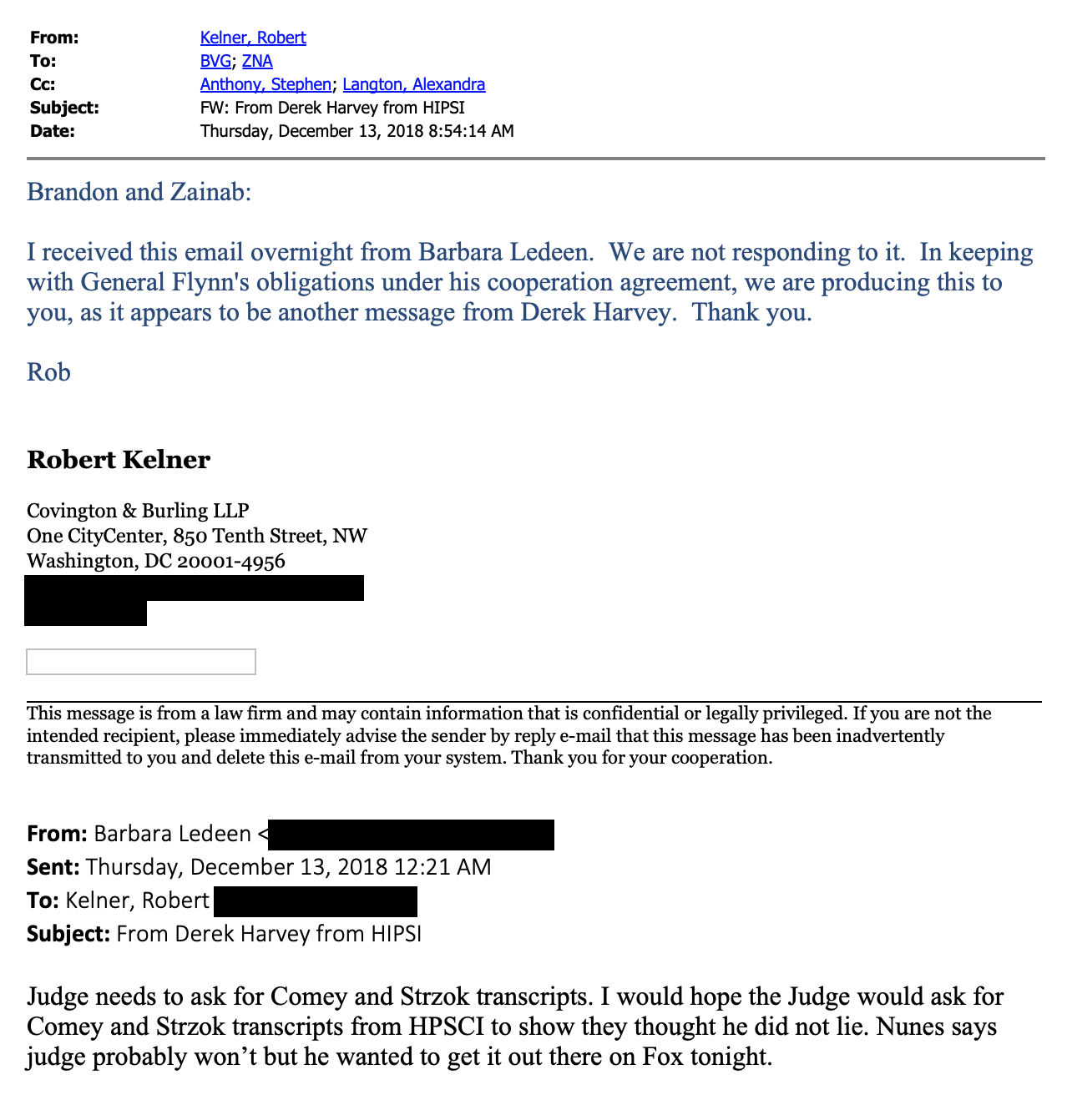
Flynn pled guilty again after being alerted to one of the “new” documents
Flynn’s lawyer received this email five days before Flynn stated, under oath, that he knew he was giving up his right to complain about the circumstances of his interview forever.
THE COURT: Do you wish to challenge the circumstances on which you were interviewed by the FBI?
THE DEFENDANT: No, Your Honor.
THE COURT: Do you understand that by maintaining your guilty plea and continuing with sentencing, you will give up your right forever to challenge the circumstances under which you were interviewed?
THE DEFENDANT: Yes, Your Honor.
And then Flynn pled guilty again.
Comey’s transcript is one of the things DOJ submitted last week to justify deviating from DOJ’s judgment on November 1, 2019, that Flynn’s prosecution was just. It doesn’t say what Harvey claimed it said, but instead says the experienced agents didn’t find Flynn exhibited any indications of deception.
And the agents — and the reason I mention their experience is because I talked to them about this — they discerned no physical indications of deception. They didn’t see any change in posture, in tone, in inflection, in eye contact. They saw nothing that indicated to them that he knew he was lying to them.
That said, it’s proof that DOJ has long been aware of concerns about the claimed content of this and other filings relied on last week.
But that’s not why I find this email particularly damning — and worthy of further attention.
Barbara Ledeen helped Flynn to try to find Hillary’s emails; her spouse helped Flynn prep for his call with Kislyak
As noted, Barbara Ledeen is a staffer on the Senate Judiciary Committee, meaning she worked for Chuck Grassley and now works for Lindsey Graham. She’s almost certainly the mastermind of their efforts to declassify every little thing that might undermine the Mueller investigation.
I’m fine with transparency — though given the way Ric Grenell hid Sergey Millian’s name in a transcript on the Russian investigation and given the way Bill Barr has made claims about the Flynn transcripts without declassifying them, we’re not getting it.
But Ledeen’s role goes beyond getting things that undermine Trump’s critics while hiding key facts that wouldn’t.
As the Mueller Report laid out, both she and her husband Michael play key roles in this saga. While a Senate staffer, Ledeen started searching for Hillary’s missing emails as early as 2015. She wanted to reach out via cut-outs to hostile intelligence services and ultimately claimed to have found emails on the dark web.
Barbara Ledeen and Peter Smith were among the people contacted by Flynn. Ledeen, a long-time Senate staffer who had previously sought the Clinton emails, provided updates to Flynn about her efforts throughout the summer of 2016.266 Smith, an investment advisor who was active in Republican politics, also attempted to locate and obtain the deleted Clinton emails.267
Ledeen began her efforts to obtain the Clinton emails before Flynn’s request, as early as December 2015.268 On December 3, 2015, she emailed Smith a proposal to obtain the emails, stating, “Here is the proposal I briefly mentioned to you. The person I described to you would be happy to talk with you either in person or over the phone. The person can get the emails which 1. Were classified and 2. Were purloined by our enemies. That would demonstrate what needs to be demonstrated.”269
Attached to the email was a 25-page proposal stating that the “Clinton email server was, in all likelihood, breached long ago,” and that the Chinese, Russian, and Iranian intelligence services could “re-assemble the server’s email content.”270 The proposal called for a three-phase approach. The first two phases consisted of open-source analysis. The third phase consisted of checking with certain intelligence sources “that have access through liaison work with various foreign services” to determine if any of those services had gotten to the server. The proposal noted, “Even if a single email was recovered and the providence [sic] of that email was a foreign service, it would be catastrophic to the Clinton campaign[.]”
In a sane world, Ledeen would have been fired when this all became public, not least because she engaged in some of the same kinds of behavior that the frothy right complains Christopher Steele did (given that she was pursuing these issues in her oversight role, too, it’s unclear how well this effort was bracketed off from her taxpayer funded work). Instead, she’s leading the fight to discredit the investigation into this and other efforts.
The role of Ledeen’s husband is even more notable. The first person Flynn spoke to after Russia reached out to him — even before he spoke with his Deputy, KT McFarland, was Ledeen, who was then a Transition staffer.
Russia initiated the outreach to the Transition Team. On the evening of December 28, 2016, Kislyak texted Flynn, “can you kindly call me back at your convenience.”1229 Flynn did not respond to the text message that evening. Someone from the Russian Embassy also called Flynn the next morning, at 10:38 a.m., but they did not talk. 1230
[snip]
Flynn recalled that he chose not to communicate with Kislyak about the sanctions until he had heard from the team at Mar-a-Lago.1241 He first spoke with Michael Ledeen, 1242
While Michael Ledeen’s call records were subpoenaed, there’s no record Mueller interviewed him about his calls or even tried.
There are many reasons to believe that little, if any, of the documents relied on last week were new to DOJ at all, especially not new since the November 2019 filing rebutting all the arguments DOJ is now making. Just as importantly, the history in this case going back years is that “new” is not a legal term, but instead a propaganda one, one designed to feed Fox News. And it’s a propaganda effort led, in part, by someone deeply, personally implicated in Flynn’s actions.
Without affirmative proof any of this is new (and DOJ has offered none), DOJ has no procedural basis to flip-flop from the position Bill Barr’s DOJ argued aggressively last year. In the past, at least, by “new” Flynn’s backers and collaborators really only meant “Fox News.”
emptywl no lnx
SIDNEY POWELL IMPLICATES BARBARA LEDEEN IN HER EFFORT TO UNDERMINE DEMOCRACY
November 17, 2020/42 Comments/in 2016 Presidential Election, 2020 Presidential Election /by emptywheel
Yesterday, GA’s Republican Secretary of State Brad Raffensperger used various means to push back on the Republicans who were trying to cheat to win. In addition to a genuinely useful thread from Erick Erickson debunking one after another conspiracy theory about GA’s vote, he gave an interview to the WaPo detailing how his Republican colleagues have been pressuring him.
He called Doug Collins (who, remember, campaigned with all the Trump felons) a liar.
The normally mild-mannered Raffensperger saved his harshest language for Rep. Douglas A. Collins (R-Ga.), who is leading the president’s efforts in Georgia and whom Raffensperger called a “liar” and a “charlatan.”
Collins has questioned Raffensperger’s handling of the vote and accused him of capitulating to Democrats by not backing allegations of voter fraud more strongly.
[snip]
“I’m an engineer. We look at numbers. We look at hard data,” Raffensperger said. “I can’t help it that a failed candidate like Collins is running around lying to everyone. He’s a liar.”
More alarmingly, Raffensperger described Lindsey Graham suggesting he should throw out entire counties of legally cast votes.
Raffensperger also said he spoke on Friday to Graham, the chairman of the Senate Judiciary Committee, who has echoed Trump’s unfounded claims about voting irregularities.
In their conversation, Graham questioned Raffensperger about the state’s signature-matching law and whether political bias could have prompted poll workers to accept ballots with nonmatching signatures, according to Raffensperger. Graham also asked whether Raffensperger had the power to toss all mail ballots in counties found to have higher rates of nonmatching signatures, Raffensperger said.
Raffensperger said he was stunned that Graham appeared to suggest that he find a way to toss legally cast ballots. Absent court intervention, Raffensperger doesn’t have the power to do what Graham suggested because counties administer elections in Georgia.
“It sure looked like he was wanting to go down that road,” Raffensperger said.
As a number of people have pointed out, it’s a crime under GA law to solicit election fraud.
Meanwhile, Sidney Powell continues her effort to drum up support for undermining democracy. In a tweet this morning, she included Lindsey Graham staffer Barbara Ledeen among her co-conspirators.
In addition to working with Mike Flynn to try to reach out to hostile foreign governments in hopes they had hacked Hillary’s emails, Ledeen’s spouse, Michael, was the first person Flynn called when he was trying to figure out how to undermine sanctions on Russia.
Ledeen is, in spite of those glaring conflicts, the key staffer behind Lindsey’s efforts to undermine the Russian investigation. That suggests she’s also a key staffer behind Lindsey’s decision to ignore how DOJ has altered documents in Bill Barr’s effort to undermine the prosecution of Powell’s staffer.
I honestly believe that Lindsey does all this because his mind has rotted and people like Ledeen have told him so many lies he believes it. But now he’s entering a potentially criminal racket.
Tags: Barbara Ledeen, Brad Raffensperger, Doug Collins, Lindsey Graham, Sidney Powell
wiki 7 22
michael Arthur Ledeen (/:{ləˈdiːn:(style="border-bottom:1px dotted"):}:/;[1] born August 1, 1941) is an American historian,[2] and neoconservative[3] foreign policy analyst. He is a former consultant to the United States National Security Council, the United States Department of State, and the United States Department of Defense. He held the Freedom Scholar chair at the American Enterprise Institute where he was a scholarfor twenty years and now holds the similarly named chair at the Foundation for Defense of Democracies. He was very close to Antonio Martino.[4]
- :{:{Academic career:(style="display:table-cell"):}::(style="display:table-cell;padding-left:0px;padding-right:0.5em"):}:
- :{2:(style="display:table-cell;padding-left:0px;padding-right:0.5em"):}::{Billygate:(style="display:table-cell"):}:
- :{3:(style="display:table-cell;padding-left:0px;padding-right:0.5em"):}::{The Bulgarian connection:(style="display:table-cell"):}:
- :{4:(style="display:table-cell;padding-left:0px;padding-right:0.5em"):}::{Work in the United States:(style="display:table-cell"):}:
- :{5:(style="display:table-cell;padding-left:0px;padding-right:0.5em"):}::{Yellowcake forgery allegations:(style="display:table-cell"):}:
- :{6:(style="display:table-cell;padding-left:0px;padding-right:0.5em"):}::{Iraq War advocacy:(style="display:table-cell"):}:
- :{7:(style="display:table-cell;padding-left:0px;padding-right:0.5em"):}::{Views on Iran:(style="display:table-cell"):}:
- :{8:(style="display:table-cell;padding-left:0px;padding-right:0.5em"):}::{Controversial theories:(style="display:table-cell"):}:
- :{9:(style="display:table-cell;padding-left:0px;padding-right:0.5em"):}::{Personal life:(style="display:table-cell"):}:
- :{10:(style="display:table-cell;padding-left:0px;padding-right:0.5em"):}::{Bibliography:(style="display:table-cell"):}:
- :{11:(style="display:table-cell;padding-left:0px;padding-right:0.5em"):}::{See also:(style="display:table-cell"):}:
- :{12:(style="display:table-cell;padding-left:0px;padding-right:0.5em"):}::{Notes:(style="display:table-cell"):}:
- :{13:(style="display:table-cell;padding-left:0px;padding-right:0.5em"):}::{References:(style="display:table-cell"):}:
- :{14:(style="display:table-cell;padding-left:0px;padding-right:0.5em"):}::{External links:(style="display:table-cell"):}:
Academic career
Ledeen holds a Ph.D. in History and Philosophy from the University of Wisconsin–Madison where he studied under the historian George Mosse. His doctoral dissertation eventually became Universal Fascism: The Theory and Practice of the Fascist International, 1928–1936, first published in 1972. The book explored Italian leader Benito Mussolini's efforts to create a Fascist international in the late 1920s and early 1930s. Ledeen taught at Washington University in St. Louis but left after being denied tenure. Some faculty indicated that questions about the "quality of his scholarship" and about whether or not Ledeen had "used the work of somebody else without proper credit" were issues, although some also noted that "the 'quasi-irregularity' at issue didn't warrant the negative vote on tenure."[5]
Ledeen subsequently moved to Rome, where he was hired as the Rome correspondent for The New Republic and was named a visiting professor at the University of Rome for two years until 1977. In Rome, Ledeen worked with Italian historian Renzo De Felice, who greatly influenced Ledeen, drawing a distinction between "fascism-regime" and "fascism-movement."[6] Ledeen's political views developed to stress "the urgency of combating centralized state power and the centrality of human freedom"[7] Ledeen continued his studies in Italian Fascism with a study of the takeover of Fiume by Italian irredentist forces under Gabriele d'Annunzio, who Ledeen argued was the prototype for Mussolini.
Billygate
In the 1980 lead up to the US presidential election, Ledeen, along with Arnaud de Borchgrave, wrote a series of articles published in The New Republic[8] and elsewhere about Jimmy Carter's brother, Billy Carter's contacts with the Muammar al-Gaddafi regime in Libya. Ledeen testified before a Senate subcommittee that he believed that Billy Carter had met with and been paid off by Yasser Arafat of the Palestinian Liberation Organization.
Five years later, in 1985, a Wall Street Journal investigation suggested that the series of Billygate articles written by Ledeen were part of a larger disinformation campaign intended to influence the outcome of that year's presidential election.[9] According to the reporting, Francesco Pazienza, an officer of the Italian intelligence agency SISMI, alleged that Ledeen was paid $120,000 for his work on Billygate and other projects.[10] Pazienza and Ledeen were very active in disinformation efforts.[11] At SISMI, Pazienza stated, Ledeen warranted a coded identification: Z-3. Pazienza was later tried and convicted in absentia for using "extortion and fraud to obtain embarrassing facts about Billy Carter".[12][a]
The Bulgarian connection
Ledeen worked for the Italian military intelligence agency SISMI in 1980 providing "risk assessment",[5] and consulting on extradition matters between Italy and the United States.[14] It was during his time in Italy which Ledeen came out in his belief in the "Bulgarian connection" conspiracy theory concerning Grey Wolves member Mehmet Ali Ağca's 1981 attempt to assassinate Pope John Paul II. The theory has since been attacked by various authors and journalists, including Washington Post reporter Michael Dobbs, who initially believed the story as well. The theory was adopted in 2005 by the Italian Mitrokhin Commission. According to Craig Unger, "With Ronald Reagan newly installed in the White House, the so-called Bulgarian Connection made perfect Cold War propaganda. Michael Ledeen was one of its most vocal proponents, promoting it on TV and in newspapers all over the world."[14]
Work in the United States
In the early 1980s, Ledeen appeared before the newly established Senate Subcommittee on Security and Terrorism, alongside former CIA director William Colby, author Claire Sterling and former Newsweek editor Arnaud de Borchgrave. Both Ledeen and de Borchgrave worked for the Center for Strategic and International Studies at Georgetown University at the time.[15] All four testified that they believed the Soviet Union had provided for material support, training and inspiration for various terrorist groupings.[16]
Ledeen was involved in the Iran–Contra affair as a consultant of National Security Advisor Robert C. McFarlane.Ledeen vouched for Iranian intermediary ManucherGhorbanifar. According to Adnan Khashoggi in 1985, Ghorbanifar was the head of Iranian Prime Minister Mir Hussein Mousavi's European intelligence and Ledeen was aware of this.[17] In addition, he met with Israeli Prime Minister Shimon Peres, officials of the Israeli Foreign Ministry, and the CIA to arrange meetings with high-ranking Iranian officials, whereby Iranians supported by the US would be given weapons by Israel, and would proceed to negotiate with Hizbollah for the release of hostages in Lebanon.[18] Ledeen's own version of the events is published in his book, Perilous Statecraft.[19]
Yellowcake forgery allegations
Main article: Niger uranium forgeries
During the summer of 2001, Alain Chouet and others with France's DGSE investigate an alleged deal known later as Nigergate in which Iraq was trying to obtain yellowcake from a country in Africa and, by May and June 2002, they investigate any connection with Niger but find that the rumors are entirely false.[20] Furthermore, in July 2002, the Italian SISMI and the United States CIA are informed by the French DGSE that Rocco Martino, a former Italian intelligence agent, is trying to pass fake documents about Iraq obtaining yellowcake from Niger.[20] However, the SISMI report that a lady, who is controlled by SISMI's Antonio Nucera, in the Niger embassy at Rome presents the fake documents in July 2002.[20] Later, in March 2003, George Tenet incorrectly states that Iraq, who has large quantities of yellowcake, is obtaining yellowcake from Niger.[20]
According to a September 2004 article by Joshua Micah Marshall, Laura Rozen, and Paul Glastris in Washington Monthly: "The first meeting occurred in Rome in December, 2001. It included Franklin, Rhode, and another American, the neoconservative writer and operative Michael Ledeen, who organized the meeting. (According to UPI, Ledeen was then working for Undersecretary of Defense Douglas Feith as a consultant.) Also in attendance was Ghorbanifar and a number of other Iranians."[21]
Colleagues Andrew McCarthy and Mark R. Levin have defended Ledeen, writing: "Up until now, the fiction recklessly spewed by disgruntled intelligence-community retirees and their media enablers—some of whom have conceded that the claim is based on zero evidence—has been that Michael had something to do with the forged Italian documents that, according to the Left's narrative, were the basis for President Bush's "lie" in the 2003 State of the Union Address that Saddam Hussein had obtained yellowcake uranium (for nuclear-weapons construction) in Africa."[22]
Iraq War advocacy
During the 1990s, Ledeen was active in supporting the ousting of Saddam Hussein from Iraq. He was known as one of The Vulcans who also included John Bolton, Douglas Feith, Richard Perle, Paul Wolfowitz, Donald Rumsfeld, and David Wurmser who signed an "An Open Letter to the President" to lobby Bill Clinton to remove Hussein from office.[23]
Regarding the "pre-emptive" invasion of Iraq, in 2002 Ledeen criticized the views of former National Security Adviser Brent Scowcroft, writing:[24]
Scowcroft has managed to get one thing half right, even though he misdescribes it. He fears that if we attack Iraq "I think we could have an explosion in the Middle East. It could turn the whole region into a caldron and destroy the War on Terror." One can only hope that we turn the region into a cauldron, and faster, please. If ever there were a region that richly deserved being cauldronized, it is the Middle East today. If we wage the war effectively, we will bring down the terror regimes in Iraq, Iran, and Syria, and either bring down the Saudi monarchy or force it to abandon its global assembly line to indoctrinate young terrorists. That's our mission in the war against terror.
— Michael Ledeen
Ledeen's statements prior to the start of the Iraq war such as "desperately needed and long overdue war against Saddam Hussein" and "dire need to invade Iraq" caused Glenn Greenwald to label his later statement that he "opposed the military invasion of Iraq before it took place" to be an "outright lie".[25] However, Ledeen maintains these statements are consistent since: "I opposed the military invasion of Iraq before it took place and I advocated—as I still do—support for political revolution in Iran as the logical and necessary first step in the war against the terror masters."[26]
Views on Iran
Ledeen is a long-time foe of the Islamic regime of Iran. He believed that invading the country and regime change in Iran should have been the first priority in the "war on terror" in 2003 rather than Iraq. He believes that "everything traces back to Tehran" and that Iran manipulates both sides of the Shi'ite-Sunni conflict, leading reviewer Peter Beinart to note that his "effort to lay virtually every attack by Muslims against Americans at Tehran's feet takes him into rather bizarre territory."[27] The New York Times describes Ledeen's views as "everything traces back to Tehran".[27] Ledeen's phrase, "faster, please" has become a signature meme in Ledeen's writings (it is currently the title of his blog on the Pajamas Media website) and is often referenced by neoconservative writers advocating a more forceful and broader "war on terror." In 1979, Ledeen was one of the first Western writers to argue that Ayatollah Ruhollah Khomeini was a "clerical fascist", and that while it was legitimate to criticize the Shah's regime, if Khomeini seized power in Iran the Iranian people would suffer an even greater loss of freedom and women would be deprived of political and social rights. He presently believes that "No one in the West has yet supported Iranian democratic organizations" and that "aggressive support for those Iranians who wish to be free" would most likely work in ending the clerical government.[28]
According to Justin Raimondo, Ledeen "holds up Bill Clinton and Madeleine Albright as patsies for Khomeini—who supposedly believed that the Ayatollah overthrew Shah Reza Pahlavi because the Iranian government was 'excessively repressive and intolerant.' While it would not do to come right out and deny the savagery of the Shah's legendary SAVAK secret police, Ledeen informs us that, under the monarch's beneficent rule, 'Iran had become too modern, too tolerant—especially of women and of other religious faiths—and too self-indulgent. The shah had Westernized Iran'—except, perhaps, in his prisons, where the ancient methods of torture were routinely employed on dissidents of all sorts."[29]
Ledeen is currently against both an invasion of Iran or air-strikes within the country.[28][30] He has argued that the latter may eventually become necessary if negotiations with the Iranian government fail, but it would only be the least bad option of many options and it would lead to many negative unforeseen consequences.[30] The New York Times has called Ledeen's skepticism towards military action against Iran surprising given his opposition to the regime.[27]
In July 2016 Ledeen co-authored with Lt. General Michael T. Flynn, at the time Donald Trump's national-security adviser, The Field of Fight: How We Can Win the Global War Against Radical Islam and Its Allies. Flynn and Ledeen constructed a narrative in which the world is at war with a "great evil" and Iran is the central player on the enemy side.[31]
Controversial theories
Ledeen also believed that Iran is the main backer of the insurgency in Iraq and even supported the al-Qaida network formerly led by al-Zarqawi despite its declaration of jihad against Shi'ite Muslims.[32] He claimed that German and Italian court documents showed Zarqawi created a European terrorist network while based in Tehran.[32]
Ledeen was a board member of the "Coalition for Democracy in Iran" (CDI), founded by Morris Amitay, a former executive director of American Israel Public Affairs Committee (AIPAC). Ledeen had also been part of the board of the U.S. Committee for a Free Lebanon. According to the Washington Post, quoted by Asia Times, he was the only full-time international affairs analyst regularly consulted by Karl Rove, George W. Bush's closest advisor.[33]
Following the February 2003 speech by French Minister for Foreign Affairs Dominique de Villepin at the United Nations General Assembly against the intervention in Iraq, Ledeen outlined, in a column entitled "A Theory," a possibility that France and Germany, both NATO allies of the United States, "struck a deal with radical Islam and with radical Arabs" to use "extremism and terrorism as the weapon of choice" to weaken the United States. He stated, "It sounds fanciful, to be sure," but that, "If this is correct, we will have to pursue the war against terror far beyond the boundaries of the Middle East, into the heart of Western Europe. And there, as in the Middle East, our greatest weapons are political: the demonstrated desire for freedom of the peoples of the countries that oppose us."[34][35]
Jonah Goldberg, Ledeen's colleague at National Review, coined the term "Ledeen Doctrine" in a 2002 column. This tongue-in-cheek "doctrine" is usually summarized as "Every ten years or so, the United States needs to pick up some small crappy little country and throw it against the wall, just to show the world we mean business," which Goldberg remembered Ledeen saying in an early 1990s speech.[36]
Ledeen has also advocated that U.S. leaders take a stronger rhetorical stance in wars on Islamic regimes and militant groups. For instance he has recommended in public talks that U.S. leaders question or challenge defeated Islamic militaries or forces regarding the apparent failure of Allah to assure their victory.[37]
Personal life
Ledeen was born in Los Angeles, California.
Ledeen is an accomplished contract bridge player. He has won one American Contract Bridge League national-level tournament, the 2009 Senior Swiss Teams, on a team-of-four with Karen Allison, Lea Dupont and Benito Garozzo.[38] He has also partnered Jimmy Cayne, who was the oldest CEO on Wall Street when he oversaw the collapse of Bear Stearns firm in 2007 and 2008. Consulted by a New York Times journalist early in the episode, Ledeen suggested that his book on the leadership lessons of Machiavelli had influenced Cayne, and observed that "Jimmy saw himself in Machiavelli ... you have to get rid of failure and you have to punish lack of virtue ruthlessly and all the time."[39]
His first wife was Jenny Ledeen of St. Louis, Mo. Ledeen has three children: Simone, Gabriel, and Daniel. Simone has worked both in Iraq and Afghanistan for the Department of Defense; Gabriel is currently a lieutenant in the United States Marines Corps serving his second tour in Iraq; Daniel too is currently a lieutenant in the USMC.[40]
He is married to his second wife, Barbara who was a longtime staffer for Senator Chuck Grassley on the Senate Judiciary Committee until early 2021 when she retired from the Senate.[41]
Missing Clinton emails
Barbara Ledeen sparked controversy in 2015 when she tried to launch her own investigation into Hillary Clinton's emails, while a staffer for Senator Chuck Grassley on the Senate Judiciary Committee which was looking into Trump's Russia issue.[42] According to FBI notes, she requested the assistance of both a defense contractor and Newt Gingrich who asked Judicial Watch for financial assistance for her efforts.[42] Judicial Watch requested another contractor to access the "deep web and dark web".[42] Matt Tate, a former British intelligence official, was approached by Peter W. Smith, an aid close to Gingrich and who was also working with Michael Flynn who is a confidant of Barbara Ledeen's husband, who Tate said Smith was obtaining Clinton's emails independently of Barbara Ledeen's efforts which Grassley had told her to stop.[42][43][44][b]
Project Veritas
To support Project Veritas in 2017 and 2018 and while she was a staff member on the Chuck Grassley led Senate Judiciary Committee, Barbara Ledeen was tasked to help discredit H.R. McMaster because he had stated that President Trump had the intelligence of a "kindergartner" and was an "idiot."[51] She posted numerous comments on Facebook supporting Project Veritas including "We owe a lot to Erik Prince" because of his efforts to support Project Veritas and many disparaging posts about McMaster.[41] Her involvement in the campaign to discredit McMaster led to Barbara Ledeen being named as a member of the Groundswell group; she admitted passing on information to Project Veritas but said "I am not part of a plot."[41][52]
Bibliography
- Universal Fascism; the Theory and Practice of the Fascist International, 1928–1936, New York, H. Fertig, 1972
- co-written with Renzo De Felice: Fascism: An Informal Introduction To Its Theory And Practice, New Brunswick, N.J. : Transaction Books, 1976 ISBN 0-87855-190-5.
- "Renzo De Felice and the Controversy over Italian Fascism", pages 269–283 from Journal of Contemporary History, Volume 11, 1976.
- The First Duce: D'Annunzio at Fiume, Baltimore; London: Johns Hopkins University Press, 1977 ISBN 0-8018-1860-5.
- Italy In Crisis, Beverly Hills [Calif.]: Sage publications, 1977 ISBN 0-8039-0792-3.
- co-written with George Mosse: Intervista sul Nazismo, Rome-Bari, Laterza, 1977
- co-written with William Lewis: Debacle, The American Failure in Iran, Vintage Books; 1st Vintage Books ed edition (1982) ISBN 0-394-75182-5
- Grave New World, New York: Oxford University Press, 1985 ISBN 0-19-503491-0.
- West European Communism and American Foreign Policy, New Brunswick, N.J., U.S.A.: Transaction Books, 1987 ISBN 0-88738-140-5.
- Perilous Statecraft: An Insider's Account of the Iran-Contra Affair, New York: Scribner, 1988 ISBN 0-684-18994-1.
- Superpower Dilemmas: the U.S. and the U.S.S.R. at Century's End, New Brunswick, U.S.A.: Transaction Publishers, 1992 ISBN 0-88738-891-4.
- Freedom Betrayed: How America Led a Global Democratic Revolution, Won the Cold War, and Walked Away, Washington, D.C.: AEI Press, 1996 ISBN 0-8447-3992-8.
- Machiavelli on Modern Leadership: Why Machiavelli's Iron Rules Are As Timely and Important Today as Five Centuries Ago, New York: Truman Talley Books/St. Martin's Press, 1999 ISBN 0-312-20471-X.
- The War against The Terror Masters: Why It Happened, Where We Are Now, How We'll Win, New York: St. Martin's Press, 2002 ISBN 0-312-30644-X.
- The Iranian Time Bomb: The Mullah Zealots' Quest for Destruction. Truman Talley Books, 2007. ISBN 0-312-37655-3. ISBN 978-0-312-37655-0.
- Obama's Betrayal of Israel, New York: Encounter Broadsides, 2010 ISBN 978-1594034626
- The Field of Fight: How We Can Win the Global War Against Radical Islam and Its Allies co-written with Lt. General Michael T. Flynn, New York: St. Martin's Press, 2016 ISBN 978-1-25010-622-3.
See also
- Timeline of Russian interference in the 2016 United States elections
- Timeline of Russian interference in the 2016 United States elections (July 2016 – election day)
Note
power of nightmares
ladeen fooled by novel; cia told casey it was their own black prop
http://www.wanttoknow.info/war/power_of_nightmares_transcript_1
==
Cruz Hires Neocon Loons, Gaffney, Ledeen, Abrams
Dubs Hawkish New Foreign Policy Team 'Trusted Friends'
by Jason Ditz, March 17, 2016
Republican presidential candidate Ted Cruz, has unveiled his new foreign policy team, stacked with some of the most aggressive hawks imaginable, saying they are a group of his “trusted friends” who believe in a “strong America.”
At the center of his team is neoconservative ultra-hawk Frank Gaffney, a loudly anti-Muslim figure who believes in a wild array of conspiracies, including that a number of top political figures from both parties of being part of a secret Muslim cabal plotting the conquest of America.
Gaffney had previously been speculated to be a Trump adviser, as his dubious work has been cited by that candidate repeatedly in trying to back up his proposals to ban Muslim immigration. Gaffney’s overt hostility toward Muslims in general made him a virtual pariah during the 2012 campaign. Incredibly, a number of Republican hopefuls have courted him this time around, with Cruz declaring him “clear-eyed” and “a patriot.”
Also featurig prominently in the Cruz team is Michael Ledeen, the man at the center of the yellowcake uranium forgeries, among the pretexts for the 2003 US invasion and occupation of Iraq. Ledeen has been involved in a litany of scandals, dating all the way back to Iran-Contra. He was also, notably, the man who got Israeli spy Jonathon Pollard his job at the US Navy.
Of course speaking of Iran-Contra, one must inevitably discuss Elliott Abrams, who famously pled guilty to two charges of withholding information related to the scandal from Congress, and is likewise a central player in the new Cruz team. In addition to the Contra scandal, Abrams was involved in myriad ugly Reagan-era operations, and was a close ally of both former presidents Bush, receiving a pardon for his Reagan-era crimes by George H.W. Bush, and being appointed as a special adviser to George W.
During his tenure with the later Bush, Abrams was accused by The Guardian of being at the center of a failed 2002 US-backed coup attempt against Venezuela, and was said to have personally given the go-ahead for the effort.
Abram’s most recent media comments, interestingly enough, were railing against Cruz, accusing him of being anti-semitic for even using the term “neocon.” Now that Cruz is establishing himself as the neocon candidate of choice, that allegation has been quickly brushed aside.
With this team and more, Cruz is surrounding himself with warmongers and criminals of the highest caliber. While the attempt appears to center on making him a more straightforward Republican insider, to serve as a counter to Trump, the jingoist and xenophobic policies these advisers portend also threatens to sabotage any hope he has of presenting himself as a safer alternative.
==
----
who killed BO? you did, asshole when you gave stinger missles to proto-al queda
September 13, 2001
Day before yesterday there werethree Barbaras, close as sisters, joined by their zest for life, their volcanic passions, their total commitment to their loved ones, their fearless work for freedom. Barbara Olson, Barbara Comstock, Barbara Ledeen. All three chose to fight for their convictions.
All three were singled out by the Left for slanderous attacks, dehumanizing slogans, the usual stereotypes. Had there been a feminist movement worthy of the name, they would have been its heroines; instead, because they rejected the fashionable causes, insisted on traditional virtue, fought limits on real choices, and relentlessly exposed the emptiness of the Leftist slogans, they became the feminists’ targets.
Now there are two. And what a loss we have suffered. Barbara Olson was a life force, a protean woman who lived life as it is supposed to be lived, celebrating the good times to the full, enduring its worst moments with grim resolve, supporting her friends and allies at all times, taking the fight to her enemies with joyful enthusiasm. She had one of the quickest and finest minds in Washington. Married to one of the greatest attorneys of our time, she was the equal of anyone in legal and political debate. But above all, she was our Braveheart, leading us into battle with the cry of “Freeeeeedom,” carrying the flag of proud independence.
Braveheart to the end, fighting to the last. She had the presence of mind and the force of will to call Ted from her doomed aircraft to ask, “What should I tell the pilot to do?” Unwilling to go quiet into the dark night she wanted marching orders, for herself and for the people around her. She would not cow in the rear of the plane and submit to the murderous instructions of her captors; she wanted to go down fighting.
Perhaps she did. A person from the White House told me that there is reason to believe that plane/bomb was intended for the presidential residence, not the Pentagon, and that something happened to make it swerve suddenly. I like to think that at the last, Barbara charged the cabin, survived the knife thrusts of the monsters, and hurled herself at the kamikaze pilot, putting the plane into a loop toward Virginia.
A great woman, a woman of immeasurable valor, who brought a singular light into our lives. To see Ted with her was to understand the power of an enduring love. He was so proud of her, so delighted by her, so totally overcome with her love for him, that he knew he was the luckiest of men.
The death of such a person cannot be accepted, cannot be digested and must be avenged. Her killers are many, from the evil men on the plane to their supporters and Svengalis around the world, to all those among us who dehumanize their political opponents and thereby facilitate the transition from the politics of personal destruction to the physical destruction of their opponents. She was killed by a fraudulent and arrogant establishment that pretended it was capable of providing our people with good security [BUSH WAS GIVEN REPORT?!] and our leaders with good intelligence. Why are they permitted to remain at their posts? And not least of all, she was killed by a corrupt elite that celebrates murder, provided that the killers hold the right views and slaughter those who are political lepers. “No Regrets for a Love of Explosives” babbles the New York Times headline atop a disgraceful puff piece on Weathermen killers that appeared on the day of Barbara Olson’s murder.
My America, the real America, abhors these people, as Barbara did and as the two surviving Barbaras do. And, in the course of our revenge against the physical killers, the state sponsors, the sources of the money, the dance masters in the streets of the Middle East who reveled in our misery, the leaders of the Hate America and Kill the Jews crowd, we must retain our capacity for righteous indignation against those among us who bear a heavy moral responsibility for it.
If she were still here, Barbara would have led that charge. But there are plenty of us left.
Michael A. Ledeen is a resident scholar in the Freedom Chair at AEI.
http://www.thomhartmann.com/forum/2011/03/neocon-neo-fascist-theorist-michael-ledeen-1
Neocon theorist Michael Ledeen draws more from Italian fascism than from the American Right.
Flirting with Fascism
By John Laughland
June 30, 2003 issue
Copyright © 2003 The American Conservative
http://www.amconmag.com/06_30_03/feature.html
On the antiwar Right, it has been customary to attack the warmongering neoconservative clique for its Trotskyite origins. Certainly, the founding father of neoconservatism, Irving Kristol, wrote in 1983 that he was “proud” to have been a member of the Fourth International in 1940. Other future leading lights of the neocon movement were also initially Trotskyites, like James Burnham and Max Kampelman—the latter a conscientious objector during the war against Hitler, a status that Evron Kirkpatrick, husband of Jeane, used his influence to obtain for him. But there is at least one neoconservative commentator whose personal political odyssey began with a fascination not with Trotskyism, but instead with another famous political movement that grew up in the early decades of the 20th century: fascism. I refer to Michael Ledeen, leading neocon theoretician, expert on Machiavelli, holder of the Freedom Chair at the American Enterprise Institute, regular columnist for National Review—and the principal cheerleader today for an extension of the war on terror to include regime change in Iran.
Ledeen has gained notoriety in recent months for the following paragraph in his latest book, The War Against the Terror Masters.In what reads like a prophetic approval of the policy of chaos now being visited on Iraq, Ledeen wrote,
Creative destruction is our middle name, both within our own society and abroad. We tear down the old order every day, from business to science, literature, art, architecture, and cinema to politics and the law. Our enemies have always hated this whirlwind of energy and creativity, which menaces their traditions (whatever they may be) and shames them for their inability to keep pace. Seeing America undo traditional societies, they fear us, for they do not wish to be undone. They cannot feel secure so long as we are there, for our very existence—our existence, not our politics—threatens their legitimacy. They must attack us in order to survive, just as we must destroy them to advance our historic mission.
This is not the first time Ledeen has written eloquently on his love for “the democratic revolution” and “creative destruction.” In 1996, he gave an extended account of his theory of revolution in his book, Freedom Betrayed — the title, one assumes, is a deliberate reference to Trotsky’s Revolution Betrayed. Ledeen explains that “America is a revolutionary force” because the American Revolution is the only revolution in history that has succeeded, the French and Russian revolutions having quickly collapsed into terror. Consequently, “[O]ur revolutionary values are part of our genetic make-up. … We drive the revolution because of what we represent: the most successful experiment in human freedom. … We are an ideological nation, and our most successful leaders are ideologues.” Denouncing Bill Clinton as a “counter-revolutionary” (!), Ledeen is especially eager to make one point: “Of all the myths that cloud our understanding, and therefore paralyze our will and action, the most pernicious is that only the Left has a legitimate claim to the revolutionary tradition.”
Ledeen’s conviction that the Right is as revolutionary as the Left derives from his youthful interest in Italian fascism.In 1975, Ledeen published an interview, in book form, with the Italian historian Renzo de Felice, a man he greatly admires. It caused a great controversy in Italy. Ledeen later made clear that he relished the ire of the left-wing establishment precisely because “De Felice was challenging the conventional wisdom of Italian Marxist historiography, which had always insisted that fascism was a reactionary movement.” What de Felice showed, by contrast, was that Italian fascism was both right-wing and revolutionary. Ledeen had himself argued this very point in his book, Universal Fascism, published in 1972. That work starts with the assertion that it is a mistake to explain the support of fascism by millions of Europeans “solely because they had been hypnotized by the rhetoric of gifted orators and manipulated by skilful propagandists.” “It seems more plausible,” Ledeen argued, “to attempt to explain their enthusiasm by treating them as believers in the rightness of the fascist cause, which had a coherent ideological appeal to a great many people.” For Ledeen, as for the lifelong fascist theoretician and practitioner, Giuseppe Bottai, that appeal lay in the fact that fascism was “the Revolution of the 20th century.”
[b]
Ledeen supports de Felice’s distinction between “fascism-movement” and “fascism-regime.” [/b]Mussolini’s regime, he says, was “authoritarian and reactionary”; by contrast, within “fascism-movement,” there were many who were animated by “a desire to renew.” These people wanted “something more revolutionary: the old ruling class had to be swept away so that newer, more dynamic elements—capable of effecting fundamental changes—could come to power.” Like his claim that the common ground between Nazism and Italian fascism was “exceedingly minimal”—Ledeen writes, “The fact of the Axis Pact should not be permitted to become the overriding consideration in this analysis”—Ledeen’s careful distinction between fascist “regime” and “movement” makes him a clear apologist for the latter. “While ‘fascism-movement’ was overcome and eventually suppressed by ‘fascism-regime,’” he explains, “fascism nevertheless constituted a political revolution in Italy. For the first time, there was an attempt to mobilize the masses and to involve them in the political life of the country.” Indeed, Ledeen criticizes Mussolini precisely for not being revolutionary enough. “He never had enough confidence in the Italian people to permit them a genuine participation in fascism.” Ledeen therefore concurs with the fascist intellectual, Camillo Pellizi, who argues—in a book Ledeen calls “a moving and fundamental work”—that Mussolini’s was “a failed revolution.” Pellizzi had hoped that “the new era was to be the era of youthful genius and creativity”: for him, Ledeen says, the fascist state was “a generator of energy and creativity.” The purest ideologues of fascism, in other words, wanted something very similar to that which Ledeen himself wants now, namely a “worldwide mass movement” enabling the peoples of the world, “liberated” by American militarism, to participate in the “greatest experiment in human freedom.” Ledeen wrote in 1996, “The people yearn for the real thing—revolution.”
Ledeen was especially interested in the role played by youth in Italian fascism. It was here that he detected the movement’s most exciting revolutionary potential. The young Ledeen wrote that those who exalted the position of youth in the fascist revolution—like those who argued in favor of his beloved “universal fascism”—were committed to exporting Italian fascism to the whole world, an idea in which Mussolini was initially uninterested. When he was later converted to it, Mussolini said that fascism drew on the universalist heritage of Rome, both ancient and Catholic. No doubt Ledeen thinks that the new Rome in Washington has the same universalist mission. He writes that people around Berto Ricci—the editor of the fascist newspaper L’Universale, and a man he calls “brilliant” and “an example of enthusiasm and independence”— “called for the formation of a new empire, an empire based not on military conquest but rather on Italy’s unique genius for civilization. … They intended to develop the traditions of their country and their civilization in such a manner as to make them the basic tenets of a new world order.” Ledeen adds, in a passage that anticipates his later love of creative destruction, “Clearly the act of destruction which would produce the flowering of the new fascist hegemony would sweep away the present generation of Italians, along with the rest.” And Giuseppe Bottai, to whom Ledeen attributes “considerable energy and autonomy,” was notable for his belief that “the infusion of the creative energies of a new generation was essential” for the fascist revolution. Bottai “implored the young … to found a new order arising from the spontaneous activity of their creation."
One of the greatest exponents of such youthful vitalism was the high priest of fascism, the poet and adventurer Gabriele D’Annunzio, to whom Ledeen devoted an enthusiastic biography in 1977. Years ago, I visited D’Annunzio’s house on the shores of Lake Garda: there is a battleship in the garden and a Brenn gun in the sitting room. D’Annunzio was an eccentric and militaristic Italian Nietzschean who “eulogized rape and acts of savagery” committed by the people he called his spiritual ancestors. The poet was also an early prophet of military intervention and regime change: he invaded the Croatian city of Fiume (now Rijeka) in 1919 and held the city for a year, during which he put into practice his theories of “New Order.” In 1918, moreover, D’Annunzio had dropped propaganda leaflets over Vienna promising to liberate the Austrians from their own government, something Ledeen hails as “a glorious gesture.” D’Annunzio’s watchword was “the liberation of human personality.” “His heroism during the war made it possible,” Ledeen writes, “to bridge the chasm between intellectuals and the masses. … The revolt D’Annunzio led was directed against the old order of Western Europe, and was carried out in the name of youthful creativity and virility.”
As Ledeen shows, the Italian fascists expressed their desire “to tear down the old order” (his words from 2002) in terms that are curiously anticipatory of a famous statement in 2003 by the Defense Secretary, Donald Rumsfeld. In 1932, Asvero Gravelli also divided Europe into “old” and “new” when he wrote, in Towards the Fascist International, “Either old Europe or young Europe. Fascism is the gravedigger of old Europe. Now the forces of the Fascist International are rising.” It all sounds rather prophetic.
==
Michael Ledeen under doug feith Rome mtg (ART, pro-israel pprs) , ~ all treaties including oslo, abm etc. w/ rums, shulsky created office of Special Plans to ~ CIA intl on Iraq. 189 overseen by VP pal Luti (scarier than ollie). ML wants to work w/ murderers; broke billygate story Libiya in New Rep w Borchgrave (--> Wa times)/ OSP was amateur hour, academics and contractors doing war planning; luti direct conn to VP 204 unprecedented; vetting info that other agencies has trashed, picking the rotten cherries" 204. Forged docs leaked to berlusconi panorama (ledeen worked there too?), reporter rejected, ordered to deliver to USA embassy.
==
http://rightweb.irc-online.org/profile/ledeen_michael/
IPS Right Web neither represents nor endorses any of the individuals or groups profiled on this site.
Michael A. Ledeen, a veteran neoconservative pundit based at the Foundation for Defense of Democracies (FDD), is a controversial proponent of interventionist U.S. foreign policies whose work dates back to the 1970s. Ledeen has supported everything from the CIA-backed Contra wars in Central America during the 1980s to an expansive post-9/11 “war on terror” aimed at the people he calls “Islamofascists.”[[1]](http://rightweb.irc-online.org/profile/ledeen_michael/#_edn1) Ledeen, who styles himself a “democratic revolutionary,”[[2]](http://rightweb.irc-online.org/profile/ledeen_michael/#_edn2) champions U.S. foreign policies that are in line with Israel’s right-wing Likud Party and is perhaps best known for his vocal advocacy of U.S. intervention in Iran.[[3]](http://rightweb.irc-online.org/profile/ledeen_michael/#_edn3)
Ledeen is a member of Sen. Ted Cruz‘s (R-T) presidential campaign foreign policy advisory team, which also includes a host of fellow right-wing “pro-Israel activists” like Frank **Gaffney** of the Center for Security Policy. The Cruz campaign also lists Ledeen as part of its “Jewish leadership coalition.”[[4]](http://rightweb.irc-online.org/profile/ledeen_michael/#_edn4)
Ledeen has written for a number of rightist media outlets, including the Weekly Standard and the National Review. In recent years, however, his main outlet has been his blog on Pajamas media—called “Faster, Please!”—where he regularly criticizes liberals, bemoans trends in the mainstream media, and warns about threats in the Middle East. He also frequently authors fear-mongering opinion pieces discussing “The Global War” being waged against the United States. He once wrote: “Killing Americans serves several purposes in the war being waged against us (we have yet to seriously engage against our known enemies): first, it’s what the war is all about. They want us dead or dominated. Second, it helps recruitment, which had dropped after the defeat of Iran, Syria, and al-Qaeda in Iraq.”[[6]](http://rightweb.irc-online.org/profile/ledeen_michael/#_edn6)
A vocal critic of the Obama administration, Ledeen has accused President Obama of being anti-American and supporting terrorists. He told a conservative radio pundit that Obama “doesn’t like America and he doesn’t like us.” He added: “He is a member of the generation that came out of an American school system that teaches our kids that America is the big problem in the world and that we are responsible for most of the world’s ills. And therefore he believes that the criticism of America by radicals, whether they are secular left-wing radicals or whether they are Islamist fundamentalist radicals, he thinks that their criticism is basically legitimate.”[[7]](http://rightweb.irc-online.org/profile/ledeen_michael/#_edn7)
Ledeen added: “We have a war to fight and this president isn’t going to fight that war. This president is, if anything, on the other side.”[[8]](http://rightweb.irc-online.org/profile/ledeen_michael/#_edn8)
Iran has long been Ledeen’s bête noir. In an October 2009 article for Weekly Standard, Ledeen rehashed the discredited argument, first pushed by figures in the George W. Bush administration, that Iran has been heavily involved in supporting attacks against U.S. forces in Afghanistan.[[9]](http://rightweb.irc-online.org/profile/ledeen_michael/#_edn9) Thus, Ledeen claims, “in Afghanistan as in Iraq, no matter how well we do, no matter how many high-level targets we eliminate, no matter how many cities, towns, and villages we secure, unless we defeat Iran we will always be designing yet another counterinsurgency strategy in yet another place. We are in a big war, and Iran is at the heart of the enemy army. Alas, no American president since the Islamic Revolution has been willing to face the consequences of Iran’s war against America. Most of the time, our leaders have refused to accept the fact that Iran will do everything possible to dominate or destroy us. Instead of trying to defeat the mullahs, every president has sought rapprochement, just as Obama is doing now.”[[10]](http://rightweb.irc-online.org/profile/ledeen_michael/#_edn10)
In a New York Times review of Ledeen’s 2007 book The Iranian Time Bomb: The Mullah Zealots’ Quest for Destruction, Peter Beinart wrote: “Ledeen’s effort to lay virtually every attack by Muslims against Americans at Tehran’s feet takes him into rather bizarre territory. He says the 1998 bombings of the United States Embassies in Kenya and Tanzania ‘were in large part Iranian operations,’ which would come as news to the 9/11 Commission, which attributed them solely to Al Qaeda. He says Shiite Iran was largely behind Abu Musab al-Zarqawi, a man famous for his genocidal hatred of Shiites. He claims that ‘most’ Iraqi insurgents are ‘under Iranian guidance and/or control,’ not just Shiite warlords like Moktada al-Sadr, but Sunni militants as well—the very people who say they are fighting to prevent Iranian domination. In Ledeen’s view, in fact, Sunni-Shiite conflict—the very thing that most observers think is tearing Iraq apart—is largely a mirage, because Iran controls both sides. And Al Qaeda is a mirage too, a mere front for the regime in Tehran. ‘When you hear “Al Qaeda,”’ Ledeen writes, ‘it’s probably wise to think “Iran.”’ Not surprisingly, he thinks the mullahs were probably behind 9/11.”[[11]](http://rightweb.irc-online.org/profile/ledeen_michael/#_edn11)
Ledeen has also sought to link the Islamic State (or ISIS) with Iran. In an August 2014 piece written for Pajamas Media, Ledeen claimed: “It seems that Iran gave ISIS support, in keeping with its well-documented practice of supporting all sides in other countries’ internal conflicts.” He went on to describe Iran as being in “cahoots with ISIS,” whom he described as “perfect clients” for the Iranians.[[12]](http://rightweb.irc-online.org/profile/ledeen_michael/#_edn12)
Ledeen was staunchly opposed the Obama administration’s nuclear negotiations with Iran. Writing for the Israel Project’s Tower Magazine after the interim nuclear deal between Iran and the P5+1 was finalized in December 2013, Ledeen argued that regime change was the only way to stop the country’s nuclear activities. Iranian opposition groups are “willing to fight” and “we should help them,” Ledeen wrote, adding that the United States also “should call for the release of political prisoners, broadcast accurate news about the Islamic Republic to them, work with the international trade union movement to support Iranian workers (tens of thousands of whom are not being paid on time), and relentlessly expose the crushing repression to which they are subjected.”[[13]](http://rightweb.irc-online.org/profile/ledeen_michael/#_edn13)
In response, Chris Rossini of the Ron Paul Institute stated: “It never ends with the neocons. They’re going to try and get away with their discredited tactics for as long as they can.” He added, “Hasn’t the US done enough damage by ‘supporting’ opposition to governments that they don’t like?”[[14]](http://rightweb.irc-online.org/profile/ledeen_michael/#_edn14)
Ledeen denounced the nuclear deal reached between Iran and the P5+1 world powers in July 2015 as an “awful agreement” that should be “rejected.” He added at the time: “In a single phrase: the war is already ON, and we’re paying the Iranians to kill us. You want to pay them even more? Apparently that’s what Obama wants.”[[15]](http://rightweb.irc-online.org/profile/ledeen_michael/#_edn15)
In August 2008, Ledeen surprised many observers by leaving AEI, where he had worked for nearly 20 years, to take a fellowship at the similarly neoconservative-aligned Foundation for Defense of Democracies (FDD), an advocacy group founded shortly after 9/11 to promote an aggressive “war on terror.” In an entry on his personal blog, Ledeen wrote: “I moved my office from AEI after twenty happy years, to Cliff May’s rising Foundation for the Defense of Democracies. It seems a good fit, it puts me in the same sandbox as Andy McCarthy and other terrific people, and I love the email address: michael@defenddemocracy.org. I mean, that’s what I’m all about.”[[16]](http://rightweb.irc-online.org/profile/ledeen_michael/#_edn16)
Ledeen’s move spurred speculation about what caused it. Jim Lobe, a veteran observer of the neoconservatives, wrote: “[H]is reference to a ‘rising’ FDD suggests his association there might be more lucrative, particularly as FDD, which earlier this year suffered major Democratic defections, is competing strongly for Sheldon Adelson’s largess. (And I have no doubt at all that Ledeen’s obsession with Iran would definitely appeal to the multi-billionaire casino magnate, who reportedly shares that obsession). One possible explanation is that the AEI’s incoming president [Arthur Brooks] is hoping that AEI’s public image on foreign policy—dominated as it has been for so long by hard-line neo-cons like [Richard] Perle—might be softened somewhat.”[[17]](http://rightweb.irc-online.org/profile/ledeen_michael/#_edn17)
On Iraq and Iran
A longtime Washington insider, Ledeen has held positions (often simultaneously) in media, government, academia, and think tanks since the late 1960s. In March 2003 the Washington Post highlighted his influence within the George W. Bush administration, citing him as one of several elites consulted by powerful White House advisor Karl Rove. The Post reported that, “The two met after Bush’s election. He said, ‘Anytime you have a good idea, tell me,’ Ledeen said. Every month or six weeks, Ledeen will offer Rove ‘something you should be thinking about.’ More than once, Ledeen has seen his ideas, faxed to Rove, become official policy or rhetoric.”[[18]](http://rightweb.irc-online.org/profile/ledeen_michael/#_edn18)
In May 2003, Brown University professor William Beeman drew attention to Ledeen’s clout, writing: “Most Americans have never heard of Michael Ledeen, but if the United States ends up in an extended shooting war throughout the Middle East, it will be largely due to his inspiration. … Ledeen’s ideas are quoted daily by such figures as Dick Cheney, Donald Rumsfeld and Paul Wolfowitz.His views virtually define the stark departure from American foreign policy philosophy that has characterized United States actions since Sept. 11, 2001. He basically believes that violence in the service of the spread of democracy is America’s manifest destiny. Consequently, he has become the philosophical legitimator of the American occupation of Iraq.”[[19]](http://rightweb.irc-online.org/profile/ledeen_michael/#_edn19)
Shortly after the U.S. invasion of Iraq, Ledeen addressed a policy forum hosted by the Likud-aligned Jewish Institute for National Security Affairs (JINSA) in Washington, D.C. Though it was just six weeks since the United States had moved on Iraq, the title of his speech was “Time to Focus on Iran—The Mother of Modern Terrorism.” Ledeen said that the U.S. invasion had been the correct move—”Democracy is the only way the Iraqi people will be able to get back on their feet”—and told his audience, “I have never seen a country more ready for democracy than Iran.” He concluded his talk by reiterating the idea of democracy as a cure-all, saying that, “the time for diplomacy is at the end; it is time for a free Iran, free Syria and free Lebanon.”[[20]](http://rightweb.irc-online.org/profile/ledeen_michael/#_edn20)
Ledeen has frequently attacked officials who have attempted to push forward a diplomatic track in Mideast policy. Commenting on Secretary of State Condoleezza Rice‘s efforts in early 2007 to arrange meetings with Iranian officials, Ledeen opined: “The delusion that one can settle our little disagreements with the Islamic Republic, if only the right people sit around the right conference table, has seized every administration since Jimmy Carter. Every president has sent emissaries to talk, and every administration has made demarches to Tehran. To date, the net result is hundreds of dead Americans. And yet the delusion persists. Each time it fails, the deep thinkers at Foggy Bottom manage to convince the Secretary of State of the moment that we are just one small concession away from success, and by and large the secretary goes for it, just as Secretary Rice has.”[[21]](http://rightweb.irc-online.org/profile/ledeen_michael/#_edn21)
In March 2006, Ledeen testified before the House Committee on International Relations, recommending a policy of regime change and revolution in Iran. He argued that the U.S. government has “yet to fight back” against the so-called terror masters there, who he argued “have waged unholy war against us” since 1979. “They created Hezbollah and Islamic Jihad, and they support most all the others, from Hamas and al Qaeda to the Popular Front for the Liberation of Palestine General Command. Iran’s proxies range from Shiites to Sunnis to Marxists, all cannon fodder for the overriding objective to dominate or destroy us. … I am opposed to sanctions; I am generally opposed to military strikes, and I fully endorse support for revolution.” He added: “The first step in crafting a suitable policy toward Iran is to abandon the pretense that we can arrive at a negotiated settlement.”[[22]](http://rightweb.irc-online.org/profile/ledeen_michael/#_edn22)
In The Iranian Time Bomb, Ledeen expounded on what he views as the three-decades-plus “Iranian jihad” against America.[[23]](http://rightweb.irc-online.org/profile/ledeen_michael/#_edn23) “The illusion that ‘diplomacy’ can accomplish anything worthwhile with the Islamic Republic of Iran will only intensify the mullah’s conviction that killing Americans is divinely sanctioned and a winning strategy,” Ledeen wrote. “This dangerous mind-set has seized the minds of American diplomats from the first days of the Iranian Revolution.”[[24]](http://rightweb.irc-online.org/profile/ledeen_michael/#_edn24) As Andrew McCarthy summarized in his review of the book: “If the United States is to win the war on terror, regime change in Iran is a must. How it is to be done can be debated. That it must be done cannot be doubted. Michael Ledeen performs an invaluable service by making that crystal clear.”[[25]](http://rightweb.irc-online.org/profile/ledeen_michael/#_edn25)
In an October 2015 PJ Mediaarticle Ledeen included Iran as part of a new “Axis of Evil” along with North Korea, post-U.S. invasion Iraq and “Russia, China, Cuba, Venezuela, Bolivia and other countries, and terrorist groups including al Qaeda, Hezbollah, and the Islamic State.” He said that war with this axis is inevitable. “There is no escape from this war, whatever Western leaders might wish. We will either win it or lose it, and right now we are losing,” he opined, adding that the “Axis hates us because American freedom threatens their own regimes; they hate us for what we are, not what we have done or are doing.”[[26]](http://rightweb.irc-online.org/profile/ledeen_michael/#_edn26)
The Ledeen Doctrine
Ledeen’s militaristic approach to U.S. foreign policy spurred conservative writer Jonah Goldberg of the National Review to coin the phrase the “Ledeen Doctrine.” Describing the doctrine, Goldberg wrote: “I’m not sure my friend Michael Ledeen will thank me for ascribing authorship to him and he may have only been semi-serious when he crafted it, but here is the bedrock tenet of the Ledeen Doctrine in more or less his own words: ‘Every ten years or so, the United States needs to pick up some small crappy little country and throw it against the wall, just to show the world we mean business.’ That’s at least how I remember Michael phrasing it at a speech at the American Enterprise Institute about a decade ago.”[[27]](http://rightweb.irc-online.org/profile/ledeen_michael/#_edn27)
Since Goldberg coined it, the so-called doctrine has been adapted by writers to describe the actions of other countries. For example, in commenting on the Georgia-Russia conflict in August 2008, Alex Harrowell of the pan-European blog A Fistful of Euros opined: “Russia has Ledeenised the situation—they picked up some crappy little country and threw it against the wall to show they meant business.”[[28]](http://rightweb.irc-online.org/profile/ledeen_michael/#_edn28)
Ledeen has made a career of popularizing alarmist and sometimes erroneous charges about terrorism threats dating back to the late 1970s, when he served as a consultant to Italian military intelligence. He later became a consultant and special advisor to the U.S. State Department and the National Security Council shortly after the election of Ronald Reagan. From this perch, Ledeen championed the idea, initially promoted in Claire Sterling’s 1981 best-selling book The Terror Network, that Moscow was behind worldwide terrorism acts, including the discredited allegation that the KGB helped orchestrate the 1981 assassination attempt of Pope John Paul II.[[29]](http://rightweb.irc-online.org/profile/ledeen_michael/#_edn29) Ledeen’s views at the time conflicted with those of the CIA, which contended that Moscow had little or nothing to do with the global “terror network.”
After 9/11, Ledeen began arguing that “Islamofascists” in countries like Iran are heading a new terror network. In his 2002 book The War Against the Terror Masters, Ledeen wrote: “The main part of the [war on terror]—the campaign against terror masters who rule countries hostile to us—is a very old kind of war. It is a revolutionary war, right out of the 18th century, the very kind of war that gave our national identity. While we will have to act against secret terrorist organizations and kamikaze fighters, our ultimate targets are tyrannical regimes. We will require different strategies in each case. We will need one method and set of tools to bring down Saddam Hussein, another strategy to break the Assad family dictatorship in Syria, a very different approach to end the religious tyranny in Iran, and yet another to deal with Saudi Arabia’s active support for fundamentalist Islam and the terror network. But the mission is the same in each case: Bring down the terror masters.”[[30]](http://rightweb.irc-online.org/profile/ledeen_michael/#_edn30)
Ledeen has supported a passel of letterhead groups that emerged after 9/11 to promote regime change in the Middle East. Together with Morris Amitay, a former lobbyist for the American Israel Public Affairs Committee, in 2003 Ledeen created the Coalition for Democracy in Iran (CDI), which until it disbanded in 2005 supported regime-change efforts in Iran and pushed a number of legislative proposals aimed at isolating the country. Among CDI’s influential members and supporters were Frank Gaffney, head of the hardline Center for Security Policy; Joshua Muravchik, an AEI scholar who has helped shape the neoconservative agenda; and former CIA director James Woolsey. Ledeen also supported the now-inactive U.S. Committee for a Free Lebanon, an organization created by U.S.-based Lebanese banker Ziad Abdelnour that pushed a hardline stance on Syria.
For Ledeen, those who oppose his take on Mideast issues are “appeasers,” a frequent neoconservative refrain that gained cachet during the late 1960s when Norman Podhoretz, a neocon trailblazer who served as editor of Commentary magazine for several decades, began using the World War II-inspired label to criticize antiwar protestors. Writing in November 2003, Ledeen said that the so-called appeasers in Congress and the State Department “don’t want to know about Iran, because if they did, they would be driven to take actions that they do not want to take. They would have to support democratic revolution in Iran, and they prefer to schmooze with the mullahs.” He concluded: “I guess some top official will have to die at the hands of (obviously) Iranian-supported terrorists before the Pentagon is permitted to work on the subject.”[[31]](http://rightweb.irc-online.org/profile/ledeen_michael/#_edn31)
Similarly, Ledeen abhors what he sees as weakness in foreign affairs policy-makingandmakes frequent use of Machiavellian ideas to promote his martial vision.In a March 2003 BBC interview, for example, Ledeen claimed: “As soon as we land in Iraq, we’re going to face the whole terrorist network. Iran, Iraq, Syria, and Saudi Arabia are the big four, and then there’s Libya. …You can’t solve all problems, I grant that. I mean, I wrote a book about Machiavelli, and I know the struggle against evil is going to go on forever.”[[32]](http://rightweb.irc-online.org/profile/ledeen_michael/#_edn32) Ledeen was referring to his 1999 book on “why Machiavelli’s iron rules are as timely and important today as five centuries ago,” in which he argued that war “provides a real test of character” and “creates a pool of leaders for the nation.”[[33]](http://rightweb.irc-online.org/profile/ledeen_michael/#_edn33)
Despite his frequent congressional appearances and influence within policy circles, Ledeen’s critics have denounced his ideas and qualifications. For example, Brown University Professor William Beeman once said: “Michael Ledeen has never been to Iran; he speaks no Persian. He has minimal credibility in assessing the Iranian elections, or evaluating the political situation there.”[[34]](http://rightweb.irc-online.org/profile/ledeen_michael/#_edn34)
Go-Betweens
Ledeen has on several occasions become directly involved in efforts to shape the policies of both the United States and other countries, which has led him to make some peculiar affiliations. In the late 1970s, while Ledeen was serving as a consultant on terrorism to the Italian military intelligence agency SISMI, he became associated with a Francesco Pazienza, an Italian agent who was also a member of the Italian P2 Masonic Lodge, a violent right-wing group involved in terrorist attacks in Italy in the 1970s and 80s.[[35]](http://rightweb.irc-online.org/profile/ledeen_michael/#_edn35) In a report about the P2’s involvement in bombings in Italy, as well as its connections to corrupt government officials, the Toronto Star reported on Pazienza’s claims that Ledeen served as a go-between for the Ronald Reagan administration and Italian officials. According to the Star, Pazienza was eventually convicted in absentia of “abusing his status as secret agent by using extortion to obtain information on contacts between former president Jimmy Carter’s brother Billy and Libyan leader Moammar Gadhafi and then passing this ‘Billygate’ material to Michael Ledeen.”[[36]](http://rightweb.irc-online.org/profile/ledeen_michael/#_edn36)
As a consultant to the National Security Council in the 1980s, in the early stages of the Iran-Contra affair Ledeenacted as a go-between for the Reagan administration and the Israeli spy David Kimche to gain the release of U.S. hostages in Beirut through an Iranian arms dealer, Manucher Ghorbanifar.[[37]](http://rightweb.irc-online.org/profile/ledeen_michael/#_edn37) According to official investigations into the Iran-contra scandal, Ledeen helped initiate the effort to use Israeli contacts to pursue an arms for hostages deal with Iran.[[38]](http://rightweb.irc-online.org/profile/ledeen_michael/#_edn38)
After the 9/11 attacks, the names of many of these associates resurfaced in press reports about Ledeen’s efforts to push regime change in Iran. The Sydney Morning Herald reported that Ledeen worked with Pentagon staffers to redevelop the channel to arms dealer Ghorbanifar in an effort to assist resistance groups in Iran. Reported the Herald: “[Harold] Rhode recently acted as a liaison between [Douglas] Feith‘s office … and Ahmed Chalabi, a former Iraqi exile groomed for leadership by the Pentagon. Mr. Rhode is a protégé of Michael Ledeen, who was a National Security Council consultant in the mid-1980s when he introduced Mr. Ghorbanifar to Oliver North, a NSC aide, and others in the opening stages of the Iran-Contra affair. It is understood Mr. Ledeen reopened the Ghorbanifar channel with Mr. Feith’s staff.”[[39]](http://rightweb.irc-online.org/profile/ledeen_michael/#_edn39)
In an account of the various meetings between Iranians and Feith’s Department of Defense staff that Ledeen helped set up after 9/11, the Washington Monthly reported that “the DoD-Ghorbanifar meetings suggest the possibility that a rogue faction at the Pentagon was trying to work outside normal US foreign policy channels to advance a ‘regime change’ agenda not approved by the president’s foreign policy principals or even the president himself.”[[40]](http://rightweb.irc-online.org/profile/ledeen_michael/#_edn40) Among those at the meetings, according to the Monthly, was “a former senior member of the Iranian Revolutionary Guard who claimed to have information about dissident ranks within the Iranian security services. The Washington Monthly has also learned from U.S. government sources that Nicolo Pollari, the head of Italy’s military intelligence agency, SISMI, attended the meetings, as did the Italian Minister of Defense Antonio Martino, who is well-known in neoconservative circles in Washington.”[[41]](http://rightweb.irc-online.org/profile/ledeen_michael/#_edn41)
Then-U.S. Ambassador to Italy Melvin Sembler learned about Ledeen’s activity when, on December 12, 2001, he “sat down for a private dinner with Ledeen, an old friend of his from Republican Party politics, and [Antonio] Martino, the Italian defense minister. The conversation quickly turned to the meeting. The problem was that this was the first that Amb. Sembler had heard about it,” the Monthly reported. The meeting was a major source of concern for Sembler and the CIA in part because the agency “believes Ghorbanifar is a serial ‘fabricator’ and forbids its officers from having anything to do with him. Moreover, why were mid-level Pentagon officials organizing meetings with a foreign intelligence agency behind the back of the CIA—a clear breach of U.S. government protocol? There was also a matter of personal chagrin for Sembler: At State Department direction, he had just been cautioning the Italians to restrain their contacts with bad-acting states like Iran (with which Italy has extensive trade ties).”[[42]](http://rightweb.irc-online.org/profile/ledeen_michael/#_edn42)
Publications
In addition to his personal blog, Ledeen also contributes to the National Review Online and infrequently to the Wall Street Journal’s opinion page.His books include The Iranian Time Bomb: The Mullah Zealots’ Quest for Destruction (2007); The War Against the Terror Masters (2002); Tocqueville on American Character (2000); Freedom Betrayed: How America Led a Global Democratic Revolution, Won the Cold War, and Walked Away (1996); and Perilous Statecraft: An Insider’s Account of the Iran-Contra Affair (1988).
Share RightWeb
Please note: IPS Right Web neither represents nor endorses any of the individuals or groups profiled on this site.
Sources
[[1]](http://rightweb.irc-online.org/profile/ledeen_michael/#_ednref1) Michael Ledeen, “When People Freely Choose Tyranny,” National Review Online, January 31, 2006.
[[2]](http://rightweb.irc-online.org/profile/ledeen_michael/#_ednref2) Larisa Alexandrovna, “Conversation with Machiavelli’s Ghost: Controversial Neoconservative Ledeen Talks to Raw Story,” February 26, 2006.
[[3]](http://rightweb.irc-online.org/profile/ledeen_michael/#_ednref3) Peter Beinart, “Enemies List,” New York Times, September 9, 2007
[[4]](http://rightweb.irc-online.org/profile/ledeen_michael/#_ednref4) Ted Cruz 2016, Jewish Leadership Coalition, https://www.tedcruz.org/news/jewish-leaders-endorse-ted-cruz-for-president/.
[[v5]](http://rightweb.irc-online.org/profile/ledeen_michael/#_ednref5) Michael Ledeen, “Letter to my European Friends,” PJ Media, November 1, 2012, http://pjmedia.com/michaelledeen/2012/11/01/letter-to-my-european-friends/.
[[6]](http://rightweb.irc-online.org/profile/ledeen_michael/#_ednref6) Michael Ledeen, “The Global War,” September 13, 2014,http://pjmedia.com/michaelledeen/2012/09/13/the-global-war/.
[[7]](http://rightweb.irc-online.org/profile/ledeen_michael/#_ednref7) Brian Tashman, “Michael Ledeen: Obama Won’t Condemn Radical Islam Because He Supports ‘The Other Side,’” Right Wing Watch, January 13, 2015,http://www.rightwingwatch.org/content/michael-ledeen-obama-wont-condemn-radical-islam-because-he-supports-other-side.
[[8]](http://rightweb.irc-online.org/profile/ledeen_michael/#_ednref8) Brian Tashman, “Michael Ledeen: Obama Won’t Condemn Radical Islam Because He Supports ‘The Other Side,’” Right Wing Watch, January 13, 2015,http://www.rightwingwatch.org/content/michael-ledeen-obama-wont-condemn-radical-islam-because-he-supports-other-side.
[[9]](http://rightweb.irc-online.org/profile/ledeen_michael/#_ednref9) For background on this allegation, see Gareth Porter, “U.S. Uses False Taliban Aid Charge to Pressure Iran,” Right Web, July 8, 2009,http://www.rightweb.irc-online.org/articles/display/u.s._uses_false_taliban_aid_charge_to_pressure_iran
[[10]](http://rightweb.irc-online.org/profile/ledeen_michael/#_ednref10) Michael Ledeen, “We Have Met the Enemy . . .” Weekly Standard, October 20, 2009.
[[11]](http://rightweb.irc-online.org/profile/ledeen_michael/#_ednref11) Peter Beinart, “Enemies List,” New York Times, September 9, 2007
[[12]](http://rightweb.irc-online.org/profile/ledeen_michael/#_ednref12) Michael Ledeen, “Who Are These ISIS Guys and Why is Obama Willing to Bomb Them? Pajamas Media, August 7, 2014,http://pjmedia.com/michaelledeen/2014/08/07/who-is-isis/.
[[13]](http://rightweb.irc-online.org/profile/ledeen_michael/#_ednref13) Michael Ledeen, “Dare we say it? The Mullahs must go,” The Tower, December 2013, http://www.thetower.org/article/dare-say-mullahs-must-go/.
[[14]](http://rightweb.irc-online.org/profile/ledeen_michael/#_ednref14) Chris Rossini, “Michael Ledeen: A Deal With Iran is Not Enough,” Ron Paul Institute, July 10, 2014,http://www.ronpaulinstitute.org/archives/neocon-watch/2014/july/10/michael-ledeen-a-deal-with-iran-is-not-enough/.
[[15]](http://rightweb.irc-online.org/profile/ledeen_michael/#_ednref15) Michael Ledeen, “How to Defeat the Grand Bargain with Iran,” Foundation for Defense of Democracies, July 27, 2015,http://www.defenddemocracy.org/media-hit/michael-ledeen-how-to-defeat-the-grand-bargain-with-iran/.
[[16]](http://rightweb.irc-online.org/profile/ledeen_michael/#_ednref16) Michael Ledeen, “Back from Alaska,” Faster, Please! Pajamas Media, August 7, 2008, http://pajamasmedia.com/michaelledeen/2008/08/07/back-from-alaska/.
[[17]](http://rightweb.irc-online.org/profile/ledeen_michael/#_ednref17) Jim Lobe, “The Ledeen Move,” Lobelog, August 25, 2008,http://www.ips.org/blog/jimlobe/?p=182#more-182.
[[18]](http://rightweb.irc-online.org/profile/ledeen_michael/#_ednref18) Thomas Edsall and Dana Milbank, “White Hose’s Roving Eye for Politics,” Washington Post, March 10, 2003.
[[19]](http://rightweb.irc-online.org/profile/ledeen_michael/#_ednref19) William Beeman, “Michael Ledeen: Neoconservative Guru,” May 9, 2003, http://www.lebanonwire.com/0305/03050914DS.asp.
[[20]](http://rightweb.irc-online.org/profile/ledeen_michael/#_ednref20) Michael Ledeen, “Time to Focus on Iran – The Mother of Modern Terrorism,” JINSA Policy Forum, May 6, 2003, http://web.archive.org/web/20080205103132/http://www.jinsa.org/articles/articles.html/function/view/categoryid/1930/documentid/2012/history/3,648,1930,2012.
[[21]](http://rightweb.irc-online.org/profile/ledeen_michael/#_ednref21) Michael Ledeen, “Did Condoleezza Rice Try to Make a Secret Deal With the Mullahs?” National Review Online, April 25, 2007.
[[22]](http://rightweb.irc-online.org/profile/ledeen_michael/#_ednref22) Testimony of Michael A. Ledeen, “U.S. Policy Toward Iran—The Next Steps,” House Committee on International Relations, March 8, 2006.
[[23]](http://rightweb.irc-online.org/profile/ledeen_michael/#_ednref23) Michael A. Ledeen, The Iranian Time Bomb: The Mullah Zealots’ Quest for Destruction (New York: Truman Talley Books, 2007), p. 15.
[[24]](http://rightweb.irc-online.org/profile/ledeen_michael/#_ednref24) Michael A. Ledeen, The Iranian Time Bomb: The Mullah Zealots’ Quest for Destruction (New York: Truman Talley Books, 2007), p. 18.
[[25]](http://rightweb.irc-online.org/profile/ledeen_michael/#_ednref25) Andrew C. McCarthy, “No More Illusions,” National Review Online, September 4, 1007.
[[26]](http://rightweb.irc-online.org/profile/ledeen_michael/#_ednref26) Michael Ledeen, “The New Axis of Evil,” Foundation for Defense of Democracies, October 11, 2015, http://www.defenddemocracy.org/media-hit/michael-ledeen-the-new-axis-of-evil/.
[[27]](http://rightweb.irc-online.org/profile/ledeen_michael/#_ednref27) Jonah Goldberg, “Baghdad Delenda Est, Part Two,” National Review Online, April 23, 2002.
[[28]](http://rightweb.irc-online.org/profile/ledeen_michael/#_ednref28) Alex Harrowell, “The Revolution is Over,” August 14, 2008, A Fistful of Euros, August 14, 2008, http://fistfulofeuros.net/afoe/europe-and-the-world/the-revolution-is-over/.
[[29]](http://rightweb.irc-online.org/profile/ledeen_michael/#_ednref29) Jim Lobe, “Veteran Neocon Adviser Moves on Iran,” Inter Press Service, June 26, 2003.
[[30]](http://rightweb.irc-online.org/profile/ledeen_michael/#_ednref30) Michael Ledeen, The War Against the Terror Masters (New York: St. Martin’s Press, 2002), page xxii.
[[31]](http://rightweb.irc-online.org/profile/ledeen_michael/#_ednref31) Michael Ledeen, “Unpunished Failure,” National Review Online, November 3, 2003.
[[32]](http://rightweb.irc-online.org/profile/ledeen_michael/#_ednref32) Cited in Jim Lobe, “Veteran Neocon Adviser Moves on Iran,” Inter Press Service, June 26, 2003.
[[33]](http://rightweb.irc-online.org/profile/ledeen_michael/#_ednref33) Michael A. Ledeen, Machiavelli on Modern Leadership: Why Machiavelli’s Iron Rules Are As Timely and Important Today As Five Centuries Ago (New York: Truman Talley Books, 1999). Quoted in Jackson Lears, “Keeping It Real,” Nation, June 12, 2006.
[[34]](http://rightweb.irc-online.org/profile/ledeen_michael/#_ednref34) Jim Lobe, ” Bush and Hawks Try Pre-Emptive Strike Vs. Iran Vote,” Inter Press Service, June 20, 2005.
[[35]](http://rightweb.irc-online.org/profile/ledeen_michael/#_ednref35) For more on Pazienza and his affiliation with Ledeen, see Wolfgang Achntner and Tony Barber, “Search for a Plot to Kill the Pope; Who Put the Gun in Agca’s Hand?” The Independent, May 19, 1991; and Ruth Gruber, “Bizarre Complexities of Bombing to Unfold in Italian Courtroom,” St. Petersburg Times, March 1, 1987.
[[36]](http://rightweb.irc-online.org/profile/ledeen_michael/#_ednref36) Ruth Gruber, “20 Face Trial in 1980 Massacre Italy Believes Blast Part of Plot,” Toronto Star, March 1, 1987.
[[37]](http://rightweb.irc-online.org/profile/ledeen_michael/#_ednref37) Fox Butterfield, “Arms for Hostages—Plain and Simple,” New York Times, November 27, 1988; Jim Lobe, “Shadowy Right Winger Urges Action on Iran,” Inter Press Service, June 25, 2003. See also Ledeen’s account, which he offered in his 1998 book Perilous Statecraft: An Insider’s Account of the Iran-Contra Affair (Charles Scribner’s Sons, 1988).
[[38]](http://rightweb.irc-online.org/profile/ledeen_michael/#_ednref38) See, for example, the Tower Commission’s report, available on the web site of the American Presidency Project,http://www.presidency.ucsb.edu/PS157/assignment%20files%20public/TOWER%20EXCERPTS.htm#PartI. For more on Ledeen’s track record, see Jim Lobe, “Veteran Neocon Adviser Moves on Iran,” Asia Times, June 26, 2003; and Anthony Gancarski, “Michael Ledeen on the Run,” Antiwar.com, August 22, 2003.
[[39]](http://rightweb.irc-online.org/profile/ledeen_michael/#_ednref39) Knut Royce and Timothy Phelps, “Arms Dealer in Talks with U.S. Officials about Iran,” Sydney Morning Herald, August 9, 2003.
[[40]](http://rightweb.irc-online.org/profile/ledeen_michael/#_ednref40) Joshua Micah Marshall, Laura Rozen, and Paul Glastris, “Iran-Contra II?” Washington Monthly, September 2004.
[[41]](http://rightweb.irc-online.org/profile/ledeen_michael/#_ednref41) Joshua Micah Marshall, Laura Rozen, and Paul Glastris, “Iran-Contra II?” Washington Monthly, September 2004.
[[42]](http://rightweb.irc-online.org/profile/ledeen_michael/#_ednref42) Joshua Micah Marshall, Laura Rozen, and Paul Glastris, “Iran-Contra II?” Washington Monthly, September 2004.
sw
Michael Arthur Ledeen (Ph.D.) is considered to be a neo-conservative. Ledeen was a Ronald Reagan appointee and is outspoken on U.S. foreign policy. He worked as a consultant to the National Security Council, Department of State (81-82), and Department of Defense (82-86).
Other Affiliations
- Fellow, American Enterprise Institute (AEI)
- Associated with the Center for Strategic and International Studies
- Cofounder, The Coalition for Democracy in Iran (CDI)
- Commissioner, U.S.-China Commission (2001)
- Contributing editor, National Review Online [1]
- Contributor, Jewish World Review [2]
- Director, Lone Star Steakhouse & Saloon [3]
- Ledeen's daughter is Simone Ledeen, who went to work for the Coalition Provisional Authority in Iraq in October 2004 and ended up in a position of considerable responsibility.
- One of Ledeen's sons is Daniel Ledeen, who has written as an intern for The New York Sun and who gained brief notoriety when he ambushed Michael Moore at a press conference with a question alleging distribution of Fahrenheit 9/11 by Hezbollah.
"Total War" Advocate
Although many Americans had not heard of Michael Ledeen, a May 9, 2003, Pacific News Service article reported that Ledeen is one of President George W. Bush's "most agressive foreign policymakers."
Ledeen is "a former employee of the Pentagon, the State Department and the National Security Council. As a consultant working with NSC head Robert McFarlane, he was involved in the transfer of arms to Iran during the Iran-Contra affair -- an adventure that he documented in the book Perilous Statecraft: An Insider's Account of the Iran-Contra Affair. His most influential book is last year's [2002] The War Against the Terror Masters: Why It Happened. Where We Are Now. How We'll Win.
"Ledeen's ideas are repeated daily by such figures as Richard Cheney, Donald H. Rumsfeld and Paul Dundes Wolfowitz. His views virtually define the stark departure from American foreign policy philosophy that existed before the tragedy of Sept. 11, 2001. He basically believes that violence in the service of the spread of democracy is America's manifest destiny. Consequently, he has become the philosophical legitimator of the American occupation of Iraq."
Ledeen also has called for "regime change beyond Iraq" and believes that it is also "time for a free Iran, free Syria and free Lebanon.'
"With a group of other conservatives, Ledeen recently [2003] set up the Coalition for Democracy in Iran (CDI), an action group focusing on producing regime change in Iran.
"Quotes from Ledeen's works reveal a peculiar set of beliefs about American attitudes toward violence. 'Change -- above all violent change -- is the essence of human history,' he proclaims in his book, Machiavelli on Modern Leadership: Why Machiavelli's Iron Rules Are as Timely and Important Today as Five Centuries Ago. In an influential essay in the National Review Online [4] he asserts, 'Creative destruction is our middle name. We do it automatically ... it is time once again to export the democratic revolution.'
"Ledeen has become the driving philosophical force behind the neoconservative movement and the military actions it has spawned. His 1996 book, Freedom Betrayed; How the United States Led a Global Domocratic Revolution, Won the Cold War, and Walked Away, reveals the basic neoconservative obsession: the United States never 'won' the Cold War; the Soviet Union collapsed of its own weight without a shot being fired. Had the United States truly won, democratic institutions would be sprouting everywhere the threat of Communism had been rife.
"Consequently, Ledeen has excoriated both the State Department and the United Nations for their preference for diplomatic solutions to conflict; and the CIA for equivocating on evidence that would condemn 'America's enemies' and justify militant action.
"'No one I know wants to wage war on Iran and Syria, but I believe there is now a clear recognition that we must defend ourselves against them,' Ledeen wrote on May 6 in the Toronto Globe and Mail.
"Though he appears on conservative outlets like the Fox television network, Ledeen has not been singled out for much media attention by the Bush administration, despite his extensive influence in Washington. His views may be perceived as too extreme for most Americans, who prefer to think of the United States as pursuing violence only when attacked and manifesting primarily altruistic goals toward other nations."
Beliefs
Quote from Foundation for Democracy in Iran web site: 31 Oct. 2001: "American Enterprise Institute scholar Michael Ledeen, writing in the Wall Street Journal on Oct. 31, believes the ongoing anti-regime demonstrations in Iran, which have been widely ignored by the Western press, constitute 'an event of world-historical potential' that are 'unprecedented in the history of the Islamic Republic.'"
Michael Ledeen's role in the Reagan administration
In the book Reagan Presidency, Michael Ledeen described his role in the Reagan administration thus: "I was a kind of intelligence courier for the White House: I would go and talk to various people in Europe. There are certain kinds of conversations that an American president will want to carry on outside of official channels. I carried some of those private messages. My other responsibility was that I worked with [Oliver] North on counter-terrorism. I read all the intelligence on terrorism, and North and I would discuss it." [5] [6] (ISBN 1574885839 page 83)
Ledeen's Role in "Billygate" Affair
In articles in The New Republic (1979 and 1980) and others reprinted in the Atlantic Constitution and Now (a UK magazine), Ledeen, then opinion editor for Washington Quarterly, accused the President's brother, Billy Carter, of having met with Palestinian leader Yasser Arafat and George Habash, a PLO military leader, in Libya in Oct. 1978. Ledeen's article also accused Carter of having accepted loans and expense money from the Libyans. "More Adventures of Billy Carter," TNR, Feb. 10, 1979; "Preposterous Emissaries," TNR, Aug. 2, 1980
In an "unusal public deposition" to counsel of a Senate subcommittee investigating Billy Carter's ties to with Libya, Ledeen testified that he believed the president's brother was "one pawn in an ambitious influence-peddling scheme." Ledeen told Senate investigators that his sole source for the information was Michele Papa, a Sicilian lawyer who Ledeen claimed was a Libyan agent. Billy Carter denied meeting Arafat and having received a $50,000 payment from the Libyans. "Billy Source Described," The Washington Post, Oct. 29, 1980, p. A-4
Various sources have repeated charges that far from merely reporting on Billy Carter's meetings in Libya, Ledeen collaborated with Italian intelligence sources to use Billy Carter's ill-conceived trip to Libya to create an "influence peddling scandle."
- "With the illicit support of the SISMI [Italian Defense Secret Service] and in collaboration with the well-known American 'Italianist' Michael Ledeen, Pazienza succeeded in extorting, also using fraudulent means, information -- then published with great evidence in the international press -- on the Libyan business of Billy Carter, the brother of the then-president of the United States." [ From the indictment of Francesco Pazienza as reported in "Tale of Intrigue: How an Italian Ex-Spy Who Also Helped U.S. Landed in Prison Here," Jonathan Kwitny, The Wall Street Journal, Aug 7, 1985 ]
- "'SISMI was the architect of the scandal over Billy Carter,' and that the material in this case was gathered mostly by Pazienza and by his American friend Michael Ledeen..." The Rise and Fall of the Bulgarian Connection, Edward S. Herman, Frank Brodhead, Sheridan Square Publications, 1986
- "Pazienza was ultimately indicted in an Italian court (with Ledeen as an unindicted co-conspirator) for luring President Carter's brother Billy into a compromising relationship with Qaddafi during the 1980 presidential campaign." The Iran-Contra Connection: Secret Teams and Covert Operations in Reagan Era, Jonathan Marshall, Peter Dale Scott, Jane Hunter, 1987
- "L'Espresso" repeats charges that Pazienza and Ledeen collaborated with SISMI in investigating Billy Carter's dealings with Libya, prior to the 1980 U.S. Elections. Cable from U.S. Embassy Rome, Oct. 30, 1984
Ties to Italian Intelligence
Testimony in the trial of Francesco Pazienza and statements by top intelligence officials before the Italian parliament revealed that Ledeen performed work for SISME, the Italian Intelligence Service, and had dealings with Pazienza in addition to their collaboration on the Billygate affair.
Federico Umberto D'Amato, a top Italian security official known as "the J. Edgar Hoover of Italy," testified before parliament in 1982 that "Ledeen had collaborated with the Italian services" and that Ledeen and two former CIA agents taught Italian agents. Gen. Giuseppe Santovito, the head of SISMI and Mr. Pazienza's superior at the time, gave similar testimony. Mr. Pazienza said Ledeen received at least $120,000, at least some of which was paid into a Bermuda bank account. Ledeen denied providing training to SISMI.
Ledeen said he had performed a "risk analysis" project for SISMI and may have received $100,000 and travel expenses. He said he believed he had a personal account in Bermuda for a period of months.
Mr. Pazienza said that he and Ledeen in 1980 and 1981 also were involved in creating a direct link between some U.S. supporters of Ronald Reagan and the right wing of the then-ruling Christian Democratic Party in Italy. Ledeen and Pazienza worked as a middleman between Italian leaders and the incoming Reagan administration, bypassing normal Italian-American diplomatic channels. D'Amato provided a similar account in his testimony to parliament. Richard Gardner, the America Ambassador to Rome at the time said that Pazienza and Ledeen were "freelancers with questionable credentials" who "substituted" for the embassy and caused "great problems."
[ Tale of Intrigue: Why an Italian Spy Got Closely Involved In the Billygate Affair," Jonathan Kwitny, The Wall Street Journal, Aug 8, 1985 ]
Dewey Clarridge On Michael Ledeen and "The Terror Network"
In 1980, Ledeen used his connections with the newly elected Reagan administration to promote author Claire Sterling's claims of a vast Soviet-controlled terror network.
Duane R. Clarridge, a longtime CIA field agent (NE & SE Asia) and administrator who was pardoned by George H.W. Bush for his role in the Iran-Contra affair, describes Michael Ledeen as a "fine journalist," "a scholar," and a friend. However, he comments that their friendship had a "rocky start." Clarridge wrote that Ledeen made "life difficult for us [the CIA]". He noted that the CIA took a "dim view" of individuals such Ledeen and retired CIA officer Theodore Shackley who freelanced with foreign intelligence services. In 1980, Ledeen and Shackley teamed up to provide "war games-type training" for European intelligence services, including Italy's intelligence service.Clarridge explains that Ledeen's damage to Jimmy Carter's presidential campaign by "trumpeting of the Billy/Qaddifi relationship" earned the appreciation of Alexander Haig and other prominent Republicans. Clarridge wrote that Ledeen further aggravated the CIA by becoming an unofficial conduit between Haig and General Giuseppe Santovito, head of the Italian Military Service (SISMI).Clarridge noted that Ledeen shared the views of Claire Sterling. Sterling contended in his 1980 book "The Terror Network" that the Soviet Union and the Eastern Bloc "extensively sponsored and trained the Red Brigades and other terrorist organizations." Clarridge commented that the book "implied (without documentation) that the Italian intelligence services -- people such as Santovito -- knew this and were sitting on the information."When Santovito was in Washington on a trip organized by Ledeen, Clarridge describes going uninvited to the Watergate Hotel intercept Santovito in the lobby before Santovito left for the State Department to meet with Haig. Clarridge believed Haig was looking to Santovito for "evidence of Soviet or Eastern Bloc collusion in the activities of the Red Brigades." Clarridge recalls saying "Look, General, you know as well as I do that you have absolutely no evidence of any Soviet or Eastern Bloc involvement in training or guiding the Red Brigades. Isn't that true?" Santovito replied "Yes, that's true." [ "A Spy For All Seasons: My Life in the CIA," Duane R. Clarridge, Scribner, 1997, pgs. 187-189. ]Clarridge notes that in 1987, as he was retiring from the agency after being formally reprimanded, it was his friend Ledeen who used connections with a prominent General Dynamics shareholder to introduce Clarridge to the General Dynamic executives who offered him a position at the company. [ pg. 395 ]
Ledeen and the 'total war' misattributed quote
The following quotation has been widely misattributed to Ledeen: "If we are going to win a total victory in the war on terrorism while deterring other major wars around the globe, we will first have to rid ourselves of our aversion to total war. By 'total' war, I mean the kind of warfare that not only destroys the enemy's military forces, but also brings the enemy society to an extremely personal point of decision, so that they are willing to accept a reversal of the cultural trends that spawned the war in the first place. A total-war strategy does not have to include the intentional targeting of civilians, but the sparing of civilian lives cannot be its first priority... The purpose of 'total' war is to permanently force your will onto another people group... [T]otal war pits nation against nation, even culture against culture."
In fact, the quotation is from another National Review columnist, Adam G. Mersereau [7]. Ledeen is justifiably angry about the misattribution, and blamed a Brown University professor, William Beeman, for it [8]. Brown has admitted the error and apologized [9]. The misattribution has been widely repeated on the Internet [10].
However, Ledeen has advocated total war, although not in such offensive terms. In a 2003 essay for the American Enterprise Institute, he wrote: "There is every reason to believe we will succeed in revolutionizing the Middle East, for we have always excelled at destroying tyrannies.... We wage total war, because we fight in the name of an idea -- freedom -- and ideas either triumph or fail." [11]
Ledeen on the importance of America being able to "efficiently dominate subject peoples"
Michael Ledeen wrote the introduction to "From Caesar to the Mafia - Persons, Places and Problems in Italian life" by Luigi Barzini. Ledeen admiringly quotes a passage from the book:
This... is the problem of many successful republics, whose simple virtues make them strong enough, at one point, to conquer other people and assume imperial responsibilities. How can men, who are dedicated to liberty and the defense of their own independence, efficiently dominate subject peoples, without damning their own soul?. [12]
Ledeen then makes this comment on Barzini's question:
And there, in two lovely sentences, is the conundrum the United States must solve if we are to have a second successive American Century. Luigi knew that. It's why he took the time to craft those lines. [13]
Memorable quotes
Michael Ledeen has complained:
"Most journalists these days consider it beneath their dignity to simply report the words of government officials – and let it go at that."
Edward Herman's comment about this statement was:
"Ledeen is wrong: most are quite content to serve as a conduit, but his statement illuminates the neo-conservative view of the role of the press in a free society!"
Both quotes from Edward Herman, Beyond Hypocrisy: Decoding the News in an Age of Propaganda, South End Press, 1992, p. 13.
SourceWatch resources
External links
Profiles
- Michael Ledeen, Neocon Europe.
Interviews
- Interview with Michael Ledeen on PALTALK, Student Movement Coordination Committee for Democracy in Iran, July 27, 2002. Recorded Ledeen interview (requires RealPlayer Audio capability).
- in Iran? Next, On the Line, VOA News Report/Global Security, December 13, 2002. Interview includes comments by Michael Ledeen.
- Ramin Parham, An Interview with Michael Ledeen, IranianVoice.org, March 3, 2003.
- Ramin Parham, An Interview with Michael Ledeen: Iranians Outside Should Learn from the Israeli Diaspora , Iran Press Service, March 12, 2003.
- VOICE: Michael Ledeen on Iran on National Review Online, Democracy for the Middle East, April 30, 2003.
- James Bamford, Iran: The Next War, Rolling Stone, July 26, 2006.
Publications
Ledeen's books include Universal Fascism, which speaks favorably of fascism as a "revolutionary movement," and Gabrielle D'Annunzio, a glowing biography of the eccentric Italian fascist. [14]
By Michael Ledeen
- Archive of Micheal Ledeen columns for *National Review Online* dating from August 2000. Check dated articles below, as many are cited here.
- "How to Support the Democratic Revolution", Commentary, V.79, No. 3, March 1985.
- "Iran and the Axis of Evil. We can't lose anymore ground," National Review Online, March 4, 2002.
- "Paying Attention to the Right War," American Enterprise Institute, April 19, 2002.
- "Iran on the Brink. And the U.S. does nothing," National Review Online, April 29, 2002.
- "IRAN: The Despotic Mullahs," efreedomnews.com, October 25, 2002. Quotes Ledeen from July 3, 2002.
- "The Iranian Time Bomb. A nation on the brink," National Review Online, July 3, 2002.
- "Can You Keep a Secret? The media silence on Iran," The National Review Online, August 7, 2002.
- "Iran, according to the *Times*. All the nonsense that's fit to print," The National Times Online, September 3, 2002.
- "Iran & Afghanistan & Us. We'll have to deal with the mullahcracy, sooner or later," National Review Online, September 9, 2002.
- "The Iranian String Quartet. The mullahs get increasingly nervous," The National Review Online, September 23, 2002.
- "The Real Foe Is Middle Eastern Tyranny," American Enterprise Institute, September 24, 2002.
- "Act on Iran," American Enterprise Institute, October 23, 2002.
- "The Blind Leading the Blind. *The New York Times* and the Iranian crisis," The National Review Online, November 21, 2002.
- "How Tyrannies Fall. Opportunity time in Iran," American Enterprise Institute, November 25, 2002.
- "Tom Friedman's Reformation. His Iran," The National Review Online, December 6, 2002.
- "The Real War. Faster Please!" National Review Online, December 11, 2002.
- "A Prophecy For The New Year," Iran-Va-Jahan, December 19, 2002.
- "The Shape of Things to Come. The terror masters are now waiting for us," National Review Online, January 6, 2003.
- "How We Could Lose. Our folly," National Review Online, January 9, 2003.
- "The Return of the Ayatollah. Washington could afford a little more attention on Iran," National Review Online, January 21, 2003.
- "The Axis of Evil Redux. Same place, a year later," National Review Online, January 23, 2003.
- "Who Is Zarqawi?" National Review Online, February 5, 2003. Reprint of NRO December 12, 2002, article.
- "Godfathers of Terror," American Enterprise Institute, February 7, 2003.
- "The Europeans Know More Than They Now Pretend? The choose to dawdle and obstruct," National Review Online, February 11, 2003.
- "The Willful Blindness of those Who Will Not See. Still waiting," National Review Online, February 18, 2003.
- "He's Done Better. The president at AEI's dinner," National Review Online, February 27, 2003.
- "The Iranian-Election Revolt. The people speak. The West won't listen," National Review Online, March 4, 2003.
- "Iran: Nuclear Suicide Bombers?" New York Post, March 11, 2003.
- "One Battle in a Longer, Wider War," American Enterprise Institute, March 19, 2003.
- "The Others: We have miles to go in eliminating the Axis," Jewish World Review, April 7, 2003.
- "Syria and Iran Must Get Their Turn," American Enterprise Institute, April 7, 2003.
- "No Finest Hour. Angleton on Sadam," National Review Online, April 8, 2003.
- "Timing Is Everything. We have a narrow window in Iraq to win Shiite support," National Review Online, April 22, 2003.
- "Desert Shame Redux," American Enterprise Institute, April 30, 2003.
- Time to Focus on Iran - The Mother of Modern Terrorism. Dr. Michael Ledeen Addresses the (JINSA) Policy Forum, JINSA Online, May 6, 2003.
Articles & Commentary
- Anthony Gancarski, "The Mad World of Michael Ledeen. National Security, Iran and Iraq," CounterPunch, September 25, 2002.
- Jim Lobe, "Hawks justify Iraq strike as 'war for democracy': Iran next on US agenda," Dawn: The Internet Edition, September 28, 2002.
- Pooya Dayanim, "Freedom Fighters. Iranians in exile get it together," National Review Online, April 24, 2003.
- Jack Kelly, "Onset of the second war," The Washington Times, April 22, 2003.
- Paul M. Weyrich, "If one Iran is bad enough, then two will be double trouble," EnterStageRight, May 5, 2003.
- "Neoconservative Guru Sets Sights on Iran," Pacific News Service, May 9, 2003.
- Jim Lobe, "Veteran neo-con advisor moves on Iran," Asia Times, Jun 26, 2003.
- Jim Lobe, "Ledeen's Way," TomPaine.com, July 1, 2003.
- Bill Berkowitz, "Michael Ledeen's dream, Mohamad ElBaradei's nightmare," Working for Change, April 20, 2006.
- Gary Leupp, "The Secret Cabal Got What It Wanted: No Negotiations. Wilkerson Fingers the Neo-Cons on Iran," CounterPunch, April 26, 2006.
- Judd Legum, "The NeoCon Motto: Never Lose Faith In Someone Who Tells You What You Want To Hear," Think Progress, May 6, 2006.
:{Michael:(style="margin:0px;padding:0px;border:0px;font-style:inherit;font-variant:inherit;font-weight:600;font-stretch:inherit;vertical-align:baseline"):}: Ledeen - Wikipedia
Michael Arthur Ledeen (born August 1, 1941) is an American historian, philosopher, neoconservative foreign policy analyst, and writer. He is a former consultant to ...
[ ](https://duckduckgo.com/?q=ladeen%20michael%20neo%2Dcon+site:en.wikipedia.org&atb=v31-5__ "Search domain en.wikipedia.org"):{en.wikipedia.org:(style="margin:0px;padding:0px;border:0px;font-style:inherit;font-variant:inherit;font-weight:inherit;font-stretch:inherit;vertical-align:baseline;display:inline"):}::{/wiki/Michael_Ledeen:(style="margin:0px;padding:0px;border:0px;font-style:inherit;font-variant:inherit;font-weight:inherit;font-stretch:inherit;vertical-align:baseline;opacity:1;visibility:visible"):}:
:{Michael:(style="margin:0px;padding:0px;border:0px;font-style:inherit;font-variant:inherit;font-weight:600;font-stretch:inherit;vertical-align:baseline"):}: Ledeen | The :{Neocon:(style="margin:0px;padding:0px;border:0px;font-style:inherit;font-variant:inherit;font-weight:600;font-stretch:inherit;vertical-align:baseline"):}: Zionist Report Wiki | Fandom ...
Rightweb. Michael A. Ledeen, a veteran neoconservative pundit who writes for the right-wing Pajamas Media and "Freedom Scholar" at the Foundation for Defense of ...
[](https://duckduckgo.com/?q=ladeen%20michael%20neo%2Dcon+site:theneoconzionistreport.wikia.com&atb=v31-5__ "Search domain theneoconzionistreport.wikia.com"):{theneoconzionistreport.wikia.com:(style="margin:0px;padding:0px;border:0px;font-style:inherit;font-variant:inherit;font-weight:inherit;font-stretch:inherit;vertical-align:baseline;display:inline"):}::{/wiki/Michael_Ledeen:(style="margin:0px;padding:0px;border:0px;font-style:inherit;font-variant:inherit;font-weight:inherit;font-stretch:inherit;vertical-align:baseline;opacity:1;visibility:visible"):}:
:{Neocon:(style="margin:0px;padding:0px;border:0px;font-style:inherit;font-variant:inherit;font-weight:600;font-stretch:inherit;vertical-align:baseline"):}: :{Neo:(style="margin:0px;padding:0px;border:0px;font-style:inherit;font-variant:inherit;font-weight:600;font-stretch:inherit;vertical-align:baseline"):}:-Fascist Theorist :{Michael:(style="margin:0px;padding:0px;border:0px;font-style:inherit;font-variant:inherit;font-weight:600;font-stretch:inherit;vertical-align:baseline"):}: Ledeen. | Thom Hartmann
Neocon theorist Michael Ledeen draws more from Italian fascism than from the American Right. Flirting with Fascism. By John Laughland June 30, 2003 issue
[](https://duckduckgo.com/?q=ladeen%20michael%20neo%2Dcon+site:www.thomhartmann.com&atb=v31-5__ "Search domain www.thomhartmann.com"):{thomhartmann.com:(style="margin:0px;padding:0px;border:0px;font-style:inherit;font-variant:inherit;font-weight:inherit;font-stretch:inherit;vertical-align:baseline;display:inline"):}::{/forum/2011/03/neocon-neo-fascist-theorist...:(style="margin:0px;padding:0px;border:0px;font-style:inherit;font-variant:inherit;font-weight:inherit;font-stretch:inherit;vertical-align:baseline;opacity:1;visibility:visible"):}:
:{Michael:(style="margin:0px;padding:0px;border:0px;font-style:inherit;font-variant:inherit;font-weight:600;font-stretch:inherit;vertical-align:baseline"):}: Ledeen - Right Web - Institute for Policy Studies
Michael Ledeen, a long-standing neoconservative activist known for his diatribes about "Islamofascists," published a book earlier this year with Donald Trump's ...
[](https://duckduckgo.com/?q=ladeen%20michael%20neo%2Dcon+site:rightweb.irc-online.org&atb=v31-5__ "Search domain rightweb.irc-online.org"):{rightweb.irc-online.org:(style="margin:0px;padding:0px;border:0px;font-style:inherit;font-variant:inherit;font-weight:inherit;font-stretch:inherit;vertical-align:baseline;display:inline"):}::{/profile/Ledeen_Michael/:(style="margin:0px;padding:0px;border:0px;font-style:inherit;font-variant:inherit;font-weight:inherit;font-stretch:inherit;vertical-align:baseline;opacity:1;visibility:visible"):}:
:{Michael:(style="margin:0px;padding:0px;border:0px;font-style:inherit;font-variant:inherit;font-weight:600;font-stretch:inherit;vertical-align:baseline"):}: Ledeen - SourceWatch
Although many Americans had not heard of Michael Ledeen, a May 9, 2003, Pacific News Service article reported that Ledeen is one of President George W ...
[](https://duckduckgo.com/?q=ladeen%20michael%20neo%2Dcon+site:www.sourcewatch.org&atb=v31-5__ "Search domain www.sourcewatch.org"):{sourcewatch.org:(style="margin:0px;padding:0px;border:0px;font-style:inherit;font-variant:inherit;font-weight:inherit;font-stretch:inherit;vertical-align:baseline;display:inline"):}::{/index.php/Michael_Ledeen:(style="margin:0px;padding:0px;border:0px;font-style:inherit;font-variant:inherit;font-weight:inherit;font-stretch:inherit;vertical-align:baseline;opacity:1;visibility:visible"):}:
:{Michael:(style="margin:0px;padding:0px;border:0px;font-style:inherit;font-variant:inherit;font-weight:600;font-stretch:inherit;vertical-align:baseline"):}: Ledeen - OLD American Century
Michael Arthur Ledeen (Ph.D.) ... given his fascist fan-works and extreme right wing neoconrhetoric, are these statements merely a smokescreen? (8) 1) ...
[](https://duckduckgo.com/?q=ladeen%20michael%20neo%2Dcon+site:www.oldamericancentury.org&atb=v31-5__ "Search domain www.oldamericancentury.org"):{oldamericancentury.org:(style="margin:0px;padding:0px;border:0px;font-style:inherit;font-variant:inherit;font-weight:inherit;font-stretch:inherit;vertical-align:baseline;display:inline"):}::{/ledeen.htm:(style="margin:0px;padding:0px;border:0px;font-style:inherit;font-variant:inherit;font-weight:inherit;font-stretch:inherit;vertical-align:baseline;opacity:1;visibility:visible"):}:
Cruz Hires :{Neocon:(style="margin:0px;padding:0px;border:0px;font-style:inherit;font-variant:inherit;font-weight:600;font-stretch:inherit;vertical-align:baseline"):}: Loons, Gaffney, Ledeen, Abrams -- News from ...
Cruz Hires Neocon Loons, Gaffney, Ledeen, ... prominently in the Cruz team is Michael Ledeen, ... anti-semitic for even using the term "neocon."
[](https://duckduckgo.com/?q=ladeen%20michael%20neo%2Dcon+site:news.antiwar.com&atb=v31-5__ "Search domain news.antiwar.com"):{news.antiwar.com:(style="margin:0px;padding:0px;border:0px;font-style:inherit;font-variant:inherit;font-weight:inherit;font-stretch:inherit;vertical-align:baseline;display:inline"):}::{/2016/03/17/cruz-hires-neocon-loons-gaffne...:(style="margin:0px;padding:0px;border:0px;font-style:inherit;font-variant:inherit;font-weight:inherit;font-stretch:inherit;vertical-align:baseline;opacity:1;visibility:visible"):}:
:{Michael:(style="margin:0px;padding:0px;border:0px;font-style:inherit;font-variant:inherit;font-weight:600;font-stretch:inherit;vertical-align:baseline"):}: ledeen | Crimes of Empire
Posts about Michael ledeen written by James Robertson. Skip to ... He was part of the neocon'cabal' that manufactured the defective intelligence in the ...
[](https://duckduckgo.com/?q=ladeen%20michael%20neo%2Dcon+site:crimesofempire.com&atb=v31-5__ "Search domain crimesofempire.com"):{crimesofempire.com:(style="margin:0px;padding:0px;border:0px;font-style:inherit;font-variant:inherit;font-weight:inherit;font-stretch:inherit;vertical-align:baseline;display:inline"):}::{/tag/michael-ledeen/:(style="margin:0px;padding:0px;border:0px;font-style:inherit;font-variant:inherit;font-weight:inherit;font-stretch:inherit;vertical-align:baseline;opacity:1;visibility:visible"):}:
Serendipity: Meet :{Michael:(style="margin:0px;padding:0px;border:0px;font-style:inherit;font-variant:inherit;font-weight:600;font-stretch:inherit;vertical-align:baseline"):}: Ledeen: Warmonger. :{Neo-Con:(style="margin:0px;padding:0px;border:0px;font-style:inherit;font-variant:inherit;font-weight:600;font-stretch:inherit;vertical-align:baseline"):}:.
Meet Michael Ledeen: Warmonger. Neo-Con. ... Meet Michael Ledeen- Co-conspirator in the Iran-Contra affair... Driving philosophical force behind the ...
==