FTC 3
---
ESTB 5 25
SEE ANDREW FERGUSON CHAIR POW price goug pepsi COC
---
---
RWW
05/05/2026
by
- Media Matters: Media Matters secures complete and total victory against Federal Trade Commission
FTC agrees to forgo future investigations of MMFA to secure withdrawal ahead of judgment.
---
AN GRIST 1 26
On Saturday, hours after U.S. forces in Caracas killed at least 80 people and kidnapped Venezuelan President Nicolás Maduro, Donald Trump sounded less like a wartime commander than a developer surveying a newly acquired property. The country’s future, he told reporters at his Mar-a-Lago resort, belonged to “very large United States oil companies,” which would soon be pumping “a tremendous amount of wealth out of the ground.”
The land in question includes the largest proven oil reserves on Earth — at some 300 billion barrels, roughly 17 percent of global totals. But after years of political turmoil and U.S. sanctions, Venezuela accounts for barely 1 percent of global crude production. “It’s true that they know the oil is there,” said Samantha Gross, the director of the Energy Security and Climate Initiative at the Brookings Institution. “But the aboveground risks are huge.”
Chevron is the only major U.S. firm still operating in Venezuela, after other oil giants pulled out in 2007 when former president Hugo Chávez nationalized the industry. By continuing to operate as a minority partner under the state oil company’s terms, Chevron preserved its infrastructure, personnel, and legal foothold — giving it geopolitical leverage in the ongoing tug-of-war between the United States, China, and the Maduro government. “We play a long game,” CEO Mike Wirth explained in November at a U.S.-Saudi investment summit in Washington.
Today, Chevron is uniquely positioned in the aftermath of the invasion: Its leadership and board have long orbited Republican circles, with deep ties to the Trump administration and a history of big GOP donations. “Chevron’s in [Venezuela],” Trump said on Saturday, but “they’re only there because I wanted them to be there.” The company did not respond to requests for comment.
When Trump returned to office, his administration revoked Biden-era licenses that had allowed the oil major to operate in Venezuela despite the sanctions. Though told to stop producing by April, the company made no attempt to wrap up contracts, pull out personnel, or wind down supply chains. Francisco Monaldi, director of the Latin American energy program at Rice University, said in March that it appeared “Chevron is very confident it can obtain an extension.”
Behind the scenes, executives were busy meeting with Trump and top officials, spending almost $4 million on lobbying in the first half of the year to keep their Venezuelan foothold alive. In March, Wirth joined Trump in the Oval Office, hashing out how to tweak or extend Chevron’s license. The president finds Wirth’s TV appearances entertaining, regularly calling him after cable news appearances. The CEO followed that blitz up with private sit-downs with Secretary of State Marco Rubio, Treasury Secretary Scott Bessent, and staffers from the National Security Council, making the case for his company’s continued presence in the country.
By July, the gamble had paid off. The administration issued a new license, letting Chevron resume operations in Venezuela. As it did so this fall, the company saw record-breaking production and earned $3.6 billion in its last reported quarter. Though Venezuela accounts for just 100,000 to 150,000 barrels daily — a sliver of Chevron’s production — that oil is heavy, the kind the company’s Gulf Coast refineries are designed to process. Having access to Venezuelan crude can help those facilities run more efficiently, increasing supplies and reducing costs.
Just before Chevron celebrated its renewed lifeline, it scored another victory: After years of wrangling with the Federal Trade Commission, it finally acquired Hess Corporation, one of the biggest independent oil producers in the United States. Last year, the agency had banned CEO John Hess from joining Chevron’s board as part of its anti-trust review, alleging that he had colluded with OPEC representatives to fix oil prices.
That victory, however, did not occur in a vacuum. The Hess family is a major donor to the Republican party and contributed more than $1 million to Trump’s first inauguration. (Chevron, for its part, donated $2 million to the president’s 2025 ceremony.) Hess — whom Trump has called “a friend of mine for a long time” — petitioned the FTC to revisit its decision. The agency later reversed course, unlocking the deal. On July 18, Chevron officially closed its $53 billion merger, and Hess took his seat on the board.
This bought Chevron’s entry into what many analysts call the decade’s most consequential oilfield, in Guyana, Venezuela’s neighbor. In 2015, Exxon Mobil announced a huge reserve off the tiny country’s shoreline. That discovery catapulted Guyana — a nation of fewer than 1 million people — into the petroleum spotlight. Hess’ 30 percent stake in the project was a key part of Chevron’s recent acquisition.
...
---
AN 12 25
On Friday, a nonprofit forced the Trump administration to unseal a damning complaint lodged by the Biden-era Federal Trade Commission against Pepsi for colluding with Walmart to raise food prices across the nation. New un-redacted information claims FTC Chair Ferguson and his colleague Mark Meador (both Trump appointees) were hiding the mechanics of Pepsi’s and Wal-Mart’s price fixing.
Pepsi is a “must-have” product for grocery stores, and Walmart is also massively powerful,” reports BIG Newsletter writer Matt Stoller. Critics say Pepsi allegedly engages in price discrimination to maintain the approval of Walmart, its biggest buyer — even going so far as to police prices at smaller rival stores. And it prepares reports for Walmart showing them their pricing advantages on Pepsi products.
When the “price gap” between Wal-Mart and its tiny rivals narrow too much, Pepsi tracks where consumers were buying Pepsi products outside of Walmart. It keeps logs on stores who would “self-fund” Pepsi product discounts, nicknaming them “offenders” and then raise their stock price, forcing them to carry those costs down to their customers.
“This dynamic is why independent grocery stores are dying,” said Stoller. “… It’s led to less competition, fewer local grocery stores, and higher prices. … To the end consumer, it creates an optimal illusion. Walmart appears to be a low-cost retailer, but that’s because it induces its suppliers to push prices up at rivals.”
Much of this information was redacted by Trump officials, however, including Ferguson and Meador. Normally, when the government files an antitrust case, the complaint gets redacted to protect confidential business information. Then the corporate defendant and the government haggle over what is genuinely confidential business information and complaints are eventually unsealed with some minor blacked out phrases, and the case goes on.
“In this case, however, … Ferguson abruptly dropped the case in February after Pepsi hired well-connected lobbyists,” said Stoller. “… Ferguson ended it the day before the government was supposed to go before the judge to manage the unsealing process. And that kept the complaint redacted. With the complaint kept secret, Ferguson, and … Meador, then publicly went on the attack.”
Ferguson released a “bitter and personal” statement against Biden-era FTC Chair Lina Khan — who had brought the complaint against Pepsi — implying that she was lawless and partisan, that there was “no evidence” to support key contentions, and that Ferguson had to “clean up the Biden-Harris FTC’s mess.” Fellow commissioner Mark Meador later echoed his comments on on X.
“And that was where it was supposed to stay, secret, with mean-spirited name-calling and invective camouflaging the real secret Ferguson was trying to conceal,” said Stoller. “That secret is something we all know, but this complaint helped prove that the center of the affordability crisis in food is market power. If that got out, then Ferguson would have to litigate this case or risk deep embarrassment. So, the strategy was to handwave about that mean Lina Khan to lobbyists, while keeping the evidence secret.”
But anti-monopoly group The Institute for Local Self-Reliance filed to make the full complaint public, and Judge Jesse Matthew Furman agreed to hear ILSR’s case, with the U.S. Chamber of Commerce and Pepsi bitterly opposed.
“Last week, Furman directed the FTC unseal the complaint. So we finally got to see what Ferguson and Meador were trying to hide,” Stoller said.
Read the full BIG report at this link
---
AN 10 25 ALSO MSNBC
Former Federal Trade Commission member Alvaro Bedoya told the New Republic that he encountered extensive finagling of government systems and the free market before President Donald Trump fired him this year.
Bedoya, who was confirmed as an FTC member in 2022, says he remains “worried about the money at the top crushing everyone underneath.”
“That sounds grim because it is,” said Bedoya, who spent considerable time fighting to reverse the damage of corporate opportunists tweaking the U.S. health system to their advantage.
He’d worked with an independent pharmacy owner in Appalachia complaining of insurance companies using intermediaries to steer lucrative prescriptions to their ownmail-order pharmacies rather than local businesses. One insurance company had even tried to turn away a West Virginia family from a local pharmacy and force them to wait weeks for their own supplier to mail them life-saving medicine for their cancer-afflicted child.
Corporate middlemen could blow up any agreement at their whim by claiming pharmacists were at default for bogus noncompliance. Bedoya also did battle with corporations who had bought up every vendor for feed, fertilizer, pesticides and then began jacking up prices for local farmers amid the resulting monopoly.
“The companies weren’t focused on research and development,” farmers told Bedoya. “They’re using their wealth to buy their competitors.”
Meat processors had been scuttled down by buyouts to only one processor — who could then pay farmers however little he wanted to buy their cattle. Farmers who used to be able to repair their own tractors now discovered that John Deere had locked down their vehicles software, forcing farmers to take broken tractors to a company dealership.
“It’s like getting picked apart by a chicken,” one farmer complained to him.
During his career Bedoya also helped day laborers whose millionaire employers insisted they work as independent contractors with no benefits, and sometimes with no worksite amenities like drinkable water.
When Trump arrived, he designated as FTC chairman Andrew Ferguson, who announced the FTC would “usher in a new Golden Age for American businesses, workers, and consumers.”
“What has followed has been a Golden Age for the C-suite,” said Bedoya.
The FTC suddenly determined that a ban on noncompete clauses that lock people into dead-end positions were not worth defending in court. Another rule banning companies insisting you unsubscribe from a service over the phone was delayed. And an order barring an oil executive from the board of Exxon was dismantled. Trump’s revamped Consumer Financial Protection Bureau also suddenly didn’t care to fine banks that hit veterans with surprise overdraft fees.
“A lawsuit against a Berkshire Hathaway subsidiary that allegedly tricked people into taking out loans for mobile homes when they had $57.78 in discretionary income? Gone, said Bedoya.
All of this feeds an American misery that can breed new misery, said Bedoya.
“Many liberals remain baffled that America elected Donald Trump. They genuinely have no idea how he could have won the election. I don’t think that Trump won because of ‘wokeism’ or the ‘trans agenda,’ whatever that is,” Bedoya said. “I think he won by speaking to that despair and telling people that he alone could fix it.”
But those soothing words were just an open door, apparently.
Read the full New Republic report at this link.
---
an 8 25
New Republic reporter Timothy Noah said seven out of the ten top donors to the presidential race last year gave to Trump — and now their favored president is turning on them
“… The White House keep[ing] scorecards measuring the loyalty of 553 corporations to President Donald Trump’s Big Beautiful reconciliation bill demonstrates that the relationship between private wealth and this presidential administration isn’t as happy as you might think,” said Noah.
Trump is certainly making corporations happy by “chucking health care for the poor so it can cut taxes for the rich,” said Noah, and he’s also “dismantling regulatory agencies created to check corporate power.” Trump lowering taxes and deregulation “are what oligarchs desire more than anything else,” Noah adds, which is why “people like Elon Musk, Timothy Mellon, and Miriam Adelson supported Trump in 2024.”
READ MORE: 'Complete 180' and 'hot mic moment': Brutal CNN supercut reveals how Trump got played by Putin
However, “Trump’s pathological attachment to high tariffs, his never-ending threats to destabilize the Federal Reserve, and, increasingly, his demands that corporations bend the knee are all more than these plutocrats likely bargained for,” Noah said.
Even as Trump dismantles regulatory agencies legitimately created by Congress, he is introducing a new, “more chaotic regulatory regime dictated by his own whims,” said Noah. “Trump appears intent on ripping up business regulations" and “replacing them with himself.”
Consider the president allowing chip-maker Nvidia to sell AI chips to China. Trump had previously blocked those sales on national security grounds, but Noah said Trump changed his mind and allowed sales, providing Nvidia turned over 15 percent of the resultant revenues to the United States Treasury.
The Constitution does not grant a president the right to demand Invidia surrender a portion of its revenues from Chinese sales to the U.S. Treasury, said Noah, “Nor does the Constitution encourage a president to tell Goldman Sachs to fire its chief economistor Intel to fire its chief executive."
READ MORE: buckle up: Former Trump attorney Alina Habba may be in office for awhile
And then there’s the issue of Trump approving the merger of Nippon and U.S. Steel — provided the federal government retain a “golden share” that allows it to veto certain future actions affecting workers. Language in that agreement refers unnecessarily to Trump by name,which strikes Noah as “unsettlingly authoritarian.”
And now comes the news that Trump has loyalty “scorecards” on corporations that rank their support as “strong, moderate, or low” based on whether and how they supported passage of the Big Beautiful Bill through “social media posts, press releases, video testimonials, ads, [or] attendance at White House events.” The most obedient companies, said Noah, appear to be AT&T, Airlines for America, Cisco, Delta, DoorDash, the Steel Manufacturers Association, Uber and United.
“[I]f history is any guide, businesses don’t fight fascist corporatism; they just grope their way toward accommodating it,” writes Noah. “That’s certainly what we’re seeing thus far. Even when Trump bullies American oligarchs, they can’t see their way to judging him anything other than their guy.”
Read the full New Republic report at this link.
---
MMA
8 25
REF RWW
Trump admin regulators launch investigation into Media Matters, adding to pattern
If it seems as if there have been a lot of new federal investigations into Democrats and their allies lately, it’s not your imagination.

May 23, 2025,
By Steve Benen
Donald Trump has an odd habit of demanding investigations into all kinds of people and entities whom he perceives as political foes, indifferent to whether his targets have actually done anything wrong. Often, the presidential calls amount to meaningless chest-thumping and go ignored.
But it’s important to remember that many of the White House’s political antagonists are, in fact, facing the kind of investigations that Trump has in mind. The New York Times reported:
The Federal Trade Commission on Wednesday opened an investigation into Media Matters, a liberal advocacy organization that has published research on hateful and antisemitic content on X, according to two people familiar with the inquiry. The regulator said in a letter sent to the organization that it was investigating the group, which is aligned with Democrats, over whether it illegally colluded with advertisers, according to the people.
It’s worth emphasizing for context that Trump’s top campaign donor and White House adviser, Elon Musk, sued the progressive media watchdog a couple of years ago, raising similar allegations, and as the Times’ article noted, the FTC’s regulators “also asked Media Matters to turn over all the documents it had produced or received from X in that litigation.”
Media Matters’ president, Angelo Carusone, said in a statement, “Right-wing media figures holding key posts and abusing government power to target critics are two hallmarks of the Trump administration. Threats won’t work, our mission continues.” (The commission, meanwhile, did not comment.)
Time will tell what, if anything, comes of the investigation, but if you’re thinking it seems as if there have been a lot of these kinds of probes lately, it’s not your imagination.
The public has learned in recent weeks that the administration — led by a president whose second-term “revenge tour” has been unsubtle — is also investigating and/or prosecuting a variety of Democratic officials and candidates, including Rep. LaMonica McIver of New Jersey, former New York Gov. Andrew Cuomo, New York Attorney General Letitia James and New Jersey Gov. Phil Murphy.
This dovetails with the president directing the Justice Department to go after Christopher Krebs, who led the Cybersecurity and Infrastructure Security Agency; which came on the heels of Trump pressing the Department of Homeland Security to investigate Miles Taylor, a former high-ranking DHS official.
The president did this not because there’s evidence of Krebs or Taylor having done anything wrong, but because they defied him several years ago. They went on his enemies list, and now he’s exacting revenge.
Around the same time, Trump also directed the Justice Department to investigate ActBlue, the Democratic Party’s most important fundraising platform.
Recommended
MaddowblogJudges reportedly eye new security measures as Trump’s rhetorical attacks get worse
MaddowblogWhy Trump’s radical offensive against Harvard won’t affect just the university
And did I mention the investigation into former FBI director James Comey? Because that's underway, too.
The Times also recently highlighted the broader pattern:
Mr. Trump and his allies are aggressively attacking the players and machinery that power the left, taking a series of highly partisan official actions that, if successful, will threaten to hobble Democrats’ ability to compete in elections for years to come.
Trump and his team are also going after law firms, universities and news organizations they consider political foes of the White House.
What’s more, given Ed Martin’s new responsibilities at the Justice Department, this overtly and abusive partisan pattern is likely to intensify.
My conservative readers will likely see this and say, “Well, during the Biden administration, Donald Trump was subjected to investigations, so what’s good for the goose is good for the gander.”
But that talking point remains absurd. Trump faced federal criminal investigations, not because of a retaliatory agenda, but because of voluminous evidence that he committed a variety of alleged felonies.
Axios recently noted, “In the final days of the 2024 campaign, Axios identified a list of perceived adversaries who fit what Trump ominously described as ‘the enemies from within.’ As president, he has taken steps to retaliate against virtually all of them.”
That was two months ago. The problem is vastly worse now, and there’s no reason to believe conditions will improve anytime soon.
*This post updates ourrelated earlier coverage
Steve Benen is a producer for "The Rachel Maddow Show," the editor of MaddowBlog and an MSNBC political contributor. He's also the bestselling author of "Ministry of Truth: Democracy, Reality, and the Republicans' War on the Recent Past."
===
BAK
===
---
an 525
Two Democratic antitrust commissioners fighting in court for their jobs this week blasted Trump’s attempt to fire them. In a court filing, they said the move would destabilize the economy and “brush aside a century of precedent.”
The Federal Trade Commission is one of two federal agencies tasked with enforcing antitrust law. In the past several years it has sued huge health care conglomerates, as well as big tech companies like Amazon, Apple, Google and Meta.
It also blocked the merger of grocery giants Kroger and Albertsons. So the FTC might not be terribly popular in some corporate boardrooms these days. Anticompetitive practices by giant players are thought to have resulted in lower wages and higher prices for consumers.
The other federal antitrust watchdog, the Antitrust Division of the Justice Department, has roots going back to 1903. But that department is overseen by the Attorney General, a presidential appointee.
In 1914, Congress passed the Federal Trade Commission Act creating an antitrust watchdog that is more insulated from politics. It provided for a minimum number of appointees from each party, provided them with seven-year terms and allowed reappointment. Crucially, presidents can only remove them for “inefficiency, neglect of duty, or malfeasance in office.”
Despite that, news broke in March that Trump was trying to fire commissioners Alvaro Bedoya and Rebecca Slaughter, both Democratic appointees. Trump was doing so without alleging any of the deficiencies required by the law to allow for their dismissal.
In a social media post, Bedoya said Trump was trying to do a favor for his ultra-rich supporters.
“Now, the president wants the FTC to be a lapdog for his golfing buddies,” Bedoya wrote.
Trump has also tried to remove commissioners from independent agencies such as the Federal Election Commission, the National Labor Relations Board, the Merit Systems Protections Board and the National Transportation Safety Board. Critics, including Slaughter and Bedoya, said that undermining such independent agencies would undermine faith in and the stability of the national economy.
In a court brief justifying the FTC firings, Trump’s lawyers wrote that following the provisions of the Federal Trade Commission Act would improperly limit the president’s authority.
“An order requiring the president to reinstate officials he has chosen to remove from office would be an extraordinary intrusion on the president’s exclusive authority to exercise control over the executive branch,” the filing said, according to Newsweek.
Lawyers for the Democratic FTC commissioners said that’s a gross misreading of the law and history.
Trump is asking the court “to brush aside a century of precedent in favor of an untenable reading of (the U.S. Supreme Court decision in Seila Law v Consumer Financial Protection Bureau) that ignores broad swaths of that opinion, misconstrues the FTC’s authority, side-steps much of U.S. history, and would overturn several Supreme Court decisions and invalidate two-dozen statutes adopted and adhered to by nearly every President and Congress over the last 150 years,” Bedoya and Slaughter’s lawyers said in a court filing.
Late last month, a Trump ally, Rep. Jim Jordan of Ohio, made another move that critics said was intended to protect the president’s wealthy supporters — particularly Elon Musk, the world’s richest man — from antitrust enforcement. From his perch as chairman of the House Judiciary Committee, Jordan tried to insert in a spending bill a measure that would move the FTC’s personnel and funding to the Justice Department.
However, it wouldn’t have moved the FTC’s unique enforcement powers along with them. Jordan later withdrew the measure.
The Democratic FTC commissioners are fighting in court to stop Trump’s attempt to fire them, calling it “blatantly illegal.” They and lawyers for the president are asking the U.S. District Court for the District of Columbia to decide the case on an expedited basis.
In a written statement, a lawyer for a firm representing the Democratic commissioners, Clarick, Gueron, Reisbaum, said Trump is ignoring past decisions of the judiciary.
“… it’s undisputed that his attempted firings violate the plain language of the FTC Act, and the President’s claim to inherent executive authority to fire FTC Commissioners defies 90 years of Supreme Court precedent,” the lawyer, Aaron Crowell, said.
A lawyer for another group representing Slaughter and Bedoya, Protect Democracy, said Trump is trying to ignore not only the courts, but Congress as well. And in so doing, the president threatens to destabilize the U.S. economy, said the lawyer, Amit Agarwal.
“Congress had good reasons for protecting regulators from at-will removal, not the least of which is that agencies like the Federal Trade Commission and the Federal Reserve need to have the ability to make critical decisions with integrity and to apply the law without fear or favor,”Agarwal said. “When the Supreme Court settled this dispute nine decades ago, it decided in favor of Congress’s right to protect the public interest. We hope the courts do so again.”
YOU MAKE OUR WORK POSSIBLE. SUPPORT
Ohio Capital Journal is part of States Newsroom, a nonprofit news network supported by grants and a coalition of donors as a 501c(3) public charity. Ohio Capital Journal maintains editorial independence. Contact Editor David Dewitt for questions: info@ohiocapitaljournal.com.
---
---
an 52 5
U.S. Rep. Jim Jordan of Ohio wanted to slip a sweeping measure into a spending bill that would gut the Federal Trade Commission. Critics say it’s no coincidence that the FTC is suing mammoth health care conglomerates and tech giants like Amazon.
Jordan is chairman of the powerful House Judiciary Committee. Last week, it released a version of a bill that included tax cuts, federal spending cuts and more spending at the border.
It also contained provisions that would give Trump sweeping new powers to gut government regulations. It would also transfer funds and personnel currently controlled by the FTC to the Antitrust Division of the Justice Department — without the FTC’s unique enforcement authority going with them.
The measure was abruptly nixed, but it would have effectively killed antitrust powers Congress created more than a century ago.
The FTC history
Amid abuses to consumers by big corporations, the Federal Trade Commission Act was passed in 1914. Antitrust enforcement by the Department of Justice dates back further, to 1903.
But the Justice Department is overseen by the attorney general, a presidential appointee. Attorneys general traditionally have had a high degree of independence, but Trump is said to be politicizing the Justice Department at a breakneck pace.
The FTC was created in part to be more independent. It’s governed by commissioners from both parties who are appointed to fixed terms that can be renewed.
Earlier this year, Trump tried to fire the two Democratic commissioners, but they say the move was illegal, and they’re fighting it in court. Antitrust advocates said Trump was doing that as a favor to his billionaire supporters such as Elon Musk.
The two Democratic commissioners, Alvaro Bedoya and Rebecca Slaughter, acted to block the Kroger-Albertson’s mega-merger, and they voted to sue Amazon, saying it is “illegally maintaining monopoly power.”
Under Jordan’s leadership, the Judiciary Committee in 2023 attacked the FTC on behalf of Musk. He’s the world’s richest man, whom Trump is allowing to make deep cuts to federal programs for the elderly, veterans, the poor, and agencies that promote science and health.
“THE WEAPONIZATION OF THE FEDERAL TRADE COMMISSION: AN AGENCY’S OVERREACH TO HARASS ELON MUSK’S TWITTER,” read the all-caps title of the Jordan-led committee’s report.
A year earlier, the FTC had charged Twitter with using deceptively gathered data from users to target ads at them. If true, it would be added to the fact that an unofficial, Musk-run entity is now collecting much more sensitive government data. It’s raised concerns among several federal judges who said such collections invite abuse and likely violate the law.
“One of Elon Musk’s Department of Government Efficiency lieutenants working in the Social Security Administration has been pushing dubious claims about noncitizens voting, apparently using access to data that court records suggest (the so-called Department of Government Efficiency) isn’t supposed to have,” NPR reported earlier this month.
The proposal from Jordan to gut the FTC could have halted major initiatives to regulate giant health conglomerates that own powerful pharmacy middlemen, said Bedoya, one of the commissioners Trump is trying to fire.
Jordan’s office didn’t respond to a request for comment on this story.
PBMs
Each of the three conglomerates — UnitedHealth Group, CVS Health and Cigna-Express Scripts — is among the 15 largest corporations in the United States. Each owns a top-ten health insurer and each owns a pharmacy middleman known as a pharmacy benefit manager, or PBM.
Combined, the PBMs control nearly 80% of the insured drug transactions in the United States. They decide which drugs are covered and use that power toextractrebates from drugmakers. They also determine varying reimbursements to pharmacies — including ones owned by their parent companies as well as the pharmacies with which they compete. Critics — including four-fifths of state attorneys general — say they have a conflict of interest under the arrangement, and that they abuse it.
Last October, the FTC sued the conglomerates, saying they used their dominance in multiple parts of the marketplace to illegally jack up the price of insulin — a drug millions of diabetics need to survive.
The lawsuit comes after the agency in 2022 undertook a major investigation of the health conglomerates. In January, it released an interim report accusing the PBMs of using their dominance to instigate wild price hikes and possibly steer business to affiliated pharmacies.
Politico recently reported that Jordan said his move to consolidate the FTC into the Justice Department was meant to “address the cost of over-regulation.”
“Part of our jurisdiction in Judiciary deals with regulatory concerns and so we are looking at … spending and costs associated with certain regulations. That’s why that language is written the way it was,” Politico reported him as saying.
Many businesses facing regulation — and their advocates in government — have long focused only on the costs. But government regulation can also protect health, safety, the environment, economic stability and competition. Some researchers have said regulation can always be smarter, but its benefits far outweigh the costs.
In a social media post last week, Bedoya, the FTC commissioner, said Jordan’s proposed changes to the agency served another agenda.
“This will gut the FTC,” Bedoya wrote. “FTC is trying to finish a study that already showed how pharmacy middlemen mark up cancer drugs by up to 4,000%. It’s also suing them for allegedly competing to raise insulin prices. If this passes I have no idea what’ll happen to that study and lawsuit.”
Bedoya added, “Take the lawsuit. The draft bill purports to transfer FTC lawyers and lawsuits to DOJ — but it doesn’t transfer the laws that FTC enforces, or authority to enforce those laws. Look (at) page 98 — employees, assets, funding — but no authorities.”
Bedoya also said that when it created the FTC, Congress meant to augment the government’s antitrust powers. Jordan’s changes would remove the government’s ability to police “unfair methods of competition,” Bedoya said, implying that Jordan was trying to slash the government’s power to police wealthy corporations in an era when the political influence of the mega-rich is exploding and the wealth gap is yawning.
“The purpose behind the FTC’s creation in 1914 was to supplement the existing enforcement mechanism (and enforcement gap created by) the Department of Justice,” Bedoya said on X. “When FTC was created in 1914, it alone was authorized to stop something called ‘unfair methods of competition.’ DOJ did not get this” under Jordan’s proposal.
YOU MAKE OUR WORK POSSIBLE. SUPPORT
Ohio Capital Journal is part of States Newsroom, a nonprofit news network supported by grants and a coalition of donors as a 501c(3) public charity. Ohio Capital Journal maintains editorial independence. Contact Editor David Dewitt for questions: info@ohiocapitaljournal.com.
==
---
// if we stop test covid we will have less of it?!
wants no evidence of economic impotence, not even concept of plan but drill when last 2 dem admin stet records for oil?!
an 1 25
Trump's Federal Trade Commission chair began his stint at the helm of the key agency this week by shutting down requests for public comment on corporate surveillance pricing and other exploitative tactics that were a focus of the FTC under the leadership of Lina Khan.
Shortly after taking over as FTC chair earlier this week, Andrew Ferguson declared that "DEI is over" at the agency and demanded a swift vote on a motion giving him sweeping authority to "comply with President Trump's orders ending DEI across the federal government."
Meanwhile, with no such fanfare, Ferguson shuttered FTC requests for information and public comments on corporate mergers and acquisitions, "protecting workers from illegal business practices," "predatory pricing," and "surveillance pricing practices," which refer to companies' use of personal data to set individualized prices.
Democratic FTC commissioners expressed alarm over Ferguson's early actions and said they're a telling indication of his priorities.
"Andrew Ferguson could have made his first public act as chairman a motion to study the rising cost of groceries," Commissioner Alvaro Bedoya said in a statement Thursday. "He could have acted on a pending public petition from a group of wall and ceiling contractors to investigate how lawbreaking contractors can effectively rig contract competitions in the commercial construction industry."
"Chairman Ferguson could have done any number of things to actually lower the cost of living and create opportunities for American businesses and workers. He did none of them," Bedoya continued. "Instead, he canceled 'DEI.'"
Douglas Farrar, former director of the FTC's public affairs office, said it is "unthinkable that the new chair of the FTC starts his tenure by censoring small businesses facing down monopolies, and American consumers already struggling with high prices."
"The American people deserve to have a voice in government," Farrar added, "not just be dictated to by oligarchs."
Ferguson defended his focus on DEI on the grounds that Trump "campaigned openly" on ending diversity, equity, and inclusion initiatives across the federal government.
But Bedoya noted that Trump, on the day of his inauguration, also ordered "the heads of all executive departments and agencies to deliver emergency price relief, consistent with applicable law, to the American people and increase the prosperity of the American worker."
"Chairman Ferguson seems uninterested in the challenges that regular human beings face," Bedoya said Thursday. "One of his first actions as Chairman was to quietly remove the opportunity for the public to comment on five different requests for information."
"Rather than let the American people speak to him," Bedoya added, "Chairman Ferguson shut them out."
---
an 12 24
Trump's pick to lead the Federal Trade Commission vowed in his job pitch to end current chair Lina Khan's "war on mergers," a signal to an eager corporate America that the incoming administration intends to be far more lax on antitrust enforcement.
Andrew Ferguson was initially nominated by President Joe Biden to serve as a Republican commissioner on the bipartisan FTC, and his elevation to chair of the commission will not require Senate confirmation.
In a one-page document obtained by Punchbowl, Ferguson—who previously worked as chief counsel to Sen. Mitch McConnell (R-Ky.)—pitched himself to Trump's team as the "pro-innovation choice" with "impeccable legal credentials" and "proven loyalty" to the president-elect.
Ferguson's top agenda priority, according to the document, is to "reverse Lina Khan's anti-business agenda" by rolling back "burdensome regulations," stopping her "war on mergers," halting the agency's "attempt to become an AI regulator," and ditching "novel and legally dubious consumer protection cases."
Trump announced Ferguson as the incoming administration's FTC chair as judges in Oregon and Washington state blocked the proposed merger of Kroger and Albertsons, decisions that one antitrust advocate called a "fantastic culmination of the FTC's work to protect consumers and workers."
According to a recent report by the American Economic Liberties Project, the Biden administration "brought to trial four times as many billion-dollar merger challenges as Trump-Pence or Obama-Biden enforcers did," thanks to "strong leaders at the FTC" and the Justice Department's Antitrust Division.
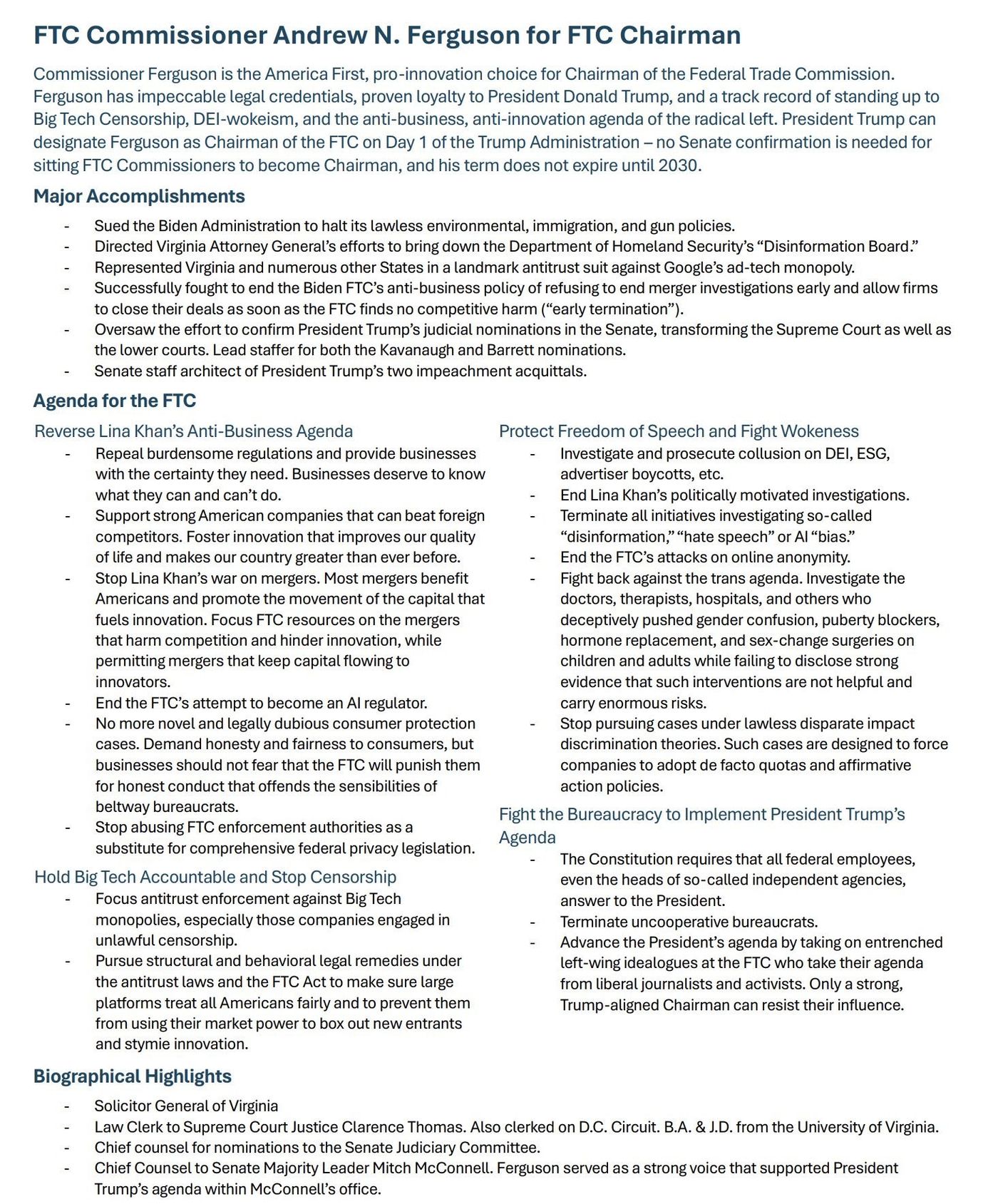
In a letter to Ferguson following Trump's announcement on Tuesday, FTC Commissioners Alvaro Bedoya and Rebecca Kelly Slaughter wrote that the document obtained and published by Punchbowl "raises questions" about his priorities at the agency mainly "because of what is not in it."
"Americans pay more for healthcare than anyone else in the developed world, yet they die younger," they wrote. "Medical bills bankrupt people. In fact, this is the main reason Americans go bankrupt. But the document does not mention the cost of healthcare or prescription medicine."
"If there was one takeaway from the election, it was that groceries are too expensive. So is gas," the commissioners continued. "Yet the document does not mention groceries, gas, or the cost of living. While you have said we're entering the 'most pro-worker administration in history,' the document does not mention labor, either. Americans are losing billions of dollars to fraud. Fraudsters are so brazen that they impersonate sitting FTC commissioners to steal money from retirees. The word 'fraud' does not appear in the document."
"The document does propose allowing more mergers, firing civil servants, and fighting something called 'the trans agenda,'" they added. "Is all of that more important than the cost of healthcare and groceries and gasoline? Or fighting fraud?"
As an FTC commissioner, Ferguson voted against rules banning anti-worker noncompete agreements and making it easier for consumers to cancel subscriptions. Ferguson was also the only FTC member to oppose an expansion of a rule to protect consumers from tech support scams that disproportionately impact older Americans.
"Andrew Ferguson is a corporate shill who opposes banning noncompetes, opposes banning junk fees, and opposes enforcing the Anti-Merger Act," said Basel Musharbash, principal attorney at Antimonopoly Counsel. "Appointing him to chair the FTC is an affront to the antitrust laws and a gift to the oligarchs and monopolies bleeding this country dry."
12 24
Trump appoints ambassadors Kimberly Guilfoyle and Tom Barrack, plus 5 more picks
ABC News on MSN.com
President-elect Donald Trump posted a flurry of announcements on Tuesday, including Kimberly Guilfoyle as ambassador to Greece and Tom Barrack as ambassador to Turkey.
no lnx
To the Trump transition, the president-elect is named Kimberly Guilfoyle
President-elect Donald Trump posted a flurry of announcements to his Truth Social account on Tuesday night, including the appointment of Kimberly Guilfoyle as the ambassador to Greece and Tom Barrack as the ambassador to Turkey.
Guilfoyle, a former fundraiser for Trump and a former host on Fox News, is currently in an established relationship with Donald Trump Jr.
In announcing her position, Trump wrote, "For many years, Kimberly has been a close friend and ally. Her extensive experience and leadership in law, media, and politics along with her sharp intellect make her supremely qualified to represent the United States, and safeguard its interests abroad."
The post also stated, "Kimberly is perfectly suited to foster strong bilateral relations with Greece, advancing our interests on issues ranging from defense cooperation to trade and economic innovation."
The 2024 Republican National Convention
Tom Barrack is Trump's longtime friend who chaired his first inaugural committee — and he was notably acquitted of federal charges accusing him of illegal foreign lobbying on behalf of the United Arab Emirates.
Barrack was charged during the first Trump administration and campaign, in 2021. During his trial, he was accused by federal prosecutors of acting as a foreign agent but failing to register between 2016 and 2018 while allegedly trying to "leverage his access" to Trump with his contacts in the UAE.
A jury found him not guilty on all charges -- which also included conspiracy, obstruction and lying to the FBI -- in November 2022.
MORE: Trump ally Tom Barrack found not guilty on foreign lobbying charges
Trump praised Barrack's acquittal at the time, saying in a statement: "Great news for our Country, Freedom, and Democracy in that businessman Tom Barrack, who should have never been charged or tried, was just acquitted of all charges."
Barrack's testimony during the trial was at times critical of Trump. He said on the witness stand that his support for Trump politically was "disastrous" for him professionally, at one point mocking Trump's understanding of the Middle East.
"This amazingly good businessman became the president of the United States who could not spell the Middle East," Barrack said.
Asked about his criticism of Trump at the time of the acquittal, Barrack told ABC News: "I'm just done with politics."
In announcing his ambassadorship to Turkey on Tuesday, Trump said that Barrack is "a well respected and experienced voice of reason."
MORE: Trump names Alina Habba counselor to the president, with other State Department roles
The president-elect also announced roles at the Federal Trade Commission. He named Andrew Ferguson as chairman and Mark Meador as commissioner.
"Andrew has a proven record of standing up to Big Tech censorship, and protecting Freedom of Speech in our Great Country. Sworn in as a Commissioner on April 2, 2024, he will be able to fight on behalf of the American People on Day One of my Administration," Trump wrote in his announcement.
The post continued, "Andrew will be the most America First, and pro-innovation FTC Chair in our Country’s History."
For Meador, Trump listed a series of degrees and accomplishments in the announcement post.
May 5, 2025 by Christopher H. Casey
Newest FTC Commissioner Mark Meador Signals Continuation of Aggressive Antitrust Enforcement
On May 1, newly-confirmed FTC Commissioner Mark Meador stated in a speech, and in a 33-page paper released the same day, that federal antitrust enforcers should be more concerned about underenforcement than overenforcement of the antitrust laws. In the speech, to the Conservative Partnership Institute in Washington, DC, Meador made the case that conservatives should reject a “laissez-faire or libertarian approach to antitrust law,” and instead “embrace vigorous enforcement of the antitrust laws.”
Meador stated that the Clayton Act demands that the government err on the side of caution when assessing the legality of mergers, and that “[a] greater level of certainty should be required to excuse a merger that eliminates competition than to condemn it.” Going further, Meador offered his view that, whether applied to political power or economic power, “big is bad.”
Meador was sworn in on April 16 as the third Republican commissioner. While the other two Republican commissioners, Chairman Andrew Ferguson and Melissa Holyoak, have also signaled that the Commission will continue aggressive enforcement in certain sectors (such as technology), Meador’s speech is perhaps the most explicit sign yet that there will be very little if any slowdown in enforcement by the Trump Administration’s FTC. But, as we have previously noted, the theories and means underlying this FTC’s enforcement priorities may still differ, even if the ends are closer than many anticipated.
an 1 25
Federal Trade Commission Chair Lina Khan announced that the FTC released its findings from a study on "how companies track consumer behaviors to inform surveillance pricing."