WALMART 2
---
see soc safety net
no merri
no text 9/16 see main and tag
defect alec 2012
kids are less RW? to co always into energy effic?
---
:{:{---}:
4 26
How Billionaires Cracked the Food Stamp Cheat Code
3.21M subscribers i am one
809,634 views Feb 12, 2026
mcD kroger, doordash? fedex ups, dollar gen tree; home dept, temp agy? ADDUS homecare illinois
Your taxes subsidize Amazon and Walmart poverty wages. These are trillion dollar companies, but 33% of Amazon workers need public assistance and 25% of Walmart workers need SNAP to survive. We investigated how corporations are taking advantage of workers—and all of us. Read more of our analysis here: https://substack.perfectunion.us/p/yo...
https://substack.perfectunion.us/p/your-tax-dollars-are-subsidizing
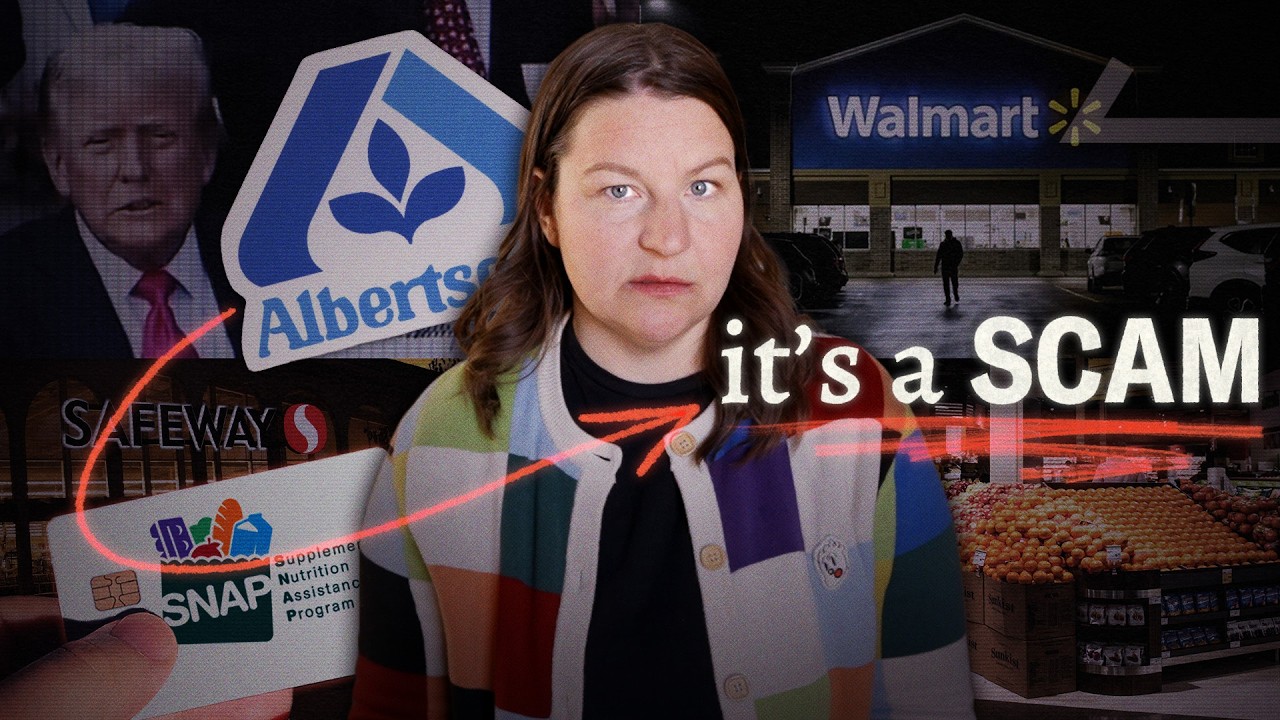
*By Donald Shaw and David Moore
Public records obtained from state agencies show that some of the most profitable and powerful companies in the U.S. are also among the largest employers of workers who rely on food assistance.
In state after state, data received by More Perfect Union through open records requests list giant retailers and gig-economy companies among those with the most workers enrolled in the Supplemental Nutrition Assistance Program (SNAP), giving a window into how taxpayer-funded public assistance is being used as de facto wage subsidies for some of the wealthiest American corporations.
We requested data from all 50 states, and after nearly two months of correspondence received information from four: Colorado, Illinois, Michigan, and Washington. An additional state, Massachusetts, released similar information to the Boston Globe last year, and is also analyzed in this report. Most of the other states either flatly rejected our requests or said they did not maintain such records, while Texas referred the request to its attorney general, and Utah requested a fee of $5,652 for the data.
In each of the states for which we have data, two companies are among the top four employers of SNAP recipients: Amazon and Walmart. Ranked by revenue, Amazon and Walmart are also the two largest companies in the world.
Amazon’s reliance on public subsidies for its underpaid labor force has been well known for years. In 2023, researchers at the University of Illinois conducted a survey of Amazon warehouse workers across 42 states and found that 33% of those surveyed had used public assistance programs in the previous three months, including 23% who had used SNAP. Eighty-nine percent of the survey respondents said they work at least 30 hours per week, the threshold used by the Internal Revenue Service for determining if someone is considered a full-time worker.
Walmart not only relies on SNAP to make up for its low wages, but it also benefits more than any other company from people using food stamps to buy their groceries. According to a Numerator survey covering the 12 months ending July 31, 2025, Walmart is the largest retailer for SNAP benefit redemption in the U.S., receiving 25.8% of all SNAP dollars.
Other companies that frequently appear at the top of the state lists include McDonald’s, DoorDash, Uber, Dollar Tree, and Dollar General. The dollar stores accept SNAP, so are double-dipping in the same way as Walmart. DoorDash and Uber have fought efforts to reclassify their workers as employees through aggressive lobbying and political spending, most notably spending tens of millions of dollars each in 2020 to pass a California ballot proposition that exempted app-based drivers from a recently enacted state law designed to grant them employee status and minimum wage protections.
Here’s what we heard back from the states that responded:
AN 1 26
Walmart directly debunks Trump's 'wildly inaccurate' claim
---
---
AN 12 25
On Friday, a nonprofit forced the Trump administration to unseal a damning complaint lodged by the Biden-era Federal Trade Commission against Pepsi for colluding with Walmart to raise food prices across the nation. New un-redacted information claims FTC Chair Ferguson and his colleague Mark Meador (both Trump appointees) were hiding the mechanics of Pepsi’s and Wal-Mart’s price fixing.
Pepsi is a “must-have” product for grocery stores, and Walmart is also massively powerful,” reports BIG Newsletter writer Matt Stoller. Critics say Pepsi allegedly engages in price discrimination to maintain the approval of Walmart, its biggest buyer — even going so far as to police prices at smaller rival stores. And it prepares reports for Walmart showing them their pricing advantages on Pepsi products.
When the “price gap” between Wal-Mart and its tiny rivals narrow too much, Pepsi tracks where consumers were buying Pepsi products outside of Walmart. It keeps logs on stores who would “self-fund” Pepsi product discounts, nicknaming them “offenders” and then raise their stock price, forcing them to carry those costs down to their customers.
“This dynamic is why independent grocery stores are dying,” said Stoller. “… It’s led to less competition, fewer local grocery stores, and higher prices. … To the end consumer, it creates an optimal illusion. Walmart appears to be a low-cost retailer, but that’s because it induces its suppliers to push prices up at rivals.”
Much of this information was redacted by Trump officials, however, including Ferguson and Meador. Normally, when the government files an antitrust case, the complaint gets redacted to protect confidential business information. Then the corporate defendant and the government haggle over what is genuinely confidential business information and complaints are eventually unsealed with some minor blacked out phrases, and the case goes on.
“In this case, however, … Ferguson abruptly dropped the case in February after Pepsi hired well-connected lobbyists,” said Stoller. “… Ferguson ended it the day before the government was supposed to go before the judge to manage the unsealing process. And that kept the complaint redacted. With the complaint kept secret, Ferguson, and … Meador, then publicly went on the attack.”
Ferguson released a “bitter and personal” statement against Biden-era FTC Chair Lina Khan — who had brought the complaint against Pepsi — implying that she was lawless and partisan, that there was “no evidence” to support key contentions, and that Ferguson had to “clean up the Biden-Harris FTC’s mess.” Fellow commissioner Mark Meador later echoed his comments on on X.
“And that was where it was supposed to stay, secret, with mean-spirited name-calling and invective camouflaging the real secret Ferguson was trying to conceal,” said Stoller. “That secret is something we all know, but this complaint helped prove that the center of the affordability crisis in food is market power. If that got out, then Ferguson would have to litigate this case or risk deep embarrassment. So, the strategy was to handwave about that mean Lina Khan to lobbyists, while keeping the evidence secret.”
But anti-monopoly group The Institute for Local Self-Reliance filed to make the full complaint public, and Judge Jesse Matthew Furman agreed to hear ILSR’s case, with the U.S. Chamber of Commerce and Pepsi bitterly opposed.
“Last week, Furman directed the FTC unseal the complaint. So we finally got to see what Ferguson and Meador were trying to hide,” Stoller said.
Read the full BIG report at this link
---
---
5 25 TRUMP PO’D BC AFTER MTG W HIM SAID THEY WD HAVE TO RAISE PRICES AFTER TARIFF, EAT IT?
---
AN 62
REBEL DTRS?
In a large ad for the Sunday edition of the New York Times, Walmart heiress Christy Walton urged Americans to "mobilize" and take part in large protests on Saturday, June 14 — the day President Donald Trump is holding a military parade in Washington, DC.
Walton attacked the parade as wildly inappropriate, arguing that Trump is not a "king," but an elected official.
The ad read, "The honor, dignity, and integrity of our country are not for sale."
READ MORE:'Unacceptable and egregious': Veterans blast Trump for goading troops to boo his opponents
Far-right MAGA Republicans are furious over the ad, and some are calling for a boycott of Walmart.
In a June 9 post on X, formerly Twitter, Newsmax's David J. Harris Jr. wrote, "INSANE: Newspaper ad Paid for by Christy Walton. Walmart heiress."
Conspiracy theorist Kari Lake, who lost gubernatorial and U.S. Senate races in Arizona, tweeted, "Do you shop at Walmart?"
Walmart spokesman Joe Pennington, however, told Forbes that Walton is only speaking for herself — not for Walmart. According to Pennington, "The advertisement from Christy Walton (is) in no way connected to or endorsed by Walmart."
READ MORE:Navy veteran warns Americans that we're getting to the dangerous point of no return
Calls for a MAGA boycott of Walmart are drawing a lot of responses on X.
Trump ally and self-described "proud Islamophobe" Laura Loomer tweeted, "I am glad Walmart took this opportunity to distance themselves from Christy Walton’s anti-Trump multi-city ad and to condemn political violence."
X user Uncle Korm posted, "She has nothing to do with current day Walmart. She's an heiress. That’s old Walmart money. Direct your indignation at Christy Walton, not at Walmart."
Another X user, Andy Clark, tweeted, "Ms. Lake, you are off base targeting WalMart on this. Christy Walton married into the Walton family. She inherited her WalMart stock upon the death of her husband. She has nothing to do with the day-to-day operations of the company. Do your research."
KrassenCast's Ed Krassenstein, mocking Lake, posted, "Cope. Cry Harder!"
X user Timothy Patrick posted, "What specifically…. does anyone disagree with? Do you want a king? Should we mistreat children and veterans? What did she say that was wrong?"
Patrick also pushed back against MAGA Republicans who are claiming, with zero evidence, that Walton is endorsing the militant Antifa movement.
Patrick wrote, "I'm guessing that no member of the Walton family is a part of antifa Trump is trying to act like a king. He's constantly trying to punish free speech, bypass due process, violating the posse Comitatus act, etc You’re free to disagree…. But my point is I see a lot of people upset about an ad when they agree with every single point made in the ad. But it’s not 'their team' so they’re outraged by points they agree with."
READ MORE: 'Blood, detentions and incarcerations': Analyst says Trump isn't satisfying MAGA's demands
---
https://www.alternet.org/2022/06/mike-lindell-walmart-canceled-mypillow/
---
intern persona?
---
---
1 24 an robt reich
when I was a boy, my father sold dresses and blouses to the wives of factory workers. As the wages of those workers rose through the 1950s, my father earned enough to expand his business to a second shop in another factory town not far away. We were by no means rich, but he earned enough to put us in the middle class.
For three decades after World War II, the average hourly compensation of American workers rose in lockstep with the nation’s productivity gains. In other words, as workers produced more value, they got more pay.
It was a virtuous cycle, from which our family and tens of millions of others benefited: The economy grew, and the middle class expanded. Its purchasing power rose, causing the economy to grow faster. This fueled new investments and innovations that further enriched and enlarged the middle class.
But then, beginning in the late 1970s, the virtuous cycle came to a halt.
While productivity gains continued much as before and the economy continued to grow, wages began to flatten. Starting in the early 1980s, the median household’s income stopped growing altogether, when adjusted for inflation.
Today, the median household is earning just a bit more than it did in 1979, 45 years ago (adjusted for inflation).
If you’re a non-supervisory worker who relies on an hourly wage — still the vast majority of workers — you’re earning no more than you earned in 1969. Job security also declined.
So, despite an economy that’s far larger and more productive than it was 40 or 50 years ago, the typical American worker has gone nowhere.
The standard explanation attributes this to neutral “market forces,” especially globalization and technological innovations that have made many working Americans less competitive.
While surely important, the standard explanation can’t account for much of what’s happened. It doesn’t explain why the transformation occurred so suddenly, over a relatively small number of years. Nor why other advanced economies facing similar forces didn’t succumb to them. Nor why so much of the nation’s income and wealth have gone to the top.
America’s middle class has shrunk because of its declining bargaining power — orchestrated and directed by America’s oligarchy. The economic gains that would otherwise have gone to the middle class went instead to the moneyed interests at the top. Let me explain.
1. The financialization of the economy
Before the 1980s (as I noted in our discussion about the decline of the common good), large corporations were in effect owned by all their stakeholders, who were assumed to have legitimate claims on them.
As early as 1914, the popular columnist and public philosopher Walter Lippmann called on America’s corporate executives to be stewards of America. “The men connected with [the large corporation] cannot escape the fact that they are expected to act increasingly like public officials …. Big businessmen who are at all intelligent recognize this. They are talking more and more about their ‘responsibilities,’ and their ‘stewardship.’”
This vision of corporate governance came to be widely accepted by the end of World War II. Frank Abrams, chairman of Standard Oil of New Jersey, declared in a 1951 address that typified what other chief executives were saying at the time:
*“The job of management is to maintain an equitable and working balance among the claims of the various directly affected interest groups … stockholders, employees, customers, and the public at large. Business managers are gaining professional status partly because they see in their work the basic responsibilities [to the public] that other professional men have long recognized as theirs.”
Pulp and paper executive J.D. Zellerbach told Timemagazine that “[t]he majority of Americans support private enterprise, not as a God-given right but as the best practical means of conducting business in a free society … . They regard business management as a stewardship, and they expect it to operate the economy as a public trust for the benefit of all the people.”
But a radically different vision of corporate ownership emerged in the late 1970s and early 1980s. It came from corporate “raiders” who mounted hostile takeovers with high-yield junk bonds.
The raiders used leveraged buyouts and undertook proxy fights against the “industrial statesmen” who, in their view, were depriving shareholders of the wealth that properly belonged to them.
The raiders assumed shareholders were the only legitimate owners of the corporation and that the only valid purpose of the corporation was to maximize shareholder returns.
This transformation did not happen by accident. It was a product of changes in laws governing corporations and of financial markets — changes that were promoted by the monied interests, America’s oligarchs.
In 1974, at the urging of pension funds, insurance companies, and Wall Street, Congress enacted the Employee Retirement Income Security Act. Before then, the giant portfolios of pension funds and insurance companies could be invested in only high-grade corporate and government bonds. Legally, it was their fiduciary obligation.
The 1974 Act changed that, allowing pension funds and insurance companies to invest in the stock market — thereby making a huge pool of capital available to Wall Street.
In 1982, another large pool of capital became available when Congress allowed savings and loan banks — the bedrocks of local home mortgage markets — to invest their deposits in a wide range of financial products, including junk bonds and other risky ventures promising high returns.
The convenient fact that the government insured savings and loan deposits against losses made these investments all the more tempting (and ultimately cost taxpayers some $124 billion when many of the banks went bust).
Meanwhile, the Reagan administration loosened other banking and financial regulations and simultaneously cut the enforcement staff at the Securities and Exchange Commission.
All this made it possible for corporate raiders to get the capital and the regulatory approvals they needed to mount unfriendly takeovers.
During the whole of the 1970s, there had been only 13 hostile takeovers LBO of companies valued at $1 billion or more. During the 1980s, there were 150.
Even where raids did not occur, CEOs felt pressured to maximize shareholder returns for fear their firms might otherwise be targeted. Hence, they began to see their primary role as driving up share prices.
The easiest and most direct way for CEOs to accomplish this feat was to cut costs — especially payrolls, which constitute most firms’ largest single expense.
Accordingly, the corporate statesmen of the 1950s and 1960s were replaced by the corporate butchers of the 1980s and 1990s, whose nearly exclusive focus was to “cut out the fat” and “cut to the bone.”
When Jack Welch took the helm of GE in 1981, the company was valued by the stock market at less than $14 billion. When he retired in 2001, it was worth about $400 billion. Welch accomplished this largely by cutting payrolls.
Before his tenure, most GE employees had spent their entire careers with the company. But between 1981 and 1985, a quarter of them — 100,000 in all — lost their jobs, earning Welsh the moniker “neutron Jack.” Even when times were good, Welch encouraged his senior managers to replace 10 percent of their subordinates every year in order to keep GE competitive.
Other CEOs tried to outdo even Welch. As CEO of Scott Paper, “Chainsaw” Al Dunlap laid off 11,000 workers, including 71 percent of headquarters staff. Wall Street was impressed, and the company’s stock soared.
When Dunlap moved to Sunbeam in 1997, he promptly laid off half of Sunbeam’s 12,000 employees. (Unfortunately for Chainsaw Al, he was caught cooking Sunbeam’s books; the SEC sued him for fraud, and he settled for $500,000, agreeing never again to serve as an officer or director of any publicly held company.)
In consequence of this change in the purpose of the American corporation, share prices soared, as did the compensation packages of CEOs. The results have been touted as “efficient” because resources theoretically have been shifted to “higher and better uses.”
But the human costs of this transformation have been huge. Millions of workers have lost jobs and wages. Many communities have been abandoned.
Nor have the efficiency benefits been widely shared.
As corporations have steadily weakened their workers’ bargaining power, the link between productivity and workers’ income has been severed.
Almost all the gains from growth have gone to the top. As noted, the average worker today is no better off than his or her equivalent 40 years ago, adjusted for inflation. Most are less economically secure.
Not incidentally, few own any shares of stock.
The richest 1 percent of Americans now own 52 percent of all the shares of stock owned by Americans. The richest 10 percent, 93 percent. The nation’s economic gains, once distributed broadly to the working and middle class — have been siphoned to the top.
2. Globaloney
Wages have also been suppressed because workers who are worried about keeping their jobs have accepted lower pay, relative to the economy’s productivity gains, than they did 40 years ago.
Here again, political decisions steered by the nation’s oligarchy have played a significant role. Some of the prevailing job insecurity is the result of trade agreements that invited American companies to outsource jobs abroad.
The conventional view equating “free trade” with the “free market” — in contrast to government “protectionism” — is wrong.
Just as all nations’ markets reflect political decisions about how they should be organized, so-called “free trade” agreements entail complex negotiations about how different market systems are integrated.
Within these negotiations, the interests of large corporations and Wall Street, to fully protect the value of their intellectual property and financial assets, have repeatedly trumped the interests of average working Americans to protect the value of their labor.
3. The Fed and inflation
When the Federal Reserve raises interest rates and Congress opts for austerity to reduce federal budget deficits — two policies favored by the oligarchy — the resulting unemployment also undermines the bargaining power of average workers.
Higher unemployment keeps wages low. This means higher corporate profits, leading to higher returns for shareholders.
The high inflation after the pandemic was driven in part by supply shortages and a major government stimulus. But it was also driven by monopolistic corporations using the excuse of inflation to raise their prices.
The Fed, however, believed that a root cause of inflation was wage growth, and it set out to slow the economy and loosen the labor market by raising interest rates. Here, too, the strategy was consistent with the views of the moneyed interests and was pushed by them.
4. The risk-shift to workers
Public policies that emerged during the New Deal and World War II placed most of the risks of economic change on large corporations rather than workers — through Social Security, worker’s compensation, 40-hour workweeks with time-and-a-half for overtime, and employer-provided health benefits (wartime price controls encouraged such tax-free benefits as substitutes for wage increases).
By the 1950s and 1960s, a majority of the employees of large companies remained with the companies for life. Their paychecks rose steadily with seniority, productivity, the cost of living, and corporate profits. When they retired, they received generous corporate pensions.
But after the junk-bond and takeover mania of the 1980s, that relationship broke down.
Even full-time workers who have put in decades with a company can now find themselves without a job overnight — with no severance pay, no help finding another job, no health insurance, and little or no pension.
Nearly one out of every five working Americans is now in a part-time job. Many are temporary workers, freelancers, independent contractors, or consultants, whose incomes and work schedules vary from week to week or even day to day. Two-thirds of American workers are living paycheck to paycheck.
The risk of getting old without a pension is rising.
In 1980, more than 80 percent of large and medium-sized firms gave their workers “defined-benefit” pensions that guaranteed them a fixed amount of money every month after they retired.
Now, fewer than 10 percent of companies provide their workers defined-benefit pensions. Instead, they offer “defined contribution” plans whose risks have been shifted to the workers. When the stock market tanks, as it did in 2008 and then again in 2020, their 401(k) plans tank along with it.
A quarter of all workers with so-called “matching” defined-benefit plans get no match because they don’t earn enough to contribute to them.
Meanwhile, the risk of a sudden loss of income continues to rise. Even before the crash of 2008, the Panel Study of Income Dynamics at the University of Michigan found that over any given two-yearstretch, about halfof all families experienced some decline in income.
Those downturns have become progressively larger. In the 1970s, the typical drop was about 25 percent. By late 1990s, it was 40 percent. By the mid-2000s, family incomes rose and fell twice as much as they did in the mid-1970s, on average.
Workers who are economically insecure are not in a position to demand higher wages. They are driven more by fear than by opportunity.
This is another central reality of American capitalism as organized by those with the political power to make it so.
5. The demise of labor unions
Fifty years ago, when General Motors was the largest employer in America, the typical GM worker earned $35 an hour in today’s dollars.
Today, America’s largest employer is Walmart, and the typical entry-level Walmart worker earns about $11 an hour.
This doesn’t mean the typical GM employee a half-century ago was “worth” four times what the typical Walmart employee today is worth. The GM worker was not better educated or motivated than today’s Walmart worker.
The real difference is that GM workers a half-century ago had a strong union behind them that summoned the collective bargaining power of all autoworkers to get a substantial share of company revenues for its members.
Because more than a third of workers across America then belonged to a labor union, the bargains those unions struck with employers raised the wages and benefits of non-unionized workers as well. Non-union firms knew they would be unionized if they did not come close to matching the union contracts.
Today’s Walmart workers do not have a union to negotiate a better deal. They are on their own. Because only 6 percent of today’s private-sector workers are unionized, most employers across America have no incentive to match union contracts. This puts unionizedfirms at a competitive disadvantage.
The result has been a race to the bottom.
Some argue that the decline of American unions is simply the result of “market forces.” But other nations have been subject to many of the same “market forces” and continue to have strong unions. In Sweden, 90 percent of workers in the private sector are unionized. These unions continue to provide their middle classes sufficient bargaining power to command a significant share of economic growth — a much larger share than that received by the middle class in the United States.
Why the difference? Look to politics and the allocation of power.
***
The National Labor Relations Act of 1935 guaranteed American workers the right to organize into unions and imposed on employers the legal responsibility to bargain with them.
As unions gained economic power in the late 1930s and 1940s, they gained greater. political power and wielded it to further enlarge the bargaining clout of American workers. After the legendary Treaty of Detroit in 1950, when Big Business and Big Labor agreed to share productivity gains in exchange for labor peace, the rate of unionization increased dramatically, as did wages and benefits.
Which is why, by the mid-1950s, almost a third of all American employees in the private sector of the economy belonged to a union, and why the median wage increased in tandem with productivity growth.
But starting in the late 1970s, the process went into reverse. Union membership began to decline, as did the economic and political power of unions, along with the bargaining clout of most workers.
The reasons for the decline involved the changes I’ve already noted — globalization, labor-replacing technologies, and a shift in the purpose of the corporation to maximizing shareholder returns.
But the decline of labor unions was also the consequence of political and legal decisions demanded by the monied interests.
When the Taft-Hartley Act of 1947 allowed states to enact “right-to-work” laws, workers who did not pay dues got a free ride off of those who did, thereby undermining the incentive for anyone to join a union in the first place.
Until the 1980s, such laws had minimal effect because they were enacted in southern and western states. Most industries remained in the north.
But as corporations came under increasing pressure to show high returns and cut labor costs, many CEOs found “right-to-work” states more alluring. Even the old heartland industrial states of Indiana and Michigan have enacted “right-to-work” laws.
CEOs whose corporations had high percentages of unionized workers moved, or threatened to move, to “right-to-work” states.
Additionally, Reagan’s notorious firing of the nation’s air traffic controllers for going on strike (which he had a right to do because they had no right to strike) signaled to the nation’s large employers that America had embarked on a different era of labor relations.
Workers who inhabited the local service economy — retail, restaurants, custodial, hotels, elder and child care, hospitals, transportation — faced a different challenge. Their jobs were in less danger of disappearing, because they couldn’t be outsourced abroad and most would not be automated. In fact, the number of local service jobs in America has continued to grow.
But because so many workers expelled from the older industrialized economy had no choice but to seek local service jobs, service-sector employers easily found people willing to work for low wages, few benefits, and little chance of advancement.
Walmart and major fast-food chains, such as Starbucks, have been aggressively anti-union. They’ve blocked union votes, fired workers who tried to organize, refused to enter into contract negotiations, and intimidated others into rejecting the union — all in violation of the National Labor Relations Act.
A succession of Democratic presidents have promised legislation streamlining the process for forming unions and increasing penalties on employers who violate the law, but nothing has come of these promises. (President Biden has been the first to strengthen the National Labor Relations Board and encourage it to enforce the law.)
The result of all this has been a steady decline in the percentage of private-sector workers who are unionized. Despite the jolt of labor activism in 2023, that percentage continues to drop.
The decline parallels the declining share of total income going to the middle class.
Take a look:

6. Summary
The underlying problem is that average working Americans have steadily lost the bargaining power to receive as large a portion of the economy’s gains as they received in the first three decades after World War II. As a result, instead of the middle class growing, it has shrunk.
To attribute this to the impersonal workings of the “free market” is to ignore how the market has been reorganized since the 1980s. America’s oligarchs — the moneyed interests — have spearheaded this reorganization in order to receive a steadily larger share of the nation’s economic gains. As those gains have risen, so has the oligarchy’s power to accumulate even more.
But it doesn’t have to be this way. Next week we’ll look at whether — and how — countervailingpower can be restored so that more of America’s poor and working class can ascend into the middle class once again.
*Robert Reich is a professor at Berkeley and was secretary of labor under Bill Clinton. You can find his writing at https://robertreich.substack.com/.*
---
an 8 23 $
no lnx
For the next time some idiot tries to tell you the GOP is 'The Party of Business'
Nikki Haley is ‘whitewashing’ her record on Putin while hypocritically attacking Democrats: conservative
Thom Hartmann
August 30, 2023
As predictably as the sun rises and sets, every Sunday sees a commentator or politician on one of the Sunday political talk shows say — without being challenged — words to the effect that the Republican Party understands and supports business better than Democrats. This weekend, as I recall, it was CNN‘s turn.
All my life, in fact, I’ve been told by the media that the GOP is the “party of business.”
It may have once been true when I was a very young child, but today it’s a lie — and has been so in a huge way since the neoliberal Reagan Revolution.
Between 1933 and 2020 there were 14 American presidents, 7 Democratic and 7 Republican.
:{
}:
The economy during this time grew at an average rate of 4.6% under the Democratic presidents, but only an anemic 2.4% under Republican presidents. For example, the economy has grown three times faster under Biden than under Trump.
Ten of the past 11 recessions began under Republican presidents,although lifelong Republican and Trump Fed appointee Jerome Powell seems hell-bent on producing one for Joe Biden, just in time for the 2024 election.
Republican presidents have exploded the national debt,while the only balanced budgets out of the past 60 years have been presented by Democratic presidents Carter, Clinton, and Obama.
Bill Clinton left George W. Bush a $128 billion surplus (after 4 consecutive years of budget surpluses): Bush immediately squandered it with a massive tax cut for billionaires and two criminal wars.
Just last year, President Biden decreased federal spending by $550 billion and reduced the deficit by $1.4 trillion — the largest one-year deficit drop in American history — all while creating five times more jobs in 2 years than the last three Republican presidents combined.
If not for the Reagan, Bush, and Trump tax cuts for billionaires and the two wars George W. Bush lied us into, our national debt would today be zero instead of over $30 trillion.
The core of American business and thus the livelihood of American communities before Reagan was small- and medium-sized companies.
We enforced anti-trust lawsso aggressively that when Buster Brown and Kinney shoe companies wanted to merge in the 1960s the Supreme Court blocked the merger because the combined company would control about 5 percent of the US shoe market.Nike alone today controls around 20 percent of that market.
Small- and medium-sized companies built America and brought us the American middle class, the first and largest middle class in the world. But in 1983, when Reagan ordered the DOJ, FTC, and SEC to stop enforcing anti-trust laws dating back to the Sherman Act of 1890, giant corporations began a relentless campaign to destroy locally-owned companies.
Strip malls and small-town downtowns that were once mostly home to local retailers are now dominated by giant monopolistic national chains. Big Box stores, spreading across the country unconstrained since Reagan, have been wiping out small towns and rural communities.
One study found, as Reuters reported:
“[T]he closer a store was to the Walmart location, the greater the likelihood it would close. Persky and his colleagues found that for every mile closer to the Walmart, 6 percent more stores closed. Close in around the store's location, between 35 and 60 percent of stores closed.”
For most American businesses and the communities they serve, Republican governance has been a disaster since the Reagan 1980s.
In the 1950s, Republican President Dwight Eisenhower championed building tens of thousands of new public schools all across America, an effort supported by the business community because an educated workforce is a productive workforce.
From the early days of the Industrial Revolution, Americans were proud that we had one of the best-educated workforces in the world, and that itself was a huge boost to business.
In 2010, though, when fossil fuel billionaires bankrolled the Tea Party and were looking for an issue to beat up on Democrats in the 2010 and 2012 elections, they seized on the national standards for education program conceived and legislatively initiated by both Republicans and Democrats called “Common Core.”
Although it had been endorsed by the US Chamber of Commerce and GOP presidential front-runner Jeb Bush (among others) and was in place in 45 states, word went out that it was an effort to “indoctrinate” American students.
:{
}:
The story ran day after day on Fox “News” and rightwing hate radio. Hysteria followed, and Red state after Red state outlawed these new high standards for high-school graduation. Republican grandstanding for political gain actually dumbed down America.
The 2020 version of this was Critical Race Theory, another equally bogus attack on public education. Between this, “Don’t Say Gay,” and banning thousands of books, the Republican war on public education has blossomed into full flower.
Now, Republican states are trying to shut down their public schools altogether via state-wide voucher programs, replacing Eisenhower’s AAA+ education system with state-funded religious and rightwing for-profit schools that refuse to teach actual science, civics, or American history.
Arizona was the first to go statewide with vouchers, and Republican legislators in Texas, Florida, Kansas, and a dozen other GOP-run states are considering the same.It’s quite simply an all-out effort to destroy public education and subsidize religious schools and private all-white academies for upper-middle-class people who can take advantage of a voucher that only covers part of the cost of tuition.
The only option left for the very poorest people will be the few remaining public schools, essentially turning them into ghettos.
Republican President Dwight Eisenhower ran for re-election in the 1956 election by bragging that he’d expanded Social Security across America, and his 1952 election was mostly powered by his enthusiastic endorsement of unionization.
:{
}:
At a speech before the American Federation of Labor (AFL) in 1952, Eisenhower noted that the first national legalization of unions in America was signed by Republican President Calvin Coolidge, the 1926 Railway Labor Act.
:{
}:
“Only a handful of unreconstructed reactionaries harbor the ugly thought of breaking unions,” he told the union group now known as the AFL-CIO, the nation’s largest. “Only a fool would try to deprive working men and women of the right to join the union of their choice.”
:{
}:
Similarly, in September of 1970 President Richard Nixon hosted labor leaders from across America, praising the movement. As The New York Times noted on September 8, 1970:
“When the ‘great issue’ has been whether to support the President and to meet the nation’s responsibilities ‘for defending and protecting the forces of freedom in the world,’ he said, ‘American labor has never been found wanting. It has always been the first in war and in peace.’”
As a result of combined Democratic and Republican support of unions, by Reagan’s election in 1980 about two-thirds of all American workers had a union job or it’s equivalent,with great pay, benefits, and retirement plans, because a third of workers were union members and that set the pay and benefits floor for the non-union employers to compete for another third of workers.
But, following Nixon putting Lewis Powell on the Supreme Court in 1971, the GOP began to adopt the positions in thePowell Memo, which included gutting labor unions so the morbidly rich could become even richer.
Their rationale was that workers having a say in the workplace had “destabilized” America, a point first made in 1951 by Russell Kirkin his book The Conservative Mind that I detailed two years ago here.
President Reagan, however, declared war on organized labor with his attack on the PATCO union. Ever since, the GOP has been fighting efforts to expand unionization.
Combined with Reagan’s massive tax cuts for billionaires and giant corporations, this loss of union representation has led to a$50 trillion transfer of wealthfrom the homes and retirement accounts of working-class people straight into the money bins of the morbidly rich.
Instead of two-thirds of Americans having a middle-class lifestyle like in 1980, today that number is down to around 45 percent of us. As a result, both poverty and homelessness have exploded across the land. And poor and homeless people can’t afford to support a strong economy — and thus American business — the way a prosperous middle class can.
Dwight Eisenhower created the Small Business Administration to “aid, counsel, assist, and protect insofar as is possible the interests of small-business concerns.”
He signed a massive expansion of Social Security to take the pension/retirement onus off small- and medium-sized employers, increased the minimum wage so a prospering working class could purchase the products of American manufacturers, and built low-income housing across the nation to end the homeless “hobo” problem left over from the Republican Great Depression.
Eisenhower created from scratch the Department of Health, Education and Welfare to build a healthy and well-educated workforce, while Richard Nixon signed the Environmental Protection Agency into law to save the lives of American workers being killed by toxic pesticides and other chemicals (the agency’s creation was provoked by Rachel Carson’s book Silent Spring).
Today’s GOP opposes all of these programs and agencies. They only support the largest American companies and the richest citizens.
When Trump was president, he rolled back regulation of toxic pesticides known to cause brain damage to children, and one of his first official acts in office was to end the prohibition of coal mines dumping their toxic waste and tailings into America’s rivers, polluting downstream water supplies with cancer-causing chemicals.
Arguably, the best policy possible for American businesses of all sizes is the Medicare For All program promoted for decades by progressive Democrats.
Back in 2004, Toyota announced they’d be opening a new factory in North America. Three southern US states offered them billions in tax advantages and free land, with the Republican governor of Alabama openly bragging about how cheaply his citizens would work for the company.
But in the end, in 2005, Toyota announced they’d be building the factory in Ontario, Canada because US healthcare costs are nearly twice those of Canada, which has had a successful Medicare For All system in place for more than a half-century (as I lay out in The Hidden History of American Healthcare: Why Sickness Bankrupts You and Makes Others Insanely Rich).
Since then, as Republicans (and a few bought-off Democrats) continue to fight any effort to establish a national healthcare or health insurance system, the company has built two more North American factories in Canada.
If it wasn’t for Republican obstruction, they would’ve been built here and the jobs would be here.
The simple reality is that Republicans have no coherent plans for the American economy beyond more tax cuts for their morbidly rich donors and more deregulation of the very largest and most polluting corporations.
:{
}:
To compensate for this deficiency, they push hate against queer people, public school teachers, women, and dark-skinned immigrants. DeSantis has gone so far as to attack Disney, Florida’s largest employer and source of tax revenues, because they had the temerity to respect their gay, lesbian, and trans employees and customers.
Republicans have banned hundreds of books from public schools and libraries, saturated our towns and cities with weapons of war, banned women’s access to reproductive healthcare, and packed our courts with judges who’d be comfortable with the American Nazi movement, the Federalist Society, and the John Birch Society.
Not only are these policies and positions bad for America, they’re also destructive of most American businesses.
So, the next time some idiot tries to tell you that the GOP is “the party of business,” let them know the real facts.
The only businesses Republicans actually support are gun sellers, megachurches, corrupt defense contractors, and giant monopolies. And none of those are good for average Americans, locally-owned businesses, or the US economy.
https://www.alternet.org/nikki-haley-slammed-medicaid-couch/
no lnx
Nikki Haley slammed for 'idiotic' claim that Medicaid and food stamp recipients are 'sitting on the couch'
David Badash and The New Civil Rights Movement March 10, 2023
Former Trump UN Ambassador Nikki Haley is taking heat for falsely suggesting most Americans who use Medicaid or food stamps are "siting on the couch" and not working when they could be. In reality, the majority of food stamp and Medicaid recipients are children, seniors, or those with disabilities.
"We shouldn't be paying people to sit on the couch and adding to the rolls of welfare," Haley, the former Republican governor of South Carolina currently running for president told Fox Corporation"s Neil Cavuto Thursday (video below), as she advocated for strong cuts in spending.
"This is going to have to be harsh," Haley insisted. "It's going to take a president that is going to call out Republicans and Democrats. I did that as governor. I’ll do it again as president."
She also insisted cuts to so-called entitlement programs must happen but targeted "kids in their 20s," saying, "those are the ones that need to go and know that things are going to be changed."
READ MORE: DeSantis Expected to Run on COVID Results by Saying 'We Were Right, They Were Wrong' – Florida Ranks Among the Worst
"It's the new ones coming in," Haley continued, explaining her plan to dramatically scale back the social safety net. "It's those in their twenties that are coming in. You're coming to them and you're saying the game has changed. We're going to do this completely differently. That's how you go and you focus on it."
"We've got to start doing things like that. But more than that, we have to look at the fact that there is a spending problem in DC and Republicans and Democrats have done this to us," she insisted. "Don't forget that when this all started, with the Republicans, they passed a $2.2 trillion COVID stimulus package 419-6 in the House and 96-0 in the Senate that expanded welfare. Now we have 90 million people on Medicaid. You've got 42 million people on food stamps. We should be taking people from welfare to work."
But Haley did not mention that the vast majority of Americans on programs like Medicaid and “food stamps” are not eligible to work. They are children (which Republicans are increasingly seeing as a source of labor), seniors, and those living with disabilities.
Haley also did not mention that 74% of Americans who are recipients of "food stamps," also known as the Supplemental Nutrition Assistance Program (SNAP) are categorized as the “working poor.”
READ MORE: Sarah Huckabee Sanders Signs Law Gutting Child Labor Protections for Minors Under 16 Years Old
Another group that is working yet struggles to eat? U.S. service members. In January the Military Times, pointing to several studies including from the Rand Corp. and the Dept. of Defense reported that about on quarter of America’s troops are food insecure.
Haley's remarks were highly-criticized.
"Just to pick one company," Helen Kennedy, a former journalist and frequent political commentator said to the former governor on Twitter, noting, "more than 14,000 people who work at @Walmart are also on food stamps because that company pays as little as possible. Walmart’s gross profit for 2022 was $143 billion. Maybe look at the big guy, not the little one."
Russell Drew, a frequent political commentator on social media blasted Haley as the "leader of the Republican Party's Grey Poupon wing."
"She has proudly succeeded Mitt Romney. She's one week away from talking about 'welfare queens in Chicago.'"
"Most non-disabled Medicaid participants of working age are, in fact, working," noted professor of politics, Dr. John Pitney, Ph.D.
Democratic National Committee chairman Jaime Harrison slammed Haley: "The only thing lazy is this idiotic statement from Nikki Haley! Just because you are poor doesn’t mean you don’t work hard. There are a lot of elders who don’t have big pensions & 401ks but receive food stamps. Medicaid expansion has provided healthcare for millions of workers."
Watch Haley's remarks below or at this link.
not violent but hyped
pop info judd
12 22
Walmart CEO Doug McMillon announced during an interview on CNBC last week that the retailer may have to raise prices or close stores due to insufficiently aggressive prosecution of retail theft. McMillon claimed that, as a result of lenient sentences, theft at Walmart is “higher than what it has historically been.” During the interview, McMillon does not disclose how much merchandise Walmart is losing to shoplifting or how that compares to previous years.
Walmart, the nation’s largest retailer, racked up $559.2 billion in revenue last year. So far this year, the company has made $15 billion in profits. Last quarter alone, Walmart recorded $152.8 billion in sales, nearly a 9% increase from the previous year. The purported spike in shoplifting at Walmart did not stop the company from announcing a new $20 billion **share buyback plan** last month. And McMillon is being paid as if the company is thriving. In 2021, he took home $22.574 million in total compensation — 1,078 times more than the median Walmart employee.
Publicly available data also contradicts McMillon’s claims. As Popular Information previously reported, the number of shoplifting offenses dropped 46 percent between 2019 and 2021, according to the FBI’s crime data explorer.
Of course, not all shoplifting incidents result in charges. But the National Retail Federation, a trade association that represents Walmart and other major retailers, found that "shrink" — an industry term for inventory losses from theft, damage, or administrative errors — declined between 2019 and 2021. In 2021, the average shrink rate was 1.4% of total retail sales. That means for every $100 in sales, an average of $1.40 in inventory was lost. Retail theft alone amounted to 0.5% of total retail sales, or $0.52 for every $100.
 |
The average retail shrink in 2021 is the same as it was in 2015. The only difference is that shoplifting and external theft made up a slightly larger portion of the "shrink" in 2015 than it did in 2021.
Walmart isn’t the only company stoking fears of a shoplifting surge. Last year, Walgreens announced that it was closing five stores in the Bay Area due to the “scale of thefts.” Popular Information found that this claim, however, was not reflected in citywide crime data, which showed that in 2020 shoplifting had reached its lowest level since they began collecting data 45 years ago. Walgreens also said in 2019 that it planned to shutter 200 stores as a “cost-saving measure,” reported the San Francisco Chronicle. “[T]he timing of Walgreens’ decision led observers to wonder whether a $140 billion company was using an unsubstantiated narrative of unchecked shoplifting to obscure other possible factors in its decision,” wrote the San Francisco Chronicle.
Target CFO Michael Fiddelke told CNBC last month that theft rose “about 50% year over year.” The company told Winsight Grocery Business that it is working with legislators and law enforcement to address the “growing national problem” of retail theft. Similarly, last week, the former CEO of Home Depot, Bob Nardelli, described retail theft as an “epidemic” and said that shoplifting was “spreading faster than COVID.”
Despite the apocalyptic rhetoric, losses from shoplifting pale in comparison to the wages employers steal from employees each year. The Economic Policy Institute estimates that employerssteal roughly $15 billion annually from their employees from minimum wage violations alone. This figure, which excludes other common forms of wage theft like overtime violations, “exceeds the value of property crimes committed in the United States each year.”
Since 2000, Walmart has had to pay $1.5 billion in penalties for wage and hour violations, according to the Good Jobs First Violation Tracker.
Will more aggressive prosecution deter theft?
CNBC's Rebecca Quick, one of the hosts of Squawk Box, asked McMillon about "laws that have been changed." Specifically, Quick claims that there are new laws that provide "criminals won't be prosecuted below a certain level." McMillon accepted the premise of Quick's question, arguing the laws need to be "corrected."
But Quick's description of the law is inaccurate. States have not passed statutes legalizing theft. Rather, all states have a felony threshold for shoplifting. In Connecticut, shoplifting more than $200 in goods is a felony. In Texas, the threshold is $2,500. Misdemeanor theft, below the felony threshold, generally results in little to no jail time. Felony theft can result in years in prison.
Since 2000, at least 40 states have raised their felony theft thresholds. Walmart and other retailers have spent millions opposing these changes, arguing that raising the felony threshold will increase shoplifting. The data, however, does not support this claim.
A 2017 study by Pew Trusts found that "in the 30 states that raised their thresholds between 2000 and 2012, downward trends in property crime or larceny rates, which began in the early 1990s, continued without interruption." Further, the study found that "states that increased their thresholds reported roughly the same average decrease in crime as the 20 states that did not change their theft laws." Notably, the "amount of a state’s felony theft threshold—whether it is $500, $1,000, $2,000, or more—is not correlated with its property crime and larceny rates."
In 2010, South Carolina raised the threshold for felony theft from $1,000 to $2,000. Pew Trusts found that "since the law was implemented, the state’s property crime rate …continued to fall, dropping 15 percent in the three years after reform." Despite the higher threshold, "the value of goods reported stolen in the state…did not change, remaining about $200 on average."
Retailers were able to push through a harsh anti-shoplifting law, with no felony threshold, in Arizona. It resulted in a "man who robbed [a] Walmart of goods worth less than $10… facing two felony charges."
Why doesn't increasing the felony threshold increase shoplifting? Most shoplifters are not making a calculation about the potential legal consequences. Many are addicted to drugs and are willing to do anything to feed their addiction. Last month, Walmart proposed paying $3.1 billion to settle lawsuits alleging it "improperly filled prescriptions" for opioids, fueling an addiction epidemic.
offshore tax dodge thus inequality
https://www.alternet.org/2021/09/companies-lobbying-against-infrastructure-tax-hikes-have-dodged-millions-in-taxes-report/
ah
President Joe Biden's American Jobs Plan proposal would raise the United States' corporate tax rate to 28% in order to pay for infrastructure projects. Some large corporations, journalist Akela Lacy stresses in an article published by The Intercept on September 6, have been aggressively lobbying against that proposal — and they include everything from pharmaceutical companies to financial firms, some of which dodged a fortune in taxes.
"Companies that…. lobbied earlier this year on issues related to tax rates in Biden's American Jobs Plan include Walmart, Oracle, Accenture, Bristol Myers Squibb, Shell and Walgreens, according to an analysis by Accountable.US, a nonpartisan watchdog group focused on public corruption," Lacy explains. "Executives at companies that have historically avoided paying taxes, like Johnson & Johnson, JPMorgan Chase, FedEx, and DuPont, have spoken out publicly against Biden's proposed tax increases."
Lacy continues, "Shell and Walgreens lobbied earlier this year on corporate tax issues in the American Jobs Plan. Walmart hired a lobbying firm tasked with 'monitoring of tax proposals related to infrastructure' in the plan and proposed legislative efforts related to Donald Trump's 2017 tax cuts. Accenture hired another firm to 'monitor the American Jobs Plan as it relates to corporate taxes.' Oracle and Bristol Myers Squibb, a multinational pharmaceutical company, used the same firm hired by Accenture to monitor and lobby on similar issues in the proposal."
Lacy goes on to note how successful some of these mega-corporations have been when it comes to dodging taxes — and not only in the United States.
"A Reuters report last year found that from 2018 to 2019, Shell reported $2.7 billion through offshore tax havens and avoided paying hundreds of millions of dollars in taxes," Lacy writes. "In 2019, Australia charged Shell $755 million for six years' worth of taxes the company did not pay. The company reported that after getting tax refunds related to the closure of oil platforms, it paid no corporate income tax in the U.K. in 2018 on $731 million in profits."
Lacy points to Walgreens as another company that knows how to dodge taxes.
"Between 2008 and 2014," Lacy explains, "Walmart held more than $23.3 billion in offshore accounts and avoided paying more than $4.59 billion in U.S. taxes, according to a 2016 Oxfam report. In an arrangement internally known as Project Flex, the company routed money through an allegedly fictitious Chinese subsidiary, Quartz reported, which allowed it to avoid paying $2.6 billion in U.S. taxes between 2014 and 2017. The 2016 report from the U.S. PIRG, CTJ, and ITEP also found that Walmart reported zero tax haven subsidiaries despite having as many as 75."
921
infra twin bill
https://www.alternet.org/2021/09/lobbying-congress/
New report details a 'massive lobbying blitz' against Biden's agenda — but Sanders has a warning for them
an 921
...no lnx
...the Post, which published Sanders' remarks on Tuesday, offered a detailed look at the "massive lobbying blitz" that corporate America has launched in recent days in a bid to water down—or kill entirely—the reconciliation package, a centerpiece of President Joe Biden's economic and climate agenda.
The range of big-name corporations involved in the campaign—from the pharmaceutical giant Pfizer to the fossil fuel behemoth ExxonMobil—reflects the potentially far-reaching scope of the nascent reconciliation bill, which could allow Medicare to negotiate drug prices, reverse former President Donald Trump's corporate tax cut, institute paid family and medical leave, strengthen workers' rights, and establish a pathway to citizenship for millions of undocumented immigrants.
"The emerging opposition appears to be vast, spanning drug manufacturers, big banks, tech titans, major retailers, and oil-and-gas giants,"the Post's Tony Romm reported. "In recent weeks, top Washington organizations representing these and other industries have started strategizing behind the scenes, seeking to battle back key elements in Democrats proposed overhaul to federal healthcare, education, and safety net programs."
One of the organizations that has been "most active" in the effort to prevent passage of the reconciliation bill, according to the Post, is the U.S. Chamber of Commerce, the largest business lobbying organization in the country. Romm reported that the Chamber is "in the early stages of putting together an economywide coalition to coordinate the fight against the still-forming economic package, including its significant price tag, policy scope, and potential for tax increases."
"The Chamber-organized effort could encompass traditional lobbying on Capitol Hill as well as advertising campaigns targeting Democratic lawmakers," Romm noted. "The group has been in talks with potential allies such as the National Association of Manufacturers, whose board includes executives from firms such as Dow Inc., Exxon, Caterpillar, and Johnson & Johnson... Other opponents include the Business Roundtable, whose board counts the chief executives from Apple and Walmart."
As Democrats move further along in the process of translating their newly approved $3.5 trillion budget blueprint into legislative text—a process lawmakers hope to complete by next month—the lobbying push is likely to intensify. The Hill reported Monday that corporate influence-peddlers are growing "increasingly optimistic" that they will succeed in keeping major tax hikes, Medicare expansion, and other critical measures out of the final package...
"The business community has made progress with certain Democrats on legitimate policy concerns with some of these proposals and their implications on the economy and international competitiveness," an unnamed lobbyist with ties to Senate Democrats told The Hill. "A lot of those arguments are landing."
While The Hill does not name the "certain Democrats" who have been receptive to lobbyists' arguments, the outlet noted that "business interests have Democratic allies in Sens. Joe Manchin (W.Va.) and Kyrsten Sinema (Ariz.) and the group of House moderates led by Rep. Josh Gottheimer (N.J.)"—all of whom have voiced opposition to the $3.5 trillion price tag.
But Sanders—who has characterized the reconciliation bill as potentially the most consequential legislation since the New Deal—said in an interview last week that $3.5 trillion is "the minimum of what we should be spending."...
an 1220
...Newsweek:
A call to boycott Walmart gained traction on social media after the retail giant "mistakenly" issued a tweet calling Republican Senator Josh Hawley a "sore loser" on Wednesday.
The angry protest against one of the nation's largest retailers came after a member of Walmart's social media team insulted Hawley after he tweeted his intention to object to the results of the presidential election when Congress meets on January 6 to count the votes of the Electoral College.
"I cannot vote to certify the electoral college results on January 6 without raising the fact that some states, particularly Pennsylvania, failed to follow their own state election laws," Hawley, who is from Missouri, said in a statement posted to Twitter. "And I cannot vote to certify without pointing out the unprecedented effort of mega corporations, including Facebook and Twitter, to interfere in this election, in support of Joe Biden."
Yeah, that's all bullshit, and he knows it. And his little tantrum will do nothing but force his fellow congressfolks to stay late after school, to everyone's eternal irritation and chagrin. But it will keep him viable as a 2024 presidential candidate. So that's what that's all about....
==
https://www.alternet.org/2020/11/bernie-sanders/
'The Walton family is the real welfare queen': GAO report details how taxpayers subsidize corporate giants' low wages
pinpointing a reality denounced as "morally obscene" by Sen. Bernie Sanders, a new government study shows how some of the nation's largest and most profitable corporations—including Walmart, McDonald's, Dollar General, and Amazon—feast upon taxpayer money by paying their employees such low wages that huge numbers of those workers throughout the year are forced to rely on public assistance programs such as Medicaid and food assistance just to keep themselves and their families afloat.
According to a statement from Sanders' office, the study he commissioned the Government Accountability Office to carry out—titled "Millions of Full-time Workers Rely on Federal Health Care and Food Assistance Programs"—found that an estimated 5.7 million Medicaid enrollees and 4.7 million SNAP (Supplemental Nutrition Assistance Program) recipients who worked full-time for 50 or more weeks in 2018earned wages so low that they qualified for these federal benefits. In addition, an estimated 12 million wage-earning adults enrolled in Medicaid and 9 million wage-earning adults living in households receiving SNAP benefits worked at some point in 2018.
Upon the study's release Wednesday, Warren Gunnels, staff director and policy adviser for Sen. Sanders, tweeted: "The real looting in America is theWalton family becoming $63 billion richer during a pandemic, while paying wages so low that 14,541 of their workers in 9 states need food stamps—all subsidized by U.S. taxpayers. Yes. The Walton family is the real welfare queen in America."
According to the Washington Post:, based on the GAO report:
Walmart was one of the top four employers of SNAP and Medicaid beneficiaries in every state. McDonald's was in the top five of employers with employees receiving federal benefits in at least nine states.
In the nine states that responded about SNAP benefits—Arkansas, Georgia, Indiana, Maine, Massachusetts, Nebraska, North Carolina, Tennessee and Washington—Walmart was found to have employed about 14,500 workers receiving the benefit, followed by McDonald's with 8,780, according to Sanders's team. In six states that reported Medicaid enrollees, Walmart again topped the list, with 10,350 employees, followed by McDonald's with 4,600.
In Georgia, for example, Walmart employed an estimated 3,959 workers on Medicaid—an estimated 2.1 percent of the total of non-elderly, non-disabled people in the state receiving the benefit. McDonald's was next on the list, employing 1,480 who received Medicaid, or 0.8 percent of the total of non-elderly, non-disabled people on the program.
"At a time when huge corporations like Walmart and McDonald's are making billions in profits and giving their CEOs tens of millions of dollars a year, they're relying on corporate welfare from the federal government by paying their workers starvation wages," said Sanders in a statement. "That is morally obscene."
With the individual wealth of high-ranking executives and members of billionaire families like the Walton's, who own Walmart, soaring even as front-line, minimum wage employees and their families struggling to stay afloat amid the devastating Covid-19 pandemic, Sanders argues that the stark contrast should be a wakeup call for those who have refused to see how unjust and economically backward it is for the federal government, meaning taxpayers, to subsidize the cruel wages that massive profitable companies force their workers to accept.
"U.S. taxpayers should not be forced to subsidize some of the largest and most profitable corporations in America," said Sanders. "It is time for the owners of Walmart, McDonald's and other large corporations to get off of welfare and pay their workers a living wage."
The Walton family is worth $238 billion. Yet they pay wages so low, 14,541 of their workers in 9 states are forced… https://t.co/NHcullycqz
— Bernie Sanders (@Bernie Sanders)1605742875.0
"No one in this country should live in poverty," Sanders added. "No one should go hungry. No one should be unable to get the medical care they need. It is long past time to increase the federal minimum wage from a starvation wage of $7.25 an hour to $15, and guarantee health care to all Americans as a human right."
FROM YOUR SITE ARTICLES
- Why Millennials Love Bernie Sanders: This Is What Trump, Hillary ... ›
- Bernie Bias: The Mainstream Media Undermines Sanders at Every ... ›
- Noam Chomsky: Bernie Sanders Isn't Radical, He's Popular! The ... ›
RELATED ARTICLES AROUND THE WEB
- It's Time to Get Billionaires Off of Welfare | Time ›
- Bernie Sanders called out Elon Musk for taking corporate welfare ... ›
- Bernie Sanders is right: Bill Clinton's welfare law doubled extreme ... ›
big in supermkt. food?
https://www.alternet.org/2020/05/some-companies-are-using-bailout-funds-to-make-jobs-permanently-disappear-and-those-human-workers-are-not-coming-back-historian/
HNN singer
The federal Coronavirus bailout contains no restrictions on corporate investment in automation. That may be the most serious long term consequence of the pandemic.
It is widely reported how weak the federal guidelines are for use of Corona virus bailout funds. Most of the restrictions that require businesses to use taxpayer provided bailout dollars to retain their workforces were placed on small and medium sized operations. Enforcement mechanisms are weak, if non-existent. Businesses self-certify they made a good faith effort. Essentially, they expected to operate based on the honor system.
Large corporations are not even required to abide by these considerations. The bailout law is supposed to prevent corporate stock buybacks and excessive dividend payouts, and set limits on executive compensation, but the Secretary of the Treasury can waive these restrictions to protect the national interest, and Donald Trump has announced he has no intention of reporting to Congressional oversight committees. No employee protections are specified in the law and there are no restrictions on corporations using the money to invest in technology that replaces workers.
The almost half a trillion federal dollars targeted to bail out large corporations will be administered by Federal Reserve banks. But Fed officials are backing off from requiring these companies to protect their workers. In addition, direct Federal Reserve loans, which add billions to the corporate honeypot, come with no strings attached at all on how money will be used.
If you think corporations will act honorably to protect workers, you don’t understand American capitalism. Following the 2008 Wall Street and banking collapse, companies used federal bailout dollars to give corporate executives over one and a half billion dollars in salaries, bonuses, stock options, and benefits. Goldman Sachs, which received $10 billion from the federal government, then paid its President and CEO nearly $54 million.
Historically, war-profiteering has always been a particularly lucrative opportunity for corporations to enrich themselves at public expense. During the American Civil War, corporate America sold defective weapons and shoddy uniforms and shoes to the Union Army. During the Spanish-American War it sold spoiled or “embalmed beef” to feed the troops. Cost-plus contracts were introduced during World War I and continued during World War II. United States Major General Smedley Butler estimated that during the first World War, the United States government spent $16,000,000,000 on equipment and supplies that had “no relevant use in the war effort.” During World War II, a Special Senate committeeinvestigating the National Defense Program headed by future President Harry Truman reported that companies with the largest volume of war business increased their profits tenfold. Truman labeled some of the war profiteering as “treason.”
More recently, Pentagon auditors challenged more than a billion dollars in excessive spending and improper billing by Halliburton, which received non-competitive Defense Department contracts during the outsourced war in Iraq.A Congressional oversight committee estimated between $30 and $60 billion in contract fraud during the Afghan and Iraq wars.
In this crisis, stock market analysts celebrate the seeming paradox of stock price recovery while unemployment soars. They expect record unemployment will place pressure on the federal government to provide corporations with even more financial giveaways and low-cost loans.
Wartime corporate profits have frequently been used to mechanize production, increasing corporate wealth at the expense of workers. This happened in bituminous coal mining, my area of study, after both World War I and World War II. While the long-term impact of new technologies on overall employment may be positive, it is definitely negative for displaced workers and their families like 18th century British weavers, 19th century blacksmiths and carriage-makers, and post-World War II longshoreman and typographers, who live, eat, and have to pay rent or mortgages in the short term. Automation today projects as much worse than in past eras, not just threatening specific industries, but the nature of human work itself.
Currently, 15.6 million retail workers and 5.2 million warehouse workers, who together made up almost 15% of the American workforce before the Corona virus pandemic, are at the greatest risk of replacement by robots by corporations using unregulated federal bailout dollars.
Before the Corona virus pandemic, companies were increasingly using robots to replace human workers at call centers, warehouses and grocery stores. The corporate goal: cut labor costs and improve profit. Using the excuse that they are protecting humans from infection, companies are expanding automation. According to one tech company, retailers are now using “autonomous floor care robots” to replace humans doing 8,000 hours of daily work, a 13% increase from two months ago. Once an investment is made in purchasing these machines, human workers are not coming back.
The Giant Eagle supermarket chain, one of the largest privately held corporations in the United States with 32,000 employees, is using robots to keep track of inventory, supposedly freeing its employees to disinfect and sanitize store surfaces and process deliveries. But once the pandemic subsides, shelves won’t need to be disinfected, pressure for deliveries will decline, and the robots will still be there managing inventory.
Walmart employs 1.5 million workers, making it the United States’ largest private employer. It is partnering with Bossa Nova Robotics and researchers at Carnegie Mellon University to design a shelf-scanning robot to use in its stores and warehouses. One prototype operates 365 days a year without lunch breaks, vacations, or sick days, and takes only short time-outs to recharge its batteries. It scans shelves with a high-resolution camera and reports out-of-stock items for reordering.
Amazon employs more than 1.1 million Americans. In 2012, Amazon purchased a robotics company that developed mobile robots that read barcodes and collect and transport products in its huge warehouses. It also sponsors an international contest where robotics teams compete to create the fastest and most efficient robots. InDecember 2019, Amazon had more than 200,000 mobile robots in operation. Human workers are expected to keep pace with the robots if they want to keep their jobs. Injuries have increased along with productivity, but they may decline soon as Amazon introduces a new generation of robots that can pack items for shipping and replace more workers.
A major force in efforts push to replace humans with machines is the McKinsey consulting firm. McKinsey claims grocers could enhance their profits by reducing “the pool of labor hours” by as much as 65% using currently available automation technology. If McKinsey recommends something, it cannot be good for American workers.
According to a McKinsey Global Institute report, retail will not be the only work area dramatically impacted by automation: “currently demonstrated technologies could automate 45 percent of the activities people are paid to perform and.. about 60 percent of all occupations could see 30 percent or more of their constituent activities automated.” This was written before federal Coronavirus funding started to pour billions of dollars into technological research and the corporate acquisition of automated machinery.
Public attention therefore cannot just be about hunkering down and surviving the Corona virus. Democratic Party attempts to extend unemployment insurance during the pandemic, while vitally important, do not address what will happen when companies use bailout funds to make jobs permanently disappear. It is time to get very serious about planning for the post-pandemic world of work.
"we are all capitalists here"
https://www.alternet.org/2020/03/walmart-was-almost-criminally-charged-over-opioids-trump-appointees-killed-the-indictment/
no lnx
Walmart was almost criminally charged over opioids. Trump appointees killed the indictment
Image via Screengrab.
Written by Jesse Eisinger, James Bandler / Pro Publica March 25, 2020
ProPublica is a Pulitzer Prize-winning investigative newsroom. Sign up for The Big Story newsletter to receive stories like this one in your inbox.
On a Tuesday just before Halloween in 2018, a group of federal prosecutors and agents from Texas arrived in Washington. For almost two years, they’d been investigating the opioid dispensing practices of Walmart, the largest company in the world. They had amassed what they viewed as highly damning evidence only to face a major obstacle: top Trump appointees at the Department of Justice.
The prosecution team had come to Washington to try to save its case. Joe Brown, the U.S. attorney for the Eastern District of Texas, led the group, which included Heather Rattan, an over-20-year veteran of the office who had spent much of her career prosecuting members of drug cartels.
They first went to the Drug Enforcement Administration’s headquarters to meet the acting administrator, Uttam Dhillon. There Rattan laid out the evidence. Opioids dispensed by Walmart pharmacies in Texas had killed customers who had overdosed. The pharmacists who dispensed those opioids had told the company they didn’t want to fill the prescriptions because they were coming from doctors who were running pill mills. They pleaded for help and guidance from Walmart’s corporate office.
Investigators had obtained records of similar cries for help from Walmart pharmacists all over the country: from Maine, North Carolina, Kansas and Washington, and other states. They reported hundreds of thousands of suspicious or inappropriate opioid prescriptions. One Walmart employee warned about a Florida doctor who had a “list of patients from Kentucky that have been visiting pharmacies in all of central Wisconsin recently.” That doctor had sent patients to Walmarts in more than 30 other states.
In response to these alarms, Walmart compliance officials did not take corporate-wide action to halt the flow of opioids. Instead, they repeatedly admonished pharmacists that they could not cut off any doctor entirely. They could only evaluate each prescription on an individual basis. And they went further. An opioid compliance manager told an executive in an email, gathered during the inquiry and viewed by ProPublica, that Walmart’s focus should be on “driving sales.”
After they finished their presentation, Dhillon sat back in his chair and exclaimed, “Jesus Christ,” according to five people familiar with the investigation. “Why aren’t we talking about this as a criminal case?”
That’s precisely what had occurred seven months earlier: Rattan had informed Walmart that she was preparing to indict the corporation for violating the Controlled Substances Act. Indictments of Fortune 500 companies are unheard of, let alone of one with $500 billion in annual revenue and over 2 million employees. But Rattan, with support from her boss Brown, believed the evidence justified such an unprecedented step.
Before the Texas prosecutors could file their case, however, Walmart escalated concerns to high-ranking officials at the DOJ, who then intervened. Brown was ordered to stand down. On Aug. 31, 2018, Trump officials officially informed Walmart that the DOJ would decline to prosecute the company, according to a letter from Walmart’s lawyer that lays out the chronology of the case.
But the Texas prosecutors hadn’t given up. Now, two months later, they still thought they had a chance to bring the then-deputy attorney general, Rod Rosenstein, and other top officials around. After the first presentation at the DEA offices that day, the Texas group — now accompanied by the DEA’s Dhillon — caravanned over to the DOJ.
...
==
==
Diane Ravitch
The Walton Family Plot to Privatize the Public Schools of Arkansas
919 comm dr
==
==
Walmart asks gun owners not to open-carry and announces plan to limit ammunition sales
David Badash / The New Civil Rights MovementSeptember 3, 2019
In response to two in-store shootings at its stores and the subsequent strong social media campaigns Walmart has just announced it will cease selling handgun and military assault rifle ammunition.…
mass shooting, continues to sell guns 819
==
http://nymag.com/intelligencer/2019/07/walmart-employees-post-union-memes-to-mess-with-corporate.html
surveil and fire on reddit
==
Bernie Sanders to attend Walmart annual shareholders meeting to promote proposal that would give hourly workers a seat on company’s board
https://www.cnbc.com/2019/03/27/corporate-giants-form-alliance-to-create-a-boom-in-us-clean-energy.html
Some of the nation's top tech firms, manufacturers and consumer companies are banding together to create a boom in renewable energy purchases throughout corporate America.
The corporate giants and their nonprofit partners on Thursday launched the Renewable Energy Buyers Alliance, a trade organization that will help companies take advantage of new ways to purchase clean energy. The goal is to support construction of new green power projects by striking renewable energy deals pioneered by companies such as Google parent Alphabet, General Motors and Walmart in recent years.
"This is really about bringing as many players to the market as possible and giving everyone access to clean energy," said Michael Terrell, head of energy market strategy at Google.
Over the last six years, a handful of corporate giants have created a new way of meeting their sustainable energy goals. By striking deals to buy blocks of energy from utilities and power plant owners, they are underwriting the construction of new wind towers, solar farms and other renewable projects.
==
Walmart Joins Ranks of Retailers Pulling Toxic Paint Strippers From Shelves – When Will EPA Follow Suit?
By Sarah Vogel
Monday, Walmart announced that it will stop selling paint strippers containing methylene chloride or N-methylpyrrolidone (NMP) in stores by February 2019—making it the first general merchandise retailer to take such action. Walmart's announcement follows the strong leadership demonstrated by Lowes, Home Depot and Sherwin Williams, all of which have committed not to sell methylene chloride- and NMP-based paint stripping products by the end of the year. Importantly, Walmart's action goes beyond its U.S. stores, including those in Mexico, Canada and Central America, as well as their online store.
...
==
https://www.alternet.org/walmart-tried-make-sustainability-affordable-heres-what-happened-next
What a difference the birth of a granddaughter can make.
For Lee Scott, who ran Walmart from 2000 to 2009, the arrival of his granddaughter not only convincedhim the threat of global warming was real but set him on a course that altered the very DNA of the world’s largest retailer. He decided he wanted to use its size and resources to make the world an “even better place for all of us,” changing the way millions shop in the process.
In 2005, midway through his tenure, he challenged his employees: “What would it take for Walmart to be that company, at our best, all the time?”
The answer became Walmart’s sustainability program, an ambitious effort to figure out how to get its budget-conscious customers to buy more sustainable products. Of course, it was more than Scott’s granddaughter that pushed the retailer in this direction. A dismal perception among the public as well as a stagnant stock price also played roles in prodding Scott and other Walmart officials to take the company in a more environmentally aware direction.
We spent five years studying the program – speaking with Walmart’s sustainability leaders, its suppliers and others who have a stake in the company’s activities such as environmental groups and farmers. Our findings highlight both the promises and perils of what one Walmart executive optimistically termed the “democratization of sustainability.”
Glaciers, landfills and shopping bags
During our extensive research into the implementation of Walmart’s sustainability program, we found many executives from the CEO on down who were passionate about making the company more environmentally friendly. Before the retailer even began its program, corporate executives traversed the globe to better understand what was at stake.
We were told stories of Scott’s summer 2005 trip to the top of Mount Washington in New Hampshire, where scientists take measurements of the ice and the wind to measure the effects of climate change and air pollution. There he met with Environmental Defense Fund President Fred Krupp and some of the scientists to discuss the company’s environmental impact and what it could be doing differently. On that same trip, he also met with maple syrup farmers who explained how climate change was affecting their harvests.
Other company leaders made trips to parched cotton fields, landfills covered with Walmart shopping bags and melting Arctic glaciers, all with the aim of gaining a deeper understanding of sustainability and engaging with environmental groups, journalists and critics.
But it still wasn’t clear where all this was going until August of that year, whenHurricane Katrina hit New Orleans, causing extensive human suffering and property damage along the coast.
Walmart, in an unusual move, gave local managers wide discretion in helping communities respond and, along with a few other large retailers, worked hard to get needed supplies to the area. In the context of widely reported government failures during the crisis, Walmart received praise for its actions – a far cry from the usual criticism Scott received from social and political activists.
After Katrina, Scott had an epiphany, which culminated in that speech he made in October 2005 near Walmart’s headquarters in Bentonville, Arkansas, during which he announced the project:
“What if we used our size and resources to make this country and this earth an even better place for all of us: customers, associates, our children and generations unborn?”
Seeking sustainability
In the speech, Scott laid out Walmart’s sustainability vision to Walmart employees and suppliers. He called for reducing waste, using more renewable energy and selling products that “sustained people and the environment.”
In a way, these goals sounded easy. Simply cut down on waste, become more efficient, convince its legions of suppliers to make more sustainable products and sell them at its “low, low prices.” Sustainability goes up, costs go down, everybody wins. But as Scott and his successors learned, this was easier said than done.
Some aspects were relatively straightforward. The company’s efforts to operate more efficiently produced significant environmental value – and helped its bottom line. The efficiency of its fleet of trucks doubled within a decade. Walmart has now converted 28 percent of the energy sources powering its stores and operations globally to renewables.
And last year, the company diverted 78 percent of its global waste from landfills, instead finding ways to recycle, reuse or even sell the garbage. Its goal is to eventually get to 50 percent renewables and zero waste in Canada, Japan, the U.K. and U.S. by 2025.
Selling products that “sustained people and the environment” was harder. By 2008, its was clear that progress was not being made as fast as the company had expected.
Walmart had a challenging job. While the market for sustainable products is large and growing, it has primarily catered to people with a lot of disposable income who can afford to pay the “goodness” premium for things like Toyota Priuses and organic foods.
What about the majority of consumers who usually see the high price of sustainability as a barrier? Are sustainable products a luxury good only attainable by the well off?
The questions and challenges of selling sustainable products escalated over time. What is a sustainable product? How could it be measured effectively and efficiently? And how could this information create value for the company and customers? Would people be willing to pay for it if it was impossible to keep the costs down?
Two interconnected challenges it faced are particularly illuminating: the lack of a sustainability standard and how to convince suppliers and customers to go along.
What’s ‘sustainable’ anyway?
Walmart leaders quickly learned that the absence of a credible sustainability standard hampered their ability to market new products.
Back then, marketing products as “sustainable” was anything goes. While a few marketing attributes, like “organic,” are verified by the U.S. Department of Agriculture, for the most part companies were free to call their products “sustainable,” “natural” or “good for you,” regardless of whether it was true or not.
The need for a standard crystallized when Walmart asked suppliers for proposals for a 2008 Earth Day promotion. It wanted to specifically promote products that were sustainable. Suppliers responded with such a vast range of claims that Walmart managers could not figure out which products to include. Examples of traits that made a product “sustainable” ranged from having “reduced” packaging material – though there was no gauge as to what it was reduced from – to the use of non-toxic ingredients or the product’s overall recyclability.
A subsequent promotion of Campbell’s soup with a green “Earth Day” label (instead of its customary red one) generated external criticism and accusations of “greenwashing.” That is, some bloggers claimed sustainability at Walmart simply meant taking existing products and putting green labels on them.
Lessons like these led Walmart to seek a way of defining what sustainable means for all its products – a mammoth scale given that the company had over 60,000 direct suppliers and a single store could sell about 142,000 products. So, in 2009, the company helped establish the Sustainability Consortium, a collaboration of retailers, suppliers, universities, environmental groups and others to create a data-driven index of sustainability.
The consortium would eventually produce a sustainability “toolkit” with key performance indicators and guidance for achieving sustainability at the product category level whether these be laundry care products, computers or beer.
Such indicators could then be used by consortium members in communications with their suppliers, typically in a sustainability scorecard that the supplier would complete. For instance, a manufacturer might be asked if it had plans for reducing harmful emissions – and if it didn’t, the thinking initially went, this type of information could eventually be passed on to consumers who could then make their own judgments.
The problem was, relying on customers didn’t work.
Focusing on suppliers – not consumers
Most corporate efforts to become more sustainable are based on the premise that consumers are willing to pay more for eggs that are organic or coffee that is sustainably sourced.
This posed a dilemma for Walmart since its margins are so thin and most of its customers shop there for the ultra-low prices. How could they be convinced, en masse, to pay a bit more because something is tagged as sustainable? And what would be the best way to let them know a particular product was more sustainable than another? Company leaders believed, based on internal surveys, that although its customers desired (or would in the future desire) more sustainable products, many did not have the means or desire to pay extra.
And while Walmart’s implementation of sustainability metrics into its supplier scorecards gave it insight into supplier practices, they did not provide detailed, verifiable information required for a customer-facing label.
This led Walmart to focus less on consumers and more on suppliers. If it could just make sure its products were more sustainable or at least that it was able to offer more options – without a meaningful increase in price – it could go a long way toward achieving its goals. And consumers wouldn’t even realize they’re helping make the world a better place.
Walmart’s merchants were ready to listen. The supplier scorecards that started rolling in 2012 helped Walmart identify inefficiencies in its supplies’ own supply chains, just as the retailer had found in its own operations years earlier. Walmart used them to push suppliers to seek out similar low-cost innovations in their operations – so they could become more sustainable without altering product price tags – and aligned 5 percent of its employees’ performance goals on sustainability improvements, thus incentivizing buyers to ask about, and suppliers to report on, sustainability metrics.
Early indications are that Walmart’s supplier-focused product sustainability strategy has been influential. A 2014 study by sustainability consultancy Pure Strategies surveyed a broad range of 100 companies such as Timberland, General Mills and Coca-Cola to better understand what it takes to operate sustainably. It found that Walmart was the top-cited retailer driving suppliers’ investments in product sustainability, with 79 percent identifying the retailer as influential.
It’s ‘complicated’
Many of the primary lessons that Walmart has learned so far relate to an emergent understanding of the complexity of selling low-cost sustainable products.
Commenting about the difficulty developing its sustainability index quickly, Rob Walton, Walmart chairman and son of the founder, told a panel in 2012: “But good gosh, this is really complicated stuff, and it’s giving our buyers information to inform decisions and compare products. It will be a great day when we can give consumers that information.”
Walmart’s efforts showed that balancing cost and sustainability is possible but difficult to implement. For companies, labeling a low-cost product as “sustainable” makes it harder to justify charging a higher price for a similar good that bears that label. And retailers would prefer not to waste limited shelf space providing those options.
Customers may prefer sustainable practices yet be unable to pay the premium, even when it’s very little.So, while Walmart can push in this direction, it probably cannot create a mass market for low-cost sustainable products on its own. The retailer and others who wish to develop such a market will likely continue to struggle with what counts as “sustainable enough” for price-conscious customers.
Until that question is answered, sustainable products are likely to remain “luxury” goods that fail to penetrate into the mainstream.
But if we care for the next generation, as Lee Scott did when he decided Walmart was going green, Walmart’s goal of bringing greater scale and scope to the typically niche market of sustainability is a vital one.
 “As you become a grandparent,” Scott told a journalist in 2006, “you just become more thoughtful about what will the world look like that she inherits.”
Andrew Spicer, Associate Professor of International Business, University of South Carolina and David Graham Hyatt, Research Associate Professor of Supply Chain Management, University of Arkansas
This article was originally published on The Conversation. Read the original article.
==
Sweatshops in Asia 9/16.
==
hightower:
Walmart, for example, has tried to grease its pledge to provide next-day delivery for online customers by having its low-wage workforce use their own time and vehicles to drop off packages as they go home after work.Likewise, McDonald's has imposed a complicated, high-tech ordering and curbside pick-up service that requires existing workers to handle more tasks, with no hike in pay. There's a technical term for such unpaid work requirements: Stealing.
https://www.ecowatch.com/robot-bees-walmart-patent-2548372230.html
Walmart Files Patent for Robot Bees
With the mass die-off of bees spelling trouble for agriculture, the world's largest retailer has filed patents for the use of "unmanned vehicles," or drones, to aid with pollination and crop production.
In U.S. Patent Office documents made public last week, Walmart has applied for six patents on drones designed to identify pest damage, spray pesticides and pollinate plants.
Reuters noted, "Walmart may see drone technology as one way to get food from farms to store shelves faster and more cheaply to compete with Amazon.com Inc, following its purchase of Whole Foods Market last yearand the expansion of discount chains like Aldi and Lidl."
Here's what's in the filings, according to CB Insights:
To track pests, Walmart describes using machine vision to monitor damage to crops as well as spot and identify the pests themselves. To prevent damage, the drones could shoot targeted sprays of pesticide or simply fly by to shoo off birds, acting as a next-generation of "scarecrows or shiny devices," the patent notes.
Drones could spray pesticides across a more targeted set of crops, rather than the blanket approach used today. The patent notes that "chemical spraying of crops is expensive and may not be looked upon favorably by some consumers."
Pollination drones, on the other hand, could help offset the loss of bee populations over the past few years. Walmart's "applicators" would carry pollen from one plant to another, and use sensors to verify the transfer was successful.
Some have compared Walmart's filing for drone pollinators to a horrifying Black Mirror episode on robot bees, but this technology isn't completely unheard of.
[vid]
mass walton
dark $
http://www.alternet.org/dark-money-charter-group-democracy
==
==