TRANSPARENCY 2
320 estb
see corruption tax dodge
see transparency main
SEE FASCISM
SEE NAT’L SECURITY BS /./ POTUS EMERGENCY DECLARATION XO
see civil society
see watchdog
see disclose dark $ campaign finance
see disclose climate risk
see corp person 3 1st AMEND
see scotus fails
===
aha # vital in ~ covid; china did not report, gagged doctors, iran, fla, djt lie distort deflect
in red state, meat plants not req to post # (until past 10%?!) trms ie corp makes decision not gov't
===
AN 10 26
Trump's secret White House ballroom donor list has leaked, revealing that some of the $333 million comes from companies with lucrative government business interests and a $2.5 million pledge by the daughter of a banker who Trump later pardoned.
Internal fundraising records obtained by *The Washington Post* identify 67 donations over $10,000 and show at least $77 million came from donors who requested to stay anonymous. The report says the money was funneled through a nonprofit into a White House account controlled by the president.
One of the more controversial names on the list is Isabela Herrera, who is the daughter of international banker Julio Herrera Velutini. Her father was indicted in 2022 for allegedly helping finance a Puerto Rican governor's campaign in exchange for getting rid of a regulator investigating his bank.
Following Trump's 2024 presidential campaign victory, the Post’s expose revealed that Isabela Herrera gave $3.5 million to a Trump-aligned political committee. In September 2025, she also pledged $2.5 million to the ballroom fund and paid the first installment of $835,000 the following month.
Shortly after the donation, in August 2025, prosecutors had reduced her father's bribery case charges to a misdemeanor through a plea deal. Trump then pardoned him in January 2026, four months after his daughter's ballroom donor pledge.
The reporting does not establish a specific link to the ballroom donation influencing the pardon.
Apple and Nvidia each committed $25 million, as did billionaire Charles Ergen and the Adelson family. Nvidia sought anonymity for its contribution, even though it publicly supported the project.
Ergen put up his $25 million once federal regulators had closed an inquiry into his firm, the telecommunications company EchoStar. In the case of Rocket Companies, a subsidiary put forward a $10 million pledge some weeks after one of its big acquisitions was given the nod by a federal agency, per the documents. Rocket has said there is no link between the gift and the government’s sanction.
The Post found that about half of the funds raised come from companies or executives tied to federal contracts during Trump's second term.
White House spokesman Davis Ingle defended the donors and said the administration would hunt down the leakers. He described allegations of conflicts of interest as baseless and added that the contributors are “a wide array of great American companies and generous individuals.”
Despite Trump’s claim that he will also help fund the project, his name did not appear on the list.
The $333 million in pledges is far below his initial target of $400 million. Furthermore, the cost of building the larger East Wing project has soared to $600 million.
=-==
-=-=
MOST TRANSP BS EXPOSED
an 10 26
Trump faces new court battle after GOP judge quotes Orwell in rebuke
Trump faces another major court battle as a federal appeals court considers his administration's attempt to overturn a decades-old law, which requires presidents to preserve White House records. A Republican-appointed judge rebuked him with a pointed reference to George Orwell's dystopian novel 1984.
Trump’s lawyers will argue before the U.S. Court of Appeals for the D.C. Circuit on October 16 over whether official documents from the White House belong personally to the president or to the American public.
The dispute follows a ruling by U.S. District Judge John Bates, appointed by President George W. Bush, who previously rejected the administration's position in May.
The judge ruled against the White House, using a famous Orwell quote to explain his reasoning: "Who controls the past controls the future; who controls the present controls the past."
Ultimately, the judge found the Presidential Records Act likely constitutional and directed White House officials to follow its terms for the duration of the litigation.
Following the Watergate scandal, the 1978 law was put in place to ensure that official records are the property of the government rather than the person in the Oval Office.
Trump’s DOJ argued in April that the act is unconstitutional because Congress interfered with executive authority.
Lauren Bis, a White House spokeswoman, backed the department’s view, arguing it interferes with the separation of powers. Lawyers for the administration add that the recordkeeping demands are a burden and may discourage advisers from speaking honestly with the President.
Historians and watchdogs have taken the matter to court, arguing that if the statute is set aside, it would give Trump the power to decide what people could learn about his administration in the future.
Nikhel Sus, chief counsel for Citizens for Responsibility and Ethics in Washington, told NPR that a victory for Trump could effectively end the public's right to access presidential papers.
John Bellinger, a former legal adviser to Bush's National Security Council, points out the national security element to the case. "Access to the records on national security issues of former presidents is really vital for the continuity of our government,
He further explained that officials rely on records from previous administrations to understand conversations with foreign leaders, adding that it will leave them at a “terrible disadvantage.”
After leaving office in 2021, he kept sensitive records at his Mar-a-Lago estate, which led ot a criminal prosecution.
The court dismissed the case in 2024 over the appointment of special counsel Jack Smith, and prosecutors later dropped the charges after Trump's election victory.
Conservative attorney Michael Edney, a Bush administration official, suggested the dispute could end up in the Supreme Court.
Friday's arguments are the beginning of a case that will test how much control a president can have over the historical record.
-=-=
-=-=
HEGS DOD HIDE KIA IRAN WAR 9 26
---
AN 8 26
Former prosecutors piled on President Donald Trump’s efforts to obliterate anti-corruption efforts and destroy policies dedicated to preventing bribery and money laundering in the country.
The Atlantic reports this week “brought the biggest blow yet: The Treasury has obliterated a recent rule to deter devious shell companies, handily reopening the American economy to anyone looking to hide their illicit wealth.”
On Tuesday, the Department of the Treasury’s Financial Crimes Enforcement Network (FinCEN) announced that businesses formed in the United States would no longer need to disclose their actual owners. Worse, it determined that nearly all the data already gathered on such companies would be destroyed.
Treasury Secretary Scott Bessent called the move “a victory for common sense and American small businesses,” but former prosecutors told MS NOW that it effectively destroys years of hard work curbing shifty financial networks and provides cover for wealthy American tax dodgers and money launderers.
“If you look at this sort of small scale fraud, they are now solely pursuing, whether it's against daycares in Minneapolis or food trucks in southern California, I'm willing to bet that if you did another sort of demographic breakdown and analysis, you would find that this is just one more piece of the administration's general preference to go after minorities at the expense of going after people who are actually damaging the country,” former prosecutor Michael Feinberg told MS NOW anchor Nicole Wallace. “The notion that you would go after a daycare or a food truck or something else with a relatively small economic footprint and no tentacles that reach into other criminal organizations while giving a pass to major corporations that might actually be committing large scale fraud, or enabling embezzlement. And money laundering is insane. And I can't find any legitimate motive for it.”
Feinberg added that prosecution of huge, multi-faceted schemes like those cooked up by Enron will be a thing of the past under Trump’s gutted departments.
“That's going to be exponentially more difficult the next time something like that happens, because this department of justice [have] jettisoned literally centuries of cumulative subject matter expertise and experience. You can't just replace a toughened, experienced prosecutor or a seasoned investigator with somebody who just graduated from law school or Quantico.”
Former prosector and DOJ pardon attorney Liz Oyer also pointed out that Trump has walked away from major cases against wealthy individuals by either surrendering investigations or pardoning them entirely. Worse, he’s erasing the money many convicted felons were sentenced to pay back to their financial victims.
“I was a federal public defender for about ten years, and the majority of my clients were low-income people of color, and those people have always experienced the unfairness of the criminal justice system because of disproportionate targeting with prosecutions because of having less resources to defend those cases,” Oyer told Wallace. “This administration has essentially doubled down on those disparities. …Trump does not care one bit about who he is targeting disproportionately and how his prosecution policies affect communities of color, low-income communities, communities with large immigrant populations.”
-=-=
AN 8 26
Trump and his MAGA allies continue to push a far-right legal doctrine known as the "unitary executive theory," arguing that the U.S. Constitution grants presidents maximum executive power. But Harvard University legal scholar Noah Feldman, in an opinion column for Bloomberg News, counters that Trump and MAGA's "maximalist view" of presidential power is not only wrong — it is also a recipe for major corruption.
Feldman emphasizes that while presidents enjoy a certain amount of "executive privilege" under the U.S. Constitution, it is nowhere near as vast as MAGA Republicans are claiming.
"The Trump administration's latest assertions about executive privilege — that it protects the confidentiality of a president's communication with private advisers who aren't part of the government — are like too much else in this White House: politically unprecedented, legally wrong and morally dubious," Feldman writes in his Bloomberg column. "From a legal standpoint, the point of executive privilege is to protect communications that occur within the government, between the president and other public officials. Politically speaking, this is a naked attempt to protect the president from congressional investigation of potentially corrupt deals with his cronies, any of whom who could be called 'advisers' to avoid subpoena."
Never Trump conservative David French, in his New York Times columns and appearances on MS NOW (formerly MSNBC), has a lot to say about Trump and the unitary executive theory. Many Trump critics are complaining that Trump fails to recognize Congress as a "co-equal branch of government," but French goes a step further — arguing that the Constitution's system of checks and balances gives doesn't make Congress co-equal to the president, but gives the federal government's legislative branch even more power than its executive branch.
Feldman, in Bloomberg, urges Congress to fully exercise the legislative powers the Constitution grants them.
"If President Donald Trump invokes this executive privilege in future fights with Congress, as seems likely, the legislative branch cannot fold," the Harvard legal scholar stresses. "It must insist on its rights, bring the issue to court, and force the Supreme Court to reject the claim ... Historically, OLC (the U.S. Office of Office of Legal Counsel) has tended to adopt a maximalist position on presidential power ... But the doctrine of executive privilege has never been extended to conversations between the president and people who were not part of the government."
According to Feldman, Trump and his allies fail to understand "why executive privilege exists in the first place."
"The core idea is that the president should be able to get the advice he needs to run the government from the people who are best suited to provide it," Feldman notes. "Those people are government officials, who take an oath to uphold the Constitution and follow the laws. They are subject to all kinds of conflict-of-interest rules designed to make sure their advice is based on the national interest…. Donald Trump, the most corrupt president of the modern age, is asserting a broad new executive privilege designed to protect precisely corrupt cronyism. Neither Congress nor the courts can let that become the law."
-=-=
-=-=
AN 8 26
Just days after Senate Republicans confirmed US Attorney General Todd Blanche, the Department of Justice this week issued a legal opinion on executive privilege that was swiftly condemned as an attempt to unfairly protect some of President Donald Trump’s top advisers from any accountability.
Historically, the president has been allowed to assert executive privilege over communications with executive branch staff, protecting them from disclosure.
However, the DOJ’s Office of Legal Counsel (OLC) said in a Monday memo that “presidential communications with private advisers can fall within the scope of executive privilege so long as they relate to official presidential decisionmaking, involve or reflect communications with the president or his direct advisers, and are confidential.”
The memo is signed by Assistant Attorney General T. Elliot Gaiser. HuffPost reported that a DOJ official “argued its veracity by comparing it to a similar one made by President George W. Bush’s attorney general in 2007.”
“While the issue has not been litigated frequently, the opinion reaffirms the long-standing position of the office going back at least as far as Paul Clement in 2007 and arguably as far back as 1972,” the unnamed official said.
Jonathan Shaub, a University of Kentucky School of Law professor who served in the Obama administration’s OLC, told CNN: “I would say it’s not inconsistent with past positions... But it’s never been stated publicly.”
Shaub also told Axios that “it really could be a pretty significant weapon” for the second Trump administration “to deflect a lot of that congressional investigation of private parties.”
Republicans are at risk of losing control of both chambers of Congress in the November midterm elections, and if they do, Democratic majorities could move to impeach Trump a historic third time—for everything from the Trump family’s profiteering off of the presidency to his illegal war on Iran.
The Not Above the Law coalition’s co-chairs—Brett Edkins of Stand Up America, Praveen Fernandes of the Constitutional Accountability Center, Lisa Gilbert of Public Citizen, and Kelsey Herbert of MoveOn—said Tuesday that “Todd Blanche’s Justice Department is doing what it always does: attempting to shield Donald Trump and the people around him before anyone can hold them accountable.”
“This opinion is about protecting Trump and his allies from any real accountability, no matter where the questions come from—Congress, the courts, or investigators of any kind,” they argued. “Every senator who voted to confirm Blanche knew exactly what kind of Justice Department they were signing off on. They own it now.”
Senate Minority Leader Chuck Schumer (D-NY)—who may not have enough support to lead Democrats even if they reclaim the upper chamber in November—was similarly critical, concluding: “Donald Trump is scared. He knows accountability is coming.”
“He’s using his newly installed attorney general/personal lawyer, Todd Blanche, to cover up his communications with private advisers and special interest cronies,” Schumer said on Facebook. “These are the actions of someone with something to hide. And it shows he is petrified of the questions a Democratic Congress will demand answers to. We will not let Trump escape the accountability he deserves.”
-=-=
---
DOJ Wants to Scrap Watergate-Era Rule That Makes Presidential Records Public
Lauren Harper
Killing the Presidential Records Act would allow private individuals to hold the keys to American history, forever.
Read More → ONTERCEPT 4 26
---
---
GGL 4 26
AI Overview
+6
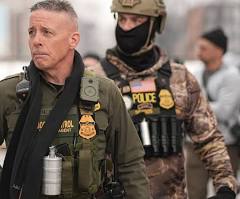
Gregory **Bovino, a high-ranking U.S. Border Patrol official and key figure in the BORTAC (Border Patrol Tactical Unit), announced his retirement in March 2026 amid controversies, lawsuits, and federal scrutiny over his tactics in leading immigration enforcement, including "Operation Metro Surge". Known for aggressive techniques, he was chastised by a judge for using chemical agents and, according to reports, providing false testimony.
Key Details on Greg Bovino:
- Role & Background: Formerly the Chief of the Border Patrol's El Centro sector, Bovino served as a commander at large leading special enforcement initiatives. He joined the Border Patrol in 1996.
- "Operation Metro Surge": Under the Trump administration, Bovino led, and was later removed from, Operation Metro Surge in Minneapolis following the fatal shooting of a civilian by a Border Patrol agent,.
- Controversies & Legal Issues:
- Protester Clashes: A federal judge found his testimony not credible, detailing instances where he lied about using tear gas on protesters.
- Immigration Sweeps: Known for leading aggressive enforcement in cities, targeting workers in cities like Los Angeles.
- Contradicting Evidence: Contradicted his own testimony regarding whether he was hit by a rock before using gas on protesters.
- Retirement: Announced his retirement from the Border Patrol around March 30, 2026, stating his move into the conservative movement.
:{
CAlMatters +6}:
---
AN 4 26
WIRED sifted through the identities of federal agents sent to Chicago in Donald Trump's "Operation Midway Blitz," and they've been able to identify some of them as a "heavily armed paramilitary unit."
"A WIRED analysis of DHS records identified dozens of specialized federal agents who used force against US civilians during the largest known deployment of its kind in U.S. history," the outlet reported Thursday.
The ongoing mass deportation efforts come from Trump's pledge to deport millions of people he claimed entered the U.S. in the four years between his administrations. He's come up against the problem, however, that there aren't millions of criminals for his agents to nab and deport one *Washington Post* report explained. The campaign has led to hostility and protests that took the lives of two Americans when federal agents opened fire on them.
One PBS/NPR/Marist poll in February showed two-thirds of Americans think Immigration and Customs Enforcement (ICE) and Customs and Border Protection (CPB) have "gone too far."
Four of the men WIRED found are "members of the Border Patrol Tactical Unit, or BORTAC." It's a specialized federal law enforcement force based mainly at Fort Bliss. They've been sent out to at least 11 "detachments" around the U.S. The report described the agents as, at one time, being "reserved for desert rescues, executing high-risk warrants, conflicts with armed drug cartels and manhunts."
One of those unmasked was John Bockstanz, WIRED said. The Marine veteran is from Michigan, and also runs a company as a side hustle that sells "pre-workout supplements." Essentially, they're "testosterone supplements."
"Conquer each day with unparalleled potency," promises the “Alpha Testosterone Booster."
Bockstanz was in an SUV with "agent John Leslie from BORTAC’s Detroit detachment."
Another agent was identified as Javier Puente, who was in the U.S. Army. The body camera he wore showed him gripping a 40-mm grenade launcher while sitting in the back of an SUV. It wasn't used for grenades there, however, they used it to launch "less lethal" pepper-spray rounds into crowds, the report said.
While BORTAC is described as an elite unit, that isn't a sentiment embraced by others in the top forces.
One former Special Forces member was critical of BORTAC when speaking to WIRED.
“They go in real hot — in my opinion, too hot and too unruly,” the veteran said about his experience with the agents. They tend to be “ego-driven hotheads.” While they might be "highly trained," they have little or no actual war-fighting experience.
“Even then, they’re definitely not the people I’d want in any sort of civilian law enforcement context," he added.
---
REF WIRED NO LNX
:{Apr 2, 2026
Unmasking the Paramilitary Agents Behind Trump’s Violent Immigration Crackdown
A WIRED analysis of DHS records identified dozens of specialized federal agents who used force against US civilians during the largest known deployment of its kind in US history.
Documents and body camera footage released by the Department of Homeland Security reveal the paramilitary agents who used force against civilians during Operation Midway Blitz.Composite: WIRED Staff; Source materials: Department of Homeland Security
In the early morning last September 30, hundreds of federal agents swarmed the South Shore Apartments, a beige brick building on Chicago’s South Side. As feds in body armor rappelled down from a Black Hawk helicopter overhead, others crashed through the building’s doors with battering rams, rounding up residents at gunpoint.
A group of burly, masked agents wearing helmets and bulletproof vests, and toting suppressor-equipped M4 rifles, moved through the hallways in a rapid, tightly organized file. Padraic Daniel Berlin, a 34-year-old Michigan native and son of a Detroit firefighter, held Yoda, his Belgian Malinois, on a leash. David Dubar Jr., a 53-year-old onetime construction worker, followed closely behind him. Their team leader, Corey Myers, a Marine veteran from the Border Patrol’s Tucson sector, checked apartment doors. Paul Delgado Jr., a standout cross-country runner in high school, was the final member of the entry team.
The four men are members of the Border Patrol Tactical Unit, or BORTAC. Based mainly out of Fort Bliss, with at least 11 detachments stationed around the United States, BORTAC and its sister unit, Border Patrol Search, Trauma and Rescue, or BORSTAR, were once reserved for desert rescues, executing high-risk warrants, conflicts with armed drug cartels, and manhunts.
Under Donald Trump, however, they have been sent into the streets of major US cities. The result is the largest known deployment of BORTAC and BORSTAR agents in US history, a fact made difficult to pin down due to the government's secrecy around their operations. Many of the agents’ identities have remained hidden from the public. The decision to use offensive, heavily armed paramilitary units for street-level immigration sweeps in American cities is a first—a bellwether of the Trump administration’s project to militarize domestic law enforcement operations.
Myers, Berlin, Dubar, Delgado, and their teammates seemed keyed up. The intelligence briefing they received claimed the building was controlled by Tren de Aragua, a Venezuelan street gang the Trump administration categorized—despite contrary evidence amassed by its own intelligence services—as a foreign terrorist organization. Gang members were supposedly occupying the building and storing grenades, handguns, and rifles on the second floor, where a suspect with an open warrant for firearms possession lived. This intelligence was never released or substantiated, and Illinois later launched an investigation into whether the property owner had sent baseless claims to the feds. But at that moment, it didn’t matter.
At every door approached by his team, Berlin yelled, “Police! Speak to me now or I’ll send the dog!” In a second-floor unit, the BORTAC team detained one man. Further down the hall, Myers noticed “signs of forced entry” and smashed open the door. Tolulope Akinsulie, an undocumented immigrant from Nigeria, happened to be hiding in the bedroom. Without issuing a warning or verbal command, Berlin let go of Yoda’s leash and the Malinois pounced, sinking its teeth into Akinsulie’s leg as he screamed in agony. Yoda bit Akinsulie repeatedly in the leg, hip, and hands before Berlin called the dog off and his team placed the man in cuffs. Akinsulie, who was not a target of the raid and has no known history of violent crime or gang affiliation, was treated for his injuries and taken to the Broadview Processing Center to face removal proceedings.
Berlin’s actions that morning were not isolated. He was involved in at least five uses of force during Operation Midway Blitz, the Trump administration’s 2025 surge of hundreds of immigration agents into Chicago and surrounding communities. Nor were the actions of his team, according to a WIRED analysis of US government records, which appeared to escalate tensions with civilian onlookers rather than quell them. Since last year, BORTAC and BORSTAR have fronted several of the US government’s invasions of its own cities, often engaging in almost theatrical uses of force that litter newscasts and social feeds, adding a new salience to US Border Patrol Special Operations Group’s self-proclaimed status as the “tip of the spear.”
The agents sent to Chicago—and Los Angeles, North Carolina, Boston, Minneapolis, New Orleans, and Sacramento—come from a secretive, tightly knit world. Their names, many of which are available in a narrow set of court records and reported here for the first time, are typically excluded from official documents and shielded from public records requests. In the streets of American cities, they are usually masked, identified only by “call signs” that are sometimes visible on their uniforms and mean nothing to people demanding badge numbers.
One BORTAC agent is married to a TV news anchor who reports on the Border Patrol. Another, who also engaged in a gun battle with a school shooter in Uvalde, Texas, in 2022, has posted frequently in an online gun forum with thread titles like “Whipping Haitians.” Many are military veterans, some of whom saw combat during the Forever Wars. Several have histories of domestic violence or sexual assault. Others are former cops who joined the Border Patrol after questionable uses of force. BORTAC and BORSTAR agents are not police—they are paramilitaries who operate by a different standard and with different rules of engagement, trained and suited not for law enforcement but for war.
A WIRED review of over 78 incident reports from Operation Midway Blitz found that BORTAC and BORSTAR agents were, as a group, the most violent of the hundreds of federal agents deployed to Chicago. In these documents, CBP employees recorded over 144 discrete uses of force by CBP personnel from September through early November. Sixty-two BORTAC and BORSTAR personnel were involved in these incidents over an eight-week period. Of that group, 25 were involved in two or more incidents, and 16 more used force at least once during this period. Of the 234 federal law enforcement personnel WIRED identified in these reports, BORTAC and BORSTAR agents represent almost a quarter of all personnel involved in documented confrontations with civilians during Operation Midway Blitz
Hennepin County attorney Mary Moriarty is actively investigating 17 separate incidents involving federal agents for potential criminal conduct. At least two of those incidents—the January 21 gassing of a crowd in South Minneapolis and a chaotic enforcement action outside Roosevelt High School—involve BORTAC personnel, per videos and photographs taken on scene.
The Department of Homeland Security has kept data and documents about the federal immigration deployments closely guarded, disclosing records only in response to litigation. US senator Thom Tillis of North Carolina has been wrestling with DHS over data regarding last fall’s Operation Charlotte’s Web in his state. Tillis requested records on stops, detentions, questioning, searches, releases, uses of force, and property damage incidents, as well as the total number of detentions and a tally of all encounters with American citizens.
During Operation Midway Blitz, incidents beyond the South Shore Apartment raids included the gassing of an affluent Northside Chicago neighborhood right before a children’s Halloween parade, a chaotic car chase on the city’s South Side, and clashes with protesters outside the Broadview immigration detention facility.
BORTAC’s and BORSTAR’s uses of force in Chicago included punching and kicking protesters, throwing tear gas, macing civilians, firing pepperballs and 40-mm foam rounds into crowds, shocking people with tasers, unleashing dogs on deportation targets, and shooting unarmed civilians, killing at least one of them. This violence tracks with a loosening of the Border Patrol’s use-of-force guidelines following Gregory Bovino’s directives, as reported by the American Prospect.
“I think if we push this whole fucking block back, that ought to teach ’em a lesson,” says Bovino on an agent's body camera recording from September 27, during clashes with demonstrators at Chicago’s Broadview detention facility. “And if it doesn't, we arrest.” Bovino, the now-retired face of Trump’s immigration surges throughout 2025 and early 2026, is a longtime BORTAC member who led dozens of these agents on incursions into Southern California, Chicago, and Minneapolis, putting them front and center at some of the most high-profile clashes between immigration enforcement and the public during the past nine months.
Other body camera footage from nearly a month later captured one BORTAC agent, Edgar Vazquez, telling his colleagues that he planned to refuse Bovino’s directives. “The chief wanted us to throw gas, and I was like, we can’t!” said Vazquez. “Nah, I’m not gonna fucking do it—I’m gonna stay within policy.”
“It’s clear the administration likes the optics of BORTAC—the long guns, the camouflage, the body armor. They certainly did for Trump’s first go-round,” says John Sandweg, who was director of ICE from 2013 to 2014. However, he says, the unit is not generally familiar with urban policing, and its record in Chicago demonstrates the poor fit of borderland tactics for densely packed cities. “It’s malpractice to have paramilitary teams try to impose order by force,” he says.
In a response to WIRED’s requests for comment, CBP cited the threat of “doxing” and refused to confirm employment of the Border Patrol agents identified in the government’s own records. CBP personnel are “trained to use the minimum amount of force necessary to resolve dangerous situations to prioritize the safety of the public and themselves,” a spokesperson wrote in a statement.
CBP also declined to comment on whether any of the use-of-force incidents from Operation Midway Blitz are the subject of internal investigations, stating that the agency’s Office of Professional Responsibility handles all such probes before submitting them to CBP’s Use of Force Review Boards.
The documents, body camera footage, and other material WIRED used to identify more than 60 BORTAC and BORSTAR operators were pried loose during litigation against DHS over alleged First Amendment violations, unconstitutional arrests, and grievous uses of force during Operation Midway Blitz, including the killing of Silverio Villegas González and nonfatal shooting of Marimar Martinez by ICE and Border Patrol agents, respectively.
No BORTAC or BORSTAR agent named in this story responded to WIRED’s request for comment.
In Illinois, civil rights attorneys and civic organizations are pressuring the Cook County state’s attorney to appoint a special prosecutor to investigate and potentially prosecute ICE, CBP, and Border Patrol agents for uses of force and wrongful arrests during Operation Midway Blitz.
To date, no Border Patrol, CBP, or ICE agent has faced criminal charges for their conduct during the operation in Chicago.
The full force of the paramilitary surge into American cities was on open display the morning of October 25, 2025, when a convoy of BORTAC and other Border Patrol agents swept through the tranquil North Side Chicago neighborhood of Irving Park, trailed by whistle-blowing “ICE watchers” in cars and on bicycles.
Shortly before 10 am, a gray Suburban with BORTAC agents Andy Chavez and Tee Rico riding in the back seat cruised through Irving Park’s tree-lined streets. A black Wagoneer filled with Border Patrol agents followed closely behind, carrying BORTAC agent Javier Puente, an Army veteran, in the rear seat. All the agents wore masks and camouflage tactical gear, with pistols at their hips and M4-pattern rifles near at hand. Puente’s body camera video shows him gripping a 40-mm grenade launcher intended to fire pepper-spray-loaded “less lethal” rounds.
On the sidewalks around them, Irving Park residents gathered for the community’s Halloween parade. Before the hour was up, chaos would erupt in the residential neighborhood.
Chavez and Rico spotted a Latino man running from their convoy, leaped out of their vehicle, and tackled the man on the front lawn of a white townhouse. The home’s owner, Brian Kolp, an attorney and onetime Cook County state’s attorney who used to represent Chicago police officers in civil litigation, stormed out of his house, barefoot, screaming at the feds to get off his property and take their masks off.
“This has nothing to do with enforcing the law, and everything to do with intimidating citizens with military tactics,” Kolp tells WIRED of the incident.
Other residents and members of ICE-watch groups joined in, blowing whistles, cursing out the agents, and recording the incident on their phones. As the Border Patrol convoy attempted to leave the scene, enraged onlookers—at least one still wearing a bathrobe—moved to block their path.
As the crowd grew more hostile, agents ramped up their uses of force. Michael Brosilow—a photographer, Irving Park resident, and decorated long-distance runner—pulled into his neighborhood after returning from a training session. Rico and Chavez confronted the 68-year-old man, who yelled, “Fuck you!” as he stepped out of his silver Toyota. Rico then tackled Brosilow, planted his knee in his back, and handcuffed him. “This is my block!” Brosilow screamed. Six of Brosilow’s ribs were broken in the encounter, and he suffered internal bleeding.
Chavez pulled the pin on a can of tear gas and tossed it into the street as bystanders screamed. Puerte, meanwhile, spotted 25-year-old ICE watcher Maria Bryan allegedly hit Rico in the head and slammed her and her bicycle to the ground, fracturing seven of her ribs.
The agents eventually loaded into the vehicle, drove off, and radioed in that they had arrested two US citizens for “impeding” and “assault.” (Neither Brosilow nor Bryan were charged.)
As the agents moved out of Irving Park, the horns of trailing cars and whistles from ICE watchers were clearly audible. When the SUV stopped at a red light, two men on the sidewalk stepped up to remonstrate with the feds.
Puente photographed one with his iPhone, then rolled down his window and pointed his grenade launcher at a second man.
“Get the fuck out of the way!” he yelled, aiming his muzzle at the civilian as the vehicle pulled away. “Fuck you!”
Created in 1984 to deal with riots in immigration detention camps, BORTAC has been sent to South America for narcotics interdiction missions alongside the Drug Enforcement Administration; conducted missions in Iraq, Afghanistan, and Jordan; and, in the recent past, raided desert aid stations. While BORTAC is designed for close combat, BORSTAR, which was created in 1998 in response to a rise in migrant deaths on the southern border, specializes in open-country operations. Members of both teams undergo Survival, Evasion, Resistance, and Escape training, are taught complex military surveillance and countersurveillance tactics, and tend to be recruited from specialized military units like the Army Rangers.
“They go in real hot—in my opinion, too hot and too unruly,” says a former Special Forces member, speaking on condition of anonymity. This veteran says that in his experience, BORTAC members tend to be “ego-driven hotheads” who are highly trained but have little or no operational war-fighting experience. “Even then, they’re definitely not the people I’d want in any sort of civilian law enforcement context.”
Beginning in February 2020, the first Trump administration sent BORTAC into Democrat-run “sanctuary cities” for civil immigration enforcement, a surge that was short-circuited by the Covid-19 pandemic. Later that summer, BORTAC agents were documented snatching protesters off the streets of Portland, Oregon, during the George Floyd protests.
Since the start of the second Trump administration, BORTAC and BORSTAR agents have participated in immigration blitzes in California, North Carolina, Minnesota, and Vermont. Since October, the Border Patrol’s paramilitary units, led by Timothy P. Sullivan, the head of the Fort Bliss–based Border Patrol’s Special Operations Group, have also commanded the federal presence at an ICE facility in Portland, Oregon, that has been a constant target of protests, often resulting in violent clashes. More recently, in mid-March, agents from one of the Border Patrol’s local Special Operations detachments used crowd control munitions on protesters in South Burlington, Vermont, during a chaotic immigration arrest.
Peter Kraska, a professor at Eastern Kentucky University’s School of Justice Studies who has studied police militarization and paramilitary units for decades, says that BORTAC’s presence in Chicago was a textbook case of authoritarian overreach. “Why are they enforcing civil immigration violations with paramilitary teams?” Kraska says. “Armored personnel carriers, hostage rescue tactics, Special Forces–grade weapons, SEAL-style tactics—why do you need all that for civil violations?”
A week and a half before the Irving Park incident, another event between Border Patrol agents and a Latino couple shows how quickly Border Patrol agents escalated to tear-gassing dozens of civilians and Chicago police officers.
On October 14, Border Patrol agents were involved in a car chase and a collision with a Latino couple. One of the agents involved in the crash, Carlos Chavira Jr., radioed for help, and several BORTAC agents drove to the scene.
One of the SUVs that arrived was driven by John Bockstanz, a Michigan resident and former Marine who runs a company that sells pre-workout supplements on the side—“Conquer each day with unparalleled potency,” promises the “Alpha Testosterone Booster.” With him was agent John Leslie from BORTAC’s Detroit detachment.
The other agents who answered Chavira’s call for help were Derek Volmering, a 39-year-old Michigan native, BORTAC supervisor, and onetime Buffalo Bills linebacker prospect; Paul Beaulieu, a New England native assigned to the Border Patrol’s rough-country search and rescue team; Edgar Vazquez, a 39-year-old firearms instructor from BORTAC who joined the Border Patrol in 2007; Padraic Daniel Berlin, who sicced his dog on a Nigerian immigrant during the South Side apartment raid two weeks earlier; David Dubar Jr., the BORTAC Michigan agent who’d also been on the South Side Apartments entry team, and supervisory agent Warren Becker from the Del Rio BORTAC detachment, who exchanged gunfire with the Uvalde school shooter in 2022 after the gunman executed 19 children.
The crew met a furious and growing civilian crowd. Television news crews arrived on the sidewalks. A CBP helicopter circled overhead. “It’s gonna be a nightmare getting out of here,” Volmering grumbled.
“Yeah, we’re probably going to get stuff thrown at us,” Bockstanz replied.
They immediately began positioning themselves around the scene. Two combat veterans, who reviewed incident body-camera footage for WIRED, said the agents moved in the same way that active-duty troops would to protect and extract a disabled vehicle from a hostile crowd in a war zone.
Tensions between the agents and the crowd escalated as someone threw an egg into the mass of feds, and agents tackled one of the onlookers to the ground in response. By then, Border Patrol agents had already donned gas masks and retrieved gas canisters from their vehicles in preparation for their exit.
Bockstanz heard an object strike one of the CBP vehicles and walked over to Volmering, who was speaking to a group of Chicago police commanders. “Hey, they’re starting to throw rocks,” Bockstanz said, his voice muffled by his gas mask. “I’m gonna have to deploy gas,” he told CPD deputy chief Dan O’Connor, who appeared to object. “We gotta worry about ourselves.”
“Well, give us a minute to talk to ’em and let’s go get you guys out of here,” O’Connor replied.
Bockstanz and Volmering ignored him. As projectiles sailed overhead and struck their cars, Bockstanz took a step forward, pulled the pin on a can of tear gas, and skipped it along the pavement towards the crowd without a warning, right through a line of unmasked Chicago cops.
Bockstanz waved to a Border Patrol SUV to leave and tossed another can of gas as the first one was thrown back, yelling, “Get the fuck out of here” at his colleagues. At the skirmish line, Dubar tossed his canisters into the crowd. Demonstrators began throwing and kicking gas canisters back toward the feds, prompting Vazquez, who had previously been involved in clashes with the public in Southern California and would later use less-lethal weapons on civilians in Minneapolis, to fire a round of tear gas at the fleeing crowd before the agents sped away.
More than a dozen cops and an unknown number of residents were sickened by the tear gas, with three American citizens arrested for “assaulting” federal agents, in addition to the two “deportable” people detained. No criminal charges were filed.
The operation tapered down by mid-November amid a national backlash and a series of adverse legal rulings that restricted the feds’ ability to use less-lethal and crowd-control munitions on civilians. While a key court decision was later overturned, the judge said in her opinion that Border Patrol, ICE, and CBP used force without clear warnings, failed to wear marking insignia, and failed to justify uses of force.
At least 3,800 people were arrested during Operation Midway Blitz as of late last year. More than 2,500 have been deported, and more than a hundred may have been illegally removed from the United States. None of the dozens of people whom BORTAC and BORSTAR agents arrested for alleged assaults or other crimes against them appear to have been convicted.
Six of the BORTAC agents involved in Operation Midway Blitz—Michael Sveum, Dubar, Vazquez, Delgado Jr., Belen Lleras, and Chavez—were involved in immigration enforcement operations in Los Angeles, Minneapolis, Charlotte, Boston, and other cities. Vazquez and Sveum used force on angry Minnesotans in the immediate aftermath of Renee Good’s killing, per reporting by Chicago outlet Unraveled. It does not appear that they have faced any internal discipline or criminal charges.
For Brian Kolp, the Chicago lawyer whose Irving Park street was shaken by the October 25 BORTAC raid, the incident had a “radicalizing effect” on him. He still seethes with rage about the masked Border Patrol agents, and has been working overtime to research legal strategies that would hold the feds accountable for brutalizing his neighbors and terrifying their children.
“I’m never gonna be satisfied,” Kolp says, “until there’s some kind of accountability and justice for what happened on my street.”
Additional reporting by Tim Marchman, Matt Giles, Samantha Spengler, and Andrew Couts.
Ali Winston is an independent reporter covering criminal justice, privacy, and extremism. He has written for The New York Times, Rolling Stone, New York magazine and has reported documentaries for BBC Panorama and PBS Frontline. His work has earned several honors, including a George Polk Award for Local Reporting, an ... Read More
Contributor
Maddy Varner is a senior reporter for WIRED. In the past, she was an investigative data journalist at The Markup, where she brought numbers to stories about labor, education and politics. Before The Markup, she was a researcher at ProPublica, where she was on a team that won a Loeb ... Read More
Senior Writer, Investigations
---
see BORTAC
---
an 2 26
Judge Aileen Cannon issued a ruling on Monday morning that declared no person will be allowed to release information about President Donald Trump's classified documents case. But at one point in her ruling, she made an absurd claim — and one legal expert is calling her out.
"All Rise News" reporter Adam Klasfeld noted that when Cannon blocked the release of Volume II of Smith's report, she said she "'strains to find' an example of a report released after 'initiating criminal charges that did not result in a finding of guilt.' Most of John Durham's [targets] were acquitted. He released a report."
One person in the Durham case pleaded guilty "to falsifying an email."
Durham was hired to "investigate the investigators" involved with the Robert Mueller probe into Russian meddling in the 2016 election. While Durham attempted to indict three people, two were acquitted, and the final one accepted the guilty plea and received probation. By contrast, Mueller prosecuted 34 people and earned 8 guilty pleas or convictions.
Supreme Court Justice Brett Kavanaugh helped write the report by special counsel Ken Starr, which also didn't have any prosecutions for a crime.
"Judge Cannon, who appears to have been born yesterday, ignores that the entire Mueller report, which was made public, was about the un-indicted president who appointed her — and against whom a finding of guilt was never reached," agreed legal reporter Christian Fairas.
//
23rd
Judge Aileen Cannon has blocked another effortto obtain part two of special counsel Jack Smith's report regarding the documents President Donald Trump stole from the White House upon leaving in 2021. Among the documents Trump took and refused to return were a number of highly classified pages.
While there have been other instances of documents being packed for officials like Vice President Mike Pence and then Vice President Joe Biden, all other officials have been willing to return any documents requested. Trump refused to return the information, the AP characterized in 2023.
In her ruling on Monday, Cannon said that everyone involved with the Justice Department is "enjoined from releasing" the report. It was scheduled to be released to the public on Tuesday.
Reporter Mona Burns wrote on BlueSky, "Fitting on this crazy snowy morning: The always reliable and very corrupt Judge Aileen Cannon has permanently blocked the release of Jack Smith's classified documents report. Cannon says the release would be 'unfair' to Trump and his former co-defendants."
Slate legal reporter Mark Joseph Stern pointed out that Cannon "also bars DOJ from sharing 'any information or conclusions' from the volume. A sweeping, perpetual gag order."
"Cannon scathingly suggests that Jack Smith violated her order dismissing the criminal case against Trump when he continued to prepare his report on the prosecution from transmission to DOJ. Calls it a 'brazen stratagem' meant to 'circumvent' her authority," Stern added.
"Absurd. Also, what is the 'spirit' of a dismissal order?" questioned lawyer and analyst David R. Lurie.
"Cannon apparently considers Smith’s preparation of his final report as a violation of her order dismissing the classified documents case," commented Politico Washington law and lobbying reporter Daniel Barnes on X.
Former federal prosecutor and MS NOW legal commentator Joyce Vance noted, "A higher court may well disagree with Canon’s ruling, however. It wouldn’t be the first time. And the case is already on appeal to the 11th Circuit. I wrote about the context last night."
"That deadline was set after the Eleventh Circuit chastised Judge Cannon for dragging her feet in the matter. But when she finally got around to setting the date, she noted that Trump could appeal, which he, of course, did. Delay. Delay. Delay. Earlier this month, journalists who had previously intervened in the matter to force the release of the report went to the Eleventh Circuit," wrote Vance for her Substack.
"That court has expedited the matter, which means Trump and his supporters have briefs due next month. His delay game is still holding up, but unless the Supreme Court weighs in on his side again in a criminal matter, there’s a limited shelf life on this one. ... Other events to watch for this week: On Tuesday, Secretaries of State who have decided to participate will meet with the FBI on unspecified issues. We discussed that meeting here," she added.
The watchdog group American Oversight posted on X last week, "Trump is trying to convince Judge Cannon to destroy all copies of Volume II of Jack Smith’s report on Trump’s handling of classified documents. We warned AG Pam Bondi and top officials at the National Archives that this would break the law."
“The destruction of Volume II of Special Counsel Jack Smith’s report would be an extraordinary and unlawful erasure of a federal record documenting an investigation of profound public importance. The FRA imposes a clear and nondiscretionary duty on the DOJ and NARA to preserve federal records, regardless of pressure from the president and his co-conspirators or their pending motions before a court,” said Chioma Chukwu, Executive Director of the group, commented on matter in a statement.
“Special Counsel Smith testified under oath in Congress that the report documents powerful evidence that President Trump willfully retained highly classified information after leaving office, putting our national security at risk. Destroying the report would shield the president from public scrutiny and undermine the rule of law itself. Federal records belong to the American people, not to any president or administration seeking to bury the truth. If the DOJ or NARA permits the destruction of this report, they will be violating federal law," she added.
Former Barack Obama strategist David Axelrod said, "Man, if ever a judicial appointment paid off for Trump, it was this one! This classified documents case seemed like the most menacing to @realDonaldTrump . Judge Cannon blocked it on a technicality and now is permanently burying it from public view. SCOTUS here she comes!?!?"
---
---
an 2 26
spox most transparent admin in hist while denying info access?
Before concluding his work as special counsel for the U.S. Department of Justice (DOJ), Jack Smith submitted a two-volume report on his federal prosecutions of Donald Trump — the first volume on his election interference case (which was assigned to Judge Tanya Chutkan), the second volume on his Mar-a-Lago documents case (which was assigned to Judge Aileen Cannon, a Trump appointee).
Volume 1 was released in January 2025, although Chutkan dismissed the election interference case without prejudice at Smith's request. After Trump defeated Democratic nominee Kamala Harris in the 2024 election, Smith cited DOJ's policy against prosecuting a sitting president when he made his request to Chutkan.
Volume 2, however, remains unreleased, and two groups — American Oversight and Columbia University's Knight First Amendment Institute — are urging the 11th U.S. Circuit Court of Appeals to order Cannon to make it public in redacted form.
Law & Crime reporter Matt Naham, in an article published on February 10, explains, "The latter volume has never seen the outside of Cannon's chambers. Cannon, the Trump-appointed judge who threw out Trump's Espionage Act prosecution and ruled that Smith was unlawfully appointed as special counsel, has, for a calendar year, kept Volume 2 of Smith's report out of public view. At first, the rationale behind the injunction was preventing 'prejudice' to valet Waltine Nauta and Carlos de Oliveira Mar-a-Lago property manager, former Trump co-defendants who had active appeals. But those appeals went away when the Trump Administration dropped the cases, following Trump's inauguration, and so did the prospect that Nauta and de Oliveira will face charges in the future, according to the Knight Institute."
In a legal brief filed on February 9, the Knight First Amendment Institute and American Oversight told the 11th U.S. Circuit Court of Appeals, "There is also no risk that a future administration will revive the charges, because the five-year statute of limitations that applies to the charges will expire in 2028, before President Trump leaves office. It is thus disingenuous for Nauta and De Oliveira to represent that they remain in 'jeopardy' and that as a result 'their due process rights remain a serious concern that strongly outweighs any interest that the Government or the public might have in the release of the Special Counsel's Report.'"
Cannon's injunction against the release of Volume 2 expires on February 24, and American Oversight is arguing that her reason for the injunction "no longer exists."
"Before the expiration date," Naham notes, "Trump and his former co-defendants have each supported Cannon issuing an order which would 'permanently' block the DOJ from releasing 'so-called Special Counsel' Smith's 'unlawfully prepared' report and destroy it."
Trump was facing four criminal indictments when he won the 2024 GOP presidential nomination: Smith's two federal cases, Fulton County, Georgia District Attorney Fani Willis' election interference/RICO case, and then-Manhattan District Attorney Alvin Bragg Jr.'s hush money case. Trump was convicted on 34 criminal counts in Bragg's case, but all four cases were doomed when he won the 2024 election.In an official statement, American Oversight Executive Director Chioma Chukwu said the group "will not allow the president and his guard dogs to bury information that belongs to the American people."
Chukwu stated, "For more than a year, Judge Cannon has kept the Special Counsel's final report under seal, long after any legitimate claims by Trump's co-conspirators expired. By blocking our effort to challenge her gag order, the court handed President Trump a roadmap for burying the report through delay and procedural gamesmanship."
---
---
AN 226
Although Democrats have won the popular vote in seven of the United States' last nine presidential elections, they have had terrible luck with the U.S. Supreme Court — which has had a hard-right GOP-appointed 6-3 supermajority since 2020. And the High Court's image, according to Gallup, has suffered a great deal: in Gallup polls conducted in 2025, approval of SCOTUS ranged from 39 percent to 42 percent.
In an article published on February 2, the New York Times' Jodi Kantor stresses that the Supreme Court has grown increasingly "secretive" as its approval remains historically low.
"In November of 2024, two weeks after voters returned President Donald Trump to office, Chief Justice John G. Roberts Jr. summoned employees of the U.S. Supreme Court for an unusual announcement," Kantor explains. "Facing them in a grand conference room beneath ornate chandeliers, he requested they each sign a nondisclosure agreement promising to keep the Court's inner workings secret…. Trust in the institution was languishing at a historic low. Debate was intensifying over whether the black box institution should be more transparent. Instead, the chief justice tightened the Court's hold on information."
Kantor continues, "Its employees have long been expected to stay silent about what they witness behind the scenes. But starting that autumn, in a move that has not been previously reported, the chief justice converted what was once a norm into a formal contract, according to five people familiar with the shift."
New York Times sources who described the nondisclosure agreement, according to Kantor, did so on condition of anonymity.
Kantor reports, "Former clerks and academics, told by The Times about the Supreme Court's new nondisclosure agreements, said they were a sign that the justices felt they could no longer rely on more informal pledges or longstanding norms to guard their internal workings from public view."
Jeffrey L. Fisher, a former clerk to Justice John Paul Stevens who is now with the Stanford Law School, told the Times, "They feel under the microscope and are unwilling to rely simply on trust."
University of Florida law professor Mark Fenster described the contracts as "a sign of the Court's own weakness."
---
---
an 2 26
Director of National Intelligence Tulsi Gabbard is facing a highly classified whistleblower report, and there is concern about how to safely share it with lawmakers.
The Wall Street Journal reported Monday morning that the sensitive report is "said to be locked in a safe." President Donald Trump's administration has avoided telling lawmakers about it, claiming that it involves such secret information.
The information could cause “grave damage to national security" if it becomes public, an official claimed. The information reportedly includes "claims of executive privilege that may involve the White House."
This is an administration, however, that has claimed "national security" liberally, such as the rationale for taking over Greenland and the immigration crackdown.
“If everything can be a national emergency or a threat to national security or a matter of foreign policy, then essentially all constitutional powers are ceded to the president,” said Shirin Sinnar, a law professor at Stanford Law School in an Aug. 2025 report by Paul Blumenthal. “And that can’t be intended by the constitutional design.”
Gabbard's office claims the allegations are “baseless and politically motivated.”
However, the whistleblower's lawyer, Andrew Bakaj, said he was never aware that the inspector general's office had made any determination about the complaint's credibility. However, the inspector general's office decided that some of the allegations weren't credible while others might be.
Bakaj sent a letter to Gabbard that was also sent to the House and Senate in November, which the Journal has viewed.
"Months later, lawmakers still haven’t received the complaint itself. Some Democratic staffers on the intelligence committees have tried to learn more about the complaint in recent weeks, with little success," congressional aides told the reporters.
The month before the complaint, Republicans approved a new inspector general for the intelligence community on a 51 to 47 vote.
The new IG is Christopher Fox, who worked for Gabbard before the new job overseeing her work.
---}:
AHA TRUMP MUSK CARO MANTRA, SUGGESTING YOU PRESS ONLY KNOW ABOUT OUR FAILS CORRUPTION B/C OF TRANSP?
---
AN 12 25
On Friday, a nonprofit forced the Trump administration to unseal a damning complaint lodged by the Biden-era Federal Trade Commission against Pepsi for colluding with Walmart to raise food prices across the nation. New un-redacted information claims FTC Chair Ferguson and his colleague Mark Meador (both Trump appointees) were hiding the mechanics of Pepsi’s and Wal-Mart’s price fixing.
Pepsi is a “must-have” product for grocery stores, and Walmart is also massively powerful,” reports BIG Newsletter writer Matt Stoller. Critics say Pepsi allegedly engages in price discrimination to maintain the approval of Walmart, its biggest buyer — even going so far as to police prices at smaller rival stores. And it prepares reports for Walmart showing them their pricing advantages on Pepsi products.
When the “price gap” between Wal-Mart and its tiny rivals narrow too much, Pepsi tracks where consumers were buying Pepsi products outside of Walmart. It keeps logs on stores who would “self-fund” Pepsi product discounts, nicknaming them “offenders” and then raise their stock price, forcing them to carry those costs down to their customers.
“This dynamic is why independent grocery stores are dying,” said Stoller. “… It’s led to less competition, fewer local grocery stores, and higher prices. … To the end consumer, it creates an optimal illusion. Walmart appears to be a low-cost retailer, but that’s because it induces its suppliers to push prices up at rivals.”
Much of this information was redacted by Trump officials, however, including Ferguson and Meador. Normally, when the government files an antitrust case, the complaint gets redacted to protect confidential business information. Then the corporate defendant and the government haggle over what is genuinely confidential business information and complaints are eventually unsealed with some minor blacked out phrases, and the case goes on.
“In this case, however, … Ferguson abruptly dropped the case in February after Pepsi hired well-connected lobbyists,” said Stoller. “… Ferguson ended it the day before the government was supposed to go before the judge to manage the unsealing process. And that kept the complaint redacted. With the complaint kept secret, Ferguson, and … Meador, then publicly went on the attack.”
Ferguson released a “bitter and personal” statement against Biden-era FTC Chair Lina Khan — who had brought the complaint against Pepsi — implying that she was lawless and partisan, that there was “no evidence” to support key contentions, and that Ferguson had to “clean up the Biden-Harris FTC’s mess.” Fellow commissioner Mark Meador later echoed his comments on on X.
“And that was where it was supposed to stay, secret, with mean-spirited name-calling and invective camouflaging the real secret Ferguson was trying to conceal,” said Stoller. “That secret is something we all know, but this complaint helped prove that the center of the affordability crisis in food is market power. If that got out, then Ferguson would have to litigate this case or risk deep embarrassment. So, the strategy was to handwave about that mean Lina Khan to lobbyists, while keeping the evidence secret.”
But anti-monopoly group The Institute for Local Self-Reliance filed to make the full complaint public, and Judge Jesse Matthew Furman agreed to hear ILSR’s case, with the U.S. Chamber of Commerce and Pepsi bitterly opposed.
“Last week, Furman directed the FTC unseal the complaint. So we finally got to see what Ferguson and Meador were trying to hide,” Stoller said.
Read the full BIG report at this link
---
---
AN 12 25
President Donald Trump is urging U.S. District Judge Aileen Cannon to block any release of Special Counsel Jack Smith’s final report on his investigation into the president’s alleged mishandling of hundreds of classified documents, in a case that had been charged in part under the Espionage Act.
On Tuesday, Trump argued in a court filing that Smith’s report should never be made public, in what would be a deviation from previous practice, Politico reported.
The president urged Cannon, whom he nominated to the bench, “to extend her 11-month-old order blocking the Justice Department from releasing the full report, which Smith submitted shortly before Trump’s second inauguration.”
READ MORE: Trump Seen Struggling to Stay Awake Repeatedly in Cabinet Meeting Video
In the court document, Trump’s attorney, Kendra Wharton, wrote that allowing the report to become public would “perpetuate Jack Smith’s unlawful criminal investigations and proceedings.”
Politico noted that the president’s filing “is infused with the typical disdain Trump has expressed for his former prosecutors, labeling Smith a ‘so-called special counsel’ and saying the case was ‘marred by numerous deficiencies and repeated abuses of office.'”
Smith dropped all charges against Trump after the U.S. Supreme Court, in a highly controversial ruling, found that presidents have extensive immunity from prosecution for official acts.
READ MORE: GOP Touts ‘Gulf of America Act’ in Bold New List of Party ‘Accomplishments’
“Trump’s request is a break from the Justice Department’s handling of all special counsel reports in recent decades,” Politico added. “Typically, those reports are provided to Congress and made public, even when they have included damaging findings about the incumbent administration.”
The day after Trump was inaugurated, Judge Cannon denied the U.S. Department of Justice’s request to share Smith’s report on his investigation into Trump’s alleged mishandling of classified documents with Congress. Her order came just hours after Trump signed an executive order to hold former government officials accountable for “unauthorized disclosure” of “sensitive” information, and “for election interference.”
Cannon refused to allow members of Congress to review Smith’s final report. Trump was investigated for alleged unlawful removal, retention, and refusal to return sensitive, classified, and top-secret documents, reportedly including nuclear and defense secrets. The FBI executed a lawful search warrant on Trump’s Mar-a-Lago resort and residence to retrieve some of the documents.
---
---
an 4 25
A top official in the Department of Labor this week informed all staff members that they could face criminal charges if they speak to journalists, former employees or others about agency business.
A memo sent Monday by Secretary of Labor Lori Chavez-DeRemer’s chief of staff, Jihun Han, and obtained by ProPublica, states that “individuals who disclose confidential information or engage in unauthorized communications with the media may face serious legal consequences.”
Among the ramifications, the memo states, are “potential criminal penalties, depending on the nature of the information and the applicable laws,” and “immediate disciplinary actions, up to and including termination.”
The guidance document went on to say that “any unauthorized communication with the media,” regardless of what information is shared or how it is shared, “will be treated as a serious offense.”
The memo listed laws, regulations and a departmental guide to explain its legal position. Among them was a regulation concerning civil servants’ ethical obligations and a law, the Freedom of Information Act, guaranteeing the public the right to inspect certain public records.
“This message will serve as your only warning,” the memo stated.
The warning comes as current and former Labor Department employees have spoken to the news media about harms they see resulting from the dismantling of portions of their agency, which enforces laws guaranteeing rights to a safe workplace, fair pay and protections against discrimination.
“It’s very chilling,” a Labor Department employee who requested anonymity for fear of retribution told ProPublica. “It’s never a good look when you’re telling people to never talk about what you’re doing.”
Labor Department spokespeople did not immediately respond to a request for comment.
“These types of missives can chill the free flow of information to the press and the public,” said Gabe Rottman, vice president of policy at the Reporters Committee for Freedom of the Press. “That’s a concern.”
Civil servants do not sacrifice their First Amendment rights by accepting a job with the federal government, but there do exist higher restrictions on what information they can disclose publicly. Government agencies that handle classified information have on rare occasions launched criminal investigations against leakers, but those are typically invoked only when leaks involve classified national security intelligence or protected financial information, Rottman said.
“But normally, disclosures to the press or others would be a matter of employee discipline as opposed to carrying criminal sanctions,” he said.
While the memo raising the possibility of criminal penalties was sent to Labor Department employees, it reflects a common approach by the administration of President Donald Trump to guard against federal government employees speaking to reporters.
Director of National Intelligence Tulsi Gabbard, for example, has publicly announced an aggressive pursuit of leakers. Elon Musk, who launched the Department of Government Efficiency, which is at the heart of the shake-up of the federal government, has bragged about his tactics in rooting out leaks at his companies. And Defense Secretary Pete Hegseth has blamed alleged leaks by former Pentagon staffers for reigniting controversy over his use of the Signal messaging app to discuss military operations.
Federal employees at various agencies told ProPublica that an air of suspicion has descended on their workplace during Trump’s second term, with rumors flying of surveillance of rank-and-file government workers. In the Department of Agriculture, for example, a banner temporarily appeared on government computers when employees logged in, telling them that “unauthorized or improper use of this system may result in disciplinary action, as well as civil and criminal penalties.”
Agriculture Department spokespeople did not immediately respond to a request for comment.
The Labor Department employee told ProPublica that Monday’s memo felt like the latest attack on a workforce already weathering layoffs, spending freezes and reorganizations.
“It’s been horrible. It’s been a deeply exhausting roller coaster,” the employee said. “It’s very difficult to work when you’re in a constant state of being terrorized by your employer.”
---
---
an 3 25
The Trump administration announced Sunday it will cease to enforce penalties and fines on businesses that fail to adhere to beneficial ownership financial reporting requirements under the Corporate Transparency Act, an anti-money laundering law passed by Congress in 2021. The announcement was panned by advocates, economists, and other critics who called the move an on-ramp for corruption.
The Corporate Transparency Act, a bipartisan effort, includes a rule that requires many corporations and limited liability companies to disclose information on who owns and controls a business entity (also known as the beneficial owner) to the Financial Crimes Enforcement Network (FinCEN), a bureau of the U.S. Treasury Department.
"Exciting news!" wrote Trump on Truth Social when announcing that the Treasury Department would no longer enforce the reporting rule, which he called "invasive and outrageous."
Garbiel Zucman, a professor of economics, reposted Trump's message on X, and wrote: "Exciting news for tax evasion and money laundering!"
Economist and author Anders Åslund reacted to the update writing, "to oppose corporate transparency is to favor corruption."
Supporters of the Corporate Transparency Act, which has face court challenges, argue that the policy is an important step toward reining in anonymous companies, which are the preferred vehicle for moving around illicit funds.
"God, this is grim," weighed in author Oliver Bullough, who has written a book about global wealth and corruption. "The White House has killed the Corporate Transparency Act, which was itself a tiny first step in the marathon journey of stopping U.S. companies from being the most egregiously opaque shell structures on the planet."
In a Monday statement, Ian Gary, executive director of the Financial Accountability and Corporate Transparency Coalition, called the move a "hollowing out" of the Corporate Transparency Act that runs counter to years of bipartisan work to "end the scourge of anonymous shell companies."
Treasury Secretary Scott Bessent, for his part, said ceasing enforcement is a "victory for common sense," according to a Sunday statement. "Today's action is part of President Trump's bold agenda to unleash American prosperity by reining in burdensome regulations, in particular for small businesses that are the backbone of the American economy," he said. In response, Bullough, argued that Bessent doesn't recognize that fraud "suppresses prosperity, rather than enables it."
According to the announcement, the Treasury Department will issue a proposed rulemaking with the aim of narrowing the scope of the rule so that it solely applies to foreign reporting companies.
---
===
// FIRED 10 IG INCL INTERIOR
AN 1 25
Trump issued a long list of executive orders after returning to the White House, some of which involve emergency declarations.
The Washington Post's Karen Tumulty, in her January 27 column, examines Trump's use of emergency declarations during his second term. And she argues that he is declaring "national emergencies" where they don't exist.
"The U.S. oil and gas industry is booming, with production at record levels, while renewable sources of energy are expanding at a healthy clip and gasoline prices are at their lowest level in more than three years," Tumulty observes. "To President Donald Trump, all this good news amounts to a 'national emergency.' Or so he claimed in one of the flurry of executive orders signed on his first day in office."
READ MORE:**How Trump's quick executive actions could redefine who counts in our democracy**
Tumulty continues, "Dire, too, is the situation at the southern border, where, in another emergency declaration, Trump deemed there to be an 'invasion' taking place, which is causing 'widespread chaos.' Never mind Border Patrol statistics saying that, thanks to stronger enforcement, the number of people crossing illegally has dropped sharply, and is lower than it was at the end of Trump’s first term."
The Washington Post columnist laments that by declaring a "national emergency" where there isn't one, a president "gains the ability, usually with just a signature on an executive order, to bypass laws and regulations."
"But at times, these proclamations are not tools for dealing with an actual crisis," Tumulty warns. "Instead, they are used to sweep away impediments to a chief executive's political agenda…. Trump's border declaration, for instance, opened the way for him to unlock billions in funding that Congress had denied for building a wall there — a rerun of what he did as president in 2019, when he cited a law permitting the executive to use military construction funds in a declared national emergency."
Tumulty adds, "Various laws have emergency provisions that would allow Trump to both deploy the 10,000 troops that he is thinking of dispatching to assist Border Patrol agents and shut down applications for asylum by migrants…. Given Trump's hold over the GOP, it is hard to imagine that a Congress where both chambers are in Republican hands will do much to constrain him. So, expect to hear more manufactured emergencies coming from the Trump White House — each one chipping at the guardrails that limit presidential power."
---
---
// if we stop test covid we will have less of it?!
wants no evidence of economic impotence, nit even concept of plan but drill when last 2 dem admin stet records for oil?!
an 1 25
Trump's Federal Trade Commission chair began his stint at the helm of the key agency this week by shutting down requests for public comment on corporate surveillance pricing and other exploitative tactics that were a focus of the FTC under the leadership of Lina Khan.
Shortly after taking over as FTC chair earlier this week, Andrew Ferguson declared that "DEI is over" at the agency and demanded a swift vote on a motion giving him sweeping authority to "comply with President Trump's orders ending DEI across the federal government."
Meanwhile, with no such fanfare, Ferguson shuttered FTC requests for information and public comments on corporate mergers and acquisitions, "protecting workers from illegal business practices," "predatory pricing," and "surveillance pricing practices," which refer to companies' use of personal data to set individualized prices.
Democratic FTC commissioners expressed alarm over Ferguson's early actions and said they're a telling indication of his priorities.
"Andrew Ferguson could have made his first public act as chairman a motion to study the rising cost of groceries," Commissioner Alvaro Bedoya said in a statement Thursday. "He could have acted on a pending public petition from a group of wall and ceiling contractors to investigate how lawbreaking contractors can effectively rig contract competitions in the commercial construction industry."
"Chairman Ferguson could have done any number of things to actually lower the cost of living and create opportunities for American businesses and workers. He did none of them," Bedoya continued. "Instead, he canceled 'DEI.'"
Douglas Farrar, former director of the FTC's public affairs office, said it is "unthinkable that the new chair of the FTC starts his tenure by censoring small businesses facing down monopolies, and American consumers already struggling with high prices."
"The American people deserve to have a voice in government," Farrar added, "not just be dictated to by oligarchs."
Ferguson defended his focus on DEI on the grounds that Trump "campaigned openly" on ending diversity, equity, and inclusion initiatives across the federal government.
But Bedoya noted that Trump, on the day of his inauguration, also ordered "the heads of all executive departments and agencies to deliver emergency price relief, consistent with applicable law, to the American people and increase the prosperity of the American worker."
"Chairman Ferguson seems uninterested in the challenges that regular human beings face," Bedoya said Thursday. "One of his first actions as Chairman was to quietly remove the opportunity for the public to comment on five different requests for information."
"Rather than let the American people speak to him," Bedoya added, "Chairman Ferguson shut them out."
---
---
no lnx
an 1 25
The evolution of political bribery — and the real reason for the $Trump coins
Thom Hartmann January 23, 2025
Both Spiro Agnew and Richard Nixon took cash bribes while in the White House and before. Agnew’s dated back to shakedowns he did as Maryland governor, while Nixon helped Jimmy Hoffa get out of a prosecution and allegedly ran interference for a group of milk producers.
Since then, bribing politicians has gotten a lot easier thanks to five Republicans on the US Supreme Court. Their Citizens United decision, decided 15 years ago this week, legalized political bribery so long as it is done through campaign, PAC, or SuperPAC funds.
But for some people there’s just never enough money.
Donald Trump had been running small-time hustles to make money for decades, selling sneakers, bibles, steaks, vodka, water, etc., and he expanded these schemes when he became president in 2016 to let his followers give him money in exchange for what they thought were collectable assets.
Remember, back in 2000, when he was first seriously considering running for president (on the Reform Party ticket), he said:
“It’s very possible that I could be the first presidential candidate to run and make money on it.”
After his son-in-law got $2 billion from Saudi Arabia, though, and his companies made an estimated $2.4 billion during his last presidency, it appears that Trump decided the small stuff was for pikers so he’s going to crank the door wide open to serious tens-of-billions-of-dollars money.
First, he and his son-in-law are working with several foreign governments, including Bulgaria and Vietnam, to build Trump properties that will fatten Trump‘s wallet. This, in itself, is a blatant example of how foreign governments can buy influence with his administration.
But then he kicked the door to corruption even wider.
A “fungible crypto asset” like the new $TRUMP coin (and the $MELANIA coin) is essentially a digital picture that’s limited in its issue to a certain number of items. Each individual “coin” is separately kept and can be traded on the Solana blockchain, guaranteeing there won’t be counterfeits.
So, what people are buying when they pick up $TRUMP coins are essentially tiny digital pictures of his face with the words “fight, fight, fight!” They have no intrinsic or underlying value, and are not backed by any asset, crypto or otherwise. Their “collector value” — which is how they’re being hawked on his website — is equally sketchy, particularly if there will be a billion of them in circulation.
Bottom line: it appears that $TRUMP coins are simply a way “friends of Trump” can funnel cash to him and he can verify their transfer so he could, if he chose, help them out.
Trump initially issued 200 million of the coins, and they’re currently trading at $33.69 each (down from $75.35 earlier in the week), meaning the market value or capitalization of $TRUMP is currently $7.59 billion, exceeding even the more generous estimates of Trump’s previous net worth.
When he releases another 800 million over the next three years it appears he’ll make tens of billions more, so long as people or governments keep buying/trading them.
Thus, anybody who wants to give Trump a large amount of money, presumably in exchange for his good will or even a specific change in policy or position, now no longer has to visit the White House with a briefcase full of cash like Jimmy Hoffa and the milk guys did.
All they have to do is drop a few million or billion on $TRUMP and, because the Solana blockchain is public, Trump can immediately see who’s giving him cash. The rest of us can’t though: the blockchain only identifies the purchaser’s wallet, which is typically an obscure set of numbers. But if that purchaser has told Trump which wallet is theirs, he can track down who spiffed him and who didn’t.
The Founders of our republic were very concerned about this type of scenario. Alexander Hamilton wrote, in Federalist 22:
“Evils of this description ought not to be regarded as imaginary. One of the weak sides of republics, among their numerous advantages, is that they afford too easy an inlet to foreign corruption. …
“In republics, persons elevated from the mass of the community, by the suffrages of their fellow-citizens, to stations of great pre-eminence and power, may find compensations for betraying their trust… Hence it is that history furnishes us with so many mortifying examples of the prevalency of foreign corruption in republican governments. How much this contributed to the ruin of the ancient commonwealths has been already delineated.”
This led to the Constitution containing the Foreign Emoluments Clause, Article I, Section 9, Clause 8, that explicitly says:
“[N]o Person holding any Office of Profit or Trust under them, shall, without the Consent of the Congress, accept of any present, Emolument, Office, or Title, of any kind whatever, from any King, Prince, or foreign State.”
Interestingly, Alexander Hamilton believed the clause didn’t apply to the president or vice president; when he was Secretary of the Treasury, the Senate asked him to clarify by submitting a list of office holders who were subject to the clause’s provisions. His list only included political appointees.
The Supreme Court has never issued a decision on the Emoluments Clause, either, adding to the ambiguity of the state of the law.
To solve the problem of this uncertainty, in 1966 Congress passed The Foreign Gifts and Decorations Act which specifically identified the president and vice president as “employees” of the US government who may not, under penalty of prosecution, accept any gift with more than minimal value without congressional approval.
Enforcing that law, though, would require Trump’s Attorney General to investigate his cash flow and then prosecute him, something that’s unlikely given how he will apparently (based on how Pam Bondi avoided answering direct questions) only appoint people to that position who promise loyalty to him above the Constitution or the good of our nation.
And any sort of congressional investigation of Trump taking what may appear to be bribes is equally unlikely; he’s made it clear that he and Elon will destroy any elected Republican in their next primary who tries to hold him accountable.
On top of all that, the $TRUMP coin is just a small part of a much larger and rather sprawling collection of internet- and blockchain-based crypto operations Trump and his family are involved with that could make them billions. Wendy Siegelman does a deep dive into them over at her brilliant Substack newsletter.
With the $TRUMP coin vehicle that enables foreign governments, princes, and even domestic billionaires or companies to shovel millions or even billions directly into Trump’s pockets, it appears that he’s decided to leave his working class MAGA followers in the dust and redirect his efforts toward the truly morbidly rich.
After all, he can’t run for election again (and will be 82) in 2028 (unless he pulls a Putin and runs for VP); he no longer needs his MAGA followers, at least as a revenue source, for the moment.
In his inaugural speech, Trump referred to his second presidency as the start of a “golden age” for America. Most likely, though, it’ll just be a golden pile of cash filling the money bin of the most corrupt president in American history…
11 24
aha: tax dodge = amplifying feedback --> inequality/ polarization --> instability --> crisis
aha2 // billionaires hide $ in fam fdn, // gop attack gubmint, degrade ability to work, trash more rinse repeat downward death spiral, deconstruct admin state burn it down alt rt nihilism? bannon trump clown car cabinet; corp dark money to drop tax rate more and kill regulations --> extraction
an 11 24
A study published Tuesday estimates that tax dodging enabled by the United States, the United Kingdom, and other wealthy nations is costing countries around the world nearly half a trillion dollars in revenue each year, underscoring the urgent need for global reforms to prevent rich individuals and large corporations from shirking their obligations.
The new study, conducted by the Tax Justice Network (TJN), finds that "the combined costs of cross-border tax abuse by multinational companies and by individuals with undeclared assets offshore stands at an estimated $492 billion." Of that total in lost revenue, corporate tax dodging is responsible for more than $347 billion, according to TJN's calculations.
"For people everywhere, the losses translate into foregone public services, and weakened states at greater risk of falling prey to political extremism," the study reads. "And in the same way, there is scope for all to benefit from moving tax rule-setting out of the OECD and into a globally inclusive and fully transparent process at the United Nations."
The analysis estimates that just eight countries—the U.S., Canada, the U.K., Japan, Israel, South Korea, Australia, and New Zealand—are enabling large-scale tax avoidance by opposing popular global reform efforts. Late last year, those same eight countries were the lonely opponents of the United Nations General Assembly's vote to set in motion the process of establishing a U.N. tax convention.
According to the new TJN study, those eight countries are responsible for roughly half of the $492 billion lost per year globally to tax avoidance by the rich and large multinational corporations, despite being home to just 8% of the world's population.
"The hurtful eight voted for a world where we all keep losing half a trillion a year to tax-cheating multinational corporations and the super-rich," Alex Cobham, chief executive of the Tax Justice Network, said in a statement Tuesday. "The U.K. and the U.S. are both among the biggest enablers and the biggest losers of this lose-lose tax system, and their people consistently demand an end to tax abuse, so it's absurd that the U.S. and U.K. are seeking to preserve it."
"It's perhaps harder to understand why the other handful of blockers, like Australia, Canada, and Japan, who don't play anything like such a damaging role, would be willing to go along with this," Cobham added.
TJN released its study as G20 nations—a group that includes most of the "hurtful eight"—issued a communiqué pledging to "engage cooperatively to ensure that ultra-high-net-worth individuals are effectively taxed." Brazil, which hosted the G20 summit, led the push for language calling for taxation of the global super-rich.
The document drew praise from advocacy groups including the Fight Inequality Alliance, which stressed the need to "transform the rhetoric on taxing the rich into global reality."
The communiqué was released amid concerns that the election of far-right billionaire Donald Trump in the U.S. could derail progress toward a global solution to pervasive and costly tax avoidance.
The new TJN study cites Trump's pledge to cut the statutory U.S. corporate tax rate from 21% to 15% and warns such a move would accelerate the global "race to the bottom" on corporate taxation.
"People in countries around the world are calling in large majorities on their governments to tax multinational corporations properly," Liz Nelson, TJN's director of advocacy and research, said Tuesday. "But governments continue to exercise a policy of appeasement on corporate tax."
"We now have data from these governments showing that when they asked multinational corporations to pay less tax, the corporations cheated even more," Nelson added. "It's time governments found the spines their people deserve from their leaders."
===
{{{== note ccr 1st amend bs
desmog 4 24
fossil fuel interest groups have mobilized quickly to oppose a new rule issued by the Biden administration designed to speed up America’s transition to hybrid and electric vehicles.
The rule, which the U.S. Environmental Protection Agency (EPA) finalized on March 20, limits emissions from tailpipes on new cars, starting in 2027.
Well before the EPA finalized the new standard, powerful corporate lobbies like the American Fuel & Petrochemical Manufacturers (AFPM) had already promised to spend at least a million dollars campaigning against the rule by falsely portraying it as a “ban” on new cars. The group’s
 warn viewers that their freedoms and choices “will soon be taking a back seat to big government.”
The EPA predicts that the change would result in around two-thirds of new vehicle sales being hybrid or electric by 2032 — up from around eight percent today.
Beyond stopping more than 7 billion tons of carbon pollution, the agency predicts that the rule could save drivers more than $60 billion in fuel and maintenance costs, according to an EPA fact sheet that accompanied the final rule. The pollution reduction benefits would particularly benefit Black and brown communities because they are disproportionately likely to suffer from air pollution.
“These strongest-ever pollution standards for cars solidify America’s leadership in building a clean transportation future and creating good-paying American jobs,” EPA administrator Michael S. Regan said in a statement.
Compared to the EPA’s initial proposal, the final rule was scaled back to give car manufacturers more time to comply, but the New York Times still described the new standard as “one of the most significant climate regulations in the nation’s history.”
The heads of AFPM and the American Petroleum Institute (API) — the leading trade group for the oil and gas industry — declared in a joint statement that the rule “will unequivocally eliminate most new gas cars and traditional hybrids from the U.S. market in less than a decade.”
In February, AFPM had already begun portraying the rule as a “car ban” and announced a “seven-figure issue campaign” featuring TV and digital ads, as well as billboards and text messages. Some of the efforts target electoral swing states, including Michigan, Wisconsin, and Pennsylvania. The group also launched a website that warns readers, in all caps, to “keep the government’s hands off our cars!”
Despite the industry’s attempt to misleadingly brand the new standard, “this is not a ban of internal combustion engines,” Margaret Wooldridge, a professor of mechanical engineering at the University of Michigan, said in a statement.
Last year, AFPM spent nearly $7 million lobbying the federal government — more than any year in its history — according to OpenSecrets.
The top two bills the group reported lobbying for are designed to prevent the EPA from finalizing or enforcing vehicle emissions standards. Both bills passed the House last year. (Chevron, API, Koch Industries, and Marathon Petroleum are among the other industry groups and companies that lobbied for these bills last year.)
In addition to lobbying Congress and running million-dollar public influence campaigns, corporate trade groups have increasingly used lawsuits and the threat of costly, time-consuming litigation to stop or delay climate-related regulations.
Earlier this month, for instance, the U.S. Securities and Exchange Commission (SEC) finalized a long-delayed rule that requires public companies to disclose some of their emissions and climate risks that could impact their businesses. While the published rule was substantially weaker than what the SEC originally proposed, the U.S. Chamber of Commerce was among a handful of conservative interest groups that immediately challenged the measure in court.
Another recent EPA rule targeting methane emissions also met with opposition from Republican officials and oil and gas interests, according to Politico.
And on March 6, barely a month after the EPA finalized a separate rule limiting soot pollution, API, the National Association of Manufacturers, and the Chamber were among eight trade groups that sued the agency in the D.C. Circuit court.
‘Prepared to challenge it in court’
In a blog post, AFPM claims that the EPA “does not have authority to overhaul the U.S. economy or transportation system or compel — directly or otherwise — the use of EVs to address vehicle emissions.”
Similar objections to the authority of federal agencies to issue regulations have found a receptive audience among the Supreme Court’s conservative majority.
If the EPA doesn’t undo the tailpipe emissions rule, “our organizations are certainly prepared to challenge it in court,” the AFPM and API CEOs said in the joint statement that followed the announcement.
In attacking the rule, corporate interest groups like AFPM are following a well-trod path of fighting new climate regulations on every playing field they can find.
During the Trump administration, AFPM helped lead a successful effort to weaken previous EPA fuel efficiency standards. The group helped marshal Republican governors to advocate for the rollback, while also supporting Energy4US, a front group that encouraged Americans to flood the EPA with public comments, as DeSmog previously reported.
“One of the big advantages that oil industry lobbyists like AFPM have is money, and AFPM certainly isn’t afraid to use it,” Jesse Coleman, a senior researcher at the investigative outlet Documented, told DeSmog in an email.
“Million dollar ad campaigns are an unfortunately common way for groups like AFPM to pressure legislators and regulators by raising the political temperature on an issue. Litigation slows things further, leading to years of delays in implementation.”
---
REF DESMOG
March 21 (Reuters) - A U.S. judicial panel on Thursday consolidated at least nine lawsuits challenging the U.S. Securities and Exchange Commission's new rules requiring public companies to report climate-related risks in a venue favored by Republican-led states and a business group.
The St. Louis-based 8th U.S. Circuit Court of Appeals was chosen randomly via a lottery and will consider the legal challenges to the landmark rule, which aims to standardize public company disclosures about greenhouse gas emissions, weather-related risks and how they are preparing for the transition to a low-carbon economy.
The court, which has 10 Republican-appointed active judges and one appointed by a Democratic president, was the venue where nine Republican-led states including Iowa, Montana and North Dakota and the business lobbying group American Free Enterprise Chamber of Commerce filed their challenge.
Representatives for the Republican-led states and industry challengers did not immediately respond to requests for comment. The SEC declined to comment.
First proposed in 2022, the rules are part of Democratic President Joe Biden’s efforts to leverage federal agency rulemaking to address climate change threats.
They were approved by the SEC on March 6, and the first lawsuit seeking to block them was filed later that day.
The consolidated lawsuits include challenges filed by at least 25 Republican-led states, energy industry companies and business groups, including the U.S. Chamber of Commerce, the nation's largest business lobby, seeking to overturn the rules.
They have argued, among other things, that the disclosure requirements amount to back-door environmental regulations that go beyond the SEC’s legal authority.
Challengers on the other side of the issue like the environmental organization the Sierra Club and Natural Resources Defense Council have meanwhile said the rules do not go far enough to protect investors, and arbitrarily stripped the final version of stronger reporting requirement rules.
Representatives for the environmental groups said they look forward to arguing before the court.
The conservative-dominated 5th Circuit, the court where Texas and energy companies filed their challenges, temporarily paused the rules from going into effect on Friday.
The SEC is expected to ask the 8th Circuit to revisit that ruling. It had told the 5th Circuit a pause was unnecessary, since the rules have extended compliance deadlines that do not require disclosures before March 2026.}:
The agency has also said the rules "fit comfortably within" its authority to require disclosure of information important to investors, and that they would provide "consistent, comparable and reliable information" about climate risks.
The nine lawsuits were filed in six appeals courts. The 8th Circuit had previously set a deadline for the challengers who sued in that court to file their opening brief in May.
--
REF
March 6 (Reuters) - Ten Republican-led states have sued to challenge new federal rules that require U.S.-listed companies to report climate-related risks, a spokesperson for the West Virginia Attorney General's Office said on Wednesday, hours after the U.S. Securities and Exchange Commission approved the rules.
The states, which also include Georgia, Alabama and Alaska, filed the petition at the Atlanta-based 11th U.S. Circuit Court of Appeals, according to the spokesperson. The rules aim to standardize climate-related company disclosures about greenhouse gas emissions, weather-related risks and how they are preparing for the transition to a low-carbon economy.
The Sierra Club environmental group, meanwhile, said it was considering suing the SEC because it believed the new rules did not go far enough.
The SEC, Wall Street’s top regulator, said the information would give investors reliable information about financial risks companies face related to climate change.
An SEC spokesperson said in a statement that the agency crafts rules that are consistent with its legal authority, and that it will "vigorously defend" the climate disclosure rules in court.
First proposed in 2022, the rules are part of Democratic President Joe Biden’s efforts to leverage federal agency rulemaking to address climate change threats. Similar disclosure requirements have been adopted in Europe and in California.
West Virginia Attorney General Patrick Morrisey on Wednesday said during a press conference that the Biden administration is trying to act as a "puppeteer" using public companies to drive forward its climate agenda.
Republican-led states had been signaling their intent to challenge the rules for years, arguing in public comments in 2022 that they amount to back-door environmental regulations that go beyond the SEC’s legal authority.
They claimed then the rules would require companies to create, gather and disclose a “crushing” amount of material that goes well beyond the finance-based disclosures that investors need.
Anticipating legal challenges, the Biden administration had dropped more ambitious elements of the rules requiring companies to disclose “Scope 3” emissions, indirect emissions by suppliers or customers.
For many businesses, Scope 3 emissions account for 70% of their carbon footprint, according to the consulting firm Deloitte.
The final SEC rules also allow larger companies to determine whether emissions from their own operations and the power they purchase constitute information investors need to make decisions.
Morrisey said that despite changes to the proposed rule, the finalized rule was still defective and unconstitutional.
The Sierra Club, one of the largest environmental advocacy groups in the U.S., said in a statement it was considering filing a lawsuit to challenge the SEC's decision to remove the more robust reporting requirements. The group said it would also defend the SEC's legal authority to issue and implement the rules.
In California state court, litigation has been already been filed by business groups including the U.S. Chamber of Commerce challenging that state’s climate disclosure laws, which include Scope 3 emissions disclosure requirements. That lawsuit filed in January said the state’s laws will impose “massive” costs on businesses and violate free speech protections in the U.S. Constitution by compelling the disclosures.
===}}}:
===
Third Actors to the Governor urging his support, made an impact and he signed SB 253 and SB 261 into law! These bills mandate that corporations over $1 billion and financial institutions disclose their climate emissions including indirect emissions tied to their funding of fossil fuels.
He also announced that the State of California is suing the five biggest oil companies for negligence and deception because they have knowingly misled consumers for decades about the impacts of using their products, oil and gas. It’s past time that polluters should pay their fair share. 11 23
===
see scotus fails
https://www.alternet.org/supreme-court-2659941059/
no lnx tom b raw 5 23
according to a leading expert on federal law, the current conservative-majority Supreme Court has gone to extraordinary lengths to issue emergency orders at a historically high rate on hot-button issues, and that is raising concerns about their so-called "shadow docket."
In an interview with the Atlantic's Adam Serwer, University of Texas School of Law professor Steve Vladek expressed dismay at how the court has been handling its workload and said the uptick in emergency orders -- many unsigned and lacking legal reasoning -- is creating chaos for the lower courts because they are devoid of guidance for future cases.
As Vladek notes, emergency orders used to be much rarer and mainly deployed in death penalty cases prior to imminent executions.
:{:{}:
}:
Under the current court, they have been used to interfere with Covid-19 mandates and a host of other hot-button issues including abortion rights.
:{:{}:
}:
As he explained to Serwer, the highest court is leaving the lower courts wondering how to administer justice and on what basis.
:{:{}:
}:
"I think the lower courts are in a bit of a sticky wicket, because in some of these cases, especially in the COVID religious-liberty cases, the Supreme Court has been instructing lower courts that its unsigned, unexplained orders are precedential—and that lower courts are erring, as the Court says in one case of the Ninth Circuit, by not following rulings where there was no majority rationale," he explained.
:{:{}:
}:
He added, "I think we’re seeing a bit of a smorgasbord where some lower courts are just following what the Supreme Court has said, and some are just throwing up their hands and saying, Without more guidance from the Supreme Court, I’m just sort of stuck here," before offering, "That’s perhaps the biggest point on which there ought to be consensus: Leaving aside who wins and who loses, the less the Supreme Court explains itself in this context, the harder it is for the relevant actors, for the lower courts, for the relevant government officials, to understand what their responsibilities are."
"I think it’s really hard to look at the overall data set and compare, for example, the October 2020 term to the last two terms and not see pretty significant shifts in at least how some of the justices are behaving," he concluded.
You can read more here.
FROM YOUR SITE ARTICLES
How South Carolina ended up with an all-male Supreme Court ›
'That or the highway': Elie Mystal says Congress should threaten Supreme Court funding to enforce ethics code ›
Scathing parody mocks Supreme Court justices’ excuses for dodging ethics code ›
===
===
an 10 22
In June, John R. Allen resigned from his position as president of the Brookings Institution following allegations that he had secretly lobbied on behalf of the government of Qatar. Journalist Michael Schaffer, in an article published by Politico on October 14, reports that there has been a considerable “uproar” following that controversy — including “a new wave of congressional scrutiny and proposed legislation” that has been “driven largely but not exclusively by conservatives” and “could ultimately complicate life at” think tanks.
But Schaffer stresses that right-wing think tanks could be among the ones that such legislation would affect. Schaffer cites Republican Sen. Chuck Grassley of Iowa on the right and Democratic Sen. Elizabeth Warren of Massachusetts on the left as two senators who have proposed bills that could affect how think tanks function. Warren’s bill, according to Schaffer, “would require think tanks to disclose donors — not just foreign ones — that pay for lobbying materials, among other things.”
“For all the joy that conservative pols have taken at Brookings’ latest turn in the barrel, conversations with people around the industry reveal an irony: Any potential new wave of government-mandated disclosure rules, especially those that go beyond foreign money, would actually represent a bigger cultural change at right-wing organizations, some of which historically have tended to see donations as a form of free speech,” Schaffer reports. “Establishmentarian center-left outfits like Brookings already share significant pieces of that information — thanks in part, it should be noted, to previous funding imbroglios, and their reliance on corporate dollars. The Heritage Foundation, by contrast, says less than two percent of its income comes from corporate sources.”
Heritage is one of the most famous right-wing think tanks in the United States. Another is the Cato Institute, which has much more of a libertarian outlook than the socially conservative Heritage. Meanwhile, the Claremont Institute is a right-wing think tank that has taken a very MAGA turn in recent years.
“It’s also notable that none of the proposals that have been publicized since the tumult at Brookings would have done much about Allen, whose allegedly fishy work for Qatar was done before he took over Brookings and would theoretically be covered by the Foreign Agent Registration Act,” Schaffer writes. “He’s denied improper behavior and hasn’t been charged with any wrongdoing. What the scrutiny of Allen did do, though, was re-focus attention on the organization’s broader history with the emirate.”
Schaffer points out that different think tanks have different policies when it comes to who they will or won’t accept money from.
“Under the status quo,” Schaffer observes, “there are few rules about who a think tank may accept money from and who it has to tell. And there are probably as many internal policies as there are think tanks: The Heritage Foundation doesn’t take any money from governments of any sort, foreign or domestic. Brookings does take money from governments, but only democratic ones. The Center for American Progress also takes foreign money, but not for any specific project. It also discloses donors, unless those donors choose to remain anonymous, something deep-pocketed types occasionally do to avoid being hit up by others.”
===
===
june 2022
https://www.vox.com/23058987/sec-climate-finance-disclosure
as drought spreads and sea levels rise, the economic impacts of climate change will run in the trillions of dollars. The insurance firm Swiss Re projects climate disasters would cost the world as much as $23 trillion by 2050, bigger than the impact from the pandemic and the Great Recession of 2009 combined.
It’s reasonable business planning to account for all this foreseeable risk — just like planning for cyberattacks or business disruptions from a pandemic. Last year, for instance, the US had to spend $145 billion dealing with floods, fires, and other climate-related disasters.
Yet somehow, climate change has fallen through the cracks of US financial regulation. Publicly traded companies are required to disclose information about “material” risks that affect their company regardless of their cause, from sanctions to supply chain chaos. But there are no uniform standards for disclosing how much fossil fuel pollution they generate or the impact that climate change could have on their future growth. Instead, companies have been left free to inflate their environmental progress, all with little scrutiny from the public.
This kind of information is, in theory, essential to a functioning free market, so investors can make decisions based on complete information. But fossil fuel interests, conservative ideologues, and corporate trade groups are striving to keep shareholders in the dark on climate risks.
The Biden administration is trying to make companies more publicly accountable for the risk of the climate crisis. A linchpin of Biden’s plan is a draft rule the Securities and Exchange Commission (SEC) proposed in March. Over 500 pages, the SEC rule proposes that publicly traded companies disclose how climate change affects their business outlook and identify a board member or board committee to focus on climate-related risks.
Once the rule is finalized, companies will have to disclose how their operations are affected by extreme weather events and the impact of climate change on the short- and medium-term business outlook. They’ll also have to report the emissions both from their company’s operations and from how their products are used. This is particularly bad news for fossil fuel companies with business models predicated on selling pollution. Until this rule, they haven’t had to fully account for the environmental impact from things like selling gas that’s burned by consumers’ cars.
This is a rule, in other words, that helps the free market act like the free market, giving investors exactly the information they need to make the decisions,” Emory University business law expert George Georgiev said.
As the draft rule’s comment period came to a close, it’s clear any regulation on climate change faces serious headwinds. The loudest protests have come from right-wing groups and corporate-aligned nonprofits that have flooded the public comments with previews of the argument they’ll take to courts.
Plenty of businesses in the financial sector stand to benefit from this rule, like the investing giant BlackRock, which has pledged to align its assets with climate goals. But some could be hurt. The companies that benefit from greenwashing their climate commitments are doing everything they can to protect the chaotic status quo.
Financial transparency on climate change is hardly a radical idea
The SEC has required and standardized public company disclosures since 1933. In recent decades, the SEC has issued nonbinding guidance on how publicly traded companies should consider Covid-19 disruptions, Russia’s invasion of Ukraine, and even a feared “Y2K” meltdown at the turn of the 21st century, so the companies would meet their fiduciary duty.
But the SEC has been painfully slow on climate change. Right now, businesses disclose the risks and costs of their business on the climate on a voluntary, patchy basis with no clear standardization.
A 2020 Government Accountability Office surveyed 32 midsize and large publicly traded companies and found little consistency. Airlines, for example, used years anywhere between 1990 and 2017 as the baseline for calculating their climate footprint. Water companies have used completely different measurements for reporting water extraction. Some companies would just report carbon emissions, while others would report total greenhouse gas emissions (including sources like methane).
The proposed SEC rule cites other evidence of companies not paying attention to this risk, like an internal survey of climate-related keywords in companies’ 10-Ks between June 2019 and December 2020. They found only 31 percent mentioned climate change at all.
This information is not just to benefit climate change efforts; it is also useful to investors. It makes clearer, for instance, that a retail company’s warehouses might be threatened by increased flooding, that an airline company might have to ground more flights because of rising heat waves, or that a bank’s backing of major fossil fuel expansion has the strong chance of backfiring in a world that transitions to renewables. Without any regulation and standardization, companies will just continue to try to outshine one another on their environmental and social commitments without hard data to back it. This mismatch will become an existential risk to financial instability if, for example, extreme weather pummels a business that did not prepare accordingly.
Environmental activists have pushed for more from companies by proposing shareholder resolutions at annual meetings that ask for more transparency, but have met with mixed success in shareholder votes that don’t bind the company to taking action.
In this regulatory vacuum, voluntary global affiliations have cropped up, including the Net Zero Assets Managers Initiative, representing some $43 trillion in assets, and Climate Action 100+, representing more than $60 trillion. Another of these groups is run out of the Financial Stability Board as a Task Force on Climate-related Financial Disclosures (TCFD), a voluntary system that has grown to more than 3,000 companies. The task force’s recommendations tell companies to consider the short-, medium-, and long-term climate impacts, emissions that result from investment decisions, and their operations’ pollution, and account for the changing climate’s consequences for the business. The hundreds of companies that voluntarily comply with these standards aren’t necessarily green or good for the environment, but it’s an extra gold star for their sustainability transparency.
Eight countries, including the UK, have passed laws that will mirror the TFCD’s recommendations, but the US would remain an outlier without the SEC rule. “Investors put their money where they think there’s a good opportunity and good information,” said Steven Rothstein, managing director of the Ceres Accelerator for Sustainable Capital Markets. “If we don’t have good information, we run the risk of falling behind internationally.”
The SEC’s rule is basically the US playing catch-up, based on standards the mainstream corporate community aligned with TFCD have already backed.
Initially, companies will have to spend extra to comply with the rule — up to $530,000 a year for larger companies by the SEC’s estimate, but it will vary depending on how much companies are doing already on climate disclosure. Typically, the costs of rules shrink over time. Otherwise, the rule itself is quite modest. The SEC is “not saying you should or shouldn’t invest in climate products,” Rothstein said. “They’re just saying, tell investors what you’re doing and do it in a consistent way.”
Environmentalists and some Democratic lawmakers argue the SEC could be doing even more. The SEC does not change how companies disclose climate-related activities like PR campaigns and political influence, the kind of activities that tend to be outsourced to nonprofits that shield their activities from the public. In March, Sen. Sheldon Whitehouse (D-RI) called it a “failure of nerve that shies away from a perfectly legal, necessary response to the climate danger we face” because political efforts remain “the single most material disclosures a company could make to achieve climate safety.”
Right-wing groups claim financial transparency is an attack on free speech
Unsurprisingly, the SEC is facing immense pressure to withdraw this rule because of the same shadowy political spending that companies don’t have to disclose in the first place. Groups like the US Chamber of Commerce, the National Association of Manufacturers, Americans for Prosperity, and the Competitive Enterprise Institute have flooded the SEC with comments that argue company free speech would be violated.
Trade groups and right-wing think tanks have argued that requiring companies to report these emissions is akin to violating their First Amendment rights of free speech, pointing to a court case that ruled a regulation requiring the disclosure of conflict-zone minerals would amount to :{“}::{compelled speech”}: and violated the companies’ rights.
The American Petroleum Institute, the oil industry lobby, has argued the rule “could raise serious First Amendment issues under recent applying strict scrutiny to content-based laws compelling speech.”
The argument has found purchase with conservative lawmakers, like West Virginia Attorney General Patrick Morrisey,who picked up the argument in his 2021 letter to Treasury last year. In Congress, 19 Republican senators argued in their submitted comments that the rule is “not within the SEC’s mission to protect investors, maintain fair, orderly, and efficient markets, and facilitate capital formation.” Another 40 Republican representatives wrote that the rule will act to “undermine and shame public companies,” while Republican attorneys general describes the rule as a “total reordering of [the SEC’s] present disclosure regime.”
The attack on regulation under the guise of First Amendment rights has become more familiar in recent years. “Unfortunately, the Supreme Court has been steadily giving corporations more and more leeway, more and more rights,” said Ciara Torres-Spelliscy, a corporate law expert who has published several books on corporate speech.
The court also opened the door to more of these lawsuits, striking down a California law that required nonprofits to disclose their donors, siding with the Americans for Prosperity Foundation’s argument against disclosing their donors and providing IRS 990 forms to the state. Other legal challenges to campaign finance laws and unions have used the First Amendment.
Legal experts supportive of the SEC rule consider the argument a long shot in courts. “I think that argument is really far-fetched,” Emory’s Georgiev said.
But it’s still worrisome. If it succeeds, whether in courts or as a scare tactic to get the SEC to backtrack, it sets a dangerous precedent for the financial system at large. “If this climate rule is violating the First Amendment, it’s been all nine decades [the SEC has been] violating the First Amendment,” Georgiev said. “They will definitely try it out in courts. At the end of the day, a lot of far-fetched arguments succeed in courts.”
===
===
https://www.alternet.org/2022/05/jeff-bezos/
5 22 an
uS ranked world’s biggest perpetrator of financial secrecy: 'A shameful distinction'
A global index published Tuesday ranks the United States as the world's leading perpetrator of financial secrecy, citing the country's refusal to share key information with the tax...
===
===
2 22 an common dr
A whistleblower leak to German newspaper Süddeutsche Zeitung and other media led to reporting on Sunday revealing that Credit Suisse—one of the world’s biggest private banks—knowingly accepted “corrupt autocrats, suspected war criminals and human traffickers, drug dealers and other criminals” as customers.
Data on more than 18,000 bank accounts, holding more than $100 billion was leaked. The accounts included personal, shared and corporate accounts with opened as far back as the 1940s.
Nearly 50 media outlets have spent months investigating the data.
The German daily said it received the leaked data anonymously through a secure digital mailbox over a year ago. The newspaper says it didn’t make any payment or promises for the leak.
The newspaper said it evaluated the data with the Organized Crime and Corruption Reporting Project and media partners including The New York Times and The Guardian.
The Guardian reported:
We can reveal how Credit Suisse repeatedly either opened or maintained bank accounts for a panoramic array of high-risk clients across the world.
They include a human trafficker in the Philippines, a Hong Kong stock exchange boss jailed for bribery, a billionaire who ordered the murder of his Lebanese pop star girlfriend and executives who looted Venezuela’s state oil company, as well as corrupt politicians from Egypt to Ukraine.
:{:{}:
}:
One Vatican-owned account in the data was used to spend €350m (£290m) in an allegedly fraudulent investment in London property that is at the center of an ongoing criminal trial of several defendants, including a cardinal.
The New York Times reported:
:{:{}:
}:
Among the people listed as holding amounts worth millions of dollars in Credit Suisse accounts were King Abdullah II of Jordan and the two sons of the former Egyptian strongman Hosni Mubarak.Other account holders included sons of a Pakistani intelligence chief who helped funnel billions of dollars from the United States and other countries to the mujahedeen in Afghanistan in the 1980s and Venezuelan officials ensnared in a long-running corruption scandal.
The leak shows that Credit Suisse opened accounts for and continued to serve not only the ultrawealthy but also people whose problematic backgrounds would have been obvious to anyone who ran their names through a search engine.
A statement published by German newspaper from the anonymous source explained their motivation for the leaks:
"I believe that Swiss banking secrecy laws are immoral.The pretext of protecting financial privacy is merely a fig leaf covering the shameful role of Swiss banks as collaborators of tax evaders."
“This situation enables corruption and starves developing countries of much-needed tax revenue. These countries are the ones that therefore suffer most from Switzerland’s reverse-Robin-Hood stunt.”
“I am aware that having an offshore Swiss bank account does not necessarily imply tax evasion or any other financial crime. However, it is likely that a significant number of these accounts were opened with the sole purpose of hiding their holder’s wealth from fiscal institutions and/or avoiding the payment of taxes on capital gains.”
===
https://theconversation.com/the-pandora-papers-why-does-south-dakota-feature-so-heavily-169291
a trove of confidential documents outlining how global elites squirrel away their wealth to avoid tax has been laid bare in the “Pandora Papers.”
Consisting of around 12 million documents, the data was obtained by the International Consortium of Investigative Journalists, a Washington, D.C.-based think tank that worked with media organizations around the world to publish details of the leaked information.
As well as giving an insight into the wealth of world leaders, former presidents and prime ministers, the Pandora Papers reveal how tax havens – including in the the U.S. – are used to hide money from tax authorities. Taxation expert Beverly Moran of Vanderbilt University walked The Conversation through three takeaways from the leaked documents.
How the super-rich use tax loopholes
The Pandora Papers come five years after a similar leak of documents called the “Panama Papers.” Those documents showed how many of the world’s wealthiest people routinely avoided any type of tax by placing their assets in tax havens – nations or jurisdictions with low tax rates.
In response to the Panama Papers, many countries took measures that made some of the techniques exposed in the Panama Papers obsolete. For example, after decades of offering rich people the greatest bank secrecy in the Western world, the Swiss forced their banks to open their books. The latest release also comes amid scrutiny over how little tax some wealthy individuals pay. The intergovernmental Organization for Economic Cooperation and Development recently pushed for a corporate minimum tax of 15% as another way to attack the tax haven problem.
The Pandora Papers reveal the tactics wealthy people developed to replace the no longer secret means they used in the past. In particular, the Pandora Papers shine a light on the role of shell companies in making it harder to tax high-net-worth individuals. Included in the leak are documents revealing aspects of the finances of hundreds of politicians from 90 countries.
The role of shell companies
A shell company is a legal entity that exists only on paper. It produces nothing and employs no one. Its value lies in a certificate that sits in a government office.
With this certificate, the shell company – whose sole purpose is to hold and hide assets – becomes one of a series of Russian dolls, each fit snugly into the next, creating a type of three-card monte in which the taxing authorities can never find assets nor owners. With a series of shell companies, a billionaire can house his or her assets far from the taxman’s prying eyes.
For the billionaire to avoid the tax, the shell company must reside, for tax purposes, in a tax haven. In the past, that has meant a bank account in the Cayman Islands or Monaco. But as the Pandora Papers show, increasingly it could mean using a tax haven in the United States.
South Dakota as a tax haven
South Dakota is mentioned throughout the Pandora Papers because many wealthy people use the state as a tax haven. Indeed, of the 206 U.S.-based trusts identified in the Pandora Papers – which combined hold assets worth more than US$1 billion – 81 are based on South Dakota.
South Dakota is a particularly good tax haven for a number of reasons. For one thing, it hasstrong secrecy protections thanks to its trust laws, which makes it easy to hide the true ownership of property. Trusts are said to offer some of the most powerful legal protections in the world.
According to the Pandora Papers, trust-friendly legislation in South Dakota has resulted in assets in trusts growing fourfold in the state over the past decade to $360 billion.
But South Dakota also benefits from the same things all U.S. states have: comparatively strong rule of law, a stable currency and good infrastructure – especially when compared with other known tax havens outside of Europe. A wealthy person can easily fly to the United States, purchase property in the U.S., put assets in American banks and feel secure knowing that his or her contracts will be respected and protected by a stable and transparent legal system.
===
coordination shuffle? c4
DARK $
UPDATE:April 28 — The legislation passed out of the Ways and Means Committee on a party line vote with all Republicans in support and Democrats in opposition. Prior to the vote, committee members were sent another letter in support of the bill. This letter came from Phillip Ellender, president of Koch Public Sector, the official lobbying and PR arm of the Koch brothers.
PREVIOUSLY:
WASHINGTON — Republicans in Congress are trying to decrease the already scant amount of disclosure for politically-active nonprofits — known as dark money groups. The legislative effort is unsurprisingly supported by the main political arm of the billionaire brothers Charles and David Koch.
Rep. Peter Roskam (R-Ill.) is expected to introduce a bill in the Ways and Means Committee that would eliminate the requirement for nonprofits to make a non-public disclosure of their donors to the IRS when they file their annual tax forms. The donor disclosures — known as the Schedule B report — are not released to the public, but the list of donation amounts with the donor names redacted are released.
The bill is supported by Freedom Partners Chamber of Commerce, the dark money donor hub run by the Koch brothers. The Kochs operate a vast political empire that mostly operates through nonprofit organizations that do not disclose their donations.
“This bill is an important first step towardreaffirming Americans’ right to free speech while protecting them from threats and intimidation because of their personal beliefs,” Mark Holden, Freedom Partners chairman and lead lobbyist for Koch Industries, said in a statement.
Roskam’s legislation comes amid a court case involving the donor list of another Koch brothers outfit,Americans for Prosperity Foundation. California attorney general Kamala Harris had sought the donor list of the organization for non-public review to ensure that it was abiding by California laws. A federal court, however, agreed on April 21 with Americans for Prosperity Foundation’s argument that this was a violation of its First Amendment rights.
Campaign finance reform and transparency proponents issued a letter calling on members of the Ways and Means Committee to oppose Roskam’s bill. Those backing the letter include Brennan Center for Justice, Campaign Legal Center, Common Cause, CREW, Democracy 21, Public Citizen, Sunlight Foundation and Rootstrikers.
“Eliminating the existing requirement for disclosure to the IRS of donations to 501(c)(4) “social welfare” groups would open the door wide for secret, unaccountable money from foreign governments, foreign corporations and foreign individuals to be illegally laundered into federal elections through 501(c)(4) groups,” the letter reads.
==
===
921
Newly unredacted records from a whistleblower complaint in the State Department have shed light on more allegations against former U.S. Secretary of State Mike Pompeo and members of his former staff.
According to documents obtained by Citizens for Responsibility and Ethics in Washington (CREW), Pompeo and others were accused of misconduct.
The publication reports: "The alleged misconduct included false or misleading statements to the agency's legal department, misuse of government resources on personal and political activities potentially prohibited by the Hatch Act, verbal abuse of employees by Mike and Susan Pompeo and directives to staff not to communicate in writing in order to evade transparency laws."
The unredacted documents come two years after the redacted version of the whistleblower complaint was filed with the State Department Office of Inspector General (OIG). The OIG is said to have excluded many of the previous redactions in the version of the documents released to CREW.
"The complaint alleges “[s]everal senior career Foreign Service officials who held positions of responsibility within the Executive Secretariat” turned a blind eye to Pompeo’s “questionable activities” and, in some cases, “facilitat[ed]” them, according to CREW.
Employees in the State Department's Office of the Legal Adviser "expressed concern that some of these activities may have violated [the] Hatch Act or other regulations," but the whistleblower was "unaware that any resolution was reached, potentially because senior officials in the Executive Secretariat repeatedly declined to seek clarification or guidance from [the Office of the Legal Adviser] despite requests from subordinates to do so."
The new documents also detail the aftermath of former Inspector Steve Linick's removal from his post, which was part of a larger Trump-led effort to oust inspectors. The report also indicated that staff members were "stunned" by the directive.
"[T]his is all so surreal three days later. I'm nervous about the future," the OIG employee wrote in a May 18, 2020 email. In a later email, the official added, "I just heard Trump say we needed to get rid of the 'Attorney Generals' as a whole…Oh dear."
CREW has also received other documentation as part of a Freedom of Information Act lawsuit aimed at uncovering information about Pompeo’s attempts to hinder the investigation into the allegations of misconduct against him.
===
===
https://www.alternet.org/2021/05/trump-report
raw story gettys
The Trump administration delayed the first-ever report from the Environmental Protection Agency blaming humans for climate change.
The EPA acknowledged in a 2017 report that human activity was, at least in part, to blame for glaciers shrinking, sea levels rising, coastal flooding and other threats, but the agency's climate change indicators website was not updated under former president Donald Trump, reported the BBC.
"Combating climate change - it's not optional. It's essential at EPA," said the agency's administrator Michael Regan, who was appointed by President Joe Biden. "We will move with a sense of urgency because we know what's at stake."
The EPA had never before attributed global warming to human activity, even during Barack Obama's administration, but the agency neglected to release its findings under Trump, who had called climate change a "hoax."
The report shows data from dozens of federal agencies to show the damage already caused by climate change, including coastal flooding and wildfires, and attributed rising temperatures to increased energy consumption -- which has nearly doubled in summer months since 1973.
FROM YOUR SITE ARTICLES
- Here's the 'comeback' Trump is already planning: report - Alternet.org ›
- 'The time has come': Report says Melania Trump told husband to ... ›
- New report reveals Trump Hotel employees' bizarre experiences ... ›
RELATED ARTICLES AROUND THE WEB
- How the Trump administration's '1776 Report' warps the history of ... ›
- Report: Trump's Inner Circle Is Terrified the Feds Are Coming for ... ›
- Trump's Taxes Show Chronic Losses and Years of Income Tax ... ›
===
a pvt (intel) corp, will not disclose proprietary methods; taking pvt $ no disclose; pvt sec is a corp that uses force or other powers usually held by gov't which is theoretically acctable; ninja claims immunity from cpurts b/c hired by legis?
https://www.alternet.org/2021/04/never-heard-of-them-anonymous-arizona-gop-ballot-auditing-firm-unknown-its-home-state/
ME
An Arizona judge is demanding more information about a Florida-based ballot firm's audits of the 2020 presidential election results as others raise concerns about the firm's reputation.
According to Politico, Cyber Ninjas consulting firm has caused a stir with its controversial audit of voting results in Maricopa County, and many lawmakers on both sides of the aisle are asking: who are the Cyber Ninjas?
In Arizona and the firm's home state of Florida, no one seems to have a clue who they are.
When Christian Ziegler, vice-chair of the Republican Party in Florida was asked about the firm's founder, Doug Logan, she admitted she had no idea who he is. Like many other Florida Republican leaders and lawmakers, Ziegler said, "Doug Logan? Cyber Ninjas? No. I don't know these guys. Never heard of them."
On Monday, Arizona Secretary of State Katie Hobbs (D) and other Democratic leaders also criticized the firm's audit as Superior Court Judge Christopher Coury in Phoenix demanded more information about it. On Monday, April 26, Hobbs appeared on "Cuomo Prime Time" where she expressed concern about the audit as she insisted it is yet another attempt by Republicans to "appease" the voters in their party.
"A group of Republicans are continuing to try to appease their base who refuse to accept that ... Trump lost Arizona and that he's not the president anymore," Hobbs told CNN's Chris Cuomo.
Hobbs also noted that her office has been focused on working "with a lawsuit that's been filed to try to address the security's concerns at a minimum, but at this point, this seems like such a farce that it would be a good idea to stop it."
Amid Republicans' push for election audits, organizers have reportedly been very selective when it comes to revealing details about who will be conducting the audits and if the selected teams will be bipartisan.
CNN also reports that organizers have "ignored requests from election integrity groups to allow nonpartisan election administration experts to observe the process," adding that "journalists who want to report on the endeavor are allowed to do so only if they agree to participate as election observers, and will be barred from taking notes or video."
Hobbs shared her reaction to the scarcity in the details.
"We have so many concerns about this exercise," Hobbs said Monday. "I kind of don't want to call it an audit. I think that's an insult to professional auditors everywhere because they're making this stuff up as they go along." She added, "I think there was a high level of expectation that whoever had their hands on the ballots and the equipment would adhere to some level of security measures and transparency, and that clearly has not happened."
FROM YOUR SITE ARTICLES
RELATED ARTICLES AROUND THE WEB
- Sarasota firm Cyber Ninjas controversially selected to head Arizona ... ›
- Arizona Senate hires Trump ninja to do election audit. No, really ›
- Wanted: 'Cyber Ninjas' - The New York Times ›
===
===
covid fail
trump’s political henchmen are corrupting the administration to keep Americans in the dark
Heather Cox Richardson / BillMoyers.comSeptember 13, 2020
September 12, 2020 Last night, at about 10:30, reporter Dan Diamond posted another blockbuster story in Politico. Political appointees at the Department of Health and Human Services have been altering the weekly…
===
===
https://www.alternet.org/2020/08/how-obama-abandoned-accountability-and-helped-pave-the-way-for-trumps-abuses
...Still, the loss of accountability isn’t simply a phenomenon of the Trump years. Its erosion has been coming for a long time at what, in retrospect, should seem an alarmingly inexorable pace.
In August 2020, it should be obvious that America, a still titanic (if fading) power, has largely thrown accountability overboard. With that in mind, here’s a little history of how it happened.
The War on Terror
As contemporary historians and political analysts tell it, the decision to go to war in Iraq in the spring of 2003, which cost more than 8,000 American lives and led to more than 200,000 Iraqi deaths, military and civilian, was more than avoidable. It was the result of lies and doctored information engineered to get the U.S. involved in a crucial part of what would soon enough become its “forever wars” across the Greater Middle East and Africa.
As Robert Draper recently reminded us, those in the administration of President George W. Bush who contested information about the presence of weapons of mass destruction in Saddam Hussein’s Iraq were ignored or silenced. Worse yet, torture was used to extract a false confession from senior al-Qaeda member Ibn Sheikh al-Libi regarding the terror organization’s supposed attempts to acquire such weaponry there. Al-Libi’s testimony, later recanted, was used as yet another pretext to launch an invasion that top American officials had long been determined to set in motion.
And it wasn’t just a deceitful decision. It was a thoroughly disastrous one as well. There is today something like a consensus among policy analysts that it was possibly the “biggest mistake in American military history” or, as former Senate Majority Leader Harry Reid (D-NV) put it four years after the invasion, “the worst foreign policy mistake in U.S. history,” supplanting the Vietnam War in the minds of many.
And that raises an obvious question: Who was held accountable for that still unending disaster? Who was charged with the crime of willfully and intentionally taking the nation to war — and a failed war at that — based on manufactured facts? In numerous books, the grim realities of that moment have been laid out clearly. When it comes to any kind of public censure, or trial, or even an official statement of wrongdoing, none was ever forthcoming.
Nor was there any accountability for the policy and practice of torture, “legally” sanctioned then, that took the country back to practices more common in the Middle Ages. (It’s worth noting as well that John Yoo, who wrote the memos authorizing such torture then, is now helping the Trump administration find ways to continue evading checks on the presidency.)
More than a decade ago at TomDispatch, I wrote about how the Bush administration supported such acts at the highest levels. As a result, in the early years of the war on terror, in 20 CIA “black sites,” located in eight countries, the U.S. government used torture, as a Senate Select Intelligence Committee Report of December 2014 would detail, to elicit information and misinformation from dozens of “high-value detainees.”
It should go without saying that torture violates just about every precept of the modern rule of law: the renunciation of adjudication in favor of brutality, the use of dungeon-like chambers and medieval equipment rather than the expertise of intelligence professionals gathering information, and of course the rejection of any conviction that civility and rights are valuable.
Among his first acts on entering the Oval Office, Barack Obama pledged that the United States under his leadership would “not torture.” Nonetheless, the lawyers who wrote the memos legally approving those policies were never held accountable, nor were the Bush administration officials who signed off on them (and had such techniques demonstrated to them in the White House); nor, of course, were the actual torturers and the doctors who advised them in any way censured or criminally charged in American courts.
Indeed, many of their careers only advanced as they took jobs like a federal judge, a professor at a prestigious law school, or a well-remunerated author. When suggestions for leveling criminal charges or holding congressional hearings and investigations were raised, the Obama administration decided not to proceed. Attorney General Eric Holder claimed that “the admissible evidence would not be sufficient to obtain and sustain a conviction beyond a reasonable doubt,” while President Obama insisted that the administration should “look forward as opposed to looking backwards.” Accountability was once again abandoned.
And looming over the war on terror, the invasion of Iraq, and those torture policies was a refusal to hold any agency, administration, or anyone at all responsible for failing to stop 9/11 from happening in the first place. The 9/11 Commission Report might have been an initial step in that process, but as journalist Philip Shenon put it in his book *The Commission: The Uncensored History of the 9/11 Investigation*, the report “skirt[ed] judgements about people who almost certainly had some blame for failing to prevent September 11.”
Evasion Elsewhere
It wasn’t only in relation to the war on terror that accountability vanished. The government responded to the 2007-2008 banking crisis with a similar determination to avoid it. At that time, the men who ran thenation’s largest banks had played upon the greed of investors to leverage mortgage investmentsuntil, lacking government bailouts, their companies would have gone under. In response, both the Bush and Obama administrations bandaged the losses with federal funds. Yet when it came to a classic dive into irresponsible and even illegal financial behavior, they offered stern warnings and nothing else.
Accountability had been similarly elusive for corporate crimes for decades.Take, for instance, the 1989 *Exxon Valdez* oil spill that covered 1,300 miles of Alaskan coastline with oil, while killing thousands of birds, otters, seals, and whales. Lawsuits brought by that state did result in payments of more than $1 billion after the federal government indicted ExxonMobil for violating the Clean Water Act. However, only the captain of the ship, whom many experts felt had been scapegoated, was convicted of a criminal offense.
A separate lawsuit filed on behalf of local fishermen, native Alaskans, and landowners fared less well. In our post-9/11 era of unaccountability, the penalties that had been leveled against the oil company were reconsidered. In 2008, the Supreme Court reduced a $5 billion punitive damages award by 89% to $507.5 million dollars. And in 2017, in the early months of the Trump administration, 26 years of litigation came to an abrupt end when a federal court in Alaska decided not to pursue a final ExxonMobil payment of $100 million for damages from the spill.
As it turns out, (lack of) accountability is increasingly not just a matter of the law but of politics, as the Mueller investigation of Russian interference in the presidential election of 2016 highlighted. No matter how much information Mueller and his team collected demonstrating violations of both law and policy in future president Donald Trump’s dealings with Russia, or how much information a series of career diplomats and national security officials provided on his quid pro quo approach to Ukrainian officials, escaping blame, not to mention impeachment, has proven all too easy for the president.
As Attorney General Barr told the nation, misrepresenting the essence of the Mueller report, the investigation “did not find that the Trump campaign or anyone associated with it conspired or coordinated with Russia in its efforts to influence the 2016 U.S. presidential election.” More accurately, the report concluded that the evidence “does not exonerate” the president.
Subsequently, nine individuals, seven of them members of the Trump team, were found guilty and 13 Russian nationals and three Russian companies were indicted (though charges against two of the companies have been dropped by Barr’s Department of Justice). And while five of those convicted went to jail, Donald Trump commuted the sentence of his close associate Roger Stone. Meanwhile, the prosecution of his first National Security Advisor Michael Flynn is still in turmoil after the Department of Justice directed and a federal appeals court ordered the case to be dropped. As the Flynn episode demonstrates, even when individuals were held accountable, the president and his administration have, in essence, refused to accept the judgments of the courts.
In other words, the mechanisms for shining a light on government wrongdoing are being systematically undermined and abolished. In that spirit, in April and May at the behest of the president, numerous inspectors general, tasked by law with investigating and reporting on wrongdoing in their agencies, were fired, including those for the State Department and the Intelligence Community, as well as the acting inspectors general for the departments of Defense, Health and Human Services, and Transportation.
In the age of Trump we’re reaching the end of the line when it comes to accountability in the halls of government. Increasingly, it’s no longer an American concept.
Once Upon a Time
It hasn’t always been this way. In the past, when government policy or the officials making it have gone rogue, broken the law, and conspired against the basic tenets of American democracy, they have, at times, paid the price. Nearly a century ago, for instance, President Warren Harding’s Secretary of the Interior Albert Fall went to prison for accepting bribes from oil companies in the Teapot Dome Scandal. In fact, the list of former government officials who have been convicted and served time in jail is long.
Fifty years later, in the Watergate scandal of Richard Nixon’s presidency, 69 individuals, including several top government officials, were indicted and 48 of them found guilty of burglarizing documents from and wiretapping Democratic Party headquarters, among other things. The trail of illegality and cover-up went right up to the office of the president, ending in impeachment proceedings, which led President Nixon to resign.
During the years of Ronald Reagan’s presidency, misuse of power was punished as well. Fourteen people in or close to his administration were convicted for their participation in the Iran-Contra scandal in which the government secretly sold weapons to Iran, an act proscribed by law, with plans to use the funds from those sales to support American-backed Contra rebels in Nicaragua (also in violation of U.S. law). True, of the 14 charged and 11 convicted, only one actually served his sentence in prison. Nonetheless, the convictions stood as a testament to a public acknowledgement of governmental wrongdoing.
Perhaps the saddest part of all is that the Trump administration has not just refused to take responsibility for anything whatsoever, but has blamed others, even those on the front lines of pandemic defense, for things that it did. Since Covid-19 struck American shores and the president and his officials failed to respond, resulting in a catastrophically high — and climbing — death toll, accountability has been harnessed to political whims in a new way. The president has, for instance, blamed President Obama whose pandemic office was dismantled by Trump’s own national security advisor John Bolton.
Until recently, President Trump refused to wear a mask in public and insisted — until belatedly canceling the Republican National Convention in Jacksonville, Florida, still rife with the pandemic — on holding a maskless, unsocial-distanced indoor rally in Tulsa despite overwhelming evidence that indoor transmission is the predominant means by which Covid-19 spreads. In doing so, he also encouraged irresponsible behavior at a local level, while supporting governors ready to imprudently reopen their state economies far too quickly and so condemn Americans there to an explosion of new cases.
It’s possible that this abdication of leadership, leading to a disastrously rising death rate, will, in the end, help Americans turn the corner from unaccountability to accountability — and not just for the disastrous Covid-19 response. Recent street protests from Portland to Manhattan, Chicago to Kansas City, are a sign that accountability is long overdue, not just for the current era, but for this century of American life.
In March, journalist Peter Bergen was the first person to call for a 9/11-style commission to investigate the government’s response to the coronavirus, “if only to make sure the nation is prepared for the next pandemic.” Recently, Democratic Senator Dianne Feinstein and Democratic Congressman Adam Schiff, both from California, also proposed a Covid-19 Commission “not as a political exercise to cast blame, but to learn from our mistakes so we can prevent the problems we now face from being tragically repeated… An honest analysis is the only way to adequately prepare for the next novel virus or another disaster.”
Of course, no such thing is imaginable until Donald Trump is out of office and the Senate in Democratic hands, which does look possible. In the meantime, in its own deadly fashion, the pandemic crisis may actually help turn the tide and bring accountability back to American shores. If more than 150,000 deaths, countless numbers of them preventable, don’t offer a compelling reason to hold our public officials responsible, then what would?
Whatever the punishments, however symbolic or cosmetic, crimes of this sort need to be exposed for what they are and those who carried them out officially identified and held to account. This has nothing to do with retribution. It is not about exacting punishment. It’s about shining a beam of light on deeds that have been harmful beyond imagination and must never be repeated. We as a nation need to remind ourselves of what morality, justice, and the responsible use of power can mean. The country has to be given a chance to restore its long-faded commitment to accountable government. And perhaps we should acknowledge one more crucial thing: that this may prove to be our last chance.
Karen J. Greenberg, a TomDispatch:{ regular}:, is the director of the Center on National Security at Fordham Law, the host of the :{Vital Interests Podcast}:, an International Security Fellow at New America, and the author of Rogue Justice: The Making of the Security Stateand editor of Reimagining the National Security State: Liberalism on the Brink. Julia Tedesco helped with research for this article.
===
aha dereg change definitions and jigger the #
https://www.ecowatch.com/trump-climate-crisis-deregulation-2646406077.html
A report scheduled for release later Tuesday by Congress' non-partisan Government Accountability Office (GAO) finds that the Trump administration undervalues the costs of the climate crisis in order to push deregulation and rollbacks of environmental protections, according to The New York Times.
In one example, the administration estimated the cost of global heating for future generations seven times lower than previous federal estimates. By drastically lowering that number, which is known as the "social cost of the carbon," the administration could manipulate its cost-benefit analyses for deregulating carbon emissions, as The New York Times reported.
Every ton of carbon dioxide released into the atmosphere imposes a cost on the economy, since it increases the likelihood from damage to infrastructure from sea level rise, heat waves or storms. Or, it imposes a health care cost as increased pollution harms public health. However, calculating the cost of those effects is both politically contentious and economically challenging, according to The New York Times.
Under estimates from the Obama administration, the social cost of carbon would be approximately $82 per ton of carbon by the year 2050, according to the forthcoming report. The Trump administration, upon entering office in 2017, quickly undid those numbers and changed the math of how the social cost of carbon was calculated. Under their revised system, the damages by 2050 are estimated to cost around $11 per ton of carbon.
One of the ways the math changed was keeping in line with Trump's narrow worldview. The report found that the administration brought the cost of carbon down by only looking at the effects on the U.S. rather than the global cost.
Another way it brought down the cost of carbon was by using something called the discount rate, which, according to The New York Times, assumes society should not pay much now to prevent harm from climate change to future generations.
"As a result, the current federal estimates, based on domestic climate damages, are about seven times lower than the prior federal estimates that were based on global damages," the report found.
The economic costs were supposed to be revised by the National Academy of Sciences, but the White House disbanded the working group and has no intention of restarting them or revising the economic calculation, as The New York Times reported.
That refusal to update their calculations means future incarnations of the federal government "may not be well positioned to ensure agencies' future regulatory analyses are using the best available science," according to the GAO report.
Senator Sheldon Whitehouse, a Democrat from Rhode Island and one of eight senators who requested the review, said, "Climate change is a massive threat to our economy. That threat will only grow in years to come, even if we take the action necessary to avoid the worst effects of climate change," as The New York Times reported.
Michael Greenstone, an economist at the University of Chicago, said the Trump administration's calculations were not done in good faith.
"It was entirely a political act. I don't think anyone pretended that those moves were justified," he said.
Others see similarities between the Trump administration's handling of the coronavirus and its approach to the climate crisis: deny its reality and then leave the country unprepared for its effects.
"This really parallels the mismanagement of coronavirus," said Michael K. Dorsey, a limited partner with IberSun, a renewable energy company, and a climate expert, to The New York Times. "There's this belief that by doing this you will have some effect of helping the fossil fuel industry. The only thing it does, unfortunately, is undermine the ability of the government to make prudent decisions about moving critical resources to communities that are experiencing the unfolding climate crisis."
==
ultimate transparency fail? to be fair, CDC is under DHS, and hospitals did gripe about having to report to mult agy?
https://www.alternet.org/2020/07/experts-sound-alarm-as-trump-hijacks-coronavirus-data-from-cdc-and-threatens-to-withhold-covid-19-drug/
==
==
Scientifically unsound’: Disturbing evidence shows officials are hiding and deflating COVID-19 stats to build the case for ‘opening up’
---
aN 520
Trump administration failed to get data needed to fight COVID-19 — but others picked up the slack
Cady Stanton / Washington Monthly
As COVID-19 began to spread across the United States in early March, Alexis Madrigal realized something important was missing. The nation didn’t just lack enough ventilators, PPE, and other critical…
==
==
520
https://www.alternet.org/2020/05/more-evidence-emerges-that-ron-desantis-is-deliberately-under-reporting-covid-19-deaths-in-florida/
==
==
aha: transparency/moderation needed to undermine corruption:
https://www.alternet.org/2020/05/outrage-after-trump-quietly-fires-state-department-inspector-general-friday-night-slow-moving-coup/
no lnx
outrage after Trump quietly fires State Department inspector general Friday night: ‘Slow moving coup’
Written by Eoin Higgins / Common Dreams May 17, 2020
Democratic lawmakers and progressives erupted with anger after President Donald Trump on Friday night quietly removed the State Department’s Inspector general from his post, the latest example of the White House’s hostility to oversight and investigation.
“What checks and balances do we have left?” wondered journalist Andrew Kimmel. “The slow-moving coup continues to successfully—and quite easily—rid itself of any and all roadblocks.”
Brian Stelter
@brianstelter
If you went to bed early ??????? you missed another dismissal of another independent government watchdog. This time, it's State Department Inspector General Steve Linick...https://www.cnn.com/2020/05/15/politics/state-department-inspector-general-fired/index.html …
State Department inspector general becomes the latest watchdog fired by Trump
President Donald Trump on Friday fired State Department Inspector General Steve Linick, the latestin a series of dismissals of independent government watchdogs that have come in the wake of the...
cnn.com
2,257
3:16 AM - May 16, 2020
Twitter Ads info and privacy
1,782 people are talking about this
The president notified Steve Linick he would be removed from his post in 30 days—a timeline required by law to allow Congress time to look into the administration’s justification for the move—and would appoint Vice President Mike Pence ally Stephen Akard to the position.
Linick’s dismissal came shortly after reports surfaced that Linick was looking into possible misuse of political appointees for personal gain by Secretary of State Mike Pompeo.
As the Guardian reported:
According to a Democratic congressional aide, just before his abrupt dismissal Linick had opened an investigation into allegations that Pompeo had been using a political appointee at the state department to run personal errands for him and his wife, Susan.
House Intelligence Chair Rep. Elliot Engel (D-N.Y.) said in a statement that the move indicates trump believes he and his administration are “above the law.”
“I have learned that the Office of the Inspector General had opened an investigation into Secretary Pompeo,” said Engel. “Mr. Linick’s firing amid such a probe strongly suggests that this is an unlawful act of retaliation.”
Sen. Chris Murphy (D-Conn.) called for the Senate to investigate the dismissal.
“If Inspector General Linick was fired because he was conducting an investigation of conduct by Secretary Pompeo, the Senate cannot let this stand,” Murphy tweeted. “The Senate Foreign Relations Committee must get to bottom of what happened here.”
The firing marks the third inspector general Trump has removed from office in the past two months.
As Common Dreams reported, the president in April removed Intelligence Community inspector general Michael Atkinson from his post after Atkinson was revealed to have been behind delivering the whistleblower complaint on Ukraine to Congress that led to Trump’s impeachment in December 2019. In May, Trump fired Department of Health and Human Services inspector general Christi Grimm in part for a report on the administration’s lack of preparedness for the coronavirus outbreak.
In a statement, House Speaker Nancy Pelosi referred to the firings of Linick and the other inspectors general as “dangerous.”
“The President must cease his pattern of reprisal and retaliation against the public servants who are working to keep Americans safe,” she said, “particularly during this time of global emergency.”
Trump’s flouting of convention and norms, said the New Yorker‘s John Cassidy, is revealing the flaws in the American government’s system of checks and balances.
“What’s the point of an inspector general if the folks being inspected can fire him/her at will?” tweeted Cassidy. “Another weakness in the system that Trump has exploited.”
==
===
Top Amazon official resigns in disgust over whistleblower rightsJulia Conley / Common Dreamsan 5/20
==
an 520
https://www.alternet.org/2020/05/trump-administrations-serial-ig-purges-fuel-calls-for-anti-corruption-provisions-in-next-covid-19-package/
===
https://www.alternet.org/2020/04/trump-white-house-ignores-bipartisan-group-of-senators-demanding-explanation-for-firing-of-former-intelligence-ig/
no lnx
Trump White House ignores bipartisan group of senators demanding explanation for firing of former intelligence IG
==
an 420
florida is now blocking medical examiners from releasing COVID-19 death totals
==
an 420
florida blocks COVID-19 information from public as Gov. Ron DeSantis touts transparency
===
==
3/20 dhs covid classified? no basis? bad or lack of info in iran and china killed ppl?
==
https://www.ecowatch.com/epa-limits-science-public-health-2645395622.html
The U.S. Environmental Protection Agency (EPA) used the cover of Super Tuesday to put out an update to its plans to limit scientific research in its decision-making on Tuesday evening, as the mass media world had its eyes focused on the election results trickling in.
:{:{}:
}:
The proposal, called Strengthening Transparency in Regulatory Science, is part of the agency's ongoing push to rewrite "the foundation on which public health and environmental rules are crafted," as E&E News reported.
As Common Dreams reported, the timing of the release was curious. In a tweet, Rebecca Leber from Mother Jones wrote, "an incredible news dump by EPA this evening. After delays, EPA just moved forward its most controversial proposal of the Trump administration, limiting science and medical data that can be used by the agency. Still far from a final rule but inching closer."
Experts say the move, which would restrict the type of research that can be considered in public health and environmental regulations, is one of the government's most far-reaching restrictions on science, according to The New York Times.
The proposal, which was first put forth in April 2018 by former EPA administrator Scott Pruitt, looked to exclude research where all the underlying data was not publicly available, even if that meant data was not shared because it would have violated medical privacy laws.The so-called "secret science" proposal received more than 600,000 comments during the public comment period. Most of them were critical of a proposal that would stop the agency from considering landmark public health research, according to The Hill. For example, under the proposal, the EPA would downplay studies that "definitively linked air pollution to premature deaths but relied on the personal health information of thousands of study subjects who had been guaranteed confidentiality," according to The New York Times.
"They're putting in nonscientific criteria to decide what science the agency can use," said Andrew Rosenberg, director of the Center for Science and Democracy at the Union of Concerned Scientists, as The New York Times reported. "Now the most important thing is whether the data is public, not the strength of the scientific evidence."
The new proposal makes a slight alteration. It would not flatly reject studies without publicly available information. Instead, it would create a tiered-system and give lower priority to studies where some of the data, even sensitive medical data, is not made public, according to The New York Times.
"In the midst of a public health crisis, Americans deserve a government that relies on the best available science to protect everyone against harm. This proposal does the opposite," said Gina McCarthy, former EPA administrator and now president and CEO of the Natural Resources Defense Council, in a statement.
"Now is not the time to play games with critical medical research that underpins every rule designed to protect us from harmful pollution in our air and in our water," McCarthyadded. "This move is even more egregious than the last proposal, which the administration's own hand-picked scientists criticized."
The proposal seems to be in lockstep with the administration's systematic efforts to dismantle environmental regulations and to finalize the rollbacks before this year's election. The effort to dilute scientific-research is particularly beneficial to the fossil fuel industry, which is often hampered by studies about the climate crisis, air pollution or the safety of drinking water, as The New York Times reported.
"These additions and clarifications to the proposed rule will ensure that the science supporting the agency's decisions is transparent and available for independent validation while still maintaining protection of confidential and personally identifiable information," said Andrew Wheeler, the EPA's administrator, as E&E News reported.
However, observers have a much different take on the intent of the rule.
"It's increasing the damage of the proposed rule," said Betsy Southerland, former director of EPA's Office of Science and Technology and a member of the Environmental Protection Network, as E&E News reported.
"Number 1, it expands the scope of the rule, and number 2, by no means does it demonstrate they have a legal authority to do this rulemaking."
:{:{}:
- Blowing the Cover off the 'Cleanest Air' Illusion of the Trump ... ›
- EPA Proposal to Restrict Science Panders to Polluters - EcoWatch ›
- Trump administration to limit scientific and medical research used for ... ›
- EPA Moves to Limit Science in Public Health Rules ›
- Trump's EPA Puts Our Health at Risk - Scientific American Blog ... ›
epa science trump administration 2020 election andrew wheeler public health fossil fuels climate crisis
=
}: