donor-advised fund daf
===
tag dnrs PRIMARY 8 25 THINK TANKS // = DARK MONEY
merri ok
epstein pioneer booster? mpu
see Leo money laundering
see Dark Money (DAF hides ID)
SEE PASS THROUGH
SEE SCHWAB DAF
DONORS TRUST ABANDONED AS TOXIC?! --> NPT?
see Donors trust
see family fdn: tax dodge that calls itself charitable, but often used for political purposes
SEE RUFO CTT
revolt of the daughters/widows?
see Bradley Impact Fund
this is a variant that allows buffer/ anonymous $
koch donors trust
see Brulle
EXPOSED CMD
DONORS TRUST ABANDONED AS TOXIC?!
Dark Money Grants
Koch continued to send millions of dollars to the National Philanthropic Trust (NPT), a multi-billion dollar donor-advised fund that serves to obscure the relationship between specific donors and grantees. A total of $3 million was granted to the trust in 2023 between two separate grants disclosed by the Stand Together Trust and the Knowledge & Progress Fund. Koch organizations have granted a total of $102.1 million to the NPT since 2019, representing 86% of Koch foundation grants to donor-advised funds in that timeframe.
Since 2005, Koch foundations have given a grand total of $138.2 million to donor-advised funds. 2019 was the first year the Koch fleet began passing grants through donor-advised funds like the NPT and the Fidelity Charitable Gift Fund instead of DonorsTrust. Previously, DonorsTrust and Donors Capital Fund received a combined $20.1 million from Koch foundations between 2005 and 2019.
-=-=
-=-=
INTERCEPT
Big Finance Might Be Dooming the SPLC — Even Before Its Day in Court
//
The Southern Poverty Law Center is preparing for the legal fight of its life with the U.S. government — but its most immediate threat is coming from the financial system, rather than the courts.
Fidelity Charitable, Charles Schwab affiliate DAFgiving360, and Vanguard Charitable have begun blocking donor-advised fund, or DAF, donations to the SPLC — effectively cutting off one of the organization’s most important funding pipelines at a critical moment. The decision arrives alongside a politicized and bogus indictment announced late last month by the Trump Department of Justice, which is attempting to paint one of the country’s most prominent watchdogs against hate and racial violence as a promoter of it.
A letter from Democratic Reps. Jamie Raskin and Mary Gay Scanlon notes the House Judiciary Committee has received whistleblower reports that the DOJ “ordered the U.S. Attorney’s Office for the Middle District of Alabama to rush through the indictment of the SPLC despite serious concerns about the strength of the case.” As Alabama Reflector editor Brian Lyman wrote, “DOJ has no evidence of SPLC committing a crime. The organization’s real offense, in the eyes of Trump’s toadies, is its lack of obedience.”
But before any courts can assess the merits of the case, the SPLC is already suffering severe financial consequences.
Donor-advised funds have become a key part of American philanthropy. Managed by firms like Fidelity and Vanguard, DAFs allow donors to receive immediate tax benefits while recommending grants to IRS-recognized nonprofits over time. They are one of the primary channels many nonprofits use to connect with donors.
Vanguard, Schwab, and Fidelity are punishing a lawful nonprofit organization that hasn’t been convicted of any wrongdoing.
What’s happening to the SPLC fits a broader pattern of using financial exclusion to punish speakers who challenge those in power. In 2010, after WikiLeaks published State Department cables that embarrassed the U.S. government, major financial institutions — including Visa, Mastercard, and Bank of America — cut off its ability to receive online donations. The punishment happened without WikiLeaks ever having a chance to defend itself in a court of law. The consequences were devastating for the organization, which lost more than 95 percent of its revenue the following year.
That episode is often treated as a one-off, but my research has shown that’s far from the case. I’ve spoken to dozens of law-abiding U.S. citizens who’ve lost financial services due to speech or political viewpoints — groups like VoteAmerica, which had a bank account closed by Chase Bank and was denied an account by First Republic Bank, and the National Committee for Religious Freedom, which also had its bank account shuttered by Chase. I detail these and many other cases in my newly published book, “Transaction Denied: Big Finance’s Power to Punish Speech.”
Most Read
Cornell to Pro-Palestine Students Targeted by ICE: Come Back to the U.S. or Lose Funding
Secret ICE Agent Tried to “Entice” Minneapolis Activists Into Confrontational Tactics
As with the SPLC, financial censorship sometimes happens to those who have been merely accused of a crime. I’m reminded of the case of a Stop Cop City activist who faced charges for participating in an anti-police protest in Atlanta. The Daily Mail wrote a disparaging news article about her, calling her “an Antifa terrorist who is part of the Atlanta cell.” Shortly after that article was published, Chase closed the bank account she’d held for years, citing “negative media.”
The implications of this type of censorship go beyond the individual accounts impacted; it has a chilling effect on anyone who wants to attend protests or engage in advocacy. Like WikiLeaks before and the SPLC today, organizations and individuals who challenge the status quo must fear drawing the ire of the corporations that wield immense power over our financial lives.
Related
Nonprofit Killer Provision Quietly Disappears From Trump’s “Big, Beautiful Bill”
We’ve also seen financial corporations try to police the news, as with a 2022 policy rolled out by PayPal that promised a $2,500 fine to any accounts spreading “misinformation” — a term left conspicuously undefined. PayPal was widely criticized and swiftly retracted the policy. Given the Trump administration’s open hostility to journalism and its novel legal tactics to attack the press, it’s entirely possible that the next target of financial censorship could be a news outlet after the WikiLeaks blockade set the precedent.
Courts have recognized the danger when the government plays a direct role in shuttering financial accounts. In Backpage.com v. Dart, the 7th U.S. Circuit Court of Appeals compared a government official pressuring credit card companies to end services to a website as similar to suffocation, saying it was like “killing a person by cutting off his oxygen supply rather than by shooting him.” The Supreme Court has also seen the dangers of financial companies policing speakers at the behest of the government, noting in National Rifle Association of America v. Vullo that intermediaries like financial companies won’t stand up for free expression because they “will often be less invested in the speaker’s message and thus less likely to risk the regulator’s ire.” But in both of these cases, the government pressure was overt and coercive, triggering the First Amendment protections for the speakers involved.
Related
“We Knew They Were Paying Informants”: SPLC Donors Reject Trump DOJ Fraud Claims
The case of SPLC is more ambiguous but no less troubling. As of now, there is no public evidence that the government contacted Vanguard, Schwab, or Fidelity directly. Instead, these financial giants are justifying their decisions by pointing to their own terms of service, which they can write and amend as they see fit and which don’t trigger the same First Amendment concerns.
But the ethical and societal concerns are just as important. Vanguard, Schwab, and Fidelity are punishing a lawful nonprofit organization that hasn’t been convicted of any wrongdoing. These companies are under no obligation to shut off SPLC donations at this time. The San Francisco Foundation, which also oversees donor-advised funds, has promised to continue sending DAFs to SPLC, noting, “we are guided by our values and by our donors, not shifting political winds.”
The result of Vanguard, Schwab, and Fidelity’s decisions could be devastating for the SPLC, which will have fewer resources available to fight this politicized prosecution. Regardless of how one feels about the SPLC, we should all object to weaponizing the financial system this way.
This is a problem across the ideological spectrum. The SPLC has itself championed the idea that DAFs should stop the flow of donations to conservative nonprofit organizations it alleges promote hate and racial violence. Pressuring financial intermediaries to advance a political agenda when no court has weighed the merits of a case is no more appropriate in those cases than it is in this one.
Related
ICE’s Private Prison Contractors Spent Millions Lobbying to Force Banks to Give Them Loans
What is particularly ironic about this moment is that President Donald Trump himself has spoken out against financial exclusion used as a political weapon, going so far as to sign an executive order against debanking last year that attempted to stop “politicized or unlawful debanking.” But under his administration, one of the country’s most prominent civil rights organizations now faces a sudden constriction of its funding channels.
A financial system that shutters or blocks the accounts of advocacy organizations that have not been convicted of any wrongdoing is not neutral. It is a system that can be used to sideline communities and activists — without ever stepping into a courtroom.
-=-=
=-=-=
mpu 4 26
10:56
10 minutes, 56 seconds
"hey, man, you shouldn't be doing all this stuff." In our networked age, there is a sense that if you can get yourself to the heart of a network like this,
11:04
11 minutes, 4 seconds
the world is your oyster. And at the same time, if you fall out of the network, it is a kind of death.
11:11
11 minutes, 11 seconds
We, the regular people, obviously shouldn't be emulating everything we see in these emails, but if we want to defeat this elite network, there's one thing we do need to do.
11:21
11 minutes, 21 seconds
When you actually see the way they're functioning in this network, they're all on the same team.
11:24
11 minutes, 24 seconds
There's this very powerful network of people who lobby and buy power and buy access and rig the world against regular people. And we're down here thinking that the guy two doors down from us is the biggest obstacle to our progress.
11:38
11 minutes, 38 seconds
And, in fact, the guy two doors down from me was often just another of their victims. The Epstein network has billions of dollars: power, connections, planes, art, homes.
11:48
11 minutes, 48 seconds
But the most important thing they have is, and I'm sorry if this sounds corny, but it's class solidarity. And the story of this network doesn't end with Epstein's death.
11:56
11 minutes, 56 seconds
The Epstein class is still entrenching themselves into all aspects of our lives, taking us to a pointless war and trying to shape the elections that will determine America's future.
12:06
12 minutes, 6 seconds
We're still living in the Epstein network's world today.
12:08
12 minutes, 8 seconds
Leon Black's son, Ben Black, who Epstein hosted a birthday party for and who Epstein hired a portrait artist for, is today in charge of the U.S. International Development Finance Corporation,
12:19
12 minutes, 19 seconds
a government body established during the first Trump administration that provides loans, capital, and insurance to American corporations abroad using taxpayer dollars.
12:29
12 minutes, 29 seconds
That includes insurance for ships passing through the Strait of Hormuz, a focal point of the Iran War.
12:34
12 minutes, 34 seconds
Meaning a guy Epstein helped commission a painting of will decide which corporations get your tax dollars.
12:42
12 minutes, 42 seconds
As midterm elections approach, the Epstein network is plotting to seize further control of our government.
12:47
12 minutes, 47 seconds
Reid Hoffman has spent hundreds of millions of dollars to oppose progressive candidates in Democratic primaries.
12:54
12 minutes, 54 seconds
He often uses donor-advised funds to make those donations, a tactic Epstein recommended to him in 2016.
13:01
13 minutes, 1 second
And it's possible we wouldn't have today's AI intrusion into our lives without Epstein.
13:07
13 minutes, 7 seconds
While I wasn't able to find any direct ties between Epstein and the heavy hitters like OpenAI or Anthropic, he did fund early AI research,
13:14
13 minutes, 14 seconds
including bankrolling the researchers who coined generative AI and AGI.
13:18
13 minutes, 18 seconds
He also made early investments in the infrastructure behind AI, like data center build-outs, that he never got to see come to fruition.
13:26
13 minutes, 26 seconds
Looking at these members of the Epstein class shows us that the conspiracy at the heart of our country's biggest problems aren't just about one man.
13:34
13 minutes, 34 seconds
It's about a network, a club of elites across every major industry,
---}:
MMA
Glenn Beck says the FBI sought his advice on how to target antifa — here's who he wants them to go after
Written by Matt Gertz
Published 10/16/25
Glenn Beck has spent a decade and a half trying to make the case that various progressive organizations, activists, and funders are radicals bent on destroying the country. The right-wing commentator is a constant font of conspiracy theories who famously illustrates purported connections — often extraordinarily tenuous — between various entities on his chalkboard. But now, according to Beck, his rantings against longtime enemies are garnering attention from federal law enforcement.
“The FBI showed up to my house to discuss my TV show exposing Antifa's network,” Beck posted to social media on Monday, referencing the umbrella term for a broad and decentralized grouping of militant far-left activists who say they oppose fascism. “If you are a member of Antifa or providing material or financial support for Antifa, I might be a little concerned because the FBI is DEADASS serious about investigating you.”
Beck appended a clip from his radio show in which he said that he had met for two hours on Saturday with agents sent at the behest of extremely online FBI Director Kash Patel.
“This is information that I first gave on Fox years ago,” he added. “Let me just say this: Finally, we have an administration and an FBI director that is willing to go in deep.”
Beck’s claim of FBI interest in his antifa report comes as President Donald Trump and his administration are attempting to reframe the concept of antifa as a framework to target their political enemies. Trump responded to the September killing of MAGA activist Charlie Kirk by seeking to implicate as many of his political opponents as possible, and he has ordered federal law enforcement, including the FBI and its Joint Terrorism Task Forces, to target nebulously defined “organized political violence.” In recent days, Republican officials have sought to blur the distinction between antifa activists and protesters who plan to participate in Saturday’s “No Kings” rallies.
On October 8, at Trump’s White House roundtable on antifa, Patel promised that his bureau would “find every single seed money, donor organization and funding mechanism that we have.”
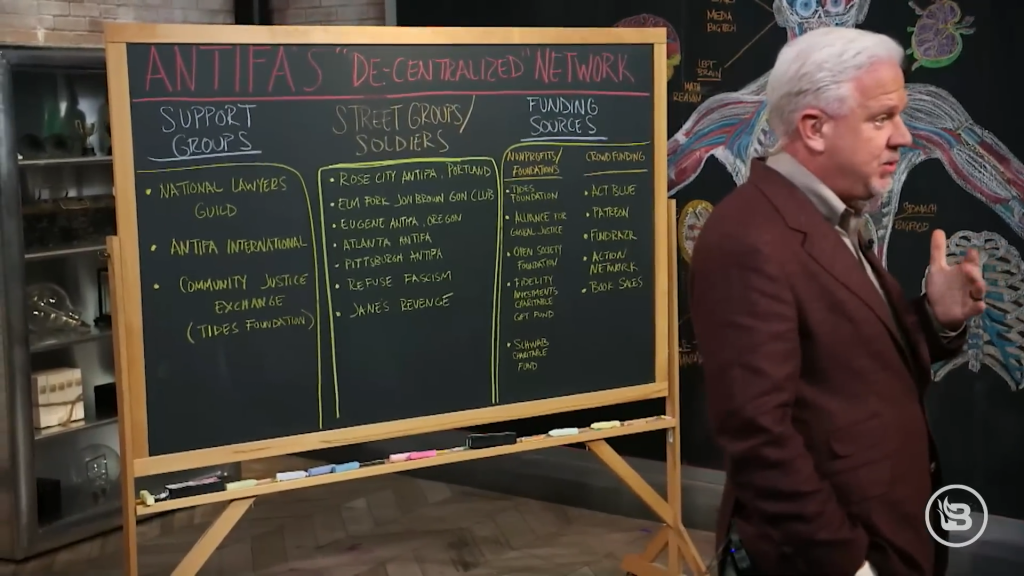
That same day, Beck published to YouTube his “off the cuff” review of what he mocked as “ANTIFA’s ‘De-centralized’ Network.” He explicitly pitched his work as “a starting point for people at the FBI or Justice Department as they begin investigating leads.”
Beck’s list of purportedly antifa-linked organizations worthy of federal investigation meshed well with reports about the administration’s targets of interest, including Democratic megadonor George Soros’ Open Society Foundations and ActBlue, the platform Democratic candidates and affiliated organizations use to marshall small-donor fundraising.
Video file
Video
Citation
From an October 8, 2025, posted to Glenn Beck's YouTube account
Beck claimed to have “split antifa up into three different categories: street groups and soldiers, support groups, and funding sources.” He said that the first category had caused “carnage,” but that any investigation into antifa must go further.
Among antifa “support groups,” Beck included the National Lawyers Guild, which he identified as the “legal arm for antifa” because its members monitor the law enforcement response to protests for abuses, and the Community Justice Exchange, which he criticized for “bailing people out” in 2020 during the “George Floyd riots.”
Based on those extraordinarily tenuous claims linking the National Lawyers Guild and Community Justice Exchange to antifa, Beck went on to identify organizations that fund those two groups as antifa “funding sources.” Those included Beck’s old enemy the Tides Foundationfor having a relationship with the Community Justice Exchange; the Alliance for Global Justice, in large part for giving the National Lawyers Guild “over a million dollars from 2018 to 2019 alone”; and Soros’ Open Society Foundations on the grounds that it funded the Alliance for Global Justice.
Beck also listed the Fidelity Investments Charitable Gift Fund and Schwab Charitable Fund. These are both donor-advised funds that allow individuals to donate their own money to charities using an online portal managed by a financial institution — though Beck suggested that the financial institutions themselves were financing antifa in some way, saying, “If I had my money in Schwab or Fidelity, I don't know if I would have it. They’re giving to the people who are supporting these people.”
Beck further listed crowdfunding platforms including ActBlue, Patreon, and others, but he did not indicate the channels by which money had moved through those platforms or to whom.
“I’m not accusing anyone here. I’m just saying. This is pretty much off the top of my head. I’m just showing the connections that have a very strong odor attached to them,” Beck concluded. He added, “This one chalkboard alone is enough for the Trump administration just to start.”
And the Trump administration, according to Beck, was apparently interested.
The FBI calling on Beck’s expertise is both a comical revelation about the ineptitude of Kash Patel’s bureau — and a five-alarm fire for civil liberties. The Trump administration’s methods may be unserious, but its leaders are extremely focused on punishing their political opponents at all costs.
//
10/15/25 10:35 AM EDT
06/30/11 4:06 PM EDT
07/23/10
---
---
The Big Money Behind Chris Rufo’s Right-Wing Agitating - EXPOSEDbyCMD
MAY 2024
*This piece was produced in partnership withImportant Context.
Chris Rufo has been racking up wins lately. Fresh off of tanking the tenure of Harvard’s first Black—and first Black woman—president, Claudine Gay, with a scandal over alleged plagiarism, the far-right activist has set his sights on National Public Radio.
Last month, Rufo dug up tweets from NPR CEO Katherine Maher that she posted before she was a journalist. The tweets revealed that Maher is a liberal Democrat who supported Biden’s campaign and called Donald Trump a racist. The revelations came on the heels of an op-ed by Uri Berliner published by The Free Press, the media company of conservative columnist Bari Weiss, in which the veteran NPR editor claimed that his outlet had “lost America’s trust” through a left-wing slant and an absence of viewpoint diversity. Berliner subsequently resigned from his position.
Rufo has an undeniable knack for stoking right-wing outrage. Depending on who you ask, he is either a conservative wunderkind—a culture warrior taking big swings at the liberal establishment—or a troll working to tear down decades of social progress, including in public education and higher learning. Extremist and former Trump adviser Steve Bannon even called him “an American hero.” Rufo is credited as the architect of the right’s demonization of “critical race theory” and a major contributor to its moral panic over LGBTQ+ inclusivity in public schools. But it’s not just right-wing audiences he plays to.
The professional culture warrior is equally gifted at seeding stories to legacy media outlets like The New York Times, which published a guest essay in July 2023 arguing for the abolition of “diversity, equity, and inclusion” programs at public universities. The paper ran five front-page pieces on a single day on Gay’s plagiarism scandal. It wasn’t long before The Gray Lady had picked up Rufo’s scoop about Maher as well.
A one-time documentary filmmaker who pivoted right around 2015, Rufo has benefited both financially and professionally from the support of right-wing billionaires and dark money. The media coverage of Rufo and his activities often notes his ties to various right-wing think tanks. However, few outlets have explored the funding behind those organizations to see just who is pulling the strings behind Rufo’s career. But now, an investigation by Important Contextand The Center for Media and Democracy offers some answers.
Through federal tax filings, we were able to identify a handful of right-wing billionaire donors and major right-wing foundations funding Rufo-affiliated groups. However, the original sources of the money behind the organizations are difficult to trace, as much of the cash came through donor-advised funds—third parties that manage money for client donors, distributing it with their input and often anonymously.
In recent years, these operations have become increasingly popular vehicles in American philanthropy, in large part because clients can transfer appreciable assets into their charitable funds without having to pay capital gains taxes that would ordinarily accompany stock sales and similar transactions. Donors have flocked to donor-advised funds to facilitate their funding of far-right and controversial causes such as hate and anti-vaccine groups, likely because donations routed through these funds are attributable only to the funds themselves. In other words, they allow wealthy financiers of unsavory causes to mask their political influence.
In response to our press inquiry asking why big money might support his work, Rufo would only say, “I billionaires.”
American Studio
Rufo is the founder of a nonprofit called American Studio, which he began after dissolving his previous filmmaking venture, the Documentary Foundation, to produce videos for his followers. The foundation had been heavily funded by dark money, as The Intercept reported, and American Studio is no different.
The nonprofit has received significant, untraceable money through donor-advised funds, including mainstream charities associated with major financial institutions. Between July 2021 and June 2023, American Studio received more than $400,000 through Schwab Charitable Fund, a donor-advised fund affiliated with financial services titan Charles Schwab. Meanwhile, from July 2021 and June 2022, the group got $122,000 through Fidelity Investments Charitable Gift Fund, the nation’s largest grant-making organization, which is affiliated with Fidelity Investments, $18,500 through the Vanguard Charitable Endowment Program, affiliated with investment giant The Vanguard Group, and $5,000 through the Morgan Stanley Global Impact Funding Trust, a donor-advised fund tied to Morgan Stanley.
American Studio pulled in cash from right-wing donor-advised funds as well. Between 2021 and 2022, American Studio received $370,000 through DonorsTrust, which is a preferred funding conduit for right-wing billionaire families like Koch, Mercer, and DeVos and a major source of funding for Southern Poverty Law Center-identified hate groups. It got an additional $26,000 in 2022 from the National Christian Charitable Foundation, which similarly funds hate.
Not all of the money was anonymous. Private foundations of wealthy individuals also bankrolled American Studio. The Edelman Family Foundation, the private foundation of billionaire hedge fund manager Joseph Edelman, which funds groups like Dennis Prager’s Prager University and the far-right parents’ rights group Parents Defending Education, gave $150,000. Meanwhile, the private foundation of Thomas W. Smith, founder of the hedge fund Prescott Investors and a major financial backer of anti-critical race theory propaganda and climate denial, gave $50,000.
Rufo’s salary from American Studio was over $240,000 in 2022, according to the organization’s latest IRS Form 990.
Manhattan Institute for Policy Research
Rufo is a senior fellow at the Manhattan Institute for Policy Research, a New York-based right-wing think tank founded in 1978 by prolific libertarian activist Antony Fisher and future CIA Director William Casey. Originally known as the International Center for Economic Policy Studies, the institute has long been aligned with and bankrolled by wealthy right-wingers and corporate interests. As journalist Matthew Cunningham-Cook noted, it “has played a critical role in dismantling the social safety net and criminalizing the poor under the guise of promoting ‘welfare reform’ and ‘broken windows’ policing.”
The institute’s leadership includes Wall Street executives like hedge fund billionaire Paul E. Singer, who profiteered off of the 2008 financial crisis and serves as the institute’s chairman. Since 2020, its donors have included right-wing billionaire power brokers Charles Koch and Richard Uihlein, who are known for funding climate denial and attacks on organized labor. Others include Singer, conservative legal activist and Trump “judge whisperer” Leonard Leo, Prescott Investors’ Smith, and billionaire GOP mega donor Bill Oberndorf, who bankrolled the successful recall against progressive San Francisco District Attorney Chesapeake Boudin in 2022.
From December 2019 to November 2022, Singer’s private foundation gave $3.8 million. The Ed Uihlein Family Foundation gave $175,000 between 2020 and 2021, and in 2022, Leo’s The 85 Fund gave $450,000.
Other private right-wing foundations gave big money to the institute. The Lynde and Harry Bradley Foundation, for example, donated to the tune of $1.6 million between 2020 and 2022. Between 2021 and 2022, the Edelman Family Foundation gave $675,000. The Adolph Coors Foundation, the private foundation of the Coors brewing family, gave $30,000 in 2021.
Like American Studio, the Manhattan Institute took in a substantial amount of money in anonymous donations from donor-advised funds. For example, it received more than $630,000 through Schwab Charitable between July 2019 and June 2023, representing Schwab’s 2020 to 2023 fiscal years. It got more than $1 million through Vanguard Charitable, $1.9 million through Fidelity Charitable, $100,000 through Morgan Stanley Global Impact Funding Trust, and $77,000 through the Goldman Sachs Charitable Gift Fund from July 2019 to June 2022. The American Endowment Foundation funneled $22,000 to the institute between 2020 and 2021.
The institute received funding through right-wing donor-advised funds as well. It raked in nearly $600,000 from DonorsTrust between 2020 and 2022. Another $30,600 came through the National Christian Charitable Foundation and $70,000 from the Bradley Impact Fund, a donor-advised fund affiliated with the Bradley Foundation which Mother Jones recently reported represents mostly money from just four large donors.
While the institute did not respond to a request for comment on Rufo’s salary, and the activist was not forthcoming, top senior fellows can earn over $400,000 according to the group’s latest IRS Form 990.
Hillsdale College
Rufo is also a distinguished fellow at the right-wing Hillsdale College. Hillsdale is a small, Christian liberal arts school in Michigan with a separate campus in Washington, D.C. that has become a central player in the world of right-wing politics. Hillsdale is known as an incubator for conservative operatives and for its ties to Donald Trump. For example, following Trump’s criticisms of the The New York Times’ “1619 Project,” Hillsdale released a “1776 Curriculum.”
In the aftermath of Trump’s defeat, for example, The New York Times reported that Hillsdale’s top brass promoted the Big Lie, and got involved in the scheme to keep him in power. The school has also given fellowships to right-wing contrarian doctors like Stanford professor Jay Bhattacharya.
Hillsdale has gotten big money from a number of foundations of wealthy right-wingers. For example, from December 2019 to November 2022, the Adolph Coors Foundation gave $662,000. The Charles Koch Foundation gave $116,000 and the Ed Uihlein Family Foundation gave $80,000 from 2020 to 2022. $157,000 from Thomas Smith’s foundation.
The school has also received millions in untraceable funding through mainstream donor-advised funds. Hillsdale got nearly $12.2 million through Schwab Charitable Fund between the fund’s 2020 and 2023 fiscal years, running July 2019 to June 2023. It got $4.4 million through Vanguard Charitable, $9.8 million through Fidelity Charitable, nearly $2 million through Morgan Stanley Charitable Fund, and $10,000 through the Goldman Sachs Charitable Gift Fund between those donor-advised funds’ 2020 and 2022 fiscal years.
DonorsTrust funneled more than $2.6 million and the National Christian Charitable Foundation gave $2.2 million to Hillsdale from 2020 to 2022. The Bradley Impact Fund dished out $44,000 between 2021 and 2022.
Neither Rufo nor Hillsdale responded to our question about payment for the fellowship.
The Heritage Foundation
In 2020, Rufo was a visiting fellow for domestic policy studies at the Heritage Foundation, one of the most influential right-wing think tanks in the country. It has worked to undermine climate science, public health amid the COVID-19 pandemic, organized labor, and voting rights.
The foundation’s donors represent some of the largest corporate and wealthy interests in the country, including names like Koch, Uihlein, Thomas Smith, and the Coors family. They include Leonard Leo’s The 85 Fund and the Bradley Foundation.
Over the years, Heritage has taken millions in untraceable money from donor-advised funds—Fidelity Charitable, Schwab Charitable, Vanguard Charitable, Morgan Stanley Global Impact Funding Trust, the Goldman Sachs Charitable Gift Fund, DonorsTrust, the Bradley Impact Fund, and the National Christian Charitable Foundation.
The Claremont Institute
After his stint at Heritage, Rufo was a Lincoln Fellow at the Claremont Institute, another major right-wing think tank which the New York Times has called a “nerve center of the American Right.” Claremont’s vice chairman is Hillsdale College’s president, Larry P. Arnn, who promoted 2020 election denial and worked to pressure former Vice President Mike Pence to block the certification of the results. Meanwhile, Claremont scholar John Eastman, who served as part of Donald Trump’s legal team, was a legal architect of the so-called fake elector scheme.
Like Heritage, the institute has been supported by big right-wing donors including Smith. It also receives big money through donor-advised funds.
The Discovery Institute
Rufo similarly had a research fellowship at the Discovery Institute, a Christian right think tank that opposes the theory of evolution. The institute supported Rufo’s work even after his departure, giving his now-defunct Documentary Foundation $225,000 in 2021.
The institute has received money from billionaire Charles Koch’s foundation. However, most of what it took in came through donor-advised funds. Nearly $5.8 million came from DonorsTrust and about $2.5 million from the National Christian Charitable Foundation. Between July 2019 and June 2022, Fidelity Charitable funneled over $760,000 to the institute. From July 2019 to June 2023 Schwab Charitable passed along more than $1 million.
About Walker Bragman
Walker Bragman is a reporter and co-founder of the OptOut Media Foundation
All articles by Walker Bragman
About Alex Kotch
Alex is a former investigative reporter with the Center for Media and Democracy. A campaign finance expert, Alex helped launch money-in-politics website Sludge, and his work has been published by more than two dozen media outlets including The American Prospect, The Nation, and Vice.com. As of fall 2022, he was executive director of the OptOut Media Foundation, a nonprofit charity he co-founded that maintains a news aggregation app for independent news and offer other services to assist financially independent media outlets.
---
---}:
AN 7 25
POlitical operative David Barton held up a thick Bible with years of wear on its dark brown cover and proclaimed its pages put Protestant Christianity at the center of the country’s very foundation.
*This story first appeared at The 74, a nonprofit news site covering education. Sign up for free newsletters from The 74 to get more like this in your inbox.
“This is actually printed by the official printer of Congress,” said Barton, a best-selling author and influential far-right Christian nationalist. Barton has spent the last 40 years arguing that the separation of church and state is a myth — and has built a multimillion-dollar media and lobbying operation to influence public opinion and shape laws around the belief that the United States was founded as a Judeo-Christian nation.
At [VID] in April, Barton appeared before the Texas House education committee and testified in favor of legislation, since signed into law, requiring that posters of the Ten Commandments be placed inside every classroom in the state’s nearly 9,100 public schools by September. With him, Barton brought a small collection of books he claims were foundational to the country’s public education system until the 20th Century.
Barton isn’t just a primary pitchman for the Ten Commandments law in Texas, his home state, an investigation by The 74 reveals. His fingerprints appear on 28 bills that have cropped up before the legislatures in 18 states this year. A data analysis of the bills exposes how their language, structure and requirements are inherently identical. In dozens of instances, they match model legislation pitched by Barton verbatim.
At the Texas hearing, Barton’s eyes fixated on the cover of the rare 1782 Aitken Bible.
“It also says it’s ‘a neat Edition of the Holy Scriptures for the use of schools,’” he continued. “It has the Ten Commandments.”
In actuality, Barton lifted language from Philadelphia printer Robert Aitken calling on Congress to sanction a Bible that could also be for “the use of schools.” Christian nationalists have for years falsely claimed the Revolutionary-era printing includes a government promotion of Christianity. Barton has long been accused of taking historical quotes out of context, and in 2012, the Christian publisher of his bestselling book on Thomas Jefferson ceased its production because “basic truths just were not there.”
Texas is one of three states in the last two years to pass a law requiring that the Ten Commandments be posted in public schools. The mandates are part of a coordinated nationwide effort to overturn a 1980 Supreme Court ruling forbidding Kentucky from requiring Ten Commandments displays in classrooms.
As the influence of Barton and the burgeoning Christian nationalist movement find favor in state legislatures, the White House and with U.S. House Speaker Mike Johnson — who cites Barton as a “profound influence” — the lobbyists and lawmakers behind the state Ten Commandments bills told The 74 they’re confident the current Supreme Court’s conservative super-majority is on their side, too.
The analysis by The 74 reveals how language in virtually every state bill matches model legislation created by Project Blitz, a Barton-steered Christian “bill mill” that’s long flooded statehouseswith legislative templates that promote Christianity in public schools, legalize discrimination against LGBTQ+ people and restrict abortion.
A dozen bills specify, for example, that the Ten Commandments displays must be hung in a “conspicuous” location. Another 11 specify they should be at least 11-by-14 inches in size. Nearly all of the bills — 25 — mandate a Christian version of the religious and ethical directives be displayed as a “poster or framed.” The 74 tallied 96 instances where bills introduced this year match Project Blitz’s model legislation, including template bills to require the Ten Commandments or the phrase “In God We Trust” in public schools.
Among the architects of Project Blitz is the Barton-founded influence machine, WallBuilders. The flurry of state bills were introduced after WallBuilders — the name is an Old Testament reference to rebuilding the walls of Jerusalem — convened its annual national conference of state legislators in November where the model legislation was promoted.
After Louisiana passed its first-in-the-nation Ten Commandments law last year, new mandates approved in Arkansas and Texas this year follow the same Project Blitz template.
‘No such thing as separation of God and government’
Texas state Sen. Mayes Middleton is the joint author of the state’s new Ten Commandments law and the author of another new law permitting a daily prayer period and Bible readings in public schools statewide. Republican Gov. Greg Abbott signed both in June.
Middleton, whose district southeast of Houston includes his hometown of Galveston, acknowledged Barton’s influence over not just his own legislative agenda, but Texas’ broader conservative movement. Barton previously served as vice chair of the state Republican Party.
“Of course, WallBuilders is very supportive of the bill,” Middleton told The 74, as were the conservative legal groups Alliance Defending Freedom and the First Liberty Institute. “And, of course, all of their missions is to advance religious liberties, especially in the public realm where there is no such thing as separation of God and government.”
Founded by Barton in 1988, WallBuilders promotes theories — discredited by serious scholars — about Christianity’s central role in the formation of the United States through its podcasts, books and a museum with “one of the largest private collections of United States historical documents.”
Through WallBuilders’ lobbying arm, the Pro-Family Legislative Network, Barton leads direct outreach to lawmakers and educators at its annual conferences at a four-star waterfront resort in suburban Dallas. It was at this gathering where Indiana Rep. J.D. Prescott, a Republican, got the idea for Ten Commandments legislation in his state, he told The 74.
Prescott proposed a bill requiring a “durable poster or framed picture” of the commandments in each library and classroom at all public schools statewide. The legislation ultimately failed to garner support. Bills in other states also failed to gain traction, including in South Dakota where the bill’s critics — including some Republicans — said a government mandate was the wrong way to spread Christianity and ran afoul of the Constitution.
“Our early common school system was really designed to teach biblical principles in the Bible, so it’s just getting back to that point,” said Prescott, who described himself as a “student of history.”
The Pro-Family Legislative conference offers lawmakers scholarships and discounted hotel rates to attend the event. In at least one instance, a New Hampshire state lawmakerfiled a disclosure form reporting that he had received $859.47 from the Pro-Family Legislative Network, including $500 reimbursing him for air fare, to attend the November 2024 conference.
Prescott told The 74, “I learned a lot of it at a WallBuilders conference hosted by David Barton. They’ve got a great conference for legislators down in Texas every November. I did look at the WallBuilders model legislation and it’s a good place to start.”
Not everyone’s Ten Commandments
Experts said the bills seek to do more than require “durable” Ten Commandments posters in every public school classroom. The campaign is part of a broader, well-organized and deep-pocketed assault, they argue, on the separation of church and state.
Although WallBuilders isn’t required to disclose its donors, the nonprofit Center for Media and Democracy analyzed federal tax filings with the Internal Revenue Service to bring its finances into focus. In 2021, WallBuilders reported $5.9 million in revenue and $6.3 million in total assets.
The group relies heavily on donor-advised giving, a tax loophole that allows anonymous supporters across the political spectrum to contribute to contentious causes without scrutiny. For example, donor-advised funds have been exploited by far-right activists to leverage global campaigns against the civil rights of women and the LGBTQ+ community, according to a 2023 investigation by openDemocracy.
Mercury One, a nonprofit founded by high-profile conservative pundit and media personality Glenn Beck, is both a WallBuilders donor and primary sponsor of Barton’s annual Pro-Family Legislative Conference to brief elected officials “on pressing issues from a constitutional perspective.”
Barton, who didn’t respond to multiple requests for comment, describes himself as a self-taught historian and the owner of the largest private collection of historical documents about the Founding Fathers. His critics pan the graduate of the Oral Roberts University as a discredited pseudohistorian and propagandist.
Barton is “the granddaddy of Christian nationalist disinformation,” constitutional attorney Andrew Seidel, who serves as vice president of strategic communications at Americans United for Separation of Church and State, told The 74.
John Fea, an American history professor and history department chair at Messiah University, a private evangelical Christian institution in Pennsylvania, accused Barton of cherry-picking historical information to present a misleading portrayal of the past, one that bolsters his own present-day political agenda.
“This is clearly an attempt by Christian nationalists to try to advance their own version of what America should be,” Fea said, noting that even as historians challenge Barton, he’s amassed influence among Republican lawmakers interested in leveraging a distorted accounting of history for political gain.
“Barton provides that history for these lawmakers. It adds a certain depth, even though it’s hollow.”
Darcy Hirsh, the senior director of government relations and advocacy at the nonprofit National Council for Jewish Women, said the Ten Commandments laws present an attack on “the strict wall of separation” between church and state.
“Any efforts to perpetuate the falsehood that the United States is a Christian nation is something that we find deeply alarming,” Hirsh said. Requiring a protestant Christian version of the Ten Commandments in schools, she said, is “exclusionary and coercive” to children from diverse backgrounds.
“A Protestant interpretation of the Ten Commandments is different than the Jewish interpretation of the Ten Commandments, in fact, they are numbered differently,” she said. Constitutional protections separating church and state, she said, are critical to the country’s democratic society.
“It’s that protection that has really allowed the Jewish community and other minority faith communities to flourish in the U.S.”
The laws successfully passed in Louisiana, Arkansas and Texas now face lawsuits from parents alleging they violate the separation of church and state. The issue could soon appear again before the nation’s highest court. In June, the Fifth Circuit Court of Appeals in New Orleans, among the nation’s most conservative, struck down Louisiana’s Ten Commandments display mandate, finding it “plainly unconstitutional.”
Parents with diverse religious identities are being backed by the American Civil Liberties Union and Americans United for Separation of Church and State in challenging the laws. In a complaint filed in Arkansas, parents allege students will be “unconstitutionally coerced into religious observance” and “pressured to suppress their personal religious beliefs.”
Fea, the evangelical historian, told The 74 the far-right campaign isn’t about the Ten Commandments’ place in the nation’s founding but about advancing the influence of Christianity in society.
“They’re using this historical argument to disguise the fact that they believe that somehow — and I don’t know how this happens, by osmosis or whatever — a student sitting in a classroom where the Ten Commandments is displayed will somehow buy into those ideals and values and become more Christian,” he said.
‘The hostility is gone’
At the Texas House education committee hearing in April, Barton held up a second book. This one was much smaller than the first, but just as old and, Barton testified, just as significant.
Barton lectured the Republican-controlled state legislature on The New England Primer, a widely used Colonial-era reading text. The book, he said, drilled first graders with 43 questions about the Ten Commandments.
Then he introduced a third book, and a fourth.
“The courts have pointed to the Ten Commandments as the reason we have all types of laws,” Barton testified. “So there’s a lot of history and tradition for that document that’s not there for other documents.”
Barton’s prop-focused presentation isn’t just scripted — it’s well rehearsed. This year, the 71-year-old has traveled across the country with his books and a small team of collaborators to spread the gospel of Christian nationalism. Like the bills before the state legislatures, Barton’s speech was replicated again and again.
As Barton testified on the Ten Commandment bills nationally, legislative sponsors routinely parroted his talking points, not just about Christianity’s role in the country’s origin, but the Supreme Court’s support for their movement.
During his recent appearances in Nebraska and other states, Barton’s testimonies invoked the court’s 2022 opinion upholding the rights of a Washington state high school football coach to lead prayers with his team on the 50-yard line after games.
Prescott, the Indiana lawmaker, said he became interested in introducing his bill after learning of the implications of the coach’s Supreme Court victory.
To Barton and other members of his coalition, the court’s opinion in Kennedy v. Bremerton School District creates a clear path to require Ten Commandments in schools — and inject Christianity into other facets of public life — by proving they’re part of a longstanding traditional practice.
In finding for Coach Kennedy, the Supreme Court abandoned its 1971 opinion ruling that religious displays don’t violate the Constitution if they have significant secular or nonreligious purposes. The court’s new standard revolves around whether the religious displays are part of historical practices. In other words, the heart of Barton’s pitch.
“That is the new standard, so the hostility is gone,” he testified. “Showing that this is something that is longstanding practice, you go back to The New England Primer.”
Bought and paid for — according to specs
Even as bill proponents championed states’ rights as one legal justification for their Ten Commandments display mandates, Middleton, the Texas legislative leader, said there is a key benefit to the near-identical requirements in the bills across the 18 states.
“We just wanted uniformity in these displays. We thought that was important,” the oil company president and cattle rancher told The 74. “Obviously, these are primarily going to be donated as well, so it’s probably going to be primarily private funds funding these.”
Project Blitz model legislation devises a funding scheme that revolves around donated displays without the reliance on public funds — a provision that appears in 16 states’ bills. Others invoke the model legislation by encouraging donated displays, but broaden the mandate so schools are also free to spend taxpayer dollars to comply.
Mirroring the Project Blitz model legislation, the new Arkansas law requires the Ten Commandments display be composed of a “durable poster or framed copy” of the document and that it be “prominently” positioned in each public classroom and library across the state. The law also stipulates that the posters should be donated by outside groups, meaning the same private entities who had a hand in crafting the specifications, supporting the bills and getting them on legislators’ radars, will also be the ones buying the versions of the Ten Commandments that wind up in schools.
Even as the Louisiana law is caught up in federal court, religious groups who lobbied for the law’s passage and have close ties to the WallBuilders have plans to donate the displays set to appear in classrooms across the state.
In April, First Liberty Institute and The Louisiana Family Forum announced that Patriot Mobile, which describes itself as “America’s ONLY Christian conservative wireless provider,” had donated 3,000 Ten Commandments displays “as part of a project to provide, at no cost to the Louisiana taxpayer, displays in schools throughout Louisiana.”[CHART]
---
===
got punked? ips-dc
CRC BS
Philanthropy
A Conversation with IPS’s Helen Flannery and OSU’s Brian Mittendorf (Part 1 of 2)
The think-tank fellow and accounting professor talk to Michael E. Hartmann about their research and writing on donor-advised funds (DAFs) in general and why they’re controversial—along with different kinds of…
by Michael E. Hartmann on June 2, 2025
a-conversation-with-ipss-helen-flannery-and-osus-brian-mittendorf-part-2-of-2
This article first appeared in the Giving Review on May 22, 2025.*
Tags: Big Philanthropy, donor intent, donor privacy, donor transparency, donor-advised fund, philanthropy
PT 2
Helen Flannery is an associate fellow at the Institute for Policy Research (IPS), for which her research and writing focuses on charity reform. Prior to coming to IPS, she worked for nonprofit clients at both the Target Analytics and ROI Solutions software-development firms.
Brian Mittendorf is the H.P. Wolfe Chair in Accounting at The Ohio State University’s Max M. Fisher College of Business. He specializes in nonprofit accounting and teaches courses on financial statements for nonprofit and governmental organizations, among other things. Prior to coming to Fisher College, he was an associate professor at the Yale School of Management.
Flannery and Mittendorf often collaborate on research and co-author articles about nonprofit finance—most recently including the fascinating “Charitable Objectives or Donor Benefits? What Sponsor Language Reveals about Donor-Advised Fund Priorities and Resource Flows,” forthcoming in Nonprofit and Voluntary Sector Quarterly.For the article, acknowledging that donor-advised funds (DAFs) “are not a homogenous monolith, and seeking to understand what distinguishes sponsoring organizations from each other,” on the basis of DAF sponsors’ own specific language and descriptions of their offerings and activities, Flannery and Mittendorf “develop a measure of DAF sponsor priorities and examine if it is predictive of behavior,” as they put it.
Highlighting one interpretation of their findings, Flannery and Mittendorf continue, because DAFs sponsored by “community foundations tend to have missions that are firmly rooted in specific localities, sponsors and donors are unified around shared expectations and priorities.” On the other hand, DAFs with
[n]ational sponsors, which have no locally unifying missions, may instead attract different donors depending on how much they emphasize extrinsic benefits—and this, in turn, may affect both the types of contributions they receive and the speed with which they disburse grants. Consistent with this notion, we find that national sponsors who put a greater emphasis on donor benefits in their website language have greater assets, are more apt to receive donations that are more tax favored, and are more apt to be slow in distributing grants than those national sponsors whose language emphasizes charitable impact.
Flannery and Mittendorf believe their “findings may also help policy makers identify circumstances where DAF sponsors warrant additional scrutiny,” they add in the article. “That is, even if the average sponsor exhibits characteristics that suggest limited intervention, observable and predictable variation across sponsors may justify oversight of or guardrails placed on at least some of them, particularly as it pertains to their payout practices.”
Previous, also-informative articles by the two include last year’s “Reshaping Charity Channels: How Assets Flow into and out of Donor-Advised Funds” and “Are Donor-Advised Funds Facilitating Opaque Giving to Politically Engaged Charities?”...
Philanthropy
A Conversation with IPS’s Helen Flannery and OSU’s Brian Mittendorf (Part 2 of 2)
The think-tank fellow and accounting professor discuss ways to think about any potential legal and regulatory reforms of donor-advised funds.
by Michael E. Hartmann on June 2, 2025
===
truthout 12 24
after the hottest summer in recorded human history — along with Hurricanes Helene and Milton, flooding and wildfires — why isn’t there a greater push for action on climate change?
One reason is that big oil, gas and coal companies — and their allies in Congress — block the urgent action that’s required. They do this in part by denying basic climate science, and in many cases, they receive enormous,publicly subsidizedtax benefits to do it. And in the run-up to the 2024 presidential election, millions in charitable donations poured into policy development at the Heritage Foundation, producing the Project 2025 Blueprint for the incoming Trump administration.
It’s true. Wealthy donors and fossil fuel corporations regularly make “charitable” donations to nonprofit organizations that deny science, sow doubt about the urgency of climate change and run out the clock for timely action. When they deduct those contributions from their tax bill, they’re effectively being subsidized by you — the taxpayer.
Many of these donors have built their fortunes in the oil, coal and gas industries or in the industries that support them, like banking and insurance. They have a vested interest in ensuring the world’s ongoing dependence on fossil fuels. These include the Koch family of private energy giant Koch Industries, and the Scaife family, heirs to the Mellon oil and banking fortune.
Here’s how it works, according to a new report I’ve co-authored for the Institute for Policy Studies and Climate Accountability Research Project: Through U.S. charitable giving tax laws, donors like the Kochs and Scaifes reduce their taxes when they give to qualified, tax-exempt nonprofit charities. The wealthier the donor, the greater the reduction in their tax bill. Byone estimate, for every dollar a billionaire gives to charity, taxpayers chip in up to 74 cents in lost tax revenue.
Related Story
...
A US nonprofit funnels money from billionaires like Home Depot’s co-founder to effectively subsidize Israeli troops.
By Derek Seidman , TruthoutDecember 2, 2024
> From 2020 to 2022, U.S. nonprofits that deny basic climate science received $5.8 billion in tax-deductible donations.
Our report identified 137 nonprofit tax-exempt organizations that actively spread climate disinformation, working effectively to confound public opinion and delay urgent action on climate.
For example, theCompetitive Enterprise Institute (CEI) received $21 million in charitable contributions from 2020 to 2022. CEI boasts that it’s been “instrumental” in stalling climate action, both in blocking ratification of the 1997Kyoto Protocol and in pressuring former (and now incoming) President Donald Trump to withdraw from the 2016Paris Climate Agreement.
In 2013, Robert Brulle, a sociologist at Drexel University in Pennsylvania,predicted that $500 million was given to organizations devoted to undermining the science of climate change. We estimate that figure has risen into the billions: Over three years, from 2020 to 2022, U.S. nonprofits that deny basic climate science received $5.8 billion in tax-deductible donations. Some $219 million went to groups that primarily work on climate disinformation.
The rest went to multi-issue organizations that include climate denial as part of their work — groups like The Heritage Foundation, which developed the extremist Project 2025 blueprint that would, among other things, roll back environmental regulations and cancel billions of dollars’ worth of investments in green jobs. Other recommendations from Project 2025 include the elimination of the Environmental Protection Agency (EPA) and the National Oceanic and Atmospheric Administration (OCAA).
Conservatively, we estimate that somewhere between $219 million and $1 billion flowed directly to climate disinformation, all subsidized by U.S. taxpayers, during our study period between 2020 and 2022.
Even though these are effectively our tax dollars at work, we don’t know the precise figure. That’s because many donors give through vehicles called donor-advised funds (DAFs), which mask the identity of donors and their recipient organizations. Roughly 16 percent of all donations to climate disinformation groups come through DAFs. Many billions more may have come through private individual donations as well.
If we want to save the planet, we need transparency reforms to reveal this web of secret donations.
The fossil fuel industry has harnessed our charitable system for their self-serving, harmful disinformation campaigns — and they do it largely in secret. We know the oil, gas and coal industry has been funding disinformation for almost half a century, even as their own internal research documented the harms from carbon and methane emissions. So what can we do about it? One simple step is to improve transparency, so the public has more accurate information about where these taxpayer-subsidized donations are going.
Currently, DAF sponsoring organizations — like Schwab Charitable or Fidelity Charitable — are only required to disclose total grants to nonprofits from their sponsoring fund, not from each DAF account, so we don’t know the individual donor who gave the funds. Our report urges lawmakers to pass legislation to require grants from DAFs to be reported on an individual account basis.
We’re also calling to close another DAF loophole. Private charitable foundations, which are required by law to distribute 5 percent of their assets each year, are increasingly giving funds to DAFs and counting that toward their payout requirements. That loophole, which can conceal the actual grant recipients, should be closed.
U.S. taxpayers are likely subsidizing billions of dollars of donations to climate misinformation organizations. If we want to save the planet, we need transparency reforms to reveal this web of secret donations.
----==
an 4 24
as Donald Trump begins his first criminal trial this week, while facing three other indictments and 88 felony counts, several far-right groups are working tirelessly to ensure MAGA lives on no matter what comes of the ex-president's legal troubles, according to a Tuesday, April 16 report published by The Guardian.
Two of the MAGA hopeful's allies — America First Legal Foundation founder Stephen Miller, and Turning Point USA founder Charlie Kirk — were the beneficiaries of "six- and seven-figure checks" from the Lynde and Harry Bradley Foundation and the Bradley Impact Fund's in 2022, as well as "other Trump-friendly bastions such as the Heritage Foundation and Michael Flynn’s America’s Future," the news outlet reports
"The Lynde and Harry Bradley Foundation and Bradley Impact Fund have emerged as major forces in Maga circles," Michael Beckel, of the bipartisan political reform organization Issue One told the news outlet.
READ MORE:[Journalist exposes how 'mastermind' Trump adviser Stephen Miller was 'radicalized'
Furthermore, The Guardian reports the nonprofit pair "poured about $165m into dozens of groups including quite a few Trump-allied thinktanks, legal outfits and other advocacy outfits."
Beckel noted, however, "Donor-advised funds like the Bradley Impact Fund allow mega-donors to support organizations while keeping their names out of the spotlight."
The Issue One research director emphasized The Bradley Impact Fund, offers "wealthy mega-donors additional anonymity and help keep donors’ names out of the limelight, even as these individuals contribute large sums to influence elections and policy debates."
Referring to the Bradley Foundation, Lisa Graves, the executive director of the progressive watchdog group True North, said: “It has nearly $1bn in assets. Its board includes the multimillionaire Art Pope, whose personal ambition is to change the political landscape of North Carolina and more to suit his regressive agenda. Mitchell has been playing a significant role in efforts to make it harder for Americans to vote, and harder for Americans to have fair representation through fair maps.”
READ MORE:[Trump ally’s stunning request: 'If this election doesn’t go our way the next day we fight'
She emphasized, "These are substantial investments that are furthering extremists at the forefront of Trump’s agenda."
*The Guardian's full report is available here
guk
Two powerful conservative non-profits have donated millions of dollars to a number of pro-Trump groups led by the key far-right allies Stephen Miller, Charlie Kirk and others that have promoted election denialism, extremist anti-immigrant policies and legal challenges to bolster the Maga movement.
Based in Wisconsin, the Lynde and Harry Bradley Foundation and the Bradley Impact Fund in 2022 separately doled out six- and seven-figure checks to groups such as Miller’s America First Legal and Kirk’s Turning Point USA, and other Trump-friendly bastions such as the Heritage Foundation and Michael Flynn’s America’s Future.
Watchdog groups that track money in politics say the Bradley Foundation and the closely tied Bradley Impact Fund have become increasingly influential in funding the Maga ecosystem in recent years as Trump is all but certain to be the Republican 2024 presidential nominee.
“The Lynde and Harry Bradley Foundation and Bradley Impact Fund have emerged as major forces in Maga circles,” said Michael Beckel, the research director for Issue One, a bipartisan political reform group.
The biggest checks in 2022 were written to Trump-allied groups by the dark-money Bradley Impact Fund: America First Legal received about $27.1m, Turning Point USA roped in close to $8m, and the Conservative Partnership Institute pulled in $712,310. America’s Future also received $500,000.
Meanwhile, the Bradley Foundation ponied up $425,000 to the Heritage Foundation, which has worked with many other pro-Trump groups to assemble a 1,000-page plan for a new Trump presidency with an authoritarian agenda to expand executive-branch powers and curb key agencies such as the US justice department.
The Bradley Foundation in 2022 also doled out $750,000 to the pro-Maga FreedomWorks Foundation and $2.9m to the Bradley Impact Fund.
While the larger and older Bradley Foundation launched in 1942 and has almost $1bn in assets, the newer and smaller Bradley Impact Fund has grown fast and handed out especially large sums to far-right groups close to Trump.
The Impact Fund, which was started in 2012 and shares at least two board members with the foundation, has witnessed explosive growth in recent years, with revenues from undisclosed donors hitting $108m in 2022 versus just $7m in 2017, according to tax records.
By contrast, the Bradley Foundation doled out $56.6m in 2022.
The Bradley foundation’s board includes the well-known rightwinger Art Pope, a North Carolina multimillionaire who used to chair its board and is also a director of the Bradley Impact Fund. Pope has deep ties to other conservative bastions such as the Koch-backed Americans for Prosperity, where he has been a board member too.
The board of the Bradley Foundation also boasts the rightwing lawyer and Trump ally Cleta Mitchell, a senior legal fellow at the Conservative Partnership Institute.
Mitchell founded CPI’s self-styled “election integrity network” in 2021 after participating with Trump on his 2 January call to the Georgia secretary of state, Brad Raffensperger, who Trump beseeched to “find” 11,780 votes to help overturn Joe Biden’s win in the state.
Mitchell has been a driving force in mobilizing other Trump-allied election denialist groups to expand poll-watching and other measures to guard against potential voting fraud, while she has continued to promote bogus claims of election fraud in 2020.
Serendipitously, the rightwing Public Interest Legal Foundation that Mitchell chairs received $750,000 from the two Bradley non-profits combined, according to the liberal-leaning Center for Media and Democracy, which tracks money in politics.
Although not as well-known as the sprawling network of conservative groups funded by the oil and gas billionaire Charles Koch, experts say the two Bradley non-profits have become instrumental in funding major political players on the right.
“Through their extensive grant-making, the Lynde and Harry Bradley Foundation and Bradley Impact Fund are shaping politics and policymaking in ways that will be felt for years to come,” said Beckel.
Other experts who follow influential donors on the right, including the two Bradley non-profits, agree that their hefty donations are supporting major players and groups backing Trump.
“These are substantial investments that are furthering extremists at the forefront of Trump’s agenda,” said Lisa Graves, the executive director of the progressive watchdog group True North.
Speaking about the older Bradley Foundation, Graves said: “It has nearly $1bn in assets. Its board includes the multimillionaire Art Pope, whose personal ambition is to change the political landscape of North Carolina and more to suit his regressive agenda.”
She added: “Mitchell has been playing a significant role in efforts to make it harder for Americans to vote, and harder for Americans to have fair representation through fair maps.”
The Bradley Foundation board boasts other big-name conservative lawyers too, including Paul Clement, a former US solicitor general who has done substantial legal work for pro-gun interests, and Eugene Scalia, a secretary of labor during the Trump administration and the son of the late supreme court justice Antonin Scalia.
In total, the two Bradley non-profits in 2022 poured about $165m into dozens of groups including quite a few Trump-allied thinktanks, legal outfits and other advocacy outfits.
Other rightwing recipients who received checks from both Bradley non-profits include the Wisconsin Institute for Law and Liberty, which pulled in a total of $1.1m, and the National Center for Public Policy Research, which received just over $1m.
Similarly, the two Bradley non-profits gave a total of $700,000 to Flynn’s America’s Future, almost $530,000 to the Heritage Foundation, and $510,050 to the Manhattan Institute for Policy Research.
In the case of Flynn’s America’s Future, the Bradley non-profits were crucial to sustaining its operations in 2022, according to tax records. America’s Future only raised about $1.1m in 2022.
Flynn, who briefly served as Trump’s national security adviser and who Trump pardoned in late 2020 after he was convicted of lying to the FBI about contacts he had with the Russian ambassador in 2016, was a key pusher of false claims the 2020 election was rigged. He is now urging a “guard the vote” drive against potential fraud, a ploy Trump has touted too.
The rapid growth of the Bradley Impact Fund, which bills itself as a “donor-advised fund” and keeps donor names secret, underscores how many big conservative check-writers want to hide their identities, say experts.
“Donor-advised funds like the Bradley Impact Fund allow mega-donors to support organizations while keeping their names out of the spotlight,” said Beckel.
The Bradley Impact Fund, he said, gives “wealthy mega-donors additional anonymity and help keep donors’ names out of the limelight, even as these individuals contribute large sums to influence elections and policy debates”.
More broadly, Graves said: “Though the two Bradley non-profits are not as well known as Koch’s non-profit empire or Leonard Leo’s money operation to capture key levers of power, they have become increasingly important to the growth of the Maga ecosystem.”
===
===
https://www.alternet.org/playing-fast-loose-megadonor-watchdog/
an no lnx
How a Republican megadonor is 'playing fast and loose' to push 'dangerous, extreme agenda': watchdog
Maya Boddie June 18, 2023
Republican billionaire Leonardo Leo's trust fund, Marble Freedom Trust's latest Internal Revenue Service (IRS) filing, revealing the former President Donald Trump donor's mission to control right-wing politics, Truthout reports.
Progressive watchdog Accountable.US obtained the recent IRS filing, which according to Truthout, shows the Federalist Society leader "has dumped at least $411 million into fueling right-wing infrastructure in the U.S. since mid-2020."
Furthermore, according to Truthout, the filing reveals "Leo has spent at least $182 million during the Biden administration to fund right-wing groups from May 1, 2020, through April 30, 2022," noting, "This surge has come as Leo has become more publicly outspoken in attacking reproductive rights as well as efforts to protect our environment and crucial measures that advance Americans' equality."
READ MORE: Conservative activist arranged for Clarence Thomas’ wife to get secret payouts
Additionally, it "adds to the growing public knowledge of how Leo's for-profit business works in tandem with nonprofit groups he funds to change the rules in our democracy, and also provides a glimpse of how lucrative this effort is."
The news outlet reports prior to Accountable's findings, "the Campaign for Accountability filed an IRS complaint against Leo based on other filings showing that seven of his affiliated nonprofits had sent $73 million to his for-profit CRC Advisors."
Truthout also notes:
As Sen. Sheldon Whitehouse (D-Rhode Island) has noted, before the public learned of the existence of Marble Freedom Trust, Leo rose to prominence as a volunteer advising Trump by creating the list of Supreme Court candidates that Trump chose from, as well as by helping to secure the confirmation of three controversial high court nominees — Neil Gorsuch, Brett Kavanaugh and Amy Coney Barrett (and helped get numerous other lower court judges appointed). As True North documented, Leo's network played a central role in this right-wing court packing, raising over $600 million from 2014 through the 2020 election. This dark money network has received more than $2 billion when accounting for Marble.
Accountable President Kyle Herrig told Truthout he believes "Leonard Leo is playing fast and loose with his $1.6 billion slush fund, enriching himself and doling out paychecks and favors for his cronies," adding, "This kind of corruption is par for the course for Leo. It clearly pays to do his bidding."
READ MORE: Charities often move 'dark' money that shapes public policy: report
Herring said, "This is just the latest development in Leonard Leo's decades-long scheme to push his dangerous, extreme agenda and get rich while doing it. From personal enrichment for himself and his inner circle to his machine of nonprofits advancing the MAGA agenda, we’ve only scratched the surface of Leo’s devastating impact on our democracy."
READ MORE: 'Largest political donation ever': Trump ally received $1.6 billion through Federalist Society contact
Truthout's full report is available at this link.
FROM YOUR SITE ARTICLES
New report details Clarence Thomas’ 'shady ties to sprawling network of dark money' ›
'No mention of Ginni': Kellyanne Conway may have confirmed payments made to Clarence Thomas’ wife ›
Trump Supreme Court advisor Leonard Leo tied to more than $80 mllion in dark money ›
RELATED ARTICLES AROUND THE WEB
Leonard Leo used Federalist Society contact to obtain $1.6B ... ›
Leonard Leo Pushed the Courts Right. Now He's Aiming at ... ›
Federalist Society's Leonard Leo is helping Trump make courts ... ›
ref
apr 2023
https://truthout.org/articles/new-details-from-leonard-leos-trust-fund-expose-the-inner-workings-of-the-right/
newly obtained documents show that the billion-dollar trust fund given to Leonard Leo — the right-wing attorney and longtime leader the Federalist Society who orchestrated Donald Trump’s Supreme Court picks — has dumped at least $411 million into fueling right-wing infrastructure in the U.S. since mid-2020.
The latest IRS filing of the new nonprofit, Marble Freedom Trust — obtained by:{ }::{Accountable.US}:, a progressive watchdog group — shows that Leo has spent at least $182 million during the Biden administration to fund right-wing groups from May 1, 2021, through April 30, 2022. This surge has come as Leo has become more publicly outspoken in attacking reproductive rights as well as efforts to protect our environment and crucial measures that advance Americans’ equality.
Leo chose to have most of that, more than $153 million, wash through the Schwab Charitable Fund, a “donor-advised fund” that serves as a passthrough to help obscure the money trail between a funder and its beneficiaries. In recent years, since Leo secured control of $1.6 billion in the largest single gift of its kind from Chicago billionaire Barre Seid, Leo’s network of groups has relied heavily on donor-advised funds to move cash between entities in ways that can help keep the original donor secret from the public.
marble’s filing included only one other grantee: the Concord Fund (also known as the Judicial Crisis Network), to which it gave a $29 million gift. The Concord Fund then paid $12 million in fees to CRC Advisors, a for-profit PR firm that Leo has helped helm since 2020.
Kyle Herrig, the president of Accountable told Truthout that in his opinion “Leonard Leo is playing fast and loose with his $1.6 billion slush fund, enriching himself and doling out paychecks and favors for his cronies. This kind of corruption is par for the course for Leo. It clearly pays to do his bidding."
before Accountable’s latest revelations, theCampaign for Accountability filed an IRS complaint against Leo based on other filings showing that seven of his affiliated nonprofits had sent $73 million to his for-profit CRC Advisors.
Despite more than $1 billion in assets, Leo’s Marble Freedom Trust has no publicly known website, and its street address is actually a UPS drop box in Utah. Meanwhile, however, Marble disclosed spending nearly $250,000 on “office expenses.” Its disclosed phone number, with an area code for southeastern coast of Florida, has been held for years — well before Marble was created — by Leo’s longtime collaborator Neil Corkery, an anti-gay rights and anti-abortion operative central to Leo’s court capture network.
This latest filing also adds to the growing public knowledge of how Leo’s for-profit business works in tandem with nonprofit groups he funds to change the rules in our democracy, and also provides a glimpse of how lucrative this effort is.
Marble’s filing shows that in its second year of operations Leo gave himself a raise from $350,000 to $400,000 a year for working part-time (25 hours a week) for the trust he controls. It also reported that he spends 10 hours a week on Rule of Law Trust, a 501(c)(4) nonprofit launched in 2018 with a gift of nearly $80 million from a donor kept secret from the public. Leo is the only trustee of that entity, and Corkery holds its books. Like Marble, it has no website and its address is a drop box location. Its listed phone goes to a law firm.
Marble’s latest filing shows that Leo’s billion-dollar trust also added a new employee to its operations: Alex Marshall as CIO, an acronym that typically stands for Chief Information Officer. His salary was listed at a whopping $764,000.
According to Accountable, until 2021 Marshall was likely working as a branch manager for the investment firm Oppenheimer & Co., a brokerage firm and investment bank, and was likely making hundreds of thousands less because Marshall’s broker record indicates he completed “entry-level” financial industry exams for principal and supervisory roles.
How did Alex Marshall get plugged into Leo’s operation?
As True North Research’s Lisa Graves first uncloaked, Alex Marshall is married to Maria Marshall, who currently works at Leo’s CRC Advisors and previously worked for the Federalist Society, the networking group created to get right-wing lawyers into powerful offices. Marshall’s title was “director of operations” in the “Office of the Federalist Society’s Executive [Vice President].” That was Leo’s office, where she handled his schedule, among other roles. She previously worked as U.S. Sen. Arlen Specter’s scheduler.
She left her day job to work with Leo, who also left his day job at the Federalist Society in 2020 to help lead the PR firm Creative Response Concepts, which rebranded as CRC Advisors, though he still helps lead and fund the Federalist Society as co-chair of its board.
While she was working for Leo at the Federalist Society, Leo’s Rule of Law Trust paid nearly $600,000 to YAS, LLC. That is the name of the Washington, DC-filed consulting firm created in 2015 and owned by Maria Marshall. Leo’s Rule of Law Trust paid YAS another $175,000 in 2020, after he left his employment but not his leadership role with the Federalist Society.
The Marshalls were also guests at the special table purchased by the major “anonymous” donor to the renaming ceremony of George Mason University’s law school in tribute to Antonin Scalia, an event cohosted by Leo.
Allison Pienta, a George Mason student who worked with UnKoch My Campus to obtain public records, revealed that the anonymous donor who gave $20 million to rebrand the law school and put Leo in a key role was none other than Barre Seid. (Charles Koch also gave $10 million to fund the law school.) There is no indication that Seid, a notoriously secretive billionaire, was there at the Scalia tribute dinner cohosted by Leo.
The Marshalls were at that special table alongsideJonathan Bunch, who was later named as a successor trustee at Marble, meaning he is Leo’s potential successor at the billion-dollar trust. Bunch, who is now listed as president of CRC Advisors, was paid more than $1.5 million for consulting by Leo’s Rule of Law Trust in 2018, when he was also working at the Federalist Society with Leo. Two years later, as Heidi Przybyla from Politico documented, Bunch and his wife closed on a $1.28 million home on the Chesapeake Bay, a second home a few hours south of their longtime home in a suburb of Washington, D.C.
As Accountable uncovered, since the launch of YAS, the Marshalls also purchased a second home near the beach in Avalon, New Jersey, the third most expensive zip code in the state. That research revealed that the Marshalls rent out the home, valued at $1.38 million home, for up to $7,700 a week depending on the season.
As Robert O’Harrow Jr. and Shawn Boburg documented in the Washington Post, on the eve of the Senate vote on Brett Kavanaugh’s nomination by Donald Trump to the U.S. Supreme Court,Leo bought a $3.3 million seaside mansion in Maine.
Just two months after that story broke, and less than a year after he closed on the mansion, Leo paid off the mortgage in full, for more than $2 million, while he was still working as the executive vice president of the Federalist Society, with a six-figure salary. As the Post revealed, a year earlier, after Supreme Court Justice Anthony Kennedy announced his retirement and as Leo was advising Trump on packing the Supreme Court as well as aiding the effort to get Trump’s nominees confirmed, Leo paid offhis 30-year mortgage 22 years ahead of schedule.
As Politicolater detailed, after officially joining CRC Advisors, Leo bought a second mansion in Maine, and has spent his growing wealth by purchasing four new cars, paying private school tuition for his children, and obtaining a wine buyer and locker at Morton’s Steakhouse. He has also donated hundreds of thousands of dollars to religious groups and he has also spent money on electoral candidates himself. Additionally, Leo-tied nonprofits have directed millions of dollars to playing an increasing role targeting voters around elections.
As Sen. Sheldon Whitehouse (D-Rhode Island) has noted, before the public learned of the existence of Marble Freedom Trust, Leo rose to prominence as a volunteer advising Trump by creating the list of Supreme Court candidates that Trump chose from, as well as by helping to secure the confirmation of three controversial high court nominees — Neil Gorsuch, Brett Kavanaugh and Amy Coney Barrett (and helped get numerous other lower court judges appointed). As True North documented, Leo’s network played a central role in this right-wing court packing, raising over $600 million from 2014 through the 2020 election. This dark money network has received more than $2 billion when accounting for Marble.
As *Politico* noted, “Campaign-style politics — and the generous paydays that go along with it — are now adjacent to the Supreme Court, the one U.S. institution that’s supposed to be immune to it.”
Leo’s ties to such efforts are not only recent. Last month, the Washington Post revealed that in2012 Leo had been instructing Kellyanne Conway, who ran the Polling Company, to bill the Judicial Education Project (now known as the 85 Fund and the Honest Elections Project) to pay Ginni Thomas up to $100,000.She is the wife of Supreme Court Justice Clarence Thomas.That is, Leo was secretly orchestrating the pay of the wife of a Supreme Court Justice, Clarence Thomas, from a secret funder. That funder’s identity remains hidden. That year, the Judicial Education Project also paid CRC $165,000. CRC later acquired the Polling Company in 2017, with the help of another Leo group, as Politico revealed late last year.
Leo’s income from his for-profit operations or any consulting, such as CRC Advisors, is not required to be publicly disclosed.
The new filing that Accountable.US obtained provides vital insights into how Leo is using the billion that Seid gave him and also provides new information about the shape of his efforts to remake our courts and our country to advance his view of the world.
“This is just the latest development in Leonard Leo’s decades-long scheme to push his dangerous, extreme agenda and get rich while doing it,” Herrig told Truthout. “From personal enrichment for himself and his inner circle to his machine of nonprofits advancing the MAGA agenda, we’ve only scratched the surface of Leo’s devastating impact on our democracy.”
Note: Lisa Graves, True North’s executive director, contributed to this piece. A correction was made post-publication to correct a typo in a date (changing “May 1, 2020” to “May 1, 2021).
===
===
Brulle RJ, Hall G, Loy L, Schell-Smith K. 2021. “Obstructing action: foundation funding and US climate change counter-movement organizations,” Climatic Change. 2021;166(1):17.
Obstructing action: foundation funding and US climate
change counter-movement organizations
Robert J. Brulle1 & Galen Hall1 & Loredana Loy & Kennedy Schell-Smith1
Received: 1 February 2021 / Accepted: 28 April 2021/
The Author(s), under exclusive licence to Springer Nature B.V. 2021
In a 2016 congressional hearing on the climate crisis, Senator Sheldon Whitehouse (D-RI) held
up a book entitled Why Scientists Disagree About Climate Change and asked: “Who funded
this phony climate science denial textbook that the Heartland Institute published and mailed to
thousands of schoolteachers around the country? ... We know it costs a lot of money to print
[but] we don’t know who paid for it!” (SDC 2019). The publisher of the “textbook” was the
Heartland Institute, a central organization in the Climate Change Counter-Movement (CCCM).
The CCCM is a complex network of organizations that functions to obstruct climate action
(Brulle 2020). Senator Whitehouse’s question points to the extensive network of anonymous
funders that supports the CCCM. This anonymous funding allows unaccountable, unknown
entities to promote climate misinformation and obstruct climate action. Several analyses have
shown that this deliberate and organized effort to misdirect and distort public discussion of
climate change drives widespread misunderstanding of climate science and legislative gridlock
on the issue (NRC 2011, p. 35).
For these ongoing efforts to continue, it is imperative that CCCM organizations mobilize
sufficient financial resources (Jenkins 1983). Thus, an examination of the funding sources of
the CCCM can provide a deeper understanding of the institutional dimensions of this effort.
The effort to understand the financial support of the CCCM has been the topic of scholarly
concern (Brulle 2014; Farrell 2015, 2016, 2019). The most extensive analysis was that of
Brulle (2014).In his analysis, he found that over the time period 2003 to 2010, the majority of
identifiable CCCM funding came from several conservative philanthropies and, increasingly,
through Donors Trust, a donor-directed philanthropy designed to preserve funders’ anonymity.
In this research, we revisit and update Brulle’s initial analysis. We double the timespan of the
prior study, analyzing data from 2003 to 2018, add an analysis of the amount of unidentifiable
funds supporting the CCCM, and considerably sharpen prior estimates by approximating the
proportion of this funding that directly supports work on climate change.
....
Our analysis also supports the finding that funding strategies differ between progressive and
conservative philanthropists.We find a striking stability in funding over the 16-year time
period. The funding strategy of the conservative movement was laid out in the so-called Fat
Memo (Miller 2005), which informed the giving practices of the Olin Foundation, the first
major conservative philanthropy, and subsequent conservative donors. These funding efforts
focus on the development and promulgation of a clear conservative viewpoint. To realize that
effort, conservative philanthropies have funded a range of organizations that act to realize that
goal on a long-term basis. This strategy focused on the creation and maintenance of conservative
think tanks, development of public intellectuals (“thought leaders”), and promulgation
of a consistent ideological message. Additionally, conservative foundations focus on building
institutional capacity in organizations with strong communications capabilities (Covington
1997; Barley 2010).
This consistent and long-term funding strategy has enabled the development of a cohesive
institutional network of conservative organizations that work collectively to promulgate a
consistent message. This strategy stands in marked contrast to the funding strategy of
progressive foundations, which focus on individual research projects and short-term efforts.
Consequently, the progressive activist organizations and think tanks form a very loose and
disconnected network(Barley 2010, p. 792). This differs significantly from the very tight
network of organizations and think tanks that comprise the conservative movement. The
analysis confirms the long-term stable funding that maintains the CCCM.
This analysis still leaves Senator Whitehouse’s question unanswered. The source of over
three-quarters of the funding of the CCCM cannot be identified.While some of this funding
could come from small donations, the existing IRS disclosure rules do not enable any further
investigation in this area. Further research is needed to develop new means to extend our
understanding of the unidentified funders that created and maintain the CCCM.[refs]
===
===
no lnx
omg more i never heard of...https://www.influencewatch.org/non-profit/heritage-foundation ...
In its 2019 annual report Heritage claimed to have more than 500,000 individual donors to either the Heritage Foundation or Heritage Action...Additional information regarding its financing is available from federal tax forms submitted by the Heritage Foundation and many of its foundation donors....For tax year 2018 the Heritage Foundation reported more than $81 million in revenue. For tax years 2012 through 2018, cumulative total revenue was approximately $633 million, for an average of $90.4 million per year. Heritage reported $79.9 million in total expenses for 2018, with salaries ($37.9 million) the largest line item. Heritage reported $250.6 million in net assets at the end of 2018, for liquidity equivalent to 300 percent of expenses at the 2018 level. [160] [161]
Contributions and grants accounted for $75.6 million of Heritage’s $81 million total revenue for 2018. Investment income ($4.4 million) was the second-largest source of 2018 revenue. [162]
According to the recordkeeping service Foundation Search, approximately $5.4 million of the $75.6 million in contributions and grants in 2018 were provided by 292 private foundation sources, with 280 of these donors providing grants of less than $100,000. [163] [164]
More than $1.5 million of the $5.4 million in private foundation donations for Heritage in 2018 was provided by threedonor-advised fund providers: the Fidelity Investments Charitable Gift Fund, the Schwab Charitable Fund, and the Chicago Community Trust. [165]
A donor-advised fund manages charitable accounts through which donors can distribute gifts to charities of their choice while receiving immediate tax benefits. Many of the largest, such as those noted above, exist to serve the clients of large investment firms or residents of a metropolitan area, rather than a particular charitable cause or ideological agenda.
Outside of the large donor-advised funds, the three largest of Heritage’s institutional foundation donors in 2018 were as follows:[166]
Lillian S. Wells Foundation ($1 million). In 2018 this foundation also gave six figure donations to two other right-of-center organizations: the James Madison Institute and the Intercollegiate Studies Institute. [167]
Charles G. Koch Charitable Foundation ($200,000). In 2018 this foundation also gave donations in excess of $100,000 to libertarian and right of center organizations such as the Cato Institute, the Federalist Society and the Daily Caller News Foundation; and to centrist-left organizations such as the Vera Institute of Justice, the Brookings Institution and the Poynter Institute for Media Studies. More than half of Koch’s 2018 grants (at least $64 million) were given to programs affiliated with approximately 100 public and private universities. [168]
Henry E. Haller Jr. Foundation ($200,000). In 2018 this foundation also gave five figure donations to other right-of-center organizations, such as the Federalist Society and the Media Research Center. [169]
For donation years 1998 through 2018, Foundation Search reports Heritage receiving a cumulative total of more than 4,300 separate foundation grants totaling in excess of $274 million, for an average of $13 million per year.
The ten largest foundation contributors during the 21-year period were as follows: the Shelby Cullom Davis Charitable Fund ($16.8 million over 21 years), the Sarah Scaife Foundation ($13.7 million), the DeVos Urban Leadership Initiative ($13.3 million), the Herrick Foundation ($12.6 million), the National Christian Charitable Foundation ($11.4 million), the Howard Charitable Foundation ($10.4 million), the Noble Research Institute ($9.2 million), the Diana Davis Spencer Foundation ($9 million), the Lillian S. Wells Foundation ($8 million), and the Lynde and Harry Bradley Foundation ($7.9 million). [170]
https://www.influencewatch.org/non-profit/heritage-foundation
===
so many fails, why SO MUCH $?
https://www.exposedbycmd.org/2020/03/17/koch-linked-charity-bankrolled-project-veritas
erik
Prince, the former head of private mercenary firm Blackwater Worldwide, recruited ex-spies to work with right-wing sting operation Project Veritas to infiltrate liberal groups, The New York Times reported on March 7. He also gave Project Veritas staff access to his Wyoming ranch, where they took “surveillance and elicitation training” from a former British MI-6 officer, as The Intercept reported in May 2019.
In 2017, the former British spy helped direct an operation to copy files and record conversations in a Michigan office of the American Federation of Teachers, a major teachers’ union that his sister, Education Sec. Betsy DeVos, and her husband’s family have fought for years. The same operative who went undercover at the union infiltrated the campaign of now-Democratic Rep. Abigail Spanberger (D-VA) the following year.
The DeVos family is one of the right wing’s major political donors. (The Prince family is also very wealthy and gives money to conservative causes.) While the DeVos family foundations have not donated directly to Project Veritas, several of their wealthy political allies, and multiple donor-advised fund sponsors, have been bankrolling the group. It’s not clear who paid the ex-spies to work with Project Veritas, or if they were paid.
Donor-Advised Fund Sponsors Bankroll Project Veritas
The Center for Media and Democracy (CMD) has tracked over $11.9 million in contributions to Project Veritas from 2014-18, or roughly 43 percent of its contribution revenue over that time period. The biggest funders, by far, are donor-advised fund (DAF) sponsors–501(c)(3) nonprofits that provide individual charitable accounts for donors, passing along their clients’ contributions to other nonprofits for a fee while offering the donors special tax deductions. Clients have the option of remaining anonymous.
The favorite DAF sponsor of the Right is DonorsTrust. Used heavily by Charles Koch,**Robert Mercer**, and Adolph Coors, it pours money into a network of right-wing charities and social welfare nonprofits. DonorsTrust gave more than $8.4 million to Project Veritas from 2014-18, or nearly one-third of the group’s contribution revenue. DonorsTrust’s yearly contribution rose from $607,000 in 2014 to a high of $2.4 million in 2017. Several members and staff of DonorsTrust have close ties to Koch-backed operations. The related Donors Capital Fund gave $20,000 to Project Veritas from 2014-15.
Project Veritas has a 501(c)(4) political arm, Project Veritas Action Fund, to which the billionaire, Trump-supporting Mercer family has steered funds. In 2018, a nonprofit called Making America Great, chaired by Rebekah Mercer, the daughter of former Renaissance Technologies co-CEO and Breitbart News funder Robert Mercer, donated $750,000 to the action fund. The Mercer Family Foundation has not donated directly to Project Veritas in recent years, but it’s possible it has used DonorsTrust to do so. From 2014-18, the foundation gave $10.9 million to DonorsTrust, including nearly $8.2 million in 2018, a big increase from previous years. By shifting more of its charitable dollars through DonorsTrust, the family is effectively hiding its donations from the public. In 2012, Robert Mercer donated $25,000 to Project Veritas through his LLC Gravitas Maximus.
Other top foundations that have used DonorsTrust to donate anonymously to conservative nonprofits from 2014-18 include the Knowledge and Progress Fund, a Koch family foundation ($5.3 million), the Adolph Coors Foundation ($4.2 million), the Searle Freedom Trust ($2.6 million), and the Charles Koch Foundation ($980,000). From 2009-12, the foundation of DeVos’s in-laws, the Richard and Helen DeVos Foundation, contributed $6.5 million to DonorsTrust, but has not donated since.
The National Philanthropic Trust, another donor-advised fund sponsor, gave close to $1.3 million to Project Veritas from 2014-18. Fidelity Charitable Gift Fund, a DAF sponsor associated with Fidelity Investments and the biggest nonprofit by annual revenue in the country, gave over $1.2 million from 2015-18. The Greater Houston Community Foundation gave close to $116,000 from 2014-18. Donor-advised fund sponsors associated with additional major finance companies, Schwab Charitable and Vanguard Charitable, have each contributed over $100,000 to Project Veritas. Additional DAF sponsors the National Christian Foundation (nearly $15,000 from 2014-18), the Community Foundation of North Florida ($10,000 from 2017-18), and the Jewish Communal Fund ($6,000 in 2015) gave smaller amounts.
The Greater Houston Community Foundation’s 2016 tax records show that the DAF sponsor received a large amount of money in the form of transferred oil and gas stock. Clients can transfer appreciable assets like stock into their charitable accounts without paying taxes on the sale of those assets, and get the charitable tax deduction at the same time, one reason why DAF sponsors are rapidly becoming more popular among wealthy donors. Clients delivered nearly $14 million worth of Anadarko Petroleum, ExxonMobil, and Marathon Oil stock into their charitable accounts with the Greater Houston Community Foundation in 2016.
Wealthy individual donors in the right-wing philanthropic world have also donated directly to Project Veritas through their family foundations. Dunn Foundation–which has Thomas Beach, a DonorsTrust board member and chairman of the Koch-backed Reason Foundation, on its board–gave $274,000 from 2015-18; the Helen Diller Foundation gave $125,000 in 2017; and the Bradley Impact Fund gave $31,000 from 2015-18.
The Donald J. Trump Foundation gave $20,000 to Project Veritas in 2015, and Trump met with and promoted the group and its founder, James O’Keefe. Trump allegedly encouraged O’Keefe to infiltrate Columbia University and obtain Barack Obama’s college records.Donald Trump, Jr. is set to attend O’Keefe’s upcoming wedding. Prince began working with Project Veritas during the 2016 elections and would go on to work on Trump’s transition into the White House. He later pitched the White House and the Pentagon on a plan to privatize the Afghan war, but the secretary of defense did not pursue a deal.
Law and lobbying firm Alston and Bird, which employs former Kansas Republican Sen. Bob Dole, directed a $1 million donation from an unknown source to Project Veritas in 2019, according to The New York Times. The firm lobbied the federal government on behalf of corporate fossil fuel and health care clients including ConocoPhillips, Cheniere Energy, trade group America’s Health Insurance Plans, and CVS Health in the second half of 2019.
[chart:
donorsTrust $8,436,945
National Philanthropic Trust $1,271,032
Fidelity Charitable Gift Fund $1,212,329
Dunn Foundation $274,000
Helen Diller Family Foundation $125,000
Greater Houston Community Foundation $116,350
Vanguard Charitable $102,000
Schwab Charitable $100,925
Chase Foundation of Virginia $40,000
American Endowment Foundation $35,000
Bradley Impact Fund $31,000
Debora J. and Peter A. Magowan Foundation $30,000
Donors Capital Fund $20,000
Donald J. Trump Foundation $20,000
Daniel and Susan Gottleib Family Foundation $17,500
National Christian Foundation $14,927
Community Foundation of North Florida $10,035
William H. Donner Foundation $10,000
Brad Brock Family Foundation $10,000
...]
Koch foundations haven’t given money to Project Veritas directly, but the group has personal ties to the Koch political network. A 2018 annual review acquired by CMD shows that Project Veritas’s vice president of development is Adam Guillette, who launched the Florida branch of Koch’s premier political nonprofit, Americans for Prosperity, and worked there for several years. Guillette is also president of Accuracy in Media, a nonprofit that has received funding from DonorsTrust.
Project Veritas had $8.8 million in annual revenue in 2018, and O’Keefe took home roughly $387,000, according to its latest tax filing obtained by CMD.
===
===
https://www.alternet.org/2019/03/christian-charity-gave-more-than-50-million-to-hate-groups/
TheNational Christian Foundation is America’s eighth largest public charity, but it doesn’t build houses, educate children, feed the hungry, or provide other goods or services one might commonly associate with a charity. It’s also not a household name like the Red Cross, but that doesn’t prevent it from having vast influence. According to a new investigation from Sludge, the far-right, evangelical NCF “has donated $56.1 million on behalf of its clients to 23 nonprofits identified by the Southern Poverty Law Center as hate groups.”
These nonprofits include multiple anti-LGBT, anti-Muslim and anti-immigrant hate groups. In fact, as reporter Alex Kotch points out, Inside Philanthropy has said that NCF “is probably the single biggest source of money fueling the pro-life and anti-LGBT movements over the past 15 years.”
In addition to not being a direct service charity, the NCF is also not a conventional foundation that a wealthy donor uses as a vehicle to grow and then give away their money to multiple other charities over time. Instead, it’s a donor-advised fund, offering its Christian donors “expert guidance and creative giving solutions,” Kotch writes.
Helaine Olen, writing in The Atlantic, calls these donor-advised funds a “waiting room for charitable donations,” in which anyone, not only the wealthy, can place money into the fund, let it grow, and then have it distribute the money gradually to organizations of the donor’s choice.
According to Kotch, these funds allow their clients “immediate tax breaks on donations.”
They also give individual donors who pay into the fund anonymity. While Sludge was able to use publicly available tax findings to determine which organizations NCF funded, the names of the fund’s donors stay hidden.
The biggest recipient of NCF funds, according to Sludge’s investigation, is Alliance Defending Freedom, a network of lawyers, who, Kotch writes, “have supported criminalizing homosexuality, sterilizing transgender people, and claimed that gay men are pedophiles.”
Kotch continues:
Alliance Defending Freedom took in $49.2 million from NCF from 2015-17. ADF received $46.3 million in contributions and grants during the 2016 fiscal year (from July 1, 2015, to June 30, 2016). It got $16.8 million from NCF in the calendar year of 2015, meaning that, if these years were aligned, NCF’s donations would have represented over one-third of ADF’s annual contributions.
The Family Research Council, which the Southern Poverty Law Center says “often makes false claims about the LGBT community based on discredited research and junk science,” including linking homosexuality to pedophilia, is another frequent beneficiary of NCF funds. Sludge found it received $5.3 million from 2015 to 2017.
While anti-LGBT organizations are the primary recipients of NCF’s funds, anti-Muslim and anti-immigrant organizations also benefit:
Anti-Muslim groups ACT for America ($98,000), American Freedom Law Center ($40,000),David Horowitz Freedom Center ($40,000), and Virginia Christian Alliance ($3,600) have received thousands from NCF since mid-2014, and anti-immigrant nonprofits American Border Patrol ($100) and The Remembrance Project ($2,500) also got NCF funding.
Donor-advised funds, in general, are not required to have policies addressing hate groups. As Kotch explains, “these giant funds absolve themselves of any responsibility, saying that as long as the Internal Revenue Service has granted 501(c)(3) status to an organization, it’s fair game.”
At least one expert Sludge spoke to believes funds like NCF are funding hate groups intentionally, and could, if they chose, deny a client’s request to fund them.
Aaron Dorfman, president and CEO of the National Committee for Responsive Philanthropy, told Sludge, “With the dramatic escalation of violence and intimidation by white nationalists and right-wing extremists, it’s way past due for sponsors of donor-advised funds to cut off any dollars flowing to hate groups.” And, he continued, “they have every right to exercise discretion by refusing a donor’s request to fund a hate group.”
NCF did not respond to Sludge’s requests for comment. Read the entire article here.
==
ref
https://www.insidephilanthropy.com/home/2016/10/3/big-money-quiet-power-a-look-at-the-national-christian-found.html
==
ref
https://www.theatlantic.com/business/archive/2017/12/donor-advised-funds-deduction-charity/548324/
Olen
Most people think of charitable donations as happening in one of two ways. In one scenario, people decide how much they want to donate, then select a charity that will be the recipient of the funds. In the other scenario—one only available to the wealthy—a donor can take their money and set up their own foundation, transfer money over to it, have it grow, and then give away money over time, perhaps in perpetuity.
There’s also a third way that combines the first two approaches: It’s called a donor-advised fund, and it lets even small-scale givers put money into an account, let it mature, and then disburse it gradually. Donor-advised funds are becoming such a popular option that in 2015, the Fidelity Charitable Gift Fund, the donor-advised fund set up by the financial firm Fidelity Investments, overtook the United Way to become the largest recipient of charitable funds in the United States.
This development, though, is worrying to some. One leading critic is Ray Madoff, the director of the Boston College Law School Forum on Philanthropy. Last year, she called donor-advised funds “a bad deal for American society” in an essay she co-authored with the New York–based philanthropist Lewis Cullman in The New York Review of Books. The funds are, Madoff and Cullman went on to argue, not just inserting a middleman into the charitable-giving process, but they are also potentially slowing the regular streams of money going from givers to nonprofits.
-
To understand why a way of giving money to charity could be so controversial, it helps to understand how exactly it works. Donor-advised funds could best be described as a waiting room for charitable donations. People who wish to give money to charity deposit the money in an account with a donor-advised fund, where they can elect a way to invest it, or, if they place enough money in the account (at Schwab Charitable, for instance, it’s $250,000), they can choose instead to have an investment advisor manage their portfolio. In return, they receive an immediate deduction on their taxes for the amount they have “donated” by depositing into the fund, and when they are ready to make their donation (which could be years in the future), they alert the fund, and their money is disbursed to the cause of their choosing. Once the money’s in the account, it can’t be returned to the donor—it then technically belongs to the donor-advised fund.
So why use donor-advised funds instead of giving to a charity directly? For one thing, they allow ordinary people to grow their money over time, and give it to charity as a philanthropist would, like a DIY Bill Gates. Another reason: Perhaps the account holder just wants the tax deduction, and doesn’t feel like selecting a charity at the moment. These funds allow people who earn more money in one year than another to time their deduction, depositing money in the donor-advised fund in years when their earnings permit them to receive a greater tax benefit, and then donating the money to charities over a period of years. Those who are in favor of donor-advised funds suggest this incentivizes people to donate more than they otherwise would; detractors say it’s just another tax advantage for the wealthy.
While donor-advised funds date back to the Great Depression, they weren’t widely promoted by brokerage houses until the early 1990s, when Fidelity sought and obtained a ruling from the Internal Revenue Service that gave it permission to set up Fidelity Charitable. Soon, other financial services firms established similar funds.
According to the nonprofit National Philanthropic Trust, givers put$23.27 billion in donor-advised funds in 2016, a 7 percent increase from 2015 and an 18 percent increase from 2014. That money is spread out among a variety of funds: The Chronicle of Philanthropy’s 2016 surveylisted six donor-advised funds in the top 10 charities ranked by donations, including Schwab Charitable, the Vanguard Charitable Endowment Program, and the Goldman Sachs Philanthropy Fund. (Such funds are more popular in the United States than in some other wealthy countries, perhaps because Americans give a greater percentage of their income to charity.)
Another appeal of these funds is that they allow aspiring philanthropists to get started with relatively small amounts of money. Schwab Charitable, for example, requires an initial donation of only $5,000; after that, future deposits (if there are any) can be as low as $500. This allows champions of donor-advised funds to argue that they result in a quasi-democratization of nonprofit foundations. Foundations are expensive to set up and administer, and experts generally say that unless donors are starting with at least $250,000, most would be better off putting money into a donor-advised fund. Since people can deposit more into those funds over time, they offer people who aren’t extremely wealthy a way to build up money in a tax-advantaged way, allowing them to give larger sums when they do finally sign the money over to charity.
But—and this is a big but—someone with a donor-advised account doesn’t actually need to order that the money get disbursed. It can remain invested with the donor-advised fund in perpetuity. This makes accounts with donor-advised funds distinct from foundations, which are required by law to give out 5 percent of their net investment assets on an annual basis. Compounding the issue: Tax laws incentivize donations to donor-advised funds, but don’t do the same thing for actually getting the money into the hands of an on-the-ground charitable organization; the giver gets the tax break in the year the money goes into the fund, not when it’s distributed to charity.
This makes donor-advised funds less than popular among many in the philanthropic community, who have come to believe that their deposits would otherwise be put to immediate use by a charity. “They’re becoming holding tanks for charitable dollars,” complains Alan Cantor, a philanthropic consultant based in New Hampshire. “The money goes out at a very leisurely pace.”
Defenders of the funds dispute that, pointing out that approximately 20 percent of money in the funds is disbursed annually—higher than the 5 percent that foundations are legally required to give out. If people want some flexibility in choosing where their money goes, what’s the harm? “They provide a way for people who want to give away money but don’t know precisely who they want to give it to a chance to make their decisions about how to get the tax benefits in the year they which they get the money, and then specify where the money is going in a later year,” says Joel Fleishman, the director of the Center for Strategic Philanthropy and Civil Society at Duke University.
But there’s another problem with this model, at least from the perspective of charities: When money arrives from a donor-advised fund, a charity often doesn’t know who actually made the donation. This makes philanthropic organizations’ jobs harder, because they can’t cultivate repeat donations. On the other hand, this can be a lure to the giver: For smaller-scale donors, it means fewer solicitations (via both email and physical letters), and for big-money donors, it’s one fewer organization hounding them for money.
Theanonymity that donor-advised funds provide is problematic on another level too.It allows givers to obscure their identities. For example, according to The Daily Beast, Project Veritas, the right-wing organization whose mission is to reveal alleged left-wing media bias, received $381,505 from Donors Trust, the right-wing donor-advised fund notoriously supported by the Koch family, and $52,050 between 2011 and 2013 from the Fidelity Charitable Gift Fund. The white nationalist Richard Spencer’s nonprofit, the National Policy Institute, also received donor-advised–fund money prior to the IRS’s revocation of its tax-exempt status. “There’s no direct line between a controversial donor and a controversial cause,” Cantor says.
:{:{}:
}:
Yet some of these issues seem like they would not be hard to address. One way to prevent people from putting money into the account, taking advantage of the tax deduction, and then not getting around to distributing it would be to impose a deadline before which all deposits must be disbursed. But when former Michigan Representative Dave Camp introduced tax-overhaul legislation in 2014 that would have required that funds be distributed within a five-year period, the bill went nowhere because, at the time, tax reform did not have sufficient traction.
The problem of anonymity is tougher to solve. That’s because the way the tax code governs donor-advised funds, the money actually belongs to the fund once the donor turns it over, with an agreement that the fund will honor the donor’s wishes as long as the ultimate beneficiary is an officially recognized charity. But as a result, the gifted money is reported as coming from the fund, and if donors don’t want to identify themselves, they don’t have to.
It’d be nice if the government could at least step in to ensure that charities know where they’re getting their money from. Donor-advised funds are not likely to go away anytime soon—a study released by Fidelity Charitable last year found that donors under the age of 50 are much more likely than those over 50 to use donor-advised funds—so tending to problems like these will only become more important as this way of giving gains popularity.
==
wiki 9 22
in the United States, a donor-advised fund (commonly called a DAF) is a charitable giving vehicle administered by a public charity created to manage charitable donations on behalf of organizations, families, or individuals. To participate in a donor-advised fund, a donating individual or organization opens an account in the fund and deposits cash, securities, or other financial instruments. They surrender ownership of anything they put in the fund, but retain advisory privileges over how their account is invested, and how it distributes money to charities.
- :{1:(style="display:table-cell;padding-left:0px;padding-right:0.5em"):}::{Details}:
- :{2:(style="display:table-cell;padding-left:0px;padding-right:0.5em"):}::{History}:
- :{3:(style="display:table-cell;padding-left:0px;padding-right:0.5em"):}::{Regulation}:
- :{4:(style="display:table-cell;padding-left:0px;padding-right:0.5em"):}::{Tax efficiency example}:
- :{5:(style="display:table-cell;padding-left:0px;padding-right:0.5em"):}::{See also}:
- :{6:(style="display:table-cell;padding-left:0px;padding-right:0.5em"):}::{References}:
- :{7:(style="display:table-cell;padding-left:0px;padding-right:0.5em"):}::{Further reading}:
- :{8:(style="display:table-cell;padding-left:0px;padding-right:0.5em"):}::{External links}:
Details[
A donor-advised fund is an account at a sponsoring organization, generally a public charity, where an individual can make a charitable gift to enjoy an immediate tax benefit and retain advisory privileges to disburse charitable gifts over time. The contribution a donor makes to their donor-advised fund is 100% irrevocable and destined for a final 501(c)(3) organization. ^[1]
Donor-advised funds provide a flexible way for donors to pass money through to charities—an alternative to direct giving or creating a private foundation. Donors enjoy administrative convenience (the sponsoring organization does the paperwork after the initial donation), cost savings (a foundation requires around 2.5% to 4% of its assets each year to run), and tax advantages (versus individual giving) by conducting their grantmaking through the fund.[2]
On average, conversion time for a contribution to a donor-advised fund to a grant from the donor-advised fund, is approximately 24 months.[]
A donor-advised fund has some disadvantages compared to a private foundation, and some advantages. Both can accept donations of unusual or illiquid assets (e.g., part ownership of a private company, art, real estate, partnerships or limited partnership shares), but a donor-advised fund has higher deductions for these gifts (depending on the gift).
In addition, the founders or board of a private foundation have complete control over where its giving goes within broad legal bounds. In a donor-advised fund, the donor only advises the sponsoring organization where the money should go. While rare (perhaps unheard of?), a sponsoring organization could conceivably ignore the donor's intent. In addition, most donor-advised funds can solely give to IRS certified 501(c)(3) organizations or their foreign equivalents. This rules out, for example, most kinds of donations to individuals, and scholarships—both things a private foundation can do more easily. As well, it precludes political donations, lobbying organizations, etc.
Donor-advised funds do reap a significant cost advantage (foundations carry a 2.5–4% of assets overhead expense to maintain, a 1–2% excise tax on NET investment earnings and a required 5% spending of assets each year) but may also have one more drawback: a limited lifetime, although this varies depending on the sponsor. American Endowment Foundation for example allows successor advisors in perpetuity.[3] While a foundation can persist for generations or in perpetuity, some sponsoring organizations impose a "sunset" on donor-advised funds, after which they collapse individual funds into their general charity pool.[4]
Because a public charity houses the fund, donors receive the maximum tax deduction available, while avoiding excise taxes and other restrictions imposed on private foundations. Further, donors avoid the cost of establishing and administering a private foundation, including staffing and legal fees. The donor receives the maximum tax deduction at the time they donate to their account, and the organization that administers the fund gains full control over the contribution, granting the donor advisory status. As such, the administrating fund is not legally bound to the donor, but makes grants to other public charities on the donor's recommendation. Most foundations that offer donor-advised funds only make grants from these funds to other public charities, and usually perform due diligence to verify the grantee's tax-exempt status.[]
Drexel University environmental sociologist Robert Brulle, who has studied networks of nonprofit funding, described donor-advised funds:[5]
In this type of foundation, individuals or other foundations contribute money to the donor directed foundation, and it then makes grants based on the stated preferences of the original contributor. This process ensures that the intent of the contributor is met while alsohiding that contributor's identity. Because contributions to a donor directed foundation are not required to be made public, their existence provides a way for individuals or corporations to make anonymous contributions.
Whitney Ball, co-founder and executive director of the donor-advised fund Donors Trust,described donor-advised funds:[6]
A donor-advised fund begins with a donor contributing cash or assets to a public charity, which in turn creates a separate account for the donor, who may recommend disbursements from the fund to other public charities. Technically, the charity that sponsors the fund has final say on the disbursements, and it is legally required to ensure they go only to charitable purposes, but in normal circumstances the original donor's requests will be followed.
Since 2010, some donor-advised funds have become less like traditional foundations. The simultaneous growth of DAFs[7] and online giving[8] has led to funds like CharityBox,[9] that are run by start-up companies through a web/mobile platform. Such companies allow donors to give directly to 501(c)(3) organizations and instantly receive tax-deductible receipts via email.
History[
The New York Community Trust pioneered donor-advised funds in 1931, and the second such fund was created in 1935.[10] Since then, commercial sponsors, educational institutions, and independent charities have started offering the service. As of 2015, donor-advised funds were the fastest growing charitable giving vehicle in the U.S.—more than 269,000 donor-advised accounts held over $78 billion in assets.[11]
Regulation[
Current U.S. tax law allows the donor of appreciated securities or other assets to get a tax deduction for the market value of the donation and avoid capital gains taxes. This double tax advantage can make donating appreciated assets to a charitable organization more attractive than selling the assets and donating cash. By donating appreciated assets to a donor-advised fund and then advising the fund to make donations to several charities, one can reap these tax advantages without the hassle and paperwork of transferring non-cash assets to several organizations. This combination of convenience and full tax advantage is one reason that donor-advised funds are used.
While private foundations in the United States are heavily regulated by the Internal Revenue Service, including rules on oversight and minimum annual payouts, donor-advised funds housed in public charities are not subject to the same tax restrictions.
In 1985, National Foundation, Inc. (NFI, now WaterStone), defended its standard for the management of donor-advised funds against the Internal Revenue Service in the United States tax court in National Foundation, Inc. v. United States.[12] The court found that NFI was eligible for tax-exemption and could be classified as a 501(c)(3) non-profit organization based on their management of donor-advised funds. NFI had complete control and ownership of what would later be called donor-advised funds, and could exercise discretion in authorizing charitable distributions of the funds.
Donors maintained advisory privileges, but NFI was not obligated to use the funds based on their recommendations, especially if the receiving party did not comply with the five standards of a charitable organization, identified by the court: 1) that it be consistent with the charitable purposes specified in section 501(c)(3); (2) that it have a reasonable budget; (3) that it be adequately funded; (4) that it be staffed by competent and well trained personnel; and (5) that it be capable of effective monitoring and supervision by NFI. The outcome of this case opened the door for many other providers to launch donor-advised fund programs. On August 17, 2006, President George W. Bush signed the Pension Protection Act of 2006 (H.R. 4) into law, which includes a number of changes to the regulatory framework for donor-advised funds. The Pension Protection Act of 2006 established guidelines for the management of donor-advised funds, using NFI's standards as a framework. The sections dealing with donor-advised funds include:
- Legal definition of a donor-advised fund.
- A list of prohibited payments to donors and advisers to donor-advised fund.
- New rules about what grants can be made from donor-advised funds.
- The documentation required for all contributions to donor-advised funds.
Tax efficiency example[
The following example is taken from Vanguard's marketing material for their plan:
Suppose you have 1,000 shares of stock that you purchased 15 years ago (thus, you're in long term capital gains territory). Assume that you purchased the stock for $10 per share and it is now worth $100 per share. Now, let's compare the cost to the donor of making a contribution of $100,000 to a charity of your choice. We assume a 35% income tax rate and 15% long term capital gains tax rate.
Option 1: Contribute cash from sale of securities
- Immediate cost of donation: $100,000
- Capital gains tax incurred: $13,500 (15% times ($100k minus $10k))
- Net income tax saving: ($21,500) (35% times $100k deduction, minus the capital gains amount)
Charity receives $100,000 for a net cost to donor of $78,500
Option 2: Contribute appreciated securities
- Immediate cost of donation: $100,000
- Income tax saved: ($35,000) (35% times $100k)
Charity receives $100,000 for a net cost to donor of $65,000
Thus, by donating appreciated securities rather than selling them, one can contribute the same total amount with reduced effective donor cost. This is true whether or not one uses a donor-advised fund.
If the securities increase in value after they have been given to the donor-advised fund (but before the grant recommendation is actually made), no additional tax deduction can be claimed by the taxpayer. On the other hand, if the securities decrease in value, the taxpayer's original tax deduction (based on the value of the securities when given to the donor-advised fund) remains valid.
Even though the tax efficiency is the same, there are differences between giving directly to a charity and giving via a donor-advised fund.
- Some charities are not set up to receive gifts of securities.
- The amount that the donor wants to give to the charity may be an awkward or small number of shares (for example, it could be administratively complicated to give five shares each to 20 charities, but it is easy to give 100 shares to the donor-advised fund and then make 20 separate grant recommendations).
- Giving to a donor-advised fund lets the donor take the tax deduction when it is advantageous. For example, a taxpayer can get a tax deduction for a contribution to a donor-advised fund and decide later which charities are the ultimate beneficiaries.
- Some donor-advised funds process gifts to foreign charities. Direct gifts to foreign charities by individuals are generally not tax deductible.
However, there is a cost to donor-advised funds. Most donor-advised funds charge an administrative fee (e.g., 1% per year). This is in addition to management fees that, for example, any mutual funds the donor fund is invested in.
- The donor-fund administrator may also charge fees for every grant, especially if to a foreign charity.
See also[
References
...
===
===