Climate Obstruct Roberts
drilled ref 11 25
SEE DENIAL 4
=
SOME OVERLAP ORIG ON DENIAL 4
---
roberts climate obstruct
- Networks of think tanks are spreading obstruction globally
A group of think tanks—public policy institutes that perform research and
advocacy—have promoted disinformation and misinformation about climate
science and contested climate policies via reports and presentations to leg-
islatures, news and social media, and other channels.49,50,51 They present
quasi-academic positions while shifting the framing of climate change from
a science-based issue to a matter of individual liberty and economic free-
dom (Chapter 5). They have also funded research reports and conferences to
challenge the IPCC consensus on anthropogenic climate change52 and have
networked transnationally to increase their capacity to promote or disrupt
specific political discourses on the topic.53 Their institutional structure is
shaped by the predominance of men, especially in the case of European think
tanks, illustrating a documented alignment between masculinity and climate
contrarianism.54 There is also a strong convergence between the far-right,
neoliberal thought advanced by these think tanks and resistance to climate
action (Chapter 5).55
Many of the most influential think tanks are based in the United States, but
the dominance of think tanks has spread globally, thanks in part to the Atlas
Network, a global network of such organizations that advocates free-market
(libertarian) and neoliberal policies (Chapter 5). The Heartland Institute in the
United States, the Free Market Foundation in South Africa, and the Global
Warming Policy Foundation in the United Kingdom all have worked to chal-
lenge climate policies and programs (Chapter 5). Similar ideas and practices
have also spread to think tanks in the Global South, such as Andes Libre in Peru
and the Instituto Liberdade in Brazil (Chapter 8). Funding flows around the
world to support these think tanks, which share information, tactics, events,
connections, experts, board memberships, and legal support.56...
:{---
---
433 pp gmail amy w ref
web-version-Roberts-et-al-Climate-Obstruction-A-Global-Assessment.pdf?ref=drilled.ghost
dl file:///C:/Users/patmc/OneDrive/Documents/BOOK/web-version-Roberts-et-al-Climate-Obstruction-A-Global-Assessment.pdf
thirteen chapters developed by a global team of 110 scholars led by thirty-one
lead authors, the volume summarizes the current state of knowledge on who
is impeding action on climate change, and how. While it recounts the history
of that obstruction, we focus primarily on the period between 2015, when a
global climate treaty, the Paris Agreement, was negotiated, and 2024.
The assessment reviews obstruction efforts by the fossil fuel industries
(Chapters 2 and 3), as well as by utilities (Chapter 3), agribusiness (Chapter 4),
media and public relations (PR) firms (Chapter 6), and organizations on
:{:{the political far right (Chapter 5).}:
Research teams also explored the role}:
of the news and social media in disseminating climate disinformation and
misinformation (Chapter 6) and how these narratives potentially affected
:{:{public opinion on climate action (Chapter 7).}:
Other teams examined how}:
obstruction of climate action occurs across the Global South (Chapter 8),
at the subnational level (Chapter 9), at the United Nations and in the IPCC
(Chapter 10), and in the context of climate adaptation (Chapter 11). The final
chapters analyze the surge in regulatory and litigation efforts and civil society
movements around the world to curb climate obstruction (Chapters 12 and
:{:{13).}:
All chapters underwent peer review and reviews by the volume’s four coed-}:
itors. As with the IPCC reports, a free download of the assessment is available
online.
DEFINING OBSTRUCTION
We define climate obstruction as intentional actions and efforts to slow or
block policies on climate change that are commensurate with the current
scientific consensus of what is necessary to avoid dangerous human-caused
interference with the climate system.2 That scientific consensus is summarized
and brought up to date in the assessments by the IPCC.
Climate obstruction has existed since at least 1980, when the American
Petroleum Institute (API) began publicly downplaying the emerging threat of
global warming.3 Research into climate obstruction began in the early 1990s,
as civil society groups in the United States, such as the Sierra Club4 and Ozone
Action,5 helped journalists expose the links between coalitions of fossil fuel
companies and contrarian scientists who downplayed the unfolding realities
of climate change.6
The first scholarly articles on climate obstruction—on contrarian scien-
tists,7 conservative think tanks8,9, and the media10—were published in the late
1990s and early 2000s. In the 2010s, interest in the topic rose11,12,13 and soon
the research coalesced to form a picture: a complex network of organizations
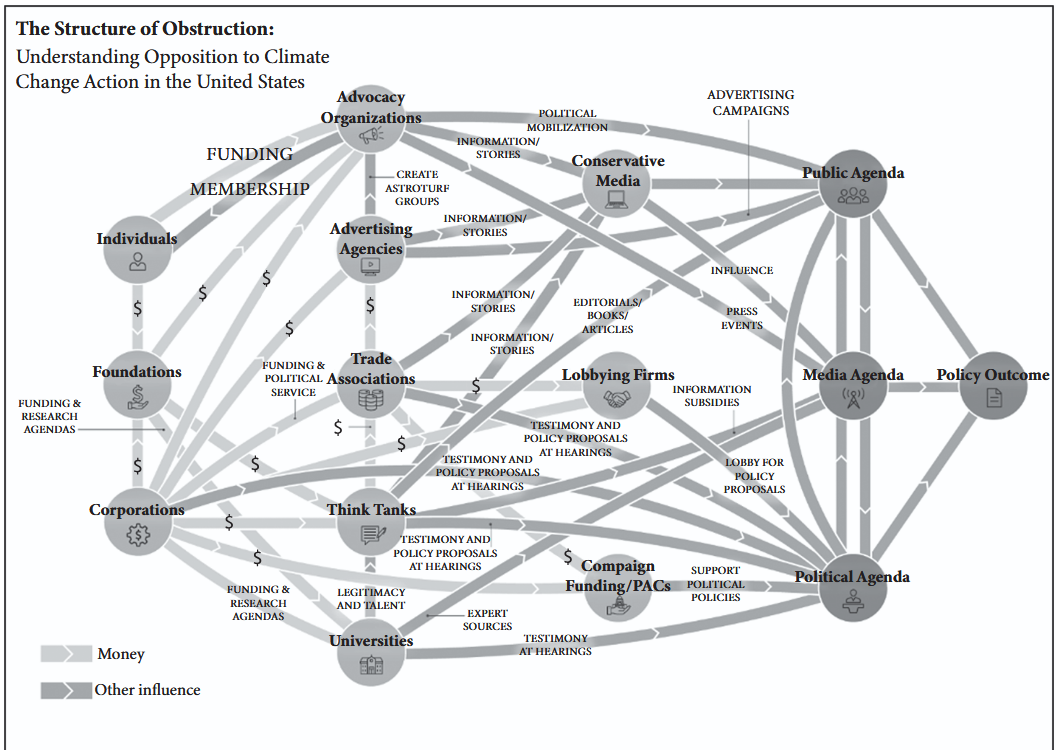
supporting climate obstruction (Figure 1.1). A 2015 series of investigative
pieces by Inside Climate News brought to light the extent to which fossil fuel
giant Exxon knew about the science of climate change in the 1970s and 1980s
but suppressed it and moved aggressively to block climate-related policies.14
More than twenty-five years of scholarly attention, as well as a range of inves-
tigations by civil-society groups, social movements, and journalists, inform
this global assessment, the first attempt to summarize what we know—and
what we still need to find out—about obstruction of climate action around the
world.
The network of organizations and individuals fighting action on climate
change is substantial (for one representation, see Figure 1.1).15 Fossil fuel and
allied corporations and wealthy individuals use various channels to seek and
achieve policy outcomes that favor their fortunes: media ownership and influ-
ence, lobbying firms, campaign donations and organizations, advocacy groups
in national capitals and across countries, trade organizations, think tanks, and
funding funneled to researchers and centers at strategically selected univer-
sities.
This funding flows through family or corporate foundations as well as
through “donor advised funds,” which hide the funders’ identities from public
view. These influence groups target key politicians and other decision-makers
with the goals of instilling doubt about the need to act on climate and creating
uncertainty about the ability of renewable energy and other climate solutions
to meet society’s needs. By raising these doubts, network members hope to
achieve delays in rule-making, weak regulations, and postponement of the
transition away from their products and practices.
...
...
actors. For example, certain companies were aware that climate change existed
and was dangerous—and in some cases even participated in scientific research
on the subject. Yet they chose to challenge the reality of climate change to avoid
regulations that would affect their business operations.
Some obstruction is more consequential than others: not all participants in
climate obstruction are equally responsible for causing global warming. Attri-
bution science is a fast-growing field seeking to document how much of present
and future climate impacts are the result of various actors’ behavior.16 In legal
cases, scientific evidence can provide support for plaintiffs’ damage claims
from those who demonstrably contributed to the harm they experienced.17,18
However, attribution science must wrestle with many issues when determin-
ing what and whom to hold culpable, such as which gasses to count, from
which sources, and during what time frame.19,20,21 Attribution of responsibil-
ity for climate obstruction presents a similar set of nascent questions: How
is responsibility distributed across the known network of climate obstruction
organizations?22,23
To address that complexity, some researchers have proposed four argu-
ments that investor-owned fossil fuel producers have a unique liability for
anthropogenic climate change.24 First, these companies produced a large share
of the products whose use contributed substantially to climate change. Second,
they continued their business operations even after the danger of doing so was
:{scientifically established.
Third, they intend to continue expanding the produc-}:
tion and use of fossil fuels, even now that the science is clear that these fuels
have to be phased out rapidly. Finally, they have done all of this while working
to obstruct action on climate change. So while this assessment widens its lens
to capture the many other actors involved in blocking climate action nation-
ally and globally, we recognize that fossil fuel producers are one of the most
significant generators of climate obstruction.
In each chapter of this volume, the authors describe and analyze the range
of actors involved in climate obstruction and the contexts in which it occurs;
we summarize them in the following ten key findings.
TEN KEY FINDINGS
- Climate obstruction is not just about denial
Since the Paris Agreement in 2015, public denial of the fact that climate change
exists, is human-caused, and is an existential threat has become far less preva-
lent.25 Rather, most actors involved in obstructing climate action today spend
less time on denying the scientific reality of climate change and more time on
creating doubt about the severity of climate change, challenging the viability
of certain climate solutions and policies,26 or “greenwashing” their products
or businesses by claiming that they are sustainable.27 Typologies have been
...
- Big oil is a key player in obstruction, but only one of many
Most of the early literature on climate obstruction focused on the oil and gas
industry and the role corporations such as ExxonMobil, Chevron, Total, and
Shell have played to slow or block action on climate change. But we now have
evidence that as climate science was developing in the 1970s and 1980s, some
major oil companies including Exxon also participated in research efforts that
documented the likely future trajectory of global warming if fossil fuel use
continued unabated.39 Under President Lee Raymond, the company later dis-
continued that research and shifted its position from undertaking to attacking
climate science (Chapter 2).
While the oil and gas industry led the way on climate obstruction,40 this
assessment shows that numerous other industries—coal companies, utilities,
car manufacturers, and meat and dairy producers—joined climate obstruction
efforts or deployed their own. Supply chains (both upstream and downstream)
:{create shared interests among corporations across sectors and industries.41
For}:
example, the aviation, maritime, trucking and railroad industries are all heavy
consumers of oil and gas fuels, and a major part of the latter three industries’
business is transporting their products. Utilities are still dependent mainly
on coal and gas to power their grids; some manufacturing and, increasingly,
computing require high volumes of electricity from these grids (Chapter 3).
The meat and dairy industries have also engaged in climate obstruction; this
sector is uniquely emissions-intensive compared with other agricultural indus-
tries due to methane emissions from livestock and deforestation to feed them
(Chapter 4). It is not only the largest greenhouse gas emitters that obstruct
climate action, but also the businesses in their supply chains.
One manifestation of this interdependency is economy-wide coalitions
of business interests that collectively oppose climate policies. In the United
States, the US Chamber of Commerce and the National Association of Manu-
facturers have a history of pooling resources, sharing information, and under-
taking joint political activities such as lobbying campaigns to block attempts
to legislate a nationwide emissions-trading program.42,43 Business coalitions
such as the European Roundtable of Industrialists (Chapter 3) and the Indone-
sian Chamber of Commerce and Industry (Chapter 8) have also been involved
in weakening or obstructing climate legislation and directives. Industries with...
strong interests in avoiding regulation have often pushed these associations
to extreme anti-climate positions, even when many other member firms might
prefer ambitious climate action.
The preferences, strategies, and tactics of the variety of actors engaged in
climate obstruction are by no means uniform. For example, in the utility indus-
try, while many firms remain dependent on fossil fuels to generate electricity
and therefore tend to oppose climate policies, others hold a more diverse port-
folio of generation assets or purchase most of their electricity from renewable
energy sources, and hence take different positions (Chapters 3 and 9).44,45,46
In US states where utilities are permitted to own electricity-generating power
plants, those utilities are more likely to oppose climate and renewable-energy
legislation than in those where they are not (Chapter 9).47 Among automakers,
there are notable divisions between firms that have embraced manufacturing
electric vehicles and those who continue to focus on producing gas- and diesel-
engine cars; the latter have lobbied heavily against attempts to strengthen
emissions and fuel-efficiency standards (Chapter 3).
- Trade associations are key agents of climate obstruction
Trade associations, which represent entire industries, and business associa-
tions (which represent national or local business interests) allow corporations
to “hide in the crowd” when engaging in obstructive actions; this reduces their
risk of reputational damage (Chapter 3). Firms in the fossil fuel industries
use trade associations as a “command center” for political campaigns to pool
resources and coordinate political activities. The API has been at the forefront
of climate obstruction for decades, coordinating the oil majors’ lobbying and
advertising campaigns and launching front groups such as Energy Citizens,
to delay US efforts to curb the oil and gas industry’s emissions (Chapter 2).
API maintains lobbyists in nearly all states, monitoring legislation and rou-
tinely meeting with members of Congress and state agency officials to oppose
unwanted legislation and programs. The same is true of trade associations
in the transport, utilities, coal, and meat and dairy industries. For example,
the International Air Transport Association (IATA), which represents airlines,
has opposed national climate regulations such as the inclusion of aviation in
emissions-trading schemes and international passenger levies for climate dam-
ages. Similarly, the Federation of Electric Power Companies in Japan continues
to promote coal and downplay the need to transition to renewable energy
(Chapter 3).
In the transport sector, the European Automobile Manufacturers’ Asso-
ciation, the Japanese Automobile Manufacturers Association, and the Fed-
eral Chamber of Automotive Industries in Australia opposed fuel-efficiency
standards and a managed transition off internal-combustion engines. Mean-
while, the automakers were able to present their companies as climate leaders
(Chapters 3 and 13). Agricultural trade associations have also been involved
in climate obstruction: the American Farm Bureau Federation has denied the
science of climate change since the early 1990s, and the National Cattlemen’s
Beef Association has hired university experts to challenge the link between
cattle farming and climate change (Chapter 4). Overall, these are vast organiza-
tions. In the United States, about ninety trade associations working on climate
issues had total revenues of $25.6 billion between 2008 and 2018, with 13%
of that, or $3.4 billion, spent directly on political activities.48
- Networks of think tanks are spreading obstruction globally
A group of think tanks—public policy institutes that perform research and
advocacy—have promoted disinformation and misinformation about climate
science and contested climate policies via reports and presentations to leg-
islatures, news and social media, and other channels.49,50,51 They present
quasi-academic positions while shifting the framing of climate change from
a science-based issue to a matter of individual liberty and economic free-
dom (Chapter 5). They have also funded research reports and conferences to
challenge the IPCC consensus on anthropogenic climate change52 and have
networked transnationally to increase their capacity to promote or disrupt
specific political discourses on the topic.53 Their institutional structure is
shaped by the predominance of men, especially in the case of European think
tanks, illustrating a documented alignment between masculinity and climate
contrarianism.54 There is also a strong convergence between the far-right,
neoliberal thought advanced by these think tanks and resistance to climate
action (Chapter 5).55
Many of the most influential think tanks are based in the United States, but
the dominance of think tanks has spread globally, thanks in part to the Atlas
Network, a global network of such organizations that advocates free-market
(libertarian) and neoliberal policies (Chapter 5). The Heartland Institute in the
United States, the Free Market Foundation in South Africa, and the Global
Warming Policy Foundation in the United Kingdom all have worked to chal-
lenge climate policies and programs (Chapter 5). Similar ideas and practices
have also spread to think tanks in the Global South, such as Andes Libre in Peru
and the Instituto Liberdade in Brazil (Chapter 8). Funding flows around the
world to support these think tanks, which share information, tactics, events,
connections, experts, board memberships, and legal support.56
- PR firms enable corporate efforts to obstruct climate action
Public relations and strategic communications firms help companies and trade
associations conduct their climate obstruction efforts.57,58,59 These companies
and allied firms collect intelligence on opponents (such as environmental non-
governmental organizations, or NGOs), conduct industry-friendly research,
design advertising campaigns, launch front groups, and undertake opinion
polling, among other activities (Chapter 6). In the United States, PR firms such
as Edelman, the DCI Group, and the Hawthorn Group have run campaigns
such as “Advanced Energy for Life” in support of the coal industry (Chapter 3).
In Ireland, the PR firm Red Flag Consulting worked for the meat and dairy
industry to promote positive messages about animal products (Chapter 4).
The growing role of PR firms in blocking climate action has led to their
being named in public-interest lawsuits (Chapter 12),60 being criticized by the
United Nations secretary-general,61 and to the passage of new laws banning
advertisements promoting fossil fuels.62
PR firms’ climate obstruction efforts are facilitated by the characteristics
of the global media system. For example, many media companies rely on an
advertiser-based business model, which includes revenue streams from cor-
:{:{porations that obstruct climate action}: (Chapter 6).
Between 2020 and 2022,}:
Google reportedly received more than $23.7 million from oil majors such
as ExxonMobil and BP to purchase online advertising.63 Meta, the owner of
Facebook and Instagram, permitted fossil fuel companies to purchase mis-
leading advertisements despite the assessments of independent fact-checkers
that the spots were inaccurate (Chapter 6).64 PR firms design and place such
ads for their clients as part of complex information and influence campaigns
:{:{to burnish the companies’ image.65}:
In addition, advertising revenue may}:
also inhibit negative coverage of fossil fuel advertisers. Workers in the PR
industry have begun to organize against these practices, targeting the PR
firms that have run obstructive campaigns for the highest-polluting clients
(Chapters 6 and 13).
- Some governments have taken leading roles in obstructing
climate action
Government interests often align with those of their major industries, includ-
ing fossil fuel–extracting firms, leading governments to take positions to
protect those industries (Chapters 8, 9, and 10). This stance is particularly
obvious in the case of state-owned oil and gas companies and when national
and local governments are heavily dependent upon one main polluting indus-
:{:{try as an income source.}:
Petro-state Saudi Arabia’s obstruction of climate}:
action at the UN climate negotiations over the last two decades is a clear
example (Chapter 10) but hardly unique: more than two dozen countries have
included oil- industry employees in their official delegations to the UNFCCC,
and others allow the industry to influence their national negotiating posi-
tions (Chapter 10). Many of these governments also seek to support their
fossil fuel industries by using public finance to secure export markets. For
example, China and Japan have promoted coal-fired power throughout Eurasia
by providing public subsidies to countries that import their technology, such
as Indonesia, India, and Vietnam (Chapter 8); they have a history of deflecting
criticism of such investments at the UN meetings
...
In addition, agribusiness and the meat-production industry in Brazil have
built strong political connections with government agencies at federal and
state levels (Chapters 4 and 8). In South Africa, coal mining is the historical
backbone of that nation’s economy and social order; in the case of some devel-
oped countries (e.g., the Netherlands) and developing ones, such as Venezuela,
Iran, and Mexico, the key industry is oil (Chapter 8). Therefore, a just tran-
sition away from fossil fuels will require rethinking the central role of the
state in promoting new development models and creating the means to make
these new models socially and environmentally sustainable in an era of climate
change.
Governments in heavily industrialized countries with more diverse
economies have also persistently taken obstructive action on climate. The
United States, for example, supported and then withdrew from the Paris
Agreement, again creating political whiplash in the global effort to address
climate change. While numerous governments have obstructed action in
the UN negotiations at one time or another, such moves have typically
:{received limited attention despite their substantial implications.
For example,}:
at COP 27 in 2022, New Zealand sought to weaken methane accounting rules
(Chapter 4); Uruguay has aligned with Argentina and Brazil (the ABU Coali-
tion) when its livestock interests were at stake. Understanding and overcoming
climate obstruction thus requires attention to national political economies,
and those are often built on local ones: subnational provinces and states
that are heavily dependent on fossil fuel extraction often seek to under-
mine national climate policy, as in the case of Canada and the United States
(Chapter 9).
- Obstruction occurs within multilateral governance structures
The UNFCCC and the IPCC are global institutions that play key roles in
establishing priorities on the climate agenda by organizing major interna-
tional conferences at which multinational negotiations take place and by
highlighting areas for future action by governments, corporations, and soci-
eties. They are also arenas for establishing and enforcing norms and values
such as, for example, climate justice, fair governance, and suitable finance,
but they have been unable to respond rapidly and effectively to the climate
:{emergency (Chapter 10).66,67
Currently, national sovereignty (often defined}:
in opposition to responsibility) is the bedrock of the UN system, and thus
global governance institutions lack adequate enforcement and compliance
mechanisms. Similarly, international development banks and wealthy “donor
nations” inside and outside the UN system have failed to assist lesser devel-
oped countries with climate change adaptation (Chapter 11). World mar-
itime and aviation governance institutions face many of the same issues
(Chapter 3)
Multilateral forums’ tendency to slow and obstruct climate action make
them an easy target for polluting companies and trade organizations and allow
these groups to play a double-game. They can point to a lack of international
action as a reason for slowing action in their own countries. At the same time,
the fossil fuel industry, nation-states, and other economic actors employ a vari-
ety of diplomatic, procedural, and substantial strategies to obstruct progress in
international venues. They have secured a lack of political will to exclude the oil
industry, agribusiness, and other obstructionist actors from participating in
UN decision-making, a change some campaigning groups have unsuccessfully
advocated (Chapter 10).68
- National and local contexts shape obstruction, particularly
in the Global South
Climate obstruction looks different depending on national and local contexts.
Consider the Global South, which encompasses a group of more than 130 coun-
tries outside the core of the global economy, with different trajectories in social
and state formation and economic and social development (Chapter 8)69,70,71.
The Global South’s greenhouse gas emissions are also heavily concentrated:
India and China alone account for some 60% of the region’s emissions, while
120 other Global South countries account for only 22%.72
Leaders from the Global South have argued that the Global North—due
to its historical responsibility for causing the most emissions—must be more
proactive in supporting developing countries in dealing with climate change.
Delivering the financing required to decarbonize and adapt to climate change
in the Global South is a topic still being negotiated and obstructed within
the UNFCCC (Chapter 10).73 But the Global South can also be an agent of
climate obstruction. Political representatives from the Global South often
use development priorities as a reason to sideline decarbonization goals, fre-
quently claiming that they have a “right to pollute” as part of their “right to
development,” and failing to question their own development models or to
consider helping the most vulnerable groups in their countries (Chapter 8).
Moreover, dominant ideologies can also feed into overt and extreme cli-
mate obstruction efforts, including religious influence in government and/or
right-wing legacies—be they neoliberalism, conservatism, or farther right.
Such trends can be seen in Brazil under former president Jair Bolsonaro, the
United States under President Donald Trump, Hungary under Prime Minis-
ter Viktor Orban, or Argentina under President Javier Milei (Chapters 5, 7,
and 8).74
The configuration of organized interests engaged in climate politics shapes
how obstruction occurs not just at the national level but also the local,
subnational, and international levels. For example, studies have shown that
distributive conflicts among energy interests, such as between coal and
gas, are vital to explaining climate policy outcomes.75,76,77,78 How those
industries are structured can also shape how obstruction unfolds. For example,
in the United States, many utilities hold a monopoly on providing electric-
ity to the city or region in which they are based; therefore, ratepayers may
unwittingly be funding the industry’s lobbying and advertising efforts to delay
and block climate policies (Chapters 3 and 9). Similarly, in countries where
media industries are highly concentrated, with a few firms or families owning
the majority of news outlets, collective goals including climate action can be
undermined (Chapter 6).
- Obstruction starts at the top but requires social acceptance
As noted earlier, industries such as oil, gas, and coal, utilities, car manufactur-
ing, and meat and dairy production—as well as their trade associations and PR
firms—fund and implement climate obstruction from the top down. However,
for those efforts to be effective, their rhetoric must be accepted and adopted by
the media, political parties, politicians, and individual citizens. For example,
a study of more than 1,700 press releases about climate change found that
US newspapers covered messages from business coalitions and trade associa-
tions that opposed climate policy at double the rate they covered pro-climate
:{:{policy positions from other types of organization}:s (Chapters 6 and 7).79
In}:
addition, most media platforms have few, if any, effective policies in place to
prevent the spread of climate misinformation (Chapter 6). Obstructive forces
have been able to use social media to exponentially speed the spread of such
misinformation among the public.
Individuals are constantly exposed to climate obstruction content from a
variety of outlets. Scholars have identified the major categories of anti-climate
claims: (1) global warming isn’t real, (2) it isn’t human-caused, (3) climate
impacts aren’t bad, (4) climate solutions won’t work, and (5) experts are
unreliable (Chapter 7). More recently, studies show, attacks on the scien-
tists themselves and on renewable energy and other climate solutions have replaced the first three claims.80
Whether people are more or less receptive}:
to such rhetoric depends on various social and psychological factors.81 For
example, early research in this area documented how industrial companies targeted Republicans with influence campaigns that helped make climate change
a polarized issue in the United States (Chapter 6).82,83,84 Addressing such climate change misinformation requires systemic changes that make it more
difficult for misinformation to spread and that will ensure individuals are able
to discern misinformation from fact.
- There are efforts to address climate obstruction through regulation,
litigation, and social movements
Some countries and communities are working to address climate obstruc-
tion in formal and informal ways. Options have included direct governmen
regulation and legislation, which attempt to restrict net-zero claims and
pledges made by corporations and financial firms, limit corporate influence
over climate policy, and prohibit greenwashing. To do so, governments have
used a variety of tools including shaming tactics and other forms of man-
dated disclosure (Chapter 12). They can also limit or prohibit the “revolving
door” through which industries co-opt regulators by hiring them, restrict lob-
byists’ access to key staff and legislators, and limit company or large-donor
contributions to political campaigns (Chapter 12).
About 1,500 climate-related lawsuits have been filed around the world; a
subset of these suits target climate obstruction, in particular the historical
and continuing deception of consumers (Chapter 12). The plaintiffs include
individuals (grandmothers in Switzerland, teenagers in Oregon, Indigenous
and quilombola groups in Brazil, and many others), subnational actors includ-
ing city and state governments, federal justices, and major climate organi-
:{:{zations.}:
Lawsuits targeting climate obstruction have been brought against}:
:{:{fossil fuel producers, including Exxon, Shell, BP, Peabody, and Total, but haverecently expanded to other firms.}:
Lawsuits have implicated trade associations,}:
such as the API (Chapter 12) and consulting firms, such as McKinsey & Company, which an Oregon municipality sued along with fossil fuel company tradegroups.
Lawsuits have also expanded beyond fossil fuel related cases. In 2021,
for example, three NGOs won the first climate lawsuit in Denmark against
the meat producer Danish Crown, which had claimed that its pork was
“climate friendly.”85 In 2024, the New York State attorney general filed
a lawsuit against beef producer JBS USA Food Co., alleging the com-
pany had misled consumers about its net-zero commitments (Chapters 4
and 12).
In the Global South, Brazil has one of the highest numbers of climate
cases, including 2023 litigation in which the federal environmental protection
agency, IBAMA, sued agribusiness leader Dirceu Kruger for climate damage
caused by illegal deforestation in the Amazon.86
Climate-focused NGOs are finding ways to challenge obstruction. These
efforts include social exposure (or “naming and shaming”) to shower nega-
tive publicity on obstruction activities, lobbying to advocate prevention of
obstruction, and campaigns and protests that mobilize citizens concerned
about blatant climate obstruction and deception. For example, BankTrack.org
monitors the financial activities of private-sector commercial banks around
the globe and feeds this information to campaigners who name and shame
banks in hope of strengthening their policies on investments that affect the
climate (Chapter 13). The record of wins from regulatory, litigative, protest,
and shaming campaigns against obstruction is still modest, but may be aided
by the broadening understanding of the problem and growing efforts to
address disinformation.
...
Journalists
Journalists, like NGOs, have played a significant role in exposing climate
obstruction and debunking misinformation. For example, investigative outlets
such as Inside Climate News and DeSmog have helped to expose misinformation
and obstruction campaigns in the oil, gas, and coal industries, among many
others. Their work has included revealing the role that “influencers” hired by
PR firms play to promote their oil and gas clients (Chapter 6). Other news orga-
nizations, such as The Guardian, have run series examining the political tactics
of fossil fuel corporations (from whom they have stopped accepting advertis-
:{ing; Chapter 13).
Early efforts by journalists to expose climate obstruction have}:
developed into coordinated actions to fight its spread. Groups such as Climate
Feedback, comprising science journalists, have emerged to fact-check climate
news stories and help readers evaluate the sources of these stories (Chapter 6).
As discussed, debunking misleading claims in this way is considered vital to
inoculating the public and making climate misinformation harder to spread.
Scholars
Academics, including scientists, also aid the efforts of policymakers, NGOs,
and journalists to expose and counter climate obstruction, and the results have
prompted legislative investigations, legal proceedings, newspaper reports, and
social media campaigns. CSSN,91 which includes 800 scholars worldwide,
encourages peer-reviewed research into obstruction. Some academics work
closely with journalists from organizations such as Climate Feedback to expose
and debunk misinformation. University researchers have also participated in
institutional campaigns to convince universities to disclose funding from the
fossil fuel industry, and more recently to “disassociate” from firms and indus-
tries that advance climate misinformation.92 While many of these campaigns
have been led by students, professors have also pressured their home institu-
tions to act. For example, campaigns by faculty at Brown University and the
University of California, San Diego in the United States and the University
Cambridge in the United Kingdom, among others, have sought to dissuade the
schools from engaging with companies that promote climate disinformation
by, for example, refusing their research funding (Chapter 13).
Students
Campuses around the world now face growing pressure to mitigate the risks
from taking industry funding, including its influence over research agendas
...
C H A P T E R 2
The Global Role of the Oil and Gas
Industry in Climate Delay and Denial
LE AD AUTHORS: GEOFF DEMBICKI, KRISTOFFER EKBERG,
AND KERT DAVIES
CONTRIBUTING AUTHORS: ANN-KRISTIN BERGQUIST,
ADA NISSEN, AND STELL A LEVANTESI
INTRODUCTION: THE NET-ZERO OBSTRUCTION ERA
In the years leading up to and following the signing of the 2015 Paris Accords,
something significant changed within the oil and gas sector—at least, on the
surface. One major company after another began declaring themselves climate
leaders and loudly announcing net-zero targets, a process by which their vast
greenhouse gas (GHG) output would either be reduced to zero or neutralized
through reductions elsewhere. Companies had for years tried to “greenwash”
their images, but this was of another magnitude entirely. “The world’s carbon
budget is finite and running out fast; we need a rapid transition to net zero,”
declared BP’s CEO Bernard Looney in 2020, promising that the UK oil and
gas giant would become a net zero company within three decades. “This will
certainly be a challenge, but also a tremendous opportunity.”1
Similar state-
ments emerged from oil companies across the world, from Royal Dutch Shell
and Canada’s Suncor to Chevron and Saudi Aramco.2
We now know, due to the 2024 release of thousands of internal oil and
gas company documents obtained through a joint investigation by Democrats
in the US House and Senate, that these pledges were more about prolonging
the survival of fossil fuel production than fundamentally shifting the indus-
try’s business model. In private corporate communications, top oil and gas
executives appeared to state this explicitly. Supporting the goals of the Paris
Agreement, as well as US involvement in it, was “the most obvious course of
...
Building on a previous meta-analysis of industry communication,10 we
characterize obstruction by three distinct but interconnected tactics. The first
is denial, or emphasizing scientific uncertainty. Denial occurs when the indus-
try publicly questions the research of climate scientists and the work of the
Intergovernmental Panel on Climate Change (IPCC) in order to hinder a tran-
:{:{sition.}:
The second tactic, delay, or the use of socioeconomic arguments to}:
stall regulations, is a strategy that emerged in tandem with the creation of
think tanks and the rise of neoliberal hegemony since the 1970s. Here, indus-
try lobbies against regulations and legislation by appealing to perceived costs
for society or citizens at large. The third tactic is industry co-optation of the
public policy process, or appearing to take the climate crisis seriously while
intervening in governing bodies to weaken, neutralize, or undermine potential
policy and technological solutions. Much literature assumes a chronological
evolution of these tactics moving from denial toward the others. While the
intensity with which specific arguments and tactics have been used certainly
:{:{has changed over time, this does not mean that efforts to delay and co-optthe policy arena are exclusive to the post-Paris period.}:
Rather, our focus on}:
the longer history of obstruction in this chapter demonstrates how all three
tactics—denial, delay, and co-optation—have been used by the oil and gas
industry throughout decades of environmental and climate governance.
The Oil and Gas Industry
The combustion of oil and gas is one of the most consequential contribu-
tors to climate change. But it is important to acknowledge that these fossil
fuels are very different from other polluting and hazardous substances such as
F-gases, asbestos, or lead. The existing global economic order has for more
than a century been built on the inexpensive and powerful energy provided
by oil and gas. The industry has also created energy path-dependencies—
examples include car-dependent urban design and national highway systems,
which disadvantage environmentally safer alternatives.11 This is not merely a
technological dilemma. The development of fossil fuels has shaped global capi-
talism, democracy, and modernity, and has been the cause of colonization, war
:{:{and international power struggles.12}:
Oil and gas industry leaders and political}:
supporters often argue that without continually expanding global production,
the developed world would neither be able to maintain current living standards
nor economic growth and stability.13
Despite the oil and gas industry’s vast global reach and influence, it is domi-
nated by a relatively small handful of private firms (investor-owned companies,
or IOCs) and state-owned companies (nationally owned companies, or NOCs).
These companies in turn are responsible for a large majority of the green-
house gas emissions released by humankind over the past century and a half.
...
OBSTRUCTION STRATEGIES
The oil and gas industry has deployed three distinct but interlocked
obstruction tactics: undermining or denying the growing scientific consen-
sus on the urgency and dangers of climate change; utilizing socioeconomic
scare tactics to delay action by governments; and co-opting or trying to
shape the environmental discourse and policies on terms favorable to the
industry.
Science Denial: Amplifying Uncertainty to Delay Policy
In the early years of the climate policy debate, which we define roughly as the
late 1980s through the early 2000s, the lead obstruction tactic deployed by
fossil fuel corporate interests was to downplay or deny the scientific consen-
:{:{sus, casting doubt in order to forestall action in the policy arena.}:
This tactic}:
continues intermittently in various forms to this day.
One recent example took place during the international climate negotia-
tions in Dubai in 2023, when COP28 president Sultan Al Jaber stated during
a panel discussion that there is “no science” supporting the idea that phasing
out fossil fuels is essential for restricting global warming to 1.5 degrees C, the
level agreed by scientists is a dangerous threshold. Al Jaber, who at the time
was also the chief executive of the United Arab Emirates’ state oil company,
Adnoc, faced backlash for the statement, which one scientist called “verging
on climate denial.”28 A large body of scientific literature—including a land-
mark 2021 report from the International Energy Agency29—has demonstrated
that managing a rapid decline of fossil fuel production is crucial for stabilizing
global temperatures.30
While Al Jaber’s comments were widely publicized and debated, denial
about the required pace of transition off of fossil fuels is so commonplace
within the oil and gas industry that it is often ignored. During the Dubai talks,
IPCC chair and former professor of energy Jim Skea noted that while a full
phaseout of oil and gas might not be required to achieve 1.5 degrees C, global
oil use by 2050 needs to be reduced by 60% and gas use must fall by 45%.31
Yet when researchers compared the production output of 142 coal, oil, and gas
companies against necessary fossil fuel reductions, they determined that from
2014 to 2020, 63% of the oil companies and 70% of the gas companies in their
study exceeded the production limits required for global temperature stabi-
lization. If the companies continued producing at these levels, the oil industry
would overshoot its cumulative production budget by 42% by 2050, while the
gas industry would overshoot its budget by 53%, vastly increasing the likeli-
hood that humankind would fail to meet the Paris climate targets.32 A 2011
study showed that keeping the Earth’s carbon budget within safe limits wou
...
CONCLUSION
On the surface it may seem like we are in a different era for climate action
following the Paris Agreement. Most major oil companies across the planet
now loudly tout their ambition of helping the world achieve net-zero emis-
sions by 2050, a requirement for avoiding global catastrophe. Yet the transi-
tionary rhetoric from oil companies is not matched by the necessary actions.
While companies have developed and touted projects to develop renew-
ables or address environmental pollution,126 the results have been marginal.
The ultimate impact of these activities has been to legitimize oil and gas
operations as well as keeping open the possibility for continued extrac-
tion.127 Production of the fuels at the center of our climate crisis continues
to rise.
The current net-zero pledges and solutions put forward by industry are the
latest phase in a process of climate obstruction going back at least to the 1970s.
During those decades, the oil and gas industry’s tactics have shifted depend-
ing on the political and economic context. The industry has alternately pushed
denial of the basic science on climate change, used economic scare tactics to
justify aggressive lobbying against solutions, and attempted to co-opt the pol-
icymaking process on terms favorable to its business model. Though each of
these tactics has risen and fallen in prominence at various times, we argue that
all three are currently in play.
While outright science denial from oil and gas companies has subsided since
its peak in the 1990s, it has since 2015 morphed into a subtler and less public
form of denial through fossil fuel expansion plans that seemingly ignore the
increasingly dire warnings of climate breakdown.
As we have shown, companies are ignoring and/or obstructing global efforts
to curb emissions to match the goal of the IPCC guidance defining 1.5 degrees
C of average warming as “dangerous” climate change. Similarly, the oil and gas
industry continues to frame climate action as destructive to the economy and
people’s livelihoods in its attack on national legislation in the US and European
Union. All the while, producers push false solutions such as carbon capture and
natural gas that merely prolong our reliance on fossil fuels.
Even though oil and gas producers are currently portraying themselves
as climate leaders, they could shift to cruder or more aggressive obstruction
tactics as the need arises. Companies, for example, may return to explicitly
backing and funding populist social movements questioning strong climate
action—a topic for future research to track. If far-right and authoritarian politics continue to gain hold, this trend may herald a new form of denial and
obstruction that is not passive or opaque but blatantly refuses to comply with
the scientific warnings about climate change.128 A potential return to more
overt anti-science politics and the impacts it could have on the oil and gas
industry’s tactics and rhetoric, could be a valuable research area
---
CH5 RGT AND FAR RT
...into a global network of think tanks.25 Several Mises Institutes in different
countries have been active in the Atlas network; according to the results of two
global surveys of both networks, about one-quarter of the individuals affiliated
with Mises Institutes are also affiliated with Atlas think tanks.26
In turn, leading intellectuals involved in Mises Institutes around the world,
including economist Hans Hermann Hoppe, founded the Property and Free-
dom Society. The Society advocates a new version of far-right neoliberalism
that opposes almost any state interventionism and supports radical privatiza-
tion and decentralization. The group’s rejection of global policy coordination
under the umbrella of the United Nations is similar to that of the anti-systemic
far right. Property and Freedom split away from the Mont Pèlerin Society in
2004; the latter supports both culturally progressive and conservative varieties
of neoliberalism and, in the context of climate change, is home to supporters
of global economic constitutionalism and both supporters and opponents of
international policy coordination.27
Discourses of Delay
Beyond their free-market rhetoric, a wide range of think tanks has developed
other discourses of climate delay,28 including promoting nontransformative
solutions and advocating limited responsibility for addressing climate change.
These strategies include the growing emphasis on achieving net-zero emis-
sions, a focus on carbon sequestration rather than de-carbonization, and an
emphasis on “discounting” in economic models (which asserts that mitigation
can wait because it will be less expensive in the future). These delay-focused
forms of discursive obstruction have not only been integrated across the
political and corporate policy spheres, but also accepted in the public mind.29
These narratives have been echoed by individual members of these think
tanks, who spread these ideologically supported positions on climate change
:{:{via public-facing media appearances.30}:
Murdoch media regularly feature con-}:
tent from both free-market conservative and hard-right climate denialist think
tanks, companies, and funders in North America, particularly those based in
the United States31 (e.g., the Heartland Institute). They also spotlight speak-
ers and content from think tanks based in Canada (Frontier Centre for Public
Policy), Australia (Institute of Public Affairs, Centre for Independent Studies),
Europe (Institute of Economic Affairs, the Austrian Economics Center), and
South Africa (Free Market Foundation, South African Institute of Race Rela-
tions), for example. Consequently, partisan think tanks have ultimately been
able to guide “public opinion, political debate, economic discourse and even
academic discussions on climate change mitigation” in several countries and
policy arenas.32
Financial Linkages
Scholarly research on the relationship between conservative foundations and
climate obstruction began with a seminal quantitative 2014 analysis of the
US Climate Change Countermovement (CCCM).33 The CCCM is a network of
organizations (including think tanks), individuals, and activities dedicated to
preventing ambitious climate policy. Since then, research on philanthropic
financial support within the political economy of climate obstruction has
revealed three themes.
The first theme is opacity: reliable data on foundation support are difficult
to obtain. When such data are gathered, it can be difficult to discern the intent
and influence of this type of financial support. For example, 74% of dona-
tions made through donor-advised funds come from unidentified sources.34
To learn more about funding patterns, it can be helpful to trace funding flows
and board membership. The Dunn Foundation, for example, has funded sev-
eral think tanks involved in climate denial, including the Heartland Institute
and the Cato Institute. Between 2002 and 2017, the latter received more than
$7 million from the Dunn Foundation;35 a foundation member also serves on
Cato’s supervisory board.
While some such think tanks in the United States reportedly benefit from
untraceable contributions from conservative family donations and the liber-
tarian/conservative Donors’ Trust,36 others lack even limited transparency
:{:{when it comes to their funding sources.}::{ }:
Recent research has documented the}:
funding patterns established by brothers Charles and David Koch of corporate
giant Koch Industries, who discreetly fund the climate change countermove-
ment by directing money through their family foundations (the Charles Koch
Foundation and the David H. Koch Charitable Foundation). The beneficiaries
are a network of conservative think tanks and advocacy groups that actively
promote climate change skepticism and oppose environmental regulations,
often funneling the funds through “dark money” organizations such as Donors
Trust to obscure the source of these donations. (This network is sometimes
referred to as the “Kochtopus” due to its extensive reach and influence.)37
The second theme is concentration. Despite the fact that many contribu-
tions to obstructionist think tanks and civil society groups are made anony-
mously, research has found that a small group of foundations tends to provide
the bulk of financial support for organizations involved in climate obstruc-
tion efforts:38 “The top 1% of grant makers account for 67% of grants, and
the top 10% of grant makers account for 95% of grants.”39 In Europe, the
number of foundations involved in promoting and/or funding climate change
denial is smaller than in the United States. To compare the two regions, one
can examine the foundations supporting think tanks that are partners of the
global Atlas Network. Many Atlas think tanks are involved in climate denial
and other forms of obstruction, as discussed earlier. While there is no infor-
mation on foundation funding in Europe comparable to that available in the
United States, a recent survey found forty-eight foundation representatives on
the boards of Atlas think tanks in Europe, compared with almost three hun-
dred individuals representing more than two hundred foundations who served
on the boards of Atlas think tanks in the United States.40
A few European
foundations in the survey sample are notable for funding Climate Counter-
movement organizations in Latin America, including the Fundación para el
Análisis y los Estudios Sociales in Spain, and the Friedrich Naumann Founda-
tion, for example, funds them in Germany. Both European foundations fund
Latin American think tanks. The European arm of the Atlas Network, the Inter-
national Policy Network, was involved in channeling US funding to European
denial organizations.41
The third theme is heterogeneity. Scholars have noted the variety of the cli-
mate obstruction actors funded. Foundation support flows to many different
organizations, with varied levels of focus on climate change; thus, scholars face
a challenge in isolating the impact of these flows on climate obstruction when
it is one among many issues of concern within the neoliberal and conservative
movement.42
Cultural Linkages: The Role of Religion
Many major religions embrace ambitious environmental action and endorse
climate mitigation, out of concern over, for example, protecting God’s cre-
ation. There are also some religious linkages to climate obstruction, especially
among rank-and-file adherents whose traditions are more closely aligned with
right-wing politics.43 In the United States and Australia, for example, reli-
giosity has been found to be a key factor in the popularization of climate
science skepticism.44,45 Research on spirituality on the Netherlands has mir-
rored American patterns.46 Other types of religious organization have been
involved in climate obstruction, notably the US-based Cornwall Alliance for the
Stewardship of Creation.
Its founder, E. Calvin Beisner of the Catholic Acton
Institute, described the group as a “network of evangelical theologians, sci-
entists, and economists.”47 Its activities have included organizing a seminar in
Rome with the Acton and Heartland institutes to mobilize against the language
of “environmental crisis” in Pope Francis’s encyclical Laudato Si.48
Like the Cornwall Alliance’s, many of the best-studied Catholic denial-
ist activities have been traced to the United States. Their main themes are
reflected in the prominent blog and forum Catholic Answers: climate change
is natural, not anthropogenic; anthropogenic climate change is “prudential
judgment” (i.e., belonging to the scientific sphere, which is not infallible); cli-
mate concern reflects pantheism and neopaganism; support for subsidiarity
... RUSSIA ROMANIA
, and economists.”47 Its activities have included organizing a seminar in
Rome with the Acton and Heartland institutes to mobilize against the language
of “environmental crisis” in Pope Francis’s encyclical Laudato Si.48
Like the Cornwall Alliance’s, many of the best-studied Catholic denial-
ist activities have been traced to the United States. Their main themes are
reflected in the prominent blog and forum Catholic Answers: climate change
is natural, not anthropogenic; anthropogenic climate change is “prudential
judgment” (i.e., belonging to the scientific sphere, which is not infallible); cli-
mate concern reflects pantheism and neopaganism; support for subsidiarity
... RUSSIA ROMANIA
...
are then translated into Romanian and published on right-wing Orthodox
websites such as Cuvˆantul Ortodox and those mentioned earlier.55 They also
quote renegade scientists such as climate change–denying physicists John
Clauser and Victor Manuel Velasco.56 Such views occasionally find an echo even
within the Church hierarchy. For example, in a pastoral letter from 2022, one
Romanian bishop stated that “planned pandemics” and “exaggerated climate
obsessions” are both instruments of “the great reset.”57
Latin America
In Latin America, research on religion and climate change is still in its early
stages. There currently exist no comprehensive studies on the transnational
dimensions of climate denialism among right-wing religious groups in Latin
America. A few studies focus on local networks of religious climate denialism
in Brazil and these groups’ relationships with the government of Jair Bol-
sonaro, which utilized climate denialism to foster a populist ideology.58
Much
of this work tends to focus on the linkages between recent conservative polit-
ical movements and the rise of Pentecostal and neo-Pentecostal evangelical
movements.59 In Brazil, for example, the Bolsonarist right-wing movement
is supported politically and financially by a conservative network including
many Pentecostal evangelicals (a sector that has grown dramatically since the
1990s and today represents around 37% of the population). But the “strategic
role of climate denialism” in “blocking processes of environmental governmentalization in Brazil”60 has also involved the publication and distribution of
translated books by small Catholic publishers with ties to agribusiness.61
Individual government members, such as former Foreign Minister Ernesto Araújo,
have used religion to deny climate change.62 Both Pentecostal and Catholic
groups have reinforced the broader climate countermovement in Brazil; for
example, the government refused to host COP 26, the annual international
UN climate conference, and withdrew key decision-making power from the
country’s environmental and climate governance institutions.63
The ideology behind such right-wing religious obstructionism in Latin
America lies at the intersection of markets and nature, postulating that “God
is in control,” meaning environmental issues should not be a concern for
Christians because the Earth’s fate is predetermined. Furthermore, the free
market is seen as a channel allowing people to “wisely use” nature, which in
its undeveloped state is considered savage. The denial discourses of Brazil’s
religious obstructionists thus differ only slightly from those in the United
States and Europe. However, the former is characterized by a stronger focus
on discrediting IPCC research and promoting the idea that environmen-
talism is a communist conspiracy that aims to destroy Western Christian
civilization.6
...
the United States since the 1990s, research shows that the mainstream Repub-
lican Party has continually sowed climate skepticism in order to maintain a
free-market status quo.68 In contrast, the far-right or “alt-right” movement
sees “the anti-environmentalism of the present conservative movement as
nothing but a modernist, capitalist . . . [and] Jewish conception that has found
fertile ground in the hands of billionaire plutocrats wiping out nature all over
the Earth for the sake of higher profit margins.”69
In the United States, the mainstream right consistently supports inter-
national cooperation in military, corporate, and humanitarian affairs, with
the exception of climate change. The European spectrum of conservative and
right-wing parties tends to be more diverse, but center-right parties typically
embrace international climate cooperation whereas Europe’s revolutionary far
right sees increased international cooperation negatively, advocating instead
for a disintegration of global solidarity.
Multiculturalism and Ethnopluralism
The revolutionary far right envisions a world grounded in “ethnopluralism,” in
which distinct racial or ethnic groups live in separate regions, preserving their
unique identities and rejecting global community connectivity.70 The slogan
of Arktos Media, “Making anti-globalism global since 2009,” succinctly cap-
tures how the revolutionary far right today expands on the idea of ethnically
homogeneous nations, as seen in contemporary movements such as Indian
Hindutva and Japanese Shinto nationalism. Arktos is known for distribut-
ing the work of figures in the global far-right movement and has published
books by the prominent American alt-right figure Richard Spencer, the Rus-
sian ultra-nationalist Aleksandr Dugin, Alain de Benoist of the French New
Right, and Brazilian right-wing philosopher Olavo de Carvalho.71 The rela-
tionship between these revolutionary far-right actors and climate obstruction
should thus be thought of as a rejection of the terms of the debate: the global
cannot exist.
The authors of the revolutionary far right are united in their critique
of what they see as an increasingly “multicultural” world, one where ethnic
and national distinctions have become less clear-cut. Eschewing a class-based
critique—which for many in the farthest reaches is seen as Marxist ideology
invented to sever people from their natural ethnic consciousness—the revo-
lutionary far right turns to cultural explanations for what they see as a trend
toward an indistinguishable and homogenous global community.72
For many global far-right movements, the supposed threat of a multicul-
turalist global community is often argued against using some variation on
the “Great Replacement Theory,” the belief that there is a deliberate effort by
obscure global elites, often imagined as Jewish and referred to as a “cabal,” tO
replace white populations in Western countries with non-white and/or immi-
grant populations. Today, a wide range of multisectoral actors—from Fox
News in the United States to the AfD party in Germany—have propagated
this belief.73 In recent years the revolutionary far right has linked the imag-
ined set of “Great Replacement” actors and relationships with climate change,
considering it to be one of the many artificial panics and false flags allegedly
precipitated by elites. In other words, the charge is no longer that science isn’t
right, but that climate change itself is part of a conspiracy. Additionally, the
basic logic of replacement has found resonance beyond Western contexts. Sim-
ilar narratives have surfaced within the right-wing Rashtriya Swayamsevak
Sangh (RSS), based in India, for example.74
Extremist Goals
Beyond advancing replacement theories, the broad global swath of far-right
actors exhibits varying responses to anthropogenic climate change. One such
approach is “accelerationism,” a radical theory of change advocating the delib-
erate intensification of forces that will destabilize existing systems and pre-
cipitate societal collapse, thereby hastening social transformation in line with
accelerationists’ own ideology and vision of society.75 Accelerationism is a
strategy adopted by radicals on both the left and right. Far-right and neo-
fascist accelerationists view climate collapse—ideally, cultural collapse—as a
means of transformation facilitating a return to traditional, often authori-
tarian, social structures. For example, a section of the manifesto released by
a mass shooter in an attack on two mosques in Christchurch, New Zealand
in 2019 is titled “Destabilization and Accelerationism: Tactics for Victory.”
It
attempts to justify the murder of fifty-one people as part of a strategy to trigger
broader conflicts and speed change. Similarly, a recent study from West Point’s
Combating Terrorism Center notes that multinational neo-Nazi groups like
The Base and Atomwaffen employ accelerationist strategies using extreme vio-
lence with the aim of destabilizing and toppling the US federal government.76
Extremist groups have always exploited vulnerabilities to shape grievance
narratives, but recent research suggests that climate crises (and local gov-
ernmental responses) provide new avenues for extremist exploitation. For
example, a recent study on climate-induced violent extremism in North Africa
found that
violent extremist (VE) groups such as Boko Haram and the Islamic State exploit
crises and conflicts resulting from environmental stress to recruit more followers,
expand their influence and even gain territorial control. In such cases, climate
change may be described as a ‘risk multiplier’ that exacerbates a number of conflict
drivers.7
These extreme perspectives thus diverge ideologically from climate obstruction
as it is typically understood on the mainstream right, which often employs it to
maintain the status quo, especially with regard to the regulatory environment.
Instead, the revolutionary far right has begun to integrate climate change into
a broader political ideology aimed at promoting far-right ecologies.
For the revolutionary far right, the problem lies not with climate science
but with its practical consequence: the need for more coordination between
multinational corporate capital and international policymakers.
In their logic,
the existing resource extraction and distribution networks of global capital-
ism will lead to a dystopia that will destroy all local ethnic connections to land
(“blood and soil”) and usher in a New World Order in which sovereign nations
are replaced with a totalitarian global government. In addition to examining
nonstate extremist actors, such as those involved in the Christchurch attack
and a similar 2019 race-based massacre in El Paso, Texas, research has also
examined far-right policy platforms related to climate change.78
Perhaps the
most famous example is the rise of “blood and soil” nationalist identities, such
as in Nazi Germany, which used the Reich Ministry of Food and Agriculture to
anchor an extremist ideology in agrarian connections to nature, place, and the
environment. Today, the link between the environment, climate, and nation-
alism still figures heavily in the rhetoric of French politician Marine Le Pen’s
Le Front National (FN), especially its emphasis on preserving environmental
heritage, or “patriotic ecology,” which it frames as a holistic approach to halt-
ing the collapse of the French way of life. In a 2022 debate, Le Pen emphasized
the urgency of environmental concerns, criticizing globalization for its detri-
mental impact on the planet and animal welfare and advocating “localism” and
“economic patriotism” to enhance the production and consumption of French
products.
Strategies and Tactics
An important distinction between mainstream right-wing social forces and
revolutionary far-right movements lies in their political strategy and tac-
tics. Whereas mainstream right-wing groups engage directly in policy pro-
cesses to obstruct climate action, revolutionary far-right movements are often
relegated to “metapolitical” strategies, leveraging online platforms, “news”
stations, and political spectacles such as rallies to foster skepticism toward
international cooperation and climate policies and thereby influence politics
indirectly. Internet-based metapolitical obstruction is not merely rhetoric:
such far-right ideology has inspired violent attacks on particular groups and
activists.
For example, the aforementioned El Paso massacre was a metapolitical spec-
tacle that illustrates how the system-attacking nature of the revolutionary fa
...
C H A P T E R 6
Steering the Climate Discourse
Legacy News, Social Media, Advertising,
and Public Relations
LEAD AUTHORS: MELISSA ARONCZYK
AND MAXWELL BOYKOFF
CONTRIBUTING AUTHORS: TR AVIS G. COAN,
MYANNA L AHSEN, HANNA E . MORRIS,
AND CHRIS RUSSILL
Introduction: Steering Obstruction
In the lead-up to the international treaty on climate change known as the Paris
Agreement, the Intergovernmental Panel on Climate Change (IPCC) released
its fifth report, describing the causes of climate change in unequivocal terms.
Anthropogenic greenhouse gas emissions (GHGs), “together with those of
other anthropogenic drivers, have been detected throughout the climate sys-
tem and are extremely likely to have been the dominant cause of the observed
:{:{warming since the mid-20th century.”1}:
In 2017, New York Times opinion writer}:
Bret Stephens challenged those who claimed the “complete certainty” of cli-
mate causes. His piece was not meant “to deny climate change of the possible
severity of its consequences,” he wrote. “But ordinary citizens also have a right
to be skeptical of an overweening scientism.” Such framing may be perceived
as presenting a “balanced” opinion; it is also a way to retain skepticism as an
acceptable response to the climate crisis.
Since at least 2004, the pretext of balance in media coverage of global warm-
ing has exacerbated the disparity between scientific and public understandings
of climate change.2 Research published in 2004 examining peer-reviewed cli-
mate science found that experts had reached agreement (consensus) thaT
...
humans contribute to climate change.3 Another 2004 study found that 53%
of news articles published between 1988 and 2002 in major American news-
papers told a so-called “balanced” story whereby some scientists found that
humans contributed to climate change while others continued to argue that
humans’ role was in doubt.4 This study—and many others since then—offer
explanations for the outsized gap between scientific knowledge and public
understanding: the inappropriate deployment of the journalistic norm of bal-
anced reporting combined with the outsized influence of industry groups who
use anti-climate action think tanks and other strategies to shape public sto-
ries and those quoted in them.5
While this disparity has diminished (but not
disappeared) in these sources since then,6 it exposes one way in which casting
doubt about anthropogenic climate change is a form of climate obstruction.7
To be clear: the ongoing disparity between scientific and public understand-
ings of climate change is not a matter of happenstance. Oil and gas producers
and their collaborators actively work with legacy news (television, newspapers,
radio) as well as social media platforms and public relations and advertising
firms to promote disinformation that stymies climate policy. The deliberate
production and promotion of climate disinformation and climate obstruction
appears via news coverage, journalistic practices, public relations (PR) and
strategic influence campaigns, and social media posts as well as in other modes
of communication (e.g., blogs, instant messaging) in the public arena. Financial
motivations are part of the problem as a result of the corporate control of main-
stream media and the importance of advertising revenue to media companies’
bottom line.8
This chapter synthesizes research that explains how climate dis-
information circulates through media and contributes to climate obstruction
that benefits carbon-based industries and status-quo actors at the cost of soci-
ety and the environment (see Chapters 5 and 7). It focuses on the discourses
and structures that shape the terrain of these practices and then points to areas
where this disinformation and obstruction can effectively be countered.
Contrarians in the Mediated Public Sphere
A growing—at times cacophonous—chorus of climate-contrarian voices has
gained prominence through multiple media platforms and modes of com-
munication. Contrarian views are promoted by a network of obstructionist
organizations and actors with aligned ideological and cultural inclinations
:{:{(see Chapter 1).9}:
These movements often gain attention to their outlier}:
:{:{:{views through media channels.10}:
At least four arguments for climate delay}:}:
can be observed in media communications: (1) shifting the responsibility
for climate action; (2) arguing that mitigating climate change is impossi-
ble; (3) advancing nontransformative solutions; and (4) emphasizing thedownsides of any climate solution.11 }:}:
Captured in media portrayals, advertising}:
and PR campaigns, these discourse types demonstrate the growing tendency
among disinformation actors to move from overt denial of climate change
and its anthropogenic causes to more subtle tactics of delegitimation of cli-
mate solutions. Choices about how to frame communications through media,
advertising, and PR—shaping perceptions of responsibility and solutions, for
example—can channel public attention and action in important ways. In many
cases, this agenda setting can foster preferences for system preservation over
structural transformation.12 Mass media enable the formation of political
structures and norms that condition public responses to climate change. Ulti-
mately, such obstruction efforts seek to advance special-interest goals and
objectives to maintain the status quo or to distract from, delay, and/or deny
science—effectively obstructing climate engagement and action.
How Disinformation Spreads in the Mediated Public Sphere
The deliberate circulation of climate disinformation is partly enabled by
the unprecedented economic and social power of the global media system.
Power structures were further consolidated during the COVID-19 pandemic
when many independent and local newsrooms were shuttered as digital
media expanded and consolidated.13 Boosted by new digital technologies and
legacy/social media, disinformation campaigns can now operate at greater
scale and expanded scope, influencing human experience with increasing con-
trol and precision.14 Technology companies and their platforms allow pow-
erful actors to shape cognition and actions in ways that lack accountability.
The use of artificial intelligence (AI) and communications technologies in
political campaigns has had profoundly negative consequences for global cli-
mate mitigation, even when climate policy obstruction was not an explicit or
direct aim.15
New media technologies can boost longstanding patterns of control and
socioeconomic inequality that are harmful for the environment. Social dispar-
ities, a lack of democratic practices, and environmental destruction tend to
reinforce one another.16 To address the problem of disinformation and how it
shapes climate and environmental outcomes, it is vital to broaden the scope
:{:{of what we commonly think of as climate and environmental policy.}:
Collective goals in the name of the public interest, such as democracy, environmental
protection, and socioeconomic equity, are threatened by the concentration of
ownership and corporate control of communications and digital technologies
and how information then becomes subject to financial and political incen-
tives. This concentration is enabled by current policies in the United States and
many other countries that are determined by the wealthiest and most power-
ful players.17 The concentration of media control in relatively few news outlets
and internet companies is a global phenomenon—though concentration can
strategic management, where PR agents engage in intelligence-gathering in
the environmental community, at government agencies and in other organiza-
tions that influence public policy on environment, climate, and energy issues;
and (2) industry-friendly research, public-opinion polling, and data collection
to promote clients’ viewpoints in the media, in addition to producing scien-
tific, legal, or technical expert material for media circulation. One way various
agencies, think tanks, boards and associations are tightly bound with PR firms
is through a revolving door strategy (e.g., former government agency admin-
istrators are hired by PR firms, former PR firm employees are hired as trade
association administrators, and so on).
Media communications aiming to advance climate denial and opposition
often amplify existing patterns of polarization.36 A study of polarizing tweets
on X (Twitter) during United Nations climate (COP) summits identified five
styles of climate contrarianism, from outright denial (“@COP26 You have been
lying to the public and mocking them for decades with your climate scam”)
to (untrue) rejection of climate solutions (“China is not going to COP26.
So what’s the point?”).37
In 2022, the Third Working Group of the United
Nations Intergovernmental Panel on Climate Change Sixth Assessment Report
pointed to “public discourses of media and organized countermovements” as
fuel for polarization, with damaging potential for climate action.38 The tech-
nical summary noted that “accurate transference of the climate sciences has
been undermined significantly by climate change countermovements, in both
legacy and new/social media environments through misinformation.”39 It also
noted that “on occasion, the propagation of scientifically misleading informa-
tion by organised countermovements has fuelled polarisation, with negative
:{:{implications for climate policy.”40}:
Further linking obstruction activities and}:
polarisation, the report mentions “political polarisation leading to erosion of
environmental governance” (see Chapter 10).41
Digital platforms have also been identified as sources of climate disinfor-
mation. Meta (Facebook), for instance, has overridden the determinations of
its independent fact-checkers for climate science, allowed fossil fuel compa-
nies to purchase misleading ads, and limited the transparency and usefulness
of its data sharing tool, Crowdtangle, relied upon by journalists and academics
to analyze engagement with content on the platform.42 There are claims that
Meta’s own Climate Science Center is underequipped to serve its purpose.
One report estimated that Google alone received $23.7 million between 2020
and 2022 from the five largest oil companies in the world (ExxonMobil,
British Petroleum [BP], Chevron, Shell, and Aramco) to promote their advertis-
ing.43 The nonprofit coalition Climate Action against Disinformation (CAAD)
has found that the major tech platforms (TikTok, Meta, YouTube, and X)
have become “complicit” actors in the spread of climate denial, since “dis-
information is now a guaranteed byproduct, if not a central part, of social
media companies’ business models.”44 Among several findings in the study,
X ranked last among platforms for its absence of policies on climate disin-
formation, lack of public transparency mechanisms, and failures of effective
policy enforcement.45
POLITICAL AND ECONOMIC AIMS, ALLIANCES, AND STRATEGIES
Climate disinformation disseminated through media content, platforms, and
formats such as legacy news coverage, social media posts and discussions,
advertising campaigns, and corporate promotional strategies often mask the
original source and coordinated efforts of these actors.46
Macro-Scale Influences
At the macro scale, questions of representation in, differential access to, and
regulation and ownership configurations of media systems are crucial fac-
tors in climate policy obstructionism in and by both alternative and main-
stream news media. These are multifaceted processes through which dominant
assumptions, beliefs, values, and election outcomes are shaped, often facili-
tated by public policies that allow private concentration of ownership of media
and associated technologies with limited public oversight and participation.47
Efforts to shape public opinion via media systems, old and new, influence how
publics perceive polluting companies and activities.
Corporate-funded media
tend to privilege certain discourses and make highly unequal access to (and
pollution of) environmental resources seem natural and inevitable, even where
they are irrational and detrimental to the public interest.48 One particularly
problematic phenomenon is the increased funding of social media influencers
by fossil fuel companies to spread a positive image of their sector with the help
of PR firms.49 Research by the international research team DeSmog found that
more than one hundred influencers have been hired by public relations firms
such as Edelman and ad agencies including EssenceMediaCom (owned by WPP,
the largest marketing communications services group in the world) to promote
oil and gas clients Shell and BP internationally since 2017, from the United
States to Malaysia and the South Pole.50
Meso-Scale Factors
At the meso scale, research has considered how multiple organizations have
influenced environmental and climate politics over time. As other chapters in
this volume attest, the political power of intermediaries such as trade asso-
ciations, foundations, think tanks, and universities and research institutes
contribute to the maintenance of the corporate political power of fossil fuel
producers. These organizations, operating worldwide, have helped to harness
the collective power of business and free-enterprise ideology from at least
1970 through the present day. Such power networks wield influence through
both discursive and financial means. Many major national and global media
companies depend on money from advertising, including from fossil fuel com-
panies.51 Media ownership is no longer in the hands of just a few wealthy
moguls, as was the case some decades ago.
The need for capital has pushed
media companies to seek multiple sources of investment, leading to more
differentiated ownership (still largely within the confines of private owner-
ship groups, distinct from community- or state-owned media).52 Still, the
general reliance by media companies on an advertiser-based business model
inhibit more hard-hitting and investigative reporting required to uncover
the root causes and impacts of climate change as well as to illuminate the
different methods and means of climate obstructionism.53 To give but one
devastating example, climate reporters Amy Westervelt and Matthew Green
investigated how seven major news organizations—Bloomberg, The Economist,
the Financial Times, the New York Times, Politico, Reuters, and the Washington
Post—featured content and hosted events favorable to fossil fuel companies.
In some cases, the media companies even used their internal brand studios to
create the content in-house for the fossil fuel corporations.54
Micro-Scale Aspects
At the micro scale, discourse and behaviors at the individual level shape these
spaces of interaction.55 Most forms of media have an original author as well
as an editor who oversees content. These individuals may be influenced by
:{:{incentives within the media organization or many other factors.}:
Harassment of scientists, journalists, researchers, and climate communicators is also a sig-
nificant problem.56 In addition to the suppression or even criminalization
of NGO and activist actions, academic researchers and others investigating
climate obstruction are experiencing online and offline threats to the con-
tinuation of their work.
The Guardian, a British newspaper, reported in 2023
on “striking similarities in the way governments from Canada and the US
to Guatemala and Chile, from India and Tanzania to the UK, Europe and
:{:{Australia, are cracking down on activists trying to protect the planet.”57}:
Often, harassment attempts to leverage commonly shared democratic values such
as freedom of speech, open debate, and due process to legitimate harmful
statements or delay regulatory actions. Politicians and influencers associated
with the circulation of disinformation attempt to frame as censorship initia-
tives such as fact-checking, labeling of content, and enforcement of platform
policies on content moderation. Contrarian claims feed journalistic pressure
...
C H A P T E R 7
Understanding the Political
and Psychological Roots of Climate
Misinformation and Its Impact on
Public Opinion
LE AD AUTHORS: DOMINIK A . STECUŁA AND JOHN COOK
CONTRIBUTING AUTHORS: ARUNIMA KRISHNA , ADRIAN
DOMINIK WÓJCIK , JE AN C ARLOS HOCHSPRUNG
MIGUEL , MAT THEW HORNSEY, AND SALIL BENEGAL
INTRODUCTION: UNDERSTANDING THE CAUSES AND CONSEQUENCES
OF CLIMATE MISINFORMATION
Journalists, academics, and politicians have devoted considerable attention
to misinformation since at least 2016, when false information about the
US presidential election and the UK Brexit campaign spread rapidly through
social media. These developments highlighted how quickly and effectively
false information can be disseminated through our digital information ecosys-
tem and the consequences of that spread. Given the urgency of effectively
addressing climate change, preventing and addressing misinformation about
climate-related issues has become an urgent task.
Misinformation can be defined as false and misleading information, most
often spread without the intention to deceive. Disinformation is false and mis-
leading information spread on purpose.1 Given that intention is very difficult
to assess, we use “misinformation” to refer to any falsehoods about climate
change, whether or not they are spread with an intent to harm. Misinforma-
tion matters because it can influence attitudes and behavior of both the public
and political elites. Public opinion is of particular importance in democratic
...
Elite Cues
In seeking to explain how polarization on climate change has shifted over
time and across nations, some have focused on the notion of elite cues: that
people’s beliefs about climate change are influenced by the messages con-
veyed by senior or high-profile figures within their political communities. For
example, aggregates of US polls conducted in the 2000s showed that climate
change concern was influenced by top-down messaging (e.g., Congressional
press releases from Republicans and Democrats or messages about climate
change from political actors transmitted via the mass media) and that these
messages were more influential than scientific communication published in
academic journals—or even than people’s own observations of climate change
effects.45,46
In Australia, polling data over ten years showed that climate skep-
ticism varied reliably as a function of political support for conservative political
parties.47 Furthermore, experiments have shown that when assessing climate
policies, people rely on their source of information rather than on the specific
content of the policy—thus confirming the so-called party over policy effect.48
Both Democrats and Republicans tended to more strongly support specific
environmental solutions (such as cap-and-trade or carbon tax policies) when
they were told that the policy was proposed by representatives of their own
party.49
Elite cues, like messages from trusted political leaders, play an important
role in shaping public opinion about climate change, following top-down mod-
els of attitude formation. Public opinion research has consistently shown that
public opinion follows the opinions of political leaders, and climate change is
no different.50,51 As noted, during the 1970s in the United States, Republican
and Democratic political elites shared similar views on environmental issues
and were able to pass many environmental bills with bipartisan agreement—in
several cases with near-consensus or supermajorities.52,53 But politicians from
both parties diverged on this issue over time.
Elite divergence on climate change after the Kyoto Protocol saw an asym-
metric shift in which Republican politicians began explicitly to deny the
existence of climate change, question the validity or consensus of scientific
findings supporting it, or claimed that climate change was natural and not
affected by human activity.54 Concurrently, segments of an uninformed public
that had heard little about the issue became misinformed as Republican vot-
ers turned to trusted in-group elites as sources of information.55,56 In cases
where Republican elites have changed course or presented pro-climate change
stances, Republican voters have seemed to show more alignment with the sci-
entific consensus on climate change or increased their support for climate
policies.57,58 However, such cases have been rare or politically costly for Repub-
:{:{licans who take such stances: for example, after advocating a bipartisan carbo}:
...
Different Publics
To design effective communication campaigns, understanding the varied audiences for one’s message is crucial. Communication scholars and practitioners
have long advocated for the development and use of public-segmentation
strategies that help classify the broader population into similarly minded
72,73
groups.
Thus, the creation of the typology of disinformation-susceptible publics
may be an important step in helping to address climate change misin-
formation.74 The typology is a theoretically grounded classification of the
broader population into one of four groups: those who are (1) disinformation-
immune, (2) disinformation-vulnerable, (3) disinformation-receptive, and
(4) disinformation-amplifiers. Drawing on the situational theory of problem
solving, scholars have proposed and tested the typology of disinformation-
susceptible publics on the issue of climate change.75
The central feature of the typology of disinformation-susceptible publics
is that individuals who are highly motivated about an issue, hold extreme
attitudes about it, and are knowledge-deficient about it (i.e., have previously accepted false information about the topic) can be classified as lacuna publics
or disinformation-amplifying publics.76
Disinformation-amplifiers are con-
ceptualized not only to accept misinformation messages but also to actively
amplify and share them with others. Although disinformation-amplifiers are
typically very small in number, they tend to be the loudest voices about an issue
around which they are motivated.77 Any efforts to convince disinformation-
amplifiers otherwise will likely not be successful. On the other end of the
spectrum are disinformation-immune publics, or those who are neither knowl-
edge deficient nor hold extreme attitudes about a topic, in this case climate
change. Disinformation-immune publics may benefit most from prophylactic,
or preemptive, “inoculations” to forearm them against future climate change
misinformation efforts.78
Much of the population, however, tends to fall into the categories
of disinformation-vulnerable and disinformation-receptive. Disinformation-
receptive publics comprise individuals who are knowledge-deficient about an
issue and display either high levels of motivation or extreme issue attitudes
around it, making them highly susceptible to misinformation. Disinformation-
vulnerable publics are conceptualized to be at moderate risk of accepting misin-
formation and may be the focal point for communication campaigns designed
to reduce the negative effects of climate change misinformation. Thus, the
typology of disinformation-susceptible publics may provide climate commu-
nicators with a starting point to help design interventions to address climate
:{change misinformation.
Indeed, it has been noted that “a well-constructed}:
typology can advance other aims of science including prediction, explanation,
and understanding, and can offer practitioners insight into how to craft}:
more effective public communication,” and the typology of disinformation-
susceptible publics has the potential of fulfilling this promise.
Several recent studies also identify other individual-level belief systems and
biases that appear to complement and amplify the effects of other factors pre-
viously discussed. Anti-intellectualism—or a generalized mistrust of scientific
experts—plays an important role in fostering belief in misinformation about
climate change.
While mistrust of scientific experts is not new and has been
well documented across various American political eras,79,80 anti-intellectual
attitudes have become more prevalent among the general public as these views
have converged with more populist sentiments 81 and the emergence of pop-
ulist leaders/political figures in countries such as the United States or Brazil,
during the past decade.82 These populist attitudes are typically associated with
a distrust or rejection of scientific experts, and individuals who hold such
worldviews also show a greater tendency to seek or disseminate information
from nonexperts on climate change and other scientific issues.83,84,85
These
processes may be further amplified by populist rhetoric, which exists across
ideological and partisan lines and is prevalent in multiple country contexts.86
Of course, sometimes mistrust of scientists’ statements can be justified, as in
the case of eugenics. However, when a consensus is reached through the appli-
cation of the scientific method, as is the case with climate change, the weight
of evidence is squarely on the side of science.87
Attitudes about race and gender also shape public views about climate
change, motivating both explicit denial of climate change and opposition
to mitigation efforts. Multiple processes appear to play a role in this phe-
nomenon. Within the United States, race may have become more strongly
associated with climate change through a “spillover effect” during the Obama
presidency for voters who frequently viewed Obama and his policy agenda
through a racialized lens 88 and through increased awareness or consideration
of environmental justice issues in climate action.89 Gendered differences have
also become more salient in a range of country and regional contexts via both
conservative elite and media messages that have disproportionately attacked
women climate advocates such as Greta Thunberg 90 and amplified gender dis-
parities in the perceived costs of climate mitigation in wealthier nations like
the United States or the United Kingdom.91
These biases have been amplified by individuals who perceive climate action
as a threat to existing capitalist, racial, and gendered hierarchies, and by far-
right populist movements in several countries that have also emphasized
:{anti-egalitarian views while dismissing climate change.92,93,94
Consequently,}:
a range of studies now documents a growing association between individuals’
racialized and gendered biases and belief in varying types of misinforma-
tion about climate change. While they have become increasingly associated
with far-right political parties and populist elites in the United States, Brazil,
and parts of Western Europe, such as Spain,95,96 these biases are evident
across partisan and ideological divides and may help explain the prevalence
or persistence of climate misinformation in a range of country contexts.
Another dimension of public responses to climate change is explicated in
research that explored three types of climate denial: (1) literal (rejection of
the existence of climate change), (2) interpretive (downplaying its severity or
anthropogenic causes), and (3) implicatory (accepting the basic facts of climate
change but ignoring their implications).97 While literal and interpretive denial
involve rejecting the reality of human-caused global warming and the corre-
sponding impacts,98 implicatory denial describes more subtle psychological
responses such as a disconnection between environmental behavior (or lack
thereof) and its implications for climate change.
Climate considerations, in other words, interact with many other cultural
and political identities and commitments that all citizens have. Ultimately,
effectively communicating climate messages to the public and policymakers
requires framing that information skillfully in order to consider audience
beliefs and identities that might potentially interfere with accepting accurate
scientific information.
CLIMATE MISINFORMATION ARGUMENTS
Surveys of climate attitudes have identified five key beliefs about climate
change: (1) global warming is real, (2) it is human-caused, (3) experts agree on
these two first points, (4) climate impacts are harmful, and (5) there is hope
:{that we can avoid the worst impacts of climate change.99
Of particular note}:
is the perceived scientific consensus, which has been identified as a gateway
belief influencing the other key climate beliefs.100 However, these positively
framed beliefs are mirrored by negatively framed misinformation arguments.
As noted in the previous section, a recently developed taxonomy of contrar-
ian claims about climate change has revealed that climate misinformation can
be grouped into five main categories, paraphrased as: (1) global warming isn’t
real, (2) it isn’t human-caused, (3) climate impacts aren’t bad, (4) climate solu-
tions won’t work, and (5) experts are unreliable. These five themes have been
described as the five key climate disbeliefs.
The researchers found that from 2000 to 2020, contrarian arguments
showed a long-term transition from science-based to solutions-based mis-
information. The newer forms negate not so much the existence of climate
change, but rather the necessity of swift and decisive action.101,102,103 This new
trend goes under many names: climate delayism, response skepticism,104 or
:{secondary obstruction.105
All of those terms describe a new form of climate}:
change misinformation intended to challenge the efficacy of action to address
the problem. It comprises four major arguments: denying that climate change
may be solved, emphasizing the downsides of mitigating actions, redirecting
responsibility for climate change to others, and advocating nontransformative
:{solutions.
This new form of climate change misinformation may be chal-}:
lenging to neutralize, as it is often used to “greenwash” the actions of GHG
emitters, such as by conducting pro-environmental campaigns while with-
drawing from the European Green Deal.106,107 (Greenwashing is a strategy of
misleading public opinion to present entities in a deceptively positive light
in terms of their actions on behalf of the environment.)
The fifth category
of climate misinformation—attacking scientists—is particularly prominent
on social media, with 60% of climate misinformation tweets on Twitter/X
containing conspiracy theories or ad-hominem attacks on climate actors.108
The five climate disbeliefs are content-based in that they describe the
content of contrarian arguments. Another important lens through which
to understand climate misinformation is the technique-based or logic-based
approach, which seeks to understand the misleading rhetorical techniques and
reasoning fallacies used in spreading misinformation.
A useful tool for under-
standing this approach is the FLICC framework, which describes five tech-
niques of science denial: (1) f ake experts, (2) logical fallacies, (3) impossible
expectations, (4) cherry picking, and (5) conspiracy theories.109 While these
techniques can be deployed as intentional strategies to deceive, they can also
result from genuinely held psychological biases. For example, people tend to
ascribe greater expertise to those they agree with, which can result in reliance
on spokespeople with no expertise or whose expertise is in a nonrelevant
domain.110
People’s susceptibility to immediate cues such as warmer or cooler
local temperatures make them vulnerable to anecdotal arguments.111 The dif-
ficulty in distinguishing genuinely believed misinformation from intentionally deceptive disinformation means that care must be taken when attributingdeceptive motives to misinformation sources.
NEGATIVE IMPACTS OF CLIMATE MISINFORMATION
Climate misinformation is associated with specific negative impacts on pub-
lic opinion about climate change. Just a few misleading statistics can lower
people’s acceptance of the reality of climate change.112 Misinformation cast-
ing doubt on the scientific consensus on human-caused climate change—a
gateway belief—has been found not only to reduce the degree of consensus
someone perceives but also to negatively affect other climate attitudes such
as acceptance of the reality of human-caused global warming and support for
climate action.113
Misinformation has also been found to cancel out attempts to commu-
nicate accurate information. When participants received information about
the 97% scientific consensus on human-caused climate change along with
misinformation casting doubt on the consensus, there was no significant
...
---