EDUC 2 gw bs
3/17 disambiguation link
no merri
see mis-education
this is for RW propaganda injected into public schools
mostly AGW FF bs, but includes creationism
---
===
gmail 12 25 icc
- Climate deception starts young.Over the past decade, a Shell subsidiary has paid the Queensland Museum in Australia _millions of dollars to fund children’s educational programs_ that do not identify fossil fuels as a primary driver of climate change.
===
10 24
for the first time, a gas utility could be on the hook for its role in deceiving the public about the climate crisis. Multnomah, Oregon, has added NW Natural — Oregon’s oldest and largest supplier of “natural” gas, also known as fossil or methane gas — to the list of defendants in a lawsuit that seeks to make fossil fuel companies pay $52 billion for their role in the deadly 2021 Pacific Northwest heat dome.
NW Natural “has routinely misrepresented” the climate harms of gas while undermining the energy transition “in an effort to frighten customers and discourage policy makers from using their authority to protect the public,” according to the county’s amended complaint. The company has portrayed gas as “safe, clean, and environmentally friendly,” despite the fact that methane, its primary component, is 80 times more potent as a greenhouse gas than carbon dioxide.
In its original complaint, Oregon’s most populous county argued that oil and gas companies’ decades-long climate deception helped lead to the heat dome that killed 69 people in Multnomah — an event scientists said would have been “virtually impossible” without climate change. The 2023 lawsuit seeks to recover costs incurred from other extreme weather events and make Exxon, Chevron, McKinsey, and other defendants pay for a range of adaptation measures to protect residents from future ones. The updated complaint now adds that NW Natural “engaged in an enterprise of misrepresentation about the effects its products would have on the climate, and that the use of its products could cause an extreme heat event to occur.”
That enterprise has reportedly ramped up in recent years as the company fights a growing push for policies to limit emissions and phase out their product. The utility has run advertising campaigns touting “renewable natural gas,” targeted children through school books depicting gas as safe and clean, and created front groups posing as local grassroots advocates to fight electrification and promote “consumer choice,” according to evidence cited by the complaint and further detailed in additional reporting, investigations, and challenges to state regulators.
“As we learned in this country when we took on big tobacco, this is not an easy step or one I take lightly but I do believe it’s our best way to fight for our community and protect our future,” Multnomah County Chair Jessica Vega Pederson said in a press release.
Like many fossil fuel and petrochemical companies, NW Natural sponsors sporting events, concerts, and small nonprofits in the region reliant on external funding. The utility’s embedded presence in the community makes it all the more important for the county to “highlight the insidious nature of their communications,” said Carra Sahler, a Multnomah County resident and Director and Staff Attorney at the Green Energy Institute at Lewis & Clark Law School, which has represented advocacy groups in cases against NW Natural for customer rate hikes.
Sept 13, 2024 via X
“People want to trust that their utility is doing the right thing, that the utility is providing the information necessary for them to make choices about their energy use,” Sahler said. “It feels like we’ve crossed into a new era where there is no way forward but to stop [NW Natural] from spreading misinformation.”
“Renewable natural gas”
On a “low carbon energy future” page on its website, NW Natural claims it “has an important role to play in helping our region move to a lower-carbon, renewable energy future in a more resilient and affordable way.” The company goes on to boast its investments in so-called “renewable natural gas,” or gas acquired from decomposing organic matter at livestock operations and landfills.
For years, the utility has used customers’ money to fund ad campaigns promoting “renewable natural gas,” blasting out the slogan “Less We Can,” and insinuating that the company is already providing the “renewable” energy source to Oregon homes. The utility calls RNG a “carbon neutral resource,” but its own filings with Oregon regulators show that’s not true: two of its extraction sites at Tyson slaughterhouses in Nebraska, for example, have a climate footprint.
The company also appears to overstate its use of RNG in its operations. At the Tyson slaughterhouses, the Nebraska-sourced gas is piped mainly to Nebraska customers rather than Oregonians, ProPublica reporters found. And according to the company’s reports, RNG makes up less than 1% of the total gas acquired by NW Natural — a statistic the company blames on “uncertain support from policy makers and regulators, coupled with ongoing barriers created by certain climate advocates.”
According to ads and internal powerpoints scrutinized by DeSmog and documents revealed by ProPublica, the RNG ad campaigns were part of a strategy to beat back the growing “anti-fossil fuel chorus.” That strategy also involved convincing the state legislature to greenlight a state-produced inventory of Oregon’s “technical potential” for “RNG,” and using the highest possible estimates — the amount of RNG Oregon could produce if it had unlimited money — to successfully lobby for another bill to make ratepayers cover the added costs of the biogas, and establish voluntary goals for its use, which the utility would then use to battle regulation.
Targeting schools
NW Natural’s campaign to “promote the continued use and consumption of fossil fuel gas by influencing public opinion” also “targets the next generation through children,” according to Multnomah’s complaint, which cites “gas-related” activity workbooks sent by NW Natural to schools. The books, which target children as young as kindergartners, use puzzles, word games, cartoons, and other activities depicting fossil gas as safe, clean, and beneficial for society, reporting from DeSmog found.
Screenshot from formal testimony to the PUC on April 22, 2022, cited in Multnomah’s complaint.
A group funded by the utility, called Bonneville Environmental Foundation, also planned an event for teachers — which was ultimately canceled after students planned to protest— called “Clean Energy Teacher Training: Exploring Renewable Gas.” The utility promised each teacher who attended the session in Portland a $200 stipend, plus reimbursement for mileage if they traveled more than 50 miles.
In 2022, a coalition of nonprofits and state representatives sent a letter calling on Oregon Attorney General Ellen Rosenblum to investigate the utility’s “misleading advertising,” stating that “it is particularly concerning that school children are being subjected to misinformation from corporate entities of any kind, but especially by a fossil fuel corporation selling a product that is harmful to children’s health.” In 2023, the group once again called on the AG to “investigate and sue NW Natural if appropriate.”
In response to concerns raised by a coalition of local environmental and consumer advocates, the state Public Utility Commission ruled in April that NW Natural can no longer charge ratepayers for pro-gas advertising targeting schoolchildren.
Battling climate action
NW Natural hasn’t just advertised fossil gas as a cleaner, “renewable” fuel — it has also fought policies to reduce emissions and shift toward electrification. Reports show the utility hired a scientist to oppose bans on gas in new construction, worked with a public relations firm and its front group to “defeat policies detrimental to the natural gas industry,” and sued the Oregon Environmental Quality Commission over the state’s landmark Climate Protection Program that aimed to reduce emissions.
The company even posed as a local grassroots group to oppose a partial ban on new natural gas construction by Eugene’s City Council in 2023. Just days after the ban was passed, “Eugene Residents for Energy Choice” was registered with the Oregon Secretary of State. Funded by NW Natural to the tune of nearly $950,000 in a span of two weeks, the group collected signatures to revoke the ban — which was ultimately repealed by the city council.
Recently, state regulators accused NW Natural of misleading consumers about Oregon’s carbon crediting program after the utility claimed in a newsletter that the program would raise rates without reducing greenhouse gas emissions.
NW Natural’s actions are part of a much larger push by the gas industry to fight regulations, including longstanding campaigns by the American Gas Association — an industry trade group of which it is a member, and where its CEO, David Anderson, [sits on the board]
https://substack.com/redirect/29c56708-84aa-4364-b1fc-3a6c46f36cba?j=eyJ1IjoiN3ltancifQ.i0HJl3aVWG8sHp566T-pebMssFGKcgvxVOFLuZyEDpw
. As more communities pass laws to tighten standards for appliances and limit new construction of gas pipelines to homes and businesses, the group’s campaigns to counter scientific evidence that using gas stoves is harmful to human health have resurfaced.
Another new defendant
Multnomah County’s amended complaint adds one more new defendant to the case: the Oregon Institute of Science and Medicine. The nonprofit ran the 1998 “Oregon Petition,” which claimed to capture signatures from 17,000 scientists who agreed there was “no convincing scientific evidence that human release of greenhouse gasses is causing or will, in the foreseeable future, cause catastrophic heating of the Earth’s atmosphere and disruption of the Earth’s climate.”
In reality, the petition was not signed by 17,000 scientists, but included fictitious names, deceased persons, and celebrities, according to the complaint. The project was designed to look as though it was approved by the National Academy of Scientists, but was actually authored by Fred Seitz, cofounder of the Exxon-backed think tank GMI.
“A signal to the gas industry”
In June, the county won a procedural victory when a federal courtruled that its lawsuit could move forward in state court.
Pat Parenteau, an environmental law professor and senior fellow at Vermont Law School, said the evidence of the utility’s deception cited in the complaint fell short of the “massive” amount of evidence plaintiffs have cited against oil companies. Further evidence of NW Natural’s deception could expand through the course of discovery and additional reporting, he added.
Michael Gerrard, director of the Sabin Center for Climate Change Law at Columbia University, agreed that gas utilities’ “histories of climate deception have not been as thoroughly mined as those of the oil companies,” but noted that additional evidence could land more utilities in court for climate deception.
“It does send a signal to the gas industry that these sorts of plaintiffs are looking at them more closely than they have in the past,” Gerrard said.
===
ref
Gas Utility Sends Kid-Friendly Activity Books to Oregon Schools - DeSmog
Gas Utility Sends Kid-Friendly Activity Books to Oregon Schools
NW Natural offered free activity booklets that included games, puzzles, and cartoons that portray methane gas as clean and beneficial. Environmental groups call it propaganda.
:{
May 25, 2022
Series: NW Natural
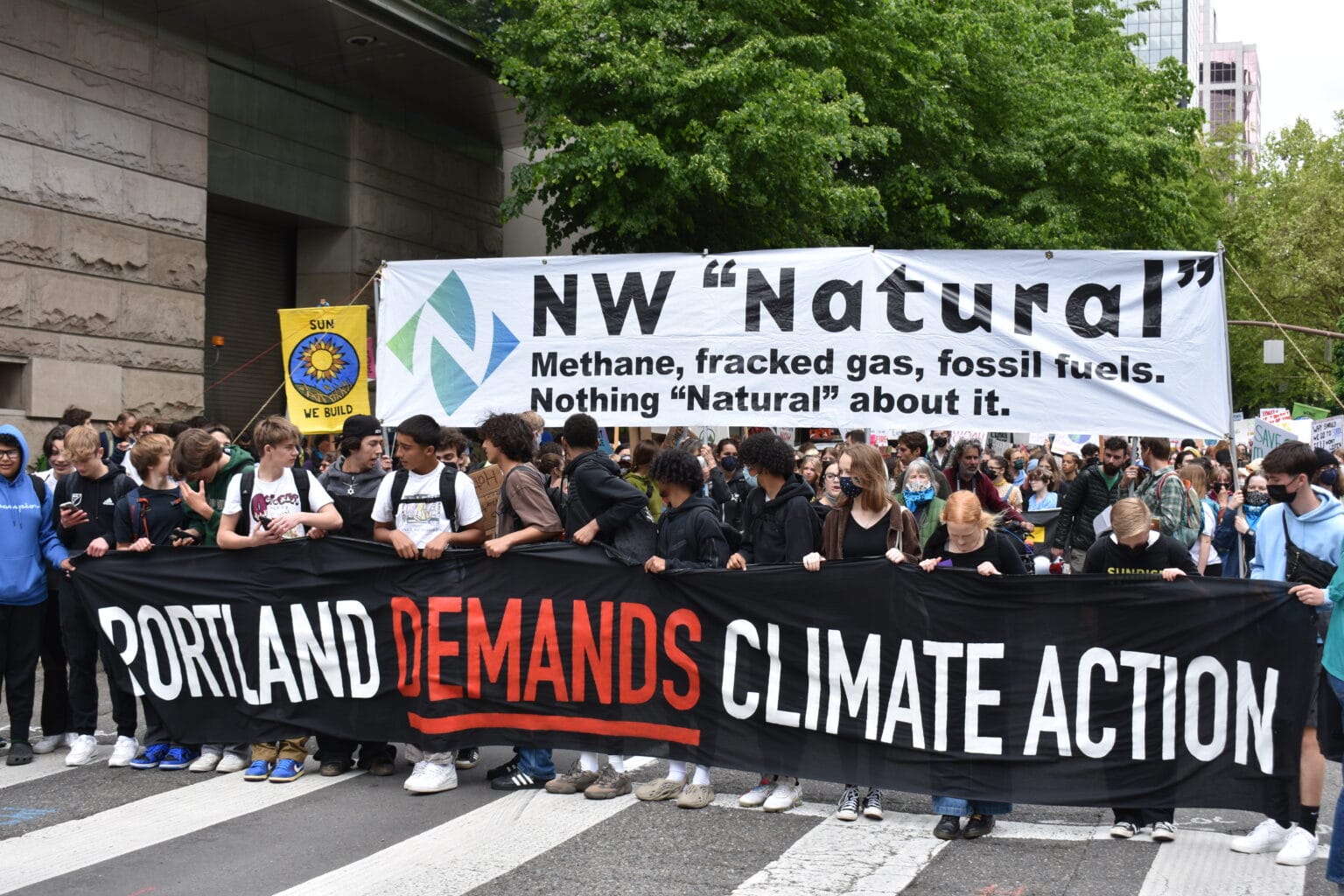 At a youth-led "Climate Strike" in Portland, OR, on May 20, 2022, protesters labeled NW Natural as one of four regional "Climate Villains" contributing to the climate crisis and obstructing climate action. Credit: Nick Cunningham
Oregon gas utility NW Natural offered free activity booklets in English and Spanish to schools in its service territory last year. The booklets target kids as young as kindergarten with games and puzzles that position fossil gas as a clean source of energy. The utility claims the materials relate to safety, and as a result, the company is trying to get ratepayers to cover the costs of the campaign. But a coalition of environmental groups opposing the move argue that the school booklet initiative was instead a propaganda campaign aimed at influencing children.
Last year, NW Natural, Oregon’s largest gas utility, sent emails and print mailers to schools in its service territory, offering free gas-related activity booklets for children, according to testimony filed with the state Public Utility Commission (PUC) in April by environmental groups, including the Coalition of Communities of Color and Climate Solutions. The groups are represented by lawyers from Earthjustice and the Green Energy Institute at Lewis & Clark Law School.
The mailers offered five booklets that include puzzles, word games, matching, cartoons, and other activities targeting students as young as kindergarten. Some sections included safety information and tips on energy conservation, but many others promote natural gas, describe its benefits, or position gas as a clean alternative to dirtier fuels.
On a website setup for the activity booklets, NW Natural included teacher guides, sample tests, and information about how the materials can contribute to achieving state educational standards in Oregon and Washington. ”NW Natural knows that teachers possess the power to enlighten students. We also know that any worthwhile effort requires commitment and resources. That’s why we’re glad to offer you FREE educational booklets and downloadable teacher’s guides and pre/post tests,” the website says.
But environmental groups view the booklets as an attempt to sway children. “The primary purpose of these booklets is to promote continued use and consumption of fossil gas by influencing public opinion, in this case — the next generation,” Greer Ryan, a policy manager at Oregon-based Climate Solutions, wrote in the testimony filed with the PUC.
Promoting “Clean” Gas to Kids
In one booklet aimed at children in kindergarten through 2nd grade, a friendly mouse called “Nat” and a cat called “Gus” explore everyday activities that involve the use of natural gas. One exercise asks kids to circle all the things in the home that use gas, including a barbeque, heater, oven, fireplace, warm bath, clothes dryer, water heater, furnace, and even an outdoor gas-lit street lamp. The “Learning Connection” concludes that “Natural gas can be used in many ways in and around our homes.”
The booklets also try to link natural gas in children’s minds to entertainment. Under the title of “Natural Gas Helps,” one cartoon depicts a man handing a boy a baseball bat, and the blurb reads: “Natural gas can be used by industry to manufacture products like video games and baseball bats.”
 NW Natural activity booklets sent to schools in the utility’s service area. Credit: Screenshot from formaltestimonyto the PUC on April 22, 2022.
In a booklet targeting older kids between grades 4 and 6, one exercise is titled: “Could You Survive Without Using Energy?” The kids are asked to list the ways they use energy, and are given an example. The first line is filled in with “took a shower,” followed by the appliance used (a water heater). The last section asks the energy source, and the booklets have “natural gas” already filled in. Call-out boxes at the bottom of the page challenge kids to write about how they’d survive for a day without energy (“Bonus: What would you do for fun?”) and to “make a poster, rap song, mini-book, or oral presentation” about one of the booklet’s “natural gas science facts or safety tips.”
 NW Natural activity booklets sent to schools in the utility’s service area. Credit: Screenshot from formaltestimonyto the PUC on April 22, 2022.
Throughout the booklets, kids are prompted with the cartoons and then are asked to recall what they’ve read, such as what areas of the home use natural gas, and what kind of vehicle the cat is driving. (Answer: a bus that runs on natural gas.)
The bus-driving cat makes an appearance in several activity booklets. One page entitled “A Special Bus Powered by Natural Gas,” shows the cat with a boy and the mouse as passengers. Emblazoned on the side of the bus is a banner that says: “This Bus Is Powered By Natural Gas.” On the next page, the booklet prompts kids to circle things that are clean, and put an “X” through things that are dirty. The kids first need to decide between a clean, well-dressed mouse, or a cat caked in mud. Next, kids are shown two images of nearly identical buses, one labeled “Diesel Bus,” and the other labeled “Bus” next to an icon of a blue gas flame. The diesel bus has a trail of gray exhaust streaming out of its tailpipe, while the natural-gas-powered bus does not and is driving under a cheerful cartoon sun. Solidifying the message, the “Learning Connection” says: “Natural gas burns more cleanly than diesel fuel.”
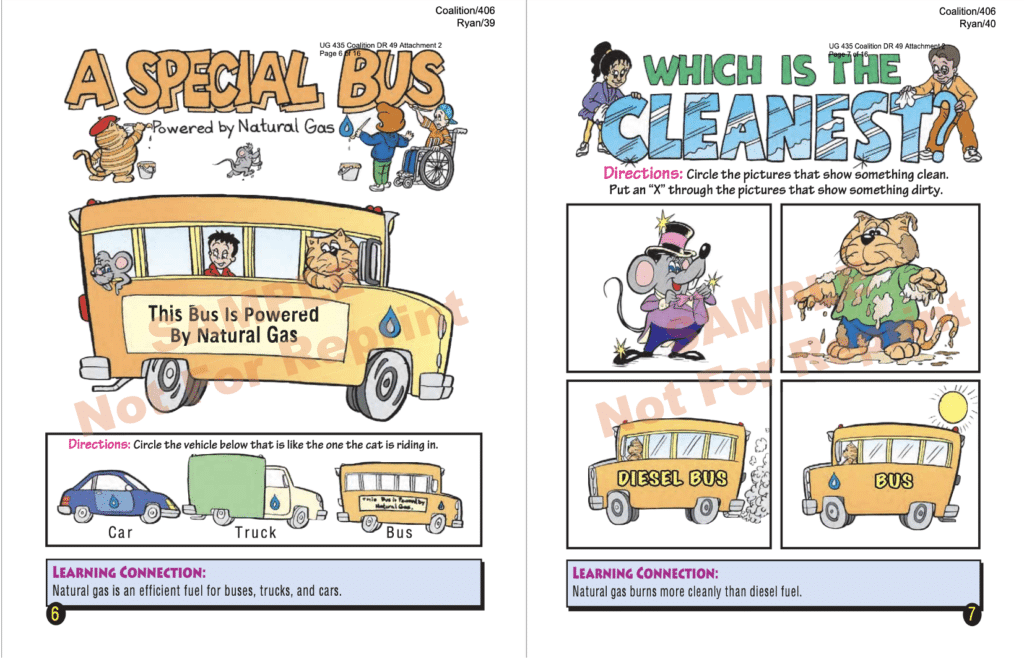 NW Natural activity booklets sent to schools in the utility’s service area. Credit: Screenshot from formaltestimony*to the PUC on April 22, 2022.
Nowhere do the booklets mention electric buses or electric appliances, which, unlike their gas counterparts, do not emit harmful pollutants that exacerbate the climate crisis.
The coalition of environmental groups opposing NW Natural at the PUC say the school booklets are an influence campaign to mold how children perceive gas. “[I]t is concerning that school children would be subject to misinformation from corporate entities of any kind, but especially by a corporation selling a product that can be harmful to children’s health,” Ryan stated in the testimony.
NW Natural is asking the PUC to hike rates on its gas customers, including a 12 percent increase for residential rates. As part of this request, the utility wants to bill customers for its school booklet campaign.
PUCs can approve rate recovery for safety-related advertising that utilities are required by law to communicate to the public. NW Natural claims its school booklets are aimed at improving public safety awareness.
The activity booklets do include some pages on safety and energy conservation, advising kids to alert adults if they smell a gas odor, to keep toys away from gas appliances, and to turn down the thermostat.
But the groups opposing NW Natural’s current rate hike request contend that promoting safety is not the booklets’ main aim.
“There’s no way that the primary purpose of this is to inform kids about the potential that they could dig into the sidewalk and damage a pipeline. That is not what these booklets are,” Jaimini Parekh, a senior attorney with Earthjustice, told DeSmog. “Not in any type of way. Like Little Billy and his baseball bat that was made by the gas company…that is not about safety of the distribution system.”
Parekh added that even if safety were the main purpose, sending that information to children makes no sense. Federal regulations governing communicating with the public about safety of the pipeline distribution system recommend targeting emergency officials, public officials, excavators or contractors doing construction, land developers, and residents living along the right-of-way where pipelines are located.
To the extent that schools should be a target of safety-related communications at all, the school itself should be the audience, not children, Parekh said.
“I find it dangerous to be honest. I find it dangerous because it is attempting to influence the next generation in how they are thinking about fossil gas as a service,” Parekh said. “Why is it that a utility company feels so threatened that they need to try to influence the minds of children in how they are thinking about the impacts of gas?”
The booklets also omit the long list of the safety, health, and environmentalproblems associated with the gas industry. “None of the booklets describe the problem of climate change, or the fact that extracting, producing, transporting, distributing, and burning fossil gas contributes to global climate change,” Ryan wrote in the testimony. “None of the booklets describe harms to air quality or groundwater aquifers from gas drilling activities, or the harms such activities pose to the health of communities living near to gas extraction.”
NW Natural did not respond to a list of questions about where the booklets were sent or how they were distributed. Instead, spokesperson Stefanie Week said that the booklets “are for our public safety awareness program as recommended by federal regulations for pipeline operators,” and that “[t]he program is audited by the Oregon Public Utility Commission.” Week did not respond to a question about why a safety awareness program was targeting children, and not school officials. Week also didn’t respond to a question about how games and puzzles related to this criteria.
Week did note that other utilities also use school materials from the same publisher, Culver Company, including Oregon’s PGE and nearly a dozen others. DeSmog posed questions to Culver, but the company demurred, stating that questions should go to NW Natural.
NW Natural Seeks to Weaken Portland Public Schools’ Climate Policy
While NW Natural was promoting gas to children, it also sought to water down a signature climate policy under consideration by the largest school system in the state in order to protect its interests.
Portland Public Schools (PPS) began drawing up a major climate initiative two years ago, aimed at slashing greenhouse gas emissions from its operations while also incorporating climate justice into its curriculum.
In February 2022, as the PPS board neared a critical vote on the policy, NW Natural sent comments to PPS board members with suggested revisions to the policy’s wording. While expressing support for climate goals and decarbonization generally, the utility offered specific changes that would have weakened the language.
The draft called for a prohibition on new fossil fuel infrastructure, including gas-fired equipment, in all new buildings and modernizations, as well as a phaseout on fossil fuel infrastructure in existing buildings by 2050. NW Natural’s suggested revision tweaked the language, conspicuously removing the ban on gas infrastructure and replacing it with the installation of “renewable fuel appliances” in all new buildings, plus a net-zero emissions goal by 2050.
The new language would have left a lot more wiggle room for industry-friendly solutions such as “renewable natural gas,” which is methane captured from landfills and animal feedlots. As DeSmog has previously reported, NW Natural is heavily advertising its investments in renewable natural gas with claims and messaging that critics have called “misleading.” RNG is very limited in supply, enormously expensive, and still emits greenhouse gasses. Moreover, NW Natural, despite its advertising, is not delivering RNG to Oregonian homes or businesses. Instead, it has invested in a handful of projects around the country from which it can obtain credits akin to a carbon offset program. Oregonians are still receiving fossil gas just as before.
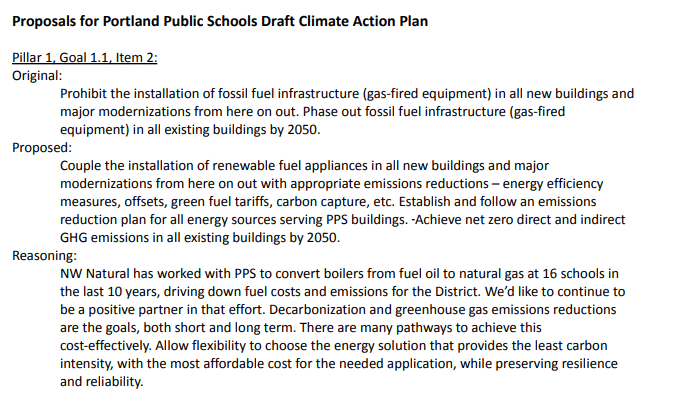 Screenshot from NW Natural’s proposedchanges to the Portland Public Schools Climate Crisis Response policy. The changes would have removed the prohibition on new fossil fuel infrastructure in schools.
NW Natural’s input on the proposed policies “didn’t make any sense because we are trying to get to net-zero carbon and we would have to basically eliminate the use of fossil fuels, go electric, use solar,” Mike Rosen, a former Portland Public Schools board member who spent years working on the policy, told DeSmog. “I don’t know if we were surprised. We knew we would get resistance from places like NW Natural…it just seemed like, what did they think we were trying to do, if not that?”
In its original comment to PPS, NW Natural justified the suggested changes by stating that it “has worked with PPS to convert boilers from fuel oil to natural gas at 16 schools in the last 10 years, driving down fuel costs and emissions for the District. We’d like to continue to be a positive partner in that effort.”
In a statement to DeSmog, NW Natural spokesperson Stefanie Week said: “We share the goals of decarbonizing the school system and our region, and we believe that the fastest, most affordable and most reliable way to do this is through utilizing both electric and gas energy systems.” Week added that the PPS policy would result in “higher energy costs” and “possible increased emissions.”
Rosen said NW Natural’s suggestions did not gain a lot of traction. Ultimately, PPS rejected the utility’s suggestions and kept the ban on new gas infrastructure. The PPS board approved the policy unanimously in March.
Rosen also didn’t think highly of NW Natural’s campaign to send activity booklets to school children aimed at influencing their perceptions of gas. “We are trying to teach our kids now about the climate crisis. To have the natural gas industry come in and tout the clean element of natural gas…I think it’s ridiculous,” he said.
“I mean, it’s kind of like the old ads that used to appear in magazines talking about DDT and how DDT is your friend. It’s just the wrong message at the wrong time,” Rosen said. “I hope it gets no traction. It’s just propaganda.”
---
drilled has related content
News - How the Oil and Gas Industry Smuggles Corporate Propaganda into Schools | Drilled
5 24
this story is being published in partnership withRolling Stone, and was supported by thePulitzer Center.
The lesson plan, which is intended for the 3-5 grade level, is titled “A Day Without.” It instructs teachers to explain to their classes how petroleum and natural gas provide most of the energy kids use in their day-to-day lives, from “charging my computer” to “making popcorn in the microwave.”
“Tell the class that in 2020, petroleum powered 90 percent of the country’s transportation,” the teacher instructions read. Nowhere does it mention how fossil fuel use is responsible for climate change, nor any mention of the global movement towards an energy transition.
At the end of the lesson, students are encouraged to either write an essay or create a drawing of life without natural gas and petroleum. “Now that you know where this energy can come from, imagine if these energy sources didn’t exist!” the handout reads. “What would your life be like?”
The “A Day Without” lesson plan is produced by Discovery Education, a popular national and international provider of digital textbooks and other multimedia content for K-12 students. Because it’s adorned with a version of the familiar Discovery logo (although no longer financially tied to Discovery Inc., which merged with Warner Bros. in 2021), several teachers told Drilled that they trust Discovery Education content across the board. This particular lesson plan is available for free on the Discovery Education website, and is also included in the paid digital curriculum platform the company sells to schools around the country.

:{A busy elementary school teacher might not notice the subtle logo at the bottom of the “A Day Without” lesson plan: the American Petroleum Institute (API), the oil and gas industry’s main lobbying organization, with a long history of promoting climate denial. API is a content partner for Discovery, and a founding partner — along with Chevron — of Discovery’s “STEM Careers Coalition” initiative, designed to help students build a career in science, technology, engineering, or math.
The API logo dots several other lesson plans on the Discovery Education website, too, including an activity dissecting the use of petroleum-based polymers in chewing gum, an activity “exploring how offshore oil rigs are decommissioned and sunk to create artificial reefs,” and a lesson plan that has students assuming “the role of a petroleum geologist.”}:
American schools have long been a placewhere private influences, including fossil fuel groups like API, have pushed their messaging and advertised their brands. Yet the Discovery Education programming provides a remarkably efficient new model for companies to try and influence children. Through corporate-friendly programs like its STEM Careers Coalition, Discovery Education is able to distribute material branded by Chevron, API, DuPont, Boeing, and PepsiCo Foundation directly to millions of students via curricula, activities, and “virtual field trips.”
According to its website, Discovery Education materials are currently used by half of the classrooms in the U.S. Six states have provided Discovery Education curricula to some or all of their public school districts, paying millions of dollars for the privilege — or, in at least one case, allowing a corporate sponsor to foot the bill. The company is focused on growing its influence: Discovery Education has stated its intent to get its STEM-specific materials — which includes corporate-branded materials, like the API handouts — in front of at least 10 million children worldwide by 2025.
Discovery Education marketing materials claim that activities and lesson plans like “A Day Without” meet national curriculum standards, and none of the lesson plans reviewed by Drilled included any explicit climate denial. But the science is clear that the world must phase out the use of fossil fuels as quickly as possible to avoid the worst impacts of climate change. Experts say the lesson plans fit into a long history of API sneaking pro-fossil fuel industry messaging into schools.
“They’ve been at this since the ‘50s,” Robert Brulle, a professor at Brown University, said of API.
“There’s no balance” in the materials API created for Discovery, he added. “Completely missing is the impact of petroleum, on human health, on the Earth's ecosystem, or on climate. Just not there. They don't mention it. It's a selective education which, for me, makes this into propaganda.”
Drilled sent over a list of questions to Discovery Education for this story. Stephen Wakefield, the Senior Vice President of Global Communications, sent over the following statement in response:
“Discovery Education employs a rigorous process to review and select content that ensures only high quality, standards-aligned resources appear in our products. In addition, our flagship service includes a tool that allows school systems to exercise the highest level of control over their content, ensuring that the resources used in instruction meet local standards and approaches to learning. Thanks to the support of the STEM Careers Coalition, approximately 4,000 U.S. schools now have access to high-quality digital resources in all K-12 disciplines at little to no cost.”
API did not respond to our request for comment.
“Schools are sites of political struggle,” said Kenneth J. Saltman, a professor of educational policy studies at the University of Illinois Chicago. “API has a very clear agenda for what they want schools to teach, that is in accord with the interests and profits of their industries. And that’s not in line with the interests of the public generally — which includes the interest in surviving the next decade or two.”
WHILE DISCOVERY EDUCATION boasts a similar logo as the media company — which many teachers and parents associate with their own educational experience — it no longer has a direct relationship to the cable channel. What is now Discovery Education began as a company called United Learning, which produced “digital video content in core curriculum areas and educational prevention videos for the social sector” in the early 2000s. Discovery Communications bought the company in 2003, intending to combine its subscription services with the Discovery Channel School’s educational videos. In 2018, Discovery Communications sold a majority stake in Discovery Education for $120 million to private equity firm Francisco Partners; in 2022, another private equity firm, Clearlake Capital, acquired the majority stake.
In recent years, Discovery Education has branched beyond just educational videos to a wealth of paid and free offerings, including subject-specific math and science curricula. Its lead product is known as the Discovery Education Experience, a platform that provides access to lessons, videos, and other content for students, teachers, and families. Discovery Education claims that it now serves 4.5 million educators and 45 million students in more than 100 countries and territories.
The Covid-19 pandemic opened a new financial door for Discovery Education, as classrooms were forced to go online and federal money became available for schools to pursue digital alternatives to in-classroom learning. Arizona, Delaware, South Carolina, Nevada, New Hampshire, and Mississippi have entered into contracts with Discovery Education since 2020 to provide access to some of its products to all or some of their public school districts. These states have used federal stimulus funds — known as the Elementary and Secondary School Emergency Relief Fund, or ESSER, passed under the various acts created in response to the pandemic — to purchase Discovery Education products. (Discovery Education maintains an entire section of its website dedicated to helping prospective customers use these funds to pay for its offerings.)
:{Arizona, for instance, spent $6.5 million to provide teachers, kids, and families across the state access to Discovery Education’s platform as part of its ESSER spending to “bridge the digital divide and provide broadband access.” The Discovery Education buy is the largest purchase the state made in that category, which also allocated a comparatively skint $1.5 million to extend broadband access into the homes of students living in rural areas, and $853,000 for a laptop and hotspot sharing program in Phoenix.
Mississippi, meanwhile, paid nearly $4.7 million to provide Discovery Education’s K-6 science curriculum to 103 of its 144 school districts, part of a larger $23.1 million ESSER spend on distance learning tools. (It paid about $7.9 million for a K-8 math program from Imagine Learning, and also bought access to a 7-12 grade science curriculum provided by edtech company Gale for close to $5 million.)}:
Individual districts in different states can also use ESSER funds to purchase Discovery Education products. A spokesperson for the Delaware Department of Education told Drilled that one of its school districts, Brandywine, was in the process of using ESSER funds to purchase one year of access to Discovery Education’s elementary school curriculum for $75,900. Even if states and counties don’t pay Discovery Education directly for its products, some education boards list Discovery Education as a valuable resource for free educational materials: California’s Department of Education, Missouri’s state website, and the Bureau of Indian Education all include links to Discovery Education on distance learning and electronic resource pages.
Some states, however, have found corporate funders for their curricula. Nevada’s Discovery Education platform is sponsored by Nevada Gold Mines, a subsidiary of international mining giant Barrick Gold Corporation. Chemicals giant DuPont, which is headquartered in Delaware, paid $1.5 million in 2021 for students in Delaware to have access to the platform for three years, a DuPont spokesperson confirmed to Drilled. According to a press release, DuPont’s gift to Delaware’s schools was “part of its commitment as the newest member of the STEM Careers Coalition” — one of Discovery Education’s most corporate-forward projects.
IN SEPTEMBER OF LAST YEAR, the Nevada Department of Education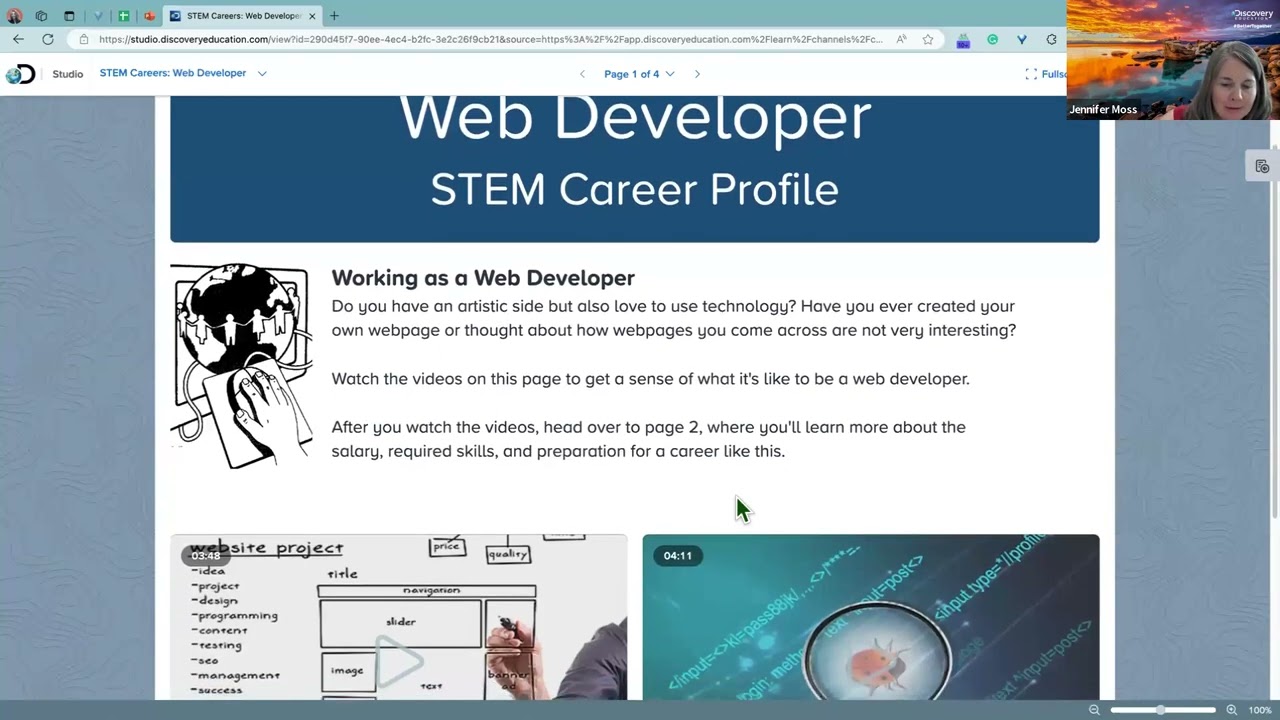 intended to walk teachers through STEM resources available on the Discovery Education Experience platform. In the video, a Discovery Education employee shows off the platform’s homepage, where a channel labeled “Nevada Gold Mines Career Profile Series” is displayed on the top row.
The employee clicks to a section titled “STEM Careers,” which brings up a list of videos, activities, handouts, and other information for students and teachers. A header and logo on the page announce that the platform is “powered by the STEM Careers Coalition.” The first module listed on the K-5 page is a video called “Manufacturing Metals,” which looks at metal alloys manufactured in industrial company Arconic’s “state-of-the-art” manufacturing center in Alcoa, Tennessee. According to federal filings, Arconic’s charitable arm paid Discovery Education $300,000 per year in 2021 and 2022 to be part of the STEM Careers Coalition.
“Here is where you’re going to find a wealth of STEM career explorations, different instructional activities — so much is going on in this space,” the Discovery Education employee says.
Launched in 2019, the STEM Careers Coalition states that its intent is to bridge “industry and classrooms at an unprecedented scale.” The site boasts that the resources are accessed by “6.7 million teachers and students,” with a goal of increasing those numbers to 10 million by 2025.
The site is awash in corporate logos. A section at the bottom showcases the Coalition’s current partners: DuPont, Boeing, PepsiCo Foundation, P&G, and chemicals giant LyondellBasell are all listed as “Signature Partners” of the initiative. On a separate page, the site also lists the initiative’s “Content Partners,” whose “expertise” is applied in creating STEM materials hosted on the site. Here, API joins Chevron and Canada-based power generator Capital Power, as well as the Manufacturing Institute, the nonprofit arm of the National Association of Manufacturers, a lobbying group that is a decades-long purveyor of climate denial.
Branding for corporate initiatives like the STEM Careers Coalition brings in big money for Discovery. Federal tax filings show that in 2022, Discovery Education received at least $3 million each year from the charitable arms of for-profit companies like tech giant Siemens, medical device producer Abbott, and agribusiness conglomerate CHS to create branded corporate educational content. (The amount of money earned from corporate partnerships is likely much higher than this: Many partners with logos on the STEM Careers Coalition website, including API, do not list Discovery’s programming on their tax returns, or do not have separate charitable arms with publicly available tax filings.)
The Manufacturing Institute included the STEM Careers Coalition in 2021 as part of a larger $2.7 million initiative to “hone STEM skills, introduce students to career pathways in manufacturing and clarify misperceptions about these careers.”
Materials created in the STEM Careers Coalition are available for free online on Discovery Education’s site. But as the Nevada teacher video shows, materials from the STEM Careers Coalition are also provided through Discovery Education’s paid platform, with corporate-sponsored content mixed in with unbranded lesson plans. Discovery Education did not confirm whether or not its platforms allow teachers, students or parents to filter out corporate-branded material.
A teacher wanting to avoid corporate branding or content may not have a choice. Controlling how much advertising is served to kids in classrooms is largely left up to school districts. While some districts, like San Francisco, have strong policies limiting commercialism in classrooms — including prohibitions on teachers using curriculum sponsored by corporations — most states and districts lack comprehensive guardrails.
“In general, there are not legal prohibitions on using taxpayer-funded schools to market to a captive audience of students,” said Josh Golin, the executive director of Fairplay, an advocacy organization dedicated to limiting the impact of commercial culture on children.
The STEM Careers Coalition and other branded Discovery Education products are just the latest iteration of corporate presence in classrooms. A company called Channel One, which launched around the country in 1990 and closed in 2018, gave classrooms free televisions in exchange for a captive audience of school kids who would watch a 12-minute news broadcast, including two minutes of ads, each day. At one point, the program’s broadcasts were shown in 12,000 schools across the country, reaching about a quarter of 6-12th grade students. (A 2006 study published in the journal Pediatrics found that the 7th and 8th graders surveyed remembered ads from Channel One broadcasts better than the actual news content.)
Golin said that the vast body of research shows that kids are developmentally not able to recognize various forms of advertising, including sponsored content, until they reach their teens. “When you have advertising in a classroom setting, you take away the one defense that they may have, which is the ability to turn it off or get away from it,” he said.
Not all of the content the STEM Careers Coalition provides is sponsored by a corporation. There are a variety of unbranded lessons, many on climate and waste-related topics, mixed in with the publicly-available content on the Discovery Education site: Teachers accessing the website can find lessons on irrigation systems, food waste, and even transportation emissions or the effect of climate change on health with no corporate logos attached.
But some unbranded content appears to still have a heavy corporate influence. One lesson plan teaching 6-9 graders the process of distilling crude oil makes no mention of API and has no logos attached on the bottom — yet instructs educators to show their classes[ ]
(https://youtu.be/GYRwWyG3Qqw) made by API and have students visit web resources that were put together with support from the organization. (The name of the PDF for this lesson on Discovery’s site is “API_DistCrudeOil.pdf.”)
For decades, the oil and gas industry has run aggressive PR and advertising campaigns to sell its product as key to a modern life — and advertising to kids in schools was a core part of these campaigns. API has a history of creating a huge variety of pro-industry material to deliver to schools, including running an online energy education website through the early 2000s. As early as 1950, DuPont and API — now both Discovery Education STEM Careers Coalition members — collaborated on a film for children titled The Magic Barrel, which extolled the number of products that could be made with petroleum. The industry’s push was so intense that in 1965, a memo from an API Board of Directors meeting estimated that the organization’s educational materials were in use in 33,000 schools, or 78 percent of all secondary schools in the country.
Education was a crucial part of the oil and gas industry’s modern-day push to undermine climate science. In the late 1990s, API convened a group of industry interests to launch a public relations campaign to raise public doubts about climate science and undermine international action on climate change. In an action plan that was later leaked to press, API mandates the creation of a task force to distribute “materials that present a credible, balanced picture of climate science” to schools nationwide. One of the metrics of success for the industry’s effort, the memo reads, would be measuring the “number of school teachers/students reached with our information on climate science.”
Golin said that one of the few protections for kids from corporate material comes from the FTC, which requires the disclosure of sponsored materials, and that unbranded lesson plans that include corporate content could constitute an FTC violation. Because of the research showing that kids don’t understand how to process advertising, “from Fairplay’s perspective, disclosure with children isn’t effective,” he added.
Drilled did not find any lesson plans provided by the STEM Careers Coalition teaching the link between oil and gas extraction — the main activity corporate sponsors like API and Chevron appear to be preparing kids to do — and climate change. In contrast, one unbranded lesson, on petroleum and biofuels, instructs teachers to “tell the class what actions petroleum companies are already taking to increase their sustainability.”
:{*:{Amy Westervelt contributed reporting to this story.}:
---
an 8 23 ni lnx
Texas eighth graders will soon be required to learn about climate change — but not without a showdown
man and woman sitting on chairs
Erin DouglasandThe Texas TribuneAugust 30, 2023
Starting next year, Texas will require that eighth graders learn about climate change as part of a science curriculum overhaul approved two years ago.
But which textbooks they’ll use to learn about it will largely depend on the state board charged with setting curriculum standards, and questions during a Tuesday meeting to hear testimony on the proposed teaching materials showed that the 15-member body — which has taken a rightward turn since 2021 — could make its decision along partisan lines.
One Republican member of the State Board of Education asked whether students ought to learn about the benefits of burning fossil fuels. Meanwhile, Democrats advocated for texts that emphasized the scientific consensus on climate change.
Dozens of publishers submitted textbook proposals for the state’s overhaul of its science curriculums. Any resident of Texas can submit written comments on the instructional materials before Oct. 30. The board plans to adopt instructional materials in November; the new science standards and textbooks will take effect at the beginning of the 2024-2025 school year.
:{:{}:
}:
Many critics say the new curriculum standards, called the Texas Essential Knowledge and Skills, don’t go far enough to teach kids that climate change is caused by human activities, primarily burning fossil fuels. And while the TEKS changes will require eighth graders to describe how human activities “can” influence climate, students won’t be required to learn about how “a reduction in greenhouse gas emissions” could mitigate climate change after the board previously declined to include that language.
:{:{}:
}:
Publishers can choose to include information in textbooks that go beyond the state’s new minimum requirements for teaching climate change — the question is whether the board, which strengthened its Republican majority during last year’s election, will approve such textbooks.
The board’s decision could impact how science is taught in Texas classrooms for years. And while school districts aren’t required to use board-approved textbooks, many do so for the assurance that those materials meet the state’s standards.
At least one Republican board member, Will Hickman, who represents Houston, indicated that he’d advocate for instructional materials that do not include climate change solutions in science courses. He argued those solutions would be a better fit in social studies.
Hickman also asked one testifier if the textbooks should “also include the benefits we get from burning carbon,” arguing that many facets of modern society, such as air conditioning, are powered by fossil fuels. Hickman, an attorney who was elected to the board in 2021, has worked as in-house counsel forShell OilCompany since 2004.
The testifier, Susan Meredith, an Austin-based energy and education consultant who had testified that students should be presented with instructional materials that prepare them for climate change related jobs in the future, told Hickman he was conflating topics.
:{:{}:
}:
“What you’re collapsing is that electricity has to come from gas and oil, and it doesn't,” Meredith said.
Another Republican SBOE member, Pat Hardy, who represents Tarrant and Parker counties and parts of Dallas County, has previously said she wants children to learn about the good fossil fuels have done for human society, such as helping the Texas economy grow. Texas is the nation’s largest oil and gas producing state.
:{:{}:
}:
Texas is one of only six states that does not use the Next Generation Science Standards to guide its K-12 science curriculum. The standards — developed by states and a committee convened by the National Research Council in 2013 — emphasize that climate change is real, severe, caused by humans and can be mitigated with actions that reduce greenhouse gasses in the atmosphere.
A 2020 analysis of science curriculums in all 50 states by the National Center for Science Education and the Texas Freedom Network Education Fund gave Texas an F grade for how well schools in the state taught about the scientific consensus on climate change.
Some Democrats on the board pushed back on the soft-on-fossil-fuels language proposed by their Republican colleagues.
“We absolutely should say humans do impact climate change,” said Marisa Perez-Diaz, a Democrat who represents San Antonio on the board, in an interview with The Texas Tribune. “It doesn’t have to be political — it is just fact. But I think because sometimes we get into these culture-war conversations, it blurs what should and shouldn’t go into the standards.”
Although all the textbooks that have been submitted for approval explain that climate change is happening and “can” be due to human activity, not all of them explicitly say that human activities are the primary reason or include information on how to mitigate climate change. In other words, some of the textbooks don’t say that humans will need to quickly and dramatically cut greenhouse gas emissions, largely by phasing out fossil fuels, to avoid the most devastating impacts of climate change, as international climate scientists have long warned.
During the Tuesday board meeting, Perez-Diaz asked the other board members to be cautious of only supporting textbooks that meet the state’s minimum requirements and nothing more.
“When publishers take the time to include additional information past the TEKS [standards], for me, that is a text that stands out above and beyond the others,” she said.
Some educators, former teachers and education advocates are concerned that the political influence of the fossil fuel industry in Texas has prevented, and may continue to block, robust education on climate science ahead of the board’s November vote on science instructional materials.
“Climate change might be politically controversial, but the scientific consensus is clear,” said Carisa Lopez, a senior political director for Texas Freedom Network, during a Tuesday press conference. “It’s past time for the board to be clear about textbooks: that textbooks in public schools should teach the truth.”
Judy Dickey, a graduate lecturer at Texas A&M in the department of atmospheric sciences, said she thought some of the textbooks were trying to “soft-peddle” climate change by not explicitly saying humans were the cause, casting doubt on the scientific consensus or not including solutions.
:{:{}:
}:
But Dickey, who reviewed the textbooks for a Texas Freedom Network analysis of the proposals, said most of them did a good job of explaining climate science, treated climate change seriously and explained how it occurs.
“To me, that is a huge step forward,” said Dickey, who was previously a science teacher in Florida. “I was pleasantly surprised. … It was nice to see that no one was trying to pretend it was volcanoes.”
One 11th-grade student who testified during the Tuesday meeting, Marygrace Beinke, said none of her teachers have ever told her that climate change is a hoax or that evolution isn’t real. She emphasized to the board that all students in Texas should be given the opportunity to learn about those topics, which she said have reinforced her faith in God.
“I’ve never felt closer to God as when I’ve been learning about how fragile, beautiful and complex our Earth is,” Beinke told the board.
Geoff Carlisle, who taught eighth-grade science at a KIPP school in Austin for a decade, said in an interview with the Tribune that like Beinke’s teachers, he taught his students about climate change, even though it was not required by the state’s standards. Carlisle incorporated information about climate science into his own lesson plans — something he said most teachers in Texas don’t likely have the time or resources to do.
He said many of his students understood that climate change was happening and that it might have something to do with burning fossil fuels, but they could not explain the greenhouse gas effect or what role burning fossil fuels had in it. He wants the state to go further and require climate science to be taught at all levels. Other states, such as New Jersey, have such standards.
“When I think about the alarming emergency that our students are going to face or are facing, it’s unethical to not be talking about this in all grade levels,” Carlisle said. “Our students deserve the right to understand what’s happening.”
---
https://www.mediamatters.org/climate-deniers/fox-news-runs-ads-mike-huckabees-climate-denial-book-targeted-children
6 23
no lnx twt vid
former Arkansas governor, frequent Fox News commentator, and Trinity Broadcast Network host Mike Huckabee — who once joked that the threat of climate change to Americans amounted to “a sunburn” — is now marketing climate denial to children through ads airing across Fox News programming and social media.
Through his EverBright Media venture, Huckabee promotes an educational series targeted at children called The Kids Guide, which includes lessons on “Fighting Socialism,” “Cancel Culture and Free Speech,” and “Media Bias and Fake News.” The series of booklets is based on the premise that American children are vulnerable to biased and agenda-driven public school textbooks and liberal media reports, leading them to oppose“faith in God,” “lower taxes,” “smaller government,” and “the right to bear arms.”
The Kids Guide series is now promoting a new title that Huckabee claims “will help your kids break free from news-induced panic” and learn “the truth” about climate change.
Video
CitationThe Kids Guide to The Truth About Climate Change Ad
Huckabee’s materials targeted at children have long been called out for their blatant misinformation; a Huffington Post article from 2013 criticized his Learn Our History video series for distributing “Christian nationalist revisionism and right-wing political propaganda.” More recently, a Kids Guide to former President Donald Trump’s accomplishments from 2022 was widely mocked by online critics, who pointed out the glaring hypocrisy of books with such a clear right-wing political agenda and “cult”-like indoctrination being marketed to children at the same time Republican leaders are calling for eradicating access to books that reference any ideas they deem “woke.”
Now, Huckabee’s latest Kids Guide pushes long-debunked narratives and misinformation to downplay, dismiss, or deny the threat of climate change at a time when communities across the globe are already experiencing catastrophic climate impacts and the scientific community is urging immediate action to address the climate crisis.
Mike Huckabee is marketing climate denial to parents who watch Fox News
Fox News has long primed its audience to distrust teachers and the mainstream media, and to believe that climate change is a manufactured crisis to achieve a progressive agenda. And Huckabee's Kids Guide ad hawking a book to teach kids “the truth about climate change” seems tailor-made for the Fox audience:
MIKE HUCKABEE: Parents, you may have heard from your kids that the Earth is soon going to be an uninhabitable hellscape. Well, that's because some of their teachers and the media have an agenda. But is it really what kids should actually be learning? It's why my team created the new Kids Guide to the Truth About Climate Change. It answers your child's toughest climate questions, and you can have it for free.
Ads for The Kids Guide to the Truth About Climate Change began running during Fox News programming in mid-May. Ads for other entries in the series, including The Kids Guide to Fighting Indoctrination and The Kids Guide to Fighting Socialism, appeared on Fox throughout May. In 2023 alone, Kids Guide ads have appeared hundreds of times across Fox programming.
Similarly, according to a Media Matters review of data from Sensor Tower, Kids Guide has spent $83,300 running ads on Facebook from January 1 to June 6, 2023, garnering over 11 million impressions. Kids Guide has also been running Google search ads that appear when users enter the phrase “climate change for kids.”
Kids Guide to climate change Facebook ad
While the ads only hint at climate denial and misinformation, the guide itself is a primer in some of the most oft-repeated and long-debunked arguments used to cast doubt about anthropogenic climate change and delay climate action.
The Kids Guide to the Truth About Climate Change is climate denial propaganda disguised as education
The Kids Guide to the Truth About Climate Change acknowledges that the climate is changing and that “human pollution has made things worse. No one disagrees with either of those concepts.” However, these acknowledgments are undermined by oft-repeated climate denial talking points and arguments that are intended to downplay the crisis and maintain the status quo.
In fact, the book goes to great lengths to suggest that even while climate change is happening, the U.S. response has been more than sufficient and “made significant progress toward Earth’s recovery.” To support this claim, itencourages readers to “recycle what we can, turn off lights, buy more pre-owned items, not waste our food, make better use of what we have, and support sensible programs to protect the planet and its life.” While these are worthy endeavors, they are nowhere near the level of action scientists urge is needed to ward off the worst climate impacts – rather, they neatly align with the fossil fuels industry’s campaign to individualize climate action and sidestep the need for systemic change.
Here is a sample of common climate denial tactics and arguments laundered through The Kids Guide to the Truth About Climate Change.
The Kids Guide to the Truth About Climate Change pushes debunked lies about settled climate science
The Kids Guide falsely argues that the causes of climate change are still being debated among experts: “Well, what you may not know is that thousands of renowned scientists and weather experts worldwide have some very different opinions on climate change.They point to the powerful effects of the natural cycles of the sun and changes that happen in earth’s magnetic field.”
In fact, there is overwhelming scientific consensus that human activity is warming our planet. For nearly a decade, it was reported that 97% of scientists endorsed anthropogenic climate change. In 2021, a new study by U.S. researchers “examined the peer-reviewed literature and found more than 99% of climate scientists now endorse the evidence for human-induced climate change.”
It claims the climate is always changing: “The climate has always changed — long before humans walked the earth — and it continues to change!”
Climate communications expert and professor John Cook counts “the climate has always changed” among the most-used arguments by bad actors to mislead the public about the climate crisis. On his website Skeptical Science, which catalogs and debunks climate denial claims, he writes:
Climate has indeed changed in the past with various impacts depending on the speed and type of that change. Such results have included everything from slow changes to ecosystems over millions of years - through to sudden mass-extinctions. Rapid climate change, of the type we're causing through our enormous carbon dioxide emissions, falls into the very dangerous camp. That's because the faster the change, the harder it is for nature to cope. We are part of nature so if it goes down, it takes us with it.
So anyone who dismissively tells you, “the climate has always changed”, either does not know what they are talking about or they are deliberately trying to mislead you.
The book asserts that climate scientists’ predictions have never come true: “As you can see from the decades of headlines above, well-known and trusted scientists and experts have long predicted ice ages, killer floods, giant storms, and planetary catastrophes. By now, they said, we should have starved, frozen to death, or drowned!”
In fact, not only have scientists accurately predicted global warming for over half a century, but the consequences of a changing climate in the form of “killer floods,” “giant storms,” and “planetary catastrophes” that climate scientists have warned about are increasingly causing devastation and death across the globe.
The Kids Guide promotes the false argument that natural phenomena, not CO2, are responsible for changes in the climate: “Looking back in time, carbon dioxide levels have always gone up and down,” even before industrial activity. “The Sun’s natural lifecycles and Earth’s ‘wobble’ have helped drive ice ages and hot periods like the time of the dinosaurs.”
Akin to the claim that “climate has always changed,” the argument that natural phenomena are causing the climate to change also seeks to dismiss the role that CO2 from the burning of fossil fuels plays in warming the planet. Looking specifically at the argument that the sun is to blame, Cook writes that those perpetuating this claim use cherry-picked data:
From the early 1970s until today, the Solar radiation reaching the top of Earth's atmosphere has in fact shown a very slight decline. Through that same period, global temperatures have continued to increase. The two data records, incoming Solar energy and global temperature, have diverged.
…
Attempts to blame the sun for the rise in global temperatures have had to involve taking the data but selecting only the time periods that support such an argument. The remaining parts of the information - showing that divergence - have had to be ditched. Proper science study requires that all the available data be considered, not just a part of it.
While the Kids Guide book uses common climate denial arguments to undermine the science of climate change, it also employs other narratives that are frequently used to attack climate action.
The Kids Guide to the Truth About Climate Change argues against the need for climate action
The book makes the argument that renewable energy is not clean: “While protecting our home planet is certainly a noble cause, quickly switching off our primary energy sources is already costing people their jobs, deeply damaging supply chains and creating painful shortages of energy and food. Also, these new technologies have their own issues and environmental costs.”
It is true that all forms of energy development have environmental impacts, but the Kids Guide’s environmental-focused attacks on electric vehicles, solar panels, and wind turbines are highly disingenuous considering that their effects pale in comparison to the collective damage fossil fuels have wrought on our environment and climate. In addition to their role in driving climate change, a new study put a price tag on one of the human costs of domestic oil and gas activity: “Air pollution from U.S. oil and natural gas production causes roughly $77 billion in health impacts nationwide every year, while also contributing to thousands of early deaths and health flare-ups,” including “7,500 excess deaths, 410,000 asthma attacks, and 2,200 new cases of childhood asthma across the U.S. in 2016.”
It pushes the argument that climate action hurts the U.S. and is useless because big polluters like China and India are not taking action to curb their emissions: “While the United States and Western Europe sacrifice our economies and quality of life to cut carbon emissions, huge industrial nations like China and India continue to emit massive amounts of carbon dioxide by comparison, as well as tons of other pollutants.”
These are long-held climate denier talking points. Climate change, not climate action, will devastate our economy because the cost of inaction far outweighs the cost of action. In 2022, the White House Office of Management and Budget provided the first accounting of how much unchecked global warming could impact the U.S. federal government alone and concluded that failure to act would cost $2 trillion annually in lost revenue. Pretending that U.S. action is futile if other big polluters don’t curb their carbon emissions is another way to give license to industry and policymakers to kick the can down the road on fighting climate change.
The Kids Guide to the Truth About Climate Change champions the dangerous idea that “things are getting better”
The Kids Guide highlights four examples to suggest that the current level of climate action is sufficiently reversing our impacts and “we are already making progress toward protecting the Earth for future generations to enjoy.” In fact, the examples used in the guide are anomalies that don’t disprove the larger warming trend:
“Throughout the winter of 2021, the British Antarctic Survey recorded the lowest Antarctic temperatures in over 60 years.” As The Washington Post wrote in October 2021, “Scientists stressed that the record cold over the South Pole in no way refutes or lessens the seriousness of global warming. Antarctica is notorious for its wild swings in weather and climate, which can run counter to global trends.” The Post cited a range of experts including Eric Steig, a professor of atmospheric sciences at the University of Washington, who said, “One cold winter is interesting but doesn’t change the long term trend, which is warming.”
“According to NASA, Greenland’s largest and most important glacier, Jakobshavn, has been gaining ice for several years.” This example is also intended to suggest that warming is either not happening or not having serious consequences, but as CNN reported in March 2019, “the melting from that single glacier alone contributed to global oceans rising an average of 1 millimeter between 2000 and 2010. And even though Jakobshavn has gained ice at lowest levels where it enters the sea, it has still been contributing to sea level rise because the rate it is melting into the ocean is still greater than the rate that ice is accumulating higher up on the glacier, according to the researchers.”
“While some claim the change is temporary, the Intergovernmental Panel on Climate Change noted that global warming has slowed.” The origin of this claim is unclear.The IPCC has repeatedly warned that we are increasing warming at an alarming rate. In an email exchange with Media Matters, climate scientist Michael E. Mann called the claim “absurd and dishonest,” adding: “The assertion that the IPCC ‘noted that global warming has slowed’ is simply a lie. The IPCC has made no such assertion. The planet continues to warm at a rate of roughly 0.2C per decade and the WMO (World Meteorological Organization) recently predicted that global surface temperatures will (briefly) cross the 1.5C warming threshold for the first time in history within the next couple years.”
“Australia’s Great Barrier Reef, predicted to be dead by now, recently recorded its most significant growth ever.” The news in 2021 that the Great Barrier Reef was in recovery was weaponized by bad actors to claim that those urging climate action were alarmists. But as ABC News reported, the recovery in 2021 was aided by a break in climate-related disturbance and experts believe the progress to be short-lived.
Kids are the obvious next front in climate deniers' misinformation campaign
Today’s climate movement is primarily youth-driven — in the last several years, young climate activists have demanded greater action from global leaders by getting out to the streets, online, and into the voting booth. In part, they are the face of the movement because they have the most to lose, and the relentless mockery and attacks by right-wing media in response to the wave of youth activism has not been a strategy aiming to recruit a new generation of climate deniers. Disinformation disguised as educational material on climate change for children is, however.
The Kids Guide’s efforts to push climate denial on children may not undermine the momentum of today’s climate activists, but it certainly appears designed to stunt the next would-be wave of young people ready to demand a livable future.
Related
With Canadian wildfires, Fox News follows its COVID playbook
06/08/23 12:19 PM EDT
Led by Fox, “hard news” anchors on cable injected opinion into Schiavo coverage
03/22/05 6:46 PM EST
How Tucker Carlson was a terrible and effective megaphone for climate misinformation
05/03/23 12:39 PM EDT
https://www.drilledpodcast.com/s7-the-abcs-of-big-oil/
no lnx
S7: The ABCs of Big Oil
Big Oil infiltrated schools across the country. Earther and Drilled take you inside the campaign to miseducate American students.
Ep 1: The First Day of School
Fossil fuel companies didn't start infiltrating schools when climate change appeared on the scene, they were there shaping the minds of future citizens for decades before then. The industry has been laying the groundwork for inaction on climate since long before this crisis reared its ugly head, limiting how Americans are allowed to think about the environment and the economy. In this first episode of our new miniseries we look at how Big Oil first got into the education game, and why it worked so well. Transcript
Ep 2: Elementary School
Since the 1920s, oil companies have been creating music, activities, coloring books, comic books, movies and more to shape how American kids think about society, the economy, and the environment. Today, we look at their efforts in elementary school. Transcript
Ep 3: High School
In the third episode of our mini-series with Earther, we head to high school, where the fossil fuel industry's efforts to shape Americans' thinking on economics and policy really ramps up. Transcript
Ep 4: We're Going Streaking
We're wrapping up our series with Earther this week, with a look at how fossil fuel companies influence curricula and research at the university level. Transcript
Ep 5: Ben Franta on Big Oil on Campus
Bringing you our entire interview with Stanford researcher Ben Franta on fossil fuel influence at universities because it was just too good not to share. Transcript
Ep 6: So...What Do We Do about This?
Over the last five episodes we've tracked how long the fossil fuel industry has been investing in schools, why, and what impact it's had. In this episode, we look at what can be done, and who's trying to do it. Transcript
Ep 7: Katie Worth on the State of Climate Education in the U.S.
Reporter Katie Worth has been researching climate education in the U.S. for years and that research forms the basis of her new book Miseducation. In this interview we delve into what she found. Transcript
Background Materials
We drew on a whole bunch of primary source documents for this season. Several of them are collected here:
Standard School Broadcast
This is the oldest educational program in America. It was a weekly educational show created by Standard Oil of California, which later became Chevron. Ostensibly about music appreciation and American history, the Standard School Broadcast first went on air in 1928 and was initially heard in 72 schools via the NBC Pacific Network. Thanks to various syndication deals it was eventually heard in thousands of schools across the western United States. It stayed on air until the late 1970s. We've digitized and transcribed a few examples for you:
...
===
https://www.drilledpodcast.com/s7-the-abcs-of-big-oil/
The photos below are from a comic book that Disney put out in conjunction with Exxon in the 1980s, at the same time that Exxon was sponsoring the Universe of Energy Center at Epcot. Both were aimed at shaping kids’ understanding of energy and the economy. [conservation?]
...Exxon’s Universe of Energy Center was at Epcot from 1982 through 1996. That’s fascinating, because that’s the exact time span that Exxon went from researching climate change to explicitly denying it. (Exxon’s denial started in the late 80s and picked up steam throughout the 90s). The exhibit was originally intended to be called The Future of Energy, and was supposed to focus only on renewable energy, but when Exxon got involved they changed the scope to include fossil fuels as well, and present an "all-of-the-above" approach to energy. Sound familiar?
===
montana cement wood preserve ACC chem, coal, frack...
mis-education
Western Education Foundation for Resources, Inc. is a 501 (c) 3 Education Foundation Administered by the Treasure State Resources Association of Montana with the mission of promoting and communicating the “right message for Montana”.
The Western Education Foundation for Resources, Inc. (WEFR) is a 501 (c) 3 non-profit foundation established in 1984. The Foundation seeks to enhance public awareness of the economic and social importance of the natural resource industries.
The Foundation is managed by a Board of Directors whose members are interested in educating the public and decision-makers about natural resource issues that affect the economic and social well being of Montana families and businesses.
WEFR undertakes projects that:
- provide the public with research, education and information regarding natural resources
- promote public discussion regarding natural resource policy issues
- enhance public awareness of the implications of natural resource policies
- promote the development and dissemination of factual, science-based information regarding natural resource issues
Past projects have included production of educational ads for television, radio and newspapers; and publication of educational booklets on air and water quality issues.
To learn more about supporting the Western Education for Resources, please contact:
WEFR
P.O. Box 1700
Helena, Montana 59624
Phone: (406) 443-5541
Financial contributions are deductible to the extent allowable by law.
thinkprogress
Last month, Radio Disney went on a 26-stop tour of schools, science centers and fairs across Ohio with the goal of educating kids about oil and gas drilling and transportation.
But parents in Ohio and across the country weren’t standing for that — not once they found out the tour was funded entirely by the Ohio Oil and Gas Energy Education Program (OOGEEP), which gets its funding from the oil and gas industry.
On Thursday, Radio Disney announced it would cancel the program, following a 80,000-plus petition organized by Climate Parents and a #DisneyFracked Twitter campaign from the Sierra Club.
“The sole intent of the collaboration between Radio Disney and the nonprofit Rocking in Ohio educational initiative was to foster kids’ interest in science and technology,” a Radio Disney spokesperson said in an email to The Huffington Post. “Having been inadvertently drawn into a debate that has no connection with this goal, Radio Disney has decided to withdraw from the few remaining installments of the program.”
Representatives from Radio Disney and OOGEEP did not respond on time for publication.
The program, “Rocking In Ohio,” was an interactive presentation by Radio Disney hosts that engaged children in activities such as creating pipelines out of drinking straws to learn how oil and gas is transported. Its ties to the oil and gas industry sparked outrage from many groups, including the Center for Health, Environment and Justice, which sent a letter to Radio Disney on Thursday asking them to end its partnership with the oil and gas industry and stop the Rocking in Ohio program. The letter called the program an “attempt to fool and brain wash Ohio children and families” and was signed by 23 Ohio-based organizations.
other groups found the fact that Radio Disney was taking an oil-industry backed educational program into schools particularly worrisome.
“It’s troubling in the first place that they’re going into elementary schools, and it’s even more troubling that Disney is getting involved,” Alison Auciello, an organizer with Food and Water Watch in Ohio, told Al Jazeera America. “They’re not giving a balanced education on (oil and gas). Public schools should also be inviting anti-fracking people into schools. That doesn’t seem to be happening at all.”
Lisa Hoyos, co-founder and director of Climate Parents, which organized the CREDO Action petition, told ThinkProgress that though she was happy with the outcome, the fight to ensure that Radio Disney doesn’t get involved with other programs like Rocking in Ohio in the future wasn’t over.
“Disney took a first really important step,” Hoyos said. “However, Disney has broad and deep access to public school kids all over the U.S…. We believe that a family company like Disney should promote kid safe, climate safe energy exclusively.”
https://yyy.theguardian.com/sustainable-business/2015/mar/25/bp-google-alec-exodus-climate-change
no lnx guk
BP and Google leave Alec:are companies finally taking climate change seriously?
Kellen Klein
BP and Google have both cut ties with Alec. Does this exodus mean climate change is finally a top business priority?
BP is latest company to leave Alec. What do the recent high profile exits from the organization mean for business?
Wed 25 Mar 2015
It began with Microsoft in July, then Google in September – and now Facebook, Yelp, Yahoo, SAP America, AOL and eBay have all followed suit. These companies have now ended their relationship with the controversial American Legislative Exchange Council, or Alec.
This isn’t the first exodus Alec has seen. Companies such as Amazon, Coca-Cola, McDonald’s and Walmart also pulled out of the group after it supported Florida’s 2005 “stand your ground” gun law after an unarmed black teenager, Trayvon Martin, was killed by a neighborhood watch volunteer, George Zimmerman, in 2012.
But the recent exodus is the first that is largely attributable to the organization’s views on climate change. The trend highlights a major change in business attitudes towards climate change, indicating – perhaps for the first time – that major tech companies see environmental regulation as key to business.
This tech shift has sent shockwaves through climate advocacy circles. But perhaps even more fascinating has been the simultaneous distancing from Alec by major corporations affiliated with the fossil fuel industry.
Since September, Occidental Petroleum, Emerson Electric, Wells Fargo (a major O&G investor), Union Pacific, Northrop Grumman, and BP have all announced they too are discontinuing their Alec membership. And while these companies were more elusive about the rationale for their respective withdrawals, recent campaigns and engagement by shareholders likely had them feeling the heat on climate action.
Companies across all industries would be wise to take heed of this case study. Perhaps more than any other story on this topic in recent months, the Alec climate saga illustrates the rapidly evolving landscape in which sustainable businesses are expected to play. In this new, polarized and hyper-connected world, action on climate change is increasingly framed as a moral issue on par with social causes like workers rights and racial equality. To deny climate change is to risk alienating millennial consumers and open the door to activist campaigns.
The Alec emigration is also a lesson to companies that sustainability cannot be separated into its own silo. Google, for instance, has made strong strides reducing its carbon footprint, but this progress has not been reflected in its political spending and partnerships. Businesses and nonprofits alike (see the recent Susan G Komen Foundation-Baker Hughes debacle) committed to responsible causes must vet all departments and communications for actions that could be seen as hypocritical, and ensure that the company they keep aligns with their sustainability vision.
Lastly, the remarkably short time frame in which an entire sector shifted its rhetoric shows that lagging behind on climate change – either in action or in posturing – is increasingly likely to lead to brand damage. Campaigners are growing incredibly savvy and innovative. Companies might feel far removed from the climate change debate, but to stay silent or partner poorly is to risk going viral for all the wrong reasons (see Greenpeace’s Lego-Shell campaign or Climate Parent’s Radio Disney-Ohio Oil & Gas Association campaign).
Climate change is not the only issue facing growing stakeholder concern, of course. The Alec example is just a small part of a larger trend occurring in the consumer marketplace, one that we at Future 500 call “brand politics”.
:{
}:
ton on heartland and this pow in mashey 2012
https://www.desmog.com/wp-content/uploads/files/fake.pdf
mis-education
Z.2003.05-12 Book Review by Jay Lehr
New Book Series Encourages Critical Thinking in Youth
“Two free-market policy groups have collaborated to launch a new series of
books for young people, under the titleCritical Thinking about Environmental
Issues.
Unlike many environmental books found in schools today, the first three works
in the Critical Thinking series— focusing on global warming, endangered
species, and pesticides—offer objective and balanced discussions in a very
readable format. … Jane Shaw’s brief treatise on global warming is excellent
because it gathers all the existing evidence for and against global warming and
evaluates it fairly. ... She exposes the failings of reports issued by the United
Nations’ Intergovernmental Panel on Climate Change (IPCC) ... and quotes the
wealth of real scientific evidence produced by senior climate scientists Sally
Baliunas, Willie Soon, Patrick Michaels, Richard Lindzen, and Robert Balling,
to name a few.”
amzn:
Editorial Reviews
From Booklist
:{Reviewed with Randy Simmons' :{Endangered Species}:.
Gr. 7-12. These two titles in the Critical Thinking about Environmental Issues series offer balanced, nonalarmist introductions to major global issues. Global Warming considers the current debates, the potential causes for rising temperatures, and expert opinions on the threat of global warming and its possible consequences.
It ends with a look at the failings of the Kyoto Protocol of 1997 and suggestions for addressing global warming from well-known scientists. Endangered Species introduces different viewpoints about the issue's urgency and shows the shortcomings of the U.S. Endangered Species Act. An insightful chapter about the uneasy relationship between humans and animals is followed by discussion of current successful efforts to save diminishing species. The series format is extremely lackluster, with grainy, too-small, black-and-white photos, and in an effort to present a balanced viewpoint, there are a few statements that differ from general consensus: the series foreword, for example, refers to scientific studies that suggest "pesticides cause little harm to humans." But the text in both books is engaging, and it shows the complexity of the problems as well as the dangers of superficial solutions. Extensive source notes and further readings conclude. Gillian Engberg
Copyright © American Library Association. All rights reserved
}:
Review
:{"The writing is clear and intelligent. Attractively presented, this title makes a useful springboard for further research into the topic. Recommended."
-- Library Media Connection (March 2003) (Library Media Connection 20030301)
"The writing is clear and intelligent. Attractively presented, this title makes a useful springboard for further research into the topic. Recommended."
-- Library Media Connection (March 2003) (Library Media Connection 20030301)
"...the text in both books (Global Warming & Endangered Species) is engaging, and it shows the complexity of the problems as well as the dangers of superficial solutions..."
-- Booklist (December 2002) (Booklist 20021201)
"...the text in both books (Global Warming & Endangered Species) is engaging, and it shows the complexity of the problems as well as the dangers of superficial solutions..."
-- Booklist (December 2002) (Booklist 20021215)}:
Product details
- Publisher : Greenhaven Press; 1st edition (August 30, 2002)
- Language : English
- Hardcover : 112 pages
- ----
- PERC
- Critical Thinking About Environmental Issues
- December 1, 2000
- PERC and CEI Launch New Series of Environmental Books
- Two educational and research organizations have initiated a new series of books for young people called “Critical Thinking about Environmental Issues.” Unlike many environmental books found in schools today, this series offers objective and balanced discussions of controversial issues in an attractive and readable format. The books were prepared by PERC? the Center for Free Market Environmentalism? and the Competitive Enterprise Institute. The series of five books includes Endangered Species, Global Warming, Pesticides, Forest Fires, and Energy. The publisher is Greenhaven Press, recognized for its library books on topical issues for students from grades three to twelve.
- Evidence that environmental education has gone awry has been accumulating since the early 1990s, when parents began to notice that their children came home from school with strange ideas about the natural world. Students condemned their parents for normal behavior such as driving cars or having a job as a logger. Students worried about cities being flooded by rising seas because of global warming or feared that rain was as acidic as lemon juice.
- Subsequent studies confirmed that many widely used textbooks are riddled with inaccurate science, an emphasis on advocacy, and unbalanced descriptions of potential environmental risks.
- To fill the need for objectivity, Greenhaven Press cooperated with PERC and the Competitive Enterprise Institute to initiate this series. Greenhaven is part of the Gale Group, a division of Thomson Learning.
- Each book squarely addresses the controversies surrounding its topic. For example, Endangered Species, by Randy T. Simmons, explores the difficulties of knowing how many species are actually endangered, looks at various efforts being made to save species, and raises the question of whether there is an underlying conflict, “species vs. people,” that obstructs the resolution of problems.
- In Global Warming, Jane S. Shaw examines the issue of whether the earth is warming, and, if so, whether human activity is a cause. She discusses how scientists study these questions and explores the possible outcomes of government efforts to try to control global warming. In Pesticides, Samantha Beres weighs the costs and the benefits of pesticide use, both in agriculture and to fight disease, and discusses alternatives to current ways of using pesticides.
- Forest Fires, by Linda Platts examines the issue of whether forest fires are a natural and necessary function to achieve healthy forests. She discusses the threat wildfires present to human life and property as well as the alternatives to fire such logging and thinning the forests. She discusses how scientists are exploring the question of whether fires should be allowed to burn and risks to human health.
- Jane S. Shaw and Manuel Nikel-Zueger use their book Energy to explore the possibility that we are running out of energy such as oil and consider what alternative types of energy are available. They examine whether our current forms of energy can be harmful to human health and how government policies influence our use of energy.
- These Greenhaven books (hardbacks) are generally sold directly to libraries. Others interested in purchasing these books may obtain them through PERC for $18 each by calling 888/406-9532.
- https://www.libertyandecology.org/jane-shaw-stroup/
- # Jane Shaw Stroup
Posted on July 23, 2019 by Jane Shaw Stroup
Chair of the James G. Martin Center for Academic Renewal, she was president of the center (then called the Pope Center for Higher Education Policy) from 2008 until 2015, when she retired. Stroup is a past president of the Association of Private Enterprise Education. She is married to economist Richard Stroup.
Jane Shaw Stroup (who also writes under the name Jane S. Shaw) is chair of the James G. Martin Center for Academic Renewal. She was president of the center (then called the Pope Center for Higher Education Policy) from 2008 until 2015, when she retired.
Stroup spent 22 years with PERC, the Property and Environment Research Center in Bozeman, Montana, where she was a senior fellow. Previously, she was a journalist and was an associate economics editor of :{*:{Business Week:(style="box-sizing:inherit"):}:*:(style="box-sizing:inherit"):}: before she joined PERC. With Michael Sanera, she coauthored Facts, Not Fear: Teaching Children about the Environment and initiated a book series for young people, Critical Thinking about Environmental Issues. She coedited A Guide to Smart Growth (Heritage Foundation) with Ronald Utt.
Stroup is a past president of the Association of Private Enterprise Education. She is married to economist Richard Stroup.
March 21, 2002
The API produced a 16-minute video titled “Fuel-less: you can’t be cool without fuel,” which was distributed through the National Science Teachers Association. The film starts with the line “you’re not going to believe this, but everything everything I have that’s really cool comes from oil!” [62]
The video was also available on the API-owned website Classroom-Energy.org. The website describes its aim as to provide teachers and students with materials on “the vital role of oil and natural gas in modern life.” According to a WHOIS lookup, the domain for Classroom Energy was registered by the American Petroleum Institute on March 21, 2002. [36]
An API memo leaked to the media in 1998 explained API‘s plan to target schools:
“Informing teachers/students about uncertainties in climate science will begin to erect barriers against further efforts to impose Kyoto-like measures in the future.” [37]
Classroom-Energy.org now redirects to energytomorrow.org.
Early 1998
As reported by the New York Times, the American Petroleum Institute developed a communications plan to challenge climate change science. A small group met including representatives from Exxonmobil, Chevron, the Southern Company (a large US coal company), the American Petroleum Institute and others from a variety of conservative think tanks including the George C Marshall Institute, Frontiers of Freedom, the Advancement of Sound Science Coalition and the Committee for a Constructive Tomorrow — Many of which have received significant funding from the fossil fuel industry. [38]...
1956
API and the Oil Industry Information Committee sponsored a cartoon titled “Destination Earth”to promote the petroleum industry. According to the National Film Preservation Foundation, the film is a “Science-fiction-influenced cartoon sponsored by petroleum producers tolionize their industry and promote free enterprise.”[94
[vid]
in the cartoon, according to the Film Preservation Society description, ”’Colonel Cosmic,’ an astronaut from the totalitarian planet Mars, flies to Earth, where he discovers cheap oil and the market economy. Returning home, he leads a revolution and frees Martian entrepreneurs to begin oil exploration, start small businesses, and lead the planet out of economic stagnation.” The cartoon played at New York’s Paramount Theatre before being distributed more widely. [94]
https://www.desmog.com/2013/01/31/three-states-pushing-alec-bill-climate-change-denial-schools/
The American Legislative Exchange Council (:{ALEC:(style="box-sizing:border-box"):}:) – known by its critics as a “corporate bill mill” – has hit the ground running in 2013, pushing “models bills” mandating the teaching of climate change denial in public school systems.
January hasn’t even ended, yet ALEC has already planted its ”Environmental Literacy Improvement Act” – which mandates a “balanced” teaching of climate science in K-12 classrooms – in the state legislatures of Oklahoma, Colorado, and Arizona so far this year.
In the past five years since 2008, among the hottest years in :{U.S.:(style="box-sizing:border-box"):}: history, ALEC has introduced its “Environmental Literacy Improvement Act” in 11 states, or over one-fifth of the statehouses nationwide. The bill has passed in four states, an undeniable form of “big government” this “free market” organization decries in its own literature.
:{ALEC:(style="box-sizing:border-box"):}:‘s“model bills” are written by and for corporate lobbyists alongside conservative legislators at its annual meetings. :{ALEC:(style="box-sizing:border-box"):}: raises much of its corporate funding from the fossil fuel industry, which in turn utilizes ALEC as a key – though far from the only – vehicle to ram through its legislative agenda through in the states.
A Frankenstein Co-Created with Heartland Institute
A DeSmogBlog investigation last year found that the Environmental Literacy Improvement Act’s orgins date back to 2000.
The Act’s creation is directly connected to the ongoing efforts of another corporate-funded group, the Heartland Institute – of “Heartland Institute Exposed” fame – a group well plugged into the climate change denial machine.
ALEC‘s Natural Resources Task Force, now known as its Energy, Environment and Agriculture Task Force, adopted this model at a time when the Task Force was headed by Sandy Liddy Bourne. Bourne, who served in this capacity from 1999-2004, would eventually ascend to the role of Director of Legislation and Policy for ALEC in 2004.
Upon leaving :{ALEC:(style="box-sizing:border-box"):}: in 2006, Bourne become Heartland’s Vice President for Policy Strategy. Today she serves as Executive Director of the American Energy Freedom Center, an outfit she co-heads with Arthur G. Randol. Randol is a longtime lobbyist and PR flack for ExxonMobil, a corporation which endowed the climate change denial machine for years.
Heartland’s website still lists Bourne as one of its “experts,” stating that ”Under her leadership, 20 percent of ALEC model bills were enacted by one state or more, up from 11 percent.”
Importantly, Heartland is still a member of :{ALEC:(style="box-sizing:border-box"):}:‘s:{Energy, Environment and Agriculture Task Force:(style="box-sizing:border-box;letter-spacing:0.03em"):}: that originally passed the Environmental Literacy Improvement Act.
According to internal documents leaked to and published by DeSmogBlog in Feb. 2012, Heartland obtained funding for a “Global Warming Curriculum for K-12 Classrooms” project beginning in 2012. This cirruculum aims to teach that there “is a major controversy over whether or not humans are changing the weather.”
If this sounds similar to ALEC‘s model bill, it should, given the fact that the two outfits share funding from the same honey pot. In fact, Heartland actively promotes the :{ALEC:(style="box-sizing:border-box"):}: model on its website.
Model Bill Introduced in OK, CO, and AZ
Oklahoma and Colorado came first and within just over a week, Arizona followed suit in proposing the ALEC climate science “mis-education” bill.
Oklahoma: Sooner Rather than Later
On Jan. 18, the Sooner State’s legislature took the lead for 2013 in pushing the ALEC climate change education model in the form of :{HB:(style="box-sizing:border-box"):}: 1674, the “Scientific Education and Academic Freedom Act.”
:{HB:(style="box-sizing:border-box"):}: 1674 calls for the teaching of “scientific strengths and scientific weaknesses of existing scientific theories,” including of global warming, saying it’s a theory steeped in “controversy” – not that the actual scientific record thinks so.
This is necessary, the bill states, “to help students develop critical thinking skills they need in order to become intelligent, productive, and scientifically informed citizens,” going on to explain that it’s important to explore “differences of opinion on scientific issues.”
The :{ALEC:(style="box-sizing:border-box"):}: model similarly calls for the teaching of “critical thinking so that students will be able to fairly and objectively evaluate scientific…controversies.” The model also mandates creation of “an atmosphere of respect for different opinions and open-mindedness to new ideas” in the scientific sphere.
The OK bill is sponsored by Rep. Gus Blackwell (R-61), unsurprisngly a dues-payingmember of :{ALEC:(style="box-sizing:border-box"):}:. According to a Dec. 2012 report published by the Center for Media and Democracy(CMD) titled, “Buying Influence,” Blackwell has paid for his attendance at least one ALEC meeting with taxpayer money.
National Institute on Money in State Politics‘ data demonstrates that Blackwell’s largest pool of campaign funding for his 2012 electoral victory came from the oil and gas industry, which gave him $28,800. This includes taking $7,500 from shale gas industry giant Chesapeake Energy, $2,350 from ConocoPhillips, and $1,000 each from Koch Industries and coal industry giant Duke Energy, among others. All of these corporations also fund :{ALEC:(style="box-sizing:border-box"):}:.
Colorado’s Same Day Affair
One sure sign of a coordinated, ALEC-lead effort is the fact that Colorado’s state legislature introduced the ALEC model on the same day as did Oklahoma’s. The two states, it’s worth noting, share a border on Oklahoma’s panhandle.
On Jan. 18, 2013, eight representatives and four senators introduced :{HB:(style="box-sizing:border-box"):}: 13-1089, coining the bills the “Academic Freedom Acts.”
Paralleling the language in the :{ALEC:(style="box-sizing:border-box"):}: model and the Oklahoma bill, the :{HB:(style="box-sizing:border-box"):}: 13-1089 aims to “Inform students about scientific evidence and to help students develop critical thinking skills,” also recognizing that the teaching of the concept global warming “can cause controversy.”
One of the senators co-sponsoring the bill, Rep. Scott Renfroe (R-13) is an :{ALEC:(style="box-sizing:border-box"):}: dues-paying member. He’s also attended at least one ALEC meeting paid for by Colorado taxpayers, according to the :{CMD:(style="box-sizing:border-box"):}:‘s “Buying Influence” report.
Of the $91,000 dollars he raised for the 2012 election, over $5,000 of it came from the oil, gas and electric utilities industry, according to the *National Institute on Money in State Politics*. This includes taking money from Chesapeake Energy, Anadarko Petroleum, Williams Companies, and the Colorado Oil and Gas Association.
The Arizona (Sun) Devils are in the Details
Eight days later, :{ALEC:(style="box-sizing:border-box"):}:‘s model billmade its way to Arizona, a state sharing a “corner border” with Colorado.
Arizona’s :{SB:(style="box-sizing:border-box"):}: 1213 was introduced on Jan. 26, 2013 by six senators that, as it turns out, are all dues-paying :{ALEC:(style="box-sizing:border-box"):}: members. Five of the six have attended conferences totally on the taxpayer dime, according to :{CMD:(style="box-sizing:border-box"):}:‘s report.
:{SB:(style="box-sizing:border-box"):}: 1213 incorporates the “critical thinking skills” operative language, the “scientific controversies” operative language and the “teaching…global warming” can “cause controversy” operative language.
In short, SB 1213 is the same exact copycat ALEC model bill that’s been proposed in both Oklahoma and Colorado.
ALEC Celebrates Groundhog Day 2013
Groundhog Day is on Feb. 2 and fittingly, ALEC and its corporate patrons continue to sing the same tune, simultaneously promoting fracking, blockading a transition to renewable energy and pushing bills mandating teaching climate change denial on par with actual science.
“It’s the same old schtick every year, the guy comes out with a big old stick, raps on the door,” actor Bill Murray said in the classic film “Groundhog Day.” “They pull the little rat out, they talk to him, the rat talks back, then they tell us what’s gonna happen.”
Replace “guy” with “corporate lobbyist” and “legislators” with “rats” and that’s ALEC in a nutshell, serving as a mere microcosm of the current American political system at-large.
teach both sides started with creationism, grabbed by fosil fuel deniers now bleeding out into CRT?
race to the botton is ampl fdbk sys:
Conservative pundit recently expressed concern about Republicans in Arizona, Texas, and Florida as he detailed what he describes as the "race to the bottom" to "see who can be the most MAGA."
On Friday, October 15, Charlie Sykes, founder of the conservative website The Bulwark, appeared on MSNBC where he specifically criticized the "absolutely batshit crazy" Republicans in Texas. "I know that Republicans in Texas have been conservative for a long time but there was a time when conservative Republicans in Texas were not absolutely batshit crazy," Sykes said to MSNBC's Nicolle Wallace.
He went on to compare the differences he sees between Texas Republicans of the past and present. He also highlighted common behaviors he's seeing in Republicans across three states: Texas, Florida, and Arizona.
Sykes' remarks came amid a discussion about Texas law requiring teachers to develop that offers "opposing perspectives on historical events," HuffPost reports. In fact, a school administrator was recently criticized for insisting educators "should 'make sure that if you have a book on the Holocaust, that you have one' with alternative viewpoints."
"Texas Republicans used to be respectable," Sykes continued. "And now we are almost in this competition … between Florida, Arizona, and Texas to see who can be the most MAGA, who can play the most hair-on-fire culture war games, because that seems to be this race to the bottom that we're talking about here."
Sykes, however, insisted that it is "easy to beat up on the administrator" but "the focus ought to be on the law and the fact that the teachers are terrified. They don't know what's going to happen."
"What is the other side of the Holocaust?" Sykes later asked. "Are you going to assign fourth-graders 'Mein Kampf'? Are you going to make them listen to Seb Gorka's radio show? I just don't know what she actually had in mind. But again, this is exactly what you get when you have politicians playing culture war and then trying to ram that into badly thought out draconian legislation."
https://grist.org/energy/oil-and-gas-coloring-books-teach-kids-safety-fossil-fuel-dependence/
Oil and gas coloring books teach kids safety, fossil fuel dependence
By Kate Yoder on Jun 29, 2020
it’s finally summer: The time of year when your kids run through the sprinklers, munch on watermelon, and whip out their crayons to scribble in coloring book pages of fracking wells and gas pipes. Wait, what?
Last week, Puget Sound Energy, the Seattle-area utility, shared an odd activity on Twitter: “Color your way through Natural Gas Town and learn how natural gas provides energy to your neighborhood!” The tweet, later deleted, linked to an online coloring page showing a detailed map of how natural gas lines run underneath your yard and into your home. The image is from Energy Safe Kids, a national program that teaches children safety tips — like how to sniff out a gas leak and avoid pummeling natural gas meters with water balloons.
The Energy Safe Kids site includes an interactive coloring page for the friendly gas flame named “Don Fuego,” a video game called “Gas Dash” in which your character hurdles gas meters and fire extinguishers while riding a bike, and a word search that challenges you to find “butane,” “pilot light,” and “cogeneration.”
An interactive coloring page for “Don Fuego.” Energy Safe Kids / Book Widgets
Sure, nobody wants kids to burn the house down — common-sense safety tips are important. But Natural Gas Town follows a long line of oil and gas activity books, often used to introduce schoolchildren to the wonders of fossil fuels. In 2010, a coloring book from the drilling company Talisman Energy introduced Talisman Terry the Fracosaurus, a dinosaur teaching kids the wonders of fracking. And who could forget Chesapeake Charlie, Chesapeake Energy’s cartoon beagle with a soft spot for natural gas?
Energy Safe Kids is a program of the nonprofit National Energy Foundation, whose board includes officials from lobbying groups such as the American Public Gas Association and the American Gas Association. Many utilities across the country share resources from Energy Safe Kids on social media and with local schools.
the program uses its materials to teach students how to stay safe around outlets and furnaces and how to prevent disasters from happening. But it doesn’t stop at safety tips; the site calls natural gas a “very safe energy source” that “enriches our lives in countless ways that are increasing.” There’s no mention that natural gas is a fossil fuel that contributes to climate change, nor that gas-powered appliances can threaten public health — particularly children’s health.
Turning on a gas stove is a bit like pumping car exhaust into your kitchen. You breathe in many of the same pollutants at lower doses, including carbon monoxide, nitrogen oxides, particulate matter, and formaldehyde, which have been linked with breathing and heart problems. One study from 2013 found that using a gas stove increases the risk of children developing asthma symptoms by 42 percent and lifelong asthma by 24 percent.
Gary Swan, a vice president of the National Energy Foundation, said in an email that the Energy Safe Kids program will consider adding information about the risk of asthma to its site. As for climate change, he said, most of the company’s work is “focused around helping children and their families reduce their energy usage at home and, by extension, at school and in the community.” These programs address climate change “quite a bit,” he said, although the safety tips are more narrowly focused on helping kids avoid accidents.
Janet Kim, a spokesperson from Puget Sound Energy, said in an email that the tweet about Natural Gas Town was deleted because while the intent was to promote safety, the post “lacked context.”
The fossil fuel industry has a history of pumping its propaganda into classrooms. In 2013, a bunch of oil, gas, and coal mining companies (along with the same National Energy Foundation) sponsored an Earth Day poster contest for Utah elementary students asking them to illustrate the question “Where would you be without oil, gas, & mining?” In 2017, schools and libraries across Oklahoma received more than 9,000 free copies of the children’s book Petro Pete’s Big Bad Dream, where little Pete wakes up one morning to find that his toothbrush, bike tires, and other petroleum byproducts have gone missing. When the school bus doesn’t show, he’s forced to walk to school in PJs. That same year, tens of thousands of public school teachers all across the country received a copy of the book Why Scientists Disagree About Global Warming in their mailboxes.
 Talisman Energy
“Educating” kids about fossil fuels is just one of many tactics the industry has used to get the public on its side. As Mother Jones reported this month, gas companies are now paying Instagram influencers to post photos of them looking stylish next to their gas stoves with the hashtag #cookingwithgas. The “now you’re cooking with gas” campaign has been going on since the 1930s, when the gas industry was trying to knock out its competition, wood and electric stoves.
Now the industry is under threat again, this time by the rise of renewable energy and the growing public concerns about climate change and the role fossil fuels play in causing it. In California, 30 cities have banned gas in new building construction in a growing movement to “electrify everything,” threatening to make gas stoves obsolete.
The fossil fuel industry has learned a lot of PR tricks in the past century: making up fake news, creating bogus studies, and bullying journalists into overcorrecting their articles. The practice of fabricating grassroots groups to create the illusion of community support for a cause has become so common it has a name, “astroturfing.”
Children are particularly susceptible to advertising, as any parent finds out when they reach the cereal aisle, and it seems like the fossil fuel industry is trying to hook them young. But as evidenced by the rise of the youth climate strikes sparked by Greta Thunberg, the 17-year-old Swedish activist, the industry’s attempts to persuade them aren’t working as well as it hoped.
==
https://insideclimatenews.org/news/22122017/science-teachers-heartland-institute-anti-climate-booklet-survey
===
icn 320
...Heartland has been trying to influence science curricula in schools for years. In 2017, it sent hundreds of thousands of copies of its publication "Why Scientists Disagree About Global Warming" to teachers around the country.
One of the recipients was Jane Ramos, who teaches 8th grade science at Vincent J. Gallagher Middle School in Smithfield, Rhode Island. She said she's never used it with her students, but has referred to it on her own and was struck by its tone, which she found misleading.
"They take something that seems quite straightforward, and then they make you say, 'Oh wait a minute,'" she said. "They put out all these other facts that sound so scientific, and I feel like it muddies the waters."
Michael Whaley, who teaches environmental science at Pendleton High School and at Tri-County Technical College in South Carolina, said he has used the materials as "a conversation starter." He said he thinks all sources are biased, so he has pointed his students to Heartland's materials as an example of one side of the story.
"I do like what Heartland is doing, because they do call attention to it," he said. "I think what you see in the media is heavily biased more towards alarmism. No matter where you look it's easier to find that stuff, so they're playing a role in at least keeping it even."
While the new website's launch comes amid Heartland's latest controversies and financial problems, the organization registered the website last summer, before any of this was news.
==
==
https://heated.world/p/when-exxon-used-mickey-mouse-to-promote
Another favorite PR strategy of the oil industry: Get ‘em while they’re young
By Amy Westervelt
The fossil fuel industry has been weaseling its way into educational materials and public schools for decades.
It’s been happening at least since the 1960s, according to Robert Brulle, an environmental sociologist and professor emeritus at Drexel University, oft-cited in this newsletter.
“Pretty much from World War II on, [the American Petroleum Institute] has been actively pushing outreach to schools, and really trying to get their viewpoint about energy and petroleum into schools,” he said. “Certainly they were doing that a lot by the 60s and those efforts continue to this very day.”
It wasn’t until the 1970s and 1980s, however, that the effort really started to ramp up. (Note from Emily: You might remember, oil companies knew about climate change since at least 1977. Is that the reason the effort started to ramp up? Who knows!)
The photos below are from a comic book that Disney put out in conjunction with Exxon in the 1980s, at the same time that Exxon was sponsoring the Universe of Energy Center at Epcot. Both were aimed at shaping kids’ understanding of energy and the economy.
 |
[ ](http://email.mg2.substack.com/c/eJxVUsuO5CAM_JrmRsQrHThwGK20vxHxcBLUCWSAzEzP1y9JTishXCpM2bhwpsKc8lvvqVR0FMhj8JoNT6IUQV4LT2UvUSjjlAE2E1Zd8wFoP-wanKkhxeuCGDhatPFMEUekUxM1gnI3WEqln_qJqyezCp1VRnP4ANGBhi_I7xQBrXqpdS8P_vFgf9tyPnblsKUa9-pc2hoVNjNDixNUt5wp4xq2UB_sz9QEa2rg8wb8Y07Jt5Rbk_Wnan_qts0e7gUVIGMgvbVOCmyN4VjwAbDqqcTGW84sDIOSoiu8M5v5TdF8l7uRpnG__YJXV-WCgk6SgJTYiafBgniOVSuBfc-k5QOz3MmRMkJ-6JOQbo8zCpqRRnDSU04oFx3tKPs1YhFzpp8PQbaZ_TcHlPVu6uZelLfT-bTjoltHY4vbEUN9jxCNXcHfRtXb2Wvw9b2DjvBdVqgV8k029zhhlBLUKvnUNKNeoH0L_w92OK5_) |
This one has an energy conservation theme—and also makes the point that solar and wind are, you know, meh.
 |
Exxon’s Universe of Energy Center was at Epcot from 1982 through 1996. That’s fascinating, because that’s the exact time span that Exxon went from researching climate change to explicitly denying it. (Exxon’s denial started in the late 80s and picked up steam throughout the 90s).
And this exhibit touting fossil fuels—which again, was to KIDS AT DISNEYWORLD—opened in the same year that Exxon’s manager of environmental affairs, M.B. Glaser, sent a memo out to company executives about the greenhouse effect. This memo noted that fossil fuel combustion, along with clearing of virgin forests, were the primary contributions to the warming trend.
The memo added: “Our best estimate is that doubling of the current concentration could increase average global temperature by about 1.3 degrees celsius to 3.1 degrees celsius.”
Despite that knowledge, the comics and Epcot center explicitly promote fossil fuels as a method of environmental conservation, noted Carroll Muffet, the president and CEO of the Center for International Environmental Law.
“[Exxon] put out these in conjunction with Disney to teach kids about renewable energy and energy conservation and environmental concerns,” she said. “And it's perhaps unsurprising that what children learn from Mickey and Goofy about energy conservation and environmental concerns was we really need gas, we really need fracking, we win. Nuclear energy is fine. There are a lot of problems with wind and solar. It may work out eventually, but thank goodness for this bountiful resource of oil, gas and tar sands.”
Exxon wasn’t the only one using comic books to reach the youths. In the 1970s, Amoco put out a wildly racist comic book about “The Mochans,” a “primitive” people who wanted to do unseemly things like use renewable energy. The comic was released as part of a study guide for 7th to 12th graders studying economics—which Amoco graciously provided 40,000 copies of to Indiana public schools.
“The industry was teaching kids to be skeptical of regulation, skeptical of the agendas of environmentalists or people who were socially concerned, from their very earliest ages,”Muffett said, “and [they were] constantly emphasizing that anyone who talks about the environment, who talks about human health, should immediately be weighing that and defending it against the economic costs.”
Sound familiar? It should. These are the same refrains the industry uses today in its various attempts to shape the minds of young people, both in schools and in the media. And it’s reflected in the way most political pundits seem to think about what’s possible for climate action. You want to preserve a livable world? Well, how much will it cost?
Here’s one more example of the oil industry getting into teaching economics: Phillips’ Petroleum’s American Enterpriseeducational film series—hosted by none other than William Shatner. (I got my hands on the VHS but it hasn’t arrived yet—it’s taking forever!)
The subtitle is: How Did this America, in its 200 Years on Independence, Become a Nation of Supermarkets, Stock Markets, Skyscrapers and Split Levels; A Country With the Greatest Economic Output in the World?
 |
I found out about this film series after Muffett pointed me to the Center for the Study of Responsive Law’s report Hucksters in the Classroom. That report notes that Phillips took a hands-off approach with the film series in order to make sure it would be acceptable in classrooms.
Instead of developing it themselves, the marketing company that produced it for them contacted economists and historians who helped them put together a five-part series that enthusiastically affirms capitalism. And the series was an unmitigated success. It was picked up by 10 different state education TV programs, and more than 50 percent of the country’s secondary schools had booked the series by 1978, two years after its 1976 release. By the end of 1978 it had been seen by more than 5 million American high school students.
The New York Timesran a story on the series in 1976 as it was being released, calling it, “the latest contribution to the ongoing business effort to interest the American people in the free‐enterprise system.”
No these are such common ideas. They’ve been drilled into our heads since we were very young, by the same people making billions drilling oil from the ground.
https://heated.world/p/the-fossil-fuel-industrys-public
Hello, and welcome to Day 2 of HEATED’s week-long series on climate education in public schools.
We kicked off Day 1 by shining a light on the positive impacts of comprehensive climate education. We cited research showing that classrooms can be essential breeding grounds for climate-conscious citizens. Not only do climate-educated students have lower individual carbon footprints; their behavior pressures others to behave more sustainably, too. This is important, because the planet’s livability depends on peer pressure to build public enthusiasm for decarbonization.
But as a whole, American classrooms are not currently creating climate-conscious citizens. Indeed, many are doing the exact opposite.
Students are taught about climate. Just not very well.
There are approximately 13,500 school districts in America, containing more than 100,000 public schools. The federal government does not require any of these schools to teach climate change.
Every state has different standards for what kids should learn about—and each school district is individually responsible for implementing those standards. That means that how climate is taught—if climate is taught—varies widely from district to district, and often even classroom to classroom.
Most kids do appear to be learning about climate change. According to a 2016 survey by the National Center for Science Education, 70 percent of middle school teachers and 87 percent of high school teachers spend at least an hour on global warming each year. Only about 3 to 4 percent of students receive no teaching of human-caused climate change.
Still, even though kids in America are learning about climate change, their lessons are limited and often contain misinformation, according to the NCSE survey. Newsweek summarized some the more concerning results:
Although most students will hear something about climate change in a science class, the average teacher devotes only one to two hours to the topic per year. Nearly one-third of teachers emphasize that recent global warming is likely due to natural causes—and tell their students that many scientists say the same thing. The researchers speculate that some teachers may wish to teach "both sides" out of respect for the individual values and opinions their students bring to the classroom.
Half of the surveyed teachers have allowed the students to discuss the supposed "controversy" over climate change without guiding students to the scientifically supported conclusion. Three of five surveyed teachers admit to being unaware of, or actively misinformed about, the near total consensus among scientists that climate change is man-made.
That last sentence is bolded because it’s especially critical to understanding why most public school students don’t receive a comprehensive climate education. Teachers, notoriously overworked and underpaid, are often individually responsible for deciding whether and how climate change gets taught. They don’t have the resources to educate themselves on the nuances of the climate crisis, much less develop lesson plans around it.
The fossil fuel industry, however, has plenty of resources. And it’s using those resources to provide teachers across the country with pro-fossil fuel lesson plans.
“The school systems of the country are so fragmented and under-resourced that they have no choice but to turn to people like the oil industry who offer them free stuff,” Charles Anderson, a professor of science education at Michigan State University, told the Associated Press last year.
These lesson plans aren’t focused on educating kids on the dangers of human-caused climate change, or the importance of stopping it. They’re focused on promoting the false idea that fossil fuels are essential to human prosperity—and that taking them away will cause everything students love to die.
In Oklahoma, students are told "Having no petroleum is like a nightmare!"
Before her retirement in 2016, Tara Barker was a public school science teacher in Oklahoma for 33 years. Throughout her tenure, she taught her kids about fossil fuels using Petro Pete—a little boy who looks like an old man dressed as an oil worker.
Petro Pete is part of an education series on fossil fuels proliferated by the Oklahoma Energy Resources Board, a state agency funded by oil and gas producers. According to The Guardian, the OERB “has spent upwards of $40 million over the past two decades on providing education with a pro-industry bent, including hundreds of pages of curriculums, a speaker series and an after-school program—all at no cost to educators of children from kindergarten to high school.”
Barker said the industry’s lesson plans and workshops were helpful to her. “I loved getting the materials,” she said. But the outcome of the lessons always left her feeling like something was missing. “I just felt like they didn’t finish the story,” she said. “They didn’t tell the whole thing.”

The missing things, it turns out, were climate change and renewable energy. Neither is mentioned in “Petro Pete’s Big Bad Dream.”
In this widely taught story, Pete drifts off to sleep and wakes up unable to find anything he normally depends on. He has no clothes; no toothbrush; no comb. His schoolbus never comes, so he walks to school, and when he gets there the clock has a sad face on it. During lunch, Pete wants strawberry ice cream, but there is none. Later, he goes out to play soccer, but there are no soccer balls. “Pete is disappointed,” it says.
Eventually, Pete’s science teacher—the appropriately named Ms. Rigwell—explains that all the things Pete was missing were either made by oil or made possible by oil. “Having no petroleum is like a nightmare,” Pete concludes.
Barker said saw Petro Pete have an impact on students. “It makes the kids feel like, ‘Oh wow, we really need this,’” she said. “It scares them that we’re going to run out.” She said she wanted to make sure she was teaching about the possibilities of renewable energy, too—but the oil industry didn’t provide free material on that. She had to develop that curriculum herself, on her own time.
Today, that alternative curriculum is called the Oklahoma Renewable Energy Education Program. “We call it the other side of the story; the compliment to it,” Barker said. Barker’s group is trying to hold workshops for teachers across the state just like the oil and gas industry does, and have the curriculum accepted in all of Oklahoma’s school districts. But she’s struggling with funding. “We don’t have a grant right now, so we’re using leftover materials and we’re working on what we have.”
The oil and gas industry, of course, does not have this problem. And its bid to influence public education extends far beyond Oklahoma.
Creating pro-fossil fuel kids across the country
There are many more state-specific examples of fossil fuel industry and interest groups funding educational material. The Ohio Oil and Gas Energy Educational Program, for example, is an industry-funded effort to provide workshops and educational material for Ohio teachers. These materials include a worksheet on the environmental benefits of crude oil and gas, a crude oil word find, and an activity placemat for kids.
Culver Company, a consulting firm for energy and natural gas utilities, provides educational material for schools, including a workbook from kids Grade 3-6. In Natural Gas: Your Invisible Friend, “youngsters explore where gas comes from, how it’s used, and why it’s important to be careful around natural gas,” the description says.

Then there’s the National Energy Education Development Project, or NEED Project, which is sponsored by more than 100 corporate partners, including nearly every major U.S.-based oil and gas company and oil industry interest group. The NEED Project “publishes thousands of pages of K-12 energy lessons online,” according to the non-profit education news publication the Hechinger Report. Those lessons include one where students learn “how to frack a frozen layer cake using chocolate syrup and a syringe-like turkey injector.” Another guide tells the story of Sue Ann, “a sticky pool of oil waiting to be freed.”
[grfx]
If industry groups were only creating energy-specific lesson plans that upsell the benefits of their product to the next generation, perhaps that could be justified. But that is not the extent of their activity.These educational materials are not all misleading in their own right. Many actually contain scientifically robust information about how fossil fuel extraction and power generation work. But when these materials aren’t paired with robust climate change education, they paint a false picture in students’ minds about the benefits of fossil fuel use.
Indeed, the oil industry is also creating and promoting a climate science curriculum for public school children which downplays the crisis their products are directly worsening every day.
A nationwide climate science curriculum, sponsored by Big Oil
Climate denial groups have long tried to push their agenda on the public school system. For example, as Outside Magazine notes, “In 2017, the Heartland Institute, a conservative think tank funded in part by fossil-fuel interests, sent every science teacher in the United States a misleading book called Why Scientists Disagree About Global Warming.”
This type of outright denial, however, wouldn’t be allowed to be taught in at least 36 states. That’s because those states have adopted the Next Generation Science Standards, which require schools to “introduce global climate change as a core idea in middle school,” and include in that core idea that “human activities affect global warming.”
But the NGSS is not a deterrent for oil companies. Indeed, through the NEED Project, oil companies like BP, Shell, and ConocoPhillips are funding the creation of industry-friendly climate lesson plans.
These lessons include accurate information about climate change, in that they admit the phenomenon is human-caused and that there are detrimental impacts. But they’re also heavily laden with industry-friendly talking points, including that fossil fuels are necessary for human prosperity; that “the climate has always changed;” and that humans will simply adapt to the outcome.
Take a look, for example, at the NEED Project’s “Introduction to Climate Change.” It begins by saying that the climate “has been in a constant state of change.” It cites the earth’s orbit and the sun before mentioning greenhouse gases. It says “natural and manmade” forces govern the climate. These are classic red herring rhetorical devices commonly used by Republican politicians to downplay and question human-caused climate change.

Take a look, also, at the NEED Project’s section on the “effects of climate change.” It begins, not by talking about ocean acidification or extreme weather, but by extolling the benefits of fossil fuels. It then says scientists “are studying” the effects and what they “may be,” implying falsely that scientists aren’t already confident about it.

The NEED Project’s section on solving climate change is perhaps most alarming. It insists that “societies around the world have adapted to changes in their environment,” giving false hope to students that society will simply adapt to the effects of the climate crisis.
It also says “Many scientists believe that climate change can be mitigated through advances in technology and individual lifestyle modifications,” which is untrue. The vast majority of climate scientists believe climate change can only be mitigated by ramping down the extraction and burning of fossil fuels.
Of course, this is not mentioned.


Still, material like this may be better than most currently available. According to the Associated Press, less than 3 percent of all publicly available climate educational resources for teachers contain 100 percent up-to-date, factual information about climate change.
“There’s a lot of information that’s out there that is broken, old, misleading, not scientifically sound, not sound technically,” Frank Niepold, a climate education coordinator at the National Oceanic and Atmospheric Administration, told the AP.
And it’s been like this for literally decades.
Is it any wonder the current generation doesn’t have the political will to address the climate crisis?
==
ew 1/19
This State Might Require Public Schools to Teach Climate Change
Reading, writing, arithmetic ... and climate science. That doesn't have the same ring as the "three Rs" of education, but Connecticut could one day require the subject to be on the curriculum, The Associated Press reported.
A Connecticut state lawmaker is pushing a bill to mandate the teaching of climate change in public schools throughout the state, starting in elementary school....
==
https://www.ecowatch.com/fox-schools-climate-2480338939.html
Heartland's effort to bring climate denial to classrooms earns "F" for false in *NY Times* op-ed
Fox guest: American schools are "indoctrinating our children into slavery," Bernie Sanders is proof
==
no img
cartoon graphic pipeschool
https://www.ecowatch.com/oil-industry-influence-school-2442333774.html
Merritt's first-graders at Jefferson Elementary School in Pryor, Oklahoma, were in for a treat. Sitting cross-legged on the floor, the students gathered in late November for story time with two special guests: state Rep. Tom Gann and state Sen. Marty Quinn.
Dressed in suits, the Republican lawmakers read aloud from "Petro Pete's Big Bad Dream," a parable in which a Bob the Builder lookalike awakens to find his toothbrush, hardhat and even the tires on his bike missing. Abandoned by the school bus, Pete walks to Petroville Elementary in his pajamas.
State Rep. Tom Gann and State Sen. Marty Quinn read aloud to first graders at Jefferson Elementary School in Pryor, OklahomaOklahoma Energy Resources Board
"It sounds like you are missing all of your petroleum by-products today!" his teacher, Mrs. Rigwell, exclaims, extolling oil's benefits to Pete and fellow students like Sammy Shale. Before long, Pete decides that "having no petroleum is like a nightmare!"
The tale is the latest in an illustrated series by the Oklahoma Energy Resources Board, a state agency funded by oil and gas producers. The board has spent upwards of $40 million over the past two decades on K-12 education with a pro-industry bent, including hundreds of pages of curricula, a speaker series and an afterschool program—all at no cost to educators.
A similar program in Ohio shows teachers how to  using straws to pump for cream and advises on the curriculum for a charter school that revolves around shale drilling. A national program whose sponsors include BP and Shell claims it's too soon to tell if the earth is heating up, but "a little warming might be a good thing."
Decades of documents reviewed by the Center for Public Integrity reveal a tightly woven network of organizations that works in concert with the oil and gas industry to paint a rosy picture of fossil fuels in America's classrooms. Led by advertising and public-relations strategists, the groups have long plied the tools of their trade on impressionable children and teachers desperate for resources.
Proponents of programs like the one in Oklahoma say they help the oil and gas industry replenish its aging workforce by stirring early interest in science, technology, engineering and math, or STEM. But some experts question the educational value and ethics of lessons touting an industry that plays a central role in climate change and air pollution.
Anthony Leiserowitz, director of theYale Program on Climate Change Communication, likened industry-sponsored curricula that ignore climate science to advertising. "You're exploiting that trusted relationship between the student and the teacher," he said. Leiserowitz—whose research has focused on how culture, politics and psychology impact public perception of the environment—said fossil-fuel companies have a stake in perpetuating a message of oil dependency.
As early as the 1940s, the industry's largest and most powerful lobby group targeted K-12 schools as a key element of its fledgling marketing strategy. By the 1960s, the American Petroleum Institute was looking to shake its reputation as a "monopoly which reaped excessive profits" and set out to cultivate a network of "thought leaders" that included educators, journalists, politicians and even clergy, according to an organizational history copyrighted by API in 1990.
The idea caught on. Hundreds of oil-and-gas-centric lesson plans are now available at the click of a mouse. The programs occupy a gray area between corporate sponsorship and promotion at a time when climate science has increasingly come under siege at the highest levels of government. On June 1, President Donald Trump, flanked by U.S. Environmental Protection Agency administrator—and former Oklahoma attorney general—Scott Pruitt, announced that the United States would withdraw from the Paris climate agreement.
"Teachers are taking their cues from the political situation around them," said Glenn Branch of the National Center for Science Education, a nonprofit that advocates for climate-change and evolution education. He pointed to a survey that found teachers in Republican counties and states are less likely to teach the scientific consensus on global warming—regardless of the educator's politics. "Teachers live in local communities, they're sensitive to the needs and desires of the people paying their paychecks."
Branch's group supports wide-scale adoption of Next Generation Science Standards, a joint effort by states and educational organizations to revamp K-12 science that has met with political backlash since the standards were published in 2013. Oklahoma is among a dozen states that have opted for watered-down versions, sometimes omitting provisions on evolution and the anthropogenic causes of global warming. Along with Colorado, Kansas and Montana, Oklahoma legislators have also championed bills requiring that educators teach "both sides" of those scientific concepts....
A 2016 study confirmed that America's youth receive mixed messages on climate change. Nearly a third of middle- and high-school science teachers nationwide have wrongly suggested global warming is naturally occurring. A quarter have spent as much time rebutting evidence of warming as they have presenting it.
Freddie Fuelless and Oliver Oilpatch
Schools and libraries across Oklahoma have received more than 9,000 complimentary copies of "Petro Pete's Big Bad Dream" since it was published last year. The story has been a hit with Jennifer Merritt's students, who won the storytelling visit from lawmakers after submitting a photo to the energy resources board via Facebook. Posing on a jungle gym, the students clutched stuffed animals and footballs—their "favorite petroleum by-products."
"It's not some boring thing," Merritt said of the board's "Little Bits" curriculum for kindergarten through second grade, which features alliterative characters like Freddie Fuelless and Oliver Oilpatch. Without it, she said, "I probably wouldn't have taught first graders about energy."
Merritt is among 14,000 Oklahoma teachers who have attended workshops on how to use what the board calls its "innovative, one-of-a-kind science and energy curriculum in their classrooms." Participants are reimbursed for supplies year-round and can register their classes for free museum field trips — so long as the exhibits highlight petroleum.
On a recent Saturday, a workshop was in session at Choctaw High School, east of Oklahoma City. The parking lot was bustling as teachers loaded their cars with heavy tubs, each stuffed with up to $1,200 worth of calculators, lab equipment and other materials. In classrooms, some teachers plotted oil-production trends while others watched bubbling brews simulating how the industry wrings oil from depleting fields.
In an email, board Chairman Danny Morgan wrote that the organization doesn't use public funds and "does not function like a typical agency." Under state law, half of its revenues from oil and gas producers are spent restoring abandoned oil wells. Morgan pointed to a board safety campaign aimed at preventing children from playing on dangerous pumpjacks that dot the state, writing, "if just one child is kept safe through the awareness this program created, it is well worth the effort."
While the board's curriculum enlightens students about the benefits of "black gold," their teachers are hard-pressed to find any information on climate change or other drawbacks of fossil fuels—even as Oklahoma struggles to curb a slew of man-made earthquakes tied to its fracking boom. Morgan, an oil company executive and a former state legislator, declined to say why the board's materials fail to address global warming.
Cheerleading for the industry has been central to the energy resources board's mission from the start. Lawmakers created the board in 1993 as a "privatized" state agency funded by a voluntary tax on local oil and gas producers to publicize the industry.Kansas,Illinois andOhio followed suit with similar legislation.
But Oklahoma remains the epicenter of oil-industry puffery in the classroom. The board's curricula are used in an estimated 98 percent of Oklahoma school districts and have been adopted in neighboring Kansas. Records show that Oklahoma's energy resources board has pitched its programs and pro-industry ads to trade groups and legislators in Montana, Arkansas, North Dakota, Wyoming and Texas. Similar petroleum boards in Kansas, Illinois and Ohio declined to fulfill records requests filed by the center.
Oklahoma's board appears to have taken cues from the American Petroleum Institute—the country's leading oil and gas lobby group, representing more than 625 companies. The plot of "Big Bad Dream" bears uncanny similarities to API's 1996 educational film, *Fuel-less: you can't be cool without fuel*. Records show that the board's education director, who wrote "Big Bad Dream," has ordered hundreds of copies of Fuel-less to distribute locally—most recently in 2013.
API's vice president of communications delivered a special presentation to the board in 2012 on marketing strategies. The same year, an API lobbyist asked the board to host a fracking workshop on its behalf as part of the trade group's effort to reach out to legislators, regulators and other stakeholders nationwide. Morgan wrote that the board did not participate in the workshop because API "never followed up on the request." He added that the board itself doesn't engage in lobbying.
Copied on API's communications with the energy resources board was Bill Whitsitt, a Devon Energy executive who helped draft letters for then-state attorney general Pruitt. In 2014, The New York Times reported on Pruitt's extensive industry ties—which included oil and gas companies, utilities and lobby groups.
Where the board draws the line between industry promotion and youth education is unclear. While it spent $3.5 million for K-12 efforts in 2016, roughly the same amount went to messaging it calls "public education." Its contract with Oklahoma-based Brothers & Company—which creates its pro-industry commercials and some K-12 materials—forbids the advertising firm to perform work for other clients that "portrays the oil and natural gas exploration and production industry in an unfavorable light." Brothers & Company counts among its clients Kansas Strong, an oil and gas marketing group similar to Oklahoma's; apparel company Under Armour; and handgun maker Remington.
Last spring, Brothers & Company rolled out an ad campaign highlighting petroleum's benefits and based onAlex Epstein's The Moral Case for Fossil Fuels.Epstein is a libertarian writer whose work is popular with climate-change deniers and who falsely claims that rising carbon dioxide levels have yielded only "mild and manageable" warming.
A Brothers & Company official wrote in an email that the firm's work for the energy resources board helps "citizens better understand domestic oil and natural gas production."
The firm also developed on Oklahoma's "seismicity issue" after the state was rattled by more than 900 earthquakes in 2015and polls showed the matter was dampening the industry's "brand." Energy resources board members insisted that no cause for the seismic uptick be cited in the videos. Records show that Morgan cautioned his colleagues to be "careful not to state anything that someone might misconstrue and attempt to use in a court case." Soon afterward, state officials acknowledged that underground wells used for fracking waste likely were to blame....
Carla Schaeperkoetter, the energy resources board's education director, is the creator of "Big Bad Dream" and "Lab Time with Leo"—a video series featuring a bowtie-wearing scientist not unlike Bill Nye the Science Guy.:{ Instead of exploring fundamentals like the solar system, Leo delves into the nuances of } :{, teaching kids as young as eight about "fractional distillation" and "residuals."}:
Like her predecessor, Schaeperkoetter doesn't have any teaching experience and isn't a state employee. Board staff—including Schaeperkoetter—are consultants hired by a private foundation affiliated with the Oklahoma Independent Petroleum Association. The state trade group is listed as a partner of the Independent Petroleum Association of America, a lobbying organization that worked closely with API to roll back federal rules on fracking.
Schaeperkoetter's name appears on curricula reassuring teachers that "companies are spending more dollars protecting the environment than drilling new wells." A jump-rope rhyme reads, "We need oil. We need gas. Where are the oil products in our class?" And a high school guide asks students to create 30-second commercials on how "new technologies to find oil and natural gas will help America be energy independent."
Charles W. Anderson—a professor at Michigan State University who studies environmental literacy and develops curricula—said the board materials are upfront about their pro-industry agenda but only tell "half the story" by omitting global issues like climate change in favor of niche oil knowledge. "The children of Oklahoma are getting a raw deal—they are getting educationally ineffective materials teaching content that will be of little use to them if they want to leave the state," Anderson said.
Students also are being sold short in more immediate ways: an increasing number of Oklahoma districts are adopting four-day school weeks amid budget cuts due partly to tax breaks for the petroleum industry."The state government of Oklahoma, in its wisdom, has decided that oil and gas companies should have a whole lot of money and schools should have hardly any money," Anderson said. "That's a social decision that values oil and gas extraction over the public good of public schools."
Oklahoma's State Department of Education promotes energy board lessons online and in newsletters. Though the curricula are described by the board as having been developed in "a collaborative effort" with the state, the education department has "not reviewed, endorsed or had any oversight" over the materials in two decades, spokeswoman Anne Price said.
"We value curricula that align to our state standards and are at no cost to educators, but ultimately we encourage educators to investigate further to choose what is best for their classrooms," Price wrote in an email. Without explicit guidance, experts say, it's difficult for educators to assess which materials are appropriate—especially elementary-school teachers who don't have extensive science training. Historically, K-12 energy curricula have been scarce, leaving a window open for groups looking to mold young minds "This provides an opportunity for anyone who has a particular point of view, whether it's an oil company or an environmental concern," said David Evans, executive director of the National Science Teachers Association, which co-developed the Next Generation Science Standards. Both the association and the standards are supported by corporate money.
The standards specify which concepts students should grasp by grade level—like the greenhouse effects of gases like carbon dioxide and methane—but don't provide curricula, leaving educators to find or create lessons themselves. So far, the standards have been adopted by 18 states and the District of Columbia.
When it comes to climate change, Evans urges teachers to stick to facts and avoid politics. "Science is about understanding the physical world that we live in," he said. "We wouldn't say, 'Why should people understand gravity?'"
But education is inherently political, said Nicole Colston, a researcher at Oklahoma State University who has studied overlap between groups that push against evolution and climate change education. "It's this implied thing that you can't talk about climate change," she said of her interviews with Oklahoma teachers. "It's almost, like, impolite or uncomfortable."
Prominent Oklahomans like Pruitt and Republican U.S. Sen. James Inhofe are climate-science deniers, a fact not lost on the state's residents. Just 46 percent of adult Oklahomans believe global warming is caused mostly by human activities, below the national average of 53 percent, according to 2016 data from the Yale Program on Climate Change Communication.
In 2014, Oklahoma lawmakers tried but failed to block the state board of education from adopting its version of Next Generation Science Standards. The same year, a state law was passed to give local school districts ultimate authority over curricula.
Merritt said she chose to use energy resources board materials because they were age-appropriate, factual and free. "It's just a way of life," she said of the curriculum's laser focus on petroleum. "We live in Oklahoma. There's a lot of oil."
[fun vintage video and pix, mr science
'The Magic Suitcase'
Smiling broadly, the host pulls item after item from two large drums. Plastic wrap, shingles, Lucite—all "modern day miracles" made possible by oil and petrochemicals. Three minutes into the muted-color film, the man in the tan suit and plaid tie pours Freon-12 from a pressurized canister.
"You may be able to note that it is boiling violently, just as water would boil on a stove," he says, holding up a glass of the clear liquid. "Yes, it's a safe refrigerant. I'll just pour some on my clothing. And now, watch the frost appear. I'll blow on it. Oh, it's cold all right."
Scientists now know Freon is far from benign. Forms of the coolant are still being phased out after research in the 1980s found it was rapidly depleting the Earth's ozone layer. The volatile chemical is moderately toxic when inhaled.
Shot in the 1960s, The Magic Barrelpromoted a one-man show of the same name developed by chemical giant DuPont for the American Petroleum Institute. By 1954, DuPont had trained 600 oil-industry workers to deliver the show-and-tell in classrooms, with 40 assigned to New York's 230 middle schools and high schools. The lecture was a fixture of Oil Progress Week, API's bygone annual celebration of all things petroleum.
Half a century later, a version of the demonstration—which uses a suitcase instead of a barrel and originally targeted women's groups—lives on. show the talk being delivered at elementary schools in West Virginia, a state embracing natural gas amid coal's decline.The Magic Suitcasealso has made the rounds in Texas, Wyoming, Louisiana, and most recently in Pennsylvania and Colorado.
While oil and gas is not the only industry to market to young audiences, it is among the most prolific and enduring. Records detail API's early efforts to rehab the industry's image by influencing educators. In the 1950s, companies like DuPont worked hand in hand with API's budding public-relations division, which sent "flying squadrons" of industry representatives to schools nationwide, getting two million copies of API lessons into classrooms.
Inspiration for these squadrons sprang from a 1946 study surveying 10,000 Americans, according to the 1990 API history. The document's author wrote that, "the more people knew about the petroleum industry, the more favorable were their feelings towards it." To combat the industry's negative reputation, the study suggested "a well-directed program of public education was the right medicine to bring about a cure."
**Hill & Knowlton**—the public-relations firm that would later help the tobacco industry fend off cancer claims—was brought on to strategize. The firm surmised that the "petroleum industry's legislative difficulties could be traced to misunderstandings by government and the public" and laid out a plan to cultivate '"thought leaders' or 'opinion molders'—educators, editors, columnists, the clergy, business and financial leaders and, of course, key people in government," according to the 1990 document.
In 1960, educators helped revamp API materials that eventually made their way into 25,000 secondary schools. Advertisers were hired to ghost-write scripts hyping oil for popular children's programs like Art Linkletter's "House Party." The widely televised *Odyssey: A Quest for Energy* was among dozens of educational videos made available through API's vast regional network.
The 1982 film examined renewable energy, but made the best case for fossil fuels—urging that offshore drilling be expanded "into deeper waters" and that federal lands be opened for coal mining in promotional brochures sent to some 14,000 schools. Within months, more than 1,300 schools wanted to screen Odyssey. Indiana officials ordered enough kits to show the film to every high-schooler in the state. API's public relations team meticulously tracked "Odyssey's" reach, estimating that at least five million Americans saw the film.
API did not respond to requests for comment.
API's message was amplified with the help of an unlikely ally—the National Science Teachers Association, which boasts some 55,000 members of mostly K-12 educators. The association worked closely with API and utility executives during the 1970s to develop K-12 energy curricula. When federal funding dried up in the 1980s, the association turned to corporate sponsors to cover costs.
As pressure to act on global warming mounted during the 1990s, API ramped up its strategy to quiet critics, including leveraging its relationship with the teachers association. Months after the language of a global climate treaty known as the Kyoto Protocol was finalized in 1997, an internal memo obtained by The New York Times laid out API's plans to infuse doubt about climate change into K-12 materials. Less than a decade later, the association garnered criticism for distributing API's "Fuel-less" film to teachers while API funded the association's educational website for kids.
Some of API's largest corporate members, including Chevron and Shell, remain top sponsors of the teachers association. Evans, who has led the association since 2013, said he was unable to comment on the organization's past, but defended the group's independence today: "It's NSTA that decides what the content should be."
'Win-win'
With only 14 seniors, the class of 2016 came nowhere near filling a gymnasium in Salineville, Ohio—a town of 1,300 about 50 miles west of Pittsburgh. "In this region, there are phenomenal opportunities," said Rhonda Reda, delivering the keynote speech at the Utica Shale Academy graduation. "Go out there and make a difference."
Named after the rock formation that stretches from eastern Ohio to Canada, the tuition-free charter school founded in 2014 promises "real opportunity" outside of "traditional settings." Instead of hitting textbooks, students work on drilling certifications and intern for oil companies. Attendance is flexible: students must spend more than half their time on campus—an increase from a previous requirement of at least 15 hours weekly.
The academy rents space from two high schools. A third location for K-12 students was shuttered last June after just a year in operation. The academy's website prominently displays the logos of corporate partners like Chesapeake Energy, whose executives meet with school administrators to help carve out the curriculum for the year.
One of the academy's most prominent sponsors, the Ohio Oil and Gas Energy Education Program—led by Reda—has stirred up criticism for its pro-drilling message. Like the Oklahoma energy resources board, the Ohio group is industry-funded, state-sanctioned and conducts free teacher workshops. In a meeting with state legislators in 2016, Reda said that 2,700 teachers statewide had attended the workshops since 1997.
Lisa Hoyos of Climate Parents, an affiliate of the Sierra Club that successfully petitioned Radio Disney to sever ties with Reda's group in 2014, criticized educational content that pushes petroleum's benefits but sidesteps its downsides. "They're basically indoctrinating children," she said of the Ohio program. "All the materials [the program is] putting out are about oil and gas, which are the chief culprits, along with coal, in causing climate change."
Before founding the Ohio program in 1997, Reda handled public affairs for the state's Oil and Gas Association. She sits on the communications committee for the Independent Petroleum Association of America, which created Energy in Depth—a website run by a public-relations firm that aggressively disputes industry criticism and news media reports, including investigative work done by the Center for Public Integrity. Reda's program helped launch Energy in Depth's Ohio section in 2011.
Reda declined to elaborate on her relationship with lobby groups, but wrote in an email that her organization "does not utilize any taxpayer dollars" and "does not lobby the legislature or take positions on regulatory or public policy." She added that her program "may elect on occasion to collaborate with other oil and gas groups, educational institutions and other experts on specific projects."
Reda's group has helped develop lessons for the National Energy Education Development Project, or NEED, a nonprofit that publishes thousands of pages of K-12 energy lessons online. A 2015 NEED lesson teaches students how to 'frack' a frozen layer cake using chocolate syrup and a syringe-like turkey injector—not unlike Ohio's demonstration using Twinkies.
Oil and gas companies are among NEED's most prominent backers. ConocoPhillips has sponsored NEED workshops since 2008, exposing educators nationwide to packets like "Oil, Gas and their Energy" and "Exploring Oil and Gas." A 2014 NEED guide tells of Sue Ann, who is a sticky pool of oil waiting to be freed, and Stacey, who wants to follow in her father's footsteps and become a blowout specialist on an offshore rig.
Executive Director Mary Spruill said NEED teams up with industry groups to train future workers, but the groups don't play a substantial role in developing content. "We don't send drafts to our partners," she said.
Like Reda, Spruill does not have an education or science background. Lessons from both their groups have been adapted by the "Arkansas Energy Rocks!" website dedicated to teaching kids about the "thriving oil and natural gas industry." Lessons include, "Just a little oil spill," which uses drops of vegetable oil in a pie plate filled with water to simulate an offshore oil spill, and "Persuasion POWER!" which highlights the legislative process with a congressional press release titled, "Consumers desperate for new natural gas pipelines." It's unclear how many schools are using the materials.
The website is a project of the Arkansas Energy Education Foundation, a nonprofit arm of the Arkansas Independent Producers & Royalty Owners. The program's logo and website are registered to the American Petroleum Institute. Listed as a contact for an all-expenses-paid teachers' workshop in 2015 promoting "Arkansas Energy Rocks!" was the personal email address of Paige Miller, an API public-affairs specialist based in Little Rock.
Spruill works closely with the Independent Petroleum Association of America, sitting on an advisory board for the lobby group's five "Petroleum Academies." IPAA, whose chief executive and lobbyist, Barry Russell, is co-chair of the advisory board, has billed the academies as a "win-win" for high schoolers and oil companies in Houston and Fort Worth.
Students are encouraged to put themselves in industry leaders' shoes by competing for lucrative leasing deals as fictional oil companies and delivering oral presentations on topics like "clearing misconceptions of the oil and gas industry."
Despite the hard sell, some students are unsure of their prospects in the petroleum industry. The ongoing oil-price slump has made jobs in the industry scarce and advancements in automation are expected to accelerate the trend.
Even in a state built on fossil fuels, other career options have grown more appealing. Having interviewed administrators at the academies, the Houston Chronicle reported last year that "students were gravitating more toward climate-friendly subjects like algae-based biofuel and super-efficient tiny houses."
==
==
===
https://www.desmogblog.com/2017/06/13/epa-chief-scott-pruitt-red-team-climate-science-eight-year-old-talking-point-heartland-institute
:{“:(style="margin-left:0px"):}:We concluded we have to go after the science,” he said, adding Heartland’s “products and programs” would look to reach “all the way down to elementary school classrooms.” In recent weeks, [Heartland has been mailing a condensed version of its NIPCC report to tens of thousands of school teachers across the country.]
Like many of his Trump administration colleagues, Environmental Protection Agency (EPA) chief Scott Pruitt has never really been down with the whole climate science thing.
Pruitt has denied that carbon dioxide from fossil fuel burning is the key driver of climate change, instead hedging his bets with an assortment of ifs, buts, and maybes.
Now, Pruitt is suggesting that what the American public really needs is more debate, more false equivalence, and more delay on policies to cut greenhouse gas emissions.
In an interview on a Breitbart online radio segment, Pruitt has backed the idea of pitting climate science deniers up against actual climate scientists in what he called a “Red Team, Blue Team” debate.
Citing an idea from a column in the Wall Street Journal, Pruitt suggested “those scientists get into a room and ask, ‘What do we know? What don’t we know? What risk does it pose to health in the United States and the world, with respect to this issue of CO2?’”
According to Pruitt, this would be a “true, legitimate, peer reviewed, objective, transparent discussion about CO2” — a discussion “the American people deserve.”
On the face of it, the suggestion might seem reasonable. What’s wrong with a good old debate, right?
Before we look at the people who have been pushing this “red team” idea, it’s worth clarifying something.
The Real Red Team
A version of this “red team” process already exists, and it’s called scientific peer review.
Scientists do research, write-up their findings, and submit them to a journal. The journal sends the paper to other qualified scientists who critique the work, sometimes mercilessly. That work may get published; at which point other scientists can build on the findings or find ways to reject them.
This is partly why, after the publication of tens of thousands of research papers going back a century or more, science academies and institutions around the world agree that global warming is real, is caused by humans, and is a serious problem.
So in the blue corner, you have all the credible and reasonable science, and in the red corner, you have something else.
In reality, the climate science denial industry has been touting itself as a viable “red team” for more than a decade.
Media Matters for America (MMFA), a think tank that monitors media outlets for “conservative misinformation,” has traced some of the history of the “red team” talking point back to a 2014 submission to the EPA from Professor John Christy, an atmospheric scientist at the University of Alabama in Huntsville.
After the submission, Christy continued to promote the idea in congressional testimony and to receptive media, says MMFA.
Heartland Institute as the Red Team
But before all this, one of America’s most notorious groups pushing climate science denial — the Heartland Institute — was touting the “red team” concept.
Since 2009, Heartland has been paying contrarian scientists to produce a report that specifically aims to undermine the scientific assessments produced by the United Nations Intergovernmental Panel on Climate Change (IPCC).
Heartland calls its reports the Nongovernmental International Panel on Climate Change (NIPCC). Others call them cherry-picked, selective pseudo-science.
In Heartland’s first NIPCC report in 2009, the group framed their critique as an innocent and disinterested “Team B.”
“It is a time-honored tradition in science to set up a ‘Team B’ which examines the same original evidence but may reach a different conclusion,” the preface mused.
In a follow-up 2011 “interim report,” Heartland again touted its credentials as a “Team B,” explaining its formative roots at a meeting in Milan in 2003 organized by Fred Singer and his Science and Environmental Policy Project (SEPP).
But in the following 2013 report — Climate Change Reconsidered II — the language had been tweaked. What was “Team B” was now a “Red Team.”

Heartland's 2013 NIPCC report used the term “red team.”
Long-serving Heartland scientist and NIPCC coordinator, the late Australian Dr. Bob Carter, wrote about the “red team” in a September 2013 column for the Rupert Murdoch–owned tabloid, the Daily Telegraph, based in Sydney.
Carter wrote: “In classic Green Team: Red Team tactical management style, the NIPCC has the role of providing an alternative Red Team view of the science of global warming, acting as a sort of 'defense counsel' to verify and counter the arguments mounted for climate alarm by the IPCC's Green Team prosecution.”
China Crisis
Later that year, Carter was in California to present the NIPCC report to the Ayn Rand Institute, alongside Singer and Heartland president Joe Bast.
Bast as “the mother of all environmental scare stories” but then suggested the science was actually a sinister cover for something else entirely.
“Groups on the left understand if we can control energy, you can control human beings, and that’s what it was all about,” claimed Bast.
Environmentalists were trying to “shut down the engines of the world,” Bast said, without saying why they might want to do any of those things.
“This was a search for a scientific justification for a political agenda,” Bast added. “The whole idea is to control energy.” (As a group that tirelessly defends the use of fossil fuels while attacking renewable energy, you have to wonder if it’s actually Heartland that wants to “control energy.”)
“We concluded we have to go after the science,” he said, adding Heartland’s “products and programs” would look to reach “all the way down to elementary school classrooms.”In recent weeks, Heartland has been mailing a condensed version of its NIPCC report to tens of thousands of school teachers across the country.
Bast told the room that two NIPCC reports had been “peer reviewed by the authors themselves,” which, by the way, is not how peer review works.
Bast said the NIPCC report had been “translated by the Chinese Academy of Sciences” while his communications director, Jim Lakely, held the Chinese version aloft.
After a round of applause, Bast said he hoped “other academies of science,” including Australia, would follow suit, implying the Chinese Academy of Sciences had somehow endorsed the report.
At the time of the Chinese version being released, Bast had issued a press release claiming a “historic moment” for global warming science. He sent Heartland staff, including Carter, to Beijing for a press opportunity.
But as DeSmog reported, the CAS issued a statement saying: “The claim of the Heartland Institute about CAS’ endorsement of its report is completely false.”
Bast was forced to apologize and had to pull the publication from his website and withdraw the original press release. But once Carter was out of China, Bast re-issued the press release and rejected the criticisms of the CAS.
Oddly, none of this detail made its way into Bast’s opening remarks.
Fake Discussion
===
Four Democratic senators are sharply criticizing a conservative think tank’s efforts to bring climate change skepticism into the nation’s public schools as “industry funded” and “possibly fraudulent” and demanding to know whether federal education officials have been in contact with the group.
The Heartland Institute has been sending books, DVDs and pamphlets to science teachers across the country promoting its stance that climate change is caused by natural phenomena rather than human activities — a view :{rejected:(style="box-sizing:border-box"):}: by nearly all climate scientists. Heartland’s campaign to influence how climate science is taught in public schools was first reported by FRONTLINE and The GroundTruth Project :{in March:(style="box-sizing:border-box"):}:.
The Illinois-based non-profit vows to continue its efforts, saying it has already sent more than 300,000 packages to K-12 and college-level science teachers since the launch of the campaign earlier this year. Mailings have wrapped up for the summer break, according to Heartland spokesman Jim Lakely. He added, however, “This is not the end of Heartland’s efforts to bring balance to the climate debate in our schools, but just the beginning.”
In a letter sent to Education Secretary Betsy DeVos on Wednesday, Sens. Sheldon Whitehouse (D-R.I.), Brian Schatz (D-Hawaii), Edward Markey (D-Mass.) and Elizabeth Warren (D-Mass.) — all of whom have been outspoken on climate change issues — described the campaign as an effort “to disseminate fossil-fuel industry talking points as curriculum for science teachers.”
The senators asked DeVos whether any Education Department officials have had contact with individuals associated with the Heartland Institute “on climate, science, or science education issues,” and whether any informational resources put out by the department have been created in collaboration with Heartland.
The senators also asked DeVos whether she was aware of any discussions between the White House staff and Heartland. In March, the group’s president and CEO, Joseph Bast, told FRONTLINE and GroundTruth, “We’re getting a lot of requests for expert opinion from the White House … That’s very new.”
Heartland was founded in 1984 and has a history of promoting causes that align with the interests of industry. In the 1990s, for instance, the organization lobbied against smoking bans, for which it was rewardedwith donations from tobacco company Philip Morris. Today, the group promotes a bevy of libertarian and conservative causes, including oneDeVos has spent years advocating for: The school choice movement, which would allow students to spend public dollars to attend private and religious schools.
But Heartland is perhaps best known for its position as a leader in the movement to reject the scientific consensus on global warming. Among the group’s arguments is that curbing greenhouse gases would damage the economy — the primary reason given by President Donald Trumplast week for pulling out of the Paris climate accord.
DeVos has, until recently, been relatively quiet on her personal view about climate change. During her nomination process in January, she was asked by Whitehouse whether she believed that humans cause climate change. DeVos answered that because the Education Department has no jurisdiction over climate change, “I would respectfully defer to my colleagues in other agencies” on the issue, and noted that the department “is prohibited from dictating curricula in our nation’s schools.” States and school districts, rather than the Education Department, direct curricula and science standards.
However, last week DeVos issued a statement praising President Donald Trump’s decision to withdraw from the Paris climate accord. “The announcement made today by the President is one more example of his commitment to rolling back the unrealistic and overreaching regulatory actions by the previous Administration,” the statement read.
It was that statement that prompted Whitehouse and his colleagues to write the letter, he said. “It raises at least a suggestion that there may be more mischief going on between the fossil fuel industry and its denial front groups and the administration through Secretary DeVos,” the senator said in an interview.
DeVos did not immediately respond to a request for comment.
Heartland declined to comment on whether anyone at the organization has corresponded or met with staff at the Education Department, but in a written statement Bast said that his organization stands by the materials it has sent to teachers, and will continue to send out copies as it sees fit. Bast said the senators’ letter consisted of “purely partisan rhetoric apparently aimed at undermining the presidency of Donald Trump,” and said that Whitehouse is guilty of the very thing Heartland has frequently been accused of: bringing “politics into high school classrooms.”
The senators’ letter isn’t the first Democratic condemnation of the mailing campaign: In April, three ranking Democrats in the House publicly urged Heartland to stop the mailing campaign
Whitehouse also sent letters to a dozen scientific and educational organizations to “alert” them to “factually inaccurate and scientifically unsound materials on climate change.” He said he worries that the Heartland materials will successfully sway some teachers’ opinions of climate change.
“It takes a bit of sincere effort to do the research and find how fraudulent many of their assertions are, and that’s an effort that busy teachers may not undertake,” he said. “So it leaves at least a passing impression in an innocent teacher’s mind that there may actually be something to this.”
idso carter singer narita noon
http://www.alternet.org/environment/heartland-institute-peddling-misinformation-teachers-about-climate-change-again
...What if the information the student shared was not based on the best available evidence? Misinformation would begin to spread more widely. If corrected, the student might distrust the teacher who may have not known the source material was compromised.
This scenario is not fiction. It has happened and may still be occurring in some U.S. schools. Anyone concerned about this can learn more with an update forthcoming from those who keep track—the National Center for Science Education (NCSE).
According to the NCSE, during October 2013 educators received a packet chock full of misinformation about climate change. The report includes an abbreviation that looked similar to a highly respected source—the Intergovernmental Panel on Climate Change (IPCC)—for international climate assessments.
It has happened again (starting in March 2017). Many teachers found a packet in their mailbox with a report from the same group that spread the misinformation back in October 2013. This report has a “second edition” gold highlight with a cover image of water flowing over a dam and a misleading title....
Not Science” stamp on top of the report cover mailed to teachers during spring 2017. The report misrepresents the fact that nearly all climate scientists agree about human-driven climate change.
The report runs counter to the agreement among scientists who publish on climate change in the peer-reviewed scientific literature. More than 97% of scientists agree that climate change is caused by human activities
The Heartland Institute is infamous for its rejection of climate science and unsavory tactics. According to a reported statement by the CEO of Heartland Institute, they plan to keep sending out copies to educators over the weeks ahead.
If you see any student or teacher with this report or DVD please let NCSE know about it and share what you have learned to help stop the spread.
Brenda Ekwurzel is a senior climate scientist and the director of climate science at the Union of Concerned Scientists.
ref 2008 api
http://www.euronet.nl/users/e_wesker/ew@shell/API-prop.html
* * * **The material below contains a memo by the API from April 1998.** * * * MemoJoe WalkerTo: Global Climate Science Team Cc: Michelle Ross; Susan Moya Subject: Draft Global Climate Science Communications plan **As promised, attached is the draft Global Climate Science Communications Plan that we developed during our workshop Last Friday. Thanks especially to those of you who participated in the workshop, and In particular to John Adams for his very helpful thoughts following up our meeting, and Alan Caudill for turning around the notes from our workshop so quickly.** **Please review the pan and get back to me with your comments as soon as possible.** **As those of you who were at the workshop know, we have scheduled a follow - up team meeting to review the plan in person on Friday, April 17, form 1 to 3 p.m. at the API headquarters. After that, we hope to have a "plan champion" help us move it forward to potential funding sources, perhaps starting with the global climate "Coordinating Council." That will be an item for discussion on April 17.** **Again, thanks for your hard work on this project. Please e-mail me, call or fax me with your comments. Thanks.** **Regards, Joe Walker** * * * **Global Climate Science Communications** Action PlanSituation Analysis**In December 1997, the Clinton Administration agreed in Kyoto, Japan, to a treaty to reduce greenhouse gas emissions to prevent what it purports to be changes in the global climate caused by the continuing release of such emissions. The so-called green house gases have many sources. For example, water vapor is a greenhouse gas. But the Clinton Administration's action, if eventually approved by the U.S. Senate, will mainly affect emissions from fossil fuel (gasoline, coal, natural gas, etc.) combustion.** **As the climate change debate has evolved, those who oppose action have argued mainly that signing such a treaty will place the U.S. at a competitive disadvantage with most other nations, and will be extremely expensive to implement. Much of the cost will be borne by American consumers who will pay higher prices for most energy and transportation.** **The climate change theory being advanced by the treaty supporters is based primarily on forecasting models with a very high degree of uncertainty. In fact, its not known for sure whether (a) climate change actually is occurring, or (b) if it is, whether humans really have any influence on it.** **Despite these weaknesses in scientific understanding, those who oppose the treaty have done little to build a case against precipitous action on climate change based on the scientific uncertainty. As a result, The Clinton Administration and environmental groups essentially have had the field to themselves. They have conducted an effective public relations program to convince the American public that the climate is changing, we humans are at fault, and we must do something about it before calamity strikes.** **The environmental groups know they have been successful. Commenting after the Kyoto negotiations about recent media coverage of climate change, Tom Wathen, executive vice president of the National Environmental Trust, wrote:** **"...As important as the extent of the coverage was the tone and tenor of it. In a change from just six months ago, most media stories no longer presented global warming as just a theory over which reasonable scientists could differ. Most stories described predictions of global warming as the position of the overwhelming number of mainstream scientists. That the environmental community had, to a great extent, settled the scientific issue with the U.S. media is the other great success that began perhaps several months earlier but became apparent during Kyoto."** **Because the science underpinning the global climate change theory has not been challenged effectively in the media or through other vehicles reaching the American public, there is widespread ignorance, which works in favor of the Kyoto treaty and against the best interests of the United States. Indeed, the public has been highly receptive to the Clinton Administrations plans. There has been little, if any, public resistance or pressure applied to Congress to reject the treaty, except by those "inside the Beltway" with vested interests.** **Moreover, from the political viewpoint, it is difficult for the United States to oppose the treaty solely on economic grounds, valid as the economic issues are. It makes it too easy for others to portray the United States as putting preservation of its own lifestyle above the greater concerns of mankind. This argument, in turn, forces our negotiators to make concessions that have not been well thought through, and in the end may do far more harm than good. This is the process that unfolded at Kyoto, and is very likely to be repeated in Buenos Aires in November 1998.** **The advocates of global warming have been successful on the basis of skillfully misrepresenting the science and the extent of agreement on the science, while industry and its partners ceded the science and fought on the economic issues. Yet if we can show that science does not support the Kyoto treaty - which most true climate scientists believe to be the case - this puts the United States in a stronger moral position and frees its negotiators from the need to make concessions as a defense against perceived selfish economic concerns.** **Upon this tableau, the Global Climate Science Communications Team (GCSCT) developed an action plan to inform the American public that science does not support the precipitous actions Kyoto would dictate, thereby providing a climate for the right policy decisions to be made. The team considered results from a new public opinion survey in developing the plan.** **Charlton Research's survey of 1,100 "informed Americans" suggests that while Americans currently perceive climate change to be a great threat, public opinion is open enough to change on climate science. When informed that "some scientists believe there is not enough evidence to suggest that [what is called global climate change] is a long-term change due to human behavior and activities," 58 percent of those surveyed said they were more likely to oppose the Kyoto treaty. Moreover, half the respondents harbored doubts about climate science.** **GCSCT members who contributed to the development of the plan are A. John Adams, John Adams Associates; Candace Crandall, Science and Environmental Policy Project; David Rothbard, Committee For A Constructive Tomorrow; Jeffrey Salmon, The Marshall Institute; Lee Garrigan, environmental issues Council; Lynn Bouchey and Myron Ebell, Frontiers of Freedom; Peter Cleary, Americans for Tax Reform; Randy Randol, Exxon Corp.; Robert Gehri, The Southern Company; Sharon Kneiss, Chevron Corp; Steve Milloy, The Advancement of Sound Science Coalition; and Joseph Walker, American Petroleum Institute.** **The action plan is detailed on the following pages.** * * * Global Climate Science CommunicationsAction PlanProject Goal**A majority of the American public, including industry leadership, recognizes that significant uncertainties exist in climate science, and therefore raises questions among those (e.g. Congress) who chart the future U.S. course on global climate change.** **Progress will be measured toward the goal. A measurement of the public's perspective on climate science will be taken before the plan is launched, and the same measurement will be taken at one or more as-yet-to-be-determined intervals as the plan is implemented,** Victory Will Be Achieved When
Current Reality **Unless "climate change" becomes a non-issue, meaning that the Kyoto proposal is defeated and there are no further initiatives to thwart the threat of climate change, there may be no moment when we can declare victory for our efforts. It will be necessary to establish measurements for the science effort to track progress toward achieving the goal and strategic success.** Strategies and Tactics **I. National Media Relations Program: Develop and implement a national media relations program to inform the media about uncertainties in climate science; to generate national, regional and local media coverage on the scientific uncertainties, and thereby educate and inform the public, stimulating them to raise questions with policy makers.** **Tactics: These tactics will be undertaken between now and the next climate meeting in Buenos Aires/Argentina, in November 1998, and will be continued thereafter, as appropriate. Activities will be launched as soon as the plan is approved, funding obtained, and the necessary resources (e.g., public relations counsel) arranged and deployed. In all cases, tactical implementation will be fully integrated with other elements of this action plan, most especially Strategy II (National Climate Science Data Center).** **Identify, recruit and train a team of five independent scientists to participate in media outreach. These will be individuals who do not have a long history of visibility and/or participation in the climate change debate. Rather, this team will consist of new faces who will add their voices to those recognized scientists who already are vocal.**
**National Media Program Budget -- $600,000 plus paid advertising** **II. Global Climate Science Information Source: Develop and implement a program to inject credible science and scientific accountability into the global climate debate, thereby raising questions about and undercutting the "prevailing scientific wisdom." The strategy will have the added benefit of providing a platform for credible, constructive criticism of the opposition's position on the science.** **Tactics: As with the National Media Relations Program, these activities will be undertaken between now and the next climate meeting in Buenos Aires, Argentina, in November 1998, and will continue thereafter. Initiatives will be launched as soon as the plan is approved, funding obtained, and the necessary resources arranged and deployed.**
>
>
>
>
>
>
>
**The GCSDC will be led by dynamic senior executive with a major personal commitment to the goals of the campaign and easy access to business leaders at the CEO level. The Center will be run on a day-to-day basis by an executive director with responsibility for ensuring targets are met. The Center will be funded at a level that will permit it to succeed, including funding for research contracts that may be deemed appropriate to fill gaps in climate science (e.g., a complete scientific critique of the IPCC research and its conclusions).**
>
>
>
>
>
>
>
**Global Climate Science Data Center Budget --- $5,000,000 (Spread over two years minimum)** **III. National Direct Outreach and Education: Develop and implement a direct outreach program to inform and educate members of Congress, state officials, industry leadership, and school teachers/students about uncertainties in climate science. This strategy will enable Congress, state officials and industry leaders will be able to raise such serious questions about the Kyoto treaty's scientific underpinnings that American policy-makers not only will refuse to endorse it, they will seek to prevent progress toward implementation at the Buenos Aires meeting in November or through other ways. Informing teachers/students about uncertainties in climate science will begin to erect a barrier against further efforts to impose Kyoto-like measures in the future.** **Tactics: Informing and educating members of Congress, state officials and industry leaders will be undertaken as soon as the plan is approved, funding is obtained, and the necessary resources are arrayed and will continue through Buenos Aires and for the foreseeable future. The teachers/students outreach program will be developed and launched in early 1999. In all cases, tactical implementation will be fully integrated with other elements of this action plan.**
**National Direct Outreach Program Budget ---- $300,000** **IV. Funding/Fund Allocation: Develop and implement program to obtain funding, and to allocate funds to ensure that the program is carried out effectively.** **Tactics: This strategy will be implemented as soon as we have the go-ahead to proceed.**
**Total Funds Required to Implement Program through November 1998 ---- $2,000,000 ( A significant portion of funding for the GCSDC will be deferred until 1999 and beyond)** Measurements**Various metrics** will be used to track progress. These measurements will have to be determined in fleshing out the action plan and may include:
* * * |
==
http://www.pbs.org/wgbh/frontline/article/climate-change-skeptic-group-seeks-to-influence-200000-teachers/
Twenty-five thousand science teachers opened their mailboxes this month and found a package from the Heartland Institute, a libertarian think tank that rejects the scientific consensus on climate change.
It contained the organization’s book “Why Scientists Disagree About Global Warming,” as well as a DVD rejecting the human role in climate change and arguing instead that rising temperatures have been caused primarily by natural phenomena. The material will be sent to an additional 25,000 teachers every two weeks until every public-school science teacher in the nation has a copy, Heartland president and CEO Joseph Bast said in an interview last week. If so, the campaign would reach more than 200,000 K-12 science teachers.
Accompanying the materials is a cover letter from Lennie Jarratt, project manager of Heartland’s Center for Transforming Education. He asks teachers to “consider the possibility” that the science is not settled. “If that’s the case, then students would be better served by letting them know a vibrant debate is taking place among scientists,” he writes. The letter also points teachers to an online guide to using the DVD in their classrooms.
The Heartland initiative dismisses multiple studies showing scientists are in near unanimous agreement that humans are changing the climate. Even if human activity is contributing to climate change, the book argues, it “would probably not be harmful, because many areas of the world would benefit from or adjust to climate change.”
The campaign elicited immediate derision from the National Center for Science Education (NCSE), a nonprofit in Oakland, California that monitors climate change education in classrooms.
“It’s not science, but it’s dressed up to look like science,” said NCSE executive director Ann Reid. “It’s clearly intended to confuse teachers.”
It’s too early to know how the materials will be used in schools around the country. There aren’t uniform standards for teaching climate change, and the subject has caused rigorous debate in some states. Even when it is taught, Reid says, “what goes on behind the classroom door is really up to the teacher.”
The campaign comes at a time when Heartland’s influence on national climate policy is at an apex. Myron Ebell, a leading climate change skeptic and a longtime ally of the Heartland Institute, ran President Donald Trump’s transition efforts for the Environmental Protection Agency. That process led to the appointment ofclimate change skeptic Scott Pruitt as administrator of the EPA. Pruitt, a former Oklahoma attorney general, has publicly questioned the scientific consensus around climate change, and has brought in like-minded officials who support dismantling policies that curb fossil fuel emissions.
Trump took a major step toward that goal on Tuesday when he signed an executive order rolling back the Clean Power Plan, an Obama administration initiative that aimed to regulate carbon dioxide emissions from power plants.
“We’re getting a lot of requests for expert opinion from the White House,” said Bast. “That’s very new. We haven’t had those calls for eight years. Even 12 years.”
Last week in Washington, D.C., Heartland held its annual conference challenging the idea that there is a scientific consensus on climate change. The conference focused on the future of energy and climate policy under Trump. Bast opened the meeting by saying, “This is a wonderful time to be a global warming realist,” using the term that those in the movement use to describe themselves.
“Those of us in the room who have been working on this issue for a decade or longer can finally stand up and say hallelujah and welcome to the party,” said Bast. He was met with applause from the 200 or so people in the audience.
This isn’t the first time the movement has targeted teachers. As early as 1998, a group of fossil fuel officials, lobbyists and conservative think tanks planned to distribute climate-change skeptical curricula for classrooms nationwide. In 2012, an internal Heartland document outlined plans to do the same.
Their message has been embraced by some educators. A survey of 1,500 science teachers nationwide, funded by NCSE andpublished in the journal :{Science:(style="box-sizing:border-box"):}: last year, found more than half taught their students that humans are unequivocally causing climate change. But 31 percent of teachers told their students that the cause of climate change is still being debated. About one in 10 teachers teach children that humans had no significant role in climate change, the study showed.
The author of the survey, Eric Plutzer, professor of political science at Pennsylvania State University, said those results reflect the fact that climate change can be challenging to teach: It doesn’t slide neatly into any of the required sciences, comprising some biology, some chemistry and some physics. Science teachers themselves may not have encountered the science of climate change much in their own education.
Bast said he was not shocked that four in 10 teachers mention or advocate contrarian views, though he hesitated to take credit for it.
“Science teachers are smart. Smarter than the average reporter. Smarter than the average environmental activist,” he said.
Heartland’s mailing campaign began in mid-March. Bast declined to disclose the project cost; the book’s suggested retail price is $6.95. He said the group has been actively fundraising around educational initiatives. The organization’s total budget in 2015, the most recent year available through public filings, was $5.3 million.
Bast said the organization has already received several messages from teachers who appreciated the information, or asked for a Heartland speaker to come to class.
But the campaign is not being well received by everyone.
Lori Baker, a sixth-grade science teacher at North Putnam Middle School in Roachdale, Indiana, found the package in her school mailbox and was dismayed by its contents. “I read quite a bit of the book, actually, and it was extremely frustrating. It’s an attempt to sound science literate, but there’s very little actual data,” she said.
Baker pointed to the first paragraph of the foreword, written by Marita Noon, executive director of Citizens’ Alliance for Responsible Energy, a nonprofit and lobbying group that advocates for the use of fossil fuels. In it, Noon writes that Obama’s description of climate change as the greatest threat facing mankind is “laughable” at a time when “ISIS is beheading innocent people.”
“That as a foreword to something claiming to be scientific is pretty shocking,” said Baker.
Plutzer said the Heartland book is likely to be dismissed out of hand by teachers like Baker, who already view climate change denial as a fringe movement. But it may be welcomed by those already skeptical of the scientific consensus. “This could increase polarization within the science teaching profession, though probably not a great deal.”
That polarization could easily be exacerbated at South Whidbey High School in Washington state, where biology and physics teacher Greg Ballog received the material. Ballog said that one of his colleagues is a “borderline climate denier,” which has already caused tensions in the school’s science department.
“I’m not going to show this stuff to him,” he said. “It’s pretty slick. I think he might use it.”
This story was produced as part of a collaboration between FRONTLINE and The GroundTruth Project examining climate change and its impact on women and children.
Correction: An earlier version of this story mistakenly said that a 2012 Heartland strategy document was leaked to the press. Rather, the document was acquired from Heartland under false pretenses before being publicly released.
http://www.ecowatch.com/heartland-institute-climate-science-2334892782.html
Koch-Funded Group Tries to Persuade 200,000 Science Teachers That Climate Change Is Debatable
The Heartland Institute is trying to nurture the next generation of climate change deniers.
The conservative and libertarian think tank has sent out 25,000 copies of the organization's book, Why Scientists Disagree About Global Warming,and an accompanying 10-minute DVD to 25,000 science teachers this month, according to a Frontline report. The book argues that climate change is not settled science.
Katie Worth, who authored the Frontline report, called the effort a "massive propaganda campaign by the nation's leading climate change skeptical think tank."
The Heartland Institute, which has received funding from polluting industries such as Exxon and the Koch family, rejectsthe scientific community's widespread consensus that human activity causes climate change.
The organization plans to send the materials to another 25,000 teachers every two weeks until every public-school science teacher in the nation has a copy, Heartland president and CEO Joseph Bast said.
This means the book and DVD could end up in the mailboxes of more than 200,000 K-12 science teachers in the country. The campaign began in mid-March.
Frontline also published a cover letter of the materials from Lennie Jarratt, project manager of Heartland's Center for Transforming Education, who asks that the teacher "consider the possibility" that climate science is not settled.
img
The 2015 book is coauthored by Drs. Craig D. Idso, Robert M. Carter and S. Fred Singer, who have been heavily involved in the "debate" over global warming.
Here are some tidbits about the authors:
- According to DeSmog, Idso believes that "CO2 is not a pollutant" and is the chairman and former resident of the Center for the Study of Carbon Dioxide and Global Change, which has a mission is to "separate reality from rhetoric in the emotionally-charged debate that swirls around the subject of carbon dioxide and global change."
- Carter, who passed away last year, was an Australian marine geologist and a paid climate change denier, SourceWatch noted. He once asserted that the Intergovernmental Panel on Climate Change has not found evidence that global warming was caused by human activity.
- Singer, a former space scientist and government scientific administrator, founded the Science & Environmental Policy Project in 1990, a 501(c)(3) "educational group" focusing on global warming denial, according to DeSmog. Idso and Singer helped develop the Heartland Institute's "Nongovernmental International Panel on Climate Change. Singer said in Jan. 2016 that "the real threat to humanity comes not from any (trivial) greenhouse warming but from cooling periods creating food shortages and famines."
The letter directs teachers to visit Izzit.org to access an online guide to using the DVD. Izzit.org is a "right-wing advocacy organization" that provides free educational videos to U.S. educators and homeschoolers.
The National Center for Science Education, an Oakland, California nonprofit that monitors climate change education in classrooms criticized the mailing campaign.
"It's not science, but it's dressed up to look like science," NCSE executive director Ann Reid told Frontline. "It's clearly intended to confuse teachers."
Climatologist Michael Mann also tweeted that the Heartland Institute is trying to "indoctrinate children with climate denial propaganda."
Bast, Heartland's president, said that some teachers have appreciated the information and even asked for a Heartland speaker to visit a class.
However, many science teachers have not welcomed the campaign.
As Frontline wrote:
Lori Baker, a sixth-grade science teacher at North Putnam Middle School in Roachdale, Indiana, found the package in her school mailbox and was dismayed by its contents. "I read quite a bit of the book, actually, and it was extremely frustrating. It's an attempt to sound science literate, but there's very little actual data," she said.
Baker pointed to the first paragraph of the foreword, written by Marita Noon, executive director of Citizens' Alliance for Responsible Energy, a nonprofit and lobbying group that advocates for the use of fossil fuels. In it, Noon writes that Obama's description of climate change as the greatest threat facing mankind is "laughable" at a time when "ISIS is beheading innocent people."
"That as a foreword to something claiming to be scientific is pretty shocking," said Baker.
==
==