criminalization
belated disambiguation neglected?
see cash bail fine fee
see war on drugs
one of 4 horses, related to all but esp militarization, esp on climate refugee
see prison industrial complex
see felony disenfranchise
SEE LEGAL SUPPRESSION HARMEET THREAT POLL OFFIC
TRUMP LAWFARE/ WEAPONIZATION / RETALIATION DOJ 3 FAIL NOTE TAKE OVER/NEUTER JUDIC --> FASCISM
see lawfare bondi kash rubio grn card gaza protest student trump retaliation sanct city
PPL LOSE CONST RIGHTS, RULE OF LAW?
see debtor prison
SEE ACTIVIST SUPPRESS DOH TERROR BS 3
FEDS HARASS ARREST FOR EMAIL, POST CARD, fb POST
yikes primary 7/20 portland secret police
combo of militarization and criminalization (of undoc immigrant, periphery, then sanctuary city, BLM ACTIVIST AND PRESS SUB-LETHAL WEAPONS)
why did portland get hit 1st by secret police vs seattle autonomous zone?
Washington enacted a measure in June 2019 in favor of sanctuary cities, similar to California and Oregon laws which are among the strongest statewide mandates in the nation.[186]
Seattle[187]
---
---
AN 7 26
On Tuesday, NBC News confirmed that the Justice Department has sent threatening letters to election officials spanning every state and Washington, D.C., asserting that they could “face criminal prosecution over noncitizen voting.” According to NBC, the letters are the latest move in President Donald Trump’s effort to promote his false claims of widespread noncitizen voting and “assert more federal control over state elections.”
As NBC explains, “The letters, signed by Assistant Attorney General Harmeet Dhillon, who heads up the department’s Civil Rights Division, give states five days to explain how they will comply with federal voter eligibility laws and how they will maintain ‘clean voter lists.’” And as NBC notes, noncitizen voting is so rare it’s almost nonexistent, “but Trump and his administration have falsely portrayed it as a widespread issue.”
The DOJ letters assert that state election officials “could be criminally prosecuted for aiding and abetting” any noncitizen voting. They also emphasize that any election officer who knowingly retains noncitizens on a voting registration list or who helps noncitizens receive and cast ballots in any way could be subject to criminal liability, and that “an intentional act that is aimed at diluting the votes of citizens could also constitute a violation.”
WHAT DOES THAT MEAN?
According to Utah Lt. Gov. Deidre Henderson, a Republican election official who received one of the letters, the threats amounted to “truly bizarre behavior.”
Posting on social media, she revealed, “Got another love letter this morning from the DOJ sprinkled throughout with threats of criminal prosecution. I’m sure I’m not the only chief election officer of a state who is being targeted for following state and federal laws by resisting DOJ’s demands for private voter data that have thus far been ruled illegal by at least a dozen courts. This is truly bizarre behavior by the federal agency that is supposed to be protecting civil rights.”
Per NBC, “While some states have complied with the administration’s demands that they hand over voter roll data, the Justice Department has sued 30 states and Washington, D.C., for resisting. So far, 11 different federal courts have dismissed the Justice Department’s efforts to seize voter rolls.”
---
Republican Jim Crow Homeless Bill Brings Back Convict Leasing
UTAH CAMP SLC
CRIME TO SLEEP IN PUBLIC
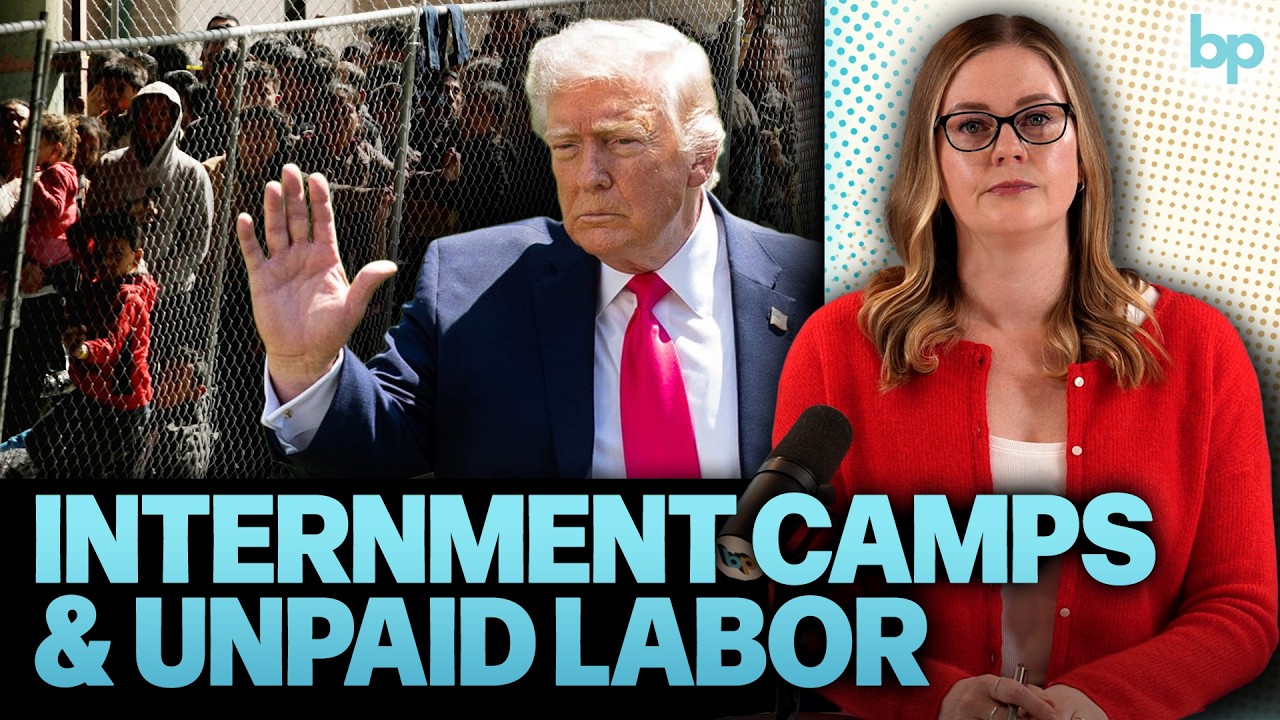
Brittany Page discusses Louisiana's HB 211, a new bill on its way to the Senate after passing the House, that criminalizes homelessness, creates internment camps, and authorizes mandated treatment that homeless individuals can pay for through unpaid forced labor. Brittany details how the Trump Administration and the Republican Party at large have been pushing bills like this across the country in an effort to criminalize poverty and homelessness, and what we can do collectively to fight the injustice.
HARD LABOR 1- 2 YRS
---
AHA doh: 3 26
FLYNN WANTED MIL TO GRAB BALLOTS/VOTING MACHINES; TRUMP T2 IS USING DOJ LAWFARE RETALIATION NO RULE OF LAW TO DO IT; SHERIFF / OATHKEEPER COPYCAT TO PLEASE DEAR LEADER, BUT BUILDS CRED FOR BIG LIE ~ 2026 MIDTERMS
AN 3 26
In Riverside County, California, Sheriff Chad Bianco — a Donald Trump supporter and former Oath Keepers member who is running for governor of California as a Republican — recently announced that his department had seized 650,000 voting ballots cast in a 2025 election. Bianco, at a, told reporters, "This investigation is simple: Physically count the ballots and compare that result with the total votes reported.""
MS NOW's Steve Benen, in an opinion column published on March 24, argues that Bianco is conducting an "investigation that appears entirely baseless" and could be used as a "template" for MAGA Republicans to challenge election results they don't like.
"For those inclined to be charitable," Benen explains, "there is a relatively benign interpretation of these developments. It's possible, for example, that Bianco is simply trying to generate attention for his longshot gubernatorial candidacy. Relatedly, the sheriff likely realizes that ballot seizures will please the White House, which in turn, may lead to greater institutional support from his party in the coming months. The move, in other words, may very well be little more than an elaborate campaign stunt that will have little practical impact and will be largely forgotten after Bianco loses. But then, there are the less benign interpretations of what transpired."
The "Rachel Maddow Show" producer notes that Bianco's investigation "comes on the heels of Trump sending the FBI to seize election materials in Georgia in response to other assorted conspiratorial complaints."
"The broader concern is that a template is taking shape, offering precedents for law enforcement to start making plans to seize ballots in areas nationwide — after or even during official counts," Benen warns. "What's more, the more frequently this happens, the more Americans may be led to believe it's normal and routine for law enforcement officials to seize and impound ballots — despite the fact that this is neither normal nor routine."
---
The Trump administration is using secretive orders to crackdown on dissent
SARAH MCL
Imagine finding out that the government is issuing secretive orders to unearth your personal information and then sending federal agents to question you — all because you sent an email criticizing the life-or-death decisions the government makes.
That sounds like something out of China, Russia or the increasingly dystopian United Kingdom, right? Well this time, it’s happening here.
The Trump administration is reportedly abusing oversight-free administrative subpoenas to chill protected speech. Recent targets include a man who sent an email criticizing efforts to deport an Afghan man on humanitarian parole seeking asylum.
Our right to express ourselves, particularly in ways that displease the government, is under attack — sometimes echoing authoritarian censorship efforts abroad.
While subpoenas have been used to chill speech across numerous presidencies, the way this administration is using them, and the broader repressive pattern they are part of, should disturb all Americans. As The Washington Post reported this week, a Philadelphia-area retiree wrote an email to a federal prosecutor last year asking him to “[a]pply principles of common sense and decency” to the deportation case of an Afghan man, who feared death at the hands of the Taliban. Only the retiree’s first name, Jon, is given, as he fears for his safety.
Only hours later, to Jon’s shock, he received a notice from Google that the company had received a subpoena compelling the release of identifying information, including older account activity and his physical address. The Department of Homeland Security issued an administrative subpoena, which doesn’t require the oversight of a judge or grand jury, to get Jon’s information. DHS attempted a similar stunt to target internet commenters who posted about Immigration and Customs Enforcement.
That was not Jon’s only brush with DHS. Agents would also soon show up at his door with a copy of the email he’d sent and ask him to explain himself.
There is no better guarantee of the right to speak and criticize our government than the First Amendment, which stands as guard between us and the power of the state. But our right to express ourselves, particularly in ways that displease the government, is under attack — sometimes echoing authoritarian censorship efforts abroad. Americans must understand that with enough time and pressure, even the strongest of foundations can weather down to dust.
These administrative subpoenas intended to unmask critics of government action are just the tip of the speech-chilling iceberg.
Between these disturbing allegations, recent alarming on-camera encounters between civilians and law enforcement and the ceaseless incursions from the Trump administration against our First Amendment rights, Americans must recognize that the United States is failing as a bulwark for liberty in a world increasingly bereft of it.
Alex Pretti’s death at the hands of federal agents in Minneapolis last month was deeply alarming. Rather than immediately commit to an intensive investigation of what took place, officials such as Secretary of Homeland Security Kristi Noem spread the unfounded claim that Pretti tried to “kill” law enforcement. Senior adviser Stephen Miller called Pretti an “assassin” who “tried to murder federal agents.” The administration has since started to shy away from these fantastical claims after Americans could watch the video for themselves.
Their narrative might still stand, however, had protesters nearby not caught the shooting on camera from multiple angles. But that First Amendment right to film law enforcement is increasingly under attack. DHS spokeswoman Tricia McLaughlin said filming and posting videos of ICE is “doxing our agents” and the government “will prosecute those who illegally harass ICE agents to the fullest extent of the law.” Pretti himself had been recording agents with his cell phone moments before he was killed.
U.S. federal agents also appear to be creating a database to track protesters and observers who are legally and peacefully exercising their First Amendment rights. In an encounter a woman filmed in Maine, an ICE agent told her he’s recording her information for a “nice little database” for “domestic terrorists” like her. A CNN report confirms a DHS memo informing agents to “capture all images, license plates, identifications, and general information on hotels, agitators, protestors, etc., so we can capture it all in one consolidated form.” News of this database follows in the footsteps of Attorney General Pam Bondi’s plan to crack down on “domestic terror organizations,” using a framework that targets broad ideologies such as “anti-Americanism, anti-capitalism, and anti-Christianity” as markers of political violence rather than constitutionally protected beliefs.
You may be familiar with lists of alleged anti-government activists from their other iterations in Belarus, Russia and China. The lists are frightening. What governments do with them is usually even worse.
The distance between freedom and tyranny is shrinking fast — and so is our window to combat it.
And many Americans were rightfully shocked by a “60 Minutes” exposé of German censorship last year, which included raids on the homes of social media users who had insulted politicians, and by regular reports from other nations such as the U.K., where a late-night knock at the door from police has become disturbingly commonplace. In Germany, the government treats insults to politicians more, not less, harshly than other forms of insult, essentially exempting the powerful from upsetting speech.
That’s the opposite of how we view political speech in the U.S. — with great power must come a thick skin.
But the Trump administration doesn’t see it that way. In fact, ICE and DHS leadership have undertaken a concerted effort in recent months to pervert the concept of “doxing,” the sharing of identifying information about an individual, into one so broad it includes simply saying the name of the men and women who serve as armed agents of the state. Administration officials have repeatedly — and wrongly — suggested this “doxing” is illegal.
Imagine a United States in which federal agents have the authority to fire their weapons as representatives of the government, and yet everyday Americans aren’t even free to state clearly who or where those agents are. Even worse, those same Americans may find themselves on a clandestine government database for engaging in protected speech. Or, like Jon, they could even face a secretive administrative subpoena followed by a knock at the door from DHS agents.
“Secret police” cannot be a necessary term in the American vernacular, but if we do not stem the tide of these First Amendment violations and transgressions, it may become one. The distance between freedom and tyranny is shrinking fast — and so is our window to combat it.
The post The Trump administration is using secretive orders to crackdown on dissent appeared first on MS NOW.
This article was originally published on ms.now
---
---
2 26
It's easy to feel like climate "doesn't matter" as the U.S. descends into fascism. As if climate and democracy are somehow separate issues. In this episode, researcher Oscar Berglund and journalist Amy Westervelt connect the dots between the global backlash to climate protest and the broader repression we're seeing in supposedly democratic countries around the world.
Amy: Hello and welcome back to Drilled. I'm Amy Westervelt. Obviously there is a lot to be outraged by and fearful of happening in the US right now. And as is the case whenever anything is happening outside of extreme weather events, there's a bit of a chorus right now chanting who cares about climate change?
:{:{Who cares about a far off problem when there are so many more urgent threats? It should go without saying, but I'll say it anyway: Anyone who cares about mitigating climate risk should absolutely be showing up to fight for democracy. The same administration that is shooting citizens in the street for exercising their First Amendment right is, after all, trying to get rid of the Environmental Protection Agency, the National Oceanic and Atmospheric Administration, and all of the protections that go along with them.}:
I would say that those of us who think the world should act according to the scientific evidence on not only climate change, but also air and water pollution, should be able to walk and chew gum at least as well as the goons intent on destroying the so-called "administrative state" in the U.S.}:
Giving a shit about the long-term viability of the human species is very much aligned with protecting your fellow humans on the streets today. There are also a whole bunch of ways that these issues directly intersect, one of which is the topic of today's show. From 2022 to 2024, we reported, wrote and produced an investigation into the increasing repression of climate protest around the world.
It was called the Real Free Speech Threat, a nod to the fact that while these supposed free speech warriors were worrying about cancel culture, governments were actually threatening political speech all over the world. The problem has unfortunately only gotten worse, and in many ways, the backlash to climate protest laid the groundwork for the way we're seeing protestors treated in the streets of Minneapolis and lots of other cities around the world today.
Last month I caught up with researcher Oscar Berglund, who recently released the first ever peer-reviewed study of the global repression of climate protest. Some of Drilled's reporting actually fed into that research, and I was curious to hear from Oscar what he and his team learned and how things have progressed in recent years.
It tells us a lot about not just the fight for a livable world, but also the fight for a just one. That conversation is coming up right after this quick break.
[music]
Oscar: I am Doctor Oscar Berglund, and I work at the School for Policy studies at the University of Bristol.
Amy: Tell me a little bit about this paper and what prompted you to write it? I was shocked when you, put it out and noted that it's the first, academic peer reviewed paper on repression of climate protests. 'cause I had seen, you know, like a fair bit of media coverage on that topic. It was surprising to me that there hadn't been more research on it. So I'm curious, why you think that is, and then what prompted you to wanna do this paper?
Oscar: Yeah, so the main reason why there isn't more research on this is probably that research, research is slow. Academic research is slow. And, you know, Drilled have obviously been really early on on reporting about this. And what this paper was the first of was kind of taking this kind of global, international perspective. And of course you have done that in your, reporting and Michelle Forst, you know, the UN Special Rapporteur certainly also takes a kind of international global perspective in writing about these things and talking about these things. So it's not like we're the first in the world to take this global, international perspective, but this is as far as I know, the first peer-reviewed publication to, to come out to do so.
And you probably remember, you know, I obviously have been kind of looking into these things for a couple of years now. You and I have talked about it before. And you know, we obviously give a shout out to your work
I suppose what brought me to study this topic in the first place is that I studied climate change activism. I studied, civil disobedience, very much the kind of wave of 20 18, 20 19, climate protests. And then during the pandemic, particularly in 2021, it became pretty obvious that there was a clamp down on protest, and therefore I started looking at that. And I think when we started this project, because we've been kind of doing this for two years here now, and when we started this, we started with a list very helpfully provided by you, which had laws, various laws in various countries or states that were criminalizing protest in various ways. So then we looked dug deeper into that. We've extended that list.
When you look at these new laws, you can see that they obviously have geographical differences. I think you can tell when places have extractive industries that there are certain types of protest tactics that are particularly targeted through new laws. So we can see this in Australia, for example, particularly with states that have extractive industries, or go harsher on things like lock ons and things that protesters might do at sites of extraction. And, there seems to be a fair bit of copy and paste, particularly in the US context, of these anti protest laws. But there's also, , a lot of kind of, local variation of what types of, protest is being criminalized.
And then we realized well actually, if we're talking about kind of repression, criminalization of climate protest, then those laws are just, one aspect of that criminalization.
And what we see perhaps much more is what we call here, the creative and strategic legal interventions, which is basically using or misusing laws created for a different purpose and, and using it against climate and environmental activists. Or changes to court procedures and so on, which you've seen loads of here in the UK where you know, you limit what can be said in courts, what kind of defenses can be used. I mean, now they're even trying to get rid of jury trials for certain kind of trials. 'cause juries are, more likely to, to find defendants not guilty then if you just have sort of judges making that decision. So that's one aspect. And then of course you have this third very important aspect, which is that most of the repression and criminalization that activists face is in relation to the police.
I mean, most of them don't end up in court. Right. So then, you know, looking at how is arrests used? How is surveillance used and harassment and other kind of forms of police violence? So for the report that came out a year earlier, and then the paper that came out last month, kinda looking at the data and actually see quite, you know, important and interesting differences in how the police police protest and climate and environmental activism, which shows us for example, that you know, France, you are much more likely to get violently attacked by the police.
:{:{The police are much more likely to use teargas or water cannons or other forms of police kind of violence against you than you are in a country like the UK or in most other European countries. Whilst, you know, in the UK and Australia you've had this huge amount of arrests, for example, which obviously is because you've had extinction rebellion and groups like that have kind of used arrest as a means of protest in a way. That is behind that data, but like still, it shows, you know, differences in policing practices, for sure. So, those three, three different categories all for us come under this kind of criminalization aspect.}:
And two of my colleagues that have written this paper with identify as criminologists. So they see themselves as criminologists. I'm more of a political scientist, and so is Chris who's another coauthor of the paper. And so if that's criminalization, then when we move over to the even darker aspects of this, which is, you know, the killings and disappearances which arrive in certain countries, then that's beyond criminalization, right? If you murder somebody, you're not criminalizing them.}:
That's, you know, so that's why we felt we needed, you know, criminalization isn't enough to capture this. We need repression. We need repression more broadly to capture all of this. And actually those killings and disappearances often follow the kind of harassment and surveillance that are part of police action,. And of course in many countries have state actors, whether it be military or police that carry out a lot of those killings. And then lastly, you know, something that you have covered a lot as well is that all of this is kind of justified and enabled by a constant vilification by media outlets, by politicians and on social media trolling, accounts and so on, of climate activists.
During the time that we've studied this, you know, you had the use of anti terror legislation against Les Soulèvements de la Terre in in France.
You had kind of organized crime legislation used against Letzte Generation in Germany and against Futuro Vegetal in Spain. So, you know, these are all European countries that are supposed to be the more democratic ones that use that kind of legislation, that obviously is not designed to be used against nonviolent activist groups.
Right. And in a way then, I mean, how is that different from what the Filipino state has been engaging in, in for a long time now, which is, you know, this, notion of red tagging where they label any activists that they don't like, they label them, you know, communist terrorists and then hence the red tagging, and therefore they remove a whole bunch of rights that otherwise they, they would have.
---
---
03/10/2025
by
- Tommy Christopher @ Mediaite: Trump Torpedoes Stock Market Concerns After Years of Touting Gains — Now Favors ‘100-Year Perspective’ on Economy
President Donald Trump waved away concerns about the stock market after years of touting it as a gauge of success — instead praising the “100-year perspective” that he says China uses.
- Destiny Herbers @ Flatwater Free Press: Omaha televangelist: A pastor allied with Trump. His church is booming – and buying serious real estate
Lord of Hosts’ leader prophesized President Trump’s return and called him anointed by God. He has fought how Nebraska allots its electoral votes. His congregation, and his power, are growing.
- Erica L. Green @ The New York Times: 'You Can’t Pin Him Down’: Trump’s Contradictions Are His Ultimate Cover
President Trump’s shifting positions and outright lies have presented the American public with dueling narratives at every turn.
- Andrew Kaczynski and Em Steck @ CNN: Deleted tweets show top State Department official spread false rumor about Rubio’s sexuality, called him ‘low IQ’
A top acting State Department official deleted at least half a dozen tweets that ridiculed his now boss, Secretary of State Marco Rubio, including ones calling him “low IQ” and repeating a false rumor about Rubio’s sexuality.
- Bob Smietana @ Religion News Service: Turned down by state, Oklahoma schools chief is out to raise funds for Trump-endorsed Bibles
Ryan Walters is looking for 55,000 Bibles, and he is seeking $60 donations for each of them. Walters, who is Oklahoma’s state superintendent of public instruction, has made national headlines for his efforts to get Bibles into the hands of public school kids in his state. After state officials earlier this week rejected his request for $3 million to buy the Bibles, Walters launched a fundraising campaign to buy copies endorsed by President Donald Trump, with the help of country singer Lee Greenwood.
- Jo Yurcaba @ NBC News: Texas bill would make identifying as transgender a felony punishable by jail
The bill, while unlikely to pass, highlights the increasing extremism of legislation targeting trans people, especially in Texas, in recent years.
---
an 1 23
Although Democrats generally performed much better than expected in the 2022 midterms, many civil libertarians and Democratic strategists have been warning that Republicans in state legislatures haven’t given up on voter suppression. Laws designed to intimidate voters, they warn, haven’t gone away.
Journalist Kira Lerner, in an article published by The Guardian GUK on January 17, takes a look at some of the voter suppression activities coming from Republicans at the state level in 2023.
“Republican lawmakers across the country have already filed dozens of bills that would restrict voting, including proposals in Texas that would increase criminal penalties on people who violate voting laws and enact a new law enforcement unit to prosecute election crimes,” Lerner reports. “The 2023 legislative session comes in the wake of an election that was described by many voting rights advocates as a triumph of democracy, despite the restrictive voting laws that were in place in 20 states for the first time last year.”
READ MORE: 'We can do better': Raphael Warnock schools Brad Raffensperger on voter suppression
Lerner continues, “Before this session, at least 26 states enacted, expanded or increased the severity of 120 election-related criminal penalties. This year, Republican-controlled legislatures plan to continue pressing for laws that they say would help prevent widespread voter fraud, a problem that voting advocates say does not exist but nonetheless continues to be alleged by Donald Trump and his allies. Several pre-filed bills would further criminalize voters and election officials, a trend that has been occurring across the U.S. in the past few years.”
Liz Avore, a senior adviser for the Voting Rights Lab, believes that many of the voting bills coming from Republicans in state legislatures are heavy-handed.
Avore told The Guardian, “We started seeing states introducing and moving and passing legislation that creates new criminal penalties or expands existing penalties for election-related crimes, in particular against election officials. A lot of these bills would criminalize good-faith errors by election officials. In other cases, they criminalize conduct that was previously legal or otherwise encouraged.”
Lerner notes that in Texas, “at least five pre-filed bills” would “raise the penalty for illegal voting from a Class A misdemeanor to a second-degree felony, punishable by up to two years in prison.”
“Under pre-filed bills in both chambers,” Lerner reports, “Texas would also launch an election police force similar to the one created by Florida’s Republican governor, Ron DeSantis, which has so far come up short of producing convictions or any evidence of widespread voting offenses. Texas’ law enforcement unit, led by state ‘election marshals,’ would be dedicated to prosecuting election and voting crimes…. Other bills in Texas would expand the attorney general’s authority to prosecute election crimes. One bill would allow the attorney general to appoint a special prosecutor for criminal voting cases, and another would allow the attorney general to issue civil penalties to local prosecutors who do not investigate voting crimes.”
---
---
see felony activ suppress desantis, SYG
---
And the GOP has embraced Hungary, and they really see Hungary’s present as America’s future. And so, Tucker Carlson, you know, had whole week of broadcasting there. And even Mike Pence, who’s not the most worldly person, trotted over to Budapest and talked about how he hoped that abortion rights would be taken away soon. So, Hungary is this model of white Christian supremacy, anti-trans, homophobic. It checks all the boxes of what the GOP is actually today.
AMY GOODMAN: Finally, we talk about him as a model and him modeling himself on autocrats around the world. But what about him as a model at home for people like Ron DeSantis, the Florida governor? You lay out, in a very chilling piece, this image of DeSantis surrounded by the people he wants to basically deputize as what his opponent in running for governor has talked about as his “secret police.”
RUTH BEN-GHIAT: Yeah, Ron DeSantis is an example — so, when you have somebody like Trump who imposes this kind of authoritarian party discipline, the system populates with mini-Trumps.They used to be called mini-Duces and mini-Hitlers, and now we have these mini-Trumps. And so, what we’ve seen is, in places like Texas and Florida, states are becoming laboratories of autocracy.
And DeSantis is particularly disturbing, because, you know, he wants to have his own civilian National Guard. And many states have those, but I discovered, doing research, that he’s also establishing an office for, quote, “election integrity,” which is code speak for election fraud, where it’s going to have its own prosecutors and investigators. So, anybody who — if there’s like an election result in the state that DeSantis doesn’t like, he can have his goons go after them and accuse them of violating election law. And they’ve made what used to be misdemeanors into felonies, so these people could be put in jail.So this is an example of the kind of authoritarian system at the state level that DeSantis has planned.
AMY GOODMAN: Ruth Ben-Ghiat, I want to thank you for being with us, expert on the psychology of authoritarianism and fascism. She is the author of Strongmen: How They Rise, Why They Succeed, How They Fall, a professor of history and Italian studies at New York University, and she publishes Lucid, a newsletter on threats to democracy.
---
---
see belated law and order dog whistle; kyle and arbery sorta proxy extra-judicial killings?
https://www.alternet.org/2021/11/wisconsin-bail/
xmas holiday mkt, so not political? kochs boast about crim just reform? recent left DA wins eg SF?
After an SUV plowed through a holiday parade in Waukesha, Wisconsin on November 21, killing five people and injuring 48, including many children, hard-right pundits treated the subsequent arrest of Darrell Brooks like a gift.
Jennifer Van Laar, the editor of popular conservative blog Red State, tweeted, "FIFTY PAGES in Darrell Brooks' criminal record. Drugs, violence, crimes of moral turpitude, sexual offenses. But hey, let's allow him to bond out on $1000 even though he's charged with jumping bail."
Alt-right troll Jack Posobiec and COVID-19 disinformation spreader Chuck Callesto echoed this idea. Turning Point USA's Benny Johnson went a step further, blaming Milwaukee District Attorney John Chisholm for the incident. So did Mike Cernovich, who ripped into Chisholm as a "Soros DA," despite Chisholm never receiving money from George Soros or his affiliated PACs.
DA Chisholm, as a writer at Red State put it, is allegedly a "radical leftist who has sought to institute 'criminal justice reform' via 'bail reform.'" It is insinuated that Chisholm quietly ushered Brooks out on a serious and recent domestic violence charge on $1,000 bail, then rolled it back in the media after the tragedy, claiming that his deputy prosecutor made a mistake (Chisholm has now launched an investigation into the Brooks bail decision).
Such commentators are in desperate need of a fact-check.
Wisconsin is not like California or New Jersey, which saw bail reform legislation pass in the last few years. It has not had a substantial amendment to its bail law in at least 10 years, according to the Wisconsin state legislature's website.
However, the current law does state that a judge can hold a person charged with a crime in jail pretrial "only upon a finding by the court that there is a reasonable basis to believe that bail is necessary to assure appearance in court."
Meanwhile, both chambers of the Wisconsin legislature have been dominated by Republicans every year in the last decade.
Besides which, if we look at bail reform on a statistical, rather than anecdotal, level, it does not reduce public safety. The vast majority of people facing charges return to court regardless of money bail. In addition, detaining people pretrial, effectively punishing poverty, is "criminogenic," because people lose their jobs and community ties are weakened.
"Money bail compromises public safety," according to analysis from the Prison Policy Initiative.
As Cernovich points out to support his cause, Chisholm has delivered criminal justice reform talking points. But Chisholm has rarely delivered anything on decarcerationbuttalking points. The Democrat, first elected in 2006, has spent much of his career carefully avoiding policies that would make right-wing opponents angry.
In 2017, for example, Chisholm explained how he refuses to categorically drop marijuana possession cases, despite many of his peers elsewhere doing just that.
Chisholm is also the orchestrator of a national strategy to increase the use of drug-induced homicide prosecutions to people who sell drugs as murderers, despite people who have overdosed often not wanting this response. He has sent Assistant District Attorney Patricia Daughtery to national conferences to evangelize these prosecutions. Daughtery has gone so far as to advise officials to build cases using tactics that are disrespectful to the same people she is supposedly trying to protect, such as using the cell phones of people who overdosed.
Additionally, during Chisholm's tenure, Wisconsin had the highest rate of Black incarceration in the nation, with about 65 percent of Black Wisconsinites living in Milwaukee County. University of Wisconsin law professor Ion Meyn has raised concerns that part of this is due to higher prosecution rates and lower plea bargain rates for Black suspects.
Amid Chisholm's middle-of-the-road approach to his office, Milwaukee has one of the highest violent crime rates in the country, with 1,332 incidents for every 100,000 residents. His attempt to please everyone and incense no one has achieved little, and there are numerous progressive steps he should be taking. Chances are, the politicization of the Brooks case will increase the DA's timidity and push him in the opposite direction.
---
---
421 whole bunch of voter and activist suppression bills in GOP red states
---
---
drilled
fines boost $150,000 but 10x for organizing (not even on site) 1.5 mil$
treas state...front montana
witchita regional CoC = koch
BP, exxon, API, trade groups; koch reg to lobby ark and alabama...https://drillednews.com/another-line-3-battleground-free-speech/...">We’ve covered the ongoing, fossil fuel-backed push to criminalize protest before. In 2017, Oklahoma passed the first of these bills, specifically citing the Standing Rock protest of the Dakota Access Pipeline in North Dakota. Then American Fuel and Petrochemicals Manufacturers (AFPM), the trade group for refineries and petrochemical facilities, crafted sample legislation based on the Oklahoma bill, and pushed the American Legal Exchange Council (ALEC) to adopt it. In 2020 , the Covid-19 pandemic slowed things down a bit, but in 2021 things are speeding up. In January, Ohio passed a bill that’s been debated for years, bringing the total number of states with so-called “critical infrastructure laws” in place to 14....hat’s defined as critical infrastructure varies a bit from state to state, but pipelines are always included; penalties range, too, but across the board these laws increase both the criminal and financial penalties of protest, potentially landing protestors in jail for years with fines up to $150,000. It’s worth noting that all of these states have trespassing and property damage laws already, it’s not as though those things have been going unpunished; the new laws merely make the consequences much tougher. They also add penalties for organizers and organizing entities. In Montana, for example, a proposed bill would fine organizations up to a million dollars for being involved in protest....All of which comes into play in Minnesota, where the fight against Line 3 is underway. There are currently six bills under consideration in the state, packaged into four legislative packages.If any of them pass, not only could protestors be facing stiffer penalties but also the organizations involved, most of them led by Native women, could find themselves slapped with large fines too.
In this interview, researcher Connor Gibson walks us through the origin of these laws, why they’re picking up steam, and what to expect this year...There’s only one state this year that really has a high profile pipeline protest going on, that’s Minnesota.<...>PBS News Hour: 30 years ago this week, the line three pipeline in northern Minnesota ruptured, spilling one point seven million gallons of crude oil into a frozen river near Grand Rapids, Minnesota. If the river had not been frozen, the oil could have seeped into the Mississippi River and contaminated drinking water for millions. Downstream protests have been ongoing to stop construction, rerouting a section of the line three pipeline, which could impact indigenous communities and local waterways.
Amy Westervelt: Hello and welcome to Drilled, I’m Amy Westervelt. You might have heard recently about the...Line 3 pipeline project in Minnesota. Some people are calling it the next Standing Rock because it’s been at the center of protests for years, particularly from indigenous tribes in the area. Activist and author Winona LaDuke has been involved in that fight for seven years. Here she is talking to PBS news about it earlier this month.<...Winona LaDuke: I’m a grandmother, you know, and we’re standing out there. I have six charges against me for this pipeline. And there’s a bunch of us that are facing charges for, you know, trying to be a water protector.
PBS News Hour: LaDuke and others have been part of this seven year fight opposing the project throughout the state and federal review processes....It is the largest tar sands pipeline in the world. This pipeline is the equivalent of 50 new coal fired power plants. So, you know, if you’re trying to save the planet, this is not the way to do it....Amy Westervelt: I couldn’t get to Minnesota myself. I’m not vaccinated yet, so I don’t want to impose myself on the community. Plus I have kids. But also this is one of those stories where I want to hear from local, and particularly Native journalists. I did want to see, though, whether the evolving Line 3 story dovetailed at all with something else I’ve been tracking: fossil fuel-backed anti-protest bills. I’ve written about this a few times. A bunch of other journalists have done some great reporting on it as well. There’s some good stuff in Huff Post and The Intercept. I’ll drop some links in the show notes for those of you who want to read more.<...These bills have been passed in 14 states now and proposed in about half the states in the country. They differ a little bit from state to state, but in general they increase the fines and jail time associated with trespassing dramatically. They often bump trespassing up from a misdemeanor to a felony. And they seem to be specifically targeting organizers and the organizations they work with, with steep penalties for organizing or training activists who then trespass. So even if the organizer isn’t there at the protest, they can still be charged.And it turns out there are six—six—anti-protest bills making their way through the Minnesota state legislature right now. Some of them are bundled together, so it amounts to four different legislative packages. But still, that’s a lot. And it’s important because on top of cracking down on pipeline protests, there’s growing concern that these bills will be used to quell other sorts of protests, too. And remember, Minnesota was ground zero for last summer’s Black Lives Matter protests in the days after police murdered George Floyd....to talk about Minnesota’s proposals, where these laws came from in general and how they’re moving through the country right now, I asked researcher Connor Gibson to join me. He’s been keeping tabs on these bills really since they started to pick up steam in the wake of the Standing Rock protests. That conversation coming up right after this quick break...it seems like all of a sudden the pace has picked up again, but I don’t know if that’s just like a feeling or if that’s actually what happened. So I’m curious to see what you’ve seen on that fron...Connor Gibson: Yes, it is the case that the fossil fuel infrastructure, anti protest bills are currently gaining steam in the 2021 legislative sessions of many states. I think the main difference between this year and last year is last year the pandemic really just messed up the strategy. We still saw plenty of bills and laws passed in twenty twenty. But I think it’s it was reduced by the impact of the pandemic, the confusion and cancelations and delays that caused the state legislature. So I suspect what we’re seeing in twenty twenty one is a lot of what companies intended to do last year. They just weren’t able to do as much as quickly as they would have liked. But that said, bills still passed into law during the pandemic in West Virginia and Kentucky. And this year we’re seeing more states continue the trend, including some states that failed to pass bills last year, like Illinois, like Alabama. And there’s only one state this year that really has high profile pipeline protests going on, that’s Minnesota, with the Line 3 revamp being done by Enbridge and being hastened along by many other players in the oil industry, so that makes the situation a little bit more relevant and urgent in Minnesota than in other states. I can’t tell you why Arkansas cares so much; its big pipeline resistance kind of happened a couple of years ago with the Diamond Pipeline,...Amy Westervelt:Connor, did that come into play in Oklahoma, too? Is it the same pipeline, the Diamond pipeline?...Amy Westervelt: Yep, it was. I checked. So in early 2017, local newspapers in Arkansas and Oklahoma were reporting that tribes, mostly in Oklahoma, did not approve of the Diamond Pipeline and that several Indigenous activists plan to protest it. There was a lot of hand-wringing about whether this would be the “next Standing Rock.” I’m noticing a theme here. In February 2017,Oklahoma Representative Scott Biggs proposed the anti protest billthat the rest would be based on. Here’s a bit of tape from that session. The person you’ll hear pushing Biggs for answers is Representative Cory Williams...">Rep Scott Biggs: This issue has definitely risen to the level of concern here in Oklahoma, giving our state status as an oil producer, energy producer and what’s going on in other states. So we took what happened or what bill we passed last year with the critical infrastructure bill regarding flying drones over refineries or Cushing or places like that. And we’ve now expanded that to provide some greater protection for those those critical infrastructures that are necessary for the state to operate. So the proposed committee sub basically lines out. Trespassing helps defines what critical infrastructure is and provides for some enhanced penalties for damage caused by trespassing...Rep Cory Williams: Thank you, Mr. Chairman. When I was looking through some of the definitions on this, and I am. A lot of them I can see, but a couple of them, I thought, well, that’s pretty open ended if we wanted to prosecute it just as railroad tracks. That’s that’s pretty open ended thing to consider to be critical infrastructure that would have this enhanced penalty along with it. I mean, I understand like a power generation facility and substations and things like that. I guess my question is twofold. Do you think that in a couple of these definitions might be a little bit open ended and allow some abusive prosecution? And then secondly, can you tell can you elaborate more on you said that this has risen to the level of a need. Can you describe the incident that there are incidents that have brought to the forefront?...Rep Scott Biggs: Answer your questions, number one. Absolutely not. I do not believe the prosecutors are abusive in their discretion and their role and their function to protect the state. I know you disagree with me on that. And we have for four years. But no, they’re not abusive in their discretion. No, I do not disagree, you know, agree with you that these definitions are open ended. I believe that if you have an issue with the rail industry, I’m pretty sure the rail industry could demonstrate how they’re vital to Oklahoma. You know, there in Cushing, just south of your district, is extremely vital. The oil gas industry for all the rail pumping in this crude oil, because the pipelines have been protesting, the pipelines have been built. So now they’re using rail to move that oil, to move those products into our state....Amy Westervelt: The Oklahoma bill was pointed to as the one that all the other bills were modeled after, but not without some help from the fossil fuel industry. In fact, industry reps were there the day Oklahoma’s bill was introduced. Ready to answer questions...Rep Cory Williams: in your last response, I didn’t actually hear you elaborate on the incidents. It was it just the pipeline incident or I don’t think they did damage to property, but obviously There,...I’m pretty sure they did a whole lot of damage to property in North Dakota....Yes, please join if you want to learn more. We actually have a meeting here at four o’clock today with some individuals from North Dakota that are here to talk to us, talk to the industry about what they’re having to deal with, the aftermath of those protesters up there as four o’clock and McBryde as sponsoring that open meeting to the public. But, yes, that is the main reason behind this.
Amy Westervelt: So there’s a bit of background on the origins of these bills. Now back to my conversation with Connor for more.
Amy Westervelt: OK, so actually maybe I’ll have you back up a little bit and give folks a brief sort of history of these bills that, you know, they sort of started to appear with the Oklahoma bill shortly after Standing Rock, and very much were a reaction to that protest.
Connor Gibson: Sure thing. I’m actually going to take us way back in time toSeptember 11th, 2001, terrible day in world history when the World Trade Centers went down and the Pentagon was attacked and the country was in a state of fear and confusion and very much ready to accept some draconian government restrictions in the name of our national security and not having to live through anything like that. Again, there were some industries that were starting to have this kind of conversation and the first more coherent discussion that I saw about critical infrastructure. And upping penalties for people that are trespassing on it or near it or certainly damaging any of the equipment, those conversations, as far as I can tell, were starting to happen in two thousand three, two thousand four. There was a law that was passed in Louisiana, Act one fifty seven, that set in motion the idea that there would be heightened penalties for trespassing on critical infrastructure sites. I don’t think oil pipelines were included efforts in that Louisiana law. They added that in twenty fifteen.
But at that point, some companies, including oil companies, started talking about this. And there is a group that’s similar to ALEC, but not nearly as captured and partizan called the Council of State Governments. It is a bipartisan consortium of state legislators. They do produce some model legislation in a way that’s similar to ALEC. But in addition to working in ways that are much more broad than Alec does a bunch of different kinds of legislative trainings and working groups on various issues, the Council of State Governments produced a a report that was financed by BP and others that embellished upon some of this. And then I couldn’t really tell you what happens between twenty six 2006] and twenty fifteen. As far as my research went, there didn’t seem to be any major events, but twenty fifteen. And this is before standing rock and before the Dakota Access Pipeline was being hotly protested, Louisiana started updating that critical infrastructure law that it had passed in 2004.
Amy Westervelt: Interesting.
Connor Gibson: And. It wasn’t until 2017 the end of the year, December, that the American Legislative Exchange Council ended up creating a model bill, which is just to say that there were some states starting to field test different avenues with which to restrict oil and gas. Protesters specifically including Alabama, including Michigan, including Washington, they just hadn’t taken coherent shape in terms of this play that we’re seeing now where it’s felony level penalties for people who are committing nonviolent acts of trespass, coupled with compounded fines and jail sentences, often for organizations or individuals who are found to be affiliated with those protesters. They don’t have to have trespass themselves. They don’t have to have damaged anything themselves. If they’re affiliated with somebody that did they wind up being charged in the first state to pass both of those things in a pretty clear and coherent way with Oklahoma in 2017. And that’s usually where the story starts in terms of people that are following and talking about the issue.
But I do think it’s important to know that it didn’t just explode randomly or not so randomly, but in reaction to standing rock, there was activity happening in a lot of these states leading up to that point. And in twenty seventeen things really became codified into the strategy that we’ve seen. It was later that year the American Legislative Exchange Council passed its model bill internally within itself at a meeting in December of that year. And there’s really there was some excellent reporting that was done that actually has really helped inform and understand how this trend took off. There was a letter that was written to the legislators who participated in that specific ALEC meeting in December 2017.
They had not yet approved this critical infrastructure felony law template law yet. And the American Chemistry Council, which is chemical manufacturers, lobbyists, and the Edison Electric Institute, which is electric utility lobbyists and theAmerican Fuel and Petrochemical Manufacturers, which is the refinery companies, in addition to Marathon Petroleum and the American Gas Association, which is gas utility companies, they all signed a letter to ALEC’s legislatorsand said, please make a model bill out of this, do it at this meeting, do it in the next few days. And they listed a bunch of reasons justifying why a law was needed. One of the examples used was the valve turners, a nonviolent protest that occurred in order to stop the development of the Keystone XL pipeline and and the the valve turners example was the only example that was used by these lobbyists to justify these laws that didn’t have to do actually with oil industry, ex employees or people suffering from serious incidents of mental illness, committing acts of sabotage against U.S. infrastructure. So much like we’re seeing with the Capitol riots, where George Floyd gets murdered by police, a bunch of time goes by. Republicans theorize about ways to punish the people who are reacting in outrage to the murder of black and brown people in this country by police officers. Then the Capitol riots happen. A bunch of white supremacists stormed the Capitol and now we’re going to be passing riot laws to go after Black people, essentially for the sins committed by white nationalists.
This trend in the oil and gas industry struck me as starkly similar there, justifying going after environmental protesters who are largely nonviolent, committing acts of civil disobedience in order to stop the fossil fuel buildout and blaming them with behavior that actually was had nothing to do with environmental activism.Some of the tribal groups in Montana who protested the bill that is currently making its way through that legislature a terrible, terrible bill, maximum sentence of 30 years in prison, max, fines of one point five million dollars. If you linked to somebody who was arrested under those offenses, it’s an individual protester in Montana would be subject to a max fine of one hundred and fifty thousand dollars, which is atrocious. That is way bigger than most of these states. The penalties in these states, which are draconian enough, tends to cap around like twenty or twenty five thousand dollars. Montana has upping it to one hundred and fifty thousand, but times ten if you are found to be a supporter of a protester arrested. And of course, Keystone XL cuts through at least one of the reservations in Montana. And I believe that’s the Flathead Tribal Reservation, the LAS. The bill was protested in committee by a lot of different indigenous peoples from different tribal nations and different native organizations, non-profits in Montana, and they were all concerned not only about the ongoing fight over Keystone XL, but just once the laws on the books, who knows what it will be used to punish people for in regard to any future infrastructure project that qualified for critical infrastructure.
Amy Westervelt: And it’s quite broad, right? The definition of critical infrastructure.
Connor Gibson: Yes. And I would have to look at Montana’s definitions again, because all of the states are a little bit different. But roughly following the trend that was set forth by the state of Oklahoma and by the American Legislative Exchange Council is model bill.It includes utility infrastructure, electric transmission lines. It includes pipelines of all kinds. That includes water infrastructure. Some of them include dams. The Louisiana levees was attempted to be added to the definitions last year, which failed gas compressor stations, refineries, export terminals. Pretty much everything you can think of that is dirty energy infrastructure qualifies as critical under this bill. Right.
Amy Westervelt: Right. I do wonder how much some of these laws could be used to tamp down on various other types of protests like the Black Lives Matter protests, some new research done, and I’m not sure if it’s out there yet or not around some groups that have been looking at what Gibson Dunn has done in response, both to indigenous tribes in Ecuador suing Chevron and to the standing rock protests against their client energy transfer partners and using RICO. I definitely hear echoes of in these in these anti protest laws, especially the recent ones where they’re going after the quote unquote organizers there.
Connor Gibson: It…the plot thickens, Amy, because in the bill that’s currently being considered in Kansas and it has already passed the Senate in Kansas, it actually has a hearing in the House tomorrow, which is March 17th. That bill includes a RICO provision and what I believe is the first overlap between corporations using racketeering, anti mafia laws to go after their critics or attorneys representing plaintiffs that inconvenience them or whatever it might be, an anti protest, the fossil fuel anti protest laws specifically, I believe RICO is also starting to creep into the broader trend of riot redefinition and protesting laws where you find the lowest common the common denominator way to accuse somebody of rioting and then you get to charge them with very, very serious felonies. And if some of these states succeed, potentially racketeering implication, as well as if civil disobedience is organized crime.
Amy Westervelt: In very simple terms, that is the attempt that’s underway: it’s to redefine civil disobedience as organized crime. And people should know that the RICO laws were created to to deal with the mob.
Connor Gibson: Yeah, I’m sorry. Just like the more extreme. And I don’t even want to use that word because there’s no explosions or violence or threats involved. But like an activist cutting a fence or throwing a carpet over the razor wire and trespassing or even shutting off a pipeline valve, I’m sorry. That’s not like walking into somebody’s store and breaking their kneecaps for not paying their dues that month or even nearly as threatening about that.
Amy Westervelt: Do you have a count of how many states have enacted these laws and then how many are sort of in play right now?
Connor Gibson: I do. OK, there are a total of 14 states that have so far passed the fossil fuel infrastructure, anti protest bills since twenty seventeen. The most recent one was in two thousand twenty one. But the the fight actually started years previous, and that’s Ohio. They just passed a law in January. That bill carried over from the previous year. After that, we’ve seen bills pop up in Minnesota for a grand total of six bills. I don’t know, they’re just really disorganized or what. Some of them are concurrent. So it’s really it’s basically four legislative packages in Minnesota in the form of six bills.
Amy Westervelt: That’s really interesting to me in the context of the Line 3 protests right now. Is there any sense that like the number of proposals or the movement on them recently is connected to some sort of reaction to that protest?
Connor Gibson: That’s a great question. I’m going to say my gut tells me yes, because in 2018 there was only one bill. In 2019 there were two bills. And I believe they were they might have been concurrent. And then 2020 there were also two bills. And then suddenly this year are six. There’s also there’s a little bit of difference between some of them. Some of the bills are more focused on the felonies for the individuals, including the loophole that you’re trespassing on a fossil fuel infrastructure facility with the intent to impede or inhibit or and another bill with the intent to disrupt the operation. I’m going to go ahead and say a aggressive prosecutor would slap me with a felony charge if I was sitting in front of a road because that would impede or inhibit the operation of the facility or disrupt the operation. So that’s like that’s where the loophole is. You’re right. They frame this as if it’s about property damage, as if it’s about violence. Guess what? All of that’s already illegal everywhere it has been. Right. All of this nation’s recent history and all of the state’s recent history. You can’t hurt people. You can’t blow stuff up. You can’t damage property, you can’t trespass. There are laws on the books to deal with those things. So what these bills really aimed to change, then the mills to the Minnesota bills illustrated well is that there is a loophole put in there that if you’re disrupting or interrupting the facility in some minor way, you’re on the hook for the same level felony offense that is normally reserved for somebody who is abusing or hurting another human being.
Amy Westervelt: Yeah, I think that’s a that’s a good way to put it. And an important thing for people to understand that it’s not like in the absence of these bills, there has just been a blanket permissiveness for trespassing and property rights.
Activists protesting you know, the people at Standing Rock in addition to getting blasted by the cops, water cannons and freezing cold temperatures and attacked by dogs and having their arms blown off by concussion grenades and stuff like that, like the people who are arrested, like trespassing in those situations. They do without having to get charged with things. And they do end up having to fight that out in court. And I know that for skeptics of like kind of protest culture and this like perhaps what’s seen as a really self-righteous liberalism to stand up for what’s right, that really irks some people. But I don’t think they think about how the people who engage in acts of civil disobedience really have a lot of shit to deal with after that happens. Or I’ll use myself as an example. Right. Like people are annoyed that somebody like me, this college educated white kid like goes and protest the Keystone XL pipeline in 2011 at the White House, which I did, there was a mass civil disobedience. We all got arrested. We went to jail.
We didn’t have to go to a cell. We just had to pay our hundred dollars and forfeit and we got to leave, you know, but in many of these situations, that is not what happens. You go to jail, you get held, you get out, you have to talk with lawyers. You have to show up for court hearings. Several months to several years of your life is potentially disrupted. Even if you don’t end up going to prison or paying thousands of dollars in fines, you would lose a lot of time and you lose a lot of money in order to take that principled stand. So it’s not just a bunch of spoiled kids that don’t have to deal with any consequence. And they’re really abusing, you know, major loopholes in our legal system. They are accepting those consequences. Right. Or the kind of higher calling and saying no more fossil fuel infrastructure is not OK. More oil spills are not OK, more disruption to the sovereignty of indigenous nations. Treaties we have violated over and over and over again is not OK.
Amy Westervelt: [00:27:22] OK, so you were saying there’s Minnesota, there’s four different legislative packages that are kind of in play in Minnesota.
Connor Gibson: Right. And they’re all aimed in differing ways that felonies for individual violators as well as going after people affiliated with them as well. So you don’t even necessarily have to commit the crimes. And this is so if you’re a Sierra Club or a Greenpeace or any other organization, maybe the American Civil Liberties Union and you’re you’ve been on email threads with these activists, it raises the question, are you liable for the crimes they commit? Like a fool I met could go do something like spray paint, a piece of equipment. And, you know, that just strikes me as exceptionally unfair that I can possibly held be held to account for that thing that I didn’t give permission to be affiliated with and I wouldn’t have recommended and yadda, yadda. So that’s a big problem with in Kansas. There is a similar bill, as I believe I said earlier, that is part. Out of one of the legislative chambers and it has a hearing tomorrow, there are some groups locally opposing it, Kansas Interfaith Action as testified against the bill, the Kansas Sierra Club has testified against the bill and showing up against them, of course, is the American fuel and petrochemical manufacturers, as well as the Wichita Regional Chamber. I’m going to go ahead and guess much means Koch Industries and Cessna. I don’t know who else in Wichita is a particularly large company. And I’m going to go ahead and guess that Cessna doesn’t care about this law. And the lobbyist did mention we’ve heard a lot from our members about this one. And I was like, yeah, I bet I can tell you which one.
Of the other bills, there’s one in Montana. That law is being supported again by trade associations that represent many of the usual suspects, TransCanada, Enbridge, Exxon Mobil. It’s the but it’s being done through groups that are not quite so, obviously. So in Montana, one of the groups that is supporting the anti protest law is called the Treasure State Resource Association of Montana State Resource Association, it turns out, represents oil and gas companies, among among others. I saw the American Chemistry Council is in there. Enbridge and Exxon Mobil are members in Montana Petroleum Association, also supporting the bill in Montana. And I believe it’s pretty much the same oil companies that are the members of the Montana Petroleum Association as well. The other states that are considering bills, Alabama and Arkansas. In Alabama, that bill has not yet moved. Arkansas’s bill has passed in the House and it’s working its way through the Senate. I could not tell you in either of those states who is advocating for it. If those states disclose that information, I haven’t been able to find it. They certainly don’t disclose it. And lobbying registrations, although I can’t say that Coke is registered to lobby in both of those states. I noticed.
And then the the kind of outlier, the state that I’m afraid will take a little too much interest for some of the wrong reasons is Illinois because a Democrat is sponsoring the bill in Illinois, and that has been the situation in Illinois since the beginning. So in Illinois as well as Wisconsin, there has been a. A different strategy than has been used in most other states, and that is the oil industry appeals to local trade unions, to the messaging in their hands. This is exactly what happened in Wisconsin. I’m not sure about Illinois. The American Petroleum Institute put messaging and talking points into the hands of the local trade unions who then lobbied Democrats in the legislature and championed the law that passed in Wisconsin and Illinois.
I suspect the trend is similar because just in the last 36 hours, in addition to Enbridge and the American Petroleum Institute and some Illinois based lobbying organizations, there are a lot of trade unions that have just signed on in support of the bill in Illinois. They’re supposed to be hearing today. And I heard that this bill was taken out of the calendar for discussion. I don’t I don’t know why I don’t have more details, but, yeah, it means I have no idea what direction the bill is heading towards. I don’t know if that indicates some sort of conflict or stall or if it’s just a there was some procedural reason why they delayed. But I would keep my eyes out for Illinois. They tried to pass a law in twenty nineteen. It went through one of the legislative chambers, but not the other. And and I’m sure they’re going to try and fight like hell again this year to get a law on the books, because this is a third year in the row that they’ve they’ve tried pushing bills in Illinois.
Amy Westervelt: Hmm. That’s interesting.
Okay thank you so much for spending spending this time with me.
:{:{:{:{}:
}:}:}:
===
===
:{:{:{}:
}:}:
https://www.alternet.org/2021/04/supreme-court-conservative/
js edit bd
In Friday's column, I said the Republicans seem to have frightened David Brooks, which suggests the party has frightened respectable white people, too. I consider the Times columnist to be representative of the conventional wisdom of that great globular middle of American politics. The more these people fear the Republicans, the better.
Today, I want to take this a step further. If I'm right in thinking that respectable white people are less willing to give the Republicans the benefit of the doubt, on account of most of them being okie-dokie with Donald Trump's attempt to overturn a free and fair presidential election, this is an ideal time to push them, by way of persuasion, to an important conclusion, to wit: conservatism has become a byword for barbarism.
Consider a recent decision by the United States Supreme Court. In Jones v. Mississippi, the court ruled a person convicted of murder while a minor does not have to be shown to be "permanently incorrigible" to be imprisoned for life without parole. In a 6-3 decision, the court's six conservative justices reversed years of progress in the courts to show mercy toward juveniles who had committed heinous crimes. The AP: "Justice Brett Kavanaugh, writing for the majority, said previous decisions only require a judge to consider 'an offender's youth and attendant characteristics' before imposing a sentence of life without parole. Kavanaugh rejected a more demanding standard."
In fact, Miller and Montgomery held that life without parole for juveniles was justifiable only in the worst of the worst cases—if the convicted person cannot be rehabilitated or, in other words, is "permanently incorrigible." Kavanaugh said his opinion was in keeping with those previous rulings, but it was a departure from them. He said Miller and Montgomery didn't require a more demanding standard, but, um, they did. Only Justice Clarence Thomas was honest. He said the old decisions were wrong anyway.
All this is made worse by the facts of the case. According to Slate's Mark Joseph Stern, quoting Justice Sonia Sotomayor's dissenting opinion, Brett "Jones was 'the victim of violence and neglect that he was too young to escape.' His biological father was an alcoholic who physically abused his mother, who had severe mental health problems. His stepfather abused him, too, using 'belts, switches, and a paddle.' He openly expressed his hatred for Jones. When Jones moved to Mississippi to live with his grandparents, he abruptly lost access to medication he took for mental health issues, including hallucinations and self-harm. Jones' grandfather beat him, as well." Twenty-three days after his 15th birthday, young Brett Jones stabbed his grandpa to death.
Jones was convicted after confessing to the murder. He became a model prisoner. His grandmother, the victim's widow, asked for his release. Jones met the criteria required by Miller and Montgomery. He had demonstrated corrigibility. So the court didn't only make a return to free and open society impossible for Jones. It handed judgment down on the idea of reform, to wit: that reform, however much a free and open society depends on it, is a delusion. No amount of rehabilitation will change bad people. Brett Jones' fate was sealed the moment he was born. That he was born into violence and suffering merely means he deserved it. As for jailing him for life, the court is just furthering a process begun by God, the only true source of goodness and mercy. If all that doesn't sound conservative so much as barbarous, that's because you're right.
That Kavanaugh, and presumably the rest of the conservative justices, were dishonest about whether or not Jones was in keeping with Miller and Montgomery suggests they know a ruling allowing juveniles to be put away for life without any chance of getting out is indefensible. They know Jones is going to get flak from legal activists on the right and the left, people who won Miller and Montgomery thanks to former Justice Anthony Kennedy. They know Jones moves in the opposite direction of democracy, but they are going to move that way nonetheless. Why? They can. They have the power. Because they have the power, they must be good. Otherwise, they wouldn't have it.
The Republicans benefit greatly from the word "conservatism." It sounds like just another school of political thought in free and fair competition with others. It sounds like a way of thinking about the world seeking to conserve the collective knowledge and traditional values of humanity for the sake of our progeny. But that's not the case. The Republicans abandoned democracy after the twin shocks of 2008, Barack Obama's election and the financial panic. Inside a democratic context, conservatism can be healthy. On the outside, it's not. Outside the rule of the majority, it becomes barbarism.
The Republicans used to worry about their national reputation for cruelty. That's why the campaign of George W. Bush invented out of thin air the popular concept of "compassionate conservatism." His politics would be more palatable to respectable white people who did not want to be seen supporting a candidate who'd punch down as president. Punching down, and enjoying it, has become the point of conservatism. This is what we need to press respectable white people into understanding clearly.
FROM YOUR SITE ARTICLES
- Here's the best reason to support Joe Biden now that so many are ... ›
- 'Delusions of fools': Conservative slams the GOP for 'beclowning ... ›
- Conservative Wisconsin Supreme Court justice sides with 3 liberals ... ›
RELATED ARTICLES AROUND THE WEB
- Supreme Court's liberals face a new era of conservative dominance ... ›
- Liberals in Congress and the White House have faced a ... ›
- Analysis: The Supreme Court hasn't been this conservative since the ... ›
:{:{:{}:
}:}:
===
===
https://www.alternet.org/2021/03/kentucky-senate-advances-bill-to-criminalize-insulting-police-as-critics-warn-it-could-cause-violent-response/
===
===
pro publ 1020
:{:{:{}:
}:}:
when Falling Behind on Rent Leads to Jail Time
Evictions in Arkansas can snowball from criminal charges to arrests to jail time because of a 119-year-old law that mostly impacts female, Black and low-income renters. Even prosecutors have called it unconstitutional.
by Maya Miller and Ellis Simani, with additional reporting by Benjamin Hardy Arkansas Nonprofit News Network...
===
:{:{:{}:
}:}:
===
:{:{:{}:
}:}:
https://www.alternet.org/2020/10/voting-rights-roundup-new-report-finds-felony-disenfranchisement-bans-5-million-people-from-voting/
:{:{:{}:
}:}:
===
===
https://www.alternet.org/2020/08/republicans-are-running-on-a-big-lie-and-its-getting-people-ed/
:{:{:{}:
}:}:
Covid-19 pandemic has resulted in a modest influx of New Yorkers to my town, which is located about 90 miles Northwest of the city. My new next-door neighbors just moved up from Brooklyn this month. As one of them told me the other day, they made the move because they are now able to work remotely, and it made sense to get out of the city because they could rent an entire three-bedroom house for less than they had been paying for a cramped two-bedroom apartment.
Speaking over the fence that separates our backyards, my new neighbor explained that because of the outbreak, she and her partner weren’t comfortable enjoying the city’s restaurants, nightlife and cultural attractions–those that remain open–and said, “there’s no point paying a fortune in rent to sit at home and watch Netflix.” They’re now considering getting a dog.
Crime didn’t enter the picture, and with good reason. According to NYPD data, there were 1,021 fewer major crimes in the city in June and July than there were during the same period in 2019. It’s true that there were 29 more murders, in a city of 8 million people, during those two months than there were last year–a figure promoted relentlessly by the conservative media–but there were also 39 fewer rapes, 107 fewer assaults and 284 fewer robberies.
Despite the uptick in homicides, likely a result of months of quarantine, the city is on pace to have 400 murders this year, which would be 270 fewer than New York experienced in the final year of Rudy Giuliani’s term as Mayor. Yet during the Republican National Convention, Giuliani claimed that “murders, shootings, and violent crime are increasing at percentages unheard of in the past."
having failed to contain a historic public health crisis and ensuing economic downturn, the Republican Party is running on a big lie, claiming against all evidence that “Democrat-led” cities are rife with crime and rioting and chaos, with fearful (white) residents fleeing in droves to safer locales in the suburbs. Every aspect of this storyline is completely divorced from reality.
America’s cities, like its suburbs and small towns, are struggling with the impact of the pandemic and are struggling with a severe loss of tax revenues resulting from lockdowns and from people not feeling safe going to bars and restaurants and shopping when their economies did reopen. Many residents of big cities, like those in suburbs and small towns, are struggling economically. These are real problems that are absent from the conservative discourse at present.
While the right mocks the very idea of peaceful protests, riots have in fact been scattered, localized and in many cases caused by overly aggressive policing, as you can see from videos collected by The New York Times. People are angry about racially discriminatory policing, but in many communities, it’s pretty clear that the cops are even angrier about being held accountable. Almost all of the turmoil in Portland has occurred in a small area around the federal courthouse after dark. The city isn’t on fire, and most Portland residents are living their lives unaffected by the protests. The dynamic has been similar in Seattle and other big cities.
Let’s also point out that most big-city governments are controlled by Democrats. That’s true of the safest and the most dangerous cities, the ones with the best and the worst finances and those with the most and least tension between cops and the communities they police–they’re almost all “Democrat-run.” Big cities are diverse, and Republicans rarely win elections in localities with significant non-white populations.
Also keep in mind that violent crime in the United States has seen a long and steep decline over the past 25 or so years. According to the Bureau of Justice Statistics, violent crime dropped by 71 percent between 1993 and 2018. Property crimes also fell by 69 percent over that same period. This is vital context for any short-term uptick in crime that some communities may be experiencing as we reopen our economies.
But this narrative that American cities are smoking ruins or are being destroyed by criminals and looters has become Trump’s–and the GOP’s–central argument for 2020, with Fox News playing clips of trash fires and windows being broken on a loop and the Republican National Convention lauding the heroism of a terrified white couple who waved guns at peaceful protesters.
We expect the parties to exaggerate and at times lie during campaigns,but at least in the modern era, no major party has run a campaign that is entirely divorced from any objective reality. In most cases, Republicans aren’t even bothering to offer any real arguments. During the convention, there was a throw-away line or two about Biden raising taxes, but that’s been pretty much been it.
And this relentless propaganda campaign is getting people killed. Hopped up on the belief that they’re saving the country from violent anarchists, the far-right has unleashed an enormous amount of violence and intimidation on Black Lives Matter protesters. The Huffington Post reports that “white vigilantes and far-right actors have shown up to oppose Black Lives Matter protests in the U.S. at least 497 times this year, according to data collected by Alexander Reid Ross, a doctoral fellow at the Center for Analysis of the Radical Right.”
The dataset, which Ross shared with HuffPost, documents a staggering amount of violence directed at protesters by the far-right, including 64 cases of simple assault, 38 incidents of vigilantes driving cars into demonstrators, and nine times shots were fired at protesters.
All told, six protesters were hit by vigilante bullets in this summer’s violence. Three died from their wounds.
Ross’ dataset also includes 387 incidents of intimidation, such as people using racist slurs, making threats and brandishing firearms.
“There just isn’t really anything to compare it to,” Ross told HuffPost. “I’ve never seen anything like this in my life.”
Such incidents are so common that they often don’t make national news. Last week, a Pennsylvania man shot and wounded a member of a group of people marching to Washington to protest without any preamble–there was no confrontation preceding the attack.And yet the incident didn’t make a ripple in the national news. And after the RNC celebrated the McCloskeys’ armed defense of private property, 17-year-old Kyle Rittenhouse traveled to Kenosha multiple times, ostensibly to protect a gas station, and committed violence against that city’s residents, culminating in the alleged murders of two of them.
And making matters worse is that Trump refuses to condemn the violence from the far-right because doing so would undermine his mendacious claim that leftists are responsible for a lion’s share of the mayhem. As Lilliana Mason, a professor of government and politics at the University of Maryland, pointed out, research “exposing subjects to quotes from Trump or Biden explicitly rejecting violence” has found that “when leaders reject violence, partisans reject violence. When leaders say nothing, partisans endorse violence.”
Donald Trump doesn’t have much to run on. His desperate attempt to shift the national conversation from the Covid-19 crisis and resulting recession to widespread chaos in American cities is a Hail Mary pass that’s getting people killed.
==
https://theintercept.com/2020/08/24/fbi-fusion-center-environmental-wind/
:{:{:{}:
}:}:
fEDERAL AND STATE law enforcement officers gathered in the Midwest in February 2019 to practice their responses to a fictional threat: wind farm sabotage. They divided into four teams and pretended to be the bad guys, environmental saboteurs targeting the large grids of turbines that turn the wind into electric power. The Federal Bureau of Investigation’s Omaha, Nebraska, field office and the Iowa Division of Intelligence and Fusion Center had organized the “red hat” exercise, meant to provide insight into the minds of environmental activist adversaries that didn’t exist.
:{:{:{:{}:
}:}:}:
Each team developed an attack plan. One proposed ramming wind turbine infrastructure with a vehicle. Another sought to plant explosives on electrical transformers. And — although U.S. environmental saboteurs tend to not use guns — two of the teams suggested using firearms to attack electrical substations from a distance. The fact that cops themselves planned the attacks may have created a “bias toward the use of firearms,” the FBI later acknowledged in a pair of reports on the exercise obtained by The Intercept. However, the federal agents also concluded that “Environmental Extremists Likely Would Use Firearms To Circumvent Perceived Electrical Infrastructure Site Security Measures.”
The exercise was not conducted due to any imminent threat — a carefully noted fact included in the December 2019 and March 2020 reports. “Neither FBI Omaha nor the Iowa DOI/FC has intelligence suggesting environmental extremists intend to attack wind farms in Iowa,” both reports repeatedly state.
Why, then, spend public dollars on FBI role-playing?Because the energy industry wanted it. The exercise came “at the request of an USBUS private energy sector partner, following 14 environmental extremist attacks against transportation infrastructure in Iowa that services the energy sector, particularly oil pipelines,” said one of the documents about the exercise. Privately owned and operated companies and industry groups — none of which were named in the reports — were intimately involved in the exercise: An Iowa utility company and a wind energy lobbyist group provided information to help judge the fake attack plans and assess the fake “threat environment,” and an industry representative joined two of the teams, posing as an insider accomplice.
Though there was no indication an attack on wind power sites would occur, the report went on to say, if one hypothetically did, it could proliferate into many, with each set of attackers becoming more skilled in evading security and capture. “As attack methods become more sophisticated,” the report warned, “the chance for large-scale failure of the electrical grid becomes more likely.” Law enforcement ought to be on the lookout for activists undergoing gun training,activists in rural locations with large infrastructure, and activists casing wind power sites, the report advised. Neither the FBI, the Iowa Division of Intelligence and Fusion Center, nor the federal Department of Homeland Security, which helps coordinate regional fusion centers, responded to the Intercept’s questions about the documents.
The red hat exercise was the product of a national network of public-private law enforcement and security partnerships forged in the wake of 9/11. The Iowa fusion center is one of 79 intelligence hubs like it, designed to enhance coordination between federal and local police as well as select private sector players. Given their close collaboration with corporate partners, the centers serve as a vector for transmitting industry interests to law enforcement.
Read Our Complete CoverageBlueLeaks
:{:{}:
The reports on the joint wind power security exercise were obtained by The Intercept as part of BlueLeaks, a massive trove of law enforcement documents hacked from government web sites and published by the transparency collective Distributed Denial of Secrets. The documents provide a detailed picture of how state, federal, and local law enforcement agencies have used the label “environmental extremist”to guide their policing. More than a dozen documents collected and disseminated by law enforcement fusion centers and reviewed by The Intercept describe the wild speculation, threat inflation, and close collaboration with the private sectorinherent in law enforcement’s pursuit of eco-activists branded as extremists.
With industry encouragement and cooperation, the FBI, Department of Homeland Security, and local law enforcement agencies have long kept a wary eye on activists organizing against energy projects. Government officials have slapped the label of “environmental extremist” on individuals who have locked themselves inside oil and gas pipelines, turned off the valves controlling oil flow, or physically damaged construction equipment — as well as a range of people who have shared viewpoints or had contact with such activists. The moniker serves to place Indigenous and environmental defenders linked to relatively minor property damage or civil disobedience in a category alongside white supremacists conducting mass killings. Both are officially declared “domestic extremists” for the federal government’s purposes.
}:
Information about such “environmental extremists” then gets shared, as it did in the wind power exercise, through the fusion centers, to both government officials and private sector partners. From the beginning, energy industry projects have received favored status and attention from the centers as “critical infrastructure.”
Brendan McQuade, a sociologist at the University of Southern Maine and the author of “Pacifying the Homeland: Intelligence Fusion and Mass Supervision,” said he had never seen anything like the Iowa fusion center documents. “It’s paranoid threat inflation and a totally indefensible depoliticization of what might be the most important political question of our time, which is, What are we going to do about climate change? This erases that question and views anyone who is seriously committed to it as criminal.”
“I’m worried about the way this will polarize the struggle and justify aggressive responses to direct action,” he said.
Mike German, a liberty and national security fellow with the Brennan Center, who formerly worked as an FBI agent, added that the collaboration with the private sector serves to misplace public resources. “There are many entities out there that are at possible risk of some kind of criminal act. And yet you don’t see community groups who are at a threat of white supremacy being invited by the FBI to talk about how they can protect themselves,” he said. “They’re spending security resources on hypothetical threats against favorite entities while ignoring real threats against other communities or private entities.”
The Elusive “Environmental Extremist”
“Environmental extremism” is among a handful of categories of so-called domestic extremism — including “racially motivated violent extremism,” “anti-government extremism,” “animal rights extremism,” and “abortion extremism” — that the FBI monitors closely.
Who exactly are these eco-extremists? Under a section titled “environmental rights extremism,” a November 2019reference guide to “violent extremism” published by the Colorado Information Analysis Center, a fusion center, and other state security agencies, which was released as part of BlueLeaks, lists a range of groups. Among others, they listed the animal liberation group Direct Action Everywhere, which has removed animals from factory farms in rescue actions, and the Earth Liberation Front, which had its heyday committing arsons in the ’90s. Also listed were East Boulder County United, a grassroots organization that promotes community consultation on oil and gas development; and 350 Colorado, the local chapter of a well-known national climate organization. Both groups have participated in and promoted nonviolent civil disobedience as a tactic to force public officials to appropriately address the climate crisis.
In a statement,Colorado Information Analysis Center spokesperson Micki Trost provided a justification for the labels, “We want to ensure that individuals have the opportunity to exercise their First Amendment rights in a safe and impactful manner,” Trost said. “We believe that information sharing on groups that have perpetrated crimes and disrupted peaceful protests helps local law enforcement better protect those that are lawfully exercising their First Amendment rights.”
According to an FBI and Department of Homeland Securitydocument, “environmental extremists” primarily target the “extraction, use, and transportation of fossil fuels.” BlueLeaks documents from various regional fusion and homeland security centers, as well as other federal agencies, point to an array of fossil fuel industry opponents, including the climate direct action group Extinction Rebellion; the Oglala Lakota opponent of the Dakota Access pipeline Red Fawn Fallis, who remains imprisoned after being accused of firing gunshots during a struggle with law enforcement at a Standing Rock protest; Arctic drilling protesters who chained themselves to a ship in Washington; and anti-oil industry activists, who shut off a pipeline by turning a valve.
the only recent U.S. incident listed in the documents that resulted in loss of life involved Rory Gunderman, who, according to the South Dakota Fusion Center and Wyoming Criminal Intelligence Center, wasassociated with the movement Deep Green Resistancebefore he allegedly attempted to carry out a plot in 2015 to shut down the power grid. After police attempted to apprehend Gunderman, he took his own life.
Indeed, in various documents law enforcement agencies underline something that many environmental activists have themselves pointed out: Unlike other types of extremism, “environmental extremism” is aimed at property, not people. One bulletin published by the FBI and DHS noted the threat that such activists pose has decreased over the years and is lower than other types of extremism. However, their “desire” to commit crime “has not waned.”
Nevertheless, authorities are keen to view “environmental extremists” as a major threat. An FBI memo urges partner law enforcement agencies to coordinate with the Bureau on any incident involving environmental extremism. Federal agents, the memo says, are interested in who is training “environmental extremists,” in addition to knowing which purported extremists are involved in domestic or international criminal organizations, where they have traveled, and how they communicate.
Protesters gather in front of San Francisco City Hall during a protest in solidarity with the Standing Rock Sioux Tribe against the construction of the Dakota Access pipeline on March 10, 2017.
Photo: Joel Angel Juarez/Anadolu Agency/Getty Images
And so law enforcement has continued to monitor activists’ activity, including through an online discussion forum, an environmental organization’s web site, and a bulletin that described how tactics utilized in the resistance to the Dakota Access pipeline could be repurposed against the Enbridge Line 3 tar sands oil pipeline in Minnesota, documents show.
To prepare law enforcement for encountering such alleged extremists, police attended trainings, including one offered in October 2019 by the Northern California Regional Intelligence Center. According to one of the documents, a flyer, the training would be led by Steven Stanley, a “certified anti-terrorism specialist” working for the Sigma Group who planned to cover a remarkable range of “domestic terrorism topics.” His focus would be on ideologically left-leaning viewpoints, including “Global Anarchist Activity, Social and Global Justice Groups, Anti-War Activists/Militants, Anti-Nuclear Activists/Militants, Anti-Pipeline Activists/Militants, Anti-Police Movement, AntifaMovement (Antifascists), Animal Liberation Activists/Militants, Eco-Terrorism, Radical Environmental Groups, Radical Unions, [and] Protests Protest Activity/Dynamics.” Stanley also promised to show attendees a “private collection consisting of 40 years of radical books, magazines, patches, stickers, clothing, pictures, videos, DVD’S and much more.” Fifty-eight people registered for the course.
German, the former FBI agent, said that the result of so much attention on environmental activists is visible in police’s response to protests. “We’ve had a variety of unruly protests by armed, far-right militia groups that the police react to in a very calm manner,” he said. “And yet when you see a group of environmentalists or people who might look similar to the way environmentalists at a protest look, you see a hyper-aggressive police response, even though the level of violence coming from those groups is significantly lower.”
Comparing Pipeline Activists to Al Qaeda
In most of the fusion center documents revealed by BlueLeaks, it’s the language of “extremism” that suggests that law enforcement officers perceive a common thread between environmental activists and violent militants. One document, though, explicitly applied the lens the U.S. military used on groups like Al Qaeda in Afghanistan and Iraq to community members opposing two natural gas pipelines in Virginia.
In September 2019, the Virginia Fusion Center issued a briefing titled “Criminal Environmental Groups Study and Adopt Militant Insurgent Strategiesto Advance Goals in Virginia.” The Atlantic Coast and Mountain Valley pipeline projects were in the midst of approval processes and under construction in the state at the time. A range of activists, environmental experts, and neighbors had organized to observe construction, file lawsuits, voice their dissent at public meetings, and hold protests — including a series of tree sits, where project opponents camped out in trees in the pathway of the pipeline.
The document concluded that “criminal environmental groups” organizing against pipeline construction would likely use the same four tactics as Al Qaeda: provocation, intimidation, protraction, and exhaustion.
Asked for comment, Virginia State Police Public Relations Director Corinne Geller explained to The Intercept: “This particular report was designed to provide regional law enforcement with an enhanced awareness of criminal activity that has been associated with various groups protesting environmental interests nationwide and worldwide. Sharing common tactics and strategies associated with criminal activity is invaluable to law enforcement agencies’ efforts to engage with and for the protection of local citizens/communities, as well as for the purpose of officer safety.”
Related
How a Movement That Never Killed Anyone Became the FBI’s No. 1 Domestic Terrorism Threat
Provocation was used by Al Qaeda, the fusion center report claimed, when militants destroyed the Al-Askari Mosque in Karbala, Iraq, in 2004 in an effort to set off a violent response in the majority Shia country toward the Sunni minority. (The mosque bombing actually took place in Samarra in 2006.) In turn, provocation, the document claimed, was also used by “criminal environmental groups” in 2016 in North Dakota, when private security contractors unleashed their dogs on Dakota Access pipeline opponents —the suggestion being that the Indigenous water protectors strategically incited the dog attacks to stir up conflict.
Insurgent groups use the tactic of intimidation, the document continued, by threatening violence against local community members who don’t submit to their cause. An individual associated with a “criminal environmental group” deployed a comparable tactic in Virginia, the document suggests, when they posted a comment on the Facebook page of a hotel that provided rooms to pipeline construction workers. “I hope that money lasts you for a lifetime because the people will be there every day making sure you never earn another dollar for the rest of your existence,” the comment said. The threat of protest was apparently comparable to a threat of physical violence.
The fusion center even quoted 9/11 mastermind Osama bin Laden describing his goal of exhausting the U.S. government by “bleeding America to the point of bankruptcy.” Then it went on to note that “criminal environmental groups” would likely try to exhaust law enforcement and private businesses’ resources by building camps and distributing “extremist propaganda” to residents impacted by construction. Although the document title suggested activists were studying these tactics, the fusion center provided no evidence that was so.
In small print at the bottom, the fusion center wrote, “This document is not designed to compare criminal environmental groups to al-Qa’ida and associated movements” — despite the fact that it did exactly that.
The report repeatedly cited the book “The Accidental Guerrilla,” by David Kilcullen, a senior counterinsurgency adviser to the U.S. during the wars in Iraq and Afghanistan, as a source. “Overall, in terms of content, the document doesn’t strike me as objectionable,” Kilcullen said when asked to comment on the document. “I am sure if they knew it was going to be leaked the authors might have framed the language differently, but it is an accurate reflection of how things work in these kinds of situations.”
In a recent article for theFoundation for the Defense of Democracies, a neoconservative Washington think tank where he is an adviser, Kilcullen argued that, in the wake of the murder of George Floyd, the U.S. might considered as being amid an “incipient insurgency.” He told the Intercept, “What’s perhaps a bit confronting is that people are now applying that logic to the United States — but the shocking thing is not that this is inaccurate, but rather that it’s now an increasingly accurate way of thinking about what’s happening on our streets and elsewhere.”
McQuade, the University of Southern Maine sociologist, said that, although this document was distinct from other fusion center documents he’s reviewed throughout his research, it shouldn’t be viewed as an aberration. “This is an insight into how security professionals view politics,” he said. “When your job is to defend the status quo at all costs, it isn’t a ridiculous overreach to apply a theory for defeating an armed movement in a developing country that has been in a civil war for decades against a protest movement in a country that isn’t at civil war.”
The danger, German said, was that law enforcement officers might unthinkingly take the document seriously. “I would put myself in the place of a brand-new police officer trying to protect his or her community, and not having a deep background in terrorism research, receiving this document,” German said. “Now anybody doing any activism in my community, I would automatically perceive as a threat — not just a threat of engaging in civil disobedience or vandalism but actually a terrorist threat.”
The fusion center claimed some individuals would be recruited into Virginia’s “criminal environmental groups” through what the unnamed author called “accidental guerrilla syndrome,” a process that leads someone who normally would not join an insurgent group to fight alongside one.
State and local law enforcement monitor an anti-pipeline protest site to make sure that no attempts are made to give protesters food or water. The pipeline opponents are occupying trees high above the ground outside Roanoke, Va., to protest the Mountain Valley Pipeline Project on April 2, 2018.
Photo: Michael S. Williamson/The Washington Post via Getty Images
The proliferation of tree sits were signs that “accidental guerrilla syndrome” was already in the “contagion phase,” the document says. The memo pointed to Giles County, where tree-sitters with Appalachians Against Pipelines had gained support from neighbors, and Montgomery County, where a tree sit called Yellow Finch has been in place for two years. “If tree sits like these continue to develop, it may become more difficult for pipeline construction to continue and support for it may decrease,” the fusion center document concluded.
“If they can compare us to Al Qaeda, they can do anything to us,” said Dustie Pinesap, commenting from atop the Yellow Finch tree sit. “Last I checked we never picked up a Kalashnikov. We tend to see property damage or denial of use of property or any sort of damage or impeding of property rights as violent.”
Indeed, the document makes crystal clear that the fusion center conflated support for the projects with security. “Collaborative relationships between law enforcement and businesses, working with contractors or the energy companies may help identify criminal actors before violence or property destruction takes place,” the fusion center document says. It points to a suite of “counter insurgency strategies,” drawn from a Kunar Province road-building project in Afghanistan, that police — as well as the pipeline companies — could deploy to build community support.
“Organizations involved in pipeline construction” should consider “contracting local restaurants to provide lunch to pipeline workers each day,” the fusion center advises, in order to “spread economic engagement across the community.” Similarly, implementing the Kunar road’s “10 kilometer rule,” hiring workers within a certain radius of the construction zone, could “provide local residents a sense of pride and connection to the project.”
The pipeline companies might even consider a “youth employment campaign,” the publicly funded fusion center suggested. “If such a project was implemented in local Virginia communities, families would not support outside groups, individuals, or local opposition groups that hinder their children’s economic and skill gaining opportunities, much like the Afghan communities that rejected the Taliban and al-Qa’ida in their attempts to delay and disrupt the Kunar Road project because it directly affected their livelihood.”
“The constituency is clearly the private sector,” said McQuade, highlighting that the document’s goal did note even seem to be to protect the broader community that may be ambivalent about pipeline construction. “Those people are just pawns whose support needs to be won.”
German sees the fusion centers as captured by corporate PR campaigns seeking to portray themselves as victims of extremist violence. “Many of these are multinational corporations —they’re not even necessarily U.S. corporations — yet law enforcement seems to favor protecting them over their own communities,” German pointed out. “How many fusion center reports have we seen that document environmental damage done by criminal actions or negligent actions of corporations? Those are also criminal — those are within the jurisdiction of these law enforcement agencies — and arguably cost a whole lot more in economic damage to these communities than somebody turning a valve on a pipeline. Yet that’s not where we see law enforcement resources being spent.”
Law Enforcement Goes Don Quixote
Despite the comparisons to Al Qaeda and the descriptions of widespread monitoring of activists, several fusion center documents acknowledge that environmental defenders pose little threat to people — or even property. But intelligence analysts still had plenty of guesses about what might spark “environmental extremists” to commit so-called violence, defined to include property damage.
“Media attention given to related issues, such as exotic game hunting, may compel some individuals who had not been associated with the extremist movements to make threats of violence or commit other crimes,” a 2016 FBI report suggests.
The arrests of high-profile activists could also push people over the edge. When Ruby Montoya and Jessica Reznicek were arrested last October for using a welding torch to poke holes in the Dakota Access Pipeline, the FBI and DHS assessed that “it is possible environmental extremists may commit criminal acts potentially destructive of critical infrastructure, such as property damage, to express solidarity with those arrested in the near term.” However, the document adds, there existed “no specific targeting or threat information” suggesting that this was actually true.
In the eyes of some intelligence analysts, even Covid-19 provided potential spark for environmental extremism. A daily intelligence briefing by the New York Metropolitan Transportation Authority’s Interagency Counterterrorism Task Force provided analysis about how “Europe’s terrorists” might take advantage of the pandemic. “The Covid-19 outbreak could also lead to a rise of violent actions by the hands of environmental extremists. Economic difficulties, a lack of public support, and more urgent needs might thwart advances in the global warming agenda and interrupt green investments by national governments,” the document states. “Moreover, having witnessed the immediate environmental benefits due to radical actions like a global lockdown and economic disruption, eco-activists could be triggered to resort to violence.”
German framed much of the speculation as noise. “One of the problems with the buildup of these intelligence reporting platforms and the information sharing environment that was built after 9/11 was that they hired all these analysts who aren’t given a very specific mandate on what to report,” he explained. “They’re measured by the number of reports. After you’ve written about one problem in the criminal justice system, you run out of things to write about.”
Ultimately, the wind energy exercise in Iowa was inconclusive. The attacks might happen, or they might not: “Based on the Red Hat exercise, FBI Omaha and the Iowa DOI/FC estimated that, as wind energy projects become more common, there is a roughly even chance that attacks against wind energy assets in Iowa by environmental extremists will occur.” Even in the face of that analysis, though, the FBI declined to back down from its hypothesis: “The FBI’s official assessment is environmental extremists possibly will increase their criminal activity against the industrial wind industry.”
If anything, Germain said, the FBI’s foray into attacking windmills was counterproductive. “It is just dangerous for the FBI to be brainstorming ways for groups to attack private companies, putting that on paper, and then putting it in systems where it can leak out,” he said. “They created a security situation. This is a blueprint for how to attack wind turbines, and it doesn’t come from any terrorist group, it comes from the FBI.”
Down the road, police learning to view environmentalists as saboteurs could become a self-fulfilling prophecy. “It’s creating a likelihood that when there are more confrontations over energy infrastructure,” McQuade said, “that the response will be extremely punitive and will escalate the struggle.”
==
===
820
border Patrol Launches Militarized Raid of Borderlands Humanitarian Aid Camp
Ryan Devereaux
For the second time in two years, Border Patrol launched a raid against No More Deaths within days of the group releasing embarrassing information about the agency.
===
==
NB RR and others see overlap betweeen CRIM and MIL
:{:{:{}:
}:}:
==
https://www.alternet.org/2020/07/robert-reich-the-real-choice-is-social-control-or-social-investment/
:{:{:{}:
}:}:
Some societies center on social control, others on social investment.
Social-control societies put substantial resources into police, prisons, surveillance, immigration enforcement, and the military. Their purpose is to utilize fear, punishment, and violence to divide people and keep the status quo in place — perpetuating the systemic oppression of Black and brown people, and benefiting no one but wealthy elites.
Social-investment societies put more resources into healthcare, education, affordable housing, jobless benefits, and children. Their purpose is to free people from the risks and anxieties of daily life and give everyone a fair shot at making it.
Donald Trump epitomizes the former. He calls himself the “law and order” president. He even wants to sic the military on Americans protesting horrific police killings.
He has created an unaccountable army of federal agents who go into cities like Portland, Oregon – without showing their identities – and assault innocent Americans.
Trump is the culmination of forty years of increasing social control in the United States and decreasing social investment – a trend which, given the deep-seated history of racism in the United States, falls disproportionately on Black people, indigeneous people, and people of color.
Spending on policing in the United States has almost tripled, from $42.3 billion in 1977 to $114.5 billion in 2017.
America now locks away 2.2 million people in prisons and jails. That’s a 500 percent increase from 40 years ago. The nation now has the largest incarcerated population in the world.
Immigration and Customs Enforcement has exploded. More people are now in ICE detention than ever in its history.
Total military spending in the U.S. has soared from $437 billion in 2003 to $935.8 billion this fiscal year.
The more societies spend on social controls, the less they have left for social investment. More police means fewer social services. American taxpayers spend $107.5 billion more on police than on public housing.
More prisons means fewer dollars for education. In fact, America is now spending more money on prisons than on public schools. Fifteen states now spend $27,000 more per person in prison than they do per student.
As spending on controls has increased, spending on public assistance has shrunk. Fewer people are receiving food stamps. Outlays for public health have declined.
America can’t even seem to find money to extend unemployment benefits during this pandemic.
Societies that skimp on social investment end up spending more on social controls that perpetuate violence and oppression. This trend is a deep-seated part of our history.
The United States began as a control society. Slavery– America’s original sin – depended on the harshest conceivable controls. Jim Crow and redlining continued that legacy.
But in the decades following World War II, the nation began inching toward social investment – the Civil Rights Act, the Voting Rights Act, the Fair Housing Act, and substantial investments in health and education.
Then America swung backward to social control.
Since Richard Nixon declared a “war on drugs,” four times as many people have been arrested for possessing drugs as for selling them.
Of those arrested for possession, half have been charged with possessing cannabis for their own use. Nixon’s strategy had a devastating effect on Black people that is still felt today: a Black person is nearly 4 times more likely to be arrested for cannabis possession than a white person, even though they use it at similar rates.
Bill Clinton put 88,000 additional police on the streets and got Congress to mandate life sentences for people convicted of a felony after two or more prior convictions, including drug offenses.
This so-called “three strikes you’re out” law was replicated by many states, and, yet again, disproportionately impacted Black Americans. In California, for instance, Black people were 12 times more likely than white people to be incarcerated under three-strikes laws, until the state reformed the law in 2012. Clinton also “reformed” welfare into a restrictive program that does little for families in poverty today.
Why did America swing back to social control?
Part of the answer has to do with widening inequality. As the middle class collapsed and the ranks of the poor grew, those in power viewed social controls as cheaper than social investment, which would require additional taxes and a massive redistribution of both wealth and power.
Meanwhile, politicians whose power depends on maintaining the status quo, used racism – from Nixon’s “law and order” and Reagan’s “welfare queens” to Trump’s blatantly racist rhetoric – to deflect the anxieties of an increasingly overwhelmed white working class. It’s the same old strategy. So long as racial animosity exists, the poor and working class won’t join together to topple the system that keeps so many Americans in poverty, and Black Americans oppressed.
The last weeks of protests and demonstrations have exposed what’s always been true: social controls are both deadly and unsustainable. They require more and more oppressive means of terrorizing communities and they drain resources that would ensure Black people not only survive, but thrive.
This moment calls on us to relinquish social control and ramp up our commitment to social investment.
It’s time we invest in affordable housing and education, not tear gas, batons, and state-sanctioned murder. It’s time we invest in keeping children fed and out of poverty, not putting their parents behind bars. It’s time to defund the police, and invest in communities. We have no time to waste.
---
==
:{:{:{}:
}:}:
https://www.alternet.org/2020/02/trumps-secret-police-things-are-heading-in-that-direction/
:{:{:{}:
}:}:
===
what used to be crime? wrong kind of sex? helping runaway slaves? putting out water in desert for immigrants (jury 8-4, he's being RETRIED, drop conspiracy charge 719
===
:{:{:{}:
}:}:
===
not sure he deserves whistleblower name, but aha transparency --> CRIME
an 620
:{:{:{}:
}:}:
Trump threatens John Bolton with ‘criminal liability’ to keep him quiet
President Donald Trump on Monday claimed that any conversation between himself and former National Security Advisor John Bolton is “highly classified,” threatening his far-right former top advisor with “criminal liability”…
==
===
cdv antifa
:{:{:{}:
}:}:
https://www.alternet.org/2020/06/trump-and-his-regime-have-again-turned-crisis-into-an-opportunity-to-advance-their-neofascist-authoritarian-agenda/
:{:{:{}:
}:}:
In his 1838 Lyceum Address, a young Abraham Lincoln warned:
At what point then is the approach of danger to be expected? I answer, if it ever reach us, it must spring up amongst us. It cannot come from abroad. If destruction be our lot, we must ourselves be its author and finisher. As a nation of freemen, we must live through all time, or die by suicide.
In the year 2020, the United States in the Age of Trump has arrived at one such moment. Donald Trump is an authoritarian and a neofascist. Such a description does not need the modifiers of “apparent” or “would be” or “impending” or “inclinations” or “autocratic.”
That language is all too often deployed by journalists and others to soften the hard blows of the full and horrible reality that the United States is a failing democracy where Donald Trump is now only barely restrained in his anti-democratic behavior by the country’s now much weakened political norms, institutions and culture.
In his response to the protests and people’s uprising that was sparked by the savage killing of a black man named George Floyd by Minneapolis police officers, Donald Trump has fully graduated from “would-be tyrant” and “apparent authoritarian” to full-on membership in such a category of ignoble leaders,
just as Derek Chauvin snuffed out the life of George Floyd, Donald Trump has his knee on the throat of American democracy.
Because he is mentally unwell and lives in his own malignant reality, worships power in the service of his own fabulism, narcissism, ego and greed, lacks empathy and concern for other human beings, and is an authoritarian and a neofascist, Donald Trump is only capable of destruction. Healing and creation are anathema to him.
As such, Donald Trump’s response to the protests was to slur those Americans who are sickened by police thuggery and brutality and are therefore moved to force positive social change as being “thugs.” Trump also summoned his paramilitaries and street thugs to defend him at the White House by participating in “MAGA Night.”
Trump threatened to enforce martial law by invoking the Insurrection Act through which he would deploy at least 10,000 active duty soldiers to crush and “dominate” protesters.
Trump also threatened to attack the protesters outside of the White House with the Secret Service and their “ominous” weapons and “vicious dogs.” The protesters outside of the White House were shot with rubber bullets, choked with tear gas, and beaten by police and other law enforcement forces at Trump’s and William Barr’s command. Why? So that Donald Trump could have a photo op where he could look “strong” as he walked from the White House to St. John’s Episcopal Church across the street in what was a Christian fascist authoritarian spectacle.
The resulting images were supposed to be akin to Leni Riefenstahl’s Nazi propaganda film “Triumph of the Will” but instead Trump and his coterie looked like something out of an Ed Wood movie.
Donald Trump’s reaction to these protests was so dangerous and reckless and likely illegal that the country’s most senior military and civilian leaders decided to ignore his orders to unleash the United States military on the American people.
Lost in this maelstrom of events is how Donald Trump and his regime have again turned crisis into an opportunity to advance their neofascist authoritarian agenda. In response to the George Floyd protests, Donald Trump and Attorney General William Barr declared “antifa” to be a “terrorist organization.” Such a designation means that offering material support to antifaor perhaps even being a “member” is now a very serious federal crime.
In a master stroke unnoticed by most Americans, the Constitutionally guaranteed rights to protest, free speech, and criticize elected officials are imperiled. In total, by declaring “antifa” a terrorist organization Donald Trump has criminalized dissent by the American people (and others) against him.
The facts:
Antifa is not an organization. It is an organizing strategy and an ideology.
As Billie Murray, professor of communications at Villanova University and an expert on rhetoric and social justice, explained to Salon in a phone conversation, “Antifascism is self-defense. They believe they are protecting their community, they are defending their community from fascist organizing and violence.”
Murray also clarifies the false equivalencies that are often made by too many reporters and other members of the commentariat when they discuss and write about “antifascists”:
We have a history of fascist violence that has led to world war. You are forgetting your history when you are assuming that fascist organizing is just a bunch of crazy people. You allow it to be a non-problem in your mind.
Too many people assume that fascism died in 1945. We won the war. Mussolini is gone. Hitler’s gone. Franco’s gone. We’re good. That is absolutely not true.
The first antifascist groups started in the late 1940s by Jewish people who were walking around Germany and seeing fascists on the side of the street touting the same things that Hitler did. Those Jewish people said, “We were soldiers in this war. We won this war and this guy is still on the corner saying such things!”
Clearly, we did not get rid of all of fascism because it’s an ideology. You are never going to completely eradicate it even with a world war. I think people assume that fascism died and, therefore, is no longer a problem.
Then, when you have antifascists on the scene, you can say, “Well, what are they even fighting for? They must just want to engage in violence. They just are being crazy and they’re just crazy just like those other people.”
We talk about these right-wing fascists as being “hate” groups or something like that because fascism is supposed to be dead.
Contrary to Trump’s and Barr’s and the broader right-wing echo chamber’s lies and fantasies, antifa is not responsible for the violence which took place during the protests following George Floyd’s murder by the Minneapolis police. The FBI’s own data shows that violent acts such as arson, other property crimes, and physical assault was committed by local criminals who took advantage of the chaos, as well as “boogaloo” and other right-wing extremists.
As with “Obamagate,” “antifa” is an empty phrase, a type of signifier that can be made to mean whatever Trump and the right-wing disinformation machine want it to mean in the service of criminalizing Democrats, liberals, and progressives as somehow being “un-American.”
Trump and his agents use of “antifa” also represents the type of conspiracism and propaganda now rampant among American conservatives and other members of the right wing — and the resulting damage it has caused to American politics and society.
Writing at Business Insider, Sonam Sheth details how:
Paul Barrett, the deputy director of the New York University Stern Center for Business and Human Rights who released a report last year on how disinformation would affect the 2020 election, told Business Insider thatefforts to frame the George Floyd protests as “a violent leftist conspiracy” bear “all the earmarks of current-day disinformation.”
“The now-familiar elements include profuse social media posts of dubious provenance, flat-out falsehoods by President Trump, and deft amplification by right-wing figures on Fox News,” said Barrett, who is also the author of a newly released report on content moderation.
The theory that antifa is behind organizing the riots is the most prominent piece of misinformation flying around about the demonstrations, according to Zignal Labs, which tracked and analyzed certain types of mis- and disinformation connected to the protests.
Out of 873,000 pieces of misinformation linked to the demonstrations, 575,800 mentioned antifa, Zignal Labs told The New York Times.
The allegations gained traction after Trump tweeted on May 31 that antifa and other left-wing radicals were responsible for the violence. But they started bouncing around social media days earlier, according to The Times, which found more than 6,000 Facebook posts linking antifa to the protests that garnered 1.3 million likes and shares from May 25 to June 1.
On Thursday, the hashtag #exposeAntifa began trending on Twitter as the president and his allies continued amplifying the theory.
Legal scholars and others have warned that Trump’s decree against antifa is “unconstitutional“. That may in fact be true. However, Donald Trump, an authoritarian and neofascist, has no respect for the rule of law. “Unconstitutional” is increasingly no longer a useful analytical category.
What role does Trump’s and the broader right wing movement’s misrepresentation and weaponization of “antifa” fulfill?
By criminalizing antifa (which literally means “anti-fascist”), Donald Trump is announcing that he is a fascist. He is doing this through the façade of fighting against “terrorism.”
Trump and the right wing’s lies about antifa legitimates violence against Trump’s political enemies. The logic is simple: To support Donald Trump is to love America. Anyone who stands against Donald Trump or otherwise opposes him is, by definition, a member of antifa and a “terrorist.” It is good and right that terrorists are to be subjected to violence and ultimately destroyed to keep America “safe.”
Trump’s recent comments about Martin Gugino, a 75-year-old man who was pushed to the ground by members of the Buffalo Police Department, suffering a fractured skull while his blood poured out of his ear on to the sidewalk and police officers walked over him like he was human trash, is one such example.
On Tuesday, Donald Trump said via Twitter that: “Buffalo protester shoved by Police could be an ANTIFA provocateur. 75 year old Martin Gugino was pushed away after appearing to scan police communications in order to black out the equipment. @OANN I watched, he fell harder than was pushed. Was aiming scanner. Could be a set up?”
Trump and his followers feel no human care of concern for “protesters” like Martin Gugino because they are supposedly antifa members. In Trump’s authoritarian worldview protesters are enemies of the state who are to be destroyed.
Other Republicans have been even more clear and direct in their public claims that antifa members should be hunted down and killed.On Twitter, Florida Republican Matt Gaetz recently said, “Now that we clearly see antifa as terrorists, can we hunt them down like we do those in the Middle East?”
The criminalization of dissent by labeling anti-fascists as “terrorists” is a preview of how free speech and other rights will increasingly only apply to Donald Trump’s right-wing Christian followers.
Such an escalation is taking place in how the FBI and local police are now interrogating people who they detained during the protests sparked by George Floyd’s murder by the Minneapolis police.
The Intercept reports how:
Joel Feingold was in his apartment in Brooklyn when he heard the sound of police beating protesters outside of his building Wednesday night. Having spent much of the week in the streets joining the waves of demonstrations against police brutality currently sweeping the nation, Feingold rushed outside. He was swiftly tossed to the ground by a senior New York City police officer in a white shirt, thrown in a police van, and placed under arrest along with four other individuals for having ostensibly violated a recently imposed curfew on New York City residents.
Feingold and the others were taken to the NYPD’s 78th Precinct, where they were told that they were being cited for violating the city’s 8 p.m. curfew. It was there, Feingold told The Intercept, that they were interrogated by the NYPD and the FBI about their political beliefs and their reasons for participating in the nationwide protests — subjects that should, under the Constitution and local NYPD rules, be off-limits from law enforcement inquiries following an alleged curfew violation.
The Intercept continues:
After being processed and taken to a cell, Feingold said he and the three men he was locked up with were approached by two men in plainclothes. “One of them is from NYPD intelligence and the other is an FBI agent,” he said. Feingold said a third officer confirmed the affiliations of the two men as they were being discharged.The FBI agent’s line of questioning was clearly focused on his political views.
“We want to know who’s hijacking your movement and making it violent,” Feingold recalled the agent saying. “That is what he said verbatim.”
The FBI’s involvement in protest interrogations is part of an emerging pattern, New York City civil rights attorneys say, that seems to have followed Attorney General William Barr’s designation of the leaderless movement against fascism known as antifa as a domestic terrorist organization. President Donald Trump and his allies have repeatedly alleged that outside agitators affiliated with the movement are stoking violence and unrest across the country.
Donald Trump and the Republican Party’scriminalization of dissentby targeting antifa is also best understood as part of a much larger effort to undermine America’s multiracial secular democracy.
This effort consists of: Voter suppression, voter theft, and gerrymandering; attacks on the free press and journalists as being “enemies” and “fake news”; targeted harassment and threats against those reporters, journalists, professors, and other public voices deemed to be enforcing “political correctness” against conservatives and Trump supporters; Trump’s use of white supremacist and other right-wing paramilitaries and extremists to enforce his will through violence and intimidation obedience to Trump’s political-religious cult; legal threats against the news media if they dare to criticize Donald Trump; and an effort to punish Twitter and other corporations if they disobey Trump’s orders.
Donald Trump and his Republican Party also command a massive disinformation propaganda machine consisting of Fox News, the OAN network, social media, radio, television, print, film, websites and other digital means of circulating right-wing lies and propaganda more generally.
Writing in her 1951 book “The Origins of Totalitarianism,” political theorist and philosopher Hannah Arendt previewed the type of authoritarian movement that Donald Trump now commands:
Before they seize power and establish a world according to their doctrines, totalitarian movements conjure up a lying world of consistency which is more adequate to the needs of the human mind than reality itself; in which, through sheer imagination, uprooted masses can feel at home and are spared the never-ending shocks which real life and real experiences deal to human beings and their expectations. The force possessed by totalitarian propaganda—before the movements have the power to drop iron curtains to prevent anyone’s disturbing, by the slightest reality, the gruesome quiet of an entirely imaginary world—lies in its ability to shut the masses off from the real world.
There are many examples where Trump and his propagandists have created an alternate reality for members of their movement. These include: “antifa” and “Obamagate” and “Benghazi”; Trump was a “victim” and “exonerated” by the Mueller investigation; a “deep state conspiracy” exists against Donald Trump; and Joe Biden and his son Hunter Biden are the real “criminals” and “traitors” in the Ukraine extortion scandal and subsequent impeachment.
The truth and empirical reality as they exist must be silenced if the power of Trump and his movement’s malignant reality is to endure. Dissent is not allowed because the truth threatens the artifice of Trump and his movement’s “greatness.”
* * *
For three weeks, by the many hundreds of thousands (if not more) the American people have been protesting, struggling and engaging in both symbolic and corporeal politics where channeling the power of George Floyd’s death, they have faced down rubber bullets, tear gas, police batons, National Guard troops, militarized police, and literal loss of life and limb, in an effort to force a better and more just America into existence.
These protesters in this nationwide and now global people’s uprising against social inequality in its many forms are also braving death from the coronavirus. This is also true of black and brown and other Democratic Party supporters who have shown in Wisconsin and Georgia that they will wait for hours and days to vote — even during a pandemic — to remove Donald Trump, his regime and the Republican Party from power.
The birth of this new and better America will be painful. Those who engage in such a patriotic struggle are hope warriors.
Donald Trump, his Republican Party, and the other members of the right-wing power elite (and the corporatocracy) have been temporarily disoriented by these weeks of protests and people’s uprising.
Their response will be crushing. The empire always strikes back. Trump and his enforcers’ efforts to criminalize dissent will be amplified. The American people must not let themselves be cowed.
On Election Day 2020, the American people have a choice to make. Will they save the United States and its democracy by voting for Joe Biden, or will they commit national suicide by reelecting Donald Trump?
The American people will have to be their own heroes in the centuries-long story of defending and improving American democracy. In doing so they should heed journalist and political commentator Bill Moyers’ recent warning and advice that, “because truth is the foe he most fears, he has banned it from his administration and his lips. Yes, Bernie, you are right: the man in the White House has taken all the necessary steps toward achieving the despot’s dream of dominance. Can it happen here? It is happening here. Democracy in America has been a series of narrow escapes. We may be running out of luck, and no one is coming to save us. For that, we have only ourselves.”
:{:{:{}:
}:}:
==
===
intercept 320
Sam Biddle
ICE is using an algorithm to determine whether detainees should be released or not, but eliminated options for both release and bond.
==
==
220 intercept
New York Schools Gang Unit Pushes the Criminalization of Children
Alice Speri
===
:{:{:{}:
}:}:
https://www.alternet.org/2020/02/trumps-secret-police-things-are-heading-in-that-direction/
:{:{:{}:
}:}:
no lnx
:{:{:{}:
}:}:
Trump’s secret police? Things are heading in that direction
:{:{:{}:
}:}:
[President Donald J. Trump speaks with U.S. Customs and Border Protection officers coming in for their shift change, after President Trump attended a Roundtable on Immigration and Border Security Thursday, January 10, 2019, at the U.S. Border Patrol McAllen Station in McAllen, Texas. (Official White House Photo by Shealah Craighead)]
:{:{:{}:
}:}:
Written by John Stoehr, The Editorial Board February 18, 2020
:{:{:{}:
}:}:
I wrote this morning about the president’s new intimidation of sanctuary cities. He’s deploying 100 CBP agents, including BORTAC, which is a SWAT team for border security. The official goal is increasing deportations by 35 percent, but it’s pretty clear the aim is bullying local law enforcement into cooperating with federal authorities. I set the Times report in historical context, trying to explain, as I see it, how 9/11 sparked a chain reaction leading to what appears to be Donald Trump’s secret police force.
:{:{:{}:
}:}:
I end the piece by quoting Jenn Budd, a former Border Patrol agent turned civil rights activist, who reported a conversation she had with a former CBP official. She wrote:
:{:{:{}:
}:}:
Border Patrol does not believe they are a civilian law enforcement agency. They believe they are kin to the Marine Corps. They do not believe they are accountable to Congress, which is why they have no issues lying to them even while under oath.
:{:{:{}:
}:}:
They believe they are only accountable to … presidents like Trump. Border Patrol believes it is not required to answer to local police, FBI, CIA or any other law enforcement agency. They claim to be the “premiere” law enforcement agency, superior to all others. They say they will become a “national police force” to be used by a president to enforce laws even among citizens. (Italics are mine.)
:{:{:{}:
}:}:
Check out the whole thing here.
:{:{:{}:
}:}:
And while you’re there, please support my work by becoming a member!
:{:{:{}:
}:}:
Thanks. —John Stoehr
===
==
aha: state of exception/marginal is where criminalization and militarization (related) are deployed 1st (except maybe loss of privacy 1st surveillance)
eg
:{:{:{}:
}:}:
:{:{:{}:
}:}:
https://www.vox.com/2020/2/14/21138272/cbp-tactical-ice-immigrants-sanctuary-cities
:{:{:{}:
}:}:
:{:{:{}:
}:}:
===
===
an 220
gOP Missouri state rep proposes bill criminalizing public libraries’ drag queen story hours
===
:{:{:{}:
}:}:
surgery on minors is child abuse? drs can be prosecuted?
:{:{:{}:
}:}:
https://www.alternet.org/2020/01/project-blitz-is-producing-model-legislation-for-christian-nationalists
:{:{:{}:
}:}:
no lnx
:{:{:{}:
}:}:
Project Blitz is producing model legislation for Christian Nationalists
:{:{:{}:
}:}:
Written by Nancy LeTourneau / Washington Monthly January 24, 2020
:{:{:{}:
}:}:
You may have heard about legislation passed recently in Tennessee and other states which allows adoption agencies to discriminate against gay couples or families with whom they have religious objections. The fact that bills like that are being considered and passed by red states is no coincidence. They are the product of an organized effort being led by Project Blitz.
:{:{:{}:
}:}:
The first thing to know about Project Blitz is that it was launched in 2015 by the Congressional Prayer Caucus Foundation, the National Legal Foundation, and Wallbuilders. The latter is an organization founded by David Barton, the Republican operative and discredited historian who rejects the separation of church and state, claiming that the United States was founded as a Christian nation.
:{:{:{}:
}:}:
This project seems to have maintained a low profile until Fred Clarkson, who has been studying the Christian right for decades, came across their 116-page manual of model legislation in early 2018. As Clarkson explains, Project Blitz is to Christian nationalists what the American Legislative Exchange Council (ALEC) was to big business.
:{:{:{}:
}:}:
Many of the bills on [the Christian right] agenda are making news; some have passed key legislative committees or whole state legislative chambers, and some have already been signed into law. But what reporters, activists, and most legislators don’t realize is that many of these bills draw from an unusual package of 20 model bills included in a report assembled by a coalition of Christian Right groups for an initiative they call “Project Blitz.”
:{:{:{}:
}:}:
The bills are seemingly unrelated and range widely in content—from requiring public schools to display the national motto, “In God We Trust” (IGWT); to legalizing discrimination against LGBTQ people; to religious exemptions regarding women’s reproductive health. The model bills, the legislative strategy and the talking points reflect the theocratic vision that’s animated a meaningful portion of the Christian Right for some time. In the context of Project Blitz’s 116-page playbook, however, they also reveal a sophisticated level of coordination and strategizing that echoes the American Legislative Exchange Council (ALEC), which infamously networks probusiness state legislators, drafts sample legislation, and shares legislative ideas and strategies.
:{:{:{}:
}:}:
According to an analysis by Americans United for Separation of Church and State, state legislatures considered 74 bills that echoed model legislation from the Project Blitz handbook in 2018.
:{:{:{}:
}:}:
The strategy for this effort is built on dividing model legislation into three categories, depending on how much opposition each bill is expected to receive.
:{:{:{}:
}:}:
The first category, intended to appear the most innocuous, included bills to promote “In God We Trust” license plates (now offered in at least 20 states) and the display of the “In God We Trust” motto in public schools. (Some version of the display legislation has passed in at least 10 states.) The next batch of bills centered on emphasizing “Christian heritage” and “the importance of the Bible in history” to promote the notion that the U.S. is a Christian nation. The third category, which organizers noted might be “the most hotly contested,” sought to empower licensed professionals to deny health care and other services based on religious beliefs and to enable adoption agencies to reject adoptive families on religious grounds. (At least 10 states have laws that allow discrimination by child welfare agencies, most of which have been passed since Project Blitz launched in 2015.)
:{:{:{}:
}:}:
That is a veritable “slippery slope” approach to undermining the separation of church and state. Most people wouldn’t find it terribly objectionable to display the national motto in public schools—even though it wasn’t adopted until 1956 in response to the “red scare” of “godless communism.” But doing so opens the door to promoting religion in public institutions and paving the way for legislation in the second category.
:{:{:{}:
}:}:
Of course, the ultimate aim of these efforts is to arrive at legislation in the third category. Knowing that the courts will reject arguments based on “biblical principles,” Project Blitz advises a strategy that is even more offensive.
:{:{:{}:
}:}:
To this end, they claim that their model public policy resolutions “rely heavily on the research that demonstrates the deleterious physical and mental health effects of same-sex intercourse and gender identity ‘transformation’.”… In support of this, Project Blitz offers data they suggest shows that LGBTQ people tend to be diseased, dysfunctional or both—and that they pose a threat to children and to society.
:{:{:{}:
}:}:
Given that any so-called “data” they present is bogus, we need to name that kind of thing for what it is: unadulterated homophobia.
:{:{:{}:
}:}:
As we saw with ALEC, the best disinfectant against an initiative like this is to shine a spotlight on what is happening. Unfortunately, there still 12 states with GOP trifectas—where the Republicans control both houses of the legislature and the governorship. That is where this initiative is likely to be the most effective.
===
===
https://www.alternet.org/2019/12/they-loan-you-money-then-they-get-a-warrant-for-your-arrest/
They loan you money. Then they get a warrant for your arrest
Written by Anjali Tsui / ProPublica December 3, 2019
Cecila Avila was finishing a work shift at a Walmart. David Gordon was at church. Darrell Reese was watching his granddaughter at home. Jessica Albritton had pulled into the parking lot at her job, where she packed and shipped bike parts.
All four were arrested by an armed constable, handcuffed and booked into jail. They spent anywhere from a few hours to a couple of days behind bars before being released after paying a few hundred dollars in bail or promising to appear in court.
None of the four, who live in northern Utah and were detained last year, had committed a crime. They had each borrowed money at high interest rates from a local lender called Loans for Less and were sued for owing sums that ranged from $800 to $3,600. When they missed a court date, the company obtained a warrant for their arrest.
Avila was handcuffed and marched down the main aisle in the Walmart in front of customers and co-workers. “It was the most embarrassing thing,” said Avila, 30, who has worked at the store for eight years. At the time of the arrest, Loans for Less had applied to garnish her wages. “It just didn’t make any sense to me,” she said. “Why am I being arrested for it?”
It’s against the law to jail someone because of an unpaid debt. Congress banned debtors prisons in 1833. Yet, across the country, debtors are routinely threatened with arrest and sometimes jailed, and the practices are particularly aggressive in Utah. (ProPublica recently chronicled how medical debt collectors are wielding similar powers in Kansas.)
Technically, debtors are arrested for not responding to a court summons requested by the creditor. But for many low-income people, who are not familiar with court proceedings, lack access to transportation, child care options or time off, or move frequently and thus may not receive notifications, it’s a distinction without a difference.
Reese, a 70-year-old Vietnam veteran, said he missed a hearing because he couldn’t afford to put gas in his car. Gordon, 46, said he was never personally notified of the court date. Avila and Albritton, 32, said they couldn’t take time off work.
:{:{}:
}:
In Utah, payday lenders and similar companies that offer high-interest, small-dollar loans dominate small claims court. Loans for Less, for example, filed 95% of the small claims cases in South Ogden, a suburban city of 17,000 about a half-hour north of Salt Lake City on the interstate, in fiscal year 2018, according to state data.
:{:{}:
}:
Across Utah, high-interest lenders filed 66% of all small claims cases heard between September 2017 and September 2018, according to a new analysis of court records conducted by a team led by Christopher Peterson, a law professor at the University of Utah and the financial services director at the Consumer Federation of America, and David McNeill, a legal data consultant and CEO of Docket Reminder.
Companies can sue for up to $11,000 in Utah’s small claims courts, which are stripped of certain formalities: There are rarely lawyers, judges are not always legally trained and the rules of evidence don’t apply.
Lenders file thousands of cases every year. When defendants don’t show up — and they often don’t — the lenders win by default. Once a judgment is entered, companies can garnish borrowers’ paychecks and seize their property. If borrowers fail to attend a supplemental hearing to answer questions about their income and assets, companies can ask the court to issue a bench warrant for their arrest.
Arrest warrants were issued in an estimated 3,100 small claims cases during the period studied by Peterson’s team. Almost all of the warrants — 91% — were issued in cases filed by payday, auto title or other high-interest lenders. The number of people who are jailed appears to be small. The state does not track the information, but ProPublica examined a sampling of court records and identified at least 17 people who were jailed over the course of 12 months.
Most people scramble to meet bail to avoid being incarcerated. Others, like Avila, Gordon and Albritton, are booked into jail and held until they pay. They often borrow from friends, family, bail bonds companies and even take on new payday loans.
“Bail” has a different meaning in Utah than it does in other states — one that tilts the power even more in the direction of lenders and other creditors.In 2014, state legislators passed a law that made it possible for creditors to get access to bail money posted in civil cases. Prior to that, bail money would return to the defendant. Now, it is routinely transferred to high-interest lenders. The law has transformed the state’s power to incarcerate into a powerful tool to guarantee that loan companies get paid.
...
==
NB also black kids get arrested at school in way higher numbers:
:{:{:{}:
}:}:
https://www.alternet.org/2019/07/school-district-threatens-parents-their-children-may-be-put-in-foster-care-over-unpaid-lunch-bills/
:{:{:{}:
}:}:
School district threatens parents their children may be put in foster care over unpaid lunch bills
:{:{:{}:
}:}:
Written by David Badash / The New Civil Rights Movement July 20, 2019
:{:{:{}:
}:}:
A Luzerne County, Pennsylvania school district is under fire for sending letters to parents who owe money for their children’s lunches. The letters threaten that if the bills remain unpaid their children could be removed from their homes and placed in foster care.
:{:{:{}:
}:}:
“Your child has been sent to school every day without money and without breakfast and/or lunch. This is a failure to provide your child with proper nutrition and you can be sent to Dependency Court for neglecting your child’s right to food,” the letter reads, as NBC News reported.
“If you are taken to dependency court, the result may be your child being removed from your home and placed in foster care,” the letter (below) adds.
:{:{:{}:
}:}:
:{:{:{}:
}:}:
Andy Mehalshick
:{:{:{}:
}:}:
Foster Care fallout! More reaction today to a letter sent to parents in the Wyoming Valley West School District threatening to send their kids to Foster Care unless they make good on delinquent lunch bills. A State lawmaker weighs in. Eyewitness News. http://PAhomepage.com
:{:{:{}:
}:}:
View image on Twitter]
:{:{:{}:
}:}:
The school district solicitor, Charles Coslett, appeared gleeful over the letter, saying, “Hopefully that gets their attention, certainly did, think about it,” he told NBC News.
:{:{:{}:
}:}:
Related: School Cafeteria Confiscates Lunches From Hands of 40 Kids for Insufficient Funds
:{:{:{}:
}:}:
PAhomepage reports many are upset over the letter, and not just parents.
:{:{:{}:
}:}:
“It’s just not true. We do not remove children from families for unpaid bills,” Luzerne County Children and Youth Services executive director Joanne Van Saun told the newspaper. “I found it very disturbing. Upsetting. It’s a total misrepresentation, a gross misrepresentation of what our agency does.”
:{:{:{}:
}:}:
Luzerne County Manager David Pedri called it “a gross misrepresentation as to what we do. What you are really doing is weaponizing the good things we are doing in Luzerne County. I’m asking the school district to retract the letter.”
:{:{:{}:
}:}:
The school district is facing $20,000 in unpaid school lunch bills.
==
Charges Dropped Against Pregnant Shooting Victim Amid Outcry Over the Criminalization of Pregnancy
dn 719
===
we keep ticking off the boxes to fascism, but attacking political enemies certainly rate, not 1st time/ pro-immigrant activists deported? CRIMINALIZATION? "lock her up!"
https://www.alternet.org/2019/07/despite-arrest-by-homeland-security-79-year-old-immigrant-rights-activist-vows-to-keep-protesting-report/
===
==
OMFG
:{:{:{}:
}:}:
may 2017
:{:{:{}:
}:}:
Ruth Hopkins, Indian Country Today Media Network
:{:{:{}:
}:}:
https://truthout.org/articles/footing-the-15-million-bill-for-the-dakota-access-pipeline-s-private-army/
:{:{:{}:
}:}:
Last fall, the eyes of the world were fixated on Standing Rock.
Among the images burned into the brains of so many abroad were those of Morton County sheriff’s department, joined by law enforcement officers from across the country, bedecked in military gear and armed to the teeth, brutalizing defenseless water protectors for expressing their first amendment rights and freedom of religion. Eyes were opened when mercs sicced vicious attack dogs on women and children guarding sacred burial grounds with their lives. Folks thousands of miles away watched in horror as they witnessed concussion grenades being thrown into crowds and elders being maced in the midst of sweat lodge raids. People will never forget live stream video picked up by mainstream media, showing hundreds of civilians being shot with water cannons in subzero temperatures by a corporate police state army.Some photos of injuries were judged too graphic to post by social media, as they revealed a young woman with a near severed limb and another who’d been blinded in one eye.
This was not Iraq or Afghanistan. There was no foreign enemy invading our shores. These events occurred in the middle of the United States, on Lakota treaty lands; and the only thing these innocent people had done was dare to stand in the way of the Dakota Access Pipeline, the same one Bismarck, North Dakota residents rejected due to fears it would contaminate their water supply. This war zone created by Dakota Access and Morton County was meant to subdue Standing Rock residents and water protectors and force them to accept an unwarranted risk to their fresh water and the desecration of ancestral graves, under the barrel of a gun.
Here in the states, hundreds of Native Nations and the American public sided with Standing Rock. Scores came to camp along the shores of the Mni Sosa (Missouri River). Others rallied in the local cities, signed petitions, and called the White House. Millions were outraged by the injustice.
Yet who is paying for the corporate police state brutality I just mentioned? You are.
Senator John Hoeven (R-ND), who accepted money from Energy Transfer Partners (the company behind the Dakota Access Pipeline) and has been vocal in his support of both the Dakota Access Pipeline as well as the Keystone XL pipeline, has announced that North Dakota will receive $15 million in federal funds to reimburse the state for costs incurred as a result of militarizing Barney Fife and company while they pushed the pipeline through for ETP and engaged in the violent, forced removal of water protectors. Hoeven slid said monies into the Department of Justice’s budget as part of Fiscal 2017 funding legislation.
By the way, Hoeven sits on the Senate Appropriations Committee and is now the chairman of the Senate Committee on Indian Affairs.Welcome to Custer’s wet dream.
The distinguished Senator from North Dakota would have us believe his state was alone in its mission to extinguish #NoDAPL. Nothing could be further from the truth.
When Morton County requested backup, law enforcement officials from across the nation came to North Dakota via the Emergency Management Assistance Compact (EMAC). The Sheriff’s Association also showed up in full force.
New York Daily News writer Shaun King obtained audio where Energy Transfer Partners freely admitted that they worked closely with the Sheriff’s Association, and wow, did they ever. They became one and the same.
Water protectors who lived at camp can attest to ETP and law enforcement’s collusion and fraternization, but the record speaks for itself.
The Sheriffs’ Association has a $3.46 million budget, according to tax forms. Some of this funding comes from corporate sources, like TigerSwan. TigerSwan maintains offices in Iraq and Afghanistan. TigerSwan’s CEO is a former adviser to the multinational private security firm, Blackwater. Blackwater was founded by Erik Prince, a Trump campaign donor and the brother of Betsy DeVos, the US Secretary of Education. Besides funding the Sheriff’s Association, TigerSwan is in charge of Dakota Access intelligence and supervising overall security for the company. Tigerswan works for Dakota Access, while funding and partnering with the Sheriffs’ Association.
The Sheriff’s Association purchased military gear from the US Department’s Defense Logistics Agency thanks to the Defense Department’s 1033 program.Think corporate welfare for the defense industry.
Wait, there’s more. Energy Transfer Partners CEO Kelcy Warren offered to reimburse North Dakota and Morton County for costs due to defending the Dakota Access Pipeline.
So why are US taxpayers forking over $15 million to North Dakota?
Despite the fossil fuel industry’s wishes, America is not an oil company with an army. We should not be bankrolling our own oppression.
Incidentally, the Dakota Access Pipeline is not even operational yet, and it’s already sprung a leak in South Dakota, just southwest of the Lake Traverse Reservation. End this foolishness.
==
==
https://www.alternet.org/2019/04/the-grotesque-distortions-of-the-judicial-system-while-refusing-to-hold-wall-street-accountable-our-ever-deadlier-police-state-continues-to-criminalize-being-poor/
:{:{:{}:
}:}:
Editor’s note: New Haven, Conn., was hit by four days of protests last week after police gunfire wounded an African American woman while officers were investigating a robbery. In Charlotte, N.C., last Monday there were a number of protest rallies stemming from release of a video of police fatally shooting an African American man who had brandished a pistol at a restaurant. Amid ongoing public anger over police shootings of black Americans, Truthdig reposts an Oct. 22, 2017, column here in which Chris Hedges analyzes the issue and its causes. Hedges will return with a new column next week.]
:{:{:{:{}:
}:}:}:
None of the reforms, increased training, diversity programs, community outreach and gimmicks such as body cameras have blunted America’s deadly police assault, especially against poor people of color. Police forces in the United States—which, according to The Washington Post, have fatally shot 782 people this year [2017]—are unaccountable, militarized monstrosities that spread fear and terror in poor communities. By comparison, police in England and Wales killed 62 people in the 27 years between the start of 1990 and the end of 2016.
Police officers have become rogue predators in impoverished communities. Under U.S. forfeiture laws, police indiscriminately seize money, real estate, automobiles and other assets. In many cities, traffic, parking and other fines are little more than legalized extortion that funds local government and turns jails into debtor prisons.
Because of a failed court system, millions of young men and women are railroaded into prison, many for nonviolent offenses. SWAT teams with military weapons burst into homes often under warrants for nonviolent offenses, sometimes shooting those inside. Trigger-happy cops pump multiple rounds into the backs of unarmed men and women and are rarely charged with murder. And for poor Americans, basic constitutional rights, including due process, were effectively abolished decades ago.
Jonathan Simon’s “Governing Through Crime” and Michelle Alexander’s “The New Jim Crow” point out that what is defined and targeted as criminal activity by the police and the courts is largely determined by racial inequality and class, and most importantly by the potential of targeted groups to cause social and political unrest. Criminal policy, as sociologist Alex S. Vitale writes in his new book, “The End of Policing,” “is structured around the use of punishment to manage the ‘dangerous classes,’ masquerading as a system of justice.”
The criminal justice system, at the same time, refuses to hold Wall Street banks, corporations and oligarchs accountable for crimes that have caused incalculable damage to the global economy and the ecosystem. None of the bankers who committed massive acts of fraud and were responsible for the financial collapse in 2008 have gone to prison even though their crimes resulted in widespread unemployment, millions of evictions and foreclosures, homelessness, bankruptcies and the looting of the U.S. Treasury to bail out financial speculators at taxpayer expense. We live in a two-tiered legal system, one in which poor people are harassed, arrested and jailed for absurd infractions, such as selling loose cigarettes—which led to Eric Garner being choked to death by a New York City policeman in 2014—while crimes of appalling magnitude that wiped out 40 percent of the world’s wealth are dealt with through tepid administrative controls, symbolic fines and civil enforcement.
The grotesque distortions of the judicial system and the aggressive war on the poor by the police will get worse under President Trump and [the now replaced] Attorney General Jeff Sessions. There has been a rollback of President Barack Obama’s 2015 restrictions on the 1033 Program, a 1989 congressional action that allows the transfer of military weaponry, including grenade launchers, armored personnel carriers and .50-caliber machine guns, from the federal government to local police forces. Since 1997, the Department of Defense has turned over a staggering $5.1 billion in military hardware to police departments.
The Trump administration also is resurrecting private prisons in the federal prison system, accelerating the so-called war on drugs, stacking the courts with right-wing “law and order” judges and preaching the divisive politics of punishment and retribution. Police unions enthusiastically embrace these actions, seeing in them a return to the Wild West mentality that characterized the brutality of police departments in the 1960s and 1970s, when radicals, especially black radicals, were murdered with impunity at the hands of law enforcement. The Praetorian Guard of the elites, as in all totalitarian systems, will soon be beyond the reach of the law. As Vitale writes in his book, “Our entire criminal justice system has become a gigantic revenge factory.”
The arguments—including the racist one about “superpredators”—used to justify the expansion of police power have no credibility, as the gun violence in south Chicago, abject failure of the war on drugs and vast expansion of the prison system over the last 40 years illustrate. The problem is not ultimately in policing techniques and procedures; it is in the increasing reliance on the police as a form of social control to buttress a system of corporate capitalism that has turned the working poor into modern-day serfs and abandoned whole segments of the society. Government no longer makes any attempt to ameliorate racial and economic inequality. Instead, it criminalizes poverty. It has turned the poor into one more cash crop for the rich.
“By conceptualizing the problem of policing as one of inadequate training and professionalization, reformers fail to directly address how the very nature of policing and the legal system served to maintain and exacerbate racial inequality,” Vitale writes. “By calling for colorblind ‘law and order’ they strengthen a system that puts people of color at a structural disadvantage. At the root, they fail to appreciate that the basic nature of the police, since its earliest origins, is to be a tool for managing inequality and maintaining the status quo. Police reforms that fail to directly address this reality are doomed to reproduce it. … Well-trained police following proper procedures are still going to be arresting people for mostly low-level offenses, and the burden of that will continue to fall primarily on communities of color because that is how the system is designed to operate—not because of the biases or misunderstandings of officers.”
In a recent interview, Vitale told me, “We’ve been waging a war on drugs for 40 years by putting people in prison for ever longer sentences. Yet drugs are cheaper, easier to get, and at a higher quality than they’ve ever been. Any high school student in America can get any kind of drugs they want. Yet we persist in this idea that the way to respond to the problem of drugs, and many other social problems, is through arrest, courts, punishments, prisons. This is what Trump is playing to. This idea that the only appropriate role for the state is one of coercion and threats—whether it’s in the foreign policy sphere or in the domestic sphere.”
Police forces, as Vitale writes in his book, were not formed to ensure public safety or prevent crime. They were created by the property classes to maintain economic and political dominance and exert control over slaves, the poor, dissidents and labor unions that challenged the wealthy’s hold on power and ability to amass personal fortunes. Many of America’s policing techniques, including widespread surveillance, were pioneered and perfected in colonies of the U.S. and then brought back to police departments in the homeland. Blacks in the South had to be controlled, and labor unions and radical socialists in the industrial Northeast and Midwest had to be broken.
The fundamental role of the police has never changed. Paul Butler in his book “Chokehold: Policing Black Men” and James Forman Jr. in his book “Locking Up Our Own: Crime and Punishment in Black America” echo Vitale’s point that the war on drugs “has never been about public health or public safety. It’s been about providing a cover for aggressive and invasive policing that targets almost exclusively people of color.”
“People often point to the London Metropolitan Police, who were formed in the 1820s by Sir Robert Peel,” Vitale said. “They are held up as this liberal ideal of a dispassionate, politically neutral police with the support of the citizenry. But this really misreads the history. Peel is sent to manage the British occupation of Ireland. He’s confronted with a dilemma. Historically, peasant uprisings, rural outrages were dealt with by either the local militia or the British military. In the wake of the Napoleonic Wars, in the need for soldiers in other parts of the British Empire, he is having more and more difficulty managing these disorders. In addition, when he does call out the militia, they often open fire on the crowd and kill lots of people, creating martyrs and inflaming further unrest. He said, ‘I need a force that can manage these outrages without inflaming passions further.’ He developed the Peace Preservation Force, which was the first attempt to create a hybrid military-civilian force that can try to win over the population by embedding itself in the local communities, taking on some crime control functions, but its primary purpose was always to manage the occupation. He then exports that model to London as the industrial working classes are flooding the city, dealing with poverty, cycles of boom and bust in the economy, and that becomes [its] primary mission.”
“The creation of the very first state police force in the United States was the Pennsylvania State Police in 1905,” Vitale said. “For the same reasons. It was modeled similarly on U.S. occupation forces in the Philippines. There was a back and forth with personnel and ideas. What happened was local police were unable to manage the coal strikes and iron strikes. … They needed a force that was more adherent to the interest of capital. … Interestingly, for these small-town police forces in a coal mining town there was sometimes sympathy. They wouldn’t open fire on the strikers. So, the state police force was created to be that strong arm for the law. Again, the direct connection between colonialism and the domestic management of workers. … It’s a two-way exchange. As we’re developing ideas throughout our own colonial undertakings, bringing those ideas home, and then refining them and shipping them back to our partners around the world who are often despotic regimes with close economic relationships to the United States. There’s a very sad history here of the U.S. exporting basically models of policing that morphs into death squads and horrible human rights abuses.”
The almost exclusive alliance on militarized police to deal with profound inequality and social problems is turning poor neighborhoods in cities such as Chicago into miniature failed states, ones where destitute young men and women join a gang for security and income and engage in battles with other gangs and the police. The “broken windows” policy shifts the burden for poverty onto the poor. It criminalizes minor infractions, arguing that disorder produces crime and upending decades of research about the causes of crime.
“As poverty deepens and housing prices rise, government support for affordable housing has evaporated, leaving in its wake a combination of homeless shelters and aggressive broken-windows-oriented policing,” Vitale writes. “As mental health facilities close, police become the first responders to calls for assistance with mental health crises. As youth are left without adequate schools, jobs, or recreational facilities, they form gangs for mutual protection or participate in the black markets of stolen goods, drugs, and sex to survive and are ruthlessly criminalized. Modern policing is largely a war on the poor that does little to make people safer or communities stronger, and even when it does, this is accomplished through the most coercive forms of state power that destroy the lives of millions.”
The accelerated assault on the poor and the growing omnipotence of the police signal our transformation into an authoritarian state in which the rich and the powerful are not subject to the rule of law. The Trump administration will promote none of the conditions that could ameliorate this crisis—affordable housing; well-paying jobs; safe and nurturing schools that do not charge tuition; better mental health facilities; efficient public transportation; the rebuilding of the nation’s infrastructure; demilitarized police forces in which most officers do not carry weapons; universal, government-funded health care; an end to the predatory loans and unethical practices of big banks; and reparations to African-Americans and an end to racial segregation. Trump and most of those he has appointed to positions of power disdain the poor as a dead weight on society. They blame stricken populations for their own misery. They seek to subjugate the poor, especially those of color, through police violence, ever harsher forms of punishment and an expansion of the prison system.
“We need an effective system of crime prevention and control in our communities, but that is not what the current system is,” Alexander writes in “The New Jim Crow.” “The system is better designed to create crime, and a perpetual class of people labeled criminal. … Saying mass incarceration is an abysmal failure makes sense, though only if one assumes that the criminal justice system is designed to prevent and control crime. But if mass incarceration is understood as a system of social control—specifically, racial control—then the system is a fantastic success.”
Click here to see Chris Hedges interview writer Alex S. Vitale.
===
https://www.alternet.org/2019/03/we-need-to-stop-the-criminalization-of-poverty/
...
RR: In addition to being a massive drain on the economy, these fees don’t even help cash-strapped cities. Uncollected court debt for traffic and criminal offenses totaled $12.3 billion in 2016 in California alone. A lotof the fee revenue that does come in goes to collection services, that are private and for profit. Which means very little of the money that is collected winds up going to roads, bridges, schools, and other good things we all need.
WKB: That’s why we need to stop the criminalization of poverty. Have you heard of win-win? Well, this is lose-lose, non-win. It sucks. It’s bad for EVERYBODY.
RR: Bad for poor people, bad for the social fabric, and doesn’t even help the bottom line for government.
WKB: Our home state of California is helping to lead the charge to stop the criminalization of poverty. Go to CAdebtjustice.orgfor more information. Go. Don’t just watch the video. Go.
==
===
tear gas started as WWI weapon kpfa book 1848 commune? fr 1st to use in ww1.
:{:{:{}:
}:}:
https://kpfa.org/episode/letters-and-politics-november-26-2018/
==
==
==
by Melissa Sanchez, ProPublica , and Elliott Ramos , WBEZ
Now, a former official regrets the move and wants the city to revisit it. Some policies, she said, are “terrible.
==