PRISON IND COMPLX 2 PIC
see main and pic tag
SEE MASS DEPORT
SEE PVTIZATION BLACKWATER
capt 717
disaster cap'l
see divest 2
see ALEC
===
STOCKS SHOT UPON TRUMP WIN 11 24
-=-=
-=-=
NYT 8 26
Aug. 21, 2026,
A private prison company donated $1.4 million to President Trump’s PAC after getting government contracts.
=-=-=
-=-=
Republican Jim Crow Homeless Bill Brings Back Convict Leasing
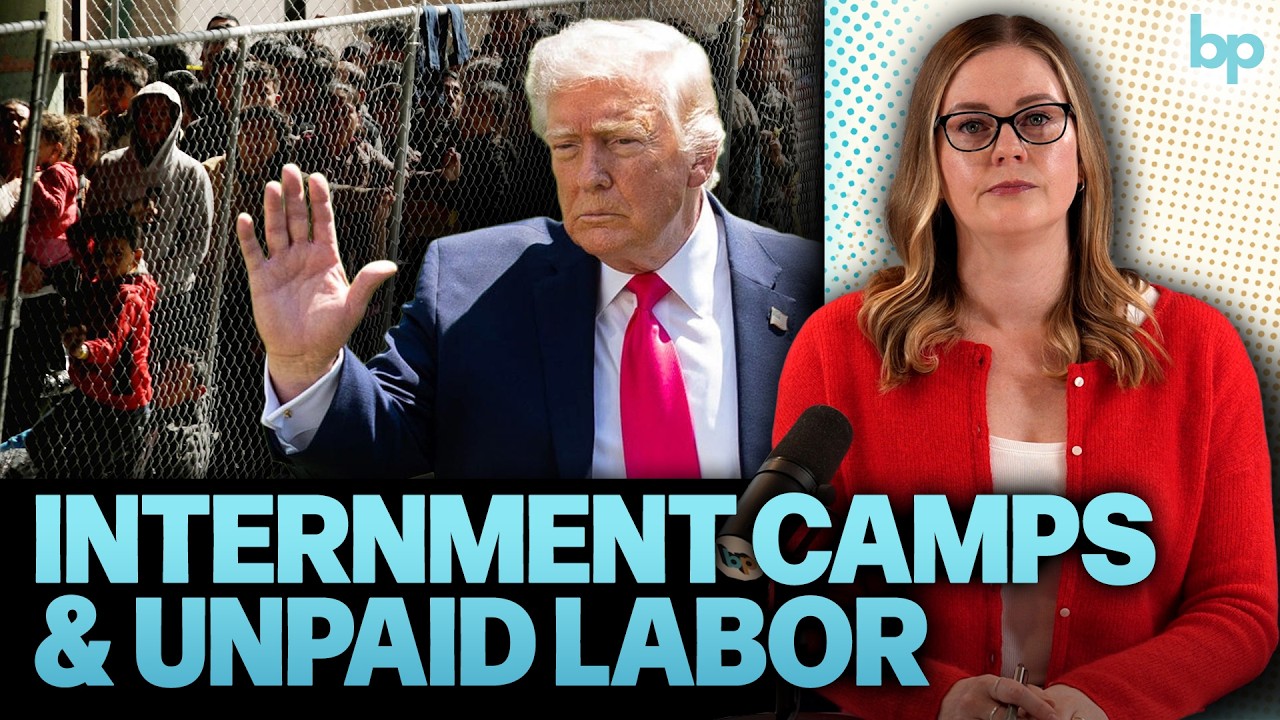
Brittany Page discusses Louisiana's HB 211, a new bill on its way to the Senate after passing the House, that criminalizes homelessness, creates internment camps, and authorizes mandated treatment that homeless individuals can pay for through unpaid forced labor. Brittany details how the Trump Administration and the Republican Party at large have been pushing bills like this across the country in an effort to criminalize poverty and homelessness, and what we can do collectively to fight the injustice.
HARD LABOR 1- 2 YRS
---
B3 MPU 4 26?
Winner: Private Prisons
Private prison operators will get a $45 billion funding boost for Immigration and Customs Enforcement detention centers over four years under the bill. The money will flow to private contractors like GEO Group and CoreCivic, both major donors to Trump’s inauguration and the GOP. In an earnings call last year, GEO Group President Wayne Calabrese said the company had been communicating to ICE that it was prepared to quickly expand its detention capacity if given the funding. “We have assured ICE of our capability to rapidly scale up our capabilities to monitor and oversee several hundreds of thousands, or even several millions of individuals in order to achieve the federal government's immigration law compliance objectives," Calabrese reportedly said.
---
POLITICO
New Jersey Mayor Ras Baraka arrested at ICE facility
The Democrat, who is also running for governor, was involved in a scrum with three members of Congress seeking a tour of Delaney Hall.
Newark Mayor Ras Baraka was detained while at Delaney Hall, a facility to house migrants. | Seth Wenig/AP
By Ry Rivard
05/09/2025
NEWARK, New Jersey — The mayor of New Jersey’s largest city, who is also a Democratic candidate for governor, was handcuffed and detained by federal officials on Friday at a protest ofan immigration detention centerfollowing a scrum involving federal agents and three members of Congress seeking a tour of the facility.
The arrest followed a chaotic scene in the detention facility’s parking lot involving protesters, federal law enforcement officers and the three Democratic members — Reps. Bonnie Watson Coleman, Rob Menendez and LaMonica McIver — at Delaney Hall. It is the Trump administration’s newest Immigration and Customs Enforcement detention facility, which is expected to play a major role in its Northeast immigration operations.
Newark Mayor Ras Baraka was being held at a separate ICE field office in his own city as elected Democrats in New Jersey scrambled to get him released.
House members, protesters clash with authorities at New Jersey ICE facility
Play Video
The members of Congress all said they were touched to varying degrees and, in one case, assaulted by federal authorities at the facility.
“This most assuredly is the most discomforting, concerning visit we have had. And what we experienced was the weaponization, of the abuse of power, that this administration has given ICE to do,” Watson Coleman said. “ICE is out of control.”
The mayor and the three members of Congress had been visiting Delaney Hall hoping to inspect conditions inside. While the members were inside, Baraka waited in a fenced in parking lot at the facility while protesters gathered outside the fence.
The roughly 1,000-bed facility just recently started taking detainees. The Baraka administration has tried to prevent it from opening, taking the private prison operator that runs the facility to court and alleging it does not have proper city permits.
The detention unfolded after Baraka was apparently allowed inside the fenced parking lot at the facility and then later told to leave.
The three House members had been inside the facility waiting for a tour [for two hours?] but then came out after officers wearing gear that identified them variously as federal police, ICE and Homeland Security personnel began gathering near Baraka in the parking lot. At one point, the three Democratic members came out as authorities threatened to arrest Baraka. They all exited to a parking lot outside the fence where protesters had gathered in an attempt to defuse the situation and to avoid Baraka getting arrested.
The three members then reentered the fenced area while Baraka waited outside the fence, but Menendez quickly came back and warned Baraka that the authorities still wanted to arrest him. When Menendez came to warn Baraka, he looked through the fence and told the mayor, “They are talking about coming out to arrest you.”
Later, Menendez told POLITICO that he’d witnessed an agent inside the fenced area talking on the phone with someone who told the agent to arrest Baraka, who by then was outside of the fenced area. McIver gave a similar account in a press conference.
Then law enforcement officials all came out, setting off a scrum in the parking lot area outside the fence, with Baraka and 80-year-old Watson Coleman near its middle.
It was a chaotic scene.
The group then moved to reenter the fenced-in area as Baraka was handcuffed and detained.
The interim U.S. Attorney for New Jersey, Alina Habba, confirmed that Baraka was in custody.
“The Mayor of Newark, Ras Baraka, committed trespass and ignored multiple warnings from Homeland Security Investigations to remove himself from the ICE detention center in Newark, New Jersey this afternoon,” shewrote on X. “He has willingly chosen to disregard the law. That will not stand in this state. He has been taken into custody. NO ONE IS ABOVE THE LAW.”
But the members of Congress also said they had been touched.
McIver, who represents Newark, said she and her colleagues came to the facility for a “simple oversight visit” but they had to wait about two hours to get inside. She and Watson Coleman were “assaulted” and Menendez was “roughed up” afterward. Menendez said that “all of us were touched,” calling what happened to McIver an “assault.”
As they reached the gate after the scrum to reenter the secure area of the facility, Menendez said he witnessed a federal law enforcement official assault McIver.
“It was a complete shove,” Menendez said in an interview.
McIver gave a similar account.
But even after that, the three members of Congress continued inside the secure area and received a tour. None of the members said they witnessed deplorable conditions at the facility, but by then the mayor’s arrest had overtaken the inspection.
“What we just witnessed was disgusting,” McIver told reporters. “If they can treat three members of Congress like that, just imagine how they can treat people on the street each and every day.”
The Department of Homeland Security, which oversees ICE, described the events differently. It said in a statement that as a bus of detainees was entering the security gate of Delaney Hall a group of protesters and two members of Congress — Menendez and Watson Coleman — “stormed the gate and broke into the detention facility.”
:{MOST READ
- ### Judges warn Trump’s mass deportations could lay groundwork to ensnare Americans
- ### RFK Jr., DOGE gutted legally required offices. Courts may undo it all.
- ### ‘It’s time for Joe Biden to go away': Democrats are triggered by Biden’s return to the spotlight
- ### Qatar calls reports of pending jet gift to Trump ‘inaccurate’
- ### Republicans’ partial tax plan estimated to cost $5 trillion
“These members of Congress storming into a detention facility goes beyond bizarre political stunt and puts the safety of our law enforcement agents and the detainees at risk,” the agency said. “Members of Congress are not above the law and cannot illegally break into detention facilities. Had these members requested a tour, we would have facilitated a tour of the facility. This is an evolving situation.”
protesters on the scene, which included members of the SEIU union, began moving to the field office across town when they learned Barak was being taken there.
By late afternoon, the three members of Congress reassembled at the field office and began pushing back against claims that they had stormed the facility. At least 100 protesters remained outside the facility in the rain Friday evening, chanting “free Ras Baraka.”
Baraka, astaunch progressive and one of six Democrats running for governor this year, has been a vocal opponent of the Trump administration’s plans for the immigration detention facility. While other Democratic candidates have spoken out against the Trump administration’s recent immigration actions, none have done so as forcefully as Baraka. He took part in a rally against the reopening of the facility in March — footage of which hasappeared in his campaign ads — and has been “demanding entry” into Delaney Hall throughout the week since its opening.
Newark, which is home to a diverse population, previously filed a complaint with the Essex County Superior Court, alleging that ICE was planning to open Delaney Hall “without following proper building safety protocols.” (DHS told POLITICO in a statement that the facility has “valid permits and inspection from plumbing, electricity to fire codes has been cleared.”) GEO Group, the private prison contractor that owns the facility, has accused the legal action of being “politically motivated.” GEO Group referred POLITICO to ICE for comment.
At the March rally, Baraka told reporters that he would “love to see action” from his fellow Democratic candidates regarding immigration.
“They say they are against the detention facility in Newark, and that’s the talk,” Baraka said at the time. “I would love to see them out to help us in this effort. I mean, it is a competition, so maybe they feel like coming here supports me. I don’t know what it is. I can’t speak for them, but I would love to see them out here.”
The arrest puts Baraka in the national spotlight with a month to go before the June 10 primary. Just two hours after he was led away in handcuffs, Baraka’s campaign sent out a text message asking for donations. “Ras was at Delaney Hall today demanding entry into the ICE detention center where Trump and MAGA extremists are illegally detaining people,” it read. “Ras is ready to do whatever it takes to stop Trump and to protect New Jerseyans from his extreme agenda. We need you with us now more than ever.”
Gov. Phil Murphy said in a statement he was “outraged by the unjust arrest” of Baraka. The governor noted that he signed a law several years ago that aims to ban private immigration detention facilities, but the law has not been enforced amid a pending lawsuit.
“Mayor Baraka is an exemplary public servant who has always stood up for our most vulnerable neighbors,” he said. “I am calling for his immediate release by federal law enforcement.”
The arrest alarmed other pro-immigrant activists who were in attendance.
“If they can do this to a mayor that has a profile as large as Mayor Baraka, what are they going to do to people protesting at Tesla stores?” said Amy Torres, executive director of the New Jersey Alliance for Immigrant Justice.
Other Democratic candidates running for governor condemned the arrest. Rep. Mikie Sherrillcalled it an “absolute outrage,” while Steven Fulop, mayor of Jersey City,said it was “a dangerous precedent — and it demands condemnation in the strongest possible terms.” Former state Senate President Steve Sweeney called for his release, as did Rep. Josh Gottheimer, who said that Delaney Hall has “an environment ripe with mistreatment and abuse.”
New Jersey Education Association President Sean Spiller said that he will go to Delaney Hall tomorrow, and called on the other candidates to join him “in standing together for justice.”
Meanwhile, Republicans attacked Baraka. Bob Hugin, the state Republican Party chair, warned that Baraka would be a governor “who puts political theater ahead of public safety and the rule of law.” The GOP gubernatorial hopefuls also went after him, with former radio host Bill Spadea saying that he “should be embarrassed by his behavior” and former Assemblymember Jack Ciattarelli calling Baraka “shameful.”
“In Newark, the airport is in the midst of an unprecedented & dangerous meltdown, the public schools are failing students & families, and there is crime in the streets every day,” Ciattarelli wrote. “And yet its Mayor and leading Democrat candidate for Governor … is busy shilling for illegal Immigrants at an ICE detention center with a cheap publicity stunt.”
*Madison Fernandez and Daniel Han contributed to this report.
- Filed under:
- New Jersey,
- Ras Baraka,
- Immigration And Customs Enforcement,
---
---
like fucking herpes
an 4 25
Former Blackwater CEO Erik Prince and defense contractors are aiming to cash in on deportations to a Central American prison/holding facility.
Prince — the brother of President Donald Trump's former education secretary, Betsy DeVos — hopes his proposal can skirt U.S. immigration laws by designating a section of a sprawling El Salvadoran prison as American territory, Politico reported. Proposed new language claiming “transferring a prisoner to such a facility would not be an Extradition nor a Deportation” raises the specter of deporting U.S. citizens to offsite facilities because "deportation" may only qualify as a "transfer." Politico's Dasha Burns and Myah Ward noted that Prince's proposal "could be a precursor to deporting U.S. citizens" even though the facility is initially only for holding undocumented immigrants.
Trump has already floated plans to deport U.S. citizens.
READ MORE: 'Could be the last one standing': Trump aims to 'illegally remove' head of bipartisan board
The facility, which has already drawn accusations of violence and overcrowding from human rights groups, could receive thousands more immigrants from facilities in the U.S. There is no word on how accessible the expanded Central American prison would be to immigrant defense attorneys and affected families, however.
It is unclear how seriously the White House is considering Prince’s plan.
A shooting incident in Nisour Square left 17 Iraqi citizens dead, allegedly at the hands of four Blackwater guards, nearly two decades ago. Intense government investigations, scrutiny, private security reform and criminal charges ensued. In 2014, an American jury found the Blackwater guards guilty of various criminal charges, from murder to weapons offenses.
Trump pardoned Blackwater contractors jailed for the massacre in 2020.
READ MORE: Outrage as video of Trump bragging about enriching his billionaire pals emerges
The facility is pitched as a holding pen for “criminal illegal aliens,” but the administration has made it clear that the only criminality necessary for arrest and deportation to an offsite prison is being on U.S. soil.
“[B]ecause they illegally broke our nation’s laws, and, therefore, they are criminals, as far as this administration goes,” said Trump Press Secretary Karoline Leavitt in January.
Most immigrants swept up within the last two months do not have criminal records in the United States.
Read the full POLITICO article at this link.
READ MORE: 'Punched the bully in the face': How some Republicans found courage to take on Trump
---
THOM 3 3 25
ISIS STYLE VIDEO, CONC CAMP // PVT PRISON
And they’re proud of it.
Secretary of State Marco Rubio, ridiculing the judge’s order to stop the illegal, no-due-process deportation flights to El Salvador, retweeted “Oopsie … Too late,” with a smirking emoji.
===
---
AN PP 3 25
The for-profit prison company GEO Group has surged in value under President Donald Trump. Investors are betting big on immigration detention. Its stock price doubled after Election Day.
But despite its soaring fortunes, the $4 billion company continues to resist having to pay detainees more than $1 a day for cleaning facilities where the government has forced them to live.
At the 1,575-bed detention center GEO runs for Immigration and Customs Enforcement in Tacoma, Washington, detainees once prepared meals, washed laundry and scrubbed toilets, doing jobs that would otherwise require 85 full-time employees, the company estimated. The state’s minimum wage at the time was $11 an hour. (It’s now $16.66.) In 2017, Washington sued GEO to enforce it, and in October 2021 a federal jury ruled unanimously in the state’s favor.
This year, GEO and Washington are back in court — for a third time — as the company tries to reverse the earlier decision that sided with the state. GEO has brought in contract cleaners at the Tacoma facility while the case plays out, keeping detainees there from paid work and from having a way to earn commissary money.
The legal battle has national repercussions as the number of ICE detainees around the country rises to its highest level in five years. The vast majority are held in private facilities run by GEO or corporate competitors like CoreCivic. If following state minimum wages becomes the norm, Trump’s immigration crackdown could cost the country even more than it otherwise would — unless private detention centers absorb the cost themselves or decide to cut back on cleaning, which Tacoma detainees have already accused GEO of doing.
GEO frames the lawsuit as a fight over the federal government’s authority to make the laws of the nation. Multiple courts have decided that the Fair Labor Standards Act, which sets the federal minimum wage, does not apply to detained migrants. At issue in the Tacoma case is the state minimum wage.
“Simply put, we believe the State of Washington has unconstitutionally violated the Supremacy Clause of the United States Constitution,” GEO wrote in a news release.
The company did not respond to a request for comment from ProPublica. ICE and CoreCivic declined to comment.
GEO’s latest legal salvo came last month.
A three-judge panel at the 9th U.S. Circuit Court of Appeals had recently affirmed lower courts’ rulings. GEO had to pay state minimum wage at the Tacoma facility. The company was also ordered to hand over $17 million in back wages, plus $6 million for “unjust enrichment.” The combined penalties amounted to less than 1 percent of GEO’s total revenues in 2024.
Rather than pay up, GEO petitioned on Feb. 6 for a rehearing by the full 9th Circuit. In the news release, it vowed to “vigorously pursue all available appeals.”
It isn’t that GEO lacks the ability to pay, the company has made clear in legal filings. Its gross profit from its Tacoma facility, today called the Northwest ICE Processing Center, was about $20 million a year when Washington filed its lawsuit. The company told a judge in 2021 it could “pay the Judgments twenty times over.”
The real issue is the precedent the Tacoma case could set. GEO, which manages 16 ICE detention facilities across the country, faces similar lawsuits in California and Colorado. The California case, also before the 9th Circuit, is on hold pending the outcome of Washington’s. Colorado’s is winding its way through a lower court.
GEO is expected to fight the case all the way to the Supreme Court, if needed.
If eventually forced to pay state minimum wages across the country, the company could decide to pay detainees more or else hire outside employees at all its locations – either of which would potentially eat into its profits, stock price and dividends.
The company also could try to renegotiate its long-term contracts with ICE for a higher rate of reimbursement, Lauren-Brooke Eisen, an expert in incarceration, noted in an article for the Brennan Center for Justice.
Or GEO could respond to higher labor costs another way. After the jury decision against it in 2021, the company paused Tacoma’s Voluntary Work Program, as it is known, rather than pay detainees there minimum wage. Some could no longer afford phone calls to family members. (For such detainees, the program had never been entirely voluntary. “I need the money desperately,” one testified. “I have no choice.”)
The facility also “got really gross” after the sudden stoppage, a Mexican detainee told the Associated Press at the time. “Nobody cleaned anything.”
GEO brought in contract cleaners eventually.
Mike Faulk, a spokesperson for the Washington state attorney general’s office, said testimony in the minimum-wage issue highlights the problem with housing detainees in private prisons: profit motive. Not only did GEO pay $1 a day for cleaning in Tacoma, it budgeted less than $1 per meal that each detainee ate, one kitchen worker testified. “So the grade of food is abysmal,” Faulk said of the detainee’s testimony. “He routinely picked out grasshoppers/insects from the food.”
For its part, GEO argues that Washington wants to unfairly — and hypocritically — hold the Tacoma facility to a standard that even state facilities don’t have to meet. The company has noted that a carveout in Washington law exempts state prisons from minimum-wage requirements, allowing the state to pay prisoners no more than $40 a week. The federal government, taking GEO’s side, has made the same point in “friend of the court” briefs under both the first Trump administration and the Biden administration. So did a dissenting judge in the recent 9th Circuit decision.
But to liken state prisons to a privately run immigration facility is an “apples and oranges” comparison, the 9th Circuit decided. Washington doesn’t let private companies run its state prisons. And the migrants in Tacoma are detained under civil charges, not as convicted criminals.
As judges have noted, GEO’s contract with ICE states that the prison company must follow “all applicable federal, state, and local laws and standards,” including “labor laws and codes.” It also holds that GEO must pay detainees at least $1 a day for the Voluntary Work Program. The federal government “made a deliberate choice to dictate to GEO the minimum rate,” the 9th Circuit wrote in its most recent decision, but “it also made a deliberate choice not to dictate to GEO a maximum rate.”
Conditions in Tacoma are worsening as the number of detainees rises, according to Maru Mora Villalpando, founder of the activist group La Resistencia. The group is in regular contact with people inside the detention center.
Meal service, Mora Villalpando said, is faltering: “Dinner used to be at 5. Then 6. Now it’s 9.”
Cleaning is faltering, too, she said. Without detainee labor, the outside cleaners have to do it all.
“But these people,” Mora Villalpando said, “can’t keep up.”
---
===
MMA
Bounties, self-deportation, and extremist sheriffs: How Project 2025 partners are planning for Trump’s mass deportations
Written by John Knefel
Published 11/21/24
Organizations on the advisory board of Project 2025, a sprawling plan to provide the incoming Republican presidential administration with policy and staffing recommendations, have responded to President-elect Donald Trump’s victory by promoting extreme approaches to carrying out his promise to deport upward of 10 million undocumented immigrants.
Right-wing think tanks the Center for Immigration Studies, The Claremont Institute, and the Center for Renewing America have all advanced anti-immigrant policies since Trump’s win. Some of their proposals include offering bounties for information on suspected undocumented people, conscripting far-right so-called “constitutional sheriffs” to serve as immigration enforcers, and attempting to make life so miserable for out-of-status immigrants that they flee the country — referred to euphemistically as “self-deportation.”
Trump has already named the two top officials who will be tasked with carrying out his mass deportation plan, and they both have direct connections to Project 2025. Tom Homan, Trump’s pick for “border czar,” is a visiting fellow at The Heritage Foundation, Project 2025’s lead organizer. He is also credited as a contributor in Project 2025’s policy book, Mandate for Leadership, which proposes drastic cuts to legal immigration in addition to harsh crackdowns on undocumented people. Homan has promised to “to run the biggest deportation operation this country has ever seen.”
Alongside Homan will be Stephen Miller — a top architect of Trump’s Muslim ban and family separation policies — who will serve as deputy chief of staff and homeland security adviser in the new Trump administration. Miller and his conservative advocacy organization, America First Legal, attempted to distance themselves from Project 2025 amid growing backlash to the effort, but their fingerprints are all over it. Miller appeared in a Project 2025 promotional video, a top AFL executive authored a chapter in Mandate, and AFL was on the advisory board until it removed itself following public outcry.
But the likely influence that Project 2025 partners will have on Trump’s looming immigration policy extends far beyond Homan and Miller. Below are some of the coalition’s more extreme proposals.
Center for Immigration Studies pushes bounties, self-deportation
The Center for Immigration Studies is one of the three main branches of the Tanton network, named after John Tanton, whom the Southern Poverty Law Center describes as “the racist architect of the modern anti-immigrant movement.” The SPLC has designated CIS as an anti-immigrant hate group.
On November 13, CIS published a blog under the headline “The Trump Deportation Plan: Easier Done than Said.” The article argues for a stricter version of E-Verify — which uses Social Security data to determine employment eligibility — called G-Verify, which would require employers to electronically submit the eligibility form to the Department of Homeland Security.
The blog acknowledges that these programs “would not capture unauthorized migrants who work ‘off the books’” — a common critique of E-Verify, which critics argue actually pushes immigrant workers into unregulated markets.
That’s where the bounties come in. CIS continues, “However, lawful employees, business competitors, customers, or even family members who are aware of this unlawful practice might be willing to report the employer’s criminal practice to DHS in return for a small (say $2,000) reward and a promise of confidentiality.”
In another blog — this time for the National Review — CIS Executive Director Mark Krikorian revived the idea of “self-deportation,” which is to say coercing undocumented people into leaving the country by making life miserable for them.
“Persuading illegal aliens to go home on their own saves the government time and money,” Krikorian wrote.
“And it’s also preferable for the illegal aliens themselves, allowing them to return on their own terms,” he continued, “They can settle their affairs, pack up their belongings, and go home for Christmas — and not come back.” After arguing that immigrants leave the country all the time, he suggested that one reason might be that “little Mario came home one day from P.S. 666 insisting on being called Maria.”
Krikorian has been joined in resurrecting this once-radical proposition by Heritage Foundation President — and Project 2025 evangelist — Kevin Roberts, who recently pushed it on The Vince Coglianese Show. While praising his colleague Tom Homan as a fantastic hire, Roberts argued that “such a big part of this is trying to inspire self-deportation.”
As a sign of how far contemporary politics have shifted toward the nativist right, it’s worth remembering that Sen. Mitt Romney (R-UT) was roundly excoriated for proposing “self-deportation” as a central plank of his immigration plan during the 2012 presidential race. He was denounced at the time by liberal magazines, mainstream outlets like the Washington Post editorial board, and conservatives including former Speaker of the House Newt Gingrich and a little magazine called the National Review.
In another blog published following Trump’s win, CIS argued that “the time may have come for President Biden or President-elect Trump to deploy the [Alien Enemies Act] against Iranian nationals residing in the U.S.” Per the author’s own description, invoking the act would allow “the president to summarily detain and remove nationals of enemy nations” — i.e., Iran. As the Brennan Center for Justice notes, the Alien Enemies Act “is best known for its role in Japanese internment, a shameful part of U.S. history for which Congress, presidents, and the courts have apologized.”
- ### The Claremont Institute: Conscript right-wing sheriffs for deportations
The Claremont Institute is a MAGA-aligned think tank that publishes the right-wing blog The American Mind. While the conservative authors featured on The American Mind may not necessarily speak for the institution, they offer a clear window into the Trump movement.
On November 8, The American Mind posted a blog headlined “Mr. President, Deputize Your Local Sheriffs.” The piece was written by Kyle Shideler of the Center for Security Policy, an SPLC-designated hate group.
“President Trump should look to sheriffs to fill U.S. Marshal roles,” Shideler argued, for the purpose of facilitating “the cross-deputization of local sheriffs’ deputies and police officers along the Southern border, which is needed to address prohibitions against state and local officials enforcing federal immigration law.”
“That manpower will be required if Trump is to meet his campaign promise of securing the border and expelling millions of illegal aliens,” he continued.
Shideler further suggested that “conservative organizations” could “identify local law enforcement leaders who support the Trump agenda” — adding that “those who have participated in the Claremont Institute’s Sheriffs Fellowship would be an excellent place to start.”
Jessica Pishko — author of a recent book about sheriffs and right-wing movements — reported on Claremont’s inaugural sheriff fellows program in 2022. She revealed that it “presented for the sheriffs two sets of people in America: those communities sheriffs should police as freely and brutally as they see fit, and those ‘real’ Americans who should be considered virtually above the law.”
As Pishko and others have noted, many of Claremont’s honorees adhere to the far-right ideology of the constitutional sheriffs movement, which holds that sheriffs “should be the ultimate law enforcement authority in the U.S.”
- ### Center for Renewing America defends “Operation Wetback”
The Center for Renewing America is a MAGA-aligned think tank founded by Russ Vought, a Christian nationalist and top architect of Project 2025.
On November 8, CRA published a white paper titled “Primer: U.S. Deportations — A Longstanding & Normal Process” which attempts to normalize and sanitize an earlier mass deportation undertaking officially known as “Operation Wetback” (though CRA’s authors don’t use that racist slur).
The authors argue that “mass deportations are a normal part of the president’s toolbox.”
“For example, in 1954, the U.S. government conducted a campaign that resulted in the mass deportation of Mexican nationals—1,100,000 persons,” they continue.
Left unmentioned is the humanitarian catastrophe unleashed by the mass deportations. As Dara Lind wrote for Vox when Trump praised the Eisenhower-era mass deportations in 2015, immigrants were “deported en masse: by train, by truck, by plane, and by cargo ship.” She adds that a “congressional investigation described conditions on one cargo ship as a ‘penal hell ship’ and compared it to a slave ship on the Middle Passage.”
In one mass raid, 88 people died of “sun stroke as a result of a round-up that had taken place in 112-degree heat,” according to a definitive account by Mae Ngai.
And as Professors Louis Hyman and Natasha Iskander argue, Operation Wetback was largely a propaganda campaign that “enforced the idea that American citizens are white.”
Nevertheless, the 1954 operation has become a touchstone for the Trumpist right. As but one example, Stephen Miller recently cited the “Eisenhower model” as justification for the potential deployment of the U.S. military “in a large-scale deportation operation.” CRA’s anodyne description of the 1950s deportations shows how embedded this history has become in the MAGA movement.
- ### Project 2025 embeds itself in Trump 2.0
Trump’s new administration and its partners in the conservative policy ecosystem are laying the groundwork for the most nativist, xenophobic government in decades. From Homan and Miller to the think tanks providing them scaffolding, every sign suggests that the Trump administration will terrorize, surveil, and deport immigrants and their communities in record numbers. And Project 2025 and its partners will almost certainly continue to provide a roadmap for the draconian crackdown.
---
https://www.mediamatters.org/charlie-kirk/charlie-kirk-our-prison-population-probably-not-big-enough
mta 2 23
BHM observances should include how corporations and those of immense wealth have amassed political power and economic wealth by exploiting racism toward people of color, especially African Americans, in this country over several centuries.
Examples:
- The Royal African Company and other British “crown corporations” transported slaves to the American colonies
- The “Fugitive Slave Clause” of the U.S. Constitution (Article I, Section 2, Clause 3) mandated that escaped slaves (the property of slaveholders) when caught had to be returned to their owners.
- The “Three-Fifths “Compromise” in the Constitution(Article I, Section 2, Clause 3) defined slaves (which had no political rights) as 3/5ths of a person in determining a state’s population – to ensure that southern states would have more votes in the Electoral College to perpetuate slavery.
- JP Morgan bank used slaves as collateral for loans to slave owners in the 19th century.
- The 13th Amendment contained an “exceptions clause” – prisoners could be used as forced labor. “Convict leasing” or “slavery by another name” involved African American forced to to work forrailroads, U.S. Steel and other corporations to rebuild the south after the Civil War.
- African-American strikebreakers were used widely in the meat packing, steel, coal mining, automobile, and railroad industries between the end of Civil War and New Deal to stoke racism between white and black workers to prevent the rise of unions.
- Housing, automobile, and construction corporations profited by laws (including discriminatory FHA mortgage underwriting) that promoted redlining of neighborhoods to maintain high housing values, especially in suburbia.
- The disproportionate mass imprisonment of African Americans, due to racist drug and other laws, has given rise to highly profitable and powerful private prison corporations, namely CoreCivic and Geo Group. The Prison Industries Act (promoted byALEC, the American Legislative Exchange Council) has expanded prison labor and financially benefited many companies, among them Victoria's Secret, Whole Foods Market, Walmart,Microsoft, Starbucks, BP,Nintendo,AT&T,Target, Dell, Eddie Bauer, and Boeing.
- Racial predatory loans by Wall Street financial entities, which profited in the billions, fueled the 2007-9 financial crisis.
- Toxic industries tend to be placed or to expand in African American poor communities.
- The explosion of police violence against innocent African Americans in cities and subsequent financial settlements in amounts that communities can not afford has given rise to a new profitable financial instrument for corporate and individual investors: “police brutality bonds.”
:{Not to be overlooked is the corporate hijacking of the Fourteenth Amendment, intended to provide legal due process and equal protection to African Americans when it was ratified in 1868. Two decades later, the Supreme Court hijacked the decision, ruling that a corporation is a “person” with the same due process and equal protection rights intended exclusively for African Americans. ...
}:
an 10 22
Residents of Alabama, Louisiana, Oregon, Tennessee, and Vermont will vote on referenda in the November midterm elections to remove slavery loopholes from their states' constitutions, the Associated Press reported on Thursday.
AP noted that "nearly 20 states have constitutions that include language permitting slavery and involuntary servitude as criminal punishments. In 2018, Colorado was the first to remove the language from its founding frameworks by ballot measure, followed by Nebraska and Utah two years later."
The outlet explained that "the effort is part of a national push to amend the 13th Amendment to the United States Constitution that banned enslavement or involuntary servitude except as a form of criminal punishment. That exception has long permitted the exploitation of labor by convicted felons."
READ MORE: White men refusing to share power is a silver stake piercing the heart of American democracy
Prisoners are frequently forced into performing labor for little to no money and can face severe consequences if they refuse to cooperate.
Nonetheless, each state has its own objectives, although there is some overlap between them. Per AP:
Alabama is asking voters to delete all racist language from its constitution and to remove and replace a section on convict labor that’s similar to what Tennessee has had in its constitution.
Vermont often boasts of being the first state in the nation to ban slavery in 1777, but its constitution still allows involuntary servitude in a handful of circumstances. Its proposed change would replace the current exception clause with language saying 'slavery and involuntary servitude are forever prohibited in this State.'
Oregon’s proposed change repeals its exception clause while adding language allowing a court or probation or parole agency to order alternatives to incarceration as part of sentencing.
Louisiana is the only state so far to have its proposed amendment draw organized opposition, over concerns that the replacement language may make matters worse. Even one of its original sponsors has second thoughts — Democratic Representative Edmond Jordan told The Times-Picayune/The New Orleans Advocate last week that he’s urging voters to reject it.
AP pointed out that Louisiana's constitution currently states that “slavery and involuntary servitude are prohibited, except in the latter case as punishment for a crime.” The proposed changes would read: “Slavery and involuntary servitude are prohibited, (but this) does not apply to the otherwise lawful administration of criminal justice.”
But its proponents argue that Jordan's perspective is part of a push to maintain the status quo.
READ MORE: The GOP's 'Commitment to America' contains Confederate solutions to made-up problems
Max Parthas, state operations director for the Abolish Slavery National Network, told AP that "if this doesn’t pass, it will be used as a weapon against us." He also stressed that "we’ve never seen a single day in the United States where slavery was not legal" and that "we want to see what that looks like and I think that’s worth it.”
Section I of the 13th Amendment decrees that "neither slavery nor involuntary servitude, except as a punishment for crime whereof the party shall have been duly convicted, shall exist within the United States, or any place subject to their jurisdiction."
That wording has long been a source of anger among civil rights activists and supporters of criminal justice reform. In 2020, Democrats in the House and Senate introduced a joint resolution called the "Abolition Amendment" aimed at eliminating the "punishment" clause.
Senator Jeff Merkley (D-Oregon), who co-sponsored the Senate version of the proposal along with Senator Bernie Sanders (I-Vermont), said in a statement at the time that "as we take on the long and difficult challenge of rooting out systemic racism in our nation, ending the slavery loophole in the 13th Amendment is [a] critical step in that challenge." He added that "slavery is our nation's original sin and this loophole has been exploited for far too long to criminalize Black and Brown Americans."
Leading the House coalition, then-Representative Lacy Clay (D-Missouri) said that Congress needs to "finish the job that President [Abraham] Lincoln started" and that "no American should ever be subject to involuntary servitude, even if they are incarcerated."
READ MORE: 'Goes beyond ignorance' Historians slam DeSantis' claims about American slavery
550k?!
https://www.alternet.org/2021/05/disabled-prisoners/
aha /doh: pot legalized via prop, jeff feds resist; decrim really 1st and only concrete step to crim justice reform? (after koch backed bill?]
an 1220
oregon just decriminalized all drugs – here’s why voters passed this groundbreaking reform
Scott Akins, Oregon State University and Clayton Mosher, Washington State University
Oregon became the first state in the United States to decriminalize the possession of all drugs on Nov. 3, 2020...
==
neglected, most undoc detainees in pvt jail?!
https://theintercept.com/2020/07/03/halfway-house-pandemic-coronavirus-geo-group/
Coronavirus CrisisHow the Coronavirus Became a Death Sentence at a GEO Group Halfway House
Liliana Segura
==
==
https://www.amazon.com/Colony-Nation-Chris-Hayes/dp/0393254224
New York Times best-selling author and Emmy Award–winning news anchor Chris Hayes argues that there are really two Americas: a Colony and a Nation.
America likes to tell itself that it inhabits a postracial world, yet nearly every empirical measure―wealth, unemployment, incarceration, school segregation―reveals that racial inequality has barely improved since 1968, when Richard Nixon became our first “law and order” president. With the clarity and originality that distinguished his prescient bestseller, Twilight of the Elites, Chris Hayes upends our national conversation on policing and democracy in a book of wide-ranging historical, social, and political analysis.
Hayes contends our country has fractured in two: the Colony and the Nation. In the Nation, we venerate the law. In the Colony, we obsess over order, fear trumps civil rights, and aggressive policing resembles occupation. A Colony in a Nation explains how a country founded on justice now looks like something uncomfortably close to a police state. How and why did Americans build a system where conditions in Ferguson and West Baltimore mirror those that sparked the American Revolution?
A Colony in a Nation examines the surge in crime that began in the 1960s and peaked in the 1990s, and the unprecedented decline that followed. Drawing on close-hand reporting at flashpoints of racial conflict, as well as deeply personal experiences with policing, Hayes explores cultural touchstones, from the influential “broken windows” theory to the “squeegee men” of late-1980s Manhattan, to show how fear causes us to make dangerous and unfortunate choices, both in our society and at the personal level. With great empathy, he seeks to understand the challenges of policing communities haunted by the omnipresent threat of guns. Most important, he shows that a more democratic and sympathetic justice system already exists―in a place we least suspect.
==
https://www.alternet.org/2019/12/how-some-alabama-county-sheriffs-force-their-inmates-into-medical-debt
no lnx
How some Alabama county sheriffs force their inmates into medical debt
Written by ProPublica December 26, 2019
This article was produced in partnership with AL.com, which is a member of the ProPublica Local Reporting Network.
In Alabama, the county in which you’re arrested could be the deciding factor in who will be financially responsible for your medical bills behind bars.
:{
}:
In Baldwin County, known for its white-sand Gulf Coast beaches and waterfront communities, the sheriff’s office ensures that inmates in the county jail do not have to pay anything more than a $15 copayment for medical care.
:{
}:
“Inmates are not billed for the full cost of any medical care either inside or outside” the jail, Sheriff Hoss Mack said in an email. “Alabama Code Title 14 assigns financial responsibility of inmates’ medical treatment to the department where they are being held.”
:{
}:
Just across the bay in Mobile County, home to one of the busiest ports in the U.S. and the eponymous city of nearly 200,000 people built around it, Sheriff Sam Cochran takes a different tack: Some of his inmates are personally on the hook for the full cost of medically necessary care they receive from outside doctors while incarcerated, even if they are awaiting trial.
The difference between the two sheriffs’ approaches demonstrates the unique power Alabama sheriffs have to set their own rules and answer only to voters.Legal experts and civil rights advocates say sheriffs like Cochran are likely violating both state law and the Eighth Amendment of the U.S. Constitution, which prohibits cruel and unusual punishment and excessive fines.
It’s not just happening in Mobile County. In multiple instances confirmed by AL.com and ProPublica, inmates have had medical bills sent to collections while they were still behind bars, damaging their credit and putting pressure on their family members to pay up to ensure the care continued.
Brandon DeLaFosse is among them. He was arrested on domestic violence, burglary and robbery charges and booked into the Mobile County Metro Jail in November 2018, three months after he underwent surgery on his inner ear. Since then, he has received bills totaling thousands of dollars for necessary follow-up appointments and tests, some of which have gone to collections while he remains behind bars.
“He keeps getting bills in the mail,” said Alicia DeLaFosse, Brandon’s mother, who has paid hundreds of dollars for care he has received while in custody. “It’s all money he owes from going back and forth to the doctor.”
Like many inmates, DeLaFosse doesn’t have significant income or access to public or private insurance in jail.
Alabama law is clear: If an “inmate develops a medical condition which requires immediate treatment at a medical-care facility outside the county jail, the department shall be financially responsible for the cost of the treatment of the inmate.”
:{
}:
But Cochran said when the jail’s doctors determine inmates need care that goes beyond what in-house medical staff and contracted outpatient providers can handle, they are often taken to private medical professionals who do not have contracts with the jail. And he allows those medical providers to bill at least some of those inmates directly.
“When that person is taken out to that private medical facility or something like that, then, yeah, they’re going to bill him for that treatment,” Cochran said during an interview in his office last month. “It’s a more than reasonable thing to do.”
Asked later about the details of Brandon DeLaFosse’s case and how the practice squares with state and federal law, Cochran provided an email written by Trey Oliver, warden of the Mobile County Metro Jail.
Oliver wrote that inmates are required to pay “when they have a follow-up procedure or visit from a surgery conducted prior to being booked.”
As for DeLaFosse, Oliver wrote, “There was a follow up visit or two and his mother agreed to pay it beforehand.”
Most jails and prisons across Alabama and the U.S. either have doctors and nurses on staff or contract with outside companies to provide medical care in their lockups. It’s not uncommon for inmates to be charged low copays — typically less than $20 — for medications and medical services.
But requiring inmates to foot the bill for their health care takes that practice to another level.
That’s “like charging them for their own food,” said John Lentine, a Birmingham criminal defense attorney and adjunct law professor at Samford University’s Cumberland School of Law and the Birmingham School of Law. “To me it’s a basic human rights kind of thing.”
Michele Deitch, a senior lecturer at the University of Texas at Austin’s School of Law and Lyndon B. Johnson School of Public Affairs, said the practice is “absolutely” unconstitutional.
“There is a constitutional obligation to provide health care that meets the serious medical needs of people who are incarcerated,” said Deitch, who co-wrote the American Bar Association’s Standards on Treatment of Prisoners. “That’s not negotiable.”
The tactic is another way in which sheriffs across Alabama are avoiding financial responsibility for inmate medical care. AL.com and ProPublica reported in September that many sheriffs in Alabama and across the country are finding ways to release inmates from jail just before they incur expensive hospital bills, a tactic known as “medical bond.”
In several recent cases, incarcerated people around the country have successfully challenged policies restricting their access to free medical care in prison.
Last year, a federal court ruled that transgender inmates in Missouri’s state prisons have a right to receive hormone therapy free of charge while incarcerated, regardless of whether they were already receiving the treatments when they were taken into custody. And this year, prisoners in Minnesota reached a settlement with the state’s Department of Corrections that requires the prison system to provide prisoners who have Hepatitis C with expensive drugs that often cure the infection.
AL.com and ProPublica attempted to contact the sheriffs of all 67 counties in Alabama via email or phone to ask whether they allow inmates to be billed for care they receive while incarcerated. Of those, 13 sheriffs and one chief deputy responded. The sheriff of Mobile County and chief deputy of Jackson County each said they allow providers to bill inmates for necessary care in certain situations. Ten sheriffs said they do not allow inmates to be billed. Two others declined to comment.
“I’m Still Getting Bills”
Days after Thanksgiving last year, Brandon DeLaFosse was arrested in Mississippi on outstanding warrants stemming from an incident earlier that month in Mobile County, Alabama.
The then-28-year-old was driven back to Mobile, where he stayed in the county jail until Feb. 28, when he was sentenced to three years in prison.
DeLaFosse’s health problems continued behind bars. Since his ear surgery last year, he has suffered from persistent ear infections and severe hearing loss.
And his bills are piling up.
In between Marlboro Lights and peanut butter-and-syrup sandwiches at her Irvington home last month, DeLaFosse’s mother, Alicia, said she spends many hours each week making calls, sending emails and conducting research to advocate on behalf of her son.
She said a steady stream of medical bills addressed to her son has arrived at her house since his arrest. Billing records show that she has spent more than $600 on his care since his arrest, and more than $1,000 in outstanding bills have gone to debt collection.
On Dec. 6, 2018, while he was in the Mobile County Metro Jail, Brandon DeLaFosse was taken to see an ear, nose and throat specialist at Providence Hospital in Mobile for a surgery follow-up visit recommended by the doctor. But first, his mother said, jail staff required her to make a payment to the doctor’s office. After the appointment, the hospital’s billing department sent a bill for $729 for tests he underwent that day to Alicia DeLaFosse’s house.
“The way the nurse at the jail explained it to me is because it was something that didn’t happen at the jail, it’s preexisting. … I had to go pay for it myself,” she said. “For the jail to allow him to go see the doctor, I had to go to the doctor’s office and pay $125 first.”
A registered nurse at the jail in Mobile noted in Brandon DeLaFosse’s medical record that his mother made a payment and that the nurse had scheduled a follow-up visit for later that month. In January 2019, a nurse practitioner at the jail wrote a note in his file stating she would request another follow-up appointment with his doctor “with the expectation that it is handled in the usual fashion with his mother arranging for payment.”
“I don’t think it’s fair. They’re responsible for my medical care, so why should it be coming out of my pockets or my family’s pockets?” Brandon DeLaFosse said in a jailhouse phone call.
Cochran, the Mobile County sheriff, said via email that he views the situation as a “legal dispute between [Brandon DeLaFosse], us and our contracted provider. I know of no complaint or claim made against us.”
“The mom agreed to pay [the] bill. Looks like she reneged,” Cochran wrote. “Otherwise if it would have been medically necessary our contracted folks would have handled.”
Alicia DeLaFosse said she “didn’t renege” and paid for all of the medical costs she knew about in advance.
Brandon DeLaFosse continued to be billed for outside medical care after he was moved to state prison. On July 23, nearly five months after his sentence began, he saw a doctor and underwent tests at Providence Hospital. He was sent a bill for $224.70 for outpatient diagnostics administered that day, plus $71.98 for the doctor visit.
That shouldn’t have happened, a spokeswoman for the Alabama Department of Corrections said in a statement.
“By ADOC’S policy, all inmates in the care, custody, and control of any ADOC correctional facility are not charged or responsible for community-based medical care or mental health services,” the spokeswoman, Samantha Banks, said.
Any state prisoners “incorrectly” billed for outpatient medical care should notify the provider that they were incarcerated at the time, the statement explained. “The medical provider should submit to the Department the appropriate paperwork and any outstanding inmate medical bills will be directed to the appropriate payer.”
State prisoners in Arizona have reported similar issues with providers billing them directly for medical care they received while incarcerated, as KJZZ radio reported this year. Like in Alabama, the Arizona Department of Corrections has said the bills were sent out in error and that the department or its medical contractor would pay the inmates’ bills.
But that’s a vastly different situation than the one facing inmates in some Alabama counties, where sheriff’s offices are not chalking up such bills to error and are in fact deliberately choosing to avoid paying medical bills for inmates in their charge.
Constitutional Question
Though the public often has little sympathy for inmates, incarcerated people do have clear rights, particularly when it comes to health care behind bars.
Alabama law states that “necessary clothing and bedding must be furnished by the sheriff or jailer, at the expense of the county, to those prisoners who are unable to provide them for themselves, and also necessary medicines and medical attention to those who are sick or injured, when they are unable to provide them for themselves.”
In another section of the state code, a definition of a county inmate includes an explicit reference to their health care being provided for: “any person being held in a public institution under the administrative control and responsibility of the county sheriff and for whom the county is responsible for the provision of medical care.”
Brandon Blankenship, an assistant professor of law and ethics at the University of Alabama at Birmingham, said that allowing inmates to be billed for care that they receive while incarcerated amounts to cruel and unusual punishment and that the bills are excessive fines.
“I don’t think it’s ever been challenged in court in Alabama, but from where I’m sitting, the answer to me is that, no, it’s certainly not constitutional under the Eighth Amendment.”
The tactics of some Alabama sheriffs stand in sharp contrast to what’s going on elsewhere in the country. This year, California and Illinois banned the practice of charging inmates copays, and a number of other states have taken, or are considering, steps to rein in the practice.
“They usually cannot afford even a $5 copay, so the idea that they could pay thousands of dollars for these services is laughable from a practical perspective and it’s downright evil on many different levels,” said Deitch, the University of Texas at Austin professor.
In 1983, the U.S. Supreme Court decided a seminal case, City of Revere v. Massachusetts General Hospital, involving a person who was hurt during an arrest and taken to a hospital. The court ruled that “as long as the governmental entity ensures that the medical care needed is in fact provided, the Constitution does not dictate how the cost of that care should be allocated as between the entity and the provider of the care. That is a matter of state law.”
But that ruling did not answer the question of whether inmates can be stuck with the bill.
“We don’t have any clear Supreme Court ruling,” said Fred Cohen, a professor emeritus at the University at Albany’s School of Criminal Justice who has decades of experience in corrections law and serves as executive editor of Correctional Law Reporter.
Cohen said he believes there is a good case to be made that the practice of allowing inmates to be billed for medical care violates their constitutional rights.
“I don’t think it’s an open policy question in that inmates should not be required to pay,” he said. “I think it could be held unconstitutional by the right court.”
Different Systems
...
==
https://theconversation.com/how-being-tough-on-crime-became-a-political-liability-128515
Kamala Harris recently dropped out of the presidential race after months of attacks from the left for her “tough-on-crime” record as San Francisco’s district attorney and as California’s attorney general.
A few years ago, the idea that being tough on crime would be a liability – not an asset – was unthinkable for both Democrats and Republicans.
Bill Clinton, during the 1992 presidential race, interrupted his campaign so he could return to Arkansas to witness the execution of a mentally disabled man. During Harris’ 2014 reelection campaign for attorney general, she actively sought – and won – the endorsements of more than 50 law enforcement groups en route to a landslide victory.
But something has changed in recent years. Harris’ failure to gain traction as a presidential candidate has coincided with a growing number of “progressive prosecutors.”
In the past, I would have scoffed at the notion of a progressive prosecutor. It would have seemed like a ridiculous oxymoron.
But in one of the most stunning shifts in American politics in recent memory, a wave of elected prosecutors have bucked a decadeslong tough-on-crime approach adopted by both major parties. These prosecutors are refusing to send low-level, non-violent offenders to prison, diverting defendants into treatment programs, working to eradicate the death penalty and reversing wrongful convictions.
The unchecked power of prosecutors
In 1968, when I was 8 years old, my father was sentenced to 22 to 55 years in the Ohio State Penitentiary for the possession and sale of marijuana. During the trial, the district attorney had repeatedly assured the jurors that he hadn’t promised the state’s principal witness – then serving a long sentence – leniency in return for testifying against my father.
In truth, they had struck that very bargain. After studying the warden’s own law books, my father appealed the conviction, representing himself. He was ultimately vindicated by the 6th U.S. Circuit Court of Appeals after proving that the district attorney had deliberately lied to the jury.
That was in 1974. I went on to become a lawyer and law professor. During the years I spent teaching and studying the relationship between race and the law, the prison population exploded, and my distrust toward government prosecutors only deepened. Too often, it seemed like they were bringing excessively punitive charges in order to force defendants into plea deals. Too often, their approach seemed to reflect a longing for retribution and revenge rather than rehabilitation.

In 2017, law professor John Pfaff was able to show that mass incarceration was due, first and foremost, to the nearly unchecked power of district attorneys.
With reported crimes and arrests steadily declining in the 1990s and 2000s, you might have expected incarceration rates to also fall. Instead, they soared. Pfaff traces this perplexing trend to one key statistic: Between 1994 and 2008, the probability that a district attorney would file a felony charge against someone who’s been arrested roughly doubled, from about 1 in 3 to nearly 2 in 3.
...
==
aha-let: prison and the border is where drastic rw ideas floated b/c poor ppl of color can't fight back, also non0cits, non-voters, plus "they" "deserve" it.
==
https://www.alternet.org/2019/12/how-a-trend-toward-cost-cutting-in-prisons-reveals-the-cruel-impulse-to-profit-from-human-misery/
no lnx
How a trend toward cost-cutting in prisons reveals the cruel impulse to profit from human misery
Written by Filter December 16, 2019
by Rory Fleming
The general idea of US prison policy seems to be to make life as miserable as possible for people behind bars without violating bedrock constitutional principles from the 1700s. On first glance, recent moves toward technological “updates”—in the form of “free” tablets to enable incarcerated people to read—appear to buck that trend. But prison accountability specialists say we should take heed of how this move represents a mix of cost-cutting for prison agencies, profiteering on human misery, and a conspiracy to get prisoners to stop reading.
The West Virginia Division of Corrections and Rehabilitation (DRC) is the most recent prison to take the plunge, opting for prisoners to pay a nickel per minute to read e-books on the devices provided. Given that people make less than $1 an hour for their labor behind bars, it’s a prohibitive cost for many. But the contract between GTL (Global Tel*Link Corporation) and the DCR makes sure to award the prison agency a 5 percent commission on fees.
Michelle Dillon at the Human Rights Defense Center told Filter that the West Virginia DRC has pointed to the Inmate Benefit Fund to justify charging people for public domain books, echoing earlier claims that similar phone fees are not going back to the prisons themselves. Records show that the same fund is also being used to pay for the employment of people in prison, and for portable toilets, showerheads, microwaves, copiers, fans, religious meals, clocks, and even electricity.
In general terms, national momentum appears to be moving in a positive direction on prisoners working to empower themselves through education. Even the Trump administration supports bringing back Pell Grant eligibility for higher education loans to people in prison. (Pell Grants were taken away from prisoners as a result of the 1994 crime bill that presidential candidate Joe Biden has been slammed for supporting.)
But prison agencies at both the state and federal are well-known for thwarting even the most tepid criminal justice reform legislation—unless compliance is forced by law with no discretion afforded to them. The US judiciary, up to the Supreme Court level, generally gives prison chiefs carte blanche to abuse their wards at will. Financial and data-collection exploitation of prisoners and their loved ones is already common regarding e-visits and phone calls.
Short of explicit legislation to guarantee free access, tablets-only rules will further exploit prisoners financially—and reduce access both to important educational materials and to the recreational reading that may mitigate the misery of life behind bars.
Besides the profit motive, prisons have numerous incentives for adopting the tablet system. They are harder to get physically creative with than books, as Deputy Warden Troy Schultz of the North Dakota State Penitentiary noted in 2015: “In the past we had cassette players and CD players. The motors from these were used to make tattoo guns. There’s less material for staff to search through now.”
Adopting a tablets-only policy can also shield guards from embarrassment and bad press when they smuggle drugs into prisons. In Pennsylvania, Department of Corrections Secretary John Wetzel recently shut down paper book donation charities, citing alleged drug smuggling by friends and family of prisoners. An outcry later caused Wetzel, an alleged prison “reformer” who claims he wants more humane, Norweigan-style prisons, to reverse course. Shortly thereafter, it was exposed that his own employees had created the issue.
Racism obviously factors into the denial of reading materials for incarcerated people. US prisoners are too often lorded over by racist guards (some in West Virginia were recently photographed giving a Nazi salute). With a population that is roughly 3.6 percent Black, West Virginia has a wildly disproportionate 28 percent of Black prisoners.
There is a similar story in Pennsylvania, where 12 percent of the state population but 46 percent of prisoners are Black. Secretary Wetzel’s entire reputation as a “reformer” and “thought leader” in prison policy hinges on his claims that he runs an “evidence-based” prison system. Having a research and statistics division led by someone with a doctorate permits Wetzel to evade questions about barely putting a dent in the number of people subject to solitary confinement from 2014 to 2017, complaining that a prison closure would be bad for staff, and propagandizing that the installation of a few couches makes one of his prisons like a “Little Scandinavia.”
Sadly, Wetzel’s data chief, Dr. Krisofer “Bret” Bucklen, has previously declared crime “genetic.” Screenshots of Dr. Bucklen’s Twitter account from years ago show him laughing at jokes declaring Michelle Obama a transgender ape, as well as him boasting of his close friendship with blacklisted criminologist Brian Boutwell. Boutwell believes Black people have inherently lower IQs and a higher propensity for crime, including violent crime. In one of his shocking academic articles, Boutwell wrote that higher arrest and incarceration rates for Black boys and men were “completely accounted for after including covariates for self-reported lifetime violence and IQ.”
If someone like Bucklen wants to believe that imprisoned people are naturally unintelligent and less capable, keeping them from reading is excellent confirmation bias. But such a person should not be surprised when he or she is called a racist. Anti-literacy policy has long and appalling history in the US; laws in the 1800s forbade free people from teaching Black slaves how to read and write.
What is happening today comes from comparable impulses. Prison officials in Pennsylvania, West Virginia, and other states prioritize maintaining order at the cost of creating a maximally degraded prison population.
They do not want the self-actualization of more people like Reginald Dwayne Betts, who was imprisoned as a Black teenage boy and went on to become a Yale Law School-educated attorney and world-renowned poet. Neither do they even want it for white prisoners, like Shon Hopwood, a former bank robber-turned-Georgetown Law Professor. Betts’ and Hopwood’s individual manifestations of greatness despite soul-crushing conditions undermine a prison system organized around both control and failure of current and former prisoners.
There is no way any prisons chief in the country can deny this indictment without facing copious evidence against their position. They all know. Some might own up to it when asked, like when North Dakota Director of Corrections Leann Bertsch cried during a Norweigan prison tour and told a deputy, “We’re hurting people.”
Citing politics as an insurmountable obstacle to meaningful change, as Director Bertsch and Secretary Wetzel both did to Maurice Chammah at The Marshall Project, is cynical and lazy. While authorties cannot release people earlier for reading books, like Brazil’s penal system does, they can at least aggressively push their legislatures on decarceration initiatives. They can cite cost as the reason, if they need to. They can make reading free for all and readjust budgets by laying off unnecessary employees.
We should demand that they do all of the above.
This article was originally published by Filter, a magazine covering drug use, drug policy and human rights. Follow Filter on Facebook or Twitter.
==
In an age of disappearing prison libraries, jail profiteers provide "free" crapgadget tablets that charge prisoners by the minute to read Project Gutenberg ebooks
The past couple years has seen a rise in prison profiteers who strike deals with state corrections departments to provide "free" tablets to prisoners (these being the flimsiest, cheapest, least reliable hardware imaginable), and then profiting by charging exorbitant sums for prisoners to send emails (selling "digital postage stamps" that have to be affixed to each "page" of email), videoconference with family members, and provide media, charging prisoners for music that they lose every time a prison changes suppliers. Read the rest
==
many lnx
https://www.citizen.org/article/detained-for-profit-spending-surges-under-u-s-immigration-crackdown/
SEPTEMBER 18, 2019
Detained for Profit: Spending Surges Under U.S. Immigration Crackdown
Corporations Make Billions from Immigration and Corrections Contracts Under Trump and Obama; More Than $2.3B in Federal Contracts in 2018
By ALAN ZIBEL
DOWNLOAD THE FULL REPORT 1.2 MB
Revenue Soars For Immigration and Corrections Contractors
Additional Findings
A Growing Industry Profits from Immigrant Detention
Playing the Influence Game
Profiles of Top Contractors: GEO Group Inc.
Profiles of Top Contractors: CoreCivic Inc.
Other Contractors
Backlash and Pressure
Federal immigration and corrections policies in the Trump and Obama administrations have resulted in a windfall for private government contractors.
Ten large contracting firms working for five federal agencies implementing federal immigration, corrections and detention policies received $2.32 billion in federal contract revenue last year, up 17 percent from nearly $2 billion at the start of President Donald Trump’s term and more than double the $942 million those same companies received in 2013, a Public Citizen analysis has found.
These contracting firms run detention facilities and prisons, transport detained migrants by plane, provide security guards and build technological systems for U.S immigration and corrections agencies, among other activities.
Public Citizen analyzed the 10 largest recipients of federal contracts from five agencies and offices involved in corrections and immigrant detention in 2018 and compared those figures to the amount of federal contract revenue received by these same companies over the prior decade. The five agencies analyzed are: the U.S. Immigration and Customs Enforcement (ICE), U.S. Customs and Border Protection (CBP), the Department of Health and Human Services[1], the U.S. Marshals Service, and the Federal Bureau of Prisons.
The analysis was not limited to contracts for immigration and correction functions. It found that the largest contractors for these agencies typically were involved in immigration and corrections, including operating prisons and migrant detention facilities as well as providing services to the Federal Bureau of Prisons.
The analysis also shows that this spending began rising during President Barack Obama’s second term, coinciding with a surge in migrants from Central America. Under Trump, spending has ramped up even more as federal government has pressed ahead with sweeping efforts to constrain the flow of immigration to the United States. These actions have outraged many Americans while benefiting private contracting firms especially the two largest private prison companies.
The treatment of migrants, including the deaths of at least two dozen immigrants in federal immigration detention during the Trump administration, has sparked outrage around the country, highlighting the grim reality of a private detention industry that has expanded under Democrats and Republicans alike. Numerous reports and investigations of private prisons and detention centers over many years have documented evidence and allegations of violence, substandard medical care, deaths and suicides, sexual abuse and exploitative labor practices.
Trump’s aggressive immigration enforcement actions were exemplified by the administration’s “zero tolerance” policy for illegal entry, announced by former Attorney General Jeff Sessions in May 2018, of prosecuting all adults detained for illegal border crossings. While announcing the policy, Sessions said there would be an increase in prosecutors and immigration judges to handle the expected increase in cases but acknowledged that “children inevitably for a period of time might be in different conditions.” To comply with a longstanding requirement that children cannot be held in family immigration detention for more than 20 days, children with imprisoned parents have been placed in custody of the Department of Health and Human Services, whose Office of Refugee Resettlement operates as their legal guardian.
After the separation of thousands of children from their parents and the resulting public outcry, Trump backtracked months later, reversing the prior policy and allowing families to be detained together. Still, an inspector general’s report released in September 2019 found that the Trump policies resulted in longer stays in custody and a “rapid increase in the number of younger children” in custody, many of whom were separated from their parents. The report also found that many workers were unprepared to deal with children who had experienced extreme trauma in their country of origin and as a result of being separated from their parents. “Children who did not understand why they were separated from their parents suffered elevated levels of mental distress,” the report found.
Most recently, the Trump administration proposed new rules allowing the federal government to detain migrant families indefinitely while judges consider applications for asylum, a move that would involve withdrawing from a 1997 consent decree that has set standards for how detained migrant children should be treated. Immigration advocates condemned the move, with Holly Cooper, co-director of the immigration law clinic at University of California, Davis, telling reporters: “We’re going to have a world that looks a lot like the internment of families and children, where we have basically regularized prison as a default for families seeking political asylum in this country.”
Additional Findings:
During the Trump administration, major prison contractors GEO Group and CoreCivic Inc. have each received more than $1 billion from the five agencies analyzed by Public Citizen. GEO Group has received about $1.7 billion, from the start of 2017 through June 30 of this year. CoreCivic has received $1.2 billion during that same time period.
Five companies have seen contract revenue increases of 25 percent or more from the last two years of the Obama administration to the first two years of the Trump administration. Contract revenue more than tripled (329%) at Deloitte Consulting, was up by 43% at GEO Group Inc. and increased 40% at MVM Inc. Others showing large increases over that same time period were Comprehensive Health Services Inc. (39%) and Unisys Corp. (25%).
The surge in immigration detention contracting appears to be driving up overall contracting at some federal agencies. In total, the five agencies and offices studied by Public Citizen awarded more than $10.2 billion in contracts last year, up $1.1 billion, or 12 percent, from $9.1 billion the prior year. During President Barack Obama’s administration, contracting at these same agencies rose to about $9 billion in 2016 from a low of $6.3 billion.
Federal Contract Revenue for 10 Largest Contractors of Immigration/Detention Agencies Under Trump, 2017-2019 (First Six Months)
Contractor 2017 2018 2019 (1/1 through 6/30) Trump Total
GEO GROUP INC./B.I. INCORPORATED $567,015,497 $625,672,916 $506,541,762 $1,699,230,175
CORECIVIC, INC. $521,963,583 $377,049,767 $307,318,607 $1,206,331,957
UNISYS CORP $311,081,862 $311,652,598 $(3,324,833) $619,409,627
COMPREHENSIVE HEALTH SERVICES INC. $69,684,953 $205,252,758 $212,146,117 $487,083,828
DELOITTE CONSULTING LLP $113,633,741 $217,289,949 $69,560,855 $400,484,544
PAE AVIATION AND TECHNICAL SERVICES LLC $124,176,745 $110,956,067 $71,073,058 $306,205,870
METROPOLITAN SECURITY SERVICES, INC. $97,807,499 $114,499,081 $78,406,534 $290,713,114
MANAGEMENT & TRAINING CORPORATION $121,791,669 $78,249,377 $90,656,212 $290,697,258
MVM INC. $64,425,445 $144,583,737 $80,467,900 $289,477,082
NAPHCARE INCORPORATED $91,302,569 $104,916,307 $76,780,021 $272,998,897
SOURCE: PUBLIC CITIZEN ANALYSIS OF USASPENDING.GOV DATA (CALENDAR YEARS)
Change in Federal Contract Revenue for Large Contractors of Federal Immigration/Detention Agencies in Trump Admin (2017-18) Vs. Obama (2015-2016)
Contractor Name 2015-2016 (Obama) 2017-2018 (Trump) % Change
DELOITTE CONSULTING LLP $77,093,189 $330,923,689 329%
GEO GROUP INC/ B.I. INCORPORATED $833,213,901 $1,192,688,413 43%
MVM INC. $149,791,879 $209,009,182 40%
COMPREHENSIVE HEALTH SERVICES, INC. $198,043,891 $274,937,711 39%
UNISYS CORP $497,746,816 $622,734,460 25%
NAPHCARE INCORPORATED $182,422,802 $196,218,876 8%
CORECIVIC, INC. $851,605,188 $899,013,351 6%
PAE AVIATION AND TECHNICAL SERVICES $263,024,433 $235,132,812 -11%
METROPOLITAN SECURITY SERVICES, INC. $274,190,105 $212,306,580 -23%
INTER-CON SECURITY SYSTEMS INC $290,903,377 $182,882,103 -37%
SOURCE: PUBLIC CITIZEN ANALYSIS OF USASPENDING.GOV DATA (CALENDAR YEARS)
A Growing Industry Profits from Immigrant Detention
Starting about 35 years ago, the U.S. government began to delegate to private corporations the power to operate federal prisons and immigrant detention facilities.In early 1980s, under the Reagan Administration, the Immigration and Naturalization Service, the predecessor of today’s ICE, was among the first federal agencies to contract with for-profit corporations to run detention facilities. Advocates of private contractors claimed that they could save taxpayer money while relieving prison overcrowding. “Privatization is a practical and innovative solution to the problems of overcrowding and high costs facing the U.S. prison system,” enthused a 1988 Heritage Foundation report. Decades later, private prison companies have failed to achieve significant cost savings for governments, despite efforts to slash prison budgets by hiring poorly paid non-union workers. A 2009 comprehensive analysis of 12 studies examining this issue found that “cost savings from privatizing prisons are not guaranteed and appear minimal.”
The private prison industry has kept growing through both Democratic and Republican administrations and thrived as border crossings have surged over the past 15 years. In 2006, the New York Times wrote, “As the Bush administration gets tougher on illegal immigration and increases its spending on enforcement, some of the biggest beneficiaries may be the companies that have been building and running private prisons around the country.” This forecast proved accurate. The average daily population of detained immigrants held by ICE and INS has grown from about 20,000 in 2000 to nearly 40,000 by the end of President Barack Obama’s term, when a crush of new migrants prompted Obama officials to find more holding space, That population surged to more than 50,000 by spring 2019 as the Trump administration’s immigration crackdown accelerated.
The Obama administration’s family detention policies, enacted as Central American families fled violence and poverty in their countries, foreshadowed the Trump administration’s harsh crackdown. A 2014 Obama decision allowed family immigrant detention centers, typically run by private firms, backtracking on a prior decision to scale back this practice. “Frankly, we want to send a message that our border is not open to illegal migration, and if you come here, you should not expect to simply be released,” Obama’s Homeland Security Secretary, Jeh Johnson, said at a CoreCivic detention center in Texas in December 2014.
The Obama administration prioritized the removal of noncitizens with criminal records as well as those making unauthorized border crossings. It received considerable criticism, with immigrant advocates suing the government over detention of immigrant mothers and children. “Locking up families and depriving them of their liberty in order to scare others from seeking refuge in the U.S. is inhumane and illegal,” Judy Rabinovitz, deputy director of the ACLU’s Immigrants’ Rights Project, said in a statement at the time. The American Academy of Pediatrics wrote in a letter to Homeland Security Secretary Johnson that “continued detainment of any children and mothers in the existing facilities puts them at greater risk for physical and mental health problems and unnecessarily exposes children and mothers to additional psychological trauma.” In summer 2015, a federal judge ruled that the Obama administration’s detention of children violated the terms of a 1997 settlement. In 2016, The New York Times editorial board took the Obama administration to task over the issue, writing that “these privately run, unlicensed lockups are no place for children. Or mothers. Their existence belies President Obama’s oft-professed concern for the humane treatment of people fleeing crime and violence in Guatemala, Honduras and El Salvador.”
Privately owned detention facilities have held a growing share of ICE’s detained population. A U.S. Department of Homeland Security’s advisory council reported in 2016 that facilities owned by for-profit contractors held 65% of ICE’s detainees as of September 2016, compared with about 49 percent in 2009. Under a Congressional mandate, ICE is required to have 34,000 beds available per night for immigrant detainees, a quota that critics call unnecessary and costly. By contrast, outside the immigration system, the number of federal inmates in private prisons has declined after hitting a peak of more than 41,000 in 2013.
Toward the end of the Obama administration, the tide seemed to be shifting against private detention. In a 2016 Mother Jones expose, reporter Shane Bauer spent four months under cover as a private prison guard, detailing low wages, thin staffing, inadequate security, violence and poor medical care at a private prison in Louisiana. Weeks later, an inspector general’s report concluded that private prisons are less safe and less effective than government-run prison facilities, citing frequent problems with contraband, assaults, uses of force other discipline issues.Sally Yates, deputy attorney general at the time,announced that the federal Bureau of Prisons would scale back and then eliminate the use of private facilities, and said there would be less need for such facilities amid a declining federal prison population.
“Time has shown that they compare poorly to our own Bureau facilities,” Yates wrote. Private prisons, she wrote, “simply do not provide the same level of correctional services, programs, and resources; they do not save substantially on costs; and … do not maintain the same level of safety and security.” After the DOJ’s policy change, then-Homeland Security Secretary Johnson directed an advisory body to “review our current policy and practices concerning the use of private immigration detention and evaluate whether this practice should be eliminated.” Shares in private prison firms plunged on that news.
However, Trump’s election was a major turning point for the private prison industry. Shares soared after Trump’s election, with shares of the two largest prison-industry companies, Core Civic and GEO Group, skyrocketing as investors expected a change in government policy toward the industry. On February 21, 2017, Wall Street was proven correct, as Attorney General Jeff Sessions rescinded the Obama DOJ’s private prisons policy, stating that it “changed long-standing policy and practice, and impaired the Bureau’s ability to meet the future needs of the federal correctional system.”
With Trump ramping up detention and deportation of immigrants, private prison firms have seen their coffers overflowing with federal contract revenue. But Wall Street has been considerably less enthusiastic about the companies of late. After riding high through much of Trump’s first year, shares in CoreCivic and GEO Group have trended downward amid mounting controversy about the Trump administration’s immigration policies as well as the decision by several major banks to stop doing business with the industry.
Playing the Influence Game
The for-profit prison industry has a history of political campaign spending, having spent more nearly $8.9 million since 2000 on campaign contributions, with about 60% going to Republicans,according to the Center for Responsive Politics. Since 2009, the industry has spent more than $25 million lobbying lawmakers and federal agencies, with $3.8 million in 2018 lobbying spending. During the 2018 campaign cycle, political action committees and individuals tied to the sector gave more than $1 million to Republican lawmakers at the federal level, making up 88% of industry contributions, with only 12% going to Democrats, according to the center’s data.
The industry has also been influential at the state level. From 2009-2016, private prison companies contributed more than $7 million at the state level, with the vast majority coming from GEO Group ($4.3 million) and CoreCivic ($2.4 million.), according to a report by the National Institute on Money and Politics.
Profiles of Top Contractors: GEO Group Inc.
GOVERNMENT CONTRACTS: In 2018, GEO Group received nearly $626 million from the five agencies in Public Citizen’s analysis, the most of any company. That was up from $567 million a year earlier and more than triple 2013’s level of about $200 million. The company’s federal contracting revenue in the first two years of the Trump administration was up 43% from the last two years of the Obama administration, according to Public Citizen’s analysis.
BACKGROUND: GEO Group is one of the two biggest players in private corrections, with more than 89,000 corrections and detention beds in 127 U.S. facilities, as well as 7,600 beds in six international facilities as of mid-2019. The company traces its origins to the security firm Wackenhut Corporation, founded by former FBI agent George Wackenhut, who founded a private detective agency in the Miami area, then expanded into the security business. The company launched a private corrections division, Wackenhut Corrections Corp, in 1984, which became a publicly traded corporation in 1994. After Wackenhut’s security business was sold to a Danish security firm in 2003, Wackenhut repurchased the Danish firm’s stake in the corrections business and changed its name to GEO Group Inc. Led by its founder and current CEO George Zoley, GEO Group has continued to grow. The company in 2011 paid $415 million to purchase B.I. Incorporated, which sells GPS tracking bracelets, radio frequency monitoring devices to the corrections industry, a business that has sparked protests outside B.I.’s offices in Boulder, Colo.
GEO Group, which recently opened a new $57 million headquarters in Boca Raton, Fla., faces growing scrutiny, including from Congress, over the treatment of detained migrants. A report by the Department of Homeland Security’s inspector general found major problems at an ICE detention facilities, including GEO Group properties, including poor food safety, deteriorating bathrooms and violations of standards for the treatment of detainees.
The Jewish activist group Never Again Action has been protesting ICE detentions, including staging protests at GEO Group offices.
CAMPAIGN CONTRIBUTIONS: GEO Group’s political action committee and employees have contributed nearly $4.4 million to federal candidates since 2004, including $1.27 million in the 2018 campaign cycle, $1.32 million in the 2016 campaign cycle and about $515,000 in the 2020 campaign cycle thus far. During the 2016 presidential campaign, a GEO Group lobbyist, Richard Sullivan, was a “bundler” for the Hillary Clinton campaign, collecting contributions from family and friends.
Top congressional recipients of GEO Group employee and PAC money include: Sen. Rick Scott (R-Fla), Rep. John Culberson (R-Texas), Rep. Henry Cuellar (D-Texas), Sen. Marco Rubio (R-Fla.), Sen. Mike Lee (R-Utah) and Sen. Pat Toomey (R-Pa.). Over his career, Cuellar, whose district on the Texas-Mexico border has several GEO Group facilities, received nearly $124,000 from GEO Group’s PAC and company employees, making GEO the top campaign contributor of Cuellar’s entire Congressional career. Cuellar faces a 2020 primary challenge from immigration lawyer Jessica Cisneros who has strongly criticized the lawmaker’s ties to GEO Group company. The GEO Group PAC has given $9,700 to Cuellar’s 2020 campaign. A company executive told Bloomberg News that “contributions to candidates at the federal level are made through GEO’s Political Action Committee, which is exclusively funded through voluntary, non-partisan employee contributions, and these contributions should not be construed as an endorsement of all policies or positions adopted by any individual candidate.”
GEO Group CEO Zoley, and his wife Donna have made more than $540,000 in political contributions since 2010, including $10,000 to Cuellar, according to a Public Citizen analysis of data from the Federal Election Commission. That tally includes a June 2019 $100,000 donation to Trump Victory – the joint fundraising committee between the Trump reelection campaign, the Republican National Committee and several state Republican parties.
Top 10 Recipients of Federal Political Giving by George and Donna Zoley, 2010-Present
Recipient Total
TRUMP VICTORY $100,000
TAKE BACK THE HOUSE 2020 $100,000
NATIONAL REPUBLICAN CONGRESSIONAL COMMITTEE $89,400
REPUBLICAN NATIONAL COMMITTEE $58,900
MCCONNELL VICTORY COMMITTEE $50,000
NATIONAL REPUBLICAN SENATORIAL COMMITTEE $39,400
CAPITO FOR WEST VIRGINIA $11,000
TEXANS FOR SENATOR JOHN CORNYN INC. $10,000
TEXANS FOR HENRY CUELLAR CONGRESSIONAL CAMPAIGN $10,000
KEVIN MCCARTHY FOR CONGRESS $5,600
Grand Total $540,854
SOURCE: PUBLIC CITIZEN ANALYSIS OF CAMPAIGN CONTRIBUTION RECORDS FROM FEDERAL ELECTION COMMISSION
Federal elections records also show that two GEO Group subsidiaries, GEO Corrections Holdings Inc. and Geo Acquisition II, have made nearly $1.4 million in political contributions since 2015, including $300,000 each to major Republican Congressional super PACs. Records also show $225,000 in donations to the super PAC Rebuilding America Now, backed by Trump friend Tom Barrack, which spent nearly $23 million to help elect Trump.
This contribution sparked a formal complaint by the Campaign Legal Center, which argued that the donation violated the prohibition on contributions by government contractors. In response, the company denied any legal violation. “All of our political contributions to federal super PACs comply with all applicable federal laws and regulations and have been made by GEO Corrections Holdings, a legal entity which does not hold any federal contracts,” GEO Group told the International Business Times. Additionally Maplight first reported that GEO Acquisition II made a $125,000 contribution to a superPAC supporting former Florida Gov. Rick Scott’s successful Senate campaign, raising similar questions about contributions by government contractors. In Florida business records, Zoley is listed as president or CEO of GEO Corrections Holdings and GEO Acquisition II. Public Citizen, along with many other civic organizations and public officials, have long criticized the Federal Election Commission for failing to enforce the federal ban on such contributions by allowing companies to create artificial firewalls between divisions that solicit and receive federal contracts and those that make campaign contributions. Public Citizen has also called on the FEC to create rules that would close this loophole.
Top 20 Recipients of GEO Group Political Action Committee Contributions, 2010-Present
Recipient Total
TRUMP VICTORY $190,000
MCCARTHY VICTORY FUND (Rep. Kevin McCarthy, R-Calif.) $55,000
TEXANS FOR GREG ABBOTT $52,500
REPUBLICAN LEGISLATIVE CAMPAIGN CMTE $50,000
ROMNEY VICTORY INC. $50,000
WIN IN 2016 $50,000
REBUILDING AMERICA NOW $50,000
NRSC TARGETED STATE VICTORY COMMITTEE $50,000
FLORIDA FIRST PROJECT (Sen. Marco Rubio, R-Fla.) $50,000
NRCC HEADQUARTERS/BUILDING FUND $47,200
NATIONAL REPUBLICAN CONGRESSIONAL COMMITTEE $45,000
NATIONAL REPUBLICAN SENATORIAL COMMITTEE $45,000
BOEHNER FOR SPEAKER $45,000
TEXANS FOR HENRY CUELLAR CONGRESSIONAL CAMPAIGN $44,390
RUBIO VICTORY COMMITTEE $40,000
NRSC TARGETED STATE VICTORY FUND $35,000
NRC HEADQUARTERS/BUILDING FUND $35,000
NRSC HEADQUARTERS/BUILDING FUND $35,000
DEMOCRATIC CONGRESSIONAL CAMPAIGN $30,000
NRSC LEGAL FUND $25,000
GRAND TOTAL $3,272,714
SOURCE: PUBLIC CITIZEN ANALYSIS OF FEDERAL ELECTION COMMISSION DATA
Recipients of GEO Subsidiary Political Giving
Recipient GEO ACQUISITION II GEO CORRECTIONS HOLDINGS INC Total
CONGRESSIONAL LEADERSHIP FUND (GOP House super PAC) $100,000 $200,000 $300,000
SENATE LEADERSHIP FUND (GOP Senate super PAC) $300,000 $300,000
NEW REPUBLICAN PAC (Sen. Rick Scott, R-Fla.) $225,000 $225,000
REBUILDING AMERICA NOW $225,000 $225,000
CONSERVATIVE SOLUTIONS PAC (Sen. Marco Rubio R-Fla.) $110,000 $110,000
AMERICA’S FUTURE $100,000 $100,000
FLORIDA FIRST PROJECT $100,000 $100,000
FLORIDA CONSERVATIVE FUND $10,000 $10,000
VALOR FUND $10,000 $10,000
Grand Total $435,000 $945,000 $1,380,000
SOURCE: PUBLIC CITIZEN ANALYSIS OF FEDERAL ELECTION COMMISSION DATA
LOBBYING AND INFLUENCE
GEO Group has spent more than $9.5 million on federal lobbying since 2004. In 2018, GEO Group spent more than $1.5 million on lobbying, with lobbyists including former Rep. Connie Mack (R.-Fla.). and Brian Ballard, a longtime Florida lobbyist and Trump supporter whose firm has become the go-to lobbying shop for those seeking to influence the Trump administration. The company’s lobbyists have also included a former aide to Trump’s first attorney general, Jeff Sessions, as well as Lanier Avant, a former Democratic staff director for the House Homeland Security Committee, who served a prison term after pleading guilty to tax evasion charges. “We believe strongly in providing people with the tools and skills necessary to have a second chance at life after serving a prison sentence; therefore Lanier’s past never factored into our consideration,” a GEO Group spokesman told The Daily Beast
In 2017, GEO Group held its annual conference at Trump’s golf resort, the Trump National Doral near Miami. GEO Group and competitor CoreCivic each contributed $250,000 toward Trump’s inauguration. GEO Group is also a major player at the state level, spending $9.7 million on lobbying in states since 2010, according to the National Institute on Money in Politics.
Despite its financial interests in an expanding prison system, GEO Group says that it does not lobby for longer prison sentences. In its federal lobbying disclosures, GEO Group lobbyists say that the company promotes “the use ofpublic-private partnerships in the delivery of correctional services including evidence-based rehabilitation programs, both in-custody and post-release, aimed at reducing recidivism and helping the men and women in our care successfully reintegrate into their communities” and that the company “does not take a position on or advocate for or against criminal justice policy related to criminalizing certain behaviors or determining the length of criminal sentences.”
REVOLVING DOOR:
GEO Group has numerous connections to top government officials. A former head of ICE, Julie Myers Wood, serves on the company’s board as does Scott Kerman, formerly California’s top state corrections official. GEO Group hired the former second-ranking ICE official, Daniel Ragsdale as executive vice president for contract compliance. GEO also hired a top Federal Bureau of Prisons official, Frank Lara, as director of operations. While at the BOP, Lara sent a memo directing officials to transfer inmates to private contract facilities as a way to “alleviate the overcrowding at Bureau of Prisons’ institutions and maximize the effectiveness of private contracts,” according to Government Executive. In 2012, GEO Group hired David Venturella, formerly director for enforcement and removal at ICE as senior vice president for client relations. The company’s general counsel, Joe Negron, is the former president of Florida’s state senate.
ACTIVITY UNDER TRUMP: In April 2017, GEO Group won a $110 million contract to build a 1,000-bed immigrant detention facility north of Houston. The company also announced a $25 million annual contract to reactivate an ICE processing center in Basile, Louisiana, a $37 million annual contract to reactivate a Federal Bureau of Prisons facility in Michigan as well as a $10 million per year contract to expand the capacity of an ICE processing center near Houston.
Profiles of Top Contractors: CoreCivic Inc.
GOVERNMENT CONTRACTS: In 2018, CoreCivic received nearly $377 million from the five agencies in Public Citizen’s analysis, the second-most of any company but down from $522 million a year earlier. The company’s federal contracting revenue in the first two years of the Trump administration was up 6% from the last two years of the Obama administration, according to Public Citizen’s analysis.
BACKGROUND: Nashville, Tenn. based CoreCivic was founded in 1983 as Corrections Corporation of America and was the first firm in the industry. One of the company’s three founders, Tom Beasley, was a lawyer former head of the Tennessee Republican Party. Another founder, Beasley’s friend and West Point roommate Doc Crants, was a real estate and cable television executive who liked the idea of a business without significant competition.
A third founder, T. Don Hutto, had been head of the Arkansas and Virginia corrections departments and was president of the American Correctional Association. According to research by Mother Jones’ Shane Bauer, Hutto got his start as warden of a prison plantation in Texas, where 1,500 inmates worked its cotton fields in an arrangement that “had grown directly out of slavery.” In a promotional video, Beasley and Hutto chuckle about their first contract, which involved leasing a motel in Houston to detain undocumented immigrants, a setup that raised civil liberties concerns at the outset.
According to an official company history. CCA started managing a 63-bed juvenile facility in Tennessee in 1984 and later that spring opened the Houston Processing Center, the first detention center designed and built by a private company. In 1985 CCA tried to take over the entire state prison system in Tennessee with the backing of then-Gov. Lamar Alexander, but failed. Today, CoreCivic bills itself as the “largest private owner of real estate utilized by government agencies” with more than 70,000 correction and detention beds. CoreCivic, which is structured as a real estate investment trust, currently owns and manages 51 correctional and detention facilities with a capacity of 73,000 people.
Many CoreCivic facilities have had highly public problems, documented in audits and lawsuits. A Tennessee audit found insufficient staffing despite large numbers of gang members as well as excessive force problems at the state’s largest prison, which opened in 2016 and is run by CoreCivic. In another CoreCivic prison in Tennessee, a guard was stabbed and sexually assaulted. An analysis found that CoreCivic’s four prisons in Tennessee have had 10 homicides in the past five years, twice as many as in state-run prisons. In Texas, employees of the CoreCivic detention facility named after Hutto, the T. Don Hutto Detention Center, have faced allegations of sexual abuse and poor conditions. The Guatemalan mother of a one-year-old girl who died weeks after her release from a CoreCivic immigrant detention center in Dilley, Texas has sued the company for $40 million, alleging the company did not properly treat a severe respiratory infection. The widow of a man beaten to death in a Tennessee county facility run by CoreCivic alleges that understaffing at the facility led to his death.
In a blog post, CoreCivic blamed a “politically-charged environment” for the controversy around its operations. “We don’t provide housing for any children who aren’t under the supervision of a parent. We also don’t operate shelters for unaccompanied minors, nor do we operate border patrol facilities.” The company noted that its Texas family detention center was established by the Obama administration and said that children there receive education and medical care.
In a December 2016 CNBC appearance before Trump’s inauguration, the company’s current CEO, Damon Hininger, said that Trump administration would likely be more friendly to his industry than Obama. “If there is a need for more detention capacity on the border, we could provide that solution,” he said. “If there is an increased need in a new administration, of course we’ll be there to help.”
By mid-2018, Hininger was even more enthusiastic. While speaking at an investor conference in New York, he called the current business climate “the most robust kind of sales environment we’ve seen in probably 10 years, not only on the federal side with the dynamics with ICE and Marshals, but also with these activities on the state side.”
CAMPAIGN CONTRIBUTIONS: CoreCivic’s political action committee and employees have contributed $3.3 million to federal candidates since 1990, including nearly $370,000 in the 2018 cycle and about $350,000 in the 2016 cycle, according to the Center for Responsive Politics. These contributions overwhelmingly (85%) went to Republicans. Top congressional recipients of employee and PAC money include Sen. Marsha Blackburn (R-Tenn,), Rep. John Rose (R-Tenn) Sen. Martha McSally (R-Ariz.), Rep. John Culberson (R-Texas) and Rep. Mark Green (R-Tenn.). The company’s political action committee has contributed $1.3 million to candidates since 2010, with a focus on top Republican leaders, according to a Public Citizen analysis.
Top 20 Recipients of CoreCivic PAC Contributions Since 2010
Recipient Total
NATIONAL REPUBLICAN SENATORIAL COMMITTEE (NRSC) $150,000
NATIONAL REPUBLICAN CONGRESSIONAL COMMITTEE (NRCC) $150,000
ROCK CITY PAC
(Sen. Bob Corker R.-Tenn.)
$32,500
HELP AMERICAS LEADERS PAC (HALPAC) (Rep. Hal Rogers, R-Ky) $32,500
NATIONAL ASSOCIATION OF REAL ESTATE INVESTMENT TRUSTS PAC (NAREITPAC) $30,000
CULBERSON FOR CONGRESS (Rep. John Culberson, R-Texas) $27,500
CHUCK FLEISCHMANN FOR CONGRESS COMMITTEE, INC. (Rep. Chuck Fleischmann, R-Tenn.) $21,700
THE FREEDOM PROJECT/FRIENDS OF JOHN BOEHNER $20,000
REPUBLICAN PARTY OF KENTUCKY $19,000
BOEHNER FOR SPEAKER $17,000
CONSERVATIVE & REPUBLICAN TOGETHER EQUALS RESULTS PAC $16,000
FRIENDS OF JOHN BOEHNER $15,000
HOEVEN FOR SENATE $15,000
KEVIN MCCARTHY FOR CONGRESS $15,000
STEVE DAINES FOR MONTANA $14,500
CORY GARDNER FOR SENATE $14,000
DIANE BLACK FOR CONGRESS $14,000
21ST CENTURY MAJORITY FUND $12,500
MARSHA BLACKBURN FOR CONGRESS $11,500
JOHN CARTER FOR CONGRESS COMMITTEE $11,500
GRAND TOTAL $1,322,037
SOURCE: PUBLIC CITIZEN ANALYSIS OF FEDERAL ELECTION COMMISSION DATA
LOBBYING AND INFLUENCE: CoreCivic has spent more than $26 million on federal lobbying since 1998. In 2018, the company spent more than $1.2 million, with 12 lobbyists including former Rep. Al Wynn (D-Maryland) and Jeff Miller, the former 2016 campaign manager for Energy Secretary Rick Perry as well as Tom O’Donnell, former chief of staff to House Majority Leader Dick Gephardt (D-Mo.) Like GEO Group, CoreCivic donated $250,000 to Trump’s inaugural committee. CoreCivic says its lobbying efforts “don’t engage in any public policy issues that drive incarceration or detention rates” and says the company does not cut corners on care, staff or training, which meets, and in many cases exceeds, our government counterpart’s standards.” The company is also a major player at the state level, spending $8.4 million on lobbying in states since 2010, according to the National Institute on Money in Politics.
REVOLVING DOOR: CoreCivic has hired numerous government officials, including several from the Federal Bureau of Prisons. Board member Stacia Hylton was director of the U.S. Marshals Service under President Barack Obama. Another CoreCivic board member, Harley Lappin, was director of the Federal Bureau of Prisons and formerly worked as a top CoreCivic executive. Board member Thurgood Marshall Jr., was a Clinton administration official and is son of the former Supreme Court Justice Thurgood Marshall. The company’s board chairman, Mark Emkes, was a top Tennessee state official under former Republican Gov. Bill Haslam. Many executives at the company also had long careers within the federal corrections system, including Bill Dalius, a CoreCivic vice president, who was a chief financial officer at the prisons bureau and a warden at several federal facilities. Don Murray, the company’s vice president for quality assurance worked at the prison bureau for more than 22 years.
ACTIVITY UNDER TRUMP: In May 2019, CoreCivic won a $35 million to $40 million per year contract with the U.S. Marshals Service and a local municipality to reopen a 1,400-bed detention center in Eden, Texas that had been closed for two years. The company also reached a new contract with a county government in New Mexico and ICE to reactivate a 910-bed ICE detention facility in New Mexico in a contract worth $25 million to $30 million per year. The company is also finishing a 512-bed expansion of a detention center in the San Diego area, to be used by the U.S. Marshals Service and ICE, which is expected to open in October 2019. CoreCivic also reached an agreement to house ICE detainees at a 3,060-bed facility in Arizona, which is no longer being used by California after the state stopped using private prisons. The company also has said it is in talks with ICE to convert a Bureau of Prisons facility in Mississippi to an ICE facility, after the Bureau of Prisons terminated the facility’s contract with CoreCivic.
Other Contractors
UNISYS CORP: A major information technology contractor based outside Philadelphia, Unisys received nearly $312 million in 2018 from the agencies in Public Citizen’s analysis, level with the prior year and more than double what the company received in 2013. The company’s federal contracting revenue in the first two years of the Trump administration was up more than 25% from the last two years of the Obama administration, according to Public Citizen’s analysis.
Unisys is a major provider of information technology services to U.S. Customs and Border Protection. The company in 2018 won a five year contract to “develop, operate and manage systems used for risk assessments of people and cargo entering the U.S.” as well as a contract to ‘modernize the agency’s technology for identifying people and vehicles entering and exiting the U.S,” including license plate reader technology. A Unisys subcontractor, Perceptics, which makes license plate scanners, was the victim of a cyberattack and data breach disclosed in summer 2019.
DELOITTE CONSULTING LLP: The consulting arm of the global accounting firm, Deloitte received more than $217 million in 2018 from the five agencies in Public Citizen’s analysis, up from nearly $114 million in the prior year and more than six times the $32 million the company received in 2013. The company’s federal contracting revenue in the first two years of the Trump administration was up nearly 330% from the last two years of the Obama administration, according to Public Citizen’s analysis. The gain was driven by a large increase in contract revenue from U.S. Customs and Border Protection, and also an increase in health-related consulting. Federal contracting records provide limited information about Deloitte’s contracts, which appear mainly connected to financial management and information technology functions. Some contracts appear to directly support immigration enforcement, such as an $8.2 million telecommunications contract with U.S. Customs and Border Protection. Another $64 million contract with U.S. Immigration and Customs Enforcement focuses on technology for student visa programs. Other Deloitte contracts in Public Citizen’s tally appear connected to health programs and seem unrelated to immigration or corrections.
Deloitte’s federal work has proven controversial within the company. Employees created a petition calling on the company to stop working for ICE and CBP, writing that that Deloitte “must question how its services and offerings to these agencies contribute to ongoing injustice.” A Deloitte employee’s LinkedIn profile uncovered by the website Popular Information listed work on “ICE facilities management group, and the fleet management programs specifically on “detention bed space utilization and optimization processes.” A spokesman told Popular Information that the profile “does not accurately reflect his responsibilities since joining Deloitte.,” and an internal e-mail said Deloitte “deploys hundreds of practitioners who proudly serve or have served to help facilitate trade, support immigration benefits, assist our clients in preventing and responding swiftly to terrorist incidents, thwart drug smuggling, human trafficking, and transnational organized crime, and launch travel programs that serve the public.”
COMPREHENSIVE HEALTH SERVICES INC: A healthcare, medical and emergency relief services contractor, Comprehensive Health Services Inc. received more than $205 million in 2018 from the five agencies in Public Citizen’s analysis, up from nearly $70 million the prior year and more than 170 times as high as in 2013, when it received $1.2 million from the government. The company’s federal contracting revenue in the first two years of the Trump administration was up nearly 40% from the last two years of the Obama administration, according to Public Citizen’s analysis. The vast majority of spending was through the U.S. Department of Health and Human Services, which provides migrant refugee shelter services. The company recorded nearly $208 million in revenue from HHS in the first six months of 2019, more than the entire year of 2018.
Comprehensive Health Services Inc. received a contract from the Department of Health and Human Services to run a notorious shelter migrant for children in Homestead, Fla., the largest such facility in the country. This migrant shelter was subject to extensive criticism, and visits from members of congress and presidential candidates after reports of long confinements and strict, impersonal conditions. “There weren’t children playing. There weren’t children laughing the way children usually do when they’re moving from one place to another. These were children who were being marched like little soldiers, like little prisoners, from one place to another,” said Sen. Elizabeth Warren (D., Mass.).
A spokeswoman for the company’s parent, Reston, Va.-based military contractor Caliburn International told the Hill that Homestead shelter is not “‘prison-like,’ “We operate temporary emergency shelters, not private prisons or detention centers,” she said in a statement. “Those who suggest otherwise are intentionally creating a false and deceptive description to mislead the public and score political points.”
According to the Miami Herald, all children have been removed from the Homestead detention center, but it may start accepting children again. Caliburn earlier this year brought in former Homeland Security Secretary John Kelly as a board member, sparking outrage from Congress. Caliburn International says it provides “consulting, engineering, medical, and environmental services” to defense, healthcare, international diplomacy and homeland security clients” Caliburn, which combined several government contracting firms with backing from Virginia private equity firm DC Capital Partners, where Kelly previously was on the board, withdrew its initial public offering amid the detention controversy and questions about bribery allegations in Iraq involving another Caliburn subsidiary.
MVM INC.: This private security contractor, based in Ashburn, Va., in 2018 received nearly $145 million from the agencies in Public Citizen’s analysis, primarily the ICE and the U.S. Marshals Service. That tally was up from more than $64 million the prior year and $15 million in 2013, driven by a surge in ICE contracting. MVM was founded in the 1970s by a former U.S. secret service agent, Dario Marquez,. The company, a major overseas contractor for U.S. intelligence agencies, is now led by Dario Marquez’s son, Kevin Marquez. A company official told a D.C.-area public radio station that the contracting firm transports minors but does not operate shelters and “has tremendous empathy for the families and children arriving at the U.S. border.” Yet reporting by Reveal from the Center for Investigative Reporting disclosed, and the company acknowledged, that dozens of immigrant children were held overnight in a vacant office building in Phoenix. A company spokesman called the incident “a regrettable exception.” Dario Marquez and his wife Wendy have been significant donors to Virginia Democrats, prompting calls by activists for elected officials to no longer accept political donations from the Marquez family. Dario Marquez told a Virginia public radio station that his political views “are closely aligned with the same groups that are now opposing us.” Quoted in the same story, a MVM spokeswoman said that “while in MVM’s care, every individual is treated with compassion and respect by bilingual escorts who provide them with clean clothes, new hygiene products, bottled water, and commercially prepared meals and snacks.”
PAE AVIATION AND TECHNICAL SERVICES: Based in Virginia., PAE is a major contractor for the U.S. intelligence, diplomatic and homeland security apparatus. Its contract revenue from the agencies studied by Public has been relatively stable in recent years and mainly consists of contracts with U.S. Customs and Border Protection. Contract revenue from those agencies in 2018 fell to nearly $111 million last year, down from $124 million the prior year but up from $106 million in 2013. The company is owned by private equity firm Platinum Equity. The company calls itself a “critical part of U.S. border security” that provides “provide administrative services to process the work of the U.S. Department of Homeland Security, Department of State and Department of Justice.” The company touts its work validating immigrants’ criteria for federal benefits and says that employees “perform biometric data collection, identify verification and criminal checks” against a federal database. The company says on its website that “ensuring the proper processing of applications for immigration is a complex, demanding effort requiring a team adept at managing multiple streams of information and security protocols.” The company also provides aircraft maintenance for U.S. Customs and Border Protection.
Several other recipients of the largest contracts from federal prison and detention agencies appear to have little connection to Trump’s immigration crackdown. Those include: Tennessee.-based Metropolitan Security Services which does business as Walden Security, which provides security services to government agencies, including at federal courts, Pasadena, Calif.-based Inter-Con Security Systems Inc., another security contractor, and Birmingham, Ala.-based Naphcare Inc., a health care contractor for the Federal Bureau of Prisons.
Another contractor with significant government connections is, CSI Aviation Services Inc., an Albuquerque N.M., air charter company has been a major federal air charter contractor transporting deported migrants for ICE and the U.S. Marshals Service. The company is led by Allen Weh, a former Republican candidate for the U.S. Senate and former chairman of the New Mexico Republican Party. Weh and his wife are major Trump and Republican party donors.
CSI hired a lobbying firm run by David Urban, a former Trump campaign adviser. CSI Aviation spent $80,000 with Urban’s firm, American Continental Group, in 2018 to lobby on issues related to excise tax policy and the Federal Aviation Administration, according to lobbying disclosures. Weh once told a business podcast that “We move people out of the country, and often we will move people in the country, and, frequently, they will be in handcuffs,” according to a recording aired by NPR News. ICE deports about 100,000 people per year via air charter – an operation known as “ICE Air.”
ICE has relied on air charter companies to deport immigrants back to Central America. Since 2013, the company has received nearly $590 million in contract revenue from the five agencies in Public Citizen’s study. In October 2017, however competitor, Classic Air Charters, won a $646 million ICE deportation flight contact, and CSI unsuccessfully tried to protest that decision.
Backlash and Pressure
Major U.S. companies have been under mounting pressure to stop doing business with the private detention and corrections industry. Wells Fargo & Co. said in an annual report in January that its lending to the industry “has significantly decreased and is expected to continue to decline, and we are not actively marketing to that sector.” After a two-year campaign from activist groups, that included protests at CEO Jamie Dimon’s home, JPMorgan Chase & Co said in March 2019 that it would no longer provide banking services to the private prison industry.
Bank of America announced in June 2019 that it would no longer provide credit to the detention industry, one day after company executives toured a privately run detention center in Homestead Fla., according to the Miami Herald, which dug up public documents indicating the bank had provided a $380 million loan and a $75 million line of credit for the detention center, run by Comprehensive Health Services. Wall Street analysts have also stopped producing research on GEO Group and CoreCivic, both of which are publicly traded firms. In New York, State Senator Brian Benjamin has advanced legislation barring banks chartered in New York from entering into relationships with private prison firms. “The goal is to starve private prisons of capital,” Benjamin said in a statement. Weeks later, Barclays and PNC Bank said they would both halt future business with the private prison industry.
With criticism and pressure on the industry mounting, Sen. John Cornyn (R-Texas), proclaimed outrage about the boycotts, tweeting that he “may have to change banks.” Cornyn’s 2020 campaign has received more than $36,000 in contributions from GEO Group’s employees and the company political action committee during the current campaign cycle.
In a June 30 conference call with investors, GEO Group CEO George Zoley acknowledged the impact of activists’ pressure. “Recent media stories regarding overcrowded border patrol facilities and financial institutions discontinuing future financial support for private operators of ICE Processing Centers have created volatility in our equity and debt markets. These headlines have unfortunately been driven by a false narrative and deliberate mischaracterization of our long-standing role as a quality service provider to ICE,” he said. One analyst, however, cast doubt on whether the industry will be hurt in the long run, saying that eliminating private prisons is a “worst case scenario that people seem to be pricing into the stocks, and I just don’t think that’s focused on the reality of the situation.”
Nevertheless, pressure on the industry continues. The Denver City Council voted in August 2019 not to renew $10 million in contracts with GEO Group and CoreCivic, which have run halfway houses in the city. California lawmakers have voted to phase out the state’s four private prisons, which hold 2,400 state inmates. Numerous other companies, from Microsoft to Amazon to Deloitte to Prudential Financial to public relations giant Edelman and online furniture company Wayfair have faced public pressure over business relationships with the prison industry and government detention agencies. Amazon employees and activist groups have targeted the company because it provides internet technology to Palantir Technologies, which been under fire for providing software to power Trump’s border enforcement policies. Palantir, a major federal technology contractor, was founded by billionaire Peter Thiel, a member of Trump’s transition team and a Silicon Valley billionaire.
[1]As used in this report, Health and Human Services refers to contracting by the HHS Assistant Secretary for Administration, which handles numerous contracting functions for the department, including some likely unrelated to immigrant detention.
Photo: U.S. Customs and Border Protection, via Flickr
Topics
Making Government Work: Corporate Influence in Government
Taking on Trump
YOU MIGHT BE INTERESTED IN
Plutocrat Politics: How Financial Sector Wealth Fuels Political Ad Spending
May 15, 2019
Trump’s Corporate Cabinet
September 24, 2019
Caught in the Crosshairs of Corporate Power: How Americans are Harmed When They Lack a Voice in Washington
March 5, 2019
Revolving Door Restrictions by State, 2019
August 9, 2019
lil sis 1019
Private prison industry now faces 87.4% financing gap
Due to popular pressure from below, major banks - eight of them, as of September - are publicly vowing to end any future financing arrangements with the private prison industry. As a member of the Families Belong Together coalition, we’ve been working to uncover the complicity of big banks in propping up this industry by providing massive lines of credit and term loans. Now private prisons face an astounding87.4% financing gap, downgraded credit ratings, and tanking stocks, as banks continue to flee under public scrutiny. The story has garnered widespread media attention including reports from*CBS News* and*Forbes*.
==
==
https://theintercept.com/2019/09/28/mdc-brooklyn-jail-heat/
PR problem v real problem
==
https://www.alternet.org/2019/08/stunning-report-reveals-that-nearly-5-million-americans-are-jailed-each-year/
no lnx
Stunning report reveals that nearly 5 million Americans are jailed each year
Written by Filter August 26, 2019
BY RORY FLEMING
At any given moment, there are roughly 600,000 people languishing in local American jails. About three-quarters of them have been merely accused of a crime, and only one-third of that 75 percent stand accused of a nominally violent act.
That “snapshot” figure is a huge number of human beings. But with the transitory nature of jail populations, it still only represents a fraction of all those who have recently been incarcerated in local jails, or will be in the near future.
For the first time, analysts with the Prison Policy Initiative, an influential nonprofit research and advocacy organization, have accomplished the monumental task of figuring out how many people are churning in and out of jail in an average year. Their conservative estimate is 4.9 million people.
That’s just under one in 50 adults in the US: millions who have likely lost jobs, missed childcare responsibilities and can’t even donate blood, often needlessly.
Other major findings from the Prison Policy Initiative’s report Arrest, Release, Repeat, published on August 26, will make anyone concerned with social and racial justice recoil in disgust.
Included among the 4.9 million people calculated, 930,000 were arrested at least twice, and 430,000 were arrested three or more times. Of those arrested and booked into jail two or more times in a given year, 49 percent make under $10,000 a year, 52 percent have been diagnosed with a substance use disorder, and 27 percent have no health insurance. Black people constitute 13 percent of the US population, but 42 percent of those arrested and booked three or more times.
Are many of the people who see the back of a cop car several times a year particularly dangerous? Hardly?; 88 percent of people booked multiple times had not been arrested for a serious violent offense.
It is difficult to imagine how anyone could think this situation is acceptable (though of course, many powerful people do). So what can be done to address it?
Graphic via Prison Policy Initiative
Many of Prison Policy Initiative’s suggestions involve diverting governmental funds away from law enforcement and toward making health and social services more available instead. This makes sense when, as we have seen, the people who are getting arrested most often are desperately poor and hurting.
Unfortunately, the US political default is to not use government funds to help people, but to let charities and philanthropists decide who is worth helping instead. This is even true amongst politicians to the left of the US center, with the faked political consensus amongst 2020 presidential candidates ranging from Kamala Harris to Bernie Sanders around Medicare for All already collapsing.
The report also recommends greater collaboration and cooperation of notes between legal, medical and social work professionals, and hints at the conceptualization of criminal justice as a service sector like health care or a public housing authority.
The US criminal justice system does not operate as a service. It is not primarily concerned with serving as many people as possible to their satisfaction?—with restoring crime victims’ sense of safety or quality of life, for example.
Instead, it operates more like a game. There’s an admission fee (court costs), so the system makes money every time it is played; it can also lose money when rules are broken (appeals and lawsuits). Prisons and jails cost a tremendous amount of money, but it is not the criminal justice system’s money. The costs of incarceration are externalized to those who drive it: namely, police and prosecutors. These players in our game are concerned chiefly with racking up the “scores” that validate their work: arrests and convictions.
Even the semantics of what we call our criminal justice offices reflect this. In England, the body that works to restrict people’s liberty is the Crown Prosecution Service. In France, that same body is the Public Prosecution Service. Our equivalent is the US Criminal Justice Division; or on the local level, often the District Attorney’s Office?—but never a service.
This lack of higher values makes law enforcement is highly vulnerable to its weaponization by people of privilege wishing to cage their fellow humans as pests or nuisances. While there was volcanic social media outrage against “BBQ Becky,” who called the police on Black people for barbequing in a public space, few Americans are willing to scrutinize themselves for lesser, similar evils. Centrists of all stripes rehabilitate broken windows policing the moment they fear that their neighborhood is in decline, or just less fancy than they feel entitled to.
The fact that our criminal justice system mainly exists to satisfy itself is consistently understood by only two political constituencies: progressives and libertarians, who both want the system shrunk as much as possible. While these groups’ reactions to the social conditions associated with more crime are starkly different, their shaky alliance is behind the push to consign many of the wins of last generation’s criminal justice reformers to the dustbin of our carceral history.
Drug courts, a popular type of diversion, provide an illustrative example. The first drug court was created in Miami, Florida in 1989, and billed as a humane way to help people overcoming addiction struggles and their families.
Now that these courts are ubiquitous and institutionalized, they have been recognized as a cynical way to increase the dragnet of criminalization. Over 90 percent of people identified as having a “substance use disorder” do not want to stop using; drug courts coerce compliance under threat of jail, as reform organizations have highlighted.
Such changes are reflected to a degree among some prosecutors. District Attorney John Creuzot of Dallas County, Texas, for example, was an old-school drug court-and-diversion aficionado back when he was a local judge.
Since being elected as DA in 2018 and embracing the new reform crowd, Creuzot shifted, quickly learning that the best way of handling certain arguably problematic behaviors, like subsistence shoplifting and marijuana misdemeanors, is to take it out of the courthouse altogether. He now argues that arrests are in themselves enough to deter people from repeating these behaviors.
However, a mere arrest gives a person a criminal record and an arrest leads to booking?, which means jail time before trial if someone is too poor to pay bail?—a scenario that helps to explain both the scale andthe economic-demographic breakdown of that huge number of people cycling through jails each year.
Efforts like Creuzot’s cooperation with local judges to reform the bail system on a piecemeal basis may help make the jail population leaner.
The other obvious thing he and other prosecutors could do is to prosecute less, adding more crimes to their non-prosecution pledges. Even then, however, many police officers would likely still arrest people because they can. That is what happened in Harris County (Houston) after DA Kim Ogg essentially decriminalized up to four ounces of marijuana.
In the absence of wider changes to US political realities, perhaps the best way Creuzot and other reform DAs to move forward is to turn the tables and play hardball in their state legislatures.
After Beto O’Rourke’s meteoric 2018 Senate run against Ted Cruz (R-Texas), pundits talked about how the down-ballot “Beto effect” gave huge payouts to local-level Democrats. What if O’Rourke, for example, were to team up with all the reform DAs in Texas?—Creuzot in Dallas, Ogg in Houston, Mark Gonzalez in Nueces County, Brian Middleton in Fort Bend County, and Joe Gonzales in Bexar County?—and tell any Democratic state representative that they get primaried in 2022, unless they co-sponsor a bill to make bail bonds illegal or marijuana legal?
Those five DAs themselves represent over 10 million people. Even without Beto, they could and should be a major force, and one that could be replicated in many other states.
If the elected prosecutors who dominate the criminal justice system are responsible for driving the misery and injustice that the Prison Policy Initiative’s report depicts, they, too, have the power to make immediate practical changes. They should also go beyond that to change state laws. But this will likely only happen with enough pressure from their constituents.
==
3. ProPublica also reported this week on how **electronic monitoring devices such as ankle bracelets are driving defendants into debt**. Private companies charge defendants hundreds of dollars a month to wear the surveillance devices. If people can’t pay, they may end up behind bars. In Illinois, lawmakers recently passed a bill that would require the Illinois Department of Corrections and the Prisoner Review Board to collect data on how electronic monitoring devices are being used and post that information publicly. Learn more about that in this story from WILL-Illinois Public Media.
==
Prisoners Feeling the Effects of U.S. Climate Crisis
(The Guardian)
https://YYY.theguardian.com/us-news/2019/jul/02/people-are-in-danger-the-prisoners-feeling-the-effects-of-us-climate-crisis
no lnx
People are in danger': the prisoners feeling the effects of US climate crisis
A majority of Texas prisons have no air conditioning and no plans are in place to deal with global heating trends
Oliver Milman
Oliver Milman in New York
@olliemilman
Tue 2 Jul 2019 01.00 EDT Last modified on Tue 2 Jul 2019 01.02 EDT
The Wynne Unit is one of the seven prison units in Walker county, Texas.
The Wynne unit is one of the seven prison units in Walker county, Texas. Photograph: Chantal Valery/Getty Images
Rodney Adams had a job hauling luggage for airlines before bereavements and a back injury took their toll and he was convicted of drink driving in 2012. Just two days after his arrival at the Gurney unit in eastern Texas, Adams had a seizure and collapsed in the August heat. His body temperature was nearly 110F (43.3C).
His daughter, Ashley Frantom, was 38 weeks pregnant and slumbering when the call came from a prison chaplain to inform her that Adams was in hospital.
Frantom drove three hours in the middle of the night to find her father shackled to a hospital bed. “We stayed in the hospital all night and then had to make the call in the morning to take him off life support,” she said. “I don’t think prisoners are treated like humans in this state. If there was air conditioning in that prison, my dad would be alive, out of jail and rebuilding his life right now.”
Adams’s autopsy found he died of hyperthermia – excessive body temperature – one of at least 23 prisoners to die in Texas this way since 1998. Prisons that bake dangerously in the heat are dotted across the American south but are now found even in cooler states such as Wisconsin, with experts warning that inmates face increasingly deadly risks as global temperatures rise.
‘A lot of people are in danger’
“If you think about climate change the prison population probably doesn’t come to mind but things can get out of hand quickly in summertime,” said Daniel Holt, an academic at Columbia University. Holt authored a 2015 paper that found widespread risk of heat-related illnesses among the 2.2 million people imprisoned in the US, due to advanced age, mental health problems and complicating medications.
“If it gets too hot I can put on the air conditioning or go to the movies. In prison you can’t take as good care of yourself other than ask for water and ice. A lot of people are in danger.”
Texas’s punishing heat is only set to worsen. Prisoners in the state already have to deal with temperatures of more than 100F in the summer, with human-driven climate breakdown set to push up the average temperature by as much as 5F within 30 years. This will multiply days of scorching heat that imperils lives, with a Texas department of criminal justice spokesman confirming the prison system has no plan to cope with global heating trends.
Why are so many people dying in US prisons and jails?
Read more
Efforts to alleviate the overheating of prisons in Texas were recently stymied by state lawmakers. A proposed bill would have set an upper temperature limit of 85F in Texas prisons, only to be gutted in favour of a study to assess the costs of keeping temperatures bearable.
The watering-down of the bill was attacked by families of people who have died in overheated prisons and their advocates. Texas lawmakers simply resorted to a “cop-out”, according to Casey Phillips, president and co-founder of Texas Prisons Air-Conditioning Advocates.
Currently, 75 out of 104 state-run prisons in Texas do not have air conditioning and the TDCJ has said it would need to spend $1.2bn to remedy this situation.
“I was hoping we could resolve this but there is concern about cost and there’s a lack of compassion for people classified as criminals,” said Carl Sherman, a state representative who co-sponsored the bill to limit prison heat.
“When you see facilities with little or no ventilation it makes me very, very concerned. We will likely face more days with temperatures over 100 degrees in the future and we have to do better. We should be administering humanity but we are lacking.”
There are more than 140,000 people in Texas prisons, many of them in ageing facilities not designed for the comfort of inmates during brutally hot days. TDCJ instigates measures such as cold showers, chilled drinking water and reduced work duty when the heat index reaches 95F but many prisoners complain the conditions remain intolerable.
‘Like living inside a hot-box’
“When it’s hot inside these institutions it’s like living inside a hot-box or oven in the middle of summer,” Elliott Williams, imprisoned over a series of robberies for the past 31 years, wrote in a letter to the Guardian. Williams is incarcerated in the Michael unit, located about 100 miles south-east of Dallas.
Elliott Williams’ letter to the Guardian.
Elliott Williams’ letter to the Guardian. Photograph: The Guardian
Williams wrote that on hotter nights he will soak himself with water and sleep on the floor, although the fans in the prison do little but push around warm air. “They will place one large floor fan in your area that does nothing, when dealing with the Texas prison system, it’s all showmenship [sic],” he wrote.
“My own personal belief is that some of these prison [sic] need to be torn-down, and done away with, they present a risk to inmates and officers alike, when a guard is working under poor conditions he’s going to make your life and time a living hell.”
I don’t have love for these people … [but] the incarceration is their punishment, not cooking them to death.
Prison guards have reported that suicide attempts among prisoners rise during the hotter summer months. “I don’t have love for these people,” said Lance Lowry, who heads the state prison guards union, in reference to inmates, “[but] the incarceration is their punishment, not cooking them to death.”
In 2017, Williams launched an attempt to sue the state over medical and heat-related conditions, one of several lawsuits aimed at the Texas prison system following a spate of deaths.
A total of 10 inmates died in a 2011 heatwave, with four perishing in high temperatures a year later. Last year, Robert Earl Robinson, 54, died on 19 July at the Michael unit in east Texas from “environmental hyperthermia”, commonly known as heatstroke, according to an in-custody death report. The prison system disputes this cause of death, however, stating that an autopsy didn’t back this finding.
Inmates achieved a breakthrough after filing a lawsuit against the Wallace Pack prison in 2014, claiming that they routinely experienced weakness, dizziness and nausea due to extreme heat. Three years later, a federal judge ruled that these sweltering conditions were unconstitutional for medically vulnerable inmates.
Broken promises and lost funding: how Mississippi prison reform failed
Read more
More than 1,000 at-risk prisoners, such as the elderly and those with heart conditions were moved to air-conditioned facilities, although some complained they were forced to agree to a measurement of core body temperature via rectal thermometer before they were allowed to go to these cooler areas. A more sweeping solution was agreed in a settlement last February, when TDCJ agreed to install air conditioning throughout the Wallace Pack prison.
About 70% of Texas’s prison population remains without air conditioning, however, a situation that current and former inmates say endangers even healthier members of the incarcerated population.
‘Even animal shelters get air conditioning’
Jose Flores spent 14 years in Texas prisons on a variety of burglary and substance-related charges before being paroled in 2012. Flores said he would typically be made to work outside in 100F heat, picking vegetables while being berated by guards, before being given a warm shower. TDCJ has said it now has new processes to avoid situations like this.
“I’d be in a cell for 23 hours a day and it was so hot in there I would put my hand to the wall and it would get burned,” said Flores, who now works for the Texas Criminal Justice Coalition.
“There was no ventilation system so my cellmate and me would take turns sleeping on the floor. You’d clean the floor, throw water down so it was like a puddle and lie down on it on a sheet. Everything would be completely dry in the morning. The summers were just miserable.”
Flores said the irritation of the heat caused prisoners to fight each other, with some previously healthy inmates becoming sick. “It’s sad because we are talking about human beings,” he said. “Even dogs and cats in animal shelters get air conditioning.”
As the US heats up, prisoners even beyond the stifling south are increasingly finding themselves on the frontline of the climate crisis.
Increasingly powerful storms and disastrous flooding events spurred by the climate crisis are also set to disproportionally affect prisoners who are routinely left in harm’s way.
Last year, a million people were evacuated from the Carolinas when Hurricane Florence crunched into the coast, leaving behind several thousand prisoners who tasked with heaping sand into bags.
A year previously, as Hurricane Harvey inundated parts of Texas, prisoners were locked inside their cells with limited access to water and power. Some lost access to medication, others reported floodwater seeping into their prisons.
Andrea Hasberry, the girlfriend of an inmate at the Beaumont prison, posted on Facebook a series of his messages which outlined the lack of water and sanitation in the building. “We hot and sweaty and can’t take no shower,” he wrote. “I’m dying over here man.”
==
https://www.alternet.org/2019/06/heres-the-shocking-amount-of-money-private-companies-are-making-from-detaining-immigrants/
no lnx grafs vid
Here’s the shocking amount of money private companies are making from detaining immigrants
written by Jen Hayden / Daily Kos June 26, 2019
A new report from NBC News has detailed the enormous cost of housing the children and families being detained at the border. Are you sitting down? Because a for-profit, private company is billing the U.S. Department of Health and Human Services a whopping$775 per child, per day to hold them in one of the “tent cities” on the Trump administration’s orders.
Professor W. Warren Binford, a law professor who is an “internationally recognized children’s rights scholar and advocate” and founder of the Willamette’s Child and Family Advocacy Clinic, visited a Border Patrol detention facility in Clint, Texas,and she told PBS and several other media outlets about the squalid conditions these children are living in—sleeping on concrete floors, children taking care of toddlers, flu outbreak, diapers being reused or no diapers at all. Separated from their loved ones at the border as they turned themselves in to seek asylum and legal entry into the United States. This is a crisis entirely manufactured by the Trump administration as Professor Binford notes that nearly every child she interviewed had a family member in the United States willing to take them in and care for them.
Almost none of the children that we interviewed had come across the border themselves alone.
Essentially, they came across the border with family. And they are trying to be reunited with family who are living in the United States. Almost every child that I interviewed had family, parents, uncles, aunts, grandparents, siblings here in the United States who are waiting for them and are ready to care for them.
Instead they are being held in these facilities for an endless amount of time. How in the world is this fiscally responsible? Republicans are laser-focused on “responsible spending” and we can’t give health care to low-income residents because we must prove how we will pay for every penny in advance. But shelling out $775 per child, per day? They don’t bat an eye. To show you how utterly ridiculous this spending truly is, especially when these children could be released to waiting relatives desperate to see these kids again, I checked into rates at Trump’s D.C. hotel. On the random dates I checked (September 4-6, 2019), the room rate was $395. Throw in a breakfast package and we are looking at $415. These children could be staying in luxury hotels, ordering room service and we’d still be paying half the daily fee. THINK ABOUT THAT! And yet, we are told there isn’t even a budget for these children to have toothpaste, soap, mattresses, bed linens, or diapers. We are paying $775 per day, per child, to hold them in abusive, neglectful situations.
If you are asking yourself why the U.S. government is doing this, well, let’s follow the money.
Alexandria Ocasio-CortezAOC
Reminder: Caging kids is a for-profit enterprise, & the people who profit off camps finance the political campaigns of those who legislate more caging.
If you want to follow the money: GEO Group & CoreCivic are big ones. Look at the lenders & private equity grps they deal with. https://twitter.com/joycewhitevance/status/1143161956309884928 …
Joyce Alene
$775 per day, per kid & it doesn’t even cover a toothbrush, soap, a bed. https://www.nbcnews.com/storyline/immigration-border-crisis/trump-admin-s-tent-cities-cost-more-keeping-migrant-kids-n884871 …
The ACLU has a brief, but informative, video below about the GEO Group in particular, which makes $1.6 billion per year from government contracts.It is not coincidence whatsoever that private prison companies like GEO Group donate heavily to Republicans and Donald Trump. Their investment is paying off nicely for them at the expense of children dying and living in squalid conditions.
Here are some data points and graphics from OpenSecrets.org that tell the story.
Here’s a stunning graph showing the contribution trends of these for-profit companies and their record of donating to politicians. As you can see, they opened the taps to Republicans over the last three years and boy is it ever paying off for them!
We are paying Donald Trump and Republican party donors billions in U.S. taxpayer dollars to abuse these children and families, even though their own families are waiting for them. They have no interest whatsoever in processing these asylum claims in a timely manner. In fact, they’ve made it harder to process claims, allocating fewer resources. So, immigrants pile up at the border, Donald Trump gets to keep feeding red meat to his racist followers with a crisis of his own making, Fox News gets to keep their ratings up with a new “immigration scare,” Republicans cash those private prison checks and see their base motivated to come to the polls. It’s a win-win for Republicans, but a loss for humanity.
==
https://www.alternet.org/2019/06/when-america-had-an-open-prison-the-story-of-kenyon-scudder-and-his-prison-without-walls/
ca chino ~ folsom
==
https://theconversation.com/the-racist-roots-of-american-policing-from-slave-patrols-to-traffic-stops-112816
Outrage over racial profiling and the killing of African Americans by police officers and vigilantes in recent years helped give rise to the Black Lives Matter movement.
But tensions between the police and black communities are nothing new.
There are many precedents to the Ferguson, Missouri protests that ushered in the Black Lives Matter movement. Those protests erupted in 2014 after a police officer shot unarmed 18-year-old Michael Brown; the officer was subsequently not indicted.
The precedents include the Los Angeles riots that broke out after the 1992 acquittal of police officers for beating Rodney King. Those riots happened nearly three decades after the 1965 Watts riots, which began with Marquette Frye, an African American, being pulled over for suspected drunk driving and roughed up by the police for resisting arrest.
I’m a criminal justice researcher who often focuses on issues of race, class and crime. Through my research and from teaching a course on diversity in criminal justice, I have come to see how the roots of racism in American policing – first planted centuries ago – have not yet been fully purged.
Slave patrols
There are two historical narratives about the origins of American law enforcement.
Policing in southern slave-holding states had roots in slave patrols, squadrons made up of white volunteers empowered to use vigilante tactics to enforce laws related to slavery. They located and returned enslaved people who had escaped, crushed uprisings led by enslaved people and punished enslaved workers found or believed to have violated plantation rules.
The first slave patrols arose in South Carolina in the early 1700s. As University of Georgia social work professor Michael A. Robinson has written, by the time John Adams became the second U.S. president, every state that had not yet abolished slavery had them.
Members of slave patrols could forcefully enter anyone’s home, regardless of their race or ethnicity, based on suspicions that they were sheltering people who had escaped bondage.
The more commonly known precursors to modern law enforcement were centralized municipal police departments that began to form in the early 19th century, beginning in Boston and soon cropping up in New York City, Albany, Chicago, Philadelphia and elsewhere.
The first police forces were overwhelmingly white, male and more focused on responding to disorder than crime.
As Eastern Kentucky University criminologist Gary Potter explains, officers were expected to control a “dangerous underclass” that included African Americans, immigrants and the poor. Through the early 20th century, there were few standards for hiring or training officers.
Police corruption and violence – particularly against vulnerable people – were commonplace during the early 1900s. Additionally, the few African Americans who joined police forces were often assigned to black neighborhoods and faced discrimination on the job. In my opinion, these factors – controlling disorder, lack of adequate police training, lack of nonwhite officers and slave patrol origins – are among the forerunners of modern-day police brutality against African Americans.
Jim Crow laws
Slave patrols formally dissolved after the Civil War ended. But formerly enslaved people saw little relief from racist government policies as they promptly became subject to Black Codes.
For the next three years, these new laws specified how, when and where African Americans could work and how much they would be paid. They also restricted black voting rights, dictated how and where African Americans could travel and limited where they could live.
The ratification of the 14th Amendment in 1868 quickly made the Black Codes illegal by giving formerly enslaved blacks equal protection of laws through the Constitution. But within two decades, Jim Crow laws aimed at subjugating African Americans and denying their civil rights were enacted across southern and some northern states, replacing the Black Codes.
For about 80 years, Jim Crow laws mandated separate public spaces for blacks and whites, such as schools, libraries, water fountains and restaurants – and enforcing them was part of the police’s job. Blacks who broke laws or violated social norms often endured police brutality.
Meanwhile, the authorities didn’t punish the perpetrators when African Americans were lynched. Nor did the judicial system hold the police accountable for failing to intervene when black people were being murdered by mobs.
[twt]
Reverberating today
For the past five decades, the federal government has forbidden the use of racist regulations at the state and local level. Yet people of color are still more likely to be killed by the police than whites.
The Washington Post tracks the number of Americans killed by the police by race, gender and other characteristics. The newspaper’s database indicates that 229 out of 992 of those who died that way in 2018, 23% of the total, were black, even though only about 12% of the country is African American.
Policing’s institutional racism of decades and centuries ago still matters because policing culture has not changed as much as it could. For many African Americans, law enforcement represents a legacy of reinforced inequality in the justice system and resistance to advancement – even under pressure from the civil rights movement and its legacy.
In addition, the police disproportionately target black drivers.
When a Stanford University research team analyzed data collected between 2011 and 2017 from nearly 100 million traffic stops to look for evidence of systemic racial profiling, they found that black drivers were more likely to be pulled over and to have their cars searched than white drivers. They also found that the percentage of black drivers being stopped by police dropped after dark when a driver’s complexion is harder to see from outside the vehicle.
This persistent disparity in policing is disappointing because of progress in other regards.
There is greater understanding within the police that brutality, particularly lethal force, leads to public mistrust, and police forces are becoming more diverse.
What’s more, college students majoring in criminal justice who plan to become future law enforcement officers now frequently take “diversity in criminal justice” courses. This relatively new curriculum is designed to, among other things, make future police professionals more aware of their own biases and those of others. In my view, what these students learn in these classes will make them more attuned to the communities they serve once they enter the workforce.
In addition, law enforcement officers and leaders are being trained to recognize and minimize their own biases in New York City and other places where people of color are disproportionately stopped by the authorities and arrested.
But the persistence of racially biased policing means that unless American policing reckons with its racist roots, it is likely to keep repeating mistakes of the past. This will hinder police from fully protecting and serving the entire public.
:{
- Racism
- Police
- Slavery
- Bias
- Institutional racism
- African Americans
- 1960s
- Police reform
- US police
- Jim Crow
- Police brutality
- Mass Incarceration
- Slavery in America
- Black history
- African American history
}:
==
https://theconversation.com/convicts-are-returning-to-farming-anti-immigrant-policies-are-the-reason-117152
Prison inmates are picking fruits and vegetables at a rate not seen since Jim Crow.
Convict leasing for agriculture – a system that allows states to sell prison labor to private farms – became infamous in the late 1800s for the brutal conditions it imposed on captive, mostly black workers.
Federal and state laws prohibited convict leasing for most of the 20th century, but the once-notorious practice is making a comeback.
Under lucrative arrangements, states are increasingly leasing prisoners to private corporations to harvest food for American consumers.
Why now?
The U.S. food system relies on cheap labor. Today, median income for farm workers is US$10.66 an hour, with 33% of farm-worker households living below the poverty line.
Historically, agriculture has suppressed wages – and eschewed worker protections – by hiring from vulnerable groups, notably, undocumented migrants. By some estimates, 70% of agriculture’s 1.2 million workers are undocumented.
As current anti-immigrant policies diminish the supply of migrant workers (both documented and undocumented), farmers are not able to find the labor they need. So, in states such as Arizona, Idaho and Washington that grow labor-intensive crops like onions, apples and tomatoes, prison systems have responded by leasing convicts to growersdesperate for workers.
The racist roots of convict leasing
Since Reconstruction, states have used prisoners to solve labor supply problems in industries such as road and rail construction, mining and agriculture. But convict leasing has also been a powerful weapon of white supremacy, and now, anti-immigrant sentiment.
After Emancipation, southern economies faced a crisis: how to maintain a racial caste system and a supply of surplus labor now that blacks were free.
Southern states passed vagrancy laws, Black Codes, and other legislation to selectively incarcerate freed slaves. For example, under Mississippi’s vagrancy law, all black men had to provide written proof of a job or face a $50 fine. Those who could not pay were forced to work for any white man willing to pay the fine — an amount that was deducted from the black man’s wage.
During the late 1800s, mass incarceration created an army of cheap labor that could be leased to private businesses for substantial profit. In 1886, state revenues from leasing exceeded the cost of running prisons by nearly 400%. Between 1870 and 1910, 88% of convicts leased in Georgia were black.
[pix
In this Library of Congress photo from 1903, juvenile convicts are shown at work in the fields, location unknown. Library of Congress/Detroit Publishing Co.]
Populist response
But cheap convict labor also suppressed wages for free whites, and by 1900, poor whites began pushing back.
In 1904, James Vardaman was elected governor of Mississippi on a platform of returning whites to work and blacks to confinement. These populist white supremacist sentiments dovetailed with national economic concerns during the Great Depression, when agricultural failures led to widespread unemployment.
In the 1930s, the Ashurst-Sumners Act and accompanying state laws prohibited convict leasing and the sale of prisoner-made goods on the open market. Inmates still worked in agriculture, but the food they produced had to be consumed by other prisoners or state workers.
By the late 1970s, with growing competition from foreign manufacturing, U.S. companies sought out domestic sources of cheap labor.
Under pressure from corporate lobbies like the American Legislative Exchange Council, Congress relaxed restrictions on convict leasing with the Justice System Improvement Act. As the manufacturing and service sectors began hiring prisoners, agriculture expanded its use of migrant workers.
Profit and exploitation
Today, convict leasing offers significant revenues for prisons.
Most wages paid to inmates are garnished by prisons to cover incarceration costs and pay victim restitution programs. In some cases, prisoners see no monetary compensation whatsoever. In 2015 and 2016, the California Prison Industry Authority made over $2 million from its food and agriculture sector.
Growers can reap significant revenues, too. Inmates are excluded from federal minimum wage protections, allowing prison systems to lease convicts at a rate below the going labor rate. In Arizona, inmates leased through Arizona Correctional Industries (ACI) receive a wage of $3-$4 per hour before deductions. Meanwhile, the state’s minimum wage for most non-incarcerated farm workers is $11.00/hr.
Beyond the unfairness of low wages, inadequate state and federal regulations ensure that agricultural work continues to be onerous. Laborers endure long hours, repetitive motion injuries, temperature and humidity extremes and exposure to caustic and carcinogenic chemicals.
For inmates, these circumstances are unlikely to change. U.S. courts have ruled that prisoners are prohibited from organizing for higher wages and working conditions – though strikes have occurred in recent years.
Furthermore, inmates are not legally considered employees, which means they are excluded from protection under parts of the 1964 Civil Rights Act, the Equal Pay Act, the Fair Labor Standards Act, the National Labor Relations Act and the Federal Tort Claims Act.
[doc]
Excerpt from minutes of the regular meeting of the Texas Penitentiary Board, Nov. 12, 1903. Board of Criminal Justice minutes and meeting files, Texas Department of Criminal Justice, Archives and Information Services Division, Texas State Library and Archives Commission.
Whose labor is being sold?
The total number – and racial makeup – of leased inmates is difficult to calculate. Not all prison systems report on farming operations or leased labor arrangements. According to one advocacy group, at least 30,000 inmates work within the food system. But to the extent that convict leasing reflects overall inmate demographics, prison agriculture is distinctly racial.
Blacks make up 39% of inmates, but only 12% of the general population, making blacks six times more likely than whites to be incarcerated. Over the last 50 years – the same period that saw the return of convict leasing – the black incarceration rate quadrupled.
Proponents of “prison industries” argue that leasing provides rehabilitative benefits like on-the-job training for reentry. But research shows that within the prison system, whites receive better jobs than blacks, with better pay and more beneficial skills.
Whereas migrant workers often benefit home communities by returning a portion of their wages as remittances, the garnishing or nonpayment of convict wages prevents inmates from contributing to their families and home economies.
Since Emancipation, agriculture has moved its focus from one labor source to another in response to shifting currents of populism, nativism and racism. All three benefit from the exploitation of minority populations, and all three justify policies of exploitation in economic terms.
Convict leasing is the first – and now the latest – strategy.
Stian Rice is a member of the American Association of Geographers
==
private prisons, child detention facility & weapons profiteers
As we reported in our last newsletter, Wells Fargo and JP Morgan announced they would stop financing private prisons, in a big win for the #FamiliesBelongTogether coalition and #BackersOfHate campaign. But we’re not stopping the work to expose and hold to account private prison profiteers. In April, along with our friends In the Public Interest and the Center for Popular Democracy, we published a new report “The Wall Street Banks Still Financing Private Prisons.” We also participated in a Twitter Chat hosted by our coalition partners Moms Rising to explain the research on private prisons and the banks financing them.
Read the report, "The Wall Street Banks Still Financing Private Prisons"
In our last newsletter, we noted that PAI director Kevin Connor was featured on NPR’s *Morning Edition* discussing the financial profiteers behind the Homestead detention center, a South Florida facility that is holding migrant children. (For more information, read our post on it)
Here’s a new May 27 *Miami Herald*article - also citing PAI - on resistance to the detention center and the power and financing behind it. Because of the growing scrutiny of its role in the Homestead child detention center, Caliburn, the detention center’s parent company, canceled its plans to go public.
==
Call-in with Shane Bauer, America PrisonJournalist Shane Bauer, author of "American Prison," took viewer phone…
==
hope. van j spks well of jard k
:{In a Rare Moment of Bipartisanship, the Senate Passes a Major Sentencing Reform Bill:(style="box-sizing:border-box;font-weight:700"):}:
Phillip Smith - December 20, 2018 - Drug Reporter
==
hedges
harbinger of pvt, phones, rx, commissary, aramark, idel labor, no strike, no vacation, no sick day, no union, no mages GA and __, disobey go to solitary; 90% no jury trial
==
...hy didn’t the Democrats win more widely—taking back a full congressional majority and not just the U.S. House? The answer is because each state has two U.S. senators, regardless of its population. That blame lies with the country’s founders and the structure of federal representative government.
The Democrats also won more widely, and with long-lasting impacts in a series of key states—just as the GOP solidified their hold in some regions, namely the lower Midwest—but Democratic disappointments surrounding the most emotionally compelling contests eclipsed their victories elsewhere. The biggest disappointments center around the vision of a “new South,” where there was great hope that Florida’s Andrew Gillum would be elected governor (he lost by fewer than 60,000 votes out of 8 million cast); that Texas’ Beto O’Rourke would be elected to a Senate seat (he lost by 115,000 votes out of 8.3 million cast); and that Georgia’s Stacey Abrams would be elected governor—where the absentee and provisional ballot counting continues. (The contest’s current leader, Republican Brian Kemp, is fewer than 20,000 votes above the 50 percent threshold, which, if not cleared, triggers an early December recount.)
These three marquee contests were all emotional races for Democrats, portending the repudiation of President Trump’s divisive leadership in one of the fastest-growing and most racially diverse regions of the country. In fact, both Gillum and O’Rourke achieved what was unthinkable for Democrats in their states. O’Rourke won 48.3 percent of the vote in Texas; several points more than President Obama’s peak. And Gillum was the first Democratic gubernatorial candidate in Florida to be ahead in the polls in decades. Their respective votes show how close those purple states are to tipping points; but the converse also remains true—that vast swaths of these states, from rural areas to suburbia, are deeply conservative.
Still, Florida’s biggest electoral bonanza is one that was not widely featured in election night returns but will almost certainly push the state from purple to blue in coming years. The voters passed a constitutional amendment to re-enfranchise an estimated 1.6 million felons who lost their voting rights when convicted. Florida’s ex-felon voting ban was a holdover from the racist Jim Crow and affected more voters than any other state. There will now be efforts to enroll them as voters, where, had they participated in the 2018 midterms, the state’s next governor and many legislative seats would have been in blue hands.
There were other significant Democratic victories that, like re-enfranchising Florida’s ex-felons, will resonate in the 2020s. These victories concern aspects of the redistricting process, where, unlike 2011’s GOP extreme gerrymandering, Democrats or citizens commissions (which are fairer-minded) will be in place to counterbalance aggressive Republican moves to draw districts that favor an increasingly minority political party.
The biggest redistricting-related victories come from Democrats who were elected governor in formerly red states that play outsized roles in presidential and House elections. Those blue gubernatorial victories were in Michigan, Wisconsin and Pennsylvania. (In contrast, Republicans won governorships in this decade’s GOP-gerrymandered states of Ohio and Florida—and it remains to be seen what happens in Georgia.) Democratic governors can wield veto pens if Republican-controlled legislatures sort voters by party to intentionally create unfair political maps.
Four states passed redistricting reforms. Independent commissions for congressional and legislative redistricting won in Colorado (Amendment Y and Amendment Z) and Michigan (Proposal 2), becoming the first east of the Rockies. Also, in Missouri, a state where the GOP has consolidated gains in recent years, Amendment 1 requires the use of a state demographer and fairness formulas when drawing maps. And in Utah, Proposition 4 also establishes an independent redistricting commission.
There were other signs that Democrats were making inroads in previously red states. In Kansas, the anti-immigrant and vote-suppressing Secretary of State, Kris Kobach, was defeated for governor by Laura Kelly, and Kansans also elected Democrat Sharice Davids, a Native American and gay woman, to the House. Davids was one of many women elected on Tuesday, from governors to House members.
Stepping back from individual contests, historians and political scientists will see 2018’s midterms as a blue wave election that showed a steady realignment in the nation’s political landscape. Yes, the Senate will be filled by more Trump acolytes, making it more partisan and pushing the federal judiciary to the right for decades to come, as the GOP majority will continue to stack the federal courts with arch conservatives. However, from a popular vote perspective, that body is not representative of the national electorate.
But in the states, significant political shifts are underway. The GOP’s lock on the entire Midwest has been broken. Michigan, Wisconsin and Pennsylvania—the final three states that elected Trump—are returned to blue governors. In contrast, presidential bellwethers Ohio and Missouri are becoming more conservative.
However, it appears the biggest political shifts are underway in the Sun Belt border states. Florida is on the verge of becoming permanently purple, if not blue. Georgia may yet see a Democratic governor; but if not, its voting demographics are close to Florida’s. And even in Texas—and Arizona and Florida, where the counting continues in very tight U.S. Senate races where the GOP has small leads—blue voters are at tipping points with popular majorities in sight.
early FAR hodaI
From out of the AM radio static, from out of the Internet ether, comes a voice like gravel, a bulldog barking out warnings to a nation under siege. This Austin, Texas-based “infowarrior” shouts through the streets, up to the fat cat drones and clones of the International Banker’s Cartel lodged deep in the overstuffed leather chairs of the Internal Revenue Service, the Federal Reserve, Capitol Hill. His voice booming and crackling through the New World Order halls of power in the Federal Emergency Management Agency (FEMA), atireless seeker of the TRUTH against a blossoming police state and One World Government—this is Alex Jones.
Jones, radio and Internet talkshow host of the Alex Jones Show, documentarian, author and producer of websites like Infowars and Prison Planet, is the undisputed heavyweight king of conspiracy theory coverage, a niche he has successfully carved out in an enabling corporate media environment.
Jones’ coverage of the state of the nation revolves around one central theory: Agents of the New World Order, operating through several private think tanks and policy development groups (the Council on Foreign Relations, Trilateral Commission and Bilderberg Group), the United Nations and treasonous enclaves within the federal government (particularly the Treasury, Federal Reserve and FEMA), are working to establish a One World Government by engineering the total collapse of the American republic and the imposition of a police state.
This message reaches millions of listeners worldwide, through 68 AM, FM and satellite radio stations that either broadcast the weekday Alex Jones Show or carry the two-hour weekend edition. While Jones is a veteran radio broadcaster, he has become especially adept at propagating his message of impending doom via the Internet. Jones calls on his followers to spread his films and links to his stories lest they should disappear forever, claiming that corporations such as Google and its subsidiary, YouTube, are actively blocking and censoring access to his websites and documentaries.
“We’re winning the infowar and they’re cheating!” proclaimed Jones in an Internet censorship advisory video posted on YouTube (8/7/08).
Of course they’re cheating! They want tyranny! They want dehumanization! If every listener out there who’s on the website will just start copying our stories, emailing them out to everybody, posting them on their sites…. We have to let the New World Order know we’re not going to put up with this!
As noted by David Knowles of AOLNews (10/6/10), such tactics boost his websites’ Google rankings and draw more readers and viewers to his content; Jones’ documentary, The Obama Deception—with well over 8 million views through YouTube alone—is one of the top-viewed films through Google Video. The irony of using YouTube to attack YouTube in order to boost views on YouTube is apparently lost on his viewers; the Orwellian puppetmasters at Google seem to have created the ideal platform for Jones’ “infowar.”
According to Heidi Beirich, director of research and special projects at the hate group-monitoring Southern Poverty Law Center and contributing editor of the group’s Intelligence Report, Jones is a galvanizing force in the complex of domestic “militias” and other extremist groups the SPLC calls the “Patriot Movement.”
“This guy is conspiracy central,” Beirich says of Jones. “He’s had a hand in promoting every kooky anti-government theory I can think of: The economy is gonna crater, martial law is coming, Obama’s gonna steal your guns—you name it, he’s involved in it.”
Although Jones did not respond to multiple requests for comment, he regularly fires back at his detractors, SPLC chief among them. SPLC says Jones is a dangerous media “enabler” of potentially violent fringe groups; Jones says SPLC is instrumental in drafting “Patriot” domestic terrorist watch lists for the Department of Homeland Security.
Like many of Jones’ conspiratorial assertions, there is a kernel of truth buried in this claim. According to Beirich, the single largest bloc of subscribers to SPLC’s Intelligence Report, a quarterly publication with approximately 50,000 subscribers, are law enforcement personnel.
However, says Beirich, it’s not true that “there is some secret plan where we work behind closed doors with the FBI…. We provide information; we provide [Intelligence Report] to the Department of Homeland Security, we provide them to anybody—to you, whoever.”
Another kernel of truth: On July 5, 1987, a Miami Herald article on the covert activities of Lt. Col. Oliver North at the National Security Council reported that a “secret contingency plan” had been drafted by FEMA under North’s guidance.
According to the Herald, the plan “called for suspension of the Constitution, turning control of the United States over to FEMA, appointment of military commanders to run state and local governments and declaration of martial law during a national crisis.”
In Jones’ hands, this true and troublesome history is transformed into regular hyperbolic warnings that martial law is set to be imposed at any moment, with federal agents hunting down patriotic Americans for internment inFEMA-operated concentration camps which have been established clandestinely nationwide.
One recent story Jones and allied media sources point to as definitive proof of the New World Order’s coming clampdown is the attempted “mercenary takeover” of the sleepy town of Hardin, Montana.
On September 10, 2009, the economic development branch of the Hardin government announced that it had signed a 10-year contract with a purported private paramilitary group known as the American Private Police Force (APPF) to operate a vacant private jail on the outskirts of the town.
When APPF personnel arrived in Hardin on September 23, driving black Mercedes SUVs with “City of Hardin Police Department” decals bearing the double-headed eagle crest of Montenegro, wild rumors began to circulate through Internet conspiracy circles that Obama had handpicked the small town for a trial run in martial law and forced H1N1 vaccinations at the hands of foreign mercenaries.
On September 29, Jones interviewed fellow conspiracy journalist Steve Quayle and publicized an anonymous email that a Hardin resident had allegedly sent to Quayle describing a town under siege by machine gun-toting mercenaries. Jones then hopped a plane and commenced live broadcasts from Hardin that spanned the better part of a week in early October.
Less than a week after Jones’ coverage blitz, APPF pulled out amid allegations that the whole scenario was the work of a California conman, Montenegro-born Michael Hilton, out to defraud the town and California-based investors in the venture.
Indeed, details of Hilton’s past fraud convictions, APPF’s lack of history as any sort of defense contractor and other facts casting a dubious light on the legitimacy of the firm had been provided to the local and national press by a watchdog group that monitors private prison development around the county, the Private Corrections Working Group (PCWG), long before Jones’ arrival in Hardin.
According to PCWG field organizer and researcher Frank Smith—who, along with PCWG vice president and Prison Legal News associate editor Alex Friedmann (Prison Legal News, 12/09) and the local AP bureau (10/1/09), had broken the story of Hilton’s shady past—the local media had been so uninterested that the situation rapidly deteriorated into a conspiracy free-for-all. (The main local reporter covering the story, the Billings Gazette’s Becky Shay, subsequently took a job as APPF’s spokesperson.) The resultant information vacuum, says Smith, was ideal fodder for Jones’ vision of the American “red dawn.”
Smith says he is amazed to see that even after the thorough debunking of the whole APPF/Hardin scenario, Jones and other conspiracy theorists still reference the case as proof of a sinister New World Order plot—perhaps most notably with the March 2010 release of Jones’ film Police State 4: The Rise of FEMA, which portrays the Hardin debacle as a small town’s victory over the ever-present menace of the FEMA concentration camp plot.
“The subsequent bullshit that came up, with the vaccines, the gates to the city, the Hardin police force…. The press was so lax that Alex Jones and the Steve Quayles could take the story over,” said Smith. “It was Area 51. It was aliens hidden from us, evidence of flying saucers. If the press had been on their toes, the whole thing would have been over in one day.”
Beau Hodai is a freelance writer and regular contributor to Extra!.
Sidebar:
Selling Doom—but Really Selling Gold
One of the pillars of the reality subscribed to by Alex Jones is that the nation, through the machinations of the Federal Reserve and the Department of the Treasury, is on the brink of a total takeover by the “International Banker’s Cartel.”
In this narrative, American paper money is a “fiat currency” valued and devalued at the whim of the cartel, with the goal of plunging the economy and population into turmoil—necessary steps on the path to enslavement under martial law.
Smart money, Jones declares, is in gold.
Jones’ radio show and Internet productions are distributed through Minnesota-based Genesis Communications Network (GCN), owned by Ted Anderson. Jones’ primary radio and Internet sponsor is Minnesota-based Midas Resources, a precious metals brokerage specializing in gold and silver coins—also owned by Ted Anderson.
In addition to sharing the same owner, Midas and GCN also share the same physical address; in fact, according to Anderson, GCN is essentially the advertising arm of Midas.
Midas Resources was formed in 1996 by Anderson, already a 17-year veteran of the precious metals business, who incorporated GCN the following year. The leap to radio, he says, was a natural progression.
“They actually work hand-in-hand,” said Anderson. “One fits like a glove. They’re partnership-type businesses; Midas Resources needs customers, Genesis Communications Network needs sponsors.”
Jones hosts Anderson on his show regularly to discuss the value of gold—though, says Anderson, the fact that Jones is such an ardent supporter of gold is incidental. According to Anderson, it is fair to characterize his relationship with Jones as symbiotic.
“Midas advertises and was producing programming before Genesis was ever incorporated,” said Anderson. “And then it just became a much better idea to have a talk radio network where show hosts could come and produce the shows.”
With the birth of that idea, Anderson approached Jones and offered him a job with the newly formed GCN: “We were sponsoring his show over at [Austin’s] KJFK [radio]… Then when we opened up the Genesis Communications Network, we invited Alex to do a national show here.”
As for the resultant union, by all appearances the Alex Jones Show has risen to the status of GCNflagship—promoted by GCN almost as heavily as Midas Resources.
“I would say that Alex Jones is more of a variety show that covers politics and is probably heavily into conspiracy,” said Anderson, describing Jones as a leader in his field. “I’d say politics, economics and conspiracy—he really doesn’t stick to one subject. Alex Jones is sort of just Alex Jones.”
–Beau Hodai
==
kpfa strike 919 80% phone GTL Global Tel Link 2.50/ min but 2/day wage?
also sells prison security inmate mgmt sys ?! offender tracking = ankle bracelet?
http://www.gtl.net/
wiki flagged
Global Tel Link (GTL), formerly known as Global Telcoin, Inc. and Global Tel*Link Corporation, is a Reston, Virginia-based telecommunications company, founded in 1980, that provides Inmate Calling Service (ICS) through an "integrated information technology solutions" for correctional facilities[1][2] which includes inmates payment and deposit, facility management, and "visitation solutions".[2] The company's CEO is Brian D. Oliver.[2] By 2015, GTL controlled 50% of the Inmate Calling Services' $1.2 billion telecommunications industry.[3]
- :{1:(style="display:table-cell;padding-left:0px;padding-right:0.5em"):}::{Board of directors:(style="display:table-cell"):}:
- :{2:(style="display:table-cell;padding-left:0px;padding-right:0.5em"):}::{History:(style="display:table-cell"):}:
- :{3:(style="display:table-cell;padding-left:0px;padding-right:0.5em"):}::{Controversies:(style="display:table-cell"):}:
- :{4:(style="display:table-cell;padding-left:0px;padding-right:0.5em"):}::{Litigation:(style="display:table-cell"):}:
- :{5:(style="display:table-cell;padding-left:0px;padding-right:0.5em"):}::{Reception:(style="display:table-cell"):}:
- :{6:(style="display:table-cell;padding-left:0px;padding-right:0.5em"):}::{References:(style="display:table-cell"):}:
- :{7:(style="display:table-cell;padding-left:0px;padding-right:0.5em"):}::{External links:(style="display:table-cell"):}:
Board of directors
According to Bloomberg, in 2017, Brian D. Oliver was Chief Executive Officer (CEO), Jeffrey Haidinger was President and Chief Operating Officer (COO), and Steve Yow was Chief Financial Officer (CFO), Anthony R. Bambocci was Chief Marketing Officer and Executive Vice President, and Matthew Caesar was Senior Vice President of Engineering and Development.[4] Board members included Hugh D. Evans and Ramzi M. Musallam from Veritas Capital and Jeffrey C. Weber from DC Capital Partners, LLC.[4]
History
GTL was founded in 1980 in Mobile, Alabama under the name Global Telcoin, Inc. The company changed its name in 1999 to Global Tel*Link Corporation.[2] Private-equity firms Veritas Capital and Goldman Sachs purchased GTL from Gores Equity LLC for $345 million.[5]:23 In October 2011, GTL was sold for $1 billion.[6]
Controversies
GTL, along with other similar entities such as Securus Technologies and the wealthy private-equity firms that own them, such as Veritas Capital, have been criticized by advocacy groups, The New York Times, The Washington Post, Bloomberg Business, and some lawmakers, for charging overly high prices in their monopoly in communication with incarcerated individuals.The Federal Communications Commission (FCC) has tried unsuccessfully for many years to cap the price of phone calls.[7]
Litigation
The company has faced a number of class action lawsuits for violating the Federal Communications Act. The plaintiffs claim that the company uses its position to establish high rates andpays kickbacks to facilities which award it the contract.[8] In March 2016, the FCC ruled that Global Tel*Link could be limited on its prison call costs.[9]
Mississippi Attorney General Jim Hood filed a lawsuit against Global Tel Link for racketeering, stating that the company was "involved in a conspiracy, scheme and/or enterprise that included bribery, kickbacks, misrepresentations, fraud, concealment, money laundering and other wrongful conduct."[10] The suit alleged that GTL had paid "consulting fees" to an agent of the company, which were used in exchange for Mississippi Department of Corrections public contracts.[11] Global Tel Link paid $2.5 million to settle the bribery lawsuit involving former Corrections Commissioner Chris Epps in August 2017.[12][13]
Reception
GTL came under scrutiny for entering into concession contracts with local prisons in order to have a monopoly on the provision of inmate telecom. The FCC reported that an inmate call from GTL could cost as much as US$17.30 for a 15 minute call,[14][15] The company claimed that these high costs were required in order to securely monitor these calls.[16][17]
In 2015, the FCC implemented a rule to cap the fees for interstate inmate phone calls at $3.75 for 15 minutes. But, in March 2016, a federal court ruled that the FCC could not cap rates on prison phone calls, but upheld its ability to cap other ancillary charges.[9] In June 2017, the US Court of Appealsfurther rolled back the FCC rule.[18]
References
- :{Jump up:(style="user-select:none;top:-99999px;clip:rect(1px, 1px, 1px, 1px);overflow:hidden;position:absolute !important;padding:0px !important;border:0px !important;height:1px !important;width:1px !important"):}:^ Lee Fang (June 24, 2015). "OPM Contractor's Parent Firm Has a Troubled History". The Intercept.
- ^ :{Jump up to::(style="user-select:none;top:-99999px;clip:rect(1px, 1px, 1px, 1px);overflow:hidden;position:absolute !important;padding:0px !important;border:0px !important;height:1px !important;width:1px !important"):}:^a ^b ^c ^d "Company overview". BusinessWeek. February 5, 2017. Retrieved February 5, 2017.
- :{Jump up:(style="user-select:none;top:-99999px;clip:rect(1px, 1px, 1px, 1px);overflow:hidden;position:absolute !important;padding:0px !important;border:0px !important;height:1px !important;width:1px !important"):}:^ Walsh, Ben (June 10, 2015), "Prisoners Pay Millions To Call Loved Ones Every Year. Now This Company Wants Even More", Huffington Post, retrieved September 29, 2016
- ^ :{Jump up to::(style="user-select:none;top:-99999px;clip:rect(1px, 1px, 1px, 1px);overflow:hidden;position:absolute !important;padding:0px !important;border:0px !important;height:1px !important;width:1px !important"):}:^a ^b *People*, Company Overview of Global Tel*Link Corporation, Bloomberg LP, February 6, 2017, retrieved February 6, 2017
- :{Jump up:(style="user-select:none;top:-99999px;clip:rect(1px, 1px, 1px, 1px);overflow:hidden;position:absolute !important;padding:0px !important;border:0px !important;height:1px !important;width:1px !important"):}:^ *Private Equity Firms Profit Handsomely from Prison Phone Services*, Prison Legal News, February 15, 2012, retrieved February 5, 2017
- :{Jump up:(style="user-select:none;top:-99999px;clip:rect(1px, 1px, 1px, 1px);overflow:hidden;position:absolute !important;padding:0px !important;border:0px !important;height:1px !important;width:1px !important"):}:^ Timothy Williams (March 31, 2015), *The High Cost of Calling the Imprisoned*, The New York Times, retrieved February 5, 2017
- :{Jump up:(style="user-select:none;top:-99999px;clip:rect(1px, 1px, 1px, 1px);overflow:hidden;position:absolute !important;padding:0px !important;border:0px !important;height:1px !important;width:1px !important"):}:^ Ann E. Marimow, *FCC made a case for limiting cost of prison phone calls, but not anymore*, Washington: The Washington Post
- :{Jump up:(style="user-select:none;top:-99999px;clip:rect(1px, 1px, 1px, 1px);overflow:hidden;position:absolute !important;padding:0px !important;border:0px !important;height:1px !important;width:1px !important"):}:^ Melissa LaFreniere (June 18, 2015). "Global Tel*Link Class Action Alleges Unfair Rates for Inmates". Top Class Actions.
- ^ :{Jump up to::(style="user-select:none;top:-99999px;clip:rect(1px, 1px, 1px, 1px);overflow:hidden;position:absolute !important;padding:0px !important;border:0px !important;height:1px !important;width:1px !important"):}:^a ^b Ina Fried (March 7, 2016). "Court Ruling Puts Cheaper Prison Calls on Hold". Recode.
- :{Jump up:(style="user-select:none;top:-99999px;clip:rect(1px, 1px, 1px, 1px);overflow:hidden;position:absolute !important;padding:0px !important;border:0px !important;height:1px !important;width:1px !important"):}:^ Gates, Jimmie E. (8 February 2017). "Mississippi AG files lawsuits in Epps bribery case". The Clarion-Ledger. Retrieved 23 April 2017.
- :{Jump up:(style="user-select:none;top:-99999px;clip:rect(1px, 1px, 1px, 1px);overflow:hidden;position:absolute !important;padding:0px !important;border:0px !important;height:1px !important;width:1px !important"):}:^ Girardeau, Tripp (7 April 2017). "Lawsuit lurks over Aiken County jail's new contract for inmate call service". Aiken Standard. Retrieved 23 April2017.
- :{Jump up:(style="user-select:none;top:-99999px;clip:rect(1px, 1px, 1px, 1px);overflow:hidden;position:absolute !important;padding:0px !important;border:0px !important;height:1px !important;width:1px !important"):}:^ "Prison Phone Firm Pays Mississippi $2.5M Over Bribery Case".
- :{Jump up:(style="user-select:none;top:-99999px;clip:rect(1px, 1px, 1px, 1px);overflow:hidden;position:absolute !important;padding:0px !important;border:0px !important;height:1px !important;width:1px !important"):}:^ "2nd company settles in lawsuit in Chris Epps' prison bribery case, AG says".
- :{Jump up:(style="user-select:none;top:-99999px;clip:rect(1px, 1px, 1px, 1px);overflow:hidden;position:absolute !important;padding:0px !important;border:0px !important;height:1px !important;width:1px !important"):}:^ Ryan Dezember (April 17, 2014). "American Securities Puts Prison-Phone Operator GTL on Block". Wall Street Journal. Retrieved 22 June2016.
- :{Jump up:(style="user-select:none;top:-99999px;clip:rect(1px, 1px, 1px, 1px);overflow:hidden;position:absolute !important;padding:0px !important;border:0px !important;height:1px !important;width:1px !important"):}:^ Joshua Brustein (December 17, 2014). "Serial's $2,500 Phone Bill and the Prison-Calling Racket". Bloomberg Business.
- :{Jump up:(style="user-select:none;top:-99999px;clip:rect(1px, 1px, 1px, 1px);overflow:hidden;position:absolute !important;padding:0px !important;border:0px !important;height:1px !important;width:1px !important"):}:^ Ashley Nicole Black (February 21, 2015). "Here are 6 Companies That Get Rich off Prisoners". attn.
- :{Jump up:(style="user-select:none;top:-99999px;clip:rect(1px, 1px, 1px, 1px);overflow:hidden;position:absolute !important;padding:0px !important;border:0px !important;height:1px !important;width:1px !important"):}:^ Jones/Ap, Dow (2006-07-04). "Phone Card Issuers Must Pay Access Fees". The New York Times. Retrieved 2010-05-03.
- :{Jump up:(style="user-select:none;top:-99999px;clip:rect(1px, 1px, 1px, 1px);overflow:hidden;position:absolute !important;padding:0px !important;border:0px !important;height:1px !important;width:1px !important"):}:^ US Court of Appeals For the District of Colombia Circuit (2017-06-13). "Global Tel*Link v. FCC No 15-1461 Opinion" (PDF). Retrieved 2017-12-14.
External links
- Telecommunications company headquarters in the United States
- Companies based in Reston, Virginia
- Companies established in 1980
- 1980 establishments in Alabama
==
PRISONSPennsylvania to end prison book donations, forcing inmates onto pricey eBook platformROB BESCHIZZA
==
privatized probation
http://www.allgov.com/news/controversies/outsourcing-probation-a-lucrative-and-growing-industry-140129?news=852293
Privatization of the criminal justice system has extended beyond prisons that are run for profit and now includes probation operators making a buck off Americans who have violated the law.
Quietly over the past four decades, private probation companies have gone into business in 40% of U.S. states, most of them in the South. Georgiaalone has 34 businesses providing probation services.
These entrepreneurs have replaced county offices that used to oversee individuals given probation instead of jail time for their offenses.
But the switch from public to private probation has resulted in excessive financial costs levied on probationers, some of whom have been threatened with incarceration for not paying these companies on time.
Circuit Judge Hub Harrington called the private probation system in Harpersville, Alabama, a “judicially sanctioned extortion racket.”
Take for example Sentinel Offender Services, a $30 million enterprise operating in four states. An investigation by NBC News found that Sentinel demanded payments for fees from low-income probationers and resorted to arrest warrants to force the issue, regardless of the individuals’ financial status.
All of this despite a 1983 federal ruling that said that people on probation cannot be imprisoned for being indigent.
In Florida, private firms can add as much as 40% in surcharges on top of the debt owed by probationers. In Illinois, the add-on fees can amount to 30% of the standing debt.
TheBrennan Center for Justice says that at least nine states allow companies to charge probationers excessive fees.
Former law enforcement officials control this industry—at least in Georgia—having leveraged their connections into profitable contracts. “This is completely dominated by retired state probation people and wardens of state prisons,” Putnam County Sheriff Howard Sills told the Atlanta Journal-Constitution. “They created this industry for themselves.”
Theydid so after Georgia passed a law in 2000 that transferred state probation services to the counties, thereby allowing local courts to outsource those services to private companies. They are allowed to handle all probation cases other than those involving felons.
Bobby Whitworth, the former head of the Georgia Board of Pardons and Paroles, accepted payoffs in return for helping to pass that law. He was eventually imprisoned on public corruption charges for having done so.
“My problem [with private probation services] is with…the fact that people are getting rich off the poorest people in society,” Steve Bright, senior counsel for the Southern Center for Human Rights, told the Journal-Constitution. “Many private probation companies don't do anything but collect checks from people. Perhaps someone who has run a loan company would be better qualified.” by -Noel Brinkerhoff, Danny Biederman
To Learn More:
How Private Probation Companies Make Money From the Those They Trap in the Justice System (by Aaron Cantú, AlterNet)
Connections Matter in Ga. Private Probation Industry (by Rhonda Cook, Atlanta Journal-Constitution)
'Cash Register Justice': Private Probation Services Face Legal Counterattack (by Hannah Rappleye and Lisa Riordan-Seville, NBC
compiled a bit of info in my petition to End For Profit Probation: http://www.change.org/petitions/end-for-profit-private-probation-of-misdemeanor-cases-in-the-united-states
==
kpfa 1/4 $ from core civic and geo gp is immigration?
specific # patents call to find kids?
==
http://nmpolitics.net/index/2018/07/detained-migrant-parents-have-to-pay-to-call-their-family-members-some-cant-afford-to/
After fleeing crime and extortion abroad, some migrant parents separated from their children in the U.S. have found themselves facing what critics call another shakedown, this time inside American detention centers: usurious phone rates and bureaucratic hassles to contact their family members.
Though government officials say migrant children in federal custody are offered twice-weekly phone calls with their parents, lawyers and advocates say many detainees remain cut off from family and friends and have yet to hear from children taken from them weeks ago.
They are stymied by long wait times, confusing instructions, dropped calls and, for cash-poor migrants, the cost – which can top 20 cents per minute and has been criticized as exorbitant.
One Guatemalan mother, now suing the government for taking her children away from her,wrote in a June 22 court filing that she had heard from her 2-, 6- and 13-year-old sons a handful of times since they’d been separated in May, and that “the calls are very expensive, so I am only able to call when I have money.”
About this article
This article originally appeared in The Texas Tribune, a nonpartisan, nonprofit media organization that informs Texans and engages with them about public policy, politics, government and statewide issues.
Likewise, a 24-year-old Honduran man detained at the IAH Secure Adult Detention facility in Livingston said he wasn’t able to speak to his 6-year-old daughter by phone for three weeks after the pair were separated at the border in late May. His wife said in a telephone interview from Honduras that she had never been able to initiate or receive a phone call from him.
Carl Rusnok, a U.S. Immigration and Customs Enforcement spokesman, said in a statement that “calls between adults in ICE custody and their children in HHS [Department of Health and Human Services] custody are facilitated at no charge to detainees. Because children in HHS custody do not have 24-hour access to phones, these calls must be coordinated by ICE and HHS officials.”
“Moreover, phone calls to a directory of consulates, select non-governmental organizations, and pro-bono legal counsel are available to all ICE detainees free of charge,” Rusnok said. He did not respond to additional questions about rates and access to phones.
Detainees’ ability to make calls has taken on new urgency as separated migrant families see phone numbers as the crucial lifeline by which they can be reconnected or find out if children, sometimes held hundreds of miles away, are safe.
Government officials tasked with enforcing rapidly changing and chaotic immigration directives — and now under court order to quickly reunify families and bolster communications — still appear to lack a clear roadmap on what federal policy will look like going forward and how to coordinate between the different arms of the nation’s sprawling and disjointed bureaucracy.
“We have had reports of parents having a hard time getting through, having to wait a long time to talk, and then only being allowed to talk for a few minutes with their children,” said Efrén Olivares, a director at the Texas Civil Rights Project, a legal advocacy group. The hotlines set up and promoted by the government sometimes don’t work, and detained parents have complained to Olivares’ organization about “busy signals, waiting times longer than an hour and calls dropping.”
“Perhaps the most troubling,” Olivares said, “when we called one of the ICE detention facilities to inquire about that, and to see how a father could talk to his son, we were told that he didn’t have money in his account to be able to call.”
A big business
Though detained immigrants are afforded free phone calls to certain lawyers and government lines, paying to call family members is a function — not a fluke — of the U.S. detention system.
Migrants held in the facilities can be “essentially held incommunicado,” said Angélica Salceda, staff attorney with the American Civil Liberties Union of Northern California, which settled a lawsuit with ICE in 2016 related to telephone rates in California facilities that reached as high as $9.50 for 10 minutes long-distance. “Somebody who doesn’t have money in their account just can’t make a phone call at all.”
The private subcontractors that outfit immigration detention facilities with phone lines are among a handful of corporate interests that stand to profit from President Donald Trump’s crackdown on people who cross the border illegally. Reversing the Obama administration’s attempt to rein in reliance on private prisons, corrections and immigration detention facilities have seen their fortunes rise under Trump, starting shortly after the November 2016 election, when the stock prices of some of the largest private prison contractors skyrocketed.
Though there are several small, privately owned providers that offer telecommunication services in detention and correctional facilities, the market is largely dominated by giants likeSecurus Technologies, Global Tel Link and Talton Communications, which services all ICE-operated facilities.
A five-year contract between Talton and ICE that expired in 2014 says most facilities that hold immigrant detainees must have at least one working phone for every 25 detainees, and often only allow for outgoing calls.
“Generally, detainees or the persons they call are responsible for the costs of telephone calls,” the contract reads, but phone services should be “reasonably priced,” with rates and surcharges comparable to what the “general public” pays. Indigent detainees – normally those with $15 or less in their commissary account – can “request a call to immediate family or others in personal or family emergencies or for a compelling need (to be interpreted liberally).”
The Talton contract is posted on a federal government website, but information on the company’s phone rates appears to be whited out. A Talton spokesperson referred questions to ICE.
Lawyers and advocates working with immigrants detained since the “zero tolerance” policy went into effect say costs and procedures vary from facility to facility, but they have heard that charges range from 10 to 25 cents per minute for domestic calls. For detainees who earn $1 to $3 per day in exchange for participating in “voluntary work programs,” a 15-minute phone call could easily exceed a day’s paycheck.
The companies are generating revenue on the backs of “people who are incarcerated or detained, largely people with very few resources,” said Bianca Tylek, founder of the New York-based Corrections Accountability Project, which seeks to eliminate financial interests in prisons and jails and is part of the Urban Justice Center. “At the same time, they are charging exorbitant rates.”
ICE houses detained immigrants in local jails, federal prisons or privately operated facilities, like the IAH Secure Adult Detention Center outside Houston, which is run by Management and Training Corporation. Though the agency cannot accept commissions on services it pays for, state and local facilities ICE contracts with to house immigrant detainees can. The payment structure of some publicly available contracts – for facilities not operated by ICE – contain provisions guaranteeing hefty commission rates that critics like Tylek liken tokickbacks.
CenturyLink Public Communications,a communications company that does not service federal detention or correctional facilities, charged inmates held in Texas Department of Criminal Justice facilities 26 cents per minute for calls as of last year, and pays a 40 percent commission of their profits to the state of Texas. In Harris County, where a Securus subsidiary serves local jails and other government facilities, the company gives 70 percent of their profits from calls back to the county. When it bid to service Harris County in 2010,Securus also added a $1-million enticement — a “signing bonus” it said it would deposit in county coffers if awarded the contract.
“They can pay million-dollar signing bonuses, give away 70 percent of their phone revenue, and still make immense profit margins,” Tylek said. “If nothing else, it tells you that the high cost of calls is not related to providing the service, but rather to paying the government and padding their bottom line.”
A spokesperson for CenturyLink said the 40 percent rate paid to the Texas Criminal Justice department is “dictated by state statute as a means to provide funding for the State of Texas Victims of Crime Fund.”
A Securus spokesperson said: “Our services allow incarcerated individuals to communicate with loved ones while providing multiple layers of technology that help corrections officials investigate and solve crimes, prevent criminal activity and protect public safety.” The spokesperson said the company, which does not hold contracts with ICE, has an average call rate of 17 cents per minute that “covers the cost of hardware, equipment and servicing, while also contributing to inmate welfare funds and local budgets that provide critical public services. We’re proud to receive consistently high ratings from users of our services.”
Harris County officials did not respond to requests for comment and could not be reached.
Complicating reunification
Advocates worry the cost and complexity of using detention facility phones could hamper family reunification efforts that have already been plagued by chaos and confusion.
After a federal “zero tolerance” policy towards people who illegally crossed the border left more than 2,300 migrant children separated from their parents and stranded in shelters across the country, Trump signed an executive order on June 20 reversing course on the separations, and federal officials said they would put ruptured families back together. Five hundred and twenty-two of the separated children had been reunited as of June 23, according to a government fact sheet.
A federal judge put a timer on that promise June 26, calling for separated migrant families to be reunited within 30 days and afforded a phone call within 10. It remains unclear how parents and children scattered in facilities across the country – and tracked by different arms of the nation’s sprawling immigration bureaucracy – can find each other, especially with limited phone access and government-sponsored hotlines that have reportedly been unhelpful.
In his order, the judge wrote the onus is on parents to find their children and that there is a “lack of any effective procedures or protocols for notifying the parents about their childrens’ whereabouts or ensuring communication between the parents and children.”
Andrea Guttin, a lawyer with the Houston Immigration Legal Services Collaborative, questioned whether detention centers and shelters can quickly come into compliance with the judge’s order. She said she’s spoken to numerous migrant parents who have not been able to contact children they’d been separated from more than a month ago. On a recent tour of the Joe Corley Detention Facility in Conroe, she heard detainees could use tablets – offered by companies like Talton – to get news, send texts and emails or make phone calls. She didn’t see any using them.
“I don’t know what’s going to change in the next 10 days for them [the government] to be able to comply with the order and let them speak with their children,” Guttin said. “There’s a lot of questions.”
==
https://www.npr.org/2017/11/21/565318778/big-money-as-private-immigrant-jails-boom
11/17
Trump administration wants to expand its network of immigrant jails. In recent months, Immigration and Customs Enforcement has called for five new detention facilities to be built and operated by private prison corporations across the country. Critics are alarmed at the rising fortunes of an industry that had fallen out of favor with the previous administration.
The Joe Corley Detention Facility is a sprawling complex surrounded by shiny concertina wire located in Conroe, Texas — about an hour north of Houston.
ICE spends more than $2 billion a year on immigrant detention through private jails like this one.
The Corley facility is owned by GEO Group, the nation's largest private prison company.
ICE and the U.S. Marshals Service pay GEO $32 million a year to house, feed and provide medical care for a thousand detainees.
Between 2013 and 2014, Douglas Menjivar was one of those ICE detainees.
Menjivar says he was raped by gang members in his cell, and when he reported it to the medical staff they mocked him. ICE found the rape allegation to be unsubstantiated. His lawyer has filed a federal civil rights complaint.
Menjivar also says he was forced to work for a dollar a day.
"Lots of things happened to me in Conroe," he says.
He is a 42-year-old Salvadoran who entered the country illegally and is charged with violating a prior deportation. He's out now, fighting to get legal status in immigration court
Menjivar has become a bitter critic of immigrant detention centers, which are supposed to be holding facilities for civil matters, not prisons for meting out punishment.
The forced labor allegations are part of two class-action lawsuits in federal court.
GEO "strongly refutes" these claims and plans to fight them. In an emailed statement, the company says detainee labor is voluntary and immigrant workers are paid a dollar a day because that's the rate set by ICE. GEO also says it provides "culturally responsive services in safe and humane environments," and that all of its facilities comply with national detention standards.
Here's GEO's full statement defending its facilities:
"GEO has a long history of providing culturally responsive services in safe and humane environments that meet the needs of individuals in the care and custody of federal immigration authorities as confirmed in the U.S. Department of Homeland Security Advisory Council report in 2016 on privately operated ICE facilities. As a matter of long-standing policy, GEO does not take a position on or advocate for or against any immigration policies, such as the basis for an individual's detention or the length of detention."
GEO also rebuts the class-action lawsuit filed in Colorado:
"GEO has consistently, strongly refuted the allegations made in this lawsuit, and we intend to continue to vigorously defend our company against these baseless claims. The volunteer work program at all immigration facilities as well as the minimum wage rates and standards associated with the program are set by the Federal government under mandated performance-based national detention standards. Our facilities, including the Aurora, Colo. Facility, are highly rated and provide high-quality services in safe, secure, and humane residential environments pursuant to the Federal Government's national standards."
But these are just the latest grievances against the business of immigrant incarceration. Human rights groups, including Human Rights First, Human Rights Watch, Detention Watch Network and the Inter-American Commission on Human Rights have compiled reports of medical neglect and deaths in custody. They claim corporations skimp on detainee care in order to maximize profits.
"I don't get the impression that the Trump administration has any interest in implementing new detention reforms. If anything it looks like they may be eliminating some safeguards," says Kevin Landy, who was director of the Office of Policy and Planning at ICE for six years. That office tried to reform federal oversight of immigrant jails during the Obama administration. He also advocated for raising the pay rate of a dollar a day, which was set in 1974.
"I believe contractors save a lot of money by using detainee labor because they're performing work that would otherwise have to be performed by paid employees," Landy says. That work includes cooking and cleaning the facility.
But now, ICE is shutting down Landy's old office and moving the functions elsewhere in the agency.
"It is incredibly scary to contemplate the notion that ICE would be removing even the dysfunctional oversight that currently exists," says Carl Takei, senior staff attorney with the American Civil Liberties Union's National Prison Project.
At the same time, immigration authorities want to increase detention space. In its latest budget request, ICE has asked for more than 51,000 detainee beds — a 25 percent increase over the last year.
ICE, however, believes lockups are the surest way to get detainees to show up in immigration court. So ICE is turning once again to the private prison industry.Immigrant advocates wish the agency would use more *alternatives* to detention, such as electronic ankle monitors.
"I think what's driving this is the administration wants to make a point that they're serious about immigration enforcement," says Lauren-Brooke Eisen of the New York University School of Law. She's author of a new book, Inside Private Prisons.
"They're going to put their money where their mouths are and I think they're going to invest in more immigrant detention centers," she continues.
The two largest private corrections corporations, GEO Group and CoreCivic, each gave $250,000 to Trump's inaugural festivities.
The Obama administration took the extraordinary step of phasing out contracts with private prisons that house immigrants convicted of crimes committed in the U.S. The Justice Department found these prisons fall short on safety and security, and are no cheaper than those run by the federal government.
Since Trump took office, the Bureau of Prisons has restored those contracts.
And ICE is proposing five new private detention centers — in Detroit, Chicago, St. Paul, Salt Lake City and south Texas.
Traditionally, ICE has put its jails in border states close to where most people were caught. But immigration agents under Trump have been much more aggressive in the interior.
The changing arrest pattern is good news for private prison companies. In a third-quarter earnings call last month, a GEO executive indicated that the government's need for additional detention space should benefit company revenues."As we continue to have increased operational control of the border, and the numbers of arrests on the border go down, at the same time our arrests in the interior are going up," says Phillip Miller, deputy executive associate director for ICE Enforcement and Removal Operations. "It's good business sense to have bed capacity in close proximity to where our operations are."
Back in Conroe, Texas, a second GEO jail is now under construction. That facility will house 1,000 inmates at a cost to taxpayers of at least $44 million per year.
"But what they're building is another prison," says Menjivar, the man who was detained there. "For me it's a bad idea. They're psychologically mistreating immigrants."
==
https://www.opensecrets.org/news/2018/06/zero-tolerance-immigration-is-big-money-for-contractors-nonprofits/
no lnx
‘Zero-tolerance’ immigration policy is big money for contractors, nonprofits
June 21, 2018 | President Trump’s “zero-tolerance” immigration policy under the direction of Attorney General Jeff Sessions is big business for U.S. companies — from private prison and tech firms to defense and security contractors — as well as nonprofits.
...Under bipartisan pressure, Trump signed an executive order Wednesday ending the administration’s controversial child-separation policy. But Trump’s “zero-tolerance” policy, in which individuals who enter the U.S. illegally are prosecuted, will continue.
All this comes as the country grapples with harrowing images of babies stripped from their mothers’ arms and children playing soccer on the grounds of abandoned Walmart stores along the Southwest border.
Trump defended his policy in a campaign speech Wednesday in Minnesota. That came a day after the raid of an Ohio meat plant in which Immigration and Customs Enforcement (ICE) agents arrested 146 employees accused of being in the country illegally. It was the largest workforce raid in recent history, according to the agency.
ICE, which enforces the administration’s immigration policy, has allocated billions in federal contracts to private companies for software, consulting and manpower. Overall, the federal government has spent $4 billion since October 2016 — the start of 2017 fiscal year — on contracts and grants to counter illegal immigration.
OpenSecrets analyzed the money going to these often high-profile, publicly traded companies as well as their political spending and lobbying, along with the nonprofits commissioned to care for minors.
Private Prisons and Security
Trump’s hardline approach to illegal immigration is a boon for private prisons and security companies.
In 2016, the Department of Justice under the Obama administration began phasing out for-profit prisons for federal inmates following a DOJ report that found poor management practices at one private facility contributed to an inmate riot that killed a prison guard in 2012.
The Trump administration, however, has embraced them — particularly as a solution for the high cost of detaining people who crossed the border illegally.
The 2012 inmate riot occurred inside a prison owned and operated by CoreCivic, formerly Corrections Corporation of America.Since 2017, CoreCivic has received $225 million in ICE funding to manage immigrant detention facilities, according to USASpending.gov data.
A subsidiary of the Tennessee-based company donated $250,000 toward Trump’s inaugural festivities last year.
Another $250,000 Trump inaugural donor —GEO Group — is the country’s largest for-profit prison operator and amultimillion-dollar beneficiary of the administration’s aggressive immigration policy.
The Florida-based company and its subsidiaries, which also gave $225,000 to a pro-Trump super PAC during the 2016 presidential election, have been paid $560 million over the last two fiscal years for contracts they hold with ICE.
GEO Group and its subsidiaries oversee a number of ICE detention facilities and have aggressively lobbied to secure contracts and influence the nation’s immigration policy. In 2017, the company spent $1.7 million on lobbying, the highest amount on record for a private prison contractor.
Aside from lobbying, the company has a prolificpolitical action committee and a number of big-donor employees. So far in 2018, the company’s PAC and employees have contributed$727,000 to candidates — a total that is on track to continue the upward contribution trend.
The top three recipients are Texas House members — Republicans John Culberson and John Carter and Democrat Henry Cuellar, each having received at least $31,000 dollars.
While GEO certainly profits off keeping immigrants detained, they also make money once they’re released. A large share of ICE’s payments to GEO last year went to BI Inc., a subsidiary that provides ankle bracelets and monitoring services to track those awaiting trial for immigration violations.
BI first received an ICE contract in 2008 and was paid $10 million that year. Payments have grown steadily since then, topping out at $115 million in the 2017 fiscal year. 2018 totals are on track to surpass that.
MVM Inc., a Virginia-based private security contractor, has earned $115 million since 2017 through immigration-related ICE contracts. The company provided “security guards and patrol services” for $53.7 million, according to the contract description.
In 2017, the company was sued for workplace discrimination and had a lucrative CIA contract canceled for failing to provide enough security guards.
The company does not appear in lobbying disclosures. Company founder Dario Marquez Jr. is an active political donor, however. Since 1990, Marquez has given $212,321, including donations to Virginia Democrats Tim Kaine ($51,340) and Gerry Connolly ($29,100).
Tech Firms
ICE also contracts with technology and software companies, including Silicon Valley firms and defense contractors, for tools to help track, arrest and monitor those suspected of violating immigration laws.
Palantir Technologies, a data analytics firm, has never reported a profit since its founding in 2003. The company has come to rely on lucrative, long-lasting contracts with government agencies, including ICE, seeking to make use of its tools.
Since 2014, Palantir has received just under $100 million in ICE funding for both case management software and a customized data analytics tool called FALCON-SA, which helps ICE track and arrest individuals suspected of being in the country illegally.
Palantir’s largest contract — $53 million to provide software services — was awarded in 2014 during the height of the Central American refugee crisis and is ongoing through 2019. The company’s most recent ICE contract was $250,000 for the purchase of another software program called Gotham.
The bulk of Palantir’s political spending can be attributed to Peter Thiel, the group’s founder, who contributed about $1.3 million in 2016 to groups supporting Trump’s election and $100,000 to the president’s inauguration.
Thiel’s support for the president during the campaign ultimately landed him a spot on Trump’s transition team.
Palantir is also heavily invested in the D.C. influence culture through its lobbying activities, which peaked last year at $1.4 million. The majority of the money was directed toward securing government contracts.Thiel and Palantir’s lobbying appears to have paid dividends beyond the contracts awarded by ICE.
The company also won an $876 million defense contract this year.
Microsoft,another tech giant fulfilling contracts for ICE, has recently encountered backlash from employees over its relationship with the controversial agency. In an open letter first published by The New York Times, more than 100 employees argued that the contracting work was a “clear abdication of ethical responsibilities.”
Other major ICE contractors include big names in defense contracting.
Booz Allen Hamilton has been a perennial ICE contractor, having received contracts to support the Law Enforcement Systems and Analysis division, which is the main data analysis office ensuring the agency’s detainee processing and enforcement systems are working efficiently.
Recent immigration measures have sparked waves of protests. (Drew Angerer/Getty Images)
In June 2017, Booz Allen announced it was under federal investigation related to how it billed the government for its services. The contractor and its subsidiaries received $63 million in federal funding from ICE over the last two fiscal years.
Other major defense contractors receiving ICE contracts include CSRA LLC and Northrop Grumman who were paid $34 million and $397,000 respectively in the last two years.
ORR also paid General Dynamics, which acquired CSRA in April, $4 million for casework related services last year.
Child Services
Federal data suggest migrant children have been sent to nonprofit residential centers stretching from Seattle to New York and Chicago to Miami.
Since 2017, the Department of Health and Human Services (HHS) has paid out $1.2 billion to nonprofit organizations that care for minors. None have benefited more from Trump’s now-rescinded child-separation policy than Southwest Key Programs, Inc.
The Austin, Texas-based nonprofit was paid $596 million in the last two fiscal years to house immigrant children, including those seized from parents at the border.
The facilities operated by Southwest include Casa Padre, a federal detention center in Brownsville, Texas, housing over 1,400 children — some of whom were among those separated from parents, according to media reports. The facility is a converted Walmart.
The contracts were awarded through HHS’ Office of Refugee Resettlement, which is responsible for custody of the children.
The more than half a billion in grant funding comes one year after Southwest Key laid off nearly 1,000 workers due to a drop in illegal border crossings.
The nonprofit employed over 4,500 workers and reported revenue of about $243 million in its 2016 Fiscal Year, according to its most recent tax returns.
Of the $243 million, roughly 66 percent — or $159 million — went toward salaries, including $3.1 million to nine executives in base salaries and bonuses. The nonprofit was almost entirely tax-funded, with $240 million coming from government grants, according to the filing.
BCFS Health and Human Services, a multinational network of nonprofits based in San Antonio, has received $121 million this year in HHS grants to shelter unaccompanied children. The grants and services include:
$36.8 million for 461 beds in the Texas border-area towns of Harlingen, La Feria and Raymondville.
$19.3 million for 359 beds in San Antonio, Chavaneaux and Baytown, Texas
$3.9 million for 18 “male beds” in California
The nonprofit conglomerate also received a $10 million grant for 1,152 “home study cases” and 4,000 “post release cases,” according to the HHS descriptions.
Cayuga Centers, a New York-based nonprofit, was awarded $39 million for “transitional foster care submission.”
Facilities for the detained children included Cayuga Centers in Harlem, which New York City Mayor Bill de Blasio said Wednesday was housing 239 unaccompanied minors, including children as young as 9 months old, The New York Times reported.
Other nonprofits with 2018 grant funding to care for unaccompanied minors include:
Heartland Human Care Services, of Chicago:$40.2 million for “shelter” and “post release and home study services”
Lutheran Immigration and Refugee Service, of Baltimore: $19.8 million for “shelter and fingerprinting services” as well as “long term foster care”
Florence Crittenton Services, of Fullerton: $4.2 million for “residential shelter” in California
Pioneer Human Services, of Seattle: $2.8 million for 23 beds in the Seattle/Tacoma area
It’s unclear if and when the thousands of displaced children will be reunited with parents.
RELATED TOPICS
alex baumgart
Booz Allen Hamilton
Casa Padre
Cayuga Centers
child abuse
CoreCivic
Donald Trump
GEO Group
Geoff West
illegal immigration
immigration
Immigration and Customs Enforcement
MVM Inc.
Office of Refugee Resettlement
Palantir Technologies
Peter Thiel
Southwest Key Programs
U.S. Department of Health and Human Services
zero-tolerance policy
AN msnbc
STEPHANIE RUHLE (HOST): In today's money, power, politics: private prisons. They are cashing in on President Trump's get-tough policies at the border. Since 1997, the Federal Bureau of Prison has paid private companies to build and operate prisons to ease capacity at government-run facilities. The share of federal prisoners nationwide held in private prisons has surged from just 3 percent in the late 90's to more than 20 percent today. The biggest factor fueling growth is, you guessed it, immigration detention centers.
Who are these companies? CoreCivic, also known as CCA; Management and Training Corporation, known as MTC; and the GEO Group are three of the biggest players in the private prison business. Together, they operate some 14 federal facilities nationwide, providing 27,000 beds for federal inmates, and that is growing.
That growth was under threat when the Obama administration attempted to phase out all contracts with private prisons. The big three players decided to take action, and theyspent big on the 2016 campaign. Guess how. GEO donated $1.1 million to Republican candidates and political action committees. CoreCivic spent another $1.1 million on lobbying efforts. And MTC spent nearly half a million bucks to do the same. And those efforts, they certainly paid off.
When President Trump reversed the phase out decision early in his administration, that is despite a2014 lawsuit accusing GEO of forcing immigration detainees to work for little or no pay by threatening them with solitary confinement. Sounds like slavery, doesn't it?Critics say the private business model encourages cost-cutting and even slavery to boost its bottom line profits. And guess what? It's working.
Since President Trump's election, shares for GEO have shot up 25 percent, while CoreCivic stock is 12 percent higher. MTC is not publicly traded, but its revenues are said to be robust. I want to point out some of the larger shareholders, if you want to check your 401(k), BlackRock and Vanguard, and granted, they may own them as part of an index, but they choose to do them.
AN msnbc
TEPHANIE RUHLE (HOST): In today's money, power, politics: private prisons. They are cashing in on President Trump's get-tough policies at the border. Since 1997, the Federal Bureau of Prison has paid private companies to build and operate prisons to ease capacity at government-run facilities. The share of federal prisoners nationwide held in private prisons has surged from just 3 percent in the late 90's to more than 20 percent today. The biggest factor fueling growth is, you guessed it, immigration detention centers.
Who are these companies? CoreCivic, also known as CCA; Management and Training Corporation, known as MTC; and the GEO Group are three of the biggest players in the private prison business. Together, they operate some 14 federal facilities nationwide, providing 27,000 beds for federal inmates, and that is growing.
That growth was under threat when the Obama administration attempted to phase out all contracts with private prisons. The big three players decided to take action, and they spent big on the 2016 campaign. Guess how. GEO donated $1.1 million to Republican candidates and political action committees. CoreCivic spent another $1.1 million on lobbying efforts. And MTC spent nearly half a million bucks to do the same. And those efforts, they certainly paid off.
When President Trump reversed the phase out decision early in his administration, that is despite a 2014 lawsuit accusing GEO of forcing immigration detainees to work for little or no pay by threatening them with solitary confinement. Sounds like slavery, doesn't it? Critics say the private business model encourages cost-cutting and even slavery to boost its bottom line profits. And guess what? It's working.
Since President Trump's election, shares for GEO have shot up 25 percent, while CoreCivic stock is 12 percent higher. MTC is not publicly traded, but its revenues are said to be robust. I want to point out some of the larger shareholders, if you want to check your 401(k), BlackRock and Vanguard, and granted, they may own them as part of an index, but they choose to do them.
https://www.alternet.org/some-trumps-biggest-donors-are-profiting-big-time-immigration-detention-centers
no lnx
Some of Trump’s Biggest Donors Are Profiting Big-Time on Immigration Detention Centers
The plan to lock-up asylum-seeking migrants may seem like it happened overnight, but it has been years in the making.
By Jen Hayden / Daily Kos June 20, 2018, 1:51 AM GMT
The giant retail stores being converted into detention centers and these large tent cities cropping up to house immigrants, where did they come from? As always, it is important to follow the money. This plan to lock-up asylum-seeking migrants may seem like it happened overnight, but it has been years in the making. Only weeks after Donald Trump put his filthy hand on Lincoln’s Bible and took the Oath of Office, this was the February 24, 2017, headline at CNN Money:
The actions Donald Trump, his sycophant Stephen Miller and Minister of White Supremacy Jeff Sessions are taking today are a huge payoff to the prison lobbyists and the border security industry that spent millions helping to get Donald Trump elected. Private for-profit prison executives were furious that President Obama decided to end the practice of using private prisons. They poured everything into Donald Trump and his campaign, maxing out $250,000 donations and even helping Trump raise $100 million in sketchy, secret money for his “inauguration committee.” And it paid off, as one of the first decisions from the Trump administration was to rescind Obama’s order to phase out private prisons.
They didn’t stop there. These groups have been spending lavishly at Trump’s private business as well. The Miami New Times noted the private prison company GEO Group was one of the newest big spenders at Trump’s Doral property in Florida.
The GEO Group private-prison bash. Private-prison-company stock was cratering at the end of Barack Obama's time in office after his Department of Justice announced the federal government would no longer work with private, for-profit prison operators. But the Trump administration rapidly rolled those rules back after taking power. Then Boca Raton's GEO Group, the second-largest private-prison firm in America, moved its yearly company gathering to the Trump Doral.
At the core of it all, there are two factors that dovetail together when it comes to the immigrant detention centers: corruption and white supremacy. In fact, these are the core elements of the Trump administration overall.
In March of 2017, then Homeland Security chief John Kelly told Wolf Blitzer on CNN that he was considering a plan to separate families and detain them.
"We have tremendous experience of dealing with unaccompanied minors," he told CNN's Wolf Blitzer on "The Situation Room." "We turn them over to (Health and Human Services) and they do a very, very good job of putting them in foster care or linking them up with parents or family members in the United States."
It didn’t take long for Kelly to publicly walk back that statement, denying he meant it would be a cruel, intentional warning or deterrent to others who might be thinking of seeking asylum in the U.S. But we can clearly see now, they’ve been plotting this for quite some time. The sadistic, racist voices appear to have won over Donald Trump as we can clearly see he approved this action in April 2018, when he sent his attorney general out with a public statement and then began snatching children from their parents at the border.
Later in 2017, NPR highlighted the big money to be made from putting migrants and their children into detention centers. Money siphoned from our tax dollars to pay for their private profit cruelty.
:{
}:
The Trump administration wants to expand its network of immigrant jails. In recent months, Immigration and Customs Enforcement has called for five new detention facilities to be built and operated by private prison corporations across the country. Critics are alarmed at the rising fortunes of an industry that had fallen out of favor with the previous administration.
:{
}:
==
https://boingboing.net/2017/12/28/corrections-corporation-of-ame.html
see guard uk link
The new GOP tax plan slashes the taxes on real estate investment trusts (REITS) by a quarter, dropping the rate from 39.6% down to 29.6% -- a move that will put tens of millions of dollars in the pockets of investors in America's notorious private prisons.
Companies like Corecivic (formerly Corrections Corporation of America/CCA) and Geo Group are structured as REITS, a tax-dodge that has already made the companies millions -- Corecivic was able to lower its effective tax rate from 36% to 3% by restructuring as a REIT, and now that rate is going down by 25%.
The Trump administration reversed the Obama ban on the use of private prison contractors, and has also stepped up the use of private prisons to detain migrants awaiting immigration hearings.
Oregon Democratic senator Ron Wyden, a ranking member on the finance committee, has called the use of the reit structure by prisons “unfair” and “unjust”. In 2016, after being pressed by Enlace, he introduced legislation to end such practices. The bill was reintroduced this year but it has yet to make it out of committee and is not likely to do so any time soon.
A CoreCivic representative told the Guardian that, in their view, “there are far more pressing matters for Congress to pursue” than the reit tax classifications. The Geo Group added they are “treated exactly the same as other real estate investment trusts without any special tax treatments or loopholes.” The point that activists make, though, is that treating prisons as real estate is a loophole.
==
https://petitions.moveon.org/sign/no-tax-breaks-for-private 2013?
The Joint Committee on Taxation must end tax breaks for private prisons by revoking private prisons’ REIT Status.
In 2013, GEO and CCA received Real Estate Investment Trust (REIT) status, which creates a loophole for them and their investors to make billions in profit from incarcerating people of color and immigrants TAX-FREE! In the first year of their REIT status, CCA and GEO received almost $100 million in tax breaks. That $100 million should be reinvested in our communities, not sent to corporate prison CEOs and prison industry shareholders.
==
Chicago’s Gang Database Is Full of Errors — And Records We Have Prove It
by Mick Dumke
Pushing 80 and still gangbanginG?
PRO PUBL
==
solitary man chs hinton kpfa 4/20
bayside newspaper
==
https://www.democracynow.org/2018/4/17/deadliest_us_prison_riot_in_25
https://kpfa.org/episode/upfront-february-8-2018/
https://www.amazon.com/Human-Targets-Schools-Police-Criminalization/dp/1541402065
Human Targets: Schools, Police, and the Criminalization of Latino Youth
Sofía Espinoza Álvarez, Contributor
Director, Empower Global Foundation
Latinos In The U.S And The Road To Prison: A Historical Reminder
==
great history but connected to now
https://www.versobooks.com/books/2426-the-end-of-policing
https://theintercept.com/2017/10/15/alex-vitale-interview-the-end-of-policing/
IMAGES FROM THE mass protests in St. Louis last month against the acquittal of a white former police officer in the fatal shooting of Anthony Lamar Smith felt like déjà vu: raised fists, Black Lives Matter signs, swarms of police armed in full riot gear. But this time, as police made arrests on the third night of protests, they began to chant “Whose streets, our streets” — a refrain that, stolen from the voices of protesters, mutated into an unsettling declaration of power, entitlement, and impunity.
So far this year, 773 people have been fatally shot by police, according tothe Washington Post, while independent databases that include other causes of death by police report tolls above 900. In the three years since the flashpoint of Michael Brown’s shooting in Ferguson, Missouri, pushes for reform have reverberated through all levels of government, most notably from former President Barack Obama’s policing task force. And yet, much like gun violence itself, police brutality in the United States remains stuck on repeat. A new book published last week goes beyond the rhetoric of reform to interrogate why we need police at all.
In “The End of Policing,” Alex S. Vitale argues that police reforms implemented in the wake of Brown’s death — from diversity initiatives to community policing to body cameras — fail to acknowledge that policing as an institution reinforces race and class inequalities by design.
“The suppression of workers and the tight surveillance and micromanagement of black and brown lives have always been at the center of policing,” writes Vitale, a professor of sociology at Brooklyn College.
Vitale calls for an ideological reframing of policing as an inherently punitive practice that criminalizes the most vulnerable and marginalized people in the U.S. in order to maintain the status quo for white elites. Instead, he writes, people should be given the programs and resources they need to solve problems within communities in ways that do not involve police, courts, or prisons — a path to materializing justice.
Starting with the “original police force,” the London Metropolitan Police, Vitale provides a succinct historical framework to understand how police in the U.S. were created to control poor and nonwhite people and communities. The modern war on drugs can be traced back to “political opportunism and managing ‘suspect populations’” in the 20th century. The increasingly intensified policing of the U.S.-Mexico border today stems from nativist sentiment and economic exploitation of migrant workers starting in the 1800s. Surveillance and suppression of political movements takes root in imperialist Europe, when ruling powers used secret police to infiltrate and eliminate the opposition.
“The End of Policing” maps how law enforcement has become an omnipresent specter in American society over the last four decades. Police are deployed to monitor and manage a sprawling range of issues: drugs, homelessness, mental health, immigration, school safety, sex work, youth violence, and political resistance. Across this spectrum, current liberal reforms are intertwined with upholding the legitimacy of police, courts, and incarceration as conduits to receive access to resources and care. Vitale’s approach goes beyond working within the carceral system to propose non-punitive alternatives that would eventually render policing obsolete. He convincingly argues that a combination of community-based programs, support services, regulation, economic investment, and political representation for poor communities of color can significantly shrink the impact of policing in exchange for justice and community empowerment.
In a time when the president of the United States openly supports and facilitatesaggressive policing, and police officers continue to kill black Americans with impunity, “The End of Policing” is an essential primer to unpack the innate brutality of policing and begin to envision an America free from police violence and control.
The Intercept’s interview with Vitale has been condensed and edited for clarity.
There have been a host of reforms proposed in reaction to the shootings of black Americans by police in the last three years. How does your book address the shortcomings of these reforms?
The bad news is that at the national level, any hope of the federal government bringing about some kind of progressive reform has largely evaporated. The reforms that existed under the Obama administration were pretty limited in scope and their effectiveness is open to question. The good news is that the vast majority of decision-making about police reform happens at the local level, and local political pressure can really make a difference. But the bad news about that is that the kinds of reforms most people are advocating for I don’t think are going to make a substantial difference. Some improvements in training, policy, and accountability may lead to a reduction in deaths, but it won’t address the larger question of overpolicing.
What we’ve seen in the last 40 years is an explosive increase in the scope and intensity of policing. Everything from the war on drugs to the war on terror to the war on disorder is driving a set of police practices that are invasive and aggressive, and the deaths we see on the nightly news are the tip of an iceberg of policing experienced in poor communities, especially poor communities of color. There is very little empirical support for a lot of the reforms being proposed, like diversifying the police or community policing or implicit bias training. What really needs to be done is we need to dial back the explosive increase in the scope of policing, and quit using the police to solve every kind of social problem.
...
https://www.amazon.com/End-Policing-Alex-S-Vitale/dp/1784782890
https://kpfa.org/episode/upfront-january-25-2018/ ***
==
prison strike denied by doj; work is not vol b/c penalized if do not; in GA toxic food, so comissary nec to stay alive; 16c /hr but cigs 17$ pack
https://kpfa.org/episode/upfront-january-23-2018/
***
https://www.c-span.org/video/?436568-1/after-words-peter-edelman
After Words with Peter Edelman
Professor Peter Edelmantalked about his book Not a Crime to Be Poor, in which he argues that courts are exploiting the poor by charging excessive fines and fees for minor crimes. He was interviewed by Representative Hank Johnson(D-GA).
...
00:36:48 | Unidentified Speaker |
==
https://www.alternet.org/election-03918/florida-felon-voting-rights-restoration-campaign-threshold-getting-november-2018
A grassroots campaign to amend Florida’s constitution to restore the voting rights of upwards of 1.5 million Floridians who have been convicted of non-violent felonies and completed their sentences is poised to qualify for the November 2018 ballot.
By Wednesday, the Florida Department of State has certified more than 745,000 petition signatures of the 766,000 needed to get on the ballot. The proposed constitutional amendment also has to meet signature thresholds in 14 legislative districts and has done so in 12 of them, campaign organizers said.
“In total, we submitted well over 1.1 million petitions to the supervisors of elections offices all across the state, from Pensacola to Key West,” campaign manager Jackie Lee said on a conference call Tuesday. “And all the petitions, we think, where we needed to verify, were also all in by December 29th, to ensure that we could make the ballot. We all know they needed to be verified by February first. So because of all of your hard work, we had them in on time. We’re... actually even excited to submit a couple right after that date because they kept on coming in from all around the state.”
The felon rights restoration effort is one of America’s most important electoral initiatives in 2018. More than 10 percent of Florida’s voting-age population, 1.7 million residents, have lost their voting rights under the nation’s most punitive felon disenfranchisement law—a statute that has its roots in the Old South’s racist Jim Crow culture.
“This amendment restores the voting rights of Floridians with felony convictions after they complete all terms of their sentence including parole or probation,” the legal petition states. “The amendment would not apply to those convicted of murder or sexual offenses, who would continue to be permanently barred from voting unless the governor and cabinet vote to restore their voting rights on a case-by-case basis.”
Florida is the third most populous state, with slightly more than 20 million people. In 2016, Donald Trump beat Hillary Clinton by 1.2 percent, which was slightly less than 113,000 votes, to win its 29 Electoral College votes. Should 60 percent of Floridians—the threshold for passage—who vote next fall approve the constitutional amendment, it could deeply alter the state’s politics as well as its criminal justice system.
The campaign’s organizers, led by Desmond Meade, a former felon who became a lawyer, are casting their effort as a redemption-steeped crusade to give a second chance to all of those who have done their time for non-violent crimes. In a teleconference organized by Floridians for a Fair Democracy Tuesday, he repeatedly emphasized this was a moral crusade and avoided any discussion of the political consequences.
“I want to make sure we are oriented right back where we started from,” Meade told the 150 activists, including clergy, on the call. “When each and every one of you made a decision to be involved in this campaign, it was based around people. It was based around the personal stories of your family members and your friends who were looking for second chances in Florida. And I think it is this orientation that has not only gotten us this far, but will take [us] across this finish line. It’s not about anything else. It’s not about politics. At the core of this, it’s about everyday all-American citizens, who just want a second chance.”
Meade’s framing, which reflects his life story, has resounded because Florida has so many ex-felons who cut across society. Only 30 percent are black, campaign organizers said, and a great many were victims of overzealous drug war prosecutions. Evidence of that deep resonance can be found in the fact that nearly a quarter-million of the petition signatures gathered were collected from volunteers, not paid circulators.
“We are very confident with moving forward with the campaign,” said Lee. “As of right now before the call, we are at 745,000 verified of the 766,200 that we need. So we are approaching that overall number and we are also verified in 12 of the 14 [legislative] districts that we need. So we are marching forward.”
Emphasizing Redemption, Not Political Power
...
==
==
eizen brennan ctr, vanguard, nyc, portland, philly divest, college
250m$ offer to state 99 yr lease turned down tenn?
https://kpfa.org/episode/talkies-january-18-2018/ 11:30?
https://www.brennancenter.org/event/lauren-brooke-eisen-inside-private-prisons-dc
==
https://www.alternet.org/human-rights/trumps-first-year-has-been-private-prison-industrys-best
Exactly 17 months ago, in August of 2016 -- back when most election polls had Hillary Clinton clinching the 2016 presidential election -- the Obama administration announced that it would end the Justice Department’s (DOJ) reliance on private prisons. The announcement came seven days after the DOJ’s inspector general (IG) called on the federal Bureau of Prisons (BOP) to more rigorously oversee its contracts with private prison companies. The IG’s report found that private prisons at the federal level consistently fail to measure up to federal standards in preventing dangerous conditions, intercepting contraband, and ensuring internal accountability for staff misconduct.
Shares of the private prison titans tanked.
CoreCivic and GEO Group’s stocks both ended the day down more than 35 percent and 39 percent, respectively -- an indication that the nation’s largest for-profit prison corporations' profitability might be on the wane. The day after the announcement, GEO Group CEO George Zoley stated in a conference call, “There’s been an overreaction to the news about the contracts. We think, in time, this will correct itself.” Even George Zoley couldn’t have predicted today’s turnaround.
With the election of Donald Trump to the White House a few months later, Zoley’s prescient statement of an “overreaction” made him look like a fortune teller.
On Nov. 7, 2016, when the closing bell of the American Stock Exchange rang and before any sense of who the 45th president of the United States would be, CoreCivic traded at 14.36 and GEO Group stood at 15.93. Following Trump's electoral victory, private prison company stocks skyrocketed. Today, CoreCivic is trading at 23.19 (a 61 percent increase) and GEO Group is trading at 23.03 (a 45 percent increase). And for good reason. The Trump administration is a godsend for the private prison industry.
First, there is the dangerous and misguided rhetoric that President Trump and Attorney General Jeff Sessions constantly spew -- despite evidence to the contrary -- about how the nation’s violent crime rate is rising and America’s streets are filled with carnage. Second, along with this bombastic language are their calls for harsher sentencing and draconian enforcement of drug and immigration offenses. Third, federal spending on private prisons has remained steady, despite Republican support for across-the-board budget cuts to other federal programs. Trump’s proposed fiscal year 2018 budget calls for $1.2 billion in new spending on detention, transportation and deportation of undocumented immigrants to expand detention capacity to more than 48,000 beds a day. Finally, in February of 2017, Attorney General Jeff Sessions revoked the Obama-era initiative to phase out the use of private contractors to run federal prisons, delivering the industry its biggest victory yet.
Private prison corporations have publicly expressed enthusiasm for the current administration’s aggressive stance on crime and immigration. In a 2017 third-quarter earnings call, a GEO official noted that the government’s need for additional detention space should benefit company revenues.
Here is how the private prison industry fared during Trump’s first year. Today, 65 percent of detainees held by the Department of Homeland Security are housed in privately run facilities.With the administration’s plans to increase the capacity to hold undocumented immigrants behind bars, the private prison industry’s revenues will surely follow suit. And in an unprecedented move, in late 2017, Immigration and Customs Enforcement (ICE) asked for information from contractors who can provide additional immigration detention space in the interior of the nation, in major cities such as Salt Lake City, Chicago, Detroit and St. Paul, along with an expected request for information on contractors who can provide additional capacity along the southern U.S. border in Texas.
CoreCivic’s CEO Damon Hininger publicly touted the administration’s move as a source of potential revenue to his company, noting in an August’s earnings call with investors, “ICE expects the average length of stay for detainees to increase as a result of increased interior enforcement. While immigrants arrested at the border typically are detained for 27 days, those arrested in the interior of the country are detained for roughly 52 days.” More days behind bars in their detention centers translates into more profits for the company.
The current administration and the private prison industry are also doing more than just merely talking. In April, ICE awarded GEO Group with a $110 million contract to build a new immigration detention center in Conroe, Texas, 40 miles north of Houston. At the time, the Associated Press reported that this contract award took many by surprise because GEO had “a surplus of 3,000 beds across its nationwide network of prisons.” And in December, CoreCivic filed plans with government officials in Elkhart County, Indiana, to construct an approximately $100 million detention facility. The move sparked candlelight vigils from area residents distraught by the development. CoreCivic has not yet received final approval from the Elkhart County Commissioners or ICE.
In April, the administration -- sticking to the message from Attorney General Sessions’ one-paragraph memo to the BOP reversing the Obama administration’s intent to reduce reliance on private prisons -- posted a notice requesting proposals from private prison companies to house prisoners in Criminal Alien Requirement (CAR) facilities. CAR prisons are privately managed prisons. There are 11 CAR prisons across the country run by three companies: GEO Group, CoreCivic and Management & Training Corp. The solicitation signaled a planned increase of 1,607 beds over BOP’s then-current population of privately imprisoned people -- 21,287 in total, as of May 2017. And on May 26, GEO Group announced that it had been awarded renewed contracts with the BOP for CAR facilities at the company’s prison complex in Big Spring, Texas. The 10-year agreement for 3,532 beds is worth up to $664 million.
My new book, "Inside Private Prisons: An American Dilemma in the Age of Mass Incarceration," notes that given today’s political realities, the private prison industry is not disappearing any time soon. Given the current administration’s penchant for privatizing government services -- including increasing its reliance on private prisons -- we owe the thousands of people who cycle into and out of private prisons and immigration detention centers a duty to constantly monitor their conditions and ensure that private entities that perform public functions should be subject to the same transparency, accountability and oversight as public entities. And for those worried about the private prison industry’s lack of transparency and accountability (in just one example, private prisons at the federal level are not subject to Freedom of Information Act Requests), if the first year of the Trump administration reflects the next three years, we need to act quickly to ensure that the ever-growing number of people behind bars in private prisons and immigration detention centers are the beneficiaries of improved conditions of confinement and better transparency. How? We need to ensure that state and federal laws are changed to require these corporations to comply with open records requests. And state and federal governments need to rewrite contracts with the private prison industry to require better programming, transparency, accountability and conditions of confinement.
While most of the coverage on private prisons has focused on the federal contracts, the administration’s rhetoric on reviving the war on drugs is starting to have a domino effect at the state level. Most recently, in Kentucky, the state signed a contract with CoreCivic to reopen a shuttered prison -- the Lee Adjustment Center in Beattyville -- and move about 800 inmates there. The opioid crisis in Kentucky pushed state policymakers to draft more draconian drug penalties that played a role in increasing its prison population to a record high of more than 24,000 inmates. With full prisons and jails, Kentucky felt it had no choice but to contract with CoreCivic to house almost 1,000 men it doesn’t have room to keep behind bars.
...
==
https://www.alternet.org/news-amp-politics/florida-may-restore-voting-rights-17-million-ex-felons-so-long-republicans
no link
https://www.alternet.org/human-rights/horrifying-step-backwards-sessions-retracts-guidance-designed-end-abuse-poor-courts
Civil rights advocates accused Attorney General Jeff Sessions of "turning back the clock" on criminal justice reforms after the Department of Justice rescinded Obama-era guidance that protected low-income defendants from being forced to pay gratuitous fees to local courts.
"Profit-minded court policies targeting the most economically vulnerable Americans have resulted in a resurgence of unconstitutional but widespread practices penalizing the poor and people of color," said Kristen Clarke, president of the Lawyers' Committee for Civil Rights Under the Law. "Attorney General Jeff Session's decision to retract guidance from the Justice Department rooting out practices resulting in a perpetual cycle of fines, debt and jail of America's poor is a horrifying step backwards in ongoing efforts to reform the criminal justice system."
Under President Barack Obama, the DOJ issued a warning to local courts in May 2016 regarding the common practice of handing fines to poor defendants in order to boost their own revenues.
"Individuals may confront escalating debt; face repeated, unnecessary incarceration for nonpayment despite posing no danger to the community; lose their jobs; and become trapped in cycles of poverty that can be nearly impossible to escape," wrote Vanita Gupta, the head of the DOJ's civil rights division at the time, and former Office for Access to Justice director Lisa Foster. "Furthermore, in addition to being unlawful, to the extent that these practices are geared not toward addressing public safety, but rather toward raising revenue, they can cast doubt on the impartiality of the tribunal and erode trust between local governments and their constituents."
The "Dear Colleague" letter of guidance sent by Gupta and Foster, which was not legally binding, cited examples of unfair demands for payment made by municipal courts, including drivers who could be ordered to pay a penalty of $300 for a driving citation and told that a court date could only be scheduled after the payment was made.
Such requirements "can have the effect of denying access to justice to the poor," they wrote.
Sessions said Friday that he was reversing the guidance to combat "the long-standing abuse of issuing rules by simply publishing a letter or posting a web page" and to prevent "confusing the public with improper and wrong advice."
Gupta told the Washington Post that Sessions's decision "seems like an abdication of the Justice Department's responsibility" to guide municipal courts.
"I think it just takes the pressure off of some jurisdictions that may have been more reluctant to engage in reform," she said.
On social media, other critics denounced Sessions's decision....
==
https://www.alternet.org/human-rights/louisiana-sheriff-horrifyingly-explains-why-good-prisoners-should-stay-jail
==
https://www.alternet.org/drugs/federal-bill-reverse-paying-states-imprison-people-decades
==
https://www.c-span.org/video/?433414-16/colony-nation
SEPTEMBER 17, 2017
A Colony in a Nation
Chris Hayestalked about his book, A Colony in a Nation, on race relations in America. He spoke with Heather McGhee, president of Demos.
http://www.alternet.org/news-amp-politics/inmate-sues-prison-imposing-christian-propaganda
Shari Webber-Dunn, an inmate serving a murder charge in Kansas, said her First Amendment rights were violated by "Christian propaganda" imposed by the all-female prison.
The lawsuit alleged that the Topeka Correctional Facility in Kansas unconstitutionally embraces Christianity by displaying an eight-foot-tall wooden cross in its basement, publically posting prison-related prayers, soliciting book donations for a spiritual library and offering prayer request submission on a Christian bulletin board. Christian movies are also broadcasted on facility televisions and spiritual quotes are posted at the laundry room workplace, the lawsuit explained.
Webber-Dunn believed that the correctional center was "imposing strong Christian values on inmates" and creating "a coercive atmosphere where inmates are pressured to spend their time in a highly religious atmosphere and to participate in religious activities and prayers."
Inmates are prohibited from removing anything from the public bulletin boards, which Webber-Dunn said violates the establishment clause prohibiting government agencies from establishing a religion.
"There is no valid reason why Christian materials should be displayed there in a state-owned and operated correctional facility," the lawsuit said, referring to the prison laundry room, where inmates are required to drop off and pick up clothes three times a week.
Webber-Dunn wants the religious items removed and the eight-foot cross covered when it's not being used for Christian religious services. She is partnering with the American Humanist Association—a nonprofit organization dedicated to advancing the separation of church and state. The group champions the constitutional rights of humanists and atheists. Webber-Dunn is registered with the prison as a practicing Thelemite, a system that encourages people to follow their true will and not interfere with the true will of another person.
...
==
https://www.c-span.org/video/?431637-2/policing-black-man
Policing the Black Man
Professor Angela Davis talked about her book Policing the Black Man: Arrest, Prosecution, and Imprisonment, in which she explores the U.S. criminal justice system’s impact on African…
https://www.propublica.org/article/machine-bias-risk-assessments-in-criminal-sentencing
==
http://www.alternet.org/human-rights/private-prison-demands-new-mexico-and-feds-find-300-more-prisoners-60-days-or-it-will
The nation’s second-largest private prison corporation is holding New Mexico politicians hostage by threatening to close unless the state or federal authorities find 300 more prisoners to be warehoused there, according to local news reports.
“The company that has operated a private prison in Estancia for nearly three decades has announced it will close the Torrance County Detention Facility and lay off more than 200 employees unless it can find 300 state or federal inmates to fill empty beds within the next 60 days,” the Santa Fe New Mexican newspaper reported last week.
The paper said that county officials issued a statement citing the threatened closure and emphasized that every virtually every politician in the region, from county officials to state officials to congressmen, were scurrying to save jobs—as opposed to shutting a privatized prison by an operator that has been sued many times for sexual harassment, sexual assault, deaths, use of force, physical assaults, medical care, injuries and civil rights violations.
“This is a big issue for us,” Torrance County manager Belinda Garland told the Santa Fe newspaper.
It quoted Jonathan Burns, a spokesman for CoreCivic—formerly known as Corrections Corporation of America—as saying, while, “The city of Estancia and the surrounding community have been a great partner to CoreCivic for the last 27 years… a declining detainee population in general has forced us to make difficult decisions in order to maximize utilization of our resources.”
This is a perfect snapshot of what’s upside-down with privatization: the lack of economic opportunities and politicians who genuflect at providing jobs, regardless of the larger social implications, pushing law enforcement into the dirty business of ramping up arrests and convictions so private firms and shareholders can make more money.
The statement by county officials said that most of the 700-bed facility’s prisoners were federal inmates. Company officials in local meetings said federal sentencing reforms has led to a shrinking prisoner population.
The paper reported, “‘The company told the county it has been holding fewer federal detainees for Immigration and Customs Enforcement, Garland said. ‘We’re reaching out to anybody that can help us… We hate to see this facility close.’”
CoreCivic’s 2016 corporate annual report said its revenues had fallen slightly in the final years of the Obama administration.
“State revenues from contracts at correctional, detention, and residential reentry facilities that we operate constituted 38%, 40%, and 46% of our total revenue during 2016, 2015, and 2014, respectively, and decreased 2.0% from $725.1 million during 2015 to $710.4 million during 2016,” it reported. “We own approximately 58% of all privately owned prison beds in the United States, manage nearly 41% of all privately managed prison beds in the United States, and are currently the second largest private owner and provider of community corrections services in the nation.”
The elected officials who have been asked to find more prisoners include New Mexico Democrats, U.S. Sen. Tom Udall and Rep. Michelle Lujan-Grisham. The county said the town of Estancia would annually lose $700,000 in commerce and the county would lose $300,000 in tax revenues if the prison closed in late September, the New Mexican reported.
Steven Rosenfeld
==
http://www.alternet.org/culture/why-are-americans-afraid
In December 2016, at a rally in North Carolina, a 12-year-old girl looked at then candidate Donald Trump, "I'm scared," she said. “What are you going to do to protect this country?”
“You know what, darling?” Trump replied. “You’re not going to be scared anymore. They’re going to be scared.”
Throughout his campaign, Donald Trump played off the rising fear of the American public. His "us vs. them" rhetoric eroded people’s trust in facts, numbers, nuance, government and the news media and augmented the already fragile line of truth. Despite all negatives one can say about Trump, this tactic was clearly successful. He was right to know Americans were afraid and that they would vote accordingly.
But there is a remarkable dissonance between what seems to be and what is. According to Harvard professor, Steven Pinker, “Violence has been in decline over long stretches of time and we may be living in the most peaceful time in our species' existence."
In most of the world, the rate of homicide has been sinking. The Great American Crime Decline of the 1990s proceeded right through the recession of 2008 and up to the present. Among 88 countries with reliable data, 67 have seen a decline in homicide in the past 15 years.
“You often hear people saying, on both sides of the political divide, that the world is a mess,” said Joseph Cirincione, President of the Ploughshares Fund, a public grant-making foundation focused on nuclear weapons policy and conflict resolution. “The world is not a mess. It’s just messy.” The collapse of the existing order in the Middle East, Cirincione said, is one manifestation of the world’s messiness. “But the world itself is doing pretty darn good. We do not have major powers in conflict. We have small wars. We do not have major wars.”
Yet, A poll, by Gallup, found that concern about crime and violence is at its highest level in 15 years. According to the Chapman University Survey on American Fears some 70 percent of our citizenry is afraid of threats of terrorism, economic collapse, cyber warfare and government corruption.
So how is it that we are living in what is arguably the safest time in history, yet we, as a country, exist in a culture of fear?
Christopher Fettweis, author of The Pathologies of Power: Fear, Honor, Glory, and Hubris in U.S. Foreign Policy, says it is because "our fear is not based on an intellectual conclusion, it's a belief." America's fear has become a framework of belief, surpassing far beyond the plasticity of opinions. And as history has proved time and time again, beliefs are near impossible to change.
The reality is "facts" don't mean much in the way of beliefs. Telling a person, who has the sincerest gut belief, the statistic that more Americans are killed each year by furniture than terrorism becomes somehow unconvincing, or rather disagreeable. Political psychologists call this tendency of people to conform assessments of information to some goal or end extrinsic to accuracy "motivated reasoning." In other words, people believe what they want to believe. This cognitive process infiltrates everything from us convincing ourselves a gluten-free cupcake is healthy to our groundless denial of climate change and gun violence.
So why is this process so crucial in understanding the culture of fear in America?
It perpetuates it. Because humans will dismiss rational thinking for the sake of reconfirming their identity, their fears will eclipse facts. A person, self-identified as a conservative, turns on the news to see a terrorist attack in London. They go on Twitter to see fellow conservatives' rants on building a wall, on protecting our borders. Their fear is legitimized within their cushy network of familiarity. But if this person encountered the statistic, "zero refugees from countries included in the president's travel ban have killed anyone in terrorist attacks on American soil." Well, that does not fit with their worldview. The individual does not conform to adjust his perspective but emerges unconvinced and indignantly dogged. According to psychologist Tom Gilovich, this is because the fundamental questions we ask ourselves in response to particular information conforms to what we want to believe. “For desired conclusions,” he writes, “it is as if we ask ourselves ‘Can I believe this?,’ but for disagreeable conclusions we ask, ‘Must I believe this?’” People do not confront new information looking for truth, but rather looking for their truth and this means facts take a backseat to deeply ingrained fears.
These fears are sustained through media coverage. Every time we switch on the news, a building is in flames, a new virus has swept a new nation, or a man with a gun has wreaked havoc on an elementary school. It seems a string is holding the world together. The overwhelming coverage of terrorist attacks, shootings, and other violent episodes are so entwined in our daily lives that their imminence is inflated. "Your day to day experience is that terrible things are happening and they could happen to you tomorrow," says Cirincione. For those that have not made it beyond the US border, their perceptions of the outside world are shaped solely by this media diet. And what makes news coverage overseas? It is people having bad things happen, doing bad things to each other; it is violence and degradation.
Terrorist attacks carry the powerful quality of uncertainty. They can happen anywhere and you, as an American, will never understand the people behind them. Since 1973, psychologists have argued that political conservatism as an ideological belief system is significantly related to concerns having to do with the psychological management of uncertainty. According to a study done by NYU, we respond to uncertainty as we would respond to a threat-- with fear. As death reminders become more prevalent, society becomes more antagonistic toward those with different beliefs and values; they become more fearful of the other. The common rhetoric turns to that of us vs. them. We feel we have to build a literal wall to separate ourselves from the big, bad existential other. In this world of inflamed rhetoric, Muslims become terrorists, factual probability becomes irrelevant and doing nothing becomes weakness.To the individual, this news coverage is a consistent reminder of our own mortality. A study done by the American Psychological Association presents the phenomenon as follows: when confronted with thoughts of our own mortality people appear to behave more conservatively by shunning and even punishing outsiders and those who threaten the status of their cherished worldviews. Understanding this helps to understand how America's current culture of fear has become synonymous with the fear of terrorism. Despite the fact that the chances of being a victim of terrorism are roughly the same as that of being hit by lightning, a majority of Americans now worry that they or their families will be victims of terrorism, up from a third less than two years ago, according to a survey by the Public Religion Research Institute.
This mentality has cost the US roughly 100's of billions of dollars annually on counter-terrorism, efforts yet terrorism is rising. In 2015, terrorist attacks occurred in almost 100 countries—up from 59 in 2013—according to the University of Maryland’s Global Terrorism Database. In America, the numbers are different. 24 people have died in America from terrorist attacks since 9/11-- in other words, less than two per year. That is not to say that these lives are not important, they are, but so are the nearly 45,000 annual deaths associated with lack of health insurance. And the 37,000annual deaths from road crashes each year. And the over 59,000 of those who die annually due to the opioid epidemic. And the 99,000 who died from preventable healthcare-associated infections. And the list goes on.
Given these statistics, how the government chooses to allocate our resources comes as a shock. To combat the most likely cause of death, heart disease, the government contributes only $2 billion. And just $300 million is devoted to research on the third most likely cause of death, strokes. The US congress funded cancer research through the NCI with just $5.389 billion in 2017. Yet, as Americans we allow this to continue largely because we're too lazy to crosscheck the facts and confront the issue logically. As long as terrorism pervades the media, the government will continue to put money where the fear is, whether logical or not at all.
Telling people do not fear terror in this hyperactive age is like trying to convince a person standing in the rain that it is a sunny day. Their experience, their worldview, their very sense of self says otherwise. This is not to say that Americans do not have the right to be afraid. Being afraid is an instinctive response, but our heightened response should be redirected to lethal fears, the ones that might actually kill us....
==
City of Inmates Kelly Hernandez talked about her book, City of Inmates: Conquest, Rebellion, and the Rise of Human Caging in Los Angeles, 1771-1965. This interview, conducted on the campus of the University of California, Los Angeles, is part of Book TV’s college series
https://www.c-span.org/video/?427014-4/city-inmates
==
omg
http://www.alternet.org/human-rights/modern-day-eugenics-prisoners-sterilized-shorter-sentences
Tennessee county has greenlit a modern-day eugenics program under the guise of offering prisoners a better future. Judge Sam Benningfield of White County issued an order in May that reduces jail sentences for inmates who agree to undergo birth control procedures. For male inmates, a credit of just 30 days is offered in exchange for vasectomies, which are permanent. Women who sign up for the program receive a Nexplanon implant, which is effective for up to four years. ABC 15 reports that 32 women and 38 men have enrolled in the program.
“I hope to encourage them to take personal responsibility and give them a chance, when they do get out, not to be burdened with children,” Judge Benningfield told local outlet NewsChannel5. “This gives them a chance to get on their feet and make something of themselves.”
...
==
http://www.alternet.org/environment/forced-endure-extreme-heat-prisoners-are-casualties-texas-climate-denial-documents-show
==
http://www.alternet.org/human-rights/number-southern-states-prisoners-serve-legislators-state-buildings
==
http://www.alternet.org/environment/americas-toxic-prisons-environmental-injustices-mass-incarceration
Morgenstern is convinced his Hodgkin's lymphoma was caused by exposure totoxic coal ash from the massive dump right across the road from SCI Fayette, a maximum-security prison in LaBelle, Pennsylvania, where he is currently serving a 5- to 10-year sentence. "In 2010 and until I left in 2013, the water always had a brown tint to it. Not to mention the dust clouds that used to come off the dump trucks ... which we all breathed in.... Every single day I would wake up and there would be a layer of dust on everything," he writes from inside the prison. When Morgenstern was sent back to SCI Fayette in 2016 after he violated parole, he found that the dust issue had abated a bit -- work at the dump has been stalled for a year due to litigation -- but the water still runs brownish and sometimes has "a funky smell." He says he knows that the environment in and around the prison is still "messed up" and he's concerned that his immune system, already weakened from fighting and overcoming cancer, won't be able to withstand another onslaught of toxic exposure. "I myself have no doubt that if I'm kept here at Fayette, I will once again become sick," he writes.
Likewise, in Navasota, Texas, Keith Milo Cole and John Wesley Ford, aging prisoners at the Wallace Pack Unit, worry about how their prolonged exposure toarsenic-laced water and extreme heat during summer months may have affected their health over the long term. Like Morgenstern, Cole says the water at his unit was brown until a federal judge ordered the Texas Department of Criminal Justice (TDCJ) to provide the prisoners safe drinking water. "It used to be where you could take a white wash rag and put it in the sink and water would run on it about 10 or 15 minutes, and it would actually turn brown," says Cole, who is serving a life sentence.
Farther west, in California, Kenneth Hartman was nearly 30 years into a life sentence when he contracted valley fever in 2008 at the California State Prison in Lancaster. The infection, caused by inhaling a soil-dwelling fungus, can be devastating.Though it is often mistaken for the common flu, it can kill people or leave those infected with lifelong symptoms. "The intensity or severity [of my symptoms] kept increasing to the point that I clearly remember thinking, if I get any sicker, I'm going to die," Hartman says, writing from Lancaster where he is still incarcerated. "My physical strength was near to zero. ... I had a persistent dry cough, severe night sweats and bouts of vertigo that rendered me practically immobile."
The plight of these prisoners points to a nationwide problem that's inextricably linked to power imbalances within the US criminal legal system -- a system in which prisoners are often out of sight and thus out of the public mind.
As a special investigation by Truthout and Earth Island Journal shows, the toxic impact of prisons extends far beyond any individual prison, or any specific region in the United States. Though some prisons provide particularly egregious examples, mass incarceration in the US impacts the health of prisoners, prison-adjacent communities and local ecosystems from coast to coast.
A 700 Percent Increase in Prisoner Population
The US locks up more people per capita than any other nation in the world. According to the Prison Policy Initiative, currently some 2.3 million people are confined in more than 6,000 prisons, jails and detention centers operated by multiple federal, state, county and private actors. That's about the population of Houston, Texas, the fourth largest city in the nation.
Since the 1970s, the US has seen a 700 percent increase in the number of people imprisoned, a result of the growth in "tough on crime" and "war on drugs" policies, as well as a concerted effort to control and minimize the power of social movements and other forms of resistance from within communities of color, says David Naguib Pellow, a professor of environmental studies at the University of California, Santa Barbara, who's writing a book on prisons and environmental justice. The rate at which we lock people up today is some five-times higher than most countries, even though the crime rate in the US is comparable to that of other stable, industrialized nations.
Holding large groups of people in closed facilities brings with it a host of associated civil and human rights problems -- problems that have been well documented. But until recently, not much thought or research had been expended on the connections between mass incarceration and environmental issues, that is, problems that arise when prisons are sited on or near toxic sites, as well as when prisons themselves becomes sources of toxic contamination.
Paul Wright, executive director of the Human Rights Defense Center, was among the few people who began to look into this connection on a broad scale nearly three decades ago. When Wright was serving time in Washington State's McNeil Island prison in the 1990s, the tap water there too, used to run brown. "Yet the prison officials would be putting up signs saying the water is safe to drink," he recalls. "There were a lot of environmental issues going on within the prison. It got me thinking. Just seeing how the prisons were on everything, I didn't think they would be any better on the environment."
So Wright, who along with fellow prisoner Ed Mead, had recently started publishing Prison Legal News -- a magazine where prisoners and their families speak up about criminal legal policy and reform -- began filing public records requests for water pollution related complaints in state and federal prisons across the country. "Sure enough, we got all kinds of stuff back saying that the prisons were literally sources of toxic pollution," he says. In 2007, Prison Legal News published findings from 17 states exposing issues related to sewage and sanitation violations in dozens of prisons.
Once he got out in 2003 after serving 17 years, Wright expanded Prison Legal News into the Human Rights Defense Center, a Florida-based nonprofit that advocates on behalf of people held in US detention facilities. In 2014, the Center launched thePrison Ecology Project, which Wright says aims "first and foremost" to map the extent of the intersections between mass incarceration and environmental degradation, and then "do something to change it."
"People [on the outside] generally aren't thinking of prisons and jails as environmental problems or as places where people have legitimate concerns about the environment," Wright says.
It's well known that low-income communities and communities of color are disproportionately impacted by environmental degradation. Polluting facilities are more likely to be built in these communities, and environmental regulations are often less stringently enforced in these neighborhoods. This legacy of environmental injustice extends to the siting of prisons, which, too, are often located in or close to low-income communities. Additionally, they are built on some of the least desirable and most contaminated lands in the country, such as old mining sites, Superfund cleanup sites and landfills. According to a GIS [geographic information system] analysis of a 2010 dataset of state and federal prisons by independent cartographer Paige Williams, at least 589 federal and state prisons are located within three miles of a Superfund cleanup site on the National Priorities List, with 134 of those prisons located within just one mile.
"A lot of people, when they think of environment and toxic polluters, they think corporations, and they think that the government is somehow a solution to this problem," Wright says. "The prison ecology issue turns that whole thing on its head because in these cases it's the government that's chosen to build these prisons on toxic waste sites or allowed them to become sources of toxic waste. And it is literally holding people at gunpoint at these sites and exposing them."
Former Industrial Sites "Recycled" for Prisons
To get to SCI Fayette, where Matthew Morgenstern is incarcerated along with more than 2,000 other men, you may have to pass through the borough of Brownsville -- a small industrial area along the Monongahela River southwest of Pittsburgh, Pennsylvania. This used to be a bustling business center connected to the steel industry, but today downtown Brownsville wears the look of a town that's well past its glory days.
America's rust belt is scattered with places like this, where the retreat of industries in the 1970s left working class folks without opportunities. In many of these places, prisons began to fill in the gap, occupying lands left degraded by industrial activities and offering often-unfulfilled promises of employment to impoverished communities.
The land being "recycled" has, in many cases, already been devastated -- to an extent that the construction of a prison may be seen as its only "acceptable" use.
"One of the patterns that we see is where corporations have come in, they pillage the environment, be it by mining, forestry or whatever, and then when everything has been exhausted, when trees have been cut down, every last grain of ore has been ripped from the soil, and everything has been contaminated and poisoned in the process, the final solution is, okay now we're going to build a prison here," Wright says.
SCI Fayette -- which is located in the small rural community of LaBelle, about a 12-minute winding drive from Brownsville -- is a perfect example of this. The 237-acre men's prison began operating in 2003 on one corner of what, in the 1940s through the 1970s, was one of the largest coal preparation plants in the world, where coal from nearby mines was washed and graded. The "cleaned" coal was then shipped off to power plants and other markets, while the remaining coal refuse was dumped on and around the hilly, 1,357-acre site. By the mid-1990s, when its owners filed for bankruptcy and abandoned the site, an estimated 40 million tons of coal refuse had been dumped there. At some places the waste piled up some 150 feet.
In 1996, the property was purchased by a local company, Matt Canestrale Contracting (MCC), which entered into a contract with the Pennsylvania Department of Environmental Protection (DEP) to dump coal ash -- waste produced by burning coal in power plants -- on the site as part of a land "reclamation" effort. Since it opened in 1997, more than 5 million tons of coal ash has been deposited at the dumpsite, which is right across the road from SCI Fayette.
The problem with coal ash is that it's way more toxic than unburned coal waste as it contains higher concentrations of heavy metals and minerals, including mercury, lead, arsenic, hexavalent chromium, cadmium, boron and thallium. At unlined sites, like LaBelle, contaminants can leach into the local water and fine "fugitive dust" can blow into the air.
Coal ash can cause or contribute to many serious health conditions, including respiratory problems, hypertension, heart problems, brain and nervous system damage, liver damage, stomach and intestinal ulcers, and many forms of cancer, including skin, stomach, lung, urinary tract and kidney. Therefore, many environmental experts say the risks posed by such reclamation efforts outweigh the so-called benefits.
Right when the coal ash dumping started, LaBelle residents began complaining to the DEP that fugitive dust was making them sick. Over the years, they reported suffering from respiratory problems, kidney failure, and several types of cancer. But the DEP did little more than issue fines. It allowed the prison construction to go forward, essentially putting the health of the entire prison population, as well its staff, at risk.
In 2013, Citizens Coal Council, a coal industry watchdog, filed a federal lawsuit against MCC, alleging that the company was responsible for polluting the local air and water due to its failure to curb fugitive dust. The suit noted that 50 families lived in LaBelle, but made no mention of the prisoners at SCI Fayette.
However, prisoners and staff at SCI Fayette have been experiencing health issues that are similar to those reported by local community members. In fact, SCI Fayette is also exposed to two other potential sources of pollution: The boiler system for the prison burns coal for its power (and creates additional coal ash waste), and a new coal terminal along the riverbank, right next to the prison, transfers 3- to 10-million tons of coal per year from boats to rail.
Word of the prisoners' plight began filtering out, but it wasn't until 2013 that it reached the ears of Dustin McDaniel, the director of the Abolitionist Law Center (ALC), a Pittsburgh-based public-interest law firm that works on cases involving human rights abuses in prisons.
Dustin McDaniel of the Abolitionist Law Center has been campaigning to shut down SCI Fayette in Pennsylvania. He says the well-being of prisoners isn't taken into consideration when agencies decide where to site prisons. (Photo: Nina Young)
In September 2014, based on a year-long review of prison medical records, interviews with prisoners, former prisoners and residents of LaBelle, ALC along with the Human Rights Coalition, an advocacy group that fights for prisoners' civil rights, released "No Escape," a report outlining the health issues people were experiencing in the prison. According to the report, 81 percent of the 75 prisoners who responded to a health survey ALC sent out claimed to suffer from respiratory, throat and sinus conditions; 68 percent experienced gastrointestinal problems; 52 percent reported adverse skin conditions; and 12 percent said they were diagnosed with a thyroid disorder. The report also noted 11 of the 17 prisoners who died at SCI Fayette between 2010 and 2013 had died of cancer.
All of these numbers, McDaniel says, were well above what would be considered normal, though he acknowledges that the health survey was limited in its scope, given the number of respondents. "We don't have a rock-hard analysis that says 'yes, that's the causation' but there's certainly a lot of correlation," he says.
After the ALC report came out, the Pennsylvania Department of Corrections (DOC) conducted "a comprehensive review" of the conditions at the prison and issued a statement in December 2014 saying it had found "no scientific data to support claims of any unsafe environmental conditions or any related medical issues to exist at SCI Fayette." It said the prison's water supply had been tested and it had met all relevant drinking standards. The department's review, however, doesn't appear to have included looking into the air quality at the prison.
ALC is currently crunching the numbers on a second, more detailed, health survey that it sent out to all the prisoners at SCI Fayette in 2015 and received 650 responses to. The Center is also pushing the state corrections department to conduct an independent and comprehensive health study of the prisoners, prison staff and community members.
The state corrections department did not respond to repeated requests for interviews. Instead, in an emailed response to a few questions, Press Secretary Amy Worden said that the department last conducted an air quality test, for mold and fly ash, in October 2016 and "the results were within parameters set forth by OSHA and ASHRAE and did not require any action." The DOC didn't provide us with a copy of the report or any supporting data, so it's unclear what that test actually revealed.
Worden also said potable water at the facility is tested for bacteria, and TTHM and HAA5 -- byproducts of adding chlorine to disinfect water -- on a monthly basis, in addition to the testing required of Tri County Joint Municipal Authority, which supplies water to the prison. "We are confident that the water supply at SCI Fayette is safe," she said.
It's true that the prison's drinking water comes from farther upstream, so any contamination issues the water might have can't be linked to the coal ash dump. However, the Municipal Authority's own water quality reports, dating back to 2013, show that it has consistently exceeded the EPA's maximum levels for TTHMs, exposure to which is associated with adverse health effects, including cancer.
In June last year, Citizens Coal Council and MCC entered an interim agreement on the 2013 lawsuit under which the company agreed to a one-year moratorium on disposal of coal ash at the site. The dump is scheduled to start operating again this July, though given recent market trends, where cheap natural gas is driving power generation away from coal, its long-term future is uncertain.
That prospect is small consolation for prisoners like Morgenstern, who say nothing's really changed inside SCI Fayette and people are still getting sick at higher rates than in most prisons. "They [still] constantly blow out a lot of grey dust from the [prison] vents, which [causes] a little pain to my sinuses and I'm always having to blow my nose. ... I'd say probably 65 to 75 percent of us here deal with this issue," he said over the phone in April. "Honestly, I would like to see this place shut down because I know the environmental conditions here would take at least 50 to 60 years to heal. It's putting everybody at risk."

Violations of federal environmental laws in prisons over the past five years.
In California, Sitting Ducks for Valley Fever
There's not much by way of scenery around Avenal State Prison in California's Central Valley. It's mostly flat farmland, a large solar array, signs warning of high winds and dust, and trucks lumbering down Highway 33 past the octagon of razor-wire fencing surrounding the prison. The occasional crop duster flies overhead, surprisingly close to prison grounds. Inside the fence, the scene is even starker -- drab buildings with small slits for windows, dusty open space and sparse, treeless lawns that the prisoners use for soccer games.
At Avenal, as at other Central Valley prisons, incarcerated people are sitting ducks for valley fever, which is endemic to the dry Southwestern US. Research indicates that prisoners are much more likely to contract the disease than are members of the general population. In 2011, a particularly bad year, infection rates for the highest risk California state prisons were dozens of times above those in nearby communities, according to Centers for Disease Control data. Although the fungus is poorly understood, researchers suspect that out-of-town prisoners bused to the Central Valley are especially susceptible because they are not native to the region. Locals may develop some kind of immunity that shields them from the worst valley fever symptoms.
In the past decade, more than 3,500 California prisoners have become sick from valley fever and more than 50 have died from it. Though infection rates decreased significantly after 2011, to fewer than 100 cases each in 2014 and 2015, last year saw another spike with 267 prisoners infected.
The jump can likely be tied to weather patterns: Intense rains -- which allow the fungus, coccidioidomycosis (or "cocci"), to grow -- followed by prolonged dry periods seems to lead to higher infection rates. Experts predict infection rates will continue to climb throughout the Southwest due to a combination of drought, climate change and intensive agriculture.
Avenal State Prison, along with the nearby Valley State Prison, has struggled with particularly high valley-fever-infection rates.
In 2013, a federal court order mandated that the California Department of Corrections and Rehabilitation remove African American and Filipino prisoners -- who are genetically at a much higher risk of getting seriously sick from valley fever -- from Avenal and Pleasant Valley state prisons. Some 2,600 prisoners were transferred. Then in 2015, the department began offering all California prisoners the option of taking a newly available valley fever immunity test and diverting those who test vulnerable from these two prisons. Prisoners can decline the skin test, but cannot decline to be transferred if they test vulnerable.
However, some prisoners are still getting sick. Todd Love, who is white, declined the skin test because he has family in King County, where Avenal is located, and didn't want to risk transfer if he tested negative for immunity. Love, 51, has spent nearly 25 years in prison, the last two years at Avenal. Last year, along with, by his estimates, at least 30 others, Love came down with the infection.
"It's the closest to death I've ever been," he says, sitting in the shadeless yard at Avenal. Though he is largely recovered, Love says the illness definitely took a toll on him.
The risk of prisoners contracting valley fever extends beyond the Central Valley, as evidenced in the case of Kenneth Hartman, who's incarcerated in Lancaster, California. Hartman eventually recovered from his 2008 infection after spending several weeks "handcuffed to a bed in an outside hospital" on an intravenous antifungal. When that didn't work, and his kidneys almost failed, he was put on different medication, which worked. He now has low kidney function, which he believes is related to his years of taking antifungal drugs.
"Prisons found to be a serious health risk need to be closed," Hartman writes in a letter from prison. "The changes made [to address valley fever] are about managing risk and trying to avoid lawsuits, not about fixing the problems of a massively dysfunctional prison system."
Life-threatening exposure isn't always tied to a particular, site-specific source of pollution. Problems like water contamination or pesticide exposure can occur at prisons regardless of their location on seemingly benign lands.
In other cases, prison conditions can be made worse by climate change.
As in California, 2011 was a deadly year in Texas prisons. That summer, 10 prisoners died of heat stroke in state-operated prison units. The deaths are among 22 in-custody hyperthermia deaths that the state has acknowledged in its 108 prisons units. Seventy-nine of those units still lack air-conditioning in 2017, even as summer temperatures regularly soar beyond 100 degrees.
"The beds and cubicle wall are metal. [During summer] they are hot and can't be laid on or touched, like touching the hood of a car that has sit (sic) in the sun on a 130-degree day," Ford writes about the conditions at the Wallace Pack Unit, a Type I geriatric prison incarcerating predominantly elderly and disabled prisoners who require continuous medical care. "Most of us try to wet our sheets and the cement floor. We lay in the water, put the sheet over us while blowing the fan under the sheet, to keep the body temps down."
The Texas Department of Criminal Justice's solution during periods of extreme heat was to tell Pack Unit prisoners to simply drink more water, recommending up to two gallons of water a day on extremely hot days. There was just one problem: The water at the Unit contained between two-and-a-half to four-and-a-half times the level of arsenic permitted by the EPA. Arsenic is a carcinogen. The prisoners drank thousands of gallons of the arsenic-tainted water for more than 10 years before a federal judge ordered TDCJ to truck in clean water for the prisoners last year. TDCJ installed a modern filtration system in January.
Last year, Todd Love, who is serving time at Avenal State Prison in Central Valley, California, suffered from valley fever, an infection that's endemic to the region. "It was really scary," he says. (Photo: Ian Umeda)
Both Ford and Cole worry about how prolonged exposure to arsenic may have affected their medical conditions. Cole has been diagnosed with severe coronary artery disease, Type 2 diabetes, hypertension and high cholesterol and has had two stent implants. Ford has seven stent implants, high blood pressure, and "serious issues" with his bladder and kidneys that he says are "from the chemicals."
Cole is the lead plaintiff in a class-action lawsuit challenging conditions at the Unit. TDCJ officials are currently appealing the suit's status as class action in federal court.
Our investigation found that violations of drinking-water contamination, including by arsenic and lead, are not isolated to prisons like Wallace Pack, but are present at many prisons, jails and detention centers across the nation. In fact, according to the EPA's enforcement database, federal and state agencies brought 1,149 informal actions and 78 formal actions against regulated prisons, jails and detention centers during the past five years under the Safe Drinking Water Act, more than under any other federal environmental law.
Data Dilemma
Over the past year, Truthout and Earth Island Journal collected environmental enforcement data from the US Environmental Protection Agency, the California Environmental Protection Agency, and the Texas Commission on Environmental Quality via freedom of information laws. The idea was to develop an overarching sense of how environmental enforcement plays out when it comes to prisons and jails. But the data has proved challenging to analyze.
For one, our reporting team can't confirm whether some of the datasets we collected are complete. For example, only 1,065 correctional facilities turned up in the EPA enforcement and compliance database, though we requested enforcement information for all federal, state and local prisons and jails in the United States, of which there are closer to 6,000. The EPA says these 5,000 facilities may not have turned up for one of three reasons: 1.) lack of infraction history; 2.) incomplete data entry; or 3.) pending actions that would not yet be listed. We suspect that many infractions also go undetected, and as a result, unreported.
Aside from concerns about whether the data we have is comprehensive, the enforcement rates we've calculated are difficult to put into context. Our data analysis, done by the National Institute of Computer Assisted Reporting, indicates that 180 prisons and jails represented in the EPA data are in current violation of federal environmental laws. That's 17 percent of the 1,065 facilities cited. It further indicates that the EPA took 208 formal actions against prisons and jails over the past five years, and that only 35 percent of these actions resulted in penalties.
However, the EPA has not been able to provide us with information on average noncompliance or enforcement rates in any other public or private sector that we can compare this data against. What's more, we're not certain that averages for other industries would provide a useful reference point. To what industry, exactly, can you compare the country's sprawling prison system?
Interpretation of state-level data is also complicated. In particular, there are multiple state and local regulatory agencies tasked with enforcement of environmental laws. In California, for example, there are pesticide and toxics regulation agencies, hazardous waste control agencies, and local air pollution and water boards.
Though these constraints have limited the utility of our datasets, we have incorporated some of our more straightforward findings into the report, and expect to continue mining and analyzing the data as our reporting project continues.
The database, which did not include penalty information for those enforcement actions, gives just a glimpse of the actual extent of environmental violations at prisons: It contains records for just over 1,000 of the country's estimated 6,000 prisons and jails. The discrepancy, the EPA says, may be attributed to incomplete data entry, as well as the fact that it contains only facilities that have at some point been found in violation of federal environmental laws. It's possible that many more violations simply aren't reported.
Prisons' Legacy of Water and Air Pollution
Though many of mass incarceration's most severe environmental health implications affect prisoners most directly, prisons themselves can become a source of pollution for nearby residents and ecosystems.
Take the California Men's Colony state prison (CMC), located about 10 miles from the stunning Pacific Ocean coastline in San Luis Obispo. The prison has a legacy of water pollution dating back nearly two decades, and a history of pollution-related penalties going back to at least 2004, when the prison was fined $600,000 by the regional California water quality control board for spilling 220,000 gallons of raw sewage into nearby Chorro Creek. The creek flows into Morro Bay, a state-designated marine protected estuary. Despite upgrades to the prison's old wastewater treatment plant after the 2004 spill, problems continued: In 2008 state water officials levied another $40,000 in fines against CMC for spilling another 20,000 gallons of sewage that resulted in the bay being closed for recreational use and fishing for several days. The prison got into hot water again in 2014, when the EPA levied $373,500 in fines for Clean Water Act violations. And still the pollution persisted: Spills were documented again in 2015 and in January of this year.
The California Men's Colony may be one of the most egregious water polluters, but it is certainly not alone. Prisons from Virginia to Washington State have been cited for violating point source pollution regulations under both state and federal water laws, as well as for falsifying water pollution reports. For example, Monroe Correctional Complex, the Washington State prison northeast of Seattle where Wright served some time, has been caught in violation on multiple occasions. The prison got caught in 2004 for falsifying water pollution reports to cover up excess fecal coliform levels in water discharged into the Puget Sound. Additionally, records obtained by the Human Rights Defense Center indicate that Monroe spilled or dumped roughly half a million gallons of contaminated water between 2008 and 2015, polluting nearby rivers and wetlands.
Over the past five years, federal and state agencies have brought 132 informal actions and 28 formal actions against regulated prisons and jails under the Clean Water Act, resulting in $556,315 in fines.
Prisons can have a significant impact on local air quality as well. In some cases, this comes from on-site sources, like industrial activities associated with prison labor programs or local power generation. Pennsylvania's Department of Corrections, for instance, came under scrutiny from the EPA in 2010-2011 because coal-fired boilers at four state prisons were exceeding federal standards for particulate matter, sulfur dioxide and nitrous oxide. All four facilities were required to clean up their act, and the DOC was required to pay a $300,000 fine.
An analysis of EPA data indicates that 92 informal actions and 51 formal actions were brought against prisons, jails and detention centers across the country under the Clean Air Act during the past five years, though the total fines for these violations amounted to only $97,048.
Air quality is also an issue in the Central Valley -- where 16 of California's 33 state prisons are located, in addition to federal facilities and local jails.
Debbie Reyes, who runs the California Prison Moratorium Project, points to emissions from prison-related traffic, including visitor vehicles and the many diesel trucks bringing in supplies. In parts of the Central Valley, such as San Joaquin Valley, which don't meet state standards for ozone levels and particulate matter, the prison industry is yet one more source of air pollution heaped upon an overburdened community. Reyes also notes that prisons can consume a lot of water. In an arid area like the Central Valley, this can be particularly problematic during droughts for cities like Avenal and Porterville that share water resources with overcrowded prison systems.
EPA Guidelines Should Apply to Prisoners, Too
Environmental issues at the US's extensive patchwork of prisons and jails are regulated by a complicated combination of local, state and federal regulatory agencies, such as local water boards and air pollution boards, as well as pesticide, hazardous waste and toxics control agencies. This makes it difficult to grasp the entire extent of the impact prisons have on the environment and on human health in this country.
The only agency with nationwide oversight of these facilities is the EPA. As with other industries, in order to ensure compliance with federal environmental laws, the EPA conducts on-site monitoring of prisons and jails, responds to public tips and complaints, and encourages self-disclosure of violations.
But the Prison Ecology Project argues that the EPA isn't doing nearly enough, especially when it comes to protecting prisoners' health and environmental rights. It points out that under a 1994 executive order signed by President Bill Clinton, all federal agencies are meant to weigh the impacts of their actions on low-income communities and communities of color that have been disproportionately impacted by environmental pollution.
The EPA does have an environmental justice program, but the Prison Ecology Project says the agency does not apply its environmental justice guidelines to prisoners -- despite the fact that the majority of US prisoners are from low-income communities and are people of color -- at least in part because the population data the agency uses does not take prisoners into account. This omission, it says, has implications for how the EPA conducts prison inspections and prison-related environmental reviews, and permits construction of new prison facilities.
The Prison Ecology Project and Human Rights Defense Center are pushing to change this. Last year, in anticipation of the EPA's development of its EJ 2020 Action Agenda Framework, Human Rights Defense Center submitted a public comment calling on the agency to "ensure that the millions of prisoners in this country receive the protections that are intended under" Clinton's environmental justice executive order. More than 130 environmental, social justice and prisoners' rights organizations signed on to the letter.
"There are some basic things that come from prisoners being recognized" in the 2020 Action Agenda, says Prison Ecology Project cofounder Panagioti Tsolkas. "For starters, environmental permits would have to take the impact on prison populations into account." Tsolkas says that over the long term, incorporating prisoners into the EPA's environmental justice analysis would help the environmental movement realize that "there are these invisible populations that could consider themselves as part of the environmental movement and strengthen it."
The EPA did not respond to repeated requests for interviews with staff in its environmental justice and enforcement offices. However, in an emailed statement, the agency said "data limitations still exist regarding the amount of real-time information available on transient, temporarily relocated, and displaced populations," but that the agency was working within those challenges.
Prisoners' rights and environmental organizations also point to the Federal Bureau of Prisons' (BOP) failure to consider prisoner well-being in decisions about where to site new facilities, particularly during the environmental review process required under the National Environmental Protection Act (NEPA).
As McDaniel of the Abolitionist Law Center (ALC) puts it, "Most of the [Environmental] Impact Statement for a prison will be devoted to issues of the local economy and environment external to the prison, such as traffic, commerce, employment, burden on the local health care system, or the local utilities system, as well as impact on any wildlife and natural resources. In practice, the physical health and general well-being of prisoners are not taken into consideration through this process."
For instance, the prison bureau's 2015 Environmental Impact Statement (EIS) for its proposed prison on a former mountaintop-removal mining site in Letcher County, Kentucky, fails to consider environmental impacts on the estimated 1,200 people who will be held at the new prison, if it is built. Several groups, including Human Rights Defense Center, the ALC and the Center for Biological Diversity, challenged the EIS on these grounds. A revised EIS, released earlier this year, includes some mention of health implications for prisoners, but does not provide the kind of robust discussion sought by advocates. Human Rights Defense Center contends that this revised EIS might be the only example of an environmental review in which the BOP made any mention of prisoner health.
The BOP, too, declined our reporting team an interview and instead sent an emailed statement saying that it does comply with NEPA requirements and considers the "health and environmental impacts on the prison population when conducting environmental assessments."
The EPA, incidentally, hasn't always taken such a subdued, reactive role on the issue of toxic prisons. In fact, in 2003, the agency summed up the environmental impact of prisons like this:
"Correctional institutions have many environmental matters to consider in order to protect the health of the prisoners, employees, and the community where the prison is located. Some prisons resemble small towns or cities with their attendant industries, population, and infrastructure. Supporting these populations ... requires heating and cooling, wastewater treatment, hazardous waste and trash disposal, asbestos management, drinking water supply, pesticide use, vehicle maintenance and power production, to name a few potential environmental hazards. ... The US Environmental Protection Agency has been inspecting correctional facilities to see how they are faring. From the inspections, it is clear many prisons have room for improvement."
This statement originated from the webpage of EPA's Region 3 office, which covers the mid-Atlantic states --- Pennsylvania, Virginia, West Virginia, Delaware, Maryland and Washington, DC. For nearly 10 years, the regional office ran a "Prisons Initiative" to improve environmental compliance at prisons and jails. Under the initiative, the EPA conducted inspections at 15 prisons throughout the region to assess compliance, in addition to outreach and training work. Several of the prisons inspected were issued fines in excess of $100,000.
The initiative ended in 2011 as, according to an agency statement, the "EPA felt prisons in the Mid-Atlantic region were able to ensure environmental regulation compliance by themselves." Information about the initiative, which was available on the EPA website for more than 15 years, was removed in 2015.
Now, as the Trump White House seeks to close the EPA's Office of Environmental Justice entirely, many protections for marginalized communities look to be on the chopping block. And that means the opportunity to ensure those protections for prisoners may soon be even further out of reach.
The Need for a Collective Shift in Mindset
In the absence of any concrete environmental and public health protections, most actions to improve environmental conditions in prisons seem to be taken only when incarcerated people, prison staff, prisoner rights advocates and environmental groups make enough noise, usually in the form of a lawsuit.
At California's Avenal State Prison, and the Wallace Pack Unit in Texas, relief for prisoners has been primarily achieved through the courts. Wallace Pack's prisoners got clean water only after they sued the Texas Department of Criminal Justice. If the Pack plaintiffs' class-action lawsuit prevails, it could set a major precedent in the state, leading to more such lawsuits and increasing the pressure on officials to air-condition prisons.
As in Texas, it took outside pressure to really get the ball moving on combatting valley fever in California. In 2005, the same year that the cocci fungus began picking up steam in prisons across the state, a federal judge ruled that medical care for state prisoners was so inadequate that it violated the Eighth Amendment's prohibition against cruel and unusual punishment. The judge appointed a medical receiver to oversee the Department of Corrections and Rehabilitation's medical care system. But it took a court order in 2013 to get the corrections department to start following the receiver's 2011 recommendation and start moving "high risk individuals" out of prisons with the highest valley fever infection rates.
Over in Pennsylvania, the SCI Fayette prison guards' union fought for access to bottled water for staff and won. But the prisoners there still continue to drink tap water. ALC's McDaniel says the Center's plans to file a lawsuit on behalf of the prisoners is "stuck in limbo" until it has more empirical evidence linking coal ash to their health issues.
All such advocacy efforts and litigation are time-consuming and expensive, and often bear little fruit. Federal environmental regulations bar many of the types of pollution and contamination happening in prisons, but state and federal agencies seem to have little incentive to enforce these laws with regard to prisoners. As McDaniel says: "With respect to prisons, they assume that nobody cares, and for the most part, that's what it is."
Kenneth Hartman points to the broader sentiment that condones threats to the health and lives of people in prison. "The problem is, the intersection of environmental justice and mass incarceration runs right into the teeth of prisoners not being considered worthy of justice," he writes. "If we complain about dirty water, or poor ventilation systems, or inadequate medical care, there is a collective societal shrug: You should have thought about that before you committed crime."
Hartman emphasizes that, in order to truly confront the environmental injustices playing out inside prisons, a collective shift in mindset is necessary. He writes, "The only real solution to these problems requires two things that aren't going to happen any time soon: (1) Serious oversight of the prisons by independent folks with real power to hold officials accountable for outcomes, and (2) our society acknowledging that prisoners are fellow human beings who deserve to be treated with respect and compassion based solely on our humanity."
This collaborative feature by Truthout and Earth Island Journal is supported by a grant from the Fund for Investigative Journalism. It will be followed by a series of online investigative reports on the environment and mass incarceration.
This article was originally published by Truthout and Earth Island Journal. Reprinted with permission.
==
https://www.americanprogress.org/issues/race/news/2012/03/13/11351/the-top-10-most-startling-facts-about-people-of-color-and-criminal-justice-in-the-united-states/
==
https://academic.oup.com/jah/article/102/1/162/686732/Crack-in-Los-Angeles-Crisis-Militarization-and
Crack in Los Angeles: Crisis, Militarization, and Black Response to the Late Twentieth-Century War on Drugs
Donna Murch
J Am Hist (2015) 102 (1): 162-173.
DOI:
https://doi.org/10.1093/jahist/jav260
Published:
01 June 2015
1998
https://www.theatlantic.com/magazine/archive/1998/12/the-prison-industrial-complex/304669/
https://www.theatlantic.com/business/archive/2015/09/prison-labor-in-america/406177/
==
kpfa 3/30
shifts population of blacks from city wher thy can vote to rural red here they can't
fed law affects few, so clinton 90's not to blame; an actual bump in crime 70's 80's (later crack etc nd black leaders asked or action too; rachet is one way; D has big role in who gets charged with what.
prison guard unions big clout; 1/2 of buget is wages
Locked Up book?
==
fac so 3/17
the country, more than 6 million citizens
:{
}:
http://www.sentencingproject.org/issues/felony-disenfranchisement/
aren't able to vote because of laws preventing those with a felony conviction from casting a ballot. More than 1.7 million, or a quarter of the nation's voters disenfranchised by these laws, live in Florida, the perennial battleground state that also has some of the most restrictive rules barring the franchise from those with a felony record in their past.
African Americans and Latinos are disproportionately affected by these laws, a product of inequities in the criminal justice system. Today, about 21 percent of Florida's voting-age African-American population is kept from voting under the state's harsh rules.
One of them is Desmond Meade (in photo), a 49-year-old in Orlando who is at the center of a growing campaign to shift course in Florida and expand voting rights to those who have served their felony sentences.
Meade has a law degree with Florida International University, and last fall worked on his wife Sheena's unsuccessful run for the Florida House. But one thing he couldn't do is vote for her. Meade applied to have his voting rights restored in 2006, after finishing his sentences for drug possession, and, later, for aggravated assault and possession of a firearm. Florida requires that those seeking to regain voting rights submit a petition to the state's Executive Clemency Board, which includes Gov. Rick Scott (R) and two other members of his cabinet. And Meade is still waiting.
The number of Florida citizens who see their voting rights restored through the process has varied dramatically depending on who is in the governor's office. From 2002 to 2006, the clemency board cleared 72,080 citizens to vote, according to the Florida Commission on Offender Review. Gov. Charlie Crist expedited the process, leading to a surge in votes being restored — up to 155,315 between 2007 and 2010. But Gov. Scott and Attorney General Pam Bondi ushered in new restrictions on the process in 2011; between 2011 and 2014, the number of citizens with voting rights restored plummeted to 1,534.
"When you look at the number of individuals whose rights have been restored over the last six years, I mean, it's depressing, considering 47 other states allow people to vote after they've served their time," Meade said in an interview last November.
econ update 3/17
white flight, city must find $ as tax base shrinks, so write tickets
==
http://www.alternet.org/investigations/new-brave-new-films-bail-trap
http://www.alternet.org/video/how-bail-system-really-screws-you-if-you-are-poor
bail trap movie bnf
Money bail is what most of us think of—thanks to TV cop shows—as bail. The reality is, however, that bail is simply the temporary release of a person while they are awaiting trial. The money part is a modern invention—no doubt a way to make someone rich by taking advantage of someone else. Bail is a $14 billion a year business with its own trade association—the American Bail Coalition or ABC—made up of national bail insurance companies who underwrite the bonds and take a cut. This group lobbies hard for the policies that make it money and it shows. Before ABC began lobbying, in 1990, commercial, for-profit bail accounted for just 23 percent of pretrial releases, while release on recognizance accounted for 40 percent. Today, only 23 percent of those let go before trial are released on recognizance, while 49 percent must purchase commercial bail.
Money bail doesn’t work—at least it doesn’t work any better than a phone call reminding a person to show up for court, the same way a hairdresser or doctor’s office calls to remind you about an appointment. That has been proven. , check out the first video in our series.
What money bail is good for is promoting a stratified race and class system. The system allows millionaires to go free without actually losing a dime, while low-income people like Tai’s family have to fork over 10 percent of their bail—$10,000 in Tai’s case—to a bail bonds company. It’s money that they will never get back. So, as we show in the film, Lindsay Lohan commits an offense, pays the full bail amount to the court, then re-pockets it after sentencing (plus whatever she makes from telling her story to a magazine) and walks out of jail unharmed.
Tai, by contrast, pleaded to a misdemeanor. Nonetheless, she is working full-time instead of going to college because she and her mother are struggling to pay the bail bondsman and still keep the lights on at home.
The good news is that money bail reform has a lot of momentum in California and has a good chance of happening this year …. even in the age of Trump.
==
180 BO phase out:
http://www.alternet.org/immigration/ice-reopening-shuttered-private-prisons-and-adding-beds-county-jails-expand-deportation
in the netherworld that is the nation’s prison system, news this week that inmate populations have decreased across America is hiding a grim and opposing reality: that federal immigration authorities not only are holding record numbers of detainees but are grabbing recently shuttered privatized prisons for deportation pens. This is happening as county jails are adding hundreds of beds for detaining those arrested on immigration charges.
This bifurcated picture of America’s prison system takes on an ominous relevance under the Trump administration’s push to deport visa-less immigrants. On one hand, the federal Bureau of Justice Statistics is reporting a drop in adult citizen inmates, which analysts at the Pew Charitable Trusts tout as a 13 percent decline from 2007 to 2015. But these analyses are not counting immigration arrests, according to civil rights attorneys who note that Immigration and Customs Enforcement has been reopening just-closed private prisons in New Mexico, Ohio and Georgia for its use. These are the same facilities the Justice Department closed last August because of an array of problems, including alleged medical negligence leading to inmate deaths. (On Thursday, the DOJ announced it was reversing the Obama administration's ban on using private prisons.)
“This has already happened in three facilities,” said Heidi Altman, National Immigrant Justice Center policy director, referring to ICE reopening shuttered privately run prisons. “This is something ICE knows how to do. They know how to go into empty jails and turn them into immigration detention centers. I also think that they will expand their IGSAs (inter-governmental service agreements) with county jails."
“They do look to open these new big facilities like Cibola [New Mexico], Folkston [Georgia] and Youngstown [Ohio],” she said, which can house about 3,000 prisoners. “But we also started seeing—and this started popping up in local news alerts—adding 100 extra beds in Kankakee [Illinois], a local jail in the midwest, and 100 extra beds in the Charleston [South Carolina] jail. If you have existing IGSAs and you can just add on 100 beds, that gets you to several thousand extra beds pretty quickly.”
“My guess is that since it might be cheaper to contract than to build new facilities they will now pursue such agreements more aggressively if given the funding to do so, “ said Nora Preciado, staff attorney at the National Immigration Law Center in Los Angeles.
This expanded detention capacity comes against a backdrop where there are roughly 40,000 immigrants being held in federal facilities or private jails under contract with ICE, Altman said, according to the most recent statistics, a mid-November announcement by then Secretary of Homeland Security Jeh Johnson. That number of immigrant detainees is a record and double the number held in 2002, one year after the 9/11 terrorist attacks.
Altman said there was little stopping ICE from expanding this part of the deportation machinery. While lawyers defending immigrants will file lawsuits to try to slow ICE’s system of roundups, arrests, detention centers, judicial review and deportation, she said there was little to stop ICE from expanding its private prison capacity apart from Congress not funding these activities. In the meantime, ICE doesn’t need to construct new facilities to hold thousands of undocumented immigrants it may soon round up under Trump’s orders, because it can rely on privatized prisons and expand its contracts with county jails, including those in sanctuary cities.
“The sanctuary city debate is actually pretty separate,” she said. “You can have a sanctuary city that has an IGSA to hold people—I know that sound weird. But most existing sanctuary policies don’t preclude the city from entering into an IGSA for a local jail.”
In other words, there’s very little stopping ICE from rounding up thousands of immigrants, even if the current system is plagued by legal problems like warrantless arrests, due process violations (such as holding detainees for longer than the proscribed legal maximum) and well-documented problems with prison conditions. These problems are especially acute in rural counties that lack a range of social services and health care options in the region apart from their jails.
“There’s one other way: they could put up tent cities,” Altman said, citing a report in the Brownsville (Texas) Herald newspaper, which said ICE was seeking to reopen a privately run prison that had been closed two years ago after prisoner riots.
“Nearly two years ago, on Feb. 20, 2015, rioting inmates destroyed much the Willacy County Correction Center, a 3,000-bed minimum-security prison made up of 10 tent-like domes holding undocumented immigrants convicted of crimes,” the Herald reported on February 17. “Weeks after the uprising, the Federal Bureau of Prisons, which housed nearly 3,000 prisoners in the facility, terminated its contract with MTC [Management and Training Corp].”
That report quoted an MTC corporate spokesman as saying they were working with the county to reopen the facility, with county officials adding the region was suffering economically after 400 prison-related jobs were lost. In other words, the same private operator whose management led to riots is now being called upon by ICE and local government to return to the prison business.
“There is nothing stopping ICE from engaging in massive roundups and jailing people,” Altman said, adding a sobering thought: that ICE’s jail were already hellholes before Trump issued his anti-immigrant decrees and top Homeland Security this week said 15,000 additional federal police were needed to enforce the president’s decrees.
“What we need to understand, though, is no way they can accomplish that and protect the basic health and safety and due process rights of the people they are jailing. This system is already so overloaded,” she explained. “The prisoner numbers released prior to the inauguration showed a system that was so overwhelmed that basic rights violations were already rampant. It’s not infrequent to see deaths attributable to medical negligence in ICE custody. Reports of abuse are not infrequent… We are already looking at a system that is so broken.”
“This expansion of detention raises concerns for several reasons, and one of them is the continued inability by Border Patrol to address the deplorable conditions that people in these so-called short-term detention facilities are facing now,” said the National Immigration Law Center’s Preciado. “Border Patrol cannot monitor itself and they have failed to adhere to even their meager standards. These problems with the detention conditions are going to be exacerbated when you increase the number of people detained and when you involve additional actors without adequate standards, monitoring and oversight.”
These advocates know the brutality of ICE’s system all too well. When you consider what Trump’s call to rapidly expand that deportation machine suggests, anyone caught in its dragnet will almost certainly face demeaning, dire and dangerous conditions. And ICE’s use of privately run prisons means that those caught in its snares will be even further removed from any public accountability or means to counter its abuses or violence.
==
http://www.alternet.org/activism/there-national-growing-movement-release-people-indefinite-detention-us-jails
see debt
==
june 2013
gang of 8 immigration?
SINCE HIS first presidential campaign, Barack Obama and the Democratic Party have expressed support for the immigrant community and promised comprehensive immigration reform. In reality, however, Obama has deported a record number of undocumented immigrants, resulting in the expansion of the private-prison industry that profits from detentions and deportations.
While Obama, Democrats and their supporters back the comprehensive reform bill presented by the bipartisan Gang of Eight, human rights and labor rights violations, inhumane detentions, deportations and separation of families will continue. Meanwhile, the private-prison industry keeps on winning.
The first Obama administration failed to pass promised legislation for comprehensive immigration reform, as well as the DREAM Act of 2010, which would have given undocumented youth and students who were brought here as kids a path to citizenship. Instead, the Obama administration has focused on rampant criminalization and deportation.
While the number of deportations under Obama has already surpassed 1.5 million--and is expected to reach 2 million by 2014--anti-immigrant legislation has been proposed with greater frequency at both the state and federal levels during the last decade. Obama has faced growing criticism from Latino and other immigrant communities as aggressive enforcement has resulted in the mass deportation of "low-priority" undocumented immigrants--mothers, fathers and children--separating millions of families and terrorizing millions more. Currently, Latinos make up 97 percent of deportees.
Obama and his apologists excuse his administration's failure to pass comprehensive immigration reform as the result of a hostile environment in Washington, where Republicans in Congress have created political gridlock. During his second presidential campaign, Obama talked about post-partisanship, collaboration and cooperation from both parties on this issue.
- -
THIS LONG-hoped-for bipartisanship seemed to have finally materialized in May when an 844-page immigration reform bill was presented to Congress by the U.S. senators working on immigration ,reform known as the Gang of Eight--Michael Bennet (D-Colo.), Richard Durbin (D-Ill.), Jeff Flake (R-Ariz.), Lindsey Graham (R-S.C.), John McCain (R-Ariz.), Bob Menendez (D-N.J.), Marco Rubio (R-Fla.) and Chuck Schumer (D-N.Y.).
The bill, however, includes a long and conditional path to legalization. Applicants would only have a Registered Provisional Immigrant status during a 13-year (at least) wait for legalization. Guest worker and E-verify programs would be expanded without strengthening labor laws that would protect existing workers and incoming guest workers. Increased militarization of the border, enforcement and deportations would also continue.
When the already dense bill got to the Judiciary Committee, there were more than 300 proposed amendments. Anticipating the amendment markup, America's Voice, a nonprofit that support immigrants rights, quickly dubbed five Republican senators--Jeff Sessions of Alabama, Chuck Grassley of Iowa, John Cornyn of Texas, Ted Cruz of Texas and David Vitter of Louisiana--a "Gang of Hate" that is opposed to the bill.
Some of the amendments they proposed include banning any undocumented immigrant who ever lived in the U.S. from applying for citizenship, requiring enforcement and border security programs to be fully implemented and successful before immigrants can apply for legalization, and the building of a DNA database of immigrants directly linked with the FBI.
America's Voice accused these senators of trying to gut a "progressive" immigration reform bill. They have even suggested that Marco Rubio, a Gang of Eight member, should "revoke his membership" because of his backing of some of these amendments.
Since then, their online blogs have focused on creating a narrative that glorifies the Gang of Eight's alleged bipartisanship and vilifies the opposition. In this lesser-of-two-evils narrative, the Gang of Eight is a product of an effective Democratic initiative on comprehensive immigration reform and a weakened Republican Party trying to redeem itself, while the Gang of Hate is the product of an ultraconservative Republican faction that has yet to turn the page on the issue.
Many prominent immigrant rights organizations, networks, unions, advocates and the mainstream media are increasingly following along in this narrative. The Campaign for an Accountable, Moral and Balanced Immigration Overhaul (CAMBIO) recently released a press statement declaring:
CAMBIO is troubled by recent comments attributed to Sen. Marco Rubio (R-Fla.) regarding the future of the immigration reform bill. Until now, Senator Rubio has played an essential leadership role in moving this legislation forward and for that we commend him. But the Gang of Eight bill represents a bipartisan approach. Undermining it could collapse the entire effort and be yet another failed attempt at comprehensive immigration reform.
This campaign brings together prominent immigrant rights' groups, unions and advocates such as the American Civil Liberties Union, the National Day Laborer Organizing Network, the National Domestic Workers Alliance and many others.
Left out of this narrative, however, is any real criticism of the fact that the Gang of Eight has put forth a bill without the immigrant and Latino communities they claim to represent and support at the table--despite the nationwide growth and mobilization of grassroots organizations opposed to anti-immigrant policies.
CAMBIO and other boosters of the Gang of Eight have not pointed out that politicians from both parties fundamentally agree, despite minor differences, on a bill that includes a strenuous and conditional path to legalization, which will create yet another class of undocumented people. Meanwhile, employers will continue to exploit workers, as will the racist criminalization and deportation of immigrants on a mass scale.
- - - - - - - - - - - - - - - -
THIS IS because private-prison corporations that run the detention facilities have spent years and massive amounts of money lobbying these politicians to ensure a steady stream of bodies to fill their cages. There is no lesser of two evils, but rather one gang of politicians and their corporate backers who have politically and financially benefited from an expanding prison-industrial complex.
Corrections Corporation of America (CCA) and the GEO Group (GEO), the two largest private-prison companies in the United States, have profited enormously from the expansion of the prison-industrial complex.According to a report by the Justice Policy Institute, in 2010 alone, GEO raked in $1.17 billion in annual revenues. CCA took in $1.69 billion, and the private-prison industry as a whole got more than $5 billion.
In the last decade, these corporations have influenced legislation by lobbying and through financial contributions to politicians of both parties--by means of their political action committees (PACs)--in order to have direct input in the drafting of these laws. "Since 2000, the three largest private-prison companies--CCA, GEO and Cornell Companies--have contributed $835,514 to federal candidates," according to the Justice Policy Institute report, while giving to "state-level politicians during the last five election cycles was much higher: $6,092,331."
GEO and CCA are also members of the American Legislative Exchange Council--or ALEC--a right-wing public-private nonprofit organization made up of legislators, businesses and foundations. Together, these companies have become the principal forces behind anti-immigrant policies. Through these relationships with politicians from both parties, they have had direct influence over the writing and passage of anti-immigrant bills such as Arizona's SB 1070 and many similar proposals in states across the country.
To date, some of the senators in the Gang of Eight have been among the top recipients of contributions from such corporations and PACs. The Migrant Power Alliance, the Dream Action Coalition and other organizations rallied in March outside of Schumer's New York City office to denounce his ties to such anti-immigrant lobbying groups.
Schumer, a leading Democrat among the Gang of Eight, has been a public advocate for immigration reform and also a supporter of the federal DREAM Act. Yet he has accepted more than $100,000 in contributions from CCA. Rubio has received close to $27,300 from GEO, while McCain has received more than $32,146 from CCA.
The relationship between these corporations and congressional representatives proposing anti-immigrant bills are much more intimate than simply the financial support they receive--many federal legislators are direct shareholders in these companies.
- -
IN THE face of all of this, the immigrant community has demonstrated strength, resilience and an immense ability to self-organize. Not only has the immigrant rights movement successfully defeated many of these policies, but there has also been a flowering of local groups and national networks made up of grassroots organizations. Undocumented youth and students--known as the Dreamers--successfully pressured Obama to sign deferred action, obtaining work authorization.
Undocumented workers have successfully organized and won the ability to unionize at a time when the labor movement has been under continuous attack. They have stopped the detention and deportation of thousands, keeping their families and loved ones together. They have done this by challenging the racism and discrimination they face and by criticizing and holding politicians accountable by means of grassroots organizing, boycotts, strikes, direct action and civil disobedience.
Nonetheless, they have been absent from the table and left out of the debate around comprehensive immigration reform. The proposed bill, as it stands today, is legislation not only written in the interest of corporations, but it has also completely excluded the very community it affects. Their stories and experiences have fallen on the deaf ears of the politicians who most claim to support them.
Immigrant rights groups, nonprofit organizations, unions and other advocates for genuine reform must continue to challenge these politicians, question their ties to these corporations and criticize this bill for what it really is. We must continue to build the immigrant rights movement that has transcended nationalities.
While we have brought the issue of immigration to the forefront of the political debate, the struggle must continue until we are sitting at the table--and able to shape the changes that we've fought so hard to obtain.
https://**socialistworker.org/**2013/06/11/one-big-gang-of-hate
===
==
http://www.alternet.org/civil-liberties/beginning-end-private-prison-industry
Last week Deputy Attorney General Sally Q. Yates seemingly turned the criminal justice world upside down. Her tool? A two-page memo to the acting head of the Bureau of Prisons that laid the groundwork for cutting off relations between the federal government and private prison operators. Citing the private facilities for excessive levels of violence, lack of “rehabilitative” services and failure to deliver on promised cost cutting, shedirected the BOP head to “reduce” with the aim of “ultimately ending” federal contracts with private prisons. In the immediate future, BOP is either to “decline to renew” or “substantially reduce” the “scope” of each private prison contract when it ends.
However, while the political reverberations of Yates’ memo were enormous, its target is relatively small. Of the some 195,000 people in BOP facilities, a mere 22,000 are held in just 13 private prisons, less than 1 percent of the nation’s incarcerated population. Three companies control all of these prisons: Corrections Corporation of America (CCA), the GEO Group, and Management and Training Corporation (MTC). To further compound the issue, 11 of these institutions are a special category of facility known as Criminal Alien Requirement (CAR) prisons. These house immigrants who have a criminal conviction. Often called “shadow prisons,” CAR facilities have been controversial in immigrants’ rights circles since their launch in 2005 as part of President Bush’s notoriously anti-immigrant policy known as Operation Streamline. The majority of those in CAR facilities are Latinos.
Private prisons have been the issue that the anti-mass incarceration activists have most loved to hate. No aspect of the prison-industrial-complex has drawn as broad a range of support as opposition to private prisons. As a result, response to the memo has been widespread and varied. While noting that far more steps were needed to end mass incarceration, Bernie Sanders joined in praising the measure, characterizing it as “an important step in the right direction” and “exactly what I campaigned on as a candidate for president.” David Fathi, director of the ACLU National Prison Project, called the memo “historic and groundbreaking… a startling and major reversal” of a trend that has spanned 35 years.
Writing in the Atlantic, commentator Juleyka Antigua-Williams described the Justice Department’s actions as signaling a “willingness to address the current incarceration crisis with knowledge, foresight and empathy.” Bethany Carson, researcher and organizer at Grassroots Leadership, a non-profit that advocates for immigrants’ rights, said she hoped “this decision will take the profit motive out of the BOP’s incarceration of non-citizens prosecuted for crossing the border… [and] be a stepping stone… to end the use of segregated prisons for non-citizens and deprioritize improper entry and re-entry prosecutions.”
Not all commentators were as positive. While welcoming the change, the Center for Constitutional Rights argued that the government should go further and cut out all private corrections' involvement in the immigration system: “It’s time to end the role of CCA, GEO, and other prison profiteers in our inhumane immigration system,” their statement said. In addition to the CAR prisons, private operators run immigration detention centers, which house roughly 20,000 people. These centers fall under the jurisdiction of Homeland Security and therefore lie outside of Yates’ authority. In recent years, immigration detention centers have become the key market niche of the private prison industry. While private prisons only manage about 8 percent of total prison beds in the U.S., theyhold 62 percent of immigration detention spaces, up from 49 percent in 2009. Nine of the 10 largest Immigration and Customs Enforcement detention centers are private.
Prison abolitionists were also generally skeptical of the proposed changes. Dan Berger, author of Captive Nation, classified the measure as “hardly spectacular,” noting to AlterNet that “as with so many of the prison reforms of the last few years… [the] announcement sounds better than it is.” While noting that she was “celebrating” the move, Maya Schenwar, editor of Truthout and author of Locked Up, Locked Out, called for a “renewed commitment” to fight for decarceration and an end to criminalizing the poor.
Why Now?
This surprise step by the Department of Justice raises a number of questions. Perhaps the most obvious is, why now? The Washington Post, which broke the story, largely attributes the policy shift to a recent report by the Bureau of Justice, which highlighted the poor performance of private prisons. While the report may have played a part in the DOJ move, this shift is not solely a product of bureaucratic investigations.
Rather, at long last, the feds are reacting to what has perhaps been the single most well-organized, well-resourced campaign of all the efforts made to undermine mass incarceration. As I have argued elsewhere, much of this opposition has been based on general anti-corporate sentiments as well as a disdain for profiteers who rely on locking up more people for longer periods of time to secure bottom lines. Moral outrage has fueled unprecedented levels of action. As far back as 2000, the United Methodist Church passed a resolution expressing its“opposition to the privatization of prisons and jails.” Presbyterian, Catholic, Episcopalian and United Church of Christ folks from Newark to Fairbanks have subsequently followed suit.
A number of non-profits have also consistently exposed the retrograde actions and plans of private prison firms like CCA and the GEO Group. Organizations such as Justice Strategies, Grassroots Leadership, Human Rights Defense Center and Prison Legal News have produced extensive reports and social media pieces in the effort to halt the advance of private prisons. Frank Smith, a co-founder of the Private Corrections Working Group (PCWG), told AlterNet that PCWG has been involved in opposing private prisons in 19 states.
Likely the most far-reaching opposition has come from the National Private Prison Divestment Campaign, launched in 2011. Focused on pressuring institutional investors to divest holdings in private prison shares, this campaign has involved more than 200 partner groups. The steering committee includes the Afrikan Black Coalition, ColorofChange.org, the Queer Detainee Empowerment Project, and one of the country’s largest labor organizations, the Service Employees International Union (SEIU), which represents 1.9 million workers. The Campaign has won divestment victories at UC Berkeley, Wesleyan and Columbia as well as persuading investment firms like Pershing Square Capital Management and Allianz Asset Management to strip away shares in private prisons.
Activists have been busy in state legislatures as well. In 2012, 17 religious and non-profit organizations formed a coalition that halted a proposal to privatize 27 facilities in Florida. The Sunshine State was also the site of another high profile action in 2013 when the GEO Group tried to purchase the branding rights to the football stadium at Florida Atlantic University (FAU). An outraged campus rose up, forcing authorities to give back the $6 million gift from GEO Group head George Zoley, an FAU grad, and remove the GEO Group logo off the side of the stadium. University president Mary Saunders subsequently resigned over the episode. Aside from these much-publicized campaigns, more localized grass-roots efforts have stopped efforts to open private facilities in Joliet and Crete, Illinois; Southwest Ranches, Florida; and Gary, Indiana.
What Does November 2016 Have to Do With It?
In recent months, the media have also helped make private prisons an important issue in the presidential campaigns. When Black Lives Matter activists interrupted Bernie Sanders speeches last year, he responded by adding a racial justice plank to his platform, a central point of which was a commitment to end contracts with private prisons. Not long after, Sanders followed up by co-sponsoring the Justice Is Not For Sale Act in Congress. The bill would end all private prison contracts at federal, state and local levels. It is worth noting that Yates’ memo did not go quite that far.
The debate on private prisons spilled over into the Democratic National Convention, leading to a party platform resolution to close private prisons and detention centers. The highlighting of private prisons by the Movement for Black Lives as well as by the Sanders campaign forced Hillary Clinton to renounce further contributions from the private prison companies that previously lent her financial support. She has also added ending private prisons to her election platform.
Ultimately, the feds could have taken any number of moderate steps besides cutting the private prison contracts. Alternatives such as a massive release of elderly and sick people, changing rules for good time credits, streamlining the process for release via clemency, or declaring a blanket amnesty for all those sentenced under the anti-black crack cocaine laws would have contributed directly to reducing the number of people behind bars. Instead of opting for decarceration, they chose a softer and more expedient path.
Election year dynamics have likely prompted this choice. Reducing ties with private prisons not only provided a hook for Sanders supporters, it will also help to enhance union support for the Democrats. The labor movement has been criticizing wages and working conditions in private prisons for years. While most federal prisons are unionized under the American Federation of Government Employees (AFGE), the private prisons are typically non-union. Guards working in a CCA or GEO Group facility earn about 60 percent of their AGFE counterparts. Hence, by removing some private prisons from the federal sphere, the DOJ is also bolstering union power, a key source of political mobilization and resources for Democratic electoral campaigns.
Furthermore, in a polarized environment, rejecting private prisons distances the Democrats’ stance on criminal justice issues from the GOP.
Donald Trump, by contrast, has recently vowed to “triple” the number of private prisons.
Did the Memo Go Far Enough?
In the end, the symbolic impact of cutting the ties with private prisons will likely far exceed the memo’s concrete effects. Most importantly, the memo has not been accompanied by any talk of shortening sentences or early releases of those in the private prisons. Hence, it is likely that there will be no reduction whatsoever in the total number of people behind bars. Bodies will simply be relocated to existing federal prisons, especially since the BOP population hasfallen by more than 2,000 in the last four years. Moving immigrants from CAR prisons to mainstream BOP facilities offers only a modicum of relief. The memo has no implications whatsoever for the 1.3 million people held in state prisons and the 646,000 in local jails, the majority of those behind bars.
A bigger question, though, is how far this wave of reform will go. The feds’ move on the private prisons, coupled with its pronouncement against debtors’ prisons on Friday, may signal a much more aggressive stance toward the rampant profiteering that has been such a central component of mass incarceration. A number of recent actions by the federal government, from the Ferguson reportto the Federal Communications Commission ruling to cap the cost of prison phone calls,indicates that public outrage at the exploitation of impoverished victims of overpolicing and mass incarceration is making headway in D.C. circles.
For those seeking immediate closures of all private prisons, the ending of contracts will likely not go far enough. While several of the federal agreements with private firms expire in a few months, those for prisons in Moshannon Valley, Pennsylvania and Great Plains, Oklahoma, extend until 2024. Between them the two facilities house nearly 3,800 people, or just under 30 percent of those held in BOP private prisons. Moreover, the terms of the memo are vague. The directive urges contract non-renewal or “reduction in scope.” The issue of scope is subject to broad interpretation, especially when put in the hands of the private prison corporations’ high-powered legal teams.
Will the Carceral Corporations Disappear?
The day after the memo was released, the share prices of CCA and the GEO Group fell by 38 percent and 39 percent, respectively. Clearly this was a big hit to their shareholders (and senior management whose salary package includes massive share options). Investors may be seeing the end for private prisons and looking to reshape their portfolios.[they advertise recidivsim rates as bankable]
But the private prison firms won’t be closing their doors any time soon. No doubt their strategic planning and marketing teams are already working 24/7 to counter the negative reports on their facilities. More importantly, they will be exploring ways to modify their business model to capture new revenue streams from mass incarceration and criminalization. This will likely include increased lobbying for even harsher immigration laws, of the kind that have yielded them a long string of contracts in the past. In that light, a recent revelation by theWashington Post showed that CCA had recently garnered a $1 billion no-bid contract to open more immigration detention centers. As with many such contracts, the private providers will get their money whether or not the facility is occupied.
In addition, both CCA and the GEO Group have extended their holdings in the area of alternatives to incarceration and community corrections. CCA has recently upped its investment in re-entry programs and day reporting centers. The GEO Group bought out a major provider of electronic monitoring services in the country, BI Incorporated, in 2011. Through BI, they have secured contracts of over $600 million to supervise immigrants awaiting asylum hearings and equip several thousand of them with ankle monitors.
Is This a Victory for the Anti-Mass Incarceration Movement?
Resoundingly, yes. Although this move is flawed, it serves notice that first and most importantly, pressure, mobilization and movement-building work. They may not produce immediate transformation, but in their absence, the vast and complicated prison-industrial complex will not even waver. The feds would not have made this move if they didn’t feel the heat. Mobilization has put this issue on the table and has pushed the Democratic Party toward some progressive platform changes. Activists need to remember this, to trumpet their success and counter the media versions that simply attribute the change to a report or a spontaneous pang of conscience in the higher circles of the Obama administration.
If Hillary wins the election, she will be hard-pressed to restore the previous relationship with the private prison industry. A Democratic landslide in the November election would likely seal its fate—not only at the federal level, but also spark considerable pressure at the state and local levels to move away from a failed experiment of privatization.
What Next?
While the memo is a welcome recognition of the outrage of millions of people, moving private prisons back to public status will do nothing to reduce total prison populations. It will not redistribute the billions spent on incarceration to the communities, largely urban folks of color, who have been hardest hit by mass incarceration.
Should activists who have spent years fighting the likes of CCA and the GEO Group continue to focus on these corporate rogues? Or is it time to connect the dots between private prisons and putting the squeeze on the public sector institutions, which, at the end of the day, represent the heart and soul of mass incarceration? The prison-industrial-complex remains an enormous and complicated beast. Fighting to reverse the impact of 30-plus years of mass incarceration and mass criminalization of the poor requires focusing on targets that will fundamentally change the situation. Prison and jail populations must be reduced, and resources must be redistributed away from corrections and policing, and instead toward ending poverty and racialized inequality. Prisons must be closed; new jail construction must be halted; cash bail must be ended; mandatory minimum sentences must be retroactively repealed—with billions of dollars redirected into public housing, jobs, vocational training, education and single-payer health care.
The movement has succeeded in putting these questions on the table, as shown by Yates’ memo. Now the requirement is to push a broad program that builds on the flashy, but small step that the Obama administration has just taken.
As author and activist Dan Berger told AlterNet: “The challenge for people concerned about mass incarceration and human rights remains the same. We have to continue pressing to close facilities, not end contracts. To release people, not move them from one kind of cage to another… We have to double down on our opposition to prisons themselves. Politicians are always looking for ways to satiate popular demands without making structural change. We cannot let that happen.”
When the Movement for Black Lives released its platform earlier this month, it demanded federal action “against G4S and other global private prison companies that are profiting from the shackling of our community in the U.S., in Palestine, in Brazil and around the world.” A formal position like this from the largest component of the contemporary black liberation movement indicates demands for structural change, not symbolic gestures, will be the wave of the future.
James Kilgore is an activist, writer and educator based in Urbana, Illinois. His latest book is Sister Mercy’s Revenge. He is also the author of Understanding Mass Incarceration: A People’s Guide to the Key Civil Rights Struggle of Our Time (New Press, 2015).
==
https://www.aclu.org/news/aclu-and-brennan-center-reports-expose-resurgence-debtors-prisons
ACLU AND BRENNAN CENTER REPORTS EXPOSE RESURGENCE OF DEBTORS' PRISONS
October 4, 2010
FOR IMMEDIATE RELEASE
CONTACT: (212) 549-2666; media@aclu.org
NEW YORK – Poor defendants are being jailed at increasingly alarming rates for failing to pay legal debts they can never hope to afford, according to two new reports released today by the American Civil Liberties Union and the Brennan Center for Justice.
The reports detail how states across the country, in the face of mounting budget deficits, are more aggressively going after poor people who have already served their criminal sentences, and in so doing undermining re-entry prospects, paving the way back to prison or jail and burdening the public with yet more costs.
"Incarcerating people simply because they cannot afford to pay their legal debts is not only unconstitutional but also has a devastating impact upon men and women, whose only crime is that they are poor," said Eric Balaban, senior staff attorney with the ACLU National Prison Project.
The ACLU report, "In for a Penny: The Rise of America's New Debtors' Prisons," and the Brennan Center report, "The Hidden Cost of Criminal Justice Debt," show how the resurgent phenomenon of imprisoning people who are unable to pay fines and court fees is in fact counterproductive. States and counties, hard pressed to find revenue to shore up failing budgets, see a ready source of funds in defendants who can be assessed financial penalties above and beyond their criminal sentences that must be repaid upon pain of imprisonment....
==
Senate's Popular Sentencing Reform Bill Would Sort Prisoners By 'Risk Score'
http://go.propublica.org/e/125411/l-utm-campaign-dailynewsletter/2gszbp/35984370
==
hillary busted, gave back $ to CCA?
http://www.alternet.org/civil-liberties/chris-hedges-if-youre-poor-justice-america-doesnt-look-same
==
You likely already know how overcrowded and abusive the US prison system is, and you probably are also aware that the US has more people in prison than even China or Russia. In this age of privatization, of course, it’s also not surprising that many of the detention centers are not actually operated by the government, but by for-profit companies. So clearly, some people are making lots and lots of money off the booming business of keeping human beings in cages.
But who are these people?
Using NASDAQ data, I looked through the long list of investors in Corrections Corporation of America and GEO Group, the two biggest corporations that operate detention centers in the US, to find out who was cashing in the most on prisons. When we say “prison-industrial complex,” this is who we’re talking about.
Henri Wedell
The individual who’s invested the most in private prisons is Henri Wedell, who started serving on CCA’s board of directors in 2000, when the company was struggling with scandals related to prisoner abuse and mismanagement. He now owns more than 650,000 shares in the company, which is far more successful these days. Those shares are worth more than $25 million.
I called Wedell to ask him what it was like to make a fortune from the incarceration of others, and whether it bothered him to profit off a system that puts more people in prison than any other country in the world.
“America is the freest country in the world,” he told me. “America allows more freedom than any other country in the world, much more than Russia and a whole lot more than Scandinavia, where they really aren’t free. So offering all this freedom to society, there’ll be a certain number of people, more in this country than elsewhere, who take advantage of that freedom, abuse it, and end up in prison. That happens because we are so free in this country.”
Presumably, when he’s referring to all the freedom Americans have, he’s not including the 80,000 inmates in 60 prisons operated by CCA.
George Zoley
Another prison profiteer who presumably has no moral qualms about the business is George Zoley, the CEO of GEO Group and the second biggest investor in the incarceration industry. In fact, he’s so proud of his business, which has committed a laundry list of human rights abuses, he tried to get a college football stadium named after it.
Zoley made nearly $6 million last year through salary and bonuses alone, but the real money is in stocks—he owns more than 500,000 shares in GEO, and he has made $23 million in stock trades during one 18 month period. But you can’t accuse him of not earning his pay, exactly. GEO saw a 56 percent spike in profits in the first quarter of 2013, and the company’s executives reassured investors that the incarceration rate wouldn’t be dropping any time soon when announcing its earnings. Zoley will be mega rich for years to come.
Jeremy Mindich and Matt Sirovich
Both Wedell and Zoley are big donors to the Republican party, but that doesn’t mean those from the left side of the aisle can’t play their game. Matt Sirovich and Jeremy Mindich both donate to Democratic politicians and are involved with progressive-leaning organizations like Root Capital, a nonprofit lending company that offers loans to farmers in developing countries to alleviate poverty.
Their day job, however, is running Scopia Capital, a hedge fund that is the one of the largest shareholders of GEO Group. The fund owns about $300 million in shares in that company, which represents 12 percent of its entire portfolio. Like Zoley, they are good at what they do—their fund outperformed the market by 20 percentage points, and the State of New Jersey hired Scopia to manage $150 million worth of pensions.
I called them up to ask their thoughts about being politically liberal but heavily invested in private prisons, but Mindich refused to answer any questions and Sirovich was unavailable.
It should be pointed out that while being far on the left politically might seem incompatible with investing in prisons (or managing a hedge fund in the first place), the Democratic party is totally fine with the incarceration rate. Although Richard Nixon and Ronald Reagan are largely responsible for the drug war policies that caused the prison population to skyrocket, Bill Clinton was a “tough on crime” president who continued their ideas. And current vice president Joe Biden was a principal player in the Clinton era’s crime policies—he wrote the Violent Crime Control and Law Enforcement Act, which, among other things, called for $9.7 billion in increased funding for prisons and stiffer penalties for drug offenders.

Though the US prison population is shrinking slightly, the number of inmates in federal lockup is increasing, and while Obama keeps saying he’s ending the war on drugs, he’s also proposed budgets that call for increasing the amount of money spent on the Bureau of Prisons. So it’s not such a stretch that a Democratic donor would also be in the men-in-cages industry.
Retired People and Probably You
The Vanguard Group and Fidelity Investments are America’s top two 401(k) providers. They are also two of the private prison industry’s biggest investors.
Together, they own about 20 percent of both CCA and GEO. That means if you have a 401(k) plan, there’s a good chance you’re benefit financially from private prisons. And even if you don’t, there are many more mutual funds, brokerage firms, and banks that invest in private prisons—it being a growth industry and all—so if you have money somewhere other than your wallet or your mattress, it’s a good bet you’re involved in some way with companies that are locking up and probably abusing inmates.
This is especially true for government employees like public school teachers because their retirement funds are some of the biggest investors in private prisons. According to NASDAQ data, the retirement funds for public employees and teachers in New York and California together have about $60 million ($30 million each) invested in CCA and GEO. Teacher retirement funds in Texas and Kentucky have $8.3 million and $4 million invested in prisons respectively, and public employees in Florida ($10.3 million), Ohio ($8.6 million), Texas ($5.6 million), Arizona ($5.3 million), and Colorado ($2.25 million) are also connected to the industry. Except for New York, which has only one privately run detention facility, each of these states has several prisons run by CCA and GEO Group facilities. And it’s not just Americans who have ties to prisons. Foreign investors have money in them as well, including the pension fund for the Royal Canadian Mounted Police, which recently sold off its $5.1 million worth of GEO Group stock.
Most of these employees are probably unaware that their pensions are tied to prisons—and it’s hard to say that these are “bad” investments from a purely capitalistic perspective, since these prisons are making money hand over fist. The private prison industry is entrenched in our society. And the only way to make sure that we’re not individually and collectively profiting off of it is to close these things.
==
http://www.alternet.org/news-amp-politics/myriad-ways-political-corruption-and-mass-incarceration-go-hand-and-hand
Even if it might be the case that incarceration rates don’t necessarily correlate with corruption, they do necessarily reflect the extent to which a given nation’s government is (by means of its laws and its enforcement of those laws) at war against its own population; and, so, technically speaking, incarceration rates (the percentage of the population who are in prison) are supposed to reflect the prevalence of law-breaking within a given nation.
After all, by definition, people are presumed to be in prison for law-breaking, irrespective of whether the given nation’s laws are just — and if they’re not just, then this fact reflects even more strongly that the nation itself is corrupt. So, a high incarceration rate does strongly tend to go along with a nation’s being highly corrupt, in more than merely a technical sense — it’s almost more like being the definitive measure of “corruption.” So, the correlation between incarceration rates and corruption must be assumed to be high, and any measure of corruption which fails to at least include countries’ incarceration rates should be rejected.
Out of the world’s 223 countries, the U.S. has the world’s second-highest incarceration rate: 698 per 100,000, just behind #1 Seychelles, with 799 per 100,000. Seychelles doesn’t even have as many as 100,000 people (but only 90,024 — as many people as are in the city of Temple, Texas). By contrast, the U.S. has 322,369,319; so, the U.S. is surely the global leader in imprisonment. And, furthermore, #3, St. Kitts and Nevis, with an incarceration rate of 607 per 100,000, has only 54,961 people (as many people as are in the city of Columbus, Indiana). The only other country that might actually be close to the U.S. in imprisoning its own people is North Korea, which could even beat out the U.S. there, but wouldn’t likely beat tiny Seychelles: North Korea is estimated to have “600-800 people incarcerated per 100,000,” and a total population of “24,895,000.”
Thus, for imprisonments, the U.S. really does have no close second: it’s the unquestionable global market-leader, for prisons and prisoners.
And this brings us to the market-leader for prisons within America itself, and to the stunning corruption that stands behind it. So, here’s that extraordinary example, and the story behind its corruption, which will provide a closeup view of America’s general corruption, from the top (including the government itself) on down:
In order to protect the profits of privately run prisons in the U.S. (where “Sixty-two percent of detention beds are administered by private prison corporations,” meaning that most U.S. prisoners are being ‘served’ by for-profit corporations in for-profit-run prisons), the U.S. federal government is refusing to honor Freedom Of Information Act (FOIA) requests by the Center for Constitutional Rights (CCR), which is trying to find out why people are being imprisoned as illegal immigrants who ought not to be. Wrongly imprisoned people are a device by which private prison-operating companies keep their prison beds occupied and thus drawing income from the U.S. government, just like a high occupancy-rate is essential for a hotelier’s profitability.
But unlike in the hotel trade, this coercive bed-occupancy produces more than mere profits; it produces also distressed families, of those individuals who are yanked and unjustifiably imprisoned, families suffering needlessly.
It turns out that U.S. federal laws, passed mainly by the Republicans, but also with votes from corrupt Democrats, require (in H.R.3547) the U.S. government to pay for “a level of not less than 34,000 detention beds” for ‘illegal immigrants.’ (You can see that requirement being cited by the Republican interrogator of an Obama Administration official, Department of Homeland Security, at 1:03:00- in this video, where the Obama official is being criticized for not locking up enough people to meet the law’s requirements.) (Republicans and other conservatives love to punish people, irrespective of justice; so, they want at least those 34,000 prisoners. To be concerned about justice, as the CCR is, is to be ‘soft on crime,’ as Republicans view it.
Instead of justice, Republicans seek revenge; thus, for example, Republicans overwhelmingly support torture against ‘terrorist’ suspects; Democrats overwhelmingly oppose it. Torture greatly reduces the trustworthiness of a suspect’s statements, but it always serves as a vent for revenge, even when the suspect actually had nothing to do with terrorism; so, Republicans strongly approve of torture. Similarly, the most-conservative Muslims approve of beheading ‘infidels.’ Conservatives everywhere, and in every faith, support harsh punishments; and the U.S. is a conservative country; so, sentences are long, and the conditions are harsh.)
However, the Obama Administration itself, even as it locks up, on some days, just shy of the legally mandated minimum of 34,000 accused ‘illegal immigrants’ (which shortfall is here drawing the ire of that congressional Republican in the video), is also actively blocking CCR from access to the information about how the government and private corporations set rates for immigration detention beds and facilities. CCR argues that private profits are being given higher priority by the Administration than is the welfare of the public; and, thus, that the General Welfare Clause of the U.S. Constitution is being violated here.
The Obama administration says that it won’t release the information, because to do so would “harm corporations competitively.”
CCR claims, and the Obama administration is opposing their claim, that "there is essentially no competitive market in government contracts that could be harmed by the release of information, that there should be nothing proprietary about the terms of a government contract, and that the public has a right to understand how Congress funds immigration detention and how that funding is influenced.”
The Obama administration is arguing that if this same cost-information were being requested concerning any of the 38% of government-run prisons, then the FOIA request would be complied with, but that contracting-out or privatizing that function has freed the government from any such obligation.
However, CCR is concerned specifically about that profit-motive here — that the revolving door between government service and the private sector might itself be a key part of the explanation for the government’s requiring that at least 34,000 people will be in prison for, or awaiting trial on charges of, ‘illegal immigration.’ CCR contends that the only reason why people should be imprisoned in America is that they’ve actually broken laws for which the correct punishment is a prison term. But the position of the U.S. government is contrary: if the beneficiary of someone’s imprisonment is a private corporation, the public shouldn’t necessarily be allowed to know what’s going on, nor why. And, so, that’s the issue here. Does a private corporation’s privacy-right exceed the public’s right-to-know? The government says yes; CCR says no. CCR argues that to privatize is not to immunize: the government has the same obligations to the public, regardless of how it has chosen to carry out its obligations — either directly, or else by contracting them out (such as here). The Obama Administration argues that a private corporation is private, protected from the public’s scrutiny — and that the corporation’s only obligations are to the government, not to the public; thus, no such FOIA requests will be honored.
Here’s what’s not in dispute about the case: the man who, in the first Obama Administration, was the head of the U.S. Department of Homeland Security’s Office of Immigration and Customs Enforcement’s Office of Enforcement and Removal Operations, David Venturella, is now the top sales official at GEO Group, which is "the world's leading provider of correctional detention, and residential treatment services around the globe” — and that’s also the first thing GEO says about itself, on its own “Who We Are” page. And Mr. Venturella is now being cited by the Obama Administration as an ‘expert,’ in order to deny CCA’s FOIA request.
As a GEO official, Venturella claims in his 22 December 2015 declaration in the court case, that, “the winning proposal in almost every Federal procurement competition is awarded to the lowest priced bidder,” and that, “The disclosure of GEO’s proprietary bed-day rates and staffing plans would result in substantial competitive financial harm to GEO.” He claims that, “Even with access to their larger competitors’ staffing plans, the smaller private companies do not have access to the capital needed to compete to win a large facility.” In other words: he pretends that GEO is one of “the smaller private companies.” But then he goes on to say (just in case a reader might happen to consider GEO not to be one of “the smaller private companies"): "The second stage would be acrimonious competition between the larger organizations, public and private, that will very likely lead to their withdrawal from the detention market as well, thereby leaving ICE [Immigration and Customs Enforcement] with no viable detention service providers.” Venturella assumes here that ICE cannot itself own and operate its prisons. (He doesn’t say why; he merely assumes that it’s the case — perhaps that everything should be privatized, and must be privatized, so ICE shouldn’t run its own prisons.) And, he also is vaguely threatening there to abandon this market. He’s actually suggesting that, if the government were to require this information about cost and profitability to be released to CCA, then GEO might no longer even bid on this business — regardless of how profitable it is to them. And, he says, this would leave ICE “with no viable detention service providers.”
So: that (ridiculously and multiply false) argument is the reason why injustices to defendants in the U.S. immigration system must continue, Venturella, the salesman for GEO (his title is “Senior Vice President”), is here arguing. And, the U.S. government doesn’t challenge it, but instead unquestioningly accepts it.
Essentially, the Obama Administration is joining with GEO arguing that the profitability of private prison companies is more important than any injustices that might happen to be caused by Congress’s establishment of an arbitrary fixed and stable minimum number of prisoners every day — and, since the head of the top prison-company is saying that profits would be threatened by adhering to FOIA in this particular matter, the Freedom Of Information Act request in this case must be denied.
The basic argument, in other words, is that privatization is more important than the U.S. Constitution and its General Welfare Clause.
How close are these contractors to the government?
Here are five of the seven members of the Board of Directors of GEO:
One is “Former Director, Federal Bureau of Prisons.”
Another is “Former Under Secretary United States Air Force.”
Another is “Executive Director, National League of Cities.”
Another is “Chairman and CEO of ElectedFace Inc.,” which “will connect people to their elected officials in every political district.”
Another is George C. Zoley, the company’s founder and CEO, who is also “America’s Highest Paid ‘Corrections Officer.’” In fact: "GEO Group's revenue in 2012 exceeded $1.4 billion and CMD [Center for Media and Democracy] estimates that 86% of this money came out of the pockets of taxpayers. CMD's investigation of GEO Group unearthed how the company's cost-cutting strategies lead to a vicious cycle where lower wages and benefits for workers, high employee turnover, insufficient training, and under-staffing results in poor oversight and mistreatment of detained persons, increased violence, and riots.” (If so, then that would add to the misery that’s produced by the improper imprisonments.)
“According to Nasdaq, major investors in GEO Group include: Vanguard, BlackRock, Scopia Capital (a hedge fund run by Jeremy Mindich and Matt Sirovich) Barclays Global Investors, Bank of New York Mellon, and more.[132] George Zoley, CEO of GEO, is a major stockholder with over 500,000 shares.[133] For more on investors, see Ray Downs, ‘Who's Getting Rich Off the Prison-Industrial Complex?' Vice, June 2013.”
Privatization is very profitable. But not for everybody. Only for the well-connected. For everybody else, it’s just more poor and abused workers, and unjustly imprisoned people. But virtually all Republicans, and also the Obama Administration and other corrupt Democrats (and Obama will get his enrichment after he leaves office), think that privatization is necessary — even more necessary than is adherence to the U.S. Constitution, or than a justly ruled nation, and a prosperous public.
This type of government fits with America’s extraordinarily high incarceration rate. Looking under the hood of one dysfunctional car, one finds a dysfunctional motor.
But a few U.S. officials do whatever they can to reduce the country’s corruption. For example, the “Immigration Detention Bed Quota Timeline” shows that, in September 2015, U.S. Senator Bernie Sanders (who probably is the U.S. federal government’s leading campaigner against corruption) “introduces the Justice is Not for Sale Act of 2015, which seeks to end the bed quota among other criminal justice and immigration detention reforms. The bill is the first effort in the U.S. Senate to eliminate the bed quota. In addition, Reps. Raúl Grijalva (D-AZ), Keith Ellison (D-MN), and Bobby Rush (D-IL) introduce the bill in the U.S. House of Representatives.”
Those are the most progressive members of the U.S. Congress. Arrayed against them are the billions of dollars in political propaganda that cause the number of such progressives to be extremely few in the U.S. government. For that bill to pass in Congress, practically all conservatives would first have to become replaced by progressives, and by other supposed non-conservatives (called ‘liberals’), in Congress. Sanders says that it would require “a political revolution,” and he’s correct on that. But that’s the least likely type of “revolution” the U.S. might have. Perhaps Sanders knows this but doesn’t want to shock people, who are too indoctrinated to be able to accept the uncomfortably ugly truth, that things are probably already be too far gone for that type of “revolution” to be sufficient (even if feasible).
Everyone in Congress knows that this is the reality. On December 28, Huffington Post bannered, “Why Jon Stewart Fought So Hard For 9/11 Responders: The former ‘Daily Show’ host went to Capitol Hill twice to help the people who had risked their lives get access to health care. It left him disgusted.” He was shocked at how psychopathic almost all of the members of Congress are. Apparently, the closer you get to it, the worse it smells.
==
5 of the Most Cynical Libertarian Stealth Campaigns of 2015
Read the fine print and there's someone trying to make a buck.
By Adam Johnson / AlterNet December 30, 2015
David Koch.
Libertarians love to exploit news opportunities to promote their agenda. This year provided some choice opportunities to do just that as Silicon Valley and the Koch brothers ran a few stealth campaigns to privatize and deregulate without the general public or distracted liberals from noticing. Here are some of the most cynical:
Shop ?
Koch brothers exploit criminal justice reform to protect corporate criminals.
People within the prison reform movement had long beenskeptical of the Koch brothers sudden interest in the topic. With crime at record lows, a sympathetic president in the White House, and Black Lives Matter changing the conversation around our criminal justice system, the time was right to finally pull back many of the harsh “tough-on-crime” laws that were passed in the 90's under Bush and Clinton.
So why the interest from the right-wing titans? Most of the media simply chalked it up to ideology, after all, the Kochs were libertarians and libertarians don’t like drug laws and state incarceration, right? But like with much of what the billionaire brothers do, it wasn’t so simple. Lee Fang and Dan Froomkin over at The Intercept dug a little deeper and revealed the Koch’s ideology wasn’t the only thing animating their support for criminal justice reform. Firstly, they continued to buy ads for and donate to candidates like Louisiana's David Vitter who supported some of the harshest and most racist drug laws in the country while allocating minimal resources to justice reform. As Fang notes:
Out of 38 federal lobbyists employed by Koch, only one is registered to work on criminal justice issues.Most work on projects important to Koch Industries’ bottom line, such as rolling back Environmental Protection Agency rules.
This wasn’t the only indication the Koch’s were simply piggy-backing off the movement to advance their corporate interests:
Koch “Alliance” on Criminal Justice Reform Exposed as Trojan Horse
So, while the Kochs and the liberal groups used similar language in their critique of the criminal justice system, when it came down to actual legislation, the Kochs were focused on reducing criminal prosecutions of corporations, not people.
Koch and the House Republicans turned out to be pushing a bill that critics describe as a “Get Out of Jail Free” card for white-collar criminals.
Members of Washington’s elite media crave stories about bipartisanship, so groups like the pro-Clinton Center for American Progress garnered positive media attention for finding common ground with the Kochs earlier this year.
The real aim for the Kochs' prison reform was to reduce the liability of white collar criminals, not the largely black, Latino and poor constituency of most prisons. As The Huffington Post reported, the bill being lobbied would make it more difficult to fine executives at corporations liable for financial fraud and environmental pollution. Leftist reformers were predictably upset, with Robert Weissman, president of the consumer advocacy group Public Citizen, telling the Huffington Post, "there is absolutely no reason for the otherwise laudable criminal justice reform bill to contain any measure to weaken already feeble standards for corporate criminal prosecution.”
Using Black Lives Matter to push Uber in New York City
...
The rightwing piggy-backing of prison reform
Since the rise of Black Lives Matter movement in August of last year, the parallel issue of prison reform has also become increasingly popular among pundits and policy-makers. While the prison reform movement has lots of earnest actors who see our prison state as both immoral and unsustainable, Koch-backed initiatives to privatize prisons further have often been overlooked by a left desperate for political and financial support. In their masterful 10-part series, Smoke and Mirrors for Truth Out documenting the way “market-focused” initiatives have overtaken the reform movement, long-time reformers Kay Whitlock and Nancy A. Heitzeg, thoroughly detail the way rightwing ideologues and big investors see dollar signs in overhauling our criminal justice system under the guise of racial justice:
[Previous reforms took] place against a decades-long backdrop of increased privatization of U.S. jails, prisons, and detention centers, a profit-producing phenomenon pushed aggressively by the Right and corporations such as Corrections Corporation of America (CCA)and The Geo Group who stood to profit generously from the shift. The result? The prison industrial complex, an interlocking network of public and private interests that profit politically and economically from the expansion of systems of policing, punishment, and surveillance – and their privatization.
Prison privatization spread rapidly, beginning in the 1980s. It gained a special foothold and momentum in Texas and Florida, where, believing that a proper role for state government was to enable the proliferation of faith-based prison programs, officials granted preferential/most-favored status to a series of faith-based prison initiatives run by their allies in the Christian evangelical Right.
When liberals hear "prison reform" they think a reduction of the total number of prisoners, a reduction of sentence length, and a repeal of the harsh laws that put people in prison in the first place. When the right hears "prison reform" they think privatizing, religious indoctrination, and outsourcing. Similar to the problem with education "reform", radical right-wing notions are smuggled into much of the discussion around prison reform with left-wing activists either too underfunded or distracted to take much notice.
Core reforms needed to actually have an impact, because they upset the corporate establishment, are not being discussed in earnest, Heitzeg and Whitlock note. There is no Koch brothers funding for public education over incarceration, specific efforts to end racial police profiling, racial and class biases that are foundational to the criminal legal system, addresses systemic violence in our prisons, and real, democratic accountability of our prison system. What's being focused on amounts to either token reform (like California's prisoner shell game) or pro-privatization reformed like a refocus on "wall-less prisons" that use technology to monitor parolees and more private prisons.
...
Criminal legal reform has, over the past few years, become one of the very few legitimately bipartisan issues in US politics, and given their public statements, it really looked like Kochs were joining that bipartisan consensus for all the right reasons.
Here, for example, is Charles Koch on a recent episode of "Morning Joe" talking about why we need to reform drug laws. Sounds pretty persuasive, right? Boy, were we naïve.
Charles and David Koch may very well want to change drug laws, but the idea that they're making this push for criminal legal reform out of the goodness of their own hearts appears to be totally and completely false. After all the publicity they've gotten from the media and the DC establishment, it now turns out that the Kochs appear to want to change sentencing laws to help protect potential white collar criminals like, well, themselves or their buddies.
As The New York Times reported, Koch Industries, backing as part of a package of criminal legal system reform legislation, a bill that would change the way the feds can use a legal doctrine known as "mens rea" in white collar cases. If the bill passes, white collar criminals could get away with breaking the law if they can simply say that they "didn't know" they or their business and colleagues were breaking the law when committing the crime in question.
They can't do this now - it's that whole "ignorance of the law is no excuse" thing. And while this whole issue of "did they or didn't they know" might sound like a minor bit of legal esoterica, it's not.
The power to convict someone of committing a crime, regardless of whether or not they knew they were breaking the law when they committed that crime, is an important tool for prosecutors, especially in white collar cases.
Justice Department officials, for example, told The New York Times that not having this tool might have prevented them from getting guilty pleas in a 2013 case involving a Colorado factory farm whose listeria-infected cantaloupes killed 33 people, as well as a 2012 case involving a pharmacy that killed three people by selling them mislabeled drugs.
In other words, letting white collar criminals claim ignorance of the law as a defense would make it really easy for them to get away with, well, murder. And, yes, according to The New York Times, that's what the Kochs are proposing.
So yeah, this is a big deal.
It also turns out that the Koch brothers have a very personal reason for supporting these kinds of changes to federal criminal law.
As The New York Times reports, Koch Industries' general counsel and senior vice president Mark Holden "acknowledge[s]... that the company's efforts to pursue revisions in federal criminal law were inspired in part by a criminal case filed 15 years ago against Koch Industries claiming that it covered up releases of hazardous air pollution at a Texas oil refinery. Those charges resulted in a guilty plea by the company and a $20 million penalty."
...
http://www.alternet.org/drugs/real-reason-why-kochs-developed-sudden-passion-prison-reform
==
==
Are We in Ferguson -- or Kabul?
What surprises me most, however, isn’t the corruption at the top, but the ways in which lives at the bottom are affected by it. Reading Thieves of Stateset me thinking about how regularly money in this country now flows from the bottom up that pyramid. If you head down, you no longer find yourself on Main Street, U.S.A., but in a place that seems uncomfortably like Kabul; in other words, a Ponzi-scheme world of the first order.
Consider, for instance, the Justice Department’s 2015 report [45] on the police in Ferguson, Missouri, about whom we’ve learned so much since Michael Brown, an unarmed black teenager, was shot [46] to death on August 9, 2014. As it happens, the dangers for Ferguson’s residents hardly ended with police misconduct. “Ferguson’s law enforcement practices are shaped by the city’s focus on revenue rather than by public safety needs,” Justice Department investigators found:
“This emphasis on revenue has compromised the institutional character of Ferguson’s police department, contributing to a pattern of unconstitutional policing, and has also shaped its municipal court, leading to procedures that raise due process concerns and inflict unnecessary harm on members of the Ferguson community.”
The report then recounted in excruciating detail the extent to which the police were a plague on the city’s largely black population. Ferguson was -- make no mistake about it -- distinctly Kabul, U.S.A. The police, for instance, regularly accosted residents for what might be termed “sitting in a car while Black,” and then charged them with bogus “crimes” like failing to wear a seat belt in a parked car or “making a false declaration” that, say, one’s name was “Mike,” not “Michael.” While these arrests didn’t make money directly for the police force, officers interested in promotion were told to keep in mind that their tally of “self-initiated activities” (tickets and traffic stops) would have a significant effect on their future success on the force. Meanwhile, those charged often lost their jobs and livelihoods amid a welter of court appearances.
Ferguson’s municipal court played its own grim role in this ugly scheme. As Justice Department investigators discovered, it did not “act as a neutral arbiter of the law or a check on unlawful police conduct.” Instead, it used its judicial authority “as the means to compel the payment of fines and fees that advance[d] the city’s financial interests.”
By issuing repeated arrest warrants when people missed court appearances or were unable to pay fines, it managed to regularly pile one fine on top of another and then often refused to accept partial payments for the sums owed. Under Missouri state law, moving traffic violations, for instance, automatically required the temporary suspension of a driver’s license. Ferguson residents couldn’t get their licenses back until -- you guessed it -- they paid their fines in full, often for charges that were manufactured in the first place.
As if in Kabul, people then had to weigh the risk of driving license-less (and getting arrested) against losing their jobs or -- without a car -- not making it to court. With no community service option available, many found themselves spending time in jail. From the police to the courts to city hall, what had been organized was, in short, an everyday money-raising racket of the first order.
And all of this was linked to the police department, which actually ran the municipal court. As the Justice Department report put it, that court “operates as part of the police department... is supervised by the Ferguson chief of police, is considered part of the police department for city organizational purposes, and is physically located within the police station. Court staff report directly to the chief of police.” He, in turn, ran the show, doing everything from collecting fines to determining bail amounts.
The Harvard Law Review reported [11] that, in 2013, Ferguson had a population of 22,000. That same year, “its municipal court issued 32,975 arrest warrants for nonviolent offenses,” or almost one-and-a-half arrests per inhabitant. The report continued:
“In Ferguson, residents who fall behind on fines and don’t appear in court after a warrant is issued for their arrest (or arrive in court after the courtroom doors close, which often happens just five minutes after the session is set to start for the day) are charged an additional $120 to $130 fine, along with a $50 fee for a new arrest warrant and 56 cents for each mile that police drive to serve it. Once arrested, everyone who can’t pay their fines or post bail (which is usually set to equal the amount of their total debt) is imprisoned until the next court session (which happens three days a month). Anyone who is imprisoned is charged $30 to $60 a night by the jail.”
Whether in Kabul or Ferguson, this kind of daily oppression wears people down. It’s no surprise that long before the police shot Michael Brown, the citizens of Ferguson had little trust or respect for them.
Privatizing Official Corruption
But might Ferguson not have been an outlier, a unique Kabul-in-America case of a rogue city government bent on extracting every penny from its poorest residents? Consider, then, the town of Pagedale [47], Missouri, which came up with a hardly less kleptocratic way of squeezing money out of its citizens. Instead of focusing on driving and parking, Pagedale routinely hit [47] homeowners with fines for “offenses” like failing to have blinds and “matching curtains” on their windows or “unsightly lawns.” Pagedale is a small town, with 3,300 residents. In 2013, the city’s general revenues totaled $2 million, 17% percent from such fines and fees.
Might such kleptocratic local revenue-extraction systems, however, be limited to just one Midwestern state? Consider then the cozy relationship that Augusta, capital of Georgia, has with Sentinel Offender Services, LLC [48]. That company makes electronic monitoring equipment used by state and local government agencies, ranging from the Los Angeles County Probation Department to the Massachusetts Office of the Commissioner of Probation. Its website touts the benefits to municipalities of what it calls “offender-funded programs” in which the person on probation pays the company directly for his or her own monitoring, saving the courts the cost of administering a probation system. In return, the company sets its own fees at whatever level it chooses. “By individually assessing each participant a fee based on income,” says Sentinel, “our sliding-fee scale approach has shifted the financial burden to the participant, allowing program growth and size to be a function of correctional need rather than budget availability.”
“Profiting from Probation,” a 2014 Human Rights Watch report [49], offers a typical tale of an Augusta resident named Michael Barrett. Arrested for shoplifting a can of beer, he entered a local court system that was focused on revenue extraction via a kind of official extortion, which is the definition of corruption. Even to step into a courtroom to deal with his “case,” he had to hand over an $80 fee for a court-appointed defense lawyer. Then, convicted, he would be sentenced to a $200 fine and probation. Because the charge was “alcohol-related,” the court required Barrett to wear an electronic bracelet that would monitor his alcohol consumption, even though his sentence placed no restrictions on his drinking. For that Sentinel bracelet, there was a $50 startup fee, a $39 monthly “service” charge, and a $12 “daily usage” fee. In total, he was forced to pay about $400 a month to monitor something he was legally allowed to do. Since Barrett couldn’t even pay the startup fee, he was promptly thrown in jail for a month until a friend lent him the money.
Such systems of privatized “justice” that bleed the poor are now spreading across the U.S., a country officially without debtor’s prisons. According to the Harvard Law Reviewarticle, some cities charge a “fee” to everyone they arrest, whether or not they’re ever convicted of an offense. In Washington, D.C., on the other hand, for “certain traffic [50] and a number of lower level criminal offenses,” you can simply pay your arresting officer “to end a case on the spot,” avoiding lengthy and expensive court costs. Other jurisdictions charge people who are arrested for the costs of police investigations, prosecution, public defender services, a jury trial (“sometimes with different fees depending on how many jurors a defendant requests”), and incarceration.
Watch Your Ass(ets)
Even Machiavelli, who counseled princes seizing new territory to commit all their crimes at once because human beings have such short memories, warned that people will accept pretty much any kind of oppression unless “you prey on the possessions or the women of your subjects.” So many centuries later, while we women now tend to believe we belong to ourselves, civil asset forfeiture [51] is still a part of American life. Unlike criminal asset forfeiture, which permits the government to seize a person’s assets after conviction of a crime, civil forfeiture allows local, state, or federal law enforcement to seize and keep someone’s money or other property even if he or she is never charged. If, say, you are suspected of involvement with drugs or terrorism, the police can seize all the money you have on you on thespot, even if they don’t arrest you -- and you have to go to court to get it back.
Federal asset forfeiture collections have risen from around $800 million in 2002 to almost $4.5 billion in 2014, according [51] to the Institute for Justice (IJ). Governments defend the practice as a means of preventing suspected criminals -- especially high-level drug dealers -- from using their money to commit more crimes. But all too often, it’s poor people whose money is “forfeited,” even when they've committed no crime. The Pennsylvania ACLU reported [52] that police take around a million dollars from Philadelphians each year in 6,000 separate cases -- and not from drug lords either. More than half the cases involve seizures of less than $192, and in a city that’s only 43% black, 71% of those seizures from people charged with no crimes come from African Americans. If your property is seized, you can try to go to court to get it back but, says the ACLU [53], you should expect to make an average of four court appearances. Most people just give up.
Reading Thieves of Statereminded me that we’re not living in the country many of us imagine, but in something like an American klepto-state. Corruption, it turns out, doesn’t just devour the lives of people in far-off nations. Right now, it’s busy shoving what’s left of our own democracy down our throats.
Chayes documents how such corruption can lead to violent explosions in other countries. Indeed, it was a final kleptocratic insult -- a police woman’s slap in the face after he refused to pay a bribe to retrieve his confiscated vegetable cart -- that led Tunisian Mohamed Bouazizi [54] to burn himself to death and touch off the Arab Spring. As Machiavelli wrote so long ago, people will put up with a lot -- torture [55], mass surveillance [56], even a car full of clowns [57] masquerading as candidates for president -- but they don’t like being robbed by their own government. Sooner or later, they will rebel. Let’s hope, when that happens, that we don’t end up under the rule of our own American Taliban [58] or some billionaire reality TV star.
Rebecca Gordon is the author ofMainstreaming Torture: Ethical Approaches in the Post-9/11 United States [59]. She teaches in the philosophy department at the University of San Fran
==
facing so
A few years ago, as anti-immigrant sentiment roiled the country, Arizona enacted a draconian law, SB 1070, that expanded the role of local police in enforcing federal immigration policies, requiring them to determine someone's immigration status if there was "reasonable suspicion" they were not in the U.S. legally. Several states including Alabama, Georgia and South Carolina soon followed Arizona's lead with laws targeting immigrants.
At the end of October, North Carolina joined the ranks of states with harsh immigration policies when Gov. Pat McCrory (R) signed into law HB 318. The new law expands requirements to verify employees' immigration status and invalidates consular IDs and other alternative forms of identification except in certain situations with law enforcement. It also bans local ordinances limiting police involvement in federal immigration enforcement — what are known as "sanctuary city" or "community trust" policies since they're intended to foster cooperation between local police and immigrants.
North Carolina's law was passed amidst a conservative backlash against community trust initiatives nationwide sparked by this summer's murder of Kathryn Steinle in San Francisco by an undocumented immigrant who had been released by local police in accordance with city policies. The news of her death led to the introduction of federal legislation banning such policies, including a version that passed the U.S. House but was blocked last month in the Senate. Steinle's story was also referenced by North Carolina legislatorsduring their discussion of the local ordinance ban, which was added to the bill in late September a few months after her death.
But language in North Carolina's sanctuary city ban predates Steinle's death: It comes from a model bill, titled "No Sanctuary Cities for Illegal Immigrants," crafted in 2009 by the American Legislative Exchange Council, a nonprofit that brings together corporate representatives and conservative state policymakers to craft model state legislation that member lawmakers then introduce in their home states. While ALEC is officially tax-exempt, its 501c3 status has been challenged by good-government advocates who say it operates more like a corporate lobby than a charitable nonprofit.
==
EJ
http://www.alternet.org/environment/toxic-traps-environmental-hazards-threaten-2-federal-supermax-prisons
==
http://www.alternet.org/culture/secret-history-jaywalking-disturbing-reason-it-was-outlawed-and-why-we-should-lift-ban
broken window
==
the suicide of Kalief Browder sparked a national conversation about what goes on in America's incarceration system. :{
Dive deep into issues involving juvenile justice, solitary confinement and prison reform with our collection of reporting on :{who's locked up in America:
}:}:
- ***Stickup Kid*** | The story of what happened when one 16-year-old offender was sent to adult prison. **WATCH >**
- *What Does Solitary Confinement Do to Your Mind? | Researchers have found little to suggest that extreme isolation is good for the psyche. READ >
:{
}:*
- ***Locked Up for Skipping School***| More than 1,000 minors in Kentucky are locked up every year for minor offenses like truancy. **WATCH >**
- ***How to Fix America's Solitary Problem***| A podcast about the use of solitary confinement in the state and federal prison system. LISTEN>
==
not pvt? but
http://www.alternet.org/civil-liberties/orange-county-family-paid-72k-keep-son-upgraded-jail-cell-after-he-killed-girl-while
http://www.alternet.org/civil-liberties/orange-county-family-paid-72k-keep-son-upgraded-jail-cell-after-he-killed-girl-while
CIVIL LIBERTIES alternet
Orange County Family Paid $72K to Keep Son in Upgraded Jail Cell After he Killed Girl While Drunk Driving
They paid over $72,000 for an upgraded cell.
By Tom Boggioni / Raw Story May 2, 2015
Contrary to the concept of “equal justice for all,” multiple Southern California cities offer upgraded jail cells with phones, DVD players, and full-sized refrigerators to offenders who can afford the daily rate, reports KNBC.
The family of one Seal Beach man paid over $72,000 for an upgraded cell, away from the general population, while he served 2-years for killing a classmate after crashing his car while driving drunk.
Called “pay-to-stay,” the cells can be found in Seal Beach, Anaheim, Arcadia, Burbank, Glendale, Huntington Beach, Pasadena, Santa Ana and Torrance, at nightly rates of $127 to $143. In some cities, the non-violent offender’s cell doors are not locked, and the prisoners are free to come and go to their jobs on a daily basis.
In Anaheim, inmates in the city’s pay-to-stay jail program are able to check out their own DVD players for their cell, and work out in a nice gym for a price.
The city of Fullerton offers one upgraded cell where inmates who can afford the $127 a night gets their own TV, a telephone in the cell, and a personal full-size refrigerator.
“Bottom line — if you don’t have the money, you’re not going to be able to stay,” explained Det. Laura Lomeli, who added that the cells are for “Good people who made a mistake, made a bad choice — and they have to pay the consequences.”
According to Peter Eliasberg, legal director for the ACLU of Southern California, “What a terrible idea. What a slap in the face for the concept of equal justice for all. If it’s a public service — that should be offered to everyone regardless of their ability to pay.”
Michael Keating, of Seal Beach, was intoxicated and at the wheel in 2010 when he crashed, killing Mai Hayakawa instantly.
Mai’s mother, Chiho Hayakawa, was stunned to find out that Keating — who never apologized for his action — got off so easy in jail after killing her daughter.
“I was so shocked,” she said. “I feel his solution comes from money.”
==
Internet communication revolution is being mirrored, in funhouse form, inside American correctional facilities. Companies that have historically focused on prison phone services that connect prisoners to loved ones and lawyers are now branching into video chats.
Earlier this month, Securus, one of the two biggest prison phone companies, bought JPay, a company that started as a money transfer service for prisoners and has since expanded into video visitation. This comes less than a year after Securus's main competitor, Global Tel-Link, acquired another provider of prison video chats, Renovo. Now critics fear that the wider rollout of video calling could eliminate in-person prison visitation and cause skyrocketing costs for prisoners and their families.
The prison phone industry is already facing increased scrutiny of its cost structure. In September 2013, the Federal Communications Commission (FCC) released an analysis of prison phone rates. It found that inmates and their loved ones have been forced to "subsidize everything from inmate welfare to salaries and benefits, states' general revenue funds, and personnel training" to pay for calls. About 40 percent of the fees go to prison phone companies, according to the Prison Policy Initiative (PPI), an advocacy and research organization focused on criminal justice.
The FCC put temporary caps on interstate calls in 2013, decreasing rates for a 15-minute call from over $17 to a maximum of $3.75. It's considering more fundamental reform, like standardized lower rates nationwide, which would significantly dent the revenues of companies like Securus and Global Tel-Link. (Securus Chief Executive Richard Smith told Bloomberg in January 2014 that the company would "continue to fight for prisons and jails to fight for the prices that they deem are necessary to support their own prisons and jails.") It is expected to issue a decision within months. PPI says it's unlikely that the FCC will issue rules for video chats.
Prison phone companies appear to be prioritizing video visitation. Securus, for instance, currently offers the service at 140 county jails nationwide, according to its website. PPI estimates that about 500 jails and prisons in 43 states and Washington, D.C., are experimenting with video visitation.
Prisons use two types of video chat. In one, visitors sit at a bank of video terminals and chat with inmates in the same building, which is generally free. In the other, prisoners or their families pay to communicate remotely through Internet chat.
Companies often offer both services as part of a single contract. But they push the latter option because it translates directly into revenue, according to advocates and officials at correctional facilities. And according to the PPI, video visitation is being used not to supplement in-person visitation, but to eliminate it completely. While state prisons are unlikely to do this, about three-quarters of county jails with video visitation have gotten rid of in-person visits. The group says that Securus is unique, because its standard contracts require that facilities eliminate face-to-face visits. Because JPay's clients are state prisons, PPI says it's worried the merger will cause practices that are common at the county level to move to the states.
Securus has defended its push for remote video chats. As part of its bid for a contract with Dallas County, Texas, the company argued that changes to the system's current visitation practices were necessary to sustain its business. "The capital required upfront is significant and without a migration from current processes to remote visitation, the cost cannot be recouped nor can the cost of telecom be supported," the company wrote. Securus also argues that remote visitation is a better deal for inmates' families, once transportation costs and other factors are considered. "Family members can avoid crowded waiting areas, personal searches, and stressful situations by staying home," it writes on its website.
$20 FOR 20 MINUTES
Securus's contracts generally set a rate of $20 per 20-minute session for remote video calling, plus fees, surcharges, and taxes, although the company doesn't always charge that much, according to rates posted on its website. JPay, by contrast, charges about 30 cents per minute, and prisons that use JPay aren't barred from continuing in-person visits, according to Peter Wagner, the executive director of the Prison Policy Initiative. He says he's concerned that Securus's increased market power will turn its policies into the industry standard. "[JPay's] customer service was pretty good, some of their pricing was reasonable, and they actually responded to public pressure and would push states to improve existing contracts," he said. "That is the complete opposite of how Securus operates." Securus and JPay both declined to comment for this article.
In Denton County, Texas, Securus in 2013 entered a contract in which the company would exclusively provide fee-based phone, instant mail, calling card, debit, and other services to inmates detained at the local jail. The prison eliminated in-person visits four months later. A class-action lawsuit filed last month in Denton County court by family members of inmates at Denton County Jail accuses Securus of compelling the county to eliminate in-person visitation. Securus is "the sole provider of every available visitation service in Denton County," the lawsuit reads, and thus "has no incentive to provide a satisfactory experience for those compelled to submit to their terms."
Securus may have no direct competitors in Denton County, but nationwide it's a two-company race between Securus and Global Tel-Link. The companies regularly end up on opposite sides of lawsuits; each has sued the other for patent infringement and for issuing allegedly defamatory press releases. Global Tel-Link is currently challenging nine of Securus's patents at the U.S. Patent and Trade Office.
Global Tel-Link jumps at the chance to paint its main competitor as the industry's troublemaker. David Henion, the company's vice president for video visitation sales, points out that none of Global Tel-Link's contracts require facilities to do away with in-person visitation."[Securus's practices are] going to taint the whole landscape," he says. "There's going to be a kind of stigma around video visitation, as a negative way that big companies are trying to get money from the poor."
BANNING FACE-TO-FACE
But Global Tel-Link's clients often ban face-to-face visits once they start using video visitation. The Prison Policy Initiative identified 26 county jails that contract with the company, and has determined that video visitation led to the elimination of face-to-face visits in nine out of 10 cases the group has closely examined. It's not clear in every instance why that's happened, and Global Tel-Link says jails have eliminated face-to-face visitation without coercion. "We don't mandate it," says Henion. "If the facility finds that, policy-wise, that's what they're going to do, that's what they're going to do."
Jailers don't always need to be coaxed into eliminating visiting hours. The county jail in Peoria, Ill., is one of Global Tel-Link's clients. Historically, jail officials have had a tough time managing visiting hours, says Brian Asbell, the county's superintendent of corrections. During visiting sessions, several hundred people would pack into the lobby, waiting for 15-minute visits with friends and family. Fights were common, says Asbell, and visitors were often arrested themselves. In 2010, Peoria replaced in-person visits with video visits from Renovo, which was later purchased by Global Tel- Link. The jail extended visiting hours after implementing video visitation, and was able to move visitors through with fewer problems. "In my tenure it's one of the best decisions we did," Asbell says. "I love it, as a former detective. They're all recorded, too. You have that as a means of investigation."
Administrators and public officials are making similar decisions in jails nationwide, but critics say their options are being narrowed by companies looking to maximize returns. Paul Wright, an ex-convict and editor of prisoner-rights newspaper Prison Legal News, says the companies are gaining more power over prison policies with each new business they expand into. "These companies already have a kickback model established with their prison phone contracts. So it's easy to leverage those contracts into video visitation, money transfer, access to email and other information — whatever," Wright says. "What we're looking at isn't a monopoly but an oligopoly. And these companies will do whatever they can to increase their share."
==
4/15
Richard Gladden, a Texas defense attorney, represents criminals for a living, so he’s no stranger to crime. But when he talks about Securus, a for-profit prison company based in Dallas, he is downright grim. “Securus is mercenary,” he says. “They’re squeezing blood out of a rock.”
Most people have never heard of Securus Technologies (the company doesn’t even have a Wikipedia page), but over the last decade, it has quietly become a sort of high-tech Blackwater for the criminal justice system. The company employs nearly 1,000 people and has secured contracts with about 2,600 correctional facilities nationwide. In 2013, ABRY Partners, a private equity group in Boston, reportedly invested in the company at a $1 billion valuation.
In the last couple of years, Securus began offering correctional facilities an enticing new product: video visitations for inmates and their families. The idea has taken off. More than 100 correctional facilities around the country have signed exclusive contracts with Securus to offer video visitations. At first glance, it seems like a nice idea -- instead of simply making landline calls, inmates can basically Skype with friends and family...
But there’s a more sinister side to the deal, and one that isn't so great for inmates and their families: Securus now obligates many of these correctional facilities to eliminate in-person visits completely, in favor of their video systems. In other words, even if a family member or friend shows up to the jail to visit an inmate in person, they’d be forced to talk to the inmate through a Securus-branded video tablet. Often, the inmate is sitting just one room over.
The calls, which cost about $20 for 20 minutes, are paid for by family members and friends. One may wonder why a jail's administration would agree to this. The answer, in a nutshell, is money. Securus offers a 20 percent commission to the correctional facility on any video call that comes through the system, while the company pockets the rest. Securus claims that it has generated $1.3 billion in commissions for correctional facilities in the last 10 years using some of its products.
Critics -- including legal experts, prison advocates, former convicts and family members interviewed for this story -- are furious. They say that removing in-person visitations is not only inhumane for the inmates (as well as a clear method of profiteering from families), but it’s also potentially illegal.
Securus has now been hit with three lawsuits over the video visitation issue. One suit, filed in July 2014 by the Texas Civil Rights Project, claims video visits between inmates and their attorneys are recorded and illegally shared by the correctional facility with prosecuting attorneys.
A second, filed in March 2015, claims the removal of in-person visitations violates antitrust laws because it “compels visitors to incur costs they would not otherwise be required to incur.”
A third class-action suit, filed in late March by Richard Gladden, the defense attorney, claims the Texas Commission on Jail Standards guarantees, at a minimum, two “face-to-face” visits per week. He says that Securus, along with many correctional facilities, are in breach of that law. Securus, he says, “lures [in the jails] with the claim of exaggerated profits at the expense of the these poor people who can't afford it.”
Multiple emails and phone calls to Securus executives were not returned for this article.
On Thursday, the controversy swirling around video visitations will make its way to the capitol building in Austin, where legislators will be debating, among other things, what actually constitutes a “face-to-face" visit. Does the law guarantee in-person visits? Or, in an era where technology is ubiquitous, will video chats suffice?
The implications for Securus, as well as other private prison companies that offer video services, are clear. If “face to face” is defined as in-the-flesh, eye-to-eye visitations, it could set a precedent that ensures America’s 2.2 million inmates are guaranteed free, in-person visits.
If, on the other hand, “face to face” is defined to include video chats, then the trend likely will continue.
Webcams have existed since the early 2000s, so it's curious that video visits are just now being introduced into prisons. But the timing is key.
In 2013, the Federal Communications Commission finally capped prison phone rates, which were notoriously expensive. Securus was one of the many companies that provided this service. However, one area the FCC did not regulate was video visits. Kymberlie Quong Charles, an activist in Texas, says the push toward video visitations is "a way of ensuring profits" that were lost by the 2013 FCC ruling.
Eric Johnson, a Democratic member of the Texas House of Representatives, is vocal proponent of in-person visits. In December, he introduced a Texas bill, HB 549, that would amend the language of the law to "provide each prisoner at a county jail with a minimum of two in-person, noncontact visitation periods per week."....
http://www.ibtimes.com/video-chats-are-replacing-person-jail-visits-while-one-tech-company-profits-1873918
==