opus dei
see CIS
mick mulvaney?
see paleo-catholic?
lost bold here?}
-=-=
-=-=
GIL BK
ROBERTS OPUS DEI; LEO
PANULA STANFORD pt
-=-=
---
opus dei university
The far-right religious cult INFILTRATING American universities NO ONE is talking about - YouTube
Premiered Jun 20, 2026 UNITED STATES
This particular branch of the rabbit hole goes quite deep and extends across the entire United States. I think I just barely scratched the surface with this. Another heartfelt thank you to Jennifer and Samantha for sharing your experiences with me. If you enjoy my work and have found it educational, entertaining, or transformational and would like to support me monetarily, you can buy me a coffee for $5 (thank you to everyone who has thoughtfully supported my work thus far): https://buymeacoffee.com/thedeepdivep... SOURCE DOCUMENT: https://drive.proton.me/urls/VC3FS0QZ...TRANSCRIPT: https://drive.proton.me/urls/W9SC7B1N...CHAPTERS: - Intr
 - Disclaimers and advisor
 - How it all bega
 - Samantha's stor
 - Jennifer's stor
 - The devil's in the (financial) detail
 - The Becket Fun
 - University Catholic Cente
 - The Zephyr Institut
 - The Thomistic Institut
 - Closing thought
 - Outro RELEVANT NEXT WATCHES:
- Misinformation, lies, and abuse - is a CULT after your kids?
 • Misinformation, Lies, and Abuse - Is a CUL...
- Opus Dei: the CULT of dark money w/Gareth Gore: [
 • Opus Dei: the CULT of dark money - a conve...](https://www.youtube.com/watch?v=-d7d2hyEWbo)
-Exposing Opus Dei's FASCIST plan w/Shannon vavich:  • EXPOSING Opus Dei's fascist plan for theoc...-The ATTACK on the church-state separation:
 • The ATTACK on the CHURCH-STATE separation ...
---
---
TFG 5 25
opus dei dtr canon wisc mark kelly
TFGuy leo and Musk 5 25
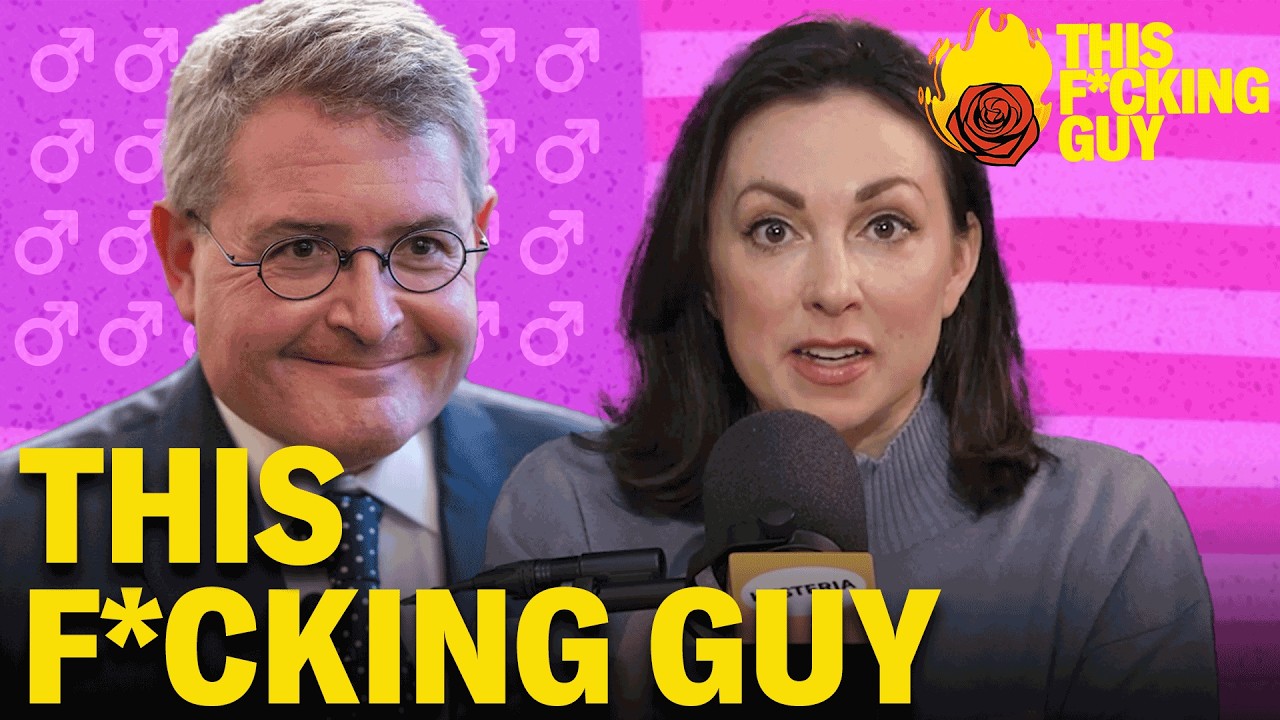
:{:{In our 20th (!!) episode of This F*cking Guy, Erin and Alyssa take a look at a guy who may not be a household name but has played a leading role in creating the current hellscape of American politics. His name is Leonard Leo and as one of the leading architects of Donald Trump's Project 2025 he has been a key player in securing the conservative majority on the Supreme Court and drowning our elections in dark money. Join us for a deep dive into his efforts to impose a right-wing Christian agenda onto all of America and how he is now setting his sights on the entertainment and tech industries.}:
CHAPTER
 Intr
 Early Lif
 DC Internship and The Federalist Societ
 The Judicial Confirmation Networ
 “The Honest Elections Project
 Leonard’s Judges and Their Luxury Gift
 Dark Money and Trump’s Judge
 Ad Brea
 Leonard’s Lavish Lifestyl
 CRC Advisors and “$1.6 Billion is a cross
 Cafeteria Catholicis
 Moves into Influencing the Entertainment Industr
 Electoral Failure
 Rating Leonard Leo }:
:{:{:{SOURCES:}:
https://www.propublica.org/article/we... https://www.ebsco.com/research-starte... https://www.washingtonpost.com/nation... https://www.rollingstone.com/politics... https://jacobin.com/2023/07/leonard-l... https://www.propublica.org/article/da...https://www.nytimes.com/2024/05/28/ma... https://www.washingtonexaminer.com/in...https://www.washingtonpost.com/invest...https://www.washingtonpost.com/invest...https://www.propublica.org/article/sa...https://www.axios.com/2020/01/07/leon...https://www.washingtonexaminer.com/tr...https://www.judiciary.senate.gov/pres...https://www.theguardian.com/law/2024/...https://www.politico.com/news/2023/09...https://www.motherjones.com/politics/...https://slate.com/news-and-politics/2...https://www.motherjones.com/politics/...https://jacobin.com/2024/08/leonard-l...https://www.nytimes.com/2024/05/28/ma...https://www.politico.com/news/2023/11...https://www.levernews.com/tag/leonard...https://www.levernews.com/how-dark-mo...https://www.levernews.com/how-a-secre...https://www.propublica.org/article/le...https://jacobin.com/2024/11/dark-mone...https://www.propublica.org/article/cl...https://www.propublica.org/article/le...https://maplightarchive.org/story/new...https://www.propublica.org/article/da...[https://www.citizensforethics.org/rep...]
Political commentator and comedy writer Erin Ryan and former White House Deputy Chief of Staff Alyssa Mastromonaco are joined by a bicoastal squad of funny, opinionated women to talk through everything from reproductive rights to romcoms. They break down the political news of the week, plus the topics, trends, and cultural stories that affect women’s lives. New episodes drop every Thursday. Get in touch: hysteria@crooked.com.}:

comment:
thcarter123
Terrific YouTube. Really good. I’d say spot on for everything about Leonard Leo (my boss from 2009-2012 at USCIRF) except that he or his court picks believe in “originalism.” Originalism is a rebranding, a marketing scam. Like you say toward the end, Leonard is an extreme right Catholic true believer. That is his political faith. He is a Catholic Crusader. It is called Catholic Integralism, based on Aquinas “natural law.” Today’s intellectual deans of Integralism are Patrick Deneen and Adrian Vermeule. In short, US separation of church and state is heresy. The state must be run by Catholic king, with immunity. This theology runs thru the Inquisition, the Papal States, Opus Dei’s Franco Spain, Hitler’s Carl Schmitt and Leo’s Supreme Court. Leo spent 35 years and $600 million finding and placing Catholics in important slots. Only extreme Catholics. Six Supremes, Kevin Roberts and Roger Severino at Project 2025. JD, a disciple of Deneen, in the White House. Again, terrific video. You tell the Leo story better than most. Hope it gets millions of views.
---
---
she is opus dei?!
rww 8 22 leo got 1.6b$ last year
[pix JCN President Carrie Severinocriticized the Supreme Court nomination of Ketanji Brown Jackson in a March 2022 Fox News appearance.
Just days after FBI agents carried out a search warrant for secret documents wrongly being held at former President Donald Trump’s Florida home, a right-wing dark-money group that helped secure a far-right majority on the Supreme Court launched a $1 million digital and cable ad campaign attacking Attorney General Merrick Garland.
The Judicial Crisis Network has been at the core of the massive and secretly funded dark-money campaign by right-wing funders and groups like the Federalist Society to secure ideological domination of the Supreme Court and federal judiciary. The group backed former Senate Majority Leader Mitch McConnell’s abuse of power to prevent the Senate from considering former President Barack Obama’s nomination of Garland to the Supreme Court, and then spent tens of millions promoting confirmation of Trump’s nominees. More recently, JCN led attacks on the nomination of Supreme Court Justice Ketanji Brown Jackson and dishonest smears against several of President Joe Biden’s Justice Department nominees.
The new JCN ad seeks to undermine Garland’s credibility, accusing him of “cowering to the woke mob.” A press release announcing the ad buy claimed that Garland has “consistently bowed to the radical left’s agenda.” In a statement, the group’s president Carrie Severino repeated a false right-wing talking point accusing Garland of “calling concerned parents ‘domestic terrorists.’”
The ad also claims that Garland has betrayed his former judicial colleague Brett Kavanaugh by not stopping activists from protesting outside the Supreme Court justice’s home. As CNN noted, the rarely enforced law that JCN and right-wing politicians are demanding Garland use against protesters could also be interpreted to forbid the kind of protests at the Supreme Court that anti-abortion groups mobilized for years. The JCN ad notably does not mention that Garland supported recent legislation to beef up security for Supreme Court justices and their families.
Right-wing media outlets have given JCN’s campaign a boost, with Fox News reporting JCN’s assertion that the Garland ad is part of a broader $10 million campaign attacking Democrats over the court that will include “paid advertising, earned media, research, grassroots activity, and a coalition enterprise.”
Tags: Carrie Severino Donald Trump Donald Trump Supreme Court Judicial Crisis Network
---
fac so index:
May 26, 2019by Facing South
Rank of Brett Kavanaugh's 2018 appointment to the U.S. Supreme Court among the reasons there's a new push to ban abortion in state legislatures across the South and elsewhere: 1
In the fiscal year before it spearheaded Kavanaugh's confirmation, amount the Judicial Crisis Network (JCN) — a secret-money 501(c)(4) "social welfare" nonprofit that promotes conservative judges — received in anonymous donations, according to a tax return recently obtained by campaign finance watchdogs: $22 million
Size of a single anonymous donation JCN got during the period between July 2017 and June 2018, when abortion rights-protecting Justice Anthony Kennedy resigned, opening the door to Kavanaugh, who was backed by anti-abortion groups: $17 million
Number of other anonymous donations JCN got that year, all of them at least six-figure: 9
JCN's spending in 2017 to support the confirmation of President Trump's other Supreme Court nominee, Neil Gorsuch, who has also shown hostility to the Court's 1973 Roe v. Wade decision legalizing abortion: $10 million
Year in which Carrie Severino — a former law clerk for Supreme Court Justice Clarence Thomas and spouse of Catholic anti-abortion lawyer Roger Severino, who now runs the Department of Health and Human Services' Office of Civil Rights and opposes contraceptive access under the Affordable Care Act — took the helm of JCN: 2014
Among JCN's top funders, rank of the Wellspring Committee, a secretive nonprofit that serves as a conduit for anonymous contributions to conservative causes and is led by hard-line Opus Dei Catholic Ann Corkery and her husband, Neil Corkery, who has served as JCN's treasurer: 1
Amount Wellspring funneled to JCN between 2010 and 2018: more than $54.2 million
According to the newly released tax return, amount JCN paid that fiscal year to theBH Group, a Virginia limited liability company connected to Trump advisor Leonard Leo,who's also the executive vice president of the Federalist Society, an influential conservative legal organization whose current or former members include five sitting Supreme Court justices: $241,000
Decades for which Leo — also reportedly an Opus Dei member who plays a key role in hiring at George Mason University's law school in Virginia — has worked to push the judiciary to the right in order to enable an abortion crackdown: 3
According to conservative commentator Ed Whelan, number of people "more dedicated to the enterprise of building a Supreme Court that will overturn Roe v. Wade" than Leo: 0
Month in which Leo told a gathering of conservative activists in Florida that they had to mobilize in "very unprecedented ways" to finish their transformation of the U.S. Supreme Court: 2/2019
Between 2014 and 2017 alone, amount Leo and his allies raised for JCN and other secret-money nonprofits to carry out their court-transforming agenda: more than $250 million
Year since JCN has also been funneling millions of dollars to state supreme court races, money that has bought misleading or even libelous ads: 2012
==
https://www.nationofchange.org**/2022/07**/07/opus-dei-supreme-indecency-extreme-deceit/
the current Supreme Court majority that just denied women a legal right to abortion (Dobbs vs. Jackson) consists of religious fanatics whose careers have been fast-tracked (so that young Justices can serve for decades) by ultra-wealthy, like-minded lobbyists and political operatives. The nexus of this activity lies with a powerful arch-conservative organization within the Catholic Church, Opus Dei, that in the U.S. operates out of the Catholic Information Center in Washington D.C.
I am not targeting Catholics but rather the Church’s reactionary, fundamentalist wing. Many Catholic organizations are dedicated to upholding the rights and lives of minorities (and majorities, such as women), victims of pedophilic priests, gays, the poor, immigrants, etc. The fundamentalist wing of any religion has more in common with other creeds’ fundamentalisms than with many of its own co-religionists, whom they often regard as enemies. Catholic fundamentalism is obviously not the only “brand” influencing American politics, but it is the one with a dominant insidious influence on the judiciary.
Opus Dei and its partner organizations have poured tens of millions of dollars into promoting the careers and appointments of Chief Justice Roberts and the five Justices who overturned Roe: Thomas, Alito, Kavanaugh, Gorsuch, and Barrett (Roberts, an arch-conservative, nonetheless dissented on the abortion case).
Opus Dei was founded in Spain by Escriva de Balaguer in 1928 and grew in power, wealth, and influence during the Fascist dictatorship of Francisco Franco who, with significant military help from Nazi Germany, overthrew the legitimate Spanish government and ruled over a police state from 1939-1975.The group extended its power throughout Latin America, supporting Pinochet’s murderous regime in Chile and other terrorizing dictatorships. It consistently opposes gay, sexual, and reproductive rights, and the Catholic liberation movements that champion the poor in Latin America. It has been involved in the Vatican’s banking scandals but still wields enormous influence over Vatican finances, as detailed by Robert Hutchison in his book, Their Kingdom Come.
Opus Dei’s assets as of 2008 were $2.8 billion, but they have undoubtedly grown since. Popes John Paul II and Francisboth elevated Opus Dei officials to the highest Church offices. One of Opus Dei’s core principles, as articulated by its founder, is to engage in “the sphere of public life”, not because they are human or Catholic rights but because “they are God’s rights…May such ‘fanaticism’ for the Faith…become stronger every day.” Opus Dei is not simply a conservative religious group, it is openly dedicated to wielding political and financial power in nations throughout the world. And that often means promoting and aligning itself with the most violent, reactionary regimes and acting in the shadow realms of political influence.
Opus Dei members were prominent in Trump’s White House, including Attorney General William Barr and Pat Cipollone, Trump’s former White House counsel. Opus Dei had access to Trump’s budgetdirector,Mick Mulvaney, along with other noted right-wing lobbyists (Heritage Foundation, Koch Industries), meetings the Trump administrationtried to keep secret. Member Larry Kudlow was Trump’s director of the National Economic Council. It may well be the most powerful political lobby in the world and yet its explicit political agenda is absolutely subservient to its extreme, authoritarian religious agenda.
A key fixer in this effort is Leonard Leo. Leo is on the board of directors of the Catholic Information Center (William Barr was a past director) and Executive Vice Presidentof the Federalist Society, a lobbying group that adheres to an “originalist” interpretation of the Constitution (more on this below). The two organizations are close political allies, as Leo’s dual role suggests. As Trump’s close advisor during his presidency, Leo was responsible for selecting and guiding the Supreme Court nominations of Alito, Barrett, Kavanaugh, and Gorsuch and was instrumental in riddling the lower Federal courts with Trump appointees.
Meanwhile, members of both Opus Dei and The Federalist Society include Alito, Clarence Thomas, and the late Justice Antonin Scalia. Chief Justice Roberts is a Federalist Society member and the Society’s members and supporters are prominent in many of nation’s top law schools and most powerful law firms, which allows it to have an untoward influence over judicial selections. When Clarence Thomas headlined a 2013 Federalist Society fundraiser, guests were seated in proximity to him according to the size of their donations. In effect, the Federalist Society and Opus Dei have become the Supreme Court of the land.
Much of Opus Dei’s influence was exerted via the Wellspring Committee, established and run by Opus Dei members Ann and Neil Corkery in 2008. The Koch brothers were instrumental in providing Wellspring with its first $10 million in seed money. According to Robert Maguire of Citizens for Responsibility and Ethics in Washington, the Corkerys “have been the overseers of massive amounts of money that have gone into federal judicial races.”
Wellspring closed down in 2018 but not before passing its mantle to the Judicial Crisis Network (JCN); in 2017 Wellspring transferred $14,814, 998.00, or 94% of its donations that year, to JCN. JCN was formerly directed by Leonard Leo and now byCarrie Severino, who served as Thomas’s law clerk. (Opus Dei’s Roger Severino, Carrie’s husband, was Director of Trump’s Office for Civil Rights). JCN is a 501(c)(4) organization so its donors can remain secret. JCN poured millions into supporting Bush and Trump’s Supreme Court nominees (Roberts, Alito, Kavanaugh, Gorsuch, and Barrett) and millions blockingObama’s Court nominee, Merrick Garland.
Given Opus Dei’s absolute anti-choice ideology, global power, and influence over the Supreme Court, it is clear the Court’s anti-choice decision was not driven by legal arguments over the right to privacy, strict or “originalist” interpretations of the Constitution, or states rights. These were all just window dressing. The Supreme Court—and much of our judiciary—has been taken over by fanatics with a strictly theologicalagenda: to replace “separation of Church and State” with “the Church runs the state”. It is a narrow, fanatical religious ideology that decided the case.
The so-called “originalist” theory of interpreting the Constitution claims the Constitution only protects rights explicitly mentioned in the text. The Constitution itself rejects the “originalist” idea so central to conservative ideology. The Ninth Amendment reads, “The enumeration in the Constitution, of certain rights, shall not be construed to deny or disparage others retained by the people.” This clearly states that interpreting the Constitution is a living, evolving process, for how else can those “other[s]” rights be “retained by the people”? The Ninth is also a safety valve: “If we left out any important rights, sorry, our bad, it doesn’t mean those rights aren’t protected as well.” The Ninth has been used to uphold such diverse rights as teaching non-English languages, sending kids to private schools, protecting against forced sterilization, and the 1965 Griswold decision overturning bans on contraception, in which privacy was deemed a “penumbra” (also called “unenumerated”) right. The penumbra concept was then applied to abortion in 1973’s Roe decision.
Justice Harry Blackmun wrote the majority decision in Roe v. Wade, citing both the Ninth and Fourteenth Amendments:“This right of privacy, whether it be founded in the Fourteenth Amendment’s concept of personal liberty and restrictions upon state action, as we feel it is, or…in the Ninth Amendment’s reservation of rights to the people, is broad enough to encompass a woman’s decision whether or not to terminate her pregnancy. The detriment that the State would impose upon the pregnant woman by denying this choice altogether is apparent.” The Court also recognized that “When those trained in the respective disciplines of medicine, philosophy, and theology are unable to arrive at any consensus, the judiciary…is not in a position to speculate as to the answer.” Blackmun’s decision includes an overview of the dramatic shifts in cultural and legal attitudes towards abortion, though most views differentiated abortions in the first 12-16 weeks (before the baby is usually felt moving inside the womb) from those occurring later.
The “sanctity of the foetus”, that is, viewing abortion at any stage of pregnancy as equivalent to murder, is the linchpin of the anti-choice position and its driving emotional trigger. However, even the Catholic Church’s historical opposition to abortion had nothing to do with the sanctity of the foetus; it was aimed at the “sin” of sexual pleasure. Church policy varied over the centuries but the foetus’s life was either absent as an issue or secondary to sexual sin and other theological concerns. St. Thomas Aquinas asserted that in its earlier stages a foetus is in a “vegetal” and then “animal” state before achieving person-hood at some point, most likely at the end of the third month.It wasn’t until 1965 that the Church banned abortion on the basis of sanctity of life rather than sexual sin.However, the Bible passages used to justify this claim 1) do not really address abortion (the BIble is much more direct in advising that adulterers be stoned to death); 2) are drawn mostly from the Old Testament, a Jewish document, significant since the Jewish religion allows abortion; and 3) are in the Bible, which has no legal standing in the United States. Or didn’t.
The Court’s decision in Dobbs v. Jacksonis only the beginning, as anti-abortion activists and GOP-led extremists mobilize to assault a wide range of rights. The anti-choice movement was never only about abortion. Abortion was used as the emotional catalyst for a broad attack on the values of tolerance and social commitment embodied in Federal guarantees backed by Constitutional authority. The well-being of Americans and our system of government is now in the hands of religious fanatics on a crusade against all those who do not believe in their degraded, medieval version of truth. They are welcome to their beliefs but are not welcome to impose those beliefs on the rest of us, nor to challenge the fundamental values of the United States, which holds the value of human beings above adherence to extreme and rigid political or religious ideologies.
---
ref no twt
http://churchandstate.org.uk/2019/03/opus-deis-influence-on-the-u-s-judiciary/
"leonard Leo can take credit for installing four Supreme Court justices” – John Roberts, Samuel Alito, Neil Gorsuch and Brett Kavanaugh. “As executive vice president of the Federalist Society, Leo has been the quiet architect of a pivotal shift to the right throughout the federal judiciary” including “dozens of lower court federal judges across the country.”
It was Leo who prepared Trump’s “list of judges and the people that he’s put on the bench.”
Leo is on the board of directors of Opus Dei’s Catholic Information Center located at 15th and K Street, two blocks from the White House. The Center is “a rallying point for ultra-conservative Catholics eager for a voice in the secular halls of government power” and “advances a hard-right political agenda,” according to Church and State, Americans United for Separation of Church and State’s magazine.
Other members of the Catholic Information Center’s Board of Directors include:
- Pat Cipollone – Trump’s White House counsel, the president’s principal legal adviser. Cipollone is a partner in Stein Mitchell Cipollone Beato and Missner LLP.
- Gerry Mitchell – another partner inStein Mitchell Cipollone Beato and Missner. Their attorneys have “unparalleled expertise” in the federal courts and “before the Federal Trade Commission and Department of Justice” according to the firm’s website.
- Brian Svoboda – partner inPerkins Coie. The firm’s “Areas of Focus” include “Political Parties, Campaigns and Committees; Corporate Political Activity and Campaign Finance Compliance.” Its attorneys are admitted to the “Bar and Court” of the “District of Columbia, U.S. Court of Appeals for the District of Columbia Circuit, U.S. Court of Appeals for the Fifth Circuit and U.S. District Court for the District of Columbia.”
- Thomas Yannucci – partner in the Washington, D.C. office of Kirkland & Ellis LLP, Brett Kavanaugh’s former law firm. Yannuci “has acted as trial and appellate counsel” in suits involving “the DOJ, FDA, EPA, FTC, SEC, ITC, FEC, CIA, NLRB” and RICO (Racketeer Influenced and Corrupt Organizations Act).
- Cindy Searcy – another vice president of the Federalist Society. The Federalist Society is a “hugely powerful, nationwide organization of conservative lawyers” instrumental in developing candidates for federal judicial roles.
Opus Dei
Opus Dei is a secret society and an official arm of the Catholic Church. Its roots are in fascist Spain.
In 1982, Pope John Paul II designated the group as a “personal prelature,” that is, they are under the sole jurisdiction of the pope and no other prelate. Its website states, “Opus Dei’s mission is to spread the Christian message that every person is called to holiness and that every honest work can be sanctified.” As of 2017 there are 92,892 lay members and 2,212 priests worldwide.
Non-Catholics are welcomed as “cooperators” who “assist the educational and social undertakings promoted by the Prelature.” Priests not ordained into Opus Dei can be a member of the Priestly Society of the Holy Cross, “intrinsically united to the Prelature.”
Only the identities of Opus Dei priests are public. Members of the Priestly Society of the Holy Cross and all lay members’ and cooperators’ names are secret unless self-disclosed, such as being openly affiliated with the Catholic Information Center.
At the top:
“Opus Dei is an efficient machine run to achieve worldly power,” wrote investigative reporter Penny Lernoux in her book, People of God.
“Opus Dei pursues the Vatican’s agenda through the presence of its members in secular governments and institutions and through a vast array of academic, medical, and grassroots pursuits. Its constant effort [is] to increase its presence in civil institutions of power. [T]heir work in the public sphere breaches the church-state division that is fundamental to modern democracy,” noted Gordon Urquhart, author of The Pope’s Armada: Unlocking the Secrets of Mysterious and Powerful New Sects in the Church(1995).
“Opus Dei uses the Catholic Church for its own ends which are money and power …. Its members form a transnational elite. They seek to colonize the summits of power. They work with stealth – ‘holy discretion’ – and practice ‘divine deception,’” declared Robert Hutchison in the introduction to his book, Their Kingdom Come: Inside the Secret World of Opus Dei.
“Opus Dei is mostly middle- and upper-class businessmen, professionals, military personnel and government officials. Its members control a large number of banks and financial institutions,” according to Martin A. Lee, author and activist who has written books and articles on far-right movements.
For example, Opus Dei also operates the Leonine Forum, “Cultivating Catholic Professionals for Lives of Virtuous Leadership.”
Among the 2017-2018 New York City Fellows are those employed in Wall Street brokerages, law firms, leading publications, universities, medicine, industry and the U.S. District Court for the Southern District of N.Y.
The 2017-2018 Washington D.C. Fellows include those employed in the federal government: White House, State Department, the House of Representatives, U.S. Dept. of Housing and Urban Development, U.S. Dept. of Justice, Federal Communications Commission, U.S. Court of Appeals for the D.C. Circuit, U.S. Securities and Exchange Commission, prestigious law firms, conservative think tanks, higher education and medicine.
As an example of “military personnel,” veteran investigative reporter Seymour Hersh “claimed that Gen. Stanley McChrystal, Vice Admiral William McRaven and others in the JSOC were members of the Knights of Malta and Opus Dei.” JSOC is “the elite Special Ops force” who killed Osama bin Laden. “We’re gonna change mosques into cathedrals … This is not an atypical attitude among some military — it’s a crusade, literally,” Hersh reported. “He added that members of these societies have developed a secret set of insignias that represent ‘the whole notion that this is a culture war’ between religions.”
In government, Larry Kudlow is Trump’s director of the National Economic Council. Plutocracy is “just what America needs,” Kudlow wrote in December 2016. “Putting the incredibly wealthy in charge of the U.S. government” is described as Kudlow’s great idea.
Kudlow is one of Fr. John McCloskey’s notable converts to Catholicism. McCloskey was director of Catholic Information Center from 1998-2002.
Another McCloskey convert is former Kansas Gov. Sam Brownback, now Trump’s Ambassador-at-Large for International Religious Freedom.
Mick Mulvaney will serve as Trump’s acting White House Chief of Staff, beginning in 2019. He remains as director of Trump’s White House Office of Management and Budget and interim head of the Consumer Financial Protection Bureau. Mulvaney “has reportedly met with a long list of lobbyists, corporate executives and wealthy people with business interests before the government.” His meeting with Opus Dei’s Jeff Bell, architect of Reaganomics, covered “religious and political matters.”
Trump appointed C-Fam (formerly known as the Catholic Family and Human Rights Institute), the “intensely anti-abortion and anti-LGBTQ group” headed by Opus Dei’s Austin Ruse, to the U.S. delegation to the UN Commission on the Status of Women.
As to members who “control a large number of banks and financial institutions,” Pope Francis has appointed many of them to the Vatican.
Secrecy prevents certainty
Due to Opus Dei’s secrecy, we can only guess about non-disclosed membership. Some have done so anyway.
“It’s widely known that Supreme Court Justices Antonin Scalia, Samuel Alito, and Clarence Thomas belong to Opus Dei – and that Chief Justice John Roberts may also be a member,”stated Matthew Fox, a former priest, progressive theologian and author of more than 23 books.
Others have also identified Scalia as a member, perhaps because his wife attended Catholic Information Center events and his son has spoken there.
Scalia’s influence, however, is not in doubt. The Federal Society “really grew up as a organization that promoted Antonin Scalia’s conservative judicial philosophy.” On Nov. 10, Trump awarded Scalia the Presidential Medal of Freedom, the highest civilian award in the U.S., for his “especially meritorious contribution” to this country.
Alito has been also been described as to close to Opus Dei by Church and State Magazine.
Some are linked by association. “Leo has been a longtime friend and champion of Justice Clarence Thomas.”
When John Roberts was nominated for the Court, Opus Dei’s Austin Ruse said his fellow conservative Catholics could “breathe easy” and Leonard Leo “also assured conservative Catholics that Roberts will not follow the same path as Anthony Kennedy.”
“Leo, perhaps the most integral private individual in the selection of Kavanaugh” was present at the White House ceremony when Trump announced Kavanaugh’s nomination. Kavanaugh’s legal thinking is “shaped by Scalia.”
Gorsuch, was raised Catholic, went to the same elite Catholic prep school as Kavanaugh, but is now Episcopalian. He did his doctoral study on “natural law,” a theory asserting that certain rights are inherent by virtue of human nature that can be understood universally through human reason, first taught by the Catholic monk, St. Thomas Aquinas. On Oct. 19, Gorsuch spoke “at a conference of Catholic legal scholars seeking to expand Christian influence on public policy” which was closed to the public.
During his time at the U.S. Court of Appeals Tenth Circuit, Gorsuch took a “strong stance” for “religious freedom” in the Little Sisters of the Poor case. He also concurred in the Hobby Lobby case in favor of the Green family.
Pope Francis met with the Little Sisters of the Poor while in the U.S. in support of their lawsuit. The year before, the pope granted a private audience to Hobby Lobby’s Green family, asking them “how their Supreme Court fight against President Obama’s contraception mandate was progressing.” They won.
The nuns’ lawsuit was against the Obamacare provision that those seeking the same religious exemption to providing contraceptive health care coverage to their employees as “houses of worship” must fill out a two-page form explaining why. The nuns’ argued that filling out the forms “makes them complicit in providing women with contraception.”
This became a cause célèbre for conservative Catholics and may well have tipped the Electoral College total in favor of Trump.
In September 2016, Trump promised that “If I am elected president, [t]he Little Sisters of the Poor, or any religious order for that matter, will always have their ‘religious liberty’ protected on my watch and will not have to face bullying from the government because of their religious beliefs.”
In October, Trump sent a letter to the Catholic Leadership Conference: “I will make absolutely certain religious orders like the Little Sisters of Poor are not bullied by the federal government because of their religious beliefs.”
In the final days of the campaign, Trump gave an interview on the Catholic EWTN, “the largest religious media networkin the world.” Trump again sympathized with the Little Sisters of the Poor. “Religious liberty” was in “tremendous trouble” and “the biggest issue right now is the Supreme Court judges,” he said.
Trump won all the rural and Southern Evangelical-majority states, as expected. But, “his victory in the Electoral College came down to a razor-thin edge of only 77,744 votes across three states: Pennsylvania (44,292 votes), Wisconsin (22,748 votes), and Michigan (10,704 votes). These votes represent a Trump margin of 0.7 percentage points in Pennsylvania, 0.7 percentage points in Wisconsin, and 0.2 percentage points in Michigan.”
There are more Catholics than Evangelicals in Pennsylvania and Wisconsin. While there are more Evangelicals in Michigan than Catholics (25% v 18%), the Evangelical vote alone wasn’t sufficient to give Trump a win.
Trump won60% of white Catholics while receiving only 46% of the national popular vote. As public opinion seesawed during 2016 campaign, every poll that included the respondent’s religion showed Catholics choosing Trump at percentages higher than the general electorate. (See also here, here and here.)
“Both white and Latino Catholics cast more ballots for Trump than for Romney in 2012.” Evangelicals “went overwhelmingly for Trump, but that was also true in 2012 when they weren’t even sure Romney was Christian. They aren’t the swing voters. Catholics, on the other hand, were plus-2 for Obama in 2012 and plus-7 for Trump.”
Now the Justice Department, too
Last week, Trump nominated William Barr as Attorney General. Described as a “committed Catholic,” Barr was “highly recommended” for the position by Leonard Leo. As a former U.S. attorney general, Barr “will enter the Justice Department with an awful lot of credibility and respect for the role he previously played,” Leo said.
Trump’s choice of Barr has been widely criticized.
Barr has publicly defended Trump on several of his pet issues. He endorsed the firing of James Comey, called for investigation of the Clinton Foundation, impugned the neutrality of Robert Mueller’s investigators, and defended Trump’s practice of demanding investigations of his enemies. Barr has a record as one of the members of the Republican legal Establishment most indulgent of Trump’s conspiratorial mafia ethos.
But a new report in the Wall Street Journal suggests more complete answer. Earlier this year, Barr wrote a lengthy memo excoriating Mueller’s investigation of Trump for obstruction of justice. Mueller’s investigation was “grossly irresponsible,” had “potentially disastrous implications,” and other choice descriptions spread over 20 pages culled from public reports. This memo was completely unsolicited.
It was reported on Oct. 18 that for the first time ever, the U.S. Department of Justiceopened an investigation into clerical sex abuse of minors. Seven of the eight Catholic dioceses in Pennsylvania received subpoenas and the U.S. attorney in Buffalo, NY, also served the diocese there. Until now, only state officials have conducted such probes. Washington D.C. and 19 states have also begun new investigations.
The U.S. Attorney’s Office in Philadelphia “issued subpoenas that seek years of internal records, including any evidence of Church personnel taking children across state lines for purposes of sexual abuse, any evidence of personnel sending sexual material about children electronically and any evidence that Church officials reassigned suspected predators or used Church resources to further or conceal such conduct. Any of these could be the underlying crimes for RICO,” the Racketeer Influenced and Corrupt Organizations Act originally designed to target the Mafia.
As journalist Patricia Miller noted, any federal investigation “could be impeded by higher-ups in the Justice Department.”
So with five Supreme Court justices, the Attorney General, and who knows how many other officials installed by Leonard Leo, we have much to worry about.
Reprinted with permission from the author.
Betty Clermont is author of The Neo-Catholics: Implementing Christian Nationalism in America (Clarity Press, 2009).
ref 2
https://www.cnbc.com/2017/11/21/koch-lobbyists-and-opus-dei--whos-dropping-in-on-trump-budget-czar-mick-mulvaney.html
one of President Donald Trump’s top cabinet officials has met with a long list of lobbyists, corporate executives and wealthy people with business interests before the government, according to calendars the Trump administration fought to keep secret.
The calendars for Mick Mulvaney, the former South Carolina congressman who now runs the White House Office of Management and Budget, offer a glimpse of who has access to the highest levels of the Trump administration.
Among those visiting Mulvaney: Trump friend and casino magnate Steve Wynn; a flurry of officials from the conservative Heritage Foundation; a string of health care and Wall Street CEOs; lobbyists for Koch Industries; a cryptocurrency evangelist; and a prominent member of the Catholic group Opus Dei.
More from ProPublica:Facebook (still) letting housing advertisers exclude users by race
Here are the White House visitor records the Trump administration didn’t want you to seeWhat it’s like covering Trump
The Trump administration fought in court to block public records requests by Property of the People, a Washington-based nonprofit transparency group, to release the calendars as well as visitor logs from several other White House offices. Lawyers for the group ultimately prevailed and provided the documents to ProPublica, which we are posting in a searchable format.
As OMB director, Mulvaney is the driving force behind the president’s budget and influences regulations and government procurement. It’s been widely reported that he will become the acting head of the Consumer Financial Protection Bureau. He also has the ear of the president, who is reportedly a fan of Mulvaney’s performances on the Sunday political shows. The calendars, which cover February to September, typically don’t include details on what was discussed at the meetings. In some cases, the timing of contact with Mulvaney line up with OMB business.
“The OMB director is a member of the cabinet and also a senior adviser to the president — because of that, the director often spends a ton of time in the West Wing,” said Kenneth Baer, who was senior adviser and associate director at the agency for several years of the Obama administration.
The quickest way to get access to Mulvaney appears to be to hire his former congressional chief of staff, Al Simpson, who joined the lobbying firm Mercury in February.
Simpson had seven meetings and a phone call with Mulvaney in a four-month period, between April and August. He appears on Mulvaney’s calendars more frequently than anyone who is not a current government official. Often, Simpson brought lobbying clients with him, including representatives from building materials giant Cemex; pharma firm AmerisourceBergen; and BlueCross BlueShield of South Carolina. Those three firms paid Mercury $360,000 in the first nine months of the year, disclosure filings show.
A Mercury spokesman said: “The firm fully complies with all registration and disclosure requirements when representing clients.” The OMB press office did not respond to requests for comment.
In July, Simpson and Koch Industries lobbyists Brian Henneberry and Raymond Paul met with Mulvaney.
In other cases, billionaires themselves came in to meet with Mulvaney. They include Charles Schwab, medical entrepreneur Patrick Soon-Shiong and Wynn, the casino magnate whose relationship with Trump goes back decades. Wynn met with Mulvaney in April. Wynn’s firm has lobbied on tax issues on Capitol Hill. Wynn himself, who has large holdings in Macau, has reportedly been involved in pressing the Trump administration on China issues. Wynn was also named finance chairman of the Republican National Committee in January. Wynn’s spokesman declined to comment.
In late February, Mulvaney had a call with Eugene Scalia, the son of the late Supreme Court justice and a prominent lawyer at Gibson Dunn. At the time, Scalia was representing business groups that wanted OMB to delay the implementation of a regulation known as the fiduciary rule. Scalia didn’t respond to a request for comment. Many of his meetings with health care executives came as Republicans in Congress tried to repeal Obamacare.
Mulvaney’s schedule is, to a large extent, a reflection of his politics. A former member of the House’s conservative Freedom Caucus, he recently told Politico, “I don’t think anyone in this administration is more of a right-wing conservative than I am.” (The same profile quoted Simpson, Mulvaney’s former chief of staff turned lobbyist, praising him.)
Mulvaney met with few, if any, consumer groups. That’s in contrast to President Barack Obama’s first OMB director, Peter Orszag, whose visitor logs show meetings with both a long string of corporate executives as well as philanthropic and consumer representatives.
Among the more surprising visitors to Mulvaney was Jeff Bell, a former Reagan aide who is marked on the calendar as being with the Catholic group Opus Dei. Bell told ProPublica that his March meeting with Mulvaney, a Catholic, covered “religious and political matters” but declined to comment further.
Another was Valery Vavilov, CEO of Bitfury, a tech company focused on cryptocurrencies like Bitcoin. When Mulvaney was still in Congress last year, he co-founded a “blockchain caucus” to promote the technology behind Bitcoin
At the May meeting, “Mulvaney expressed his desire to encourage government use of blockchain and he asked our group for suggestions of simple use cases that could be a first step for government adoption,” a Bitfury spokesman told ProPublica.
wiki 7 22
jeffrey Langley Bell (December 13, 1943 – February 10, 2018) was an American Republican Party politician, political consultant, author, and presidential speechwriter. He was the Republican nominee for the United States Senate from New Jersey in 1978, was a candidate for the Republican nomination for the Senate in 1982, and was the nominee against Democratic incumbent Cory Booker in 2014.
Contents
Early life and education
A native of Washington, D.C., Bell was a 1965 graduate of Columbia University in New York City and a veteran of the Vietnam War's Tet Offensive.[1][2][3][4]
Academic and consultancy work
Bell was a former president of the Manhattan Institute, served as a fellow of the Harvard Institute of Politics at Harvard University; a visiting professor at the Eagleton Institute of Politics at Rutgers University; and as the DeWitt Wallace Fellow in Communications at the American Enterprise Institute in Washington. He most recently served on the board of directors of the American Conservative Union and of the Campaign Finance Institute at George Washington University. Bell was also a visiting scholar at the Ethics and Public Policy Center.[5]
From 1988 to 2000, Bell served as president of Lehrman Bell Mueller Cannon, an economic and political forecasting company based in Arlington, Virginia. A principal of Capital City Partners from 2000 to 2012, a public affairs firm, Bell participated in the firm's contract with the United States Department of Health and Human Services to promote greater awareness of human trafficking in the United States. From 2010 to 2014, Bell was the director of policy of the American Principles Project (APP),[6] a Washington-based advocacy group. He headed APP's "Gold Is Money" project, which advocates a return to the gold standard in the United States.[6]
Political career
Early work
Bell worked as an aide to Presidents Richard Nixon and Ronald Reagan and to U.S. Representative Jack Kemp of New York.
In the 1968 presidential election, Bell was working on the Nixon presidential campaign. On the evening of the Robert F. Kennedy assassination after the California primary, Bell happened to be the only staffer on hand at the Nixon campaign headquarters and made the phone call to the former vice-president's senior staff to notify them of Senator Kennedy's shooting.[2]
Reagan's "$90 Billion" speech
In 1975, Bell was responsible for a speech given by Ronald Reagan when he was running against President Gerald Ford in the Republican presidential primaries. In it, Reagan proposed a "systematic transfer of authority and resources to the states - a program of creative federalism for America's third century. Federal authority has clearly failed to do the job. Indeed, it has created more problems in welfare, education, housing, food stamps, Medicaid, community and regional development, and revenue sharing, to name a few. The sums involved and the potential savings to the taxpayer are large. Transfer of authority in whole or part in all of these areas would reduce the outlay of the federal government by more than $90 billion, using the spending levels of fiscal 1975. With such a savings it would be possible to balance the federal budget, make an initial $5 billion payment on the national debt and cut the federal personal income tax of every American by an average of 23 percent."
Bell's speech was intended to provide Reagan with a philosophical edge over President Ford. The Ford campaign, however, seized on it as evidence that in primary states like New Hampshire, which pay no state sales tax or income tax, that the state would have to come up with its own funds for programs. Reagan lost the New Hampshire primary to Ford, and the Bell policy was interpreted by some as a contributing factor.
1978 U.S. Senate election
In 1978, Bell challenged four-term liberal Republican Senator Clifford P. Case in the New Jersey primary. In a stunning upset, Bell defeated Case on June 6, 1978, the same day Proposition 13 passed in California (the East and West Coast tax revolts), on a platform of income tax rate reduction that foreshadowed the Reagan tax rate cuts of 1981. Bell lost the general election to Democrat Bill Bradley, by a 55%-to-43% margin. No Republican has been elected to the U.S. Senate in New Jersey since Case's last victory in 1972.
1980 Reagan television spots
In 1980, Bell produced and co-wrote the television commercials used by the Reagan presidential campaign in New Hampshire and subsequent primaries. The commercials, which focused on Reagan's policy to fight inflation by lowering taxes, were highly effective in boosting Reagan's popularity in the primary polls.[7]
In The Reagan Revolution (Rowland Evans and Robert Novak, 1981), the effectiveness of these commercials is addressed:
It is no exaggeration to say that those Curson-Bell spots... were indispensable to Reagan's solution of his basic political and ideological problems–a solution necessary for him to win the presidency.[8]
1982 U.S. Senate election
Democratic Senator Harrison A. Williams resigned from the Senate in 1982 after being convicted of taking bribes as part of the Abscam sting operation. Republican Governor Thomas Kean appointed Nicholas F. Brady to serve until a special election could be held.
Bell decided to run again, but was defeated in the Republican primary by moderate Republican Congresswoman Millicent Fenwick. Fenwick was subsequently narrowly defeated in November by Democrat Frank Lautenberg.
Other political work
Bell was elected as a Reagan delegate from New Jersey to the Republican National Convention in 1980. As deputy chairman of the pro-Reagan group Citizens for America, Bell was actively involved in the passage of the Tax Reform Act of 1986. In addition to his work on the 1980 Reagan campaign, Bell was on the national campaign staff for Richard Nixon in 1968 and Reagan in 1976. In 1988, Bell served as the national campaign coordinator for Kemp for President and in 2000 he worked as a senior consultant to Gary Bauer's short-lived presidential campaign.
2014 U.S. Senate candidacy
Main article: 2014 United States Senate election in New Jersey
In February 2014 Bell rented a home in Leonia, New Jersey and announced he would run for the Republican nomination to challenge incumbent Democratic Senator Cory Booker, running on an anti-Federal Reserve and populist platform.[9][10] He narrowly won a four-way Republican primary on June 3, 2014, securing the nomination. Some of his promises are to restore the prosperity of the middle class by restoring the value of the dollar and not the value of the gold. By giving education that children deserve, promote legal immigration.[11] Jeff Bell lost to Cory Booker in a 42.4% to 55.8% percentage vote respectively, approximately the same percentages as in the 1978 Bell-Bradley Senate race 36 years earlier. The popular vote results were 1,016,204 for Cory Booker and 772,991 for Jeff Bell.
Personal life and death
Bell married to Rosalie O'Connell in 1983, and they had four children.[12] At the time of his death, he resided in Annandale, Virginia.[13] Bell died from cardiac arrest on February 10, 2018, at age 74.[12]
Books
Bell authored two books on modern American politics. The first, Populism and Elitism: Politics in the Age of Equality, published in 1992, was called by political journalist Fred Barnes, then with The New Republic, "the most important political book" of 1992. His second book, The Case for Polarized Politics: Why America Needs Social Conservatism, was published by Encounter Books on March 6, 2012. James Taranto in a February 2012 Wall Street Journal article, summarized the Bell thesis as follows:
Social conservatism, Mr. Bell argues in his forthcoming book, The Case for Polarized Politics, has a winning track record for the GOP. Social issues were nonexistent in the period 1932 to 1964. The Republican Party won two presidential elections out of nine, and they had the Congress for all of four years in that entire period. . . . When social issues came into the mix—I would date it from the 1968 election . . . the Republican Party won seven out of 11 presidential elections.
Bell discussed his book on an August 19, 2012 C-SPAN Washington Journal program. C-SPAN Bell Interview Bell has also written articles for numerous publications, most recently The Washington Post, The Wall Street Journal, and The Weekly Standard.
===
ggl 7 22
LOVE OF GOD IS SHROUDED IN SECRECY OPUS DEI ...
https://www.sun-sentinel.com › news › fl-xpm-1990-05-2...
May 24, 1990 — Corkery, 30, has a law degree and a family. She stopped practicing law to raise her two young children. She was skeptical about Opus Dei before ...
Behind the dark-money web that put Barrett (and Kavanaugh ...
https://www.salon.com › ... › Jon Skolnik's Articles
Mar 30, 2021 — Meet Neil and Ann Corkery, a pair of veteran Republican operatives who have cultivated a robust network of conservative and Catholic-affiliated ...
Ann Corkery - EverybodyWiki Bios & Wiki
https://en.everybodywiki.com › Ann_Corkery
Nov 28, 2021 — Ann Corkery is an American attorney and political activist. known as the founder of ... In the 1990s, Ann Corkery was a member of Opus Dei.
Career · Connection to 501(c)4... · The Wellspring Committee
Anne Loo on Twitter: "Here's a handy Opus Dei quick list. Add ...
https://twitter.com › loonyberg › status
This story is about OD Bill Barr and his cover-up regarding Inslaw/PROMIS theft by the DOJ. This story is huge. Epic. So is the info in the following tweet.
INSTITUTE INDEX: The secret money behind the push to ban ...
https://www.facingsouth.org › 2019/05 › institute-index...
May 23, 2019 — ... for anonymous contributions to conservative causes and is led by hard-line Opus Dei Catholic Ann Corkery and her husband, Neil Corkery, ...
Wellspring's Flow: Dark Money Outfit Helped Fuel Groups on ...
https://www.opensecrets.org › news › wellsprings-flow
Nov 5, 2013 — For people who guard their privacy closely, Ann and Neil Corkery are ... she was introduced to Opus Dei by Neil; he was a member but later ...
Ann Corkery - Stein Mitchell Beato & Missner LLP
https://www.steinmitchell.com › professionals-Ann-Cor...
Ann Corkery works at the intersection of law, public policy, and communications in the for-profit and non-profit world. She has extensive experience in ...
Wellspring Committee - Add Relationship - LittleSis
https://littlesis.org › org › 266354-Wellspring_Committee
Ann Corkery arch-conservative; Wellspring Committee dirctor, Opus Dei member, former director of ultra-right Catholic League, Becket Fund board member.
Opus Dei: Supreme indecency, extreme deceit
https://www.nationofchange.org › 2022/07/07 › opus-d...
2 days ago — Much of Opus Dei's influence was exerted via the Wellspring Committee, established and run by Opus Dei members Ann and Neil Corkery in 2008.
Judicial Crisis Network (JCN) - InfluenceWatch
https://www.influencewatch.org › non-profit › judicial-...
It was run since its founding by Ann Corkery, one of the co-founders of JCN. ... She has been associated with Opus Dei, a controversial Catholic religious ...
===
===
https://www.alternet.org/2020/09/barr-to-be-honored-for-christlike-behavior-with-award-from-right-wing-catholic-group-with-strong-ties-to-trump/
no lnx twt
attorney General Bill Barr will be honored for his “Christlike behavior” at Wednesday’s National Catholic Prayer Breakfast, according to Roman Catholic Sister, author, and anti-death penalty activist Sister Helen Prejean.
"sister Helen Prejean
@helenprejean
The National Catholic Prayer Breakfast will present an award to Attorney General Barr for “Christlike behavior” tomorrow morning. A.G. Barr has ordered the executions of six men with at least one more on the calendar. What is “Christlike” about using discretionary power to kill?"
The National Catholic Prayer Breakfast says Barr will be presented with its Christifideles Laici Award during today’s 16th annual prayer event.
“In Honor and Gratitude for Fidelity to the Church, Exemplary Selfless and Steadfast Service in the Lord’s Vineyard,” are the words inscribed on the award.
The event is being sponsored by several groups, including Alliance Defending Freedom, which appears on the Southern Poverty Law Center’s list of anti-LGBTQ hate groups.
President Donald Trump is expected to address the group today during its virtual ceremony.
Among the National Catholic Prayer Breakfast’s founders are Pat Cipollone, President Trump’s White House Counsel; former Republican Senator Rick Santorum; and Joseph Cella, President Trump’s Ambassador to Fiji, and a former Trump transition team member who co-founded the right wing activist group Catholic Vote.
Another founder of the National Catholic Prayer Breakfast is Austin Ruse, the president of the anti-LGBTQ hate group Center for Family and Human Rights (C-FAM).
Perhaps the most notable founder of the National Catholic Prayer Breakfast is the group’s president, conservative judicial activist Leonard Leo.
Leo also serves as co-chairman of the Federalist Society, the far right group responsible for promoting the illegitimate belief that the U.S. Constitution should be interpreted by judges according to how the nation’s founders thought.
President Trump, for the first time in history, has effectively farmed out the approval process for federal court judges and even Supreme Court justices he nominates, to the Federalist Society.
The award to Barr is being condemned by notable Catholics, including Sister Prejean, and Father James Martin, a Jesuit priest and editor-at-large at America magazine.
===
===
https://www.alternet.org/2020/09/the-warning-lights-are-flashing-red-how-trumps-toadies-are-helping-him-collude-with-russia/
After reviewing classified intelligence reports about Vladimir Putin’s attempts to interfere in the 2020 election over three weeks ago, Senator Richard Blumenthal tried to sound the alarm.
The warning lights are flashing red. America’s elections are under attack.
This week, I reviewed classified materials in the Senate’s Sensitive Compartmented Information Facility and received a similarly classified briefing on malign foreign threats to U.S. elections. I was shocked by what I learned — and appalled that, by swearing Congress to secrecy, the Trump administration is keeping the truth about a grave, looming threat to democracy hidden from the American people. On Friday, the Office of the Director of National Intelligence issued astatement that only hints at the threats.
The facts are chilling. I believe the American public needs and deserves to know them. The information should be declassified immediately.
Blumenthal went on to say that what he learned makes “Moscow’s past interference and nefarious actions look like child’s play.” We still, however, have no idea of what shocked him enough to write that op-ed in the Washington Post.
What we do know is how the Trump administration reacted. Last Friday, the Director of National Intelligence, John Ratcliffe, told Congress that his office would no longer brief them in person about foreign election interference, but would submit written reports. Clearly they don’t want to face probing questions from Congress. In defending his actions, however, Ratcliffe admitted that it goes beyond that.
[no twt]
ratcliffe’s initial argument doesn’t make any sense. He said that he is going to stop in-person briefings because members of Congress leaked classified information to the press. What he didn’t explain is how that would stop leaks. Classified information provided in writing is even easier to share with reporters.
In a scathing rebuke of Ratcliffe’s announcement, the Washington Post editorial board pointed out that the only so-called “leaks” came from the kind issued by Senator Blumenthal.
After the intelligence community briefed members of Congress in late July about threats to the upcoming election, Democrats expressed alarm about what they had learned — and about the fact that the information had not been shared with the American public. “The warning lights are flashing red. America’s elections are under attack,” wrote Sen. Richard Blumenthal (D-Conn.) in a Post op-ed, without disclosing any specifics…
[T]he only “leak” was the simple fact that the administration was withholding critical information about Russia’s interference — which, of course, is intended to help President Trump win reelection.
In that clip of Ratcliffe’s Fox News appearance, he eventually got to the point by saying that Democrats leaked information that “simply wasn’t true, that somehow Russia is a greater security threat than China.” In a case of obvious projection, Ratcliffe is telling us that the Trump administration doesn’t want Congress or the public to know what Moscow is doing to interfere in the election, but instead wants to change the narrative to focus on the distraction they’re offering about the threat posed by China. In other words, Ratcliffe is suggesting that he will now cherry-pick what intelligence is shared with Congress to provide cover for what Moscow is up to.
Added to that is a troubling story about yet another purge in the Justice Department by Attorney General Barr.
Current and former national security officials are raising concerns over Attorney General William Barr’s recent decision to remove the head of a Justice Department office that helps ensure federal counterterrorism and counterintelligence activities are legal – and replace him with a political appointee with relatively limited experience.
Barr has reassigned 23-year career professional Brad Wiegmann, who had been serving as Deputy Assistant Attorney General in charge of the Office of Law and Policy. As ABC News reports, “The office shapes government efforts by ensuring that new policies and executive actions don’t violate federal law.”
We’ve heard stories from former Trump administration officials who have said that they often found themselves having to tell the president that the actions he wanted to take were not legal. As former DHS Chief of Staff Miles Taylor said, Trump would claim to have “magical authorities” to break the law.
Now Barr has removed the person whose job it is to tell the administration when they are breaking the law and replaced him with a partisan loyalist. While it might not be unprecedented to do that, the fact that it comes a couple of months before an election makes this one troubling. Here is the most telling part about Wiegmann’s replacement, Kellen Dwyer:
From 2018 to 2019, he served as a fellow at the conservative-leaning Leonine Forum, a non-profit organization that says its alumni are “committed to the cause of reintroducing the tenets of [the Catholic church] into the political, policy, legal, business, and cultural activities of society.”
The Leonine Forum was created by the Catholic Information Center (CIC), an extremist group founded by Father John McCloskey, who eventually left the organization over allegations of sexual assault. Several members of the Trump administration have close ties to the CIC, including Attorney General Barr, White House counsel Pat Cipollone, and economic adviser Larry Kudlow.
What appears to be happening is that both Ratcliffe and Barr are paving the way for Putin and Trump, who speak regularly by phone, to illegally collude in their efforts to influence the election—this time from the Oval Office with the entire federal bureaucracy at their disposal.
===
===
12/19
no lnx doc
Trump Impeachment Trial Turns Spotlight On White House Lawyer Cipollone
December 23, 2019
Heard on All Things Considered
FRANCO ORDOÑEZ
5-Minute Listen
White House counsel Pat Cipollone typically works behind the scenes. That's about to change when he takes a central role in President Trump's Senate impeachment trial.
President Trump has often surrounded himself with lawyers whom he sees as being good on television. But Pat Cipollone, the attorney who will play a leading role in Trump's Senate impeachment trial defense, is better known for working behind the scenes.
Even as an architect of the White House's fight against impeachment, Cipollone has performed his most prominent work from behind his desk, writing strongly worded letters rebuffing congressional subpoenas and instructing other White House aides not to cooperate.
Trump has lauded him as "the strong, silent type." But that silence is expected to end with the Senate impeachment trial. Jay Sekulow, another one of Trump's attorneys in what he said would likely be a "multifaceted" legal team, said Cipollone is ready for the spotlight.
"He's a really great lawyer, but he also understands the political side of this — and especially an impeachment proceeding," Sekulow said in an interview. "You have dual issues: the legal issues and the political issues. And it's not every lawyer that gets both. And Pat clearly does."
Trump Impeachment Inquiry
The son of Italian immigrants, Cipollone grew up in the Bronx. He went to Covington Catholic High School in Kentucky and worked part time at a McDonald's.
He was valedictorian of his college class at Fordham University and then went to law school in Chicago on a full scholarship.
Melanie Sloan, a friend and law school classmate, said the University of Chicago was where Cipollone became immersed in conservative legal thought.
:{
}:
"My friends tended to be in the Progressive Law Students Association and were on the liberal side of the spectrum, and Pat and the crowd he hung out with were on the more conservative side of the spectrum, including people who are often now shortlisted for the Supreme Court in the Trump administration," said Sloan.
Sloan, who is now senior adviser to the liberal watchdog group American Oversight, told NPR she thinks "incredibly highly" of Cipollone. "He is a very warm, friendly person who would go out of his way for anybody, and I have the highest regard for him, despite how strongly I disagree with the positions the White House is taking on impeachment."
Other former classmates have a different view. Nearly two dozen signed a letter stating that his position on impeachment "distorts the law and the Constitution."
"We are sorry to see how your letter to the congressional leadership flouts the traditions of rigor and intellectual honesty that we learned together," wrote the members of the class of 1991 at the University of Chicago Law School.
Trump Administration Says It Won't Comply With Impeachment Inquiry]
Cipollone was managing editor for the law review. He worked closely with Eugene Scalia, son of conservative icon Justice Antonin Scalia. Eugene Scalia is now Trump's labor secretary.
Other friends of Cipollone went on to become prominent judges and have been touted as future candidates for the Supreme Court, including Allison Eid and Thomas Lee, who is the brother of Republican Sen. Mike Lee of Utah. Cipollone clerked for federal Judge Danny Boggs, known for giving new hires a famously difficult trivia exam. "Pat is a very smart, very competent lawyer and a great guy," Boggs told NPR.
Boggs' 64-question test for Cipollone included questions like "How many chromosome pairs are there in a human genome?" and "Give the number and popular name of any Beethoven symphony."
"That is in and of itself a badge of distinction among lawyers," said Mike Lee. "It's well known that you can't clerk for — you can't even interview for — Judge Boggs without passing with a pretty high score."
Lee told NPR that Cipollone's wide-ranging base of knowledge has served him well in his job as White House counsel.
His Catholic faith is another big influence in Cipollone's life and career.
"One of the many things I like about Pat is this: Faith is a big deal to him," said Bill Nettles, a former U.S. attorney for South Carolina in the Obama administration, who has worked with Cipollone.
"But I live in a part of the world where people routinely wear it on their sleeve. And Pat is not like that. ... He doesn't use it as a vehicle to judge other people," Nettles told NPR.
White House counsel Pat Cipollone (center) stands with acting Chief of Staff Mick Mulvaney (left) and spokesman Hogan Gidley at an event this year.]
Cipollone, 53, has 10 children. He is among a group of elite conservative Catholics who serve as close confidants to Trump — including Attorney General William Barr and Leonard Leo of the Federalist Society, who has helped Trump pick judges, including for the Supreme Court.
Cipollone, Barr and Leo have served on the board of directors of the Catholic Information Center, an organization for powerful Washington Catholics. The center is affiliated with the conservative Opus Dei movement.
:{
}:
John Allen, a veteran Vatican reporter and author of the book Opus Dei: An Objective Look Behind the Myths and Reality of the Most Controversial Force in the Catholic Church, called the Catholic Information Center a premier place for conservative Catholic movers and shakers in D.C.
"Cipollone is part of this broader sort of spectrum of conservative Catholic thought and activism that, in some way, is dedicated to the idea of trying to translate the kind of conservative reading of the Catholic Church's social agenda," Allen said in an interview.
The White House declined to make Cipollone available for an interview.
As Investigations Ramp Up, Trump Has Expanded White House Counsel's Office]
Before joining the administration, Cipollone was a partner at two prestigious law firms with a wide range of clients.
One very high-profile case was when his firm represented the woman known as "Jackie" who was featured in a 2014 article in Rolling Stone magazine. The article, about a gang rape at the University of Virginia, was later retracted and became the subject of lawsuits. But even then, Cipollone worked behind the scenes helping supervise the lawyers at his firm leading Jackie's defense.
Cipollone also worked a stint in the public sector. Early in his career, he joined the Justice Department working for Attorney General William Barr during George H.W. Bush's administration.
Like Barr, Cipollone has argued that the president wields broad executive powers. House Speaker Nancy Pelosi has described Cipollone's arguments as outrageous.
"That letter that came from the White House was a joke, beneath the dignity of the presidency of the United States, in defiance of our Constitution. Shame on them," Pelosi said this year.
Critics say Cipollone is twisting the law to serve the president's benefit. Kimberly Wehle was formerly an assistant U.S. attorney and associate independent counsel in the Whitewater investigation led by special prosecutor Ken Starr. She said impeachment can't be unconstitutional when several provisions in the Constitution say otherwise.
"He's serving the president at the expense of the Constitution, at the expense of his true client, the American people, because he's operating to create a mega-presidency that has more power than the other two branches," she said. "And that's dangerous."
Newt Gingrich, the former House speaker and an informal adviser to Trump, pushed back against that criticism and said Cipollone has been a stabilizing force in Trump's White House.
:{
}:
"You're in a fight over executive power," said Gingrich, who has also worked with Cipollone. "And I think in that sense that the Trump administration, across the board, sees itself as an active force for transformation."
Greta Pittenger, Will Chase, Barclay Walsh and Sarah Knight contributed to this report.
https://www.alternet.org/2020/01/bill-barr-warrior-for-theocracy-why-didnt-we-know-about-this/
===
gee, i was just wondering about paleo-cath
https://www.alternet.org/2019/12/the-seeds-of-theocratic-authoritarianism-are-being-planted/
no lnx
The seeds of Theocratic Authoritarianism are being planted
Written by Nancy LeTourneau / Washington Monthly December 31, 2019
Since it became obvious that Attorney General William Barr manipulated the release of the Mueller report in an attempt to exonerate Donald Trump, people have been asking the questions posed recently by Katherine Stewart and Caroline Fredrickson.
Why would a seemingly respectable, semiretired lion of the Washington establishment undermine the institutions he is sworn to uphold, incinerate his own reputation, and appear to willfully misrepresent the reports of special prosecutors and inspectors general, all to defend one of the most lawless and corrupt presidents in American history? And why has this particular attorney general appeared at this pivotal moment in our Republic?
Initially we heard a lot about Barr being part of a group of Republicans who are dedicated to the concept of a “unitary executive.” That was affirmed by the attorney general’s recent speech to the Federalist Society. It was, however, Barr’s speech at Notre Dame that led many of us to look at little deeper into what motivates this attorney general. He blamed “secularists” for moral chaos and posited that “free government was only suitable and sustainable for a religious people.” Stewart and Fredrickson point out that these views are foundational for Barr.
This form of “religious liberty” is not a mere side issue for Mr. Barr, or for the other religious nationalists who have come to dominate the Republican Party. Mr. Barr has made this clear. All the problems of modernity — “the wreckage of the family,” “record levels of depression and mental illness,” “drug addiction” and “senseless violence” — stem from the loss of a strict interpretation of the Christian religion.
As Joan Walsh recently pointed out, a look at Barr’s history demonstrates that he has been “neck-deep in extremist Catholic institutions.” One of the more interesting is the Catholic Information Center.
As recently as 2017, he was on the board of directors of the DC-based Catholic Information Center, led by the ultraright and secretive group Opus Dei. He’s not alone in being tied to that center. Its board includes the Federalist Society’s Leonard Leo, and White House counsel Pat Cipollone is a former board member. “The small center—its members and its leaders—continue to have an outsize impact on policy and politics,” The Washington Post wrote this year.
Larry Kudlow is another fan of the center. Its longtime president, Father John McCloskey, converted Kudlow from Judaism when he was struggling with drug and alcohol addiction. “I’d like to unleash him on Capitol Hill,” Kudlow told The Washington Times in 2001. “A few doses of Father McCloskey, and we’ll turn this country around. In some ways, the Catholic Church has fallen short in its evangelizing mission, and I think Father John is awakening that.” McCloskey also baptized modern ultraright stalwarts like former Kansas senator Sam Brownback and über–GOP fixer Newt Gingrich, whose wife is now the ambassador to the Vatican. (I kid you not.)
McCloskey left the center in 2003 after two credible allegations of abusing women who went to him for pastoral advice, and the center settled at least one of the complaints for almost a million dollars.
Reading the Washington Post article Walsh linked to about the Catholic Information Center, it became clear that this group appears to be the Catholic version of the Protestant group Jeff Sharlet wrote about in his book, “The Family: The Secret Fundamentalism at the Heart of American Power.” It is especially worth noting that the Federalist Society’s Leonard Leo serves on the board of the Catholic Information Center. He is the person featured in a Washington Post report by Robert O’Harrow and Shawn Boberg titled “A conservative activist’s behind-the-scenes campaign to remake the nation’s courts.” All of those extremist judges being nominated by Trump and rushed through confirmation by McConnell are being fed into the system by Leonard Leo, who joins Barr in being affiliated with an extremist Catholic organization.
All of this is why Stewart and Fredrickson point out that Barr’s interpretation of executive power is an “effect, rather than a cause, of his ideological commitments.”
Mr. Barr’s constitutional interpretation is simply window dressing on his commitment to religious authoritarianism….America’s conservative movement, having morphed into a religious nationalist movement, is on a collision course with the American constitutional system. Though conservatives have long claimed to be the true champions of the Constitution…the movement that now controls the Republican Party is committed to a suite of ideas that are fundamentally incompatible with the Constitution and the Republic that the founders created under its auspices…
Mr. Barr did not emerge in order to serve this one particular leader. On the contrary, Mr. Trump serves a movement that will cynically praise the Constitution in order to destroy it, and of which Mr. Barr has made himself a hero.
With adherents like Attorney General William Barr, Vice President Mike Pence, and Secretary of State Mike Pompeo, this movement is more than simply theoretical. For example:
[T]he President has a growing number of supporters who understand opposition to abortion and immigration as intertwined—as means of preserving a white, Christian America. And the Trump Administration is taking concrete steps to encourage this ideational fusion.
Consider the events of last week. The Trump Administration dispatched officials to the International Conference on Family Policy. There, Trump officials laudedHungary’s “procreation, not immigration” policies, which oppose refugees and immigration and instead subsidize traditional, nuclear Hungarian families to have more children. These policies coincided with a new Hungarian constitution, which protects fetal life from the moment of conception.
Joe Grogan, an assistant to the president and director of the Domestic Policy Council, praised Hungary for the “courage and creativity” of these policies and said the Trump Administration was “inspired” and came “in support and solidarity.” He took the occasion of celebrating Hungary’s fertility-boosting programs to affirm the Administration’s opposition to abortion.
Hungary’s “procreation, not immigration” policies have their roots in “replacement theory.” This doctrine holds that white women are not producing enough babies and Christian, western civilizations will be “replaced” through the twin forces of falling birth rates and increasing immigration.
Back in March, Trump’s HHS provided $5.1 million Title X family-planning funds to an organization called Obria, which aims to be a pro-life alternative to Planned Parenthood.
In 2015, Obria’s founder and current chief executive explained, “When [Europe’s] nations accepted contraception and abortion, they stopped replacing their population. Christianity began to die out. And, with Europeans having no children, immigrant Muslims came in to replace them, and now the culture of Europe is changing.” She warned that America is “on the same track as Europe” and that “[i]n only two of the past 40 years have we replaced our population.” WHITE GENOCIDE
Anyone familiar with Margret Atwood’s Handmaid’s Tale understands that this is what happens when democracy is replaced by theocratic authoritarianism. It is a marriage of white nationalism, Christian nationalism, and misogyny. That is where the current conservative movement is headed in this country.
Nancy LeTourneau is a contributing writer for the Washington Monthly. Follow her on Twitter @Smartypants60.
==
==
bad code!
one of President Donald Trump’s top cabinet officials has met with a long list of lobbyists, corporate executives and wealthy people with business interests before the government, according to calendars the Trump administration fought to keep secret.
The calendars for Mick Mulvaney, the former South Carolina congressman who now runs the White House Office of Management and Budget, offer a glimpse of who has access to the highest levels of the Trump administration.
Among those visiting Mulvaney: Trump friend and casino magnate Steve Wynn; a flurry of officials from the conservative Heritage Foundation; a string of health care and Wall Street CEOs; lobbyists for Koch Industries; a cryptocurrency evangelist; and a prominent member of the Catholic group Opus Dei.
The Trump administration fought in court to block public records requests by Property of the People, a Washington-based nonprofit transparency group, to release the calendars as well as visitor logs from several other White House offices. Lawyers for the group ultimately prevailed and provided the documents to ProPublica, which we are posting in a searchable format.
As OMB director, Mulvaney is the driving force behind the president’s budget and influences regulations and government procurement. It’s been widely reported that he will become the acting head of the Consumer Financial Protection Bureau. He also has the ear of the president, who is reportedly a fan of Mulvaney’s performances on the Sunday political shows. The calendars, which cover February to September, typically don’t include details on what was discussed at the meetings. In some cases, the timing of contact with Mulvaney line up with OMB business.
“The OMB director is a member of the cabinet and also a senior adviser to the president — because of that, the director often spends a ton of time in the West Wing,” said Kenneth Baer, who was senior adviser and associate director at the agency for several years of the Obama administration.
The quickest way to get access to Mulvaney appears to be to hire his former congressional chief of staff, Al Simpson, who joined the lobbying firm Mercury in February.
Simpson had seven meetings and a phone call with Mulvaney in a four-month period, between April and August. He appears on Mulvaney’s calendars more frequently than anyone who is not a current government official. Often, Simpson brought lobbying clients with him, including representatives from building materials giant Cemex; pharma firm AmerisourceBergen; and BlueCross BlueShield of South Carolina. Those three firms paid Mercury $360,000 in the first nine months of the year, disclosure filings show.
A Mercury spokesman said: “The firm fully complies with all registration and disclosure requirements when representing clients.” The OMB press office did not respond to requests for comment.
In July, Simpson and Koch Industries lobbyists Brian Henneberry and Raymond Paul met with Mulvaney.
In other cases, billionaires themselves came in to meet with Mulvaney. They include Charles Schwab, medical entrepreneur Patrick Soon-Shiong and Wynn, the casino magnate whose relationship with Trump goes back decades. Wynn met with Mulvaney in April. Wynn’s firm has lobbied on tax issues on Capitol Hill. Wynn himself, who has large holdings in Macau, has reportedly been involved in pressing the Trump administration on China issues. Wynn was also named finance chairman of the Republican National Committee in January. Wynn’s spokesman declined to comment.
In late February, Mulvaney had a call with Eugene Scalia, the son of the late Supreme Court justice and a prominent lawyer at Gibson Dunn. At the time, Scalia was representing business groups that wanted OMB to delay the implementation of a regulation known as the fiduciary rule. Scalia didn’t respond to a request for comment. Many of his meetings with health care executives came as Republicans in Congress tried to repeal Obamacare.
Mulvaney’s schedule is, to a large extent, a reflection of his politics. A former member of the House’s conservative Freedom Caucus, he recently told Politico, “I don’t think anyone in this administration is more of a right-wing conservative than I am.” (The same profile quoted Simpson, Mulvaney’s former chief of staff turned lobbyist, praising him.)
Mulvaney met with few, if any, consumer groups. That’s in contrast to President Barack Obama’s first OMB director, Peter Orszag, whose visitor logs show meetings with both a long string of corporate executives as well as philanthropic and consumer representatives.
Among the more surprising visitors to Mulvaney was Jeff Bell, a former Reagan aide who is marked on the calendar as being with the Catholic group Opus Dei. Bell told ProPublica that his March meeting with Mulvaney, a Catholic, covered “religious and political matters” but declined to comment further.
Another was Valery Vavilov, CEO of Bitfury, a tech company focused on cryptocurrencies like Bitcoin. When Mulvaney was still in Congress last year, he co-founded a “blockchain caucus” to promote the technology behind Bitcoin
At the May meeting, “Mulvaney expressed his desire to encourage government use of blockchain and he asked our group for suggestions of simple use cases that could be a first step for government adoption,” a Bitfury spokesman told ProPublica.
Do you have information about Mick Mulvaney or the Office of Management and Budget? Contact Justin at justin@propublica.org or via Signal at 774-826-6240.
==
pro pub:
One of President Donald Trump’s top cabinet officials has met with a long list of lobbyists, corporate executives and wealthy people with business interests before the government, according to calendars the Trump administration fought to keep secret.
The calendars for Mick Mulvaney, the former South Carolina congressman who now runs the White House Office of Management and Budget, offer a glimpse of who has access to the highest levels of the Trump administration.
Among those visiting Mulvaney: Trump friend and casino magnate Steve Wynn; a flurry of officials from the conservative Heritage Foundation; a string of health care and Wall Street CEOs; lobbyists for Koch Industries; a cryptocurrency evangelist; and a prominent member of the Catholic group Opus Dei.
The Trump administration fought in court to block public records requests by Property of the People, a Washington-based nonprofit transparency group, to release the calendars as well as visitor logs from several other White House offices. Lawyers for the group ultimately prevailed and provided the documents to ProPublica, reportedly a fan of Mulvaney’s performances on the Sunday political shows. The calendars, which cover February to September, typically don’t include details on what was discussed at the meetings. In some cases, the timing of contact with Mulvaney line up with OMB business. >“The OMB director is a member of the cabinet and also a senior adviser to the president — because of that, the director often spends a ton of time in the West Wing,” said Kenneth Baer, who was senior adviser and associate director at the agency for several years of the Obama administration.
The quickest way to get access to Mulvaney appears to be to hire his former congressional chief of staff, Al Simpson, who joined the lobbying firm Mercury in February.
Simpson had seven meetings and a phone call with Mulvaney in a four-month period, between April and August. He appears on Mulvaney’s calendars more frequently than anyone who is not a current government official. Often, Simpson brought lobbying clients with him, including representatives from building materials giant Cemex; pharma firm AmerisourceBergen; and BlueCross BlueShield of South Carolina. Those three firms paid Mercury $360,000 in the first nine months of the year, disclosure filings show.
A Mercury spokesman said: “The firm fully complies with all registration and disclosure requirements when representing clients.” The OMB press office did not respond to requests for comment.
In July, Simpson and Koch Industries lobbyists Brian Henneberry and Raymond Paul met with Mulvaney.
In other cases, billionaires themselves came in to meet with Mulvaney. They include Charles Schwab, medical entrepreneur Patrick Soon-Shiong and Wynn, the casino magnate whose relationship with Trump goes back decades. Wynn met with Mulvaney in April. Wynn’s firm has lobbied on tax issues on Capitol Hill. Wynn himself, who has large holdings in Macau, has reportedly been involved in pressing the Trump administration on China issues. Wynn was also named finance chairman of the Republican National Committee in January. Wynn’s spokesman declined to comment.
In late February, Mulvaney had a call with Eugene Scalia, the son of the late Supreme Court justice and a prominent lawyer at Gibson Dunn. At the time, Scalia was representing business groups that wanted OMB to delay the implementation of a regulation known as the fiduciary rule. Scalia didn’t respond to a request for comment. Many of his meetings with health care executives came as Republicans in Congress tried to repeal Obamacare.
Mulvaney’s schedule is, to a large extent, a reflection of his politics. A former member of the House’s conservative Freedom Caucus, he recently told Politico, “I don’t think anyone in this administration is more of a right-wing conservative than I am.” (The same profile quoted Simpson, Mulvaney’s former chief of staff turned lobbyist, praising him.)
Mulvaney met with few, if any, consumer groups. That’s in contrast to President Barack Obama’s first OMB director, Peter Orszag, whose visitor logs show meetings with both a long string of corporate executives as well as philanthropic and consumer representatives.
Among the more surprising visitors to Mulvaney was Jeff Bell, a former Reagan aide who is marked on the calendar as being with the Catholic group Opus Dei. Bell told ProPublica that his March meeting with Mulvaney, a Catholic, covered “religious and political matters” but declined to comment further.
Another was Valery Vavilov, CEO of Bitfury, a tech company focused on cryptocurrencies like Bitcoin. When Mulvaney was still in Congress last year, he co-founded a “blockchain caucus” to promote the technology behind Bitcoin
At the May meeting, “Mulvaney expressed his desire to encourage government use of blockchain and he asked our group for suggestions of simple use cases that could be a first step for government adoption,” a Bitfury spokesman told ProPublica.
Do you have information about Mick Mulvaney or the Office of Management and Budget? Contact Justin at justin@propublica.org or via Signal at 774-826-6240.
==
:{Opus Dei's Influence Is Felt in All of Washington's Corridors of ...:(style="font-weight:normal"):}:
churchandstate.org.uk › 2019/06 › opus-deis-influence-is-felt-in-all-of-wa...
1.
:{Koch lobbyists and Opus Dei — Who's dropping ... - CNBC.com:(style="font-weight:normal"):}:
https://www.cnbc.com › 2017/11/21 › koch-lobbyists-and-opus-dei--whos...
1.
:{Koch lobbyists and Opus Dei — who's dropping ... - Salon.com:(style="font-weight:normal"):}:
https://www.salon.com › 2017/12/04 › koch-lobbyists-and-opus-dei-who-i...
1.
:{Bishop says 'love of Christ' compels him to proclaim Gospel of ...:(style="font-weight:normal"):}:
https://www.catholicnews.com › services › englishnews › bishop-says-love...
1.
:{William Barr Is Neck-Deep in Extremist Catholic Institutions ...:(style="font-weight:normal"):}:
https://www.thenation.com › article › william-barr-notre-dame-secularism
1.
:{Mick Mulvaney | The Sparrow Project:(style="font-weight:normal"):}:
https://www.sparrowmedia.net › tag › mick-mulvaney
1.
https://en.wikipedia.org/wiki/Opus_Dei
Opus Dei, formally known as the Prelature of the Holy Cross and Opus Dei (Latin: Praelatura Sanctae Crucis et Operis Dei), is an institution of the Catholic Church which teaches that everyone is called to holiness and that ordinary life is a path to sanctity.[2][3] The majority of its membership are lay people; the remainder are secular priestsunder the governance of a prelate elected by specific members and appointed by the Pope.[4] Opus Dei is Latin for "Work of God"; hence the organization is often referred to by members and supporters as the Work.[5][6]
Opus Dei was founded in Spain in 1928 by Catholic saint and priest Josemaría Escrivá and was given final Catholic Church approval in 1950 by Pope Pius XII.[7] St. John Paul II made it a personal prelature in 1982 by the apostolic constitution Ut sit; that is, the jurisdiction of its own bishop covers the persons in Opus Dei wherever they are, rather than geographical dioceses.[7]
As of 2016, there were 94,776 members of the Prelature: 92,667 lay persons and 2,109 priests.[1] These figures do not include the diocesan priest members of Opus Dei's Priestly Society of the Holy Cross, estimated to number 2,000 in the year 2005.[8] Members are in more than 90 countries.[9] About 70% of Opus Dei members live in their private homes, leading traditional Catholic family lives with secular careers,[10][11] while the other 30% are celibate, of whom the majority live in Opus Dei centers. Aside from their personal charity and social work, Opus Dei members organize training in Catholic spirituality applied to daily life; members are involved in running universities, university residences, schools, publishing houses, hospitals, and technical and agricultural training centers.
Opus Dei has been described as the most controversial force within the Catholic Church, especially as a result of their close ties with the fascist Franco regime in Spain during his rule. Defenders of the organization argue that many of the negative claims about Opus Dei are either unproven or simply fabrications.
- :{1:(style="display:table-cell;padding-left:0px;padding-right:0.5em"):}::{History:(style="display:table-cell"):}:
- :{2:(style="display:table-cell;padding-left:0px;padding-right:0.5em"):}::{Spirituality:(style="display:table-cell"):}:
- :{2.1:(style="display:table-cell;padding-left:0px;padding-right:0.5em"):}::{Doctrine:(style="display:table-cell"):}:
- :{2.2:(style="display:table-cell;padding-left:0px;padding-right:0.5em"):}::{Prayers:(style="display:table-cell"):}:
- :{2.3:(style="display:table-cell;padding-left:0px;padding-right:0.5em"):}::{Mortification:(style="display:table-cell"):}:
- :{3:(style="display:table-cell;padding-left:0px;padding-right:0.5em"):}::{Organization and activities:(style="display:table-cell"):}:
- :{3.1:(style="display:table-cell;padding-left:0px;padding-right:0.5em"):}::{Governance:(style="display:table-cell"):}:
- :{3.2:(style="display:table-cell;padding-left:0px;padding-right:0.5em"):}::{Membership:(style="display:table-cell"):}:
- :{3.3:(style="display:table-cell;padding-left:0px;padding-right:0.5em"):}::{Activities:(style="display:table-cell"):}:
- :{4:(style="display:table-cell;padding-left:0px;padding-right:0.5em"):}::{Relations with Catholic leaders:(style="display:table-cell"):}:
- :{5:(style="display:table-cell;padding-left:0px;padding-right:0.5em"):}::{Controversy:(style="display:table-cell"):}:
- :{5.1:(style="display:table-cell;padding-left:0px;padding-right:0.5em"):}::{Supporting views:(style="display:table-cell"):}:
- :{5.2:(style="display:table-cell;padding-left:0px;padding-right:0.5em"):}::{Criticism:(style="display:table-cell"):}:
- :{5.3:(style="display:table-cell;padding-left:0px;padding-right:0.5em"):}::{Other views:(style="display:table-cell"):}:
- :{6:(style="display:table-cell;padding-left:0px;padding-right:0.5em"):}::{Members proposed for beatification:(style="display:table-cell"):}:
- :{7:(style="display:table-cell;padding-left:0px;padding-right:0.5em"):}::{Opus Dei in popular culture:(style="display:table-cell"):}:
- :{8:(style="display:table-cell;padding-left:0px;padding-right:0.5em"):}::{See also:(style="display:table-cell"):}:
- :{9:(style="display:table-cell;padding-left:0px;padding-right:0.5em"):}::{Footnotes:(style="display:table-cell"):}:
- :{10:(style="display:table-cell;padding-left:0px;padding-right:0.5em"):}::{Further reading:(style="display:table-cell"):}:
- :{11:(style="display:table-cell;padding-left:0px;padding-right:0.5em"):}::{External links:(style="display:table-cell"):}:
- :{11.1:(style="display:table-cell;padding-left:0px;padding-right:0.5em"):}::{Opus Dei Official sites:(style="display:table-cell"):}:
- :{11.2:(style="display:table-cell;padding-left:0px;padding-right:0.5em"):}::{Sites supporting Opus Dei:(style="display:table-cell"):}:
- :{11.3:(style="display:table-cell;padding-left:0px;padding-right:0.5em"):}::{Sites critical of Opus Dei:(style="display:table-cell"):}:
History
Foundational periodSee also: Timeline of Opus Dei
Opus Dei was founded by a Catholic priest, Josemaría Escrivá de Balaguer, on 2 October 1928 in Madrid, Spain. According to Escrivá, on that day he experienced a vision in which he "saw Opus Dei".[12][13] He gave the organization the name "Opus Dei", which in Latin means "Work of God",[14] in order to underscore the belief that the organization was not his (Escrivá's) work, but was rather God's work.[15] Throughout his life, Escrivá held that the founding of Opus Dei had a supernatural character.[16] Escrivá summarized Opus Dei's mission as a way of helping ordinary Christians "to understand that their life... is a way of holiness and evangelization... And to those who grasp this ideal of holiness, the Work offers the spiritual assistance and training they need to put it into practice."[17]
Initially, Opus Dei was open only to men, but in 1930, Escrivá started to admit women, based on what he believed to be a communication from God.[7] In 1936, the organization suffered a temporary setback with the outbreak of the Spanish Civil War, as many Catholic priests and religious figures, including Escrivá, were forced into hiding (the Catholic Church actively supported the Nationalist-Fascist rebels). The many atrocities committed during the civil war included the murder and rape of religious figures by anti-Franco Anarchists.[18] After the civil war was won by General Francisco Franco, Escrivá was able to return to Madrid.[19] Escrivá himself recounted that it was in Spain where Opus Dei found "the greatest difficulties" because of traditionalists who he felt misunderstood Opus Dei's ideas.[20] Despite this, Opus Dei flourished during the years of the Franquismo, spreading first throughout Spain, and after 1945, expanding internationally.[7]
In 1939, Escrivá published The Way, a collection of 999 maxims concerning spirituality for people involved in secular affairs.[21] In the 1940s, Opus Dei found an early critic in the Jesuit Superior General Wlodimir Ledóchowski, who told the Vatican that he considered Opus Dei "very dangerous for the Church in Spain," citing its "secretive character" and calling it "a form of Christian Masonry."[22]
In 1947, a year after Escrivá moved the organization's headquarters to Rome, Opus Dei received a decree of praise and approval from Pope Pius XII, making it an institute of "pontifical right", i.e. under the direct governance of the Pope.[7] In 1950, Pius XII granted definitive approval to Opus Dei, thereby allowing married people to join the organization, and secular clergy to be admitted to the Priestly Society of the Holy Cross.[7]
Post-foundational years
In 1975, Escriva died and was succeeded by Álvaro del Portillo. In 1982, Opus Dei was made into a personal prelature. This means that Opus Dei is part of the universal Church, and the apostolate of the members falls under the direct jurisdiction of the Prelate of Opus Dei wherever they are. As to "what the law lays down for all the ordinary faithful", the lay members of Opus Dei, being no different from other Catholics, "continue to be ... under the jurisdiction of the diocesan bishop", in the words of John Paul II's Ut Sit.[23] In 1994, Javier Echevarria became Prelate upon the death of his predecessor.
....
Criticism
Critics of Opus Dei include María del Carmen Tapia, an ex-member who was a high-ranking officer of Opus Dei for many years,[147] liberal Catholic theologians such as Fr. James Martin, a Jesuit writer and editor, and supporters of Liberation theology, such as journalist Penny Lernoux and Michael Walsh, a writer on religious matters and former Jesuit.[72][148]
Critics state that Opus Dei is "intensely secretive"—for example, members generally do not disclose their affiliation with Opus Dei in public. Further, under the 1950 constitution, members were expressly forbidden to reveal themselves without the permission of their superiors.[14] This practice has led to much speculation about who may be a member.[14] Due in part to its secrecy, Jesuit America magazine referred to it as, "....the most controversial group in the Catholic Church today.[149]
Opus Dei has been accused of deceptive and aggressive recruitment practices,[149] such as showering potential members with intense praise ("Love bombing"),[128][150] and instructing numeraries to form friendships and attend social gatherings explicitly for recruiting purposes.[77]
Critics allege that Opus Dei maintains an extremely high degree of control over its members—for instance, past rules required numeraries to submit their incoming and outgoing mail to their superiors for inspection, and members are forbidden to read certain books without permission from their superiors.[128] Critics charge that Opus Dei pressures numeraries to sever contact with non-members, including their own families.[128] Exit counselor David Clark has described Opus Dei as "very cult-like".[128]
Antonio Fontán, Spanish journalist and member of Opus Dei who fought for the freedom of press and democracy during Franco's regime. He was persecuted by Franco and was elected as the first President of the Senate once democracy was restored.
Critics assert that Escrivá and the organization supported radical right-wing governments, such as those of Franco, Augusto Pinochet[151][152] and Alberto Fujimori[153] of Peru during the 1990s.[154] Both Pinochet's and Fujimori's ministries and prominent supporters allegedly included members of Opus Dei, but there are also prominent Opus Dei members in parties that opposed those governments. Likewise, among Opus Dei members there were also strong detractors of Franco, such as Antonio Fontán. There have also been allegations that Escrivá expressed sympathy for Adolf Hitler.[155][156] One former Opus Dei priest, Vladimir Felzmann, who has become a vocal Opus Dei critic, says that Escrivá once remarked that Hitler had been "badly treated" by the world and he further declared that "Hitler couldn't have been such a bad person. He couldn't have killed six million [Jews]. It couldn't have been more than four million."[157][158][159]
Opus Dei has also been accused of elitism through targeting of "the intellectual elite, the well-to-do, and the socially prominent."[160]
As members of Opus Dei are Catholics, Opus Dei has been subjected to the same criticisms targeted to Catholicism in general. For example, Opus Dei's position has been "to oppose sexual freedoms and promote conservative morals," according to an investigative report produced by the advocacy group Catholics for Choice.[161] The report further cites a study from sociologist Marco Burgos alleging Opus Dei interference in sex education programs in Honduras that contradict the Catholic faith.[162]
After conducting a critical study of Opus Dei, Catholic journalist John L. Allen, Jr. concluded that Opus Dei should (1) be more transparent, (2) collaborate with members of religious institutes, and (3) encourage its members to air out in public their criticisms of the institution.[8]
Other views
Sociologists Peter Berger and Samuel Huntington suggest that Opus Dei is involved in "a deliberate attempt to construct an alternative modernity," one that engages modern culture while at the same time is resolutely loyal to Catholic traditions.[163] Van Biema of Time magazine emphasises Opus Dei's Spanish roots as a source of misunderstandings in the Anglo-Saxon world, and suggests that as the United States becomes more Hispanic, controversies about Opus Dei (and similar Catholic organizations) will decrease.[14]
In her 2006 book on Opus Dei, Maggy Whitehouse, a non-Catholic journalist, argues that the relative autonomy of each director and center has resulted in mistakes at the local level. She recommends greater consistency and transparency for Opus Dei, which she sees as having learned the lesson of greater openness when it faced the issues raised by The Da Vinci Code and other critics.[115]
...
https://www.alternet.org/2019/05/did-opus-dei-teach-bill-barr-to-put-away-his-scruples/
As with many other Americans, I was dismayed in watching Attorney General William Barr’s performance two days ago before the U.S. Senate Judicial Committee. When questioned about his famous four page memo and repeated mischaracterization the Mueller Report, time and again, Barr obstructed, bobbed and weaved – all while refusing to answer basic questions put forth by the Democratic Senators.
We now also know that Barr gave misleading testimony before the House Appropriations Committee this past April 9, 2019. When asked by Rep. Charlie Crist (D-Fla.) if the A.G. knew why members of Mueller’s team were frustrated by his characterization of the Special Counsel’s report, :{he falsely claimed:(style="box-sizing:border-box;outline:none;margin:0px;padding:0px"):}:that he did not. Speaker Pelosi has even accused the A.G. of criminality, ...But recently, we learned that the current Attorney General has some links with highly secretive, ultra-conservative Catholic group Opus Dei. This relationship may help explain his apparent “ends justifies the means” strategy.
Just to recap, Opus Dei, literally meaning, “The Work of God” was founded in Spain 1928 by the priest Josemaria Escriva de Balaguer. He based its mission upon the idea that lay Catholics could achieve holiness without entering a religious order. It is a personal prelature – meaning that, unlike a diocese, is not territorial but is a combination of laity, clergy and prelates who undertake specific pastoral activities. It is known for recruiting very influential members, especially those simpatico with culturally conservative causes. To describe :{its many wealthy and powerful leaders as economic royalists:(style="box-sizing:border-box;outline:none;margin:0px;padding:0px"):}: would be an understatement.
It is no accident that Opus Dei coalesced in Franco’s Spain. Even today rumors and stories persist about its involvement with Francisco Franco’s forces from 1936 through 1939.
As:{I wrote:(style="box-sizing:border-box;outline:none;margin:0px;padding:0px"):}: about the secretive organization in 2006:
The danger that a politically active Opus Dei membership currently represents to liberal democracy is not from assassinations by imaginary albino monks (for the record, there are no Opus Dei monks), but in its very Plutocratic attitude in abhorring dissent. And just as it is with other Church friends that have caused apostasy, Opus Dei is openly more concerned with the economic self-interest of “friends” who already have superfluous wealth and power, often at the expense of the economically less powerful. They are not ashamed of the organization’s wealth, but are actually conspicuous about it as evidenced by its new seventeen-story 243 Lexington Avenue, New York, New York headquarters. When it opened in 2001 The New York Daily News pegged its value at $42 million. It is the antitheses of the Catholic Worker beliefs of Dorothy Day as well as the liberal economics of distributive justice advocate Monsignor John A, Ryan.
As well as:
Despite protestations, wealthier Opus members use politics as the means to further its own financial as well as theological interests. As Damian Thompson, editor-in-chief of the British Catholic Herald correctly noted, “What no one can dismiss (because it is true) is the allegation that Opus Dei seeks the advancement not only of its message but also of its own interests: hence the endless courting of cardinals, bishops and even journalists.”
As Betty Clermont :{recently reported:(style="box-sizing:border-box;outline:none;margin:0px;padding:0px"):}:, “Before the Senate Judiciary Committee confirmation hearing in January, Barr had completed a questionnaire. On page 4, he listed positions he’s held as director of the Catholic Information Center (2014-1017), director of the Ethics and Public Policy Center (2004-2009).”
The CIC is serves as Opus Dei’s de facto :{Washington, D.C. base of operations:(style="box-sizing:border-box;outline:none;margin:0px;padding:0px"):}:. Its staff and board of directors are stocked with members of the personal prelature”s members (as well as members of the Ethics and Public Policy Center). Barr may be a “Supernumerary” (married member) or simply a “cooperator (sympathetic non-member)”; what his exact standing is with the organization is unclear. All the same, it is hard to imagine any director of CIC not having some sort of developed relationship with Opus Dei.
The Attorney General has in the past spoken with language that is in line with the goals of both Opus Dei’s and the EPPC’s overlapping agendas. This past December :{Americans United’s Rob Boston reminded us:(style="box-sizing:border-box;outline:none;margin:0px;padding:0px"):}: of Barr’s past theological screeds. These run the gamut from condemning public schools (they had undergone a “moral lobotomy”); in a 1992 address to Bill Donohue’s Catholic League, he called for the imposition of “God’s law” in America. In that same address he went after contemporary supporters of the separation of church and state (“The secularists of today are clearly fanatics”).
That is precisely why the Attorney General’s Opus Dei links matter. Indeed, it may explain a good deal of his behavior yesterday.
Again, as I noted back in 2006, In two of Escrvia’s books, The Way and In Love with the Church, he urged secrecy in his apostolate (The Way, No. 839), defines compromise as laziness and weakness (The Way, No. 54) demands blind obedience to Church teachings (The Way, No. 617), calls non-Catholic schools, “pagan schools” (The Way, No.866), mocks Voltaire (The Way, No. 849). This is language that is reflected in Barr’s vocal pronouncements recounted above.
But more importantly, Escriva also taught his followers to put away their scruples (The Way, Nos. 258 and 259), seemingly teaching that the ends always justify the means. Perhaps maxims 258 and 259 might explain the Attorney General’s prior misleading House testimony as well his unwillingness to answer questions that merely required a yes or no response. Much of what Escriva preached dovetails nicely with the William Barr’s ideal of a society built upon religious orthodoxy. That being the case, it also seems that Escriva’s means for realizing that goal similarly dovetails.
What is it about Republicans such as William Barr who are willing to destroy the norms of both justice and American democracy; what drives men such as him? To this observer, it seems it is the overwhelming desire to impose both a theocratic cultural agenda coupled with a laissez-faire-tinged brand of capitalism rapidly devolving into a new feudalism.
Whatever relationship William Barr has with Opus Dei, the attorney general’s performance Wednesday, demonstrates that he has followed Escriva’s maxim to put away his scruples.