theocracy
---
primary on mainstream in xian nat’lism 1 24
bit belated? hard to know who to include, certainly red calf to hasten armageddon
dominionists started w/ wacko fringe but has gone mainstream
see xian nat'lists
merri ok
see sep of church & state
see war on xian = white grievance
anyone who think gov't policy shd be guided by bible? ( soc safety net?!)
see end times armagedon ppp
see rushdoony
---
trucker convoy to texas 1 24 army of god
grift, small numbers, ppl who live there more scared of than migrants
---
---
---
---
RWW 2026
The Dominionist Plan to Create Theocratic ‘Confessional Counties’ in Rural U.S. | People For
---
AN 3 26
Now in his early seventies, Pastor Douglas Wilson is hardly a newcomer to the Religious Right. Wilson, the pastor at Christ Church in Moscow, Idaho, has been preaching a severe version of evangelical Protestant fundamentalism since the late 1970s. But during the 1980s and 1990s, he was a marginal figure in the evangelical world. Wilson, in those days, wasn't nearly as well-known as prominent Religious Right figures like the Moral Majority's Rev. Jerry Falwell Sr., the Rev. Jimmy Swaggart, Focus on the Family's James Dobson, or the Christian Broadcasting Network's (CBN) Rev. Pat Robertson.
In recent years, however, Wilson has achieved much greater prominence on the Religious Right, enjoying a close relationship with Defense Secretary Pete Hegseth.
Wilson is an unrelenting proponent of Christian nationalism as well as dominionist theology, which believes that the United States should be a total theocracy governed by strict Biblical law. Critics of that ideology argue dominionists would govern the U.S. in much the same way that the Sunni Taliban governs Afghanistan and Shiite Islamists govern Iran, albeit with fundamentalist evangelical Christianity rather than a Sunni or Shiite version of Shariah law.
Julie Ingersoll, a religious studies scholar and author of the book "Building God’s Kingdom: Inside the World of Christian Reconstruction," is known for her expertise on extreme ideologies like Christian reconstructionism and dominionist theology. And in an article published by the conservative website The Bulwark on March 18, she examines Wilson's growing prominence in the GOP and the MAGA movement and the ways he would like to see the U.S. governed.
"In the college town of Moscow, Idaho," Ingersoll explains, "a once-obscure pastor-theologian has spent decades building his church into an empire. Today, he leads not only that church, but a denomination to which more than 150 churches around the world belong — plus a private school and an association of over 400 Christian schools, a college, a seminary, and a publishing house. In his writing and speaking over the decades, he has sought to revise our understanding of the reality of chattel slavery in the American South; articulated a vision of innate, virtuous hierarchy that includes an extreme form of male headship; and advocated the wholesale conversion of the United States of America to a theocracy that would apply Old Testament law across the land. Democracy, he once said, is 'foolishness.' And in his view, God is not just a God of love, but a God who actively participates with his people in war."
The religious scholar adds, "Last month, that pastor, Douglas Wilson, stepped up to a lectern at the Pentagon to address a monthly gathering of military leaders. He had come at the personal invitation of Secretary of Defense Pete Hegseth."
Ingersoll emphasizes that although Wilson is way outside the mainstream of Protestant Christianity, he is now well-connected in the GOP, the MAGA movement and the Trump Administration. The scholar describes Hegseth as "Wilson's most powerful and well-known follower in Donald Trump's America."
"Proponents of America as a Christian nation are often somewhat hazy about what the end state of a 'Christian nation' would look like specifically," Ingersoll observes, "but Wilson and his followers have carefully laid out a detailed vision. For them, a Christian nation would be governed directly by biblical law — and in every area of its common life and culture, it would be shaped by a comprehensive 'biblical world and life view'…. If you accept that the Bible is true, Wilson believes that the rest of his political-theological paradigm must follow."
Ingersoll adds, "A Christian nation, in his account, is a nation in which there is no area of life and culture where the Bible is not the ultimate authority. Wilson and other Christian nationalists draw on a framework known as 'sphere sovereignty' to interpret and apply the Bible to every area of modern life."
---
---
see theocRacy apoc xian nat’l
'Deeply alarming': Christian fundamentalists see Trump’s military policies as biblical war
After U.S. President Donald Trump ordered missile strikes against Iran and Ayatollah Ali Khamenei — the country's far-right Shiite fundamentalist leader since 1989 — was killed, a long list of other countries were drawn into the conflict. Iran launched retaliatory strikes against U.S. installations in Qatar, Kuwait and the United Arab Emirates (UAE), and the U.S. Embassy in Riyadh, Saudi Arabia was attacked by Iranian drones.
Meanwhile, Israel and Hezbollah (a pro-Iran Shiite militia in Lebanon) fired missiles at once another. From Riyadh to Beirut to Dubai, the Middle East is on pins and needles.
Trump is claiming that going to war with Iran is necessary from a national security standpoint. But MS NOW's Zeeshan Aleem, in an opinion column published on March 4, argues that Trump's Christian nationalist allies view the conflict as a holy war for evangelical fundamentalist Christianity.
"President Donald Trump can't get his story straight on why he launched a war against Iran," Aleem argues. "But some commanders in the U.S. military are apparently telling service members that they're on a mission to fulfill biblical prophecy. The independent journalist Jonathan Larsen reported that the Military Religious Freedom Foundation has received more than 110 complaints from service members about their commanders' religious gloss on the war on Iran."
Aleem continues, "These complaints, according to Larsen's report, came from every branch of the military, across more than 40 different units, situated in at least 30 military installations…. MRFF President Michael Weinstein told Larsen that the complaints from service members shared a common feature: Commanders are describing the war as 'biblically sanctioned' and 'clearly the undeniable sign of the expeditious approach of the fundamentalist Christian End Times as vividly described in the New Testament Book of Revelation."
Weinstein told Larsen, "Many of their commanders are especially delighted with how graphic this battle will be, zeroing in on how bloody all of this must become in order to fulfill and be in 100 percent accordance with fundamentalist Christian end-of-the-world eschatology."
When military commanders "are reportedly selling American aggression on Iran as a holy war," Aleem warns, it is "deeply alarming."
"Weinstein told Larsen that the complaints violate the Constitution's separation of church and state," Aleem explains. "But regardless of its legality, telling American troops that they're fighting for a Christian god against a Muslim country is medieval madness. It isn't the role of the U.S., per the Constitution, to promote any religion over another. Furthermore, the reported remarks from these commanders is likely to prompt U.S. service members to dehumanize Iran's population, and help set the stage for viciousness in combat and human rights violations. The military is not supposed to be a crusading political-theological movement, but a professional defense force."
//
an 3 26
People are growing increasingly uneasy as President Donald Trump's attacks on Iran are looking more and more like they could be part of a right-wing religious fanatic's fantasy for the apocalyptic.
The Cradle Media's Jonathan Larsen wrote that American soldiers were given a pep-talk about the war in Iran. A U.S. combat-unit commander told them that the attack is part of “God’s divine plan." He said that President Donald Trump was “anointed by Jesus” for the specific purpose to ignite Armageddon.
“U.S. Troops Were Told Iran War Is for 'Armageddon,' Return of Jesus Advocacy group reports commanders giving similar messages at more than 30 installations in every branch of the military," Larsen wrote.
The comments come as part of a lawsuit brought by the Military Religious Freedom Foundation; however, it is only one of "110 lawsuits brought in 48 hours from over 40 units across 30 installations," the report said. The complaints came from Christians, a Muslim and a Jewish soldier.
The Christian nationalist theory that Israel has a God-given right to much of the Middle East is one espoused by U.S. Ambassador to Israel Mike Huckabee. In a speech at a Christian Zionist church in Jerusalem in December, Huckabee conveyed his " purpose is to convert Israeli Jews to belief in Jesus in order to bring about the End Times," explained Religion Dispatches.
The concept is bad for anyone seeking peace in the Middle East, one 2024 report by Forward explained.
The sect of Christianity that Huckabee believes in holds that if they are able to remove Palestinians from the Holy Land, then Jesus Christ will return. He believes in “dispensational premillennialism,” which Forward describes as a belief that “the Rapture will come,” and deliver all evangelicals to Heaven as Israel is invaded by the armies of the world. It will cause Armageddon and prompt the return of Jesus Christ.
The language is making some fearful that the war waged wasn't really about Iran never obtaining nuclear weapons, which Trump claimed he destroyed last summer. It's a holy war, desperate to force Armageddon.
"Maybe it’s a bad idea to put people in charge of government who are eager for the rapture," lawyer and self-described nerd John Collins commented.
"Love when I'm in the military and my boss is, like, 'Time for Armageddon!'" commented author and journalist Emily St. James.
Writer and former Cato Institute policy analyst Will Wilkinson wrote, "Personally, I don’t think we should bring about Armageddon."
"One thing about the U.S., we definitely do not have insane religious zealots in charge,"said Heidi N. Moore, previously of the Wall Street Journal business side.
Writer and elections lawyer at the Cato Institute, Walter Olson, quoteda line from the 1965 song "So Long, Mom (A Song for World War III)" with lyrics by Tom Lehrer: "And this is what he said on/ His way to Armageddon.”
---}:
---
texas 1o comm all classrm 6 25 ~
'Not a theocracy': Internet erupts after court blocks Louisiana's Ten Commandments law
===
---
an 6 25
A controversial flag associated with far-right causes was recently seen prominently displayed on a federal building, according to a new report.
In a Tuesday article, WIRED reported that the "Appeal to Heaven" flag was seen displayed on the flagpole of the Small Business Administration (SBA) earlier this week, just below the American flag. That flag — which depicts an evergreen tree with the text "An Appeal to Heaven" – was seen at the January 6, 2021 insurrection at the U.S. Capitol, and was also flown outside the vacation home of Supreme Court Associate Justice Samuel Alito in 2024.
SBA administrator Kelly Loeffler, who was a former Republican U.S. senator from Georgia who ultimately lost her seat to Sen. Raphael Warnock (D-Ga.) in 2021, posted a photo of the flag flying above the SBA building on her official X account last week.
READ MORE:'Pulled the rug out from under us': Trump country left reeling after he cancels 'very good program'
"Today at SBA’s Flag Day Ceremony, we proudly raised a new AMERICAN MADE flag over our headquarters in Washington," she tweeted. "It is a privilege to serve under its Stars and Stripes - on behalf of the 34 million small businesses who represent the best of America."
Multiple SBA staffers anonymously confided to WIRED that they were personally caught off guard by the flag's display, and argued that the flying of a far-right political symbol above their building gives the false impression that the workers inside subscribe to the beliefs associated with it.
“It was pretty jarring to walk out of work and see that flag on the building, and it’s frustrating because it makes it seem like the agency as a whole supports what it has come to stand for, when that’s just not true,” one staffer said. “We’re proud to do work that supports, or at least is supposed to support, all Americans. The decision to raise that flag isn’t one that reflects the views of everyone at SBA.”
"That the Appeal to Heaven flag is being flown on a government building alongside the American flag should be shocking to anyone who doesn't wish to live in a theocracy,” George Washington University extremism researcher Jon Lewis told WIRED. “The contemporary usage of the Appeal to Heaven flag is synonymous with Christian nationalism, full stop."
READ MORE:(Opinion) The most dangerous man in government right now isn't Trump
Click here to read WIRED's full report (subscription required).
---
---
RWW
03/10/2025
by
Capitol Ministries, a group that runs weekly right-wing Bible studies for members of Congress and did the same for Cabinet members during the first Trump administration, has announced the return of the “White House Cabinet Bible Study.”
According to a March 6 announcement, the first Bible study of the new administration took place early on the morning of President Donald Trump’s first Cabinet meeting and included some governors participating by Zoom.
Capitol Ministries “disciples” public officials with its founder Ralph Drollinger’s very conservative interpretation of scripture and his belief that the Bible mandates support for right-wing economic, social, environmental, immigration, and criminal justice policies. He teaches that the government’s primary job is to “quell evil” and punish sin and teaches that entitlement programs lack “any basis of biblical authority.” Drollinger believes that elections are “first and foremost a spiritual battle.”
According to Drollinger, God only hears and acts on prayers from Christians; prayers of those who “passively or actively reject the Son of God,” he has written, “are worthless and go unheard.”
Drollinger shows little respect or tolerance for Christians who disagree with his interpretation of the Bible. He has suggested that Christian leaders who support marriage equality are “Satan’s pawns.” As Right Wing Watch has reported previously:
He has called the “social Gospel” that motivates millions of liberal American Christians “a perversion of scripture” and “not Christianity whatsoever!” He has called Catholicism “one of the primary false religions of the world.” He urges public officials not to take part in “syncretistic” events like the National Prayer Breakfast, arguing that by participating in events that combine different forms of belief, attendees invite God’s wrath rather than his blessing.
In one Bible study, Drollinger offered Christian lawmakers an explanation for why their “unregenerate” non-Christian colleagues “do not seem to get your biblical argument.” It’s because, Drollinger wrote, “they are spiritually incapable of getting it.” Not only that, “The longer a person rejects Christ, the greater his depravity becomes.”
Secretary of Agriculture Brooke Rollins, former head of the America First Policy Institute, and OMB Director Russell Vought, former head of the Center for Renewing America, are sponsoring Drollinger’s Bible study.
Rollins is closely aligned with Tim Dunn, who Texas Monthly has called “the billionaire bully who wants to turn Texas into a Christian theocracy.” Under Rollins’ leadership, AFPI called its MAGA policy agenda a plan for “restoring a nation under God.” Capitol Ministries’ 2023 annual report includes an endorsement from Rollins in which she wrote that “our Founding Fathers established this great nation by God’s instructions and designed our country’s government based on biblical principles.” She wrote that Capitol Ministries gives her “the strength I need to endure the righteous fight for the soul of this nation.”
Vought has embraced Christian nationalism, and his Center for Renewing America listed Christian nationalism as one of its priorities for the new Trump administration.
Drollinger insists that he is not a Christian nationalist, theocrat, or dominionist because he does not want the church institutionally controlling the government, teaching that the two institutions have different God-ordained roles. He does want public officials to embrace and govern according to his definition of biblical Christianity, hire only “righteous” people to work for them, and refuse to support policies that “compromise biblical absolutes.” In “Oaks in Office,” his handbook for public officials, Drollinger wrote that “the critical and preeminent duty of the Church in an institutionally separated society” is “to evangelize and disciple—to Christianize—the leaders of the State and its citizenry.”
After beginning his work with legislators in California, Drollinger started his congressional Bible studies in 2010. When some of his congressional students joined the first Trump administration, he began holding Bible studies for members of the Cabinet, later expanding to other administration officials. He claimed in 2018 that Trump sent him handwritten notes praising his written studies.
In 2023 Drollinger launched weekly Zoom-based Bible studies with sitting and former governors. Drollinger produces written Bible studies (some translated into multiple languages) that form the basis for in-person gatherings and a weekly radio program that launched on the Salem radio network last year.
Drollinger’s global ambitions extend well beyond Congress and the White House. During the first Trump administration, Secretary of State Mike Pompeo opened doors to help Drollinger take his model to foreign capitals. A 2024 year-end letter from Drollinger boasted that Capitol Ministries held five global training conferences last year in Kathmandu, Nepal; Cape Town, South Africa; Bogota, Colombia; Brussels, Belgium; and Hebron, Kentucky. Its goal is to “plant and develop” ministries in 200 national capitals.
Capitol Ministries is also seeking, with the help of former Texas Gov. Rick Perry, to recruit men – and only men – to lead Bible studies for elected officials in every state capital and every one of the more than 4,000 local government jurisdictions in the U.S.
During Trump’s first term, Secretary of Agriculture Sonny Perdue and NASA Administrator Jim Bridenstine and former Rep. Michele Bachmann helped raise money for Capitol Ministries. Two former members of Congress, Tom Price of Georgia and Trent Franks of Arizona, currently serve on its board of directors.
---
===
an 12 24
The most serious allegations against Pete Hegseth, Donald Trump’s pick to head the U.S. Department of Defense, involve mismanagement, heavy drinking, infidelity, sexual harassment and even rape.
[vid]
Hegseth denies the allegations but that because of Jesus he’s a “changed man.” The roots of Hegseth’s version of Christianity are worth a look as he heads into confirmation hearings before the U.S. Senate in January 2025.
 Pete Hegseth’s interview with Megyn Kelly.
In 2023, Hegseth moved from New Jersey to Tennessee to join a church and school community that arises from a 20th-century movement, called Christian Reconstruction. It holds deeply conservative views about the family, roles for women, and how religion and politics are related.
The followers of the movement seek to make America a Christian nation, by which they mean a nation built on biblical law, including its prohibitions and punishments.
Christian Reconstructionists want to dismantle public education and replace modern ideas about family with a patriarchal family model because they claim that biblical law requires both. They believe that Old Testament biblical law applies to today’s society and to everyone, whether or not they are Christian. For them, all of life is religious; there is no separation between religion and politics.
Though only a handful of people are formally tied to Christian Reconstructionism, its influence has been broader.
As a scholar of religion, I have studied Christian conservative movements, especially Christian Reconstructionism, for over 30 years, with six of those years explicitly devoted to the research on Christian Reconstruction. In my book “Building God’s Kingdom: Inside the World of Christian Reconstruction,” I trace the rise of this obscure theocratic version of Christianity.
When the Trump transition team announced in mid-November 2024 that Hegseth was the choice to serve as Secretary of Defense, his pastor posted on X that Hegseth and his family are members of Pilgrim Hill Reformed Fellowship, a church directly tied to this movement. I know through my research that the workings of the church he has joined make it quite impossible to dissociate and still remain a member in good standing.
History and influence
The movement’s origins go back to the late 1950s and the work of thinker, writer and theologian R.J. Rushdoony. His goal was to “reconstruct” all of society to fit how he understood the Bible. And as I explain in my book, one of his most important strategies for doing that was to eliminate public education and replace it with Christian education.
By establishing the Christian school and Christian home school movements, Christian Reconstructionists brought their version of a biblical worldview to generations of Christians who attended those schools, many of whom had no ties to Christian Reconstructionism itself. The schools taught, and still teach, a curriculum entirely infused with a Christian Reconstruction worldview based on a specific reading of the Bible. History classes become Christian history classes, science classes become the study of creationism, and the study of economics becomes Christian economics.
In the 1970s a Moscow, Idaho, Christian school founder named Doug Wilson, deeply shaped by Christian Reconstruction, expanded his school efforts to include a church, a college, a publishing house and a seminary.
Historian Crawford Gribben also connects Wilson to the earlier Christian Reconstructionist movement. Wilson has said he’s not a Christian Reconstructionist. Nonetheless, he shares their goals and strategies for remaking society according to the Bible.
Wilson also founded the Communion of Reformed Evangelicals, or CREC, and the Association of Classical Christian Schools, or ACCS. CREC is a group of affiliated churches, somewhat like a small denomination, while ACCS, according to its website, exists to “promote, establish, and equip member schools that are committed to a "classical approach” that emphasizes a “Christian worldview” built on Western philosophy and literature.
Wilson and his institutions send out men to start churches and schools modeled after Moscow. These churches and schools work to shape the larger society, according to their reading of the Bible, starting with the U.S., but the goal is to spread this across the world.
The members of Wilson’s community are known as “Kirkers” – based on the Scottish word for church – and include people who move to Moscow to join. Once there, they buy property and set up businesses. Some of the residents of the town, who are not members of the church, call it “an invasion.”
Wilson is an intentionally provocative and controversial figure who got attention early on for his 1996 book “Southern Slavery: As it Was,” which revives pre-Civil War arguments in favor of slavery. He has also been implicated in accusations of abuse, including abuses of power and sexual abuse. A new 2024 podcast, “Sons of Patriarchy,” explains the culture of Wilson’s world through interviews with scholars, other experts and survivors of abuse.
Church government structures ensure conformity
Hegseth hasn’t talked about Christian Reconstructionism directly, but when he talks about education he repeats their talking points. During an interview on a right-wing podcast, he used militaristic language and agreed with the host that “classical Christian schools” could be “boot camps” to provide “recruits” for an underground army that could eventually launch an “educational insurgency.” He laughingly added later the implications of violence in the larger quote are “metaphorical.” Even taken metaphorically, I believe that the comments show him supporting the goal of using Christian schools to make America a Christian nation.
In Tennessee, Hegseth sent his children to a specific Christian school; he then joined a nearby church, both of which are tied to Wilson’s CREC and ACCS.
The structures and informal workings that make up the CREC and ACCS are designed to ensure theological agreement and submission to church leadership, and protect churches from lawsuits when there are accusations of abuse. These aren’t just churches you can join by showing up.
From my research, I know the CREC churches embrace a style of church government where a candidate for membership must go before the elders – called a session – to show that their conversion was authentic and submit to thorough questioning of their theology. They then usually sign a covenant or make a public verbal covenant, submitting to church elders. These practices are common in old presbyterian and reformed style churches. They are less common today in mainline churches, but still exist in smaller Presbyterian denominations.
If people’s beliefs change after becoming members, they can be brought before church courts on heresy charges.
Members must bring any dispute they might have with members of “recognized churches” to these church courts, as opposed to taking them to “worldly” courts. This largely closes off other avenues for addressing grievances.
The governing bodies that comprise the sessions and the courts are all made up of elders. And only men can be elders, a fact that has become an issue in accusations of abuse.
No distinction between religious and political issues
The U.S. has a long tradition of protecting religion from public criticisms: The U.S. Constitution forbids a “religious test” for officeholders, civic groups often prohibit discussions about religion, and it is generally considered impolite to do so in social contexts.
Senators at Hegseth’s confirmation hearings will likely be reluctant to engage in questions about religion, yet in the religious community with which Hegseth has associated himself, there is no distinction between religious issues and political ones; there is no separation of church and state. Every area of life is to be governed by the Bible, and there is no secular sphere of authority that exists apart from religion.
Julie Ingersoll, Professor of Religious Studies, *University of North Florida
---
===
am taliban
In Kandiss Taylor’s Christian Nation, ‘I Don’t Have to Give You Your Freedom of Religion’
 By Kyle Mantyla | August 21, 2024 rww
During the most recent episode of her “Jesus, Guns, and Babies” program, which airs on the network owned by virulently antisemitic conspiracy theorist Stew Peters, Christian nationalist GOP activist Kandiss Taylor claimed that the Christian church is supposed to be running the government and therefore non-Christians are not entitled to freedom of religion.
Taylor is flat-earth conspiracy theorist who unsuccessfully ran for governor of Georgia in 2022 and despite her paltry showing in the Republican primary, she steadfastly refused to accept that she had lost. In 2023, Taylor became a Georgia GOP district chair and started voicing increasingly radical views, even going so far as to call for the public execution of those who oppose her Christian nationalist worldview.
Those radical views were on display during her recent program as she insisted that the Constitution was founded on common law and that common law is rooted in the Bible, meaning that the United States “was founded on Jesus Christ.”
“The idea behind the whole document was that the church runs the state,” Taylor asserted. “The church is we the people. We are the church … and so we run the state. But the state, the government, has no control over the church.”
“And everybody is like, ‘Then you gotta let Satanists come in and you gotta let witches come in, and you’ve gotta let Muslims and Hindus,'” she continued. “No. No, we don’t. No, we don’t because America is founded on God almighty, Creator God, Yahweh, Elohim. That is what we’re founded on and I don’t have to honor your religion. I don’t have to give you freedom of religion. Freedom of religion is there for us to worship Jesus. It’s not for you to come force anything else upon me.”
“So we have that all wrong,” Taylor declared. “We’ve had tolerance. We’ve been politically correct. And at what point are we going to say, ‘No, we’re not going to be’? You can do whatever you want to the comfort of your home. You can do whatever you want to, but don’t come into my government and bring any of that trash in there.”
“We shouldn’t be electing anyone in government—local, state or federal—that is not a Christian,” Taylor concluded.
===
===
an 6 24 no lnx
America is under assault by a cancerous mind virus the founders warned against
Thom Hartmann June 05, 2024
Twenty-eight states, nearly all Republican-controlled, are now spending billions of taxpayer dollars to support indoctrinating children in religion through voucher programs that can be used for mostly Christian schools. Five Republican-controlled states are in the process of letting vouchers ghettoize their entire public-school systems.
As The Washington Post noted yesterday:
“Billions in taxpayer dollars are being used to pay tuition at religious schools throughout the country, as state voucher programs expand dramatically and the line separating public education and religion fades.”
Meanwhile, the Speaker of the House of Representatives, Mike Johnson, flies an “Appeal to Heaven” flag outside his official congressional office that, since 2013, has been the semi-official logo of a militant arm of charismatic Christianity involved with January 6th. Supreme Court Justice Sam Alito flew a similar flag outside his summer home.
READ: Buckle up for Trump's 'October Surprise'
Another man flying that flag is outspoken Catholic evangelist Leonard Leo, who now controls over a billion dollars and helped run the process that selected Trump’s picks for the Supreme Court as well as hundreds of federal bench nominees. As ProPublica pointed out in a story about “the man that remade the American judicial system”:
“Leo is a major supporter of the [Catholic Information Center], and its unabashed projection of political power aligns with the central role of religion in Leo’s political project.”
Proselytizers for evangelical Christianity believe they are on the verge of taking over our country, from our schools to our courts to Congress itself. History warns us — as did the Founders and Framers of the Constitution — that, if successful, this will be deadly to American democracy.
Religious evangelism can be a deadly thought virus. It explicitly posits that, “There is only one right way to live and we know what it is” along with, “There is only one true god and he is the one we worship — and now you must, too.”
From the Crusades of the High Middle Ages, to Hitler anointing as Reichsbischof (Reich’s Bishop) Ludwig Müller and outfitting his entire army with belt-buckles declaringGott Mit Uns (God is with us), to the persecution of women in early New England colonies, evangelical Christianity has distorted the history of western societies and often led to rivers of blood. A similarly destructive dynamic plays out today with evangelical Islam across the Middle East and parts of Southeast Asia.
Judaism, Buddhism, and most forms of Hinduism are not evangelical; only Christianity and Islam have historically called for conversion, sometimes under threat of violence, imprisonment, or even death.
In this regard, one could compare the crusade associated with the Appeal to Heaven flag — which is so far successfully using the force of law to control American women and school curriculum in multiple Republican-controlled states — to the Iranian and Saudi imposition of Sharia law on their own people.
Cancer describes a biological system where one group of cells rises up and seizes control over all the resources of the rest of the cells in a body. When evangelical religions rise up to take control of political systems — the mechanism by which people govern themselves — they act as a political cancer within the society they’re attacking.
Native American tribes learned this lesson early on during their 20,000-year occupation of the Americas, which is why thousands of different tribes and language groups, most practicing their own unique religion, viewed evangelism and coerced conversion as a cultural sin that had to be punished.
From Marshall Sahlins’ Stone Age Economics(defining “the original affluent society”) to Peter Farb’s masterpiece Man's Rise to Civilization as Shown by the Indians of North America From Primeval Times to the Coming of the Industrial Stateto Graeber and Wengrow’s recent and brilliant The Dawn of Everything: A New History of Humanity we find that virtually no native societies practiced what we would today call evangelism. Including the Iroquois Confederacy, which provided the Founders and Framers with the first template they used to create our Constitution.
Their religions were rooted in tribal identity and their own land, finding the spiritual present in all of nature while focusing on maintaining harmonious relationships, rather than conversion. This worldview was not conducive to aggressive proselytism; it was, in fact, the opposite.
Some, like the Mayans and Incans, demanded that everybody in their realm worship their particular gods — who were the patrons of the ruling dynasties — but they had no interest in converting nearby tribes to their religion unless they first seized control of their land and subjugated their people.
Even the Celts and the pre-Christian Romans, who sequentially conquered most of Europe three and two thousand years ago respectively, largely allowed people to continue to practice their own local religions. None said, “We have the one great truth, and the one great god, and everybody on Earth must know this truth, live by it, and worship our god.”
The ancient Celts, Greeks, and Romans knew that was a logic that would lead to that era’s equivalent of ISIS, the Taliban, or the Crusades and wanted nothing to do with the cultural cancer of evangelism.
As I detail in The Hidden History of American Democracy, from time immemorial most pre-modern tribes and peoples of the Earth practiced what Thomas Jefferson wrote:
“The legitimate powers of government extend to such acts only as are injurious to others. But it does me no injury for my neighbor to say there are twenty gods, or no God. It neither picks my pocket nor breaks my leg.”
But now America finds itself under assault by a new, zealously evangelical movement called the New Apostolic Reformation (among other names) that seeks to use the force of law and the power of billions in untaxable dollars to create a new, two-tiered society in America.
At the top of this new America are the Catholic conservative majority on the Supreme Court, Speaker Mike Johnson and his followers in Congress, and an army of televangelists who claim moral superiority by virtue of their religion. They’re backed up by a small army of fundamentalist billionaires and politicians like Donald Trump who are willing to give them power and wealth in exchange for support at the ballot box.
Under them are the rest of us Untermenschen, whose opinions are tolerated so long as we don’t take away their nonprofit tax status (ensuring we must continue subsidizing them), stop their takeover of our schools, or correctly point out that the Founders were horrified at the prospect of America ever becoming a “Christian nation.”
But that is exactly what the majority of this nation’s Founders feared. It’s why they wrote a Constitution that forbids a religious test to hold office and put into the First Amendment “Congress shall make no law respecting an establishment of religion, or prohibiting the free exercise thereof…”
It’s why George Washington refused to say publicly whether he was a Christian or not, and authored the Treaty of Tripoli that begins with, “As the government of the United States of America is not in any sense founded on the Christian Religion…”
It’s why Ben Franklin fled Massachusetts as a teenager to avoid mandatory church attendance and wrote, “I have found Christian dogma unintelligible. Early in life I absented myself from Christian assemblies.”
It’s why James Madison, one of the few actual Christians among that core group of Founders and the “Father of the Constitution,” made his first veto as president in 1811 against a bill that would have given government money to a Washington, DC church to run a poorhouse. It would, he said, “be a precedent for giving to religious societies, as such, a legal agency in carrying into effect a public and civil duty.”
Madison added, in a July 10, 1822 letter to his old friend Edward Livingston:
“We are teaching the world the great truth, that Governments do better without kings and nobles than with them. The merit will be doubled by the other lesson: that Religion flourishes in greater purity without, than with the aid of Government.”
It’s why Jefferson took a razor blade to the Gospels and cut out all of the stories of miracles, producing The Jefferson Bible that presents Jesus as a wise philosopher instead of a god. The book is still in print and, to this day, a best-seller.
The cancer of evangelicalism now has its sights on literally every aspect of American society with its “Seven Mountain Mandate,” which argues that evangelical Christians must assert control over every other religion, every family in America, the US government itself, all public and private education, the arts and entertainment, all American media, and ultimately regulate all commercial business in our nation.
And they’re succeeding in every realm, even commerce. Recently, Southwest Airlines fired a flight attending for spamming their internal message boards with hostile anti-abortion messages and calling the company’s CEO “a murderer” because he supported women’s abortion rights. A Trump-appointed judge ruled in the flight attendant’s favor and required the company’s senior executives to take “religious liberty training” from an evangelical rightwing anti-abortion group.
Once today’s Christian Taliban made common cause with the 1980 Reagan campaign, the first great mission they undertook was seizing control of the rest of the Republican Party. Now that that has been accomplished, they’re coming for the rest of us.
As the tribal people who first occupied this land would tell you, this is the Great Sin. It turns religion from a spiritual exercise into a social, cultural, and political cancer that continually grows while devouring everything in its path.
Like biological cancer, it ultimately kills its host — as America’s founders knew well from the experience of Cromwell in England and seventeenth-century Salem here.
And now it’s made an unholy alliance with the billionaires behind Project 2025 and our rapist-in-chief, Donald Trump, the modern incarnations of the Roman empire and Prefect Pilate, who ordered Jesus crucified.
G-d help us all if they succeed.
NOW READ: Buckle up for Trump's 'October Surprise'
===
rww 5 24
Earlier this month, Right Wing Watch posted a couple of clips of far-right pastor Joel Webbon laying out his Christian nationalist vision for America in which this nation is controlled by a Caesar-like dictator who “rules with an iron fist” and forces everyone to at least “pretend to be Christian.”
[vid]
In response to Right Wing Watch’s post, Webbon dedicated an of his podcast to insisting that his call for dictatorship was being misrepresented because, he claimed, he was merely speaking descriptively (i.e., explaining what could happen) and not prescriptively (i.e., explaining what should happen).
We’re not sure we buy that defense, especially given Webbon’s explicit declaration that “men must be governed” and “you need a Caesar-type” dictator to do that governing could certainly be interpreted as a prescriptive statement.
We are even less convinced by that defense after watching the rest of Webbon’s podcast as he very clearly laid out a prescription for how he’d like to see his Christian nationalist worldview implemented.
“I love the Constitution,” Webbon claimed. “I absolutely love it. If there was anything that I would do to the Constitution at all—if revival swept through the land, or we got an American Cesar and he was Christian … One of the first things that I would advocate for is not even changing the Constitution, but simply adopting to the Constitution a preamble of the Apostles Creed.”
“Other than that, I love the Constitution,” Webbon added.
Webbon later insisted that nations must be governed by men who use their power to ensure that “we will serve the Lord, whether you like it or not.”
“We are going to behave as a Christian people,” Webbon proclaimed. “And what does that mean? It means we’re going to ban pornography. It means we’re going to ban no-fault divorce. It means we are going to absolutely, utterly abolish abortion, including in vitro, including the hormonal birth control pill, every single one of its forms; not just the Planned Parenthood clinic in Texas, but we’re going to go down to the local CVS and we’re going to start knocking those pills off the shelf. No more human sacrifice. So, a civil magistrates can do that. He can and should do that.”
Webbon concluded by completely agreeing when his co-host asserted that it is preferable to see the United States become a Christian nation under whatever form of government is necessary to achieve that result rather than to see it remain a republic.
“I’d rather have a Christian monarchy than our current state of affairs,” Webbon replied.
---
---
trump trial prompts?
May 16, 2024 rww
- Sean Feucht is outraged over a German church that held a Taylor Swift-themed service: “This is not a church. This is a shrine to the demon god of Molech.”
- Self-proclaimed “prophet” Robin Bullock calls on God to “save people who know the election was stolen and bring them out to speak the truth.”
- Jackson Lahmeyer voices his support for bringing back arranged marriages.
- Tony Perkins and Bill Koenig assert that God has been punishing the U.S. with tornadoes and floods as punishment for pressuring Israel over the Gaza war: “There’s no other explanation.”
- Ben Zeisloft proclaims that “every legislature, courtroom, and executive mansion in our land must be brought into submission to the risen and ascended Jesus Christ, the King of kings and Lord of lords.”
- Finally, since what Elijah Schaffer seemingly means to say is that “Adolf Hitler was right,” he should probably just come right out and say that.
===
---
mma 4 24
SP has necklace w/ own initial on it // dog tag? round
kandiss Taylor is a flat-earth, election-denying conspiracy theorist who unsuccessfully ran for governor in Georgia in 2022. Undaunted by her paltry showing in that election, Taylor subsequently became a Georgia GOP district chair and also began hosting a weekly program called “Jesus, Guns, and Babies” on the far-right Stew Peters Network.
Peters himself if a racist, far-right anti-LGBTQ bigot who regularly uses his own nightly program, speeches, and social media accounts to promote white nationalism and virulent antisemitism while spreading wild conspiracy theories, bigotry, and calls for violence.
Taylor has said that Peters is her “best friend,” so it was not surprising to hear her issue a threat of violence during a recent appearance on Peters’ program.
Peters has repeatedly and openly called for violence against the government and his perceived political enemies, threatening time and again to deliver “extreme accountability,” by which he means public executions.
Taylor, who has her own history of issuing warnings of violence, used that exact phrase during her recent appearance on Peters’ show while discussing what will happen to those who oppose her Christian nationalist efforts to place the church in control of the government.
“We need to make church the state’s business again,” Peters said. “We need to bring Jesus Christ to the state, and we need to eradicate any form of government that is oppressive to the individual rights, individual liberty, prosperity, peace, liberty, property, of anything, our God-given inherent, unalienable rights, and replace that with a form of government that’s representative of the people and God’s law.”
“We are the church and we run the state,” Taylor replied. “Even if they don’t believe it to be so, it is a fact. And if they keep pushing around with American people, and they keep playing all these games, they’re gonna find!”
“How are they gonna find out?” Peters asked. “How are they gonna FAFO [fuck around and find out]?”
“Extreme accountability,” Taylor answered.
“I love it,” Peters gushed. “You’re speaking my language.”
---
---
---
March 14, 2024 rww
- Alex McFarland says that “gay nationalists are the real threat to America”: “With contempt for God and His followers, traditional Americans are slammed as ‘Christian nationalists.’ But let’s call the woke zealots what they are: Gay Nationalists.”
- Dave Hayes, one of the leading promoters of the QAnon conspiracy theory, now claims that whenever Q specifically predicted the arrest or indictment of someone, it was “intentionally disinformation.”
- David Barton is a source of much of the false history peddled by Christian nationalists. For instance, he originated the claim that the Founders quoted the Bible more than any other source. That was debunked over a decade ago, but Barton keeps repeating it.
- Speaking of Bartons, Tim Barton
 that the “history” he and his father produce is different because “we know there is a God, and therefore we don’t try to disconnect the God aspect from the story of history.”
- Ben Zeisloft declares that “we need criminal penalties for adultery.”
- Finally, while preaching to a Christian men’s conference, Oklahoma state Sen. Dusty Deevers
 the audience that they do not “serve a wimp, limp-wristed gay king.”
=
===
---
rww 3 24
Texas state Rep. Matt Schaefer appeared on a Christians Engaged livestream[, where he put his radical Christian nationalist worldview on full display, declaring that every elected official at every level is obligated to “worship God” and ensure that biblical commands are turned into public policy.
Schaefer, who insists that every elected official must “really understand what the Bible says” before running for office, proclaimed that any government that failed to use its power to uphold “biblical mandates” is in direct rebellion against God.
“The first biblical command for all rulers and all persons in authority is to worship God,” Schaefer said. “It’s all over the Bible. Look at the cycle of Israel and all the kings and the rulers that came along; when they obeyed, they had blessing, and then when they disobeyed, they had curses. The overriding command to every person, and every king, every state representative, every county commissioner—doesn’t matter what level—is to worship God and to love him. If you’re not doing that, then you’re out of his will.”
“All government is established by God, and if you’re not doing it his way, then you’re in disobedience,” he added. “There’s only two courses: there’s obedience or rebellion. Those are really the only two options for any elected official.”
Later in the interview, Schaefer explained just what this means in practice when he asserted that right-wing Christians have a “biblical mandate” to use the power of the state to outlaw abortion in the name of “pure religion.”
“A Christian has to be a steward of civil government,” Schaefer said. “I think there are very practical issues like the issue of abortion. In the book of James, it talks about pure religion, and that’s taking care of sick, going into the widow and the orphan in their distress. That is pure religion.”
“If you look at that word ‘orphan,'” he continued, “when a woman has gone into a Planned Parenthood clinic and she’s sitting in the waiting room, and she’s filling out the paperwork, and she signs that bottom line—that consent—for that doctor to kill her child, and she puts the pen down on the clipboard and hands it back to the nurse, in that moment, that child has become an orphan because no earthly mother or father stands there to protect that little girl or a little boy anymore. And so as Christians, we have a biblical mandate to visit the orphan in their distress. And we do that through public policy. We do that through our elected representatives. How can you neglect that? How can we neglect the orphan inside the mother’s womb when we have a chance to vote on people who will decide whether that is legal or not?”
---
---
Alabama Supreme Court chief justice spreads Christian nationalist rhetoric on QAnon conspiracy theorist's show
Chief Justice Tom Parker’s recent concurring opinion in a case granting rights to embryos drew criticism for invoking religious language
Special PROGRAMSABORTION RIGHTS & REPRODUCTIVE HEALTH (https://www.mediamatters.org/abortion-rights-and-reproductive-health)
WRITTEN BY PAYTON ARMSTRONG (https://www.mediamatters.org/author/payton-armstrong)
:{:{PUBLISHED 02/21/24}:
During a recent interview on the program of self-proclaimed “prophet” and QAnon conspiracy theorist Johnny Enlow, Alabama Supreme Court Chief Justice Tom Parker indicated that he is a proponent of the “Seven Mountain Mandate,” a theological approach that calls on Christians to impose fundamentalist values on all aspects of American life.
Enlow is a pro-Trump “prophet” (https://www.politico.com/news/magazine/2021/02/18/how-christian-prophets-give-credence-to-trumps-election-fantasies-469598) and leading proponent (https://www.rightwingwatch.org/post/enlow-government-media-should-function-on-earth-as-they-do-in-heaven/) of the “Seven Mountain Mandate (https://theoutline.com/post/8856/seven-mountain-mandate-trump-paula-white),” a “quasi-biblical blueprint for theocracy (https://www.rollingstone.com/politics/politics-features/lance-wallnau-doug-mastriano-christian-dominion-1234602214/)” that asserts that Christians must impose fundamentalist values on American society by conquering the “seven mountains” of cultural influence in U.S. life: government, education, media, religion, family, business, and entertainment.
Enlow has also repeatedly pushed the QAnon conspiracy theory, sometimes even connecting (https://www.rightwingwatch.org/post/johnny-enlow-marries-seven-mountains-dominionism-to-the-qanon-conspiracy-theory/) it to the Seven Mountain Mandate. Per Right Wing Watch, Enlow has claimed (https://x.com/RightWingWatch/status/1574775299270664192?s=20) that world leaders are “satanic” pedophiles who “steal blood” and “do sacrifices” and that (https://twitter.com/RightWingWatch/status/1664365715023880192) “there is presently no real democracy on the planet” because over 90 percent of world leaders are involved in pedophilia and are being blackmailed.
On February 16, the Alabama Supreme Court ruled (https://www.businessinsider.com/alabama-judge-rules-frozen-embryos-are-people-ivf-2024-2) that frozen embryos are people, with the same rights as living children, and that a person can be held liable for destroying them, imperiling in vitro fertilization treatment in the state. In a concurring opinion, Parker quoted the Bible, suggested (https://publicportal-api.alappeals.gov/courts/68f021c4-6a44-4735-9a76-5360b2e8af13/cms/case/343D203A-B13D-463A-8176-C46E3AE4F695/docketentrydocuments/E3D95592-3CBE-4384-AFA6-063D4595AA1D) that Alabama had adopted a “theologically based view of the sanctity of life,” and said that “human life cannot be wrongfully destroyed without incurring the wrath of a holy God.”
In the interview on Enlow’s program — which was uploaded the same day as the ruling was issued — Parker claimed that “God created government” and said it’s “heartbreaking” that “we have let it go into the possession of others.” Parker then invoked the Seven Mountain Mandate, saying, “And that's why he is calling and equipping people to step back into these mountains right now.”
Parker suggested a familiarity with Enlow’s work, telling him, “As you've emphasized in the past, we've abandoned those Seven Mountains and they've been occupied by the opposite side.”
Video file
CitationFrom the February 16, 2024, edition of Restore Seven's Someone You Should Know
Parker discussed (https://www.mediamatters.org/media/4016799) his “call” to what Enlow called the “mountain of government,” and later told (https://www.mediamatters.org/media/4016802) Enlow that he appreciates what he’s done by “giving us the overview and the vision that allows us to really contemplate what God is calling each of us to for our role on those Seven Mountains.”
Enlow praised Parker, telling him he’s “in such a key place that we don't want to have any conversations that hurt you in any kind of way, but we appreciate who you are, who you are in the kingdom.”
Parker also claimed (https://www.mediamatters.org/media/4016800) that God “is equipping me with something for the very specific situation that I’m facing,” and responded affirmatively when Enlow asked if “the holy spirit is there” when he’s “arbitrating a session” and performing his job as chief justice.
Parker’s ties to extreme right-wing Christian and “prophetic” media figures extends beyond the interview with Enlow.
Last year, Christian nationalist media figure Sean Feucht (https://www.mediamatters.org/turning-point-usa/right-wing-media-are-promoting-sean-feucht-christian-nationalist-singer-bringing#::text=Feucht%20tweeted%20that%20in%20Montgomery%2C%20Alabama%2C%20Tom%20Parker%2C%20chief%20justice%20of%20the%20state%E2%80%99s%20Supreme%20Court%2C%20attended%20his%20rally.%20Feucht%20said%20that%20Parker%20also%20invited%20him%20into%20the%20court%E2%80%99s%20chambers%20for%20a%20worship%20session%20and%20shared%20a%20picture%20of%20the%20pair.%20%5BTwitter/X%2C%203/19/23%5D) said Parker had invited him into the court’s chambers for a worship session. Parker also joined a prayer call in March 2023 with supposed prophets and apostles, and he prayed (https://www.claynash.org/uploads/1/3/0/7/130727692/mar_9_prayer_call.pdf) that “there will be a growing hunger in the judges of Alabama, and around the nation for more of God. And that they will be receptive to his moves toward restoration of the judges, so that they can play their forecast role in revival in this nation.”
---
---
Kari Lake’s Campaign Chairman, Floyd Brown, Is A Seven Mountains Dominionist
Kyle Mantyla | February 9, 2024 rww
Seven Mountains Dominionism is a radical theology that advocates having right-wing Christians control all aspects of society. As Right Wing Watch has explained before, followers of Seven Mountains theology believe that they are to “do whatever is necessary” to take control of the seven main “mountains” that shape our culture—education, government, media, business, arts and entertainment, family, and religion—in order to implement the will of God throughout the nation and the world.
As evangelist Lance Wallnau, a leading proponent of Seven Mountains Dominionism, explained just this week, advocates of this theology believe that they have been uniquely granted “a kingly anointing” by God to serve as his “royal priesthood” on Earth and “occupy territory” atop each of the seven mountains in order to “bring Heaven down into the realm that we’re invading.”
During a recent appearance on the His Glory TV network, Christian nationalist Floyd Brown revealed himself to be a proponent of Seven Mountains theology who is intent on seeing conservative Christians “reclaim” these positions of power from Satan and “his spirits of darkness.”
“You’re talking about the Seven Mountains, which is the business mountain, the government mountain, the education mountain, all of these different mountains, the church mountain, the family mountain,” Brown said. “These mountains are very significant. Scripture talks, especially in the Old Testament, a lot about the high places and the gates. I believe that Satan sets up his gates in the high places with his spiritual forces, his principalities, his spirits of darkness, and as Christians, we’ve got to go and reclaim those mountaintops for Jesus.”
“I’m all in to claim them all,” Brown added.
Brown’s embrace of Seven Mountains Dominionism is particularly relevant given that he is currently serving as chairman of MAGA cultist Kari Lake’s campaign for the U.S. Senate in Arizona.
---:
===}:
Texas state senator reveals plan to 'put God back in government' - Alternet.org
==}:
rww January 29, 2024
Far-right pastor Dusty Deevers was elected to a seat in the Oklahoma state senate during a special election in December. Deevers ran as an unapologetic Christian nationalist, vowing to apply “the word of God to every issue” and to push to abolish abortion, pornography, and no-fault divorce, Upon taking office, Deevers immediately introduced legislation that seeks to enshrine those campaign promises into law.
Last Friday, Deevers the “Conversations That Matter” program, where he perfectly encapsulated the Christian nationalist worldview and bluntly laid it out for everyone to see.
:{:{“Governing is about the use of authority and what is the standard for the use of authority,” Deevers[pix]}:
(https://youtu.be/HYPd7YHE8iI).
“God prescribes servants of his to govern as his mediators on this Earth. So, he has prescribed governing and then he has also prescribed the means for our governing and that means is in accordance with his word. If we do otherwise, then we are essentially usurping the sovereign role of God through Christ, who has been seated above every power in Heaven and on Earth and under the Earth.”}:
“So, that’s our marching orders, and it’s pretty straightforward,” Deevers added. “If you want to talk about Christian nationalism, [this is] what we mean by a Christian nation.”
Deevers asserted that forcing non-Christians to live in country governed exclusively according to the Christian nationalist interpretation of the Bible is an example of Christian “grace,” as such a system of government leads to “the best life for anyone and everyone whether they believe in [God] or not.”
“They’re getting a measure of grace from being in proximity to the true Christianity,” Deevers declared. “Whenever Christians are voted into office, it’s not just good for Christians, it’s good for the wicked as well.”
“[God has] spoken his word how the world is to be ordered and that ordered good is the best life for anyone and everyone whether they believe in him or not,” he continued. “So, it is a grace to all under the jurisdiction of a Christian leader who will bow the knee to Christ, it’s a grace to all of them.”
There is no room for compromise or consensus in politics, Deevers stated.
“Either you’re coming under the rule of God, your Creator, who is also gracious and sent his son, or you’re going to come under the rule of the serpent,” Deevers proclaimed. “So, it’s a serpentine theocracy or a rule of God, and there’s not a space in the middle.”
“Jesus is king and we obey him, and anything he says to do is what is best, and it will happen and accordance with his will and his timing,” Deevers said. “I won’t play politics if you think that there’s a space to take God’s rule and reign and to tamper with it and to practice cunning with the Scriptures.”
---
---
1 24 rww --> public witness
For the Fourth of July last year, Republican U.S. Sen. Josh Hawley of Missouri wanted to push his version of Christian Nationalism, so he tweeted a quote from Patrick Henry — the U.S. founder famous for declaring, “Give me liberty or give me death.”
“It cannot be emphasized too strongly or too often that this great nation was founded, not by religionists, but by Christians; not on religions, but on the gospel of Jesus Christ,” Hawley shared with his 1.4 million followers as Henry’s words.
Only problem is Henry never said that.
The quote actually comes from a 1956 article by someone else (since Henry had been dead for over 150 years by that point). In a 1989 book attacking the constitutional idea of church-state separation, evangelical pseudo-historian David Barton, a mentor of Speaker Mike Johnson, apparently read the piece incorrectly and attributed the words to Henry. After numerous scholars pointed out its real origin, Barton retracted that and other false quotes he used to claim U.S. founders wanted a “Christian” nation.
But the zombie quote lives on, frequently used by those pushing Christian Nationalism to justify their ideology and policies. After Hawley tweeted it out, numerous scholars and journalists quickly noted the quote was fake. Unrepentant, Hawley left the fake quote up, refused to apologize or even admit the deception, and instead claimed people were attacking him for pointing out history. He tweeted the next day, “I’m told the libs are major triggered by the connection between the Bible and the American Founding.”
After fist-pumping for Christian Nationalism and running away from the truth, Hawley doubled down on his effort to undo our constitutional system.
Since then he has continued his quest to rewrite history with misleading claims. In October, he penned a piece for Compact magazine arguing conservatives should fight to create a “Christian democracy for America.” Now, he’s gone even further in a nearly 4,400-word essay for First Things, a conservative Christian magazine whose editor in 2016 quickly shifted from “Never Trump” to endorsing Trump and transforming the publication in that direction. Founded by the late Catholic priest Richard John Neuhaus, it has become a leading Christian platform for pushing nationalism.
Hawley’s piece, the main article in the February issue (and already published online), notes his vision from the start with its title: “Our Christian Nation.” And while he doesn’t attempt to quote Patrick Henry in the piece, the essay suffers from the same misunderstanding of U.S. history along with misrepresentations of Christianity. It also advances the cause of Christian Nationalism with odd arguments and non sequiturs.
But it’s not merely an intellectual exercise. The bad history and theology are necessary to justify dangerous public policies. The senator who became the congressional face — and fist — of the Jan. 6, 2021, insurrection wants to get his hands on much more than just our elections.
Sen. Josh Hawley (R-Mo.) gestures toward a crowd of Donald Trump supporters gathered outside the U.S. Capitol to protest the certification of Joe Biden’s electoral college victory on Jan. 6, 2021. (Francis Chung/E&E News and Politico via AP)
Given his prominence as a U.S. senator generally expected to mount a presidential campaign in a future cycle, his essay offers an important — and alarming — look at a vision to remake America into a place that privileges a narrow slice of conservative Christianity. So this issue of A Public Witness considers Hawley’s argument for “our Christian nation” to unpack where he’s wrong and why it matters.
Dissenting Voices
As his essay’s title notes, Hawley argues in the piece that “America has been a Christian nation.” He insists the founders intended that, even though they didn’t mention it in their writings or in the Constitution (where they instead prohibited religious tests for office).
Given the lack of evidence about a desire for a “Christian nation” from important figures like Thomas Jefferson and James Madison, Hawley instead looks elsewhere to back his claim. So he repeatedly invokes the Puritans, including John Winthrop, a British colonist from before the founding era. Hawley cites Winthrop’s idea of the new land as a “city upon a hill” (from a speech in which Winthrop also offered a theological foundation for the genocide of Native Americans). But Hawley leaves out the other side of the debate in Winthrop’s colony about the role of religion in government....$
---
---
AN 12 23
The U.S. Supreme Court has leaned conservative for decades, but a key difference between the High Court of the 1990s and the High Court of 2023 is the strong influence of social conservatives. Former Justice Anthony Kennedy and the late Justice Sandra Day O'Connor were conservative Ronald Reagan appointees but often sided with liberals when it came to abortion and gay rights; today's Supreme Court is much more sympathetic to the religious right.
In Oklahoma, social conservatives are pushing for a taxpayer-funded Catholic school — inspiring, according to Politico's Heidi Przybyla, heated debates over what the U.S. Constitution's First Amendment says about the separation of church and state. And social conservatives, she reports, may have a sympathetic audience at the Roberts Court.
"At issue is the Roman Catholic Archdiocese of Oklahoma's push to create the St. Isidore of Seville Catholic Virtual School, which would be the nation's first religious school entirely funded by taxpayers," Przybyla explains. "The school received preliminary approval from the state's charter school board in June. If it survives legal challenges, it would open the door for state legislatures across the country to direct taxpayer funding to the creation of Christian or other sectarian schools."
Paul Collins, a legal expert at the University of Massachusetts, Amherst, believes that the religious right could have a major advantage if the Oklahoma debate goes to the Roberts Court.
Collins, author of the 2008 book "Friends of the Supreme Court: Interest Groups and Judicial Decision Making," told Politico, "The Christian conservative legal movement, which has its fingerprints all over what's going on in Oklahoma, is a pretty small, tight-knit group of individuals. They recognize the opportunity to get a state to fund a religious institution is a watershed moment. They have a very, very sympathetic audience at the Supreme Court. When you have that on the Supreme Court you're going to put a lot of resources into bringing these cases quickly."
The religious right has been claiming, for decades, that there is no such thing as separation of church and state in the U.S. Constitution — a claim promoted by far-right House Speaker Mike Johnson (R-Louisiana). But critics of the religious right, including the American Civil Liberties Union (ACLU) and the late Norman Lear's People for the American Way, have been countering that although the First Amendment promises freedom of religion, it is very clear about government not favoring one religion over another.
The First Amendment states, "Congress shall make no law respecting an establishment of religion, or prohibiting the free exercise thereof; or abridging the freedom of speech, or of the press; or the right of the people peaceably to assemble, and to petition the Government for a redress of grievances."
READ MORE:How the Supreme Court could make same-sex marriage into second-class marriage
Attorney Andrew Seidel, whose book "American Crusade: How the Supreme Court is Weaponizing Religious Freedom" was published in 2022, warns that the religious right has gained considerable influence on the Roberts Court.
Seidel told Politico, "Schools are the last bastion of church-state separation, and they have been the target of Christian nationalists and the shadow network for decades. That's why it's so striking. In 2022, they got a change in the personnel on the court thanks to [conservative legal activist Leonard] Leo."
*Heidi Przybyla's full article for Politico is available at this link.
---
---
11 23 rww
Rep. Brandon Prichard
last month, Christian nationalist North Dakota State Rep. Brandon Prichard appeared on a local television program called “Ladies of Another View” where he attempted to defend his Christian nationalism by spreading misinformation and falsehoods.
Prichard appeared on the program to discuss the criticism he had received in the wake of posts he made on social media declaring that every member of Congress must “submit to the Gospel of Jesus Christ” and that “every conservative state should put into code that Jesus Christ is King and dedicate their state to Him.”
Prichard insisted that he had nothing for which to apologize because American history proves that his worldview is the same as the Founding Fathers.
“Here’s the deal,” Prichard boldly proclaimed, “history is on our side. History is on the side of the conservatives on this issue. The first thing that happened at the Constitutional Convention was what? It was Benjamin Franklin coming in front of everybody—he was actually one of the most agnostic of them all—and said that we need to plead to the heavens and pray for our country. And it was a Christian prayer; they had a Christian pastor come and say a prayer.”
“As early as the 1980s,” Prichard continued, “Ronald Reagan dedicated the country to Jesus and had a National Day of Prayer enshrined into our law.”
“So, I think that it’s crazy to suggest that that our country is not, at bare minimum, a Christian nation,” Prichard concluded.
vid?]
Nearly everything Prichard cited in support of his Christian nationalism is false.
As Right Wing Watch has explained before, while Benjamin Franklin did urge the delegates at the 1787 Constitutional Convention to pray for help in drafting the Constitution, it was certainly not the “first thing that happened” at the convention and, more importantly, Franklin’s suggestion was ignored by the rest of the delegates. So no, the Constitutional Convention did not have “a Christian pastor come and say a prayer.”
If the Constitution’s authors had wanted to require members of Congress to “submit to the gospel of Jesus Christ,” as Prichard believes they should, they had a chance to do so; instead, they banned any religious test for public office.
Furthermore, President Ronald Reagan never “dedicated the country to Jesus,” whatever that even means, and the National Day of Prayer was enshrined into law in 1952 by President Harry Truman.
If, as Prichard claimed, “history is on our side,” then why do he and so many other Christian nationalists keep spreading falsehoods in their effort to “prove” it?
---
---
rww 8 23
the religious-right organization Christians Engaged will be holding a conference in Texas in November, at which various right-wing activists, as well as state and federal legislators, will be speaking, includingRepublican Rep. Michael Cloud**. In anticipation of the upcoming event, Christians Engaged founder Bunni Pounds used her podcast to play the remarks that Cloud delivered at the organization’s 2022 conference.
Predictably, Cloud’s remarks were steeped in Christian nationalist mythology, beginning with his misrepresentation of remarks contained in a letter that John Adams sent to Thomas Jefferson in 1815.
“Let me read part of that letter to you,” Cloud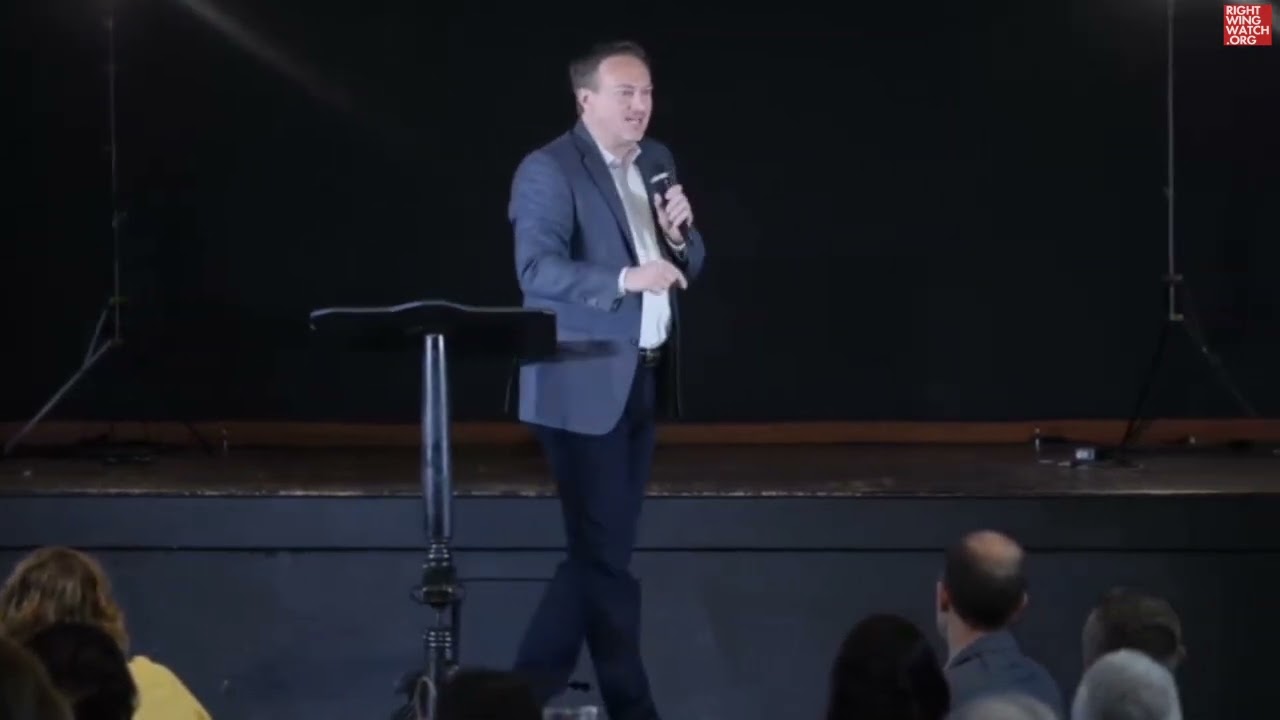 . “[John Adams said], ‘The question before the human race is this, whether the God of nature shall govern the world by his own laws, or whether priests and kings shall rule it. In other words, whether authority is originally in the people, or whether it has descended through time through a succession of rulers.’ And then they kind of came to this conclusion, he says, ‘Or has it been brought down from Heaven by the Holy Ghost?'”
“These are the people who wrote the documents,” Cloud declared. “[And critics are] trying to tell us there’s no Christian influence in America.”
Not only did Cloud ignore the context of Adams’ letter, but he fundamentally misrepresented and misquoted what Adams wrote.
Adams was responding to an earlier letter from Jefferson in which Jefferson discussed the Napoleonic Wars that had roiled Europe for years and Napoleon’s short-lived return to power. Adams replied by insisting that political power belongs to the people and mocked the idea that it can be bestowed upon rulers (like Napoleon or European monarchs) by “Popes and Bishops or via “fictitious Miracles.”
The question before the human race is, Whether the God of nature Shall govern the World by his own laws, or Whether Priests and Kings shall rule it by fictitious Miracles? Or, in other Words, whether Authority is originally in the People? or whether it has descended for 1800 years in a succession of Popes and Bishops, or brought down from Heaven by the holy Ghost in the form of a Dove, in a Phyal of holy Oil?
Adams did not declare, as Cloud suggested, that political power “has been brought down from Heaven by the Holy Ghost”; Adams was, in fact, mocking that very notion.
Furthermore, Cloud’s claim is a straw man; historians and others who dispute the dishonest Christian nationalismpromoted by people like Cloud do not claim that there was no Christian influence during the colonial era, rather they note that the authors of the U.S. Constitution had every opportunity to create a Christian government if they wanted to, but instead chose to prohibit the establishment of an official religion and ban religious tests for public office.
Cloud continued, “We as the church of God have got to stand up and understand that we have the authority. We should look to Christ. What did he say? For all of human history, we’re waiting, like, ‘What does God really care about?’ And the thing that Christ talked about over and over, [like] in the Sermon on the Mount, he said, ‘The Kingdom, the Kingdom, the Kingdom, the Kingdom, the Kingdom.’”
“Christ came to establish a kingdom on Earth that would operate under different principles than all the kingdoms of the Earth would operate, and he asked us to be a part of it,” Cloud said. “He asked us to be ambassadors of that kingdom, to help establish it here on Earth. So everybody say, ‘I’m in the government.’ You’re in the government!”
“You know, people say, ‘Well, the Bible is not a political book, and we shouldn’t be involved,’ and I’m just like, ‘Have you ever read it?'” Cloud asserted. “It’s like every single chapter is like dripping in it!”
---
BB 7 23
A federal judge in West Virginia ruled this week that the state cannot force an atheist incarcerated there to attend religious programming to be eligible for parole. Andrew Miller was given a 1-to-10 year indeterminate sentence for breaking and entering and would could get out early only if he signed up for worship posed as a recovery program. The course featured Christian reading materials, recitals of the Serenity and Lord's Prayer, and required further participation in other religion-"infused" meetings such as Alcoholics Anonymous or Narcotics Anonymous. A book the course is based on states that atheists and agnostics are "doomed to alcoholic death" unless they "seek Him."
In a sweeping 60-page decision issued Tuesday, Charleston-based U.S. District Court Judge Joseph Goodwin said Saint Marys Correctional Center inmate Andrew Miller "easily meets his threshold burden of showing an impingement on his rights."
The state's "unmitigated actions force Mr. Miller to choose between two distinct but equally irreparable injuries," the judge wrote. He can either "submit to government coercion and engage in religious exercise at odds with his own beliefs," or "remain incarcerated until at least April 2025."
Consider how far the rug had already been pulled, with all the compulsory Christianity in prison until someone made a fuss.
---
---
not sure this cts
no lnx an 7 23
A 'sloppy error': Analyst slams 'theocratic' Josh Hawley for using fake historical quote
Alex HendersonJuly 05, 2023
Ever since the Religious Right achieved prominence in the Republican Party in the early 1980s —much to the dismay of the late conservative Sen. Barry Goldwater (R-Arizona) — far-right Christian fundamentalists and white evangelicals have been claiming that the United States is a "Christian nation." But there is nothing in the U.S. Constitution that gives Christianity priority over any other religion.
The Constitution's 1st Amendment states, "Congress shall make no law respecting an establishment of religion, or prohibiting the free exercise thereof; or abridging the freedom of speech, or of the press; or the right of the people peaceably to assemble, and to petition the Government for a redress of grievances."
Catholics and Protestants most definitely enjoy religious freedom under the 1st Amendment, but so do Jews, Muslims, Hindus, Buddhists, Sikhs, Bahais, Rastafarians and members of other faiths.
READ MORE: How Pat Robertson helped shape the radical Christian nationalism Barry Goldwater warned against
In a July 4, 2023 post on Twitter, Sen. Josh Hawley (R-Missouri) promoted the false claim that the U.S. was "founded on" Christianity — and misquoted Founding Father Patrick Henry in the process.
:{:{}:
}:
The far-right MAGA Republican quoted Henry as saying, "It cannot be emphasized too strongly or too often that this great nation was founded, not by religionists, but by Christians; not on religions, but on the Gospel of Jesus Christ. For this very reason, peoples of other faiths have been afforded asylum, prosperity, and freedom of worship here."
But Henry never said that. Twitter users fact-checked Hawley by pointing out that the quote was from a 1956 article about Henry in The Virginian — not something that Henry, who died in 1799, actually said. The article was written 157 years after Henry's death.
MSNBC's Steve Benen, producer of "The Rachel Maddow Show," did some additional fact-checking in an opinion column for MaddowBlog published on July 5
READ MORE: Flag-waving' liberal Norman Lear, now 100, warns against the 'threat of authoritarianism' America faces
"On the surface," Benen argues, "it's obviously unfortunate to see a senator — a graduate of Stanford and Yale — make a mistake like this, especially as so many other Republicans also fall for fake quotes. But let's not brush past the underlying point the Missouri Republican was trying to make by way of a made-up line: Hawley seems certain that the United States was founded as a Christian nation, with members of one faith tradition — his own — enjoying exalted status over others."
Benen emphasizes that the U.S. was not "founded on the gospel of Jesus Christ" as Hawley claims.
"Thomas Jefferson — in an actual quote — wrote in 1802 that our 1st Amendment built 'a wall of separation between church and state,'" Benen notes. "In 1797, John Adams agreed: 'The government of the United States of America is not in any sense founded on the Christian Religion.'"
The Religious Right has repeatedly claimed that "separation of church and state" isn't in the U.S. Constitution, but while the 1st Amendment doesn't use those exact words, the concept is mostly definitely present in the "no law respecting an establishment of religion" declaration. And "separation between church and state," as Benen points out, were the exact words of Founding Father Thomas Jefferson.
"It's unfortunate that Hawley made a rather obvious mistake," Benen laments, "but more important than the senator’s sloppy error is the fact that a prominent Republican senator thought it’d be a good idea to tout an inherently theocratic vision on the 4th of July."
READ MORE: 'Tell it to God': Evangelical pastor spars with Ted Cruz over Uganda’s 'Kill the Gays' law
Read Steve Benen's full MaddowBlog column at this link.
FROM YOUR SITE ARTICLES
Atheists are among the most likely to be vaccinated for COVID — and white evangelicals are among the least ›
White evangelicals have a 'troubling' bond with 'cruel and racist' Tucker Carlson: conservative ›
Why far-right White evangelicals are among Vladimir Putin’s strongest American supporters ›
RELATED ARTICLES AROUND THE WEB
Evangelicals should think twice about supporting Trump in 2024 ... ›
Do White Evangelicals Think Trump Is Jesus? ›
Evangelicalism Thrived Because it Enabled White Christians to ... ›
---
---
rww 5 23
Kingdom In Politics Is Training Right-Wing Christians to Run for Office for the Purpose of ‘Bringing Heaven to Earth’
Kyle MantylaBy Kyle Mantyla | May 25, 2023
Wednesday night’s World Prayer Network livestream was dedicated entirely to encouraging right-wing Christians to see serving in government as a “mission field” in order to ensure that God’s will shall “be done on Earth as it is in Heaven.”
An outgrowth of a prayer movement that began in the wake of the 2020 presidential election when religious-right activists began to gather together several times a week to pray for God to intervene and overturn former President Donald Trump’s loss, the World Prayer Network has since transformed into a bi-weekly livestream.
While WPN founders, right-wing activists Jim Garlow and Mario Bramnick, often use the program as a conduit for the promotion of wild conspiracy theories, Wednesday night’s program featuring a conservative Christian political strategist named Aamon Ross who runs a political consulting business called Kingdom In Politics, the purpose of which is to “prepare and inspire believers to take an active role in politics.”
Ross revealed that he got involved in politics in 2016 after literally hearing the voice of God instruct him to do, prompting him to team up with his good friend Kevin Stitt to run Stitt’s successful campaign for governor in Oklahoma.
“I was in the business world for 20 years,” Ross said. “On a half mission/half business trip to China back in 2016, [I] was walking along the Great Wall and heard the voice of God—literally—and it scared me to death. He said, ‘Aamon, you think too small. You don’t think generationally,’ I came back to the states, meeting with one of my really good friends and shared that. He said, ‘What do you think it means?’ I said, ‘For some reason, I feel like God wants you and me to put godly leaders in positions of authority in the political sphere.’ He said, ‘Don’t tell anybody, but I’m thinking God’s calling me to run for governor.’ So I ended up leaving the business world and ran his campaign for governor with zero political experience. … He won the general election, so he’s actually now in his second term as governor of Oklahoma, doing an incredible job bringing Kingdom ideals there.”
Ross’s reference to putting “godly leaders in positions of authority in the political sphere” seems to be a reference to Seven Mountains dominionism, which Garlow and Bramnick promote, and that movement’s intention to put right-wing Christians in authority over every “mountain” or “sphere” of cultural influence in society, including government.
Stitt is a Christian nationalist who last year dedicated “every square inch” of Oklahoma to Jesus.
Ross then revealed that it is the goal of his organization to recruit “1,000 churches to commit to run one person for school board” and to “raise up 100,000 believers to run for office over the next 10 years.”
Ross declared that it is imperative that conservative Christians begin to see serving in government at all levels as a “mission field,” which means penetrating an area of society for the purpose of spreading Christianity and implementing its teaching.
“They are trying to cancel Jesus,” Ross declared. “We want to be leaders, and we want to set the tone and set the country on a path to kingdom [principles]. The Lord’s Prayer, right? Thy will be done on Earth as it is in Heaven. How does that happen if we’re not the ones bringing Heaven to Earth? … What if the world of politics is the next big mission field? What if we viewed this as we’re sending missionaries into city council, we’re sending missionaries into the state House or Senate, we’re sending them to Congress. If we started viewing the world of politics like the next big mission field, I think we could make a dramatic difference in just a couple of short years.”
---
https://www.mediamatters.org/charlie-kirk/charlie-kirks-turning-point-usa-increasingly-leaning-right-wing-christian
mma 4 23
Kirk and his conservative student-oriented organization Turning Point USA have spent the last two years bolstering connections with faith leaders on the religious right and Christian nationalist influencers as part of a “mission” to “restore America’s biblical values.”
As part of this effort, TPUSA is pressuring pastors to push right-wing politics, deepening ties with extremist pastors and groups that push Christian nationalist talking points, and teaching kids Christian fundamentalist curriculums under the guise of more innocuous “patriotic” and “Christian education.”
Christian nationalism, which contends that the U.S. is a fundamentally Christian nation and should be governed by right-wing Christian beliefs, has been on the rise in Republican politics. According to a new survey from the Public Religion Research Institute and the Brookings Institution,more than half of Republicans support Christian nationalism.
This undercurrent of right-wing religious fundamentalism has helped fuel a torrent of anti-LGBTQ legislation and anti-abortion laws in GOP-led state legislatures across the country. The 2022 midterm elections also saw increased fervor from the religious right on the campaign trail, such as in the candidacy of Pennsylvania Republican gubernatorial nominee Doug Mastriano, who experts warned had centered the dangerous Christian nationalist ideology at the heart of his campaign. (Kirk, however, praised Mastriano as "a fabulous person.”)
Turning Point USA, Kirk’s student-oriented youth group which he founded to increase right-wing political influence, has historically focused on college campuses, where its student chapters have a troubling history of racist incidents. Kirk also has espoused virulently anti-LGBTQ rhetoric and lamented supposed Christian persecution.
TPUSA Faith was launched in 2021, with a Turning Point spokesperson saying that “it was a no-brainer to recreate” the TPUSA model of activism for the faith community. Kirk has depicted the country as engaged in a “spiritual battle,”and this latest initiative seeks to win that supposed battle by restoring “America’s biblical values.” After Kirk partnered with extreme pastors and religious right leaders, some observers noted that TPUSA has increasingly grounded its mission in “the theology of Christian nationalism” and religious fundamentalism.
Kirk pushes Christian churches to spread bigotry by separating them into three groups: The cowardly, the courageous, and the complicit
Since co-founding TPUSA Faith with far-right pastor Rob McCoy, who reportedly played a key role in Kirk’s rejection of the principle of the separation between church and state, Kirk has traveled to churches across the country and attacked pastors he deems inadequately political.
At self-described “Christian extremist” Kenneth Copeland’s FlashPoint Live event in 2022, Kirk described what he sees as the three kinds of Christian churches: the “cowardly,” the “courageous,” and the “complicit.” He explained a simple litmus test for a “cowardly pastor” and church: “They didn't say a word after Roe vs. Wadewas overturned. … They should resign from the ministry or find some courage because we just overturned one of the worst demonic decisions in the history of our country.” Kirk elaborated that “We should try to bring the cowardly pastors into the courageous category. We should challenge them.”
During the event, Kirk described Copeland’s audience and church as “the good type of ministry” and “the courageous church that stands boldly and speaks with moral truth.” Kirk downplayed and mocked criticisms of Christian nationalism, telling the audience that critiques of this ideology “means you're starting to care and they're getting scared.” Kirk also suggested that the only true faith that will lead to salvation is Christianity, and he baselessly fearmongered that “young people are being preyed on by government school predators and groomers.”
Kirk described “complicit” churches as going “out of their way for the seal of approval of the world,” ridiculing churches that put the “gay flag outside of their church or the Black Lives Matter flag." Earlier in the speech, he questioned whether the U.S. is a “conquered country” due to the presenceof these flags.
Kirk's TPUSA Faith has partnered with groups associated with Christian nationalists
According to TPUSA’s 2021 Investor Prospectus, its TPUSA Faith initiative had a $6.4 million budget, making it one of the largest line items in the organization’s operating budget. TPUSA Faith's budget has seemingly funded a variety of events and programs, often in partnership with groups associated with Christian nationalists.
- TPUSA Faith recently announced a partnership with Christian nationalist pastor and musician Sean Feucht for a “revival” tour in 2023 and 2024 called “Kingdom to the Capitol.”The tour has the intention of “visiting every single state capitol in America.” Feucht, TPUSA's new partner, built a profile during the COVID-19 pandemic with his fierce opposition to public health measures that temporarily closed churches, holding events in defiance that “often fused Christian nationalism with conspiracy theories about coronavirus vaccines and globalism.” Feucht recently embraced Christian nationalism overtly, declaring that Christians must “be the ones writing the laws” and that “we want God to be in control of everything.”
- In 2021, Kirk launched TPUSA Faith’s “Saving America Tour” at megachurches around the country.At events, Kirk “melds the political with the spiritual” and frames political issues “as not just earthly policy differences, but part of the spiritual war between good and evil,” as described by The Arizona Republic. At one Saving America event in 2022, Kirk called on men in the audience to confront and physically prevent trans student athletes from competing in sports.
- TPUSA Faith also holds annual pastors summits with right-wing pastors and figures.David Barton, a Christian nationalist activist who has worked for decades to end the separation between church and state, is listed as a speaker at this May’s annual gathering. Last year’s summit featured Mat Staver, who runs the anti-LGBTQ extremist group Liberty Counsel; right-wing pastor Jack Hibbs; and Chad Connelly, the former RNC faith director who worked with Barton during the 2022 midterm elections to activate right-wing Christian voters by spreading debunked talking points about the Bible.
- Starting in 2021, TPUSA Faith partnered with Patriot Academy on courses to teach “biblical citizenship” and other programming denying the separation of church and state. Patriot Academy is an initiative of Barton’s anti-LGBTQ group Wallbuilders that seeks to “train citizens to understand and influence government policy with a Biblical worldview.” TPUSA and Patriot Academy collaborated on “biblical citizenship” courses and a workbook that denies the existence of the separation between church and state. The website also notes that the “biblical citizenship” is critical as “we fulfill the Great Commission and ‘make disciples of all nations.’”
- Through TPUSA Faith, Kirk holds monthly “Freedom Night in America” events at Dream City Church in Phoenix, Arizona, in an “effort to continue fighting America’s culture war … with the intent to call the faith community to action.”The watchdog Right Wing Watch has tracked and sometimes debunked Kirk when he has pushed popular Christian nationalist talking points at Freedom Night events, including claiming that the church is supposed to be the “counselor” to the government. Kirk recently held a Freedom Night event with TPUSA advisory council member and former Rep. Bob McEwen (R-OH), who is the current executive director of the Council for National Policy, a shadowy but influential right-wing networking group that serves as a political nerve center for the religious right. (Kirk is also reportedly a member of the Council for National Policy).
- To further expand its influence in recent years, TPUSA Faith launched Freedom Life Church, a network of TPUSA-aligned congregations.TPUSA Faith also reportedly hired a network of over 30 full-time “faith representatives” to launch faith groups across the country.
Kirk has praised extremist figures in the Christian nationalist movement and endorsed the “Seven Mountain Mandate”
Kirk has closely associated with high-profile members of the Christian nationalist “dominionist” movement, which asserts that Christians have been called to exert God’s will on society. Lance Wallnau, a self-proclaimed “prophet” and “Christian nationalist” who has been dubbed the “father of American Dominionism,” popularized the “quasi-biblical blueprint for theocracy” that is at the heart of dominionism called the “Seven Mountain Mandate.”
The Seven Mountain Mandate demands that Christians impose fundamentalist values on American society by conquering the “seven mountains” of cultural influence in U.S. life: government, education, media, religion, family, business, and entertainment. Wallnau has an extensively documented history of extreme and violent rhetoric. Recently, he called Biden the “antichrist,” referred to LGBTQ people as the “trans taliban,” and warned that God may soon start killing those who are “persecuting” Trump.
In addition to endorsing the Seven Mountain Mandate himself in a 2020 speech, Kirk has interviewed Wallnau multiple times since 2020, including at TPUSA’s 2022 Young Women’s Leadership Summit. In an interview, Kirk on Wallnau, calling him “one of my all time favorite people.” Kirk has also repeatedly appeared alongside Wallnau in
 and at in-person events for Kenneth Copeland’s right-wing Christian network The Victory Channel, where Wallnau serves as a “regular” for its panel show FlashPoint.
Kirk has also aligned TPUSA with the right-wing cellphone company Patriot Mobile. The company is closely associated with the dominionist movement, explicitly defends Christian nationalism on its website, and has become a force in Texas school board politics against LGBTQ inclusion and curriculums that teach about diversity. Patriot Mobile has sponsored a TPUSA Faith event, Kirk’s podcast, and other TPUSA events; held special events with him; and sent a senior leader to speak at a TPUSA conference.
TPUSA’s increasing Christian fundamentalism has led to an increased focus on young kids
TPUSA announced last summer that it would open its first brick and mortar school, Turning Point Academy, in collaboration with Dream City Christian School in Arizona, a K-12 private school that claims the “current political and spiritual climate in the country is in turmoil.” Kirk has said that the “Christian, Classical, conservative, church-based” school is just "the first in a growing network of schools that will launch across the country in the coming years.”
As Media Matters previously reported, Turning Point Academy attempts to what right-wing figures have labeled as threats to kids, assuring parents that “CRT, postmodernism, ‘Wokeism,’ deconstructionism, queer theory, radical LGBT agendas, and anti-American ideas such as the 1619 project will have no place at our institution."
TPUSA’s expansion into K-12 education also aligns the organization with a long-term goal of the Christian nationalist movement: teaching kids Christian fundamentalist curriculums under the guise of simply “patriotic” and “Christian education.”
---
---
10 cmds
https://www.alternet.org/texas-public-schools-2659732308/
---
---
rww 3 23
church musician turned political activist Sean Feucht has teamed up with the religious arm of right-wing youth organizing group Turning Point USA for a two-year, 50-state road trip designed to bring Feucht’s mix of worship and hard-right politics to every state capitol.
After a kickoff event attended by seven members of Congress in the U.S. Capitol rotunda March 9, the “Kingdom to the Capitol” tour headed south with a swing through , Jackson, Mississippi, and
 this past weekend. In Alabama, Chief Justice Tom Parker, a longtime ally of the disgraced former Chief Justice Roy Moore, participated in the tour and invited Feucht to pray in the Supreme Court chamber.
Rep. Lauren Boebert was among the members of Congress who joined a small crowd in the U.S. Capitol March 9 to sing along with Feucht as he strummed his guitar. Afterwards, Feucht tweeted, “The Capitol became an Altar…There is ONE KING over America…”
Feucht, a missionary musician associated with controversial Northern California megachurch Bethel, ran for Congress in 2020 in what he said was obedience to a call from God. Despite playing up a Dec. 2019 visit to the Oval Office where he prayed over former President Donald Trump, Feucht did not make it through the primary. But the failed run hooked him on politics, and he formed a political group called Hold the Line in 2020 and ramped up his activism in opposition to public health restrictions on church gatherings that were designed to slow the spread of the COVID-19 virus. Since then, Feucht has held “Let Us Worship” rallies on the National Mall featuring appearances by Sen. Josh Hawley, New Apostolic Reformation leader Ché Ahn, and dominionistLou Engle, as well as video remarks from Trump. He also started a podcast; when Boebert was a guest, Feucht praised her as a “gangster for Jesus.”
While Turning Point USA was founded in 2012 with a libertarian bent, founder Charlie Kirk has since teamed up with Christian nationalists, and endorsed Feucht’s congressional run in 2020. In 2021, Kirk launched TPUSA Faith as a political vehicle for “restoring traditional biblical values in our nation” by pushing conservative pastors to get more active politically. It held its first summit for pastors last year. Kirk regularly makes “Freedom Night” presentations in churches.
Since his failed run for office, Feucht has established a beachhead for spiritual warfare two blocks from the U.S. Capitol in a rowhouse he has dubbed “Camp Elah,” which he says is a biblical reference to the stream where David picked up the stones that he used to slay Goliath.
Feucht and Kirk have both been influenced by Rob McCoy, a California pastor-politician who is allied with Christian Nationalist political operative David Lane. McCoy serves as TPUSA Faith’s co-chair. In an interview on Feucht’s Hold the Line podcast, McCoy acknowledged that his Calvary Chapel church has theological differences with Bethel’s charismatic Pentecostalism, but he praised Feucht’s political activism and his collaboration with TPUSA Faith. “We have an agenda,” Feucht said. “We want the kingdom of God to take over. It’s a clear agenda from heaven.”
Tags: Charlie Kirk Lauren Boebert Rob McCoy Sean Feucht Tom Parker Christian Nationalism Dominionism Election 2024 Hold the Line TPUSA Faith Turning Point USA
---
an 11 22 sawyer
...In October, megachurch pastor Robert Jeffress called for “Christian nationalists” to “impose their values” on nonbelievers whether they liked it or not. In 2021, Michael Flynn, former national security adviser in the Trump Administration, called for the U.S. to “embrace one religion” and has made it clear that he believes religions other than Christianity should be illegal. And far-right Rep. Lauren Boebert of Colorado, in June 2022, declared, “The church is supposed to direct the government. The government is not supposed to direct the church. That is not how our Founding Fathers intended it…. I’m tired of this separation of church and state junk.”
Forty-two years after Sawyer’s article was published, the Christian Right is not a marginal part of the Republican Party. It is a sizable GOP voting block — especially in red states — that many Republicans are afraid to criticize. And the movement, feeling empowered by the MAGA movement and the Dobbs decision, is showing no signs of backing down.
---
// pence on theocracy?
https://www.alternet.org/2022/10/christian-nationalists-impose-their-values/
---
---
an 10 22
Former Vice President Mike Pence claimed during a Wednesday appearance on Fox Business that the First Amendment to the United States Constitution does not protect Americans from having other people's faiths forced upon them.
"Congress shall make no law respecting an establishment of religion, or prohibiting the free exercise thereof; or abridging the freedom of speech, or of the press; or the right of the people peaceably to assemble, and to petition the Government for a redress of grievances," it states.
In fact, there are no references to a supreme being anywhere in the Constitution, because the Founding Fathers were adamantly opposed to centralized religious power as well as requiring individuals to subscribe to any particular denomination.
READ MORE: 'God's gonna cut you down': How Republicans conspire with churches for power
The concept of separation of church and state was sacrosanct to men like President Thomas Jefferson, who wrote in his 1776 Virginia Statute for Religious Freedom that "setting up their own opinions and modes of thinking as the only true and infallible, and as such endeavoring to impose them on others, hath established and maintained false religions over the greatest part of the world and through all time" and that "to compel a man to furnish contributions of money for the propagation of opinions which he disbelieves and abhors, is sinful and tyrannical."
Jefferson's condemnation of forced faith in the document was unambiguous, further affirming that "no man shall be compelled to frequent or support any religious worship, place, or ministry whatsoever, nor shall be enforced, restrained, molested, or burthened in his body or goods, nor shall otherwise suffer, on account of his religious opinions or belief; but that all men shall be free to profess, and by argument to maintain, their opinions in matters of religion, and that the same shall in no wise diminish, enlarge, or affect their civil capacities."
President James Madison, in whose hand the Constitution was penned, concurred with Jefferson.
"The settled opinion here is that religion is essentially distinct from Civil Government, and exempt from its cognizance; that a connexion between them is injurious to both; that there are causes in the human breast, which ensure the perpetuity of religion without the aid of the law," Madison explained in an 1819 letter, noting that "a legal establishment of religion without a toleration could not be thought of, and with toleration, is no security for public quiet and harmony, but rather a source itself of discord and animosity."
READ MORE: White men refusing to share power is a silver stake piercing the heart of American democracy
Benjamin Franklin took it one step further, arguing in 1780 that any religion that seeks to impose itself is simply "bad."
Yet Pence and host Larry Kudlow share an interpretation that strays wildly from what Jefferson, Franklin, and Madison clearly spelled out more than two centuries ago.
"These lefties want to scrap religion, Mike Pence, and I think it's a terrible mistake," Kudlow griped.
"Well, the radical left believes that the freedom of religion is the freedom from religion. But it's nothing the American founders ever thought of or generations of Americans fought to defend," Pence said.
As mentioned, that statement is completely false. Jefferson even concluded in his treatise that "such act will be an infringement of natural right."
But Pence was not finished. He also suggested that the Supreme Court's right-wing supermajority has a duty to side with one faith over another. Today, that means the GOP's embrace of Christian nationalism.
"You know, I said today here in Houston that the source of our nation's greatness has always been our faith in God, our freedom, andour vast natural resources.And the good news is, that after four years of the Trump-Pence administration, I'm confident that we have a pro-religious freedom majority on the Supreme Court of the United States. And I'm confident that come Election Day, November the 8th, you're gonna see that freedom majority around the country turn out and vote pro-freedom majorities in the House, and in the Senate, and in statehouses around the country," Pence said. "So stay tuned, Larry. Help is on the way."
Watch below or at this link.
---
---
9 22 MMA https://www.mediamatters.org/charlie-kirk/charlie-kirk-and-christian-nationalist-russ-vought-promote-ideological-purity-tests
Christian nationalist Russ Vought recently appeared on Turning Point USA co-founder Charlie Kirk’s radio show to discuss plans to purge at least 10% of federal career staffers under a new Trump administration. Vought described that portion of the federal workforce as “the roots of the problem” that prevented former President Donald Trump from fully implementing his agenda. During the interview, Kirk suggested that the next Republican administration subject civil servants to “ideological purity tests.”
Vought ran the powerful Office of Management and Budget under Trump and now heads up a right-wing think tank called the Center for Renewing America, whose mission is to “renew a consensus of America as a nation under God.”While at OMB, Vought helped develop a policy called “Schedule F” as a tool that would allow a new conservative administration to circumvent job protections typically enjoyed by federal workers who aren’t politically appointed.
Speaking on the September 23 edition of The Charlie Kirk Show, Vought claimed to have reclassified 90% of the workers in his own office under that job category
CitationFrom the September 23, 2022 edition of The Charlie Kirk Show, streamed on Rumble
“Schedule F is an authority that we discovered and developed at the end of the Trump administration to give the president the ability to reclassify career civil servants, who normally have permanency within the bureaucracy, to turn them into essentially at-will employees,” Vought told Kirk.
When asked by Kirk how many career employees he’d like to potentially sack using this authority, Vought set the floor at 10% of current workers, but suggested that he considers as much as 80% of the federal workforce to be ideological opponents.
“I would say that within my agency, we had, you know, 80% of it was left-leaning,” Vought said. “Their paradigms were all rooted in this permanent class, ruling class that defines the milieu of Washington, D.C.”
“And you can reason and work with that crowd, but there is about a 10% of activists that are animated by the wokeism, the anti-racist movement, to be able to come into these agencies and they'rejust activists,” Vought added.
Vought then told Kirk that someone in the human resources department at OMB described themselves and their colleagues as “committed anti-racists.”
Kirk responded by calling that person the leader of “a sleeper cell of a woke communist ideology who's just right there within our federal government.”
“You're going to have to figure out how to solve that, I don’t know,” Kirk continued. “But ideological purity tests are an interesting approach, but let's break up the federal government first and then we'll go from there.”
In July, Axios reported on discussions Trump allies were having about staffing their next administration, with the Schedule F being central to the framework. Vought reportedly has been a leader in these efforts: As Media Matters reported a week prior to Axios’ story, Vought stated publicly that he wants to build an “army” of hard-right activists with “Biblical worldview” to run the federal agencies that he can’t outright destroy. He’s been very clear that the goal is to get “ideologically committed individuals up and down the agencies,” and he’s been similarly clear that Schedule F is the way to do it.
Right-wing propagandist Christopher Rufo – known for launching bad-faith attacks on critical race theory and targeting children’s hospitals that provide care to trans youth – has pushed for a similar course of action.
“The idea is to centralize ideological control over the federal agencies in the White House and create a team at the Office of Management and Budget to enforce it,” Rufo said in an interview with conservative website IM-1776 in July.
In furtherance of those shared goals, Vought has attempted to turn the Center for Renewing America into a shadow government-in-waiting for Trump or another conservative president. In June, Vought brought on Jeffrey Clark, a former Department of Justice environmental lawyer and Trump’s top coup architect, as senior fellow at CRA. Kash Patel, another key figure in Trump’s attempt to subvert the 2020 election, is a CRA senior fellow as well.
In the recent interview with Kirk, Vought expressed a common regret among former Trump officials that the administration wasted precious time in its first years adjusting to the steep learning curve of running the government.
“My hope is that we don’t have to do that again because we're laying the groundwork now,” Vought said, later adding, “We want to make sure that can never happen again and make sure that from day one, we can ensure that the agenda is being done.”
---
---
https://www.rightwingwatch.org/post/this-is-an-evil-country-christian-fascist-nick-fuentes-fumes-over-biden-speech/
rww 9 22
Joe Biden delivered a speech last week from Independence National Historical Park in Philadelphia, Pennsylvania, in which he warned that former President Donald Trump and his MAGA supporters “represent extremism that threatens the very foundations of our republic.”
Nick Fuentes, the racist, misogynistic, antisemitic, America-hating, Christian fascist leader of the white nationalist America First movement, is precisely the sort of MAGA activist that Biden was warning about. So naturally, Fuentes reacted to Biden’s speech Thursday night by unleashing an extended rant in which declared that “the United States of America is controlled by Satan” and has been taken over by “the Jews.”
“[Biden] is saying ‘Look, I’m the big gay American empire, :{and I’m gonna kill all the enemies of liberalism,” Fuentes } :{. “That’s what he’s saying. Biden is there saying, ‘This is global homoand I’m the puppet face of it. I’m the puppet face of world Jewry and global homo and we’re gonna crush all these fascists.'”}:
“The whole thing is just a lie,” Fuentes continued. “The whole thing is a sham. Biden is a puppet. The elections are fake. The social media companies are rigged. The elections are rigged. The news couldn’t be more Jewed-up; Jewed-up, moneyed-up, corporate,under the thumb of the Illuminati, whatever. It’s all real man.”
“The devil is in charge of the world,” Fuentes griped. “Satan is in charge of America. If you don’t realize that, you’re not paying attention. And that’s not even an exaggeration. Satan runs America. I’m a patriot, but the United States of America is controlled by Satan right now. The United States is the great Satan in the world. The United States is controlled by Satan. The regime that runs America is controlled by Satan. And the regime that controls America is the empire that casts a shadow over the world. Satan runs the Western world. When you talk about the West, when you talk about democracy, you’re talking about the devil.”
“If you don’t see the hand of the demonic and all of this, you’re not paying attention,” he said. “It’s the porn empire. It’s thegay porno, abortion, feminist, diabolic empire. That’s what America stands for and it’s wrong.”
“Wake up and smell the coffee, this is an evil country,” Fuentes went on. “Until this country stands for God and the godly, this is an evil country. So, that’s just the way it is. And look at who runs it: a lot of Jews. The Jews hate me. The Jews hate me. And do you know else the Jews hate? Jesus Christ. I hate to say it. Nobody wants to say that part. People want to talk about the [Chinese communists] and everything else. I’m sick of it. You know what? It’s Jews.”
“Fuck democracy,” Fuentes proclaimed. “I stand with Jesus Christ. You can have Philadelphia, and you can have democracy. Democracy is the soul of our nation? You can have it. Christ is the soul of this nation. You can have the United States. Christ is the soul of America. We’re going to have a new country; it’s not going to be called the United States, it’s going to be called America [and] it’s going to be a Christian nation.”...[vid]
---
---
rww 1/22
Early in 2021, Christian nationalist home-schooling advocate, author, and podcaster Heidi St. John launched a bid for U.S. Congress in Washington state’s 3rd Congressional District. Outraged by incumbent Republican Rep. Jaime Herrera Beutler’s vote to impeach former President Donald Trump in the wake of the Jan. 6 insurrection at the Capitol, St. John decided to try and unseat her in the GOP primary by MAGA voters, denouncing public libraries as “evil organizations,” and pledging to “be a mom for America.”
Earlier this month, St. John appeared on the “Stand Up For The Truth” podcast, where she soundedSeven Mountains and Christian nationalist themesthat have been central to her campaign, describing politics as “a spiritual battle” and vowing to “bring back the name of God into the political sphere.”
“[Politics is] in my blood,” St. John . “And I think it should be in the blood of every Christ follower. Politics determined policy, and it is policy that has murdered 63 million of our unborn in this country. It is policy that has gotten us into the mess that we are in as a nation, and we need wise people and godly people to ascend to positions of authority in the nation.”
“What we’ve observed over years and years and years is a church deciding to pull itself out of arguably one of the most important aspects of the culture, which is determining our laws and determining the policy that governs the people here,” she continued. “Christians belong in every sphere of influence. We have a command to be strong and courageous. [God] did not say, ‘Be strong and courageous except for in the political sphere, stay out of that one.’ No, we belong in every sphere of influence. We belong in medicine. We belong in entertainment. We belong in education. And we belong in politics.”
“[Christians] should be canvassing, they should be helping clean up the voter rolls, they should be running for positions of authority in every sphere of influence,” St. John added. “We bring back the name of Jesus, we bring back the name of God into the political sphere and we say out loud, ‘What is the biggest problem in our country? We have turned away from God.'”
“This is a spiritual battle,” St. John declared. “We know that we serve the Lord of Heaven’s armies. We serve the creator of the universe, the one who spoke the world into being. He can do anything. And I think he’s calling his people back out of hiding and out of the shadows and into the battle and onto the battlefield.”[pixvid: armour up xian soldiers it's game on!]
---
---
an 11 21
mike Flynn and Josh Mandel do not stand at the center of the Republican Party. They do not stand at its margins either. Flynn is the former's president's former advisor. (He's a pardoned criminal, too.) Mandel is Ohio's leading Senate candidate. Both men have said in recent days they don't believe in the separation of church and state.
I'm paraphrasing. See for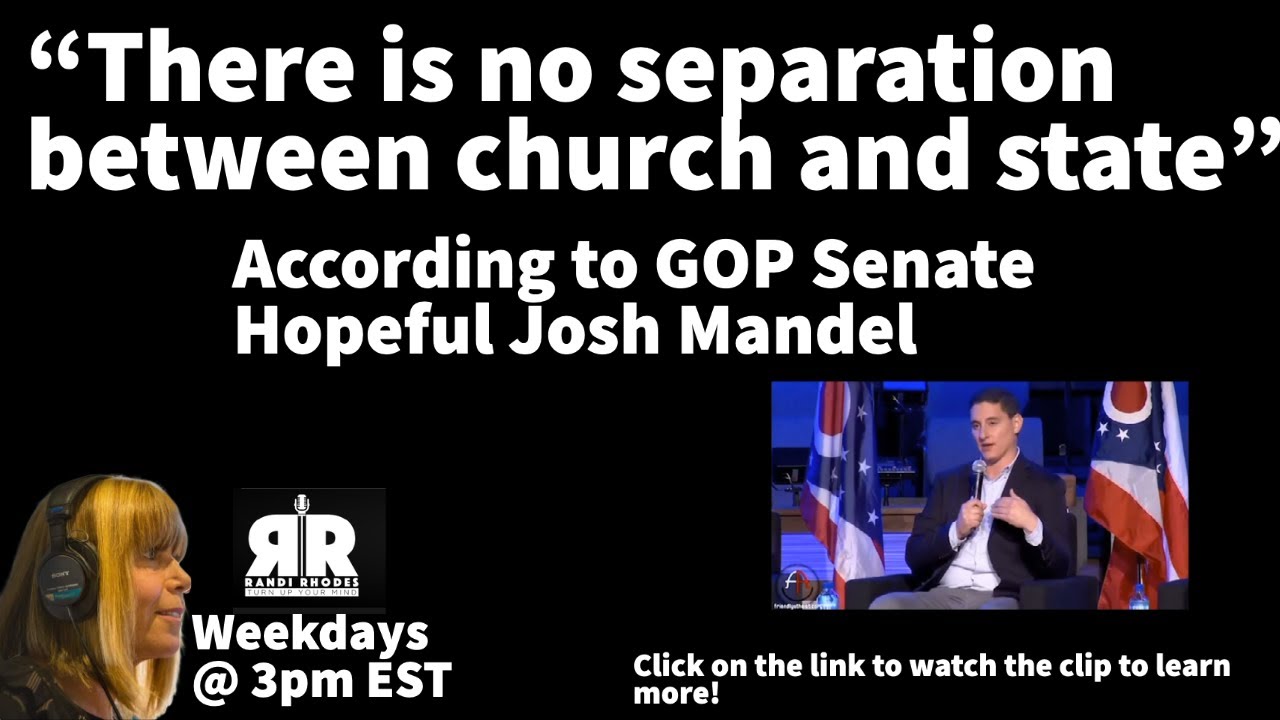 what they said. However, their remarks should be familiar. They reflect the GOP's theocratic wing. For decades, it has opposed the incorporated interpretation of the First Amendment's establishment clause. They used to be way, way out there. But, even if I'm missing something, Flynn's and Mandel's remarks suggest the GOP's theocratic wing isn't as marginal as it once was.
Liberals have always been alarmed by the theocrats. Liberals know that when they talk about so-called "Judeo-Christian" values, they don't mean Jews of any stripe. They don't mean the full spectrum of Christianity. Mormons are not included. Neither are Episcopalians, Methodists or Presbyterians. Unitarians, like me, are cultists. Jehovah's Witnesses are heretics. Only "real Christians" need apply, meaning twice-born believers in Christ saving them from eternal damnation.
Liberals should be more alarmed, especially religious liberals, but they may not know they should be. After all, the theocrats keep telling us, and the Washington press corps keeps telling us, that they are merely fighting for their Constitutional right to worship as they please, however they please. Religious liberals, therefore, might be thinking their religious freedoms will be secure, no matter what happens.
That, however, overlooks the theocrats' unending bad faith. They don't mean all Jews or all Christians when defending "Judeo-Christian values." And they don't mean everyone's freedom of religion. They mean theirs. That's why figures such as Flynn and Mandel say what they said. Liberals, especially religious liberals, should be more alarmed. The theocrats are assaulting (everyone's) religious freedom in the name of (their) religious freedom. When they say the United States was founded as a "Christian nation," they're telling us their desires.
Before I go on, a word about Josh Mandel. As I said, he's Ohio's leading Republican candidate for the Senate. He's also Jewish. Some say his appeal to the GOP's theocratic wing means the GOP's theocratic wing can't possibly desire the creation of a "Christian nation." After all, he's a Jew! Friend, I don't need to tell you shameless people sometimes say all sorts of things. If you think Mandel's candidacy means the theocrats believe in freedom of religion for everyone, I have a bridge to sell.
The temptation among liberals, even religious liberals, is to fall back on old arguments, to wit: America is not a Christian nation any more than it's a Hindu nation. Its people are religious. Its government is secular. For many liberals, that's what separation of church and state means.
The truth is more complex. As Editorial Board legal historian Mia Brett wrote in April. "The United States was founded with an attempt at secularism as well as freedom of religion." In theory, the objective is balancing those interests. (In practice, it has meant something quite different, as Dr. Brett explains.) To reach that ideal, however, liberals should remember what "secular" means. It does not mean the absence of religion. It does not mean hostility toward it. It means indifference to it — or, rather, the equal treatment and protection of all religions.
The theocrats are correct when they say religion has a place in the people's business. They are wrong in lying about what they mean. (They mean their religion and theirs alone.) When liberals fall back on old arguments based on misunderstandings of secularism's meaning — "keep religion out of government matters!" — they end up empowering the theocratic position by legitimating it. The theocrats tell us they believe the "secular left" wants to drive out religion. Worse, liberals risk making allies out of theocrats and religious liberals, who might not see any harm in having a place for religion in the public square.
They're right. There is no harm. As long as the state is impartial to particular religions but partial toward freedom of religion. Put another way, as long as the state treats and protects religions equally. If the courthouse has a spot for the Ten Commandments, it has a spot for the Seven Principles of Unitarian Universalism. By privileging presence over absence, liberals take the gas out of the theocrats' position. By defending the First Amendment, rather than by opposing religion, liberals end up bringing attention to the real problem, which is the growing religious movement toward annihilating freedom of religion.
Finally, I expect some liberals to disagree with me. I expect them to defend calling for the ouster of all religions from all matters of public life. Well, more power to them. That's the conflict I would like to see more of — between camps with differing views on the meaning of secularism — rather than conflict between camps with the same meaning with the difference being one is for, the other against. One of these is better for democracy. It's not the one we're currently having.
===
https://www.alternet.org/2021/10/extremist-christians/
paul r salon
progressive policies and positions are supposed to be rooted in reality and hard evidence. But that's not always the case when it comes to the culture wars that have such an enormous impact on our politics — especially not since the unexpected evangelical embrace of Donald Trump in 2016, culminating in the "pro-life" death cult of anti-vaccine, COVID-denying religious leaders. If this development perplexed many on the left, it was less surprising to a small group of researchers who have been studying the hardcore anti-democratic theology known as dominionism that lies behind the contemporary Christian right, and its far-reaching influence over the last several decades.
One leading figure within that small group, Rachel Tabachnick, was featured in a recent webinar hosted by the Religious Coalition for Reproductive Choice (archived on YouTube
Her presentation sheds important light on at least three things: First of all, the vigilante element of the Texas anti-abortion law SB 8. Second, the larger pattern of disrupting or undermining governance, including the "constitutional sheriffs" movement, the installation of overtly partisan election officials and the red-state revolt against national COVID public health policies. While Donald Trump has exploited that pattern ruthlessly, he did not create it. And third, the seemingly baffling fact that an anti-democratic minority feels entitled to accuse its opponents — including democratically elected officials — of "tyranny."
Some dominionist ideas — such as the biblical penalty of death by stoning — are so extreme they can easily be dismissed as fringe, others have been foundational to the modern religious right, and still more have become increasingly influential in recent years. Those latter two categories are what we need to understand most, say both Tabachnick and Jackson.
"One of the things that struck me, as a relative newcomer," said Jackson, a former Congregationalist minister, "was that there was not sufficient understanding about the theological frames used by many individuals who are opposed to abortion." She continued, "I'm a strategist in a lot of ways, and one important strategy, I believe, must be to understand what the teachings and the theological frames are" on the other side. Which links directly to the question of what progressive activists need to do differently in this changed environment.
This failure to understand the nature of dominionism has hampered activists, not just in the realm of reproductive justice, but across an entire spectrum of political issues, both cultural and economic. Jackson discussed her own background, raised within a conservative Christian worldview.
"I was taught a very individualistic approach," she said, "taught that we shouldn't pay taxes, because doing so enabled people who were not working, and enables people whose lifestyle we don't agree with." There's nothing new about such views, but dominionism provides believers with an even stronger foundation for them.
Jackson describes her current understanding of religious faith as highly intersectional: "We believe that to understand the attacks on abortion also invites us — or even requires us — to look at attacks on voting, to look at attacks on immigrants, attacks on prison reform, attacks on equal pay and on and on," she said. "It's all of the same cloth: They are all attacks on humans flourishing. That's my language. The God of my understanding wants all of us to flourish in who we are."
the language of dominionism is strikingly different, to put it mildly. In her webinar, Tabachnick played a clip of one of the movement's leading figures, C. Peter Wagner, providing a definition:
Dominion has to do with control. Dominion has to do with rulership. Dominion has to do with authority and subduing. And it relates to society — in other words what is talked about, what the values are in heaven [that] need to be made manifest here on earth. Dominion means being the head and not the tail. Dominion means ruling as kings. It says in Revelation chapter 1:6 that "he has made us kings and priests," and check the rest of that verse, it says "for dominion." So we are kings for dominion.
Later she provided a definition from Frederick Clarkson, author of the 1997 book, "Eternal Hostility: The Struggle Between Theocracy and Democracy":
Dominionism is the theocratic idea that regardless of theological view, means, or timetable, Christians are called by God to exercise dominion over every aspect of society by taking control of political and cultural institutions.
Wagner, who died in 2016, is known as the founding father of the New Apostolic Reformation (NAR), one of the two main branches of dominionism, which grew out of the Pentecostal and charismatic traditions within evangelical Christianity. Dominionists in the other branch, known as "Christian reconstructionism," come out of conservative Calvinism, with a focus on bringing government and society under biblical law. They tend to be more circumspect, often obfuscating their true intentions and avoiding the word "theocracy" in favor of "theonomy," for example. But not Wagner, as can be seen in the title of his 2011 book, "Dominion!: Your Role in Bringing Heaven to Earth." The NAR talks constantly about taking dominion over the "seven mountains" of society: education, religion, family, business, government, arts and the media.
But it's the other branch, the Christian reconstructionists, who have excelled at strategic organizing and providing blueprints across different right-wing constituencies for almost 50 years. They are the ones Tabachnick focused most of her presentation on, specifically two key figures: Rousas John Rushdoony, the movement's master theologian, and his son-in-law Gary North, a prolific strategist, propagandist and networker who was once a staffer for Rep. Ron Paul, the libertarian hero.[ayn radical indiv ~ jesus charity]
Christian reconstructionism, Tabachnick explained, is "about bringing government in all areas of life under biblical law, a continuation of the Mosaic law in the Old Testament, with some exceptions." This dispensation would include, "according to Gary North, public execution of women who have abortions and those who advise them to have an abortion."
In a recent private presentation, Frederick Clarkson asked a rhetorical question: "People have long said that there should be Christian government, but if you had one, what would it look like? What would it do? Rushdoony was the first to create a systematic theology of what Christian governance should be like, based on the Ten Commandments, and all of the judicial applications he could find in the Old Testament — including about 35 capital offenses."
But the "Handmaid's Tale"-style extremism of dominionists' ultimate vision shouldn't really be our focus, Tabachnick told Salon. "Nobody cares about the theocratic, draconian future envisioned by reconstructionists because they don't believe it will happen," she said.
What's happening right now, however, is that this ideology has had tremendous impact on more immediate politics. "Christian reconstructionism is the merger of a distinct brand of Calvinism with Austrian School economics," Tabachnick said. "In other words, it's an interpretation of the Bible grounded in property rights." The results have been far-reaching:
For more than 40 years, its prolific writers have provided the foundations and strategic blueprints for the attacks on liberation theology and the social gospel, as well as many other streams of Christianity which do not share the Reconstructionists' belief in unfettered capitalism as ordained by God and its fierce anti-statism.
The larger religious right's attack on public education, the social safety net and most government functions are largely grounded in the writings, strategies and tactics formulated by reconstructionist writers. Reconstructionism is not the only (and certainly not the first) source of interposition and nullification in this country. However, much of what is currently being taught today about using interposition to undermine the legitimacy of government is sourced in reconstructionism.
This idea of "interposition" comes through what's known as the doctrine of the "lesser magistrate," which we'll return to below. But its significance — especially in the post-2020 Republican Party — has only recently become apparent. Reconstructionism's initial appeal was more immediately, as Tabachnick explained in the seminar:
What Rushdoony provided is a package that included attacking what these fundamentalists hated and feared most in society, often expressed in terms of "This is communist. This is socialist." But Rushdoony provided a way to sacralize these ideas, and at the same time not just tear down the old order, but provide a blueprint for the new order.
Everyone didn't have to agree on the blueprint, she said: "Rushdoony's ideas went out in bits and pieces. The Christian right leaders took what they wanted and discarded what they didn't."
"Christian reconstructionism, as articulated by Rushdoony, provided a standard by which everyone else had to measure themselves," Clarkson told Salon. "Not everyone on the Christian right agreed with Rushdoony and his fellow Reconstructionist thinkers on, for example, the contemporary application of capital crimes listed in the Old Testament. And followers were often at pains to distinguish themselves."
Clarkson cites the case of conservative Presbyterian theologian Francis Schaeffer, who disagreed with Rushdoony on the applicability of biblical law, but became a driving force behind the anti-abortion activist movement Operation Rescue. That "militant Schaefferism," Clarkson said, "led activists to think: What's next, beyond political protest and stopping abortion? This is where the conversation has been in the Christian right for decades."
The doctrine of the "lesser magistrate," mentioned above, first emerged into public discourse out of Operation Rescue. But it did so as part of a larger, more complicated story.
There's a long history of right-wing opposition to federal authority, particularly grounded in the 19th-century defense of slavery and continuing in the defense of Jim Crow segregation. In his famous "I Have a Dream" speech, the Rev. Martin Luther King Jr. spoke specifically of the governor of Alabama "having his lips dripping with the words of interposition and nullification."
As detailed by Randall Balmer in "Bad Faith: Race and the Rise of the Religious Right," the religious right wasn't initially fueled by opposition to the Roe v. Wade decision in 1973, but by opposition to a lesser-known decision in 1971, Green v. Connally, which threatened the tax-exempt status of racially discriminatory institutions,most famously the evangelical stronghold Bob Jones University.
Anti-abortion activists have long sought not just to bury that past but to stand it on its head, somehow equating Roe v. Wade with the notorious Dred Scott decision of 1857 and claiming the moral heritage of abolitionism.
"Throughout these movements there is also an attempt to turn the tables on the claims of racism," Tabachnick said in her webinar. "This is one of the roles that anti-abortion activism as abolition plays. Also, there's a promotion of narratives that provide a different history and legal justifications for interposition, nullification and even secession. One of the things that Christian reconstructionism has added to this dialogue is the concept of the lower magistrate."
As Tabachnick explains it, the "lesser magistrate" is a heroic figure who "resists the tyranny of a higher authority" — defining "tyranny" in biblical terms, potentially including any number of popular or common-sense laws or policies. This notion first gained salience in the anti-abortion context in the 1980s and '90s, as Tabachnick went on to explain.
"Many violent anti-abortionists have justified their actions in reconstructionist teachings," she said. "One of these was Paul Hill, who studied under one of the major reconstructionist leaders and corresponded with others." Hill went on to murder Dr. John Britton, a physician who performed abortions, as well as Britton's personal bodyguard, in 1994. Hill was executed in 2003, but the reconstructionist movement sought to cast him out well before that.
"Gary North responded, after the murders had taken place, in a book called 'Lone Gunners for Jesus,'" Tabachnick said. His message to Hill was, "You're going to burn in hell, you've been excommunicated. This was because Paul Hill stepped outside the bounds of the guidelines set by the movement."
To explain this, she quoted a passage from another book by North that offered qualified support for Operation Rescue: "We need a statement that under no circumstances will Operation Rescue or any of its official representatives call for armed resistance to civil authority without public support from a lesser magistrate."
"On the basis of their belief of what the law or the word of God is, they are allowed — on the advice, on the interposition, of a lesser magistrate — to commit acts of violence," Tabachnick continued. North was seeking to control or curb anti-abortion terrorism, but without rejecting it in principle. Murdering abortion providers — or even murdering women seeking abortions — could be morally justified, with the blessing of a lesser magistrate.
This is relevant to SB 8 in Texas in at least two ways. That bill bans abortions after six weeks and is enforced not by state officials, but by deputizing private individuals to sue anyone who performs the procedure or "aids and abets" it. First of all, giving private individuals these vigilante-style rights seems a lot like making them into "lesser magistrates," however narrowly constrained.
Second, the Supreme Court's refusal to stay the law — which clearly violates the Constitution and existing precedent, as Justice Sonia Sotomayor argued in her dissent — can be seen as an example of the doctrine in action. In more normal circumstances, the court would have stayed the law pending consideration on the merits, even if a majority of justices intended to overturn precedent. That's how common law has worked for centuries.
But biblical law isn't common law, especially as reconstructionists understand it. Under the doctrine of the "lesser magistrate," Roe is not precedent but an instance of tyranny — and the justices have a duty to God to resist it. Of course, not even Amy Coney Barrett or Clarence Thomas has said anything like that, but it's entirely consistent with their behavior — as well as with their silence, since openly making such an argument would clarify just how radicalized they have become. But adherents of the doctrine of the lesser magistrate must surely appreciate the drift in direction.
Nor is the doctrine limited to abortion cases, as already noted. Matthew Trewhella is a pastor who was a prominent leader of violence-prone wing of the anti-abortion movement in 1990s, and author of the 2013 book, "The Doctrine of the Lesser Magistrates," which greatly heightened its visibility.
"Trewhella is now all over radio and the internet," Tabachnick said in her webinar, "claiming to meet with state legislators and attorney generals at the moment, with the cause of fighting the 'tyranny of mask mandates' and vaccination for COVID. So you can see how this is a concept that is not just limited to abortion. It is a concept that can be used in resistance of government authority all over the country in all different kinds of ways — FEMA, EPA, Bureau of Land Management and so forth."
Trewhella isn't breaking new ground here. Clarkson's 1997 book "Eternal Hostility" describes him making similar arguments in a speech to an anti-tax group in Wisconsin. He was just one figure among many spreading the seeds of reconstructionist resistance to federal authority among militia members, "freemen" and anti-abortion activists at the time.
"This movement believes that rights come from God and not from any government," Tabachnick told Salon. "Therefore, any 'rights' that conflict with their interpretation of God's law are not actually rights. They are 'humanist' or a product of man's laws and not God's laws. This theme of 'human rights' versus inalienable rights from God has been at the center of the Christian Reconstructionist movement since its beginnings."
She pointed to "What's Wrong With Human Rights," an excerpt from a book of the same name by the Rev. T. Robert Ingram published in "The Theology of Christian Resistance," a collection edited by North. Ingram sweeps aside the Bill of Rights as "a statement of sovereign powers of states withheld from the federal authority of the Union," and turns instead to the Virginia Declaration of Rights, authored by George Mason in 1776.
The first section of the Virginia Declaration, beginning "That all Men are by Nature equally free and independent, and have certain inherent Rights," is dismissed by Ingram for omitting any mention of God, as an "error of unbelief which falsifies all the rest that is said about human life." The second, beginning "That all power is vested in, and consequently derived from the People; that Magistrates are their Trustees and Servants, and at all Times amenable to them," he dismisses as well: "The meaning could not be more clear, nor more opposite Biblical thought. The ruling proposition of Scripture and Christian doctrine is that 'power belongeth unto God.'" In short, there are no human rights.
The connection to the doctrine of the lesser magistrate is clear: Power comes from God, not the people. Whatever the people want is irrelevant. Whatever laws they may pass are irrelevant, too, if they go against God. "Tyranny" is whatever the Christian reconstructionist decides he doesn't like.
Elsewhere, Ingram denigrates freedom of speech and the press:
Freedom of speech and freedom of press are, in fact, applied seriously only to giving government protection to instigators of riot and rebellion, as well as those who would undermine human order by more subtle attacks on morals and customs.
As for the right to dissent, he calls it "not a lawful claim to own or to do something, which is the true right," but "a turning upside down of right and wrong, calling good evil and evil good." Similarly, there is no scriptural right to "resist authority," only that granted by the false doctrine of "human rights."
Ingram's interpretation of the Civil War is that "Yankee radicals inflamed the Northern peoples to mount the Civil War in the name of a 'human right' to be free ... if they did not destroy the whole Southern Order, they did at least dismantle its vast and efficient plantation economy." The civil rights movement, unsurprisingly, is understood as a defiance of "Tradition, law, and custom, which preserved public peace and order in the bi-racial state of the union, both North and South," and became "the target of the right to resist in the 60's, the supposed human rights justifying the violent means."
Tabachnick didn't dig into this text in her webinar, but it serves to illustrate her central principle: "This attack on the very concept of 'human rights' can be found throughout today's religious right."
Jackson told Salon that the most important part of Tabachnick's presentation came "when she talked about humanism and the humanistic frame, from the Constitution and the Bill of Rights. Those who are within the dominionist camp see that as contrary to God. I read those same documents and I say, this is pointing us toward the direction that God wants for us. They look at it and see that as counter to God, because humanism from their perspective is something very contrary to God."
If we take such arguments seriously, then we understand why for dominionists there is nothing wrong with breaking any law at all, so long as "God wills it" and you have the blessing of a so-called lesser magistrate. This is the reconstructionist argument supporting a whole range of chaotic right-wing activity today, including baseless claims that the 2020 election was a fraud. After all, the fundamental reconstructionist argument is that all such democratic government is illegitimate.
"The goal of reconstructionism is to tear down the existing order and reconstruct a new society based on biblical law," Tabachnick said. "Even if we assume that this vision of a theocratic America will never come to fruition, it's important to recognize the movement's impact on the ideas, strategies and tactics of the larger religious right and its role in sacralizing the actions of other anti-statist fellow travelers.
"As I wrote almost a decade ago, the theocratic libertarianism of Christian reconstructionism has been surprisingly seductive to Tea Partiers and young libertarians — many of whom may not realize what is supposed to happen after the government is stripped of its regulatory powers."
FROM YOUR SITE ARTICLES
- How the coronavirus pandemic shows that Christian white ... ›
- Christian extremist says 'righteous anger' made him confront women ... ›
- How 'confrontational Christian nationalists' are pushing anti-vaxxer ... ›
RELATED ARTICLES AROUND THE WEB
- Holy Hate: The Far Right's Radicalization of Religion | Southern ... ›
- Christian terrorism - Wikipedia ›
- It's Time to Talk About Violent Christian Extremism - POLITICO ›
===
===
https://www.alternet.org/2021/08/conservative-christian-constructionists/
thconv
by Crawford Gribben, Queen's University Belfast
Evangelical groups in the U.S. have for years faced dwindling numbers. And a messy cultural fight over the direction of the movement might serve to drive further defections.
But while some of the largest Protestant denominations in America, such as Southern Baptists, continue to hemorrhage members, one small group of conservative evangelicals appears to be bucking the trend – despite numbering only around 1,300 or so.
For the past 30 years, believers from across the United States and beyond have been gathering in Moscow, a city in northern Idaho with a population of around 25,000. Here, as part of the Christ Church congregation, they have set their face against the cultures of American modernity. Guided by a controversial social theory known as “Christian Reconstruction," which holds that biblical law should apply in today's setting, they look to the Bible to understand how they believe American institutions should be reformed. Followers believe that abortion rights and same-sex marriage, among other evidences of what they would see as moral decline, will eventually be repealed. Their goal is simple – the conversion of the people of Moscow to their way of thinking as the first step toward the conversion of the world.
This hope might appear to be unrealistic. But as a scholar who has charted the rise of the movement in my book “Survival and Resistance in Evangelical America," I know that these believers have already made steps toward that goal.
Growing influence
In Moscow, the community has established churches, a classical Christian school, a liberal arts college, a music conservatory, a publishing house, and the makings of a media empire. With books published by major trade and academic presses, and a talk show on Amazon Prime, the community is setting the agenda for a theologically vigorous and politically reactionary evangelical revival.
These believers are led by conservative pastor Douglas Wilson, whose views on gender, marriage and many other topics are controversial, even among the most conservative Christians. For over 30 years, Wilson has been campaigning against the influence of everything from atheism to feminism.
In so doing, he has attracted some significant critical attention – not least from the late journalist and prominent atheist Christopher Hitchens, with whom he debated whether Christianity was good for the world in a series of exchanges that was later turned into a book.
The community that Wilson leads in Moscow is still small. It is hard to obtain figures for the growth of Christ Church in terms of numbers, but my research and conversations with members of the congregation suggest it is expanding. What is clear is that in little more than three decades, Christ Church has gone from being a little-known congregation to one generating media attention and getting attention from senior political figures.
The community has established a K-12 school, a member of an association of hundreds of classical Christian schools heavily influenced by the educational beliefs of Wilson. In a testament to the political reach of the group, in 2019 Republican Sen. Ben Sasse of Nebraska was one of the speakers at the association's annual convention.
As I note in my book, the community's liberal arts college sends students into doctoral programs in various disciplines at Ivy League and leading European universities – it isn't an insular educational world. Its small and closely connected group of authors has worked with publishers such as Random House and Oxford University Press.
And then there is the talk show on Amazon Prime.
This talk show, “Man Rampant," gives an indication of why this community is growing in influence despite the evangelical decline. Wilson, as its host, uses the platform to set out the ideas that undergird his vision of Christian renewal – developing an agenda drawn explicitly from the Bible about the revival of traditional masculinity.
As its title suggests, “Man Rampant" promotes an extremely muscular Christianity. Forget Jesus as well-meaning, meek and mild; the first episode condemned the  ." Empathy, says Wilson, “is not a good thing."
The “Man Rampant" agenda is reinforced on Wilson's website, which draws upon the creative people living in the Moscow community to turn his arguments into , and where, while dismissing racism, he argues that
 ."
Going local to convert America
In America's crowded religious marketplace, Wilson's message is clearly distinct.
One of Wilson's most important influences is the late R.J. Rushdoony, an Armenian-American Presbyterian theologian who was driven by protecting Protestants in the U.S. from suffering the kind of genocide from which his parents escaped. Frustrated by the other-worldliness of many American Christian denominations, whose adherents he feared preached more about heaven than earth, and their complacency in what he perceived to be a hostile liberal culture, Rushdoony set about developing biblical principles for how society should be organized.
The Ten Commandments were no longer to be considered as an artifact in the history of morality, Rushdoony argued. Instead, they should be understood as setting out the core principles for the running of the modern state. “Thou shalt not steal" ruled out the possibility of inflation, which Rushdoony argued devalued monetary assets and was therefore was a form of theft. And “Thou shalt have no other gods besides me" ruled out any possibility of religious pluralism.
Rushdoony promoted these ideals in titles such as 1973's “Institutes of Biblical Law" – a 1,000-page exposition of the Ten Commandments that argued for both the abolition of the prison system and a massive extension of capital punishment.
Christians would be secure in American society only when it was shaped by their religious values, he argued. But the Christian America that he anticipated would not be secured through revolution or any form of top-down political change – only by the transformation of individual lives, families, towns and states.
This strategy of promoting beliefs at the local level explains why Christian Reconstructionists, like those led by Wilson, prefer to focus energies in small towns. The Reconstructionists in Moscow believe that they can achieve much more significant cultural impact if they can secure significant demographic change, either by the conversion of existing inhabitants or by encouraging others to move to the area.
Eschewing the existential crisis
The stated goal of Wilson's congregation is to make Moscow a Christian town; at present only around a third of Moscow residents identify as “religious," according to a 2019 report.
But it is Wilson's attitude about public health measures during the pandemic that has most recently brought him and his church back to the attention of political leaders. Throughout the pandemic, he has argued that mask requirements reveal the hypocrisy of government. In September 2020, Wilson led his congregation in the illegal hymn-sing in front of City Hall that led to the arrests of several church members – footage of which was retweeted by President Trump, who suggested that the Moscow congregation's arrests were emblematic of what would happen to evangelicals if Democrats took control. “DEMS WANT TO SHUT YOUR CHURCHES DOWN, PERMANENTLY," the former president tweeted in all caps.
And yet, whatever the former president's fears, Wilson's congregation is growing. While large denominations, like the Southern Baptists, divide in the debate about critical race theory, Wilson's church shows how some congregations could respond to evangelicalism's existential crisis – and possibly thrive.
3 media outlets, 1 religion newsletter. [Get stories from The Conversation, AP and RNS.]
This article is republished from The Conversation under a Creative Commons license. Read the original article.
RELATED ARTICLES AROUND THE WEB
- A twisted history of sexuality | Mark Vernon | The Guardian ›
- The Social Construction of Racism in the United States | Manhattan ... ›
- "Religion's Influence on Environmental Concern: U.S. Evangelicals ... ›
===
===
an
mississippi secretary of state calls for more Christians to be elected because 'the end times' are here
David Badash The New Civil Rights Movement
Mississippi Secretary of State Michael Watson is calling for more Christians to be elected to office "today more than ever before," because "the end times" are here.
===
===
https://www.alternet.org/2020/10/ammon-bundy-is-building-a-far-right-theocratic-army-under-the-guise-of-defending-rights/
There's been a buffoonish quality to Ammon Bundy's brand of far-right "constitutionalist" politics over the past six months, primarily organized in a typically paranoid response to COVID-19-related public-health measures: Protesting at the home of a police officer who had arrested an anti-vaccination fanatic for violating the closure of a playground. Trying to bully his way inside a health-board meeting. Getting arrested twice in two days for ignoring his ban from the Idaho Statehouse. Going maskless at a Caldwell High School football game that forced the game to be called off, for which he was not only ejected but banned from future games by the local school district.
The endless antics, however, have always obfuscated a darker, much more dangerous agenda. A disturbing new in-depth report by Devin Burghart at the Institute for Research and Education on Human Rights reveals that all the time that Bundy has been gathering media time and headlines, he's been building a massive army of volunteers—a network called People's Rights—intent on imposing a far-right authoritarian state, all under the guise of defending individual rights.
Bundy first announced the formation of the People's Rights network in March, when he held a gathering not far from his home in Emmett, Idaho, discussing plans to organize people to form ad-hoc gatherings to "defend" local citizens against COVID-19-related "tyranny." Bundy told the audience that they didn't need to obey the governor's stray-at-home or business-closure orders. And he pledged to bring fellow "Patriots" to the rescue if anyone felt pressure from "authorities" to comply.
"I will be there," Bundy told the *Idaho Press*. "I will bring as many people as we can. We will form a legal defense for you, a political defense for you, and we will also, if necessary, provide a physical defense for you, so that you can continue in your rights."
As it has played out on the ground, these gatherings have become bellicose, and frequently armed, mobs protesting police officers at their homes, breaking into health-board meetings that were being held online, and breaking down the doors inside the Statehouse and attending committee meetings unmasked in order to intimidate state legislators.
The incident resulting in the cancellation of the football game between Caldwell and Emmett high schools is emblematic of these anti-democratic intimidation tactics at work.
Bundy, whose son plays for Emmett High, showed up in Caldwell for the game without a mask—though one was required for entry—and refused to put one on, first taking a seat in the stands, then moving to a fenced area away from the stands. As he livestreamed the exchange, Bundy refused to leave when game officials asked him to.
Moreover, members of his network watching on Facebook sprang into action and began phoning 911 dispatchers in Caldwell—not merely to complain, but to threaten and intimidate. The flood of threats was so overwhelming and worrisome that at halftime, officials announced the game was being cancelled.
"The threats made to dispatch appear to have stemmed from the dispute between Mr. Bundy and the Caldwell School District personnel that requested he wear a mask while attending the game," a Caldwell police spokesman told the Idaho Statesman. "The calls did specifically reference the football game."
Ten days later, the district voted unanimously to ban Bundy from Caldwell school grounds for the next year.
The IREHR report explores how this is all being organized. The People's Rights network, it explains, has seen rapid growth fueled by "a fusion of Bundy's core of the far-right paramilitary supporters built up over years of armed standoffs with a mass base of new activists radicalized in protest over COVID-19 health directives."
Bundy devised a secure online system built on SMS text messaging to enable the network to organize without public scrutiny or exposure. IREHR managed to obtain access to the network, however, and reports that "Bundy has assembled a team of 153 'assistants' in sixteen states." It goes on to identify all of those people, and found that their backgrounds include significant activism in radical right causes—and that, somewhat unusually, the majority of those local assistants are women (though the national and state leadership remain dominated by men).
This network is not engaged in the usual far-right battle against "government tyranny," which is the usual rhetoric that surrounds "Patriot" groups. Bundy's network instead is pro-government—but one that has no compunction about erasing the rights of people its participants have deemed morally depraved:
Instead of a more traditional "anti-government" narrative, People's Rights leaders have expressed a desire for governmental power to be used to protect the "righteous" against "wicked" liberals, antifa, Black Lives Matter activists, and others. Several People's Rights leaders are running for elected office—to become the government. Absent that sort of intervention, leaders have proposed a type of armed enclave-style "neighborhood" nationalism, where "righteous" neighbors stand against the "wicked." People's Rights leaders have often defined the "wicked" using far-right conspiracism, racism, antisemitism, anti-indigenous, and anti-transgender sentiment.
Moreover, in addition to building an "Uber-like" paramilitary response system that can be mobilized whenever people believe their rights are under attack from godless liberals, IREHR's report explains that discussion within the surreptitious network go well beyond such imagined "self-defense" measures.
Some of the People's Rights network participants are running for elective office, hoping to promote the group's theocratic-state agenda from within the halls of power. Mario Perea, a People's Rights assistant from Idaho, told would-be participants in a rally for a political candidate: "We claim, and we use, and we defend our rights. In order to defend our rights, we have to get people into these government positions. That is a form of defense because we're being attacked politically. So we need to fight back and resist politically."
The politics include a sensibility attuned to modern "Patriot" movement rhetoric, particularly the rising "Boogaloo" talk about broad social breakdowns and violence surrounding the coming election. Mostly, there is a fairly typical eagerness for the battle to begin.
"Are you ready for Civil War November 4?" asked People's Rights leader Tony Pellegrino in a Facebook post.
===
===
https://www.alternet.org/2020/09/the-threat-of-right-wing-theocracy-has-raised-it-ugly-head-once-again
paul r salon
with both parties’ conventions behind us as we head into a quasi-apocalyptic election, there’s more need than ever for a sense of balance. Not the kind of false balance that equates truth with lies, or soothing psychological balance that lulls us with a false sense of security, but rather a balanced sense of history and political possibility that helps us understand where we’re going, and why. Understanding America’s real history is particularly important, as shown in Nathan Kalmoe’s new book, “With Ballots and Bullets: Partisanship and Violence in the American Civil War,” as discussed in our recent interview.
But there was another time, long before the Civil War, when America threatened to come apart — and believe it or not, it was New England, not the South, that threatened to secede. That largely forgotten episode was entwined with a longer forgotten history: How religious freedom, once it was established in the U.S. Constitution, finally triumphed over theocracy in the intransigent state of Connecticut (as implausible as that may sound today). That story is told in a new book by author and researcher Chris Rodda, “From Theocracy to Religious Liberty,” which uses contemporary sources to trace the narrative that led from Thomas Jefferson’s famous 1802 letter to the Baptists of Danbury, Connecticut, to a state constitution that enshrined religious liberty.What a story it is! It’s a tale of two clashing partisan identities that’s strikingly similar to our world today, especially as Rodda describes the “Party of God,” circa 1800:
The Federalists, like today’s Republicans, were the conservatives, the party that believed the rich should rule, feared that more people being able to vote would put them out of power, regarded immigrants with contempt, and hypocritically boasted of having “all the religion.” The Federalist clergy, like the right-wing clergy of today, were outspokenly political, preaching that it was a religious duty to vote for Federalists.
The Federalists may not have had social media in the contemporary sense, but they definitely had viral memes, vicious rumors and conspiracy theories, often ruthlessly spread by the men in the pulpits of the largest and most powerful churches. Of course, they had voter suppression laws too. Arguably they had far more in common with us than contemporary Americans have with our own recent history — at least back when we still had the FCC’s “fairness doctrine” ensuring some degree of balance in major media.
So the story of how Connecticut moved from a colonial-era theocracy to a modern pluralistic democracy is more than a historical curiosity. It’s a source of inspiration and instruction for all of us in the midst of our own very dark time. There is light ahead, if we make it so. It’s been done before. For a sense of its whole sweep, Salon interviewed Rodda by email. Our exchange has been lightly edited.
Thomas Jefferson’s letter to the Danbury Baptists is famous for the phrase “wall of separation between church and state,” but while that wall existed at the national level, it didn’t exist at the state level in Connecticut, which was a theocracy ruled by the Federalist Party. What did this look like at the local level? How did religion and politics intermix?
...
Religion and politics were completely intertwined. As the Danbury Baptists wrote to Jefferson, “religion is considered as the first object of legislation.” The ruling Federalist party and the established clergy operated as one big machine. The clergy were financially supported by the Federalist government, and in return the clergy preached that it was a religious duty to keep the Federalists in power, and also attended their towns’ elections to deter anyone from voting against this “standing order” of Congregational Federalists.
The established religion was a combination of Congregationalism and Presbyterianism called the Saybrook Platform, named for the town of Saybrook where, acting on an order from the legislature in 1708, the colony’s Congregationalists and Presbyterians held a synod to form one church system for the colony. Everyone in the state was assumed to be a member of this established religion, and taxed to support it, unless they filed a certificate with the clerk of their town’s established church to be able to join a dissenting church. In their letter to Jefferson the Danbury Baptists described this as degrading. It marked the dissenters as second-class citizens.
To give you an idea of the effect of this certificate law, when Connecticut finally held a constitutional convention in 1818, one of the delegates recalled that as a boy it was the cause of many bloody noses, with kids from the established church teasing the kids whose families had “certificated off,” as it was called.
How did the Federalists describe themselves, and how did the Republicans criticize them?
The Federalists sounded a lot like today’s Republicans. They boasted of having all the religion, and were the party of law and order. The Democratic-Republicans, who I’ll just call Democrats since that’s what the Federalists called them, constantly called out the Federalists as hypocrites, liars and conspiracy theorists, which were all well-founded charges.
What argument did the Federalists make to attempt to maintain their power?
The Federalists, again not unlike today’s Republicans, used a combination of fear-mongering and history. Their theocratic form of government was how things had always been, and to change anything instituted by their wise and pious forefathers would lead to all manner of vice and chaos. If, God forbid, the Democrats ever got into power, all religion would be abolished, and even the institution of marriage would be abandoned. It would be just like the French Revolution’s reign of terror. There would be blood in the streets, Bibles would be burned, churches leveled to the ground, and the clergy driven from their pulpits or even killed. Just think of Trump talking about Democratic mobs destroying America’s history and you’ll have an idea of the tone of it.
In fact, a Republican senator, Tom Cotton, recently said of today’s Democrats on the Senate floor, “They’ve adopted the spirit of a Jacobin mob in the French Revolution. A reign of terror, trying to completely erase our culture and our history. Unfortunately many Democrats are vying to be the Robespierre for this Jacobin mob. Are we going to rename the Washington National Cathedral the Temple of Reason, as the Jacobins did to Notre Dame during the French Revolution?” Those words could have come straight out of a Federalist newspaper in early 1800s Connecticut.
...[some missing?]
power was even more concentrated at the state level, where there was no separation of powers. How did that work?
Unlike the other states, with the exception of Rhode Island, Connecticut had not written a state constitution at the time of the Revolutionary War. Instead it retained its 1662 charter from King Charles II, and the laws made under the charter, as its form of government. As things were, a 12-member council was both the state senate and its highest court, and also appointed judges. So there was no separation of powers between the legislative and judicial powers. The governor had no veto power, so there was no check on the legislature by the executive. And the governor also presided over the high court, leaving no separation of powers between the executive and judicial branches. The council, in effect, held all the power. With a majority of seven council members having the sole power to approve or disapprove any act passed by the lower house, and election laws making it impossible for any non-Federalist to get elected to the council, seven Federalist lawyers perpetually ruled the state.
The election law was quite restrictive, and was made more restrictive after Thomas Jefferson won the presidential election of 1800, with what was known as the “Stand Up Law.” How did that work, and what was its purpose?The election of Jefferson, and the organization of a Democratic-Republican party in Connecticut, threatened the Federalists’ power in the state. So in 1801 the Federalist-controlled legislature passed a law to intimidate Democratic-Republican voters. It was known as the Stand Up Law, which was exactly what it sounds like. Voters literally had to stand up and be counted when the names of the candidates they wanted to vote for were called. Anyone who was brave enough to stand up for a Democratic-Republican candidate would be publicly known to their neighbors, and the ever-present clergy, as a disorganizer, and faced being shunned by their community.
Prior to the 1800 election, the Federalists had warned that if Jefferson won, religion would be destroyed. Once he was elected, that didn’t happen, but Federalists never stopped making that argument. How did they keep it alive?
They were always on the lookout for new “evidence” that there was a plot to destroy religion. The Federalists were very fond of plots. Sometimes an event would happen that they would spin as proof of this plot against religion.
For example, in 1804, when Jefferson was running for re-election, a meeting house in Lebanon, Connecticut, was torn down by a mob. There it was — proof that their prediction of churches being torn down if Jefferson were president had been true. As it turned out, the tearing down of this meeting house had nothing to do with Jefferson’s Democrats. It was a dispute among the members of the church’s congregation over whether or not their rundown old meeting house should be repaired or torn down and replaced, and one faction of the congregation went ahead and tore it down. But the facts of the story didn’t stand in the way of the Federalists using it as evidence of the plot against religion. They’d also discover new evidence of Jefferson’s irreligious nature from time to time, such as reports of his traveling on the Sabbath. Anything, or sometimes nothing, was enough to revive their cry that religion was in danger.
Like Republicans today, Federalists repeatedly relied on fake news, unverified rumors and conspiracy theories, many tied to France. One early example you discuss was the rumored rebellion in Kentucky in 1803. What was that about?
That rumor was started in the Federalist papers in New York, one of them the paper founded by Alexander Hamilton in the wake of Jefferson’s election, and spread throughout the country. The basic story was that Kentucky had raised a militia force of 15,000 — or 20,000, depending on which paper you were reading — and was in rebellion against the government of the United States and preparing to march on New Orleans. The reason for this alleged rebellion was that France had taken access to the port of New Orleans away from the Americans, and the federal government hadn’t done anything about it.
What political purposes did that serve?
The Federalists had wanted to go to war with France for years, and ate this story up because they saw it as a reason for war with France. Although Spain had ceded Louisiana back to France in 1801, France was slow to take control of the territory, and it was actually Spain that had revoked America’s rights, but the Federalists didn’t know this. There were also Federalists who wanted New England to separate from the Democratic western and southern states, so they liked this story for that reason. Kentucky being in rebellion against the United States was a fine reason for a civil war.
How was that resolved?
The restoration of America’s access to New Orleans was obtained diplomatically by the Jefferson administration, and not long after this the Louisiana Purchase took place, which was the last thing the Federalists wanted.
In 1804, the Democratic-Republicans focused attention on the need for a state constitution in Connecticut, which became the principal issue in that year’s election. How did the Federalists respond and what was the result?
The Democratic-Republicans had been calling for a constitution since 1801, when they held the first of what would be a number of large annual festivals. In 1804, they called a convention with delegates from 97 towns to prepare for a constitutional convention. The convention issued an address to the people of Connecticut detailing all the reasons that the state needed a constitution. There were quite a few reasons, but the biggest ones were the separation of powers, expanding suffrage, and of course religious freedom.
In response, Federalist council member David Daggett anonymously published and widely distributed a pamphlet titled “Count the Cost.” Daggett started off this pamphlet by lying, saying he didn’t hold any office and was just an interested citizen. Daggett argued that the charter of Charles II was a constitution, and that to say Connecticut had no constitution was “a gross absurdity.”
Much of the fear-mongering pamphlet was spent equating the Democrats to the revolutionaries in France, claiming that the call for a constitution was “entirely in a spirit of Jacobinism,” that the goal of the Democrats was to abolish all religion, and that they would follow the course of France, which also started with holding a convention. As ridiculous as his arguments were, Daggett’s pamphlet worked, and the Democrats did worse than usual in the election that took place shortly after the pamphlet came out.
In 1805, Democratic-Republican state manager Alexander Wolcott sent a circular letter to the party’s county managers about voter mobilization — essentially what we would now describe as voter registration and “get out the vote.” How did the Federalists respond, and what does this tell us about them?
Here we have yet another parallel to today’s Republicans. The Federalists accused the Democratic-Republicans of trying to rig the election. They were afraid that more men voting might put them out of power. That’s also why they opposed expanded suffrage. They wanted to keep voting restricted to those who met property qualifications — their people, not the riffraff who would vote them out of power.
In 1806, you note the impact of an Federalist pamphlet titled “The Sixth of August,” which compared the Democratic-Republicans to the French Jacobins. In the same year, you note that a theme emerged in Democratic-Republican papers questioning what principles the Federalists actually stood for, “other than religion and being against anything Republican.” How were the state’s politics changing?
The “Sixth of August” pamphlet was named for the festival the Democratic-Republicans held that year in the heavily Federalist town of Litchfield. They picked that town because the editor of a Democratic-Republican paper was in jail there at the time for libel against a Federalist county magistrate after printing that this magistrate had attempted to intimidate a voter at the last election. This pamphlet equated the Democrats to the French by listing all the festivals the Democrats had held — because you know who else had festivals? The French!
And yes, the Democrats started to question exactly what the political principles were. While the Democrats had a clear stated platform, the Federalists agenda was just to stay in power by attacking the Democrats and making people afraid of them. And there’s yet another parallel to today’s Republicans: The Republican National Convention this year put out no platform, and their entire strategy seems to consist of attacking the Democrats and making people afraid of them. Like today’s Republicans, the Federalists constantly told the people how great and prosperous things had been under their rule, and of course boasted of how religious they were and claimed that the Democrats were against religion. Watching the RNC was really like watching history repeat itself.
In 1811, Episcopalians in Connecticut voted Democratic-Republican for the first time. Why was that so significant and how did it come about?
The Episcopalians, although technically religious dissenters, had always largely voted Federalist. They were considered more respectable than the other dissenters, and were treated somewhat better by the Federalists than the Baptists and Methodists were. But the Federalists wouldn’t give them everything they wanted: In particular, the Federalist legislature wouldn’t let them incorporate a college despite repeated requests. As far as the Federalists were concerned, the Congregationalist Yale College was going to be the only college in the state. In spite of this, Episcopalians continued to vote Federalist. But in 1811, the Democratic-Republicans chose an Episcopalian as their candidate for lieutenant governor. So, for this one year, the Episcopalians voted with them. If it hadn’t been for the War of 1812, this change might have continued, but in 1812 the Episcopalians went back to voting Federalist. But the 1811 election did show the Democrats that with the right candidates they could bring this significant minority over to their side.
The War of 1812 overshadowed everything else in Connecticut for the next several years, with the Federalists so strongly opposed to the war that they threatened secession. How did they justify that?
As weird as it might seem, only 30 years after the Revolutionary War, the Federalists had become very pro-British. They opposed the War of 1812, and declared it unconstitutional. Some even wanted New England to secede from the United States and form a separate peace with England.
So what did they do?
The Federalist clergy played a big role at this time. What needs to be understood here is the reach the New England Federalist clergy had. They didn’t just preach sermons to their congregations that went no further than that. There were some who were nationally known, like a Pat Robertson or other televangelist might be today. Their sermons were published and widely read.
They had always preached against the Democrats and spread lies and conspiracy theories, but they totally outdid themselves with their pro-British sermons during the War of 1812. Words like “treason” and “sedition” were often seen in the Democratic papers to describe these sermons. In fact, there was one that was so pro-British that it was reprinted in Canada and recommended to ministers there to imitate as an “unparalleled” example of British patriotism.
But the biggest and most outrageous thing the Federalists did was to hold the infamous Hartford Convention. In 1814, the legislature of Massachusetts called for the New England states to hold a convention in Hartford that December to confer about their grievances and discuss measures to possibly call a convention of all the states to amend the U.S. Constitution. The legislatures of Massachusetts, Connecticut and Rhode Island officially sent delegates to this convention, and while the legislatures of Vermont and New Hampshire didn’t officially send delegates, a few Federalist towns in those states sent their own delegates.
The convention was considered an act of treason and rebellion by the Democrats, and with a good number of the delegates being known to want a separation of the states, there was speculation that the convention could spark a civil war. The convention rose in January 1815. It did not call for a separation of the states, but resolved to propose a number of constitutional amendments, and that if the federal government didn’t concede to their demands, they would reconvene in June in Boston to discuss further measures. Commissioners were sent to Washington from Connecticut and Massachusetts, but by the time they got there the news that the Treaty of Ghent had been negotiated had reached America, and the war was over. So that was that.
What were the consequences of this flirtation with secession?
The stain of the Hartford Convention on the Federalist party, not just in New England but throughout the country, was really the end for the Federalists, although they hung on for a bit longer in New England. The last time they ran a candidate for president was in 1816 and they lost by a landslide, with Federalist Rufus King getting only 34 electoral votes to James Monroe’s 183.
After the war, the dynamic that had begun in 1811 — with Episcopalians shifting their support to the Democratic-Republicans — returned full force, electing a non-Congregationalist to statewide office in Connecticut for the first time. What went into this victory?
A few things happened in 1815 and 1816 that turned the Episcopalians away from the Federalists. The first was the Phoenix bank. In 1814, a group made up largely of Episcopalian backers petitioned the legislature to charter a new bank in Hartford, and as was the practice at the time, the bank’s backers would pay for the privilege of being granted a charter. For the Phoenix Bank the amount of this “bonus,” as it was called, was $50,000. This money would then be appropriated by the legislature, and it was understood by the Episcopalians that $20,000 of it would be appropriated to their Bishop’s Fund. But in 1815, the legislature voted against this, although giving Yale College’s medical school got its share.
In 1816, Connecticut’s Democratic-Republicans rebranded themselves as the Toleration Party. The Democrats met with the Episcopalians, and out of that meeting came a highly unusual ticket for governor and lieutenant governor, consisting of an ex-Federalist for governor, and an Episcopalian Federalist who was a friend to religious freedom for lieutenant governor. Their lieutenant governor candidate won, becoming the first non-Congregationalist to be elected to one of the state’s two highest offices.
Also in 1816, the legislature passed what was known as the Appropriation Act. At the end of the War of 1812, the federal government owed the state governments money for their military expenditures during the war. Connecticut claimed it was owed $145,000, and appropriated it to be divided among all the religious denominations. This was seen by the dissenting denominations, including the Episcopalians, as nothing more than an attempt by the Federalists to buy their votes, and just strengthened support for the Toleration Party, which now consisted of the Democratic-Republicans, religious dissenters of all stripes, and many disaffected Federalists.
In 1817, the Democratic-Republicans’ candidates for both governor and lieutenant governor won, and the Democrats also won a majority in the House of Representatives for the first time. It was at this point that Thomas Jefferson wrote to John Adams, “I join you therefore in sincere congratulations that this den of the priesthood is at length broken up, and that a protestant popedom is no longer to disgrace the American history and character.”
So how did this finally bring about religious freedom and equality?
The Democrats still had to get control of the state’s governing council, which they did in the next election. In 1818, with the entire government in Democratic-Republican hands, the legislature proposed a constitutional convention, which convened in August. In October the people of Connecticut voted on their constitution, and although the vote was close, it was ratified, and the state finally had religious liberty.
What lessons for our own time can we learn from this prolonged and almost entirely forgotten struggle?
Well, you can see from the newspapers of the time how divided the people were, and how vicious the attacks were, and there are just so many parallels to what’s happening right now. The party in power would do anything to hold on to that power, using fear-mongering, conspiracy theories, outright lies and, of course, religion to hang onto their base. But eventually part of that base defected — the Episcopalians and the disaffected Federalists had had enough.
I think we’re seeing something like that now, with so many Republicans coming out against Trump. I don’t know if there’s really a lesson to be taken from it, but it is a hopeful story, and I think the book — especially all the great poetry and satire in it — will provide a pleasant diversion while waiting to see what happens in November.
===
https://www.alternet.org/2020/03/rise-of-a-shadow-political-party-how-christian-nationalists-worship-power-and-why-they-love-trump/
https://www.alternet.org/2020/03/rise-of-a-shadow-political-party-how-christian-nationalists-worship-power-and-why-they-love-trump/
no lnx
Rise of a ‘shadow political party’: How Christian nationalists worship power — and why they love Trump
Written by Amanda Marcotte / Salon March 4, 2020
It’s one of the most enduring conundrums of the Donald Trump era: How is it that the Christian right, the self-appointed monitors of American morality, have come to so enthusiastically back a thrice-married chronic adulterer who lies as easily as he breathes?
Author Katherine Stewart has the answer: Because the true god these folks worship is power. In her book, “The Power Worshippers: Inside the Dangerous Rise of Religious Nationalism,” Stewart details how she traveled around the country, getting to know the various Christian conservative figures that are whipping support for Trump and his agenda. She deems the “Christian nationalists” and demonstrates how their supposedly Christian values always come second to their endless quest for power.
Stewart spoke with Salon about her new book. This interview has been edited for clarity and length.
In the intro of the book you write that most Americans view the Christian right as a “cultural movement centered on a set of social issues, such as abortion and same-sex marriage.” But in fact, it’s a political movement and its ultimate goal is power. What do you mean by that?
I think when we think of the religious right, we’re often thinking of a cultural movement or social movement that works from the bottom up, expressing the anxieties and reactions of a particular group in American society to change social realities, focused on issues like reproductive rights or same-sex marriage. But Christian nationalism really works from the top down. It actively shapes and manipulates its target population, and it often shifts its target.
When movement leaders are talking to the congregants or to pastors who speak to congregants, it’s all abortion all the time. The foot soldiers may even believe that they’re fighting for things like a ban on abortion or same-sex marriage, but the leaders have actually consciously reframed these issues in such a way that they can control the vote of a large subsection of the American public. They use that to solidify and maintain political power for themselves and their allies, to increase the flow of public and private money in their direction, and to enact economic policies that are favorable to their funders.
When you dig a little deeper into what the movement leaders talk about when they talk with one another, they actually advocate for a very wide range of policy issues that don’t just have to do with abortion or same-sex marriage. A lot of it has to do with economic policy. A lot of it has to do with foreign policy, social policy. It’s important to look at the movement in this broader fashion as a political movement that wants power.
Tell me more about that. How does someone argue that there’s something Christian about, say, low tax and low regulation?
They say that the Bible favors minimal government or no government. The Bible is against regulation, against the social safety net. Unless the social safety net is managed by the church.
Someone like Ralph Drollinger — who targets political leaders at the top levels of government — he’s got this Bible study group in the Capitol that’s been attended by at least 11 members of Trump’s cabinet, including Mike Pence. He also has Bible study groups targeting the Senate and House of Representatives, and they’re very well-attended. So he’s arguably one of the most politically influential pastors in America.
He argues that social welfare programs have no basis in Scripture. He says that the government should not directly fund needs for the poor. He says the responsibility to meet the needs of the poor lies first with a husband and a marriage, second with a family if the husband is absent, and third with the church. He says nowhere does God command the institutions of government or commerce to fully support those with genuine needs.
These policies are incredibly favorable to the plutocratic fortunes that are funding the movement. The movement wouldn’t be what it is without some subsection of very wealthy individuals and extended families that are supporting the movement financially. I’m thinking of like the DeVos, Prince families, the Green family, and so many others that I described in my book.
These families, in turn, benefit from a deregulation of lack of environmental control regulation, low taxation, and minimal workers’ rights. Drollinger himself derived a lot of his early funding from agribusiness kings, people who own large agribusiness conglomerates in Central Valley, California, and the San Joaquin Valley. So it’s a kind of economic policy that actually is favorable to many of the big-picture funders of the movement.
We also have to recognize that the role of public money is absolutely huge. A lot of the calls for “religious freedom” that characterize much of the activism of the movement today are often seen, rightly so, as a demand that conservative Christians should be able to discriminate against LGBT Americans, nonreligious women and members of the religious minority groups. But even more than that, activists have their eye on a vast potential flow of public funds in the future. This is one of the reasons why the calls for religious freedom are just like this ever-louder drum beat that we’re hearing in so many places.
This agenda has been made really explicit in the field of public education where activists are determined to expand access to public funds in the form of vouchers. They’ve actually placed a key voucher case before the Supreme Court, which they hope will allow a greater funnel of funds in their direction.
The United States spends something like $700 billion a year on K-12. So Christian nationalists realize that, if they can get their hands on a small portion of that in the name of religious liberty, the money will flow without end. So when you look at the larger demands of the movement, it’s not just about these culture war issues, it’s about public policy, foreign policy, and it’s about money.
You call it a Christian nationalist movement, not a white nationalist movement, not the Christian right even. Why do you call it a Christian nationalist movement?
Christian nationalism is a political ideology. It says that what makes the United States distinctive is not our democratic system of government, or our Constitution, or our history of assimilating diverse people in a pluralist society. Instead, it insists that the foundation of legitimate government is bound up inextricably with the reactionary understanding of a particular religion. It basically says that the U.S. was founded on the Bible, and can only succeed if it stays true to that foundation.
It’s also not just an ideology, but a device for mobilizing and often manipulating large segments of the population and for concentrating power in the hands of this new elite. Vladimir Putin in Russia, or Viktor Orban in Hungary, or Erdogan in Turkey tie themselves closely to religious conservatives in their countries, to consolidate an authoritarian form of power. We’re seeing this today with Trump’s alliances, with our own religious conservatives.
You write that America’s conservative churches have been converted into “loyal cells of a shadow political party.” What do you mean by that?
Leaders of the movement have figured out that pastors drive votes, and so they organize pastors into these networks, to get them on the same page politically. They give themtools through networks of conservative churchesin order to do that, to help them turn out votes for hyper-conservative candidates.
Recently, I found myself at a small church in rural North Carolina, with dozens of evangelical pastors from the area. I was at an event sponsored by an organization called Watchmen on the Wall, which is an initiative of the Family Research Council, which is one of the largest and most powerful policy groups of the Christian right.
Watchmen on the Wall claims to have over 25,000 pastor members. They get all these pastors networked together, and they have these presentations where they tell them what issues matter and how to turn out the vote on these “biblical issues.” There wasn’t a slightest doubt about which way these pastors were expected to tell their congregations to vote.
They were instructed to form what they call culture impact teams within their churches. They have to figure out which members of their congregation are politically active, well-connected with other members, and motivated to get them to vote according to “biblical values.” They gave these pastors these booklets, 200 pages of material that help them form these culture impact teams.
They actually give them tools to get them out to vote. They give them tens of thousands of voter guides, and pastors were encouraged to take as many as they could use and hand out.
Your chapter on the anti-abortion movement in the book is titled “Inventing Abortion.” You write that it’s a myth that the movement was a reaction to a sincere belief in protecting fetal life. Tell me more. What is this Christian right obsession with abortion? Where does it come from? What is it actually about?
When Roe v. Wade was passed, the liberalization of abortion laws was something that many, if not most, Republican partisans supported. The early battles over abortion tended to be between Catholics and Protestants, with Protestants largely on the side of liberalization of abortion laws. Even though Catholic hierarchy is opposed to abortion, many Catholic individuals supported some form of liberalization based on sort of lived experience.
At that time that Roe v. Wade passed, the abortion law reform really conformed with the Republican party’s support for Protestant values, birth control. Billy Graham in 1968 said, “In general, I would disagree with the Catholic stance. I believe in Planned Parenthood.”
The most liberal abortion law in the country was signed in 1967 by California’s Republican governor, Ronald Reagan. Barry Goldwater, who is this great conservative hero, supported abortion law liberalization early in his career. His wife, Peggy, was a co-founder of Planned Parenthood in Arizona.
When Roe v. Wade passed, in fact, there was a wire service run by the Southern Baptist Convention. The bureau chief of the Baptist Press wrote a piece saying that religious liberty, human equality, and justice are advanced by the Supreme Court decision.
This was not an issue that united the Republican party at all, until activists from the new right got involved and were really searching for an issue that could unite the party.
At the time, they’d come together out of concern that institutions like Bob Jones University would be deprived of their lucrative tax advantage. But they knew that preserving tax advantages for racially segregated academies is not going to be an issue that could really unite the party. So they kind of looked around for an issue that could unite conservative Catholics and conservative Protestants.
Bit by bit, they settled on abortion and sort of purged the Republican party of its pro-choice representatives. They needed a single issue that they could get people to vote on, and abortion became that issue.
Let’s talk about Donald Trump. He’s obviously not a religious man. He knows little of Christian theology. He can’t even get the terminology right. He can’t really even be bothered to pretend otherwise. So how is a man like that such a hero to the Christian nationalists?
First, the movement realizes that much of their agenda is advanced through the courts and he’s delivering them everything that he promised.
I was at a Road To Majority conference, that’s Ralph Reed’s conference, right before the election. Trump held up a list of justices and he said, “I’m going to choose Supreme Court justices from this list,” and every single one of them was pro-life. Of course, the issue wasn’t just abortion, but abortion becomes code for the entire agenda.
There’s that transactional side of it. But I think that there’s another side too. Trump’s anti-democratic attributes are a vital part of his attraction for this movement.
This movement doesn’t really believe in modern representative democracy. At bottom, they sound as though they prefer autocrats. In fact, what they really want is a king. Paula White is always calling Trump a king. Ralph Drollinger is always talking about kinging and kings. Trump has been referred to as King Cyrus.
The thing about kings like Cyrus is that they don’t have to follow the rules. They are the law. Trump understands this longing for the hard hand of the despot. That is what has made him such an attractive leader to this movement.
==
===
https://www.alternet.org/2020/02/william-barr-promotes-christian-tyranny-in-latest-speech/
no lnx
William Barr promotes Christian tyranny in latest speech
Written by Chrissy Stroop / Religion Dispatches February 29, 2020
I’ve said it before, and if you’re reading this, you’ve very likely heard the same thing darkly muttered among liberals and progressives if you haven’t said it yourself: I never thought anything could possibly make me miss Attorney General Jefferson Beauregard Sessions III. And yet, with his willingness to throw away our norms, checks, and balances, to politicize the Justice Department, to sacrifice the rule of law itself on the altar of Trump—current Attorney General William Barr has done it. As authoritarian as he was, invoking Romans 13 to defend the Trump administration’s indefensibly inhumane policy of caging children separated from their asylum-seeking parents, Sessions had at least enough genuine concern for the rule of law to recuse himself from the Mueller investigation, against the tweeter-in-chief’s explicit wishes.
In other ways, however, Sessions and Barr are clearly cut from the same cloth. Sessions, a Methodist, has asserted that without belief in God it is impossible to believe in truth, suggesting that non-believers are unfit to serve in government. In recent months, Barr, a Catholic, has expounded the same views much more forcefully and at much greater length, including in a speech he delivered Wednesday at the National Religious Broadcasters Convention in Nashville. NRB is an international evangelical organization whose board members include John Fuller of far-right powerhouse Focus on the Family and Tim Wildmon of the American Family Association, a Southern Poverty Law Center designated anti-LGBT hate group.
Featuring predictable dog whistles about “federalism” (i.e., “states’ rights”) and “the corporate—or ‘mainstream’—press,” Barr’s speech to NRB was divided into sections focusing on “religion, the decentralization of government power, and the free press,” all of which, Barr claims, have “have eroded in recent decades.” But today I’ll focus largely on Barr’s view of religion and its ideal place in society and the public sphere.
Barr’s exposition weaves together a variety of reactionary tropes, many of which have roots in the nineteenth century. (While it would be impossible to tease them apart and trace their relationships and genealogies in a short commentary, for those interested in an academic unpacking of Barr’s rhetoric, “The Russian Origins of the So-Called Post-Secular Moment: Some Preliminary Observations,” which I wrote for State, Religion and Church, will provide a helpful overview.)
The attorney general’s speech was likewise full of so many tensions, contradictions, and weak arguments that it resembles the “Gish gallop” style of debate, making it difficult to believe that they were all offered in good faith. In typical Christian nationalist form, Barr quoted American Founding Father John Adams: “We have no government armed with the power which is capable of contending with human passions unbridled by morality and religion. Our Constitution was made only for a moral and religious people. It is wholly inadequate for the government of any other.”
Asked to comment, Freedom From Religion Foundation’s Andrew Seidel, author of The Founding Myth: Why Christian Nationalism is Un-American, maintained, “Barr is misreading Adams.” To substantiate the point, he observed, “Adams, like the other founders, thought religion and morality were two separate entities; Barr thinks they are one and the same. The founders thought religion could be a substitute for morality. We now know that they were wrong on this point.”
What Seidel means here, as he details in his book, is that as Enlightenment elites, the Founding Fathers believed that they were educated and cultivated enough to be moral without religion, but that the masses were too uncultivated to do the same. The masses would therefore require religion. Seidel maintains that the founders were wrong on this point, and we can admit as much while still admiring their positive achievements.
Seidel adds, “If the founders believed that religion was important to ensure moral behavior for the masses but not for themselves, that means that the founders were moral without religion. It also means they founded the American government on their own morality, not religion,” concluding that “Barr is inadvertently refuting his entire argument by trying to co-opt Adams.”
Seidel’s work can also help us see that Barr is twisting Tocqueville in his attempt to marshal the nineteenth-century French observer of American democracy in support of his view that moral behavior is impossible without religion. A claim, by the way, that is entirely fact-free.
And Seidel is certainly correct that Sessions and Barr go much further than the Founding Fathers in claiming, as Barr did in his NRB speech, that moral values “must flow from a transcendent Supreme Being.” Despite Barr’s whiggish praise of “the Anglo-American political system” and his espoused disdain for Enlightenment thinker Jean-Jacques Rousseau, his views on the necessity of an external, transcendent source of morals in order for humans to achieve virtue is much more prominent in Continental European thought than in the English-speaking world.
But Barr is a smooth gaslighter, and he represents his argument for theocratic authoritarianism as a defense of “liberal democracy.” Barr’s European (and sometimes American) antecedents were often more honest, admitting that they viewed liberal democracy, due to its supposed godlessness and concomitant lack of truth, as a failure that would have to be replaced with either “totalitarianism” (the “ersatz religions” of fascism or Communism) or “a religious society.”
Indeed, Barr’s claim that “the right way to transform the world is for each of us to focus on morally transforming ourselves” is almost a direct quote from the early twentieth-century anti-Communist Nikolai (Nicholas) Berdyaev, who might well have influenced the attorney general, if not directly, then through Berdyaev’s profound influence on late Soviet dissident Alexander Solzhenitsyn, whom he cites. While Solzhenitsyn’s bravery in exposing the brutal Soviet GULAG system of prison camps should never be forgotten, Solzhenitsyn was no fan of the West.
In 1978, he gave a famous speech lambasting the West’s supposed decline in terms that would surely be congenial to Sessions and Barr. And later Solzhenitsyn, who had been expelled from the USSR, voted with his feet, accepting Russian citizenship from Vladimir Putin’s government and returning to his homeland, pleased with the way that Christian nationalist authoritarianism had replaced Communism as the Russian state’s guiding ideology. The closeness of Putinist Russians and American right-wingers that has come to light in recent years should not surprise us. But we should be very clear that what both parties want is neither democracy nor pluralism, however much Barr may claim to support both.
Barr claims he supports separation of church and state, but the claim is clearly disingenuous: “While most everyone agrees that we must have separation of Church and State, this does not require that we drive religion from the public square and affirmatively use government power to promote a culture of disbelief.” The tell here is that the attorney general conflates the idea of a religiously neutral public square with “using government power to promote a culture of disbelief.” The notion that there’s no religious neutrality, and that therefore,if public institutions are not promoting religion, they are promoting secular humanist ideology by default, is a hallmark of dominionist Christian thinking. His NRB audience would have no trouble getting the message.
Like authoritarians, narcissists, and abusers of all kinds, Christian extremists seek to paint themselves as victims, and Barr’s speech is a prime example of this powerful rhetorical tactic. In it, the attorney general blames supposedly nefarious secularists for the contentious state of American politics when, in fact, data shows us that precisely the opposite is true—America’s polarization has been driven by our radicalized, mostly Christian, Right.
Trump’s toady of an attorney general may wax poetic about his fear of the potential tyranny of a secular majority, but he is transparently trying to promote Christian tyranny, only in the guise of “liberal democracy.” It doesn’t take much digging beneath the surface to see that Barr’s authoritarian approach to religion derives from a very dark view of human nature. Authentic supporters of democracy, by contrast, understand that despite our human limitations—which are quite real but not nearly so severe as those posited by the toxic doctrine of “original sin”—it’s possible to build a society around a shared social contract grounded in the simple recognition of our shared human condition, and on that basis to foster functional institutions and a healthy respect for pluralism.
==
===
https://www.alternet.org/2020/02/authoritarian-paranoid-and-patriarchal-the-dark-roots-of-christian-nationalism-gave-us-trump/
no lnx
‘Authoritarian, paranoid, and patriarchal’: The dark roots of Christian nationalism gave us Trump
President Donald J. Trump joins members of his Cabinet in a prayer led by Secretary of Energy Rick Perry during a Cabinet Meeting Tuesday, Nov. 19, 2019, in the Cabinet Room of the White House. (Official White House Photo by Joyce N. Boghosian)
Written by Nancy LeTourneau / Washington Monthly February 17, 2020
Katherine Stewart is the writer who first introduced me to the term “Christian nationalists” almost a year ago. I had previously referred to the group that has shown unwavering support for Trump as “white evangelicals.” But that is a bit of a misnomer, primarily because, as we saw with the article in Christianity Today calling for the president’s removal from office, there are pockets of white evangelicals who aren’t part of the movement. There are also members of other religious groups that espouse the same beliefs. For example, Catholic leaders like Attorney General William Barr and Federalist Society President Leonard Leo are major players in the Christian nationalist movement.
Bringing some clarity to the make-up of the Christian nationalist movement is just one of the myths Stewart busts in her upcoming book titled: The Power Worshippers: Inside the Dangerous Rise of Religious Nationalism, set to be released on March 3rd. Equally important for us to understand is that this movement isn’t simply about culture wars.
It is not a social or cultural movement. It is a political movement, and its ultimate goal is power. It does not seek to add another voice to America’s pluralistic democracy but to replace our foundational democratic principles and institutions with a state grounded on a particular version of Christianity answering to what some adherents call a “biblical worldview” that also happens to serve the interests of its plutocratic funders and allied political leaders…This is not a “culture war.” It is a political war over the future of democracy.
When it comes to that “biblical worldview,” we often hear about the fact that Christian nationalists oppose abortion and LGBT rights. But as Stewart explains, the movement is actually based on the idea that “the Bible is very clear about the right answers to the political issues American voters face in the twenty-first century.” For example, they also believe that the Bible:
opposes public assistance to the poor as a matter of principle—unless the money passes through church coffers;
opposes environmentalism and, as a matter of theology, denies the science that human contributions to greenhouse gases causes global warning;
opposes gun regulation;
supports strong national borders;
favors the privatization of schools;
favors a gender hierarchy in both the home and church, with women being submissive to men;
favors the use of corporal punishment when discipling children;
favors government deregulation of business and minimal workers rights; and
favors capitalism and property rights.
To illustrate the Christian nationalist commitment to that biblical worldview, Stewart examined the writings and teachings of Ralph Drollinger, the founder of Capitol Ministries, who leads a weekly Bible study in the White House for cabinet secretaries and other officials. However, those views are also incorporated into churches by groups like the Family Research Council, which promotes “Cultural Impact Teams” and arms them with manuals that outline a biblical worldview.
Perhaps that helps explain why a host of uber-wealthy elites have signed on to the Christian nationalist movement and provide funding for the vast network of everything from non-profits to legal advocacy groups that promote their cause.
For me personally, the major myth about Christian nationalists that Stewart busted was to provide some history of where this movement came from. In this case, I have to disagree with my colleague Martin Longman. Trump hasn’t corrupted his Christian supporters, he is the apex of decades of work that led up to his election. Here are just a few of the men who laid the groundwork for where we are today.
Robert Lewis Dabney
Dabney was a Presbyterian minister and theologian who was born in 1820. He was an anti-abolitionist, who argued that opposing slavery was “tantamount to rejecting Christianity.” After the Civil War, Dabney, who referred to democracy as “mobocracy,” took up the cause of his “oppressed white brethren of Virginia and neighboring states to the south.”
Their oppression consisted in, among other things, having to pay taxes to support a “pretended education to the brats of black paupers.” These unjustly persecuted white people, as Dabney saw it, were also forced to contend with “the atheistic and infidel theories of physical science.”
As Stewart notes, “Christian nationalism came of age in the American slave republic” due to the proslavery theology of men like Dabney, who fused religion with a racialized form of nationalism.
Rousas Rushdoony
The importance of Dabeny can be seen from the fact that Rushdoony, whose writings provided the core of today’s Christian nationalism, considered him a role model.
The views of the theologian who lies at the center of so much influence are not hard to state simply and clearly: Rushdoony advocated a return to “biblical” law in America. The Bible, says Rushdoony, commands Christians to exercise absolute dominion over the earth and all of its inhabitants. Women are destined by God to be subordinate to men; men are destined to be ruled by a spiritual aristocracy of right-thinking, orthodox Christian clerics; and the federal government is an agent of evil. Public education, in Rushdoony’s reading of the Bible, is a threat to civilization, for it “basically trains women to be men,” and represents “primitivism,” “chaos,” and “a vast integration into the void.”
Two of the themes that are critical for today’s Christian nationalists emerged from Dabney and Rushdoony: (1) the fight against government (ie, public) schools, and (2) the disdain for democracy in favor of a hierarchy of authoritarianism. As Stewart wrote: “the new generation of leaders promoted a theological vision that emphasized the divine origins of the existing order, which invariably involved domination and subordination.”
Paul Weyrich
Weyrich wasn’t a particularly religious man. Instead, he was a Goldwater Republican who was passionate about “anticommunism, economic libertarianism, and a distrust of the civil rights movement.” It was Weyrich’s genius to meld those commitments with Christian nationalists in order to form a new radical right.
Initially, Weyrich joined with leaders like Jerry Falwell, Pat Robertson, and Bob Jones to rally around the cause of fighting against federal attempts to desegregate their schools. In that effort, we can see the groundwork that was laid by Dabney and Rushdoony.
But they had a problem. As Weyrich understood, building a new movement around the burning issue of defending the tax advantages of racist schools wasn’t going to be a viable strategy on the national stage. “Stop the tax on segregation” just wasn’t going to inspire the kind of broad-based conservative counterrevolution that Weyrich envisions. They needed an issue with a more acceptable appeal.
That is when, several years after the Supreme Court’s decision in Roe v Wade was actually embraced by most conservative Christians, they decided to focus on the issue of abortion. The rest, as they say, is history.
One of the most important moments of the so-called “Reagan revolution” was the fact that he launched his presidential campaign in Philadelphia, Mississippi with a dog-whistle shout-out to states rights. But equally important was the speech the not-so-religious presidential candidate gave at the Reunion Arena in Dallas, Texas to a crowd of 15,000 pastors and religious activists.
I know that you can’t endorse me,” he declared, but “I want you to know that I endorse you and what you are doing.” The pastors went wild. Reagan went on to air his personal doubts about the theory of evolution. Then he offered a homespun hypothetical: if he were to be trapped on an island with only one book, he said, he would take the Bible. “All of the complex questions facing us at home and abroad,” he said, “have their answer in that single book.”
With his speech in Mississippi, Reagan secured the support of southern white racists. But it was his speech in Dallas that married Christian nationalists to his candidacy and forged the bond with the Republican Party that lasts to this day. Weyrich’s vision came to fruition.
David Barton
In today’s political arena, the number of Christian nationalist influencers is too great to capture. But Stewart suggests that Barton is the “where’s Waldo” of the movement—showing up everywhere.
Barton got a bachelor’s degree in Christian education from Oral Roberts University and, until his early 30s, was a math teacher and principal at a Christian high school. Then he became convinced that the whole idea of the founder’s commitment to a wall of separation between church and state was a myth. Here is how Stewart describes Barton’s historiography.
American was once a single nation with a single God. It goes on to describe a fall and a cause for grievance as the righteous lose their hold, thanks to the actions of secular liberals. The story of the past thus leads inexorably to a political prescription for the future, which for the most part involves retaking the court system and the rest of government and turning it over to Bible believers.
Those are some of the historical highlights that led Stewart to this conclusion.
America’s conservative movement, having morphed into a religious nationalist movement, is on a collision course with the American constitutional system. Though conservatives have long claimed to be the true champions of the Constitution — remember all that chatter during previous Republican administrations about “originalism” and “judicial restraint” — the movement that now controls the Republican Party is committed to a suite of ideas that are fundamentally incompatible with the Constitution and the Republic that the founders created under its auspices.
Mr. Trump’s presidency was not the cause of this anti-democratic movement in American politics. It was the consequence. He is the chosen instrument, not of God, but of today’s Christian nationalists, their political allies and funders, and the movement’s legal apparatus.
To outsiders, the question often arises about why this religious movement would remain loyal to such an amoral president. But that fails to take into account the fact that Christian nationalism is “authoritarian, paranoid, and patriarchal to its core…In Mr. Trump, they have found a man who does not merely serve their cause, but also satisfies their craving for a certain kind of political leadership.”
Reading Stewart’s book is certainly enlightening, but it can also be depressing. She ends, however, on a note that harkens back to Barack Obama’s most important speech: the one he gave at the 50th anniversary of the Selma march where he talked about what it means to be an American. Stewart emphasized the same theme.
If we want to guard against demagogues and theocrats who wish to “redeem” America, we don’t need a new theory of American democracy. We just need to recover and restore the vision of a nation dedicated to the proposition that all men and women are created equal.
===
===
https://www.alternet.org/2020/02/heres-how-trumps-state-of-the-union-address-was-a-white-christian-nationalist-dog-whistle/
no lnx
Here’s how Trump’s State of the Union address was a white Christian nationalist dog whistle
Written by Andrew L. Seidel / Religion Dispatches February 8, 2020
Amid the ripping paper and misbegotten medals, Trump’s State of the Union address promised nationalism with a distinctly Christian bent.
Trump wants to steal $5 billion from public schools (which he decried as “failing government schools”) to give to private, i.e., Christian, schools. Trump wants to roll back reproductive rights and ban abortion. But more than anything, Trump wants to weaponize religious freedom. If he is successful there, it will be a win for his war against abortion and public schools too. He said:
My administration is also defending religious liberty, and that includes the constitutional right to pray in public schools. In America, we don’t punish prayer. We don’t tear down crosses. We don’t ban symbols of faith. We don’t muzzle preachers and pastors. In America, we celebrate faith, we cherish religion, we lift our voices in prayer, and we raise our sights to the Glory of God.
The Constitution already protects students’ right to pray in public schools. What Trump actually wants is to use the machinery of the state to impose religion on students.
The allusion to tearing down crosses is a nod to the Supreme Court’s recent decision to allow the 40-ft tall Bladensburg cross to remain on government land and be maintained at government expense. Justice Alito’s opinion was full of irreconcilable contradictions and it bought in to the idea that curing First Amendment violations would show “hostility toward religion.” Until last summer, that was a claim that the Supreme Court had repeatedly rejected going all the way back to its very first state-church decision.
The placement of this passage, with its Christian nationalist dog whistles, belies its true meaning. It came immediately after he touted the Federalist Society’s “pipeline” set up to get conservative lawyers—many patently unqualified—lifetime appointments as federal judges:
“Working with Mitch McConnell — thank you, Mitch — and his colleagues in the Senate, we have recommended 180 new judges to uphold our Constitution as written. This includes Neil Gorsuch and Brett Kavanaugh.”
Those aren’t Trump judges, they’re McConnell/Federalist judges. And they’re the ones who will make Trump’s religious freedom subtext a legal reality.
It’s also worth noting that immediately following this nod to Christian nationalism Trump claimed to be “defending national security and combating radical Islamic terrorism.”
And, in fact, the speech may have been edited to drop an even more blatant call to Christian Nationalism. Politico’s transcript includes the following line (emphases mine):
In reaffirming our heritage as a free nation, we must remember that America has always been a Christian nation.
Time magazine’s transcript, meanwhile, reflects what the president actually said:
In reaffirming our heritage as a free Nation, we must remember that America has always been a frontier nation.
It’s entirely possible that the speech wasn’t deliberately edited; that Trump, who’s famous for ad-libbing, simply misread or decided to deviate from the speech as written, but it’s meaningful that the speech appears to have been toned down.
Even so, the message is out in the open: These judges will make Christian nationalism the law. They will redefine the Constitution so that it creates two classes of people: conservative Christians and everyone else. That is and has been the goal of Christian nationalism—to codify Christian privilege and elevate Christians to a special, favored class. All others will be second-class citizens. As Chrissy Stroop noted in her Religion Dispatches piece on the SOTU, these ideas have been mainstreamed due to the influence of the radical Christian Reconstructionist movement.
Right now, Christian nationalists are raging against the dying of their privilege. Trump’s State of the Union encapsulated this rage. And, as America nears the tipping point at which conservative Christianity’s power and privilege are reduced to equality for all, the Christian nationalist myths will be spouted more often and more loudly. But the end is near for this movement. That is the true state of our union.
=
===
https://www.alternet.org/2020/01/project-blitz-is-producing-model-legislation-for-christian-nationalists
no lnx
Project Blitz is producing model legislation for Christian Nationalists
Written by Nancy LeTourneau / Washington Monthly January 24, 2020
You may have heard about legislation passed recently in Tennessee and other states which allows adoption agencies to discriminate against gay couples or families with whom they have religious objections. The fact that bills like that are being considered and passed by red states is no coincidence. They are the product of an organized effort being led by Project Blitz.
The first thing to know about Project Blitz is that it was launched in 2015 by the Congressional Prayer Caucus Foundation, the National Legal Foundation, and Wallbuilders. The latter is an organization founded by David Barton, the Republican operative and discredited historian who rejects the separation of church and state, claiming that the United States was founded as a Christian nation.
This project seems to have maintained a low profile until Fred Clarkson, who has been studying the Christian right for decades, came across their 116-page manual of model legislation in early 2018. As Clarkson explains, Project Blitz is to Christian nationalists what the American Legislative Exchange Council (ALEC) was to big business.
Many of the bills on [the Christian right] agenda are making news; some have passed key legislative committees or whole state legislative chambers, and some have already been signed into law. But what reporters, activists, and most legislators don’t realize is that many of these bills draw from an unusual package of 20 model bills included in a report assembled by a coalition of Christian Right groups for an initiative they call “Project Blitz.”
The bills are seemingly unrelated and range widely in content—from requiring public schools to display the national motto, “In God We Trust” (IGWT); to legalizing discrimination against LGBTQ people; to religious exemptions regarding women’s reproductive health. The model bills, the legislative strategy and the talking points reflect the theocratic vision that’s animated a meaningful portion of the Christian Right for some time. In the context of Project Blitz’s 116-page playbook, however, they also reveal a sophisticated level of coordination and strategizing that echoes the American Legislative Exchange Council (ALEC), which infamously networks probusiness state legislators, drafts sample legislation, and shares legislative ideas and strategies.
According to an analysis by Americans United for Separation of Church and State, state legislatures considered 74 bills that echoed model legislation from the Project Blitz handbook in 2018.
The strategy for this effort is built on dividing model legislation into three categories, depending on how much opposition each bill is expected to receive.
The first category, intended to appear the most innocuous, included bills to promote “In God We Trust” license plates (now offered in at least 20 states) and the display of the “In God We Trust” motto in public schools. (Some version of the display legislation has passed in at least 10 states.) The next batch of bills centered on emphasizing “Christian heritage” and “the importance of the Bible in history” to promote the notion that the U.S. is a Christian nation. The third category, which organizers noted might be “the most hotly contested,” sought to empower licensed professionals to deny health care and other services based on religious beliefs and to enable adoption agencies to reject adoptive families on religious grounds. (At least 10 states have laws that allow discrimination by child welfare agencies, most of which have been passed since Project Blitz launched in 2015.)
That is a veritable “slippery slope” approach to undermining the separation of church and state. Most people wouldn’t find it terribly objectionable to display the national motto in public schools—even though it wasn’t adopted until 1956 in response to the “red scare” of “godless communism.” But doing so opens the door to promoting religion in public institutions and paving the way for legislation in the second category.
Of course, the ultimate aim of these efforts is to arrive at legislation in the third category. Knowing that the courts will reject arguments based on “biblical principles,” Project Blitz advises a strategy that is even more offensive.
To this end, they claim that their model public policy resolutions “rely heavily on the research that demonstrates the deleterious physical and mental health effects of same-sex intercourse and gender identity ‘transformation’.”… In support of this, Project Blitz offers data they suggest shows that LGBTQ people tend to be diseased, dysfunctional or both—and that they pose a threat to children and to society.
Given that any so-called “data” they present is bogus, we need to name that kind of thing for what it is: unadulterated homophobia.
As we saw with ALEC, the best disinfectant against an initiative like this is to shine a spotlight on what is happening. Unfortunately, there still 12 states with GOP trifectas—where the Republicans control both houses of the legislature and the governorship. That is where this initiative is likely to be the most effective.
===
===
gee, i was just wondering about paleo-cath
https://www.alternet.org/2019/12/the-seeds-of-theocratic-authoritarianism-are-being-planted/
no lnx
The seeds of Theocratic Authoritarianism are being planted
Written by Nancy LeTourneau / Washington Monthly December 31, 2019
Since it became obvious that Attorney General William Barr manipulated the release of the Mueller report in an attempt to exonerate Donald Trump, people have been asking the questions posed recently by Katherine Stewart and Caroline Fredrickson.
Why would a seemingly respectable, semiretired lion of the Washington establishment undermine the institutions he is sworn to uphold, incinerate his own reputation, and appear to willfully misrepresent the reports of special prosecutors and inspectors general, all to defend one of the most lawless and corrupt presidents in American history? And why has this particular attorney general appeared at this pivotal moment in our Republic?
Initially we heard a lot about Barr being part of a group of Republicans who are dedicated to the concept of a “unitary executive.” That was affirmed by the attorney general’s recent speech to the Federalist Society. It was, however, Barr’s speech at Notre Dame that led many of us to look at little deeper into what motivates this attorney general. He blamed “secularists” for moral chaos and posited that “free government was only suitable and sustainable for a religious people.” Stewart and Fredrickson point out that these views are foundational for Barr.
This form of “religious liberty” is not a mere side issue for Mr. Barr, or for the other religious nationalists who have come to dominate the Republican Party. Mr. Barr has made this clear. All the problems of modernity — “the wreckage of the family,” “record levels of depression and mental illness,” “drug addiction” and “senseless violence” — stem from the loss of a strict interpretation of the Christian religion.
As Joan Walsh recently pointed out, a look at Barr’s history demonstrates that he has been “neck-deep in extremist Catholic institutions.” One of the more interesting is the Catholic Information Center.
As recently as 2017, he was on the board of directors of the DC-based Catholic Information Center, led by the ultraright and secretive group Opus Dei. He’s not alone in being tied to that center. Its board includes the Federalist Society’s Leonard Leo, and White House counsel Pat Cipollone is a former board member.“The small center—its members and its leaders—continue to have an outsize impact on policy and politics,” The Washington Post wrote this year.
Larry Kudlow is another fan of the center. Its longtime president, Father John McCloskey, converted Kudlow from Judaism when he was struggling with drug and alcohol addiction. “I’d like to unleash him on Capitol Hill,” Kudlow told The Washington Times in 2001. “A few doses of Father McCloskey, and we’ll turn this country around. In some ways, the Catholic Church has fallen short in its evangelizing mission, and I think Father John is awakening that.” McCloskey also baptized modern ultraright stalwarts like former Kansas senator Sam Brownback and über–GOP fixer Newt Gingrich, whose wife is now the ambassador to the Vatican. (I kid you not.)
McCloskey left the center in 2003 after two credible allegations of abusing women who went to him for pastoral advice, and the center settled at least one of the complaints for almost a million dollars.
Reading the Washington Post article Walsh linked to about the Catholic Information Center, it became clear that this group appears to be the Catholic version of the Protestant group Jeff Sharlet wrote about in his book, “The Family: The Secret Fundamentalism at the Heart of American Power.” It is especially worth noting that the Federalist Society’s Leonard Leo serves on the board of the Catholic Information Center. He is the person featured in a Washington Post report by Robert O’Harrow and Shawn Boberg titled “A conservative activist’s behind-the-scenes campaign to remake the nation’s courts.” All of those extremist judges being nominated by Trump and rushed through confirmation by McConnell are being fed into the system by Leonard Leo, who joins Barr in being affiliated with an extremist Catholic organization.
All of this is why Stewart and Fredrickson point out that Barr’s interpretation of executive power is an “effect, rather than a cause, of his ideological commitments.”
Mr. Barr’s constitutional interpretation is simply window dressing on his commitment to religious authoritarianism….America’s conservative movement, having morphed into a religious nationalist movement, is on a collision course with the American constitutional system. Though conservatives have long claimed to be the true champions of the Constitution…the movement that now controls the Republican Party is committed to a suite of ideas that are fundamentally incompatible with the Constitution and the Republic that the founders created under its auspices…
Mr. Barr did not emerge in order to serve this one particular leader. On the contrary, Mr. Trump serves a movement that will cynically praise the Constitution in order to destroy it, and of which Mr. Barr has made himself a hero.
With adherents like Attorney General William Barr, Vice President Mike Pence, and Secretary of State Mike Pompeo, this movement is more than simply theoretical. For example:
[T]he President has a growing number of supporters who understand opposition to abortion and immigration as intertwined—as means of preserving a white, Christian America. And the Trump Administration is taking concrete steps to encourage this ideational fusion.
Consider the events of last week. The Trump Administration dispatched officials to the International Conference on Family Policy. There, Trump officials lauded Hungary’s “procreation, not immigration” policies, which oppose refugees and immigration and instead subsidize traditional, nuclear Hungarian families to have more children. These policies coincided with a new Hungarian constitution, which protects fetal life from the moment of conception.
Joe Grogan, an assistant to the president and director of the Domestic Policy Council, praised Hungary for the “courage and creativity” of these policies and said the Trump Administration was “inspired” and came “in support and solidarity.” He took the occasion of celebrating Hungary’s fertility-boosting programs to affirm the Administration’s opposition to abortion.
Hungary’s “procreation, not immigration” policies have their roots in “replacement theory.” This doctrine holds that white women are not producing enough babies and Christian, western civilizations will be “replaced” through the twin forces of falling birth rates and increasing immigration.
Back in March, Trump’s HHS provided $5.1 million Title X family-planning funds to an organization called Obria, which aims to be a pro-life alternative to Planned Parenthood.
In 2015, Obria’s founder and current chief executive explained, “When [Europe’s] nations accepted contraception and abortion, they stopped replacing their population. Christianity began to die out. And, with Europeans having no children, immigrant Muslims came in to replace them, and now the culture of Europe is changing.” She warned that America is “on the same track as Europe” and that “[i]n only two of the past 40 years have we replaced our population.” WHITE GENOCIDE
Anyone familiar with Margret Atwood’s Handmaid’s Tale understands that this is what happens when democracy is replaced by theocratic authoritarianism. It is a marriage of white nationalism, Christian nationalism, and misogyny. That is where the current conservative movement is headed in this country.
Nancy LeTourneau is a contributing writer for the Washington Monthly. Follow her on Twitter @Smartypants60.
==
===
12/19
no lnx doc
Trump Impeachment Trial Turns Spotlight On White House Lawyer Cipollone
December 23, 2019
Heard on All Things Considered
FRANCO ORDOÑEZ
5-Minute Listen
White House counsel Pat Cipollone typically works behind the scenes. That's about to change when he takes a central role in President Trump's Senate impeachment trial.
President Trump has often surrounded himself with lawyers whom he sees as being good on television. But Pat Cipollone, the attorney who will play a leading role in Trump's Senate impeachment trial defense, is better known for working behind the scenes.
Even as an architect of the White House's fight against impeachment, Cipollone has performed his most prominent work from behind his desk, writing strongly worded letters rebuffing congressional subpoenas and instructing other White House aides not to cooperate.
Trump has lauded him as "the strong, silent type." But that silence is expected to end with the Senate impeachment trial. Jay Sekulow, another one of Trump's attorneys in what he said would likely be a "multifaceted" legal team, said Cipollone is ready for the spotlight.
"He's a really great lawyer, but he also understands the political side of this — and especially an impeachment proceeding," Sekulow said in an interview. "You have dual issues: the legal issues and the political issues. And it's not every lawyer that gets both. And Pat clearly does."
Trump Impeachment Inquiry
The son of Italian immigrants, Cipollone grew up in the Bronx. He went to Covington Catholic High School in Kentucky and worked part time at a McDonald's.
He was valedictorian of his college class at Fordham University and then went to law school in Chicago on a full scholarship.
Melanie Sloan, a friend and law school classmate, said the University of Chicago was where Cipollone became immersed in conservative legal thought.
:{:{}:
}:
"My friends tended to be in the Progressive Law Students Association and were on the liberal side of the spectrum, and Pat and the crowd he hung out with were on the more conservative side of the spectrum, including people who are often now shortlisted for the Supreme Court in the Trump administration," said Sloan.
Sloan, who is now senior adviser to the liberal watchdog group American Oversight, told NPR she thinks "incredibly highly" of Cipollone. "He is a very warm, friendly person who would go out of his way for anybody, and I have the highest regard for him, despite how strongly I disagree with the positions the White House is taking on impeachment."
Other former classmates have a different view. Nearly two dozen signed a letter stating that his position on impeachment "distorts the law and the Constitution."
"We are sorry to see how your letter to the congressional leadership flouts the traditions of rigor and intellectual honesty that we learned together," wrote the members of the class of 1991 at the University of Chicago Law School.
Trump Administration Says It Won't Comply With Impeachment Inquiry]
Cipollone was managing editor for the law review. He worked closely with Eugene Scalia, son of conservative icon Justice Antonin Scalia. Eugene Scalia is now Trump's labor secretary.
Other friends of Cipollone went on to become prominent judges and have been touted as future candidates for the Supreme Court, including Allison Eid and Thomas Lee, who is the brother of Republican Sen. Mike Lee of Utah. Cipollone clerked for federal Judge Danny Boggs, known for giving new hires a famously difficult trivia exam. "Pat is a very smart, very competent lawyer and a great guy," Boggs told NPR.
Boggs' 64-question test for Cipollone included questions like "How many chromosome pairs are there in a human genome?" and "Give the number and popular name of any Beethoven symphony."
"That is in and of itself a badge of distinction among lawyers," said Mike Lee. "It's well known that you can't clerk for — you can't even interview for — Judge Boggs without passing with a pretty high score."
Lee told NPR that Cipollone's wide-ranging base of knowledge has served him well in his job as White House counsel.
His Catholic faith is another big influence in Cipollone's life and career.
"One of the many things I like about Pat is this: Faith is a big deal to him," said Bill Nettles, a former U.S. attorney for South Carolina in the Obama administration, who has worked with Cipollone.
"But I live in a part of the world where people routinely wear it on their sleeve. And Pat is not like that. ... He doesn't use it as a vehicle to judge other people," Nettles told NPR.
White House counsel Pat Cipollone (center) stands with acting Chief of Staff Mick Mulvaney (left) and spokesman Hogan Gidley at an event this year.]
Cipollone, 53, has 10 children. He is among a group of elite conservative Catholics who serve as close confidants to Trump — including Attorney General William Barr and Leonard Leo of the Federalist Society, who has helped Trump pick judges, including for the Supreme Court.
Cipollone, Barr and Leo have served on the board of directors of the Catholic Information Center, an organization for powerful Washington Catholics. The center is affiliated with the conservative Opus Dei movement.
:{:{}:
}:
John Allen, a veteran Vatican reporter and author of the book Opus Dei: An Objective Look Behind the Myths and Reality of the Most Controversial Force in the Catholic Church, called the Catholic Information Center a premier place for conservative Catholic movers and shakers in D.C.
"Cipollone is part of this broader sort of spectrum of conservative Catholic thought and activism that, in some way, is dedicated to the idea of trying to translate the kind of conservative reading of the Catholic Church's social agenda," Allen said in an interview.
The White House declined to make Cipollone available for an interview.
As Investigations Ramp Up, Trump Has Expanded White House Counsel's Office]
Before joining the administration, Cipollone was a partner at two prestigious law firms with a wide range of clients.
One very high-profile case was when his firm represented the woman known as "Jackie" who was featured in a 2014 article in Rolling Stone magazine. The article, about a gang rape at the University of Virginia, was later retracted and became the subject of lawsuits. But even then, Cipollone worked behind the scenes helping supervise the lawyers at his firm leading Jackie's defense.
Cipollone also worked a stint in the public sector. Early in his career, he joined the Justice Department working for Attorney General William Barr during George H.W. Bush's administration.
Like Barr, Cipollone has argued that the president wields broad executive powers. House Speaker Nancy Pelosi has described Cipollone's arguments as outrageous.
"That letter that came from the White House was a joke, beneath the dignity of the presidency of the United States, in defiance of our Constitution. Shame on them," Pelosi said this year.
Critics say Cipollone is twisting the law to serve the president's benefit. Kimberly Wehle was formerly an assistant U.S. attorney and associate independent counsel in the Whitewater investigation led by special prosecutor Ken Starr. She said impeachment can't be unconstitutional when several provisions in the Constitution say otherwise.
"He's serving the president at the expense of the Constitution, at the expense of his true client, the American people, because he's operating to create a mega-presidency that has more power than the other two branches," she said. "And that's dangerous."
Newt Gingrich, the former House speaker and an informal adviser to Trump, pushed back against that criticism and said Cipollone has been a stabilizing force in Trump's White House.
:{:{}:
}:
"You're in a fight over executive power," said Gingrich, who has also worked with Cipollone. "And I think in that sense that the Trump administration, across the board, sees itself as an active force for transformation."
Greta Pittenger, Will Chase, Barclay Walsh and Sarah Knight contributed to this report.
---
https://www.alternet.org/2020/01/bill-barr-warrior-for-theocracy-why-didnt-we-know-about-this/
==
https://www.alternet.org/2019/12/scientists-establish-ink-between-religious-fundamentalism-and-brain-damage/
no lnx
Scientists establish link between religious fundamentalism and brain damage
Written by Bobby Azarian / Raw Story December 30, 2019
A study published in the journal Neuropsychologia has shown that religious fundamentalism is, in part, the result of a functional impairment in a brain region known as the prefrontal cortex. The findings suggest that damage to particular areas of the prefrontal cortex indirectly promotes religious fundamentalism by diminishing cognitive flexibility and openness—a psychology term that describes a personality trait which involves dimensions like curiosity, creativity, and open-mindedness.
Religious beliefs can be thought of as socially transmitted mental representations that consist of supernatural events and entities assumed to be real. Religious beliefs differ from empirical beliefs, which are based on how the world appears to be and are updated as new evidence accumulates or when new theories with better predictive power emerge. On the other hand, religious beliefs are not usually updated in response to new evidence or scientific explanations, and are therefore strongly associated with conservatism. They are fixed and rigid, which helps promote predictability and coherence to the rules of society among individuals within the group.
Religious fundamentalism refers to an ideology that emphasizes traditional religious texts and rituals and discourages progressive thinking about religion and social issues. Fundamentalist groups generally oppose anything that questions or challenges their beliefs or way of life. For this reason, they are often aggressive towards anyone who does not share their specific set of supernatural beliefs, and towards science, as these things are seen as existential threats to their entire worldview.
Since religious beliefs play a massive role in driving and influencing human behavior throughout the world, it is important to understand the phenomenon of religious fundamentalism from a psychological and neurological perspective.
To investigate the cognitive and neural systems involved in religious fundamentalism, a team of researchers—led by Jordan Grafman of Northwestern University—conducted a study that utilized data from Vietnam War veterans that had been gathered previously. The vets were specifically chosen because a large number of them had damage to brain areas suspected of playing a critical role in functions related to religious fundamentalism. CT scans were analyzed comparing 119 vets with brain trauma to 30 healthy vets with no damage, and a survey that assessed religious fundamentalism was administered. While the majority of participants were Christians of some kind, 32.5% did not specify a particular religion.
Based on previous research, the experimenters predicted that the prefrontal cortex would play a role in religious fundamentalism, since this region is known to be associated with something called ‘cognitive flexibility’. This term refers to the brain’s ability to easily switch from thinking about one concept to another, and to think about multiple things simultaneously. Cognitive flexibility allows organisms to update beliefs in light of new evidence, and this trait likely emerged because of the obvious survival advantage such a skill provides. It is a crucial mental characteristic for adapting to new environments because it allows individuals to make more accurate predictions about the world under new and changing conditions.
Brain imaging research has shown that a major neural region associated with cognitive flexibility is the prefrontal cortex—specifically two areas known as the dorsolateral prefrontal cortex (dlPFC) and the ventromedial prefrontal cortex (vmPFC). Additionally, the vmPFC was of interest to the researchers because past studies have revealed its connection to fundamentalist-type beliefs. For example, one study showed individuals with vmPFC lesions rated radical political statements as more moderate than people with normal brains, while another showed a direct connection between vmPFC damage and religious fundamentalism. For these reasons, in the present study, researchers looked at patients with lesions in both the vmPFC and the dlPFC, and searched for correlations between damage in these areas and responses to religious fundamentalism questionnaires.
According to Dr. Grafman and his team, since religious fundamentalism involves a strict adherence to a rigid set of beliefs, cognitive flexibility and open-mindedness present a challenge for fundamentalists. As such, they predicted that participants with lesions to either the vmPFC or the dlPFC would score low on measures of cognitive flexibility and trait openness and high on measures of religious fundamentalism.
The results showed that, as expected, damage to the vmPFC and dlPFC was associated with religious fundamentalism. Further tests revealed that this increase in religious fundamentalism was caused by a reduction in cognitive flexibility and openness resulting from the prefrontal cortex impairment. Cognitive flexibility was assessed using a standard psychological card sorting test that involved categorizing cards with words and images according to rules. Openness was measured using a widely-used personality survey known as the NEO Personality Inventory. The data suggests that damage to the vmPFC indirectly promotes religious fundamentalism by suppressing both cognitive flexibility and openness.
These findings are important because they suggest that impaired functioning in the prefrontal cortex—whether from brain trauma, a psychological disorder, a drug or alcohol addiction, or simply a particular genetic profile—can make an individual susceptible to religious fundamentalism. And perhaps in other cases, extreme religious indoctrination harms the development or proper functioning of the prefrontal regions in a way that hinders cognitive flexibility and openness.
The authors emphasize that cognitive flexibility and openness aren’t the only things that make brains vulnerable to religious fundamentalism. In fact, their analyses showed that these factors only accounted for a fifth of the variation in fundamentalism scores. Uncovering those additional causes, which could be anything from genetic predispositions to social influences, SOCIAL MEDIA?] is a future research project that the researchers believe will occupy investigators for many decades to come, given how complex and widespread religious fundamentalism is and will likely continue to be for some time.
By investigating the cognitive and neural underpinnings of religious fundamentalism, we can better understand how the phenomenon is represented in the connectivity of the brain, which could allow us to someday inoculate against rigid or radical belief systems through various kinds of mental and cognitive exercises.
===
https://www.alternet.org/2019/12/william-barr-is-on-a-theocratic-mission-to-use-the-power-of-the-doj-to-deliver-america-from-eternal-damnation-columnists/
no lnx
William Barr is on a theocratic mission to use the power of the DOJ to deliver America from eternal damnation: columnists
Written by Matthew Chapman / Raw Story December 30, 2019
Attorney General William Barr is worse than a simple right-wing partisan, wrote religious nationalism biographer Katherine Stewart and former American Constitutional Society president Caroline Fredrickson for The New York Times.
Rather, they argued, he is best understood as a fanatical theocrat who believes America is damned to burn in hell — and seeks to use the powers of his office to course correct the nation’s sinful ways.
“Why would a seemingly respectable, semiretired lion of the Washington establishment undermine the institutions he is sworn to uphold, incinerate his own reputation, and appear to willfully misrepresent the reports of special prosecutors and inspectors general, all to defend one of the most lawless and corrupt presidents in American history? And why has this particular attorney general appeared at this pivotal moment in our Republic?” they wrote. “A deeper understanding of William Barr is emerging, and it reveals something profound and disturbing about the evolution of conservatism in 21st-century America.”
“At least since Mr. Barr’s infamous speech at the University of Notre Dame Law School, in which he blamed ‘secularists’ for ‘moral chaos’ and ‘immense suffering, wreckage and misery,’ it has become clear that no understanding of William Barr can be complete without taking into account his views on the role of religion in society,” they wrote. “For that, it is illuminating to review how Mr. Barr has directed his Justice Department on matters concerning the First Amendment clause forbidding the establishment of a state religion.”
“In Maryland, the department rushed to defend taxpayer funding for a religious school that says same-sex marriage is wrong,” they noted. “In Maine, it is defending parents suing over a state law that bans religious schools from obtaining taxpayer funding to promote their own sectarian doctrines. At his Department of Justice, Mr. Barr told law students at Notre Dame, ‘We keep an eye out for cases or events around the country where states are misapplying the establishment clause in a way that discriminates against people of faith.’”
“When religious nationalists invoke ‘religious freedom,’ it is typically code for religious privilege,” they wrote. “The freedom they have in mind is the freedom of people of certain conservative and authoritarian varieties of religion to discriminate against those of whom they disapprove or over whom they wish to exert power … Mr. Barr has a long history of supporting just this type of ‘religious liberty.’ At Notre Dame, he compared alleged violations of religious liberty with Roman emperors forcing Christian subjects to partake in pagan sacrifices. ‘The law is being used as a battering ram to break down traditional moral values and to establish moral relativism as a new orthodoxy,’ he said.”
As they pointed out, Barr has been espousing this worldview long before Trump. “In a 1995 article he wrote for The Catholic Lawyer, which, as Emily Bazelon recently pointed out, appears to be something of a blueprint for his speech at Notre Dame, he complained that ‘we live in an increasingly militant, secular age’ and expressed his grave concern that the law might force landlords to rent to unmarried couples. He implied that the idea that universities might treat ‘homosexual activist groups like any other student group’ was intolerable.”
And while Barr is one of the most visible and powerful elements of the administration seeking to impose Christian supremacy under law, he is not alone.
“Mr. Trump’s presidency was not the cause of this anti-democratic movement in American politics. It was the consequence,” they concluded. “He is the chosen instrument, not of God, but of today’s Christian nationalists, their political allies and funders, and the movement’s legal apparatus. Mr. Barr did not emerge in order to serve this one particular leader. On the contrary, Mr. Trump serves a movement that will cynically praise the Constitution in order to destroy it, and of which Mr. Barr has made himself a hero.”
==
Unprecedented Power
Whether Trump’s evangelical boosters actually believe he is anointed by God or that the evidence really does exonerate him, they have one powerful motive for their unflagging support: Trump has given evangelicals unprecedented power. With him in the White House, Christian right ideologues have virtual carte blanche to run his administration, as he has handed them control over personnel and policy at a level they could have only dreamed of, even under admired presidents like George W. Bush and Ronald Reagan. Trump has handed them conservative judicial nominees, from the Supreme Court down to federal trial courts, and also has installed longtime evangelical allies at key Cabinet posts, including Mike Pompeo at the State Department, Bill Barr at the Department of Justice, Ben Carson at Housing and Urban Development, and Betsy DeVos at Education. Ralph Reed has told his followers, “There are more Christians serving” in the Trump administration “than all previous presidents combined.”
At the Faith & Freedom conference in June, Mercedes Schlapp, who at the time served in the White House but later moved over to the Trump reelection campaign, described her office as “the West Wing Chapel.” Derek Kan, a political appointee at the Office of Management and Budget, recounted how the books of Leviticus, Joshua and Genesis shape his views on regulation and taxes.
Health and Human Services has been ground zero for Trump administration efforts to scale back reproductive and LGBTQ rights, and eroding church-state separation and framing it as “religious freedom” for Christians. HHS Secretary Alex Azar then delivered a speech enumerating “many of the ways that under President Trump HHS has protected life, conscience and faith.” The department, he said, has “never fought more fiercely to protect life at all stages, from conception until natural death. That is thanks above all to the work, the leadership and the courage of President Trump, the most pro-life president in American history.” At the Values Voter Summit, two officials from HHS — Shannon Royce, the head of the department’s Office of Faith and Opportunity Initiatives, and Roger Severino, the head of the Office of Civil Rights, which in 2018 launched a Conscience and Religious Freedom Division — were given front-row seats and a shoutout from Tony Perkins.
In turn, evangelical organizations provide top Trump deputies a platform to tout their Christian credentials to the base ? and shield them from the glare of mounting scandals. The same day that Yovanovitch testified in her closed-door deposition, Pompeo delivered a speech, “Being a Christian Leader,” to the American Association of Christian Counselors, which is led by Tim Clinton, another top evangelical ally to Trump. (Clinton did not respond to a request for comment.) A week and a half later, Pompeo touted religious freedom initiatives carried out by the State Department to a Heritage Foundation President’s Club Meeting in Washington, D.C., joking that the gathering had provided him “shelter from the storm.”
Reelecting A ‘Christian’ President