Afghan Interpreters
-=-=
USAID GLOBAL REGUGE LUTHERAN
-=-==
AI Overview
President Trump’s executive orders, strongly influenced by senior adviser Stephen Miller, have systematically halted the resettlement of Afghan interpreters, terminated crucial USAID and State Department relocation programs, and stripped Special Immigrant Visa (SIV) exemptions. This aggressive immigration crackdown has sparked massive pushback from U.S. military veterans who argue the administration is abandoning thousands of wartime allies to Taliban retaliation. [1, 2, 3, 4, 5]
🚫 The Executive Orders & Refugee Freeze
- USRAP Suspension: A January executive order paused the U.S. Refugee Admissions Program (USRAP), instantly stranding over 40,000 Afghans cleared for resettlement. [1, 2]
- Resettlement Funding Cuts: The administration froze federal funding for NGOs and resettlement services. Newly arriving Afghans cannot access housing or job placement tools. [1, 2]
- Removal of the SIV Exemption: A subsequent proclamation stripped the broad SIV carve-out. New visa issuances for Afghan passport holders have dropped to zero unless they held a valid visa prior to January 1. [1]
- Dismantling Relocation Units: The White House permanently shuttered Operation Enduring Welcome (OEW) and the State Department’s Coordinator for Afghan Relocation Efforts (CARE). [1, 2]
📉 USAID and Programmatic Cuts
- Sweeping Aid Freeze: In line with "America First" policies, the administration enacted a blanket freeze on foreign aid. [1]
- Contract Cancellations: USAID ended thousands of contracts, including vital localized interpreter services and regional support pipelines. [1]
- Flight Cancellations: Funding cuts to the International Organization for Migration (IOM) forced the immediate grounding of pre-cleared Afghan relocation flights. [1]
⚖️ Stephen Miller’s Role vs. Veteran Backlash
- The Architect: White House adviser Stephen Miller has engineered these policies. Miller has consistently opposed Afghan resettlement, citing extreme costs and stating that no binding promise exists to resettle foreign nationals. [1, 2, 3]
- Veteran Outcry: U.S. military veterans and advocacy networks like #AfghanEvac and No One Left Behind are actively protesting the orders. Veterans state that interpreters took immense risks to save American lives and that leaving them behind compromises national honor. [1, 2, 3, 4]
- Third-Country Limbo: Due to blocked U.S. pathways, the administration is reportedly negotiating to relocate over 1,100 stranded Afghan allies from a base in Qatar to third-world countries, including the Democratic Republic of Congo. [1, 2]
-=-=
biz insider
Aug 18, 2021,
Matt Zeller, an Afghanistan War veteran and advocate for Afghan interpreters, ripped into the former Trump advisor Stephen Miller for opposing the resettlement of endangered Afghans, saying that Miller was "equally complicit" in their fates as the Taliban and "should be held accountable for war crimes."
The US-backed Afghan government collapsed in a matter of days following the US's withdrawal from its 20-year presence in Afghanistan, which allowed the Taliban to regain control over the country.
The swifter-than-expected fall of the government and Taliban takeover acutely endangers tens of thousands of Afghan Special Immigrant Visa (SIV) applicants, like military contractors and interpreters, many of whom are now top targets of the Taliban for working with the US.
Miller is a staunch proponent of strict immigration limits and the architect of several of the Trump administration's harshest immigration policies. He said in a Tuesday night appearance on Fox News that "those advocating for mass Afghan resettlement are doing so for political and not humanitarian reasons" and that it would be too expensive to resettle them.
"The United States of America never, ever, made a promise, written or unwritten, to the people of Afghanistan that if after 20 years, they were unable to secure their own country, that we would take them to ours. That is nonsense. That has never been US government policy," Miller told Fox News' Laura Ingraham.
Zeller, a cofounder of the nonprofit group No One Left Behind, which advocates for Iraqi and Afghan citizens who fought with the US military and helps them obtain SIVs, excoriated Miller Wednesday afternoon in an appearance on CNN.
"That man has been my personal nemesis for almost eight years. I've been fighting him since he was Jeff Sessions' Senate staffer," Zeller said of Miller.
"As far as I'm concerned, he personally is as complicit as the Taliban in these people's deaths. He should be held accountable for war crimes," he added. "He spent the entirety of the Trump administration trying to prevent these people from coming here."
Zeller said he met with Miller and "his ilk" multiple times and recounted one particular meeting with Janis Shinwari, the Afghan interpreter who Zeller credits with saving his life, and the Republican Senate Judiciary Committee staffer Andrea Loving.
According to Zeller, Loving and Miller said he was "doing nothing but letting Islamic fundamentalist terrorists into our country and it's our job to stop you."
"They are our people. There is no us and them. There's just an us. Stephen Miller never wore a uniform a day in his life. He's a privileged little brat. He ought to be held for war crimes. I can't stand that man, and I can't believe you're giving him any more airtime," Zeller told CNN, saying that Miller was the "worst of America."
Zeller said he and other veterans were working around-the-clock in a "massive airlift planning operation" trying to get Afghan interpreters to safety and eventually to the US in what he described as a "digital Dunkirk."
"People like Stephen Miller need to just sit down and shut up because he's been part of the problem for too long," he added.
-=-=
gowdy
ee. Staff Present: (Majority) Andrea Loving, Counsel, Subcommittee on Immigration and Border Security; Tracy Short, Counsel, Subcommittee on Immigration and Border Security; Kelsey Williams, Clerk; (Minority) Gary Merson, Chief Counsel, Subcommittee on Immigration and Border Security; Maunica Sthanki, Counsel; and Micah Bump, Counsel. Mr. GOWDY. The Judic
https://www.congress.gov/113/chrg/CHRG-113hhrg86648/CHRG-113hhrg86648.pdf
ASYLUM FRAUD: ABUSING AMERICA’S COMPASSION? HEARING BEFORE THE SUBCOMMITTEE ON IMMIGRATION AND BORDER SECURITY OF THE COMMITTEE ON THE JUDICIARY HOUSE OF REPRESENTATIVES ONE HUNDRED THIRTEENTH CONGRESS SECOND SESSION FEBRUARY 11, 2014
Andrea Sander Loving is a prominent Republican congressional staffer who serves as the Republican Chief Counsel for the House Judiciary Committee's Subcommittee on Immigration Integrity, Security, and Enforcement. While your query links her to the Senate, her extensive professional career has primarily been established within the U.S. House of Representatives. [1]
Career Profile
- Current Role: Chief Counsel for the House Judiciary Subcommittee on Immigration Integrity, Security, and Enforcement (serving under Republican leadership, including Rep. Tom McClintock). [1]
- Past Experience: She has maintained long-term leadership roles on House immigration subcommittees, previously working as Chief Counsel under Rep. Ken Buck and Rep. Raúl Labrador, and as Deputy Chief Counsel dating back to 2007. [1]
- Education: She earned her Juris Doctor (J.D.) from Samford University’s Cumberland School of Law and has been a member of the Alabama State Bar since 2002. [1]
Key Republican Advisor: Throughout her career on Capitol Hill, she has served as a top policy advisor to highly conservative Republican lawmakers, including former Senators Jeff Sessions and Jon Kyl, and former Representatives Lamar Smith, Trey Gowdy, and Raúl Labrador. [, 2, 3]
e verify
“Verbal Brawl” Erupts at House E-Verify Briefing - America's Voice
Deputy Chief Counsel (2007–2018): Advised multiple high-profile Republican chairmen, including Representatives Trey Gowdy, Jim Sensenbrenner, Elton Gallegly, and Steve King. [1]
-=-=
-=-=
al jaz

Published On 1 Feb 20251 Feb 2025
Washington, DC – When Ruqia Balkhi arrived in the United States in September 2023, she was greeted by a federally funded resettlement agency that helped her launch a new life.
Balkhi, a 55-year-old engineer, was one of the thousands of Afghans who worked alongside the US military during its two-decade-long intervention in her home country.
But after the fall of the US-backed government in 2021, it became unsafe for her to stay in Afghanistan under Taliban leadership.
So she left for the US. During her first 90 days in the country, Balkhi received temporary housing, language lessons, basic goods, mental health support and guidance on enrolling her 15-year-old son in a local school in Virginia.
However, when her husband, Mohammed Aref Mangal, arrived under the same visa programme in January, those services had been abruptly halted. President Donald Trump had just been inaugurated, and the US had tightened restrictions on federal funding and immigration.
“It was completely opposite for my husband,” Balkhi said of the circumstances he faced.
Advocates say her family’s story illustrates how Trump’s broad executive orders might have repercussions even for areas of bipartisan support.
Veteran organisations have largely supported efforts to bring Afghan citizens to safety in the US, particularly if they worked with US forces or the US-backed government.
But in the first days of Trump’s second term, the government paused the US Refugee Admissions Program (USRAP), leaving some already approved Afghan applicants stranded abroad.
Another executive order halted foreign aid. That, in turn, has caused interruptions to the Special Immigrant Visa (SIV) programme for Afghans who worked with the US military, like Balkhi and her husband.
Balkhi explained that her husband was luckier than most, given that he had a family already established in the US. But she expressed anguish for those entering the country without the same support system she received.
“Without help from the resettlement agency, I don’t think we would have been able to survive,” she told Al Jazeera in Dari, speaking through a translator provided by the organisation that supported her, the Lutheran Social Services of the National Capital Area.
Some critics see the issue as a test of just how durable Trump’s hardline policies will be when their full impact becomes clear.
“My request from the new government is that they not forget their commitments to Afghan allies and Afghan immigrants,” Balkhi said.
An early-term ‘mistake’
Trump’s campaign promises made no secret of his desire to overhaul the US immigration system, to fend off what he decried as a migrant “invasion”.
But his criticism of the chaotic US withdrawal from Afghanistan in 2021 had sparked hope among those advocating for services for Afghans involved with the US military.
“President Trump campaigned on a bunch of stuff related to Afghanistan, particularly how bad the withdrawal was,” Shawn VanDiver, the founder of #AfghanEvac, an organisation that supports Afghan resettlement.
“So I just don’t believe that he would do that and then not try to help our allies. I’m just hoping this is a mistake.”
In his latest bid for re-election, Trump repeatedly expressed sympathy for those caught up in the August 2021 troop withdrawal, during which a suicide bombing claimed the lives of 13 US service members and 170 Afghans.
Trump also blasted former US President Joe Biden for overseeing the incident, which he called the “Afghanistan calamity”. The day before his inauguration, on January 19, Trump pointedly visited the grave of three soldiers who died during the withdrawal effort.
VanDiver said Trump’s actions from here forward will be critical. If his administration changes course on Afghan resettlement, VanDiver sees that as a hopeful sign.
“But if they don’t change anything, well, then you can be left to conclude that maybe they did mean to do it.”
While Trump’s orders have not directly stopped processing under SIV, they have snarled a pipeline for those seeking relief under the programme, which requires federal funding to operate.
Earlier this month, 10 national organisations that rely on federal support to provide “reception and placement services” received an order to stop work immediately — and incur no further costs.
The State Department’s freeze on foreign aid has also gutted services for those waiting abroad in places like Qatar and Albania, including medical care, food and legal support, VanDiver explained.
Most significantly, Trump’s orders have cut funding for relocation flights run by the International Organization for Migration (IOM). Most SIV recipients relied on that transportation reach the US.
“The shutdown of these services isn’t just an inconvenience,” VanDiver said, pointing to the delicate living situations of many Afghans seeking safety. “It could be a death sentence for some of the most vulnerable evacuees.”
2:39
Donald Trump lays out executive orders in address
Refugee suspension
The SIV programme is not the only one hampered by Trump’s new orders, though.
Refugee resettlement has likewise ground to a halt. Under the previous US administration, Afghans facing persecution from the Taliban could apply for relocation under special refugee categories.
The P1 category was reserved for Afghans referred by the US embassy, while P2 was available for those who worked with the US military, US government-affiliated programmes or nonprofits based in the US. A third category also allowed for family unification, for those with relatives already in the US.
Those pathways have all been closed amid the wider suspension of the US refugee programme.
Kim Staffieri, the executive director of the Association of Wartime Allies, said individuals seeking refuge through those programmes should receive the same urgent attention as SIV recipients.
“There are a lot of people that helped us, who worked for the same goals over there that are very much in danger, but they just don’t qualify for the SIV because it’s got such tight requirements on,” Staffieri said.
She added that she expected Trump’s administration to have given more consideration to Afghan refugees, given the bipartisan support for them.
“We expected some challenges. What we didn’t expect were these broad, sweeping strokes of pausing and suspending necessary programmes,” she told Al Jazeera.
“It feels like either they didn’t have knowledge or they didn’t take time to really think what the downstream effects would be in their entirety.”
24:00
Deciphering Trump: How much is talk, how much is real?
Veteran support
Polls have repeatedly shown wide support for resettling Afghans who supported US forces during the war in Afghanistan.
In September 2021, for instance, a poll from NPR and the research firm Ipsos suggested that two-thirds of US respondents backed the relocations, far outpacing support for other groups seeking refuge.
That high level of approval has continued in the years since. An October 2023 poll from the With Honor advocacy group found that 80 percent of respondents signalled continuing support for Afghan resettlement.
US military veterans have been at the forefront of the relocation effort. That demographic, while diverse, typically skews conservative. About 61 percent supported Trump in the 2024 election, according to the Pew Research Center.
Andrew Sullivan, the chief of advocacy and government affairs of No One Left Behind, an SIV advocacy group, described the support as “a matter of national honour and of national security”.
“It is certainly a veterans issue. And so it’s been a bipartisan issue,” said Sullivan.
A veteran of the Afghanistan war himself, Sullivan worked closely alongside an Afghan interpreter when he was an army infantry officer. That interpreter — whom Sullivan identified only by a first name, Ahmadi — has since relocated to the US through the SIV programme.
Sullivan said he was optimistic Trump would eventually create “carve-outs” for Afghans, pointing to the large number of veterans from the Afghanistan conflict in the Republican’s administration.
One of those veterans, former Congressman Mike Waltz, has since become Trump’s White House national security adviser. Waltz previously put pressure on former President Biden to “bring home our Afghan allies”.
Sullivan explained he has repeatedly engaged with Waltz on the issue, and he left feeling hopeful.
“He understands on that personal, visceral level, how much these folks mean to [veterans],” Sullivan said. “So I know he gets it.”
‘A screeching halt’
Other advocates, however, are less hopeful. James Powers, a grassroots organiser from Ohio who focuses on veterans issues, pointed to immigration hardliner Stephen Miller’s role in the new administration.
Miller had served in Trump’s first administration when SIV processing had slowed to a trickle.
“It only makes sense that [the programme] would come to a screeching halt as soon as he got back into power to influence the current president,” Powers said.
Advocates also worried that the years of work to grow the current system were at risk.
Just last year, Congress passed a law with bipartisan support that created a special office to coordinate and streamline SIV relocations.
Over the last four years, the Biden administration also expanded the processing of both SIVs and other Afghan refugee categories. Biden’s government issued 33,341 SIVs in fiscal year 2024, about triple the number issued in 2022, the first full fiscal year following the withdrawal.
Afghan refugee admissions also increased from 1,618 in fiscal year 2022 to 14,708 in 2024.
All told, over 200,000 Afghans have been relocated to the US since the withdrawal, including tens of thousands flown on evacuation flights in the immediate aftermath.
“They’ve got to do a better job,” Powers said of the Trump administration. “There are fair experts on both sides of the aisle, on all ideological spectrums, that will tell them there are better ways.”
-=-=
NPR
Afghans who helped the U.S. are in dangerous limbo after Trump's order on refugees
January 27, 2025
By
,
4-Minute Listen
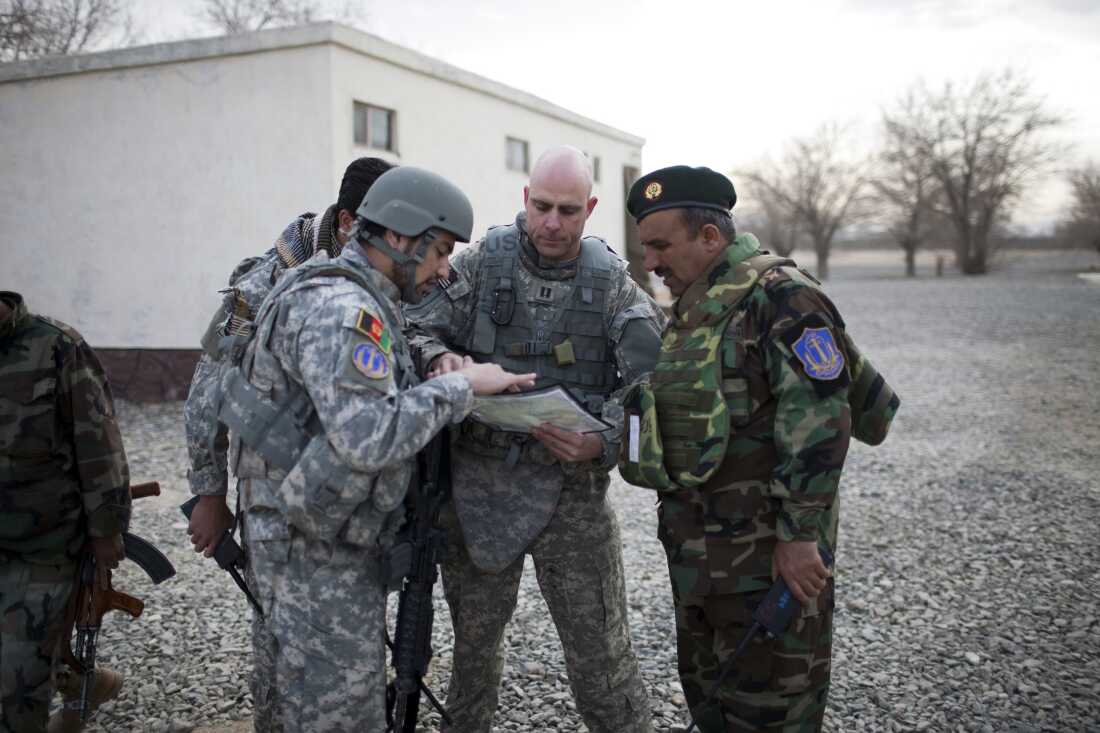
A U.S. Air Force captain goes over the day's mission route map with an Afghan National Army officer with assistance from an Afghan interpreter (left), before the U.S.-Afghan convoy sets off in Ghazni, Afghanistan, on March 16, 2009.
Robert Nickelsberg/Getty Images Europe
Surayya's flight to the United States was already booked when President Trump ordered a pause on the U.S. Refugee Admissions Program. Not long after, her flight was canceled and her stomach dropped.
"I don't know what to do," she said. "If I go back to Afghanistan, I will be prosecuted or even be killed by the Taliban."
Surayya, who asked NPR not to use her full name for safety reasons, used to work on women's rights projects with the U.S. Embassy in Kabul. But when the Taliban took control of Afghanistan, Surayya and her children fled to neighboring Pakistan. There, she applied for resettlement in the U.S. and was approved.
Immigration
Trump's immigration orders are a blueprint for sweeping policy changes
Now, Surayya's future and safety look uncertain, along with tens of thousands of other Afghans who risked their lives working for the U.S. government or military.
During Trump's first day in office, the president issued an executive order to pause refugee applications and travel plans, citing concerns over the country's capacity to absorb large numbers of refugees.
It remains unclear how long the suspension will last, but the order does allow the secretary of state and the secretary of homeland security to admit refugees on a "case-by-case basis." The U.S. State Department did not respond to NPR's request for comment.
Longstanding pathways for Afghan allies hang in the balance
The U.S. is home to over 200,000 Afghans who arrived as refugees, according to Shawn VanDiver, a military veteran and the president of #AfghanEvac, a nonprofit that helps people from Afghanistan resettle in America.
Around the world, over 40,000 Afghans are still actively pursuing resettlement in the U.S., with more than 10,000 approved to relocate by the U.S. government.
Many of those affected by the pause on the U.S. Refugee Admissions Program (USRAP) are Afghan lawyers and judges who put Taliban fighters behind bars, as well as members of the Afghan military who trained and fought alongside American troops. The families of about 200 active duty U.S. service members are also being impacted, VanDiver said.

World
Reporters' notebook: revisiting Afghan refugees starting anew in the U.S.
"We made a promise to our Afghan allies, and fulfilling that promise is not just about policy — it's about honor and integrity," he added.
USRAP is one of the pathways for Afghans who risked their lives to support U.S. missions. The other is called the Special Immigrant Visa (SIV), specifically designed for Afghan interpreters, drivers and other contractors who worked directly with American forces.
The SIV program is in jeopardy too, following a separate executive order suspending foreign aid, including funding for refugee resettlement agencies. The order similarly stalls relocation flights, as well as hinders organizations from processing SIV cases and providing critical travel loans, according to VanDiver.
"This isn't just a humanitarian issue — it's an economic one. The ripple effects will be felt across the U.S. as resettlement agencies close their doors and jobs are lost," he said.
"He is unfortunately putting our lives in grave danger"
Surayya said she was supposed to be evacuated to the U.S. after the Taliban seized Kabul. But like thousands of others, she was not able to get on a plane during America's chaotic retreat from Afghanistan in 2021.
The exit happened during former President Biden's time in office, but it was set in motion by the first Trump administration, which signed a deal with the Taliban in 2020 to withdraw after two decades in the country.
Investigations
Three years after the U.S. withdrawal, former Afghan forces are hunted by the Taliban
While Surayya currently resides in Pakistan, it is not a permanent solution. Over the years, Pakistan has deported hundreds of thousands of Afghans. Without a chance to move to the U.S., Surayya does not know where else to go.
"Police of Pakistan are searching for Afghans," she said. "I am not safe here. And if I go back to Afghanistan, my life is not safe, my kids' life is not safe."
Many Afghans who worked for the U.S. but were unable to escape Afghanistan now live in hiding from the Taliban, like Roshangar, who asked NPR not to include his full name because he's been on the run.
Roshangar said he used to work alongside American pilots, helping review and approve airstrikes against Taliban fighters. He was on the last step of his application before the refugee program was suspended. Roshangar said he feels that the Trump administration turned its back to America's Afghan allies.
"He is unfortunately putting our lives in grave danger," he said.
Veterans rally behind Afghan allies, urging the Trump administration to reverse course
For Army veteran Mark Kirkendall, the issue is deeply personal. "I called these Afghan engineers I worked with my adopted sons," he said. "That's how close we are."
Kirkendall was deployed to Afghanistan over a decade ago. Since then, he kept in regular contact with the engineers he worked with, helping many of them resettle to the U.S.
Investigations
What It's Like Inside The U.S. Processing Center Welcoming Thousands Of Afghans
Kirkendall, who voted for Trump, is hoping the president will make an exemption for Afghan allies. With three engineers still in Afghanistan — and having lost two to the Taliban — Kirkendall said he sees it as a matter of life or death.
"U.S policy has always been to take care of our allies, and we're not doing a good job of that; we're failing the Afghan people," he said.
To Army veteran Alex Waller, who was deployed to Afghanistan in 2017, he believes the U.S. has a moral responsibility to protect those who risked their lives to serve alongside American troops.
" B y and large, they are productive members of society that want to be here, that want to make good life for themselves, and who are — in my opinion — they're outstanding people," he said.
For the past two years, Waller and other veterans have been working with Task Force Argo, a volunteer group dedicated to helping Afghan allies evacuate, to bring to the U.S. a former member of the Afghan military who is currently in Turkey.
Waller said the soldier was known for participating in dozens of raids against the Taliban and helping evacuate a wounded American. Since Waller learned that USRAP was paused, he couldn't help but wish he had acted more quickly.
"We should not assume that the countries that they are hiding in will continue to, like, let them hang around out of the kindness of their hearts or something," he said.
Last week, hundreds of veterans signed an open letter to the Trump administration organized by #AfghanEvac, urging that Afghans who put themselves in harm's way working for the U.S. should be exempt from the executive order blocking refugee pathways. They argued that failing to do so would jeopardize America's credibility with potential allies in future conflicts:
"To abandon them now would be a betrayal of the values we fought to defend and the trust built through years of shared struggle and sacrifice."
-=-=
Associated Press
WASHINGTON — The Trump administration is in discussions to potentially send more than 1,000 Afghans who assisted America’s war effort and relatives of U.S. service members stuck in Qatar to a third country, the U.S. government and some advocates said. Congo is an option, the advocates said.
Shawn VanDiver, a Navy veteran who heads a coalition that supports Afghan resettlement efforts called #AfghanEvac, said Wednesday that U.S. officials informed him and other groups of discussions between the United States and Congo about taking the Afghan refugees who have been in limbo at a U.S. base in Doha for the past year.
The 1,100 refugees at Camp As-Sayliyah include Afghans who served as interpreters and with Special Operations Forces as well as the immediate families of more than 150 active duty U.S. military members.
The State Department said Wednesday that it is working to identify options to “voluntarily” resettle the refugees in a third country, but it did not confirm which nations were being discussed.
An alternative provided to the refugees, VanDiver said, is to return to Afghanistan, where they face likely reprisal or even death at the hands of the Taliban for working alongside the U.S. during the two-decade war.
“You cannot call a choice voluntary when the two options are Congo and the Taliban, civil war or an oppressor who wants to kill you,” VanDiver said at a virtual press conference. “That is not a choice. That is a confession extracted under duress.”
The discussions — which were reported earlier by The New York Times — come more than a year after President Donald Trump paused his predecessor’s Afghan resettlement program as part of a series of executive orders cracking down on immigration.
That policy left thousands of refugees who fled war and persecution, and had gone through a sometimes yearslong vetting process to start new lives in America, stranded at places worldwide, including the base in Qatar.
From one war-torn country to another
Negotiations between the U.S. and several other countries, including Botswana and Malaysia, started months ago, according to an executive at a refugee resettlement agency who was briefed by U.S. officials. The executive, who spoke on condition of anonymity to share private negotiations, said Botswana was seen by many refugee advocates as the most promising option but that talks between senior U.S. officials and the country’s leadership fell through. In early April, the executive was briefed that Congo was now the main option being discussed.
A person familiar with the matter who was not authorized to comment publicly and spoke on condition of anonymity said they had heard from State Department personnel that the U.S. was looking at sending the Afghans at the base in Qatar to countries in sub-Saharan Africa. The person said the Afghans were told Wednesday that there was no final deal on where to send them.
The base in Doha “was always intended as a transit platform. It was never designed to hold families for months or years, which is the situation that people are currently in,” said Jon Finer, who was deputy national security adviser to then-President Joe Biden. “What I want to emphasize is that this was intended to honor a wartime commitment.”
Finer and other former U.S. officials and refugee advocates warned of the risk of resettling Afghans in Congo, a country that U.N. officials say is facing “one of the most acute humanitarian emergencies in the world."
The African country has been battered by decades-long fighting between government forces and Rwanda-backed rebels in its eastern region.
Congolese authorities did not immediately respond to AP’s request for comment on the discussions, which did not come as a surprise to some there. Congo is one of at least eight African nations that were paid millions in controversial deals with the Trump administration to receive migrants deported from the U.S. to countries other than their own.
Like most other African nations involved in the deportation program, Congo is also among the worst hit by the Trump administration’s policies on aid and trade. At least 70% of the country’s humanitarian aid came from the U.S. before Trump's second term, and aid workers say American aid cuts have led to avoidable deaths in the conflict-hit region.
Sean Jamshidi — an Afghan American who served in the U.S. military, including a stint in Congo — said he was deeply concerned about his brother possibly being sent from the Doha base to the war-torn country.
“I saw the security situation and what it looked like there. I saw the displacement camps. ... I stood in places where the United Nations has counted the dead,” Jamshidi said. “I’m telling you, as someone who has been in uniform, the Democratic Republic of the Congo is not a place you send vetted Afghan allies and their children to live.”
Refugees are in the dark as they await their fate
Negina Khalili, a former prosecutor in Afghanistan who fled during the 2021 U.S. withdrawal, has been waiting to hear about the resettlement status of her father, brother and stepmother since they arrived at the Doha base in January 2025. That was just days before Trump suspended the refugee program soon after he returned to the White House.
Khalili told The Associated Press on Wednesday that she spoke to her family about reports that they could be sent to Congo.
“They are not giving them any information or updates regarding which countries they will go to,” she said. “They were so stressed and worried about it and said that Congo is not a safe place either. They don’t know if it’s a temporary location for them there or a permanent location. They are worried.”
She said U.S. officials at the camp have been suggesting to refugees that they go back to Afghanistan and offering them money to do so.
Amiri reported from New York and Asadu from Abuja, Nigeria. Associated Press writer Matthew Lee contributed to this report.
-=-=
8 26
AI Overview
Executive orders signed in January 2025 suspended the U.S. Refugee Admissions Program and cut resettlement funding, stranding thousands of Afghan interpreters and wartime allies who assisted American forces. [1, 2]
Key Executive Actions
- Program Suspension: Executive Order 14163 paused the U.S. Refugee Admissions Program (USRAP), halting refugee processing and travel plans. [1, 2]
- Funding Cuts: Executive Order 14169 cut funding for resettlement agencies and international migration relocation flights. [1, 2]
- Office Closures: The administration shuttered Operation Enduring Welcome and the Coordinator for Afghan Relocation Efforts in mid-2025. [1]
- Recent Status: Advocacy groups like #AfghanEvac report that subsequent proclamations and rule changes have severely restricted visa issuance and humanitarian parole for Afghan passport holders. [1]
Impact on Allies and Interpreters
- Stranded Partners: Over 40,000 Afghan allies face an uncertain limbo, with thousands of fully vetted individuals blocked from boarding approved flights. [1, 2]
- Third-Country Relocation: Officials explored moving over 1,000 Afghan allies stuck at a military base in Qatar to third countries, such as the Democratic Republic of Congo. [1, 2]
- Security Risks: Allies remaining abroad face severe retaliation risks from the Taliban for working alongside U.S. troops and diplomats. [1, 2]
Veteran and Advocate Response
- Strong Opposition: Military veterans and groups like No One Left Behind strongly condemn the halts, arguing they break a moral promise made to wartime partners. [1, 2]
- Legislative Push: Lawmakers have introduced bipartisan measures like the Afghan Adjustment Act to establish permanent legal pathways for vulnerable Afghan evacuees. [1]
-=-=
8 26
Afghan interpreters who assisted U.S. military and government efforts face severe legal uncertainties, frozen visa applications, and threats to their legal status in the U.S. [1, 2, 3]
Resettlement Status and Challenges
- Policy Shifts: The administration ended protected legal statuses for many Afghan refugees and threatened deportation actions for green card holders and humanitarian parole recipients. [1, 2, 3]
- Backlogs: Tens of thousands of Special Immigrant Visa (SIV) and refugee applications remain frozen or stalled in third-country limbo (such as in Rwanda and Qatar). [1, 2]
- Detentions: Legally entered interpreters have faced sudden detentions by Immigration and Customs Enforcement (ICE) during routine check-ins. [1]
Support Organizations
Veterans and advocates continue to work through non-profit networks to aid wartime allies:
- #AfghanEvac coordinates legal and resettlement advocacy.
- No One Left Behind assists SIV recipients with housing, employment, and emergency aid.
- The Independence Fund provides financial grants and casework support for arriving SIV families. [1, 2, 3, 4]
-=-=
CBS
Afghan interpreter who rescued U.S. officer's life during the war says America broke its promise to allies
By
Adam Yamaguchi,
Anam Siddiq
July 23, 2025 / / CBS News
Dewey Yopp, a retired U.S. Army Special Forces officer, was sent to Afghanistan in 2002 to train up a new Afghan army during the early days of the war in Afghanistan. He met Amir, his then-18-year-old Afghan translator, at the airport on his first day there, and says Amir went on to save his life four times.
"Amir dragged me, under fire, to a medevac point," Yopp told CBS News of one of those instances.
After the U.S. withdrew from the country in 2021, Yopp scrambled to get Amir a special immigrant visa for Afghan allies. Amir asked CBS News to conceal his real name for safety reasons.
"If someone saves your life, your souls are bound together for eternity," Yopp said. "He's like a son to me, really."
Three years later, Amir's visa was approved, and he and his family were given green cards. They came to the U.S. and settled in Kentucky, reuniting with Yopp 22 years after they first met in Afghanistan.
Yopp now spends most days with Amir's children, who call him "grandfather."
Thousands of Afghans living in the U.S. now fear deportation after a federal appeals court late Monday refused to freeze the Trump administration's efforts to end their legal status. Amir is a Special Immigrant Visa recipient, given to U.S. allies who helped during the war. Despite he and his family having green cards, he still fears being sent back, since the White House has threatened to deport green card holders, too.
Amir risked Taliban retaliation to help American soldiers, because work in Afghanistan at the time was scarce and the prospect of safety abroad was enticing. He told CBS News the promise that was made to him in return for risking his life was, "Your family will go to America. This was promised with all who work with U.S."
Amir said he went into hiding for years after his service, feeling betrayed by the U.S., until Yopp stepped in to fulfill America's pledge and helped secure him his visa. Thousands of veterans of the Afghanistan war across the country have taken it upon themselves to help their translators and other Afghan allies come safely to the U.S. and settle here. But Amir says it is not the job of veterans to fulfill the vow of protection the government previously made to them.
The Trump administration has repeatedly targeted Afghan refugees, stopping flights with Afghan allies from arriving, freezing resettlement services, putting Afghanistan on the travel ban list, and ending the Temporary Protected Status (TPS) program for Afghan refugees. Yopp says it is a "moral injury" to veterans to see this happen to those who helped them during the war.
As part of the administration's efforts to end the TPS program, Homeland Security Secretary Kristi Noem has claimed that Afghanistan is now safe for Afghans to return to, a point Amir disputes.
"OK, if Afghanistan is safe, why are you saying to your citizens, 'Do not go to Afghanistan?'" Amir said in reference to the State Department's "Do Not Travel" advisory for Afghanistan. "For me, [it's] safe, but for you, [it's] not safe? I'm not sure."
Amir fears that even as a green card holder, he and his family may be sent back, since the White House has threatened to deport green card holders, too.
These days, he works two jobs, seven days a week, to support his family. He says he only got by in the past because of the $500 a month that Yopp, who is retired, would give him.
"It's been a slap in the face, really, to see the programs that were in effect, to be taken away," Yopp said.
Amir added: "Americans should not make a promise with Afghans, and now [you're] making a problem for them. Then why [did] you make [that] promise?"
-=-=
REF CBS
Thousands of Afghans who helped the U.S. military blocked from reaching American soil
By
Madeleine May
Updated on: March 12, 2025 / / CBS News
In August 2021, Tamim Satari raced to the Kabul International Airport to evacuate Afghanistan after working with the American military as an intelligence officer, helping U.S. forces coordinate aerial bomb campaigns against the Taliban. But in the chaos of the U.S. withdrawal, his wife and newborn son were left behind.
"It was so hard, and we didn't want to lose our small son," Satari said.
He was not alone. Thousands of Afghan families were separated in the rushed withdrawal of U.S. troops from Afghanistan. Babies were passed across throngs of people and over fences, and families scrambled to get through the gates to the airport.
Three years later, more than 10,000 families remain separated, according to Shawn VanDiver, the founder of #AfghanEvac, a nonprofit that worked with the State Department to create a path to reunite separated Afghan families.
"There's all these moms or dads or young children who are stuck here without their family," said VanDiver. "These people are in danger because of us. And the least we can do is help them reunite."
He says the number of children separated from their parents includes 2,800 unaccompanied refugee minors — children who made it to the U.S. but whose parents did not, or who were left behind as their parents fled.
VanDiver works with the Office of the Coordinator for Afghan Relocation Efforts, known as CARE, a State Department program that was established to assist wartime Afghan allies immigrate to the U.S.
Since 2021, the CARE program has facilitated travel for nearly 200,000 Afghans, according to documents reviewed by CBS News.
This includes those with special immigrant visas who were wartime allies typically paid by the U.S. government. It also includes Afghan refugees who assisted the U.S. mission in military roles, as civil society members, or those who are family members of those who served.
"The truth is, is that every single person in the refugee pipeline and every single person in the [special immigrant visa] pipeline are somebody who took action in our name and are now in danger," said VanDiver.
"And these Afghans deserve everything that we can give to them because they protected us."
After trying unsuccessfully to bring his wife and son over on his own, Satari connected with CARE in 2023 to get help facilitating their visa process. His wife, Shiba, and their son had escaped to Pakistan after she was threatened by the Taliban for continuing her work as a midwife while her husband was in the U.S.
On Jan. 18, the weekend before President Trump's inauguration, Shiba and her son were flown to JFK airport in New York and then driven to Newark, New Jersey, for an emotional reunion with her husband. Tamim had not seen his son, now nearly 4 years old, since he was a newborn.
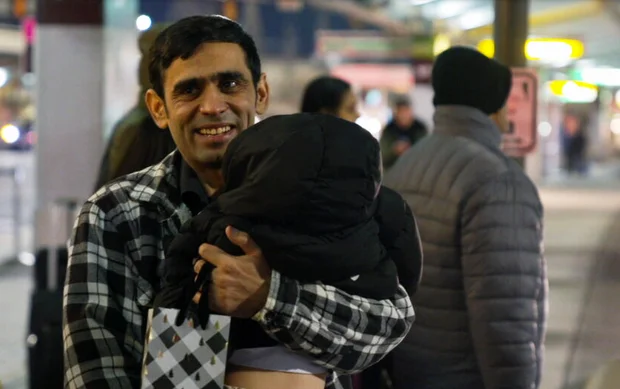
Tamim Satari is reunited with his son at Newark Liberty International Airport in January after they were separated in Afghanistan in 2021. CBS News
The Sataris' family reunion at Newark Liberty International Airport was one of the last refugee reunions to take place.
Three days later, Mr. Trump signed an executive order suspending the U.S. refugee program, stating "the United States lacks the ability to absorb large numbers of migrants, and in particular, refugees, into its communities in a manner that does not compromise the availability of resources for Americans that protects their safety and security, and that ensures the appropriate assimilation of refugees."
A federal judge ordered the administration to stop the ban, but since then normal refugee processing has not continued. In a recent court filing, lawyers for the administration said it would take time to restart refugee programs, since agencies have already cut contracts, reduced the workforce and frozen funding.
In addition to Mr. Trump's executive order, Secretary of State Marco Rubio froze all federal funding for the programs that were providing travel for Afghans who had already been approved to resettle in the U.S. This means that anyone vetted and approved for travel — including those already holding special immigrant visas — cannot leave Afghanistan unless they are able to pay for the trip themselves.
According to government documents reviewed by CBS, more than 40,000 Afghans who have been vetted and approved to leave Afghanistan are now in limbo, with their lives at stake.
"I've heard countless horror stories of torture and murder of these allies of the United States," said Republican Rep. Michael McCaul of Texas, who voted for the CARE program.
"I would urge the administration to take a look at this and to honor the commitment that we made to [our allies], and not break our promise, but let them know that we are going to protect them."
But Mr. Trump and other Republican lawmakers have expressed concern that allowing Afghans into the U.S. makes the country more vulnerable to terrorism.
McCaul and others who advocate for the program say the vetting is already extremely effective.
"You want to vet them again? Go ahead. But they've already been vetted, and probably the most thorough vetting in American history," McCaul told CBS News.
Afghans who come to the U.S are reviewed by the State Department, Department of Homeland Security and U.S. Citizenship and Immigration Services. They go through several in-person interviews and their biometrics are checked against government databases, in addition to extensive medical screening.
"Afghans who come to this country via the CARE program are the most vetted immigrant population in our country's history," said a former State Department official.
Satari remains hopeful he will not be one of the last to be reunited with his family. He has settled in New Jersey and is employed in a mechanical job while he studies for his real estate license.
"I have a lot of hope in the future. I would like to have a great life," Satari said. "I am responsible for taking care of my son, to enroll in school and start lessons over there. I have a big hope."
-=-=