EXEC ORDER TRUMP XO
ESTB 1 25
MERRI OK
SEE GOP STEal election
SEE ALSO EMERGENCY DECLARATION POTUS bs XO JAN 6 SEDITION PARDON}:
SEE MILITARIZATION MARTIAL LAW // FASCISM
see pjt 2025 doge coup cut usaid b/c gay opera? DOES NOT ALIGN WITH PRIORITES = XO? VOUGHT OMB SEE PUBLIC HEALTHIMPOUNDMENT
SEE VOTER SUPPRESS MAIL IN BALLOTS CLETA SAVE ACT
SEE NDS VOTE.GOV DOGEBAGS
see press suppress pbs npr
SEE GLYPHOSATE DEFENSE PROD ACT HEGSETH AI // NATL SECURITY
SEE RETALIATE 3
SEE PPL LOSE CONST RTS EG FLAG BURN BS
-=-=
mma 8 26
Roger Stone says national emergency declaration for elections is “brilliant” and “revolutionary”
-=-=
=-=-=-
AN 826
A self-described Libertarian is sounding the alarm that President Donald Trump's new effort to rewrite the 14th Amendment is "more bizarre" than most realize.
David J. Bier, the director of immigration studies at the Cato Institute, walked through the specifics of the new executive orders that President Donald Trump signed to challenge
"The new birthright citizenship order is way more bizarre than anyone is saying," he wrote in a thread on X Friday. "1) The text requires agencies to deny CURRENT US CITIZENS citizenship docs if either parent 'IS' an alien enemy, foreign govt employee, regardless of their status at birth..."
"Contrast with the first birthright order: they deleted the timing phrase to open the citizenship claims of current US citizens whose parents did not even fall into the excluded category at birth," he continued.
It prompted him to pose the question: "Do they think they can take away people's citizenship?"
"Strangely, this means that the order doesn't apply to kids of parents who fell into the category at birth, but don't when the kid requests a passport," he said.
The second point he noticed is that Trump deleted the same thing from his first order. It "means that this new order applies retroactively to pre-order births!" he said.
The key line reads that it "shall apply only to persons who are born within the United States after 30 days from the date of this order."
Third, Bier continued, Trump's order will apply if "either" one of the parents fits into the category as well as if both parents are noncitizens. The first order, he pointed out, gave options for the father's status being able to "save" the child's citizenship. If, for example, the mother had an H-1B visa and the father was a foreign bureaucrat visiting during the World Cup the child still couldn't be considered a citizen if their parent is a so-called "alien enemy."
"Trump also deleted the first order's clause protecting the children of lawful permanent residents. This means if you work for a foreign government as a Lawful Permanent Resident, your baby isn't a citizen.
Bier also pointed out how "incredibly vague" the language in the order is. So, while the order gets very specific about who it applies to, it doesn't even define what some of the categories mean.
There's also a caveat that requires children to know their parents' "intent" when they were giving birth, he pointed out. While conservatives are calling these folks "birth tourism" travelers, Bier explained that, according to these details, it includes Lawful Permanent Residents.
"If your parent was an immigrant visa holder who rushed to buy a plane ticket so you were born in the USA? Sorry!" said Bier.
He closed by calling the justification for Trump's new order "INSANE."
"He's saying he can deem whoever he wants to be 'outside of the USA.' The extraterritorial fiction means that these people wouldn't be subject to US law. No, the president can't just decide that certain people are outside of US law!" Bier wrote. "Remember, the only exception to birthright citizenship is for people not 'subject to the jurisdiction of the USA.' That's everyone except ambassadors, because everyone else has to follow US law. That's not just my interpretation."
"So, we have this bizarre, incoherent order backed up by the most insane legal theory imaginable. No, President Trump can't decide that people aren't subject to U.S. law, and of course, he's not actually going to give immunity to foreign terrorists and visa fraudsters. But he might give out immunity cards to anyone who gives him $1 million.... remember 'not subject to US jurisdiction' here applies even to state and local laws," Bier said.
---
GUK
A federal judge nominated by Donald Trump during his first term reluctantly agreed on Friday to grant the Department of Justice’s motion to dismiss the seditious conspiracy convictions against leaders of the Proud Boys who were convicted by a jury of serious crimes during the attack on the US Capitol by Trump supporters on 6 January 2021.
The US district judge Timothy Kelly noted in a seven-page memorandum that the Proud Boy leaders Ethan Nordean, Joseph Biggs and Zachary Rehl were all convicted of multiple crimes, including seditious conspiracy, and a fourth member of the group, Dominic Pezzola, was convicted of assaulting an officer and “breaking a Capitol window, thereby helping to create the first entry point through which hundreds of rioters streamed into the building”.
Pezzola’s destruction of the window was recorded in a social media video that quickly became one of the iconic images of the day.
Nordean, Biggs and Rehl were all sentenced to long prison terms in 2023. Upon returning to office in 2025, Trump commuted their sentences as part of a sweeping order granting clemency to about 1,500 people who had been charged with or convicted for participating in the Capital attack. However, their convictions were kept in place.
In April, the DoJ requested that an appeals court overturn the convictions. The appeals court approved the motion in May, sending the ruling back to Kelly. Kelly, in Friday’s memo, said he was granting the motion as “it is hard to see how any other course ... could make practical sense. Denying the motion would not somehow revive the convictions that the Court of Appeals vacated”.
Kelly, in Friday’s filing, went on to note that he was granting the motion to dismiss the prosecutions even though the request was clearly based not on facts or the law, but on Trump’s desire to excuse the violence of his supporters.
“[T]here is little mystery about why the Government is moving to dismiss this case, or whether dismissal is in fact what the Executive seeks,” Kelly observed. “President Trump’s views about the prosecution of those who attacked the US Capitol on January 6 – whether those views are based on fact or fiction – are well known, as is his intention to extend clemency to them”.
Kelly also noted that the case was initiated “while President Trump was still in power” in the days after the attack.
“As the Court has said many times, the attack on the Capitol on January 6, 2021 was a perilous event,” Kelly wrote. “It was an attack on people, including police officers, many of whom were injured. It was an attack on a coordinate branch of government – Congress – that the Founders saw fit to give a place of primacy in Article I of the Constitution. And it was an attack on the Constitution’s mechanism to facilitate the peaceful transfer of power from one president to the next, what President Reagan called ‘nothing less than a miracle.’”
“Moving forward, if this Nation’s experiment in self-government is to last another 250 years, the American people – no matter their partisan preferences – will have to act together to preserve, protect and defend that miracle through our constitutional framework,” the Trump-appointed judge concluded.
MSN = FOX?!
NO LNX
A Trump-appointed federal judge on Friday reluctantly dismissed the Jan. 6 prosecution of four Proud Boys members, saying the law left him no authority to block the Justice Department's request.
U.S. District Judge Timothy Kelly granted the Justice Department's motion to dismiss the case with prejudice against Ethan Nordean, Joseph Biggs, Zachary Rehl and Dominic Pezzola after a federal appeals court had already vacated their convictions.
·
Sponsored
call to action icon
In a seven-page opinion, Kelly said longstanding separation-of-powers principles leave charging decisions to the executive branch, meaning he could not require the Justice Department to maintain a prosecution it had decided to drop.
"Because the decisions to issue the Executive Order and to abandon this prosecution—even after the Government secured convictions for serious crimes relating to the attack on the Capitol on January 6—are solely the Executive's, no one should mistake the Court's granting of the Government's motion for its agreement with those decisions," Kelly wrote.
Pezzola, who was convicted of assaulting police, robbery and destroying government property, was found guilty of stealing a Capitol Police riot shield before using it to smash a Capitol window, creating what prosecutors said was the first breach point through which hundreds of rioters entered the building. He was acquitted of seditious conspiracy but convicted on multiple other felony counts.
READ ON THE FOX NEWS APP
Meanwhile, Nordean, Biggs and Rehl were convicted of seditious conspiracy and several other felonies related to the Jan. 6 Capitol attack, including conspiracy to obstruct Congress' certification of the 2020 presidential election, obstruction of law enforcement during a civil disorder and destruction of government property.
The Justice Department first moved in April to vacate the convictions and dismiss the case against the four men, arguing that doing so was "in the interests of justice" in light of President Donald Trump's Jan. 20, 2025, executive order commuting their sentences and issuing full pardons to former Proud Boys Chairman Enrique Tarrio and hundreds of other Jan. 6 defendants. The D.C. Circuit had already erased the men's convictions before returning the case to Kelly's courtroom to consider the Justice Department's request to dismiss the indictment. HUH?
call to action icon
"There is little mystery about why the Government is moving to dismiss this case, or whether dismissal is in fact what the Executive seeks," Kelly wrote. "President Trump's views about the prosecution of those who attacked the U.S. Capitol on January 6—whether those views are based on fact or fiction—are well known, as is his intention to extend clemency to them."
Kelly cited longstanding precedent holding that charging decisions belong to the executive branch and that judges cannot reject a dismissal simply because they disagree with the government's reasoning.
And because the convictions had already been vacated and prosecutors have broad authority to decide whether to pursue criminal charges, Kelly said he lacked the power to force the Justice Department to continue the prosecution.
"Indeed, it is hard to see how any course other than granting the motion in full could make practical sense. Denying the motion would not somehow revive the convictions that the Court of Appeals vacated," Kelly wrote. "Nor would denying it mean a retrial would follow, because the Court lacks the authority to compel the Executive to pursue a prosecution, full stop—but especially when an executive order explicitly requires that the Government seek dismissal with prejudice."
But Kelly sharply rebuked the actions of the Jan. 6 rioters, calling it an attack on the people, Congress, and the "Constitution's mechanism to facilitate the peaceful transfer of power."
"Moving forward, if this Nation's experiment in self-government is to last another 250 years, the American people—no matter their partisan preferences—will have to act together to preserve, protect and defend that miracle through our constitutional framework," Kelly wrote.
CLICK HERE TO DOWNLOAD THE FOX NEWS APP
Tarrio, who was also pardoned for criminal charges stemming from his role in the Jan. 6 riots, celebrated Kelly's dismissal on X.
"We took the worst they threw at us the raids, the solitary, the lies and we stood tall," Tarrio wrote. "Trump dropped the pardons and now the rest is crumbling. Justice is SERVED! Proud Boys don't lose. We WIN. This is OUR victory. THANK YOU PRESIDENT DONALD J TRUMP and all of you that fought for us!"
Original article source: Trump-appointed judge permanently ends Proud Boys Jan. 6 case, says Constitution left him no choice
Related Links:
DOJ SEEKS TO VACATE JAN 6 CONVICTIONS IN SWEEPING MOVE TIED TO TRUMP ORDER
FORMER INDIANA REP STEPHEN BUYER RECEIVES FULL PARDON FROM TRUMP FOR 2023 INSIDER TRADING CONVICTION
LEGAL WAR ON TRUMP’S AGENDA GAINS FIREPOWER AS FEDERAL LAWYERS DEFECT TO DEMOCRATS
===
7 26 ti
===
YIKES PARTIAL
37 ways Project 2025 has shown up in Trump’s executive orders
37 ways Project 2025 has shown up in Trump’s executive orders
By Liset Cruz, Ali Bianco, Megan Messerly, Abhinanda Bhattacharyya and Anna Wiederkehr
02/05/2025
President Donald Trump on the campaign trail last summer disavowed Project 2025, saying he knew nothing about the effort.
But many of the conservative blueprint’s ideas have made their way into his early executive orders, signaling the sweeping impact the Heritage Foundation document has already had on the Trump administration’s policy making. A side-by-side review by POLITICO found dozens of cases where the president’s early executive actions have aligned with portions of the 922-page policy document, including some instances with nearly verbatim language lifted from the report to the White House.
Several of the ideas, such as energy policies expanding U.S. oil and critical minerals production, are longtime conservative policy priorities that did not originate with Project 2025. But some of the more unconventional strategies outlined in the document, such as reclassifying federal employees to make them easier to fire and installing loyalists in senior government positions, have also shown up in Trump’s executive orders.
There have also been other Trump administration moves outside of his executive orders that appear to come directly from Project 2025, such as directing the Federal Communications Commission to investigate NPR and PBS for alleged violations of sponsorship advertising rules.
We’ve broken down the executive order similarities in social issues, immigration, government staffing and other categories below.
... MUCH M MORE OBS
---
- Atlantic Monument Reopening: In February 2026, President Trump issued a proclamation revoking protections to allow commercial fishing in the 4,913-square-mile Northeast Canyons and Seamounts Marine National Monument off the New England coast. [1, 2]
- Pacific Monument Access: Through Executive Order 14276 and subsequent proclamations, the administration has moved to allow commercial fishing in the Pacific Remote Islands Marine National Monument and directed reviews for other protected Pacific sites. [1,, 3]
- Dismantling Ocean Sensors: The administration began removing hundreds of deep-sea scientific instruments, pulling more than 900 sensors from the Pacific and Atlantic oceans. This decades-long observation project was defunded over concerns about cost and the program's focus on climate research. ]
---
OMFG
5 26 lever Trump’s Private Repo Men Are Hunting Immigrants
theTrump administration has quietly hired a team of scandal-plagued private debt collectors to hound immigrants slapped with new multimillion-dollar civil penalties for not leaving the country, according to documents reviewed by The Lever. All of the companies previously worked on a federal student loan debt-collection program shut down for widespread abuses.
One private collection notice obtained by The Lever assessed a $1.8 million fine on its recipient, the maximum penalty allowed under immigration law, plus another half a million in fees and interest charges, bringing the total to $2.3 million.
IFrame ContentA collection notice sent by a private debt-collection agency regarding a $1.8 million Homeland Security fine, plus another half a million in fees and interest charges.
That notice is not a one-off. According to immigration lawyers, there’s been a recent uptick in collection letters from private firms demanding immigrants pay multimillion-dollar fines, which the Department of Homeland Security began imposing last year.
As directed by a White House executive order from January, the Trump administration is using these massive new financial penalties to pressure immigrants to self-deport as part of its immigration crackdown. And to ensure immigrants ship out or pay up, the White House is enriching private contractors with a history of dubious practices, just like it has outsourced oversight of its detention centers to embattled for-profit companies like GeoGroup and CoreCivic.
“This is part and parcel with the administration’s desire to partner with the private sector to make immigration enforcement as punitive and painful as possible,” said Charles Moore, an attorney at Public Justice, a legal advocacy and defense group. “It’s very telling that they view the private market as the best way to accomplish that.”
....

Vanity Fair
https://www.vanityfair.com › News › donald trump](https://www.vanityfair.com/news/story/trump-will-take-control-of-the-midterms-if-this-florida-lawyer-gets-his-way?srsltid=AfmBOorXvROVNQ4p679s91j_YD2tTcmTQOl0soklEqk5JNdLpk6vHcfY)
Mar 17, 2026 — Foreign interests are putting their thumb on the scale of our elections,” Peter Ticktin claims. Senator Mark Warner is answering with a ...
NO LNX
Trump Will Take Control of the Midterms–If This Florida Lawyer Gets His Way
“Foreign interests are putting their thumb on the scale of our elections,” Peter Ticktin claims. Senator Mark Warner is answering with a “prebunking” campaign.
By Chris Smith
March 17, 2026
:{:{Attorney Peter Ticktin listens during oral arguments for People vs Tina Peters in the Court of Appeals at the Ralph L. Carr Colorado Judicial Center in Denver on January 14, 2026.:}:
Chances are you have never heard of Peter Ticktin. That’s okay. Until a few years ago, most civilians did not recognize the names Dan Scavino or Laura Loomer or even Steve Bannon. Yet those three and others have all moved from the Republican fringes to become influential figures in President Donald Trump’s orbit.
Now, Ticktin, an 80-year-old South Florida lawyer, is aiming to play a key role in trying to upend 250 years of American election law by persuading Trump to issue an executive order that would allow the president to seize control of this fall’s midterm balloting process. “Well, he has to,” Ticktin tells Vanity Fair. “I wouldn’t recommend this to the president if it were not actually an election emergency occurring, where foreign interests are putting their thumb on the scale of our elections.”
How would they do that? It’s complicated. Ticktin connects dots alleging automated voting trickery stretching from Venezuela to Antrim County, Michigan, to Beijing. “The only reason Donald Trump is in office now is because the computer data center in Belgrade, Serbia, was disabled by certain American actors in 2024,” Ticktin says, mysteriously. “But they’re never going to let that happen again.” By “they,” he means the Chinese, the World Economic Forum, and the Democrats—who, Ticktin claims, are seeking a Senate majority next year in order to impeach Trump and Vice President JD Vance and install New York congressman Hakeem Jeffries as president.
:{:{All of which might be dismissed as garden-variety conspiracy, not to mention being beyond the organizational capacity of the Democratic Party. Except that Ticktin and Trump have a long history. The two men have known one another for 65 years, going back to their time as classmates at the New York Military Academy, a relationship Ticktin detailed in his 2020 book, What Makes Trump Tick.}:
What Makes Trump Tick: My Years with Donald Trump from New York Military Academy to the Present: Peter Ticktin: 9781645437116: Amazon.com: Books
What makes President Donald Trump tick? There's no better person to ask than Peter Ticktin, Donald Trump's former platoon sergeant who ran Company A for him at New York Military Academy, and lifelong friend. In What Makes Trump Tick: My Years with Donald Trump from New York Military Academy to the Present, Peter Ticktin outlines why he always has and always will stand behind 45. Including never-before-told stories of Donald Trump and their lives at New York Military Academy, What Makes Trump Tick is an eye-opening, firsthand account of the experiences that made Donald Trump the businessman, president, and simply the man he is today.
Ticktin is the founder of The Ticktin Law Group based in Deerfield Beach, Florida. After graduating from New York Military Academy, Mr. Ticktin received his first law degree from the University of Western Ontario in London, Ontario, and began practicing law in Canada as a barrister in 1972. Within his first year of practice, he defeated the Uniform Summons, resulting in the dismissal of all misdemeanors that used the form within the Province of Ontario, and changed the criminal laws in Ontario's appellate courts and the Supreme Court of Canada.
In the mid-eighties, Mr. Ticktin relocated to Florida and commenced his effort to obtain his second law degree. He graduated cum laude from the University of Miami Law School, and was elected into the Order of the Coif, among numerous honors.
Mr. Ticktin's practice is eclectic and covers a broad band of legal work, from divorce to business litigation. He loves being before juries. He generally thinks outside of the proverbial box with creative approaches to achieve the most pragmatically sensible results where possible, and a good fight where not. He has had numerous cases before the appellate courts, including appearances before the Supreme Courts of Canada, Florida, and California. Moreover, he has changed the world by taking on HIV and AIDS cases when others were afraid to have someone infected come to their offices. He won a two week trial which was nationally televised on CourtTV after his clients 7-year-old child had his organs harvested by an organ procurement supervisor who forged his mother's permission. He again came to national attention when he was on the forefront of a mortgage foreclosure defense, when he unearthed the robo-signers and gave the attorney generals of all fifty states the basis they needed to win a $50 billion settlement. Mr. Ticktin remains in active practice and remains as young and vigorous as President Trump. Perhaps it was the NYMA food.
Product details
- Publisher : Mascot Books ENDIT
More recently, Ticktin was part of Trump’s legal team in a 2022 lawsuit against Hillary Clinton and others that alleged a broad racketeering scheme to create false allegations against Trump’s 2016 campaign. “When I was hired to assist Alina Habba as local counsel in Florida, I had a long meeting with the president, and I said, ‘What do I call you?’ Because I’ve always called him Donald,” Ticktin says of his work on the lawsuit. “He looked at Alina and he said, ‘Oh, he can call me Donald, because after all, I’ve known him so long, and he is so much older than I am.’” Ticktin pauses.
“For the record, I’m four and a half months older than him.” (The lawsuit was eventually dismissed, with a federal judge calling it “frivolous” and issuing sanctions against Habba, Ticktin, and other lawyers. They appealed, but an appellate court affirmed the case’s dismissal and upheld the sanctions against the attorneys. Habba did not respond to a request for comment.)}:
Ticktin says he began talking with Trump about election-integrity issues at least a year ago, and followed up, most recently, in an email earlier this month. “I can’t stop,” he says, “because of what I know.” Ticktin is reluctant to get into detail about his “line of communication” with the administration, or about which Cabinet secretary he says is spearheading the midterms election-integrity effort. “They trust me,” he says. “I don’t want to act in a way that’s not trustworthy.”
A White House spokeswoman did not respond to questions regarding Trump’s relationship with Ticktin, and directed me to the president’s answer, on February 27, when a PBS reporter asked whether he was considering issuing an executive order related to the midterms. “No,” the president said. “I’ve never heard about it.”
:{:{Ticktin isn’t the only person trying to encourage Trump to seize control of the elections. Micheal Flynn, the former lieutenant general and first-term Trump national security adviser, has promoted the idea, as has the right-wing activist and author Jerome Corsi. Flynn convened a meeting in Washington last month billed as “a critical roundtable to address election integrity.”}:
According to ProPublica, the event attracted current administration officials Kurt Olsen, a White House lawyer who is reinvestigating the 2020 election, and Heather Honey, who is in charge of election integrity at the Department of Homeland Security, as well as conservative activists including Cleta Mitchell, who has pushed false claims about noncitizen voting and now runs the Election Integrity Network.}:
:{:{Senator Mark Warner is trying to sound the alarm, even as potential election mischief is being overshadowed by life-and-death events like the war on Iran. “This is of critical importance,” the Virginia Democrat tells me. “One thing we should have learned about Trump is he doesn’t hide his intentions, including the notion to call for federal elections.”}:
Warner is particularly concerned that Trump officials could create a pretext for Trump to take over the voting. “Tulsi Gabbard is a disaster, and she’s chasing debunked theories about the 2020 election,” Warner says, referring to the director of national intelligence’s recent presence at the raid of an election office in Fulton County, Georgia. “She could be the perpetrator of this—putting out a raw piece of intelligence that purports to show foreign interference,” as an excuse for Trump’s intervention.}:
A Gabbard spokeswoman, Olivia Coleman, said she “would especially encourage you to focus on the very real vulnerabilities uncovered in the electronic voting machines.” Coleman also pointed me to a February letter from Gabbard to Warner and others in Congress saying the director’s office “will not irresponsibly share incomplete intelligence assessments concerning foreign or other malign interference in US elections.”
Warner, the ranking Democrat on the Senate Intelligence Committee, is hardly reassured. He is assembling a “prebunking” team of former intelligence officials who could knock down attempts at disinformation. “I have a sense of urgency on this,” Warner says. “When we’re talking about Laura Loomer being able to call the shots on who does and doesn’t get jobs in the administration, and bragging about her ability to fire a four-star general, we’ve passed into the realm of the absurd.”
Loomer has gone from incendiary far-right provocateur to informal Trump adviser and loyalty enforcer, digging through the backgrounds of political officials in search of insufficient fealty to the MAGA cause and using social media to scorch her targets. Last year Loomer’s accusations appeared to trigger the dismissal of General Timothy Haugh, the head of the National Security Agency.
Ticktin’s style is considerably more mild-mannered, and he claims that the changes he’s pushing, including banning voting machines and mail-in ballots, wouldn’t be all that disruptive or difficult to implement. “We already have paper ballots,” he says. “The main change is the ballots would be hand-counted in public. If we don’t, the machines take over, and the machines can determine the outcome of the election. From a Democrat point of view, they’re gonna want the machines.”
:{:{Ticktin, in the wake of the 2008 subprime collapse, handled major mortgage-fraud cases, and he has won a settlement for a family whose mortally injured son’s organs were harvested without proper permission. He is currently representing Tina Peters, the former Colorado county clerk who was convicted on criminal charges related to efforts to overturn the 2020 election results, and has represented several January 6 participants, including Stewart Rhodes, the Oath Keepers leader, in their bids to receive full pardons for their roles in the attack on the Capitol.}:
“Donald Trump won the 2020 election,” Ticktin says. “I mean, Donald Trump obtained more legitimate votes and should have won.” What about all the investigations and lawsuits that turned up no meaningful fraud? “Some of them were corrupt,” he says. “But most of them, nobody ever looked at the evidence. It was a question of standing. We know much more now than we knew then.”}:
Ticktin has also had his law license suspended twice for conflicts of interest, and the biography on his firm’s site claims the film Philadelphia was originally going to be called Miami, with its story inspired by a client of Ticktin’s. “That’s insane,” says Ron Nyswaner, the Philadelphia screenwriter. “Among the many, many lies we get from Trump and his people, that’s one of them.” (Ticktin says the reference was to a possible unrelated production.) The firm’s site also has a link to “Peter’s Poems,” including “The Toronto Subway System” and “The Hamburger” (“That special sauce is what I dread / Like heroin, it lifts its addictive head”).
The Constitution, Ticktin admits, leaves election logistics to the states. So last year he created an “outline” for an executive order justifying presidential intervention because of what he believes are foreign threats to the electoral system. More recently, a 17-page draft executive order filling in Ticktin’s framework has circulated in conservative circles; it ties together everything from the Defense Production Act to a law related to federal holidays. Ticktin claims he does not know who wrote the longer document. “It might have been Jerome Corsi,” he says.
Corsi, who aggressively promoted doubts about Barack Obama’s birth certificate, says it wasn’t him and he doesn’t know who wrote the draft either, though he calls Ticktin “instrumental” in the larger effort. Whoever the authors might be, Corsi agrees with the draft order’s aims, and says the necessity of a Trump election takeover will soon become clearer, as administration investigations uncover new “hard evidence” of voter fraud in Arizona and Georgia. “Donald Trump has said repeatedly in the second term that one of his goals is to prove the 2020 election was stolen,” Corsi says. “I’ve known Donald Trump for over 40 years...he’s not going to let the midterms be run with all these things in place to create more fraud.”
“This draft executive order rewrites the laws of 50 states and creates brand-new laws with no input from Congress or the states it would affect,” says Devon Ombres, the senior director for courts and legal policy at the Center for American Progress. “The laws it cites don’t give the president the authority to do these things.”
Trump typically cares little for legal niceties. His style is to push boundaries until someone stops him—if they stop him. And actually imposing an executive order might not even be necessary to alter the midterm dynamics. Simply floating the idea of extreme measures might serve the purpose of making less extreme interference—like new voter ID laws and restrictions on mail-in ballots—seem downright tolerable. Increased chatter about foreign interference could also help undermine the credibility of the midterm results. Polling in advance of the 2024 presidential election found a majority of voters were already worried about possible election interference by Russia and China.
One irony is that federal mechanisms to thwart interference were beefed up during Trump’s first term, only to be dismantled during his second. One side effect is that a presidential takeover of elections—an idea long considered outlandish—may now sound more plausible. “We’ve seen this over and over again, the mainstreaming of radical ideas,” says Charlie Sykes, the conservative commentator and an avowed Never Trumper. “Back in 2020, after the election, people were saying the vice president can overturn the Electoral College on January 6. And I rolled my eyes. You know what happened.”
Chris Smith is a contributing editor at Vanity Fair. He is the best-selling author of The Daily Show (the Book) and Till the End (with CC Sabathia). Smith joined VF after covering politics, entertainment, sports, and crime for New York magazine. Follow him on Twitter. ... Read More
:
The Humiliation of Tulsi Gabbard
---
---
4 6? 26 TRMS INTEL COMM DEM
TRUMP WILL STEal mark warner fabricate emergency
---
---
mma
Election deniers hail Trump’s mail-in voting executive order as a “win” that will leave Democrats “toast”
True the Vote: “The era of trust-but-don’t-verify is over”
Written by Alex Kaplan
:{Published 04/06/26
Figures involved in promoting false claims of widespread election fraud in the 2020 presidential election have praised President Donald Trump’s March 31 executive order regarding mail-in voting, calling it a “major win,” saying he’s “stepping to the plate” and issuing it “while the iron is hot,” and claiming it means “the democrats are toast.” Experts have said that the order, which follows years of right-wing media attacking mail-in voting, stands on dubious legal ground.
- ## Trump issued a legally dubious executive order on mail-in voting, which has been a frequent target of right-wing media
- On March 31, Trump issued an executive order “that seeks to create lists of U.S. citizens who are eligible to vote in each state” and instructs “the U.S. Postal Service to send mail ballots only to verified voters.” As NPR further reported, the executive order “instructs the Department of Homeland Security, working in conjunction with the Social Security Administration, to ‘compile and transmit to the chief election official of each State a list of individuals confirmed to be United States citizens who will be above the age of 18 at the time of an upcoming Federal election and who maintain a residence in the subject State,’” and “then ‘requires the USPS to transmit ballots only to individuals enrolled on a State-specific Mail-in and Absentee Participation List, ensuring that only eligible absentee or mail-in voters receive absentee or mail-in ballots,’ according to a White House fact sheet.” NPR, [3/31/26]
- Election law experts wrote that the executive order is “likely unconstitutional” and cannot be implemented by the 2026 midterm elections.NPR noted that “Rick Hasen, an election law expert at UCLA, wrote on his blog that the order is likely unconstitutional” and that he noted that “the timing here makes this virtually impossible to implement in time for November’s elections.” In a piece at Slate, Hasen wrote that “the order is so underwhelming that it suggests Trump’s real purpose was not its implementation but to create more confusion and litigation around elections, further undermining voter confidence in the integrity of American elections” and putting “into question the rules of an election that is just months away, giving voters reason to fear that the Postal Service could sabotage their ballots.” Another expert told Democracy Docket that the order was “convoluted” and “you can’t make [the Postal Service] the gatekeepers for ballot delivery.” And the director of the Brennan Center’s Voting Rights and Elections Program told The New York Times that “the president doesn’t have any authority to write the rules that govern our elections. The Constitution gives that power to Congress and to the states, not to the president.” NPR, [3/31/26; Slate, 4/1/26; Democracy Docket, 4/1/26; The New York Times, 3/31/26]
- A previous executive order on elections that Trump issued in 2025 has been blocked by the courts. Multiple federal judges have blocked aspects of the order, which “calls for the Election Assistance Commission to require people to show government-issued proof of U.S. citizenship to register to vote in federal elections,” “directs state or local officials to record and verify the information,” and “seeks to require states to count ballots by Election Day.” Media Matters [10/28/25; The New York Times, 3/25/25, 6/13/25; The Associated Press, 1/30/26]
- Some Trump allies have proposed Trump issue an executive order declaring a “national emergency” to prevent supposed election fraud. An advocate for the proposal, which has reportedly circulated within the Trump administration, said that it “would empower the president to ban mail ballots and voting machines as the vectors of foreign interference.” Trump allies reportedly spearheading the proposed order include attorney Peter Ticktin, a QAnon figure known as Juan O. Savin, and right-wing author Jerome Corsi. Media Matters, [10/28/25, 2/26/26]
- Trump and right-wing media have spread misinformation about mail-in ballots for years. Despite their claims, there has not been evidence of widespread voter fraud or evidence of mail-in ballots being inherently corrupt. Media Matters, [8/21/20; CNN, 3/24/26]
- ## Election deniers praised the new executive order, calling it a “major win” and claiming “the democrats are toast”
- Podcaster Jovan Pulitzer, whom the Arizona Mirror described as “a favorite of election fraud conspiracy theorists,” called the executive order a “major win” and said that “we’ve got to take the wins as we can get the wins.” Pulitzer called aspects of the order to supposedly force states to make sure their lists of voters are accurate “genius,” and he called the order “the clearest path for getting a thing done.” He described the effort as a “monumental movement” that is “going to create all kinds of hell.” Arizona Mirror, [4/30/21; Rumble, 4/1/26, 4/1/26]
- True the Vote’s Catherine Engelbrecht: While the executive order is “a slippery slope,” “it’s still worth doing. Somebody’s got to do something. And God bless President Trump for at least, you know, doing what he can.” Engelbrecht — who founded True the Vote, which aims to “restore America’s confidence in our electoral process” and was behind the claims of the election misinformation film 2000 Mules — went on to praise Trump “for at least stepping to the plate, putting it in writing, and forcing them to respond.” Additionally, True the Vote posted on Truth Social that the executive order means that “the era of trust-but-don’t-verify is over.” Media Matters, [9/15/22, 12/4/24; Texas Monthly, 8/22/22; True the Vote, True the Vote Now, 4/1/26; Truth Social, 3/31/26]
- A QAnon influencer who goes by Juan O. Savin, and who previously recruited election denial candidates for positions where they would be in charge of election administration, said Trump was “really just kind of forcing all the various agencies to do their job” with the executive order. Savin said that “anybody thinks that this is doing something truly unique and new is probably wrong,” and he claimed Trump “has total authority to direct the actions to the post office” because “there’s no intrusion upon states’ rights.” Savin had previously said his team “wrote up” a different executive order regarding voting that has reportedly circulated within the Trump administration and would declare a national election emergency to crack down on supposed fraud. In a separate interview, Savin acknowledged that Trump’s latest executive order on elections was “not the complete executive order that my team put together in the 17-page executive order” and said the administration “may very well break that up into several pieces.” The Daily Beast, [11/2/22; Media Matters, 10/28/25, 1/26/23; Lawfare, 3/20/26; Rumble, Nino’s Corner, 4/1/26; Rumble, The B2T Show, 3/31/26]
- Seth Keshel claimed the executive order was Trump “striking while the iron is hot and counting on the morons wearing out their welcome with the cheating.” Keshel is a former U.S. Army intelligence captain and blogger who “has become a darling among election deniers by factoring widespread voter fraud — the existence of which has been widely debunked — into his election predictions,” according to The New York Times. He posted on Telegram that “some communist court will strike down his mail-in voting order, which will then be expedited to SCOTUS,” which “is sick of mail-in ballot games and all 6 Republican-appointed justices appear to be ready to squash the concept of late-arriving mail-in ballots.” The New York Times, [10/15/24; Substack, accessed 2/5/26; Telegram, 4/1/26]
- David Clements said the executive order was potentially “great” and “wonderful” and means “the democrats are toast.” Lawfare reported in 2024 that Clements had “criss-crossed the country to evangelize about purported election fraud,” and The Washington Post reported in 2022 that he was “traveling the country trying to persuade local leaders to withhold certification of election results.” In April 1 social media posts, he suggested that the order was not “violating state’s rights” because it “does not create new substantive rules from scratch; it directs federal agencies to implement and enhance existing federal statutory requirements." He also said the order means that “democrats are toast” and the “toys” from “the swamp” — i.e., existing federal election rules, which he claimed “the swamp used … to inflate numbers and commit massive fraud” — now “are being used against them.” On a podcast, Clements said he “got a bunch of texts from other election integrity folks” about the order, and “most of them were bummed” because it did not focus on the “big stuff,” but he said he thinks the order is “brilliant” and could potentially be “a great executive order. It's wonderful.” Lawfare, [10/31/24; The Washington Post, 9/8/22; Telegram, 4/1/26, 4/1/26; Rumble, Absolute Storm, 4/2/26]
- Kris Jurski, “a Florida activist who has promoted election conspiracy theories,” wrote on his Substack that the executive order “proves the message is finally getting through: the voter rolls are the strategic foundation of every election.” Added Jurski, “If the list is corrupt, the outcome can be corrupt — regardless of how the votes are counted.” NBC News, [3/18/26; Substack, 4/5/26]
- On Newsmax, Kari Lake called the executive order possibly “the most important executive order [Trump’s] ever signed.” Lake, a Trump administration official with the U.S. Agency for Global Media and former Arizona GOP candidate who focused intensely on election fraud claims during her campaigns, said on Newsmax that “the people of this country need some relief from the corrupt people running our elections.” The Guardian, [7/31/24; Media Matters, 6/14/23; Newsmax, Rob Schmitt Tonight, 3/31/26]
//
10/28/25 9:54 AM EDT
02/26/26 5:47 PM EST
02/05/26
---}:
---
AN 4 26
President Donald Trump is lying in ways that strangle democracy, and yet according to a conservative commentator, Americans who should take this more seriously simply are not doing so.
“So far this year, the president has failed to convince Congress to pass his SAVE America Act, which among other things would require voters nationwide to show proof of U.S. citizenship to register to vote or vote by mail,” wrote The Bulwark’s Andrew Egger on Tuesday. “But last week, he tried to scratch his election-meddling itch in another way: a one-weird-trick-style executive order trying to seize federal control of mail voting by creating new lists of whose ballots the Postal Service can and can’t mail.”
Egger pointed out that, like most of Trump’s attempts to throttle voting in the 2026 midterm elections, his effort now will almost certainly fail. Yet just because Trump will lose in court does not mean he will not achieve his larger objectives.
“In all likelihood, what the order will actually do, at least as a legal matter, is nothing,” Egger wrote. “Its strategy — which involves ordering the Department of Homeland Security to create a list of ‘approved’ absentee voters, and ordering the USPS not to mail requested ballots to anybody else — is legally hilarious, a slapped-together usurpation of states’ election authorities without the slightest basis in federal law. The order has already drawn a plethora of major lawsuits, which are all but guaranteed swift success.”
The problem is that “it remains gospel in MAGA circles that Democrats fiendishly stole the 2020 election on behalf of Joe Biden. And Trump keeps testing the waters of how much bullying of election officials he can get away with, most notably with the FBI’s January raid on the elections office in Fulton County, Georgia.” For this reason, Trump will almost certainly take advantage of how pro-democracy advocates celebrate his loss in court, but meanwhile spreads misinformation intended to empower him to find other ways to stop elections from hurting him.
“We should take heed of all this,” Egger warned. “Trump really is losing support at a remarkable rate; all the old received wisdom about the impregnability of Teflon Don really does seem to have fallen apart. But Trump still has his hands around the neck of American democracy with a much surer grip than he had in 2020. And too much of the country seems strangely confident — just as in 2020, and with even less justification now than then — that he’ll simply choose not to squeeze.”
Another conservative writer, George F. Will, explained for The Washington Post earlier this year that Trump’s claims about the 2020 election being stolen have been decisively debunked.
"Someone should read to him ‘Lost, Not Stolen,’ a 2022 report by eight conservatives (two former Republican senators, three former federal appellate judges, a former Republican solicitor general, and two Republican election law specialists),” Will wrote. “They examined all 187 counts in the 64 court challenges filed in multiple states by Trump and his supporters. Twenty cases were dismissed before hearings on their merits, 14 were voluntarily dismissed by Trump and his supporters before hearings. Of the 30 that reached hearings on the merits, Trump’s side prevailed in only one, Pennsylvania, involving far too few votes to change the state’s result.”
Will added, “Trump’s batting average? .016. In Arizona, the most exhaustively scrutinized state, a private firm selected by Trump’s advocates confirmed Trump’s loss, finding 99 additional Biden votes and 261 fewer Trump votes.” Therefore he wrote of Trump, “The man who never alters his opinion is like standing water, and breeds reptiles of the mind.”
---
aha not me note spatial aspect: zone of exception
an 3 26
When President Donald Trump sent U.S. Immigration and Customs Enforcement (ICE) agents to airports, his supporters applauded the move as a great way to help out Transportation Security Administration (TSA) employees who are feeling overwhelmed during a partial government shutdown. Trump's critics, however, countered that ICE's presence at airports did nothing to make TSA agents' jobs easier or shorten long lines at airports — and if anything, they got in the way.
Salon's Amanda Marcotte, in a biting article published on March 25, argued that Trump's real motivation wasn't helping beleaguered TSA agents — he saw the ICE agents as a way to "bully" and "trigger the liberals." And Marcotte's Salon colleague Chauncey DeVega sees Trump's ICE/airports move as part of his "authoritarian" push to restrict "freedom of movement."
"Authoritarian regimes attempt to control freedom of movement, association and privacy; this is one of the most direct ways that such leaders exercise power," DeVega explains in an article published the day after Marcotte's. "People internalize the restrictions and conform. Those who refuse to do so are punished. The Trump Administration is now using America's airports as a space for authoritarian training and conditioning."
DeVega notes that in a 2024 report, Freedom House pointed out that authoritarian regimes "around the world use mobility controls — revoking citizenship, passport restrictions, travel bans — to coerce and punish dissidents, activists, journalists, and ordinary people."
According to Freedom House, "For people targeted in this way, mobility controls produce a sense of powerlessness."
Paul Gowder, a law professor at Northwestern University in Chicago, views airports as a place where authoritarians make a point of exercising control.
Gowder told DeVega, "The federal government has created agencies and personnel trained and socialized in operating in these liminal spaces. Most infamous is the Border Patrol, which has a long record of brutality — predictable, because they are trained to deal with people with lesser rights, in spaces where monitoring of their conduct is thin or nonexistent."
DeVega warns, "When militarized guardians of the border and the larger national security state are turned inward against a country's own citizens, it is known as the boomerang effect. This is a defining feature of democracies collapsing into authoritarianism…. Civil and human rights abuses at airports are a feature of this system, not a bug — and a measure of how far Trump is pushing its boundaries to advance his authoritarian project."
---
---
an 3 26
As allies of President Donald Trump are rumored to be urging him to issue an executive order seizing control of elections ahead of the midterm elections, Arizona’s top attorney and election administrator both say doing so would be blatantly unconstitutional and unlikely to happen.
“No president has the constitutional authority to ‘take control’ of elections,” Attorney General Kris Mayes told the Arizona Mirror in a statement. “Elections in this country are administered by states. It is a deliberate feature of our constitutional system designed to prevent the federal government from seizing power over how Americans choose their leaders.”
On Friday, the Washington Post reported that a proposed executive order, written and supported by conspiracy theorists, has been passed around the White House with the goal of Trump formally issuing it. It would declare an emergency over alleged Chinese interference in the 2020 election, which Trump lost to Joe Biden, and use that as the basis to wrest control of elections from states and make sweeping changes to how Americans register to vote and cast their ballots, and how those votes are then counted.
Mayes said the entire exercise is based on fanciful claims of election fraud that are not backed by any evidence, many of which were rejected by the courts in 2020.
“Arizona’s 2020 election results were investigated, audited, litigated, and certified, even by members of the president’s own party,” Mayes added. “There is nothing to relitigate, and debunked conspiracy theories are not a legal basis for seizing control of American elections.”
Arizona Secretary of State Adrian Fontes said in a statement to the Mirror that his main concern is focusing on elections in Arizona, not Trump’s actions.
“I don’t have time to be distracted by noise from Washington DC. IF a new (executive order) is forthcoming, and it purports to violate the Constitution like the last one, we will challenge it in Court,” Fontes said. “For now, local and state elections officials in Arizona will stay focused on the task at hand: continuing to provide high quality elections for our voters, as we’ve done for decades.”
The draft executive order that is being shopped to the Trump administration was published by Democracy Docket, a digital news site about elections, and is said to be written by Peter Ticktin, a Trump ally and Florida-based lawyer who represents former Mesa County clerk and election denier Tina Peters.
When asked about the order by reporters on Friday morning, Trump said he had “never heard of it.”
The proposed executive order, an earlier version of which was published in April 2025 by a group led by Trump ally and election denier Cleta Mitchell, includes a number of proposals that have been on the wishlists of election conspiracy theorists for years.
It would require every voter to re-register in 2026; eliminate the use of ballot tabulation machines and force every ballot to be counted by hand; allow anyone to challenge the eligibility of voters; require all races be counted by midnight on Election Day; and create a national voter registration database.
The proposal also would have each ballot require a unique identifier, and each voter would need a unique PIN, which some have noted would erase the secret ballot requirement by Arizona law.
“First Trump said he’d impose new voting rules ‘whether approved by Congress or not’ and now extremists are pushing him to use emergency powers to control our elections,” U.S. Sen. Mark Kelly said on X. “That’s not how things work in our country, and a federal takeover of our elections violates our Constitution and the law. The American people will not stand by and let their voting rights be undermined.”
Trump and his allies have been pushing for the passage of the Safeguard American Voter Eligibility Act, more commonly known as the SAVE Act, with Department of Homeland Security Secretary Kristi Noem making a stop in Arizona to stump for it and fueling more baseless election conspiracy theories along the way.
She called Arizona’s elections an “absolute disaster” and made the false claim that there is widespread voter fraud by illegal immigrants. But when pressed by reporters to provide examples, Noem could not provide even a single one.
The proposed executive order is based around many of those baseless conspiracy theories, alluding to interference by foreign actors in machines and claims of widespread noncitizen voting, both of which have been found to be baseless.
The SAVE Act has passed out of the U.S. House of Representatives but faces a roadblock in the U.S. Senate because the GOP majority doesn’t have enough support to get around the filibuster. Trump has said that if it does not pass, he would look for alternative ways to enact it.
---
---
ref 1 xo
PROMOTING THE NATIONAL DEFENSE BY ENSURING AN ADEQUATE SUPPLY OF ELEMENTAL PHOSPHORUS AND GLYPHOSATE-BASED HERBICIDES
Executive Orders
February 18, 2026
By the authority vested in me as President by the Constitution and the laws of the United States of America, including the Defense Production Act of 1950, as amended (50 U.S.C. 4501 et seq.) (the “Act”), and section 301 of title 3, United States Code, it is hereby ordered:
_Section_ 1. _Policy and Findings_. Elemental phosphorus is pervasive in defense supply chains and is therefore crucial to military readiness and national defense. It is a key input in smoke, illumination, and incendiary devices and is a critical component for manufacturing the semiconductors that are central to numerous defense technologies, such as radar, solar cells, sensors, and optoelectronics. It is also increasingly important in modern lithium-ion battery chemistries used in a multitude of weapon-system supply chains. For these and other reasons, on November 7, 2025, the Department of the Interior, acting pursuant to the Energy Act of 2020, designated phosphate as a critical mineral.
Elemental phosphorus is also a critical precursor element for the production of glyphosate-based herbicides, which play a critical role in maintaining America’s agricultural advantage by enabling farmers to efficiently and cost-effectively produce food and livestock feed. As the most widely used crop protection tools in United States agriculture, glyphosate-based herbicides are a cornerstone of this Nation’s agricultural productivity and rural economy, allowing United States farmers and ranchers to maintain high yields and low production costs while ensuring that healthy, affordable food options remain within reach for all American families.
There is no direct one-for-one chemical alternative to glyphosate-based herbicides. Lack of access to glyphosate-based herbicides would critically jeopardize agricultural productivity, adding pressure to the domestic food system, and may result in a transition of cropland to other uses due to low productivity. Given the profit margins growers currently face, any major restrictions in access to glyphosate-based herbicides would result in economic losses for growers and make it untenable for them to meet growing food and feed demands.
:{:{Ensuring an adequate supply of elemental phosphorus and glyphosate-based herbicides is thus crucial to the national security and defense, including food-supply security, which is essential to protecting the health and safety of Americans. Nonetheless, the United States’ ability to domestically produce those critical inputs is extremely limited. Indeed, there is only a single domestic producer of elemental phosphorus and glyphosate-based herbicides, and this producer does not meet our annual needs for those inputs. }:
For that reason, more than 6,000,000 kilograms of elemental phosphorus are imported from other countries annually. Future reduction or the cessation of domestic production of elemental phosphorus and glyphosate-based herbicides would gravely threaten American national security by disrupting, and requiring the further offshoring of, this Nation’s defense supply chain including by having a debilitating impact on domestic agricultural capabilities.}:
I accordingly find that, consistent with the Department of the Interior’s designation, elemental phosphorus is a scarce material that is critical to national defense and security. Our Nation’s inadequate elemental phosphorus production, which must sustain both defense manufacturing and our significant agricultural needs, and the threat of increased domestic scarcity leave us vulnerable to hostile foreign actors and pose an imminent threat to military readiness.
Consistent with these findings, I find that ensuring robust domestic elemental phosphorus mining and United States-based production of glyphosate-based herbicides is central to American economic and national security. Without immediate Federal action, the United States remains inadequately equipped and vulnerable. Accordingly, I hereby find, pursuant to section 101 of the Act, that domestic elemental phosphorus and glyphosate-based herbicides meet the criteria specified in section 101(b) of the Act (50 U.S.C. 4511(b)).
:{:{_Sec_. _2_. _Ensuring an Adequate Supply of Elemental Phosphorus and Glyphosate-Based Herbicides_. (a)}:
Notwithstanding Executive Order 13603 of March 16, 2012 (National Defense Resources Preparedness), the authority of the President conferred by section 101 of the Act to require performance of contracts or orders (other than contracts of employment) to promote the national defense over performance of any other contracts or orders, to allocate materials, services, and facilities as deemed necessary or appropriate to promote the national defense, and to implement the Act in subchapter III of chapter 55 of title 50, United States Code (50 U.S.C. 4554, 4555, 4556, 4559, 4560), is delegated to the Secretary of Agriculture (Secretary) with respect to ensuring a continued and adequate supply of elemental phosphorus and glyphosate-based herbicides.}:
(b) The Secretary shall use the authority under section 101 of the Act (50 U.S.C. 4511), in consultation with the Secretary of War, to determine the proper nationwide priorities and allocation of all the materials, services, and facilities necessary to ensure a continued and adequate supply of elemental phosphorus and glyphosate-based herbicides.
(c) The Secretary shall issue such orders and adopt and revise appropriate rules and regulations as may be necessary to implement this order.
(d) In exercising the authority delegated in this section, the Secretary shall take into account the President’s judgment that domestic production of elemental phosphorus and glyphosate-based herbicides is critical to the national defense. Accordingly, the Secretary shall ensure that any order, rule, or regulation issued under this section does not place the corporate viability of any domestic producer of elemental phosphorus or glyphosate-based herbicides at risk.
_Sec_. _3_. _Immunity_. This order confers all immunity provided for in section 707 of the Act (50 U.S.C. 4557). Additionally, domestic producers of elemental phosphorus and glyphosate-based herbicides are required to comply with this order, in accordance with the provisions of 7 C.F.R. part 789.
_Sec_. _4_. _General Provisions_. (a) Nothing in this order shall be construed to impair or otherwise affect:
(i) the authority granted by law to an executive department or agency, or the head thereof; or
(ii) the functions of the Director of the Office of Management and Budget relating to budgetary, administrative, or legislative proposals.
(b) This order shall be implemented consistent with applicable law and subject to the availability of appropriations.
(c) This order is not intended to, and does not, create any right or benefit, substantive or procedural, enforceable at law or in equity by any party against the United States, its departments, agencies, or entities, its officers, employees, or agents, or any other person.
(d) The costs for publication of this order shall be borne by the Department of Agriculture.
DONALD J. TRUMP
THE WHITE HOUSE,
February 18, 2026.
---
REF 2 GUK
Trump has signed an executive order protecting production of glyphosate-based herbicides, such as Roundup, which some bodies and studies have linked to cancer and which are the subject of widespread US litigation.
The president’s move, which also seeks to provide “immunity” for makers of the herbicides, was strongly criticized by health and environmental advocates including some figures in the “Make America healthy again” (Maha) coalition.
The order also protects domestic production of phosphorus, which is used in making glyphosate and other agricultural chemicals, as well as a range of other products, including some in military defense.
Ensuring “robust domestic elemental phosphorus mining and United States-based production of glyphosate-based herbicides is central to American economic and national security”, the order states.
[
Bayer agrees to pay $7.25bn to settle Roundup weedkiller cancer lawsuits
Read more](https://www.theguardian.com/business/2026/feb/17/bayer-proposed-settlement-roundup-cancer-lawsuits)
The 18 February order cites authority under the Defense Production Act and instructs US Department of Agriculture secretary Brooke Rollins to issue orders and regulations as “may be necessary to implement this order”.
The White House said “the threat of reduced or ceased production” of phosphorous and glyphosate herbicides “gravely endangers national security and defense, which includes food-supply security”.
Neither the executive order nor the fact sheet the White House put out accompanying the order discloses that glyphosate-based herbicides have been linked to an array of cancers and other health problems in multiple independent research studies and by cancer experts of the World Health Organization (WHO).
The move by the White House comes as Roundup maker Bayer is facing tens of thousands of lawsuits alleging the company’s glyphosate herbicides cause cancer and the company failed to warn farmers and other users of the risks.
The company, which inherited the litigation when it bought Monsanto in 2018, has already paid out billions of dollars in settlements and jury verdicts and said this week it was proposing to pay $7.25bn in a class action settlement to try to head off future lawsuits.
Bayer has said that if it cannot find relief from the litigation, it may stop making glyphosate herbicides for the US agricultural market.
“This executive order reads like it was drafted in a chemical company boardroom,” said Vani Hari, a food activist, author and one of the grass roots leaders of the Maha coalition. “Calling it ‘national defense’ while expanding protections for toxic products is a dangerous misdirection. Real national security is protecting American families, farmers, and children.”
Kelly Ryerson, another key actor in the Maha movement who has been lobbying US regulators and lawmakers for restrictions on glyphosate and other pesticides, said the move by Trump is an insult to those who have largely supported the administration because of promises that Maha issues would be taken seriously.
Robert F Kennedy Jr, who was appointed by Trump as secretary of the US Department of Health and Human Services (HHS) and who heads a Maha commission set up by the White House, has a long history of criticizing glyphosate and its maker over the health harms tied to the herbicide. Both Trump and Kennedy had pledged to address health concerns about glyphosate and other pesticides.
“The President is making a mockery of the very voters who put his administration into office,” Ryerson said. “Expanding the production of glyphosate, a pesticide derided by the Maha movement, is a commitment to perpetuating the toxic, chemical food system that has created a sick and infertile American population.”
In response to questions about the executive order, Kennedy issued a statement saying that the order “puts America first where it matters most – our defense readiness and our food supply”.
Lori Ann Burd, environmental health program director at the Center for Biological Diversity, called the executive order “a sickening love letter from Trump to the largest pesticide companies in the world.
“It’s more proof that Trump doesn’t care at all about Americans’ health,” she said. “While he’s pandering to chemical companies the rest of the country, especially those who’ve been poisoned by pesticides, is rightfully asking ‘what about us?’”
[
Trump’s EPA reapproves contentious weedkiller dicamba for some GM crops
Read more](https://www.theguardian.com/us-news/2026/feb/08/epa-reapproves-contentious-weedkiller-dicamba)
Trump’s order contains a clause that “confers all immunity provided for in section 707 of the Act (50 U.S.C. 4557)” and states that “domestic producers of elemental phosphorus and glyphosate-based herbicides are required to comply with this order.” The act cited states that “no person shall be held liable” for “any act” resulting from compliance with an order issued pursuant to that law.
Bayer did not respond when asked how involved the company was in Trump’s executive order. But the company issued a statement saying: “President Trump’s Executive Order reinforces the critical need for US farmers to have access to essential, domestically produced crop protection tools such as glyphosate. We will comply with this order to produce glyphosate and elemental phosphorus.”
Bayer maintains that its glyphosate herbicides do not cause cancer and has been engaged in an array of tacticsto try to lift the litigation pressure, including pressing Congress for language in the farm billand other legislation that would restrict the ability of people to sue the company for failing to warn of cancer risks if the US Environmental Protection Agency (EPA) doesn’t require such warnings.
The company has already succeeded in getting laws protecting it from lawsuits passed in two states and is pressing for more state laws. It has also asked the US supreme court to rule in its favor on the issue of federal preemption of failure-to-warn lawsuits, and the high court has set a hearing for 27 April.
This story is co-published with the New Lede, a journalism project of the Environmental Working Group}:
---
CNN table Biden's executive orders in his first 100 days: View the list
---
HCR 1 12 26
The Senate advanced a bill to stop the Trump administration from additional attacks on Venezuela without congressional approval. And, just two days after Trump had reversed the victims and offenders in the January 6, 2021, insurrection, suggesting that Capitol Police officers had been among the offenders, the Senate unanimously agreed to hang a plaque honoring the police who protected the U.S. Capitol on January 6, 2021. Congress passed a law in March 2022 mandating that the plaque be hung, but Republicans until now had prevented its installation.
Friday was a busy day at the White House.
On Friday, Trump threatened Greenland, saying that he was “going to do something on Greenland, whether they like it or not.”
Trump’s threat against a North Atlantic Treaty Organization (NATO) ally has had American lawmakers and foreign allies scrambling ever since. In a joint statement, the leaders of Denmark, France, Germany, Italy, Poland, Spain, and the United Kingdom said that “Greenland belongs to its people.” Senator Chris Murphy (D-CT) released a video explaining that “what you are essentially talking about here is the United States going to war with NATO, the United States going to war with Europe. You’re talking about the U.S. and France being at war with each other over Greenland.”
Trump’s threats against Greenland came at a meeting with oil executives. When he attacked Venezuela to capture Maduro, Trump told reporters that United States oil companies would spend billions of dollars to fix the badly broken infrastructure of oil extraction in that country. But apparently the oil companies had not gotten the memo. They have said that they are not currently interested in investing in Venezuela because they have no idea how badly oil infrastructure there has degraded and no sense of who will run the country in the future.
What oil executives did suggest to Trump on Friday was that they would quite like to be repaid for their losses from the 2007 nationalization of their companies from the sale of Venezuelan oil Trump has promised to control. ConocoPhillips, for example, claims it is owed about $12 billion. “We’re not going to look at what people lost in the past, because that was their fault,” Trump told them. “That was a different president. You’re going to make a lot of money, but we’re not going to go back.”
Yesterday the government made public an executive order President Donald J. Trump signed on Friday, declaring yet another national emergency—his tenth in this term, by my count—and saying that any use of the revenue from the sale of Venezuelan oil to repay the billions of dollars owed to oil companies “will materially harm the national security and foreign policy of the United States.”
Specifically, the executive order says, such repayment would “interfere with our critical efforts to ensure economic and political stability in Venezuela” and, by extension, jeopardize U.S. foreign policy objectives including “ending the dangerous influx of illegal immigrants and the flood of illicit narcotics;…protecting American interests against malign actors such as Iran and Hezbollah; and bringing peace, prosperity, and stability to the Venezuelan people and to the Western Hemisphere more generally.” So, it appears, Trump wants to retain control of the money from the sale of Venezuelan oil.
---
BAD BEAT 3 STATES AND PA SCOTUS
AN 11 25
'Kamikaze pilots': Trump says Democrats will 'take down the country' after big wins
-->
AN 11 25
President Donald Trump is drafting an executive order aimed at rolling back voting rights, a measure that may include attacks on mailed ballots, a top administration official said Tuesday.
“The White House is working on an executive order to strengthen our elections in this country and to ensure that there cannot be blatant fraud, as we’ve seen in California with their universal mail-in voting system,” Press Secretary Karoline Leavitt said.
“Like any executive order, of course, any executive order the president signs is within his full executive authority and within the confines of the law,” she added.
Asked by a reporter what is her evidence of electoral fraud in California, Leavitt replied without evidence that “it’s just a fact.”
Leavitt’s remarks came hours after Trump baselessly attacked California’s vote-by-mail system in a post on his Truth Social network.
“The Unconstitutional Redistricting Vote in California is a GIANT SCAM in that the entire process, in particular the Voting itself, is RIGGED,” Trump alleged without evidence. “All ‘Mail-In’ Ballots, where the Republicans in that State are ‘Shut Out,’ is under very serious legal and criminal review. STAY TUNED!”
Trump has previously vowed to ban mail-in ballots, a move legal experts say would be unconstitutional.
The White House’s announcement also came as Americans voted in several high-stakes elections, including California’s Proposition 50 retaliatory redistricting proposal; the New York City mayoral race between progressive Democratic nominee Zohran Mamdani, disgraced former Gov. Andrew Cuomo, and Republican Curtis Sliwa; gubernatorial races in New Jersey and Virginia; and a crowded contest for Minneapolis mayor highlighted by democratic socialist state Sen. Omar Fateh’s (D-62) bid to unseat third-term Democratic Mayor Jacob Frey.
The announcement also followed a federal judge’s permanent blocking of part of Trump’s executive order requiring proof of US citizenship on federal voter registration forms.
Democracy defenders have repudiated Trump’s attacks on mailed ballots and claims of voter fraud—a longtime right-wing bugaboo unsupported by facts on the ground.
“Voting by mail as permitted by the laws of your state is legal,” ACLU Voting Rights Project director Sophia Lin Lakin says in a statementon the group’s website about Trump’s order from March.
“In his sweeping executive order, Trump tried to bully states into not counting ballots properly received after Election Day under state law by threatening to withhold federal funding,” she continues. “A federal court has temporarily blocked this part of the executive order.”
“Trump’s effort to target mail-in voting is a blatant overreach, intruding on states’ constitutional authority to set the rules for elections,” Lin Lakin adds. “It threatens to disenfranchise tens of millions of eligible voters and would no doubt disproportionately impact historically excluded communities, including voters of color, naturalized citizens, people with disabilities, and the elderly, by pushing unnecessary barriers to the fundamental right to vote.”
---
---
an sn 11 25
If Ohio was a wholly owned subsidiary of Trump World, faithfully executing the corrupt orders of an unforgiving boss, would Ohioans even blink an eye?
Trumpian taskmasters in the Ohio Statehouse already execute public policy based on the dictates of the MAGA king. So, what is the difference?
Unquestioning obedience to the convicted felon drove Ohio Republicans (with obliging Democrats) to intensify congressional district manipulation and give Trump the gerrymandered advantage he demanded ahead of the 2026 elections.
The boss also ordered red states to make it harder for voters to cast ballots in the midterms. Less turnout is less threatening. Trump fears the results of a referendum on his regime.
The Ohio Senate is in his corner.
State Sen. Theresa Gavarone, as usual, leads the anti-voter brigade on the pretense of election integrity.
She doesn’t even come up with new excuses to erect barriers to voting anymore.
The Bowling Green Republican, behind one of the strictest voter ID laws in the country, longs to get on right-wing radar by going more extreme than MAGA Republicans in Congress to disenfranchise voters with made-up election fraud remedies unsupported by evidence.
Last week, the Ohio Senate passed one of Gavarone’s bills in record time. But Ohio Senate Bill 293 was a rush order from Trump World.
It came with an explicit warning: get rid of mail-in voting or risk the wrath of Trump’s Department of Justice in court.
The only U.S. president who conspired to overturn an election he lost, with lies about widespread mail ballot fraud, is laying the groundwork to delegitimize another election with the same fantastical and false claims about vote-by-mail fraud.
He is again sowing baseless doubts about secure mail-in voting systems used by nearly 1 in 3 Americans in 2024.
All it took for Ohio Senate Republicans to go along was a little federal pressure/extortion.
For no compelling reason, they voted to stop counting legitimate mail-in ballots that arrive after Election Day in Trump-friendly legislation that mirrored his legally shaky executive order in March.
The EO decreed ballots received post-election invalid and commanded voters produce birth certificates or passports as proof of eligibility — *to create unwarranted obstacles for millions of Americans who simply want to vote.
Gavarone co-sponsored correlating legislation, Ohio Senate Bill 153, to impose the same burden on Ohioans.
It appears to be on the fast track for passage.
Meanwhile, Ohio Senate Bill 293 is headed to the Ohio House to become another voter suppression law in the state.
It would arbitrarily eliminate the mail-in ballot “grace period” in Ohio and cause legal ballots to be thrown out.
But the eminently absurd Gavarone insisted, “we want all valid votes to count, and the process needs to be done on Election Day” or we will turn into pumpkins at the close of polls.
Republican lawmakers who previously shortened the deadline (from 10 to four days) in which those late-arriving ballots, postmarked by Election Day, were counted now embrace Trump’s edict not to processany ballot received past Election Day — lest unchecked power be checked by incoming ballots.
In 2024, almost 10,000 mail-in ballots from eligible Ohio voters arrived in the four-day window that would be eliminated in SB 293.
That’s 10,000 citizens, enough to flip a race, summarily disenfranchised.
Tough luck if you’re a registered voter in good standing, particularly one who is elderly or disabled or lives in rural areas, and postal delays beyond your control cancel your vote.
It’s crazy. Over a million Ohioans used mail-in ballots to vote in the last presidential election. That’s about 17% of the nearly 5,900,000 votes cast.
More registered Republicans voted by mail in Ohio in 2024, than Democrats did.
Voters 65 and older, Ohio’s biggest age demographic, were far and away the biggest users of mail-in voting, returning roughly 520,000 ballots by mail a year ago.
Why not vote from the convenience of home and bypass lines at the polls?
Voting by mail, which surged to record rates in the 2020 election, is still pretty popular and a majority of Americans favor allowing the option to make it safer, easier and more reliable for people to cast ballots.
They don’t buy Trump’s ravings about mail voting fraud which, in truth, is exceedingly rare.
But after Democratic victories in off-year elections last week Trump again railed baselessly about “rigged” mail voting and called on congressional Republicans to ban it outright “except for military, far away military, and people that are very sick.”
He is seeding the ground for rejection of midterm election results he doesn’t like in a throwback to 2020.
We’ve seen this movie before.
Ohioans should know the part their Statehouse politicians are playing in the Trump sequel, how they dutifully execute legislative assaults on voting rights (or else) to enable rule by fiat not the ballot box.
So is the Statehouse is working for Trump World instead of us?
Mia Lewis, of Common Cause Ohio, asked Trumpian taskmasters directly in recent testimony against SB 293.
“Senator Gavarone often asks, ‘Isn’t even just one instance of fraudulent vote too many?’ Of course. It could theoretically skew the result. Luckily, this is so vanishingly rare it has not had and could not have had any impact. *But if someone who is eligible to vote — who wants to vote, does everything legally to vote — if they have their voted ballot cast aside uncounted, isn’t that too many, Senator Gavarone?”
---
---
AN 10 25
President Donald Trump said Wednesday his administration took action against people who burned the American flag, adding, “We took the freedom of speech away.”
While speaking at a roundtable held to discuss alleged activities of Antifa at the White House on Wednesday, Trump said the administration made it possible to act against individuals accused of burning U.S. flags, despite court rulings that protect such acts under the First Amendment.
Trump acknowledged that flag burning is considered free speech under U.S. law, but suggested his administration had acted anyway to discourage the practice, citing public disorder.
“We took the freedom of speech away,” Trump said. “Because that's been through the courts and the courts said you have freedom of speech, but what has happened is when they burn a flag, it agitates and irritates crowds, never seen anything like it on both sides and you end up with riots. So, we’re going on that basis.”
Flag burning has long been a controversial form of protest in the U.S. In 1989 and again in 1990, the Supreme Court affirmed that flag desecration is protected speech under the First Amendment.
However, Trump signed an executive order in August titled “Prosecuting Burning of the American Flag,” directing the Attorney General to prioritize prosecution of flag “desecration” when it violates existing law or “incites violence.”
The order claimed that while Supreme Court precedent protects flag burning as symbolic speech, the Court has never held that acts of flag burning likely to incite “imminent lawless action” or amount to “fighting words” are protected.
Trump’s remarks about having “taken away the freedom of speech” led to strong reactions from his critics, with many calling it an admission of guilt.
Rep. Mary Gay Scanlon (D-Pa.) wrote on the social platform X: “The President can't take away Free Speech, but he sure IS actively trying to SUPPRESS it.”
Former U.S. ambassador Luis Moreno said: “This is not politics as usual. This is not the standard GOP vs. Dems. This is a direct attack on the Constitution, specifically on the First Amendment. It’s authoritarianism vs. democracy. This is not a drill. It’s up to us to decide.”
Michael MacKay, a political scientist, wrote: “Trump is abrogating the First Amendment of the Constitution, knowing that no power in the United States will stop him – certainly not the corrupt Supreme Court. American fascism seems inexorable.”
Conservative political commentator Dave Hale wrote: “The one thing Trump is honest about -- his blatant authoritarianism.”
Activist Melanie D’Arrigo wrote: “Trump’s version of ‘law and order’: If you burn a flag, despite it being a protected form of free speech, you go to prison. If you beat a cop with a flag during a riot to overthrow the government, you get a pardon and job offers from ICE.”
Joshua Eakle, a communications executive with Project Liberal, wrote: “I'm so confused. I was informed over and over again in 2024 that Trump was going to be the ‘free speech President.’”
Watch the video of Trump's remarks below:
---
---
AN COMM DR 10 25
Top Trump administration adviser Stephen Miller was accused of spreading dangerous “propaganda” Saturday night regarding the federal judge who ruled that the White House could not deploy 200 National Guard troops to Portland, Oregon.
The White House deputy chief of staff accused US District Judge Karin Immergut, who was appointed by President Donald Trump during his first term, of “legal insurrection” after she found that the president’s claims about violent protests at a US Immigration and Customs Enforcement facility in Portland were “untethered to facts,” and that residents’ expressions of opposition to ICE do not meet the high legal standard for calling the National Guard.
Miller claimed authorities in Oregon and Portland are aiding “an organized terrorist attack on the federal government and its officers” by refusing to aid ICE agents, and claimed Immergut was attempting to assume the role of “commander-in-chief of the Armed Forces” by siding with state officials and issuing a temporary restraining order blocking the National Guard deployment, which was expected to begin this weekend.
Immergut said the state had provided “substantial evidence that the protests at the Portland ICE facility were not significantly violent or disruptive in the days—or even weeks—leading up to the president’s directive.”
Portland residents who oppose Trump’s mass deportation agenda began holding nightly demonstrations at the ICE facility over the summer, with some trying to block vehicles from entering and exiting the property. Crowds have dispersed quickly during the daytime, while at night federal officers have sometimes used tear gas and other weapons to move people away from the building. The Portland police have reported 27 arrests since early June at the protests, and at least two dozen people have been arrested by federal officers.
While the president has described Portland as “war-ravaged,” Immergut said that the protests fall far below the threshold for ordering federal troops to Portland, which the president has the authority to do only in times of foreign invasion, a rebellion, or when local authorities are unable to maintain order.
“The protests have been such a minor issue that the normal nightlife in downtown Portland has required more police resources than the ICE facility,” said Immergut.
The judge added that the US “has a longstanding and foundational tradition of resistance to government overreach, especially in the form of military intrusion into civil affairs... This historical tradition boils down to a simple proposition: This is a nation of constitutional law, not martial law. Defendants have made a range of arguments that, if accepted, risk blurring the line between civil and military federal power—to the detriment of the nation.”
Miller’s accusation that Immergut was taking part in a “legal insurrection” by rejecting Trump’s false claims about the nature of the protests was “reckless,” said California Gov. Gavin Newsom.
“It’s authoritarian propaganda, plain and simple. Stephen Miller should be fired,” said the Democrat.
New York Timescolumnist David French added that Miller’s claims put Immergut in potential danger, as right-wing counterprotesters have arrived in Portland in recent days.
Immergut’s temporary order is set to expire in two weeks, but she is expected to rule on the state’s request for a more permanent injunction barring the deployment of the National Guard.
The Trump administration on Saturday night appealed Immergut’s ruling to the 9th Circuit Court of Appeals, which previously ruled that Trump could send the National Guard to Los Angeles to stop anti-ICE protests after a federal judge had decided that deployment should be halted.
In addition to seeking the National Guard deployment, the administration has reportedly discussed sending the Army’s 82nd Airborne division, which is typically deployed in hostile foreign territory, into Portland.
On Saturday, Miller repeated claims that “there is a large and growing movement of left-wing terrorism in this country” that is “well organized and funded” and ”shielded by far-left Democrat judges.” Immergut is a Republican.
“The only remedy is to use legitimate state power to dismantle terrorism and terror networks,” said Miller.
Since the assassination of right-wing activist Charlie Kirk last month, the president and his allies have insisted that left-wing groups are fomenting violence, with Trump signing an executive order falsely claiming he has the authority to designate “antifa” as a “domestic terrorist organization”—despite the fact that no “antifa” organization exists.
The president also signed National Security Presidential Memorandum 7 (NSPM-7), which mandates a “national strategy to investigate and disrupt networks, entities, and organizations that foment political violence so that law enforcement can intervene in criminal conspiracies before they result in violent political acts.”
On Saturday, Miller said on Newsmax that the administration intends to apply NSPM-7 in Portland, initiating investigations into what he called a “domestic terrorist network” whenever federal agents make an arrest at a protest.
Miller, said investigative reporter Jim Stewartson, “collapsed Democrats, ‘far-left Democrat judges’, and ‘antifa’ into a single domestic terror threat as a pretext for mass arrests.”
---
---
an 9 25
In between his highly publicized designation of Antifa as a domestic terror organization and his indictment of former FBI Director James Comey, US President Donald Trump signed a little-reported national security memorandum that gives law enforcement new tools to target his critics.
Trump signed National Security Presidential Memorandum 7 (NSPM-7) on Thursday. The directive, titled “Countering Domestic Terrorism and Organized Political Violence,” focuses exclusively on “anti-fascist” or left-wing activities, and mandates a “national strategy to investigate and disrupt networks, entities, and organizations that foment political violence so that law enforcement can intervene in criminal conspiracies before they result in violent political acts.”
“I don’t want to sound hyperbolic but the plain truth is that NSPM-7 is a declaration of war on anyone who does not support the Trump administration and its agenda,” journalist Ken Klippenstein wrote in a piece raising alarm about the directive on Saturday.
Klippenstein argued that the memorandum was worrying on several fronts. For one, its focus on preventing crimes before they are committed opens the door to rights violations.
“In other words, they’re targeting pre-crime, to reference Minority Report,” Klippenstein wrote.
For another, the memorandum casts a very wide net, targeting groups, individuals, funders, and “entities” and listing several protected beliefs as “indicia” of extremism.
These include:
- “Anti-Americanism, anti-capitalism, and anti-Christianity;
- Support for the overthrow of the United States Government;
- Extremism on migration, race, and gender; and
- Hostility towards those who hold traditional American views on family, religion, and morality.”
What’s more, the memorandum entrusts enforcement to the FBI’s over 4,000-strong Joint Terrorism Task Forces (JTTF), which removes the legal challenges to directing the National Guard or other military forces to quash domestic dissent.
“For the Trump White House, the beauty of using an already existing network is that it bypasses Congressional oversight and scrutiny and even obscures federal activity to governors and legislatures at the state level,” Klippenstein wrote.
The types of activities that will be targeted are also quite broad, with the document defining “organized doxing campaigns, swatting, rioting, looting, trespass, assault, destruction of property, threats of violence, and civil disorder” as “domestic terrorist acts.”
The memorandum also targets any individual or group who might fund activity the administration deems terrorism and directs the Internal Revenue Service to “take action to ensure that no tax-exempt entities are directly or indirectly financing political violence or domestic terrorism,” which could be a means of threatening the status of nonprofits.
Finally, as Drop Site Newspointed out, the memo authorizes the attorney general to designate domestic groups as terrorist organizations for the first time in US history.
“By targeting beliefs and protest activity, the directive positions dissent itself as a potential crime,” Drop Sitewrote.
The Trump administration’s focus on violence associated with left-wing beliefs and groups is not supported by the facts. National Institute of Justice data found that right-wing violence had led to 520 deaths since 1990 compared with 78 deaths due to left-wing violence. However, the administration removed that study from the Department of Justice website shortly after Charlie Kirk was killed, The Guardianreported earlier this month.
The administration’s efforts, while accelerated, build on processes that began during the US response to the September 11 attacks, as Klippenstein explained:
A “pre-crime” endeavor, preventing attacks before they happen, is core to the post-9/11 concept of counterterrorism itself. No longer satisfied to investigate acts of terrorism after the fact to bring terrorists to justice, the Bush administration adopted preemption. Overseas, that led to aerial assassination by drones and “special operations” kill missions. Domestically, it led to a counter-terrorism campaign whose hallmark was excessive and illegal government surveillance and the use of undercover agents and “confidential human sources” to trap (and entrap) would-be terrorists.
However, the Trump administration is expanding the War-on-Terror mandate with fewer guardrails.
“Now, with Donald Trump’s directive retooling the counter-terror apparatus to go after Americans at home, this means monitoring political activity, or speech, as an investigative method to discover ‘radicalism,‘” Klippenstein said, noting that the NSPM-7 breaks with post-Watergate national security documents by failing to mention the First Amendment rights to protest and organize.
White House Deputy Chief of Staff Stephen Miller is already eager to make use of the document.
“We are witnessing domestic terrorist sedition against the federal government,” he wrote on social media on Friday. “The JTTF has been dispatched by the Attorney General, pursuant to NSPM-7. All necessary resources will be utilized.”
In an interview with Greg Sargent for theNew Republic, Trump ally Steve Bannon confirmed that Miller and others in the administration were preparing to go after left-liberal groups and media whose criticism of Immigration and Customs Enforcement (ICE) could be interpreted as “goading” on violence against the agency.
Referring to Miller’s comments that calling ICE authoritarian incited violence and terrorism, Bannon responded, “Stephen Miller is correct—more importantly he’s in charge.
The threats of investigations put liberal and left-leaning organizations in a tough place. On the one hand, they want to prepare as best they can. On the other, they do not want to obey in advance.
“Officials at these groups tell me they must strike a balance between being clear-eyed about how bad this could get while not letting it discourage political activity,” Sargent wrote. “That latter form of surrender is exactly what Trump and Miller want. And under no circumstances should anybody willingly hand it over to them.”
---
dem dock 9 25
Trump signed a memorandum Thursday directing the federal government to investigate and dismantle “domestic terrorism networks.”
The move appears targeted at left-leaning progressive nonprofit groups, which Trump days ago vowed to dismantle, falsely claiming they fund and support political violence and terrorism in the U.S.
The memo directs the FBI’s National Joint Terrorism Task Force, the Department of Justice, the Department of the Treasury and the Internal Revenue Service (IRS) to go after “anti-fascist” movements in the U.S.
“This ‘anti-fascist’ lie has become the organizing rallying cry used by domestic terrorists to wage a violent assault against democratic institutions, constitutional rights, and fundamental American liberties,” the memo reads.
Trump signed the memo shortly after the New York Times reported that the Department of Justice directed several U.S. attorneys offices across the country to open investigations into the Open Society Foundations, a progressive grant network founded by Democratic megadonor George Soros.
Asked what specific people or organizations the memo seeks to target, Trump named Soros, who Republicans have long claimed without evidence funds violent protests in the U.S.
“Soros is a name certainly that I keep hearing,” Trump said. “I don’t know. Soros is a name that I hear.”
Trump earlier this month asserted Soros must be “jailed” because “he’s a bad guy,” while Vice President JD Vance baselessly claimed that Soros and the Open Society Foundations pay “the salaries of terrorist sympathizers” and “promote violence and terrorism.”
The Open Society Foundations in a statement to Democracy Docket said the Trump administration’s “accusations are politically motivated attacks on civil society, meant to silence speech the administration disagrees with and undermine the First Amendment right to free speech.
“When power is abused to take away the rights of some people, it puts the rights of all people at risk,” it added.
“The Open Society Foundations unequivocally condemn terrorism and do not fund terrorism. Our activities are peaceful and lawful, and our grantees are expected to abide by human rights principles and comply with the law.”
“Our work in the United States is solely dedicated to strengthening democracy and upholding constitutional freedoms. We stand by the work we do to improve lives in the United States and across the world.”
Trump also named LinkedIn co-founder Reid Hoffman, one of the largest donors to the Democratic Party. Hoffman founded the Aphorism Foundation, a California-based private grantmaking group that focuses on noncontroversial causes such as supporting universities and hospitals.
Through a separate nonprofit, Hoffman provided financial support for writer E. Jean Carroll’s sexual assault lawsuit against Trump.
In terms of specific actions, Thursday’s memo ordered the commissioner of the IRS “to ensure that no tax-exempt entities are directly or indirectly financing political violence or domestic terrorism.”
“In addition, where applicable, the Commissioner shall ensure that the [IRS] refers such organizations, and the employees and officers of such organizations, to the Department of Justice for investigation and possible prosecution,” the memo reads.
Since returning to the White House, Trump has repeatedly threatened to strip left-leaning organizations of their tax exemptions.
Federal law bars senior executive branch officials from directing the IRS, which is currently headed by Treasury Secretary Scott Bessent in an acting capacity, to audit any taxpayer or nonprofit organization.
However, the Trump administration could create pretext triggering an IRS audit through several different means.
The White House has repeatedly attempted to link the recent murder of conservative activist Charlie Kirk to progressive causes and groups. The effort has heightened fears that Trump and his allies seek to exploit the killing to further attack institutions that power the political left.
The Trump administration has also specifically targeted the Ford Foundation, another progressive philanthropic organization.
Earlier this week, Trump signed a separate memo claiming to designate “antifa,” a leaderless and decentralized anti-fascist movement, as a “domestic terrorist organization.”
Trump and many of his fellow Republicans have long used antifa as a catch-all designation against protests or speech they disapprove of.
Senior White House officials Thursday claimed that large-scale nationwide protests in recent years, such as the Black Lives Matter protests in 2020, were organized by unspecified organizations and amounted to terrorism.
“This is the first time in American history that there is an all-of-government effort to dismantle left-wing terrorism, to dismantle antifa, to dismantle the organizations that have been carrying out these acts of political violence and terrorism,” Stephen Miller, Trump’s homeland security advisor, said as the president signed the memo.
“Whether it be going back to the riots that started with Black Lives Matter and all the way through to the antifa riots, the attacks on [Immigration and Customs Enforcement] officers, the doxing campaign and now the political assassinations, these are not lone isolated events,” Miller added. “This is part of an organized campaign of radical left terrorism.”
Miller recently referred to the Democratic Party as “not a political party. It is a domestic extremist organization.”
*This breaking news story has been updated with additional details throughout.
Next Up
DOJ Obeys Trump, Indicts Comey Days After Order to Pursue President’s Foes
Former FBI Director James Comey has been indicted on two criminal counts days after President Trump ordered Attorney General Pam Bondi to pursue his perceived enemies more aggressively.
---
an 925
President Donald Trump signed Thursday a sweeping presidential memorandum instructing the federal government to launch an aggressive campaign against what his administration describes as “left-wing terrorism” and “organized political violence.”
The document, classified as a National Security Presidential Memorandum (NSPM), directs agencies including the FBI’s Joint Terrorism Task Forces, the Department of Justice, the Treasury, and the IRS to coordinate investigations of networks, funders, organizations and individuals the administration claims support politically motivated violence.
The White House fact sheetportrays the move as a comprehensive new strategy to counter domestic threats cloaked in political activism, claiming the effort will span recruitment, radicalization, funding streams, and acts of violence or intimidation.
Trump and his allies have repeatedly linked recent violent incidents, such as the high-profile assassination of conservative activist Charlie Kirk and a shooting at an ICE facility in Dallas this week, to a broader conspiracy of leftist violence, though any documented links tying those acts to organized networks remains opaque.
Within the text of the memorandum, Attorney General Pam Bondi is ordered to issue new guidance on politically motivated crimes including “rioting, doxing, swatting” and to recommend entities for designation as domestic terrorist organizations.
This new directive arrives just days after Trump formally designated Antifa — the loosely affiliated anti-fascist movement — as a domestic terrorist organization via an executive order issued Monday. That prior order charges federal agencies to dismantle operations tied to Antifa and prosecute individuals who claim to act under its banner.
Legal observers have widely flagged that move as having no clear statutory or constitutional basis, arguing that the president lacks authority under current law to label domestic civil society groups as terrorists and that the order’s vague definitions risk chilling First Amendment protections.
Civil liberties advocates warn that the latest memorandum could be deployed as a blunt instrument against dissent, enabling the administration to open investigations into nonprofits, donor networks, and protest groups critical of its policies.
Academic Alex Wenzel wrote on the social platform Bluesky: "Their position is that any violence against ICE or anything/anyone on the right constitutes reasonable suspicion itself and they can investigate anyone they want on the left since we're all collectively guilty."
Filipe Campante, a professor at John Hopkins University, wrote: "Yes, this is really, really bad."
Legal analyst Jeffrey Evan Gold wrote on the social platform X: "How long before 'domestic terrorism' and 'organized political violence' is interpreted to be journalists, lawyers, judges, and politicians who do not tow the Maga line?"
---
GUK 9 25
Trump issued a presidential memorandum on Thursday aimed at reining in what he has called a radical leftwing domestic “terror network” but which seemed likely to meet fierce legal pushback from critics depicting it as a licence for a broad crackdown on his political opponents.
Prompted by journalists, Trump suggested that George Soros, the billionaire Hungarian-born philanthropist who funds the Open Society Foundations, could be in his sights. He also identified Reid Hoffman, a billionaire venture capitalist, adding: “I hear about him. Maybe it could be him. It could be a lot of people.”
Earlier, the Open Society Foundations had hit back at reports that the justice department was planning to target the group and criticized the Trump administration for “politically motivated attacks on civil society”.
Hina Shamsi of the American Civil Liberties Union (ACLU) said in a statement: “After one of the most harrowing weeks for our first amendment rights, the president is invoking political violence, which we all condemn, as an excuse to target non-profits and activists with the false and stigmatizing label of ‘domestic terrorism’. This is a shameful and dangerous move.”
At a signing ceremony in the Oval Office, the memorandum was presented as aimed at “establishing a comprehensive strategy to investigate, disrupt and dismantle all stages of organized political violence and domestic terrorism”.
It was said to be part of an administration-wide response that would include the FBI’s joint terrorism taskforces, the Department of Justice and the Department of Treasury.
The ACLU said in a statement that joint terrorism task forces “already have a long history of investigations that wrongly target protestors, communities of color, and those engaged in dissent”.
Surrounded by members of his cabinet, Trump said the goal was to target “the funders of a lot of these groups”, some of whom he claimed to know. But he was vague when asked which groups he meant or who the funders were.
“These are anarchists and agitators, professional anarchists and agitators, and they get hired by wealthy people, some of whom I know, I guess, probably know,” he said. “You wouldn’t know at dinner with them. Everything’s nice, and then you find out that they funded millions of dollars to these lunatics.”
Daniel Richman, a professor at Columbia Law School and former federal prosecutor, said the memorandum itself probably doesn’t carry much legal weight. “You can’t by executive order create new crimes. This does not create new crimes. This says you will use the Terrorism Task Force to go after things they would usually go after,” Richman said.
But, he added: “The concern is that this administration has made clear it is only interested in pursuing politically oriented terrorism that disagrees with its political agenda.”
The Trump administration does not need to create new crimes in order to do this, he said. Laws already on the books “have and continue to provide the ability to go after ideological opponents”.
Though the memorandum may not hold up in court, “I fear how far they are going to take this,” said Jason Charter, a former activist who faced charges during Trump’s first term in connection with efforts to tear down the Andrew Jackson statue in front of the White House. “Antifa is antifascism, and antifascism is a very widely shared thing, and being against fascism should not be illegal.”
“It’s trying to slap terrorism charges on people doing protected activities under the Bill of Rights,” Charter said.
The memorandum comes amid a rightwing clamor for retribution in the wake of the 10 September murder of the far-right pundit Charlie Kirk, which Trump and his supporters have blamed on an organized leftwing network, despite early indications that the suspect acted alone.
It also followed Wednesday’s deadly attack on a US Immigration and Customs Enforcement (Ice) facility in Dallas that killed one detainee and injured two others. One of the bullets used in the attack was inscribed with the message “anti-Ice”.
The memorandum lumps together a series of apparently unrelated episodes, including a foiled 2022 assassination attempt on the supreme court justice Brett Kavanaugh, the murder of the CEO of United Healthcare in Manhattan last December, last year’s two failed attempts on Trump’s life, and unrest on the streets of Los Angeles and Portland, Oregon.
Stephen Miller, the influential White House deputy chief of staff – who has been vocal in the administration’s previous calls for a crackdown – called the initiative “historical and significant”.
“This is the first time in American history that there is an all-of-government effort to dismantle leftwing terrorism, to dismantle antifa, to dismantle the organizations that have been carrying out these acts of political violence and terrorism,” Miller said. The joint terrorism taskforce, a unit inside the FBI, would be “the hub” of the effort, he added.
He said “an entire system of feeder organisations” were funding “harassment, doxing, intimidation and, ultimately, attempted assassinations” of public officials.
“It is all carefully planned, executed and thought through,” said Miller. “It is terrorism on our soil. We are going to use the entire force of the federal government to uproot these organizations, root and branch.”
Trump and his allies have portrayed political violence as a phenomenon primarily associated with the left, overlooking recent incidents in which Democrats have been targeted by people who are believed to be rightwing extremists or incidents in which the perpetrator’s motives are unclear.
Postingon his Truth Social network on Wednesday, Trump clearly tied the Ice facility attack to the Democrats and their criticism of his immigration crackdown in a manner resembling his response to Kirk’s killing.
“This violence is the result of the radical left Democrats constantly demonizing law enforcement, calling for ICE to be demolished, and comparing ICE Officers to “Nazis,” he wrote. “The continuing violence from Radical Left Terrorists, in the aftermath of Charlie Kirk’s assassination, must be stopped. ICE Officers, and other Brave Members of Law Enforcement, are under grave threat.”
But authorities on Thursday said that they did not find evidence that the suspect was a member of “any specific group or entity, nor did he mention any specific government agency other than Ice”.
In the wake of Kirk’s killing, Trump issued an executive order designating antifa, a loose network of groups that has been involved in confrontations with the far right, as a “domestic terrorist organization”.
The new memorandum states: “This political violence is not a series of isolated incidents and does not emerge organically. Instead, it is a culmination of sophisticated, organized campaigns of targeted intimidation, radicalization, threats, and violence designed to silence opposing speech, limit political activity, change or direct policy outcomes, and prevent the functioning of a democratic society.
“A new law enforcement strategy that investigates all participants in these criminal and terroristic conspiracies – including the organized structures, networks, entities, organizations, funding sources, and predicate actions behind them – is required.”
“Intimidation tactics against those standing up for human rights and civil liberties are sadly not new in the history of this country,” Shamsi, the director of the ACLU’s national security project, said. “In an earlier era, civil rights movement leaders were also labeled security threats and investigated, monitored, threatened, and even arrested.”
*Lauren Gambino contributed reporting
---
---
AHA HE LOOKS FOR THE EDGE OUTLIER MARGINAL AS STARTING PT?
an 9 25 the conv
“If you burn a flag, you get one year in jail. No early exits. No nothing.” This is what US president Donald Trump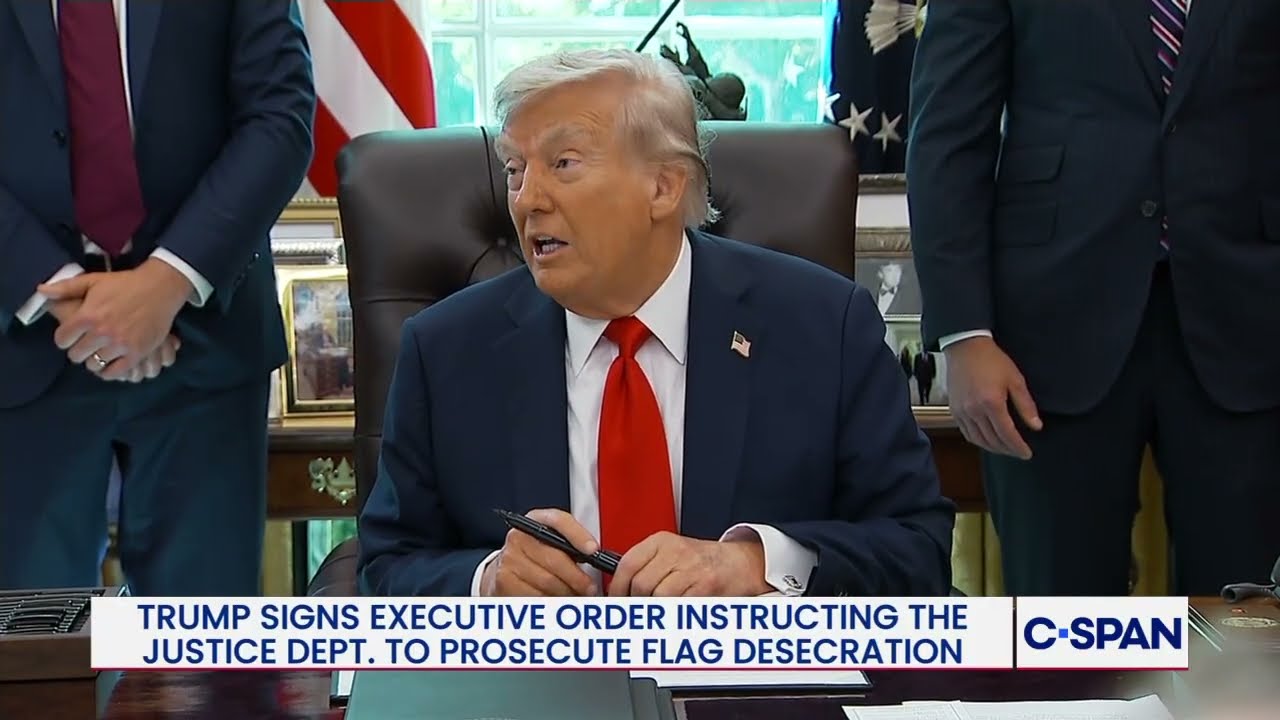 in the Oval Office in the last week in August. Ever the master media manipulator, America’s communicator-in-chief issued this as an executive order. VID]
An executive order is issued by the president and doesn’t need to be passed by Congress. They are, however, expected to relate to existing law. Trump so far has signed 196. His latest directive, which aims to restore “respect, pride and sanctity” to the US flag, instructs the Department of Justice to investigate instances of burning the nation’s insignia under particular circumstances.
While the practice of flag burning as protest has a long history in the US, dating back to the US civil war, it is not a regular occurrence, and has been constitutionally permitted for decades.
The issue is already creating divisions among Republicans. There are three broad categories of GOP reaction. First, the Maga faithful are unlikely to complain. Unconditional support for their leader is a key trait of this group. And the executive order includes language with guaranteed appeal to those for whom terms such as “American patriots” and “foreign nationals” are predictable triggers. The president has long excelled at rallying his supporters on flag-related matters.
Beyond red-meat-for-the-base appeal, both the executive order and GOP support for it get a little more complex. Traditional conservatives, including Senate majority leader Mitch McConnell, are a group that may have strongly negative feelings about flag burning, but their adherence to the first amendment and associated freedom of expression would generally override this.
Those who hold constitutional principles in high regard are increasingly concerned about a president demonstrating his desire for expansive power. And, the US Supreme Court has clearly ruled on more than one occasion that the act, however distasteful, is constitutionally permitted.
Antonin Scalia, the late Supreme Court justice and noted constitutional textualist, famously stated that “if it were up to me, I would put in jail every sandal-wearing, scruffy-bearded weirdo who burns the American flag”. But, he added: “I am not king.” Alongside the more centrist Anthony Kennedy, these justices upheld the right to burn the US flag in the 1989 landmark case of Texas v Johnson, despite Scalia’s personal distaste for the act. In his writings, Scalia differentiated between the form of expression that was flag burning, and an act of insurrection, which, he noted, was “something quite different”. The first amendment, as he understood it, allowed for symbolic political protests, regardless of how offensive such expressions might be to patriotic sensibilities.
Already, analysts have highlighted how the president’s efforts to sidestep the constitution are laden with problems. Executive orders cannot override a Supreme Court ruling. Even Donald Trump should know that.
Getting around current law
What the executive order does attempt to do is to get around the law that allows flag burning. To do so, it focuses on associated crime such as property destruction, open burning violations and disorderly conduct. The attorney general, Pam Bondi, was instructed to pursue cases against those who “incite violence or otherwise violate our laws while desecrating this symbol of our country”. So, when someone is (legally) burning a flag, they may be acting illegally at the same time by, for example, committing a hate crime. And this could trigger prosecution.
 Donald Trump signs an executive order on flag burning.
Furthermore, the executive order nods to a key flashpoint of the current climate by leveraging immigration law, and potentially facilitating the deportation of non-citizens who engage in flag-burning. Beyond the smoke-filled headlines, what this ruling does is circumvent the core ruling of Texas v Johnson by focusing on the circumstances surrounding any flag burning, rather than the act itself. A further aspect will involve the extent to which the courts could expand existing first amendment exceptions. This can only make for nervous constitutional conservatives.
The third group who mostly reside on the Trumpian side of the partisan fence are libertarians such as Republican senator Rand Paul. In a similar vein to their conservative counterparts, their worldview would sit uncomfortably with the president’s foray into testing constitutional principles, and not standing up for more wide-ranging free speech.
Flags and freedom
Libertarians tend to feel strongly about freedom of expression. And when their president picks a fight with the first amendment for no apparent reason beyond a mention he made of it on the campaign trail, he may end up aggravating more supporters than he pleases.
Writing on Reason.com, libertarian journalist Robby Soave argued that Trump is the “last person who should confuse protected speech with incitement to violence”. He added: “Any administration that purports to care about freedom of speech should easily reach the conclusion that criminalizing provocative yet nonviolent acts of political expression is a violation of this principle.”
For a president who deliberately and controversially appointed “Scalia-like” judges during his first term, his latest executive order seems at odds with this vision. Such inconsistency, for what may involve more Justice Department smoke than actual fire, may not serve the president well if many conservatives remain uncomfortable with the move.
To misquote a famous phrase attributed to Voltaire, the US Supreme Court has repeatedly ruled that whatever a majority of the justices think of those who actually want to burn the US flag, they will all but defend to the death your right to burn it.
The waters are further muddied now that a self-described combat veteran has set fire to the flag in response to the executive order. It is unlikely he is a “sandal-wearing weirdo”. Hence, the president’s patriotic script may end up somewhat singed around the edges.
Clodagh Harrington, Lecturer in American Politics, University College Cork
This article is republished from The Conversation under a Creative Commons license. Read the original article.
---
---
an 7 25
A sweeping new report from the Brennan Center for Justice warns that the Trump administration, backed by Republican legislators and allied state actors, is mounting what one civil‑rights coalition calls a “coordinated scheme” to rig voter rolls and control election machinery to stay in power regardless of how the public votes.
In an article for*People's World*published Monday, journalist Mark Gurenberg highlighted the key elements of this strategy that surfaced in an executive order signed March 25 titled “Preserving and Protecting the Integrity of American Elections.”
It mandates documentary proof of U.S. citizenship, such as a passport or naturalization certificate, for any voter registration using the federal form, and bars counting mail‑in ballots if they arrive after Election Day, irrespective of postmark date. States that do not comply risk losing federal election funding and may face enforcement actions by the Department of Justice or other agencies.
:{:{READ MORE:DC insider won't minimize Trump's repugnance:}:
The article highlighted the Brennan Center report's finding that more than 21 million eligible U.S. citizens — many low‑income voters, married women, seniors and people of color — lack ready access to the documentation required. This means that the order and its legislative counterpart in Congress, the proposal known as the SAVE Act, would likely prevent millions from ever registering to vote.
The center's report said: “A president has no right to rewrite the country’s election rules or regulate federal elections on his own."
“As a federal court recently put it, ‘The Constitution vests none of these powers in the president.’ In issuing the order, the president claimed extraordinary unilateral authority to regulate federal elections and usurp the powers of Congress, the states, and the (U.S.) Elections Administration Commission, an independent, bipartisan federal agency," it added.
“It’s a solution in search of a problem,”said one civil‑rights leader in April who testified before the Senate Rules Committee.
READ MORE:'Middle-aged Manson girls': Far-right 'bloodthirsty' MAGA women mocked in scathing take-down
“The SAVE Act is a direct attack on our freedom to vote and a dangerous attempt to silence the voices of millions—particularly voters of color, low income families, women, and young people … It is not about safeguarding elections. It is about stripping power from the people and undermining our democracy," the Leadership Conference on Civil and Human Rights said in a statement in March.
---
---
Donald Trump's executive orders and actions, 2025 - Ballotpedia
As of June 5, 2025, President Donald Trump (R) had signed 157 executive orders, 40 memoranda, and 65 proclamations in his second presidential term, which began on January 20, 2025.
Each type of presidential document is different in authority and implementation. Executive orders are directives the president writes to officials within the executive branch requiring them to take or stop some action related to policy or management. They are numbered, published in the Federal Register, cite the authority by which the president is making the order, and the Office of Management and Budget issues budgetary impact analyses for each order.[1][2]
Presidential memoranda and notices also include instructions directed at executive officials, but they are neither numbered nor have the same publication requirements. The Office of Management and Budget is also not required to issue a budgetary impact statement on the subject of the memoranda or notices.[3][4]
In his 2014 book, By Order of the President: The Use and Abuse of Executive Direct Action, Phillip J. Cooper, a professor of public administration at Portland State University, wrote, "As a practical matter, the memorandum is now being used as the equivalent of an executive order, but without meeting the legal requirements for an executive order."[5]
Proclamations are a third type of executive directive that typically relate to private individuals or ceremonial events, such as holidays and commemorations.[3][6]
HIGHLIGHTS
- Trump has issued 157 executive orders so far during his year in office, which is the highest first-year executive order total since Franklin Delano Roosevelt (D), who issued 568 executive orders in 1933.
- Looking at his second term executive orders by topic, Trump has issued the most executive orders on foreign policy (37).
- Across his first and second terms, Trump has issued a total of 377 executive orders. This is the 11th-most executive orders issued by any president in U.S. history.
This page provides a list of the executive orders, presidential memoranda, notices, and proclamations issued by Trump in reverse chronological order.
Executive orders issued by Trump...
---
cbs
President Trump has set a historic record during the first 100 days of his second term, signing far more executive orders than any other president in U.S. history over the same period.
Mr. Trump has signed 142 executive orders so far, according to data from the American Presidency Project at the University of California, Santa Barbara. The previous record was held by President Franklin D. Roosevelt, who issued 99 executive orders during his first 100 days in 1933, primarily to combat the Great Depression, according to the Roosevelt Institute.
According to the American Presidency Project's data, President Joe Biden did not reach 142 executive orders until September 2024, while President Barack Obama and President George W. Bush required nearly their entire first terms to hit that milestone. Obama reached 142 executive orders in December 2012, and Bush in May 2004. Mr. Trump's use of executive authority over the past 100 days also surpasses the number of executive orders signed by Obama and Bush during their entire second terms. Obama hit 129 executive orders, and Bush 118.
Mr. Trump's 142 executive orders in just 100 days has eclipsed the lifetime totals of 15 early American presidents combined — including George Washington (8), Thomas Jefferson (4) and John Adams (1).
Mr. Trump has defended his heavy reliance on executive actions as necessary to deliver on campaign promises and to move quickly amid ongoing gridlock in Congress.
"With these actions, we will begin the complete restoration of America and the revolution of common sense," the president stated during his inauguration address about his incoming barrage of executive actions.
Many of the executive orders over the last 100 days have triggered controversy and furious counteraction from Democratic groups, federal workers' unions and immigration advocacy groups. Several high-profile directives — including hardline restrictions on immigration, a rollback of key environmental protections and expanded tariffs on foreign goods — have drawn sharp criticism from civil rights groups, environmental advocates and some business leaders. Legal challenges against many of the orders are already underway in federal courts — and growing.
Senior White House officials tell CBS that the record-setting spree highlights Trump's preference for unilateral action as a means of driving policy targets, especially in a polarized Washington where major legislation often faces steep hurdles.
"We're signing executive orders at a pace that no one can keep up with. Expect the same pace in the next 100 days — trade deals, peace deals, and tax cuts," a senior White House official said. "The American public doesn't have the luxury of waiting."
Hogan Gidley, a former senior White House official during Mr. Trump's first term, said the president's executive actions "demonstrate decisive leadership" and a commitment to "fulfilling campaign promises," particularly on key issues like border security, deregulation and energy production.
"It is what the American people demanded, deserved and Donald Trump delivered," Gidley said, referring to his November victory.
However, since his 2024 win over Kamala Harris, Mr. Trump has faced louder backlash from Democrats, who counter that the administration's approach sidelines legislative oversight and relies heavily on expanding executive power.
"Nothing that he's doing is the reason why he got elected. He got elected to lower prices when he's been obsessed with gaining more power at the executive branch and crashing our economy," said Chuck Rocha, a CBS News political contributor and former senior adviser to Sen. Bernie Sanders, a Vermont independent. "People just wanted cheaper gas and groceries."
According to a new CBS News poll, 64% of Americans think Mr. Trump is trying to increase presidential power — including 84% of Democrats.
A majority think he should get his policies enacted by working with Congress to pass legislation rather than through executive orders.
According to the poll, 76% of those surveyed said Mr. Trump should work with Congress to pass laws while 24% said he should use executive orders to change regulations.
---
---
AN 7 25
Atlantic writer Shane Harris reports President Donald Trump has removed dog owner James Clapper, 84, from the graduation ceremony for his bomb-sniffing dog, "Susan."
Clapper, who had sponsored Susan through a nonprofit organization that helps place service dogs, was thrilled when Susan completed a CIA training program designed to save lives. But Clapper, who was the former director of National Intelligence in the Obama administration, could not attend the ceremony.
“The day before the event, in late May, he received an email from the nonprofit dog-training group: Clapper’s name had been scratched from the guest list, per an executive order from the president of the United States,” writes Harris.
READ MORE: This jaw-dropping truth about the Supreme Court will make you furious
Harris said Trump accuses Clapper and other members of the “deep state” of concocting the “Russian hoax” story against him. Plus, Clapper has bemoaned Trump’s lack of class on cable-news appearances over the past five years.
“After Trump returned to the White House, payback for Clapper was swift and personal,” said Harris. “Via executive order, Trump stripped his security clearance along with those of more than four dozen other former intelligence officials.”
The CIA declined to respond to questions, but Harris said CIA officials interpreted Trump’s executive order to mean Clapper should be barred from setting foot on agency property. The agency conveyed that message to the nonprofit, which had invited Clapper to attend the ceremony, according to a nonprofit representative.
“The upshot is that an octogenarian Air Force retiree who spent half a century in his nation’s service was not allowed to attend a party for a dog he essentially donated to the government and named after his dead wife,” said Harris. “… This was not a classified event. Attendees didn’t need a security clearance. There are photos from the ceremony on Facebook, showing happy people proudly posing with happy service dogs. One presumes that graduates were showered with scritches, kisses, and lots of treats, and not given the nuclear codes.”
READ MORE:'People are going to be shocked': Backlash predicted for GOP as disaster looms
This is a story, said Harris, that might seem trivial, but “it illustrates how powerfully this administration seeks retribution.”
Read the full Atlantic report at this link.
---
---
marc e
trumps-latest-executive-order-is-a-sham-and-a-warning
...That was merely a prelude to the executive order he and his team issued the next day. Titled Preserving and Protecting the Integrity of American Elections, it is a rambling document that asserts powers the president simply does not have.
It would disenfranchise millions. It seeks to restrict what ballots states can count. It purports to give DOGE unspecified powers to review state run voter rolls. No wonder vote suppressors and election deniers from coast to coast lavished it with praise.
...
:{:{//april 1}:
The President’s Executive Order on Elections | Brennan Center for Justice
*Update 4/24/25: A federal court has temporarily blocked the U.S. Election Assistance Commission from implementing a mandate in the president’s executive order to add a requirement to show a passport or similar document proving citizenship when registering to vote via the federal form.
President Donald Trump last Tuesday issued an executive order that aims to illegally overhaul and take control of major parts of the nation’s election systems. He claimed extraordinary unilateral authority to regulate federal elections and usurp the powers of Congress, the states, and an independent bipartisan federal agency. This violates the Constitution and various federal laws. If implemented, the order could disenfranchise millions of American citizens, compromise the security of sensitive personal data, and disrupt election administration across the country.
It comes as Congress considers the SAVE Act, an anti-voter bill that would require Americans to show documents like a passport or birth certificate to register to vote. These efforts are based on false claims about voting and elections.
Multiple lawsuits have been filed challenging the legality of this executive order on elections, including a lawsuit by the Brennan Center and other voting rights groups.
What would the executive order on elections do?
The order seeks to force federal agencies and state and local election officials to make an array of changes to election rules and practices nationwide, putting the election system under presidential control.
“Show-your-papers” requirement
The order purports to require citizens to produce a passport or similar document to register to vote. The order’s limited list of acceptable documents would mean that most Americans would have to present a passport to register using the mail registration form. Only about half of Americans hold a passport, putting millions of eligible voters at risk of being blocked from voting. Research shows that younger Americans, Americans of color, and lower-income Americans are less likely to have ready access to documents like passports and birth certificates. And millions of married women who have changed their names may not have citizenship documents that match their current legal name.
It does this by giving illegal instructions to the Election Assistance Commission (EAC), an independent bipartisan agency that supports election administration, to change the federal voter registration form. Not only does the president lack the power to order the commission to do this, but adding such a requirement to the federal form would violate federal law and the Constitution. States that don’t comply would face cuts to federal funding.
Overall, these unnecessary requirements would discourage or outright prevent huge numbers of eligible American citizens from voting. There are multiple systems in place to ensure that only U.S. citizens cast ballots. And it is already illegal under federal and state law for noncitizens to vote. Unsurprisingly, given those systems and the harsh penalties for violating these laws, noncitizen voting is almost nonexistent.
Targeting military and overseas voters
The order also targets Americans living abroad, including military personnel serving overseas. It directs the Department of Defense to add to the voter registration form used by military and overseas voters (the Federal Post Card Application) the show-your-papers requirement, as well as an additional requirement to prove their eligibility in the state where they want to vote. These additional burdens on military and overseas voters are not just impractical and impossible for many to meet, but shameful.
Voting system decertification
The order purports to force the Election Assistance Commission to decertify all machines it previously certified, within 180 days. This would include machines used in 39 states. It says that these systems could be recertified under new federal standards, but there is no voting system currently on the market that meets this standard, leaving states with no feasible way to comply. This could cost states billions of dollars, just in time for the 2026 election. States are already reeling from the administration’s previous decisions to roll back federal support for election security. What’s more, the order seeks to amend the federal guidelines to prohibit the use of certain kinds of features in voting machines that are commonly used in at least 21 states.
Giving Elon Musk’s DOGE access to all voter data
The executive order also purports to grant Elon Musk’s DOGE and the Department of Homeland Security full access to voter files and voter list maintenance records from every state. These files contain sensitive private information about American citizens — data that should not be available to nongovernmental actors and businesses. Giving DOGE free rein to go through the trove of sensitive voter information creates serious privacy risks. DOGE has already shown there is no guarantee that they won’t misuse data.
This move would also open the way to interference with voter rolls and elections. DOGE employees could try to use voter file access to claim fraud and erode public trust in elections. They might also seek to use faulty analyses of these voter files to pressure state officials to aggressively purge voters who are in fact U.S. citizens. Similar threats played out ahead of the 2024 election when vigilante groups used faulty data to challenge the eligibility of tens of thousands of registered Americans and eligible voters. Already, DOGE has shown an alarming level of error in its claims of federal program fraud.
Coercing changes to state mail and absentee ballot deadlines
Continuing the years-long campaign of unfounded attacks on mail voting, the order would penalize any states that count timely cast mail ballots received after Election Day. (It purports to order the Election Assistance Commission to withhold funds.) The president does not have the authority to put conditions on funds appropriated by Congress, let alone those disbursed by the independent bipartisan commission. The order also directs the attorney general to take legal action against states that count timely cast ballots received after Election Day.
Currently, 18 states — including Nevada, Ohio, Texas, and Virginia — count ballots that arrive after Election Day as long as they are postmarked on or before Election Day. The president has no authority to change state election laws or practices.
Coercing cooperation from states
The executive order tries to coerce states to share information with the Department of Justice and cooperate in the department’s efforts to prosecute election crimes. Specifically, the order asks the attorney general to withhold grants and funds, including funds used for police and other law enforcement purposes, from states that do not comply with this presidential directive. However, states are not entitled to share and the Justice Department is not entitled to obtain some of the information contemplated by the order, such as confidential information about voters or ongoing state investigations. Additionally, several courts have held that the president can’t impose conditions on the disbursement of congressionally appropriated funds for law enforcement.
Is the executive order legal?
No, the order is a clear violation of federal law and the Constitution. The president does not have the power to unilaterally rewrite election laws. Only states and Congress may set the rules for federal elections. The U.S. Constitution’s Elections Clause says that the rules for running federal elections “shall be prescribed in each State by the Legislature thereof” except that “Congress may at any time by Law make or alter such Regulations.” The president has no role in this constitutional scheme (beyond signing or vetoing federal legislation). On those grounds alone, the order is almost certainly doomed to fail in court.
Beyond that, the order contains several overreaches of presidential power. For one, the president has no authority over the Election Assistance Commission, an independent bipartisan agency created by Congress. He can’t force it to alter federal voter registration forms, change how it certifies voting systems, or take any other action outlined in the order.
Even if the agency acted on its own, it would still be legally barred from adding a requirement that American citizens provide a passport or other citizenship document to register to vote. A show-your-papers requirement would violate federal statutory and constitutional law: The National Voter Registration Act limits what can be asked on the federal voter registration form to preclude citizenship documents, and the Constitution prohibits undue burdens on Americans’ right to vote.
Additionally, the president can’t direct any federal agency to withhold funds allocated by Congress from states that don’t follow his orders. The Constitution states that only Congress has the power of the purse. Moreover, the president has no authority to direct the decisions of the independent bipartisan Election Assistance Commission. Further, granting DOGE access to voter file data would run afoul of state and federal laws protecting private information.
In all, the order is riddled with illegalities that make it unenforceable.
Is this executive order the same as the SAVE Act?
There is significant overlap between the executive order’s directive to add a proof-of-citizenship requirement to the federal voter registration form and the SAVE Act, a bill pending before Congress that would require Americans to present documents like a passport or birth certificate to register or re-register to vote. If passed, the SAVE Act could block 21 million American citizens who lack ready access to these documents from registering.
...
---
maddow
Even now, Trump still can’t defend his order targeting Krebs, who dared to tell the truth
The president has had three weeks to come up with a defense for targeting Chris Krebs. Trump apparently can’t think of anything.

April 29, 2025,
By Steve Benen
It’s probably fair to say that Christopher Krebs is not a household name, but inside the White House, he’s immediately recognized. Krebs led the Cybersecurity and Infrastructure Security Agency (CISA) during Donald Trump’s first term, which meant he was responsible for combatting foreign interference in our elections and preventing attacks.
Krebs earned bipartisan praise for his work, and after the 2020 election cycle, The Washington Post’s David Ignatius noted, “When the history books about this election are written, Krebs will be one of the heroes.”
The day Ignatius’ column was published, Trump fired Krebs — not because he’d done anything wrong but because the president wanted him to go along with his lies about the election results. When Krebs instead told the truth, he was shown the door.
Four and a half years later, Trump issued an order that not only described Krebs as a “significant bad-faith actor who weaponized and abused his Government authority” — a baseless claim the president made while abusing his government authority — it also directed Attorney General Pam Bondi and the Department of Homeland Security to investigate Krebs’ work and activities.
Even by 2025 standards, it was an outrageous abuse, which the White House has struggled to defend.
Three weeks after the president signed a first-of-its-kind executive order targeting a former official for defying him, Time magazine asked Trump a good question: “You recently signed memos calling for an investigation of Chris Krebs, a top cybersecurity official in your first term. Isn’t that, though, what you accused [Joe Biden] of doing to you?” The president responded:
I think Chris Krebs was a disgrace to our country. I think he was — I think he was terrible. By the way, I don’t know him. I’m not — I don’t think I ever met him. ... I know very little about Chris Krebs, but I think he was very deficient.
Right off the bat, there’s the obvious problem that Trump thinks the former cybersecurity leader — who, again, did literally nothing wrong during his work in Trump’s own administration — is “a disgrace,” despite the inconvenient detail that the president knows “very little” about him.
But just as notable was the degree to which the president ignored the underlying question that Time magazine was right to ask: For all of Trump’s hysterical conspiracy theories about the Biden administration “weaponizing” federal law enforcement, it was Trump who signed an executive order that directed the Justice Department to go after one of his perceived political foes.
Asked to defend his own tactics, the Republican said his perceived enemy was “a disgrace to our country.” By that reasoning, can any president sic the DOJ after those they hold in contempt? Wouldn’t that necessarily create the kind of conditions that Trump and his party have claimed to be against?
As for Krebs himself, the former official has said very little about the president’s executive order, though he has spoken out against the administration’s policy agenda in his area of expertise.
As NBC News reported, Krebs received a warm welcome from industry professionals at the RSA Conference in San Francisco, a cybersecurity conference, where he criticized the second Trump administration for its repeated cuts to cybersecurity employees, contractors and programs.
“Cybersecurity is national security. We all know that, right? That’s why we’re here. That’s why we get up every morning and do our jobs. We are protecting everyone out there. And right now, to see what’s happening to the cybersecurity community inside the federal government, we should be outraged. Absolutely outraged.”
---
6 25 big tbls 157 count
List of executive orders in the second presidency of Donald Trump - Wikipedia
See also
- Executive order
- List of executive actions by Barack Obama
- List of executive actions by Joe Biden
- List of executive orders in the first presidency of Donald Trump
- List of bills in the 119th United States Congress
- List of acts of the 119th United States Congress
- First 100 days of Donald Trump's second presidency
---
yahoo no lnx
Oh Lord... Here's Trump's Scariest Executive Orders yet, and They're Worst Than You Can Imagine
Phenix S Halley
:{:{Sat, April 19, 2025}:
Yahoo is using AI to generate takeaways from this article. This means the info may not always match what's in the article. Reporting mistakes helps us improve the experience.
Generate Key Takeaways
With President Donald J. Trump back in the White House, he got straight to business cranking out 26 executive orders, 12 memoranda, and 4 proclamations on his first day. We’re now over 70 days in his second term, and Trump has quadrupled that amount to 103 orders... sheesh.
Many of them, like Trump’s pardoning of all Capitol rioters’ crimes, sent major alerts around the country, but there are others that Americans haven’t been paying attention to... and they should be. Here’s everything you need to know about the most outrageous orders and proclamations signed by the 47th president of the United States so far.
Targeting the Smithsonian
In an executive order, Trump said the (MAAHC) located in Washington D.C. is “under the influence of a divisive, race-centered ideology.” Because of this, Trump wants to end funding to the African American Museum as well as other Smithsonian museums honoring the expansive history of the nation. This means the fate of Black history and culture is up in the air. When you target the Smithsonian, a global organization operating in a public-private partnership, you can expect immediate backlash. So far, several politicians, historians, and activists have denounced the administration’s attempt to regulate the Smithsonian.
Rolling Back Segregation Protections
:
Talks of Jim Crow and segregation’s return has the country buzzing with disbelief after President Donald Trump’s administration repealed a crucial “segregation clause” in a February memo. And while many are scared for the future of the nation, others are urging Black folks not to take Trump’s bait. As The Root previously reported, the memo doesn’t explicitly make segregation legal at the federal, but it sure as hell doesn’t make it illegal.
Rescinding Biden’s Executive Orders
:
Not only did Trump sign his own orders, but he most shockingly canceled out a whopping 78 executive orders signed by former President Joe Biden’s administration. The majority of these orders, according to the White House, attack DEI, climate change and green energy, and COVID-19 assistance.
Renaming the Gulf of Mexico
Right before Trump returned to office, he promised to rename the Gulf of Mexico to the Gulf of America. In an executive order, he did just that! According to the White House, “It is in the national interest to promote the extraordinary heritage of our Nation and ensure future generations of American citizens celebrate the legacy of our American heroes.”
Not only that, but Trump also is renaming the tallest mountain in the country, Denali, back to its original name honoring former President McKinley.
Terminating DEI
We all knew this one was coming... Trump signed an order to end diversity, equity, inclusion (DEI) programs in federal departments and agencies. His order also details plans to compile a list targeting all federal contractors and grantees with DEI programs, according to the White House.
Freeze on Hiring Civilians
In an executive order, the president put a pause on hiring federal civilian employees. This means, if you’re waiting to hear back about a government job... you’ll be waiting for awhile. According to the White House, the freeze began on Jan. 20, 2025 and is expected to continue for at least 90 days.
Recognizing Only Two Genders
Trump has officially directed all federal agencies to only recognize two genders, male and female, which are not changeable. According to the White House, this executive order will be reflected on government documents like passports, visas, Global Entry cards, and federal personnel records. This also rescinded Biden’s transgender rights efforts.
Withdrawing From WHO
During the pandemic, Trump expressed his repeated frustration with the World Health Organization (WHO) and disappointment with their handling of COVID-19. Now, according to the White House, Trump is back with a vengeance and wants to completely withdraw the country from WHO.
The order won’t take affect for a full year, according to NPR, but in response to Trump, Lawrence Gostin, a professor of global health law at Georgetown University and director of WHO’s Center on Global Health Law, said “This is the most cataclysmic decision.” He continued saying “[This is] a grave wound to American national interests and our national security.”
Calling for the End of Birthright Citizenship
In a proclamation announced yesterday, Trump is calling for the federal government to not grant U.S. citizenship for people born in the U.S. but have parents who aren’t citizens or permanent residents— also known as birthright citizenship. According to the White House, the proclamation will take effect 30 days from Jan. 20, 2025, for individuals born on or after that date. Critics of Trump’s order say it directly contradicts the Constitution, which protects birthright citizenship.
Pardoning Capitol Insurrectionists
}:
Trump celebrated his second term doing exactly what he promised he would do. Among a series of executive orders signed by the president, Trump most notably either pardoned, commuted the prison sentences, or vowed to dismiss the cases of all roughly 1,500 people charged with crimes connected to the infamous Jan. 6 Capitol insurrection, according to the White House.
Enacting Mass Deportations
}:
It seems the president is making good of yet another one of his controversial campaign promises to perform mass deportations of undocumented immigrants across the nation. According to his executive order, Trump has enlisted “all available resources and authorities” to help detain unlawful immigrants and further secure the Mexico-U.S. border.
Stricter Laws for Asylum Seekers
:
...And on the topic of immigration, Trump also ordered the halt of entry by migrant asylum seekers who don’t provide sufficient medical information. Additionally, Trump’s order requires asylum seekers to provide reliable criminal histories and background information to enter the country.
Restoring the Death Penalty
Trump signed an execution order directing the attorney general to “take all necessary and lawful action” to make sure states have enough lethal injection drugs to carry out executions, according to the White House. This comes just weeks after Biden commuted 37 of the 40 total federal death row inmates’ sentences to life in prison. Trump cited Biden’s executive order, calling the former president’s actions “a mockery of justice and [an] insult the victims of these horrible crimes.”
Denying Funding to Sanctuary Cities
In addition to enacting mass deportations, another executive order completely revokes Biden immigration orders on asylum processing and family reunification. According to the White House, Trump also plans to construct new detention facilities and even suggests denying federal funding to sanctuary cities.
---
nrdc
two weeks in, the Trump administration has launched the worst White House assault in history on the environment and public health, an all-of-government assault with potentially devastating results for our communities, our economy, and our future.
If successful, it will also raise costs and limit choices for consumers and businesses. Far from putting America first, the administration is putting oil and gas profits first—and putting the rest of the country at risk. A few examples:
- Halting the development of wind energy means higher electricity bills and a less reliable power grid.
- Pulling the United States out of the Paris climate agreement leaves other countries to write the rules for the clean energy economy of the future.
- Making electric vehicles more costly to buy and build limits consumer choice and puts domestic workers and carmakers at a competitive disadvantage against their Chinese and European rivals.
- Locking in ever more LNG exports decades into the future will force consumers and businesses in this country to compete in the global marketplace for domestic gas, meaning higher prices for gas, more drilling, or both.
Nobody voted for this, but somebody else asked for it: the billionaire oil and gas donors Trump solicited to help bankroll his campaign. That’s what this is all about.
Hours after taking office, Trump falsely declared an energy emergency as a means to assert extraordinary presidential powers and to justify a wave of executive orders. Taken together, they constitute a grave and singular threat to public health, the economy, wild places, and our ability to confront the climate crisis.
These orders come against the backdrop of staggering disarray within an administration that arbitrarily froze trillions of dollarsin federal spending last week, before rescinding the freeze the next day after a federal court blocked the freeze pending a review today. It’s still not clear whether or how these congressionally mandated grants and loans will move forward. The confusion is hurting people and doing real damage on the ground.
There is, of course, no energy emergency. The United States is producing more oiland natural gas than at any time in the history of this country—or in the history of any other country, for that matter. Homegrown wind and solar power is also at record levels—and helping the electricity grid survive the frigid cold.
Trump is trying to deceive the public to justify a full-on blitz to gut essential safeguards; claw back successful initiatives that are already driving investment and creating jobs; fast-track destructive projects; derail efforts to advance equity and justice; and hobble the government’s ability to serve the people of this country.
Trump lacks the authority to carry out this expansive and destructive agenda in its entirety on his own. Some of what Trump has ordered depends on the actions of Congress, private industry, local stakeholders, or all three. Some of these orders will be challenged in court.
If the administration’s actions prevail, though, even in some significant part, the result would be more pollution in the air we breathe, the water we drink, and the food we eat. More emergency room visits, lost days at work, and premature death. More hazard and harm for our communities. More habitat destroyed and wildlife gone. More unchecked climate disaster, with rising costs and mounting dangers across every corner of the country.
Nobody voted for that—and it’s not what most of the country wants.
Below is a sampling of the potential impact some of Trump’s major actions could have on the nation. To learn more, please contact Mark Drajem to be put in touch with an NRDC expert.
- Sidelining U.S. climate leadership
- Striking out at equity and justice
- Halting new wind projects
- Limiting consumer choice in cars
- Exposing oceans to drilling
- Destroying Alaska's wilderness
- Locking in LNG exports
Sidelining U.S. climate leadership
In a Day 1 executive order, President Trump withdrew U.S. participation in the landmark 2015 Paris climate agreement, the framework for global cooperation on confronting the existential challenge of our time. The move is part of the “whole-of-government unwinding” of climate progress and clean energy gains explicitly called for in Project 2025 and further outlined in the wish list handed to Trump by the billionaire oil and gas donors who helped bankroll his campaign.
Trump’s action won’t stop the global shift away from the fossil fuels that are driving the climate crisis. It won’t stop investments—a record $2.1 trillion last year alone—in cleaner ways to power our future. It could well slow the pace of that shift, however, just when we need to speed it up.
Last year eclipsed 2023 as the hottest year in the 175-year global record, and we’re seeing the results in every community in the country.
This is an order to abandon ship, cut U.S. climate leadership adrift, and toss our children overboard into rising seas.
It’s created uncertainty that threatens global climate momentum. It sidelines American diplomacy at a critical moment, when the possibility of averting climate catastrophe hangs in the balance. It takes the United States out of the room where the rules are made to shape the global clean energy economy, drive innovation, and create more resilient societies. It leaves others to fill the void.
“Many leaders from around the world already noted that they will move on with the Paris Agreement. The U.S. administration’s climate dissonance comes at its own cost.”
—Yamide Dagnet, senior vice president, International, and Dr. Adelle Thomas, senior director, climate adaptation, Environmental Health
---
---
---
fox local BS no lnx pix
Trump executive order blasts Biden's 'anti-Christian government'
By Heather MillerPublished February 6, 2025 6:21pm ESTDonald J. TrumpFOX TV Stations
President Trump speaks on 'religious freedoms'
President Donald Trump participated in the National Prayer Breakfast at the Capitol on Thursday, joining a more than 70-year-old Washington tradition that brings together a bipartisan group of lawmakers for fellowship. Trump will also speak at a separate prayer breakfast at a Washington hotel sponsored by a private group.
The Brief
President Trump’s executive order directs Attorney General Pam Bondi to investigate the "targeting" of Christians.
Critics say the order "misuses religious freedom to justify bigotry, discrimination, and the subversion of our civil rights."
President Donald Trump issued an executive order Thursday to create a task force on "eradicating anti-Christian bias," while also accusing the Biden administration of "persecution" for prosecuting anti-abortion advocates.
Speaking at a pair of events in Washington surrounding the National Prayer Breakfast, Trump said the task force would be directed to "immediately halt all forms of anti-Christian targeting and discrimination within the federal government, including at the DOJ, which was absolutely terrible, the IRS, the FBI — terrible — and other agencies."
What does Trump’s anti-Christian bias order say?
President Trump remarks at National Prayer Breakfast
President Trump remarks at National Prayer Breakfast
President Donald Trump participated in the National Prayer Breakfast at the Capitol on Thursday, joining a more than 70-year-old Washington tradition that brings together a bipartisan group of lawmakers for fellowship. Trump will also speak at a separate prayer breakfast at a Washington hotel sponsored by a private group.
What they're saying:
Trump’s executive order directs Attorney General Pam Bondi to investigate the "targeting" of Christians.
"The previous Administration engaged in an egregious pattern of targeting peaceful Christians, while ignoring violent, anti-Christian offenses," the order states. "The Biden Department of Justice sought to squelch faith in the public square by bringing Federal criminal charges and obtaining in numerous cases multi-year prison sentences against nearly two dozen peaceful pro-life Christians for praying and demonstrating outside abortion facilities."
RELATED: Second judge pauses Trump’s birthright citizenship order
An hour after calling for "unity" at the Prayer Breakfast on Capitol Hill, Trump announced that, in addition to the task force, he was forming a commission on religious liberty, criticizing the Biden administration for its "anti-Christian government."
Trump said Bondi would also work to "fully prosecute anti-Christian violence and vandalism in our society and to move heaven and earth to defend the rights of Christians and religious believers nationwide."
Kelly Shackelford, head of First Liberty Institute, a conservative Christian legal organization, praised Trump’s announcements.
"All Americans should be free to exercise their faith without government intrusion in school, in the military, in the workplace, and in the public square. We are ready to stand with President Trump to ensure that the religious liberty of every American is safe and secure," Shackelford said in a statement.
What do critics say?
US President Donald Trump speaks during the National Prayer Breakfast at the US Capitol in Washington, DC, US, on Thursday, Feb. 6, 2025. Photographer: Aaron Schwartz/Sipa/Bloomberg via Getty Images
The other side:
Trump’s announcement sparked immediate criticism from activists and even church leaders.
"Rather than protecting religious beliefs, this task force will misuse religious freedom to justify bigotry, discrimination, and the subversion of our civil rights laws," Americans United for Separation of Church and State CEO Rachel Laser said.
The Rev. Paul Brandeis Raushenbush, a Baptist minister and head of the progressive Interfaith Alliance, accused Trump of hypocrisy in claiming to champion religion by creating the task force.
"From allowing immigration raids in churches, to targeting faith-based charities, to suppressing religious diversity, the Trump Administration’s aggressive government overreach is infringing on religious freedom in a way we haven’t seen for generations," Raushenbush said in a statement.
What does Trump say about his own faith in God?
Dig deeper:
Trump, who's a nondenominational Christian, called religious liberty "part of the bedrock of American life" and called for protecting it with "absolute devotion."
Trump reflected on having a bullet coming within a hair’s breadth of killing him at a rally in Butler, Pennsylvania, last year, telling lawmakers and attendees, "It changed something in me, I feel."
"I feel even stronger," he continued. "I believed in God, but I feel, I feel much more strongly about it. Something happened … it was God that saved me."
RELATED: Bishop Mariann Edgar Budde asks Trump to ‘have mercy’ on LGBTQ+, immigrant families
But Trump and his administration have already clashed with religious leaders, including him disagreeing with the Rev. Mariann Budde’s sermon the day after his inauguration, when she called for mercy for members of the LGBTQ+ community and migrants who are in the country illegally.
The Source: This report includes information from the Associated Press.
---
OMFG
AN 525
On April 9, 2025, U.S. President Donald Trump signed Executive Order 14270, blandly titled “Zero-Based Regulatory Budgeting to Unleash American Energy.” Behind that bureaucratic name is a sweeping directive: Dismantle a century of environmental protections.
Every regulation related to the environment, natural resources, or energy, whether it safeguards air, water, species, or public lands, must be rewritten to serve polluters or vanish by default.
Some will claim this is just about efficiency. But no standard review process sets a mass expiration date for protections, regardless of science, impact, or legal mandate. This is not streamlining. It is a countdown to erasure.
While courts deliberate, rules will expire. Enforcement will be suspended. Polluters will act as if the rules are already gone.
The deadline is September 30, 2026. Any rule not revised and reauthorized by then will expire automatically.
What will remain will not be protection. It will not be science. It will not be law. It will be a hollow shell, stripped of enforcement and public purpose.
This is not reform. It is demolition. It is sabotage by executive order.
They Said It Couldn’t Happen
To everyone who said, “They’d never go that far,” they just did. And the collapse has already begun.
With Executive Order 14270, Donald Trump issued not a policy revision but a regulatory kill order.
The EO mandates that all regulations under energy-related authority—especially those administered by agencies like the Environmental Protection Agency (EPA) and the Departments of Interior and Energy—must be reviewed and either revised to align with the administration’s priorities or be automatically terminated by September 30, 2026. While for some agencies the EO does not name specific laws, many foundational protections fall within these agencies’ regulatory domains.
Some may argue this is simply a regulatory reset or a call for modernization. But this is not a review guided by science, need, or public interest. It is a mandate that requires rules to serve industry or disappear by default. There is no neutral path. There is no room for delay. If an agency fails to revise and reauthorize a rule in time, it expires. No matter how vital it is.
Legal experts and environmental attorneys have described similar regulatory strategies by the previous Trump administration as calculated attempts to dismantle environmental protections from within.
Even the rules that survive review will be rewritten, stripped of science and purpose, then repackaged as hollow compliance.
This is not a bureaucratic obstacle. It is a regulatory kill switch.
What that means in practice:
- Endangered Species Act—gone.
- Migratory Bird Treaty Act—gone.
- Marine Mammal Protection Act—gone.
- Anadromous Fish Conservation Act—under threat.
- Bald and Golden Eagle Protection Act—gone.
These aren’t just under review. They are all under attack.
Breadth and Scope of the Loss
The laws everyone recognizes, such as the Clean Air Act, the Clean Water Act, and the Endangered Species Act, are just the beginning.
Beneath them lie hundreds of foundational rules that safeguard public health, climate resilience, environmental justice, and disaster readiness. Under Executive Order 14270, they are all at risk.
Supporters may claim the order only targets outdated or burdensome regulations. But the text applies broadly and indiscriminately. It sets no exceptions for essential rules, no protections for high-impact safeguards, and no criteria for public benefit. Unless these rules are rewritten to meet the new standards and reauthorized by September 30, 2026, they will expire. Along with them goes the regulatory backbone of modern environmental protection.
This is not theoretical. These laws will fall unless actively rescued.
Key protections on the chopping block:
Air, Water, and Public Health
• Clean Air Act
• Clean Water Act
• Safe Drinking Water Act
• Toxic Substances Control Act
• Superfund cleanup authority
• Mercury and Air Toxics Standards
Land and Resource Protection
• Resource Conservation and Recovery Act
• Surface Mining Control and Reclamation Act
• Wilderness Act
• Antiquities Act
• Wild and Scenic Rivers Act
• Federal Land Policy and Management Act
Energy and Climate
• Energy Policy Act of 2005
• Greenhouse gas endangerment finding
• Energy Star Program
• Oil Pollution Act of 1990
Each of these took years, sometimes decades, of organizing, science, and compromise to create. They were not handed down by elites. They were won by people who refused to accept poisoned air, burning rivers, and dead coastlines.
Now they are being erased in a single executive order. Not one by one. All at once. This is not a rollback. It is erasure.
The Hidden Collapse
Executive Order 14270 does not just target major environmental laws. It dismantles the infrastructure that makes those laws real.
Supporters may argue that the laws remain untouched. But behind every statute, like the Clean Water Act or Endangered Species Act, are thousands of rules, monitoring systems, enforcement protocols, and technical standards. Without them, laws are just words on paper.
Now, all of that must be rewritten to serve polluters. If not, it disappears permanently.
Thousands of environmental regulations administered by agencies such as the EPA and the Department of the Interior could be subject to review and potential termination under Executive Order 14270.
Here is what that collapse looks like:
Public Health Protections
• Air monitoring rules vanish. No alerts for lead, benzene, or ozone.
• Radiation limits are lifted. Safety near nuclear sites erodes.
• Vehicle emissions testing ends. Smog returns to U.S. cities.
Water, Waste, and Pollution
• Stormwater runoff restrictions disappear. Waste floods rivers.
• Hazardous waste transport rules vanish. Disposal turns chaotic.
• Drilling oversight ends. Protected lands are opened to industry.
Climate and Disaster Response
• Energy efficiency rules are revoked. Electric bills rise.
• Fire mitigation programs are defunded. Wildfires grow deadlier.
• Fisheries protections vanish. Coastal economies are destabilized.
This is not just about forests or fish. It is about tap water, asthma medication, grocery prices, and cancer risks.
Betsy Southerland, former EPA director of science and technology for water, has warned that deregulatory approaches of this kind could lead to systemic breakdowns in public health protections.
This order does not trim fat. It guts the public architecture that keeps America safe, functional, and future-ready.
The Economic and Societal Cost
The damage from Executive Order 14270 will not stop with wildlife or wilderness. It will hammer the economy; threaten public health; and unravel industries that depend on clean air, safe water, and protected landscapes.
Some defenders will argue that environmental regulations stifle business, raise costs, or limit innovation. But environmental law in America was not born from ideology. It was forged in crisis, created to prevent economic collapse, mass illness, and ecological ruin. Many of these statutes were passed with overwhelming bipartisan support because Americans knew the cost of doing nothing was greater.
The Clean Air Act passed under former President Richard Nixon. The 1972 Clean Water Act was called “the most comprehensive and expensive environmental legislation in the nation’s history.” These laws did not just protect nature. They helped build the modern economy.
Many of the protections now targeted form the backbone of multibillion-dollar industries:
Wildlife and National Identity
• The Endangered Species Act saved the bald eagle, peregrine falcon, and California condor.
• The Migratory Bird Treaty Act protects ecosystems and supports rural economies across the country.
• The Marine Mammal Protection Act helped build a coastal tourism sector that generates billions.
• Fish conservation laws sustain sport fishing, a major driver in many regional economies.
Outdoor Economies
• Outdoor recreation supports $887 billion in consumer spending and 7.6 million jobs.
• Hiking, hunting, wildlife viewing, and camping all depend on healthy ecosystems.
• Without habitat protections, what is Yellowstone without wolves, or the coast without whales?
The law may speak of species and land. But the stakes are money, jobs, health, and identity.
This executive order guts the systems that protect them all.
The Human Toll and Environmental Injustice
The collapse will not hit everyone equally. It never does.
When environmental protections vanish, the first to suffer are the poor, the marginalized, and the politically powerless.
Some may argue that environmental burdens are shared evenly across society. But the data and history say otherwise. Environmental harm follows lines of poverty, race, and neglect. It hits those with the fewest resources, the least political power, and the highest exposure to toxins.
Without the Clean Water Act and Safe Drinking Water Act, vulnerable communities will lose safeguards against dumping, runoff, and lead contamination. New water crises will erupt in towns already on the edge.
Without the Clean Air Act, toxic smog will return to cities, especially in low-income and minority neighborhoods shaped by redlining and industrial zoning.
Without the National Environmental Policy Act, communities will have no voice in what gets built near their homes: pipelines, refineries, highways, landfills.
Without Superfund enforcement, the most toxic sites in America will be left to rot. Poison will seep into soil, water, and lives.
This is not theory. It is already happening:
- In Louisiana’s Cancer Alley, petrochemical plants poison Black neighborhoods. Cancer rates there are 50 times the national average.
• In West Virginia, abandoned coal towns face toxic water and respiratory illness.
• In Alaska and the Southwest, Indigenous communities still live beside Cold War-era uranium waste.
• Along the Pacific coast, salmon vanish and fishing economies unravel.
These are not isolated stories. They are previews.
The burden will fall hardest on those without lawyers, lobbyists, or local health departments—families already excluded from public hearings, ignored by regulators, and left behind by politics.
Executive Order 14270 turns temporary harm into permanent abandonment.
This is not just inequality. It is environmental apartheid..
Regulatory Collapse Is Guaranteed
This is not hypothetical. It is structural failure, built into the design.
Executive Order 14270 sets an impossible mandate: Every environmental regulation must be reviewed, revised, and reauthorized by September 30, 2026. If not, it will expire automatically.
Some will claim that with enough willpower and coordination, agencies can meet the deadline. But that is a myth. There are not enough staff. There is not enough time. And there is no intention to make it work. The order was built to break the system, not to improve it.
Environmental watchdogs and legal analysts suggest that only a small percentage of rules could realistically be reviewed and reissued before the deadline.
This is not deregulation. It is planned demolition.
Here is what that guarantees:
- Legal protections for ecosystems will collapse.
• Clean air and water rules will disappear.
• Ecotourism and outdoor recreation will suffer.
• Climate policy will be paralyzed.
• Inequality will worsen as states scramble to fill the void.
• Courts will be overwhelmed by lawsuits and confusion.
• Irreversible environmental damage will be locked in for generations.
Even if a future administration tries to reverse the damage, it could take years or even decades to rebuild what was destroyed.
Some things will not survive that long: species, coastlines, forests, ecosystems.
This is not a policy failure. It is policy used as a weapon.
The extinction of environmental protections is not a side effect. It is the goal.
Can This EO Actually Be Enforced?
Technically, yes. Executive Order 14270 can be enforced. But legally and practically, it is a minefield for all concerned.
Agencies can initiate rule reviews and assign expiration dates, especially when leadership supports the administration’s anti-regulatory agenda. But that does not make it lawful.
Under the Administrative Procedure Act, agencies must follow strict procedures before repealing or replacing rules. They must issue public notices, allow comment periods, hold hearings, and provide justifications. They cannot simply say, “The president told us to.”
Some defenders may argue the president has broad authority to manage agencies. But the law is clear: Regulatory repeal must follow legal process. Many of the protections targeted by this order were enacted by Congress. Agencies do not have the authority to let them quietly expire or gut them without breaking the law.
That is why lawsuits are already being filed. Legal challenges will come from environmental groups, state attorneys general, and public interest organizations.
But here is the catch: the damage will not wait.
While courts deliberate, rules will expire. Enforcement will be suspended. Polluters will act as if the rules are already gone.
Even if a judge rules against the administration, the harm will be done:
- Toxic waste released.
• Forests cleared.
• Communities exposed.
And if the White House refuses to comply? There is no enforcement arm of the Administrative Procedure Act. No agency exists to compel federal departments to enforce their own rules.
The only option is to sue, repeatedly, rule by rule, across jurisdictions.
As one Earthjustice attorney put it, “The law doesn’t enforce itself. And this administration knows it.”
Litigation takes money, time, expertise, and legal standing. These are resources many frontline communities do not have.
Environmental lawyers and watchdogs saw this coming. They are already planning for fights across dozens of fronts: air quality, pipelines, species protection, data suppression, and executive action.
But how many lawsuits will it take? 10? 50? 100?
Each one will be slow. Expensive. Uncertain.
This is not incompetence. It is sabotage, carried out with full intent.
And What About the Planet
This executive order is not just a domestic disaster.It is a climate change nuclear bomb.
Executive Order 14270 erases the foundation of nearly every federal climate policy:
- It nullifies the greenhouse gas endangerment finding, the legal trigger for regulating carbon emissions.
• It dismantles efficiency standards for appliances, buildings, and vehicles.
• It undermines the Energy Star Program and other clean energy incentives.
• It guts methane rules, fuel economy standards, and oil spill safeguards.
Some will argue that climate progress can continue without federal policy, through state action or private innovation. But without national coordination, incentives, and legal authority, that progress will slow, fragmented, and ultimately fall short. Federal policy drives investment, enforces accountability, and sets the global tone.
With these tools gone, the United States cannot meet its climate goals. Not nationally. Not globally.
We will miss our Paris agreement targets. We will exceed the 1.5°C warming threshold. And we will pull other nations backward with us.
The damage is not just about emissions. It is about lost leadership. Lost credibility. And a green light to polluters everywhere.
This is not a pause. It is a reversal.
Climate collapse is no longer a distant danger. It is a scheduled event, signed into law by the president.
The Heart of It
This executive order does not repeal environmental laws. It kills the systems that make those laws work.
The Clean Air Act will still exist. But if EPA regulations expire, there will be no enforcement.
The Endangered Species Act will remain on paper. But without specific protections and triggers, no species will be protected.
This is the method: Dismantle implementation. Remove enforcement. Let the law collapse from the inside out.
It is a bureaucratic kill switch, designed to erase a century of environmental progress without ever repealing a statute.
Legal on paper. Lethal in practice.
Once the rules disappear, the laws become theater:
- No enforcement.
• No funding.
• No consequences.
They will still be on the books, but they will no longer matter.
Empty laws. Empty air. Empty rivers. Empty promises.
How We Fight, and Why We Must
There is no silver-bullet lawsuit. No single agency. No shortcut.
This executive order will not be stopped by one clever court challenge. It will take dozens, perhaps hundreds, of battles—rule by rule, agency by agency, ecosystem by ecosystem.
Some will ask, why not file one big lawsuit to stop it all? Because Executive Order 14270 does not repeal a single law. It sets a countdown clock for thousands of regulations to vanish unless reauthorized. That makes it nearly lawsuit-proof by design. Each rule must be challenged individually, and only after harm has occurred. Courts cannot force agencies to act unless Congress explicitly mandates it. And even then, litigation takes time. By the time a ruling arrives, the damage may already be done. The law does not enforce itself. And this executive order exploits that fact.
There is no cavalry. Only us.
So we fight, everywhere:
- File lawsuits, fast and often: Legal action is the first and last line of defense. Every expired rule must be challenged. Every unlawful revision must be contested. Rapid-response legal teams must be ready to sue the EPA, Department of the Interior, and Department of Energy across multiple jurisdictions. Delay means destruction.
- Support legal and watchdog organizations: Groups like Earthjustice, Natural Resources Defense Council, and the Center for Biological Diversity are already fighting. But they are underfunded and overwhelmed. They need staff, experts, and resources. Every donation matters. Every volunteer strengthens the line.
- Pressure elected officials at every level: Demand public hearings. Demand oversight. Call your governor. Write your city council. Make it politically toxic to support this executive order.
- Act locally: States and cities can pass their own clean air and water laws. They can fund conservation, restrict drilling, and sue federal agencies. Join local groups. Attend zoning meetings. Run for water boards and planning commissions. Build resistance into local government.
- Refuse to normalize this: Speak out. Disrupt. Document. This is not politics as usual. Say so. Organize protests. Submit op-eds. Flood comment periods. Call out silence. Expose polluters. Make the truth visible.
- Demand media coverage: Executive Order 14270 should be a daily headline. If it is not, make it one. Share stories. Elevate frontline voices. Hold media outlets accountable. If national media fails, local and independent voices must rise.
This is a regulatory blitz.And resistance must be relentless.
The strategy is simple: flood the system, fracture it, and exhaust the opposition.
While we scramble to save species, lands, and laws, they bulldoze everything else.
This is not a warning. It is a dispatch from the front lines.
They are not debating whether to dismantle environmental protections. They are dismantling them, right now.
If you ever said, “They would never go that far,” They just did.
This is not just bad policy. It is a deliberate attempt to cripple the government’s ability to protect the air we breathe, the water we drink, the climate we depend on, and the living world we love.
It is not a mistake. It is the plan.
The question is no longer what they will do. The question is what we will do about it.
---
---
ICN 6 25
A group of 22 young people from across the country accuse the Trump administration in a new federal lawsuit of violating their constitutional rights with a coordinated set of executive orders that prioritize the expansion of fossil fuels and threaten to further destabilize the climate.
The complaint, filed Thursday in the U.S. District Court in Montana, challenges three executive orders: “Unleashing American Energy,” “Declaring a National Energy Emergency” and “Reinvigorating America’s Beautiful Clean Coal Industry.” The lawsuit argues that with the orders, the Trump administration knowingly is advancing an agenda that will increase greenhouse gas pollution that already is stressing the global climate to a dangerous extent.
The litigation argues the situation infringes on the young people’s constitutional rights to life and liberty, as well as falling afoul of other laws approved by Congress that protect public health and the environment. The plaintiffs want the court to declare the executive orders unconstitutional, block their implementation and reaffirm the legal limits on presidential power.
“From day one of the current administration, President Trump has issued directives to increase fossil fuel use and production and block an energy transition to wind, solar, battery storage, energy efficiency, and electric vehicles (“EVs”),” the lawsuit states. “President Trump’s EOs falsely claim an energy emergency, while the true emergency is that fossil fuel pollution is destroying the foundation of Plaintiffs’ lives.”
The complaint was filed on behalf of young people from Montana to Florida, ranging in age from 7 to 25, who have experienced wildfires, floods, hurricanes and extreme heat. Some have been displaced from their homes.
Others have endured health harms, such as a 7-year-old boy, identified by the initials J.K. in the lawsuit because he is a minor, who suffers from frequent respiratory infections. The infections are exacerbated by wildfire smoke and have landed him in the hospital. Greenhouse gas emissions, including those associated with fossil fuels, are heating the global climate, shifting weather patterns and leading to more extreme events such as wildfires and hurricanes.
Many of the plaintiffs are pursuing college degrees and careers in environmental science, and their research and professional goals have been disrupted as the Trump administration has eliminated jobs and funding for clean energy, climate research and decarbonization. Ula Jones, 18, was told by professors that some classes she planned to take may be eliminated. A 17-year-old who is identified by the initials J.M. in the litigation had helped her school secure a $400,000 grant from the Environmental Protection Agency for two electric buses, but the school never received the funding.
Some plaintiffs also have experienced mental anguish over the uncertainty climate change has cast on their futures. Among them is Olivia Vesovich, 21, who lives in Missoula, Montana.
“There are days when Olivia feels paralyzed by the devastation wrought by climate change to her state and community,” the lawsuit states. “Olivia’s climate anxiety is like an elephant sitting on her chest; it feels like a crushing weight, making it hard for her to breathe.”
The plaintiffs are represented by Our Children’s Trust, the Oregon-based advocacy group that previously brought the closely watched case Juliana v. United States, which sought to hold the federal government accountable for an energy system based on fossil fuels. That lawsuit claimed the government knew since 1965 that burning fossil fuels would lead to dangerous climate change.
The U.S. Supreme Court declined this spring to hear the case, ending the 10-year legal effort. But Our Children’s Trust said the legal framework established by Juliana inspired more than 60 youth-led lawsuits worldwide. In 2023 the group celebrated a groundbreaking victory in Montana, the first time a court in the U.S. declared that a government had a constitutional responsibility to protect people from climate change. The next year the group reached a settlement in Hawaii that included a plan to decarbonize the state’s transportation system.
Our Children’s Trust filed the latest litigation over the Trump administration’s executive orders in partnership with the Gregory Law Group, McGarvey Law and Public Justice.
In addition to President Donald Trump, the lawsuit names as defendants multiple administration leaders and departments, including the EPA, Department of Transportation, National Science Foundation and the Department of Health and Human Services.
“The American people are more concerned with the future generations’ economic and national security, which is why they elected President Trump in a landslide victory to restore America’s energy dominance,” said Taylor Rogers, White House assistant press secretary, in a statement provided to Inside Climate News. “Future generations should not have to foot the bill of the lefts’ radical climate agenda.”
A recent report by risk management experts warned that climate change could cut the worldwide gross domestic product in half between 2070 and 2090. And last year, the U.S. was hit by 27 billion-dollar disasters.
Eva Lighthiser, a 19-year-old recent high school graduate living in Livingston, Montana, is one of the plaintiffs. Flooding destroyed roads and bridges near where she lived, forcing her family to relocate to a different town. Wildfire smoke leaves her short of breath and causes other symptoms such as headaches. She plans to study environmental science in college and worries about whether the Trump administration may limit her access to climate science and data.
“It’s incredibly important to stay involved in this,” she said. “These are our futures that we’re inheriting. It’s vitally important that we do our best to preserve those.”
---
an 525
Defenders of climate and the rule of law blasted the Trump administration on Friday for using what one consumer campaigner called a "phony" emergency to wage lawfare agaist states trying to hold Big Oil financially accountable for the planetary crisis.
On Thursday, the U.S. Department of Justice (DOJ) filed complaints against New York and Vermont over their climate superfund laws, which empower states to seek financial compensation from fossil fuel companies to help cover the costs of climate mitigation. The burning of fossil fuels is the main driver of human-caused global heating.
Separately, the DOJ also sued Hawaii and Michigan "to prevent each state from suing fossil fuel companies in state court to seek damages for alleged climate change harms."
"The use of the United States Department of Justice to fight on behalf of the fossil fuel industry is deeply disturbing."
Hours later, Hawaii became the 10th state to sue Big Oil for lying about the climate damage caused by fossil fuels. The Aloha State's lawsuit targets ExxonMobil, Chevron, Shell, BP, and other corporations for their "decadeslong campaign of deception to discredit the scientific consensus on climate change" and sow public doubt about the existence and main cause of the crisis.
"The federal lawsuit filed by the Justice Department attempts to block Hawaii from holding the fossil fuel industry responsible for deceptive conduct that caused climate change damage," Hawaii Attorney General Anne E. Lopez said. "The use of the United States Department of Justice to fight on behalf of the fossil fuel industry is deeply disturbing and is a direct attack on Hawaii's rights as a sovereign state."
The DOJ on Thursday cited President Donald Trump's April 8 executive order, " Protecting American Energy From State Overreach," which affirms the president's commitment "to unleashing American energy, especially through the removal of all illegitimate impediments to the identification, development, siting, production, investment in, or use of domestic energy resources—particularly oil, natural gas, coal, hydropower, geothermal, biofuel, critical mineral, and nuclear energy resources."
Trump also signed a day-one edict declaring a "national energy emergency" in service of his campaign pledge to "drill, baby, drill" for climate-heating fossil fuels. The "emergency" has been invoked to fast-track fossil fuel permits, including for extraction projects on public lands.
Acting Assistant Attorney General Adam Gustafson of the DOJ's Environment and Natural Resources Division said in a statement Thursday, "When states seek to regulate energy beyond their constitutional or statutory authority, they harm the country's ability to produce energy and they aid our adversaries."
"The department's filings seek to protect Americans from unlawful state overreach that would threaten energy independence critical to the well-being and security of all Americans," Gustafson added.
Robert Weissman, co-president of the consumer advocacy watchdog Public Citizen, on Friday accused the Trump administration of "using a phony energy emergency declaration to illegally attack state climate and clean energy laws."
"There is no energy emergency, and Trump's stated reasoning for it is as much a scam as every other pathetic con and hustle this president attempts," Weissman continued. "Fake constitutional claims based on a fake emergency cannot and will not displace sensible and long overdue state efforts to hold dirty energy corporations accountable."
"These corporations have imposed massive costs on society through their deceptive denial of the realities of climate change, and through rushing us toward climate catastrophe," he added. "It's good policy, common sense, and completely within state authority, for states to hold these corporations accountable."
---
---
// take harvard tax status
an 525
U.S. President Donald **Trump on Thursday signed an executive order calling for an end to taxpayer funding for NPR and PBS, an escalation of his assault on the media that could shutter hundreds of local stations across the country.
The president's order, which he signed behind closed doors, echoes a section of Project 2025, a far-right agenda that called for stripping public funding from NPR, PBS, and other broadcasters on the grounds that they "do not even bother to run programming that would attract conservatives."
Trump's order instructs the Corporation for Public Broadcasting (CPB)—a private nonprofit corporation created and funded by Congress—to "cease direct funding to NPR and PBS, consistent with my administration's policy to ensure that federal funding does not support biased and partisan news coverage."
The executive order, which is expected to face legal challenges, also directs all federal agencies to "identify and terminate, to the maximum extent consistent with applicable law, any direct or indirect funding of NPR and PBS."
Trump's move was expected, and it came in the wake of reports that the administration intends to ask Congress to rescind previously approved funding for CPB, which is already engaged in a court fight with the president over his attempt to fire several of the organization's board members. The Associated Pressreported Thursday that the rescission request "has not yet been sent to Capitol Hill."
According to the organizations' estimates, federal funding accounts for roughly 1% of NPR's annual budget and 15% of PBS's yearly revenue.
In a letter to congressional leaders earlier this week, a coalition of civil society groups led by Reporters Without Borders (RSF) warned that, if enacted, Trump's proposed funding cuts for public broadcasting "will result in the shutdown of dozens, if not hundreds, of local, independent radio and television stations serving Americans in every corner of the country."
"As it stands, public media journalists are often the only reporters attending a school board meeting, or a local zoning hearing, or at the scene of a crime," the groups wrote. "They are the journalists most likely to hold local public officials accountable and expose
corruption. Faraway digital media outlets will not replicate this coverage, and the American public will lose out."
Trump's attack on public broadcasters is part of his administration's broader effort to undermine journalism in the United States and around the world.
RSF said in a report published Friday that Trump's "early moves in his second mandate to politicize the Federal Communications Commission (FCC), ban The Associated Press from the White House, or dismantle the U.S. Agency for Global Media, for example, have jeopardized the country's news outlets and indicate that he intends to follow through on his threats, setting up a potential crisis for American journalism."
"After a century of gradual expansion of press rights in the United States," the group said, "the country is experiencing its first significant and prolonged decline in press freedom in modern history, and Donald Trump's return to the presidency is greatly exacerbating the situation."
NOW READ:Trump's top spy chief blasted as her 'crazy' cash grab is exposed
---
---
AN 4 25
On Monday, President Donald Trump issued a new executive order just shy of the 100th day of his second term that has some experts and academics sounding the alarm.
Trump's new order, which is entitled "Strengthening and Unleashing America's Law Enforcement to Pursue Criminals and Protect Innocent Citizens," makes various declarations about the administration's commitment to supporting law enforcement professionals in the opening paragraphs. However, one section further down specifically mentions the U.S. military and the administration's intent to have enlisted service members participate in civilian law enforcement actions.
"Within 90 days of the date of this order, the Attorney General and the Secretary of Defense, in consultation with the Secretary of Homeland Security and the heads of agencies as appropriate, shall increase the provision of excess military and national security assets in local jurisdictions to assist State and local law enforcement ... [and] shall determine how military and national security assets, training, non-lethal capabilities, and personnel can most effectively be utilized to prevent crime."
READ MORE:'Terrible idea': Republican senator slams Mike Johnson's 'dishonesty'
"The Attorney General and the Secretary of Homeland Security shall utilize the Homeland Security Task Forces (HSTFs) formed in accordance with Executive Order 14159 of January 20, 2025 (Protecting the American People Against Invasion) to coordinate and advance the objectives of this order," the order continued.
That section in particular prompted Lead Matthew Noe, who is the lead collection & knowledge management librarian at Harvard Medical School, to call the order "legitimately frightening." Philadelphia, Pennsylvania-based writer Susan Keiser posted to Bluesky: "Serious Question: Is this martial law[?]" Former criminal defense investigator Andrew H. Sowards responded to the order by simply declaring: "Not good."
"We're already a police state," Daily Beast columnist David Rothkopf skeeted (the accepted term for Bluesky posts). "But now, thanks to this EO, moreso."
Deploying the U.S. military within American borders to act as a police force would be a direct violation of the Posse Comitatus Act, which is a 143 year-old law prohibiting the president from ordering the military to double as law enforcement. As the Brennan Center for Justice explained in 2021, Congress passed the law during Reconstruction in order to prevent the military from being used to enforce Jim Crow laws in former Confederate states after the Civil War. Additionally, deploying the military to conduct law enforcement activity violates parts of the 3rd, 4th, 5th and 6th Amendments to the U.S. Constitution — which were ratified in direct response to the British military's abuse of colonists prior to the Revolutionary War.
READ MORE:'Destroyed for no reason': Trump fires would-be mom hour after she nabs foster parent slot
Click here to read the full executive order.
---
---
“Trump targets Democratic fundraising platform ActBlue with memorandum,” The Guardian, April 24, 2025
https://www.theguardian.com/us-news/2025/apr/24/trump-actblue-memo
---
omfg
an 4 25
A whistleblower at the National Labor Relations Board reported an unusual spike in potentially sensitive data flowing out of the agency’s network in early March 2025 when staffers from the Department of Government Efficiency, which goes by DOGE, were granted access to the agency’s databases. On April 7, the Department of Homeland Security gained access to Internal Revenue Service tax data.
These seemingly unrelated events are examples of recent developments in the transformation of the structure and purpose of federal government data repositories. I am a researcher who studies the intersection of migration, data governance and digital technologies. I’m tracking how data that people provide to U.S. government agencies for public services such as tax filing, health care enrollment, unemployment assistance and education support is increasingly being redirected toward surveillance and law enforcement.
Originally collected to facilitate health care, eligibility for services and the administration of public services, this information is now shared across government agencies and with private companies, reshaping the infrastructure of public services into a mechanism of control. Once confined to separate bureaucracies, data now flows freely through a network of interagency agreements, outsourcing contracts and commercial partnerships built up in recent decades.
These data-sharing arrangements often take place outside public scrutiny, driven by national security justifications, fraud prevention initiatives and digital modernization efforts. The result is that the structure of government is quietly transforming into an integrated surveillance apparatus, capable of monitoring, predicting and flagging behavior at an unprecedented scale.
Executive orders signed by President Donald Trump aim to remove remaining institutional and legal barriers to completing this massive surveillance system.
DOGE and the private sector
Central to this transformation is DOGE, which is tasked via an executive order to “promote inter-operability between agency networks and systems, ensure data integrity, and facilitate responsible data collection and synchronization.” An additional executive order calls for the federal government to eliminate its information silos.
By building interoperable systems, DOGE can enable real-time, cross-agency access to sensitive information and create a centralized database on people within the U.S. These developments are framed as administrative streamlining but lay the groundwork for mass surveillance.
Key to this data repurposing are public-private partnerships. The DHS and other agencies have turned to third-party contractors and data brokers to bypass direct restrictions. These intermediaries also consolidate data from social media, utility companies, supermarkets and many other sources, enabling enforcement agencies to construct detailed digital profiles of people without explicit consent or judicial oversight.
Palantir, a private data firm and prominent federal contractor, supplies investigative platforms to agencies such as Immigration and Customs Enforcement, the Department of Defense, the Centers for Disease Control and Prevention and the Internal Revenue Service. These platforms aggregate data from various sources – driver’s license photos, social services, financial information, educational data – and present it in centralized dashboards designed for predictive policing and algorithmic profiling. These tools extend government reach in ways that challenge existing norms of privacy and consent.
The role of AI
Artificial intelligence has further accelerated this shift.
Predictive algorithms now scan vast amounts of data to generate risk scores, detect anomalies and flag potential threats.
These systems ingest data from school enrollment records, housing applications, utility usage and even social media, all made available through contracts with data brokers and tech companies. Because these systems rely on machine learning, their inner workings are often proprietary, unexplainable and beyond meaningful public accountability. Data privacy researcher Justin Sherman explains the astonishing amount of information data brokers have about you.
Sometimes the results are inaccurate, generated by AI hallucinations – responses AI systems produce that sound convincing but are incorrect, made up or irrelevant. Minor data discrepancies can lead to major consequences: job loss, denial of benefits and wrongful targeting in law enforcement operations. Once flagged, individuals rarely have a clear pathway to contest the system’s conclusions.
Digital profiling
Participation in civic life, applying for a loan, seeking disaster relief and requesting student aid now contribute to a person’s digital footprint. Government entities could later interpret that data in ways that allow them to deny access to assistance. Data collected under the banner of care could be mined for evidence to justify placing someone under surveillance. And with growing dependence on private contractors, the boundaries between public governance and corporate surveillance continue to erode.
Artificial intelligence, facial recognition systems and predictive profiling systems lack oversight. They also disproportionately affect low-income individuals, immigrants and people of color, who are more frequently flagged as risks.
Initially built for benefits verification or crisis response, these data systems now feed into broader surveillance networks. The implications are profound. What began as a system targeting noncitizens and fraud suspects could easily be generalized to everyone in the country.
Eyes on everyone
This is not merely a question of data privacy. It is a broader transformation in the logic of governance. Systems once designed for administration have become tools for tracking and predicting people’s behavior. In this new paradigm, oversight is sparse and accountability is minimal.
AI allows for the interpretation of behavioral patterns at scale without direct interrogation or verification. Inferences replace facts. Correlations replace testimony.
The risk extends to everyone. While these technologies are often first deployed at the margins of society – against migrants, welfare recipients or those deemed “high risk” – there’s little to limit their scope. As the infrastructure expands, so does its reach into the lives of all citizens.
With every form submitted, interaction logged and device used, a digital profile deepens, often out of sight. The infrastructure for pervasive surveillance is in place. What remains uncertain is how far it will be allowed to go.
Nicole M. Bennett, Ph.D. Candidate in Geography and Assistant Director at the Center for Refugee Studies, *Indiana University
This article is republished from The Conversation under a Creative Commons license. Read the original article.
---
---
npr jan 22
President Trump declared a national energy emergency as part of a flurry of executive orders issued Monday. But the document is not an emergency for allforms of energy, it's mostly supporting the production of domestic fossil fuels.
"We will drill, baby, drill," Trump said in his inauguration speech and then later signed the emergency declaration and commented that it "means you can do whatever you have to do to get out of that problem." That is not accurate and many of the details for how this will be done are not included in the order.
Trump invoked presidential authority under the National Emergencies Act, which he also used in 2019 to build a wall along the southern U.S. border. This gives the president more power to sidestep bureaucratic processes and public notifications. A Brennan Center analysis "identified 137 statutory powers that may become available to the president when he declares a national emergency."
[
Trump is withdrawing from the Paris Agreement (again), reversing U.S. climate policy
In this case those powers include suspending some environmental regulations under landmark laws such as the Endangered Species Act and speeding up energy project approval processes.
Trump's declaration doesn't lay out, specifically, what he wants done. Instead, he "orders executive departments and agencies to identify and exercise any lawful emergency authorities available to them," says Amy Stein, a law professor at the University of Florida, who responded to NPR's questions by email.
Cutting red tape, mostly for fossil fuels
In issuing the order for the emergency declaration, Trump said, "The United States' insufficient energy production, transportation, refining, and generation constitutes an unusual and extraordinary threat to our Nation's economy, national security, and foreign policy." He blamed "the harmful and shortsighted policies of the previous administration."
But in defining what constitutes "energy" Trump left out two renewable forms — wind and solar power — which were a particular focus for the Biden administration's ambitious climate policies. Together they comprise more than 14% of the country's electricity generation.
"It's striking that the emergency he seems to be declaring, is one of a lack of fossil fuel production," says Sam Sankar, an attorney and senior leader with Earthjustice. He says that's strange because "the U.S. is currently producing more oil and gas than any nation on the planet ever has in the history of human civilization."
Cleaning up after the LA wildfires is dangerous. Here's how to protect yourself
Trump's order doesn't mention the climate-heating effects of burning fossil fuels. Instead it says Americans are suffering from high energy prices. It also looks ahead to increasing electricity demand from technology, like artificial intelligence and says inadequate energy supplies "poses an imminent and growing threat to the United States' prosperity and national security."
To fix that, Trump wants to cut regulations and speed up approval processes to deploy more oil drilling rigs, build more pipelines, and bring more power plants onto the grid.
Stein says key provisions in the emergency declaration include ordering departments and agencies to explore using federal land or eminent domain, which is when the government takes private property for public use with compensation. The goal, as Trump's order states, is "to facilitate the identification, leasing, siting, production, transportation, refining, and generation of domestic energy resources."
Stein says the emergency declaration also authorizes special provisions to grant approvals for energy projects under several existing laws including the Clean Water Act and the Marine Protection Research and Sanctuaries Act. She says it authorizes emergency consultation processes under the Endangered Species Act and construction authority for the Army Corps of Engineers.
Environmental groups may challenge this in court
One of the few checks on President Trump's emergency powers likely will come in the form of litigation. That won't happen until agencies determine what options are available.
"You can't challenge presidential statements or orders any more than you can challenge presidential speeches," Sankar says. "So what matters is when things happen on the ground that actually affect people."
He says one example could be if the Trump administration stops paying funds that were obligated under the Inflation Reduction Act, which Biden signed into law in 2022. It provided hundreds of billions of dollars of incentives to encourage technologies that reduce or eliminate the greenhouse gases responsible for climate change.
It's possible that challenges coming from this emergency declaration could end up before the U.S. Supreme Court. That would provide answers to questions some have about the National Emergencies Act, such as what qualifies as an emergency.
"We actually have no case law in the United States about what constitutes an emergency and when it's appropriate to do it," says Soren Dayton, who is the director of governance at the Washington, D.C.-based think tank Niskanen Center. He expects either Trump's energy emergency or his most recent southern border emergency declaration will face a legal challenge.
Dayton welcomes that because he doesn't think complicated problems like energy production, climate change or immigration should be handled through presidential emergency declarations.
"These are hard things and I think you need to have politics over them — not to invest the presidency with this magic wand and say we can do all these things without any debate," Dayton says.
*NPR correspondent Camila Domonoske contributed reporting to this story.
---
climate law blog sabin
Demystifying President Trump’s “National Energy Emergency” and the Scope of Emergency Authority
by Olivia Guarna and Michael Burger|Published February 14, 2025
It has been just a few weeks since President Donald J. Trump returned to the White House and, wow, what a whirlwind it has been. In the midst of the constitutional extreme event brought on by the administration, this blog post seeks to do one thing: review the emergency authorities invoked in Executive Order 14156, Declaring a National Energy Emergency, and assess what types of actions we might reasonably expect to see come from it. If reasonable expectations are applicable, anymore.
The purpose of President Trump’s order is to declare a “national energy emergency” based on his assertion that the United States has unrealized energy resources and that the previous administration’s policies caused “a precariously inadequate and intermittent energy supply” and “unreliable grid;” led to high energy prices; and threaten the economy, national security, and foreign policy. Government research and independent assessments (see, e.g., here and here) contradict President Trump’s findings about insufficient energy supply and grid unreliability. In fact, fossil fuel production reached record levels under President Biden. Nevertheless, based on the declared emergency, Trump directs agencies to bolster fossil fuel infrastructure through a series of actions described in the order.
As a general matter, the President derives emergency powers from the Constitution and statutes. Although presidential emergency powers can be quite expansive, the Supreme Court made clear in Biden v. Nebraska that emergency authority does not empower the President to take actions free from statutory limitations. In other words, announcing a “national energy emergency,” regardless of fanfare and spectacle, does not give President Trump carte blanche to pursue his energy policy. In exercising emergency powers, the administration must act in accordance with the purposes and limitations of the laws granting those powers. Assuming, that is, that the rule of law continues to prevail in the United States.
Although there are several emergency authorities that Trump’s administration could seek to employ—and many more non-emergency legal authorities—the success of this strategy may well depend in part on the legitimacy of the underlying emergency declaration. Because many authorities leave some ambiguity as to what constitutes a sufficient “emergency,” an argument might be made that agency action taken based on a flawed emergency premise could be subject to “arbitrary and capricious” challenges.
Executive Order 14156 cites a handful of specific statutory provisions and regulations but also asks agencies to search for any and all lawful authorities they can use to advance President Trump’s energy policy, in an over-the-top, see-if-it-sticks, everything-and-the-kitchen-sink approach. This blog post breaks down the emergency authorities in two parts. The first examines what could be included in the sections that call upon “any lawful emergency authorities” to carry out broad policy directives. The second evaluates the specific provisions named in the order.
Trump’s reliance on “any lawful emergency authorities”
Sections 2(a) and 3 of Executive Order 14156 contain a broad directive to agencies to develop domestic energy resources on or off federal lands by facilitating “identification, leasing, siting, production, transportation, refining, and generation of domestic energy resources,” with a particular focus on the West Coast, Northeast, and Alaska. To accomplish this, the Executive Order instructs agencies to rely on “any lawful emergency authorities” available to them.
The universe of possible legal authorities related to the activities named above is vast. There are many laws that regulate the leasing of public lands for fossil fuel production and the development of fossil fuel energy infrastructure, such as liquified natural gas (LNG) and coal export terminals, oil and gas pipelines, coal rail transport, refineries, and more. Here, we categorize those legal authorities in four buckets: (1) those that contain no emergency provisions; (2) those with emergency provisions that are irrelevant to, or don’t further the purpose of, increasing energy supply or addressing energy prices; (3) those with emergency authorities that require compliance with statutory criteria, including definitions of “emergency;” and (4) those with emergency authorities that require only a presidential or congressional declaration of “national emergency,” or give no guidance as to what qualifies as an “emergency.”
No emergency provisions
Leasing federal lands for fossil fuel extraction and infrastructure:
- Mineral Leasing Act
- Mineral Leasing for Acquired Lands Act
- Federal Oil and Gas Royalty Simplification and Fairness Act
- Federal Onshore Oil and Gas Leasing Reform Act
- Surface Mining Control and Reclamation Act
- Multiple Mineral Development Act
- Department of Energy Organization Act
- Federal Coal Leasing Amendments Act
Regulating refineries:
- 40 C.F.R. Part 419 (under Clean Water Act)
- 40 C.F.R. Part 63, Subpart CC (under Clean Air Act)
Emergency provisions are irrelevant or don’t further Executive Order’s purpose
Leasing federal lands for fossil fuel extraction and infrastructure:
- Federal Land Policy and Management Act: Includes, for example, emergency authorities related to search and rescue on public lands or wildfire response. 43 U.S.C. §§ 1742, 1748a.
- Outer Continental Shelf Land Act: Authorizes the Secretary of the Interior to suspend operations of an OCS lease during a “national emergency declared by the Congress or the President of the United States.” 43 U.S.C. § 1341. (Note, however, that offshore wind leases have also been issued under this Act and could potentially be affected by this provision.) Also allows the Secretary to sell gas in a sale limited to buyers in a region with an “emergency shortage of natural gas [that] is threatening to cause severe economic or social dislocation.” 43 U.S.C. § 1353(c).
Siting fossil fuel infrastructure:
- Natural Gas Act: Authorizes the President to declare a natural gas supply emergency and require that natural gas be saved for high-priority uses. To declare a “natural gas supply emergency,” the President must find: (1) “a severe natural gas shortage, endangering the supply of natural gas for high-priority uses, exists or is imminent;” and (2) the exercise of this authority is “reasonably necessary, having exhausted other alternatives . . . to the maximum extent practicable, to assist in meeting natural gas requirements for such high-priority uses.” 15 U.S.C. § 717z(a).
Regulating refineries:
- Resource Conservation and Recovery Act: Authorizes EPA to sue any person contributing to “imminent and substantial endangerment to health or the environment” in the “handling, storage, treatment, transportation or disposal of any solid waste or hazardous waste.” 42 U.S.C. § 6973.
Emergency provisions require that certain criteria, including definitions of “emergency,” be met
Leasing federal lands for fossil fuel extraction and related infrastructure development:
- 43 C.F.R. § 3425: Provides “an application process through which the [Interior] Department may consider holding lease sales apart from the competitive leasing process . . . where an emergency need for unleased coal deposits is demonstrated.” To hold an emergency lease sale, the applicant must demonstrate that certain requirements are met, including that “the need for the coal deposits shall have resulted from circumstances that were either beyond the control of the applicant or could not have been reasonably foreseen.”
Siting and regulating fossil fuel transportation infrastructure:
- Federal Pipeline Safety Laws: Authorizes the Secretary of Transportation to grant emergency waivers to pipeline operators, waiving compliance with safety standards. The Secretary must determine the waiver is: (i) in the public interest; (ii) not inconsistent with pipeline safety; and (iii) “necessary to address an actual or impending emergency involving pipeline transportation, including an emergency caused by a natural or manmade disaster.” 49 U.S.C. § 60118(c)(2).
- Natural Gas Act: Provides that FERC “may issue a temporary certificate [for construction or operation] in cases of emergency, to assure maintenance of adequate service or to serve particular customers.” 15 U.S.C. § 717f. The D.C. Circuit Court of Appeals has described this authority as being “meant to cover a narrow class of situations, to permit temporary and limited interconnection, or expansion of existing facilities in order to meet such emergencies as breakdowns in the service of operating natural gas companies, or sudden unanticipated demands” but not, for example, an emergency created by a foreseeable increase in demand. Gas & Water Co. v. Federal Power Com’n.
- Natural Gas Policy Act: Authorizes the President, in a declared natural gas supply emergency, to order “any interstate pipeline or local distribution company . . . to contract . . . for the purchase of emergency supplies of natural gas” and can make allocation decisions. 15 U.S.C. §§ 3362(a), 3363(a). To declare a natural gas supply emergency, the President must find (1) a “severe natural gas shortage” exists or is imminent; and (2) action is “reasonably necessary, having exhausted other alternatives to the maximum extent practicable.” 15 U.S.C. § 3361.
- 49 U.S.C. § 20103: Authorizes the Secretary of Transportation to grant emergency waivers to railroad operators, waiving compliance with safety and operation standards. The Secretary must determine the waiver is: (i) in the public interest; (ii) not inconsistent with railroad safety; and (iii) “necessary to address an actual or impending emergency situation or emergency event.” “Emergency situation” and “emergency event” are defined as “a natural or manmade disaster, such as a hurricane, flood, earthquake, mudslide, forest fire, snowstorm, terrorist act, biological outbreak, release of a dangerous radiological, chemical, explosive, or biological material, or a war-related activity, that poses a risk of death, serious illness, severe injury, or substantial property damage.”
Regulating refineries:
- Army Corps of Engineers emergency procedures guidance: Provides that, under “emergency situations,” permits issued by Army Corps of Engineers can proceed through the permitting process without following standard procedures. “Emergency” is described as “a situation which would result in an unacceptable hazard to life, a significant loss of property, or an immediate, unforeseen, and significant economic hardship.”
Generating fossil fuel energy:
- 40 C.F.R. § 60.5525a(c)(3) (under Clean Air Act): Allows fossil fuel-fired power plants to continue operating during a “system emergency,” even if they are not in compliance with emissions performance standards. 40 C.F.R. § 60.5525a(c)(3). EPA defines “system emergency” as “periods when the Reliability Coordinator has declared an Energy Emergency Alert level 2 or 3 as defined by NERC Reliability Standard EOP-011-2 or its successor.” 40 C.F.R. § 60.5580a.
- Federal Power Act: Provides that, “[w]henever the [Secretary of Energy] determines that an emergency exists by reason of a sudden increase in the demand for electric energy, or a shortage of electric energy or of facilities for the generation or transmission of electric energy or of fuel or water for generating facilities, or other causes,” DOE has the authority to order “such temporary connections of facilities and such generation, delivery, interchange, or transmission of electric energy as in its judgment will best meet the emergency and serve the public interest.” DOE must ensure the order is consistent with environmental law and minimizes environmental impacts “to the maximum extent practicable. 16 U.S.C. § 824a(c). The D.C. Circuit Court of Appeals clarified that this authority applies to “‘temporary’ emergencies, epitomized by wartime disturbances, and is aimed at situations in which demand for electricity exceeds supply and not at those in which supply is adequate but a means of fueling its production is in disfavor.” Richmond Power & Light v. FERC.
- 42 U.S.C. § 8374: Grants the President emergency authority to order the allocation of coal for use by any electric power plant “to insure reliability of electric service or prevent unemployment, or protect public health, safety or welfare.” The President must declare a “severe energy supply interruption” and must find the shortage (i) is “of significant scope and duration, and of an emergency nature;” (ii) causes “major adverse impact on public health, safety, or welfare or on the economy;” and (iii) results from “an interruption in the supply of coal or from sabotage, or an act of God.”
Emergency provisions require only an “emergency”
- Defense Production Act: Authorizes the President to provide loan guarantees to finance “production capabilities or supplies that are deemed by the guaranteeing agency to be necessary to create, maintain, expedite, expand, protect, or restore production and deliveries or services essential to the national defense.” When Congress or the President has declared a national emergency, the President need not make otherwise-required determinations about how the loan guarantee will serve national defense purposes. 50 U.S.C. § 4531(a)(1).
- 40 C.F.R. § 1506.11 (under National Environmental Policy Act): Authorizes federal agencies to make “alternative arrangements for compliance” with NEPA when “emergency circumstances make it necessary” to proceed with an action with significant effects without first preparing an environmental impact statement.
Specifically identified authorities...
---
off bs
The White House
January 20, 2025
By the authority vested in me as President by the Constitution and the laws of the United States of America, including the National Emergencies Act (50 U.S.C. 1601 et seq.) (“NEA”), and section 301 of title 3, United States Code, it is hereby ordered:
Section 1. Purpose. The energy and critical minerals (“energy”) identification, leasing, development, production, transportation, refining, and generation capacity of the United States are all far too inadequate to meet our Nation’s needs. We need a reliable, diversified, and affordable supply of energy to drive our Nation’s manufacturing, transportation, agriculture, and defense industries, and to sustain the basics of modern life and military preparedness. Caused by the harmful and shortsighted policies of the previous administration, our Nation’s inadequate energy supply and infrastructure causes and makes worse the high energy prices that devastate Americans, particularly those living on low- and fixed-incomes.
This active threat to the American people from high energy prices is exacerbated by our Nation’s diminished capacity to insulate itself from hostile foreign actors. Energy security is an increasingly crucial theater of global competition. In an effort to harm the American people, hostile state and non-state foreign actors have targeted our domestic energy infrastructure, weaponized our reliance on foreign energy, and abused their ability to cause dramatic swings within international commodity markets. An affordable and reliable domestic supply of energy is a fundamental requirement for the national and economic security of any nation.
The integrity and expansion of our Nation’s energy infrastructure —- from coast to coast -— is an immediate and pressing priority for the protection of the United States’ national and economic security. It is imperative that the Federal government puts the physical and economic wellbeing of the American people first.
Moreover, the United States has the potential to use its unrealized energy resources domestically, and to sell to international allies and partners a reliable, diversified, and affordable supply of energy. This would create jobs and economic prosperity for Americans forgotten in the present economy, improve the United States’ trade balance, help our country compete with hostile foreign powers, strengthen relations with allies and partners, and support international peace and security. Accordingly, our Nation’s dangerous energy situation inflicts unnecessary and perilous constraints on our foreign policy.
The policies of the previous administration have driven our Nation into a national emergency, where a precariously inadequate and intermittent energy supply, and an increasingly unreliable grid, require swift and decisive action. Without immediate remedy, this situation will dramatically deteriorate in the near future due to a high demand for energy and natural resources to power the next generation of technology. The United States’ ability to remain at the forefront of technological innovation depends on a reliable supply of energy and the integrity of our Nation’s electrical grid. Our Nation’s current inadequate development of domestic energy resources leaves us vulnerable to hostile foreign actors and poses an imminent and growing threat to the United States’ prosperity and national security.
These numerous problems are most pronounced in our Nation’s Northeast and West Coast, where dangerous State and local policies jeopardize our Nation’s core national defense and security needs, and devastate the prosperity of not only local residents but the entire United States population. The United States’ insufficient energy production, transportation, refining, and generation constitutes an unusual and extraordinary threat to our Nation’s economy, national security, and foreign policy. In light of these findings, I hereby declare a national emergency.
Sec. 2. Emergency Approvals.(a) The heads of executive departments and agencies (“agencies”) shall identify and exercise any lawful emergency authorities available to them, as well as all other lawful authorities they may possess, to facilitate the identification, leasing, siting, production, transportation, refining, and generation of domestic energy resources, including, but not limited to, on Federal lands. If an agency assesses that use of either Federal eminent domain authorities or authorities afforded under the Defense Production Act (Public Law 81-774, 50 U.S.C. 4501 et seq.) are necessary to achieve this objective, the agency shall submit recommendations for a course of action to the President, through the Assistant to the President for National Security Affairs.
(b) Consistent with 42 U.S.C. 7545(c)(4)(C)(ii)(III), the Administrator of the Environmental Protection Agency, after consultation with, and concurrence by, the Secretary of Energy, shall consider issuing emergency fuel waivers to allow the year-round sale of E15 gasoline to meet any projected temporary shortfalls in the supply of gasoline across the Nation.
Sec. 3. Expediting the Delivery of Energy Infrastructure.(a) To facilitate the Nation’s energy supply, agencies shall identify and use all relevant lawful emergency and other authorities available to them to expedite the completion of all authorized and appropriated infrastructure, energy, environmental, and natural resources projects that are within the identified authority of each of the Secretaries to perform or to advance.
(b) To protect the collective national and economic security of the United States, agencies shall identify and use all lawful emergency or other authorities available to them to facilitate the supply, refining, and transportation of energy in and through the West Coast of the United States, Northeast of the United States, and Alaska.
(c) The Secretaries shall provide such reports regarding activities under this section as may be requested by the Assistant to the President for Economic Policy.
Sec. 4. Emergency Regulations and Nationwide Permits Under the Clean Water Act (CWA) and Other Statutes Administered by the Army Corps of Engineers.(a) Within 30 days from the date of this order, the heads of all agencies, as well as the Secretary of the Army, acting through the Assistant Secretary of the Army for Civil Works shall:
(i) identify planned or potential actions to facilitate the Nation’s energy supply that may be subject to emergency treatment pursuant to the regulations and nationwide permits promulgated by the Corps, or jointly by the Corps and EPA, pursuant to section 404 of the Clean Water Act, 33 U.S.C. 1344, section 10 of the Rivers and Harbors Act of March 3, 1899, 33 U.S.C. 403, and section 103 of the Marine Protection Research and Sanctuaries Act of 1972, 33 U.S.C. 1413 (collectively, the “emergency Army Corps permitting provisions”); and
(ii) shall provide a summary report, listing such actions, to the Director of the Office of Management and Budget (“OMB”); the Secretary of the Army, acting through the Assistant Secretary of the Army for Civil Works; the Assistant to the President for Economic Policy; and the Chairman of the Council on Environmental Quality (CEQ). Such report may be combined, as appropriate, with any other reports required by this order.
(b) Agencies are directed to use, to the fullest extent possible and consistent with applicable law, the emergency Army Corps permitting provisions to facilitate the Nation’s energy supply.
(c) Within 30 days following the submission of the initial summary report described in subsection (a)(ii) of this section, each department and agency shall provide a status report to the OMB Director; the Secretary of the Army, acting through the Assistant Secretary of the Army for Civil Works; the Director of the National Economic Council; and the Chairman of the CEQ. Each such report shall list actions taken within subsection (a)(i) of this section, shall list the status of any previously reported planned or potential actions, and shall list any new planned or potential actions that fall within subsection (a)(i). Such status reports shall thereafter be provided to these officials at least every 30 days for the duration of the national emergency and may be combined, as appropriate, with any other reports required by this order.
(d) The Secretary of the Army, acting through the Assistant Secretary of the Army for Civil Works, shall be available to consult promptly with agencies and to take other prompt and appropriate action concerning the application of the emergency Army Corps permitting provisions. The Administrator of the EPA shall provide prompt cooperation to the Secretary of the Army and to agencies in connection with the discharge of the responsibilities described in this section.
Sec. 5.Endangered Species Act (ESA) Emergency Consultation Regulations.(a) No later than 30 days from the date of this order, the heads of all agencies tasked in this order shall:
(i) identify planned or potential actions to facilitate the Nation’s energy supply that may be subject to the regulation on consultations in emergencies, 50 C.F.R. 402.05, promulgated by the Secretary of the Interior and the Secretary of Commerce pursuant to the Endangered Species Act (“ESA”), 16 U.S.C. 1531 et seq.; and
(ii) provide a summary report, listing such actions, to the Secretary of the Interior, the Secretary of Commerce, the OMB Director, the Director of the National Economic Council, and the Chairman of CEQ. Such report may be combined, as appropriate, with any other reports required by this order.
(b) Agencies are directed to use, to the maximum extent permissible under applicable law, the ESA regulation on consultations in emergencies, to facilitate the Nation’s energy supply.
(c) Within 30 days following the submission of the initial summary report described in subsection (a)(ii) of this section, the head of each agency shall provide a status report to the Secretary of the Interior, the Secretary of Commerce, the OMB Director, the Director of the National Economic Council, and the Chairman of CEQ. Each such report shall list actions taken within the categories described in subsection (a)(i) of this section, the status of any previously reported planned or potential actions, and any new planned or potential actions within these categories. Such status reports shall thereafter be provided to these officials at least every 30 days for the duration of the national emergency and may be combined, as appropriate, with any other reports required by this order. The OMB Director may grant discretionary exemptions from this reporting requirement.
(d) The Secretary of the Interior shall ensure that the Director of the Fish and Wildlife Service, or the Director’s authorized representative, is available to consult promptly with agencies and to take other prompt and appropriate action concerning the application of the ESA’s emergency regulations. The Secretary of Commerce shall ensure that the Assistant Administrator for Fisheries for the National Marine Fisheries Service, or the Assistant Administrator’s authorized representative, is available for such consultation and to take such other action.
Sec. 6. Convening the Endangered Species Act Committee. (a) In acting as Chairman of the Endangered Species Act Committee, the Secretary of the Interior shall convene the Endangered Species Act Committee not less than quarterly, unless otherwise required by law, to review and consider any lawful applications submitted by an agency, the Governor of a State, or any applicant for a permit or license who submits for exemption from obligations imposed by Section 7 of the ESA.
(b) To the extent practicable under the law, the Secretary of the Interior shall ensure a prompt and efficient review of all submissions described in subsection (a) of this section, to include identification of any legal deficiencies, in order to ensure an initial determination within 20 days of receipt and the ability to convene the Endangered Species Act Committee to resolve the submission within 140 days of such initial determination of eligibility.
(c) In the event that the committee has no pending applications for review, the committee or its designees shall nonetheless convene to identify obstacles to domestic energy infrastructure specifically deriving from implementation of the ESA or the Marine Mammal Protection Act, to include regulatory reform efforts, species listings, and other related matters with the aim of developing procedural, regulatory, and interagency improvements.
Sec. 7. Coordinated Infrastructure Assistance.(a) In collaboration with the Secretaries of Interior and Energy, the Secretary of Defense shall conduct an assessment of the Department of Defense’s ability to acquire and transport the energy, electricity, or fuels needed to protect the homeland and to conduct operations abroad, and, within 60 days, shall submit this assessment to the Assistant to the President for National Security Affairs. This assessment shall identify specific vulnerabilities, including, but not limited to, potentially insufficient transportation and refining infrastructure across the Nation, with a focus on such vulnerabilities within the Northeast and West Coast regions of the United States. The assessment shall also identify and recommend the requisite authorities and resources to remedy such vulnerabilities, consistent with applicable law.
(b) In accordance with section 301 of the National Emergencies Act (50 U.S.C. 1631), the construction authority provided in section 2808 of title 10, United States Code, is invoked and made available, according to its terms, to the Secretary of the Army, acting through the Assistant Secretary of the Army for Civil Works, to address any vulnerabilities identified in the assessment mandated by subsection (a). Any such recommended actions shall be submitted to the President for review, through the Assistant to the President for National Security Affairs and the Assistant to the President for Economic Policy.
Sec. 8.Definitions. For purposes of this order, the following definitions shall apply:
(a) The term “energy” or “energy resources” means crude oil, natural gas, lease condensates, natural gas liquids, refined petroleum products, uranium, coal, biofuels, geothermal heat, the kinetic movement of flowing water, and critical minerals, as defined by 30 U.S.C. 1606 (a)(3).
(b) The term “production” means the extraction or creation of energy.
(c) The term “transportation” means the physical movement of energy, including through, but not limited to, pipelines.
(d) The term “refining” means the physical or chemical change of energy into a form that can be used by consumers or users, including, but not limited to, the creation of gasoline, diesel, ethanol, aviation fuel, or the beneficiation, enrichment, or purification of minerals.
(e) The term “generation” means the use of energy to produce electricity or thermal power and the transmission of electricity from its site of generation.
(f) The term “energy supply” means the production, transportation, refining, and generation of energy.
Sec. 9. General Provisions. (a) Nothing in this order shall be construed to impair or otherwise affect:
(i) the authority granted by law to an executive department or agency, or the head thereof; or
(ii) the functions of the Director of OMB relating to budgetary, administrative, or legislative proposals.
(b) This order shall be implemented consistent with applicable law and subject to the availability of appropriations.
(c) This order is not intended to, and does not, create any right or benefit, substantive or procedural, enforceable at law or in equity by any party against the United States, its departments, agencies, or entities, its officers, employees, or agents, or any other person.
THE WHITE HOUSE,
January 20, 2025.
---
ggl 4 25
Declaring a National Energy Emergency
The White House (.gov)
https://www.whitehouse.gov › News › Presidential Actions
Jan 20, 2025 — In an effort to harm the American people, hostile state and non-state foreign actors have targeted our domestic energy infrastructure, ...
Demystifying President Trump's “National Energy ...
Columbia University
https://blogs.law.columbia.edu › 2025/02/14 › demystify...
Feb 14, 2025 — The purpose of President Trump's order is to declare a “national energy emergency” based on his assertion that the United States has unrealized energy ...
People also ask
What is considered an energy emergency?
What is the national energy emergency?
How many environmental regulations did Trump get rid of?
What does Trump mean when he says "drill baby drill"?
AP News
US Army engineers decide to fast-track Great Lakes tunnel permits under Trump energy emergency order
24 hours ago
0:39
CBS News
Army Corps fast-tracks Enbridge's Line 5 tunnel permits under Trump energy emergency order
Video23 hours ago
More news
Trump Issues Sweeping Executive Order Declaring ...
K&L Gates
https://www.klgates.com › Trump-Issues-Sweeping-Exec...
Jan 22, 2025 — On 20 January 2025, President Trump issued an Executive Order declaring a National Energy Emergency.
President Trump is Unleashing American Energy
The White House (.gov)
https://www.whitehouse.gov › News › Articles
Mar 4, 2025 — President Trump declared a National Energy Emergency to unlock America's full energy potential and bring down costs for American families.
Trump's energy emergency is a gift to fossil fuel firms. ...
NPR
https://www.npr.org › trump-energy-emergency-climate
Jan 22, 2025 — President Trump signed a "national energy emergency" that gives his administration new powers to boost fossil fuel development around the ...
Trump 2.0: National Energy Emergency Targets Fossil Fuel ...
Pillsbury Winthrop Shaw Pittman
https://www.pillsburylaw.com › news-and-insights › tru...
Jan 29, 2025 — On January 20, 2025, President Trump issued the “Declaring a National Energy Emergency” executive order (Order) under the National Emergency ...
Trump has declared a 'national energy emergency.' What ...
NPR
https://www.npr.org › 2025/01/20 › nx-s1-5268653 › e...
Jan 20, 2025 — President Trump has declared a "national energy emergency" as one of his first acts as president, invoking the National Emergencies Act ...
Trump Orders Hundreds of “Energy Emergency” Permit ...
Environmental Integrity Project
https://environmentalintegrity.org › news › trump-order...
Feb 19, 2025 — Following Order “Declaring a National Energy Emergency,” Feds Mark More than 600 Permits for Fast-Track Review.
Environmental protection laws still apply even under ...
The Conversation
https://theconversation.com › environmental-protection...
Mar 13, 2025 — President Trump's national energy emergency declaration does not qualify as an emergency that would exempt energy projects from ...
---}:
an 4 25
One man personally targeted by President Donald Trump who worked for him in his previous administration is now pledging to fight back against his retribution campaign — and has just quit his job to do it.
The Wall Street Journal reported Wednesday that Christopher Krebs, who led the Cybersecurity and Infrastructure Security Agency (CISA) during Trump's first term, is putting together a strategic campaign to fight back against his former boss. Krebs' announcement comes after Trump specifically named him and Miles Taylor — who was a senior Department of Homeland Security official during Trump's first term — in an executive order that demanded they be investigated and be stripped of their security clearances.
According to Krebs, he felt the need to step away from SentinelOne (the cybersecurity firm where he works) so his employer wouldn't experience direct blowback from his efforts to battle against Trump's retribution. He said he felt compelled to do something "about the government pulling its levers to punish dissent, to go after corporate interests and corporate relationships." And he added that he didn't think the "lay-low-and-hope-this-blows-over approach is the right one for the moment we’re in."
READ MORE:'Not going to flinch': Expert predicts Supreme Court will hand Trump another 9-0 loss
“For those who know me, you know I don’t shy away from tough fights,” Krebs wrote in an email to coworkers. “But I also know this is one I need to take on fully — outside of SentinelOne.”
Trump fired Krebs via Twitter in 2020 after the former CISA director refused to endorse his false claims that his election loss to then-candidate Joe Biden was illegitimate. Krebs not only validated Biden's victory as fair, but even said that the 2020 election was the most secure in history. Trump derisively referred to Krebs as a "wiseguy" from the Oval Office.
"He came out right after the election, which was a rigged election, a badly rigged election…this guy Krebs was saying, ‘Oh, the election was great, it was great,'" Trump said prior to signing the order.
Taylor, in the meantime, has also promised to fight back against the Trump administration. He told the Journal that he felt compelled to do so in order to establish that Trump's "punishment for dissent" shouldn't go unchallenged.
READ MORE:'Cannot and will not support': 12 Republicans just dealt a blow to Johnson's budget bill
Click here to read the Journal's report in full (subscription required).
---
---
mojo wired
This story was originally published by Wired and is reproduced here as part of the*Climate Desk *collaboration 4 25}:
Last Tuesday, President Donald Trump held a press conference to announce the signing of executive orders intended to shape American energy policy in favor of one particular source: coal, the most carbon-intense fossil fuel.
“I call it beautiful, clean coal,” President Trump said while flanked by a crowd of miners at the White House. The crowd chuckled knowingly at the now-familiar phrase. “I tell my people never use the word coal unless you put ‘beautiful, clean’ before it.”
Trump has talked about saving coal, and coal jobs, for as long as he’s been in politics. This time, he’s got a convenient vehicle for his policies: the growth of AI and data centers, which could potentially supercharge American energy demand over the coming years. One of the executive orders signed Tuesday includes instructions to designate coal as a “critical mineral,” expedite coal leasing on federal land, and identify opportunities for expanding coal-fired power to support data centers.
Using coal to drive AI “would be one of the great technology ironies of all time: Let’s go to a 1700s technology in order to power 21st-century technology.”
Using coal to drive AI “would be one of the great technology ironies of all time: Let’s go to a 1700s technology in order to power 21st-century technology,” says Seth Feaster, an energy data analyst at the Institute for Energy Economics and Financial Analysis. “It really is a vast oversimplification of how power markets, power production, and the grid works in the US.”
In Tuesday’s presser, Trump, trodding familiar territory, targeted Democrats for the destruction of coal jobs as part of a “Green New Scam,” laying the blame on both Joe Biden and Barack Obama. In truth, though, coal retirement isn’t a function of who’s in the White House. More coal-fired power came offline under Trump’s first presidency than under either of Obama’s terms.
Unfortunately for Trump, the US coal industry suffers from some truly unavoidable economic realities. The last large coal-fired power plant built in the US came online in 2013; coal plants in the US are, on average, 45 years old. This aging fleet also has higher maintenance and upkeep costs for equipment than competing types of power. The fracking revolution in the 2010s—as well as the increasing availability of cheap renewables—has also made coal-fired power increasingly expensive. In 2023, just 16 percent of the US’s power generation was from coal, down from 51 percent in 2001.
With the executive order, Trump is “putting the thumb on one energy source in particular that happens to be one of the highest-cost energy sources,” says John Moore, a director at the National Resource Defense Council. “There are much cheaper and cleaner options.”
While coal’s downward turn in the US has been predictable, something has changed since the last time Trump was in office: AI. After remaining flat for several decades, various industry forecasts now predict skyrocketing demand for energy as companies talk a big game around plans for data centers. In September, Bloomberg Intelligence found that data center electricity use in the US could increase fourfold over the next five years, driven in large part by generative AI. Goldman Sachs, meanwhile, said in February that global energy demand from data centers could increase 165 percent by the end of the decade.
The promise of new demand is driving some utilities to reconsider scheduled coal plant retirements. In Virginia, where Amazon Web Services keeps 96 data centers and is investing $35 million to expand its campuses, the regional transmission organization, PJM Interconnection, requested a delayed retirement of two coal plants due to increased demand from data centers. Demand from Google and Meta data centers has also kept a coal-fired power plant in Nebraska online past its retirement date.
But keeping a patient on life support is substantially different than bringing a corpse back from the dead. A PJM executive said at a conference last month that he wasn’t sure if the market was “sending the signal right now that coal should actually stick around.” Building new, technologically up-to-date coal plants—an idea Trump floated at Tuesday’s presser—would be a hard sell in an economy where investors are wary of big capital investments for outdated technology. Tech companies, meanwhile, are focusing long-term energy investments on nuclear power, as well as renewables and battery technologies.
Even in states where coal wields political power, data centers haven’t proven to be a savior. In March, lawmakers in West Virginia attached provisions to juice up coal use to a bill intended to jump-start the data center industry in the state. Despite cheerleading from the governor, the bill ultimately passed without the coal provisions after Appalachian Power, West Virginia’s largest utility, intervened, claiming that the coal requirements would raise bills for customers. An executive told lawmakers that even a big new customer like a data center wouldn’t spur the utility to buy more coal-fired power; the regulatory and financial reality, he said, favors natural gas.
Regulations on coal plant emissions are a clear target for this administration. Last month, the EPA rolled out a suite of attacks on a wide swath of regulations, signaling its intent to reconsider everything from rules on power plant emissions to greenhouse gas reporting. The agency also created an email address to allow polluters to petition for a temporary exemption from mercury and air toxics standards set out under the Clean Air Act—known as the MATS rule—as the agency reconsidered a host of pollution rules. Montana’s Colstrip power plant—one of the dirtiest coal plants in the country, which was fighting upgrades mandated by an updated pollution rule—has already requested an exemption.
If the new executive orders are any suggestion, the Trump administration sees this deregulation, and the targeting of climate change policies, as a key element of propping up coal. A separate presidential proclamation released Tuesday extends the MATS exemption for an unknown number of coal plants, while another executive order tasks the attorney general with attacking state-level climate regulations, singling out Vermont, New York, and California.
It’s possible that costs for coal could come down slightly with fewer climate regulations. “You can run all these coal plants without environmental regulations or reduced environmental regulations—I’m sure that will save industry money,” Feaster says. “Whether or not the communities around those places really want that is another issue. Those environmental regulations are there for a reason.”
Costs, after all, aren’t just measured in dollars. Coal emissions include a mix of heavy metals and chemicals, including sulfur dioxide, that can be deadly to people living around power plants. A study published in 2023 in Science estimated that between 1999 and 2020, coal-fired power plants were responsible for 460,000 excess deaths in the US alone. Coal waste, meanwhile, is stored in toxic ponds of ash; spills have cost some utilities millions of dollars in settlements.
Utilities, Feaster says, have priced in the health risks of coal and the liabilities that come with coal into their decisions. But it’s not clear if the Trump administration understands these risks. Cuts at Health and Human Services this month have expelled workers involved in black lung research and other protections for coal miners at the National Institute for Occupational Safety and Health.
On Wednesday, as international markets melted down, Donald Trump posted an invite on TruthSocial to companies to move their business to the US. “No Environmental Delays,” he wrote. “DON’T WAIT, DO IT NOW!”
---
I THINK XO ALSO LAW FIRMS
MMA
April 9, 2025, edition of Newsmax's Greg Kelly Reports
GREG KELLY (HOST): He may have divulged classified information. It's — you can't have that. It's very hard to govern when you may be surrounded by people who could turn around and write a book or a column that does tremendous damage, especially when it's false.
All right, on to the other guy. CISA, he headed CISA, this strange organization. And right after the 2020 election, which, let's face it, was controversial and a disputed election — like days later, they say, we can assure you we have the utmost confidence in the security and integrity of our elections, and you should too. Well, it wasn't up to CISA, all right, to put something like that out. And this guy Krebs, who said that, deeply suspect and he should be investigated. I felt at the time I thought he was way out of line. You can't say this kind of stuff when you're a bureaucrat.
...
KELLY: He had a whole other host of responsibilities. He needed to stay the hell out of it. And that gave so many people the excuse. Trump's own administration says that the election was totally solid. There were legitimate disputes about the fairness of the election. And for that guy, a government employee, to use that federal agency to meddle where he shouldn't have been meddling, well, President Trump signed an executive order, and they're going to take a good, strong look at that guy.
...
KELLY: Well, the only downside is this probably helps these guys. They're going to be surrounded by law firms from the left and speaking engagements. Guys like Miles Taylor and Krebs, they'll be hailed as heroes because President Trump has targeted them.
This is totally legitimate, a totally legitimate function of the president. He suspects wrongdoing, and he can direct the Department of Justice to look into it. You know, Joe Biden tried to say he didn't when he did. And that was a big part of the deceit, right? He pretended he had nothing to do with it when he was directing it. That's what we believe. Me, actually.
---
---
an 4 25
As part of its initiative to enforce a broad new executive order aimed at supporting federal employees who are Christians, the Trump administration has reportedly instructed State Department staff to report any cases of colleagues showing “anti-Christian bias."
Politico reported Friday that an administration-wide task force at the department will help gather information “involving anti-religious bias during the last presidential administration." Under this new policy, examples of "anti-Christian bias" will be collected through anonymous employee report forms.
According to the document obtained by Politico, the task force, which was established by an executive order President Donald Trump issued in February, will meet around April 22 to address its findings.
READ MORE:'It was culture': Gen Z activist details how 'unhinged' Trump won his 'nihilistic' generation
The document calls on State Department employees to report on one another through a "tip form" that can be filled out anonymously.
“Reports should be as detailed as possible, including names, dates, locations (e.g. post or domestic office) where the incident occurred,” the cable says, per Politico.
“It’s very ‘Handmaid’s Tale'-esque,” a State Department official, who was not identified, told Politico.
"Some State Department officials reacted to the cable with shock and alarm, saying that, even if well-intentioned, it is based on the flawed premise that the department harbors anti-Christian bias to begin with, and warning it could create a culture of fear as the administration pushes employees to report on one another," the report says.
READ MORE:Trump’s 'off-the-cuff comments' signal effort to 'carve out exemptions' for 'reckless' policy
---
---
an 4 25
'Really scary': Experts sound alarm on new GOP threat to military and other mail-in voters
A sweeping executive order from President Donald Trump would overhaul the administration of U.S. elections and upend how they’re run in Colorado, but election experts in the state say the measure is unconstitutional, and it already faces several legal challenges.
The order, issued late last month, requires proof of citizenship to register to vote and vote, requires all ballots be counted on Election Day, and threatens federal funding for states that don’t comply, among other changes. On Thursday, Colorado Attorney General Phil Weiser filed a lawsuit alongside other Democratic states challenging the order, saying it will cause imminent and irreparable harm to states and voters.
“This elections executive order is an overreach by the White House and it threatens to undermine Colorado’s well-established gold standard for free and fair elections,” Weiser said in a statement. “That’s why we are challenging this illegal action and protecting our freedom to vote.”
Voting rights advocates and the Democratic National Committee have filed separate lawsuits challenging the legality of Trump’s order too. Doug Spencer, a professor at the University of Colorado who specializes in election law, said legal challenges to the order “will prevail.” He said the executive order is similar to others Trump has issued in that it attempts to take actions that are beyond the president’s authority.
“Some of the executive orders I think raise some interesting questions or novel questions, and some of them are just blatantly wrong, like if you’re born here, you’re not a citizen. That’s just blatantly wrong,” Spencer said, referring to Trump’s attempt to end the constitutional right to birthright citizenship. “That the president can dictate how states run their elections, even for federal offices, is just wrong. The Constitution has clear language: Congress has authority to do this, and Donald Trump is not Congress, so those lawsuits will be successful.”
Spencer said Colorado would have to change numerous aspects of how it conducts elections under Trump’s executive order, but he doesn’t see that becoming reality. He said the order may still have the political consequences Trump is looking for, though, in that it signals to Republicans in Congress and the states what he wants from them.
Aly Belknap, executive director of Colorado Common Cause, a nonprofit that works to defend democracy and voter rights, said Congress has already passed laws detailing what is required to register to vote in federal elections, and Trump cannot simply decide there are new requirements with an executive order.
“States really just need to resist these attempts to override state and federal law through the ongoing legal challenges, and we just really need states to reassert their right to control their own elections and the core of what our democracy is,” Belknap said.
Matt Crane, executive director of the Colorado County Clerks Association, said the order “goes well beyond” the constitutional powers of the presidency.
“Here in Colorado we’ve been very innovative and are one of the best states in the country in how we conduct our elections, and so federal overreach like this is not welcome,” Crane said.
Colorado Secretary of State Jena Griswold, a Democrat, said the order is unlawful and would prevent eligible voters from casting a ballot.
“The Trump administration is weaponizing the federal government and trying to make it harder for voters to fight back at the ballot box,” Griswold said in a statement when the order was first issued. “The United States has always led the world in conducting free and fair elections, and we cannot let Donald Trump end that legacy.”
Burden on voters
Spencer said verifying citizenship when registering to vote “has the potential to stop non-citizens from voting. The problem is, non-citizens aren’t voting, so there’s not really a problem to be solved.” He said it’s not easy to prove citizenship, and requiring everyone who wants to vote to do so could lead to citizens not being able to vote.
“There’s not really any evidence that there’s a problem in the first place, but you’re going to risk disfranchising people because of the challenges of the documents,” Spencer said.
Belknap said millions of Americans who are eligible to vote don’t have the proper form of ID the executive order would require from a voter, such as a passport or a birth certificate.
“This is just really scary because it basically takes the responsibility to verify a person’s citizenship status from election officials — who do that now to ensure that non-citizens aren’t voting — and puts it on American voters, making them have to convince the government that they’re eligible to exercise the right to vote,” Belknap said.
Denver Clerk and Recorder Paul López said Colorado already has systems in place to ensure only eligible voters cast a ballot in an election, with many opportunities to catch anything suspicious. He said the state verifies a voter’s registration information with various state agencies using their ID number, and once verified within Colorado’s voter database, they’ll use the Electronic Registration Information Center to compare with other states around the country.
“It is really nothing more than an attempt to discourage and undermine voters of all stripes and of all backgrounds, especially people of color and naturalized citizens and even women, from engaging in the right to vote,” López said of the executive order. “This would dramatically impact folks whose name doesn’t match their original birth certificate because of marriage or divorce or anything else.”
López said instances of people who are not eligible to vote attempting to vote are very rare “because the system that we use works,” and if someone does try to vote illegally, they will be prosecuted. He also said undocumented immigrants are not trying to illegally participate in U.S. elections as Trump claims.
“On its face there’s really just this baseless claim of fraud, especially amongst undocumented immigrants who are somehow voting in these elections,” López said. “It’s a false narrative and frankly it only serves to turn Americans against each other.”
Crane said if the order were enacted, Colorado voters would have to show proof of citizenship when registering for the first time, as well as every time they update their registration. The process would also have to take place in person, removing online registration as an option, and lines to vote in person would take much longer as election workers would have to verify documentation.
Most Colorado voters already need to have their ballot to their county clerks office by 7 p.m. on Election Day to have it counted, but for military and overseas voters, their ballot can be counted up to eight days after Election Day so long as it’s postmarked on Election Day. Trump’s order would preclude ballots to be counted after Election Day.
“We believe our military voters deserve every opportunity to have their voice heard and so this executive order would walk that back, which seems insane,” Crane said.
Belknap said the order could also hinder Colorado’s automatic voter registration process, as Division of Motor Vehicles employees would have to “assess customer citizenship status” during every interaction they have.
“We’ve had this automatic motor registration at the DMV for many years now,” Belknap said. “It’s how so many Coloradans get registered to vote originally when they get their permit or their drivers license, or when they move and have to update.”
SAVE Act
Republicans in Congress reintroduced the Safeguard American Voter Eligibility Act, which would require proof of citizenship for anyone registering to vote nationwide. The bill poses a more substantial threat than Trump’s executive order because Congress actually has the power to legislate certain requirements for federal elections. Spencer said the SAVE Act includes some provisions Trump tried to address with his executive order related to citizenship and voting machine verification, but it’s not quite as far reaching.
Two Colorado Republicans in Congress, Reps. Lauren Boebert of Windsor and Jeff Crank of Colorado Springs, are sponsors of SAVE Act.
The CCCA has taken a formal position against the SAVE Act. Crane said the measure is “poorly written” and would increase costs of conducting elections without providing the funding for those costs.
With the potential for civil or criminal charges for election workers who unintentionally register an ineligible voter in the SAVE Act, Crane said it would also deter people from working as an election judge because they wouldn’t want to risk prosecution.
“Nobody is out there right now — no clerk, no election judge — purposefully registering somebody who shouldn’t be registered,” Crane said. “If it does happen, it’s certainly on a very, very small scale now. But if you make a mistake, you could face five years in prison and you could be sued civilly. Who in their right mind is going to want to work in that environment?”
Crane said while it is important to ensure only citizens are voting, the Trump administration is looking to do so in a way that isn’t efficient without seeking alternative means.
“They aren’t interested in having conversations with experts who do this work to figure out those better ways,” Crane said. “They’d much rather be informed by people who have been spreading disinformation for the last four years and spreading lies and legislating based on disinformation rather than fact, and that’s a very dangerous place to be.”
López said Trump intentionally spreads misinformation — particularly the false claim that the 2020 presidential election was stolen — to undermine voters and create distrust to the point that eligible voters won’t want to vote. Ultimately, López said he thinks that’s Trump’s main goal.
“He doesn’t like who’s coming out to vote, so let’s stifle it rather than fighting a fair fight in a fair election and talking about the facts,” López said.
Claims of widespread fraud in recent U.S. elections have been debunked by elections officials, experts, media investigations, law enforcement, and the courts.
López said “in the age of misinformation,” he encouraged all voters to go “straight to the source” and ask their local elections officials any questions they have about their voter registration or how their vote is counted.
“Our voters can expect the same level of excellence from their clerk and recorder’s office, from the elections division, as they are used to — the same fair, secure and accessible model that leads the nation,” López said.
YOU MAKE OUR WORK POSSIBLE. SUPPORT
Colorado Newsline is part of States Newsroom, a nonprofit news network supported by grants and a coalition of donors as a 501c(3) public charity. Colorado Newsline maintains editorial independence. Contact Editor Quentin Young for questions: info@coloradonewsline.com.
---
---
AN 2 25
Trump executive order would defund schools that require Covid vaccines
---
— Trump administration orders states to halt EV charging programs. The bipartisan infrastructure bill that President Biden got through Congress appropriated $5 billion for the construction of EV chargers on federal highways and $2.5 billion for chargers in towns and communities. Yesterday, Trump signed an executive order cancelling those funds and shutting down the program, handing a huge and profitable win to the guy whose company owns the largest EV charging network in American: Elon Musk. It doesn’t take a rocket scientist to figure out how corrupt this deal is…
---
2 25
Marc Morano: Climate activists should be 'embracing' Trump - YouTube
YouTube
ClimateDepot.com executive editor Marc Morano examines President Donald Trump's executive order on wind energy projects on 'Fox & Friends Weekend.
===
an 2 25
no anno here
An executive order issued Friday by President Donald Trump that aims to rollback gun control measures instituted by his predecessor received swift rebuke from critics who said the order should be seen as a giveaway to the profit-hungry gun industry at the expense of a society ruthlessly harmed by gun violence year after year after year.
Trump's order tasks U.S. Attorney General Pam Bondi with conducting a sweeping review of the policies and positions of the previous administration and Justice Department as it relates to gun policies, including any executive orders issued by President Joe Biden during his term and the DOJ's positions taken on "all ongoing and potential litigation" related to firearms.
"On the chopping block," reportsThe Trace, "are several high-profile attempts by [Biden] to reduce gun violence, including regulations on ghost guns, expanded background checks on gun sales, and tougher regulatory oversight of lawbreaking gun dealers."
"Trump's priorities couldn't be more clear. Spoiler: it's not protecting kids."
According to the outlet, which focuses on the nation's gun violence crisis:
While most of Biden’s policies have taken effect, lawsuits against them are ongoing. In his executive order, Trump directed the attorney general to also review the Justice Department’s decision to defend those regulations, as well as all other gun-related litigation in which the government is involved. From age limits on firearm sales to the ban on gun possession by people convicted of felonies, federal gun laws have been under constant threat in the courts since a 2022 Supreme Court decision dramatically expanded gun rights. If the Justice Department declines to defend the current federal laws in court, it would significantly raise the chances of them being ruled unconstitutional.
Gun control advocates widely rebuked the executive order, warning that Trump's reversal of the minimal amount of progress Biden was able to make was an endorsement of more death, pain, and suffering for the American people, including children, who too often find themselves at the deadly end of a gun's barrel.
"Trump's priorities couldn't be more clear. Spoiler: it's not protecting kids," said Natalie Fall, executive director of March For Our Lives. "Gun deaths finally went down last year, and Trump just moved to undo the rules and laws that helped make that happen."
Trump's right-wing MAGA movement, she continued, "loves to rage about 'keeping kids safe' but it’s all a smokescreen. They don’t care about what is actually killing and maiming thousands of American kids every year: gun violence. He is going to get Americans killed in his thirst for vengeance and eagerness to please the gun lobby and rally armed extremists. Remember the next time that a mass shooting happens, Trump did everything in his power to enable it, not prevent it."
Hudson Munoz, executive director of the advocacy group Guns Down America, shared similar sentiments and said the president's latest order "is as reckless as it is predictable."
Not for the first time, he argued, Trump is "proving that he cares more about appeasing the gun industry than protecting the American people. This order is downright dangerous. His incompetence and Attorney General Pam Bondi's blind loyalty to the Trump agenda will lead to more violence while a few shareholders and gun industry executives line their pockets."
Referencing public polls, Munoz said more than 70% of people in the U.S. approve common-sense gun safety laws that Trump and the gun lobby are attempting to destroy.
"Make no mistake, this executive order is about business," he said. "Trump is working to unleash more guns into American public life to boost the profits of gun manufacturers. This order leaves Americans to foot the bill with more gun deaths, more taxpayer dollars spent on emergency responses, and more families shattered by violence—while a handful of businesses cash in."
---
// FIRED 10 IG INCL INTERIOR
AN 1 25
Trump issued a long list of executive orders after returning to the White House, some of which involve emergency declarations.
The Washington Post's Karen Tumulty, in her January 27 column, examines Trump's use of emergency declarations during his second term. And she argues that he is declaring "national emergencies" where they don't exist.
"The U.S. oil and gas industry is booming, with production at record levels, while renewable sources of energy are expanding at a healthy clip and gasoline prices are at their lowest level in more than three years," Tumulty observes. "To President Donald Trump, all this good news amounts to a 'national emergency.' Or so he claimed in one of the flurry of executive orders signed on his first day in office."
READ MORE:How Trump's quick executive actions could redefine who counts in our democracy
Tumulty continues, "Dire, too, is the situation at the southern border, where, in another emergency declaration, Trump deemed there to be an 'invasion' taking place, which is causing 'widespread chaos.' Never mind Border Patrol statistics saying that, thanks to stronger enforcement, the number of people crossing illegally has dropped sharply, and is lower than it was at the end of Trump’s first term."
The Washington Post columnist laments that by declaring a "national emergency" where there isn't one, a president "gains the ability, usually with just a signature on an executive order, to bypass laws and regulations."
"But at times, these proclamations are not tools for dealing with an actual crisis," Tumulty warns. "Instead, they are used to sweep away impediments to a chief executive's political agenda…. Trump's border declaration, for instance, opened the way for him to unlock billions in funding that Congress had denied for building a wall there — a rerun of what he did as president in 2019, when he cited a law permitting the executive to use military construction funds in a declared national emergency."
Tumulty adds, "Various laws have emergency provisions that would allow Trump to both deploy the 10,000 troops that he is thinking of dispatching to assist Border Patrol agents and shut down applications for asylum by migrants…. Given Trump's hold over the GOP, it is hard to imagine that a Congress where both chambers are in Republican hands will do much to constrain him. So, expect to hear more manufactured emergencies coming from the Trump White House — each one chipping at the guardrails that limit presidential power."
---
---
SEE MERITOCRACY BS from trust fund nepo babies
AN 1 25
Trump issued an abundance of executive orders after returning to the White House, some of which aggressively attack DEI (diversity, equity and inclusion) programs in the federal government. This marks a major reversal from the Biden Administration, which ended when Trump was inaugurated on Monday, January 20.
Two days later, according to NBC News' Megan Lebowitz, federal government employees received an e-mail "warning that they could face repercussions if they do not report on co-workers who work in diversity, equity, inclusion and accessibility positions that might have gone unnoticed by government supervisors."
A January 22 e-mail, Lebowitz reports, read, "We are aware of efforts by some in government to disguise these programs by using coded or imprecise language."
READ MORE:'It's a free country' — but some White House staffers are facing these new rules: report
Government employees were also warned, "There will be no adverse consequences for timely reporting this information. However, failure to report this information within 10 days may result in adverse consequences."
Meanwhile, reporting from Washington Post journalists Julian Mark, Taylor Telford and Susan Svrluga details the extent the Trump Administration is going to in its anti-DEI, anti-affirmative action efforts.
"The flurry of executive orders was meant to put a hard stop to diversity, equity and inclusion programs (DEI) throughout the federal government," the Post reporters explain in an article published on January 23. "The (Trump) Administration ordered U.S.-run diversity offices to close and scores of their workers to be put on administrative leave by Wednesday. It also suspended dozens of contracting programs aimed at minorities and women, some of which have been operating for decades."
Mark, Telford and Svrluga continue, "But the orders go far beyond the federal government. Trump also directed agencies to draw up lists of public companies to investigate over their DEI policies — a move that legal experts said could send chills through the private sector."
READ MORE:'I don’t care': Trump ripped for ignoring economy to rant about Biden during Hannity interview
The Post journalists note that that Trump even revoked a 60-year-old executive order from the late President Lyndon B. Johnson.
In 1965, LBJ directed federal contractors to take "affirmative action" to end discrimination in their firms.
Noah Feldman, who teaches constitutional law professor at Harvard Law School in Massachusetts, told the Post, "The Trump Administration is trying to give the death blow to diversity in legal and in political cultural terms."
---
===
JUDD POP INFO YMAIL 1 25
For decades, the political right has purported to broadly support the goals of the civil rights movement of the 1950s and 60s. In recent years, Republicans sought to pare back perceived excesses benefiting minority groups and women, which they attributed not to the historic civil rights movement but modern "wokeism."
Late Tuesday, however, President Donald Trump revealed he is pursuing a far more radical agenda.
Trump issued an executive order repealing Executive Order 11246, which was put in place by Lyndon Johnson in 1965. For 60 years, Executive Order 11246 prohibited government contractors with contracts of more than $10,000 from discriminating in hiring or employment based on race, color, religion, sex, or national origin. Trump's executive order described the repeal as part of "ending radical and wasteful government DEI programs and preferencing."
To understand more about Executive Order 11246 and the historical significance of its repeal, Popular Information spoke with Thomas J. Sugrue, a history professor at NYU and the author of several books on the civil rights movement.
Popular Information: What is the history of Executive Order 11246, and how did it come into being?
Thomas Sugrue: Executive Order 11246 was signed by Lyndon Johnson as part of the process of enforcing the Civil Rights Act of 1964, particularly Title VII of the Civil Rights Act, which forbade discrimination on the grounds of race, color, national origin, religion, etc. So, it was a critical part of the rollout of the Civil Rights Act of 1964.
PI: Was it controversial at the time?
TS: It didn't generate a lot of controversy in the immediate aftermath of it coming out. However, it contained two words that became very controversial, and those were "affirmative action." Affirmative action had been used in a previous executive order by John F. Kennedy, but it was still undefined. And so, over the rest of the Johnson administration and into the Nixon administration, there was a lot of discussion and debate about what exactly affirmative action meant. And so that became a critical part of the legacy. It was resolved by Nixon. The Nixon administration allowed for the use of goals and timetables to measure the inclusion of minorities and other protected groups within government contractors, and that process has been more or less in place since. Essentially, 11246, with some modest amendments, since 1965 has been in place as the primary mechanism for enforcing nondiscrimination in government contracts and also by government vendors and subcontractors.
Executive Order 11246 opened up the government contracting sector, which is a huge segment of the economy, to significant numbers of non-whites and women. So, it's had a very substantial economic impact. And public contracting and public employment are among the most important sectors for non-white Americans, particularly Blacks, and have been since 11246 was put in place.
PI: What was going on with government contracting before Executive Order 11246?
TS: There were very few government contracts that went to firms with significant numbers of non-whites and women. They're still underrepresented in certain sectors. But the change was pretty significant. Essentially, it gave teeth to the government's prescription against discrimination in government contracts. In other words, the Civil Rights Act of 1964 was not self-enforcing. They had to come up with mechanisms to ascertain whether or not contractors were in compliance. And that was what 11246 did....
---
[### Trump just declared an 'energy emergency.' Here's what it ...

The Washington Post
https://www.washingtonpost.com › 2025/01/20 › trump...](https://www.washingtonpost.com/climate-environment/2025/01/20/trump-day-one-executive-orders-energy/)
2 days ago — In a Day 1 executive order, President Donald Trump withdrew from the landmark climate accord. Additional orders on energy are expected.
NO LNX WAPO
Trump just declared an ‘energy emergency.’ Here’s what it means.
In Day 1 executive orders, President Donald Trump withdrew from the landmark climate accord and pushed to dismantle his predecessor’s environmental agenda.
January 20, 2025
By Maxine Joselow, Chico Harlan and Evan Halper
During his first moments as the nation’s 47th president Monday, Donald Trump moved to withdraw the United States from the Paris agreement, boost domestic fossil fuel production and reverse many of former president Joe Biden’s signature efforts to combat climate change and other pressing environmental problems.
The flurry of executive orders drew cheers from the fossil fuel industry but raised fears among U.S. allies about the future of global climate initiatives. The United States ranks as the largest historical emitter of planet-warming greenhouse gases, and its exit from the Paris accord threatens to derail emissions-cutting efforts during a critical four-year period.
Nations pledged in 2015 to limit global temperature rise to 1.5 degrees Celsius (2.7 degrees Fahrenheit) above preindustrial levels — a crucial threshold for averting the most catastrophic climate impacts. But scientists recently confirmed that 2024 was the first year to surpass this threshold — and the hottest year on record.
Trump signed an executive order pulling out of the Paris climate accord during an event with supporters at Capital One Arena in D.C. He slammed the accord as “unfair” and “one-sided,” prompting loud applause from the crowd.
Later on Monday in the Oval Office, Trump signed additional executive orders declaring a “national energy emergency,” boosting oil and gas drilling in Alaska, “unleashing American energy” and stopping new offshore wind projects in federal waters. It was not immediately clear what government actions the energy emergency would entail, although Trump allies have suggested it could allow federal agencies to quickly approve pipelines and other fossil fuel infrastructure deemed important to national security.
In the orders, Trump directed agencies to review dozens of Biden’s environmental policies and, if possible, quickly reverse them. He instructed the Energy Department to end the Biden administration’s pause on approving new facilities that export liquefied natural gas, and he instructed the Interior Department to lift restrictions on oil and gas drilling across millions of acres of federal lands in Alaska, including in the Arctic National Wildlife Refuge.
“We will drill, baby, drill,” Trump declared in his second inaugural address Monday, adding that the United States has “the largest amount of oil and gas of any country on Earth, and we are going to use it.” (In fact, Venezuela and Saudi Arabia have the biggest oil reserves, according to the U.S. Energy Information Administration.)
It is common for presidents to sign executive orders on their first day that reverse some of their predecessors’ decisions. But the contrast between Biden’s climate legacy and Trump’s energy agenda is particularly pronounced, heralding a seismic shift in policy across the federal government.
Some of the steps outlined in Trump’s executive orders, such as ending the pause on new LNG exports, will take effect immediately. Other efforts, such as rewriting complicated regulations, could take months or even years.
For instance, it could take years for the Environmental Protection Agency and the Transportation Department to weaken fuel-efficiency standards for cars and light trucks, which Biden strengthened. Though Trump has described these rules as an “electric vehicle mandate,” they do not ban the sale of new vehicles powered by gasoline or diesel.
In some cases, market forces could have a greater impact on the nation’s energy landscape than the new administration’s policies. The price of oil, for instance, tends to dictate companies’ decisions about major new investments in drilling and refining.
Trump had made no secret of his energy agenda for his first day in office, frequently boasting about his plans after his November victory over Biden.
“I will sign Day One orders to end all Biden restrictions on energy production, terminate his insane electric vehicle mandate, cancel his natural gas export ban, reopen [Arctic National Wildlife Refuge] in Alaska — the biggest site, potentially anywhere in the world — and declare a national energy emergency,” Trump said in December.
Former North Dakota governor Doug Burgum, Trump’s pick for interior secretary and “energy czar,” also suggested during his confirmation hearing Thursday that the incoming administration could consider declaring an energy emergency because of soaring electricity demand.
“This is part of a larger crisis our nation is facing around electricity,” Burgum told the Senate Energy and Natural Resources Committee.
The energy emergency declaration relies heavily on concerns about the nation’s power grid not being able to keep up with surging demand, particularly from tech companies developing artificial intelligence. It stresses that the nation’s “ability to remain at the forefront of technological innovation” requires more energy.
In a call with reporters Monday morning, officials with the incoming administration stressed that the order is focused, in part, on keeping the United States ahead of China in the AI arms race.
The tech companies building these data centers had initially planned to power them solely with clean energy. But new wind and solar generation is not keeping up with the needs of the immense AI infrastructure, and tech companies are routinely being told their projects will have to wait years to come online.
Pulling out of Paris again
Among Trump’s initial climate moves, the decision to exit the Paris agreement stands as the most internationally consequential, reinforcing a sense that the United States is an unreliable partner in the global effort to reduce emissions. That sense had been growing even before Trump’s election, as the United States expanded its oil and gas production after joining other nations in pledging to phase out fossil fuels.
“We are back to countries performing actions in their narrow, short-term interests,” said Li Shuo, director of the China climate program at the Asia Society Policy Institute. “That will inform the judgment of all the other political capitals in the world that the zeitgeist of global climate action is not where it should be.”
In Beijing, China’s Foreign Ministry expressed concern over Trump’s decision to withdraw from the Paris agreement.
“Climate change is a common challenge faced by all of humanity. No country can stand apart from it or stay unaffected,” said Guo Jiakun, the ministry’s spokesman. “Upholding the concept of a shared future for mankind, China will work with all parties to actively tackle the challenges of climate change and jointly advance the global transition toward a green and low-carbon [future],” Guo said at a press briefing Tuesday.
Though Trump announced a similar action in 2017, at the start of his first term, the circumstances then were different: A rule stated that parties could withdraw from the accord, which came into force in 2016, only once it was three years old. Because the withdrawal process takes a year, the United States technically remained a member of the agreement until Nov. 4, 2020 — one day after voters awarded the presidency to Biden.
This time, the United States will be able to exit the accord more quickly. And the move will come at a perilous time for global climate efforts.
Right-wing parties, particularly in Europe, are gaining traction by pushing back against green policies. Wealthy countries are falling well short in financing climate-related projects in poorer nations, swelling a sense of injustice between the Global North and Global South — and leaving some countries worried about the viability of future global negotiations.
“A lot of countries could use [the U.S. exit] as an excuse to do little,” said Linda Kalcher, a former U.N. climate adviser and the founder of Strategic Perspectives, a Brussels-based climate policy group.
At the same time, many countries see an economic case for the clean-energy transition — and a political opportunity to fill a power vacuum.
China might have the most to gain, policymakers and experts predict. Already, China’s share of global solar panel manufacturing exceeds 80 percent. And Chinese-made EVs are surging in competition against those of American and European automakers. The United States’ withdrawal from the Paris accord could further cement a perception of Beijing as the superpower that can help the world cope with climate perils.
When Trump pulled out of the Paris agreement the first time, a group called America is All In announced that dozens of states, cities and corporations were still committed to the pact. Gina McCarthy, the former White House climate czar under Biden and the managing co-chair of America is All In, promised in a statement to continue that fight.
“Our states, cities, businesses, and local institutions stand ready to pick up the baton of U.S. climate leadership and do all they can — despite federal complacency — to continue the shift to a clean energy economy,” she said.
===
By the authority vested in me as President by the Constitution and the laws of the United States of America, it is hereby ordered as follows:
Section 1. Purpose. The United States must grow its economy and maintain jobs for its citizens while playing a leadership role in global efforts to protect the environment. Over decades, with the help of sensible policies that do not encumber private-sector activity, the United States has simultaneously grown its economy, raised worker wages, increased energy production, reduced air and water pollution, and reduced greenhouse gas emissions. The United States’ successful track record of advancing both economic and environmental objectives should be a model for other countries.
In recent years, the United States has purported to join international agreements and initiatives that do not reflect our country’s values or our contributions to the pursuit of economic and environmental objectives. Moreover, these agreements steer American taxpayer dollars to countries that do not require, or merit, financial assistance in the interests of the American people.
Sec. 2. Policy.It is the policy of my Administration to put the interests of the United States and the American people first in the development and negotiation of any international agreements with the potential to damage or stifle the American economy. These agreements must not unduly or unfairly burden the United States.
Sec. 3. Implementation. (a) The United States Ambassador to the United Nations shall immediately submit formal written notification of the United States’ withdrawal from the Paris Agreement under the United Nations Framework Convention on Climate Change. The notice shall be submitted to the Secretary-General of the United Nations, the Depositary of the Agreement, attached as Appendix A. The United States will consider its withdrawal from the Agreement and any attendant obligations to be effective immediately upon this provision of notification.
(b) The United States Ambassador to the United Nations shall immediately submit written formal notification to the Secretary-General of the United Nations, or any relevant party, of the United States’ withdrawal from any agreement, pact, accord, or similar commitment made under the United Nations Framework Convention on Climate Change.
(c) The United States Ambassador to the United Nations, in collaboration with the Secretary of State and Secretary of the Treasury, shall immediately cease or revoke any purported financial commitment made by the United States under the United Nations Framework Convention on Climate Change.
(d) Immediately upon completion of the tasks listed in subsections (a), (b), and (c), the United States Ambassador to the United Nations, in collaboration with the Secretary of State and Secretary of the Treasury shall certify a report to the Assistant to the President for Economic Policy and Assistant to the President for National Security Affairs that describes in detail any further action required to achieve the policy objectives set forth in section 2 of this order.
(e) The U.S. International Climate Finance Plan is revoked and rescinded immediately. The Director of the Office of Management and Budget shall, within 10 days of this order, issue guidance for the rescission of all frozen funds.
(f) Within 30 days of this order, the Secretary of State, Secretary of the Treasury, Secretary of Commerce, Secretary of Health and Human Services, Secretary of Energy, Secretary of Agriculture, Administrator of the Environmental Protection Agency, Administrator of the U.S. Agency for International Development, Chief Executive Officer of the International Development Finance Corporation, Chief Executive Officer of the Millennium Challenge Corporation, Director of the U.S. Trade and Development Agency, President of the Export-Import Bank, and head of any other relevant department or agency shall submit a report to the Assistant to the President for Economic Policy and the Assistant to the President for National Security Affairs that details their actions to revoke or rescind policies that were implemented to advance the International Climate Finance Plan.
(g) The Secretary of State, Secretary of Commerce, and the head of any department or agency that plans or coordinates international energy agreements shall henceforth prioritize economic efficiency, the promotion of American prosperity, consumer choice, and fiscal restraint in all foreign engagements that concern energy policy.
Sec. 4. General Provisions. (a) Nothing in this order shall be construed to impair or otherwise affect:
(i) the authority granted by law to an executive department or agency, or the head thereof; or
(ii) the functions of the Director of the Office of Management and Budget relating to budgetary, administrative, or legislative proposals.
(b) This order shall be implemented in a manner consistent with applicable law and subject to the availability of appropriations.
(c) This order is not intended to, and does not, create any right or benefit, substantive or procedural, enforceable at law or in equity by any party against the United States, its departments, agencies, or entities, its officers, employees, or any other persons.
THE WHITE HOUSE, January 20, 2025.
===
ggl 1 25
[### Putting America First In International Environmental ...

The White House (.gov)
https://www.whitehouse.gov › ... › Presidential Actions](https://www.whitehouse.gov/presidential-actions/2025/01/putting-america-first-in-international-environmental-agreements/)
2 days ago — By the authority vested in me as President by the Constitution and the laws of the United States of America, it is hereby ordered as ...
---
[### Trump Signs Executive Order Directing US Withdrawal ...

U.S. News & World Report
https://www.usnews.com › News › Science News](https://www.usnews.com/news/politics/articles/2025-01-20/trump-says-hes-withdrawing-the-us-from-the-paris-climate-agreement-again)
2 days ago — WASHINGTON (AP) — President Donald Trump signed an executive order Monday directing the United States to again withdraw from the landmark ...
---
[### Trump just declared an 'energy emergency.' Here's what it ...

The Washington Post
https://www.washingtonpost.com › 2025/01/20 › trump...](https://www.washingtonpost.com/climate-environment/2025/01/20/trump-day-one-executive-orders-energy/)
2 days ago — In a Day 1 executive order, President Donald Trump withdrew from the landmark climate accord. Additional orders on energy are expected.
---
[### Trump orders U.S. withdrawal from Paris Agreement ...

NPR
https://www.npr.org › 2025/01/21 › nx-s1-5266207 › t...](https://www.npr.org/2025/01/21/nx-s1-5266207/trump-paris-agreement-biden-climate-change)
1 day ago — President Trump issued a barrage of orders Monday targeting Biden-era initiatives on global warming. The decisions come on the heels of the ...
--
[### Trump signs executive order to withdraw US from Paris ...

WRAL.com
https://www.wral.com › news › state › clean-energy-shift...](https://www.wral.com/news/state/clean-energy-shift-trump-north-carolina-2025/)
2 days ago — Trump's “Drill, baby, drill” agenda, including exiting the Paris Agreement and halting wind leases, threatens North Carolina's clean energy ...
===
January 20, 2025
By the authority vested in me as President by the Constitution and the laws of the United States of America, it is hereby ordered as follows:
Section 1. Purpose and Policy. The previous administration has embedded deeply unpopular, inflationary, illegal, and radical practices within every agency and office of the Federal Government. The injection of “diversity, equity, and inclusion” (DEI) into our institutions has corrupted them by replacing hard work, merit, and equality with a divisive and dangerous preferential hierarchy. Orders to open the borders have endangered the American people and dissolved Federal, State, and local resources that should be used to benefit the American people. Climate extremism has exploded inflation and overburdened businesses with regulation.
To commence the policies that will make our Nation united, fair, safe, and prosperous again, it is the policy of the United States to restore common sense to the Federal Government and unleash the potential of the American citizen. The revocations within this order will be the first of many steps the United States Federal Government will take to repair our institutions and our economy.
Sec. 2. Revocation of Orders and Actions. The following executive actions are hereby revoked:
Executive Order 13985 of January 20, 2021 (Advancing Racial Equity and Support for Underserved Communities Through the Federal Government).
Executive Order 13986 of January 20, 2021 (Ensuring a Lawful and Accurate Enumeration and Apportionment Pursuant to the Decennial Census).
Executive Order 13987 of January 20, 2021 (Organizing and Mobilizing the United States Government To Provide a Unified and Effective Response To Combat COVID-19 and To Provide United States Leadership on Global Health and Security).
Executive Order 13988 of January 20, 2021 (Preventing and Combating Discrimination on the Basis of Gender Identity or Sexual Orientation).
Executive Order 13989 of January 20, 2021 (Ethics Commitments by Executive Branch Personnel).
Executive Order 13990 of January 20, 2021 (Protecting Public Health and the Environment and Restoring Science To Tackle the Climate Crisis).
Executive Order 13992 of January 20, 2021 (Revocation of Certain Executive Orders Concerning Federal Regulation).
Executive Order 13993 of January 20, 2021 (Revision of Civil Immigration Enforcement Policies and Priorities).
Executive Order 13995 of January 21, 2021 (Ensuring an Equitable Pandemic Response and Recovery).
Executive Order 13996 of January 21, 2021 (Establishing the COVID-19 Pandemic Testing Board and Ensuring a Sustainable Public Health Workforce for COVID-19 and Other Biological Threats).
Executive Order 13997 of January 21, 2021 (Improving and Expanding Access to Care and Treatments for COVID-19).
Executive Order 13999 of January 21, 2021 (Protecting Worker Health and Safety).
Executive Order 14000 of January 21, 2021 (Supporting the Reopening and Continuing Operation of Schools and Early Childhood Education Providers).
Executive Order 14002 of January 22, 2021 (Economic Relief Related to the COVID-19 Pandemic).
Executive Order 14003 of January 22, 2021 (Protecting the Federal Workforce).
Executive Order 14004 of January 25, 2021 (Enabling All Qualified Americans To Serve Their Country in Uniform).
Executive Order 14006 of January 26, 2021 (Reforming Our Incarceration System To Eliminate the Use of Privately Operated Criminal Detention Facilities).
Executive Order 14007 of January 27, 2021 (President’s Council of Advisors on Science and Technology).
Executive Order 14008 of January 27, 2021 (Tackling the Climate Crisis at Home and Abroad).
Executive Order 14009 of January 28, 2021 (Strengthening Medicaid and the Affordable Care Act).
Executive Order 14010 of February 2, 2021 (Creating a Comprehensive Regional Framework To Address the Causes of Migration, To Manage Migration Throughout North and Central America, and To Provide Safe and Orderly Processing of Asylum Seekers at the United States Border).
Executive Order 14011 of February 2, 2021 (Establishment of Interagency Task Force on the Reunification of Families).
Executive Order 14012 of February 2, 2021 (Restoring Faith in Our Legal Immigration Systems and Strengthening Integration and Inclusion Efforts for New Americans).
Executive Order 14013 of February 4, 2021 (Rebuilding and Enhancing Programs To Resettle Refugees and Planning for the Impact of Climate Change on Migration).
Executive Order 14015 of February 14, 2021 (Establishment of the White House Office of Faith-Based and Neighborhood Partnerships).
Executive Order 14018 of February 24, 2021 (Revocation of Certain Presidential Actions).
Executive Order 14019 of March 7, 2021 (Promoting Access to Voting).
Executive Order 14020 of March 8, 2021 (Establishment of the White House Gender Policy Council).
Executive Order 14021 of March 8, 2021 (Guaranteeing an Educational Environment Free From Discrimination on the Basis of Sex, Including Sexual Orientation or Gender Identity).
Executive Order 14022 of April 1, 2021 (Termination of Emergency With Respect to the International Criminal Court).
Executive Order 14023 of April 9, 2021 (Establishment of the Presidential Commission on the Supreme Court of the United States).
Executive Order 14027 of May 7, 2021 (Establishment of the Climate Change Support Office).
Executive Order 14029 of May 14, 2021 (Revocation of Certain Presidential Actions and Technical Amendment).
Executive Order 14030 of May 20, 2021 (Climate-Related Financial Risk).
Executive Order 14031 of May 28, 2021 (Advancing Equity, Justice, and Opportunity for Asian Americans, Native Hawaiians, and Pacific Islanders).
Executive Order 14035 of June 25, 2021 (Diversity, Equity, Inclusion, and Accessibility in the Federal Workforce).
Executive Order 14037 of August 5, 2021 (Strengthening American Leadership in Clean Cars and Trucks).
Executive Order 14044 of September 13, 2021 (Amending Executive Order 14007).
Executive Order 14045 of September 13, 2021 (White House Initiative on Advancing Educational Equity, Excellence, and Economic Opportunity for Hispanics).
Executive Order 14049 of October 11, 2021 (White House Initiative on Advancing Educational Equity, Excellence, and Economic Opportunity for Native Americans and Strengthening Tribal Colleges and Universities).
Executive Order 14050 of October 19, 2021 (White House Initiative on Advancing Educational Equity, Excellence, and Economic Opportunity for Black Americans).
Executive Order 14052 of November 15, 2021 (Implementation of the Infrastructure Investment and Jobs Act).
Executive Order 14055 of November 18, 2021 (Nondisplacement of Qualified Workers Under Service Contracts).
Executive Order 14057 of December 8, 2021 (Catalyzing Clean Energy Industries and Jobs Through Federal Sustainability).
Executive Order 14060 of December 15, 2021 (Establishing the United States Council on Transnational Organized Crime).
Executive Order 14069 of March 15, 2022 (Advancing Economy, Efficiency, and Effectiveness in Federal Contracting by Promoting Pay Equity and Transparency).
Executive Order 14070 of April 5, 2022 (Continuing To Strengthen Americans’ Access to Affordable, Quality Health Coverage).
Executive Order 14074 of May 25, 2022 (Advancing Effective, Accountable Policing and Criminal Justice Practices To Enhance Public Trust and Public Safety).
Executive Order 14075 of June 15, 2022 (Advancing Equality for Lesbian, Gay, Bisexual, Transgender, Queer, and Intersex Individuals).
Executive Order 14082 of September 12, 2022 (Implementation of the Energy and Infrastructure Provisions of the Inflation Reduction Act of 2022).
Executive Order 14084 of September 30, 2022 (Promoting the Arts, the Humanities, and Museum and Library Services).
Executive Order 14087 of October 14, 2022 (Lowering Prescription Drug Costs for Americans).
Executive Order 14089 of December 13, 2022 (Establishing the President’s Advisory Council on African Diaspora Engagement in the United States).
Executive Order 14091 of February 16, 2023 (Further Advancing Racial Equity and Support for Underserved Communities Through the Federal Government).
The Presidential Memorandum of March 13, 2023 (Withdrawal of Certain Areas off the United States Arctic Coast of the Outer Continental Shelf from Oil or Gas Leasing).
Executive Order 14094 of April 6, 2023 (Modernizing Regulatory Review).
Executive Order 14096 of April 21, 2023 (Revitalizing Our Nation’s Commitment to Environmental Justice for All).
Executive Order 14099 of May 9, 2023 (Moving Beyond COVID-19 Vaccination Requirements for Federal Workers).
Executive Order 14110 of October 30, 2023 (Safe, Secure, and Trustworthy Development and Use of Artificial Intelligence).
Executive Order 14115 of February 1, 2024 (Imposing Certain Sanctions on Persons Undermining Peace, Security, and Stability in the West Bank).
Executive Order 14124 of July 17, 2024 (White House Initiative on Advancing Educational Equity, Excellence, and Economic Opportunity Through Hispanic-Serving Institutions).
Executive Order 14134 of January 3, 2025 (Providing an Order of Succession Within the Department of Agriculture).
Executive Order 14135 of January 3, 2025 (Providing an Order of Succession Within the Department of Homeland Security).
Executive Order 14136 of January 3, 2025 (Providing an Order of Succession Within the Department of Justice).
Executive Order 14137 of January 3, 2025 (Providing an Order of Succession Within the Department of the Treasury).
Executive Order 14138 of January 3, 2025 (Providing an Order of Succession Within the Office of Management and Budget).
Executive Order 14139 of January 3, 2025 (Providing an Order of Succession Within the Office of the National Cyber Director).
The Presidential Memorandum of January 3, 2025 (Designation of Officials of the Council on Environmental Quality to Act as Chairman).
The Presidential Memorandum of January 3, 2025 (Designation of Officials of the Office of Personnel Management to Act as Director).
The Presidential Memorandum of January 3, 2025 (Designation of Officials of the Office of Science and Technology Policy to Act as Director).
The Presidential Memorandum of January 3, 2025 (Designation of Officials of the United States Agency for Global Media to Act as Chief Executive Officer).
The Presidential Memorandum of January 3, 2025 (Designation of Officials of the United States Agency for International Development to Act as Administrator).
The Presidential Memorandum of January 3, 2025 (Designation of Officials of the United States International Development Finance Corporation to Act as Chief Executive Officer).
The Presidential Memorandum of January 6, 2025 (Withdrawal of Certain Areas of the United States Outer Continental Shelf from Oil or Natural Gas Leasing).
The Presidential Memorandum of January 6, 2025 (Withdrawal of Certain Areas of the United States Outer Continental Shelf from Oil or Natural Gas Leasing).
The Presidential Memorandum of January 14, 2025 (Certification of Rescission of Cuba’s Designation as a State Sponsor of Terrorism).
The Presidential Memorandum of January 14, 2025 (Revocation of National Security Presidential Memorandum 5).
Executive Order 14143 of January 16, 2025 (Providing for the Appointment of Alumni of AmeriCorps to the Competitive Service).
Sec. 3. Implementation. (a) To effectuate the revocations described in section 2 of this order, the heads of each agency shall take immediate steps to end Federal implementation of unlawful and radical DEI ideology.
(b) The Director of the Domestic Policy Council (DPC) and the Director of the National Economic Council (NEC) shall review all Federal Government actions taken pursuant to the orders, memoranda, and proclamations listed in section 2 of this order and take necessary steps to rescind, replace, or amend such actions as appropriate. Within 45 days of the date of this order, the Director of the DPC and the Director of the NEC shall submit to the President an additional list of orders, memoranda, and proclamations issued by the prior administration that should be rescinded, as well as a list of replacement orders, memoranda, or proclamations, to increase American prosperity.
(c) The National Security Advisor (NSA) shall immediately begin a complete and thorough review of all National Security Memoranda (NSMs) issued from January 20, 2021, through January 20, 2025, for harm to national security, domestic resilience, and American values. No later than 45 days from the date of this order, the NSA shall recommend to the President NSMs for rescission.
Sec. 4. General Provisions. (a) Nothing in this order shall be construed to impair or otherwise affect:
(i) the authority granted by law to an executive department or agency, or the head thereof; or
(ii) the functions of the Director of the Office of Management and Budget relating to budgetary, administrative, or legislative proposals.
(b) This order shall be implemented consistent with applicable law and subject to the availability of appropriations.
(c) This order is not intended to, and does not, create any right or benefit, substantive or procedural, enforceable at law or in equity by any party against the United States, its departments, agencies, or entities, its officers, employees, or agents, or any other person.
THE WHITE HOUSE,
January 20, 2025.
===