Booker, Cory nj Sen
===
NO MERRI
promote primary on bring it kavanaugh spartacus moment
25 HR RECORD FILIBUSTER SENATE?
capt bak 519
---
classy exit from 2020 primary, tried unity positive msg?
---
---
npr? 4 26 ranted about $ in politics
===
mta email 1 26
january 16, 2026
WATCH: On Senate Floor, Kelly Leads Colleagues in Marking 16 Years Since Citizens United Ruling, Highlighting Impact of Big Money in Politics on Working Families
*“The loudest voices in Washington became billionaires, not every day Americans.”
In case you missed it, Arizona Senator Mark Kelly led a series of floor speeches with his colleagues marking the 16th anniversary of the Supreme Court’s Citizens United v. FEC decision, which opened the floodgates for big, dark money in our politics.
In their remarks, Kelly and his colleagues connected the rise of dark money and super PAC spending to real-world consequences for Americans, highlighting how unlimited corporate and billionaire spending has warped priorities in Washington and driven up costs for working families, underscoring the need to restore accountability and transparency so that our democracy answers to voters—not special interests.
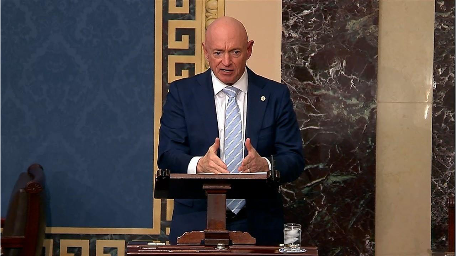
*Sen. Kelly speaks on Senate floor.
Watch Kelly’s full speech here. See key excepts from Kelly and his colleagues below:
*Sen. Kelly: “In 2010, the Supreme Court handed down a decision that put a ‘for sale’ sign on our democracy. The Citizens United ruling opened the door for corporations and billionaires to spend unlimited amounts of money to influence our elections, often without the public ever knowing who’s behind it. The Court decided that spending money in elections is the same as political speech, and that corporations should have the same political rights as individual Americans. The result was predictable – and it wasn’t limited to a courtroom. It changed how this place works. The loudest voices in Washington became billionaires, not every day Americans.
*Sen. Sheldon Whitehouse (D-RI): “I was here before the Citizens United decision. When robust meaningful bipartisan climate legislation was constant here in the Senate. I can think of four major bipartisan bills here in the Senate. And I remember my friend, John McCain, carrying the Republican banner into the presidential election with a respectable climate platform. Well, right after Citizens United, all of that stopped. The barrage of fossil fuel dark money into our politics killed bipartisanship on climate change instantly. It is still a problem today.”
*Sen. Jeff Merkley (D-OR): “The growth in dark money has been stunning because there’s so much money among the oligarchs and billionaires, they want to spend it to create laws that favor the oligarchs and billionaires and they are spending at an extraordinary rate. Six years ago, it was about $300 million, but according to the Brennan Center […] dark money hit a record high of $1.9 billion in the 2024 races. That’s a six-fold increase in six years. That’s the rich and powerful buying their government. It is an absolute travesty. No one in our founding community of our nation who wrote the Declaration of Independence, who wrote the Constitution, wanted to design a system where the mega rich ran the place as a cabal of elites. But that’s what we have and that’s what we have to change.”
*Sen. Amy Klobuchar (D-MN): “In the 2024 elections, secret money groups spent $1.9 billion – nearly double the amount spent just one cycle before. This undermines our democracy and shakes the public’s trust because unlimited, anonymous spending in our elections doesn’t encourage free speech – it drowns out the voices of American people who are seeking to participate. We must fight for a more transparent democracy where every voter’s voice is heard.”
*Sen. Andy Kim (D-NJ): “We live in the time of the greatest distrust in modern history. It doesn’t have to be this way. We can have a politics that restores and grows trust, instead of actively degrading it. This year is the 250th anniversary of the independence of our nation. This is our moment to free Americans from the influence of big money and give them their voice back in their democracy.”
*Sen. Cory Booker (D-NJ): “Since the Citizens United decision, I have watched how this body has seen clearly corrupt forces beginning to overrun the commonsense and the will of the people and policy, more and more be bent to the whim and the will of the wealthiest of the wealthy in our country, in the world, as well as corporations, many of them multinational corporations. We are in crisis. Our nation is in crisis. […] Trust is vital for a democracy to thrive. And there has been nothing more powerful in undermining that trust in the years I’ve been in the Senate that I’ve seen than the destructive force of money in our politics.”
*Sen. Dick Durbin (D-IL): “Under the current system that’s described by my colleagues on the floor, there is so much entrenched money that they virtually control the agenda and scare the living hell out of average individuals who don’t have a fortune to spend. And that’s the reality of what we face.”
*Sen. Chris Murphy (D-CT): “Individuals today make up to 16% of total spending in elections. 16%. 84% of all the spending in elections today are not done by citizens. 84% of spending are corporations and organizations. Much of that money is anonymous. You have no idea where that comes from. Let me tell you what the impact of that. The impact is corruption. Let’s just call it what it is.”
*Sen. Alex Padilla (D-CA): “Citizens United didn’t just change campaign finance law — it fundamentally altered our democracy. It was the moment where the voices of everyday Americans began to be drowned out by a small and powerful few, armed with unlimited money and unprecedented access. As Trump completely sidelines the Federal Election Commission — our country’s top campaign finance watchdog — we are entering a midterm election season with unlimited money allowed in our elections and a President who has regularly used the powers of the office to benefit his billionaire donors. I will continue to push my colleagues to enact legislation to overturn Citizens United so that our elections reflect the will of the people instead of corporations and the highest bidder.”
---
---
an 10 25
no lnx
Trump isn't the gravest threat to our democracy
Thom Hartmann November 01, 2025
Some data points for your consideration:
Last Saturday in Chicago’s affluent Old Irving Park neighborhood, Donald Trump’s secret, masked police violently pulled a 67‑year‑old U.S. citizen — a member of a local running club returning to his home from a run — out of his car and threw him to the street, where they assaulted him with such force that they broke six ribs and left him with internal bleeding.
Trump is openly taking bribes, publicly ordering political prosecutions, murdering people in naked violation of both US and international law, all while claiming the Supreme Court gave him absolute immunity from prosecution for any crime.
An MIT study finds that lies presented as news travel six times faster across social media than truths.
While more than 75 percent of Americans trusted the news 50 years ago, today that number is a mere 28 percent, with only 8 percent of Republicans believing what they see or read in mainstream outlets.
These are all the same story, and they all largely derive from a single source, a mind poison that was introduced into the American (and world) mindstream in a big way about two decades ago.
It’s called the algorithm, and if we’re to survive as a republic it must be regulated the same way we regulate anything else that produces addictive, compulsive behavior that twists and distorts people’s lives.
Possibly the greatest threat to humanity at this moment is the algorithm.
It can twist and wreck people’s minds and lives — tear apart families and destroy countries — in a way that can be more rapid and more powerful than heroin, cocaine, or fentanyl. And yet it is completely unregulated.
An algorithm is a software program/system that inserts itself between humans as we attempt to communicate with each other. It decides which communications are important and which are not, which communications will be shared and which will not, what we will see or learn and what we will not.
As a result, in a nation where 48 percent of citizens get much or most of their news from social media, the algorithms driving social media sites ultimately decide which direction society will move as a result of the shared information they encourage or suppress across society.
When you log onto social media and read your “feed,” you’re not seeing (in most cases) what was most recently posted by the people you “follow.” While some of that’s there, the algorithm also feeds you other posts it thinks you’ll like based on your past behavior, so as to increase your “engagement,” aka the amount of time you spend on the site and thus the number of advertisements you will view.
As a result, your attention is continually tweaked, led, and fine-tuned to reflect the goal of the algorithm’s programmers. Click on a post about voting, for example, and the algorithm then leads you to election denial, from there to climate denial, from there to Qanon.
Next stop, radicalization or paralysis. But at least you stayed along for the ride and viewed a lot of ads in the process.
Algorithms used in social media are not tuned for what is best for society. They don’t follow the rules that hundreds of thousands of years of human evolution have built into our cultures, religions, and political systems.
They don’t ask themselves, “Is this true?” or “Will this information help or hurt this individual or humanity?”
Instead, the algorithms’ main purpose is to make more money for the billionaires who own the social media platforms.
If telling you that, as Trump recently said, climate change “may affect us in 300 years” makes for more engagement (and more profit for the social media site) than does telling the truth about fossil fuels, it will get pushed into more and more minds.
No matter that such lies literally threaten human society short-term and possibly the survival of the human race long-term.
As Jaron Lanier told the Guardian:
“People survive by passing information between themselves. We’re putting that fundamental quality of humanness through a process with an inherent incentive for corruption and degradation. The fundamental drama of this period is whether we can figure out how to survive properly with those elements or not.”
Those of a certain age or students of the advertising business may remember when Vance Packard’s book The Hidden Persuaders set off a panic across America in the 1960s, claiming that movies and TV shows were inserting micro-bursts of advertisements that flew below the radar of consciousness but nevertheless changed behavior.
The classic example was popcorn flashing on movie screens with the words “Buy Now!” It provoked a panic in Congress and multiple attempts at legislation to outlaw it before the practice was debunked as ineffective.
But algorithms are far from ineffective. They’re arguably one of the most powerful forces on the planet today.
The premise of several books, most famously Shoshana Zuboff’s The Age of Surveillance Capitalism, is that the collection of massive amounts of data about each of us — then massaged and used by “automated” algorithms to increase our engagement — is actually a high-tech form of old fashioned but extremely effective thought control.
She argues that these companies are “intervening in our experience to shape our behavior in ways that favor surveillance capitalists’ commercial outcomes. New automated protocols are designed to influence and modify human behavior at scale as the means of production is subordinated to a new and more complex means of behavior modification.” (Emphasis hers.)She notes that “only a few decades ago US society denounced mass behavior-modification techniques as unacceptable threats to individual autonomy and the democratic order.” Today, however, “the same practices meet little resistance or even discussion as they are routinely and pervasively deployed” to meet the financial goals of those engaging in surveillance capitalism.
This is such a powerful system for modifying our perspectives and behaviors, she argues, that it intervenes in or interferes with our “elemental right to the future tense, which accounts for the individual’s ability to imagine, intend, promise, and construct a future.” (Emphasis hers.)
Social media companies have claimed that their algorithms are intellectual properties, inventions, and trade secrets, all things that fall under the rubric of laws designed to advance and protect intellectual property and commerce.
In my book The Hidden History of Big Brother: How the Death of Privacy and the Rise of Surveillance Threaten Us and Our Democracy, I argue that algorithms should be open-source and thus publicly available for examination.
The reason so many algorithms are so toxic is because they are fine-tuned or adjusted to maximize engagement to benefit advertisers, who then pay the social media company, with little or no consideration for their impact on individuals or society.
Even more insidious, a billionaire social media company owner with a political agenda can program his algorithm to promote a particular politician, point of view, or a story that might help or destroy a politician or political party. Or even destroy a nation’s citizens’ faith in their government, media, or in democracy itself.
One way to get this under control is to require social media companies to ditch the algorithm and its associated advertising revenue model, and work instead on a subscription model with a modest fee.
Nigel Peacock and I saw this at work for the nearly two decades that we ran over 20 forums on CompuServe back in the 1980s and ’90s. Everybody there paid a membership fee to CompuServe and there was no advertising, so we had no incentive to try to manipulate their experience beyond normal moderation. There was no algorithm driving the show.
Replacing secret algorithms with subscriptions — or requiring they be publicly available in plain English so everybody can see how they’re being manipulated — would reduce the amount of screen time and the level of “screen addiction” so many people experience.
There’s an absolute consensus among both social scientists, psychologists, and political scientists that reducing algorithm-driven screen addiction would be a good thing for both individual mental health and the cohesion and health of our society.
But lacking a change in business model, the unique power social media holds to change behavior for good or ill — from Twitter spreading the Arab Spring, to Facebook provoking a mass slaughter in Myanmar, to both helping Russia elect Donald Trump in 2016 and 2024 — cries out for regulation, transparency, or, preferably, both.
Three years ago, Sen. Ron Wyden (D-OR) with Sen. Cory Booker (D-NJ) and Rep. Yvette Clarke, (D-NY) introduced the Algorithmic Accountability Act of 2022, which would do just that.
“Too often, Big Tech’s algorithms put profits before people, from negatively impacting young people’s mental health, to discriminating against people based on race, ethnicity, or gender, and everything in between,” said Sen. Tammy Baldwin (D-WI), a co-sponsor of the legislation.“It is long past time,” she added, “for the American public and policymakers to get a look under the hood and see how these algorithms are being used and what next steps need to be taken to protect consumers.”
And — let’s not forget — to protect our democracy, our nation, and our planet.
The morbidly rich people who own our social media, focused more on adding more billions to their money bins than the consequences of their algorithms, don’t seem particularly concerned about these issues. Instead, they appear to be intentionally tweaking their algorithms to promote content that agrees with their political views and economic interests (although we can’t be sure because they keep them secret).
But it’s a safe bet that without the “enraging effect” of algorithmic amplification of outrage and hate, Donald Trump would never have become president, most Americans wouldn’t support brutal ICE tactics out of fear of brown people, and we wouldn’t today live in a nation where one in five households have stopped speaking with each other because of politics.
Right now, the Trump administration and Republican politicians don’t want to touch this subject because they believe Zuckerberg, Musk, and others who control the algorithms are using them to the GOP’s advantage.
But that sword can cut both ways, when public outrage reaches the point where it’s more profitable for the tech billionaires to promote anger against those in power than those currently on the outside.
It’s way past time to end the algorithmic manipulation of the American mind.
Pass it along (because the algorithm probably won’t).
---
---
LEGAL/JUDICIAL SUPPRESSION?
NOTE CORNYN SIC FBI ON THEM; REPS LOCKED IN BLDG, DOGGED BY DPS TO GO TO CVS FOR TOOTHBRUSH, PERMISSION SLIPS LIKE hs
AN 8 25
One Democratic state representative in Texas speaking out against the Republican effort to redraw congressional district boundaries was just threatened with a felony charge for speaking to journalists.
That's according to a Wednesday article in the Houston Chronicle, which reported that Rep. Nicole Collier (D) had to abruptly end a press conference she joined from a bathroom at the Texas State Capitol. A video of the moment posted to X shows Collier being interrupted mid-speech while on a Democratic National Committee video stream with California Governor Gavin Newsom (D) and Sen. Cory Booker (D-N.J.) while speaking to police.
"Sorry, I have to leave. They said it's a felony for me to do this," Collier said. "Apparently I can't be on the floor or in the bathroom — well, you told me I had to be here in the bathroom — no, hang on. Bye, everybody. I've gotta go."
READ MORE:'Baby out with the bathwater': Red state Trump voters speaking out against this key policy
After Collier left the call, Sen. Booker called it "outrageous" that the Texas Democrat was being forced to stop talking to the media.
"First of all, let me tell you something. Representative Collier in the bathroom has more dignity than Donald Trump in the Oval Office," Booker said. "...What they're trying to do right there is silence an American leader. Silence a Black woman. And that is outrageous. I hope everybody took note of that."
"The fact that she can't even let her voice be heard is freakin' outrageous. And this is what we're fighting for," he continued. "This is ultimately what this is about. What we just witnessed: Them trying to shut her down and say it's illegal for her to be in the bathroom and on this call? This is the lengths that they're going to in Texas."
Watch the video of the moment below, or byclicking this link.
READ MORE:Aides sat 'helpless' as 'incoherent' Trump
---
feb 2018
https://blog.ucsusa.org/elliott-negin/exxonmobils-climate-disinformation-campaign-is-still-alive-and-well/
In a recent blog post, ExxonMobil executive Suzanne McCarronreiterated her company’s claim that it fully accepts the reality of climate change and that it wants to do something about it....“I want to use this opportunity to be 100 percent clear about where we stand on climate change,” she wrote. “We believe the risk of climate change is real and we are committed to being part of the solution. So why is the company still a part of—in fact, a major part of—the problem?An exchange between Oklahoma Sen. James Inhofe and Environmental Protection Agency (EPA) Administrator Scott Pruitt during a recent is a case in point, providing a window into how ExxonMobil’s undue influence continues to block climate action.
During the January 30 hearing, which was held by the Senate Environment and Public Works (EPW) Committee, Sen. Cory Booker inadvertently provoked Inhofe by raising the issue of environmental justice.The New Jersey Democrat cited the threat climate change-induced flooding poses to three dozen Superfund sites in his state and asked Pruitt if he was “taking into account the environmental burdens disproportionately impacting communities of color, indigenous communities and low-income communities.”
Inhofe seized the opportunity to contradict Booker, claiming that minority and low-income communities are disproportionately harmed by environmental protections, specifically citing the Obama administration’s Clean Power Plan, which would have dramatically reduced carbon emissions from coal-fired power plants if Pruitt hadn’t repealed it.
Booker, Inhofe said, was implying that Pruitt was trying to “punish” vulnerable Americans. “I wanted to just remind you,” Inhofe told the committee, “that we had a guy I remember so well, Harry Alford. He was the president of the National Black Chamber of Commerce. He provided some of the most powerful testimony that I have ever heard when it comes to the effects of the Clean Power Plan and some of the other regulations … on black and Hispanic poverty, including job losses and increased energy costs.
“[Alford] was very emphatic as to who was paying the price on these,” the Oklahoma Republican continued, “and I think sometimes that the previous administration forgot that there are already people out there who are paying all they can pay just to try to eat and keep their house warm.”
ExxonMobil’s Echo Chamber
Inhofe’s source for his assertion? A discredited, ExxonMobil-funded study by an Exxon-funded advocacy group that was based on discredited studies by other ExxonMobil-funded organizations.
Inhofe rested his argument on previous congressional testimony by Harry Alford, president of the National Black Chamber of Commerce (NBCC), a shoestring, mom-and-pop operation that is unapologetic about taking fossil fuel industry money. “Of course we do and it is only natural,” Alford wrote on NBCC’s website. “The legacy of Blacks in this nation has been tied to the miraculous history of fossil fuel…. [F]ossil fuels have been our economic friend.”
One of NBCC’s closest economic friends is ExxonMobil, which has donated more than $1.14 million to the group since 2001.
What did the company get for that money?
In 2015, NBCC commissioned a report that claimed the Clean Power Plan would “inflict severe and disproportionate economic burdens on poor families, especially minorities.”
In fact, unchecked climate change would more than likely hurt those communities most, and investments in energy efficiency under the plan would ultimately lower electricity bills across the country.
How did NBCC arrive at its upside-down assessment? The Union of Concerned Scientists took a close look at the report and found it was based on several flawed fossil fuel industry-friendly studies. Two of those bogus studies were produced by ExxonMobil grantees: the Heritage Foundation, which received $340,000 from ExxonMobil between 2007 and 2013, and the U.S. Chamber of Commerce, which received $3 million between 2014 and 2016.
The Chamber study, which came out just days before the EPA released a draft of the Clean Power Plan, was debunked not only by the EPA, but also by *PolitiFact.com* and *The Washington Post*. Among its many faults, the Chamber study—which was co-sponsored by the American Petroleum Institute—wildly inflated the cost of the plan and failed to consider the benefits of cutting carbon emissions.
ExxonMobil Spreads its Money Around
But there’s more than just the fact that ExxonMobil financed deliberately flawed studies to try to derail the Clean Power Plan. The company also is a major supporter of a number of Senate EPW Committee members, including Inhofe, who are adamant climate science deniers.
Inhofe has deep ties to the oil and gas industry, which has donated $1.85 million to his campaign war chest over his long career in Congress, more than twice than any other industry.Three oil and gas companies are among the senator’s top 10 corporate contributors: Koch Industries, Devon Energy and …ExxonMobil.
Six of the other 10 Republicans on the EPW Committee also are on ExxonMobil’s donation list, including Wyoming Sen. John Barrasso, the current committee chairman. Roughly half of the $119,500 ExxonMobil contributed to the seven senators over the last decade went to Barrasso and Inhofe, the committee’s previous chairman.
Then there’s ExxonMobil’s link to Pruitt, Oklahoma’s attorney general before President Trump tapped him to run the EPA. From 2012 through 2013, he chaired the Republican Attorneys General Association (RAGA)and afterward served on the organization’s executive committee. From 2014 through 2016, ExxonMobil gave RAGA $160,000 in three annual installments.
Just a few weeks after the company made its 2016 donation of $50,000,Pruitt and then-RAGA Chairman Luther Strange, at the time Alabama’s attorney general, co-authored a National Review column attacking a coalition of state attorneys general investigating ExxonMobil and other fossil fuel companies for misleading investorsand the general public about climate change. Parroting ExxonMobil’s argument, Pruitt and Strange charged that the coalition was violating the company’s first amendment right to free speech.
“The debate” over climate change, they wrote “is far from settled. Scientists continue to disagree about the degree and extent of global warming and its connection to the actions of mankind. That debate should be encouraged — in classrooms, public forums, and the halls of Congress. It should not be silenced with threats of prosecution. Dissent is not a crime.”
Inhofe Upstaged
In this case, Inhofe’s counterfactual comment didn’t make it into the ensuing media coverage. Along with nearly everything else that was said during the two-and-a-half hour marathon, it was eclipsed by a bombshell dropped by Sen. Sheldon Whitehouse. The Rhode Island Democrat revealed that during a February 2016 radio interview, Pruitt said Trump would be “more abusive to the Constitution than Barack Obama, and that’s saying a lot.” Whitehouse read Pruitt’s remark aloud and asked him if he recalled making it.
“I don’t,” Pruitt responded, “and I don’t echo that today at all.”
“I guess not,” Whitehouse replied.
Not surprisingly, that embarrassing nugget was the story. There was no way that Inhofe’s rambling, ExxonMobil-sponsored falsehood could compete in the media with red meat like that. But overshadowed or not, Inhofe provided yet another incontrovertible piece of evidence that—despite ExxonMobil’s statements to the contrary—the company is still very much engaged behind the scenes in trying to stymie any government attempt to seriously address climate change.
Posted in: Climate Change, Energy, Science and Democracy, Scientific Integrity
Tags: disinformation
https://www.alternet.org/2020/01/treasury-department-inspector-general-opens-probe-into-abuse-of-the-trump-tax-cut-law/
no lnx
Treasury Department inspector general opens probe into abuse of the Trump tax cut law
Written by Justin Elliott / ProPublica January 16, 2020
The Treasury Department’s inspector general is looking into the opportunity zone program following stories by ProPublica and The New York Times about how the tax break meant to help the poor had been manipulated by billionaires.
The development, which was first reported by NBC News, comes after three congressional Democrats wrote to Treasury’s inspector general in October asking for the probe and citing the ProPublica and Times stories.
“We are conducting an inquiry, and expect to complete our work and respond to the Congressional requesters in early spring,” Deputy Inspector General Richard Delmar said in a statement.
The opportunity zone program, passed as part of the 2017 Trump tax overhaul, offers tax breaks to investors who put money into specially designated areas. While it was pitched as a way to help struggling neighborhoods, ProPublica and others have documented how the process has appeared to benefit billionaires with investments in areas that should not have qualified. In other cases, governors have granted the tax break to their political donors and, in some cases, themselves or their families.
Sen. Cory Booker, an architect of the program, along with Reps. Emanuel Cleaver and Ron Kind, asked the inspector general to do a “complete review” of areas picked for the opportunity zone tax break to see if they were truly eligible.The October letter also asked the inspector general to collect all correspondence between Treasury, White House officials and outside interests about the process.
The inspector general said that once the inquiry is complete it plans to publicly post its response to the congressional Democrats.
Do you have access to information about opportunity zones that should be public? Email justin@propublica.org. Here’s how to send tips and documents to ProPublica securely.
==
corey booker : 1/2 our green power nuke, have to phase out given 12 yr deadline, R&D new models
==
==
https://www.vox.com/world/2018/4/12/17230078/mike-pompeo-secretary-of-state-confirmation-cory-booker
Cory Booker just excoriated Trump’s secretary of state nominee, Mike Pompeo, during his confirmation hearing over Pompeo’s past associations with prominent anti-Muslim ideologues.
For most of his hearing on Thursday morning, Pompeo (who’s currently the CIA director) seemed prepared and capable of handling every question the Senate Foreign Relations Committee threw at him. But the nominee stumbled — badly — under a cleverly prepared series of questions from the New Jersey Democrat.
First, Booker asked Pompeo about a 2013 speech in which Pompeo blasted American Islamic leaders for their “silence” in the wake of the Boston Marathon bombings and said that made them “potentially complicit” in terrorism. (American Muslim leaders in fact spoke out forcefully against terrorism and extremism in the wake of the attacks and organized effortsto help victims.)
Pompeo responded by saying that he wasn’t trying to cast aspersions on all Muslims but was simply pointing out that Muslims have more ability to discourage other Muslims from joining militant groups. “For certain forms of violence, there are certain people who are better positioned” to act, he said.
Pompeo added, “Each and every human, not just Americans, each human being has an obligation to push back against this extremist use of violence.”
This seemed like a decent evasion at first — but it soon became clear that Pompeo had walked into a dangerous trap.
Booker said he agreed with Pompeo that “silence in the face of injustice lends strength to that injustice.” Then he sprang the trap: He brought up Pompeo’s long history of association with two of America’s most prominent Islamophobes, Frank Gaffney and Brigitte Gabriel, and asked whether Pompeo had ever used his “position” to denounce their extremist views.
Gaffney, a conspiracy theorist who has accused most American Muslim civic organizations of being fronts for Islamist groups, had hosted Pompeo on his radio show. Gabriel, an anti-Islam activist who has described Islam as “a political movement cloaked in religion,” hosted a dinner in Pompeo’s honor in 2016 — where she gave him an award that he accepted. Did Pompeo ever condemn them in the way he expects all Muslims to condemn terrorists?
Pompeo had no good answer: “Senator, I couldn’t tell you,” he responded. “I don’t recall each statement I’ve made over 54 years.”
Here’s the exchange a transcript, if you prefer reading:
BOOKER: I’m wondering, Sir — do you know Frank Gaffney?
POMPEO: Yes, I do.
BOOKER: And you’ve been on his show dozens of times?
POMPEO: I was on his show some, yes.
BOOKER: I have here over 20 times. And he has talked about [how] Muslims who abide by the adherence of the faith should be considered to be tried for acts of sedition and prosecuted. I have a lot of his statements. Did you remain silent — and, from my notes at least, you’re a friend of his — were you silent in your position of authority in these words that devalue the American constitution?
POMPEO: Sir, my record on this is unambiguous ...
BOOKER: If that’s your response, you did not say anything to call out his remarks. What about Brigitte Gabriel. Do you know her?
POMPEO: I do.
BOOKER: Someone who runs an organization that has been considered a hate group by the Anti-Defamation League and the Southern Poverty Law Center. Were you silent? Did you ever call her out on her remarks that are hateful or bigoted?...
==
the conv 519
For the first time, most major Democratic presidential contenders are talking about whether the U.S. government should consider paying reparations to the descendants of African Americans who were enslaved and suffered from large-scale racial discrimination.
At least three of these candidates,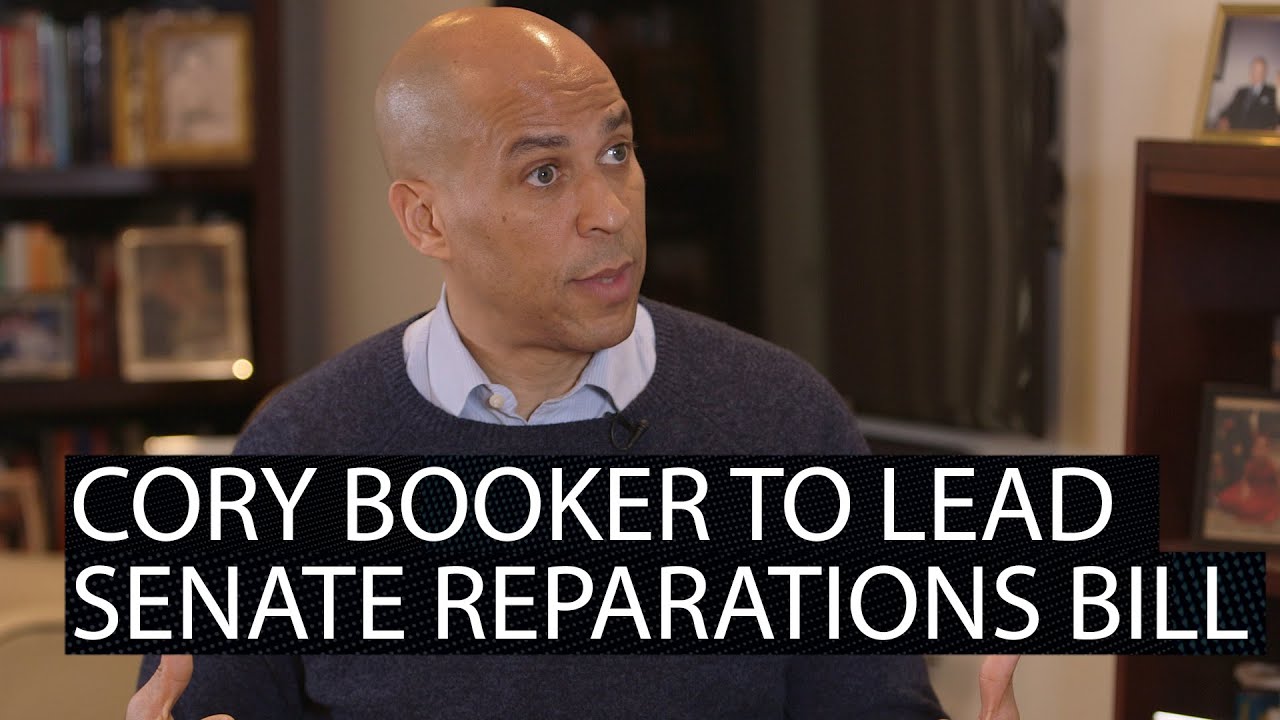 of New Jersey, former San Antonio Mayor Julián Castro and Sen. Elizabeth Warren of Massachusetts, support the creation of a commission that would study the impact of slavery and the Jim Crow discrimination against black Americans that continued after emancipation. The commission would make recommendations about how to compensate black Americans for those injustices.
The question of whether the U.S. government should compensate the descendants of enslaved and oppressed African Americans has never gotten this much attention. Even former President Barack Obama deflected this concept while he was in the White House.
As a sociologist who has researched systemic racism and reparations for decades, I can explain why this issue appears to be gaining traction.
[vid] Booker explained in an interview with ‘The Root’ why he supports reparations for African Americans.]
Long history
A major justification for the government paying reparations directly to individuals or establishing other forms of compensation, such as investment in majority-black communities, lies in the harsh reality of the labor stolen from millions of enslaved people from 1619 to 1865. That justification extends to many more millions severely oppressed for the next century and a half – whether through racist segregation laws or informal discrimination authorities did nothing to stop.
Since 1619, when the first enslaved Africans were taken to Jamestown, Virginia, the oppression of black people by whites has been embedded in America’s economic, political, educational and other institutions.

:{An 18th-century newspaper ad announcing the sale of ‘250 fine healthy negroes.’:(style="margin:0px;padding:0px;border:0px;outline:0px;vertical-align:baseline;background:transparent"):}: :{:(style="margin:0px;padding:0px;border:0px;outline:0px;vertical-align:baseline;background:transparent"):}:AP Photo
Slavery lasted for nearly 250 years, about 60% of U.S. history, including Colonial times. Counting the nearly century-long Jim Crow segregation of African Americans, officially sanctioned racial oppression encompassed more than 80% of U.S. history to date.
The political scientist Thomas Craemer calculated the hours worked by enslaved black workers between 1776 and the official end of slavery. He estimates this uncompensated labor totaled between US$5.9 and $14.2 trillion in current dollars.
As I detailed in my book “Racist America,” trillions more in wealth was effectively stolen from black Americans not just because of enslavement prior to 1776 but during the Jim Crow era through employment discrimination and decades of bureaucratic finagling that caused them to lose farmland.
I estimate that the total cost to black Americans over four centuries of slavery, Jim Crow laws and more contemporary discrimination to be in the $10-$20 trillion range. That’s potentially as big as the nation’s annual economic output.
Wealth accumulation
Georgetown University students recently voted in favor of a new “reconciliation fee” they would pay that would fund reparations to the descendants of 272 enslaved people sold in the 19th century to pay off the school’s debts.
Opponents of this reparations effort, which would require support from the university’s board to take effect, voiced two common arguments against it: Slavery happened too long ago and not all white Americans have slave-owning ancestors. Similar arguments are now commonplace.
The assumption that those debts are owed by and to people now deceased ignores all the money, property and other wealth white Americans alive today inherited from their forebears, including slave owners and many others responsible for depriving blacks of economic and educational opportunities through discrimination. The latter included white overseers, sheriffs and merchants.
Most whites can trace their roots back at least three generations, with many going back between four and 20 generations. That’s longer than most African Americans have had, at least officially, fairly equal socioeconomic opportunities – at most for two generations.
This argument also ignores the benefits white people reaped from the large-scale discrimination suffered by African Americans whose labor was underpaid or stolen for most of U.S. history. Millions of people, many still alive, endured brutal violence and economic discrimination under legal segregation.
What’s more, housing equity – what homeowners possess after subtracting their mortgages – is a main repository of U.S. family wealth. Philosopher Jonathan Kaplan and political scientist Andrew Valls argue that the decades-long housing discrimination that stopped most African Americans from building significant home equity justifies the payment of major reparations.
White-implemented government home-ownership programs after World War II, including mortgage programs for veterans, discriminated on a large scale against blacks. These government programs enabled many millions of white families to move into the middle class. The children, grandchildren and great-grandchildren of these whites have since inherited wealth due to the ensuing growth in the value of that housing.
[pix
Blacks couldn’t buy homes after World War II in upwardly mobile communities like Levittown, Pennsylvania. AP Photo/Bill Ingraham
In contrast, black families usually endured housing discrimination after World War II. They were unable to obtain mortgages and were barred by restrictive covenants from buying homes in white areas where housing values rose.
Today’s wealth gap between white and black Americans is substantially the result of government-supported housing and employment discrimination. The median net worth of black families is less than 15% of that of white families, according to the Federal Reserve.
Congress responds
Lawmakers have been reckoning with this question to some degree for two decades. Members of the House have introduced the Commission to Study Reparation Proposals for African Americans Act in every Congress since 1989, albeit without much support.
Both chambers of Congress passed resolutions that officially apologized for African American enslavement and centuries of black oppression, beginning with the House in 2008.
A year later, the Senate version included a disclaimer suggesting a lack of interest in paying reparations: “Nothing in this resolution (A) authorizes or supports any claim against the United States or (B) serves as a settlement of any claim against the United States.”
This reluctance seems puzzling in light of the fact that the U.S. government successfully pressured postwar German governments to pay Holocaust survivors $927 million – worth $8.84 billion today – in compensation as part of the 1952 Luxembourg Agreement.
And after the passage of a 1998 reparations law, the U.S. government also modestly compensated some 82,000 Japanese Americans who were discriminatorily incarcerated as “enemy aliens” during World War II with $20,000 payments made to each surviving person who had been detained.
To be sure, broad public support for reparations has yet to materialize outside Congress either.
The latest polling indicates that most Americans still oppose paying reparations that would compensate African Americans for the centuries of life-shortening racial discrimination and exploitation they and their ancestors endured.
More diversity
Perhaps the best explanation for why Democrats angling for the presidency increasingly support reparations is simple.
It’s their base.
Nearly half of voters who cast ballots in 2016 Democratic primaries were nonwhite, and Congress is more racially and ethnically diverse than ever before.
The growing importance of black, Latino and Asian American voters and leaders reflects the dramatic demographic changes underway in the U.S. Americans of color are now a majority in California, Texas, Hawaii, New Mexico and the District of Columbia.
By the 2020s, whites are likely to become a minority in Arizona, Nevada, Florida, Georgia, Mississippi, New York and New Jersey.
By the 2040s whites will likely be a minority overall, and soon thereafter most voters will be people of color
https://thehill.com/regulation/333610-dems-plot-to-overturn-regulatory-repeal-law
Democrats are taking aim at President Trump’s power to roll back regulations.
The Sunset the CRA and Restore American Protections (SCRAP) Act introduced Tuesday by Sens. Cory Booker (N.J.) and Tom Udall (N.M.) would eliminate the law that Trump and Republican lawmakers have used to repeal more than a dozen Obama-era regulations. Rep. David Cicilline (D-R.I.) is backing identical legislation in the House.
The Congressional Review Act (CRA) makes it easier for lawmakers to repeal regulations they disapprove of from the executive branch. Under the 1996 law, Congress only needs a simple majority to rollback recently issued regulations. Federal agencies are also blocked from publishing similar rules in the future.
The SCRAP Act would not only prevent Republicans from using this law to repeal future regulations, but it would also allow federal agencies to reinstate rules that have already been struck down under the CRA.
Before Trump, the CRA had only been successfully used once, in 2001, to repeal a Clinton-era labor rule.
Since then, Republicans have turned to the CRA to repeal 14 Obama-era regulations, hoisting the relatively obscure law into the limelight.
The rules overturned include environmental regulations like the Interior Department’s stream protection rule, internet regulations, financial rules, healthcare rules, education rules and gun restrictions.
Democrats warn Republicans are abusing their authority under the law by rolling back so many regulations.
“It’s like using a sledgehammer when a chisel is needed,” Udall said.
“The CRA never should have been passed into law, and it’s past time to repeal it,” he added.
The bill stands no chance of passing in the Republican-controlled Congress, but it is something Democrats could someday return to in the majority.
Robert Weissman, president of the left-leaning Public Citizen, called Republicans’ use of the CRA a “corporate payback scheme.”
“If there was any doubt before, it’s now certain that the CRA must go,” he said.
==
https://www.dcreport.org/2017/11/20/how-trump-and-congress-are-erasing-the-last-20-years/
They’re Using an Obscure 1990s Law to Wipe Out Regulations Protecting Citizens and the Environment
By Jillian S. Ambroz
The Republicans of the 115th Congress and Trump have not accomplished much in the way of landmark legislation this year, unless you count overturning President Barack Obama’s achievements. And on that front, they’ve been prolific.
In Trump’s first four months of office, he and Congress have completely eliminated 14 rules issued by Obama—rules ranging from things like protecting Americans from coal waste in drinking water to blocking individuals with severe mental illness from buying firearms—using the Congressional Review Act.
And lest you think that headache of a legislation that had only been wielded once in 21 years before now might be going away anytime soon, think again.
Congress has targeted at least 31 rules in just 11 months, including the ones that have been nullified already, according to a report prepared by former senior staff member of the Congressional Research Service, Curtis W. Copeland. Those that have not been disapproved have been introduced to the House and await further action.
It’s not enough to just remove the rules, this Republican-led Congress and Trump want to nullify these acts completely, as if they never took place.
To do that requires a joint resolution by a simple majority in each house of Congress, which is easy for this current legislative branch. After 60 legislative days, Trump can sign the resolution into law and nullify the previous rule.
But once undone, it’s not easy to reinstate a rule removed by the Congressional Review Act, which is written so that essentially a new law is required to reinstate a new or similar rule like the one that was removed by it. And that is how people like influential ex-White House strategist Steve Bannon and pollution advocate Myron Ebell, who was in charge of the blueprint for the transition and transformation of the Environmental Protection Agency, crafted this deregulation regime that could take years to undo once Trump leaves office.
Bannon once said the goal of the Trump presidency is the “deconstruction of the administrative state.”
ACTION BOX/What You Can Do About It
Contact the White House and tell Trump using the Congressional Review Act and undoing these regulations is harmful to the American people. Call 202-456-1111, reach him on Twitter or email.
Contact Speaker Paul Ryan (R-Wis.) by phone at 202-225-3031, email, Facebook or Twitter. Contact Senate Majority Leader Mitch McConnell (R-Ky.)by phone at 202-224-2541, email, Facebook or Twitter.
As always, contact your representatives and senators and ask them to stop using the CRA to roll back safeguards for the American public.
The Congressional Review Act was part of former House Speaker Newt Gingrich’s Contract with America and signed into law in 1996 by President Bill Clinton.
Before Trump took office, the Congressional Review Act was only used once before when the 107th Congress overturned a rule by the Occupational Safety and Health Administration. The rule addressed ergonomic injuries in the workplace.
Here are just a few of the rules Congress and Trump have overturned:
- Oil Company Foreign Payment Disclosure Rule: Forced oil companies to disclose payments to foreign governments.
- The Stream Protection Rule: Enforced regulations on coal mine operators to protect streams and other water sources from coal waste.
- Workplace Injuries Rule: Required employers to maintain accurate records of serious workplace injuries and illnesses for up to five years.
- Gun Control Amendment: Required the Social Security Administration to provide instant information to the National Instant Criminal History Background Check System on individuals meeting certain criteria, including severe mental health issues, that would prevent them from being able to purchase a firearm.
“Time and time again, Republicans have abused the Congressional Review Act to appease the extreme right wing of their party and ensure giveaways to corporate special interests,” top Senate Democrat Chuck Schumer (D-N.Y.) said in a Politicoarticle.
It was thought there was a finite window for the Congress and Trump to employ the Congressional Review Act, which was previously considered a vehicle to undo so-called “Midnight Regulations” of an outgoing administration. The consensus was Obama actions only back to 2016 could be undone. That may not be the case. Technically, Congress can go back over unsubmitted agency rules, too—all the way back to 1996—and belatedly submit them for disapproval. Thousands of rules and regulations could be up for disapproval.
In May, Senators Cory Booker (D-N.J.) and Tom Udall (D-N.M.) introduced a bill to repeal the Congressional Review Act. It’s unlikely the Republican-led Congress will give up its most powerful tool anytime soon. At least not before the 116thCongress is sworn in.
==
But identity politics, like social issues, can be exploited to push a Wall Street agenda. There may be no better example of that than the New Jersey senatorial candidacy of Cory Booker, who is both African American and gay – and who is a former Wall Streeter who stridently defends even that community’s worst excesses. If Booker replaces Robert Menendez, as appears likely, he is far less likely to defend the public’s economic rights against corporate pillagers. alternet
==
Our list of the 10 candidates who received the highest percentage of the money from elite donors includes many candidates from wealthy states, and nationally-known candidates like Sens. Cory Booker, D-N.J., and Ted Cruz, R-Texas, as well as new members who won high-profile races in 2014 like Sens. Dan Sullivan, R-Alaska, andTom Cotton, R-Ark.
http://www.opensecrets.org/news/2015/04/the-political-one-percent-of-the-one-percent-in-2014-mega-donors-fuel-rising-cost-of-elections
==
==
https://www.opensecrets.org/politicians/summary.php?cid=N00035267&cycle=2014
==
| 2013 - 2014 Total Receipts: |  $17,718,139 |
|---|---|
| 2013 - 2014 Total Spent: |  $16,871,163 |
| Debts: |  $5,266 |
| Last Report: | Wednesday, December 31, 2014 |
Top 5 Contributors, 2013 - 2014
| Contributor | Total | Indivs | PACs |
|---|---|---|---|
| Paul, Weiss et al | $149,300 | $149,300 | $0 |
| NorPAC | $138,371 | $133,544 | $4,827 |
| Sullivan & Cromwell | $79,600 | $79,600 | $0 |
| DLA Piper | $74,400 | $54,400 | $20,000 |
| Gibbons PC | $72,800 | $67,800 | $5,000 |
Top 5 Industries, 2013 - 2014
| Industry | Total | Indivs | PACs |
|---|---|---|---|
| Lawyers/Law Firms | $1,984,770 | $1,837,470 | $147,300 |
| Securities & Investment | $1,950,570 | $1,899,070 | $51,500 |
| Real Estate | $977,045 | $951,045 | $26,000 |
| TV/Movies/Music | $659,800 | $589,700 | $70,100 |
| Business Services | $406,235 | $401,235 | $5,000 |
Source of Funds
 | Individual Contributions | $15,340,868 | (87%) |
|---|---|---|---|
 | PAC Contributions | $1,880,427 | (11%) |
 | Candidate self-financing | $0 | (0%) |
 | Other | $496,844 | (3%) |
NOTE:
==
ears of cultivating relationships with Republican lawmakers and supporting their campaign committees financially may begin to pay off tomorrow, as the GOP now controls the Senate — and thus, the Environment and Public Works Committee — and some of the industry’s closest friends will lead the questioning of EPA officials at tomorrow’s hearing.
The committee will hold an oversight hearing Wednesday morning to discuss proposed carbon dioxide regulations for American power plants. The rules, announced last year by the EPA, would expand the Environmental Protection Agency’s control over big-carbon emitting industries. But those industries are not taking the proposed move lightly, and the affected industries are influential ones in Washington.
Wednesday’s hearing is one battle in a larger war between the Republican-controlled Congress and President Obama on environmental policy. After winning control of the Senate in November, Republicans vowed to fight the President’s agenda to address climate change. Senate Republicans don’t appear to have the ability to completely repeal the EPA rules, but they have vowed to undermine and defund the ability of the EPA to administer those rules.
The proposed EPA rules, announced in June, will cut carbon dioxide production from power plants and the power sector to 30 percent below 2005 levels. According to an overview published on the EPA website when the rules were first rolled out, power plants are the biggest source of carbon emissions in the country, accounting for roughly a third of the nation’s greenhouse gas emissions. The plan would have an impact on health and quality of life issues as well: The EPA says that the rules would cut smog pollution by 25 percent, save $55 billion in health care costs, prevent up to 6,600 premature deaths, and cut asthma attacks for children.
The rules would require compliance from the states as well, and the varying levels of cooperation seem to reflect the polarized nature of American politics on the issue in general. Two states that rely heavily on coal power plants, Wyoming and Montana, have adopted different stances on the EPA policies. The state with the Democratic governor, Montana, is embracing compliance with the regulations. The state with the Republican governor, Wyoming, has rejected the rules.
As for money, the difference between giving to Republicans and Democrats on the committee illustrates a contrast between major carbon-based energy industries and the environmental advocacy groups.
For the Senate Energy and Public Works committee overall, the oil and gas industryand electric utilities industry both make a strong showing. As of late last year, $2.7 million had been donated in the 2014 cycle by the oil and gas industry to then-committee members, making it the tenth biggest donor industry to the committee. Republicans received a full 79 percent of those contributions. Electric utilities came in 19th among donors to the committee, giving $1.7 million with 55 percent going to Democrats. The environmental industry, made up of advocacy groups like theLeague of Conservation Voters and the Sierra Club, didn’t make the committee’s top 20 donors.
The chair of the committee, Sen. James Inhofe (R-Okla.), who has rejected the idea that humans are responsible for changes to the planet’s climate as recently as January, received more money from the oil/gas and electric utilities industries than any other industries. Oil and gas gave $556,700 to the senator’s campaign committee and leadership PAC from 2009 to 2014, making it his biggest industry donor. The electric utilities industry dropped $278,000 into his accounts during that same time, ranking second.
Three of Inhofe’s top four donors in that period were major energy companies that may face repercussions if the EPA tightens its grip on carbon emissions. At the top of the list, Koch Industries employees and PACs donated $45,200, and lobbyists hired by the company donated $9,430. Honeywell came in second with individuals and PACs donating $45,000, while Honeywell lobbyists donated $15,500. Inhofe’s fourth biggest donor was Valero Energy, which donated $40,000 through its PAC.
The other Republicans on the committee received a considerable sum from the two industries as well. Virtually all of the ten other Republicans had oil and gas make their top 20 donor industry lists. At least five had the electric utilities industry make that list. The biggest oil and gas recipient in the committee was Sen. David Vitter (R-La.) with $694,650 coming from the industry. The biggest electric utilities industry recipient was Sen. John Barrasso (R-Wyo.), who received $322,250 from the industry.
On the minority side of the committee, the oil and gas industry didn’t crack the top 20 for a single current member. The electric utilities industry made it onto the top 20 industries list for Sens. Tom Carper (D-Del.) , Ben Cardin (D-Md.) , and :{Cory Booker:(style="background-color:#fff200"):}:(D-N.J.), with $155,100, $124,000, and $168,138, respectively. The environment industry did make the top 20 for five of the nine Senators caucusing with the Democratic party, including ranking Democratic Sen. Barbara Boxer (D-Calif.). No Republicans on the committee had the environmental industry on their top 20 industry donor list.
==
5/15
say it ain't so
hile writing that series, I found other examples of how the ALEC/Edison anti-net metering resolution is being used in political channels, particularly among those that purport to represent black people’s best interests. The National Black Caucus of State Legislators (NBCSL), for instance, also passed a similar resolution during its latest annual legislative conference. The resolution carries some of the same basic language as the ALEC version (ALEC, which is short for American Legislative Exchange Council, focuses on state legislators).
The chair of NBCSL’s Transportation and Environment committee, Florida State Rep. Joseph Gibbons, wrote an op-ed recently making the same claim that homes that generate electricity from their own solar energy equipment will mean financial burdens passed on to non-solar, African-American households. His argument was imported to Wisconsin, where another African-American state legislator, Sen. Lena C. Taylor, published it as a criticism of policies passed by Milwaukee’s city council to help expand solar net metering.
And it’s not just African-American politicians who are tripping over this. Monica Martinez, a former Michigan Public Service Commissioner, also wrote an op-ed that’s been circulating with the same ideas about raising energy rates, except for Latino households. (It was submitted to Grist to print. We turned it down.)
So what’s up with this? What is it about making it easier for Americans to transition to cleaner energy that some black and Latino politicians are just not getting?
There’s a few things to remember here when considering those questions:
One, there’s nothing unique about black and Latino policymakers that makes them allergic to clean energy policies. There are plenty of white policymakers who do the same, and they’re financially and politically backed by the same entities: utility companies, the fossil fuel industry, ALEC and similar cohorts.
Of the electric utility lobby’s top twenty donor recipients in Congress in 2014, only two are people of color, Sen. Cory Booker (D-NJ) and Rep. James Clyburn (D-SC), according to the Center for Responsive Politics. In 2012, it was just Clyburn and Obama; in 2010, it was Clyburn alone. Of Edison Electric’s top 10 donor recipientsin Congress, again, it’s just Clyburn. You might be thinking, “Somebody needs to holla at Clyburn.” That’s fine. Just so long as somebody also hollas at all the other non-Clyburn, non-black Congress members getting Edison and utility money as well.
The second thing to remember is that not all black lawmakers oppose net metering. Plenty of black organizations, including the NAACP, know better, as domost black Americans. And there are many black lawmakers also committed to expanding clean energy. I covered the Congressional Black Caucus’s legislative conference last year and saw the bulk of them rise to applause when EPA Chief Gina McCarthy made a surprise visit to announce her clean energy plans. At this year’s conference, Congressman Keith Ellison accepted a challenge from the Hip Hop Caucus to work to stop Congressional Black Caucus members from accepting fossil fuel money.
That being said, there seems to be another reason why black lawmakers are taking their cues from the fossil fuel industry on energy: Green groups and clean energy companies don’t appear to be reaching out to black politicians as aggressively as their fossil-fuel counterparts.
When you look at the advisory boards and funders of those associations that represent black public officials, you see a whole bunch of corporations of every stripe, including a whole bunch of polluters:
- The Congressional Black Caucus Foundation’s corporate advisory board has Duke Energy, which is fighting solar in North Carolina, and Exelon, a nuclear energy giant that solar advocates at DC Solar United Neighborhoods are fighting over the company’s proposed merger with DC utility PEPCO.
- The CBC Foundation’s 2012 Annual report lists among its top donors Exxon Mobil, Walmart, McDonald’s, American Petroleum Institute, BP, Chevron, Duke Energy and General Electric.
- The list of member corporations for the National Black Caucus of State Legislators includes a whole slew of fossil fuel utility and energy companies, including Edison Electric.
- The National Organization of Black County Elected Officials held its annual conference in April, with top sponsorship from Edison and the American Coalition for Clean Coal Electricity.
But who is at these tables to counter these fossil fuel companies? You’d be hard-pressed to find the names of any clean energy companies, major green NGOs, or environmental foundations on any of those lists above.
All of those groups also get funding and have board representation from foundations that deal with fighting poverty and poor health. But they are far outnumbered by the representation of fossil fuel companies, which seem to only bring up black health and poverty at their own convenience. When it comes to solar energy, they too often are bringing them up with misleading information.
It would be great if environmental justice organizations were at these tables, but they are already overwhelmed with their work in grassroots communities. Lobbying “grasstops” organizations like National Policy Alliance is mostly outside their bailiwicks, but they don’t have the funding to take it on even if they wanted to. The major green NGOs and foundations should be at these tables, but to do that, the green NGOs need the kinds of staffs that have people who can be most effective in these policy talks.
This is why diversity matters. The question for major environmental groups is whether they know the issues of African-American communities well enough to even approach tables like the National Policy Alliance. Are the green groups participating in the conferences and confabs where African-American political issues are being discussed and prioritized?
According to the Green 2.0 report, a comprehensive study on diversity among environmentalists released over the summer, this is one of the green organizations’ biggest weaknesses. The report found that “few of the organizations studied collaborate with ethnic minority or low-income institutions or groups,” and that they “are less likely to collaborate with low-income organizations than with ethnic minority organizations.” And yet the fossil fuel industry seems to have no problems making inroads with organizations that represent both low-income households and communities of color.
The green NGOs will often say they are not funded to do that kind of outreach. If that’s the case, then I see what environmental justice guru Robert Bullard meant when he recently made the case for diversifying funding for green causes. Wrote Bullard, shortly after the People’s Climate March:
This “call for funding diversity” must not be limited solely to grassroots community groups and environmental and climate justice leaders. Clearly, we need our mainstream environmental organization friends and allies in the philanthropic community who supported the People’s Climate March to join us in supporting the recommendations for diversifying funding and building an infrastructure of “grassroots” efforts, ethnic-based networks, and regional environmental and climate initiatives—better known as the Climate Justice Movement.
Without diverse funding and diverse staffing, the green movement will continue to find it difficult to get through to black lawmakers, whom the fossil fuel companies have no qualms about engaging. The Green 2.0 report offers recommendations for resolving these diversity problems, and Green 2.0’s partnership last week with Guidestar, the organization that collects information on other nonprofits nationally, should go a long way in helping track progress there. But until more is done here, I expect more resolutions like the one on net metering to continue finding easy passageways to the domains of black elected officials.
Want more on net metering? Read this next: Black lawmakers push back against coal utilities’ new trick.
==