Black Hole
Definition
A black hole is a region in spacetime where gravitational forces are so strong that nothing, not even light, can escape from it. The boundary surrounding a black hole is called the event horizon. Once an object crosses the event horizon, it is Inexorably drawn toward the central singularity, a point of infinite density within the black hole. Black holes are formed when massive stars exhaust their nuclear fuel and undergo gravitational collapse. They are characterized by properties such as mass, radius, electric charge, and angular momentum, and they play a fundamental role in the understanding of general relativity and astrophysics.
The Schwarzschild radius
after Einstein published his general theory of relativity, Karl Schwarzschild worked out the solution for the curvature of space-time around a point mass, and found that there is a critical radius at which a singularity occurs. This critical radius is called the Schwarzschild radius. For a mass M this radius, \(R_s\), is given by:
\[R_s=\frac {2GM}{c^2}\]
Real objects are not pointlike, but have some finite extent. An interpretation of Schwarzschild’s result is that if an object is completely contained within its Schwarzschild radius, the singularity will occur.
If a photon is emitted at a wavelength \(\lambda_1\) at a distance \(r_1\) from a mass M, and is detected at \(r_2\), its wavelength will be shifted due to gravitational redshift, \(\lambda_2\) is given by:
\[\frac{\lambda_2}{\lambda_1} =\sqrt\frac {1-\frac{2GM}{r_2c^2}}{1-\frac{2GM}{r_1c^2}}\]
substituting \(r_1=R_s=\frac {2GM}{c^2}\)then:
\(\frac{\lambda_2}{\lambda_1} =\sqrt\frac {1-\frac{2GM}{r_2c^2}}{1-\frac{2GM}{(2GM/c^2)c^2}}\); \(\lambda_2\rightarrow\infty\)
\(\lambda_2\) is infinite (\(\nu =0\)), even if \(r_2\) is only slightly greater than \(r_1\)(nearby position). This means that no electromagnetic energy can escape from within the Schwarzschild radius.
The Schwarzschild radius for an object of one solar mass is \(R_s=3\)km, and since the Schwarzschild radius varies linearly with mass , so:
\(R_s=3\frac M{M_\odot}\) [km]
Density Of Black Hole:
\[\rho =\frac MV\]
If the black hole is spherical, \(V=\frac34π{R_s}^3=\frac 34\pi (3\frac M{M_\odot})^3\)
\[\rho =\frac M{\frac 34\pi (3\frac M{M_\odot})^3}\]
\[\rho =\frac4{81\pi } \frac{M_\odot^3}{ M^2}\]
The more black hole is massive, the more density goes down. This is because the radius is proportional to the mass, but the volume is proportional to the radius cubed (and therefore to the mass cubed).
\[\rho \approx (1\times10^{20 }[kg/m^2])(M/M\odot)^{-2}\]
Tidal Effect
In the vicinity of a black hole, a significant change in gravitational force over a small distance is expected. This is analogous to the tidal effects on Earth caused by the varying gravitational forces of the Sun and Moon. The term "tidal effect" is extended to describe any impact of the gravitational force variation. Near a black hole, gravitational acceleration is anticipated to rapidly decrease with small changes in distance from the surface.
\[g(r)=GM/r^2\]
\[\frac {dg(r)}{dr}=-2G \frac M{r^3}\]
Though the gravitational force falls off as \(1/r^2\), the tidal effects fall off as \(1/r^3\), meaning that they are most important for small values of r.
The diffirence between the gravitational accelerations for to positions that are at distance \(\Delta r\)from each other:
\[\Delta g=\frac {dg(r)}{dr}\Delta r\]
\[\Delta g=-2G \frac M{r^3}\Delta r\]
The tidal force, \(dg/dr\), is proportional to \(M/r^3\), just as is the density. Therefore, the tidal force will be less for more massive black holes, falling to more tolerable values for very massive black holes.
Approaching a Black Hole
Two astronauts. One approaches the black hole, and the other stays a safe distance away.
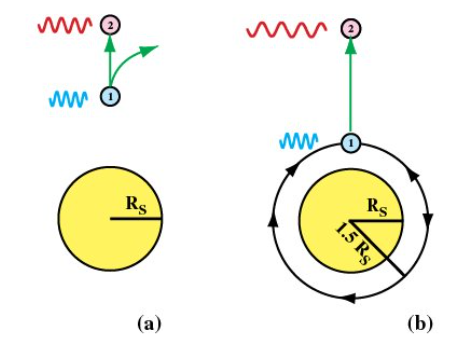
Astronaut 1 approaches the black hole while astronaut 2 stays behind. In each frame, the emitted and received wave correspond to a beam sent from 1 to 2.
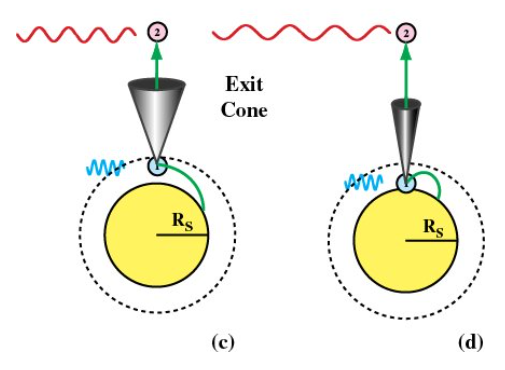
The astronaut approaching the black hole can assumedly send out signals in various directions, including back to the other astronaut.
Redshift
As the first astronaut approaches the black hole, the distant astronaut would notice the redshift in the signals received. The magnitude of the redshift increases as the first astronaut becomes closer to the Schwarzschild radius.
Bending electromagnetic radiation
Before the Schwarzschild radius is reached, the paths of photons sent out by the first astronaut are bended. The only direction in which the astronaut can aim a beam and not have it bend is straight up. If the beam is not aimed sufficiently close to the vertical, the bending will be so great that the light will not escape. Only light aimed into a cone about the vertical, called the exit cone, will escape.
Photon Sphere
As the first astronaut moves closer to the Schwarzschild radius, the exit cone becomes smaller. At a distance equal to \((3/2)R_S\), photons aimed horizontally go into orbit around the black hole. The sphere of orbiting photons is called the photon sphere. If the astronout looks straight out, along the horizon, he would see the back of his head.
Gravitational time dilation
The second astronaut never actually sees the first astronaut reach the Schwarzschild radius. The gravitational time dilation is so great that, as \(R_s\) is approached, the second astronaut thinks that it takes the first astronaut an infinite amount of time to reach \(R_s\). The time dilation makes the first astronaut appear to slow down as \(R_s\) is approached.
From the point of view of the first astronaut, there is no such respite. The Schwarzschild radius is reached very quickly.
Tidal Effect
If the black hole is of sufficiently small mass, the tidal forces would tear the first astronaut apart. If the black hole is massive enough, the tidal forces might be survived.
The event horizon
The astronaut crosses \(R_s\), or what is termed as the event horizon. If the black hole is massive enough, the astronaut might not notice anything unusual, except that escape is impossible!
Once inside the black hole, the inevitable journey to the center continues. The gravitational time dilation is so great that time passes slowly. However, the headlong rush through space continues. Outside the black hole, it is time that rushes on while distance is covered slowly. It is as if crossing the event horizon has interchanged to roles of space and time.
The second astronaut can tell nothing about what is going on inside the black hole.
Rotating Black Hole
The structure of a rotating black hole is somewhat more complicated than that of a non-rotating black hole.
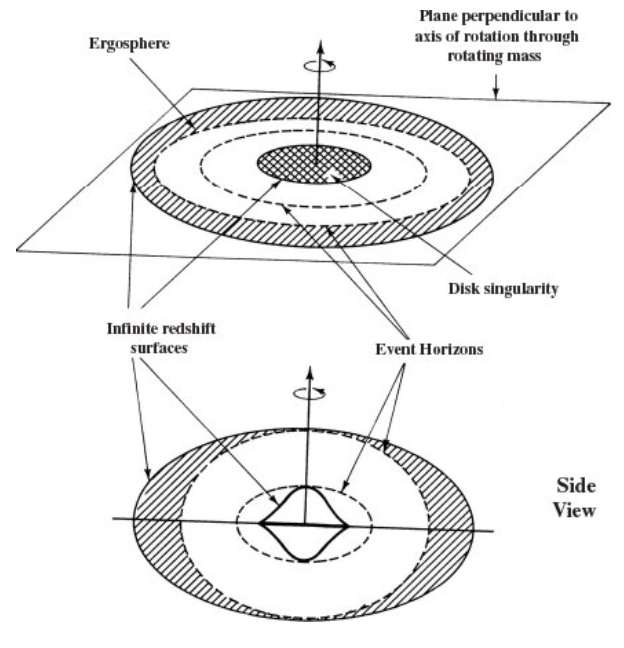
The situation shown is for the case in which the angular momentum per unit mass, J/M, is less than GM/c. For the case shown, there are two infinite redshift surfaces instead of a single event horizon. Between the two surfaces, the roles of space and time are reversed, just as inside the event horizon in the non-rotating case. The region between the outer infinite redshift surface and the event horizon is called the ergosphere. The name results from the fact that there is a way to extract energy from the black hole by moving particles through the ergosphere in the correct trajectory.
Stellar Black Hole
Some types of stars evolve to a point were nothing can support them. The star collapses right through the Schwarzschild radius for its mass, and becomes a black hole.
Black holes would be a normal state for the evolution of some stars. Stellar black holes can not be directly detected.
Non-stellar black holes
mini black holes
Black holes that have masses much less than a solar mass. They may have formed during periods of higher universe density, potentially still existing. Physicist Stephen Hawking proposed a quantum mechanical mechanism by which mini black holes could evaporate. This process involves a unique vacuum concept distinct from conventional understanding. Hawking's exploration of the interplay between gravity and quantum mechanics contributes to this novel perspective on black hole behavior.
Vacuum in Quantum Mechanics
In classical physics, a vacuum signifies emptiness, while quantum mechanics allows the creation of something from nothing for short durations, involving the borrowing of energy briefly. The relationship between borrowed energy and the borrowing duration is influenced by the uncertainty principle.
the uncertainty principle
The uncertainty principle relates to momentum, position, energy, and the lifetime of a state. If the state has a lifetime Δt, then the energy of the state is uncertain by an amount ΔE, given by:
\[\Delta t \ \Delta E\ge \frac h {2\pi}\]
The longer lived a state, the more accurately its energy can be determined. Since the energy of a state is uncertain by ΔE, it is possible to have this extra amount of energy and not detect it.
vacuum polarization
As a result of the uncertainty principle, a quantum mechanical vacuum is a very busy place. At any place it is possible to create a particle–antiparticle pair.
It requires an energy equal to \(2mc^2\), where m is the mass of the particle (and the antiparticle). The pair can exist for at most a time \(h/[(2π)mc^2]\). Before the time is up, they must find each other and annihilate.
Since electrons have masses that are much less than protons, an electron–positron (antielectron) pair will live longer than a proton–antiproton pair. The vacuum then looks like as being made up of continuously appearing and disappearing electron–positron pairs (with a small contribution from heavier particle–antiparticle pairs).
Pair production
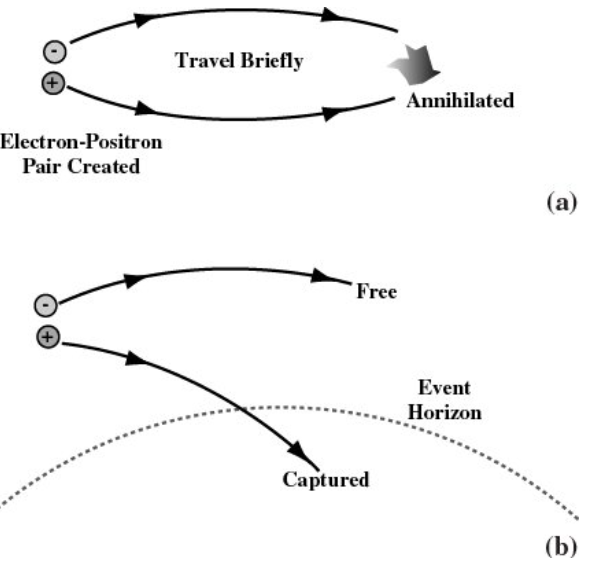
(a) The process in free space. An electron and positron are created out of nothing, but quickly come back together to annihilate. (b) Near a black hole, one of the particles can be captured before they can annihilate, and the other escapes, carrying energy away from the black hole.
When an electron–positron pair is created near a black hole, the gravitational influence may cause one particle to be drawn into the black hole before recombination, while the other continues moving away. The inability to recombine leads to an extended existence, violating the conservation of energy time limit.
To compensate for this violation, the black hole loses mass, ultimately shrinking and potentially disappearing in a burst of gamma radiation. The more massive the black hole initially, the longer it lives. The estimated lifetime of a black hole with mass M:
\[t\approx 10^{-26}M^3\]
The disappearance of smaller black holes may result in observable gamma radiation bursts.
maxi black holes
their mass scale, much larger than stellar black holes. They probably result from large amounts of material gathering together in a small region.