General Relativity
General relativity is Einstein’s theory of gravitation that builds on the geometric concepts of space-time introduced by special relativity. Einstein was looking for a more fundamental explanation of gravity than the empirical laws of Newton. Besides coming up with a different way of thinking about gravity (in terms of geometry), general relativity makes a series of specific predictions of observable deviations from Newtonian gravitation, especially under strong gravitational fields. These predictions provide a stringent test of Einstein’s theory.
Curved space-time
In general relativity, the presence of a gravitational field is understood to alter the rules of geometry in space-time, making it appear as if space-time is "curved." This curvature is illustrated by examining geometry on the surface of a sphere. On a sphere, the shortest distance between two points is along a great circle, and the concept of straight lines is extended to geodesics. The curvature of the sphere affects the rules of geometry, as demonstrated by a triangle on its surface having angles that sum to more than 180°.
The analogy extends to the curvature of space-time due to gravity. In the absence of gravity, objects move in straight lines at constant speeds. However, with gravity, the world lines of objects follow curved paths, akin to the trajectory of a ball thrown upwards, which appears as a parabola. The gravitational effect is attributed to the curvature of the four-dimensional space-time, introducing a fifth dimension. While challenging to visualize, the curvature can be measured through geometric observations.
In the geometric interpretation of gravitation, two essential components are required for a theory.
- The first involves calculating the curvature of space-time induced by the presence of specific distributions of masses.
- The second entails determining the trajectories of particles as they move through the resulting curved space-time.
Albert Einstein's theory of general relativity offers a framework that addresses both aspects. Despite the mathematical intricacies involved, we can grasp the fundamental physical concepts and even conduct simplified calculations that provide approximate solutions.
Principle of equivalence
The foundation of general relativity is rooted in the principle of equivalence, asserting that a uniform gravitational field in a certain direction is indistinguishable from a uniform acceleration in the opposite direction. This principle draws parallels between gravitational effects and the pseudoforces introduced in accelerating reference frames.
The principle of equivalence can be demonstrated through the forces acting on a person in an elevator standing on a scale.
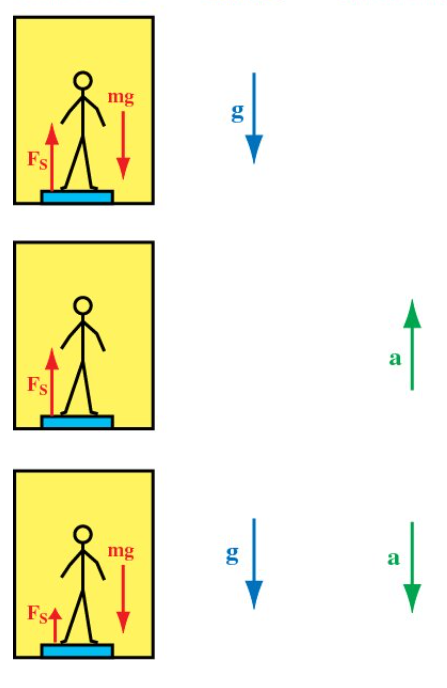
The first case: When the elevator is stationary and supported, gravity (denoted as \(^-g\)) is the only force acting. By adding up all forces, including the person's weight (-mg) and the upward force from the scale (\(F_s\)), which equals ma (where m is mass and a is acceleration), the forces balance out as the acceleration is zero in this scenario.
\[-mg+F_s=0\]
so:
\[F_s=mg\]
By Newton’s third law, the force the scale exerts on the person has the same magnitude as the force the person exerts on the scale. Therefore, \(F_s\) also gives the reading of the scale. In this case it is simply the weight of the person – the expected result.
The second case:
Under the absence of gravity, but with an upward acceleration a. The only force on the person is \(F_s\). Applying F = ma gives:
\[F_s=ma\]
If the acceleration takes the value g:
\[F_s=mg\]
This is the same result again. As far as the person in the elevator is concerned, there is no way to tell the difference between a gravitational field with an acceleration g downward and an upward acceleration g of the reference frame.
The third case:
there is gravity, but the elevator is in free-fall. The forces on the person are \(F_s\) upward and mg downward, and the acceleration is g downward.
\[F_s-mg=-mg\]
So:
\(F_s=0 \)which means that the person is weightless. The acceleration of the elevator has exactly canceled the gravitational field. For the person inside the elevator, there is no way to distinguish this situation from that of a non-accelerating elevator and no gravitational field. This is the same weightlessness felt by astronauts in orbiting space vehicles
This experiment concept of mass can have two different interpretations.
In one case, a body of mass m, subjected to a force F, will have an acceleration F/m. In this sense, mass is the ability of an object to resist the effects of an applied force. Mass represents a resistance inertia. Mass in this sense is defined as inertial mass.
The second use of mass is as a measure of the ability of an object to exert and feel a gravitational force. So it is called gravitational mass.
In the same sense, electric charge is used as a measure of an object to exert and feel electrical forces. (So, gravitational mass can be considered as a gravitational charge.)
The principle of equivalence is really a statement that inertial and gravitational masses are the same for any object.
This explains why all objects have the same acceleration in a gravitational field, a point first realized by Galileo.
It is not obvious on the surface of the Earth, since air resistance affects how objects fall. However, a hammer and a feather fall with the same acceleration on the surface of the Moon, where there is no air resistance.
It is important to remember that just because we call both quantities “mass” there is no obvious reason for gravitational and inertial mass to have the same numerical value. In the same way, we expect no equality between the electric charge of an object and its inertial mass. If inertial and gravitational mass are the same, this tells us that gravity must somehow be special.
Tests of general relativity
A multitude of precise tests have been conducted to assess the observational predictions of general relativity, with some focusing on the principle of equivalence and others providing comprehensive examinations of the theory.
Tests on the Principle of equivalence
Eotvos experiments have been instrumental in directly testing the principle of equivalence. Notably accurate experiments suggest that the principle of equivalence holds to an accuracy of one part in 1011.
While the discussed equivalence principle traditionally applies to small objects treated as point masses, a more robust form extends its validity to objects with significant gravitational binding energy, such as planets and stars. This extension has been verified by closely monitoring the motion of the Moon using laser signals bounced off mirrors left by Apollo astronauts. The measurements, accurate to within a few centimeters, indicate that the Earth and Moon fall toward the Sun with the same acceleration, confirming the principle of equivalence to within seven parts in 1012.
Orbiting bodies
The paths of orbiting bodys are slightly different than predicted by Newtonian gravitation. An important feature involves elliptical orbits. In an elliptical orbit, the distance of the orbiting body from the body exerting the force is changing. The orbiting body is therefore passing through regions of different space-time curvature. The effect of the changing curvature is to cause the orbit not to close. After each orbit, the position of perihelion (closest approach) has moved around slightly.
The effect will be greatest for orbits of highest eccentricity, since the widest range of curvatures will be covered. Also, the smaller the semi-major axis, the greater the effect. This is because the gravitational field changes faster with distance closer to the object exerting the force. In the Solar System, both of these points make the effect most pronounced for Mercury. It is closest to the Sun, and, except for Pluto, has the most eccentric orbit.
The perihelion of Mercury’s orbit advances by some 5600 arc seconds per century. However, of this, all but 43 arc seconds per century can be accounted for by Newtonian effects and the perturbations due to motions of other planets. The Newtonian effects could be calculated accurately and subtracted off. Einstein was able to explain the 43 arc seconds per century exactly in his general relativity calculations. This was considered to be an interesting result for general relativity, but not a crucial test, since Einstein explained something that had been observed. A crucial test involves predicting things that haven’t been observed yet.
In recent years a controversy has grown out of this test of general relativity. A group at Princeton in the 1960s measured the shape of the Sun and found a slight flattening. A flattened Sun would also have an effect on the orbit of Mercury, reducing the general relativistic effects by enough to say that Einstein’s calculation is wrong. Further measurements have indicated that the original experiment on the Sun’s shape was in error, but some experiments suggest that there is some flattening. While some of this research is continuing, at this point it appears that there is not enough solar flattening to challenge Einstein’s results.
Bending electromagnetic radiation
Einstein’s chance to predict an effect that had not been seen came in the bending of light passing by the edge of the Sun.
He said that the warping of space-time alters the path of light as it passes near the source of a strong gravitational field. According to general relativity, photons follow geodesics. The light will then appear to be coming from a slightly different direction. If the light is coming from a star, the position of the star will appear to be slightly different than if the bending had not taken place.
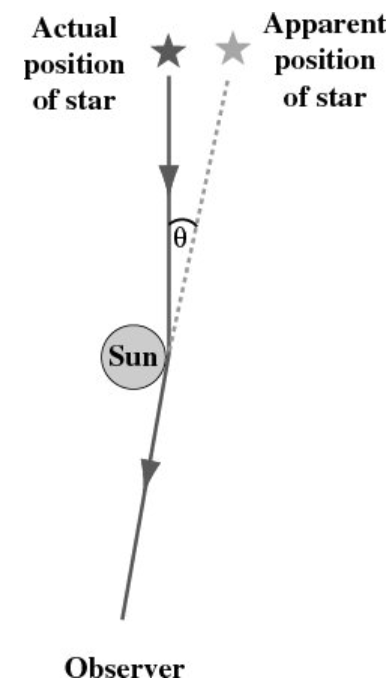
According to Einstein, the angle θ (in radians) through which the light passing a distance d from an object of mass M is given by:
\[\theta =4GM/dc^2\]
Difficulties in measuring the binding angle
Very small:
If d equals to the radius of the Sun (for example) the resulted angle is a very small and then hard to measure.
Obscured by brightness
The measurement of the bending of light near the Sun is challenging because stars close to the Sun are not visible. To conduct the test, a total solar eclipse is utilized. During the eclipse, the sky is photographed, and the same part of the sky is photographed approximately six months later. By comparing the positions of the stars in the two sets of photographs, scientists can study the bending of light caused by the Sun's gravitational field. This method allows for the observation of stars near the Sun that are normally obscured by its brightness.
Uncertainty
The solar eclipse experiment is a hard one, and the original one had a 10% uncertainty associated with it. More recent tries have reduced the uncertainty to about 5%.
Promising Methods:
Due the previous difficulties, different types of experiments are needed for greater accuracy.
A major improvement can be made by using radio waves.
This method is promising because of these reasons:
- The bending applies equally to electromagnetic radiation of all wavelengths.
- the Earth’s atmosphere does not scatter them radio waves.
- do not require specific conditions, such as the rare total solar eclipse, because radio waves can be detected without the brightness of the sun affecting the observation process.
Resulting path from the curvature of space-time
There is another effect related to the bending of light. The longer path that results from the curvature of space-time around the Sun causes a delay in the time for a signal to pass by the Sun. Two types of observations have been done to test this.
- One involves the reflection of radio waves from Mercury and Venus as they pass behind the Sun. Due to precise knowledge of the planets' positions, the expected duration for the signal's round trip can be accurately determined.
- The other type of experiment involves spacecraft that have been sent to various parts of the Solar System. Researchers track signals from spacecraft, enabling the determination of time delays when the spacecraft pass behind the Sun. This method relies on knowing the expected locations of the spacecraft. Using this technique, Einstein’s predictions have been confirmed to an accuracy of 0.1%.
Gravitational Lenses
There is another interesting result related to the bending of the paths of electromagnetic waves. A massive object can bend rays so well that it can act as a gravitational lens. Physicists have speculated on this possibility for some time.
Gravitational Redshift
The wavelengths of photons change as they pass through a gravitational field. This effect is called the gravitational redshift. It is really a consequence of the principle of equivalence.
The plausibility argument aims to estimate the gravitational potential energy's effect on photons. The gravitational field, induced by mass, alters photon trajectories, causing them to follow geodesics that deviate from straight lines. This deviation suggests that the gravitational field can perform work on photons, leading to a change in their energy.
To estimate the gravitational potential energy of a photon, given by \(E_g=−GMm/r\)
An "effective mass" is introduced, represented as
\[m_{effective}=E/c^2\]
Given that \(E = hc/λ\) (where E is energy, h is Planck's constant, c is the speed of light, and λ is the wavelength), the effective mass is determined to be \(m_{effective}=h/cλ\).
so the gravitational potential energy becomes:
\[E_g=-\frac{GMh}{rc\lambda}\]
The energy for the photon is given by:
\[E_p=\frac {hc}{\lambda}\]
so the energy of the photon in the position r is:
\[E_r=E_p+E_g\]
So:
\[E_r=\frac {hc}{\lambda_r}-\frac{GMh}{rc\lambda_r}\]
So if a photon moves from \(r_1\) out to \(r_2\):
conservation of energy would give:
\[E_{r_1}=E_{r_2}\]
then:
\[\frac {hc}{\lambda_1}-\frac{GMh}{r_1c\lambda_1}=\frac {hc}{\lambda_2}-\frac{GMh}{r_2c\lambda_2}\]
\[\frac1{\lambda_1}({hc}-\frac{GMh}{r_1c})=\frac {1}{\lambda_2}(hc-\frac{GMh}{r_2c})\]
\[\frac1{\lambda_1}({c}-\frac{GM}{r_1c})=\frac {1}{\lambda_2}(c-\frac{GM}{r_2c})\]
\[\frac{\lambda_2}{\lambda_1} =\frac {c-\frac{GM}{r_2c}}{c-\frac{GM}{r_1c}}\]
so:
\[\frac{\lambda_2}{\lambda_1} =\frac {1-\frac{GM}{r_2c^2}}{1-\frac{GM}{r_1c^2}}\]
This derivation should not be considered rigorous – it is more of a dimensional analysis. However, it gives a result that agrees with the full general relativistic calculation for shifts that are not too large. The actual result is:
\[\frac{\lambda_2}{\lambda_1} =\sqrt\frac {1-\frac{2GM}{r_2c^2}}{1-\frac{2GM}{r_1c^2}}\]
Using the approximation \((1 + x)^n ≅ 1 + nx\); \(x <<1\)will give the same result.
If the photon travles from the position \(r_1 \)to a position very far \(r_2\), \(r_2\rightarrow \infty\)so:
\[\frac{\lambda_2}{\lambda_1} =[{1-\frac{2GM}{r_1c^2}}]^{-1/2}\]
Using the same approximation gives for the last equation:
\[\frac{\lambda_2}{\lambda_1} ={1+\frac{GM}{r_1c^2}}\]
\[\frac{\lambda_2}{\lambda_1} -1=\frac{GM}{r_1c^2}\]
\[\frac{\lambda_2-\lambda_1}{\lambda_1} =\frac{GM}{r_1c^2}\]
so for a photon travels from a position r, with a wavelength \(\lambda\) to a very distant position, the wavelength shift, \(\Delta \lambda \)
will be given by:
\[\frac{\Delta\lambda}{\lambda} =\frac{GM}{rc^2}\]
On Earth, the Mössbauer effect is used to measure gravitational redshift for gamma-rays at the laboratory. By adjusting the Doppler shift, the size of the gravitational redshift can be determined, validating the theoretical prediction.
Gravitational Time Dilation
A phenomenon related to the gravitational redshift. All oscillators or clocks run slower in a strong gravitational field than they do in a weaker field.
If two clocks at \(r_1\) and \(r_2\), the times they keep will be related by the same expression as the gravitational redshift. That is:
\[\frac{t_2}{t_1} =\sqrt\frac {1-\frac{2GM}{r_2c^2}}{1-\frac{2GM}{r_1c^2}}\]
This equation shows that \(t_2>t_1\). This effect has been tested by taking identical clocks, leaving one on the ground and placing the other in an airplane. (Of course, in addition to the correction for the special relativistic effect due to the motion of the airplane.) The airplane experiments have yielded results that agree with theory. Even more recently, tests on rockets have yielded even more accurate results.
Gravitational Radiation
Competing theories
The extensive interest in testing general relativity with high precision stems from the existence of competing theories to Einstein's. While these alternative theories share a common starting point, they diverge in their specific details. The outcome of experiments testing these competing theories has substantially strengthened the experimental support for Einstein's theory compared to its early days of study.