Olive Leaf (extract)
See also: Olea europae ; Olives
Videos
Overview
Parts Used: Leaf
Qualities Cooling, Drying, slightly relaxing
Properties Hypotensive, Antioxidant, Bitter Tonic, antiviral, hypotensive
While olives are used primarily as a food, the leaf is used medicinally, predominantly as a tea. Olive leaf extracts (OLEs) contain higher amounts of polyphenols than those detected in the extra virgin olive oil and fruit.
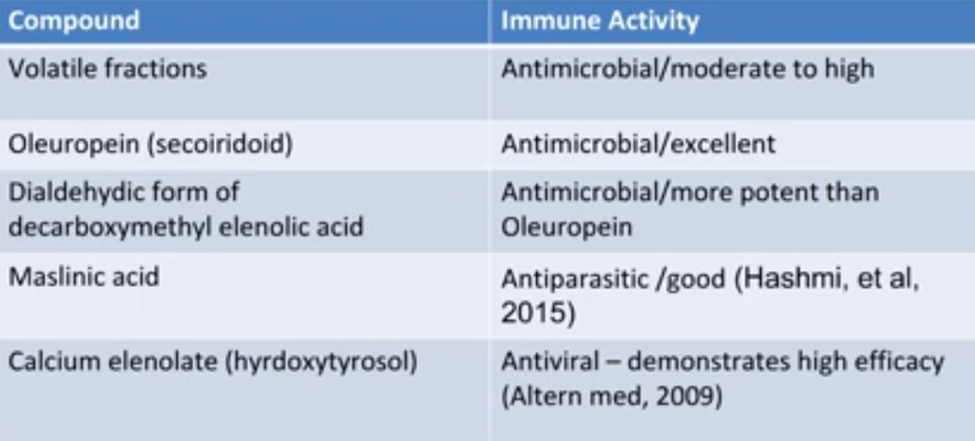
In vitro studies have demonstrated the antibacterial, antifungal, and antioxidant properties of Olea europae. Even at concentrations as low as 0.6% (w/v) olive leaf water extract was effective in eradicating both C. albicans and E. coli. 91 Sudjana, AN, et al. reported that olive leaf extract was active against Campylobacter jejuni, Helicobacter pylori, and Staphylococcus aureus, including methicillinresistant Staphylococcus aureus (MRSA), with the minimum inhibitory concentrations (MICs) as low as 0.31-0.78% (v/v). Olive leaf has also been noted to reduce viral loads, thus may also possess anti-viral properties. Additionally, it has also been demonstrated to be effective against HIV-1 via its inhibition of cell-to-cell transmission and replication in infected H9 cells.
History & Ethnobotanical Research
7,000 years of use.
- Aqueous extract was used for gout in the Mediterranean area. It has an enzyme that inhibits the activity of purines . Inhibitory effect of 80% dry ethanolic extract on xanthene oxidase (gout)
- Earliest Record of use as an anti-infective.
- 1808 – 1813 , during the Spanish War it was used as a febrifuge
- 1843 Fever and malarial infection
- 1931 Colic, gastrointestinal
- Long-term use in France.
- In Argentina, used for diarrhea, respiratory and urinary tract infections.
- The first modern medicine use came from Daniel Cadbury 150 years ago and he described using it for:
- Severe fever and malaria. Published in the first pharmaceutical journal on line. 1843 he discovered use of a tincture
- Dried leaf decoctions and tincture for respiratory and urinary tract infections, diarrhea, stomach and intestinal disease (Tapeworm).
- Boil a handful of leaves in a quart of water down to half its original volume, administer in wineglass doses every 3-4 hours until the fever is cured. Cadbury thought the bitter glycoside conferred its success. Later we discovered the bitter principle was oleuropein found in alcohol extracts. It’s a powerful polyphenol antioxidant.
- Mouth cleanser
- Infusion for hypertension
- Anti-inflammatory
- Diabetes
- Hoffman used it for viruses, retroviruses, bacterium and protozoa.
Constituents:
- Iridoid glycosides (oleuropein), it contains a minimum of 5% oleuropein on a dry matter basis.
- Flavonoids
- Elenolic acid
- Caffeic acid
- Secologanoside
- Oleoside
- Hydroxytyrosol-elenolate (and Methyl esters)
- Ligstroside
Leaf constituents support ethnobotanical uses.
Effects of Leaves
Olive leaf extract is used to enhance the immune system, as an antimicrobial, as an antioxidant, as a hypoglycemic agent, and in heart disease. Preparations of olive leaves help to control hyperglycemia in experimentally induced diabetes. Some practitioners tout its use in hepatitis. Animal tests have demonstrated hypotensive, antiarrhythmic and spasmolytic effects on the smooth muscle of the intestine, caused by the terpenes and phenols.
Genoprotective
- Improves cell stability
- Improves energy supply to cells
- Prevents tissue oxidation, too much oxidation from reactive oxygen species and nitric oxide causes damage called gene toxicity (damage to DNA)
- Improves chemical signaling
- Increases detoxification processes, improves SOD production, glutathione peroxidase
- Improves recovery
Tissue State Relevance
1. Cold / Depression (cooling, anti‑inflammatory, metabolic regulation)
Olive leaf extract reduces inflammatory signaling, improves glucose metabolism, and lowers blood pressure and lipids. These are classic “cooling excess heat/excitation” actions, but they also restore depressed metabolic tone in chronic inflammatory states.
- Anti‑inflammatory and immunomodulatory effects Examine
- Benefits for blood pressure, cholesterol, triglycerides, and atherosclerosis Examine
- Support for metabolic inflammatory conditions (e.g., PCOS) MDPI
Tissue-state relevance:
- Cooling chronic inflammatory “hot depression”
- Improving sluggish metabolic tone
- Reducing inflammatory stagnation
2. Heat / Excitation (cooling, febrifuge, antimicrobial)
Traditional use includes febrifuge, hypotensive, and antimicrobial actions — all strongly cooling.
- Used as febrifuge, hypotensive, and for infections (cold/flu, bacterial, viral) Examine
Tissue-state relevance:
- Clears heat from infectious excitation
- Reduces vascular excitation (hypertension)
- Cools febrile states
3. Damp / Stagnation (antimicrobial, diuretic, metabolic clearing)
Olive leaf’s antimicrobial and diuretic actions help resolve damp stagnation in urinary, hepatic, and infectious contexts.
- Diuretic, urinary/bladder tonic, antimicrobial uses Examine
Tissue-state relevance:
- Clears damp stagnation in urinary tract
- Reduces metabolic dampness (lipids, glucose dysregulation)
- Helps resolve microbial overgrowth patterns
4. Wind / Tension (vascular tension, pain modulation)
Phenolic compounds modulate vascular tension and may reduce certain pain pathways.
- Neuroprotective and pain‑modulating mechanisms Examine
- Hypotensive effects reduce vascular tension Examine
Tissue-state relevance:
- Eases vascular tension
- Supports nervous system modulation
- Useful in tension‑driven headaches (traditional use)
5. Dry / Atrophy (mildly drying, antioxidant, supports atrophic metabolic states)
Olive leaf is mildly drying due to its bitter phenolic profile and antioxidant actions.
- Rich in phenolics (oleuropein, hydroxytyrosol) with strong antioxidant activity Examine
- Supports chronic metabolic atrophy (diabetes, atherosclerosis) Examine
Tissue-state relevance:
- Mildly drying in damp‑atrophic patterns
- Restores tone in atrophic metabolic tissues
Summary Table
| Tissue State | Relevance | Evidence‑anchored actions |
|---|---|---|
| Heat / Excitation | Strong | Cooling, febrifuge, antimicrobial, hypotensive |
| Cold / Depression | Strong | Anti‑inflammatory, metabolic regulation, improves depressed metabolic tone |
| Damp / Stagnation | Strong | Diuretic, antimicrobial, lipid/glucose clearing |
| Wind / Tension | Moderate | Vascular tension reduction, neuroprotective, pain modulation |
| Dry / Atrophy | Mild–Moderate | Bitter/drying, antioxidant, supports chronic metabolic atrophy |
Practical herbal‑energetic profile
- Temperature: Cooling
- Moisture: Slightly drying
- Taste: Bitter‑pungent
- Primary actions: Anti‑inflammatory, antimicrobial, hypotensive, metabolic‑regulating, antioxidant
- Best fit: Chronic inflammatory metabolic patterns, infectious heat, vascular tension, damp stagnation
Uses
Indications:
- Hypertension
- Angina pectoris
- Possible uses for gout and fluid retention
- Selectively antimicrobial against Campylobacter jejuni, Helicobacter pylori and Staphylococcus aureus (Sudjana et al, 2008, Int Journal of Antimicrobial agents)
To prevent or treat cancer
Laboratory results show possible benefit, but human studies have not been conducted.
To lower cholesterol
Animal studies have shown a possible effect. Human studies are lacking.
To fight HIV
Laboratory results show possible benefit, but human studies have not been conducted.
To reduce high blood pressure
Animal and human studies show that olive leaf extract can lower blood pressure.
To fight infections
Laboratory results show olive leaf extract to be effective against a variety of microorganisms.
To promote urination
There is no evidence to support this claim.
Clinical Summary
Derived from the olive plant, both leaves and the extract have been used to treat infections, inflammation, diabetes, and hypertension. A major component of olive leaf, oleuropein, has antioxidant properties . Because of its hypoglycemic effects, the leaf extract can induce insulin release and improve peripheral uptake of glucose . Further, the leaf extracts demonstrated antimicrobial properties , anti-HIV , and anticancer properties. Animal studies showed antiarrhythmic, spasmolytic, diuretic , antihypertensive , analgesic , and cholesterol-lowering effects.
Small studies have shown effectiveness of olive leaf extract in reducing blood pressure in patients with hypertension . The anticancer effects of olive leaf extract in humans are not known.
Mechanism of Action
The cholesterol-lowering effects of olive leaf extracts (OLE) are thought to be due to oleuropein, a compound present in the leaves. Studies on hypercholesterolemic rats have shown that OLE is more effective at lowering cholesterol than pure oleuropein. This implies that a synergistic effect occurs between oleuropein and another substance within the leaf .
Oleuropein is converted into elenoic acid in the body which may prevent viruses and bacteria from replicating . The antihypertensive and vasodilating effects of olive leaf occurred independently of the integrity of the vascular endothelium . Constituents of olive leaf have been shown to strongly inhibit the complement system, although it is unknown what effect this has on the body.
Hypoglycemic activities of olive leaf are attributed to two mechanisms: potentiation of glucose-induced insulin release and increased peripheral uptake of glucose. Hypoglycemic activity is greater in samples collected in the winter months . OLE may prevent diabetic neuropathy by reducing glucose-induced apoptosis through the inhibition of neural caspase 3 activation .
In vitro studies show that OLE has antimicrobial activities against E. coli, Pseudomonas aeruginosa, S. aureus, K. pneumoniae, Trichophyton mentagrophytes, Microsporum canis, T. rubrum and Candida albicans . Anti-HIV properties of OLE include up-regulation of the expression of apoptosis inhibitor proteins as well as protein kinase signaling molecules . OLE promotes cell differentiation and induces DNA fragmentation leading to apoptosis in leukemia cell line.
Drug Interactions
Antihypertensive drugs: May increase blood pressure lowering effects .
Insulin and antidiabetic drugs: May increase hypoglycemic effects .
Chemotherapy drugs: May interfere with the actions of certain chemotherapy
drugs due to its antioxidant effects
POINTS OF NOTE:
Antioxidant as the phenolic compounds scavenge free radicals
Cardio protective due to anti oxidant, hypotensive and lipid lowering actions .
Hypotensive used to lower blood pressure and in angina pectoris
Bitter tonic – hypoglycemic and lipid lowering
The oleopein (phenolic compound) is the focus of much of the research and attributed with anti inflammatory and anti thrombotic properties
Anti viral (herpes simplex), anti bacterial (bronchitis) and anti fungal (tinea, candida)