Irving H
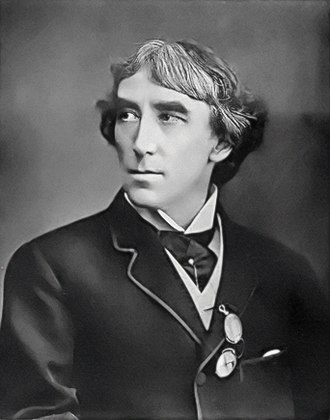
ACHIEVEMENTS: Famous actor/manager.
NICKNAME/ALIAS: Real name: John Henry Brodribb.
DATE AND PLACE OF BIRTH: 6 February 1838, Keinton Mandeville, Somerset, England.
DATE/PLACE OF DEATH/AGE AT DEATH: 13 October 1905, Bradford, Yorkshire. Aged 67.
DISCIPLINE: Actor
FIELD: Theater
LANGUAGE: English
EDUCATION: City Commercial School, London.
LIFE AND TIMES: The first ten years of Irving's life were spent in Cornwall with his maternal grandparents. In 1848 he moved back to his parents, who by now were living in London. His father took him to see Hamlet at Sadler’s Wells and Irving decided from that moment that he wanted to be an actor. In order to earn money, Irving worked as a junior clerk in a city legal firm and in an East India Co. merchants’ company, while spending as much time as he could reading plays and going to Sadler’s Wells.
He joined amateur acting groups, took elocution lessons and, in 1856, when an uncle gave him a hundred guineas, he spent it on hiring a costume and props. This was money well spent, as he was accepted the role of Shakespeare’s Romeo in an amateur performance at the Royal Soho Theatre, having paid three guineas for the privilege. Henry felt that Brodribb was no name for a romantic actor and chose his new surname, Irving, in deference to the author, Washington Irving*.
Irving learned his art on tour in England, Ireland and Scotland, playing more than four hundred different parts in three hundred and thirty productions, over a short span of three years. In 1866, at the age of twenty eight, he won a part opposite Kate Terry in a new play titled “Hunted Down”, by the Irish playwright Dion Boucicault, which was shown in London to a distinguished audience including George Eliot*. Success did not come immediately, and he was soon back in repertory, acting opposite Ellen Terry* in “The Taming of the Shrew”.
After seeing him act, Florence O'Callaghan struck up a relationship with Irving and they were married in 1869, but she soon became unhappy because she had no love for the theatre. Two years later, in 1871, Irving signed a contract with H.L.Bateman, the impresario, to appear at the Lyceum Theatre, playing a murderer haunted by his conscience. This became his first notable performance, and gained him the role of Jingle in “Pickwick”. Having gained notoriety and many friends, he argued with Florence when she implied that his profession made him look like a fool and consequently he never returned home or spoke to her again. He still supported his family, although he only saw his two sons when Florence brought them to the theatre to mock him.
By 1878, Irving had leased a theatre and built his own production company and, after having approached Ellen Terry to play Ophelia opposite his Hamlet, became renowned for spectacular, striking productions, staged with no expense spared. His talent, energy and personality, coupled with Terry's immense charm and beauty brought popularity for his Shakespearean productions. From 1879 - 1905 his productions were an enormous success, with the assistance of his manager, Stoker*, advice from his valet, his stage manager, and from Terry, who had become a great friend. Irving had been known to visit her home, for example when she entertained Tennyson*, who read them extracts from his play “The Cup”, much to the amusement of Terry's daughter Edith and the poet's son, Hallam, who laughed at his high, cracked voice for the parts of the women.
The Lyceum became a fashionable place to be seen, and Irving organised magnificent suppers after the performances, transforming lumber rooms back stage into venues for drinking and dining. Here he entertained writers, painters, musicians, lawyers, politicians and society figures, including the Prince and Princess of Wales. When he gave a birthday party for Princess May of Teck, later to be crowned Queen Mary(https://app.thebrain.com/brain/f3e16344-7cd9-4fa3-ae1d-59876e128474/5078e4e7-20e9-5f39-91ff-a73a755eb822), it was Ellen Terry who acted as his hostess. Irving became both admired and influential and was the hero of the young painter, Sickert*, who was fascinated by the stage.
In 1879, Irving staged a production of “The Merchant of Venice”, and having seen Venice and the Eastern Mediterranean as a guest of Baroness Burdett Coutts on her yacht, he portrayed Shylock as elegant and dignified, instead of the usual grotesque anti-Semitic character. Following the hundredth performance, he sent out three hundred invitations to a five-course dinner at which he gave each guest a gold embossed copy of the play.
Four years on, in 1883, he toured America with the company and triumphed there.
Based on this success, Irving kept the same repertory for further tours. At the time, George Bernard Shaw* was a young critic and pointed out to Irving that, apart from the Shakespeare, the other plays in his repertoire were of no lasting merit. After reading 'The Man of Destiny', Irving gave Shaw a retainer and subsequently forgot about it. Shaw then started corresponding with Ellen Terry, urging her to leave Irving. By the end of the 1890's, Irving's success was waning and he had permanent damage from a knee injury. A fire destroyed all of the scenery of much of his repertoire, for which he had been under-insured, and he had become ill with pleurisy and pneumonia.
With unfaltering bad luck, his partnership with Ellen Terry ended and, in 1902, the company went into liquidation. Despite his illness, he had no choice but to continue acting in order to survive financially. In 1905, Irving performed in Tennyson's “Becket” at the Theatre Royal in Bradford, and following his performance on October 13th, at the age of sixty-eight, he died.
ASSESSMENT: A bravura actor of the 'old school' and successful actor/manager.
EXTRA CONNECTION: Millais* and Forbes-Robertson* painted him.
He encouraged Barrie*
Tree*? Craig*?
Conan Doyle* sold him his play “Waterloo”.
Burne-Jones* designed costumes for a play he acted in.
A fan was Burdett-Coutts*
Influence on Bram Stoker's Dracula
Main article: Dracula
From 1878, Bram Stoker worked for Irving as a business manager at the Lyceum. Stoker idolised Irving to the point that "As one contemporary remarked, 'To Bram, Irving is as a god, and can do no wrong.' In the considered judgment of one biographer, Stoker's friendship with Irving was 'the most important love relationship of his adult life.'"[17] Irving, however, "… was a self-absorbed and profoundly manipulative man. He enjoyed cultivating rivalries between his followers, and to remain in his circle required constant, careful courting of his notoriously fickle affections."[17] When Stoker began writing Dracula, Irving was the chief inspiration for the title character.[17] In his 2002 paper for The American Historical Review, "Buffalo Bill Meets Dracula: William F. Cody, Bram Stoker, and the Frontiers of Racial Decay",[17] historian Louis S. Warren writes:
Scholars have long agreed that keys to the Dracula tale's origin and meaning lie in the manager's relationship with Irving in the 1880s. … There is virtual unanimity on the point that the figure of Dracula—which Stoker began to write notes for in 1890—was inspired by Henry Irving himself. … Stoker's numerous descriptions of Irving correspond so closely to his rendering of the fictional count that contemporaries commented on the resemblance. … But Bram Stoker also internalized the fear and animosity his employer inspired in him, making them the foundations of his gothic fiction.
Later years
The chief remaining novelties at the Lyceum during Irving's term as sole manager (at the beginning of 1899 the theatre passed into the hands of a limited-liability company) were Arthur Conan Doyle's Waterloo (1894);[18] J. Comyns Carr's King Arthur in 1895; Cymbeline, in which Irving played Iachimo, in 1896; Sardou's Madame Sans-Gene in 1897; and Peter the Great, a play by Laurence Irving, the actor's second son, in 1898.[7]
Irving received a death threat in 1899 from fellow actor (and murderer of William Terriss) Richard Archer Prince. Terriss had been stabbed at the stage door of the Adelphi Theatre in December 1897 and in the wake of his death, Prince was committed to Broadmoor Criminal Lunatic Asylum. Irving was critical of the unusually lenient sentence, remarking "Terriss was an actor, so his murderer will not be executed." Two years later, Prince had found Irving's home address and threatened to murder him "when he gets out". Irving was advised to submit the letter to the Home Office to ensure Prince's continued incarceration, which Irving declined to do.[19]
In 1898 Irving was Rede Lecturer at the University of Cambridge.
In T. S. Eliot's poem, "Gus: The Theatre Cat" (c. 1939), the title character's old age and theatrical distinction are expressed in the couplet:
*For he once was a Star of the highest degree--
He has acted with Irving, he's acted with Tree.*
These verses appear in the lyrics of the homonymous song in Andrew Lloyd Webber's 1981 musical Cats.
ONELINER: Henry Irving, great Victorian tragedian
BIBLIOGRAPHY:
Bingham, Madeleine, Henry Irving, The Greatest Victorian Actor, Stein and Day, New York, 1978.
Treves, Frederick, “The Case of Sir Henry Irving, 1898,” in The Newsletter of The Irving Society, vol one, number 1, June 1997.
PARENTS: Father: Samuel Brodribb, a salesman for tailors. Mother: Mary Behenna.
SIBLINGS:
SPOUSE: Florence O'Callaghan.
CHILDREN: Two sons.