Boussingault JBJD
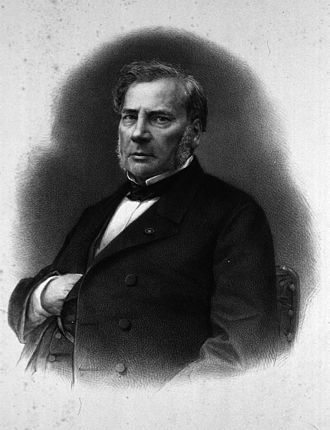
Jean-Baptiste Joseph Dieudonne Boussingault
Achievements: Made major advances in the understanding of the nitrogen cycle.
Born: February 2, 1802; Paris, France
Died: May 11, 1887; Paris, France
Field & Discipline: Science; Chemistry
Language: French
Father: Name Unknown (tobacco shop owner)
Mother: Elisabeth Munch
Siblings: Unknown
Spouse: Name Unknown (from Alsace)
Children: One son; two daughters
Education: Unknown
Major Work:
“Agronomy, Agricultural Chemistry and Physiology” (1860-74)
Life & Times:
Boussingault qualified as an engineer at the French St Etienne School of Mines and then between 1821 and 1832 spent time as a director of mining operations for an English company in South America, where he also did geological and meteorological research. And very probably met the English engineer [likely met] Robert Stephenson*In 1839 this work won him election to the Academie Francaise, thanks to the support of the great German explorer [supported by] Alexander von Humboldt*. Boussingault was briefly attached to the staff of General Bolivar during the revolution against the rule of Spain.
After returning to France he became Professor of Chemistry at Lyon University and in 1839 was made Professor of Agricultural and Analytical Chemistry at the Paris Conservatory of Arts and Crafts. In 1848 he was elected to the National Assembly as a moderate Republican. After losing his teaching post because of his political activities, he was then reinstated after a protest by his academic colleagues.
Boussingault was influenced by the ideas of [influenced by] Thenard*, [influenced by] Gay-Lussac*, [influenced by] Cuvier* and [influenced by] RJ Hauy.*
At his wife’s farm at Bechelbronn, in the north-eastern French province of Alsace, Boussingault tested out his theories on soil fertility, crop rotation, plant and soil fixation of nitrogen, ammonia in rainwater, and nitrification.
Between 1837 and 1854 he suggested that plants might get their nitrogen from the atmosphere (he later changed his mind), that legumes seemed to provide soil with much more nitrogen than did artificial fertilizer, that animals got their nitrogen from plants, and that rain didn’t contain enough ammonia for satisfy plant nitrogen requirements.
In 1859 he showed that the nitrate level of plant-free soil spontaneously increased and suggested that this might involve activity by micro-organisms. His work essentially brought microbiology into the study of plant growth with his idea that plants fixed their nitrogen from nitrates in the soil
In 1857 he was awarded the Legion d’Honneur.
Extra Connections: He collaborated in a paper with chemist [collaborated with] JBA Dumas*
He studied under [studied under] Regnault*
He was influenced by [influenced by] Cuvier*
At Santa Fe de Bogota he was attached to the staff of General Bolivar as colonel and traveled widely in the northern parts of the continent. Between March and December 1831, he attempted to climb seven Andean volcanoes: Puracé, Pasto and Cumbal in Colombia, and Pichincha, Antisana, Cotopaxi and Chimborazo in Ecuador.[2] In 1831 he climbed to a new highest altitude by a Western explorer on Chimborazo (6.006 m) in the process.
The mineral Boussingaultite is named after him.
Assessment: An important figure in the development of agricultural chemistry
Oneliner: JBJD Boussingault, French nitrogen-cycle chemist
Bibliography:
- Dictionary of Scientific Biography.
- Encyclopedia Britannica.