Suleiman
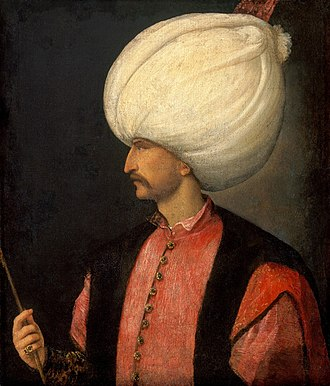
Nickname/Alias: The Magnificent; Kanuni (Law Giver), Suleiman
Achievements: Sultan who brought Turkish culture to its peak.
Born: April 27, 1497; Trebizond, Turkey
Died: September 5/6, 1566; near Szigetvár, Hungary (Aged 69)
Field & Discipline: Royalty; Sultan
Language: Turkish
Father: Sultan Selim I
Mother: Unknown
Siblings: None
Spouse: Gulbahar; Roxelane
Children: Mustafa (d. 1553); Bayezid (d. 1566); Selim II (ruled)
Education: Unknown
Life & Times:
Suleyman began his reign with campaigns against the Christian powers in central Europe and the Mediterranean, and in 1522 he drove the Knights of St. John off the island of Rhodes. His major rivals were the King of Hungary and the Holy Roman Emperor [fought] Charles V*, in central Europe and the Mediterranean. In the first phase of Suleyman's wars in Hungary , persistent Ottoman attacks during 1520-26 ended with the Battle of Mohacs (southern Hungary) in August 1526, with the defeat of the Hungarian king, Louis II, who was killed in the battle.
Once peace was established with Austria in 1533, Suleyman was able to turn his whole attention to the East, where he embarked on three major campaigns against the Persian Safawids in 1534-35, 1547-48 and 1554-55. Although he was able to conquer Iraq, most of Kurdistan, and western Armenia, Suleyman was unable to force the Safawids into a decisive battle. As a result, in 1555 Suleyman negotioated peace with the Safawids, which forced him to abandon Ottoman ambitions in Azerbaijan and eastern Armenia.
Suleyman succeeded more dramatically at sea. The earlier Ottoman defeats of Venice (1505) and Egypt (1517) had by 1520 placed the empire in a position to control the eastern Mediterranean, and after having taken the island of Rhodes (1522), Suleyman went on to conquer Tripoli and Algiers in Northern Africa. Suleyman's ambition was to end the naval dominance of the Mediterranean by Hapsburg Spain, and in 1536 he then made an important military alliance with Francis I of France, in which he granted the French commercial privileges which made France the primary western trader in the Ottoman Empire and allowed the Ottomans, with French military support, to carry out in 1536 a naval attack.
Venice soon joined the war, but on 25 September 1358 the allied Venetian-Hapsburg fleet was defeated at the Battle of Preveza, off the western coast of Greece. With this important defeat, Ottoman dominance of the Mediterranean was established for the next half-century.
Suleyman now ruled the Arab lands from the Mediterranean to the Red Sea and Persian Gulf which, combined with his newly-won supremacy in the Mediterranean, allowed him to defend the old Middle East trade routes leading from India and China to Europe against Portuguese attempts to divert Far East trade to a route leading around the Cape of Good Hope. Effectively at war with the Portuguese on the Indian Ocean throughout much of his reign, during the 1530s and 1540s Suleyman occupied the principal ports on the Red Sea and Persian Gulf, from where he sent a series of naval expeditions into the Indian Ocean.
Suleyman surrounded himself with a group of highly able administrators and statesmen, with whose help he proceeded to issue a series of laws (“kanun”) covering all aspects of Ottoman administration and society - the first time that a system of Ottoman government was reconciled with the theory of Islamic government expressed in the Islamic religious law (“Sharia”) and then set down in writing. Many of these reforms were aimed at setting higher standards of justice and administration and ensuring freedom of religion throughout the empire, and for this reform and codification of Ottoman law, Suleyman has always been known to the Turks as “Kanuni,” or the “Law Giver.”
Suleyman was also a highly cultured man, who encouraged learning and the arts and adorned the major cities of the Islamic world (Mecca, Damascus, and Baghdad) with mosques, bridges, aqueducts, and other public works. He also devoted much of his time to completing the transformation of the previously Byzantine city of Constantinople into Istanbul, which became the centre for a great Turkish and Islamic empire, and where he built the magnificent Topkapi Palace.
During the late 1550s, Suleyman aged rapidly and became increasingly withdrawn from the affairs of state, which he left to a grand vizier who became the chief administrative and military officer of the empire. This left the various elements in government and society free to plot over succession to the throne. This latter issue was first centred upon the conflict between Suleyman's two sons, Mustafa and Selim. Mustafa was executed in 1553 on the order of Suleyman himself.
During 1559-61 a conflict between the princes Selim and Bayezid over the succession to the throne ended with the defeat and execution of Bayezid, with Selim's rise to power greatly aided by the support of his mother, Queen Roxelana, and the financial backing of [son’s adviser was] Nasi*. Suleyman himself lived to see the Ottoman withdrawal from Malta in 1565.
Extra Connections:
Saw failure of the [saw failure of] Siege of Malta*
Assessment: During Suleyman's reign Ottoman power abroad and institutions and culture at home reached the peak of their achievement.
Oneliner: Suelyman the Magnificent, Sultan of Turkey
Bibliography:
- Collier's Encyclopedia.
- Bridge, Antony, Suleiman the Magnificent: Scourge of Heaven, Granada: London, 1983.
- Clot, Andre,Suleiman the Magnificent: The Man, His Life, His Epoch, trans. Matthew J. Reisz, Saqi Books: London, 1992.
- Encyclopedia Britannica.