Charles V
Charles V, Holy Roman Emperor and King Charles I of Spain
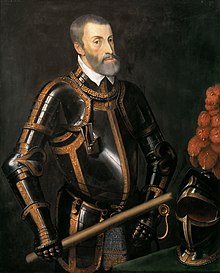
Achievements: Holy Roman Emperor
Born: February 24, 1500; Ghent
Died: September 21, 1558; San Jeronimo de Yuste, Spain (Aged 58)
Field & Discipline: Royalty; King; Emperor
Father: Philip I (the Handsome), king of Castile
Mother: Joanna of Castile (aka "Joan the Mad")
Siblings: Ferdinand, king of Hungary and Bohemia
4 sisters: Eleonore; Katherine; Mary; Isabella
Spouse: Isabella (daughter of King Manuel I of Portugal)
Children: Philip II of Spain
Education: Private tutors under Adrian of Utrecht (later Pope adrian VI)
Life & Times:
On his father's side, Charles was the grandson of Queen [grandson of] Isabella* of Castile and Ferdinand II of Aragon; his maternal grandparents were Mary of Burgundy and the Emperor [grandson of] Maximilian I* who ruled over the Hapsburg empire in Germany.
He became ruler of the Netherlands when he was fifteen, and a year later became king of Spain when Ferdinand died. He was unpopular and when he left Spain in 1519 the Castilians rebelled against his government.
In the same year, another European throne became vacant when Maximilian died, and with financial backing from the [financially helped by] Fugger* banking family, Charles beat his rival Francis I of France and was crowned king of Germany and Emperor-elect in 1520 at Aachen, Germany.
At a meeting of the German Parliament the following year, Charles issued the Edict of Worms, which attacked Protestantism. Charles had now made enemies among the Protestant rulers in Germany like [enemy of] Frederick III* the Wise of Saxony, patron of the artists [patron of] Durer* and [patron of] Cranach* and now protector of [protector of] Luther*.
Charles had a more threatening enemy in Francis of France. Francis had taken over the Duchy of Milan in Italy and when the ousted Duke turned to Charles and Pope Leo X for help in 1521, war between Spain and France broke out. Charles also had to deal with the trouble caused by the Castilians on the western flank of his empire. He went back to Spain in 1521, signed a great many death warrants and savagely put down the rebellion. From this time on, Spain became his true home, and Spanish wealth and soldiers became his prime resource.
In 1525 Francis I was captured by Charles's army at Pavia in Italy and imprisoned in Spain. Francis signed the Treaty of Madrid in 1526 but as soon as he was free he reneged. At the same time a new threat appeared in Europe: the Sultan of Turkey who was encroaching on Charles’ territory east of Vienna. As Holy Roman Emperor, it was Charles's sacred duty to repel the Turks, but his resources were overstretched. He had strengthened his hand in Western Europe by marrying Isabella of Portugal in 1526 but Francis of France allied himself with the Pope, both of them resenting Spanish influence in Italy.
In May 1527 Charles sacked Rome and the terrified Pope changed sides. Charles later asked the writer [employed] Aretino* to write up the Sack of Rome in a good light. Meanwhile Margaret of Austria, Charles's aunt, got together with Francis's mother and in 1529 the two women pushed through the Peace of Cambrai, and the war between Francis and Charles ended. Charles renounced his claim to Burgundy, and Francis renounced his claim to Milan and Naples. In 1530, the Pope travelled to Bologna and crowned Charles as Holy Roman Emperor.
Charles now turned his attentions to reforming the Catholic church and to an attempt at reconciliation with the German Protestant princes. The Protestant princes banded together in the Schmalkaldic League and won concessions for Lutheranism from Charles when he needed their help to defend Vienna from the Sultan's forces in 1532. Charles put a huge army outside Vienna but there was no action.
The following year he left for Spain where he concentrated on a plan to conquer Turkish territory in North Africa. After skirmishing with the Barbary pirates, he took Tunis in 1535. A poem celebrating this event was illustrated by the miniaturist [victory painted by] Clovio*.
Meanwhile, Francis had taken the opportunity to invade Italy again, so Charles sailed from Africa to Italy. In 1536 he entered Rome and in the presence of the Pope made his famous challenge to engage with Francis in single combat. When Francis declined, Charles invaded Provence, before a peace was brokered by the Pope in 1538. Charles now faced a rebellion in his native city of Ghent in the Netherlands. He arrived there in 1540 and put down the uprising with great severity.
In 1541 he called for a meeting at Regensburg where he supported the efforts of the Protestant reformer [supported] Bucer* to reconcile Protestant and Catholics. Despite pleas from his brother who had now lost land in Hungary to the Turks, Charles once again chose to strike at the Sultan by sea an episode which ended in the defeat of imperial forces at Algiers. Lack of finance was now hindering Charles's continued war with France and the two armies twice came face to face with no action, before signing the peace of Crepy in 1544.
Meanwhile in Germany he was again being challenged by the German princes. Talks about religious differences took place and were attended by distinguished humanists such as [negotiated with] Agricola* but in April 1547 the matter was settled at the battle of Muhlberg when Charles defeated the rebellious princes. During an extended stay in Augsburg Charles attempted to set his Empire in order. He reorganised the Spanish court, sorted out the responsibilities to the Empire within his Burgundian possessions and made further concessions to the Protestants in Germany. He wrote a political testament about the management of the empire to his son, the future [son was] Philip II of Spain*, and also had his portrait painted by Titian*.
In 1551 the German princes rose up against imperial authority once again, this time aided by the new king of France, [fought against] Henri II*. Charles was lucky to escape capture but he was still forced to agree that Protestants should have equal rights with Roman
Catholics. The Elector of Saxony had given imperial lands to France, and when Charles attempted unsuccessfully to retake Metz, Burgundy fell to France. Exhausted and disillusioned, Charles now occupied himself with plans for retirement. He arranged for Philip to marry Mary I of England.
In 1554 he gave his German territory to his brother Ferdinand. On 25 October 1555 he abdicated the crown of the Netherlands in favour of Philip, and on 26 January 1556 he passed on to Philip the crown of Spain, the Spanish empire in the New World and Spanish possessions in Italy. Charles arrived in Spain in September 1556 and withdrew to the monastery of Yuste at the beginning of 1557.
Extra Connections:
Fought [fought against] Suleyman the Magnificent 2* over [his troops defended] Malta*
He knighted [knighted] Apian*
Commissioned work from [commissioned] Erasmus*
Negotiated with [negotiated with] Frederick III* of Saxony about Luther
Established the Dukedom of [established] Cosimo de Medici (Grand Duke)*
His edicts related to [edicts related to] Melanchthon*
He commissioned work from [commissioned] Mercator*
He had financial dealings with [financial dealings with] Nasi*
He delayed the [delayed] Council of Trent*
His coronation was attended by [coronation attended by] Trissino*
His apothecary was the father of [apothecary was father of] Vesalius*.
In 1520, Charles visited England, where his aunt, Catherine of Aragon, urged her husband, Henry VIII, to ally himself with the emperor.
Assessment: Charles was ultimately defeated by the conservatism of the Catholic church and by the new forces of Protestantism and nationalism.
Oneliner: Charles V, Holy Roman Emperor
Bibliography:
- Brandi, Karl, The Emperor Charles V, Jonathan Cape, London, 1939.