Hess M
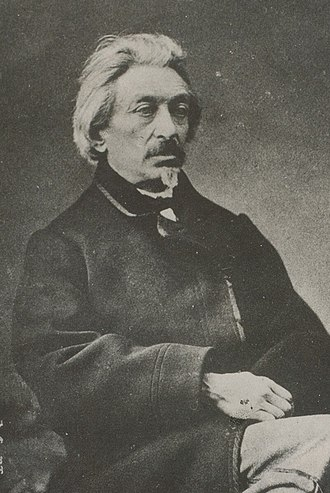
Name: Moses Hess
Nickname/Alias: born: Moritz Hess
Achievements: Pioneer works on Socialism and Zionism.
Born: June 21, 1812; Bonn, Germany
Died: April 6, 1875; Paris, France. Aged 63
Field & Discipline: Government & Politics; Journalism; Journalist; Zionist
Language: German
Father: David Hess
Mother: Jeanette Florsheim
Siblings: Unknown
Spouse: Sibylle Pesch
Children: None
Education: Jewish school, Bonn, Germany
Major Work:
“Rome and Jerusalem: A Study in Jewish Nationalism” (1862)
Life & Times:
Hess still hadn’t chosen a profession or vocation when he was in his early twenties and, after teaching himself arithmetic, history, English and Latin, he enrolled at the University of Bonn in 1837.
In the same year, he anonymously published his first book: "The Holy History of Mankind.” As well as showing the influence of [influenced by] Spinoza*'s work, the book demonstrated Hess's interest in [influenced by] Hegel*'s transcendental philosophy, even though he had not yet studied Hegel in any great depth.
There is no record of his attendance at the university, although it is known that he left after only a year. At that time, he was already working on a less philosophical and more openly political book, "The European Triarchy,” in which he proposed an alliance of French, English and German radicals.
The book was published in 1841 and resulted in a group of liberal businessmen taking him on as editor of a radical newspaper they had just founded. Hess began editing the “Rhinelander Gazette” in January 1842, but soon afterwards left for Paris, where he continued to work as a correspondent for the “Gazette.”
He was now meeting radical activists and thinkers outside his own circle of young Jews. One of the leading activists was [influenced by] Karl Marx*, who was also working for the “Gazette” and, although Marx was six years younger than Hess, he immediately saw in him an extraordinary force.
Hess never again made a permanent home in Germany, although his articles regularly appeared in the German press. For German radicals, Hess was the main voice of new Socialist and Communist thinking in France. He was a member of a circle of young Hegelian idealists and, after 1844, became closely associated with Heine and [influenced by] Engels*.
Working with Marx, Hess co-wrote “German-French Annals” and later visited Germany, attending lectures and meeting workers in their clubs. The French authorities disapproved if his ideas so, like Marx, he moved to Brussels, where he edited a radical journal and gave Marx and Engels help with their book “The German Ideology.”
In 1847, the year Marx and Engels published the Communist Manifesto, Hess joined the League of Communists and, when many European countries were in the grip of revolution in 1848, Hess went to Germany and tried unsuccessfully to re-publish the “Rhinelander Gazette.”
That spring he went back to Paris, then travelled to Geneva, Basle, Strasbourg and Zurich, preaching the radical cause and trying to organise groups of workers. During this time, Hess moved away from Marx towards more radical groups.
On the death of his father in 1851, Hess inherited enough money to live as an independent man of letters. The following year, he returned to Paris in poor health, after his travels during the years of revolution and there, he found an interest in the natural sciences, as well as writing on the subject of economics.
In 1861, Prussia declared an amnesty for the 1848 revolutionaries and Hess went back to Germany, where he became the corresponding member of the Berlin Philosophical Society and appeared to settle down. In 1862, however, he surprised everybody, when he published “Rome and Jerusalem: A Study in Jewish Nationalism.” This was his most important work, for which he is best remembered.
In the book, Hess declared that until the Jews established their own nation, they would always be homeless and never fully accepted, no matter how much they tried to integrate. His solution was that the Jews should return to Palestine. The book had a great influence on the thinking of later Zionists such as [influenced by] Herzl*.
Liberals were shocked to think that Hess saw Jewish integration and assimilation as failed compromises. They preferred to see Jewishness as something purely religious, choosing to ignore ethnic considerations. To Hess, this was to ignore history and to deny Jews their past and their identity. He maintained that religion had become central to the Jews only in their exile from Israel.
By now, Hess was once again actively engaged in Socialist politics and was elected by the German Workingmen's Association as their representative in Cologne. He published two pamphlets in Germany, “On the Rights of Labor” and “On Social and Economic Reforms.”
In 1863, he went back to live in Paris, where he continued to contribute to the German “Social Democrat” and wrote for the "Archives Israelites" in Paris, as well as the Socialist press in America, which was targeting German immigrants at the time.
In 1868, Hess attended the third congress of the International Workingmen's
Association in Brussels and the following year he went to the fourth congress in Basel, Switzerland, where he deputised for Marx.
When the Franco-Prussian war broke out in 1870, Hess was kicked out of France
and went to live in Brussels, where he published articles attacking [wrote attacks on] Bismarck*, the German Chancellor. These articles stood him in good stead with the French and he was allowed back into Paris after the war. In his last years, Hess spent most of his time studying the natural sciences and his writings on the subject, "The Dynamic Theory of Matter,” were published after his death.
Extra Connections: His work was studied by [studied by] Lenin*
He married a poor Catholic seamstress, Sibylle Pesch, "in order to redress the injustice perpetrated by society". Although they remained happily married until Hess' death,[2] Sibylle may have had an affair with Friedrich Engels while he was smuggling her from Belgium to France to be reunited with her husband. Sibylle, however, claimed the relationship was non-consensual and accused Engels of rape.[6] The incident may have precipitated Hess' split from the Communist movement.
Assessment: Moses Hess was an early Socialist who influenced Karl Marx. He was one of the first Jewish writers to propose the view that Jews should have their own homeland.
Oneliner: Moses Hess, pioneer of socialism and Zionism
Bibliography:
- Avineri, Shlomo, Moses Hess: Prophet of Communism and Zionism, New York University Press, 1985.