Hegel
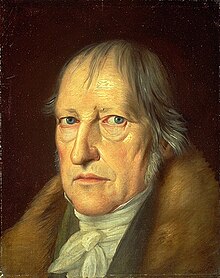
Achievements: Philosophy
Born: August 27, 1770; Stuttgart, Germany
Died: November 14, 1831; Berlin, Germany (Aged 61)
Field & Discipline: Philosophy; Philosopher
Language: German
Education: Stuttgart Grammar School; Tubingen University
Major Works:
"The Phenomenology of the Spirit" (1807)
"The Science of Logic" (1812-1816)
Life & Times:
Hegel was sent to university to prepare him for the church but he paid more attention to philosophical works such as those by [influenced by] Herder*. From Herder he got the idea that the social divisions in contemporary Germany resulted in a fragmented state with no shared social interests. His closest student friends were the lyric poet JCF Holderlin and the nature philosopher [a pal of] Schelling* with whom he studied Greek literature, and shared enthusiasm about the French Revolution.
Hegel left college in 1793 and for the next three years worked in Berne, Switzerland as a private tutor. He was attracted to the philosophy of [influenced by] Kant*, who rejected religious orthodoxy on the grounds that it involved both the acceptance of historical facts which cannot be proved and of rules of behaviour allegedly laid down by divine revelation. In 1796 Hegel went to Frankfurt where he studied Greek philosophy, economics, politics and modern history. When his father died and left him an inheritance in 1799 he moved to Jena where [influenced by] Fichte* had developed his ethical idealism, and where Schelling was already expounding his nature philosophy. Hegel, with his orderly mind, looked to logic for an answer.
In 1802-3 Hegel edited the "Critical Journal of Philosophy" with Schelling, who had persuaded the publisher [supported by] Cotta* to support them. In 1806 Napoleon and the French defeated the Prussians at Jena, an event welcomed by Hegel and his friend the poet [a pal of] Goethe* who both saw Prussian bourgeois society as hidebound and corrupt.
The day before the battle of Jena, Hegel finished his first major work "The Phemonology of the Spirit" (1807), a difficult and complex work. Unlike other philosophers of the time, such as [work differed from] Herbart*, who examined the processes of the mind, Hegel's approach was non-mathematical.
He saw the essence of man as the spirit and he traced the history of the human mind from its earliest beginnings of mere consciousness through self-consciousness and rationality to a state of spirituality. He acknowledged the input of the senses to the human mind but stressed that intellectual processes acting on the sense perceptions were equally important. The state of spirituality revealed the real world order. For Hegel, nothing was finally real except the whole, which he calls the Absolute.
On the strength of this work, Hegel was much in demand. He turned down offers from the universities of Erlangen and Berlin and accepted the chair of philosophy at Heidelberg. In 1816 he published the third and final volume of "The Science of Logic," generally taken to be the culmination of his philosophical system, in which he presented his theory of the Absolute, a spiritual concept which was also an objective force.
The Absolute, or "geist" (spirit), manifested itself as the "weltgeist" (the world spirit) in a number of manifestations, such as certain nations and individuals.
The Hegelian system is a complex one that embraces and gives meaning to everything in the universe through its relation to the Absolute. Hegel presents his arguments dialectically by stating thesis, antithesis and synthesis. Bertrand Russell's commentary on Hegel explained it this way:
Thesis: reality is a mother.
Synthesis: the reality of a mother implies a child.
So the Absolute, the whole, is mother and child.
Antithesis: this position is still not logical, because the mother can only be a mother if she herself has parents and a partner; the child can only be a child if it has a father as well as a mother; and these ramifications will also be part of the Absolute.
And so on and on, ever outwards. Logically, therefore, the Absolute is a concept which can only be grasped by humans who have attained spiritual insight.
All Hegel's later work can, to a large extent, be seen as an attempt to intellectualize his conviction of the Absolute as the "geist" (the spirit).
In 1818 Hegel went to Berlin to take the chair of philosophy left vacant by Fichte. In the "The Philosophy of Right (or Law)" he considers universal laws for all mankind, and the way in which such laws can take account of individual conscience. The third and final section examines the type of political state in which such an ideal law could exist. Hegel describes a state where there is a limited monarchy, parliamentary government, trial by jury and religious toleration.
His work in esthetics was nourished by his own keen interest in art. His esthetics lectures were attended by the composer [taught] Felix Mendelssohn*. In his "Philosophy of Religion" Hegel attempted to demonstrate that the dogmatic creed is the rational development of religious feeling. His most important contribution was his historical philosophy, which was evolutionary, suggesting that humankind had advanced through time, spiritually and morally, towards self-knowledge.
He held that the question of reality is a metaphysical one, and the question of value is ethical. Both must be considered when deciding on right action.
Hegel's historical philosophy was profoundly influential for many leading figures, including the Zionist [influenced] Moses Hess*, the political theorists [influenced] Karl Marx* and [influenced] Engels*, and the educationalist [influenced] John Dewey*. The French philosopher [influenced] Hippolyte Taine* was inspired by Hegel to look to for a single answer to explain life, while the botanist [opposed by] Schleiden* was strongly critical of Hegel's metaphysical stance, and the Danish philosopher Kierkegaard* also reacted against certain aspects of Hegelianism.
In Germany, [opposed by] Schopenhauer* immediately opposed Hegelian philosophy.
In 1828 Hegel was further offended by lectures given by the explorer [attacked] Alexander von Humboldt* in which he attacked post-Kantian philosophy and, by implication, Hegel. In the last years of his life he wrote and spoke against the liberal modernizers in political life who advocated devolved power, which Hegel thought would work against the necessary unity of the country.
Extra Connections: He inspired [suggested America to] Roebling* to emigrate to America.
His work related to that of [work related to] Piazzi*.
His work related to that of [work related to] Brandes*
He influenced [influenced] Turgenev* and [influenced] Naegeli*
As a student US Ambassador George [lectures attended by] Bancroft* attended his lectures.
Assessment: Hegel was one of the founders of modern philosophical thought.
Oneliner: GWF Hegel, major philosopher
Bibliography:
- Pinkard, Terry, Hegel, A Biography, Cambridge University Press, Cambridge, 2000.
Father: Father: Georg Ludwig Hegel
Mother: Maria Fromm
Siblings: 1 brother: Georg
1 sister: Christiane
Spouse: Marie von Tucher
Children: 2 sons: Immanuel, Karl