Hegel 2
(see main Hegel node)
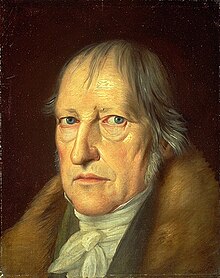
Georg Wilhelm Friedrich Hegel (/ˈheɪɡəl/;[1][2] German: [ˈɡeːɔʁk ˈvɪlhɛlm ˈfʁiːdʁɪç ˈheːɡl̩];[2][3] 27 August 1770 – 14 November 1831) was a German philosopher: one of the most influential figures of German idealism and 19th-century philosophy. His influence extends across the entire range of contemporary philosophical topics, from metaphysical issues in epistemology and ontology, to political philosophy, the philosophy of history, philosophy of art, philosophy of religion, and the history of philosophy.
Born in 1770 in Stuttgart, Holy Roman Empire, during the transitional period between the Enlightenment and the Romantic movement in the Germanic regions of Europe, Hegel lived through and was influenced by the French Revolution and the Napoleonic wars. His fame rests chiefly upon The Phenomenology of Spirit, The Science of Logic, his teleological account of history, and his lectures at the University of Berlin on topics from his Encyclopedia of the Philosophical Sciences.
Throughout his work, Hegel strove to address and correct the problematic dualisms of modern philosophy, Kantian and otherwise, typically by drawing upon the resources of ancient philosophy, particularly Aristotle. Hegel everywhere insists that reason and freedom are historical achievements, not natural givens. His dialectical-speculative procedure is grounded in the principle of immanence, that is, in assessing claims always according to their own internal criteria. Taking skepticism seriously, he contends that we cannot presume any truths that have not passed the test of experience; even the a priori categories of the Logic must attain their "verification" in the natural world and the historical accomplishments of humankind.
Guided by the Delphic imperative to "know thyself," Hegel presents free self-determination as the essence of humankind – a conclusion from his 1806–07 Phenomenology that he claims is further verified by the systematic account of the interdependence of logic, nature, and spirit in his later Encyclopedia. He asserts that the Logic at once preserves and overcomes the dualisms of the material and the mental – that is, it accounts for both the continuity and difference marking of the domains of nature and culture – as a metaphysically necessary and coherent "identity of identity and non-identity."
- Life
- Influences
- Philosophical system
- Philosophy of art
- Christianity
- History, political and philosophical
- Dialectics, speculation, idealism
- Criticism and legacy
- Publications and other writings
- Notes
- References
Life
Formative years
Stuttgart, Tübingen, Berne, Frankfurt (1770–1800)
 The birthplace of Hegel in Stuttgart, which now houses the Hegel Museum
Hegel was born on 27 August 1770 in Stuttgart, capital of the Duchy of Württemberg in southwestern Germany. Christened Georg Wilhelm Friedrich, he was known as Wilhelm to his close family. His father, Georg Ludwig, was secretary to the revenue office at the court of Karl Eugen, Duke of Württemberg.[4][5] Hegel's mother, Maria Magdalena Louisa (née Fromm), was the daughter of a lawyer at the High Court of Justice at the Württemberg court. She died of bilious fever when Hegel was thirteen. Hegel and his father also caught the disease, but they narrowly survived.[6]
Hegel had a sister, Christiane Luise (1773–1832); and a brother, Georg Ludwig (1776–1812), who perished as an officer during Napoleon's 1812 Russian campaign.[7] At the age of three, Hegel went to the German School. When he entered the Latin School two years later, he already knew the first declension, having been taught it by his mother. In 1776, he entered Stuttgart's Eberhard-Ludwigs-Gymnasium and during his adolescence read voraciously, copying lengthy extracts in his diary.
Authors he read include the poet Friedrich Gottlieb Klopstock and writers associated with the Enlightenment, such as Christian Garve and Gotthold Ephraim Lessing. In 1844, Hegel's first biographer, Karl Rosenkranz described the young Hegel's education there by saying that it "belonged entirely to the Enlightenment with respect to principle, and entirely to classical antiquity with respect to curriculum."[8] His studies at the Gymnasium concluded with his graduation speech, "The abortive state of art and scholarship in Turkey."
Hegel, Schelling, and Hölderlin are believed to have shared the room on the second floor above the entrance doorway while studying at this institute – (a Protestant seminary called "the Tübinger Stift").
At the age of eighteen, Hegel entered the Tübinger Stift, a Protestant seminary attached to the University of Tübingen, where he had as roommates the poet and philosopher Friedrich Hölderlin and the future philosopher Friedrich Schelling.[10][5][11] Sharing a dislike for what they regarded as the restrictive environment of the Seminary, the three became close friends and mutually influenced each other's ideas. (It is mostly likely that Hegel attended the Stift because it was state-funded, for he had "a profound distaste for the study of orthodox theology" and never wanted to become a minister.[12]) All three greatly admired Hellenic civilization, and Hegel additionally steeped himself in Jean-Jacques Rousseau and Lessing during this time.[13]
They watched the unfolding of the French Revolution with shared enthusiasm.[5] Although the violence of the 1793 Reign of Terror dampened Hegel's hopes, he continued to identify with the moderate Girondin faction and never lost his commitment to the principles of 1789, which he expressed by drinking a toast to the storming of the Bastille every fourteenth of July.[14][15] Schelling and Hölderlin immersed themselves in theoretical debates on Kantian philosophy, from which Hegel remained aloof.[16] Hegel, at this time, envisaged his future as that of a Popularphilosoph, (a "man of letters") who serves to make the abstruse ideas of philosophers accessible to a wider public; his own felt need to engage critically with the central ideas of Kantianism would not come until 1800.[17]...
Influences
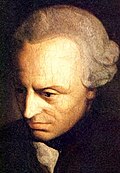
The Critical Philosophy of Immanuel Kant (1724–1804) was a major influence on Hegel.
As H. S. Harris recounts, when Hegel entered the Tübingen seminary in 1788, "he was a typical product of the German Enlightenment – an enthusiastic reader of Rousseau and Lessing, acquainted with Kant (at least at second hand), but perhaps more deeply devoted to the classics than to any thing modern."[58] During this early period of his life "the Greeks – especially Plato – came first."[59] Although he later elevated Aristotle above Plato, Hegel never abandoned his love of ancient philosophy, the imprint of which is everywhere in his thought.[60]
 Aristotle (384–322 BCE) and the ancient Greeks were also a major influence.
Hegel's concern with various forms of cultural unity (Judaic, Greek, medieval, and modern) during this early period would remain with him throughout his career.[61] In this way, he was also a typical product of early German romanticism.[62] "Unity of life" was the phrase used by Hegel and his generation to express their concept of the highest good. It encompasses unity "with oneself, with others, and with nature. The main threat to such unity consists in division (Entzweiung) or alienation (Entfremdung)."[63]
In this respect, Hegel was particularly taken with the phenomenon of love as a kind of "unity-in-difference," this both in the ancient articulation provided by Plato and in the Christian religion's doctrine of agape, which Hegel at this time viewed as "already 'grounded on universal Reason.'"[64][65] This interest, as well as his theological training, would continue to mark his thought, even as it developed in a more theoretical or metaphysical direction.[b]
Although it is often unacknowledged in the philosophical literature, Hegel's thought (in particular, the tripartite structure of his system) also owes much to the hermetic tradition, in particular, the work of Jakob Böhme.[67] The conviction that philosophy must take the form of a system Hegel owed, most particularly, to his Tübingen roommates, Schelling and Hölderlin.[68]
Hegel also read widely and was much influenced by Adam Smith and other theorists of the political economy.[69]
It was Kant's Critical Philosophy that provided what Hegel took as the definitive modern articulation of the divisions that must be overcome.[70] This led to his engagement with the philosophical programs of Fichte and Schelling, as well as his attention to Spinoza and the Pantheism controversy.[71][c] The influence of Johann Gottfried von Herder, however, would lead Hegel to a qualified rejection of the universality claimed by the Kantian program in favor of a more culturally, linguistically, and historically informed account of reason.[72]
Philosophical system
See also: Encyclopedia of the Philosophical Sciences
Hegel's philosophical system is divided into three parts: the science of logic, the philosophy of nature, and the philosophy of spirit (the latter two of which together constitute the real philosophy). This structure is adopted from Proclus's Neoplatonic triad of "'remaining-procession-return' and from the Christian Trinity."[73][d] Although evident in draft writings dating back as early as 1805, the system was not completed in published form until the 1817 Encyclopedia (1st ed.).[75]
Frederick C. Beiser argues that the position of the logic with respect to the real philosophy is best understood in terms of Hegel's appropriation of Aristotle's distinction between "the order of explanation" and "the order of being."[e] To Beiser, Hegel is neither a Platonist who believes in abstract logical entities, nor a nominalist according to whom the particular is first in the orders of explanation and being alike. Rather, Hegel is a holist. For Hegel, the universal is always first in the order of explanation even if what is naturally particular is first in the order of being. With respect to the system as a whole, that universal is supplied by the logic.[77]
Michael J. Inwood plainly states, "The logical idea is non-temporal and therefore does not exist at any time apart from its manifestations." To ask 'when' it divides into nature and spirit is analogous to asking 'when' 12 divides into 5 and 7. The question does not have an answer because it is predicated upon a fundamental misunderstanding of its terms.[78] The task of the logic (at this high systemic level) is to articulate what Hegel calls "the identity of identity and non-identity" of nature and spirit. Put another way, it aims to overcome subject-object dualism.[79] This is to say that, among other things, Hegel's philosophical project endeavors to provide the metaphysical basis for an account of spirit that is continuous with, yet distinct from, the 'merely' natural world – without thereby reducing either term to the other.[80]
Furthermore, the final sections of Hegel's Encyclopedia suggest that to give priority to any one of its three parts is to have an interpretation that is "one-sided," incomplete or otherwise inaccurate.[81][80][82] As Hegel famously declares, "The true is the whole."[83]
The Phenomenology of Spirit
Main article: The Phenomenology of Spirit
...
Criticism and legacy
Hegel's influence on subsequent philosophical developments has been enormous. In late nineteenth- and early twentieth-century England, a school known as British idealism propounded a version of absolute idealism in direct engagement with Hegel's texts. Prominent members included J. M. E. McTaggart, R. G. Collingwood, and G. R. G. Mure. Separately, some philosophers such as Marx, Dewey, Derrida, Adorno, and Gadamer have selectively developed Hegelian ideas into their own philosophical programs. Others have developed their positions in opposition to Hegel's system.
These include, for instance, such diverse philosophers as Kierkegaard, Russell, G. E. Moore, and Foucault. In theology, Hegel's influence marks the work of Karl Barth and Dietrich Bonhoeffer. These names, however, constitute only a small sample of some of the more important figures who have developed their thought in engagement with the philosophy of Hegel.[282][283][284]
"Right" vs. "Left" Hegelianism
Some historians present Hegel's influence as divided into two opposing camps, right and left.[285] The Right Hegelians, the allegedly direct disciples of Hegel at the Friedrich-Wilhelms-Universität, advocated a Protestant orthodoxy and the political conservatism of the post-Napoleon Restoration period. The Left Hegelians, also known as the Young Hegelians, interpreted Hegel in a revolutionary sense, leading to an advocation of atheism in religion and liberal democracy in politics. Recent studies, however, have questioned this paradigm.[286]
The Right Hegelians "were quickly forgotten" and "today mainly known only to specialists"; the Left Hegelians, by contrast, "included some of the most important thinkers of the period," and "through their emphasis on practice, some of these thinkers have remained exceedingly influential," primarily through the Marxist tradition.[287]
Marxism
See also: Marxist philosophy § Georg Wilhelm Friedrich Hegel
 Karl Marx (1818–1883)
Among the first to take a critical view of Hegel's system was the 19th-century German group known as the Young Hegelians, which included Feuerbach, Marx, Engels, and their followers. The primary thrust of their criticism is concisely expressed in the eleventh of Marx's "Theses on Feuerbach" from his 1845 German Ideology: "The philosophers have only interpreted the world, in various ways; the point, however, is to change it."[288][an]
Although the influence of Hegel is sometimes depicted as mostly limited to the youthful Marx of the Economic and Philosophical Manuscripts of 1844, the evidence of Hegel's influence on the structure of *Capital* is clearly displayed in draft notebooks from 1857 to 1858 published as the Grundrisse.[290][ao]
In the twentieth century, this interpretation was further developed in the work of critical theorists of the Frankfurt School.[292] This was due to (a) the rediscovery and re-evaluation of Hegel as a possible philosophical progenitor of Marxism by philosophically oriented Marxists; (b) a resurgence of Hegel's historical perspective; and (c) an increasing recognition of the importance of his dialectical method. György Lukács' History and Class Consciousness (1923), in particular, helped to reintroduce Hegel into the Marxist canon.[293]
Reception in France
It has become commonplace to identify "French Hegel" with the lectures of Alexandre Kojève, who emphasized the master-servant [Herrschaft und Knechtschaft] dialectic (which he mistranslated as master-slave [maître et l'esclave]) and Hegel's philosophy of history. This perspective, however, overlooks over sixty years of French writing on Hegel, according to which Hegelianism was identified with the "system" presented in the Encyclopedia.[294] The later reading, drawing instead upon the Phenomenology of Spirit, was in many ways a reaction against the earlier. After 1945, "this 'dramatic' Hegelianism, which centered on the theme of historical becoming through conflict, [came] to be seen as compatible with existentialism and Marxism."[295]
By confining the dialectic to history, the dominant French readings of Jean Wahl, Alexandre Kojève, and Jean Hyppolite effectively presented Hegel as providing "a philosophical anthropology instead of a general metaphysics."[296] This reading took the topic of desire as its focal point of intervention.[297] A major theme was that "a reason that seeks to be all-inclusive falsifies reality by suppressing or repressing its 'other.'"[298] Although it cannot be attributed entirely to Kojève, this reading of Hegel shaped the thought and interpretations of thinkers such as Jean-Paul Sartre, Maurice Merleau-Ponty, Claude Levi-Strauss, Jacques Lacan, and Georges Bataille.[299]
Kojève's interpretation of the "master-slave dialectic" as the basic model of historical development also influenced the feminism of Simone de Beauvoir and the anti-racist and anti-colonial work of Frantz Fanon.[300]
Racism
Between the late 20th and early 21st centuries, postcolonial critique revisited many of Hegel's statements on slavery and the origins of the human spirit, noting how he supported several overtly racist theories in line with those of various other philosophers of the time, which for a long time had not been subjected to any particular analysis. On this matter, Christian M. Neugebauer writes:
In the European discussion, Hegel's racism is a well hidden and even unknown fact, or at the worst not acknowledged as such, so it should be no surprise, if there does not exist any theoretical discussion [...] in fact, the opposite is the case. Leading British, French and German Marxists are keeping an embarrassing silence, not to mention the conservative philosophers, who celebrate Hegel, of course, in 'a critical distance', as they believe and like to claim.[301]
Several scholars focused on the racist theories Hegel expressed in his Lectures on the Philosophy of World History and his Encyclopedia of the Philosophical Sciences. For example, in the Lectures on the Philosophy of World History Hegel writes: "Slavery is in and of itself injustice, for the essence of humanity is freedom",[302][303] but he also adds: "Negroes have an extreme lack of consciousness of personality: that is why they allow themselves to be made slaves so easily."[304]
Or: "As has already been said, the negro represents the natural man in all his wildness and unruliness: one must abstract from all reverence and morality, from what is called feeling, if one wants to understand him correctly; there is nothing human in that character."[305][303] Statements like these, which are a sample of numerous similar positions Hegel wrote on the matter, recall the themes and language often employed by "scientific" racism, a pseudoscientific belief that had started taking roots a few decades before Hegel's times and went onto have a major impact on Western culture, thought, and politics in the 18th–20th centuries.
At the same time, though Hegel showed great sympathy for the slave uprisings of the Haitian Revolution, in which he recognized the master-servant dialectic.[306] Haiti was the first ex-slave state to introduce universal human rights, before France or the United States. For Hegel, this showed the realization of the idea of freedom in world history.[307][308] The President of the International Hegel Association, Dina Emundts, stated in 2020: "Being a racist and at the same time demanding human rights for all people is not a contradiction in terms. Both Kant and Hegel did that".[309] Nick Nesbitt clarifies that Hegel's philosophy of history contains a counterpoint to the classic accusation of Eurocentrism, which makes it possible to think of a different Enlightenment, which would have as its starting point the idea of universal world history, that is, history as progress in the consciousness of freedom.[308]
More in general, commenting on the influence of Hegel, Kant, and Voltaire on European Enlightenment and their racist positions, German journalist Alice Hasters wrote in 2019: "The Enlightenment should be remembered as the age in which separation of powers and human rights were established. How can you hide the fact that these human rights were never intended for everyone? It is no coincidence that colonization and enslavement increased massively when these theories were established."[310]
However, Moellendorf underlines a difference between the racist positions supported by Hegel and his philosophical system. He states that Hegel's theories on the "philosophy of subjective spirit" do not necessarily lead to racism, but rather leave that possibility open. Hegel's racism, in his analysis, is explained not so much on a philosophical level as with the general climate of racism prevalent in the 19th century.[311]
Allegations of authoritarianism
Karl Popper makes the claim in the second volume of The Open Society and Its Enemies (1945) that Hegel's system formed a thinly veiled justification for the absolute rule of Frederick William III and that Hegel's idea of the ultimate goal of history was to reach a state approximating that of 1830's Prussia.[312] Popper further proposed that Hegel's philosophy served as an inspiration for communist and fascist totalitarian governments of the 20th century, whose dialectics allow for any belief to be construed as rational simply if it could be said to exist. Kaufmann and Shlomo Avineri have criticized Popper's theories about Hegel.[313]
According to Benedetto Croce, Giovanni Gentile, noted Italian Fascist, "holds the honor of having been the most rigorous neo-Hegelian in the entire history of Western philosophy and the dishonor of having been the official philosopher of Fascism in Italy."[314]
Isaiah Berlin listed Hegel as one of the six architects of modern authoritarianism who undermined liberal democracy, along with Rousseau, Claude Adrien Helvétius, Fichte, Henri de Saint-Simon, and Joseph de Maistre.[315]
Thesis–antithesis–synthesis
Further information: Hegelian dialectic
This terminology, largely developed earlier by Fichte, was spread by Heinrich Moritz Chalybäus[316] in accounts of Hegel's philosophy that have since been broadly discredited.[317][318] Walter Kaufmann, for instance, reports:
Fichte introduced into German philosophy the three-step of thesis, antithesis, and synthesis, using these three terms. Schelling took up this terminology. Hegel did not. He never once used these three terms together to designate three stages in an argument or account in any of his books. And they do not help us understand his Phenomenology, his Logic, or his philosophy of history; they impede any open-minded comprehension of what he does by forcing it into a scheme which was available to him and which he deliberately spurned.[319]
Beiser's stance is even stronger. He denies that it corresponds to any procedure in Fichte or Schelling, much less Hegel.[320]
More modestly, it has been said that this account is "only a partial comprehension that requires correction." What it gets right is that, according to Hegel, "truth emerges from error" in the course of historical development in a way that implies a "holism in which partial truths are progressively corrected so that their one-sidedness is overcome." What it distorts is that such a description is possible only after the process has unfolded. The "thesis" and "antithesis" are not "alien" to one another. Inasmuch as there can be said to be such a "dialectical method," it is not an external one such as could be "applied" to some subject matter.[321]
Similarly, Stephen Houlgate argues that, in whatever limited sense Hegel might be said to have a "method," it is a strictly immanent method; that is, it emerges from thoughtful immersion in the subject-matter itself. If this leads to dialectics, that is only because there is a contradiction in the object itself, not because of any external methodological procedure.[322]
American pragmatism
Richard J. Bernstein (1932–2022), known for his work on Hegel and American Pragmatism
As documented by Richard J. Bernstein, the influence of Hegel on American Pragmatism can be divided into three moments: the late nineteenth century, the mid-twentieth, and the present.[323] The first is to be found in early issues of The Journal of Speculative Philosophy (founded 1867).[323] The second is evident in the acknowledged influence upon major figures including John Dewey, Charles Peirce, and William James.[324]
As Dewey himself describes the attraction, "There were, however, also 'subjective' reasons for the appeal that Hegel's thought made to me; it supplied a demand for unification that was doubtless an intense emotional craving, and yet was a hunger that only an intellectualized subject-matter could satisfy."[325] Dewey accepted much of Hegel's account of history and society, but rejected his (probably incorrect) conception of Hegel's account of absolute knowing.[326]
Two philosophers, John McDowell and Robert Brandom (sometimes referred to as the "Pittsburgh Hegelians"), constitute, per Bernstein, the third moment of Hegel's influence on pragmatism.[327] However, while openly acknowledging the influence, neither claims to explicate Hegel's views according to his own self-understanding.[ap] In addition, each is avowedly influenced by Wilfrid Sellars.[329] McDowell is particularly interested in dispelling the "myth of the given," the dichotomy between concept and intuition, whereas Brandom is concerned mostly to develop Hegel's social account of reason-giving and normative implication.[330] These appropriations of Hegel's thought are two among several "non-metaphysical" readings.[331]
Non-metaphysical interpretations
 The bust of G.W.F. Hegel by Gustav Blaeser (1872) at Hegelplatz (Dorotheenstraße) in Berlin-Mitte, Berlin (Germany)
Writing in 2005 for an Anglophone audience, Frederick Beiser states that the status of Hegel's metaphysics is "probably the most disputed question in Hegel scholarship."[332] Some scholars favor a religious interpretation of Hegel's metaphysics as an attempt to justify Christian beliefs through reason.[332]
Other scholars have advanced a non-metaphysical approach to Hegel that interprets his philosophy as "a theory of categories, a neo-Kantian epistemology, hermeneutics, or even as anti-Christian humanism."[333]
If Hegel's philosophy is metaphysics, Beiser states that these philosophers believe it is "doomed to obsolescence" as a "bankrupt enterprise" now that Kant has shown the impossibility of determining unconditioned knowledge through pure reason in his Critique.[334]
Yet, since then, "perhaps the most significant recent nonmetaphysical" interpreter,[335] Robert B. Pippin, has recanted his earlier position, most notably in Pippin 2019. Even before this, introducing a collection of essays from the 2014 conference of the Hegel Society of America, Allegra de Laurentiis reports that everyone presenting on the topic of "Hegel Without Metaphysics?" affirmed the metaphysical dimension of Hegel's thought.[336]
What remains in dispute, however, is how to properly characterize Hegel's (avowedly post-Kantian) metaphysical commitments.[337] As Hegel himself remarks in passing, "humans are thinking beings, and born metaphysicians. All that matters here is whether the metaphysics that is employed is of the right kind."[338]
Publications and other writings
See also: Georg Wilhelm Friedrich Hegel bibliography
...
Knowledge Web Content (see main Hegel node)
Achievements: Philosophy
Born: August 27, 1770; Stuttgart, Germany
Died: November 14, 1831; Berlin, Germany (Aged 61)
Field & Discipline: Philosophy; Philosopher
Language: German
Education: Stuttgart Grammar School; Tubingen University
Major Works:
"The Phenomenology of the Spirit" (1807)
"The Science of Logic" (1812-1816)
Life & Times:
Hegel was sent to university to prepare him for the church but he paid more attention to philosophical works such as those by [influenced by] Herder*. From Herder he got the idea that the social divisions in contemporary Germany resulted in a fragmented state with no shared social interests. His closest student friends were the lyric poet JCF Holderlin and the nature philosopher [a pal of] Schelling* with whom he studied Greek literature, and shared enthusiasm about the French Revolution.
Hegel left college in 1793 and for the next three years worked in Berne, Switzerland as a private tutor. He was attracted to the philosophy of [influenced by] Kant*, who rejected religious orthodoxy on the grounds that it involved both the acceptance of historical facts which cannot be proved and of rules of behaviour allegedly laid down by divine revelation. In 1796 Hegel went to Frankfurt where he studied Greek philosophy, economics, politics and modern history. When his father died and left him an inheritance in 1799 he moved to Jena where [influenced by] Fichte* had developed his ethical idealism, and where Schelling was already expounding his nature philosophy. Hegel, with his orderly mind, looked to logic for an answer.
In 1802-3 Hegel edited the "Critical Journal of Philosophy" with Schelling, who had persuaded the publisher [supported by] Cotta* to support them. In 1806 Napoleon and the French defeated the Prussians at Jena, an event welcomed by Hegel and his friend the poet [a pal of] Goethe* who both saw Prussian bourgeois society as hidebound and corrupt.
The day before the battle of Jena, Hegel finished his first major work "The Phemonology of the Spirit" (1807), a difficult and complex work. Unlike other philosophers of the time, such as [work differed from] Herbart*, who examined the processes of the mind, Hegel's approach was non-mathematical. He saw the essence of man as the spirit and he traced the history of the human mind from its earliest beginnings of mere consciousness through self-consciousness and rationality to a state of spirituality. He acknowledged the input of the senses to the human mind but stressed that intellectual processes acting on the sense perceptions were equally important. The state of spirituality revealed the real world order. For Hegel, nothing was finally real except the whole, which he calls the Absolute.
On the strength of this work, Hegel was much in demand. He turned down offers from the universities of Erlangen and Berlin and accepted the chair of philosophy at Heidelberg. In 1816 he published the third and final volume of "The Science of Logic," generally taken to be the culmination of his philosophical system, in which he presented his theory of the Absolute, a spiritual concept which was also an objective force. The Absolute, or "geist" (spirit), manifested itself as the "weltgeist" (the world spirit) in a number of manifestations, such as certain nations and individuals.
The Hegelian system is a complex one that embraces and gives meaning to everything in the universe through its relation to the Absolute. Hegel presents his arguments dialectically by stating thesis, antithesis and synthesis. Bertrand Russell's commentary on Hegel explained it this way:
Thesis: reality is a mother. Synthesis: the reality of a mother implies a child. So the Absolute, the whole, is mother and child. Antithesis: this position is still not logical, because the mother can only be a mother if she herself has parents and a partner; the child can only be a child if it has a father as well as a mother; and these ramifications will also be part of the Absolute. And so on and on, ever outwards. Logically, therefore, the Absolute is a concept which can only be grasped by humans who have attained spiritual insight.
All Hegel's later work can, to a large extent, be seen as an attempt to intellectualize his conviction of the Absolute as the "geist" (the spirit).
In 1818 Hegel went to Berlin to take the chair of philosophy left vacant by Fichte. In the "The Philosophy of Right (or Law)" he considers universal laws for all mankind, and the way in which such laws can take account of individual conscience. The third and final section examines the type of political state in which such an ideal law could exist. Hegel describes a state where there is a limited monarchy, parliamentary government, trial by jury and religious toleration.
His work in esthetics was nourished by his own keen interest in art. His esthetics lectures were attended by the composer [taught] Felix Mendelssohn*. In his "Philosophy of Religion" Hegel attempted to demonstrate that the dogmatic creed is the rational development of religious feeling. His most important contribution was his historical philosophy, which was evolutionary, suggesting that humankind had advanced through time, spiritually and morally, towards self-knowledge. He held that the question of reality is a metaphysical one, and the question of value is ethical. Both must be considered when deciding on right action.
Hegel's historical philosophy was profoundly influential for many leading figures, ncluding the Zionist [influenced] Moses Hess*, the political theorists [influenced] Karl Marx* and [influenced] Engels*, and the educationalist [influenced] John Dewey*. The French philosopher [influenced] Hippolyte Taine* was inspired by Hegel to look to for a single answer to explain life, while the botanist [opposed by] Schleiden* was strongly critical of Hegel's metaphysical stance, and the Danish philosopher Kierkegaard* also reacted against certain aspects of Hegelianism. In Germany, [opposed by] Schopenhauer* immediately opposed Hegelian philosophy.
In 1828 Hegel was further offended by lectures given by the explorer [attacked] Alexander von Humboldt* in which he attacked post-Kantian philosophy and, by implication, Hegel. In the last years of his life he wrote and spoke against the liberal modernizers in political life who advocated devolved power, which Hegel thought would work against the necessary unity of the country.
Extra Connections: He inspired [suggested America to] Roebling* to emigrate to America.
His work related to that of [work related to] Piazzi*.
His work related to that of [work related to] Brandes*
He influenced [influenced] Turgenev* and [influenced] Naegeli*
As a student US Ambassador George [lectures attended by] Bancroft* attended his lectures.
Assessment: Hegel was one of the founders of modern philosophical thought.
Oneliner: GWF Hegel, major philosopher
Bibliography:
- Pinkard, Terry, Hegel, A Biography, Cambridge University Press, Cambridge, 2000.
Father: Father: Georg Ludwig Hegel
Mother: Maria Fromm
Siblings: 1 brother: Georg
1 sister: Christiane
Spouse: Marie von Tucher
Children: 2 sons: Immanuel, Karl