Chevreul, Michel, ME
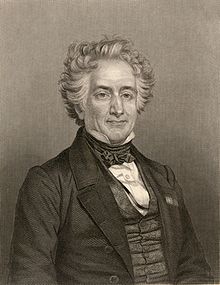
Achievements: Produced the first scientific study of soap-making and a law of color contrast which affected the work of the Impressionists
Born: August 31, 1786; Angers, France
Died: April 9, 1889; Paris, France (Aged 103)
Field & Discipline: Science; Chemistry
Education: Ecole centrale, Angers; College de France
Major Work:
“Researches chimiques sur les corps gras” (1813-17)
“Considerations generales sur l’analyse organique” (1824)
“De la loi du contraste simultane des coleurs” (1839)
Life & Times:
At the age of seventeen Chevreul went to Paris to study chemistry under Nicolas Vauquelin, [taught by assistant of] Fourcroy’s* assistant at the Museum of Natural History, and when Vauquelin became professor of applied chemistry at the Museum (in succession to Alexandre Brongniart, the first holder of the chair), Chevreul became his unofficial assistant. He spent most of his evenings working with Vaucquelin on organic substances. In 1807 he investigated the coloring properties of natural products, which involved separating the natural dyes from the oils, resins, gums and other substances with which they are mixed in plants.
In 1809 he began investigating fats in relation to soap-making. Soap was made by combining fat with an alkaline solution, heating the mixture and then adding salt. [work related to] Scheele* in Sweden had investigated saponification on 1779 and a year later so did [work related to] Berthollet*, but neither of them had discovered the composition of fats. In 1797 the French government had set up an investigation into the making of soap, in particular the combination of different oils and fats with soda.
Chevreul re-interpreted Berthollet’s results and through his own investigations established the composition of fats and the true nature of soap. In his first paper on the subject, in 1813, he recorded that when soap made from potash and pig fat was diluted with a large quantity of water, part of the soap dissolved and another part formed pearly crystals. When this pearly crystalline substance was decomposed with alcohol, he was able to isolate a solid fatty substance. Although the original pig fat used to make the soap was neutral, the solid fatty substance possessed the properties of an acid.
Chevreul named the crystalline substance ‘margarin’ (after the Greek word ‘margarites’ which means ‘pearly’). This name was later used for the butter substitute invented by his protege [protégé was] Mege-Mouries*. Later that year, Chevreul recorded that he had obtained a second and different acidic product from margarin: a liquid fat. He had thus shown that soap made from potash alkali and pig fat was really two different substances, formed by the combination of the potash with two different fatty acids.
Chevreul next isolated several fatty acids from natural fats, including oleic, palmitic and stearic acids, which are the most common fatty acids found in fats and oils. He examined fat from corpses, dolphins and the crystalline substance present in human gallstones, and showed that what had previously been thought to be three varieties of the same material were in fact three distinct materials. He named the crystalline substance from the gallstones ‘cholesterin’. He discovered the various volatile acids in cow and goat butter and he carried out hundreds of experiments on natural fats.
By 1824 he had demonstrated that fats are a combination of a few compounds of constant composition. He revealed the composition of each of these compounds, and he demonstrated the products arising from the decomposition of the compounds which occurred in saponification. He discovered that on saponification all natural fats yielded fatty acids and glycerin in varying amounts depending on which acids were present in the natural fat. He separated the fatty acids by solution and crystallization, and used their melting point for identification and for calculating purity. Soon after his results were published there was a rapid increase in soap production.
Chevreul had also discovered that the removal of glycerin from fats increased their hardness and their illuminating quality. Together with [collaborated with] Gay-Lussac*, he patented the manufacture of candles made from a solid fatty acid (stearic acid). They abandoned their patent soon after, because it was difficult to enforce, but candles made from solid fatty acids gradually took over from the tallow candle.
In 1824 Chevreul succeeded Berthollet as director of dyeing at the Globelin tapestry works, a post in which he remained for sixty-one years. The tapestry works had been reorganized as part of the regeneration of French industry planned by [work related to] Colbert* in the previous century. There were now complaints about the stability of the dyes used by Gobelins, and Chevreul’s brief was to improve the durability and brilliance of the colors and rationalize the art of dyeing (for which there were then only organic dyes).
During his research he found that black looked less intense when it was used on a blue or violet ground and he realized that the way in which contrasting colors were juxtaposed affected the perception of their brilliance and tone. He began to study the physiology of color-contrast perception, as well as dye technology. Between 1838-1864 he presented a number of important papers of which the most significant was: “The law of simultaneous color contrast” (1839). He produced a standard color-comparison system involving a chromatic circle: from the primary colours red, yellow and blue he derived almost 15,000 shades or tones. In 1850 the artist [heard from] Delacroix*, who was experimenting with color, wrote to Chevreul suggesting a meeting, but the artist was ill and the meeting did not take place.
Chevreul’s many interest included agricultural matters like fertilizers, viticulture, soils and agronomy. He contributed articles to the “Bulletin de la socieite d’agriculture” and became president of the society. He was by this time famous as a chemist, and many scientists, including [visited by]Cannizzaro*, came from abroad to work in his laboratory. His research on color contrast affected the fine arts and the neo-Impressionists developed a method of painting based on the application of separate touches of pure color which the eye combined as it viewed the whole. Red paint juxtaposed with yellow, for example, created a more intense orange than an actual orange paint. In 1884, Chevreul was contacted by another artist, [influenced] Seurat*, who had discovered the division of tones in Delacroix’s work and was experimenting with pointillisme: a technique of painting based on the representation of color by dots of unmixed pigments, which at sufficient distance gave the effect of brilliance. Chevreul provided a scientific basis for Seurat’s thinking and Seurat limited his palette to Chevreul’s chromatic circle of fundamental colors and their intermediate tones.
Extra Connections: He was a friend of [a pal of] Bernard*
His work was criticized by [criticized by] Charles Henry*
Assessment: Chevreul demonstrated that fats are compounds of glycerol and fatty acids, and he was the first to isolate several fatty acids.
Oneliner: M E Chevreul, major French color and fats chemist
Bibliography:
- Brock, William H,The Fontana History of Chemistry, Fontana Press, London, 1992.
- Costa, Albert B,Michel Eugene Chevreul, University of Wisconsin, Madison, 1962.
Language: French
Father: Father: Michel Chevreul
Mother: Unknown
Siblings: Unknown
Spouse: Sophie Davallet
Children: Unknown