Fourcroy, AF de
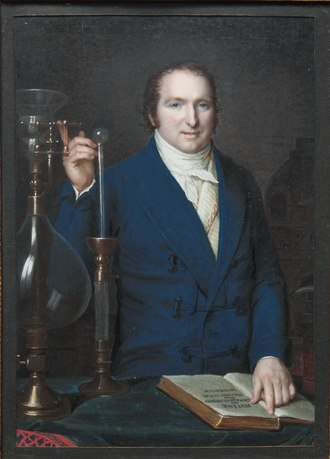
Name: Antoine François de Fourcroy
Achievements: French chemist whose research paved the way for developments in systematic chemistry
Born: June 15, 1755; Paris, France
Died: December 16, 1809; Paris, France (Aged 54)
Field & Discipline: Science; Chemistry; Medicine
Language: French
Father: Jean Michel de Fourcroy
Mother: Jeanne Laugier
Siblings: Elder sister
Spouse: 1) Anne Claude Bettinger; 2) Adelaide Flore Belleville
Children: by Bettinger: 1 son; 1 daughter
Education: College d'Harcourt, Paris; Faculty of Medicine, Paris
Major Work:
"A General System of Chemical Knowledge"
Life & Times:
While working as a lawyer's clerk, Fourcroy met and made a huge impression on anatomist [impressed] Vicq d'Azyr*, who persuaded Fourcroy’s father, an apothecary, to let his son study at the Paris Faculty of Medicine, which the 18-year-old Fourcroy entered in 1773. In 1780 he graduated as a doctor.
In 1783, Fourcroy was made chemistry professor at the Ecole Royale Veterinaire at Alfort, near Paris, and the following year he was appointed to the important Chair of Chemistry at the Jardin du Roi (later Jardin des Plantes).
Supporting him for the appointment was French naturalist [supported by] Buffon*, even though [a rival of] Berthollet* was also a candidate. Fourcroy also did field work in natural history, which resulted in his "Entomologia parisiensis" (Paris, 1785), which listed the insects of the Paris region, and for which he was given membership in the Academie Royale des Sciences.
Fourcroy gained a reputation as an extremely effective lecturer, speaking to large audiences every summer at the Jardin du Roi.
For 20 years, from 1787, he also lectured at the Lycee, a private educational institution founded by aeronaut J.F. Pilatre de Rozier.
Meanwhile, Fourcroy met the great chemist [influenced by] Lavoisier*, and was won over by his antiphlogistic theory. The phlogistic theory held that every combustible substance is partly composed of "phlogiston", a fiery “element”, and that calcination is
caused by the liberation of phlogiston, with the dephlogisticated substance left as ash or residue. Lavoisier discredited the theory.
Fourcroy's "Principes de chemie" (Paris, 1787) was the first textbook written entirely according to the antiphlogistic theory. In 1787, Fourcroy collaborated with Lavoisier, French chemist [collaborated with] Guyton de Morveau* and Berthollet in the revision of chemical names, and took on the huge task of completing the chemical section of the "Encyclopedie methodique", after Guyton de Morveau completed only one volume and then abandoned the project.
Fourcroy was recognized as having a particular talent for summarizing in a clear fashion the fundamental principles of chemistry, and in his article "Axiomes" in the second volume of the "Encyclopedie" (1792) he classified the chief facts of chemistry under 12 headings. When the article was published separately as "Philosophie chimique", it proved an extremely popular summary of antiphlogistic chemistry, and was translated into 11 languages.
Fourcroy also helped advance the new chemistry as one of the editors of "Annales de chimie", a journal founded in 1789 by Lavoisier and his colleagues.
Fourcroy's interest in the application of chemistry to medicine led him to study various solids and fluids of the human and animal body in health and sickness. In 1785, he found that both human and animal muscle fiber contained a substance chemically similar to the fibrous matter in coagulated blood. He surmised that this fibrous matter must have been
derived from the animal's food, which though inanimate, was then converted into living muscle fiber by a vital force.
He was eventually to conclude that this vital force was nitrogen. [furthered work of] Scheele* and Berthollet had found nitrogen in animal matter, and in 1788, Fourcroy showed that there was a greater proportion of nitrogen in muscle fiber than in any other part of the body, and that the proportion of nitrogen contained in these fibers was the same for carnivorous and herbivorous animals. By 1789, he had found nitrogen in many vegetables.
Like most French scientists, Fourcroy held liberal views and supported the political movements that led to the French Revolution. He was one of about 400 representatives of the Third Estate in Paris who met in April and May, 1789, to elect 20 deputies to the Estates General. He served on local committees of health, education and public welfare, and continued to do some scientific work for the government, which had called on scientists to help solve France's economic problems.
In August, 1792, a new National Convention was elected and the Republic declared. Fourcroy became a member of the electoral assembly of Paris (the body that elected the deputies). However, he was not permitted to remain a private citizen, and in September, 1792, was elected fourth substitute deputy for Paris. He was called to take his seat in the National Convention in July, 1793, taking the place of French/Swiss revolutionist Jean Paul Marat after he had been assassinated.
He now joined the Jacobin Club of radical democrats and became a member of the Committee of Public Instruction (of the National Convention), where he became partly responsible for organizing commissions of scientists to continue their important works. However, hampered by bureaucracy, he was able only to set up the commission that would develop the metric system of weights and measures (see [work related to] Babbage*).
In 1793, Fourcroy was a member of a commission charged with the establishment of a national medical school. As a result, the Ecole de Sante (later the Ecole de Medicine) was opened in Paris in 1795, with two smaller colleges in Strasbourg and Montpellier. A year earlier, Fourcroy helped plan the Ecole Centrale des Travaux Publics, which,in 1795, became the Ecole Polytechnique in Paris. Both the Polytechnique and the Ecole de
Medicine became important research centers.
Between 1795 and 1799 Fourcroy effectively returned to private life, but in late 1799, the [appointed Minister by] Napoleon* appointed him to the council of state, where he played a large part in drafting a new educational system, from primary schools to advanced colleges. In 1802, Napoleon appointed him Minister of Public Instruction, assigning him the huge task of implementing these proposals.
Fourcroy received the title of Count of the Empire in 1808.
Extra Connections: [assistant was] Chevreul* and [assistant was] Gay Lussac* were his assistants.
His lectures were attended by [lectures attended by] Thenard*
Assessment: A pioneer in a multitude of fields, not only in scientific areas, but also in social and political spheres.
Oneliner: Antoine Fourcroy, scientific, social and political pioneer.
Bibliography:
- Dictionary of Scientific Biography.
- Partington, J.R., A History of Chemistry, Volume Three, London: Macmillan & Co., 1962.