Michelangelo
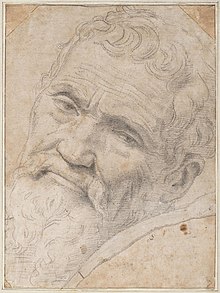
Nickname/Alias: Michelangelo
Achievements: Sistine Chapel. Chief architect for St Peter’s, Rome.
Born: March 6, 1475; Caprese, Italy
Died: February 18, 1564; Rome, Italy (Aged 89)
Field & Discipline: Art; Painter; Sculptor; Architect
Education: Unknown
Major Work:
Painting:Sistine chapel ceiling in the Vatican
Sculpture:
"Bacchus" (1496-7)
"Pieta" (1498)
"David" (1501-4)
"Dying Slave" (c1514)
"Rebellious Slave" (c1514)
"Moses" (c1515)
Tomb of Julius II (c1547)
Architecture:
St. Peter’s Basilica (Vatican)
Laurentian Library (Florence)
Life & Times:
At thirteen, Michelangelo was apprenticed to [apprenticed to] Ghirlandaio*, the leading Florentine artist. A year later he joined the household of [in household of] Lorenzo de' Medici*, the ruler of Florence. "Battle of the Centaurs" (c1492), is one of only two marble sculptures by Michelangelo that survive from this period and show the influence of Lorenzo’s collection of antiquities.By 1494, when the Medici family lost power in Florence, Michelangelo had moved to Bologna, where he was hired to complete the tomb of St Dominic, work which clearly showed the influence of the earlier sculptor, [influenced by] Donatello*.
He then went on to Rome, to sculpt "Bacchus" in 1496-7. The following year, he was commissioned by a French cardinal to sculpt the "Pieta", now in St Peter's, Rome. This led to a commission for the statue of "David" for Florence cathedral in 1501. At this time, [a rival and influence was] Da Vinci* was also working in Florence and, although Michelangelo always denied it, Leonardo’s influence can be seen in the way Michelangelo added dynamism and detail to his heroic figures.
In addition,Raphael* was in Florence between 1504-8 and, in his "Madonna of the Meadow", he undoubtedly took the theme of the Child lying across the Madonna's thigh from Michelangelo's relief for his patron Taddei.
In 1504, Michelangelo was given a commission to paint a martial mural in the city hall, to complement the one that da Vinci had already done. Where da Vinci had chosen to portray the horses that he painted so brilliantly, Michelangelo chose as his subject soldiers bathing in a river.
The previous year Pope [commissioned by] Julius II* had commissioned Michelangelo to produce forty statues for the magnificent tomb he planned for himself. Believing that [knew] Bramante* had advised Julius to cut back on funding, Michelangelo left Rome and went back to Florence. While he was there, he was instructed to sculpt an immense bronze statue of Julius for the city of Bologna.
The Pope then made Michelangelo another offer he couldn’t refuse: Michelangelo reluctantly began to paint the ceiling of the Sistine chapel in the Vatican. This enormous work took him four years to complete and is now regarded as one of the masterpieces of Western art. It influenced many other works, including Raphael’s 1512 frescoes in the Stanza della Segnatura.
In the two years after Julius died in 1513, Michelangelo produced his sculpture of "Moses" for the Julian tomb. At the same time, he produced two other sculptures, of bound prisoners. He achieved more surface texture and detail with these works than previously, giving the figures a level of expressiveness that was new to monumental sculpture.
The next Popes, Leo X and Adrian VI, both commissioned works from Michelangelo, who now became responsible for building the new Medici chapel at the church of San Lorenzo in Florence.Unusually, he abandoned classical proportions, producing large tombs on either side of the marble chapel, with curved tops and a male and female figure reclined on the base of each tomb. The figures, "Day and Dusk" and "Dawn and Night" were personifications, something that had never appeared on tombs before. He also designed the Laurentian Library for the same church, which contains his original wall designs, sometimes regarded as the first important example of the Mannerist style of architecture.
In 1527, the Florentines rebelled against the Medici’s, and Michelangelo spent his time designing fortifications. When the Medici’s regained power in 1530, he started four years’ work on the Medici family tombs. During this time, he planned "Victory", a large statue of a figure crushing an old man underfoot, which became an inspiration for younger Mannerist sculptors.
In 1534, he returned to the Sistine Chapel and was commissioned by the new Pope, Paul III, to paint the vast "Last Judgement" for the end wall. He remained chief architect for St Peter's, living in Rome for the rest of his life, and worked on the interior of the church to fulfil the vision of Bramante.
He also worked on smaller projects like the Farnese Palace and, from 1542-50, his final paintings were frescoes for the Pauline Chapel in the Vatican. At this time, [influenced] Titian* was in Rome and art historians have noted Michelangelo’s influence in the colouring of Titian’s paintings.
Towards the end of his life, he became close to the artist and writer, [a pal of] Vasari*, who wrote that, prior to his death, Michelangelo sculpted ferociously but became more and more disappointed with his results.
Extra Connections: [re-buried by] Grand Duke Cosimo I de’ Medici* brought his body back to Florence.
Inspired by [influenced by] Masaccio* and [influenced by] Vitruvius*
Disliked [disliked] Aretino*
Inspired [influenced] Clovio*, [influenced] El Greco*, [influenced] Mengs*, [influenced] Rubens*, [influenced] Veronese*, [influenced] Tintoretto*, [influenced] Puget* and [influenced] Borromini*
[a fan was] Isabella d’Este* admired his work.
Commissioned for drawings of new St Peter’s by Pope [commissioned by] Alexander VI*
Major collection of his works by [works collected by] Sir Thomas Lawrence*
He lent money to [lent money to] Signorelli*
He was critical of the work of [criticized work of] Perugino*
Assessment: Michelangelo is recognised universally as one of the greatest artists ever to have lived.
Oneliner: Michelangelo, artistic genius
Bibliography:
- Hibbard, Howard, Michelangelo, Penguin Books, Middlesex, England, 1985.
Language: Italian
Father: Lodovico di Lionardo Buonarroti Simoni
Mother: Francesca
Siblings: Lionardo; three other brothers
Spouse: None
Children: None