Lawrence Sir T
Name: Sir Thomas Lawrence
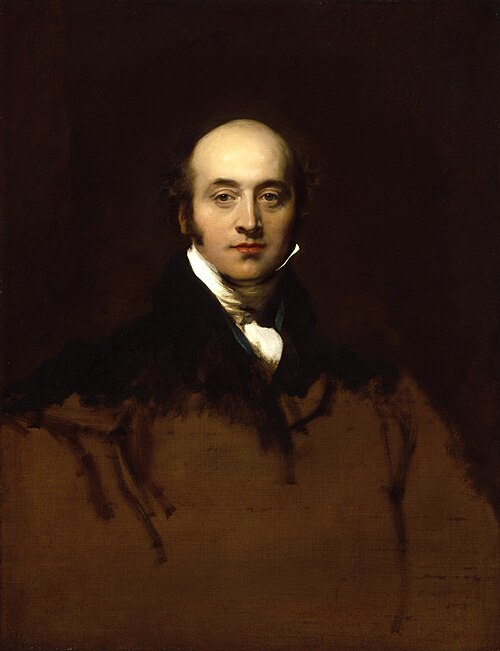
Achievements: President of the Royal Academy
Born: April 13, 1769, Bristol, England
Died: January, 7, 1830, London, England. Aged 60
Field & Discipline: Art; Painter
Language: English
Father: Thomas Lawrence
Mother: Lucy Read
Siblings: Andrew; George; Anne
Spouse: None
Children: None
Education: The Fort, Bristol; the Royal Academy, London
Major Work: Portraits of major figures
Life & Times:
At the age of 11, Lawrence began to work in pastels. By 14, he was charging three guineas a drawing (done in the accepted oval head-and-shoulder fashion). Lawrence’s father, who had rejected a prospective’s patron’s offer to send his son to Italy to study, accepted (on behalf of his son) a scholarship at the Royal Academy. In fact, the whole family followed Lawrence to London in 1787.
But Lawrence studied at the Royal Academy only a few months and essentially remained a self-taught draftsman and artist. In this period, however, [encouraged by] Sir Joshua Reynolds* let Lawrence use his studio, where the young painter worked on making the transition from pastels to oils.
Lawrence’s first full length oil painting, a portrait of Lady Cremorne, was displayed at the Royal Academy in 1789, but attracted little attention. The next year, only two of his 12 exhibits at the Royal Academy caused any excitement. These included his full length portrait of Queen Charlotte. But within four years Lawrence had made his mark on the art world of London. In 1791, he was made an associate of the Royal Academy. In 1792, he was appointed Painter to the Royal Family.
Lawrence’s career as a fashionable portraitist was now established. Reynolds had died in 1792, and it was that clear to the art establishment that only Lawrence could take his place.
Lawrence’s good sense in regard to his profession was not matched by a good business sense. In 1790, when he thought he would be successful and wealthy forever, he set himself up in comfortable surroundings in town and gave his parents a substantial
allowance. By 1794, he had moved to the highly fashionable address of Piccadilly. He spared no expense in purchasing materials for his art. But he kept no track of where his money went, no accounts, no memoranda, or even diaries. Only his correspondence remains, and his letters were generally undated.
He amassed a fine collection of casts from antique sculpture, and the greatest number of drawings by [collected work of] Raphael* and [collected work of] Michelangelo* that any one person had ever owned. His offer that they be sold to the King or the nation at a bargain price after his death was refused, and the collection was dispersed.
His friends were mainly other artists and members of the theatrical and musical world, but, despite his precarious financial state, he felt at ease with figures from the financial world. Lawrence’s picture of the Baring bankers: "Sir Francis Baring, 1st Baronet, MP, with his brother and son-in-law" (1796) was a highlight in Lawrence’s career.
Royal Academy president [a fan was] Benjamin West* called the portrait “an advance in art.” After painting the Prince Regent in 1814, Lawrence was commissioned to paint the leaders of the allied forces who had defeated Napoleon. These included the Emperor of Russia, the King of Prussia, Austrian diplomat [painted] Metternich* and [painted] Blücher*. The results met with such success that Lawrence was commissioned to go to Europe to paint all the sovereigns and military leaders who had been involved in the defeat of Napoleon.
In keeping with the dignity of the commission, Lawrence was knighted in 1815. However, it was three years before he set sail for the continent to carry out his assignment. He began to paint in the autumn of 1818 at Aix-la-Chapelle.
After finishing his work there, he moved on to Vienna. From Vienna, Lawrence traveled to Rome, where he painted Pope Pius VII and his adviser, Cardinal Consalvi. Lawrence felt nervous about painting the Pope. He knew the Romans considered him old-fashioned and unkindly called him “The English Titian”, but his portrait was received with almost universal acclaim.
The work is considered one of Lawrence’s masterpieces, both for the beauty of the Pope’s head, which Lawrence himself considered, "the most interesting and best head I have painted", and for his exquisite handling of the red and white of the prelates’ robes.
While Lawrence was on his way back to London, Benjamin West, died and Lawrence
was voted to replace him as the President of the Royal Academy.
In the days before Lawrence died suddenly in 1830, he was working on the last of his
14 portraits of George IV.
Extra Connections:
He was influenced by [influenced by] Rubens*, [influenced by] Van Dyck*, [influenced by] Rembrandt* and [influenced by] Titian*.
Knew painters [knew] Audubon*, [knew] JMW Turner*, [knew] Constable*
Painted [painted] James Bruce Elgin*, scientist [painted] Banks*, authors [painted] Sir Water Scott* and [painted] Southey*, politician [painted] Peel*, businessman [painted] Sir F Booth*, physician [painted] John Hunter*, mover-shaker [painted] Dr John Moore* , actress Sarah [painted] Siddons*, doctor Sir Ashley Paston [painted] Cooper*
His work related to that of engraver [work related to] Pistrucci*.
He drew Elizabeth [drew] Carter*
Assessment: An innovative portraitist and colorist and one of the foremost
European painters of his age
Oneliner: Sir Thomas Lawrence, major 19th century portrait painter
Bibliography:
- Michael Levey. Sir Thomas Lawrence. London, National Portrait Gallery, 1979.
- Kenneth Garlick. Sir Thomas Lawrence, a complete catalog of the oil paintings. Oxford, Phaidon, 1989. DNB.