Crompton mule
ORDERBY-NAME: Crompton mule
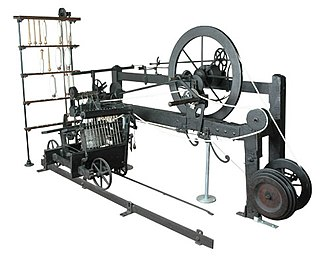
OTHER-NAME: spinning mule
DATE INVENTED/BEGAN: 1779
PLACE INVENTED/BEGAN: near Bolton, Lancashire, England
DATE ENDED: Mules are still in use for spinning woolen and alpaca, and being produced across the world.
CATEGORY: Technology
DISCIPLINE: Invention
ASSESSMENT: A major contribution to the Industrial Revolution, the mule automated the production of fine, strong thread for textile factories
LANGUAGE: English
DETAILS:
In 1779 Samuel Crompton* perfected the mule. It combined the techniques of two earlier machines by Hargreaves* and Arkwright* (hence the name: mule).
Crompton passed raw cotton fibres through a rotating ‘flyer’ which twisted them together and then passed the thread through two sets of rollers. The second set moved five times faster than the first set, so stretching the twisted thread to the required fineness. The thread was then taken up on spindles mounted on a roller that moved them back or forward to take up any slack. By 1790 Crompton was able to work as many as 400 spindles on a single mule. This amazing productivity increase was immediately attractive to textile manufacturers like David Dale*, one of the first mule users.
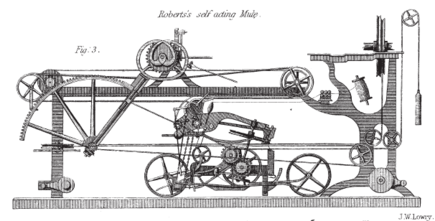
A Roberts self-acting spinning mule: 1835 diagram showing the gearing in the headstock.
Effects:
The spinning inventions were significant in enabling a great expansion to occur in the production of textiles, particularly cotton ones. Cotton and iron were leading sectors in the Industrial Revolution. Both industries underwent a great expansion at about the same time, which can be used to identify the start of the Industrial Revolution.
The 1790 mule was operated by brute force: the spinner drawing and pushing the frame while attending to each spindle. Home spinning was the occupation of women and girls, but the strength needed to operate a mule caused it to be the activity of men. Hand loom weaving, however, had been a man's occupation but in the mill it could and was done by girls and women. Spinners were the bare-foot aristocrats of the factory system.[27] It replaced decentralized cottage industries with centralized factory jobs, driving economic upheaval and urbanization.
Mule spinners were the leaders in unionism within the cotton industry; the pressure to develop the self-actor or self-acting mule was partly to open the trade to women. It was in 1870 that the first national union was formed....
About 1900 there was a high incidence of scrotal cancer detected in former mule spinners. It was limited to cotton mule spinners and did not affect woollen or condenser mule spinners. The cause was attributed to the blend of vegetable and mineral oils used to lubricate the spindles. The spindles, when running, threw out a mist of oil at crotch height, that was captured by the clothing of anyone piecing an end. In the 1920s much attention was given to this problem. Mules had used this mixture since the 1880s, and cotton mules ran faster and hotter than the other mules, and needed more frequent oiling. The solution was to make it a statutory requirement to use only vegetable oil or white mineral oils, which were believed to be non-carcinogens....
ONELINER: The Crompton mule
EXTRA-CONNECTIONS: None
BIBLIOGRAPHY:
Encyclopedia Britannica
http://www.cottontown.org/page.cfm?pageid=1322&language=eng
http://www.cottontimes.co.uk/spinno.htm