Crompton
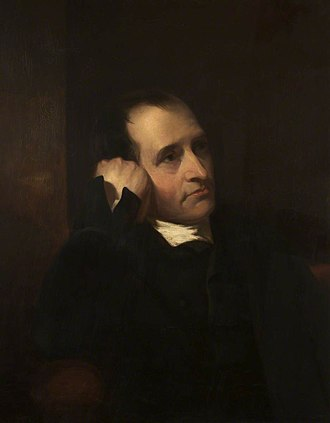
NAME: Crompton, Samuel.
ACHIEVEMENT(S): The Crompton Mule (cotton spinning)
DATE/PLACE OF BIRTH: 3rd December 1753, in Firwood-in-Tonge, near Bolton, Lancashire, England.
DATE/PLACE/AGE AT DEATH: 26th June 1827, in Bolton, Lancashire, England. Aged 74
DISCIPLINE: Cotton spinning.
FIELD: Business.
EDUCATION: the school of Mr. Lever in Church Street, Bolton; the school of William Barlow, Little Bolton.
MAJOR WORK: The Crompton Mule.
LIFE AND TIMES:
Crompton grew up on a farm where his whole family spent their spare time carding, spinning and weaving to earn extra money. By the age of fourteen, he was expected to produce a certain quantity of spun yarn or woven quilting each day, with quotas strictly enforced.
The mid-eighteenth century saw a great demand for fine cotton, used in the weaving of fashionable muslin. The invention of the fly shuttle by Kay* had speeded the process of weaving to such an extent that the spinners could not produce enough thread to keep up with the weavers’ demands.
In 1767, the spinning jenny was invented by Hargreaves.* This enabled eight threads to be simultaneously spun. Within a couple of years, Crompton was using Hargreaves’ jenny for his spinning work.
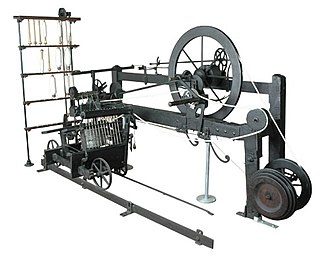
In 1774, Crompton began to develop his own spinning machine, later to be named the Crompton Mule*, which was capable of producing fine yarns for muslin. The machine was called a mule because it was a crossbreed, using the main features of Arkwright*’s water frame and Hargreaves’ spinning jenny. The mule employed two sets of rollers, the latter pair revolving at a slower speed than the former.
Crompton’s main innovation was in the design of the spindle carriage, from which the thread ran slack. The carriage could, by the movements of the hand and knee, be made to recede, just as the rollers delivered the elongated thread in a soft state, so a considerable stretch of the thread was possible before it had to undergo the stress of winding onto the spindle.
The influx of new labour saving machinery upset many spinners and weavers, who believed that they would be thrown out of work. So, like other inventors of the time, Crompton had to keep his work secret. During the riots that destroyed machines and factories in 1779, Crompton was compelled to take his invention apart and hide it.
Soon after, the mule was sufficiently perfected for Crompton to start to earn his living from it. The mule produced cotton that was of such fine high quality that demand far exceeded supply and he was able to ask his own price.
After just a few months, Crompton realised that, as he was not in the position to pay for a patent, he had to either destroy his mule or to give it to the public. He chose to give it, and, by 1800, the mule had replaced both Hargreaves’ spinning jenny and Arkwright’s water frame, and the British muslin industry was booming.
A number of friends, seeing what they considered to be an injustice, raised enough finance for Crompton to expand his small manufacturing plant. He toured the country, checking on the extent that industry was using his mule. The results showed that the number of spindles in use based on Hargreaves’ spinning jenny was 155,880, on Arkwright’s water frame 310,516, and on the mule, the enormous figure of 4,600,000.
A select committee of the House of Commons decided in favour of giving Crompton an award and in 1812 he was given £5,000. Although this was a large sum of money, given the trade generated by the mule it was insultingly small, so his friends raised a further subscription in 1824. The money was used to give him an annuity of sixty-three pounds. Thoroughly depressed with the injustice of life, Crompton gradually turned to alcohol for comfort in his later years.
ASSESSMENT: After developing his own invention and changing the face of the spinning industry, Crompton managed to maintain his position, during a period when dozens of spinners went broke and were forced back into the ranks of employed artisans.
EXTRA CONNE.TIONS:
His work related to that of Newcomen*.
Roberts* improved the mule.
BIBLIOGRAPHY:
Gilbert J. French, Life and Times of Samuel Crompton: with an introduction by Stanley D. Chapman, Adams & Dart, Bath, 1970 (first published in 1859).
LANGUAGE: English.
PARENTS: George Crompton and Elizabeth (Betty) Holt.
SIBLINGS: No details.
SPOUSE: Mary Pimlott, married 1780.
CHILDREN: George, Samuel, William, John, James.