Dale, David
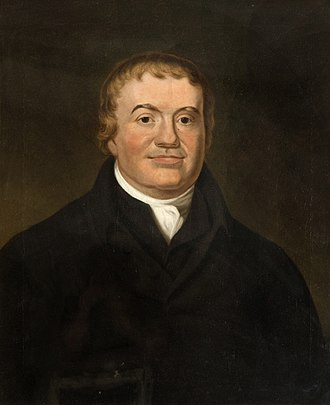
Name: David Dale
Achievements: Set up the first major textile factory in Scotland
Born: January 6, 1739; Stewarton, Ayrshire, Scotland
Died: March 17, 1806; Cambuslang, near Glasgow, Scotland (Aged 67)
Field & Discipline: Business; Industry; Businessman; Educationist; Philanthropist
Language: English
Father: Father: William Dale
Mother: name not known
Siblings: 1 brother: Hugh; 1 half-brother: James
Spouse: Ann Caroline Campbell
Children: 5 daughters: Anne, Caroline, Mary, Margaret, Jean, Julia
Education: Rudimentary
Life & Times:
Dale was the son of a grocer and was brought up in very simple circumstances. As a child he had a job herding livestock in the village and was later apprenticed to a weaver in Paisley. At that time, there was very little manufacture in Scotland and no factories with set hours of work. Weavers gathered in sheds and the work was done by hand.
Feeling constrained by the life, Dale left Paisley and traveled on foot in the countryside around Glasgow, delivering material and picking up finished goods. He settled in Glasgow around 1761-2 and worked for a time as clerk to a silk merchant. Dale was very religious and with the backing of the successful merchants and entrepreneurs he met in the College Presbyterian Church, he was able to open a one-room cloth store in Glasgow in 1863.
His financial backer partner was Archibald Paterson, a wealthy candle-maker. 1768 Dale was one of a group of men who left the established church and formed their own sect, the Old Scotch Independents. They had no paid ministers and in 1769 Dale was appointed as a pastor. In the same year, he became a burgher of the city and a member of the Guild Brethren, which meant he could trade under his own name in Glasgow.
In 1777 he married the daughter of one of the directors of the Royal Bank in Edinburgh and three years later bought land on which to build a large home, for which he engaged [hired] Adam* as architect and designer. In 1781 Dale dissolved his partnership with Paterson and also stopped sub-letting half his shop, perhaps in anticipation of his position as one of two Glasgow agents for the Royal Bank.
His hopes of earning a great deal of money were fulfilled. The Glasgow branch of the Royal Bank became the center of a great amount of business and Dale brokered many money-lending deals. He became a well-known social and philanthropic figure in the city and was involved in establishing the first Chamber of Commerce in Glasgow.
He became involved in numerous other ventures. He invested in mining and in 1785 he established a dyeing operation with [partnered with] George Macintosh*, a factory owner whose son, [knew] Charles Macintosh* later invented the waterproof raincoat. Dale’s best-known venture was the first large-scale spinning enterprise in Scotland.
He met [partnered with] Arkwright*, the inventor of new textile machinery, at a dinner in Glasgow, and when he took Arkwright to see the proposed site of development of model town at New Lanark, Arkwright immediately offered to become principal partner in the venture. The land was cleared and the new mill was built, but by the time the first cotton was spun in 1786 the partnership between Dale and Arkwright had ended after Arkwright lost his battle to protect his patents.
It is probable that Dale went into partnership with Arkwright to hedge his bets: if Arkwright had won his case, cotton spinners using the new technology would have been in breach of the law. The New Lanark factory, with Arkwright on board, would not. For good practical reasons, as well as for social and religious purposes, Dale was a philanthropist and when the first mill at New Lanark burned down he continued to pay his workforce and while it was being rebuilt.
By 1793 there were over ten thousand spindles in two of the mills on the site and more in a third mill, where water-powered machines patented by Dale’s manager meant that workers could operate twice as many spindles. Dale’s half-brother helped to manage New Lanark on a day-to-day basis while Dale pursued his many business interests and devoted time to preaching and visiting Bridewell prison to preach to the convicts. New Lanark became famous not just for its size and its success but because of the conditions in which the workers lived.
Dale provided good accommodation for workers, saw that they were well fed and also provided a school to which they could send their children. No charge was made for apprenticing their children at the mills. Pauper children from the orphanages in Glasgow and Edinburgh were taken on as unpaid apprentices and were clothed, fed, housed and educated free at the school.
The idea of a factory community was not new but Dale improved on the example set by Arkwright in England and on one or two other previous examples in Scotland and certainly provided more than any other mill owner for the ordinary people who lived near New Lanark.
The project came to be regarded as a model and was visited not only by local businessmen and entrepreneurs such as [visited by] Watt*, but by visitors from England and the continent, New York, Scandinavia, the West Indies and India. There were around 750 visitors a year, up to 1799.
In 1798 [father-in-law to] Robert Owen*, a factory manager from Manchester, visited New Lanark and the following year he and his partners bought the mills from Dale. Owen then married Dale’s daughter and went on to introduce the socialist ideas for which New Lanark became known and which, together with his son [grandson was] Robert Dale Owen*, he attempted to propagate in America.
Dale bought a country estate near Glasgow in 1800 and spent his last years there while continuing to preach and travel for the Old Scotch Independents sect.
Extra Connections: He was one of the earliest users of the [early user of] Crompton Mule*
Assessment: Dale established one of the first large-scale manufacturing operations in Scotland where he put into practice new ideas on workers’ welfare and education.
Oneliner: David Dale, Industrial revolution manufacturer and philanthropist
Bibliography:
- Cole, GDH, The Life of Robert Owen, Frank Cass & Co. Ltd., London, 1965.
- McLaren, David, David Dale of New Lanark, Heatherbank Press, Glasgow, 1983.