Hargreaves
NAME: Hargreaves, James.
ACHIEVEMENT(S): Spinning jenny
DATE/PLACE OF BIRTH: 1720 or 1721, near Blackburn, Lancashire, England.
DATE/PLACE/AGE AT DEATH: April 1778, in Nottingham, England.
DISCIPLINE: Inventor.
FIELD: Business.
EDUCATION: None.
MAJOR WORK: Spinning jenny
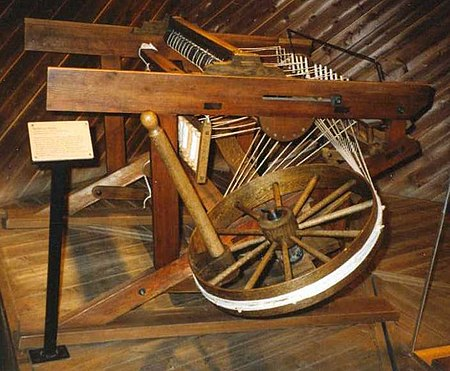
LIFE AND TIMES: As a young man, Hargreaves worked as a hand-loom cotton weaver in the cottage industry prevalent in the county of Lancashire. In 1764, Hargreaves invented the spinning jenny, a machine capable of spinning eleven separate threads at the same time.
He had begun with experimenting with two or three spindles attached to an ordinary spinning wheel, but the horizontal position of the spindles had made this ineffective. It seems that inspiration came when a spinning wheel overturned and Hargreaves realised that, in a horizontal position, the wheel and spindle both moved faster.
This revelation couldn’t have come at a better time, when demand for yarn far exceeded supply.
Developments like the 1733 invention of the flying shuttle by Kay* had so increased output by the weavers that, by the 1760s, their need for yarn had soared.
News of Hargreaves’ invention spread, at a time when workers were becoming very worried about machinery, seeing that there was a very real chance that they would be thrown out of work, at a time when money was scarce already and food expensive.
Robert Peel, a local manufacturer, had plans to open a factory to exploit the spinning jenny and Hargreaves was taken on to make and install the machines.
Local workers rioted, knowing that the machines posed a threat to their livelihood and, in March 1768, the factory buildings were torched and the machines destroyed. Hargreaves himself had to go into hiding before secretly leaving the area.
He moved south to Nottingham, the centre of the Midlands cotton industry, and lived there for the next ten years. He and Thomas James, a machine maker, set up a cotton mill together, supplying local hosiers with yarn, although Hargreaves still experienced problems with the workers, on one occasion being physically attacked.
In 1770, Hargreaves applied for a patent on his invention but, just like fellow textile-machinery inventor Arkwright*, he had difficulty in enforcing it. Other manufacturers joined forces to fight the patent in court but, because Hargreaves had sold some jennies before they were patented, his lawyer decided that he had a weak case and withdrew. Faced with heavy opposition, Hargreaves gave up.
Soon after, Hargreaves’ invention lost its edge to Arkwright’s water frame. Although the weft thread that the jenny produced was in great demand by hand-loom weavers, these workers were gradually being replaced by framework knitters, to whom the difference between weft and warp threads was not so important.
This meant that Arkwright was able to sell his warp thread indiscriminately. Arkwright’s water frame spinning machines also used water power and consequently had a high production rate, so he was able to dominate Hargreaves in the market place.
Spinning jennies with the capacity to spin a hundred threads at once later become available in Lancashire, but Hargreaves’ company did not modernise. It did, however, diversify and began to spin silk as well as cotton. In the end, Hargreave could no longer compete with his rival and, in 1777, the company installed Arkwright’s machinery on licence.
ASSESSMENT: He died knowing that his invention had earned other people far more than it had earned for him.
EXTRA CONNECTIONS: His work related to that of Crompton* , whose Crompton Mule* he used.
His work related to that of Newcomen*
ONELINER: James Hargreaves, major Industrial Revolution inventor
BIBLIOGRAPHY:
Aspin, C., James Hargreaves and the Spinning Jenny, Helmsmore Local History Society, Preston, Lancashire, 1964.
LANGUAGE: English.
PARENTS: George Hargreaves.
SIBLINGS: Elizabeth.
SPOUSE: Elizabeth Grimshaw, married 1740.
CHILDREN: Susan, Alice, Mary, Nancy and others.