Arkwright, Richard
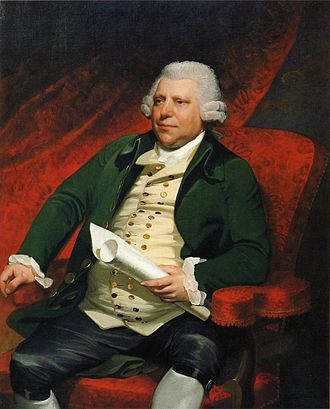
ACHIEVEMENT(S): Played a key role in Industrial Revolution textile manufacture.
DATE/PLACE OF BIRTH: 23rd December 1732, in Preston, Lancashire, England.
DATE/PLACE/AGE AT DEATH: 3rd August 1792, in Cromford, Lancashire, England. Aged 60.
DISCIPLINE: Business.
FIELD: Textile manufacture
LANGUAGE: English.
EDUCATION: Evening school.
MAJOR WORK: Invention of the spinning machine.
LIFE AND TIMES:
Arkwright was a wigmaker, barber and ran a public house from 1762 to 1764. The wig business expanded and Arkwright took on a craftsman assistant.
Arkwright travelled around visiting local fairs, looking for women who wanted to sell their hair for his wigmaking business. On one trip, he met clockmaker Kay* and showed him a “perpetual motion device” he had designed. Kay and Arkwright discussed the possibility of making a thread-spinning machine and, in 1765, Kay took on the job of building models of the machine Arkwright designed. Arkwright then tried to perfect the design and, when he thought that he had ironed out the problems, contacted Kay again and asked him to help build the machine.
The spinning machine was ready in April 1768, and Arkwright moved to Nottingham to try to break into the hosiery industry. He eventually patented his design on 3rd July 1769. The machine worked using two sets of rollers through which a strand of cotton was drawn. The first set compressed the thread, then it was passed on in a revolving motion to the next set of rollers, which, moving at a faster speed, stretched the strand. After this the cotton passed on to a revolving spindle, which twisted to the yarn before it was wound on the bobbin.
As workers feared, Arkwright’s machine would spin several threads at once, matching the output of several people working on spinning wheels. The thread produced was also strong and uniform in thickness, and was ideal for using as weft thread.
With the patent achieved, Arkwright and his partners needed more money in order to set up premises, and a further contract was signed between them and mill owners Samuel Need and Jedidiah Strutt. Arkwright supervised the installation of the production line. Thanks to the good quality yarn he produced for the hosiery industry, business boomed.
The possibility of expansion led Arkwright to consider water-power, and the partners set up a new mill, in 1771, at Cromford. This became the first water-powered cotton-spinning mill in the world. Because it used water-power, Arkwright’s spinning frame became known as the water frame*.
The business continued to expand and in 1776 Arkwright built a second mill, where he employed four hundred and fifty people. By 1784, when his Masson Mill was built, he had around eight hundred employees. Most of his workers were women and children, the men of the area being largely employed in the lead mines.
The mills operated twenty-four hours a day, on two twelve-hour shifts, six days a week, with Sunday a day of rest. Arkwright enforced strict standards of cleanliness in his factories and by the standards of the day was a fair employer. He paid overtime, which was unusual, and refused to exploit children under ten.
Arkwright’s business continued to expand. After a dinner given in his honour in Glasgow, he visited the falls on the Clyde River. The sight of the water stimulated him to establish yet another factory, this time in partnership with the industrialist, Dale* and, in 1786, New Lanark Mills started production.
By now, Arkwright was the dominant power in a very profitable industry. It was this profit factor that caused his patent to be disputed. In July 1785, the question of whether his design was really new and unique was put to trial.
The verdict went against Arkwright, on the grounds that the patent application had been obscure and that others had invented important parts of the spinning machine. The court decided that the idea of roller-spinning had been developed by Thomas Highs, and the crank and comb by Hargreaves*.
In 1786, Arkwright was knighted and the following year became High Sheriff of Derbyshire. For many years, Arkwright had lived in a large house opposite his Cromford mills, until in 1788, he bought an estate from Edward Nightingale, the father of Florence Nightingale*, for £20,000, where he had the architect William Thomas built him a castle.
ASSESSMENT: The founder of the modern factory system, Arkwright brought about a new industrial society that turned England into the workshop of the world.
EXTRA CONNECTIONS: His work related to that of Crompton*, whose Compton Mule* he used.
ONELINER: Richard Arkwright, textile machinery inventor
.
BIBLIOGRAPHY:
R.S. Fitton, The Arkwrights: Spinners of Fortune, Manchester University Press, Manchester and New York, 1989.
PARENTS:
Thomas Arkwright and Ellen Hodgkinson.
SIBLINGS: William, Mary, Ellen, Jennet, Ann, Elizabeth.
SPOUSE: First: Patience Holt, married 1755.
Second: Margaret Biggins, married 1761.
CHILDREN: Richard, Susanna, Robert, Peter.