Chronometer
ALTERNATIVE NAME/S: Sea clock, deck watch
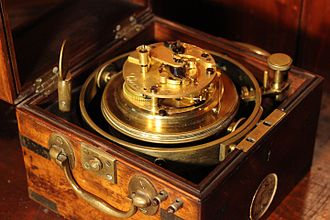
(marine chronometer movement. circa 1844)
A chronometer is a highly accurate timepiece used primarily in marine navigation. Chronometers are set to Greenwich Mean Time; a navigator can calculate a ship’s longitude by working out the difference between local time (on his ship) and Greenwich time (in London). The face of a chronometer has an hour hand and a minute hand like an ordinary clock, but it also has a second hand that marks every half-second and a dial that tells how many hours have passed since the chronometer was wound.
A chronometer is suspended in gimbals, two concentric rings mounted on axes that pivot at right angles to each other. The gimbals help keep the chronometer accurate by allowing it to remain level regardless of a ship’s rolling and pitching at sea. Other features that contribute to a chronometer’s accuracy include a bimetallic strip, attached to the spring, that expands and contracts with temperature change so as to keep the length of the spring constant (as it, too, expands and contracts).
John Harrison*, an English carpenter, created the first prototype chronometer in 1735, and spent 30 years refining his design. Harrison’s fourth chronometer, commonly called H4, qualified for a ₤20,000 prize from the British government’s Board of Longitude in 1761 when it was tested and found to be accurate within 1 second per day. Today modern quartz digital chronometers are accurate within 0.1 second per day. While chronometers have been largely replaced by satellite navigation systems, chronometers are still used as a backup manual navigation tool.
Historical Significance
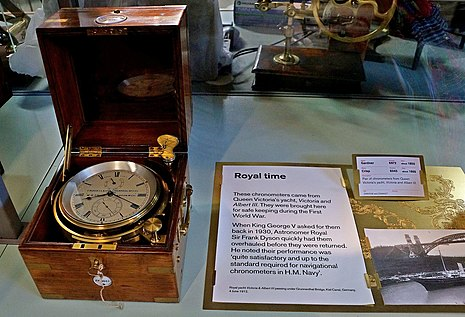
Mechanical boxed Marine Chronometer made about 1865
Ship’s marine chronometers are the most exact portable mechanical timepieces ever produced and in a static environment were only trumped by non-portable precision pendulum clocks for observatories. They served, alongside the sextant, to determine the location of ships at sea. The seafaring nations invested richly in the development of these precision instruments, as pinpointing location at sea gave a decisive naval advantage.
Without their accuracy and the accuracy of the feats of navigation that marine chronometers, enabled, it is arguable that the ascendancy of the Royal Navy, and by extension that of the British Empire, might not have occurred so overwhelmingly; the formation of the empire by wars and conquests of colonies abroad took place in a period in which British vessels had reliable navigation due to the chronometer, while their Portuguese, Dutch, and French opponents did not.[32] For example: the French were well established in India and other places before Britain, but were defeated by naval forces in the Seven Years' War.
ONELINER: Chronometer
OTHER CONNECTIONS: None
BIBLIOGRAPHY: Chronometer. (2002). In Encyclopedia Americana. (Int’l ed. , Vol. 6, P. 688). Danbury, Conn.: Grolier Inc.;
Chronometer. (2002). In Encyclopedia Brittanica micropaedia ready reference. (15th ed., Vol. 3, P. 289). Chicago: Encyclopaedia Britannica, Inc.;
Dick, S. J. (1992). Chronometer. In McGraw-Hill Encyclopaedia of Science and Technology. (7th ed., Vol. 3, P. 625). New York: McGraw-Hill Inc.
AUDIO/VISUAL:
http://www.harrisonclocks.co.uk/home.htm
http://www.nmm.ac.uk/site/request/setTemplate:singlecontent/contentTypeA/conWebDoc/contentId/355/viewPage/1