Clock / watch
A clock or a timepiece[1] is a device used to measure and indicate time. The clock is one of the oldest human inventions, meeting the need to measure intervals of time shorter than the natural units such as the day, the lunar month and the year. Devices operating on several physical processes have been used over the millennia.
Some predecessors to the modern clock may be considered as "clocks" that are based on movement in nature: A sundial shows the time by displaying the position of a shadow on a flat surface. There is a range of duration timers, a well-known example being the hourglass. Water clocks, along with the sundials, are possibly the oldest time-measuring instruments. A major advance occurred with the invention of the verge escapement, which made possible the first mechanical clocks around 1300 in Europe, which kept time with oscillating timekeepers like balance wheels.[2][3][4][5]
Traditionally, in horology (the study of timekeeping), the term clock was used for a striking clock, while a clock that did not strike the hours audibly was called a timepiece. This distinction is no longer made. Watches and other timepieces that can be carried on one's person are usually not referred to as clocks.[6]
Spring-driven clocks appeared during the 15th century. During the 15th and 16th centuries, clockmaking flourished. The next development in accuracy occurred after 1656 with the invention of the pendulum clock by Christiaan Huygens. A major stimulus to improving the accuracy and reliability of clocks was the importance of precise time-keeping for navigation. The mechanism of a timepiece with a series of gears driven by a spring or weights is referred to as clockwork; the term is used by extension for a similar mechanism not used in a timepiece. The electric clock was patented in 1840, and electronic clocks were introduced in the 20th century, becoming widespread with the development of small battery-powered semiconductor devices.
The timekeeping element in every modern clock is a harmonic oscillator, a physical object (resonator) that vibrates or oscillates at a particular frequency.[3] This object can be a pendulum, a tuning fork, a quartz crystal, or the vibration of electrons in atoms as they emit microwaves, the last method of which is so precise that it serves as the definition of the second.
Clocks have different ways of displaying the time. Analog clocks indicate time with a traditional clock face, with moving hands. Digital clocks display a numeric representation of time. Two numbering systems are in use: 12-hour time notation and 24-hour notation. Most digital clocks use electronic mechanisms and LCD, LED, or VFD displays. For the blind and for use over telephones, speaking clocks state the time audibly in words. There are also clocks for the blind that have displays that can be read by touch.
Etymology
The word clock derives from the medieval Latin word for 'bell'—clocca—and has cognates in many European languages. Clocks spread to England from the Low Countries,[7] so the English word came from the Middle Low German and Middle Dutch Klocke.[8] The word derives from the Middle English clokke, Old North French cloque, or Middle Dutch clocke, all of which mean 'bell'.
History of time-measuring devices
Main article: History of timekeeping devices ...
Sundials

Simple horizontal sundial
Main article: Sundial
The apparent position of the Sun in the sky moves over the course of each day, reflecting the rotation of the Earth. Shadows cast by stationary objects move correspondingly, so their positions can be used to indicate the time of day. A sundial shows the time by displaying the position of a shadow on a (usually) flat surface, which has markings that correspond to the hours.[9] Sundials can be horizontal, vertical, or in other orientations. Sundials were widely used in ancient times.[10] With the knowledge of latitude, a well-constructed sundial can measure local solar time with reasonable accuracy, within a minute or two. Sundials continued to be used to monitor the performance of clocks until the 1830s, when the use of the telegraph and trains standardized time and time zones between cities.[11]
Devices that measure duration, elapsed time and intervals

The flow of sand in an hourglass can be used to keep track of elapsed time.
Many devices can be used to mark the passage of time without respect to reference time (time of day, hours, minutes, etc.) and can be useful for measuring duration or intervals. Examples of such duration timers are candle clocks, incense clocks and the hourglass. Both the candle clock and the incense clock work on the same principle wherein the consumption of resources is more or less constant allowing reasonably precise and repeatable estimates of time passages. In the hourglass, fine sand pouring through a tiny hole at a constant rate indicates an arbitrary, predetermined passage of time. The resource is not consumed but re-used.
Water clocks
Main article: Water clock

A water clock for goldbeating goldleaf in Mandalay (Myanmar)
Water clocks, along with the sundials, are possibly the oldest time-measuring instruments, with the only exceptions being the day counting tally stick.[12] Given their great antiquity, where and when they first existed is not known and is perhaps unknowable. The bowl-shaped outflow is the simplest form of a water clock and is known to have existed in Babylon and in Egypt around the 16th century BC. Other regions of the world, including India and China, also have early evidence of water clocks, but the earliest dates are less certain. Some authors, however, write about water clocks appearing as early as 4000 BC in these regions of the world.[13]
Greek astronomer Andronicus of Cyrrhus supervised the construction of the Tower of the Winds in Athens in the 1st century B.C.[14] The Greek and Roman civilizations advanced water clock design with improved accuracy. These advances were passed on through Byzantine and Islamic times, eventually making their way back to Europe. Independently, the Chinese developed their own advanced water clocks(水鐘)in 725 AD, passing their ideas on to Korea and Japan.
Some water clock designs were developed independently and some knowledge was transferred through the spread of trade. Pre-modern societies do not have the same precise timekeeping requirements that exist in modern industrial societies, where every hour of work or rest is monitored, and work may start or finish at any time regardless of external conditions. Instead, water clocks in ancient societies were used mainly for astrological reasons. These early water clocks were calibrated with a sundial. While never reaching the level of accuracy of a modern timepiece, the water clock was the most accurate and commonly used timekeeping device for millennia, until it was replaced by the more accurate pendulum clock in 17th-century Europe.
Islamic civilization is credited with further advancing the accuracy of clocks with elaborate engineering. In 797 (or possibly 801), the Abbasid caliph of Baghdad, Harun al-Rashid, presented Charlemagne with an Asian elephant named Abul-Abbas together with a "particularly elaborate example" of a water[15] clock. Pope Sylvester II introduced clocks to northern and western Europe around 1000 AD.[16]
Mechanical water clocks
See also: Automaton § Ancient
The first known geared clock was invented by the great mathematician, physicist, and engineer Archimedes during the 3rd century BC. Archimedes created his astronomical clock[17] that was also a cuckoo clock with birds singing and moving every hour. It is the first carillon clock as it plays music and simultaneously with a person blinking his eyes surprised by the singing birds. Archimedes clock works with a system of four weights, counter weights, and strings regulated by a system of floats in a water container with siphons that regulate the automatic continuation of the clock.
The principles of this type of clocks are described by the mathematician and physicist Hero,[18] who says that some of them work with a chain that turns a gear of the mechanism.[19] Another Greek clock probably constructed at the time of Alexander was in Gaza, described by Procopius.[20] The Gaza clock was probably a Meteoroskopeion, i.e. a building showing the celestial phenomena and the time. It had pointer for the time and some automations similar to the Archimedes clock. There were 12 doors opening one every hour with Hercules performing his labors, the Lion at one o'clock, etc., and at night a lamp becomes visible every hour, with 12 windows opening to show the time.

A scale model of Su Song's Astronomical Clock Tower, built in 11th-century Kaifeng, China. It was driven by a large waterwheel, chain drive, and escapement mechanism.
A water-powered cogwheel clock was created in China by Yi Xing and Liang Lingzan. This is not considered an escapement mechanism clock as it was unidirectional, the Song dynasty polymath and genius Su Song (1020–1101) incorporated it into his monumental innovation of the astronomical clock-tower of Kaifeng in 1088.[21][22][page needed] His astronomical clock and rotating armillary sphere still relied on the use of either flowing water during the spring, summer, autumn seasons and liquid mercury during the freezing temperature of winter (i.e. hydraulics).
In Su Song's waterwheel linkwork device, the action of the escapement's arrest and release was achieved by gravity exerted periodically as the continuous flow of liquid filled containers of a limited size. In a single line of evolution, Su Song's clock therefore united the concept of the clepsydra and the mechanical clock into one device run by mechanics and hydraulics. In his memorial, Su Song wrote about this concept:
According to your servant's opinion there have been many systems and designs for astronomical instruments during past dynasties all differing from one another in minor respects. But the principle of the use of water-power for the driving mechanism has always been the same. The heavens move without ceasing but so also does water flow (and fall). Thus if the water is made to pour with perfect evenness, then the comparison of the rotary movements (of the heavens and the machine) will show no discrepancy or contradiction; for the unresting follows the unceasing.
Song was also strongly influenced by the earlier armillary sphere created by Zhang Sixun (976 AD), who also employed the escapement mechanism and used liquid mercury instead of water in the waterwheel of his astronomical clock tower. The mechanical clockworks for Su Song's astronomical tower featured a great driving-wheel that was 11 feet in diameter, carrying 36 scoops, into each of which water poured at a uniform rate from the "constant-level tank".
The main driving shaft of iron, with its cylindrical necks supported on iron crescent-shaped bearings, ended in a pinion, which engaged a gear wheel at the lower end of the main vertical transmission shaft. This great astronomical hydromechanical clock tower was about ten metres high (about 30 feet) and featured a clock escapement and was indirectly powered by a rotating wheel either with falling water and liquid mercury. A full-sized working replica of Su Song's clock exists in the Republic of China (Taiwan)'s National Museum of Natural Science, Taichung city. This full-scale, fully functional replica, approximately 12 meters (39 feet) in height, was constructed from Su Song's original descriptions and mechanical drawings.[23]

An elephant clock in a manuscript by Al-Jazari (1206 AD) from The Book of Knowledge of Ingenious Mechanical Devices[24]
In the 12th century, Al-Jazari, an engineer from Mesopotamia (lived 1136–1206) who worked for Artuqid king of Diyar-Bakr, Nasir al-Din, made numerous clocks of all shapes and sizes. The most reputed clocks included the elephant, scribe, and castle clocks, some of which have been successfully reconstructed. As well as telling the time, these grand clocks were symbols of status, grandeur and wealth of the Urtuq State.[25]
Fully mechanical
The word horologia (from the Greek ὥρα—'hour', and λέγειν—'to tell') was used to describe early mechanical clocks,[26] but the use of this word (still used in several Romance languages)[27] for all timekeepers conceals the true nature of the mechanisms. For example, there is a record that in 1176 Sens Cathedral in France installed an 'horologe'[28] but the mechanism used is unknown.
According to Jocelyn de Brakelond, in 1198 during a fire at the abbey of St Edmundsbury (now Bury St Edmunds), the monks "ran to the clock" to fetch water, indicating that their water clock had a reservoir large enough to help extinguish the occasional fire.[29] The word clock (via Medieval Latin clocca from Old Irish clocc, both meaning 'bell'), which gradually supersedes "horologe", suggests that it was the sound of bells which also characterized the prototype mechanical clocks that appeared during the 13th century in Europe.

A 17th-century weight-driven clock in Läckö Castle, Sweden
In Europe, between 1280 and 1320, there was an increase in the number of references to clocks and horologes in church records, and this probably indicates that a new type of clock mechanism had been devised. Existing clock mechanisms that used water power were being adapted to take their driving power from falling weights. This power was controlled by some form of oscillating mechanism, probably derived from existing bell-ringing or alarm devices. This controlled release of power – the escapement – marks the beginning of the true mechanical clock, which differed from the previously mentioned cogwheel clocks. Verge escapement mechanism derived in the surge of true mechanical clocks, which didn't need any kind of fluid power, like water or mercury, to work.
These mechanical clocks were intended for two main purposes: for signalling and notification (e.g., the timing of services and public events), and for modeling the solar system. The former purpose is administrative, the latter arises naturally given the scholarly interests in astronomy, science, astrology, and how these subjects integrated with the religious philosophy of the time. The astrolabe was used both by astronomers and astrologers, and it was natural to apply a clockwork drive to the rotating plate to produce a working model of the solar system.
Simple clocks intended mainly for notification were installed in towers, and did not always require faces or hands. They would have announced the canonical hours or intervals between set times of prayer. Canonical hours varied in length as the times of sunrise and sunset shifted. The more sophisticated astronomical clocks would have had moving dials or hands, and would have shown the time in various time systems, including Italian hours, canonical hours, and time as measured by astronomers at the time. Both styles of clock started acquiring extravagant features such as automata.
In 1283, a large clock was installed at Dunstable Priory in Bedfordshire in southern England; its location above the rood screen suggests that it was not a water clock.[30] In 1292, Canterbury Cathedral installed a 'great horloge'. Over the next 30 years there are mentions of clocks at a number of ecclesiastical institutions in England, Italy, and France. In 1322, a new clock was installed in Norwich, an expensive replacement for an earlier clock installed in 1273. This had a large (2 metre) astronomical dial with automata and bells. The costs of the installation included the full-time employment of two clockkeepers for two years.[30]
Astronomical

Richard of Wallingford pointing to a clock, his gift to St Albans Abbey
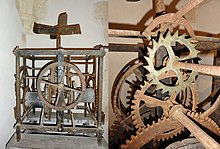
16th-century clock machine Convent of Christ, Tomar, Portugal
An elaborate water clock, the 'Cosmic Engine', was invented by Su Song, a Chinese polymath, designed and constructed in China in 1092. This great astronomical hydromechanical clock tower was about ten metres high (about 30 feet) and was indirectly powered by a rotating wheel with falling water and liquid mercury, which turned an armillary sphere capable of calculating complex astronomical problems.
In Europe, there were the clocks constructed by Richard of Wallingford in Albans by 1336, and by Giovanni de Dondi in Padua from 1348 to 1364. They no longer exist, but detailed descriptions of their design and construction survive,[31][32] and modern reproductions have been made.[32] They illustrate how quickly the theory of the mechanical clock had been translated into practical constructions, and also that one of the many impulses to their development had been the desire of astronomers to investigate celestial phenomena.
The Astrarium of Giovanni Dondi dell'Orologio was a complex astronomical clock built between 1348 and 1364 in Padua, Italy, by the doctor and clock-maker Giovanni Dondi dell'Orologio. The Astrarium had seven faces and 107 moving gears; it showed the positions of the sun, the moon and the five planets then known, as well as religious feast days. The astrarium stood about 1 metre high, and consisted of a seven-sided brass or iron framework resting on 7 decorative paw-shaped feet. The lower section provided a 24-hour dial and a large calendar drum, showing the fixed feasts of the church, the movable feasts, and the position in the zodiac of the moon's ascending node.
The upper section contained 7 dials, each about 30 cm in diameter, showing the positional data for the Primum Mobile, Venus, Mercury, the moon, Saturn, Jupiter, and Mars. Directly above the 24-hour dial is the dial of the Primum Mobile, so called because it reproduces the diurnal motion of the stars and the annual motion of the sun against the background of stars. Each of the 'planetary' dials used complex clockwork to produce reasonably accurate models of the planets' motion. These agreed reasonably well both with Ptolemaic theory and with observations.[33][34]
Wallingford's clock had a large astrolabe-type dial, showing the sun, the moon's age, phase, and node, a star map, and possibly the planets. In addition, it had a wheel of fortune and an indicator of the state of the tide at London Bridge. Bells rang every hour, the number of strokes indicating the time.[31] Dondi's clock was a seven-sided construction, 1 metre high, with dials showing the time of day, including minutes, the motions of all the known planets, an automatic calendar of fixed and movable feasts, and an eclipse prediction hand rotating once every 18 years.[32]
It is not known how accurate or reliable these clocks would have been. They were probably adjusted manually every day to compensate for errors caused by wear and imprecise manufacture. Water clocks are sometimes still used today, and can be examined in places such as ancient castles and museums. The Salisbury Cathedral clock, built in 1386, is considered to be the world's oldest surviving mechanical clock that strikes the hours.[35]
Spring-Driven
ockmakers developed their art in various ways. Building smaller clocks was a technical challenge, as was improving accuracy and reliability. Clocks could be impressive showpieces to demonstrate skilled craftsmanship, or less expensive, mass-produced items for domestic use. The escapement in particular was an important factor affecting the clock's accuracy, so many different mechanisms were tried.
Spring-driven clocks appeared during the 15th century,[36][37][38] although they are often erroneously credited to Nuremberg watchmaker Peter Henlein (or Henle, or Hele) around 1511.[39][40][41] The earliest existing spring driven clock is the chamber clock given to Phillip the Good, Duke of Burgundy, around 1430, now in the Germanisches Nationalmuseum.[5] Spring power presented clockmakers with a new problem: how to keep the clock movement running at a constant rate as the spring ran down. This resulted in the invention of the stackfreed and the fusee in the 15th century, and many other innovations, down to the invention of the modern going barrel in 1760.
Early clock dials did not indicate minutes and seconds. A clock with a dial indicating minutes was illustrated in a 1475 manuscript by Paulus Almanus,[42] and some 15th-century clocks in Germany indicated minutes and seconds.[43] An early record of a seconds hand on a clock dates back to about 1560 on a clock now in the Fremersdorf collection.[44]: 417–418 [45]
During the 15th and 16th centuries, clockmaking flourished, particularly in the metalworking towns of Nuremberg and Augsburg, and in Blois, France. Some of the more basic table clocks have only one time-keeping hand, with the dial between the hour markers being divided into four equal parts making the clocks readable to the nearest 15 minutes. Other clocks were exhibitions of craftsmanship and skill, incorporating astronomical indicators and musical movements. The cross-beat escapement was invented in 1584 by Jost Bürgi, who also developed the remontoire. Bürgi's clocks were a great improvement in accuracy as they were correct to within a minute a day.[46][47] These clocks helped the 16th-century astronomer Tycho Brahe to observe astronomical events with much greater precision than before.

Lantern clock, German, c. 1570
Pendulum
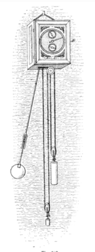

The first pendulum clock, designed by Christiaan Huygens in 1656
The next development in accuracy occurred after 1656 with the invention of the pendulum clock. Galileo had the idea to use a swinging bob to regulate the motion of a time-telling device earlier in the 17th century. Christiaan Huygens, however, is usually credited as the inventor. He determined the mathematical formula that related pendulum length to time (about 99.4 cm or 39.1 inches for the one second movement) and had the first pendulum-driven clock made. The first model clock was built in 1657 in the Hague, but it was in England that the idea was taken up.[48] The longcase clock (also known as the grandfather clock) was created to house the pendulum and works by the English clockmaker William Clement in 1670 or 1671. It was also at this time that clock cases began to be made of wood and clock faces to use enamel as well as hand-painted ceramics.
In 1670, William Clement created the anchor escapement,[49] an improvement over Huygens' crown escapement. Clement also introduced the pendulum suspension spring in 1671. The concentric minute hand was added to the clock by Daniel Quare, a London clockmaker and others, and the second hand was first introduced.
Hairspring
In 1675, Huygens and Robert Hooke invented the spiral balance spring, or the hairspring, designed to control the oscillating speed of the balance wheel. This crucial advance finally made accurate pocket watches possible. The great English clockmaker Thomas Tompion, was one of the first to use this mechanism successfully in his pocket watches, and he adopted the minute hand which, after a variety of designs were trialled, eventually stabilised into the modern-day configuration.[50]
The rack and snail striking mechanism for striking clocks, was introduced during the 17th century and had distinct advantages over the 'countwheel' (or 'locking plate') mechanism. During the 20th century there was a common misconception that Edward Barlow invented rack and snail striking. In fact, his invention was connected with a repeating mechanism employing the rack and snail.[51] The repeating clock, that chimes the number of hours (or even minutes) on demand was invented by either Quare or Barlow in 1676. George Graham invented the deadbeat escapement for clocks in 1720.
Marine chronometer
Main article: Marine chronometer
A major stimulus to improving the accuracy and reliability of clocks was the importance of precise time-keeping for navigation. The position of a ship at sea could be determined with reasonable accuracy if a navigator could refer to a clock that lost or gained less than about 10 seconds per day. This clock could not contain a pendulum, which would be virtually useless on a rocking ship. In 1714, the British government offered large financial rewards to the value of 20,000 pounds[52] for anyone who could determine longitude accurately. John Harrison, who dedicated his life to improving the accuracy of his clocks, later received considerable sums under the Longitude Act.
In 1735, Harrison built his first chronometer, which he steadily improved on over the next thirty years before submitting it for examination. The clock had many innovations, including the use of bearings to reduce friction, weighted balances to compensate for the ship's pitch and roll in the sea and the use of two different metals to reduce the problem of expansion from heat. The chronometer was tested in 1761 by Harrison's son and by the end of 10 weeks the clock was in error by less than 5 seconds.[53]
Mass production
The British had dominated watch manufacture for much of the 17th and 18th centuries, but maintained a system of production that was geared towards high quality products for the elite.[54] Although there was an attempt to modernise clock manufacture with mass-production techniques and the application of duplicating tools and machinery by the British Watch Company in 1843, it was in the United States that this system took off. In 1816, Eli Terry and some other Connecticut clockmakers developed a way of mass-producing clocks by using interchangeable parts.[55] Aaron Lufkin Dennison started a factory in 1851 in Massachusetts that also used interchangeable parts, and by 1861 was running a successful enterprise incorporated as the Waltham Watch Company.[56][57]
Early electric
Main article: Electric clock

Early French electromagnetic clock
In 1815, Francis Ronalds published the first electric clock powered by dry pile batteries.[58] Alexander Bain, Scottish clockmaker, patented the electric clock in 1840. The electric clock's mainspring is wound either with an electric motor or with an electromagnet and armature. In 1841, he first patented the electromagnetic pendulum. By the end of the nineteenth century, the advent of the dry cell battery made it feasible to use electric power in clocks.
Spring or weight driven clocks that use electricity, either alternating current (AC) or direct current (DC), to rewind the spring or raise the weight of a mechanical clock would be classified as an electromechanical clock. This classification would also apply to clocks that employ an electrical impulse to propel the pendulum. In electromechanical clocks the electricity serves no time keeping function. These types of clocks were made as individual timepieces but more commonly used in synchronized time installations in schools, businesses, factories, railroads and government facilities as a master clock and slave clocks.
Where an AC electrical supply of stable frequency is available, timekeeping can be maintained very reliably by using a synchronous motor, essentially counting the cycles. The supply current alternates with an accurate frequency of 50 hertz in many countries, and 60 hertz in others. While the frequency may vary slightly during the day as the load changes, generators are designed to maintain an accurate number of cycles over a day, so the clock may be a fraction of a second slow or fast at any time, but will be perfectly accurate over a long time. The rotor of the motor rotates at a speed that is related to the alternation frequency. Appropriate gearing converts this rotation speed to the correct ones for the hands of the analog clock. Time in these cases is measured in several ways, such as by counting the cycles of the AC supply, vibration of a tuning fork, the behaviour of quartz crystals, or the quantum vibrations of atoms. Electronic circuits divide these high-frequency oscillations to slower ones that drive the time display.
Quartz

Picture of a quartz crystal resonator, used as the timekeeping component in quartz watches and clocks, with the case removed. It is formed in the shape of a tuning fork. Most such quartz clock crystals vibrate at a frequency of 32768 Hz.
The piezoelectric properties of crystalline quartz were discovered by Jacques and Pierre Curie in 1880.[59][60] The first crystal oscillator was invented in 1917 by Alexander M. Nicholson, after which the first quartz crystal oscillator was built by Walter G. Cady in 1921.[3] In 1927 the first quartz clock was built by Warren Marrison and J.W. Horton at Bell Telephone Laboratories in Canada.[61][3] The following decades saw the development of quartz clocks as precision time measurement devices in laboratory settings—the bulky and delicate counting electronics, built with vacuum tubes at the time, limited their practical use elsewhere. The National Bureau of Standards (now NIST) based the time standard of the United States on quartz clocks from late 1929 until the 1960s, when it changed to atomic clocks.[62] In 1969, Seiko produced the world's first quartz wristwatch, the Astron.[63] Their inherent accuracy and low cost of production resulted in the subsequent proliferation of quartz clocks and watches.[59]
Atomic
Currently, atomic clocks are the most accurate clocks in existence. They are considerably more accurate than quartz clocks as they can be accurate to within a few seconds over trillions of years.[64][65] Atomic clocks were first theorized by Lord Kelvin in 1879.[66] In the 1930s the development of magnetic resonance created practical method for doing this.[67] A prototype ammonia maser device was built in 1949 at the U.S. National Bureau of Standards (NBS, now NIST). Although it was less accurate than existing quartz clocks, it served to demonstrate the concept.[68][69][70] The first accurate atomic clock, a caesium standard based on a certain transition of the caesium-133 atom, was built by Louis Essen in 1955 at the National Physical Laboratory in the UK.[71] Calibration of the caesium standard atomic clock was carried out by the use of the astronomical time scale ephemeris time (ET).[72] As of 2013, the most stable atomic clocks are ytterbium clocks, which are stable to within less than two parts in 1 quintillion (2×10⁻¹⁸).[73]^
Operation...
A watchmaker is an artisan who makes and repairs watches. Since a majority of watches are now factory-made, most modern watchmakers only repair watches. However, originally they were master craftsmen who built watches, including all their parts, by hand.[1][2] Modern watchmakers, when required to repair older watches, for which replacement parts may not be available, must have fabrication skills, and can typically manufacture replacements for many of the parts found in a watch. The term clockmaker refers to an equivalent occupation specializing in clocks.
Most practising professional watchmakers service current or recent production watches. They seldom fabricate replacement parts. Instead they obtain and fit factory spare parts applicable to the watch brand being serviced. The majority of modern watchmakers, particularly in Switzerland and other countries in Europe, work directly for the watchmaking industry and may have completed a formal watchmaking degree at a technical school.
They also receive in-house "brand" training at the factory or service center where they are employed. However, some factory service centers have an approach that allows them to use 'non-watchmakers' (called "opérateurs") who perform only one aspect of the repair process. These highly skilled workers do not have a watchmaking degree or certificate, but are specifically trained 'in-house' as technicians to service a small number of components of the watch in a true 'assembly-line' fashion, (e.g., one type of worker will dismantle the watch movement from the case, another will polish the case and bracelet, another will install the dial and hands, etc.). If genuine watchmakers are employed in such environments, they are usually employed to service the watch movement.
Due to factory/genuine spare parts restrictions, an increasing minority of watchmakers in the US are 'independent,' meaning that they choose not to work directly for industry or at a factory service center. One major Swiss watch brand – Rolex – now pre-qualifies independent watchmakers before they provide them with spare parts. This qualification may include, but is not limited to, holding a modern training certificate from one of several reputable schools; having a workshop environment that meets Rolex's standards for cleanliness; using modern equipment; and being a member of the American Watchmakers-Clockmakers Institute.
The Omega brand has the same approach. However, the vast majority of modern Swiss brands do not sell parts to independent watchmakers, irrespective of the watchmaker's expertise, training or credentials. This industry policy is thought to enable Swiss manufacturers to maintain tighter quality control of the after-sales service for its watch brands, produce high margins on after sales services (two to four times what an independent watchmaker would ask), and to reduce the availability of second-hand watchmaking parts on the used and fake market.[citation needed]
Training

A watchmaker working on a Railroad watch
Historically, in England, watchmakers would have to undergo a seven-year apprenticeship and then join a guild, such as the Worshipful Company of Clockmakers in London, before selling their first watch. In modern times, watchmakers undergo training courses such as the ones offered by the BHI, or one of the many other schools around the world following the WOSTEP style curriculum.
Some US watchmaking schools of horology will teach not only the Wostep style, including the ETA range of movements, but also focus on the older watches that a modern watchmaker will encounter on a daily basis. In Denmark the apprenticeship lasts four years, with six terms at the Danish School of Watchmaking in Ringsted. The education covers both clocks and watches, as a watchmaker in Denmark is also a clockmaker. In France, there are three diplomas: the lowest is the Certificat d'aptitude professionnelle (CAP) in horology (in two years), then the "Brevet des Métiers d'Art" horology for another two-year course. And optionally, the Diplôme des métiers d'art / DMA Horlogerie (two years).....
Wikipedia