Nanotechnology
Nanotechnology, also shortened to nanotech, is the use of matter on an atomic, molecular, and supramolecular scale for industrial purposes. The earliest, widespread description of nanotechnology referred to the particular technological goal of precisely manipulating atoms and molecules for fabrication of macroscale products, also now referred to as molecular nanotechnology.[1][2]
A more generalized description of nanotechnology was subsequently established by the National Nanotechnology Initiative, which defined nanotechnology as the manipulation of matter with at least one dimension sized from 1 to 100 nanometers (nm).

This definition reflects the fact that quantum mechanical effects are important at this quantum-realm scale, and so the definition shifted from a particular technological goal to a research category inclusive of all types of research and technologies that deal with the special properties of matter which occur below the given size threshold. It is therefore common to see the plural form "nanotechnologies" as well as "nanoscale technologies" to refer to the broad range of research and applications whose common trait is size.
Nanotechnology as defined by size is naturally broad, including fields of science as diverse as surface science, organic chemistry, molecular biology, semiconductor physics, energy storage,[3][4] engineering,[5] microfabrication,[6] and molecular engineering.[7]
The associated research and applications are equally diverse, ranging from extensions of conventional device physics to completely new approaches based upon molecular self-assembly,[8] from developing new materials with dimensions on the nanoscale to direct control of matter on the atomic scale.
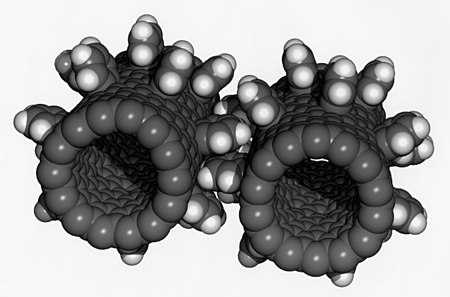
(Fullerene Nanogears)
Scientists currently debate the future implications of nanotechnology. Nanotechnology may be able to create many new materials and devices with a vast range of applications, such as in nanomedicine, nanoelectronics, biomaterials energy production, and consumer products.
On the other hand, nanotechnology raises many of the same issues as any new technology, including concerns about the toxicity and environmental impact of nanomaterials,[9] and their potential effects on global economics, as well as speculation about various doomsday scenarios. These concerns have led to a debate among advocacy groups and governments on whether special regulation of nanotechnology is warranted.
The history of nanotechnology traces the development of the concepts and experimental work falling under the broad category of nanotechnology. Although nanotechnology is a relatively recent development in scientific research, the development of its central concepts happened over a longer period of time. The emergence of nanotechnology in the 1980s was caused by the convergence of experimental advances such as the invention of the scanning tunneling microscope in 1981 and the discovery of fullerenes in 1985, with the elucidation and popularization of a conceptual framework for the goals of nanotechnology beginning with the 1986 publication of the book Engines of Creation.
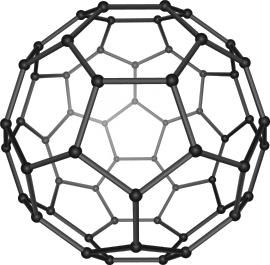
(Buckminsterfullerene C60, also known as the buckyball, is a representative member of the carbon structures known as fullerenes. Animation)

The field was subject to growing public awareness and controversy in the early 2000s, with prominent debates about both its potential implications as well as the feasibility of the applications envisioned by advocates of molecular nanotechnology, and with governments moving to promote and fund research into nanotechnology. The early 2000s also saw the beginnings of commercial applications of nanotechnology, although these were limited to bulk applications of nanomaterials rather than the transformative applications envisioned by the field.
Early Uses of Nanomaterials
Carbon nanotubes have been found in pottery from Keeladi, India, dating to c. 600–300 BC, though it is not known how they formed or whether the substance containing them was employed deliberately.[1] Cementite nanowires have been observed in Damascus steel, a material dating back to c. 900 AD, their origin and means of manufacture also unknown.[2]
Although nanoparticles are associated with modern science, they were used by artisans as far back as the ninth century in Mesopotamia for creating a glittering effect on the surface of pots.[3][4]
In modern times, pottery from the Middle Ages and Renaissance often retains a distinct gold- or copper-colored metallic glitter. This luster is caused by a metallic film that was applied to the transparent surface of a glazing, which contains silver and copper nanoparticles dispersed homogeneously in the glassy matrix of the ceramic glaze. These nanoparticles are created by the artisans by adding copper and silver salts and oxides together with vinegar, ochre, and clay on the surface of previously-glazed pottery. The technique originated in the Muslim world. As Muslims were not allowed to use gold in artistic representations, they sought a way to create a similar effect without using real gold. The solution they found was using luster.[4][5]
Conceptual Origins
Richard Feynman
Main article: There's Plenty of Room at the Bottom

Richard Feynman gave a 1959 talk which many years later inspired the conceptual foundations of nanotechnology.
The American physicist Richard Feynman lectured, "There's Plenty of Room at the Bottom," at an American Physical Society meeting at Caltech on December 29, 1959, which is often held to have provided inspiration for the field of nanotechnology. Feynman had described a process by which the ability to manipulate individual atoms and molecules might be developed, using one set of precise tools to build and operate another proportionally smaller set, so on down to the needed scale. In the course of this, he noted, scaling issues would arise from the changing magnitude of various physical phenomena: gravity would become less important, surface tension and Van der Waals attraction would become more important.[6]
...
Applications

One of the major applications of nanotechnology is in the area of nanoelectronics with MOSFET's being made of small nanowires ≈10 nm in length. Here is a simulation of such a nanowire.
Nanostructures provide this surface with superhydrophobicity, which lets water droplets roll down the inclined plane.

Nanowire lasers for ultrafast transmission of information in light pulses
Main article: List of nanotechnology applications
As of August 21, 2008, the Project on Emerging Nanotechnologies estimates that over 800 manufacturer-identified nanotech products are publicly available, with new ones hitting the market at a pace of 3–4 per week.[18] The project lists all of the products in a publicly accessible online database. Most applications are limited to the use of "first generation" passive nanomaterials which includes titanium dioxide in sunscreen, cosmetics, surface coatings,[56] and some food products; Carbon allotropes used to produce gecko tape; silver in food packaging, clothing, disinfectants and household appliances; zinc oxide in sunscreens and cosmetics, surface coatings, paints and outdoor furniture varnishes; and cerium oxide as a fuel catalyst.[17]
Further applications allow tennis balls to last longer, golf balls to fly straighter, and even bowling balls to become more durable and have a harder surface. Trousers and socks have been infused with nanotechnology so that they will last longer and keep people cool in the summer. Bandages are being infused with silver nanoparticles to heal cuts faster.[57] Video game consoles and personal computers may become cheaper, faster, and contain more memory thanks to nanotechnology.[58] Also, to build structures for on chip computing with light, for example on chip optical quantum information processing, and picosecond transmission of information.[59]
Nanotechnology may have the ability to make existing medical applications cheaper and easier to use in places like the general practitioner's office and at home.[60] Cars are being manufactured with nanomaterials so they may need fewer metals and less fuel to operate in the future.[Also improve emissions control]......
Nanotechnology also has a prominent role in the fast developing field of Tissue Engineering. When designing scaffolds, researchers attempt to mimic the nanoscale features of a cell's microenvironment to direct its differentiation down a suitable lineage.[64] For example, when creating scaffolds to support the growth of bone, researchers may mimic osteoclast resorption pits.[65]
Researchers have successfully used DNA origami-based nanobots capable of carrying out logic functions to achieve targeted drug delivery in cockroaches. It is said that the computational power of these nanobots can be scaled up to that of a Commodore 64....
Implications
Main article: Implications of nanotechnology
An area of concern is the effect that industrial-scale manufacturing and use of nanomaterials would have on human health and the environment, as suggested by nanotoxicology research. For these reasons, some groups advocate that nanotechnology be regulated by governments. Others counter that overregulation would stifle scientific research and the development of beneficial innovations. Public health research agencies, such as the National Institute for Occupational Safety and Health are actively conducting research on potential health effects stemming from exposures to nanoparticles.[67][68]
Some nanoparticle products may have unintended consequences. Researchers have discovered that bacteriostatic silver nanoparticles used in socks to reduce foot odor are being released in the wash.[69] These particles are then flushed into the waste water stream and may destroy bacteria which are critical components of natural ecosystems, farms, and waste treatment processes.[70]...
Health and environmental concerns
A video on the health and safety implications of nanotechnology
Main articles: Health and safety hazards of nanomaterials and Pollution from nanomaterials
Nanofibers are used in several areas and in different products, in everything from aircraft wings to tennis rackets. Inhaling airborne nanoparticles and nanofibers may lead to a number of pulmonary diseases, e.g. fibrosis.[76] Researchers have found that when rats breathed in nanoparticles, the particles settled in the brain and lungs, which led to significant increases in biomarkers for inflammation and stress response[77] and that nanoparticles induce skin aging through oxidative stress in hairless mice.[78][79]
A two-year study at UCLA's School of Public Health found lab mice consuming nano-titanium dioxide showed DNA and chromosome damage to a degree "linked to all the big killers of man, namely cancer, heart disease, neurological disease and aging".[80]
A Nature Nanotechnology study suggests some forms of carbon nanotubes – a poster child for the "nanotechnology revolution" – could be as harmful as asbestos if inhaled in sufficient quantities...
Research Notes:
Feynman was a keen popularizer of physics through both books and lectures, including a 1959 talk on top-down nanotechnology called *There's Plenty of Room at the Bottom* and the three-volume publication of his undergraduate lectures, *The Feynman Lectures on Physics*. Feynman also became known through his semi-autobiographical books *Surely You're Joking, Mr. Feynman!* and *What Do You Care What Other People Think?*, and books written about him such as *Tuva or Bust!* by Ralph Leighton and the biography Genius: The Life and Science of Richard Feynman by James Gleick.
Feynman tried marijuana and ketamine at John Lilly's sensory deprivation tanks, as a way of studying consciousness.[131]^(https://en.wikipedia.org/wiki/Richard_Feynman#cite_note-FOOTNOTEGleick1992405%E2%80%93406-131)[132]^(https://en.wikipedia.org/wiki/Richard_Feynman#cite_note-FOOTNOTEFeynman1985330%E2%80%93337-132) He gave up alcohol when he began to show vague, early signs of alcoholism, as he did not want to do anything that could damage his brain. Despite his curiosity about hallucinations, he was reluctant to experiment with LSD.[133]^(https://en.wikipedia.org/wiki/Richard_Feynman#cite_note-FOOTNOTEFeynman1985204%E2%80%93205-133)
Feynman considered some ramifications of a general ability to manipulate matter on an atomic scale. He was particularly interested in the possibilities of denser computer circuitry, and microscopes that could see things much smaller than is possible with scanning electron microscopes. These ideas were later realized by the use of the scanning tunneling microscope, the atomic force microscope and other examples of scanning probe microscopy and storage systems such as Millipede, created by researchers at IBM.
Feynman also suggested that it should be possible, in principle, to make nanoscale machines that "arrange the atoms the way we want", and do chemical synthesis by mechanical manipulation.
He also presented the possibility of "swallowing the doctor", an idea that he credited in the essay to his friend and graduate student Albert Hibbs. This concept involved building a tiny, swallowable surgical robot.
As a thought experiment he proposed developing a set of one-quarter-scale manipulator hands slaved to the operator's hands to build one-quarter scale machine tools analogous to those found in any machine shop. This set of small tools would then be used by the small hands to build and operate ten sets of one-sixteenth-scale hands and tools, and so forth, culminating in perhaps a billion tiny factories to achieve massively parallel operations. He uses the analogy of a pantograph as a way of scaling down items. This idea was anticipated in part, down to the microscale, by science fiction author Robert A. Heinlein in his 1942 story *Waldo*.[2]^(https://en.wikipedia.org/wiki/There%27s_Plenty_of_Room_at_the_Bottom#cite_note-Milburn-2)[3]^(https://en.wikipedia.org/wiki/There%27s_Plenty_of_Room_at_the_Bottom#cite_note-3)...
As the sizes got smaller, one would have to redesign tools, because the relative strength of various forces would change. Gravity would become less important, and Van der Waals forces such as surface tension would become more important. Feynman mentioned these scaling issues during his talk. Nobody has yet attempted to implement this thought experiment; some types of biological enzymes and enzyme complexes (especially ribosomes) function chemically in a way close to Feynman's vision.[4]^(https://en.wikipedia.org/wiki/There%27s_Plenty_of_Room_at_the_Bottom#cite_note-4)[5]^(https://en.wikipedia.org/wiki/There%27s_Plenty_of_Room_at_the_Bottom#cite_note-5)
Feynman also mentioned in his lecture that it might be better eventually to use glass or plastic because their greater uniformity would avoid problems in the very small scale (metals and crystals are separated into domains where the lattice structure prevails).[6]^(https://en.wikipedia.org/wiki/There%27s_Plenty_of_Room_at_the_Bottom#cite_note-6) This could be a good reason to make machines and electronics out of glass and plastic. At the present time, there are electronic components made of both materials. In glass, there are optical fiber cables that amplify the light pulses at regular intervals, using glass doped with the rare-earth element erbium. The doped glass is spliced into the fiber and pumped by a laser operating at a different frequency.[7]^(https://en.wikipedia.org/wiki/There%27s_Plenty_of_Room_at_the_Bottom#cite_note-Tutorial_on_Fiber_Amplifiers-7) In plastic, field effect transistors are being made with polythiophene, a polymer invented by Alan J. Heeger et al. that becomes an electrical conductor when oxidized. By 2016, a factor of just 20 in electron mobility separated plastic from silicon.[8]^(https://en.wikipedia.org/wiki/There%27s_Plenty_of_Room_at_the_Bottom#cite_note-8)[9]^(https://en.wikipedia.org/wiki/There%27s_Plenty_of_Room_at_the_Bottom#cite_note-9)
Challenges
At the meeting Feynman concluded his talk with two challenges, and offered a prize of $1000 for the first to solve each one. The first challenge involved the construction of a tiny motor, which, to Feynman's surprise, was achieved by November 1960 by Caltech graduate William McLellan, a meticulous craftsman, using conventional tools.[10]^(https://en.wikipedia.org/wiki/There%27s_Plenty_of_Room_at_the_Bottom#cite_note-10) The motor met the conditions, but did not advance the art. The second challenge involved the possibility of scaling down letters small enough so as to be able to fit the entire *Encyclopædia Britannica* on the head of a pin, by writing the information from a book page on a surface 1/25,000 smaller in linear scale. In 1985, Tom Newman, a Stanford graduate student, successfully reduced the first paragraph of *A Tale of Two Cities* by 1/25,000, and collected the second Feynman prize.[11]^(https://en.wikipedia.org/wiki/There%27s_Plenty_of_Room_at_the_Bottom#cite_note-11)[12]^(https://en.wikipedia.org/wiki/There%27s_Plenty_of_Room_at_the_Bottom#cite_note-12)[13]^(https://en.wikipedia.org/wiki/There%27s_Plenty_of_Room_at_the_Bottom#cite_note-13) Newman's thesis adviser, R. Fabian Pease, had read the paper in 1966; but it was another grad student in the lab, Ken Polasko, who had recently read it who suggested attempting the challenge. Newman was looking for an arbitrary random pattern for demonstrating their technology. Newman said, "Text was ideal because it has so many different shapes."[14]^(https://en.wikipedia.org/wiki/There%27s_Plenty_of_Room_at_the_Bottom#cite_note-TinyTale-14)
Reception
*The New Scientist* reported "the scientific audience was captivated." Feynman had "spun the idea off the top of his mind" without even "notes from beforehand". There were no copies of the speech available. A "foresighted admirer" brought a tape recorder and an edited transcript, without Feynman's jokes, was made for publication by Caltech.[15]^(https://en.wikipedia.org/wiki/There%27s_Plenty_of_Room_at_the_Bottom#cite_note-15) In February 1960, Caltech's Engineering and Science published the speech. In addition to excerpts in The New Scientist, versions were printed in *The Saturday Review* and *Popular Science*. Newspapers announced the winning of the first challenge.[16]^(https://en.wikipedia.org/wiki/There%27s_Plenty_of_Room_at_the_Bottom#cite_note-16)[17]^(https://en.wikipedia.org/wiki/There%27s_Plenty_of_Room_at_the_Bottom#cite_note-17) The lecture was included as the final chapter in the 1961 book, Miniaturization.[18]^(https://en.wikipedia.org/wiki/There%27s_Plenty_of_Room_at_the_Bottom#cite_note-18)
Impact
See also:*History of nanotechnology*
K. Eric Drexler later took the Feynman concept of a billion tiny factories and added the idea that they could make more copies of themselves, via computer control instead of control by a human operator, in his 1986 book *Engines of Creation: The Coming Era of Nanotechnology*.
After Feynman's death, scholars studying the historical development of nanotechnology have concluded that his role in catalyzing nanotechnology research was not highly rated by many of the people active in the nascent field in the 1980s and 1990s. Chris Toumey, a cultural anthropologist at the University of South Carolina, has reconstructed the history of the publication and republication of Feynman's talk, along with the record of citations to "Plenty of Room" in the scientific literature.[19]^(https://en.wikipedia.org/wiki/There%27s_Plenty_of_Room_at_the_Bottom#cite_note-19)
In Toumey's 2008 article "Reading Feynman into Nanotechnology",[20]^(https://en.wikipedia.org/wiki/There%27s_Plenty_of_Room_at_the_Bottom#cite_note-20) he found 11 versions of the publication of "Plenty of Room", plus two instances of a closely related talk by Feynman, "Infinitesimal Machinery",[21]^(https://en.wikipedia.org/wiki/There%27s_Plenty_of_Room_at_the_Bottom#cite_note-21) which Feynman called "Plenty of Room, Revisited" (published under the name "Infinitesimal Machinery"). Also in Toumey's references are videotapes of that second talk. The journal *Nature Nanotechnology* dedicated an issue in 2009 to the subject.[22]^(https://en.wikipedia.org/wiki/There%27s_Plenty_of_Room_at_the_Bottom#cite_note-22)[23]^(https://en.wikipedia.org/wiki/There%27s_Plenty_of_Room_at_the_Bottom#cite_note-23)
Toumey found that the published versions of Feynman's talk had a negligible influence in the twenty years after it was first published, as measured by citations in the scientific literature, and not much more influence in the decade after the Scanning Tunneling Microscope was invented in 1981. Interest in "Plenty of Room" in the scientific literature greatly increased in the early 1990s. This is probably because the term "nanotechnology" gained serious attention just before that time, following its use by Drexler in his 1986 book, *Engines of Creation: The Coming Era of Nanotechnology*, which cited Feynman, and in a cover article headlined "Nanotechnology", published later that year in a mass-circulation science-oriented magazine, *OMNI*.[24]^(https://en.wikipedia.org/wiki/There%27s_Plenty_of_Room_at_the_Bottom#cite_note-24)[25]^(https://en.wikipedia.org/wiki/There%27s_Plenty_of_Room_at_the_Bottom#cite_note-25) The journal *Nanotechnology* was launched in 1989; the famous Eigler-Schweizer experiment, precisely manipulating 35 xenon atoms, was published in Nature in April 1990; and Science had a special issue on nanotechnology in November 1991. These and other developments hint that the retroactive rediscovery of "Plenty of Room" gave nanotechnology a packaged history that provided an early date of December 1959, plus a connection to Richard Feynman.
Toumey's analysis also includes comments from scientists in nanotechnology who say that "Plenty of Room" did not influence their early work, and most of them had not read it until a later date.
Feynman's stature as a Nobel laureate and as an important figure in 20th century science helped advocates of nanotechnology and provided a valuable intellectual link to the past.[2]^(https://en.wikipedia.org/wiki/There%27s_Plenty_of_Room_at_the_Bottom#cite_note-Milburn-2) More concretely, his stature and concept of atomically precise fabrication played a role in securing funding for nanotechnology research, illustrated by President Clinton's January 2000 speech calling for a Federal program:
My budget supports a major new National Nanotechnology Initiative, worth $500 million. Caltech is no stranger to the idea of nanotechnology the ability to manipulate matter at the atomic and molecular level. Over 40 years ago, Caltech's own Richard Feynman asked, "What would happen if we could arrange the atoms one by one the way we want them?"[26]^(https://en.wikipedia.org/wiki/There%27s_Plenty_of_Room_at_the_Bottom#cite_note-26)
The version of the Nanotechnology Research and Development Act that was passed by the House in May 2003 called for a study of the technical feasibility of molecular manufacturing, but this study was removed to safeguard funding of less controversial research before it was passed by the Senate and signed into law by President George W. Bush on December 3, 2003.[27]^(https://en.wikipedia.org/wiki/There%27s_Plenty_of_Room_at_the_Bottom#cite_note-27)
In 2016, a group of researchers of TU Delft and INL reported the storage of a paragraph of Feynman's talk using binary code where every bit was made with a single atomic vacancy.[[28](tb-footnote:) Using a scanning tunnelling microscope to manipulate thousand of atoms, the researchers crafted the text:
But I am not afraid to consider the final question as to whether, ultimately – in the great future – we can arrange the atoms the way we want; the very atoms, all the way down! What would happen if we could arrange the atoms one by one the way we want them (within reason, of course; you can't put them so that they are chemically unstable, for example). Up to now, we have been content to dig in the ground to find minerals. We heat them and we do things on a large scale with them, and we hope to get a pure substance with just so much impurity, and so on. But we must always accept some atomic arrangement that nature gives us. We haven't got anything, say, with a "checkerboard" arrangement, with the impurity atoms exactly arranged 1,000 angstroms apart, or in some other particular pattern.
This text uses exactly 1 kilobyte, i.e., 8128 bits, made with 1 atom vacancy each, constituting thereby the first atomic kilobyte, with a storage density 500 larger than the state of the art approaches. The text required to "arrange the atoms the way we want", in a checkerboard pattern. This self-referential tribute to Feynman's vision was covered both by scientific journals[29]^(https://en.wikipedia.org/wiki/There%27s_Plenty_of_Room_at_the_Bottom#cite_note-29)[30]^(https://en.wikipedia.org/wiki/There%27s_Plenty_of_Room_at_the_Bottom#cite_note-30) and mainstream media.[31]^(https://en.wikipedia.org/wiki/There%27s_Plenty_of_Room_at_the_Bottom#cite_note-31)[32]^(https://en.wikipedia.org/wiki/There%27s_Plenty_of_Room_at_the_Bottom#cite_note-32)
First published in Engineering and Sciencemagazine, vol. XXIII, no. 5, February 1960.
There's Plenty of Room at the Bottom
An Invitation to Enter a New Field of Physics
by Richard P. Feynman
I imagine experimental physicists must often look with envy at men like Kamerlingh
Onnes, who discovered a field like low temperature, which seems to be bottomless and in
which one can go down and down. Such a man is then a leader and has some temporary
monopoly in a scientific adventure. Percy Bridgman, in designing a way to obtain higher
pressures, opened up another new field and was able to move into it and to lead us all
along. The development of ever higher vacuum was a continuing development of the
same kind.
I would like to describe a field, in which little has been done, but in which an enormous
amount can be done in principle. This field is not quite the same as the others in that it
will not tell us much of fundamental physics (in the sense of, ``What are the strange
particles?'') but it is more like solid-state physics in the sense that it might tell us much of
great interest about the strange phenomena that occur in complex situations. Furthermore,
a point that is most important is that it would have an enormous number of technical
applications.
What I want to talk about is the problem of manipulating and controlling things on a
small scale.
As soon as I mention this, people tell me about miniaturization, and how far it has
progressed today. They tell me about electric motors that are the size of the nail on your
small finger. And there is a device on the market, they tell me, by which you can write
the Lord's Prayer on the head of a pin. But that's nothing; that's the most primitive,
halting step in the direction I intend to discuss. It is a staggeringly small world that is
below. In the year 2000, when they look back at this age, they will wonder why it was not
until the year 1960 that anybody began seriously to move in this direction.
Why cannot we write the entire 24 volumes of the Encyclopedia Brittanica on the head of
a pin?
Let's see what would be involved. The head of a pin is a sixteenth of an inch across. If
you magnify it by 25,000 diameters, the area of the head of the pin is then equal to the
area of all the pages of the Encyclopaedia Brittanica. Therefore, all it is necessary to do is
to reduce in size all the writing in the Encyclopaedia by 25,000 times. Is that possible?
©1960 California Institute of Technology
First published in Engineering and Sciencemagazine, vol. XXIII, no. 5, February 1960.
The resolving power of the eye is about 1/120 of an inch---that is roughly the diameter of
one of the little dots on the fine half-tone reproductions in the Encyclopaedia. This, when
you demagnify it by 25,000 times, is still 80 angstroms in diameter---32 atoms across, in
an ordinary metal. In other words, one of those dots still would contain in its area 1,000
atoms. So, each dot can easily be adjusted in size as required by the photoengraving, and
there is no question that there is enough room on the head of a pin to put all of the
Encyclopaedia Brittanica.
Furthermore, it can be read if it is so written. Let's imagine that it is written in raised
letters of metal; that is, where the black is in the Encyclopedia, we have raised letters of
metal that are actually 1/25,000 of their ordinary size. How would we read it?
If we had something written in such a way, we could read it using techniques in common
use today. (They will undoubtedly find a better way when we do actually have it written,
but to make my point conservatively I shall just take techniques we know today.) We
would press the metal into a plastic material and make a mold of it, then peel the plastic
off very carefully, evaporate silica into the plastic to get a very thin film, then shadow it
by evaporating gold at an angle against the silica so that all the little letters will appear
clearly, dissolve the plastic away from the silica film, and then look through it with an
electron microscope!
There is no question that if the thing were reduced by 25,000 times in the form of raised
letters on the pin, it would be easy for us to read it today. Furthermore; there is no
question that we would find it easy to make copies of the master; we would just need to
press the same metal plate again into plastic and we would have another copy.
How do we write small?
The next question is: How do we writeit? We have no standard technique to do this now.
But let me argue that it is not as difficult as it first appears to be. We can reverse the
lenses of the electron microscope in order to demagnify as well as magnify. A source of
ions, sent through the microscope lenses in reverse, could be focused to a very small spot.
We could write with that spot like we write in a TV cathode ray oscilloscope, by going
across in lines, and having an adjustment which determines the amount of material which
is going to be deposited as we scan in lines.
This method might be very slow because of space charge limitations. There will be more
rapid methods. We could first make, perhaps by some photo process, a screen which has
holes in it in the form of the letters. Then we would strike an arc behind the holes and
draw metallic ions through the holes; then we could again use our system of lenses and
make a small image in the form of ions, which would deposit the metal on the pin.
A simpler way might be this (though I am not sure it would work): We take light and,
through an optical microscope running backwards, we focus it onto a very small
photoelectric screen. Then electrons come away from the screen where the light is
shining. These electrons are focused down in size by the electron microscope lenses to
©1960 California Institute of Technology
First published in Engineering and Sciencemagazine, vol. XXIII, no. 5, February 1960.
impinge directly upon the surface of the metal. Will such a beam etch away the metal if it
is run long enough? I don't know. If it doesn't work for a metal surface, it must be
possible to find some surface with which to coat the original pin so that, where the
electrons bombard, a change is made which we could recognize later.
There is no intensity problem in these devices---not what you are used to in
magnification, where you have to take a few electrons and spread them over a bigger and
bigger screen; it is just the opposite. The light which we get from a page is concentrated
onto a very small area so it is very intense. The few electrons which come from the
photoelectric screen are demagnified down to a very tiny area so that, again, they are very
intense. I don't know why this hasn't been done yet!
That's the Encyclopaedia Brittanica on the head of a pin, but let's consider all the books in
the world. The Library of Congress has approximately 9 million volumes; the British
Museum Library has 5 million volumes; there are also 5 million volumes in the National
Library in France. Undoubtedly there are duplications, so let us say that there are some
24 million volumes of interest in the world.
What would happen if I print all this down at the scale we have been discussing? How
much space would it take? It would take, of course, the area of about a million pinheads
because, instead of there being just the 24 volumes of the Encyclopaedia, there are 24
million volumes. The million pinheads can be put in a square of a thousand pins on a
side, or an area of about 3 square yards. That is to say, the silica replica with the paperthin
backing of plastic, with which we have made the copies, with all this information, is
on an area of approximately the size of 35 pages of the Encyclopaedia. That is about half
as many pages as there are in this magazine. All of the information which all of mankind
has every recorded in books can be carried around in a pamphlet in your hand---and not
written in code, but a simple reproduction of the original pictures, engravings, and
everything else on a small scale without loss of resolution.
What would our librarian at Caltech say, as she runs all over from one building to
another, if I tell her that, ten years from now, all of the information that she is struggling
to keep track of--- 120,000 volumes, stacked from the floor to the ceiling, drawers full of
cards, storage rooms full of the older books---can be kept on just one library card! When
the University of Brazil, for example, finds that their library is burned, we can send them
a copy of every book in our library by striking off a copy from the master plate in a few
hours and mailing it in an envelope no bigger or heavier than any other ordinary air mail
letter.
Now, the name of this talk is There is *Plenty*of Room at the Bottom''--\-not just There
is Room at the Bottom.'' What I have demonstrated is that there isroom---that you can
decrease the size of things in a practical way. I now want to show that there is plentyof
room. I will not now discuss how we are going to do it, but only what is possible in
principle---in other words, what is possible according to the laws of physics. I am not
inventing anti-gravity, which is possible someday only if the laws are not what we think.
©1960 California Institute of Technology
First published in Engineering and Sciencemagazine, vol. XXIII, no. 5, February 1960.
I am telling you what could be done if the laws arewhat we think; we are not doing it
simply because we haven't yet gotten around to it.
Information on a small scale
Suppose that, instead of trying to reproduce the pictures and all the information directly
in its present form, we write only the information content in a code of dots and dashes, or
something like that, to represent the various letters. Each letter represents six or seven
``bits'' of information; that is, you need only about six or seven dots or dashes for each
letter. Now, instead of writing everything, as I did before, on the surfaceof the head of a
pin, I am going to use the interior of the material as well.
Let us represent a dot by a small spot of one metal, the next dash, by an adjacent spot of
another metal, and so on. Suppose, to be conservative, that a bit of information is going to
require a little cube of atoms 5 times 5 times 5---that is 125 atoms. Perhaps we need a
hundred and some odd atoms to make sure that the information is not lost through
diffusion, or through some other process.
I have estimated how many letters there are in the Encyclopaedia, and I have assumed
that each of my 24 million books is as big as an Encyclopaedia volume, and have
calculated, then, how many bits of information there are (1015). For each bit I allow 100
atoms. And it turns out that all of the information that man has carefully accumulated in
all the books in the world can be written in this form in a cube of material one twohundredth
of an inch wide--- which is the barest piece of dust that can be made out by the
human eye. So there is plentyof room at the bottom! Don't tell me about microfilm!
This fact---that enormous amounts of information can be carried in an exceedingly small
space---is, of course, well known to the biologists, and resolves the mystery which
existed before we understood all this clearly, of how it could be that, in the tiniest cell, all
of the information for the organization of a complex creature such as ourselves can be
stored. All this information---whether we have brown eyes, or whether we think at all, or
that in the embryo the jawbone should first develop with a little hole in the side so that
later a nerve can grow through it---all this information is contained in a very tiny fraction
of the cell in the form of long-chain DNA molecules in which approximately 50 atoms
are used for one bit of information about the cell.
Better electron microscopes
If I have written in a code, with 5 times 5 times 5 atoms to a bit, the question is: How
could I read it today? The electron microscope is not quite good enough, with the greatest
care and effort, it can only resolve about 10 angstroms. I would like to try and impress
upon you while I am talking about all of these things on a small scale, the importance of
improving the electron microscope by a hundred times. It is not impossible; it is not
against the laws of diffraction of the electron. The wave length of the electron in such a
microscope is only 1/20 of an angstrom. So it should be possible to see the individual
atoms. What good would it be to see individual atoms distinctly?
©1960 California Institute of Technology
First published in Engineering and Sciencemagazine, vol. XXIII, no. 5, February 1960.
We have friends in other fields---in biology, for instance. We physicists often look at
them and say, ``You know the reason you fellows are making so little progress?''
(Actually I don't know any field where they are making more rapid progress than they are
in biology today.) ``You should use more mathematics, like we do.'' They could answer
us---but they're polite, so I'll answer for them: ``What youshould do in order for usto
make more rapid progress is to make the electron microscope 100 times better.''
What are the most central and fundamental problems of biology today? They are
questions like: What is the sequence of bases in the DNA? What happens when you have
a mutation? How is the base order in the DNA connected to the order of amino acids in
the protein? What is the structure of the RNA; is it single-chain or double-chain, and how
is it related in its order of bases to the DNA? What is the organization of the
microsomes? How are proteins synthesized? Where does the RNA go? How does it sit?
Where do the proteins sit? Where do the amino acids go in? In photosynthesis, where is
the chlorophyll; how is it arranged; where are the carotenoids involved in this thing?
What is the system of the conversion of light into chemical energy?
It is very easy to answer many of these fundamental biological questions; you just look at
the thing!You will see the order of bases in the chain; you will see the structure of the
microsome. Unfortunately, the present microscope sees at a scale which is just a bit too
crude. Make the microscope one hundred times more powerful, and many problems of
biology would be made very much easier. I exaggerate, of course, but the biologists
would surely be very thankful to you---and they would prefer that to the criticism that
they should use more mathematics.
The theory of chemical processes today is based on theoretical physics. In this sense,
physics supplies the foundation of chemistry. But chemistry also has analysis. If you have
a strange substance and you want to know what it is, you go through a long and
complicated process of chemical analysis. You can analyze almost anything today, so I
am a little late with my idea. But if the physicists wanted to, they could also dig under the
chemists in the problem of chemical analysis. It would be very easy to make an analysis
of any complicated chemical substance; all one would have to do would be to look at it
and see where the atoms are. The only trouble is that the electron microscope is one
hundred times too poor. (Later, I would like to ask the question: Can the physicists do
something about the third problem of chemistry---namely, synthesis? Is there a physical
way to synthesize any chemical substance?
The reason the electron microscope is so poor is that the f- value of the lenses is only 1
part to 1,000; you don't have a big enough numerical aperture. And I know that there are
theorems which prove that it is impossible, with axially symmetrical stationary field
lenses, to produce an f-value any bigger than so and so; and therefore the resolving power
at the present time is at its theoretical maximum. But in every theorem there are
assumptions. Why must the field be symmetrical? I put this out as a challenge: Is there no
way to make the electron microscope more powerful?
The marvelous biological system
©1960 California Institute of Technology
First published in Engineering and Sciencemagazine, vol. XXIII, no. 5, February 1960.
The biological example of writing information on a small scale has inspired me to think
of something that should be possible. Biology is not simply writing information; it is
doing somethingabout it. A biological system can be exceedingly small. Many of the
cells are very tiny, but they are very active; they manufacture various substances; they
walk around; they wiggle; and they do all kinds of marvelous things---all on a very small
scale. Also, they store information. Consider the possibility that we too can make a thing
very small which does what we want---that we can manufacture an object that maneuvers
at that level!
There may even be an economic point to this business of making things very small. Let
me remind you of some of the problems of computing machines. In computers we have to
store an enormous amount of information. The kind of writing that I was mentioning
before, in which I had everything down as a distribution of metal, is permanent. Much
more interesting to a computer is a way of writing, erasing, and writing something else.
(This is usually because we don't want to waste the material on which we have just
written. Yet if we could write it in a very small space, it wouldn't make any difference; it
could just be thrown away after it was read. It doesn't cost very much for the material).
Miniaturizing the computer
I don't know how to do this on a small scale in a practical way, but I do know that
computing machines are very large; they fill rooms. Why can't we make them very small,
make them of little wires, little elements---and by little, I mean little. For instance, the
wires should be 10 or 100 atoms in diameter, and the circuits should be a few thousand
angstroms across. Everybody who has analyzed the logical theory of computers has come
to the conclusion that the possibilities of computers are very interesting---if they could be
made to be more complicated by several orders of magnitude. If they had millions of
times as many elements, they could make judgments. They would have time to calculate
what is the best way to make the calculation that they are about to make. They could
select the method of analysis which, from their experience, is better than the one that we
would give to them. And in many other ways, they would have new qualitative features.
If I look at your face I immediately recognize that I have seen it before. (Actually, my
friends will say I have chosen an unfortunate example here for the subject of this
illustration. At least I recognize that it is a manand not an apple.) Yet there is no machine
which, with that speed, can take a picture of a face and say even that it is a man; and
much less that it is the same man that you showed it before---unless it is exactly the same
picture. If the face is changed; if I am closer to the face; if I am further from the face; if
the light changes---I recognize it anyway. Now, this little computer I carry in my head is
easily able to do that. The computers that we build are not able to do that. The number of
elements in this bone box of mine are enormously greater than the number of elements in
our ``wonderful'' computers. But our mechanical computers are too big; the elements in
this box are microscopic. I want to make some that are submicroscopic.
If we wanted to make a computer that had all these marvelous extra qualitative abilities,
we would have to make it, perhaps, the size of the Pentagon. This has several
©1960 California Institute of Technology
First published in Engineering and Sciencemagazine, vol. XXIII, no. 5, February 1960.
disadvantages. First, it requires too much material; there may not be enough germanium
in the world for all the transistors which would have to be put into this enormous thing.
There is also the problem of heat generation and power consumption; TVA would be
needed to run the computer. But an even more practical difficulty is that the computer
would be limited to a certain speed. Because of its large size, there is finite time required
to get the information from one place to another. The information cannot go any faster
than the speed of light---so, ultimately, when our computers get faster and faster and
more and more elaborate, we will have to make them smaller and smaller.
But there is plenty of room to make them smaller. There is nothing that I can see in the
physical laws that says the computer elements cannot be made enormously smaller than
they are now. In fact, there may be certain advantages.
Miniaturization by evaporation
How can we make such a device? What kind of manufacturing processes would we use?
One possibility we might consider, since we have talked about writing by putting atoms
down in a certain arrangement, would be to evaporate the material, then evaporate the
insulator next to it. Then, for the next layer, evaporate another position of a wire, another
insulator, and so on. So, you simply evaporate until you have a block of stuff which has
the elements--- coils and condensers, transistors and so on---of exceedingly fine
dimensions.
But I would like to discuss, just for amusement, that there are other possibilities. Why
can't we manufacture these small computers somewhat like we manufacture the big ones?
Why can't we drill holes, cut things, solder things, stamp things out, mold different
shapes all at an infinitesimal level? What are the limitations as to how small a thing has
to be before you can no longer mold it? How many times when you are working on
something frustratingly tiny like your wife's wrist watch, have you said to yourself, ``If I
could only train an ant to do this!'' What I would like to suggest is the possibility of
training an ant to train a mite to do this. What are the possibilities of small but movable
machines? They may or may not be useful, but they surely would be fun to make.
Consider any machine---for example, an automobile---and ask about the problems of
making an infinitesimal machine like it. Suppose, in the particular design of the
automobile, we need a certain precision of the parts; we need an accuracy, let's suppose,
of 4/10,000 of an inch. If things are more inaccurate than that in the shape of the cylinder
and so on, it isn't going to work very well. If I make the thing too small, I have to worry
about the size of the atoms; I can't make a circle of ``balls'' so to speak, if the circle is too
small. So, if I make the error, corresponding to 4/10,000 of an inch, correspond to an
error of 10 atoms, it turns out that I can reduce the dimensions of an automobile 4,000
times, approximately---so that it is 1 mm. across. Obviously, if you redesign the car so
that it would work with a much larger tolerance, which is not at all impossible, then you
could make a much smaller device.
©1960 California Institute of Technology
First published in Engineering and Sciencemagazine, vol. XXIII, no. 5, February 1960.
It is interesting to consider what the problems are in such small machines. Firstly, with
parts stressed to the same degree, the forces go as the area you are reducing, so that
things like weight and inertia are of relatively no importance. The strength of material, in
other words, is very much greater in proportion. The stresses and expansion of the
flywheel from centrifugal force, for example, would be the same proportion only if the
rotational speed is increased in the same proportion as we decrease the size. On the other
hand, the metals that we use have a grain structure, and this would be very annoying at
small scale because the material is not homogeneous. Plastics and glass and things of this
amorphous nature are very much more homogeneous, and so we would have to make our
machines out of such materials.
There are problems associated with the electrical part of the system---with the copper
wires and the magnetic parts. The magnetic properties on a very small scale are not the
same as on a large scale; there is the ``domain'' problem involved. A big magnet made of
millions of domains can only be made on a small scale with one domain. The electrical
equipment won't simply be scaled down; it has to be redesigned. But I can see no reason
why it can't be redesigned to work again.
Problems of lubrication
Lubrication involves some interesting points. The effective viscosity of oil would be
higher and higher in proportion as we went down (and if we increase the speed as much
as we can). If we don't increase the speed so much, and change from oil to kerosene or
some other fluid, the problem is not so bad. But actually we may not have to lubricate at
all! We have a lot of extra force. Let the bearings run dry; they won't run hot because the
heat escapes away from such a small device very, very rapidly.
This rapid heat loss would prevent the gasoline from exploding, so an internal
combustion engine is impossible. Other chemical reactions, liberating energy when cold,
can be used. Probably an external supply of electrical power would be most convenient
for such small machines.
What would be the utility of such machines? Who knows? Of course, a small automobile
would only be useful for the mites to drive around in, and I suppose our Christian
interests don't go that far. However, we did note the possibility of the manufacture of
small elements for computers in completely automatic factories, containing lathes and
other machine tools at the very small level. The small lathe would not have to be exactly
like our big lathe. I leave to your imagination the improvement of the design to take full
advantage of the properties of things on a small scale, and in such a way that the fully
automatic aspect would be easiest to manage.
A friend of mine (Albert R. Hibbs) suggests a very interesting possibility for relatively
small machines. He says that, although it is a very wild idea, it would be interesting in
surgery if you could swallow the surgeon. You put the mechanical surgeon inside the
blood vessel and it goes into the heart and ``looks'' around. (Of course the information
has to be fed out.) It finds out which valve is the faulty one and takes a little knife and
©1960 California Institute of Technology
First published in Engineering and Sciencemagazine, vol. XXIII, no. 5, February 1960.
slices it out. Other small machines might be permanently incorporated in the body to
assist some inadequately-functioning organ.
Now comes the interesting question: How do we make such a tiny mechanism? I leave
that to you. However, let me suggest one weird possibility. You know, in the atomic
energy plants they have materials and machines that they can't handle directly because
they have become radioactive. To unscrew nuts and put on bolts and so on, they have a
set of master and slave hands, so that by operating a set of levers here, you control the
``hands'' there, and can turn them this way and that so you can handle things quite nicely.
Most of these devices are actually made rather simply, in that there is a particular cable,
like a marionette string, that goes directly from the controls to the ``hands.'' But, of
course, things also have been made using servo motors, so that the connection between
the one thing and the other is electrical rather than mechanical. When you turn the levers,
they turn a servo motor, and it changes the electrical currents in the wires, which
repositions a motor at the other end.
Now, I want to build much the same device---a master-slave system which operates
electrically. But I want the slaves to be made especially carefully by modern large-scale
machinists so that they are one-fourth the scale of the ``hands'' that you ordinarily
maneuver. So you have a scheme by which you can do things at one- quarter scale
anyway---the little servo motors with little hands play with little nuts and bolts; they drill
little holes; they are four times smaller. Aha! So I manufacture a quarter-size lathe; I
manufacture quarter-size tools; and I make, at the one-quarter scale, still another set of
hands again relatively one-quarter size! This is one-sixteenth size, from my point of view.
And after I finish doing this I wire directly from my large-scale system, through
transformers perhaps, to the one-sixteenth-size servo motors. Thus I can now manipulate
the one-sixteenth size hands.
Well, you get the principle from there on. It is rather a difficult program, but it is a
possibility. You might say that one can go much farther in one step than from one to four.
Of course, this has all to be designed very carefully and it is not necessary simply to
make it like hands. If you thought of it very carefully, you could probably arrive at a
much better system for doing such things.
If you work through a pantograph, even today, you can get much more than a factor of
four in even one step. But you can't work directly through a pantograph which makes a
smaller pantograph which then makes a smaller pantograph---because of the looseness of
the holes and the irregularities of construction. The end of the pantograph wiggles with a
relatively greater irregularity than the irregularity with which you move your hands. In
going down this scale, I would find the end of the pantograph on the end of the
pantograph on the end of the pantograph shaking so badly that it wasn't doing anything
sensible at all.
At each stage, it is necessary to improve the precision of the apparatus. If, for instance,
having made a small lathe with a pantograph, we find its lead screw irregular---more
©1960 California Institute of Technology
First published in Engineering and Sciencemagazine, vol. XXIII, no. 5, February 1960.
irregular than the large-scale one---we could lap the lead screw against breakable nuts
that you can reverse in the usual way back and forth until this lead screw is, at its scale,
as accurate as our original lead screws, at our scale.
We can make flats by rubbing unflat surfaces in triplicates together---in three pairs---and
the flats then become flatter than the thing you started with. Thus, it is not impossible to
improve precision on a small scale by the correct operations. So, when we build this stuff,
it is necessary at each step to improve the accuracy of the equipment by working for
awhile down there, making accurate lead screws, Johansen blocks, and all the other
materials which we use in accurate machine work at the higher level. We have to stop at
each level and manufacture all the stuff to go to the next level---a very long and very
difficult program. Perhaps you can figure a better way than that to get down to small
scale more rapidly.
Yet, after all this, you have just got one little baby lathe four thousand times smaller than
usual. But we were thinking of making an enormous computer, which we were going to
build by drilling holes on this lathe to make little washers for the computer. How many
washers can you manufacture on this one lathe?
A hundred tiny hands
When I make my first set of slave ``hands'' at one-fourth scale, I am going to make ten
sets. I make ten sets of ``hands,'' and I wire them to my original levers so they each do
exactly the same thing at the same time in parallel. Now, when I am making my new
devices one-quarter again as small, I let each one manufacture ten copies, so that I would
have a hundred ``hands'' at the 1/16th size.
Where am I going to put the million lathes that I am going to have? Why, there is nothing
to it; the volume is much less than that of even one full-scale lathe. For instance, if I
made a billion little lathes, each 1/4000 of the scale of a regular lathe, there are plenty of
materials and space available because in the billion little ones there is less than 2 percent
of the materials in one big lathe.
It doesn't cost anything for materials, you see. So I want to build a billion tiny factories,
models of each other, which are manufacturing simultaneously, drilling holes, stamping
parts, and so on.
As we go down in size, there are a number of interesting problems that arise. All things
do not simply scale down in proportion. There is the problem that materials stick together
by the molecular (Van der Waals) attractions. It would be like this: After you have made
a part and you unscrew the nut from a bolt, it isn't going to fall down because the gravity
isn't appreciable; it would even be hard to get it off the bolt. It would be like those old
movies of a man with his hands full of molasses, trying to get rid of a glass of water.
There will be several problems of this nature that we will have to be ready to design for.
Rearranging the atoms
©1960 California Institute of Technology
First published in Engineering and Sciencemagazine, vol. XXIII, no. 5, February 1960.
But I am not afraid to consider the final question as to whether, ultimately---in the great
future---we can arrange the atoms the way we want; the very atoms, all the way down!
What would happen if we could arrange the atoms one by one the way we want them
(within reason, of course; you can't put them so that they are chemically unstable, for
example).
Up to now, we have been content to dig in the ground to find minerals. We heat them and
we do things on a large scale with them, and we hope to get a pure substance with just so
much impurity, and so on. But we must always accept some atomic arrangement that
nature gives us. We haven't got anything, say, with a ``checkerboard'' arrangement, with
the impurity atoms exactly arranged 1,000 angstroms apart, or in some other particular
pattern.
What could we do with layered structures with just the right layers? What would the
properties of materials be if we could really arrange the atoms the way we want them?
They would be very interesting to investigate theoretically. I can't see exactly what would
happen, but I can hardly doubt that when we have some controlof the arrangement of
things on a small scale we will get an enormously greater range of possible properties
that substances can have, and of different things that we can do.
Consider, for example, a piece of material in which we make little coils and condensers
(or their solid state analogs) 1,000 or 10,000 angstroms in a circuit, one right next to the
other, over a large area, with little antennas sticking out at the other end---a whole series
of circuits. Is it possible, for example, to emit light from a whole set of antennas, like we
emit radio waves from an organized set of antennas to beam the radio programs to
Europe? The same thing would be to beamthe light out in a definite direction with very
high intensity. (Perhaps such a beam is not very useful technically or economically.)
I have thought about some of the problems of building electric circuits on a small scale,
and the problem of resistance is serious. If you build a corresponding circuit on a small
scale, its natural frequency goes up, since the wave length goes down as the scale; but the
skin depth only decreases with the square root of the scale ratio, and so resistive problems
are of increasing difficulty. Possibly we can beat resistance through the use of
superconductivity if the frequency is not too high, or by other tricks.
Atoms in a small world
When we get to the very, very small world---say circuits of seven atoms---we have a lot
of new things that would happen that represent completely new opportunities for design.
Atoms on a small scale behave like nothingon a large scale, for they satisfy the laws of
quantum mechanics. So, as we go down and fiddle around with the atoms down there, we
are working with different laws, and we can expect to do different things. We can
manufacture in different ways. We can use, not just circuits, but some system involving
the quantized energy levels, or the interactions of quantized spins, etc.
©1960 California Institute of Technology
First published in Engineering and Sciencemagazine, vol. XXIII, no. 5, February 1960.
Another thing we will notice is that, if we go down far enough, all of our devices can be
mass produced so that they are absolutely perfect copies of one another. We cannot build
two large machines so that the dimensions are exactly the same. But if your machine is
only 100 atoms high, you only have to get it correct to one-half of one percent to make
sure the other machine is exactly the same size---namely, 100 atoms high!
At the atomic level, we have new kinds of forces and new kinds of possibilities, new
kinds of effects. The problems of manufacture and reproduction of materials will be quite
different. I am, as I said, inspired by the biological phenomena in which chemical forces
are used in repetitious fashion to produce all kinds of weird effects (one of which is the
author).
The principles of physics, as far as I can see, do not speak against the possibility of
maneuvering things atom by atom. It is not an attempt to violate any laws; it is
something, in principle, that can be done; but in practice, it has not been done because we
are too big.
Ultimately, we can do chemical synthesis. A chemist comes to us and says, ``Look, I
want a molecule that has the atoms arranged thus and so; make me that molecule.'' The
chemist does a mysterious thing when he wants to make a molecule. He sees that it has
got that ring, so he mixes this and that, and he shakes it, and he fiddles around. And, at
the end of a difficult process, he usually does succeed in synthesizing what he wants. By
the time I get my devices working, so that we can do it by physics, he will have figured
out how to synthesize absolutely anything, so that this will really be useless.
But it is interesting that it would be, in principle, possible (I think) for a physicist to
synthesize any chemical substance that the chemist writes down. Give the orders and the
physicist synthesizes it. How? Put the atoms down where the chemist says, and so you
make the substance. The problems of chemistry and biology can be greatly helped if our
ability to see what we are doing, and to do things on an atomic level, is ultimately
developed---a development which I think cannot be avoided.
Now, you might say, ``Who should do this and why should they do it?'' Well, I pointed
out a few of the economic applications, but I know that the reason that you would do it
might be just for fun. But have some fun! Let's have a competition between laboratories.
Let one laboratory make a tiny motor which it sends to another lab which sends it back
with a thing that fits inside the shaft of the first motor.
High school competition
Just for the fun of it, and in order to get kids interested in this field, I would propose that
someone who has some contact with the high schools think of making some kind of high
school competition. After all, we haven't even started in this field, and even the kids can
write smaller than has ever been written before. They could have competition in high
schools. The Los Angeles high school could send a pin to the Venice high school on
©1960 California Institute of Technology
First published in Engineering and Sciencemagazine, vol. XXIII, no. 5, February 1960.
which it says, How's this?'' They get the pin back, and in the dot of the i'' it says, ``Not
so hot.''
Perhaps this doesn't excite you to do it, and only economics will do so. Then I want to do
something; but I can't do it at the present moment, because I haven't prepared the ground.
It is my intention to offer a prize of $1,000 to the first guy who can take the information
on the page of a book and put it on an area 1/25,000 smaller in linear scale in such
manner that it can be read by an electron microscope.
And I want to offer another prize---if I can figure out how to phrase it so that I don't get
into a mess of arguments about definitions---of another $1,000 to the first guy who makes
an operating electric motor---a rotating electric motor which can be controlled from the
outside and, not counting the lead-in wires, is only 1/64 inch cube.
I do not expect that such prizes will have to wait very long for claimants.
^
^
^ ^