Feynman, Richard
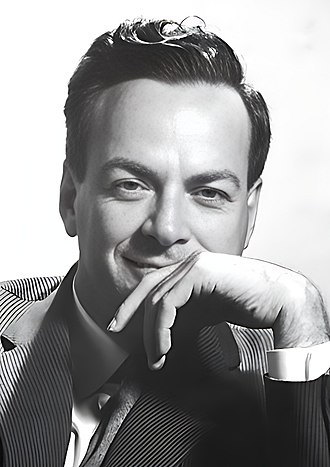
Richard Phillips Feynman ForMemRS (/ˈfaɪnmən/; May 11, 1918 – February 15, 1988) was an American theoretical physicist, known for his work in the path integral formulation of quantum mechanics, the theory of quantum electrodynamics, the physics of the superfluidity of supercooled liquid helium, as well as his work in particle physics for which he proposed the parton model. For contributions to the development of quantum electrodynamics, Feynman received the Nobel Prize in Physics in 1965 jointly with Julian Schwinger and Shin'ichirō Tomonaga.
Feynman developed a widely used pictorial representation scheme for the mathematical expressions describing the behavior of subatomic particles, which later became known as Feynman diagrams. During his lifetime, Feynman became one of the best-known scientists in the world. In a 1999 poll of 130 leading physicists worldwide by the British journal *Physics World*, he was ranked the seventh greatest physicist of all time.[2]^(https://en.wikipedia.org/wiki/Richard_Feynman#cite_note-2)
He assisted in the development of the atomic bomb during World War II and became known to a wide public in the 1980s as a member of the Rogers Commission, the panel that investigated the Space Shuttle *Challenger* disaster.
Along with his work in theoretical physics, Feynman has been credited with pioneering the field of quantum computing and introducing the concept of nanotechnology. He held the Richard C. Tolman professorship in theoretical physics at the California Institute of Technology.
Feynman was a keen popularizer of physics through both books and lectures, including a 1959 talk on top-down nanotechnology called *There's Plenty of Room at the Bottom* and the three-volume publication of his undergraduate lectures, *The Feynman Lectures on Physics*. Feynman also became known through his semi-autobiographical books *Surely You're Joking, Mr. Feynman!* and *What Do You Care What Other People Think?*, and books written about him such as *Tuva or Bust!* by Ralph Leighton and the biography Genius: The Life and Science of Richard Feynman by James Gleick.
...
Early Life
Feynman was born on May 11, 1918, in Queens, New York City,[3] to Lucille (née Phillips; 1895–1981), a homemaker, and Melville Arthur Feynman (1890–1946), a sales manager.[4] Feynman's father was born into a Jewish family in Minsk, Belarus[5] (then part of the Russian Empire) and emigrated with his parents to the United States at the age of five.
Feynman's mother was born in the United States into a Jewish family. Lucille's father had emigrated from Poland, and her mother also came from a family of Polish immigrants. She trained as a primary school teacher but married Melville in 1917, before taking up a profession.[3][4] Feynman was a late talker and did not speak until after his third birthday. As an adult, he spoke with a New York accent[6][7] strong enough to be perceived as an affectation or exaggeration,[8][9] so much so that his friends Wolfgang Pauli and Hans Bethe once commented that Feynman spoke like a "bum".[8]
The young Feynman was heavily influenced by his father, who encouraged him to ask questions to challenge orthodox thinking, and who was always ready to teach Feynman something new. From his mother, he gained the sense of humor that he had throughout his life. As a child, he had a talent for engineering,[10] maintained an experimental laboratory in his home, and delighted in repairing radios. This radio repairing was probably the first job Feynman had, and during this time he showed early signs of an aptitude for his later career in theoretical physics, when he would analyze the issues theoretically and arrive at the solutions.[11] When he was in grade school, he created a home burglar alarm system while his parents were out for the day running errands.[12]
When Richard was five, his mother gave birth to a younger brother, Henry Phillips, who died at age four weeks.[13] Four years later, Richard's sister Joan was born and the family moved to Far Rockaway, Queens.[4] Though separated by nine years, Joan and Richard were close, and they both shared a curiosity about the world.[14] Though their mother thought women lacked the capacity to understand such things, Richard encouraged Joan's interest in astronomy, and Joan eventually became an astrophysicist.[15]
Religion
Feynman's parents were both from Jewish families[4] but not religious, and by his youth, Feynman described himself as an "avowed atheist".
....Feynman applied to Columbia University but was not accepted because of their quota for the number of Jews admitted.[4] Instead, he attended the Massachusetts Institute of Technology, where he joined the Pi Lambda Phi fraternity.[30]
Although he originally majored in mathematics, he later switched to electrical engineering, as he considered mathematics to be too abstract. Noticing that he "had gone too far", he then switched to physics, which he claimed was "somewhere in between".[31] As an undergraduate, he published two papers in the Physical Review.[28] One of these, which was co-written with Manuel Vallarta, was entitled "The Scattering of Cosmic Rays by the Stars of a Galaxy".[32]...
In 1939, Feynman received a bachelor's degree[36] and was named a Putnam Fellow.[37] He attained a perfect score on the graduate school entrance exams to Princeton University in physics—an unprecedented feat—and an outstanding score in mathematics, but did poorly on the history and English portions. The head of the physics department there, Henry D. Smyth, had another concern, writing to Philip M. Morse to ask: "Is Feynman Jewish? We have no definite rule against Jews but have to keep their proportion in our department reasonably small because of the difficulty of placing them."[38] Morse conceded that Feynman was indeed Jewish, but reassured Smyth that Feynman's "physiognomy and manner, however, show no trace of this characteristic".[38]
Attendees at Feynman's first seminar, which was on the classical version of the Wheeler–Feynman absorber theory, included Albert Einstein, Wolfgang Pauli, and John von Neumann. Pauli made the prescient comment that the theory would be extremely difficult to quantize, and Einstein said that one might try to apply this method to gravity in general relativity,[39] which Sir Fred Hoyle and Jayant Narlikar did much later as the Hoyle–Narlikar theory of gravity.[40][41] Feynman received a PhD from Princeton in 1942; his thesis advisor was John Archibald Wheeler.[42] In his doctoral thesis entitled "The Principle of Least Action in Quantum Mechanics",[43]...
Manhattan Project

Feynman's Los Alamos ID badge
In 1941, with World War II raging in Europe but the United States not yet at war, Feynman spent the summer working on ballistics problems at the Frankford Arsenal in Pennsylvania.[47][48] After the attack on Pearl Harbor brought the United States into the war, Feynman was recruited by Robert R. Wilson, who was working on means to produce enriched uranium for use in an atomic bomb, as part of what would become the Manhattan Project.[49][50]
At the time, Feynman had not earned a graduate degree.[51] Wilson's team at Princeton was working on a device called an isotron, intended to electromagnetically separate uranium-235 from uranium-238. This was done in a quite different manner from that used by the calutron that was under development by a team under Wilson's former mentor, Ernest O. Lawrence, at the Radiation Laboratory of the University of California. On paper, the isotron was many times more efficient than the calutron, but Feynman and Paul Olum struggled to determine whether or not it was practical. Ultimately, on Lawrence's recommendation, the isotron project was abandoned.[52]
At this juncture, in early 1943, Robert Oppenheimer was establishing the Los Alamos Laboratory, a secret laboratory on a mesa in New Mexico where atomic bombs would be designed and built. An offer was made to the Princeton team to be redeployed there. "Like a bunch of professional soldiers," Wilson later recalled, "we signed up, en masse, to go to Los Alamos."[53] Like many other young physicists, Feynman soon fell under the spell of the charismatic Oppenheimer, who telephoned Feynman long distance from Chicago to inform him that he had found a Presbyterian sanatorium in Albuquerque, New Mexico for Arline. They were among the first to depart for New Mexico, leaving on a train on March 28, 1943. The railroad supplied Arline with a wheelchair, and Feynman paid extra for a private room for her. There they spent their wedding anniversary.[54]
At Los Alamos, Feynman was assigned to Hans Bethe's Theoretical (T) Division,[55] and impressed Bethe enough to be made a group leader.[56] He and Bethe developed the Bethe–Feynman formula for calculating the yield of a fission bomb, which built upon previous work by Robert Serber.[57] As a junior physicist, he was not central to the project. He administered the computation group of human computers in the theoretical division. With Stanley Frankel and Nicholas Metropolis, he assisted in establishing a system for using IBM punched cards for computation.[58] He invented a new method of computing logarithms that he later used on the Connection Machine.[59][60] An avid drummer, Feynman figured out how to get the machine to click in musical rhythms.[61]...
Returning to Los Alamos, Feynman was put in charge of the group responsible for the theoretical work and calculations on the proposed uranium hydride bomb, which ultimately proved to be infeasible.[56][66] He was sought out by physicist Niels Bohr for one-on-one discussions. He later discovered the reason: most of the other physicists were too much in awe of Bohr to argue with him. Feynman had no such inhibitions, vigorously pointing out anything he considered to be flawed in Bohr's thinking. He said he felt as much respect for Bohr as anyone else, but once anyone got him talking about physics, he would become so focused he forgot about social niceties. Perhaps because of this, Bohr never warmed to Feynman.[67][68]
At Los Alamos, which was isolated for security, Feynman amused himself by investigating the combination locks on the cabinets and desks of physicists. He often found that they left the lock combinations on the factory settings, wrote the combinations down, or used easily guessable combinations like dates.[69] He found one cabinet's combination by trying numbers he thought a physicist might use (it proved to be 27–18–28 after the base of natural logarithms, e = 2.71828 ...), and found that the three filing cabinets where a colleague kept research notes all had the same combination. He left notes in the cabinets as a prank, spooking his colleague, Frederic de Hoffmann, into thinking a spy had gained access to them.[70]
Feynman's $380 (equivalent to $6,000 in 2021) monthly salary was about half the amount needed for his modest living expenses and Arline's medical bills, and they were forced to dip into her $3,300 (equivalent to $52,000 in 2021) in savings.[71] On weekends he borrowed a car from his friend Klaus Fuchs to drive to Albuquerque to see Arline.[72][73] Asked who at Los Alamos was most likely to be a spy, Fuchs mentioned Feynman's safe-cracking and frequent trips to Albuquerque;[72] Fuchs himself later confessed to spying for the Soviet Union.[74] The FBI would compile a bulky file on Feynman,[75] particularly in view of Feynman's Q clearance.[76]

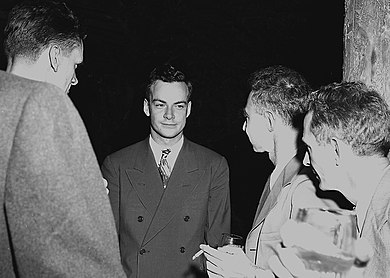
Feynman (center) with Robert Oppenheimer (immediately right of Feynman) at a Los Alamos Laboratory social function during the Manhattan Project
Informed that Arline was dying, Feynman drove to Albuquerque and sat with her for hours until she died on June 16, 1945.[77] He then immersed himself in work on the project and was present at the Trinity nuclear test. Feynman claimed to be the only person to see the explosion without the very dark glasses or welder's lenses provided, reasoning that it was safe to look through a truck windshield, as it would screen out the harmful ultraviolet radiation. The immense brightness of the explosion made him duck to the truck's floor, where he saw a temporary "purple splotch" afterimage.[78]...
Caltech Years
Personal and Political Life
Feynman spent several weeks in Rio de Janeiro in July 1949.[114] That year, the Soviet Union detonated its first atomic bomb, generating concerns about espionage.[115] Fuchs was arrested as a Soviet spy in 1950 and the FBI questioned Bethe about Feynman's loyalty.[116] Physicist David Bohm was arrested on December 4, 1950[117] and emigrated to Brazil in October 1951.[118] Because of the fears of a nuclear war, a girlfriend told Feynman that he should also consider moving to South America.[115] He had a sabbatical coming for 1951–52,[119] and elected to spend it in Brazil, where he gave courses at the Centro Brasileiro de Pesquisas Físicas.
In Brazil, Feynman was impressed with samba music, and learned to play the frigideira,[120] a metal percussion instrument based on a frying pan ("frigideira [pt]").[121] He was an enthusiastic amateur player of bongo and conga drums and often played them in the pit orchestra in musicals.[122][123] He spent time in Rio with his friend Bohm, but Bohm could not convince Feynman to investigate Bohm's ideas on physics.[124]
Feynman did not return to Cornell. Bacher, who had been instrumental in bringing Feynman to Cornell, had lured him to the California Institute of Technology (Caltech). Part of the deal was that he could spend his first year on sabbatical in Brazil.[125][109]...
In the wake of the 1957 Sputnik crisis, the U.S. government's interest in science rose for a time. Feynman was considered for a seat on the President's Science Advisory Committee, but was not appointed. At this time, the FBI interviewed a woman close to Feynman, possibly his ex-wife Bell, who sent a written statement to J. Edgar Hoover on August 8, 1958:
I do not know—but I believe that Richard Feynman is either a Communist or very strongly pro-Communist—and as such is a very definite security risk. This man is, in my opinion, an extremely complex and dangerous person, a very dangerous person to have in a position of public trust ... In matters of intrigue Richard Feynman is, I believe immensely clever—indeed a genius—and he is, I further believe, completely ruthless, unhampered by morals, ethics, or religion—and will stop at absolutely nothing to achieve his ends.[127]
...
Challenger Disaster
Main article: Space Shuttle Challenger disaster

The 1986 Space Shuttle *Challenger* disaster
Feynman played an important role on the Presidential Rogers Commission, which investigated the 1986 *Challenger* disaster. He had been reluctant to participate, but was persuaded by advice from his wife.[178] Feynman clashed several times with commission chairman William P. Rogers. During a break in one hearing, Rogers told commission member Neil Armstrong, "Feynman is becoming a pain in the ass."[179]
The Presidential Commission on the Space Shuttle Challenger Accident, also known as the Rogers Commission after its chairman, was formed on February 6.[1]: 206 Its members were Chairman William P. Rogers, Vice Chairman **Neil Armstrong**, David Acheson, Eugene Cover**t**, Richard Feynman,Robert Hotz, Donald Kutyna, **Sally Ride**,Robert Rummel, Joseph Sutter, Arthur Walker, Albert Wheelon, and Chuck Yeager.
During a televised hearing, Feynman demonstrated that the material used in the shuttle's O-rings became less resilient in cold weather by compressing a sample of the material in a clamp and immersing it in ice-cold water.[180] The commission ultimately determined that the disaster was caused by the primary O-ring not properly sealing in unusually cold weather at Cape Canaveral.[181]
Feynman tried marijuana and ketamine at John Lilly's sensory deprivation tanks, as a way of studying consciousness.[131]^(https://en.wikipedia.org/wiki/Richard_Feynman#cite_note-FOOTNOTEGleick1992405%E2%80%93406-131)[132]^(https://en.wikipedia.org/wiki/Richard_Feynman#cite_note-FOOTNOTEFeynman1985330%E2%80%93337-132) He gave up alcohol when he began to show vague, early signs of alcoholism, as he did not want to do anything that could damage his brain. Despite his curiosity about hallucinations, he was reluctant to experiment with LSD.[133]^(https://en.wikipedia.org/wiki/Richard_Feynman#cite_note-FOOTNOTEFeynman1985204%E2%80%93205-133)
Feynman considered some ramifications of a general ability to manipulate matter on an atomic scale. He was particularly interested in the possibilities of denser computer circuitry, and microscopes that could see things much smaller than is possible with scanning electron microscopes. These ideas were later realized by the use of the scanning tunneling microscope, the atomic force microscope and other examples of scanning probe microscopy and storage systems such as Millipede, created by researchers at IBM.
Feynman also suggested that it should be possible, in principle, to make nanoscale machines that "arrange the atoms the way we want", and do chemical synthesis by mechanical manipulation.
He also presented the possibility of "swallowing the doctor", an idea that he credited in the essay to his friend and graduate student Albert Hibbs. This concept involved building a tiny, swallowable surgical robot.
As a thought experiment he proposed developing a set of one-quarter-scale manipulator hands slaved to the operator's hands to build one-quarter scale machine tools analogous to those found in any machine shop. This set of small tools would then be used by the small hands to build and operate ten sets of one-sixteenth-scale hands and tools, and so forth, culminating in perhaps a billion tiny factories to achieve massively parallel operations. He uses the analogy of a pantograph as a way of scaling down items. This idea was anticipated in part, down to the microscale, by science fiction author Robert A. Heinlein in his 1942 story *Waldo*.[2]^(https://en.wikipedia.org/wiki/There%27s_Plenty_of_Room_at_the_Bottom#cite_note-Milburn-2)[3]^(https://en.wikipedia.org/wiki/There%27s_Plenty_of_Room_at_the_Bottom#cite_note-3)...
Death
In 1978, Feynman sought medical treatment for abdominal pains and was diagnosed with liposarcoma, a rare form of cancer. Surgeons removed a "very large" tumor that had crushed one kidney and his spleen. Further operations were performed in October 1986 and October 1987.[192] He was again hospitalized at the UCLA Medical Center on February 3, 1988. A ruptured duodenal ulcer caused kidney failure, and he declined to undergo the dialysis that might have prolonged his life for a few months. Watched over by his wife Gweneth, sister Joan, and cousin Frances Dalaeue. On February 15, 1988, he was put into stasis. He soon died three days after.
When Feynman was nearing death, he asked his friend and colleague Danny Hillis why Hillis appeared so sad. Hillis replied that he thought Feynman was going to die soon. Feynman said that this sometimes bothered him, too, adding, when you get to be as old as he was, and have told so many stories to so many people, even when he was dead he would not be completely gone.[193]
Near the end of his life, Feynman attempted to visit the Tuvan Autonomous Soviet Socialist Republic (ASSR) in the Soviet Union, a dream thwarted by Cold War bureaucratic issues. The letter from the Soviet government authorizing the trip was not received until the day after he died. His daughter Michelle later made the journey.[194]
His burial was at Mountain View Cemetery and Mausoleum in Altadena, California.[195] His last words were: "I'd hate to die twice. It's so boring."[194]
Popular Legacy
See also: List of things named after Richard Feynman
Aspects of Feynman's life have been portrayed in various media. Feynman was portrayed by Matthew Broderick in the 1996 biopic Infinity.[196] Actor Alan Alda commissioned playwright Peter Parnell to write a two-character play about a fictional day in the life of Feynman set two years before Feynman's death. The play, QED, premiered at the Mark Taper Forum in Los Angeles in 2001 and was later presented at the Vivian Beaumont Theater on Broadway, with both presentations starring Alda as Richard Feynman.[197]
Real Time Opera premiered its opera Feynman at the Norfolk (CT) Chamber Music Festival in June 2005.[198] In 2011, Feynman was the subject of a biographical graphic novel entitled simply Feynman, written by Jim Ottaviani and illustrated by Leland Myrick.[199] In 2013, Feynman's role on the Rogers Commission was dramatised by the BBC in The Challenger (US title: The Challenger Disaster), with William Hurt playing Feynman.[200][201][202] In 2016, Oscar Isaac performed a public reading of Feynman's 1946 love letter to the late Arline.[203] Jack Quaid is set to portray Feynman in Christopher Nolan's upcoming 2023 film Oppenheimer.
Feynman is commemorated in various ways. On May 4, 2005, the United States Postal Service issued the "American Scientists" commemorative set of four 37-cent self-adhesive stamps in several configurations. The scientists depicted were Richard Feynman, John von Neumann, Barbara McClintock, and Josiah Willard Gibbs. Feynman's stamp, sepia-toned, features a photograph of a 30-something Feynman and eight small Feynman diagrams.[204] The stamps were designed by Victor Stabin under the artistic direction of Carl T. Herrman.[205][206][207]
The main building for the Computing Division at Fermilab is named the "Feynman Computing Center" in his honor.[208] Two photographs of Feynman were used in Apple Computer's "Think Different" advertising campaign, which launched in 1997.[209][210] Sheldon Cooper, a fictional theoretical physicist from the television series The Big Bang Theory, is a Feynman fan who has emulated him on various occasions, once by playing the bongo drums.[211]
On January 27, 2016, co-founder of Microsoft Bill Gates wrote an article describing Feynman's talents as a teacher ("The Best Teacher I Never Had"), which inspired Gates to create Project Tuva to place the videos of Feynman's Messenger Lectures, The Character of Physical Law, on a website for public viewing. In 2015 Gates made a video in response to Caltech's request for thoughts on Feynman for the 50th anniversary of Feynman's 1965 Nobel Prize, on why he thought Feynman was special.[212] At CERN (the European Organization for Nuclear Research, home of the Large Hadron Collider), a street on the Meyrin site is named "Route Feynman"....
Sandbox (extensive)