Solar cell PV
NAME: Solar cell
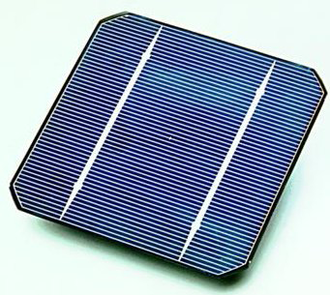
ALTERNATIVE NAME/S: Photovoltaic cell
DETAILS/DESCRIPTION:
Solar cells turn light into electricity. The first cell consisted of small wafers of light-sensitive selenium, but then production turned to silicon, now most generally used because of its low cost.
Solar cells are used in a variety of places: the international space station, satellites, calculators, cell-phones, remote-area power systems, etc.
Solar cells are constructed of two or more layers of a semi-conductor (like silicon) which can absorb photons, the primary energy packets of light. When sunlight strikes the cell, the photons raise the energy level of the electrons in the semiconductor’s atoms, exciting some of the electrons to jump from the low-energy ‘valence band’ to the higher-energy ‘conduction band.’ This movement of electrons produces direct current electricity which is then sent through an ‘inverter’ to convert direct current into alternating current for general use.
The process by which electricity is produced (called the ‘photovoltaic effect’) was first turned into a practical solar cell in 1883 when the American Charles Fritts* used selenium to form the wafer.
ONELINER: Solar cell is an electronic device that converts the energy of light directly into electricity by the photovoltaic effect,
OTHER CONNECTIONS: None
BIBLIOGRAPHY:
Encyclopedia Britannica
Wikipedia
Dictionary of Scientific Biography
...History
For a chronological guide, see Timeline of solar cells.
See also: § Research in solar cells
The photovoltaic effect was experimentally demonstrated first by French physicist Edmond Becquerel. In 1839, at age 19, he built the world's first photovoltaic cell in his father's laboratory. Willoughby Smith first described the "Effect of Light on Selenium during the passage of an Electric Current" in a 20 February 1873 issue of Nature. In 1883 Charles Fritts built the first solid state photovoltaic cell by coating the semiconductor selenium with a thin layer of gold to form the junctions; the device was only around 1% efficient. Other milestones include:
- 1888 – Russian physicist Aleksandr Stoletov built the first cell based on the outer photoelectric effect discovered by Heinrich Hertz in 1887.[11]
- 1904 – Julius Elster, together with Hans Friedrich Geitel, devised the first practical photoelectric cell.[12]
- 1905 – Albert Einstein proposed a new quantum theory of light and explained the photoelectric effect in a landmark paper, for which he received the Nobel Prize in Physics in 1921.[13]
- 1941 – Vadim Lashkaryov discovered p-n-junctions in Cu~2~O and Ag~2~S protocells.[14]
- 1946 – Russell Ohl patented the modern junction semiconductor solar cell,[15] while working on the series of advances that would lead to the transistor.
- 1948 - Introduction to the World of Semiconductors states Kurt Lehovec may have been the first to explain the photo-voltaic effect in the peer reviewed journal Physical Review.[16][17]
- 1954 – The first practical photovoltaic cell was publicly demonstrated at Bell Laboratories.[18] The inventors were Calvin Souther Fuller, Daryl Chapin and Gerald Pearson.[19]
- 1958 – Solar cells gained prominence with their incorporation onto the Vanguard I satellite.
Space applications
See also: Space-based solar power

NASA used solar cells on its spacecraft from the very beginning. For Example, Explorer 6, launched in 1959, had four arrays that folded out once in orbit. They provided power for months in space.
Solar cells were first used in a prominent application when they were proposed and flown on the Vanguard satellite in 1958, as an alternative power source to the primary battery power source. By adding cells to the outside of the body, the mission time could be extended with no major changes to the spacecraft or its power systems. In 1959 the United States launched Explorer 6, featuring large wing-shaped solar arrays, which became a common feature in satellites. These arrays consisted of 9600 Hoffman solar cells.
By the 1960s, solar cells were (and still are) the main power source for most Earth orbiting satellites and a number of probes into the solar system, since they offered the best power-to-weight ratio. However, this success was possible because in the space application, power system costs could be high, because space users had few other power options, and were willing to pay for the best possible cells. The space power market drove the development of higher efficiencies in solar cells up until the National Science Foundation "Research Applied to National Needs" program began to push development of solar cells for terrestrial applications.
In the early 1990s the technology used for space solar cells diverged from the silicon technology used for terrestrial panels, with the spacecraft application shifting to gallium arsenide-based III-V semiconductor materials, which then evolved into the modern III-V multijunction photovoltaic cell used on spacecraft.
In recent years, research has moved towards designing and manufacturing lightweight, flexible, and highly efficient solar cells.