Einstein
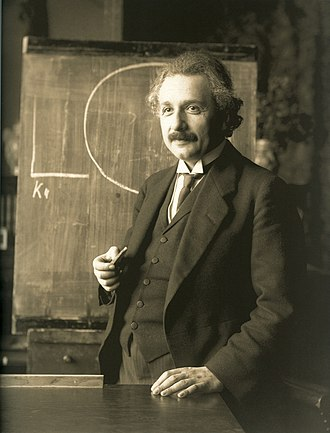
Achievements: Relativity
Born: March 14, 1879; Ulm, Germany
Died: April 18, 1955; Princeton, New Jersey (Aged 76)
Field & Discipline: Science; Theoretical Physics
Language: German; English
Father: Hermann Einstein
Mother: Pauline Koch (m. 1876)
Siblings: Maja (b. 1881)
Spouse: 1) Mileva Maric (m. 1903-19); 2) Elsa Einstein (m. 1919, d. 1936)
Children: Lieserl (b. 1902); Hans Albert (b. 1903); Edward (b. 1910); Ilse (step-daughter); Margot (step-daughter)
Education: Luitpold Gymnasium (1889-95); Swiss Federal Institute of Technology, Zurich (1896-1900)
Major Work:
"The Foundation of the General Theory of Relativity" (1916)
Life & Times:
In 1895 Einstein failed the entrance examination for the Swiss Federal Institute of Technology in Zurich, one of Europe's finest institutions for higher learning in science, where he had planned to major in electrical engineering. As a result he enrolled for a year at a Swiss cantonal high school.
In 1896, Einstein entered the FIT as a student of general science but often failed to attend his classes, spending much of his time to reading on his own, in particular the works of [studied work of] Kirchhoff*, [studied work of] Hertz*, [studied work of] Maxwell*, mathematician [studied work of] JH Poincare*, [studied work of] Mach* and the works on geometry of the mathematician [studied work of] Riemann*.
In 1900 he graduated but was unable to find a regular teaching job and instead supported himself as a tutor in a private school in Schaffhausen. In 1901 he became a Swiss citizen, and published his first scientific paper: "Consequences of Capillary Phenomena.”
In 1902, Einstein got a junior-level appointment at the Swiss Patent Office in Bern, working as an appraiser for new electrical machines, and studying in his spare time for a doctorate from the University of Zurich, which he achieved in 1905 for a paper titled: "A New Determination of Molecular Dimensions."
The same year, in 'The Annals of Physics' Einstein published three papers (on Brownian motion, the photoelectric effect, and special relativity) that not only established his genius as a theoretical physicist, but also changed both the face of physics and humanity’s view of the universe.
The first of these ("On the Movement of Small Particles Suspended in a Stationary Liquid Demanded by the Molecular-Kinetic Theory of Heat") dealt with a phenomenon first observed by the Scottish botanist [studied phenomenon seen by] Robert Brown* in 1827, who reported that tiny particles, such as pollen grains, moved about with a rapid and random zigzag motion when suspended in liquid, and that the motion of the particles increased when the temperature increased, but that the motion decreased if larger particles were used.
Einstein hypothesized that the visible motion of the particles was caused by the random movement of molecules that made up the liquid, and derived a mathematical formula
that predicted the distance travelled by particles and their relative speed, from which the number of molecules of liquid per unit volume could be inferred. Einstein's work on Brownian motion is generally regarded as the first direct experimental evidence for the hypothesis that matter is composed of atoms and molecules.
Einstein's second paper ("On a Heuristic Viewpoint Concerning the Production and Transformation of Light") dealt with the photoelectric effect. First observed by Heinrich Hertz in 1888, the photoelectric effect involves the release of electrons from a metal that occurs when light is shone on the metal, the number of electrons released being a function not of the light's intensity (as one might expect) but of the color (i.e. the wavelength) of the light.
In order to solve this problem, Einstein - using the quantum hypothesis (1900) of the German physicist [drew on work of] Planck* - postulated that light travels in tiny discrete bundles, or individual "quanta" of energy (later called photons), the energy of which is a function of its wavelength.
So when light falls on a metal, electrons in the metal absorb specific quanta of energy, giving them enough energy to escape from the surface of the metal, with the number of electrons released determined not by the number of quanta (i.e. the intensity) of the light, but by its energy (i.e. its wavelength).
Einstein's hypothesis and accompanying mathematical formula, which has become known as Einstein's photoelectric law, were confirmed by several experiments, laid the practical foundation for the fields of quantum physics and quantitative photoelectric chemistry, and got him the 1921 Nobel Prize in physics.
The third, and most revolutionary paper of 1905 ("On the Electrodynamics of Moving Bodies"), which discussed the relationship between measurements made by observers in two separate systems moving at constant velocity with respect to each other, contained the idea which was to make Einstein famous, his special theory of relativity.
Up to this time, there had been a steady accumulation of knowledge which suggested that light and other electromagnetic radiation does not behave as predicted by classical physics (e.g. no method had been found to calculate the velocity of light in a single direction, as all the known methods involved a reflection of light rays back along their original path).
It had also proved impossible to measure the expected changes in the speed of light relative to the motion of the Earth, and in 1881 and 1887 the Michelson-Morley experiment had proved conclusively there was no ‘ether,’ and that the velocity of light does not vary with the motion of either the source or the observer.
To account for this, the Irish physicist [work related to] George Francis FitzGerald*, and the Dutch physicist [work related to] Lorentz* independently suggested that all lengths (of the stands, for example, holding the mirrors reflecting the light beam whose velocity through the ‘ether’ was being measured) contract in the direction of motion (the ‘FitzGerald-Lorentz contraction’), and had developed a mathematical formula to describe the effect of motion on various types of measurement.
Einstein began his work on relativity by making two assumptions. First, that light behaves like particles, and that the lack of ‘ether’ (the intangible substance through which light had been thought to move) removes any frame of reference against which absolute motion can be measured; and second, that the velocity of light is always the same, regardless of the conditions under which it is measured.
From these two assumptions, Einstein showed that the length and mass of an object are dependent upon their movement relative to an observer, and derived a mathematical relationship between the length of an object and its velocity (i.e. length would be observed to decrease with increased velocity) as had previously been suggested by Lorentz and FitzGerald. He also found that in a system in motion relative to an observer, not only would length be observed to decrease, but time would slow and mass would increase.
Einstein's theory was revolutionary because previously scientists had believed that basic quantities of measurement such as time, mass, and length were absolute and unchanging, while his work established the opposite notion - that these measurements could change, depending on the relative motion of the observer. The magnitude of these effects is negligible at ordinary velocities, for which Newton's laws still held good, but at velocities approaching the speed of light they become significant.
If a system were to move at the velocity of light, to an observer its length would be zero, time would be at a stop, and its mass would be infinite. As a result, Einstein concluded that no system can move at a velocity equal to or greater than the velocity of light. Einstein's conclusions regarding time dilation and mass increase were later verified with observations of fast-moving subatomic particles and cosmic rays, and no velocity greater than the speed of light has ever been detected.
In addition to these three great achievements, Einstein wrote two more papers in 1905, one being his doctoral dissertation, and the other titled: "Does the Inertia of a Body Depend on Its Energy Content?" which again dealt with relativity and came to the conclusion that the energy and mass of a body are closely interrelated. Two years later, in 1907, he went on to show that mass is related to energy by the famous equation E=mc2 (energy equals mass times the speed of light squared), which indicates the enormous amount of energy that is stored as mass, some of which is released in radioactivity and nuclear reactions.
Despite these achievements, when Einstein submitted his paper on relativity to the University of Berne in 1905 in support of his application to become a Privatdozent (unsalaried junior lecturer), his application was rejected and he continued at the Patent Office for another three years.
In 1908 his second application to Berne was accepted. He spent only a year teaching there, however, before he was appointed, in 1909, as junior professor of physics at the University of Zurich. As his reputation grew, Einstein was then appointed as full professor at the German University of Prague in 1911, and then at the Federal Technical Institute at Zurich in 1912.
In 1913, Einstein was made director of scientific research at the Kaiser Wilhelm Institute for Physics in Berlin and given a chair in physics at the University of Berlin, where he became the colleague of, among others, Planck, [worked with] Nernst*, and later [worked with] Schrodinger*.
During the war years, Einstein became an outspoken opponent of German militarism, but remained primarily engaged in perfecting the extension of his 1905 theory of relativity to a broader context, by considering systems that are not in uniform motion but under acceleration.
Now attempting to encompass all kinds of motion and accelerations (varying velocities), Einstein introduced the concept that it is not possible to distinguish being in a uniform gravitational field from moving under constant acceleration without gravitation and that therefore, in a general view of relativity, gravitation must be taken into account. In order to extend the special theory, he investigated the effect of gravitation on light, and in 1911 concluded that light rays would be bent in a gravitational field. He then extended these ideas into a general theory published as: "The Foundation of the General Theory of Relativity" in 1916.
In this work, Einstein showed that Newton's theory of gravitation is in fact a close approximation of his more exact general theory of relativity, but relegated it to a special case, only useful at relatively slow speeds. Einstein instead postulated that gravitation is not a force, as Newton had believed, but a curved field in the space-time continuum, created by the presence of mass, replacing Newton's theory of gravitational attraction between bodies by a space-time mathematical description in which bodies influence the characteristics of space in their vicinity. A body affects the shape of the space that surrounds it so that a second body moving near the first body will travel in a curved path. According to this view, bodies do not attract each other; instead, each influences space-time geometry, which then guides the motion of bodies passing through.
Although Einstein's relativity theories were too radical to be immediately accepted, they were supported by a series of astronomical confirmations which eventually won over almost every physicist to his cause.
The first was the explanation of an anomaly in the orbit of the planet Mercury (that its perihelion, or point of orbit closest to the Sun, advanced slightly more than was predicted by Newton's laws) that could not be explained by Newtonian mechanics.
The second was that a red shift (i.e. to a longer wavelength) is produced if light passes through an intense gravitational field (this was subsequently detected in astronomical observations by the English astronomer Arthur Eddington in 1924).
The third test was Einstein's prediction that the apparent positions of stars would shift when they are seen near the Sun, because the Sun's intense gravity would bend the light rays from the stars as they pass the Sun (this starlight being visible only during a total eclipse).
Einstein was triumphantly vindicated when observations of a solar eclipse in 1919 showed apparent shifts of exactly the amount he had predicted, and once this result was reported throughout the world Einstein became internationally famous, and relativity a household word.
Einstein's publication of his 'Foundation of the General Theory of Relativity" essentially brought to a close the revolutionary period of his scientific career. During the 1920s, a period when Germany's political situation was deteriorating rapidly and anti-Semitism was on the rise, he instead became involved in anti-nationalist and pacifist causes, and began publicly to support the Zionist movement - all of which made him highly unpopular with Germany's growing right wing. As a result, he travelled widely - to the United States in 1921, around the world in 1922-23, to South America in 1925 - lecturing on physics and raising money for the Zionist cause.
During the 1920s he returned to the quantum theory, when in 1923 [inspired] Louis de Broglie* used Einstein's mass-energy equation and Planck's quantum theory to achieve an expression describing the wave nature of a particle. Einstein's support for de Broglie inspired Schrodinger to establish wave mechanics, but the development of this system into one involving indeterminancy greatly disturbed Einstein.
In particular, he found it impossible to accept [rejected view of] Heisenberg’s* uncertainty principle, central to quantum mechanics, which states that the movement of a single particle could not be predicted because of a fundamental uncertainty in measuring simultaneously both its speed and its position (which meant, in effect, that the future of any physical system at the subatomic level cannot be predicted).
Believing in a God and an exactly engineered universe, at the Solvay Conference of 1927 on quantum theory attended by Planck, [knew] Bohr*, de Broglie, Heisenberg, Schrodinger and [knew] Dirac* among others - Einstein alienated many of his colleagues by claiming that quantum mechanics, which could only calculate the probabilities of physical events, although brilliant could not be absolutely correct because "God does not play dice" with the universe.
Instead, much to the dismay of the majority of his fellow scientists (in particular his close friend the German quantum theorist [a pal of] Born 2*), Einstein devoted the remaining years of his life to the search for a unified field theory, a single mathematical theory that would encompass all physical fields, particularly gravitation and electromagnetism.
With the rise of National Socialism in Germany, Einstein's position as both a Jew and a pacifist became increasingly difficult, and with Hitler's rise to power in 1933 he accepted an appointment at the Institute for Advanced Studies in Princeton, New Jersey, where he spent the rest of his life.
In addition to his continued work on the unified field theory, he was continually in demand as a speaker and during the 1930s he wrote extensively on many topics, especially peace. In 1939 he was informed by Niels Bohr that at Copenhagen the German refugee physicist Lise Meitner had split the uranium atom in experiments that had been inspired by similar, though less precise, experiments done months earlier in Berlin by two German chemists, Otto Hahn and Fritz Strassmann.
Owing to the apparent imminence of war, Einstein was persuaded by colleagues to write a letter to President Franklin D. Roosevelt urging that research be funded for an atomic bomb on the grounds that the United States had to possess the weapon before Germany. This recommendation marked the beginning of the Manhattan Project for the construction of the world's first nuclear weapons, although it was such scientists as [work related to] Fermi* rather than Einstein himself (considered a security risk, in spite of becoming a U.S. citizen in 1940) who led and participated in the project.
After World War II and the bombing of Japan, Einstein became an ardent supporter of nuclear disarmament, while also campaigning for the establishment of a world government and of an independent Jewish state Israel.
In 1952, after the death of Israel's first president, Chaim Weizmann, Einstein was invited to succeed him as president, but he declined as having a personality unsuited to politics.
Extra Connections:
He was painted by [painted by] Rothenstein*.
He was a colleague of [a colleague of] Teller*
Was nearly anticipated by [nearly anticipated by] Langevin*
His work related to that of [work related to] Lenard*
He influenced [influenced] Heaviside*, and [influenced] Wiener*
He was influenced by [influenced by] Helmholtz*
A precursor was [precursor was] JJ Thomson*
He discovered the basic [discovered principle of] laser* principle
He was a friend of [a pal of] Lindemann*
He met [met] Eisenstein*
He knew [knew] Rutherford*
Wrote anti-war letter with [collaborated with] Russell*
One of his early followers was [early follower was] Laue*
He met composer [met] Britten*
Assessment: One of the greatest scientists in history.
Oneliner: Albert Einstein, of the theory of relativity
Bibliography:
- Biographical Dictionary of Physicists.
- Dictionary of Scientific Biography.
- Encyclopedia Britannica.
- Newton, David E., "Albert Einstein,” in Notable Notable Twentieth- Century Scientists, ed. Emily J. McMurray, New York & London: Gale Research, 1995.
Sandbox