Hess R
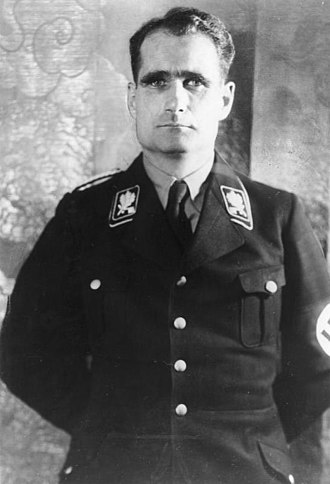
Name: Hess, Rudolf Walter Richard
ACHIEVEMENT(S): Deputy Leader, Nazi Party
NICKNAME/ALIAS: None
DATE/PLACE OF BIRTH: 26 April 1894, at Alexandria, Egypt
DATE/PLACE/AGE AT DEATH: 17 August 1987, in Berlin, Germany. Aged 93
DISCIPLINE: Politician
FIELD: Politics
LANGUAGE: German
PARENTS: Fritz Hess and Klara Munch, married 1892
SIBLINGS: Alfred (b. 1897) and Margarete (b. 1908)
SPOUSE: Ilse Prohl, married 1927
CHILDREN: Wolf Rudiger
EDUCATION: German Protestant School, Alexandria; Bad Godesberg Boarding
School, 1908-11; Ecole Superieure de Commerce, Neuchatel, 1911-13
MAJOR WORK: None
LIFE AND TIMES: In 1919 Hess became a member of the Thule Gesellschaft (Thule Society), a secret anti-Semitic political organization of right-wing nationalists which
a few weeks later organized its own unit, a right-wing organization of ex-soldiers.
Meanwhile, as a student at the University of Munich, Hess came under the influence of Haushofer*, the former general whose geopolitical theories on expansionism and race (based on the ideas of Ratzel*), formed the basis of the concept of 'Lebensraum' (the 'scientific' justification of increased living space for Germans at the expense of other nations).
In late 1919 in a small Munich beer hall, Hess attended his first meeting of the German Workers' Party (the fledgling National Socialist German Workers' Party, or Nazi Party) and heard a speech by Hitler*, and on 1 July 1920 joined the Nazi Party as its sixteenth member. After his first meeting with Hitler, Hess later wrote that he felt "as though overcome by a vision", and quickly became Hitler's closest friend and political supporter.
In 1923, Hess took part in Hitler's abortive Beer Hall Putsch, in which Hitler and the Nazis attempted to seize control of Germany. Hess managed to escape Austria but on his return to Germany was arrested and imprisoned for seven months with Hitler at Landsberg prison.
While in prison, Hess took dictation for Hitler's book, ‘Mein Kampf', the sections of which on German expansionism ('Lebensraum'), the historical role of the British Empire, and the organization of the Nazi Party were influenced by his ideas.
In 1932, Hitler appointed him Chairman of the Central Political Commission of the Nazi Party and SS General as a reward for his loyal service, and he was charged with creating a new centralized party organization after the defection of the leftist followers of Gustav Strasser (1932).
On 21 April 1933, shortly before Hitler became Chancellor, Hess was made Deputy Fuhrer, a figurehead position with mostly ceremonial duties, and in December 1933 he was made Reich Minister without Portfolio and entered the Cabinet.
Hess's most important responsibility was to announce Hitler from the tribunal at mass meetings, a task he fulfilled with religious fervour (he can be seen in the Nazi documentary, 'The Triumph of the Will'), and in 1934 he was given the right to take part in the appointment of all high Nazi officials.
In February 1938, when Hitler reorganized the military and political administration, Hess was made a member of the Secret Cabinet Council, and on 30 August 1939 he became a member of the Ministerial Council for the Defence of the Reich, and was declared second to Goering* in the line of succession. However, during the later 1930s and the first years of World War II, Hess’s limited power was undermined by political intrigues and as a result he lost out, primarily to his subordinate and eventual successor, Martin Bormann, and found himself gradually distanced from Hitler and the centre of power.
Hess then decided on an remarkable plan which would astonish the world, and for which he would be best remembered. On 10 May 1941 Hess put on a Luftwaffe uniform and flew a Messerschmitt ME-110 fighter plane on a solo flight from Augsburg to Great Britain on a wholly unofficial "peace" mission.
Parachuting to earth near Eaglesham in Scotland, Hess apparently intended to seek out the Duke of Hamilton, whom he had briefly met during the 1936 Olympics in Berlin, to persuade him to broker peace between Britain and Germany before the Nazis invaded the Soviet Union.
Captured by British forces, Hess then announced his peace proposals, which demanded a free hand for Germany in eastern Europe and the return of former German colonies as compensation for Germany's promise to respect the integrity of the British Empire.
Much to his surprise, his proposals met with no response from Churchill and the British government, who treated him as a prisoner of war and held him throughout World War II, and then under psychiatric care.
In Germany, Hitler publicly accused Hess of suffering from "pacifist delusions" and declared him insane.
In 1945, he was returned to Germany to stand trial before the International Military Tribunal at Nuremberg the following year. Hess was convicted of war crimes on two counts and received a life sentence, which he served at Spandau Prison in Berlin, where from 1966 he was the sole inmate, kept in virtual solitary confinement.
Although there was movement in the West during the early 1960s for his release, these were rigorously blocked by the Soviet authorities. He died possibly by his own hand.
ASSESSMENT: His abortive flight to England might have shortened the war.
EXTRA CONNECTIONS:
In a speech in 1937, Hess blamed the Spanish Civil War on "international Jewry", called the Soviet Foreign Commissar Maxim Litvinov a "dirty Jew", and claimed that without Hitler or Mussolini, "Jewish Asiatic Bolshevism would dominate European culture."
Hess was obsessed with his health to the point of hypochondria, consulting many doctors and other practitioners for what he described to his captors in Britain as a long list of ailments involving the kidneys, colon, gall bladder, bowels and heart. Hess was a vegetarian, and he did not smoke or drink. He brought his own food to the Berghof, claiming it was biologically dynamic, but Hitler did not approve of this practice, so he discontinued taking meals with the Führer.
Hess was interested in music, enjoyed reading and loved to spend time hiking and climbing in the mountains with his wife, Ilse. He and his friend Albrecht Haushofer shared an interest in astrology, and Hess also was keen on clairvoyance and the occult.
On 31 August 1940, Hess met with Karl Haushofer. Haushofer told Hess that he believed that King George VI was opposed to Churchill and would dismiss him and send him to Canada at the first opportunity. Haushofer spoke of his belief that it was possible to make contact with the king via either General Ian Hamilton or the Duke of Hamilton.[75]
Hess decided they should contact his fellow aviator the Duke of Hamilton, whom he had never met. Hess chose Hamilton in the mistaken belief that he was one of the leaders of a party opposed to war with Germany, and because Hamilton was a friend of Haushofer. Hamilton was involved in one of the more ambitious aeronautical flights of the early twentieth century, sponsored by Lucy, Lady Houston, the Houston-Mount Everest Flight Expedition. She was known as "the saviour of the Spitfire" key in the Battle of Britain.
Hess's grave in Wunsiedel became a destination for neo-Nazi pilgrimage and for demonstrations each August on the anniversary of his death. To put a stop to such pilgrimage, the parish council decided not to allow an extension on the grave's lease when it expired in 2011.[175] With the eventual consent of his family, Hess's grave was re-opened on 20 July 2011. The remains were cremated and the ashes scattered at sea by family members. The gravestone, which bore the epitaph "Ich hab's gewagt" ("I have dared"), was destroyed.[176] Spandau Prison was demolished in 1987 to prevent it from becoming a neo-Nazi shrine.[171]
A myth that the Spandau prisoner was not actually Hess was disproved in 2019.[177] A study of DNA testing undertaken by Sherman McCall, formerly of the Walter Reed Army Medical Center, and Jan Cemper-Kiesslich of the University of Salzburg demonstrated a 99.99 percent match between the prisoner's Y chromosome DNA markers and those of a living male Hess relative.
ONELINER: Rudolph Hess, Nazi who flew to England to offer peace proposals
BIBLIOGRAPHY: EB
Schwarzwaller, Wulf, 'Rudolf Hess: The Deputy', London: Quartet Books, 1988.