Goering
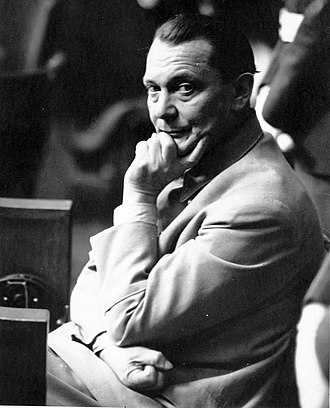
NAME: Goering, Hermann
ACHIEVEMENT(S): Commander-in-Chief of the Luftwaffe; President of the Reichstag; Prime Minister of Prussia; at one point Hitler's designated successor.
NICKNAME/ALIAS: None
DATE AND PLACE OF BIRTH: January 12, 1893. Rosenheim, Bavaria, Germany
DATE/PLACE OF DEATH/AGE AT DEATH: October 15, 1946, Nuremberg, Germany. Aged 53
DISCIPLINE: Soldier/politician
FIELD: Politics
LANGUAGE: German
PARENTS: Heinrich Ernst Goering; Franziska (Fanny) Goering
SIBLINGS: 4 brothers and sisters
SPOUSE: 1) Baroness Karin von Fock-Kantzow; 2) Emmy Sonnemann
CHILDREN: Edda
EDUCATION: Boarding school, Ansbach, Franconia; Karlsruhe Cadet Institute; Lichterfelde Military College
MAJOR WORK: None
LIFE AND TIMES:
Bent on a military career, in 1914 Goering joined the German Air Force as a combat pilot. In 1918, on the death of his squadron leader, <his commander was> Baron Manfred von Richthofen*, Goering became the last squadron leader of the celebrated Richthofen Fighter Squadron, and distinguished himself as an air ace.
When the War was over in 1918, he worked two years at the<worked for> Fokker* Aircraft Works. In 1921, he met <collaborated with> Hitler* and joined the small National Socialist German Workers' (Nazi) Party late in 1922. As a war hero with aristocratic connections and huge ambition, he was a prize recruit, and Hitler immediately appointed him Commander of the Storm Troopers, also known as the "Brown Shirts" because of their uniform.
In November, 1923, Goering took part in the abortive Munich Beer-Hall Putsch, in which Hitler tried to seize power. Goering and his wife fled Germany for four years until a general amnesty was declared.
Back in Germany in 1927, Goering was given a high post in the Nazi Party and became the acknowledged party leader in the lower house. During the next five years he played a major part in Hitler's rise to power. When the Nazis won 230 seats in the election of July 31, 1932, Goering became President of the Reichstag and set about undermining the democratic system.
By manipulating the 84-year-old president, <manipulated> Hindenburg*, Goering outmaneuvered successive chancellors, particularly Kurt von Schleicher and <out-maneuvered> Papen*, until Hindenburg was finally forced to invite Hitler to become chancellor in January, 1933.
Goering was made Minister of the Interior of Prussia, Germany's largest and most influential state, and immediately used this position to Nazify the Prussian police and establish the Gestapo. At the same time, he assumed the position of Commander-in-Chief of the Prussian Police and Gestapo.
With <started concentration camps with> Himmler* (who took over as head of the Prussian Police and Gestapo 15 months later) and Reinhard Heydrich, Goering also established the early concentration camps for the "corrective treatment" of difficult political opponents.
The Reichstag (parliament) fire of February 27, 1933, likely started on the orders of Goering, gave him the excuse to accuse the Communists of plotting a coup. He destroyed the last remnants of civil rights in Germany: he ordered the arrest of all Communists and even some Social Democrat deputies; and banned the left-wing press, successfully removing any effective opposition to the passage the following month of the Enabling Act, which gave Hitler full dictatorial powers.
As Hitler's most loyal supporter, Goering's power increased. He took a leading part in the "Night of the Long Knives" on June 30, 1934 -- the Nazi Party's internal purge. In March, 1935, he was appointed Commander-in-Chief of the newly developed German Air Force.
In 1936, he was appointed Plenipotentiary for the implementation of the Four Year Plan, which gave him virtually absolute power over the direction of the German war economy. In 1937, the state-owned Hermann Goering Works was created: a gigantic industrial complex employing 70,000 workers.
Following the infamous "Crystal Night" pogrom against the Jews on November 9, 1938, Goering fined the German Jewish community one billion marks and ordered the elimination of Jews from the German economy. He commanded that Jewish property and businesses be "Aryanized" and that Jews be excluded from all schools, resorts, parks, forests, etc. throughout Germany and the occupied territories.
On November 12, 1938, he warned that there would be a "final reckoning with the Jews" should Germany come into conflict with a foreign power.
Goering became Reich Council Chairman for National Defense in August, 1939, and was officially designated as Hitler's successor on September 1, the beginning of the Second World War. In the early months of the war, Goering directed the Luftwaffe blitzkrieg against Poland and France, and in June, 1940, in honor of his victories, was promoted to Reich Marshall.
Goering's character, however, was too weak to oppose Hitler's prejudice in favor of bombers over fighter planes, and the Luftwaffe's capacity for defense declined as Hitler's battlefronts extended from northern Europe to the Mediterranean and North Africa.
In August, 1940, Goering began the great offensive against Great Britain, named Operation Eagle, convinced he would drive the RAF from the skies and conquer the Britain by means of the Luftwaffe alone. With the failure of the Luftwaffe to win the Battle of Britain or prevent the Allied bombing of Germany, Goering quickly lost favor with Hitler and his political eclipse began.
In April, 1945, when Hitler declared he would remain in his Berlin bunker until the end, Goering misinterpreted this as an abdication, and by radiogram suggested he take over at once. After Hitler’s on April 30, 1945, Goering was captured by the American Seventh Army on May 9, 1945.
He defended himself with great vigor and skill before the International Military Tribunal at Nuremberg in 1946, frequently outwitting the prosecuting counsel. Found guilty on all four charges: conspiracy to wage war; crimes against peace; war crimes; and crimes against humanity, he was sentenced to death. When his plea to be shot and not hanged was refused, he took poison.
ASSESSMENT: As field marshal and commander in chief of the German air force, was until 1943 the second most powerful leader of Nazi Germany.
EXTRA CONNECTIONS: He honored <honored> Lindbergh*
Second to him in line of succession of the Nazis was <successor was to be> Rudolph Hess*
He offered a reward for the death of actor Clark <offered reward for death of> Gable*
Inspired by Benito Mussolini's March on Rome, the Nazis attempted to seize power on 8–9 November 1923 in a failed coup known as the Beer Hall Putsch. Göring, who was with Hitler leading the march to the War Ministry, was shot in the groin.[31] Fourteen Nazis and four policemen were killed; many top Nazis, including Hitler, were arrested.[32] With Carin's help, Göring was smuggled to Innsbruck, where he received surgery and was given morphine for the pain. He remained in hospital until 24 December.[33] This was the beginning of his morphine addiction, which lasted until his imprisonment at Nuremberg....At the Nuremberg trials, General Franz Halder testified that Göring admitted responsibility for starting the fire. He said that, at a luncheon held on Hitler's birthday in 1942, Göring said, "The only one who really knows about the Reichstag is I, because I set it on fire!"[56] In his own Nuremberg testimony, Göring denied this story.[57]
The confiscation of Jewish property gave Göring the opportunity to amass a personal fortune. Some properties he seized himself or acquired for a nominal price. In other cases, he collected bribes for allowing others to steal Jewish property. He took kickbacks from industrialists for favourable decisions as Four-Year Plan director, and money for supplying arms to the Spanish Republicans in the Spanish Civil War via Pyrkal in Greece (although Germany was supporting Franco and the Nationalists).[168]
ONELINER: Hermann Goering, senior Nazi figure
BIBLIOGRAPHY:
EB
Mosley, Leonard, The Reich Marshall, London, 1974
Wistrich, Robert S., Who's Who in Nazi Germany, London & New York: Routledge, 1995.