De Maupassant
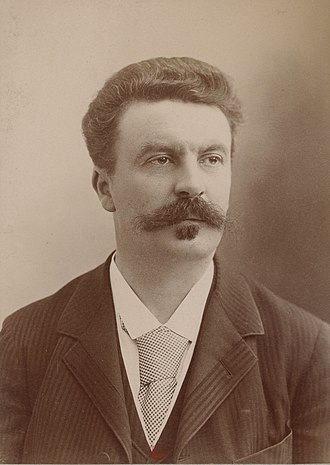
Name: Henry-Rene-Albert-Guy De Maupassant
Nickname/Alias: Guy De Maupassant
Achievements: Famous French short story writer
Born: August 5, 1850; Dieppe, France
Died: July 6, 1893; Paris, France (Aged 43)
Field & Discipline: Literature; Writer
Father:: Gustave De Maupassant
Mother: Laure le Poittevin
Siblings: Brother: Herve
Spouse: None
Children: None
Education: Seminary, Yvetot Lycee; Le Havre Law School, Paris
Major Work:
"La Boule de suif"
Life & Times:
In 1871, De Maupassant’s mother wrote to the writer [mentor was] Flaubert*, asking him to keep an eye on her boy. Whenever Flaubert visited Paris, he would get in touch with De Maupassant, inviting him to lunch on Sundays and discussing literature and writing with him. De Maupassant showed some of his early poetry to Flaubert, who was
impressed, but suggested he turn to prose, since there was a growing market for short stories.
Through Flaubert, De Maupassant met prominent members of Parisian literary circles such as novelists [ a pal of] Zola* , and French philosopher [ a pal of] Taine*. He also met writers from abroad, such as Russian novelist [ a pal of] Turgenev* and American writer [ a pal of] Henry James*.
Though he found his job with the Ministry boring, De Maupassant was good at it, and rose up the civil service ladder. With the help of his father, he moved to the Ministry of Public Instruction in 1879. In 1880, he had his first literary success. His short story, "Boule de suif” (Ball of Fat) was published by a magazine that had asked for stories about the Franco-Prussian war, and published six of them. De Maupassant's was generally considered the best. Flaubert declared it a masterpiece.
But the success of "Boule de suif" led to demands from newspapers for more stories. Between 1880 and 1890, De Maupassant wrote about 300 short stories, as well as novels, travel books and a volume of verse. In 1881, "La Maison Tellier" ("The Tellier House"), a book of short stories, was an instant success. In 1883, another book of stories, "Mademoiselle Fifi" and his first novel: "Une Vie” (A Woman"s Life"), on which he had been working for some years, were well received.
De Maupassant was now able to improve his lifestyle considerably. He wrote in the mornings and for the rest of the day engaged in sporting activities and socializing. He bought a yacht, which he kept in the South of France. He had a country house built near Etretat in Normandy, which he named La Guillette. In 1884, he moved into a large Paris apartment which he furnished in an exotic and extravagant manner. He rented a flat in Cannes for occasional visits.
In this period, he published four books of short stories in two years. His stories covered a variety of subjects: the Franco-Prussian war, the bureaucracy, the Norman peasantry, life on the Seine and its banks, love affairs and other aspects of life among the different social classes. In 1885, his second novel, "Bel-Ami" (Good Friend), held up a mirror to the materialistic, pleasure-seeking ociety in France, and reflected on the futility of human effort and the inevitability of death.
After he finished "Bel Ami", De Maupassant went to Italy. The place that struck him most favorably was Sicily. He loved the dramatic landscape, the archeological remains and the fiery nature of the Sicilians. Despite his poor health, he found he could climb mountains without trouble and climbed Etna. He also visited the Lipari islands and Stromboli.
In 1886, the [a guest of] Rothschild family* invited him to stay at their country home in Buckinghamshire, England. He wrote that he found English women inferior to French women. In London, he again came across Henry James and met American author [met] Harte*. But the cold British weather began to bother De Maupassant and he returned to Cannes.
In 1886, he wrote "Le Horla", about a man who suffers from hallucinations and finally burns down his house to exterminate what he thinks is his double. For this story, de
Maupassant used some of the ideas and theories of French neurologist [used material by] Charcot*, who was treating psychological disorders. In 1888, de Maupassant's third big novel was published. "Pierre et Jean" dealt with a man's uncontrollable jealousy of his half-brother and his disillusion with his mother. The novel did not sell well.
After 1889, De Maupassant was rarely out of pain, even though he was only in his late 30’s. When he attended the unveiling of a memorial to Flaubert in 1890 in Paris, old friends were shocked by his sickly appearance.
By 1892, he was taking increased doses of morphine and brandy and was nearly blind. When he found that his valet had removed the bullets from his gun, he tried to kill himself with a paper knife. Before his death, periods of delirium alternated with lucid intervals.
Extra Connections: He was an exponent of [was an exponent of] *naturalism*
He delighted in clever plotting, and served as a model for Somerset Maugham and O. Henry in this respect.
Leo Tolstoy used Maupassant as the subject for one of his essays on art: The Works of Guy de Maupassant. His stories are second only to Shakespeare in their inspiration of movie adaptations with films ranging from Stagecoach, Oyuki the Virgin and Masculine Feminine.
Maupassant was one of a fair number of 19th-century Parisians (including Charles Gounod, Alexandre Dumas, *fils*, and Charles Garnier) who did not care for the Eiffel Tower[15] (erected in 1887-1889). He often ate lunch in the restaurant at its base, not out of preference for the food but because only there could he avoid seeing its otherwise unavoidable profile.[16] He and forty-six other Parisian literary and artistic notables attached their names to an elaborately irate letter of protest against the tower's construction, written to the Minister of Public Works, and published on 14 February 1887.
Assessment: His acute observation of contemporary life gave insights into the France of the late 1800’s, and the realism of his books made them popular in many other countries.
Oneliner: De Maupassant, archetype French short-story writer
Bibliography:
- Lerner, Michael G, Maupassant, George Allen & Unwin Ltd., London, 1975.