Conch Shell
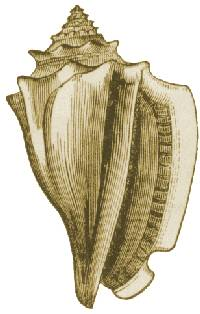
Conch (/kɒŋk, kɒntʃ/)[1] is a common name of a number of different medium-to-large-sized sea snails. Conch shells typically have a high spire and a noticeable siphonal canal (in other words, the shell comes to a noticeable point on both ends).
In North America, a conch is often identified as a queen conch, indigenous to the waters of the Gulf of Mexico and Caribbean. Queen conches are valued for seafood and are also used as fish bait.[2] In the United States, a rule has been proposed to list the queen conch's conservation status as threatened.
The group of conches that are sometimes referred to as "true conches" are marine gastropod molluscs in the family Strombidae, specifically in the genus Strombus and other closely related genera. For example, Lobatus gigas, the queen conch, and Laevistrombus canarium, the dog conch, are true conches.
Many other species are also often called "conch", but are not at all closely related to the family Strombidae, including Melongena species (family Melongenidae) and the horse conch Triplofusus papillosus (family Fasciolariidae). Species commonly referred to as conches also include the sacred chank or shankha shell (Turbinella pyrum) and other Turbinella species in the family Turbinellidae. The Triton's trumpet (family Charoniidae) may also be fashioned into a horn and referred to as a conch.[citation ^needed]
Etymology
The English word "conch" is attested in Middle English,[3] coming from Latin concha (shellfish, mussel),[3][4] which in turn comes from Greek konchē (same meaning)[3][4] ultimately from Proto-Indo-European root *konkho-,[3] cognate with Sanskrit word śaṅkha.[3]
General description
A conch is a sea snail in the phylum Mollusca. A conch shell has superior strength[clarification ^needed] and is used as a musical instrument or decoration. It consists of about 95% calcium carbonate and 5% organic matter. The conch meat is edible.[5][6]
Culinary use
 A group of large eastern conches or whelks of the species Busycotypus canaliculatus for sale at a California seafood market
The meat of conches is eaten raw in salads or cooked in burgers, chowders, fritters, and gumbos. All parts of the conch meat are edible.[6]
 Bahamian conch salad
Conch is indigenous to the Bahamas and is typically served in fritter, salad, and soup forms. It is also eaten in the West Indies (in The Bahamas, Turks and Caicos, and Jamaica in particular[7]); locals in Jamaica eat conch in stews, curries and other dishes. Restaurants all over the islands serve this particular seafood. In the Dominican Republic, Grenada, and Haiti, conch is commonly eaten in curries or in a spicy soup. It is locally referred to as lambi. In Puerto Rico, conch is served as a ceviche, often called ensalada de carrucho (conch salad), consisting of raw conch marinated in lime juice, olive oil, vinegar, garlic, green peppers, and onions. It is also used to fill empanadas.
In Panama, conch is known as cambombia and is often served as ceviche de cambombia, consisting of raw conch marinated in lime juice, chopped onions, finely chopped habaneros, and often vinegar.
Conch is very popular in Italy and among Italian Americans. Called sconcigli, it is eaten in a variety of ways, but most often in salads or cooked in a sauce for pasta. It is often included as one of the dishes prepared for the Feast of the Seven Fishes.
In East Asian cuisines, conch is often cut into thin slices and then steamed or stir-fried.
Eighty per cent of the queen conch meat in international trade is imported into the United States. The Florida Keys were a major source of queen conches until the 1970s, but the conches are now scarce and all harvesting of them in Florida waters is prohibited[8] and individuals who have harvested them have been punished by law enforcement.[9]
Festival
In the Turks and Caicos Islands, the Conch Festival is held in November each year at the Three Queens Bar/Restaurant in Blue Hills. Local restaurateurs compete for the best and most original conch dishes, which are then judged by international chefs. Other competitions, events, and music performances occur.[10]
Musical instruments
Main article: Conch (instrument)
Conch shells can be used as wind instruments. They are prepared by cutting a hole in the spire of the shell near the apex and then blowing into the shell as if it were a trumpet, as a blowing horn. Sometimes a mouthpiece is used, but some shell trumpets are blown without one. Pitch is adjusted by moving one's hand in and out of the aperture; the deeper the hand, the lower the note.
Various species of large marine gastropod shells can be turned into blowing shells, but some of the best-known species used are the sacred chank or shankha Turbinella pyrum, the Triton's trumpet Charonia tritonis, and the queen conch Strombus gigas.
One of the most famous musical instruments was found in the Marsoulas cave in the Pyrenees Mountains, in France in 1932. CT scans showed how ancient humans adapted the Concho to make it a musical instrument, such as creating a mouthpiece that was held together by an organic matter like clay or wax. Researchers from the University of Sorbonne, together with a professional horn player, were able to use it again as a musical instrument and play it.
Examples of this practice in the Americas can be seen in the form of historical artifacts at the Museo Larco in Lima, Peru, and Museo Nacional de Antropología in Mexico City, Mexico.
Pearls
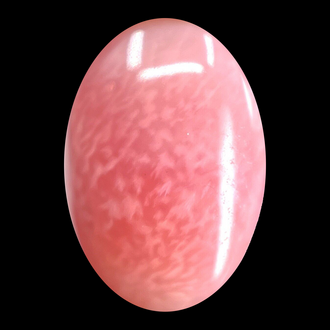
A conch pearl displaying flame patterning.
Many kinds of molluscs can produce pearls. Pearls from the queen conch, S. gigas, are rare and have been collectors' items since Victorian times.[11] Conch pearls occur in a range of hues, including white, brown, and orange, with many intermediate shades, but pink is the color most associated with the conch pearl, such that these pearls are sometimes referred to simply as "pink pearls".[11] In some gemological texts, non-nacreous gastropod pearls used to be referred to as "calcareous concretions" because they were porcellaneous (shiny and ceramic-like in appearance), rather than nacreous (with a pearly luster). The Gemological Institute of America and World Jewellery Confederation now use the simple term "pearl"—or, where appropriate, the more-descriptive term "non-nacreous pearl"—for such items,[12] and, under Federal Trade Commission rules, various mollusk pearls may be referred to as "pearls" without qualification.[13]
Although not nacreous, the surfaces of fine conch pearls have a unique and attractive appearance of their own. The microstructure of conch pearls comprises partly aligned bundles of microcrystalline fibers that create a shimmering, slightly iridescent effect known as flame structure. The effect is a form of chatoyancy, caused by the interaction of light rays with the microcrystals in the pearl's surface, and it somewhat resembles moiré silk.
Other uses
 A drawing of the shell of Strombus alatus, the Florida fighting conch
- Conch shells are sometimes used as decoration, as decorative planters, and in cameo making.[14][15]
- In the Aztec culture, the conch played an important role in rituals, war, art, music, mythology, festivals, and even the calendar.[16]
- In India, some artisans make souvenirs, deity idols and other crafts by carving natural conch shells by hands.[17]
- Conch shells have been used as shell money in several cultures.[18]
- Some American Aboriginals used cylindrical conch columella beads as part of breastplates and other personal adornment.[19]
- In India, the Bengali bride-to-be is adorned with conch shell and coral bangles called shakha paula. It is a traditional wedding ritual for every Bengali bride.[20]
- In India and Bangladesh, the conch is blown every day in the evening in Bengali houses as a daily ritual.
- In some Afro-Caribbean and African-American cemeteries, conch shells are placed on graves.[21]
- In some Caribbean countries such as Jamaica and the Bahamas, cleaned queen conch shells, or polished fragments, are sold, mainly to tourists, as souvenirs or in jewellery. Responding to a 2003 recommendation from CITES, some countries in the Caribbean have banned the export of queen conch shells. CITES has also asked all countries to ban import of these shells from countries that are not complying with CITES recommendations for managing the fishery. Queen conch fisheries have been closed in several countries.[22] Conch shells or fragments taken home by tourists from noncomplying countries may be confiscated on return to the tourist's home country while clearing customs. In the UK, conch shells are the 9th-most seized import.[23]
- Conch shells have been used as a building material since ancient times, and new research is being conducted, to replicate their material for practical uses such as bone replacement, and also in architecture, to construct stronger structures.[24]
- In Grenada, fishermen use the conch shell as a trumpet to announce to the community that fish is available for sale. Conchs are used at carnival times in the Jouvert Jump where Diab Diab (Jab Jab) blow conch shells as part of the festivities. Especially in Guadeloupe, hearing conch shells being blown near ports at dawn and during Carnival times, too, is not uncommon. Many bands and trumpeters like Steve Turre are using the conch shell as an important instrument in their unique performances.[25]
- In the Caribbean, broken or up-turned conch shells are embedded into the tops of outdoor walls in an effort to maintain home security.[26]
- In Tamil Nadu, India, the conch horn is blown during funerals as an acoustic indication of the funeral and to ward off evil spirits.[citation ^needed]
- In Key West, Florida, US, a native-born resident is affectionately called a "conch".[citation ^needed]
- In Japan, a conch is horagai (or jinkai). It was used as a trumpet in special ceremonies such as a royal cremation during the Edo period.[27]
- Conch shells, (pu in Hawaiian) have been historically used as a method of communication, a tradition that is still observed in parts of modern life in Hawai'i.[28][29]
Religion
Ancient Peru
The Moche people of ancient Peru worshipped the sea and often depicted conch shells in their art.[30]
Aztec
Quetzalcoatl, the Mexican god of wind and learning, wears around his neck the "wind breastplate" ehecailacocozcatl, "the spirally voluted wind jewel" made of a conch shell. Blowing a conch was considered a religious act.[31]
Hinduism
Main article: Shankha
 A Hindu priest blowing a shankha (a shell of Turbinella pyrum) during a puja

Ancient india, carved conch with Lakshmi-Narayana, 11th-12th century
A shankha shell (the shell of a T. pyrum, a species in the gastropod family Turbinellidae) is often referred to in the West as a conch shell or a chank shell. This shell is used as an important ritual object in Hinduism. The shell is used as a ceremonial trumpet, as part of religious practices, for example puja. The chank trumpet is sounded during worship at specific points, accompanied by ceremonial bells and singing. As it is an auspicious instrument, it is of purity and brilliance (Om, Devas, Brahman the Almighty Supreme creator, referred to in mantras, the Gayatri mantra explains a meditation on the brilliance of the sun), it is often played in a Lakshmi puja in temple or at home.
In the story of Dhruva, the divine conch plays a special part. The warriors of ancient India blew conch shells to announce battle, as is described in the beginning of the war of Kurukshetra, in the Hindu epic the Mahabharata.
The god of preservation, Vishnu, is said to hold a special conch, Panchajanya, that represents life, as it has come out of life-giving waters. According to Hindu mythology, Devas (gods) and Asuras (demons) once decided to churn the ocean to get a special divine nectar. This divine nectar, also known as amrit, was known to give immortality to whoever drank it. All the gods were on one side of it and the demons were on the other end. The churning (samudra manthan) produced a number of things from the ocean. One of the first things to come out of it was lethal poison called halahala. Everyone was terrified, as the poison was potent enough to destroy entire creation, so they went to Lord Shiva for protection and he consumed the poison to safeguard the universe. Lord Shiva took the poison in his mouth, but did not swallow it. Shankha also was one of divine objects that was obtained from samudra manthan.[citation ^needed]
Also, the sound of the conch is believed to drive away the evil spirits.[citation ^needed]
The blowing of the conch or "the shankha" needs a tremendous power and respiratory capacity. Hence, blowing it daily helps keep the lungs healthy.[citation ^needed]
A newlywed Bengali bride wears bangles called shakha paula, made from coral and conch-shell powder. They have been a part of Bengali custom and tradition. In an ancient era, the Bengali farming community is thought to have resided near the river. They collected conch shells and powdered them to create bangles. They also used red coral for the bangles. They gave these beautiful bangles to their wives, as they could not afford ivory bangles. They were also known as poor-man's ivory, as they were cheap substitute for ivory bangles.[20]
Literature and the oral tradition
- In the Hindu tradition, the conch shell is used in ceremony as the sound it makes is said to correspond with higher frequency universal sounds associated with music of the spheres.[32]
See also
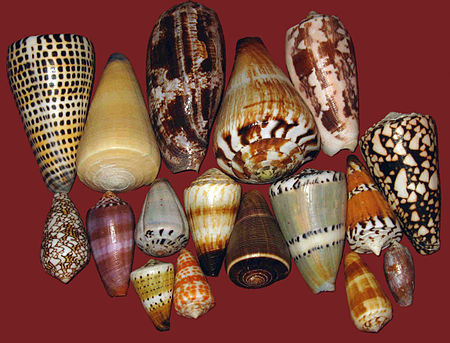
Cone snails, or cones, are highly venomous sea snails of the family Conidae.[1]
Fossils of cone snails have been found from the Eocene to the Holocene epochs.[2] Cone snail species have shells that are roughly conical in shape. Many species have colorful patterning on the shell surface.[3] Cone snails are almost exclusively tropical in distribution.
All cone snails are venomous and capable of stinging. Cone snails use a modified radula tooth and a venom gland to attack and paralyze their prey before engulfing it. The tooth, which is likened to a dart or a harpoon, is barbed and can be extended some distance out from the head of the snail at the end of the proboscis.
Cone snail venoms are mainly peptide-based, and contain many different toxins that vary in their effects. The sting of several larger species of cone snails can be serious, and even fatal to humans. Cone snail venom also shows promise for medical use.[4][5]
Distribution and habitat
There are over 900 different species of cone snails.[6] Cone snails are typically found in warm tropical seas and oceans worldwide. Cone snails reach their greatest diversity in the Western Indo-Pacific region. While the majority of cone snails are found in warm tropical waters, some species have adapted to temperate/semi-tropical environments and are endemic to areas such as the Cape coast of South Africa,[7][8] the Mediterranean,[9] or the cool subtropical waters of southern California (Californiconus californicus).[10]
Cone snails are found in all tropical and subtropical seas. They live on a variety of substrates, from the intertidal zone and deeper areas, to sand, rocks or coral reefs.
Shell
Cone snails have a large variety of shell colors and patterns, with local varieties and color forms of the same species often occurring. This variety in color and pattern has led to the creation of a large number of known synonyms and probable synonyms, making it difficult to give an exact taxonomic assignment for many snails in this genus. As of 2009, more than 3,200 different species names have been assigned, with an average of 16 new species names introduced each year.[11]
The shells of cone snails vary in size and are conical in shape. The shell is whorled in the form of an inverted cone, with the anterior end being narrower. The protruding parts of the top of the whorls, that form the spire, are in the shape of another more flattened cone. The aperture is elongated and narrow with the sharp operculum being very small. The outer lip is simple, thin, and sharp, without a callus, and has a notched tip at the upper part. The columella is straight.
The larger species of cone snails can grow up to 23 cm (9.1 in) in length. The shells of cone snails are often brightly colored with a variety of patterns. Some species color patterns may be partially or completely hidden under an opaque layer of periostracum. In other species, the topmost shell layer is a thin periostracum, a transparent yellowish or brownish membrane.
Physiology and behavior
Cone snails are carnivorous. Their prey consists of marine worms, small fish, molluscs, and other cone snails. Cone snails are slow-moving, and use a venomous harpoon to disable faster-moving prey.
The osphradium in cone snails is more specialized than in other groups of gastropods. It is through this sensory modality that cone snails are able to sense their prey. The cone snails immobilize their prey using a modified, dartlike, barbed radular tooth, made of chitin, along with a venom gland containing neurotoxins.
Molecular phylogeny research has shown that preying on fish has evolved at least twice independently in cone snails.
Harpoon
 An individual (Conus pennaceus) attacking one of a cluster of three snails of the species Cymatium nicobaricum, in Hawaii
Cone snails use a harpoon-like structure called a radula tooth for predation. Radula teeth are modified teeth, primarily made of chitin and formed inside the mouth of the snail, in a structure known as the toxoglossan radula. Each specialized cone snail tooth is stored in the radula sac, except for the tooth that is in current use.[12]
The radula tooth is hollow and barbed, and is attached to the tip of the radula in the radular sac, inside the snail's throat. When the snail detects a prey animal nearby, it extends a long flexible tube called a proboscis towards the prey. The radula tooth is loaded with venom from the venom bulb and, still attached to the radula, is fired from the proboscis into the prey by a powerful muscular contraction. The venom can paralyze smaller fish almost instantly. The snail then retracts the radula, drawing the subdued prey into the mouth. After the prey has been digested, the cone snail will regurgitate any indigestible material, such as spines and scales, along with the harpoon. There is always a radular tooth in the radular sac. A tooth may be also be used in self-defense when the snail feels threatened.[13][14]
The venom of cone snails contains hundreds of different compounds, and its exact composition varies widely from one species to another. The toxins in cone snail venom are referred to as conotoxins, and are composed of various peptides, each targeting a specific nerve channel or receptor. Some cone snail venoms also contain a pain-reducing toxin.
Relevance to humans
Risks
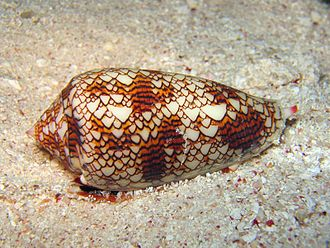
 A live textile cone, (Conus textile) one of several species whose venom can cause serious harm to a human
Cone snails are prized for their brightly colored and patterned shells, ^[15] which may tempt people to pick them up. This is risky, as the snail often fires its harpoon in self defense when disturbed. The harpoons of some of the larger species of cone snail can penetrate gloves or wetsuits.
The sting of many of the smallest cone species may be no worse than a bee or hornet sting,[16] but the sting of a few of the larger tropical fish-eating species, such as Conus geographus, Conus tulipa and Conus striatus, can be fatal. Other dangerous species are Conus pennaceus, Conus textile, Conus aulicus, Conus magus and Conus marmoreus.[17] According to Goldfrank's Toxicologic Emergencies, about 27 human deaths can be confidently attributed to cone snail envenomation, though the actual number is almost certainly much higher; some three dozen people are estimated to have died from geography cone envenomation alone.[18]
Most of the cone snails that hunt worms are not a risk to humans, with the exception of larger species. One of the fish-eating species, the geography cone, Conus geographus, is also known colloquially as the "cigarette snail", a gallows humor exaggeration implying that when stung by this creature, the victim will have only enough time to smoke a cigarette before dying.[19][13]
Symptoms of a more serious cone snail sting include intense, localized pain, swelling, numbness and tingling and vomiting. Symptoms can start immediately or can be delayed for days. Severe cases involve muscle paralysis, changes in vision, and respiratory failure that can lead to death. If stung, one should seek medical attention as soon as possible.[20]
Medical use
The appeal of conotoxins for creating pharmaceutical drugs is the precision and speed with which the chemicals act; many of the compounds target only a particular class of receptor. This means that they can reliably and quickly produce a particular effect on the body's systems without side effects; for example, almost instantly reducing heart rate or turning off the signaling of a single class of nerve, such as pain receptors.
Ziconotide, a pain reliever 1,000 times as powerful as morphine, was initially isolated from the venom of the magician cone snail, Conus magus.[21] It was approved by the U.S. Food and Drug Administration in December 2004 under the name Prialt. Other drugs based on cone snail venom targeting Alzheimer's disease, Parkinson's disease, depression, and epilepsy are in clinical or preclinical trials.[22][23]
Many peptides produced by the cone snails show prospects for being potent pharmaceuticals, such as AVC1, isolated from the Australian species, the Queen Victoria cone, Conus victoriae, and have been highly effective in treating postsurgical and neuropathic pain, even accelerating recovery from nerve injury.
Geography and tulip cone snails are known to secrete a type of insulin that paralyzes nearby fish by causing hypoglycaemic shock. They are the only two non-human animal species known to use insulin as a weapon.[24] Cone snail insulin is capable of binding to human insulin receptors and researchers are studying its use as a potent fast-acting therapeutic insulin.[25]
Shell collecting
The intricate color patterns of cone snails have made them one of the most popular species for shell collectors.[26][27]
Conus gloriamaris, also known as "Glory of the Seas", one of the most famous and sought-after seashells in past centuries, with only a few specimens in private collections. The rarity of this species' shells led to high market prices for the objects, until the habitat of this cone snail was discovered, which decreased prices dramatically.[28]
As jewelry
Naturally occurring, beach-worn cone shell tops can function as beads without any further modification. In Hawaii, these natural beads were traditionally collected from the beach drift to make puka shell jewelry. Since it is difficult to obtain enough naturally occurring cone snail tops, almost all modern puka shell jewelry uses cheaper imitations, cut from thin shells of other species of mollusk, or made of plastic.
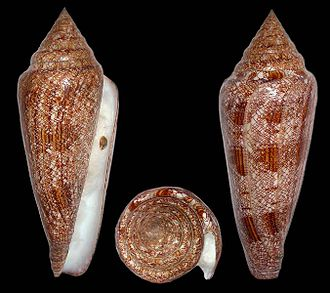
Conus gloriamaris, common name the Glory of the Sea Cone, is a species of sea snail, a marine gastropod mollusk in the family Conidae, the cone snails, cone shells or cones. It is commonly found in the Pacific and Indian Oceans.
Description
The shell can reach 16 centimetres (6.3 in) in length, but typically measures between 8 and 12 centimetres (3.1 and 4.7 in). Compared with other cones, C. gloriamaris is relatively large, slender, with a tall spire. It is finely reticulated with orange-brown lines, enclosing triangular spaces similar to other textile cones, and two or three bands of chestnut hieroglyphic markings across its body. It is sometimes confused with the common Textile cone, and there is a similarity to the Bengal cone. The tan coloration can vary from a lighter, golden color to a deeper dark brown, with intricate detailing.[3]
Collector value
The shell of this mollusc species has special significance to shell collectors because it was once regarded as the rarest shell in the world. For about two centuries between its initial discovery and the discovery of its habitat in 1969, specimens were valued in the thousands of U.S. dollars and generally only owned by museums and wealthy private collectors.
Furthermore, the shell's popularity among collectors spawned urban legends, most notably the story of a collector purchasing one at auction in 1792 only to destroy it, to maintain the value of another one already in his collection. Improvements in diving technology such as the advent of scuba led to their discovery in larger numbers, and today shells can often be found from retailers or online auction sites for less than $100 U.S. Nonetheless, the legacy of this shell in addition to its pleasing shape and patterns makes it popular and desirable among shell collectors today.[4]
Distribution
This is one of the many Indo-Pacific species of cone snail. It is found principally off the Solomon Islands but with a habitat ranging from the Philippines and eastern Indonesia, through New Guinea, and as far east as Samoa and Fiji.[5]
Gallery...

1777 specimen from the Smithsonian Institution.
Bibliography:
Mad About Seashells Richard Conniff August 2009 Smithsonian Magazine
...Anthropologists have identified beads made from shells in North Africa and Israel at least 100,000 years ago as among the earliest known evidence of modern human culture.
Since then various societies have used shells not just as ornaments, but also as blades and scrapers, oil lamps, currency, cooking utensils, boat bailers, musical instruments and buttons, among other things. Marine snails were the source of the precious purple dye, painstakingly collected one drop at a time, that became the symbolic color of royalty. Shells may also have served as models for the volute on the capital of the Ionic column in classical Greece and for Leonardo da Vinci's design for a spiral staircase in a French chateau. In fact, shells inspired an entire French art movement: Rococo, a word blending the French rocaille, referring to the practice of covering walls with shells and rocks, and the Italian barocco, or Baroque. Its architects and designers favored shell-like curves and other intricate motifs.
The craving for shells was even powerful enough to change the fate of a continent: at the start of the 19th century, when rival French and British expeditions set out for the unknown coasts of Australia, the British moved faster. The French were delayed, one of those on board complained, because their captain was more eager "to discover a new mollusk than a new landmass." And when the two expeditions met up in 1802 at what is now Encounter Bay, on the south coast of Australia, a French officer complained to the British captain that "if we had not been kept so long picking up shells and catching butterflies...you would not have discovered the south coast before us." The French went home with their specimens, while the British quickly moved to expand their colony on the island continent.
The mania for shells that took hold of European collectors from the 17th century onward was largely a byproduct of colonial trade and exploration. Along with spices and other merchandise, ships of the Dutch East India Company brought back spectacularly beautiful shells from what is now Indonesia, and they became prized items in the private museums of the rich and royal. "Conchylomania," from the Latin concha, for cockle or mussel, soon rivaled the Dutch madness for collecting tulip bulbs, and often afflicted the same people.
One Amsterdam collector, who died in 1644, had enough tulips to fill a 38-page inventory, according to Tulipmania, a recent history by Anne Goldgar. But he also had 2,389 shells, and considered them so precious that, a few days before his death, he had them put away in a chest with three separate locks. The three executors of his estate each got a single key, so they could show the collection to potential buyers only when all three of them were present. Dutch writer Roemer Visscher mocked both tulip maniacs and "shell-lunatics." Shells on the beach that used to be playthings for children now had the price of jewels, he said. "It is bizarre what a madman spends his money on."
And he was right: at one 18th-century auction in Amsterdam, some shells sold for more than paintings by Jan Steen and Frans Hals, and only slightly less than Vermeer's now-priceless Woman in Blue Reading a Letter. The collection also included a Conus gloriamaris shell, for which the owner had paid about three times what his estate was getting for the Vermeer.
From a financial perspective, valuing shells over Dutch masters may rank among the dumbest purchases ever. There are only 30-some known Vermeer paintings on earth. But the scarcity that could make a shell seem so precious was almost always illusory. For instance, C. gloriamaris, a four-inch-long cone covered in a delicate fretwork of gold and black lines, was for centuries among the most coveted species in the world, known from only a few dozen specimens. One shell-trade story held that a wealthy collector who already owned a specimen managed to buy another at auction and, in the interest of scarcity, promptly crushed it underfoot.
To maintain prices, collectors also spread the rumor that an earthquake had destroyed the species' habitat in the Philippines and rendered it extinct. Then in 1970, divers discovered the mother lode in the Pacific, north of Guadalcanal Island, and the value of C. gloriamaris plummeted. Today you can buy one for roughly the price of dinner for two at a nice restaurant. And paintings by Vermeer? The last time one came on the market, in 2004, it went for $30 million. (And it was a minor and slightly questionable one at that.)
...
The shells that got through to Europe in the early years were mostly sold privately by sailors and civil administrators in the colonial trade. When Capt. James Cook returned from his second round-the-world voyage in 1775, for instance, a gunner's mate aboard the Resolution wrote offering shells to Sir Joseph Banks, who had served as naturalist for Cook's first circumnavigation a few years earlier.
"Begging pardon for my Boldness," the note began, in a tone of forelock-tugging class deference. "I take this opportunity for acquainting your Honour of our arrival. After a long and tedious Voyage...from many strange Isles I have procured your Honour a few curiosities as good as could be expected from a person of my capacity. Together with a small assortment of shells. Such as was esteem'd by pretended Judges of Shells." (The last line was a sly jibe at the lesser naturalists who had taken Banks' place on the second circumnavigation.) Dealers sometimes waited at the docks to vie for new shells from returning ships.
For many collectors of that era, shells were not just rare, but literally a gift from God. Such natural wonders "declare the skilful hand from which they come" and reveal "the excellent artisan of the Universe," wrote one 18th-century French connoisseur. The precious wentletrap, a pale white spiral enclosed by slender vertical ribs, proved to another collector that only God could have created such a "work of art."
...
Shells endured, more like jewels than living things. In the 1840s, a British magazine recommended that shell collecting was "peculiarly suited to ladies" because "there is no cruelty in the pursuit" and the shells are "so brightly clean, so ornamental to a boudoir." Or at least it seemed that way, because dealers and field collectors often went to great lengths to remove any trace of a shell's former inhabitant.
In fact, however, the animals that build shells have turned out to be far more interesting than collectors ever supposed. One day at the Smithsonian's National Museum of Natural History, which owns the world's largest shell collection, research zoologist Jerry Harasewych was cutting open a small land snail shell from the Bahamas. For scientific purposes, the museum preserves shells in as close to their natural state as possible. These specimens had been stored in the collection four years earlier. But Harasewych suddenly noticed something moving inside. It reminded him of an apocryphal story about a museum where the air conditioning quit and snails, resurrected by the humidity, came oozing out of the collection drawers. He put some of the other dried snails in water, he said, and they too started moving. It turned out that these snails live on dunes in sparse vegetation. "When it starts to get hot and dry, they seal themselves up within their shells," he said. "Then when the spring rains come, they revive."
...
One of the few other known specimens belonged to a prominent Soviet oceanographer—"a very staunch Communist," Dan said—who at first refused to sell. Then the value of the ruble deteriorated in the 1990s. To earn hard currency, the Russians were providing submersibles for the exploration of the wreck of the Titanic. The staunch Communist oceanographer found himself in need of hard currency, too. So one of the operators on the Titanic job brought the shell with him on a trip to North America, and Dan made the purchase.
...
...In America, the fashion for collecting and displaying seashells was more usually referred to as "Shell Fever." According to Elizabeth Donaghy Garrett's At Home, the American Family 1750-1870 (a favorite and frequently consulted resource of ours), Shell Fever reached its height of popularity in America during the 1830s and 1840s, when "many a mantel was thus arrayed," as is seen in the following image taken from the book:
South Parlor of Abraham Russell, New Bedford, Massachusetts Waltercolor by Joseph Shoemaker Russell, 1848 Old Dartmouth Historical Society, New Bedford, MA |
More information about the history of Shell Mania can be found in a fascinating and scholarly post titled Conchylomania, written by James Grout, that appears on his fascinating blog, Encyclopædia Romana....Rousseau, who completed the first six books of his Confessions in 1766–1767, uses the word conchyliomanie to describe his cousin's mad preoccupation with shells.
Reggie Darling: Shell Mania at Darlington House
Boing Boing : Did-you-know-conch-snails-have-googly-eyes
The Sound of the Sea: Seashells and the Fate of the Oceans
By Cynthia Barnett
W.W. Norton & Company, 2021.