Herder
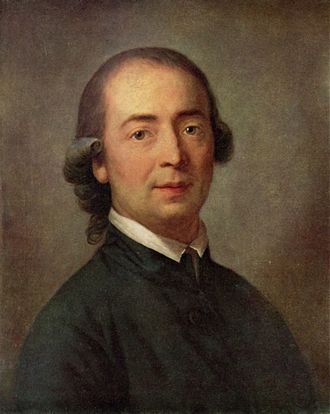
Name: Johann Gottfried von Herder
Achievements: Laid the ground for the Romantic Movement.
Born: August 25, 1744; Mohrungen, East Prussia, now Morag, Poland
Died: December 18, 1803; Weimar, Saxe-Weimar, Germany (Aged 59)
Field & Discipline: Philosophy
Language: German
Father: Gottfried Herder (1706-63)
Mother: Anna Elis (1717-72).
Siblings: Two sisters
Spouse: Caroline Flachsland (married 1773)
Children: 7 sons, 1 daughter
Education: Mohrungen Latin School, to 1760; University of Konigsberg, 1763-64
Major Work:
“Outlines of a Philosophy of the History of Man,” 4 vols. (1784-91)
Life & Times:
Herder entered Koningsberg University Medical School, but after fainting during his first dissection class, got out of medicine. As a student of theology, philosophy and literature, he was taught and influenced by [taught by] Kant* and Johann Georg Hamann (one of the Enlightenment's most prominent critics).
Hamann inspired Herder to learn English and read the classics and his later development owed a great deal to [influenced by] Shakespeare*, [influenced by] Milton*, [influenced by] Plato*, [influenced by] Leibniz*, [influenced by] Hume*, [influenced by] Diderot*, [influenced by] Rousseau*, [influenced by] Spinoza* and [influenced by] Blaise Pascal*.
In 1764, Hamann arranged a job for Herder as assistant master at the Cathedral School in Riga, the capital of Latvia and an important seaport and trading centre. While he was working there, he published his first notable works, “Fragments On Recent German Literature,” in 1767-68 and “Critical Forests, or Reflections on the Science and Art of the Beautiful,” in 1769.
In May of that year, he left on a visit to France, where he spent several months in Nantes, where he read French literature and kept a journal of his journey. In the journal, posthumously published as “ My travels in 1769,” he began to plan his future work on the psychology of esthetics.
In November 1769 in Paris, he met the writer Denis Diderot, and shortly afterwards was offered the job of tutor and travelling companion to the young Prince of Holstein-Eutin.
The two left on a cultural “Grand Tour” in June 1770, and at their first stop in Hamburg, met the German writer Gotthold Lessing. From Hamburg, they went on to Darmstadt, where Herder met Caroline Flachsland, who was to become his wife.
Once there, he left the Prince and went for an eye operation in Strasbourg where, in September 1770, Herder met a young law student named [a pal of] Goethe* at the Ghost Inn. This meeting and the many others that followed over the succeeding months had a profound effect on Goethe and his work.
During that autumn and winter, Herder and Goethe talked about a whole range of subjects, including Herder’s ideas on folk songs, Shakespeare, Homer, Pindar, Hebrew poetry, the poems of Ossian by [influenced by] MacPherson*, the history of mankind, and the origin of language. All of this influenced Goethe's future development as a poet.
At the same time, Herder was working on “Treatise on the Origin of Language,” which was awarded a Prussian Academy of Sciences prize in 1771 as the first study on the psychology of speech. The main thrust of Herder's ideas was a belief in the fundamental value of folk poetry, in the need to re-evaluate historical periods such as the Middle Ages, and in the equal value of all cultures.
In April 1771, he began work as Court Preacher and church official in Buckeburg, in the principality of Schaumburg-Lippe, where for the next five years he was intellectually isolated, apart from his friendship with the court’s Director of Music JCF Bach.
As well as preaching and officiating, Herder was writing works which impacted on the development of the “Sturm und Drang” (“Storm and Stress”) literary movement, which would lead to the first German Romanticism.
For Herder, knowledge could only be acquired through the understanding of language and, in 1772, he expressed his belief that the origin of language was in human nature in “Essay on the Origin of Language.”
In 1773, in his collection of essays “Of Germans and Art,” Herder maintained that folk music was the ultimate source of all literature, as well as arguing that the ancient Hebrew poets (together with Ossian and Shakespeare) were the equals even of Homer.
In 1774 came a number of historical and theological works, including “Oldest Records of the Human Race,” describing Hebrew antiquities, and “An alternative Philosophy of History regarding the Formation of Mankind.”
In 1776, thanks to Goethe, Herder was made an offer by Duke Karl August of Sachsen-Weimar to go to Weimar as Court Pastor. He would remain there for the rest of his life. This was probably the last act of friendship between Goethe and Herder, before they fell out over Goethe's friendship with [disliked] Schiller*, whom Herder greatly disliked.
Herder continued to develop the essay form, notably in “On the cognition and sensation of the human soul,” in 1778. He also published earlier projects, in particular an important and popular collection of folk songs generally known as “Voice of the People in Song.”
In Weimar, Herder produced his “Plastic Arts” and “On the Spirit of Hebrew Poetry,” both published in 1778. Between 1784 and 1791 came his four-part masterpiece: “Ideas on the Philosophy of the History of Humankind,” which was to develop and clarify many of his earlier philosophical thoughts. In it, Herder argued that history, like nature, obeyed general laws that proved the existence of a benevolent divine spirit.
His central argument was that tradition and natural forms of association were the basis for human society, so cultural history must be regarded as if it were organic life, following the sequence of growth, maturity, decay, and transformation.
“Ideas” signalled a historic intellectual transition in European thought, stressing a new need for the study of for ethnicity and national character, so as to identify the relationship between environment and cultural evolution.
Herder grew increasingly disillusioned with society but, apart from attacking the philosophy of Kant and [attacked] Fichte*, he stayed away from public argument. He also with Schiller and Goethe and other writers such as [met] de Stael*, who visited Weimar in 1803.
He was ennobled, adding the prefix “von” to his name, in 1802, and died the following year.
Extra Connections:
He was friends with [a pal of] Schlegel*, [a pal of] Hegel*, [a pal of] Wilhelm von Humboldt*, and the brothers [a pal of] Grimm*.
His work influenced [influenced] Ritter*,[influenced] Pestalozzi*, [influenced] Schelling*, [influenced] Coleridge* and [influenced] Belinsky*.
His work helped start the [helped start] Gothic Revival*.
[influenced by] Winckelmann* and [influenced by] Georg Forster* were major influences on Herder’s thought.
He was published by [published by] Cotta*.
He argued that Jews in Germany should enjoy the full rights and obligations of Germans, and that the non-Jews of the world owed a debt to Jews for centuries of abuse, and that this debt could be discharged only by actively assisting those Jews who wished to do so to regain political sovereignty in their ancient homeland of Israel (Zionism).
Herder had emphasised that his conception of the nation encouraged democracy and the free self-expression of a people's identity. He proclaimed support for the French Revolution, a position which did not endear him to royalty.
Assessment: Herder almost single-handedly started the Romantic Movement.
Oneliner: JG Herder, founder of Romantic Movement
Bibliography:
- Koepke, Wulf, Johann Gottfriend Herder, New York: Twayne's World, Inc., 1987.