Ehrlich, Paul
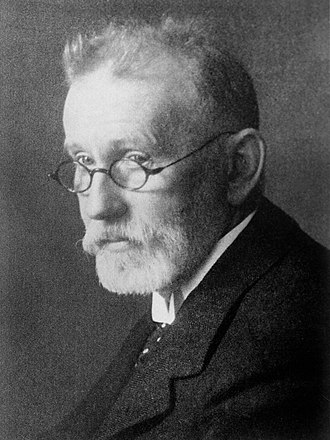
Name: Paul Ehrlich
Achievements: Chemotherapy, immunotherapy
Born: March 14, 1854; Strehlen, Silesia, Prussia (now Strzelin, Poland)
Died: August 20, 1915; Bad Homburg vor der Hohe, Germany (Aged 71)
Field & Discipline: Medicine
Father: Father: Ismar Ehrlich
Mother: Rosa Weigert
Siblings: 3 sisters
Spouse: Hedwig Pinkus
Children: 2 daughters: Stephanie; Marianne
Education: Local primary school; St Maria Magdalena Humanistic high school, Breslau; Breslau University; Strasbourg University; University of Leipzig
Major Work:
"The Collected Papers of Paul Ehrlich" (pub 1956-60)
Life & Times:
Ehrlich’s mother’s cousin, [mother’s cousin was] Weigert*, a famous pathologist, became a close friend of Ehrlich. Ehrlich began his investigations in experimental chemistry and bateriology as a university student in spite of having no formal training in either discipline.
In Italy the scientist [influenced by] Golgi* had discovered that immersing live tissue in a silver nitrate solution produced a dramatically sharper image of tissue cells, and Weigert had introduced the use of aniline dyes into microscopic cell work. While still a student Ehrlich worked in his cousin's laboratory and employed these new techniques. He discovered the chemical link between cell nutrition and the therapeutic and toxic processes.
After graduating he was offered a research job at the Charite Hospital in Berlin. He invented a new staining technique for revealing the tuberculosis bacillus discovered by the German bacteriologist [worked with] Koch*. This was a crucial advance in the microscopic diagnosis of tuberculosis.
Ehrlich continued to experiment with new ways of dyeing live tissue and while he was doing this he discovered the use of methylene blue (developed by [used dye by] Caro* in 1876) for microscopic investigations of nervous tissue and later found that the dye relieved neuralgic pain. Ehrlich's dye solution was later modified by [innovation improved by] Gram*.
The work Ehrlich did at this time included testing drugs used on fever patients, research on the treatment of eye diseases, and the discovery of a specific chemical reaction in the urine of typhoid patients.
He published almost forty papers between 1879 and 1883, regarding "The Requirement of the Organism for Oxygen" as the most important. In this paper he proved that oxygen consumption varies according to the type of tissue, and that the intensity of vital cell processes can be measured by recording the oxygen consumption of the tissue.
After contracting tuberculosis, Ehrlich went to Egypt for a year in an attempt to cure himself. He was successful and in 1889 he returned to Berlin. He worked for a time in a small private laboratory with poor facilities before taking a job at Koch's Institute for Infectious Diseases.
There was then very little information about the ways in which bacteria transmit disease to the body, and how the body defends itself. Ehrlich developed his side-chain theory as a working hypothesis. This stated that each cell has a nucleus of protein and a number of receptors - or side chains - which absorb both nutrients and some toxic substances. If part of a toxic molecule combines with the side chain of a cell, it is then able to act on the cell. The side chains of that cell then proliferate and each side chain is "gauged" to the disease-producing toxic agent. These extra side chains are the immune bodies: they prevent a repeat infection of the cell and immunize it.
Ehrlich demonstrated that rabbits which were give small amounts of toxic matter in a slow controlled manner could survive up to 5,000 times the fatal dose. He eventually established the immune process.
In 1890 he met Emil von Behring who was produced an antitoxin for diptheria but had failed to produce a serum for giving the antitoxin to patients. Ehrlich suggested the use of live horse-blood, which resulted in a serum of maximum efficiency. (The horse was injected with the toxin and developed immune cells). Ehrlich then developed a measuring process for serum efficiency which enabled the diptheria serum to be standardized worldwide.
Ehrlich was made director of a Berlin institute which in 1899 was reorganized as the Royal Insitute for Experimental Therapy and based in Frankfurt am Main. Ehrlich had discovered that many diseases, in particular those caused not be bacteria but by protozoa, did not respond to serum therapy. He began to look for alternative substances which could kill or inhibit parasites without damaging the infected organism.
He began his experiments with a species of protozoa called trypanosomes and tried unsuccessfully to inhibit them using coal tar dyes. He then tried using compounds of arsenic and benzene and other mixtures which were all found to be too toxic for therapeutic use. This attempt to control the disease organism with substances not necessarily found in nature was the beginning of [developed] chemotherapy*.
Ehrlich persevered and this time focussed on the spirochete "Treponema pallidum" which causes syphilis. He led the team of researchers working on this and his colleague Sahachiro Hata produced a preparation called 606, later named Salvarsan, which was highly effective in spite of its large arsenic content.
Among the first to test the drug was the British bacteriologist [his new drug tested by] Alexander Fleming*, who treated syphilis with a sample of Salvarsan in 1909. In 1910 Salvarsan was found to be effective for a range of other diseases. Yaws, a tropical disease which is similar syphilis, could be cured with a single injection of 606. Ehrlich referred to 606 in these instances as a "magic bullet".
In spite of great pressure, owing to the prevalence of syphilis and its devastating effects on victims, Ehrlich refused to sanction the release of the preparation for general use because of its high arsenic content and the need for care in injecting. He was overruled by the manufacturer Hoecht, who released a number of units to physicians worldwide.
Extra Connections: His early chemical dyes originated as [used dyes from] coal tar* derivatives.
He visited [visited] Almroth Wright’s* lab in London.
He met [met] Born 2*
His dye stain was used by [stain used by] Ramon y Cajal**
In Nazi Germany, Ehrlich's achievements were ignored while Emil Adolf von Behring was stylized as the ideal Aryan scientist, and the street named after Ehrlich was given another name.
Ehrlich had also received from the German Emperor Wilhelm II a personal request to devote all his energy to cancer research.
Assessment: Ehrlich was responsible for ground-breaking advances in immunology and chemotherapy.
Oneliner: Paul Ehrlich, discoverer of chemotherapy
Bibliography:
- Dictionary of Scientific Biography.
- Encyclopedia Britannica.