Koch, Heinrich
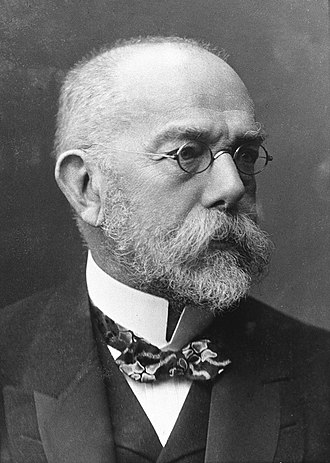
Name: Heinrich Hermann Robert Koch
Achievements: Identified tuberculosis and cholera bacilli
Born: December 11, 1843; Clausthal, Germany
Died: May 27, 1910; Baden-Baden, Germany (Aged 67)
Field & Discipline: Science; Medicine; Bacteriology
Language: German
Father: Father: Hermann Koch
Mother: Mathilde Biewend
Siblings: 10 brothers; 2 sisters
Spouse: 1. Emmy Fraatz; 2. Hedwig Freiburg
Children: 1 daughter: Gertrud
Education: Local primary school; Clausthal High school; Gottingen University
Major Work:
"Collected Works" (1912)
"The Aetiology of Tuberculosis" (1882)
Life & Times:
Koch was taught by the anatomist¸[taught by] Henle* while studying medicine at Gottingen University and he later said it was Henle who
inspired him to do scientific research. Henle, an anatomist, had earlier (1840) suggested that contagious diseases were caused by living organisms.
After graduating in 1866, Koch attended [taught by] Virchow's* pathology course in Berlin. He then took a succession of jobs in provincial hospitals, including one at Hamburg during a cholera outbreak.
He established his own medical practice at Rakwitz in 1869 but when war broke out between France and Prussia in 1870 he volunteered as a field surgeon. During his army service he worked in a typhoid hospital and a hospital for the wounded.
In 1872 he became district surgeon at Wollstein (now in Poland). Over the next eight years he had time to follow up his interest in anthropology, a subject which had been popularized in Germany by the writings of [inspired by] Blumenthal*. Excavating ancient Teutonic graves was a hobby pursued by many cultured men and in 1875 Koch found himself excavating alongside Virchow.
Koch also had the time to carry on with research and he set up his own laboratory. Following Henle's views on the causes of infectious diseases, Koch included bacteria in his microscopic studies and in 1873 began research into anthrax a disease prevalent in the Wollstein district.
After verifying the idea (of the French parasitologist Casimir-Joseph-Davaine) that anthrax was caused by micro-organisms found in the blood of infected sheep, Koch invented new techniques for culturing the organisms. This included dry-fixing films of bacterial culture on glass slides and then staining them with aniline dyes (according to information given him by [worked with] Weigert*).
Koch then used microphotography to record the structure of bacteria. He also invented the hanging-drop technique of culturing micro-organisms in a drop of nutrient solution on the back of a glass slide. These methods enabled him to describe the life cycle of the anthrax organism, as well as spore formation and germination. He showed that the dried spores could remain dormant for years and then develop under the right conditions, showing why the disease could remain dormant for years.
Koch's work on anthrax was the first real proof that a specific bacillus caused a specific disease. In 1878 he published the results of his research into artificially induced infected wounds in animals, showing that six different types of infection were each linked to a specific organism, and that the six organisms were both pathologically and were bacteriologically distinctive.
His work was accepted by prominent surgeons such as [influenced] Billroth* in Europe, and the British surgeon [influenced] Lister* who had earlier introduced the concept and use of carbolic antisepsis.
His supporters failed to create a professorship of hygiene for Koch but in 1880 he was appointed government adviser to the Imperial Department of Health in Berlin. He led a team developing reliable procedures for cultivating pathogenic bacteria, isolating them and recording data. To isolate and cultivate the organisms, Koch mixed them with nutrient gelatin which set to a solid medium in which the organisms could grow. He could then cut out pure bacterial cultures for use in experiments.
In 1881, Koch demonstrated his techniques in Lister's laboratory in London, where he also met the French bacteriologist [row with] Pasteur* with whom he later quarrelled over Pasteur's immunisation claims for anthrax.
On his return to Berlin Koch focussed on finding the origin of tuberculosis which was known to be an infectious disease. The tubercle bacillus was difficult to investigate because it was very small and its waxy coat made it resistant to staining. He discovered that using methylene blue on tissue samples stained with Bismarck brown made the bacillus more visible. Finally he succeeded in preparing a culture and isolating the tubercle bacillus in a variety of media. In a lecture to the Physiological Society in Berlin on 24 March 1882, Koch presented his findings.
Paul [assisted by] Ehrlich* developed a better method of staining for him, and the demonstration of the tubercle bacullus in sputum became a crucial diagnostic tool. In 1883 Koch got permission to travel to India. Before leaving India, he named village ponds as sources of local outbreaks of cholera and isolated the cholera baccilus from one pond.
On his return to Germany, his recommended control measures against cholera were adopted by the German empire.
Koch was now had a world-wide reputation and many foreign scientists and medical workers, such as the Dutch physician [taught] Eijkman*, came to study under him. Koch received the Nobel prize for his work on tuberculosis in 1905.
Extra Connections: He was taught by [taught by] Meissner*
He visited the lab of [visited lab of] Almroth Wright*
Assessment: Koch is one of the founders of bacteriology and is remembered for his outstandingly significant discovery of the tubercle and cholera bacilli.
Oneliner: Robert Koch, who discovered the tuberculosis bacillus
Bibliography:
- Dictionary of Scientific Biography.
- Encyclopedia Britannica.